
Global Oyster Mushroom Market size and share Analysis 2026-2033
Global Oyster Mushroom Market Report 2026???2033
Market Size (Base Year) USD 6.25 Billion
Forecast Value USD 10.87 Billion
CAGR 7.1%
Forecast Period 2026 ??? 2033
Coverage Global ??? Asia Pacific, Europe, Middle East & Africa, North America, South America
The Global Oyster Mushroom Market is valued at USD 6.25 billion in 2025 and is projected to reach USD 10.87 billion by 2033, registering a CAGR of 7.1% during 2026???2033. Market expansion is supported by the accelerating shift toward plant-based diets, increasing consumer awareness of functional and nutrient-rich foods, and rising demand for environmentally sustainable protein sources.
Global Oyster Mushroom Market Forecast Snapshot: 2026???2033
| Metric | Value |
|---|---|
| 2025 Market Size | USD 6.25 Billion |
| 2033 Market Size | USD 10.87 Billion |
| CAGR (2026???2033) | 7.1% |
| Largest Region | Asia-Pacific |
| Fastest Growing Region | North America |
| Top Segment | Fresh Oyster Mushrooms |
| Key Trend | Vertical Farming & Climate-Controlled Cultivation |
| Future Focus | Organic Production, Value-Added Formats, AI-Driven Farm Management |
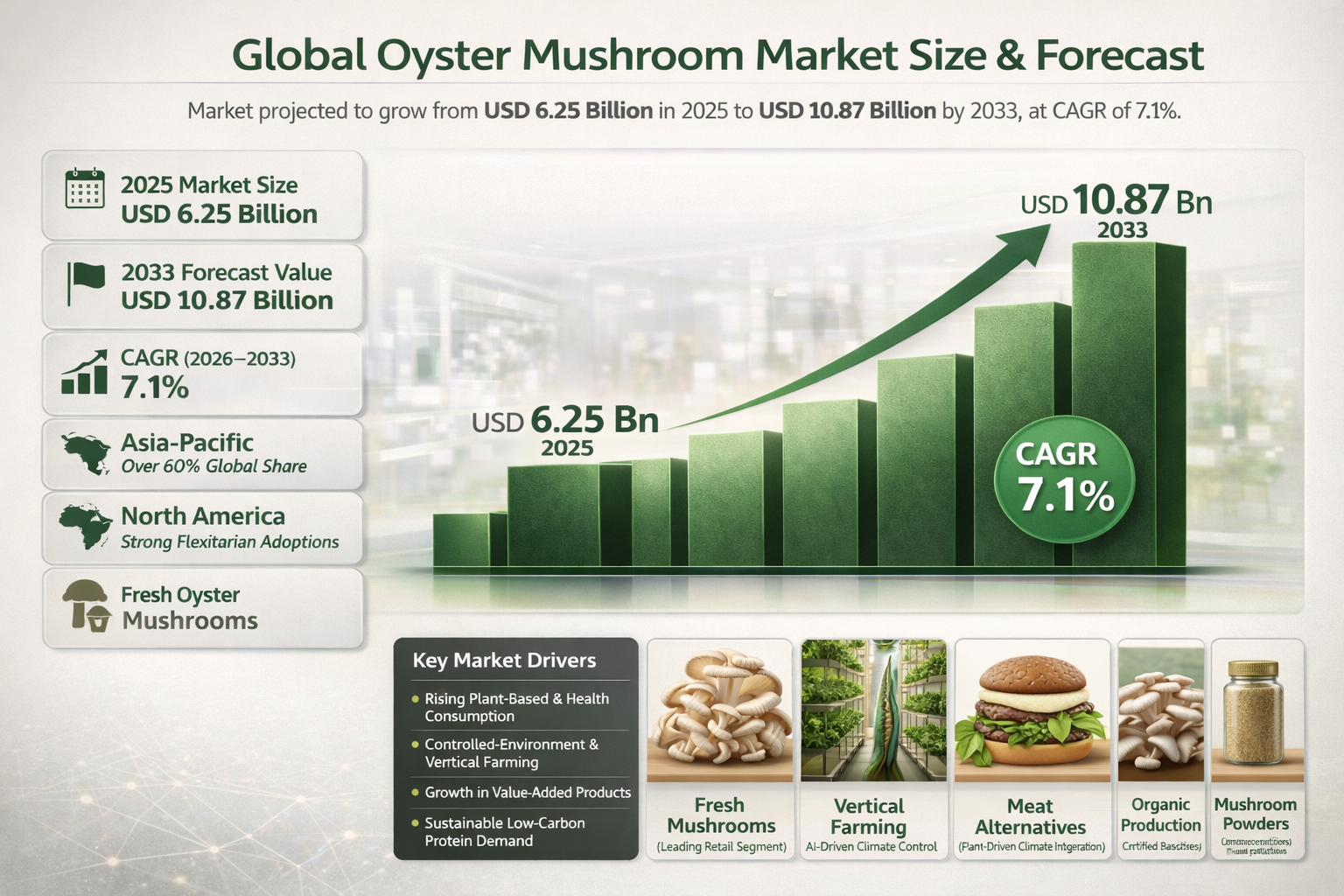
Global Oyster Mushroom Market Overview (2026???2033)
The Global Oyster Mushroom Market is entering a strong growth phase for the 2026???2033 period, supported by accelerating plant-based diet adoption, rising demand for sustainable protein sources, and increasing consumer awareness of functional nutrition. Oyster mushrooms are widely recognized for their high protein content, dietary fiber, B-complex vitamins, vitamin D, and antioxidant properties, positioning them as a key ingredient in health-focused and flexitarian food systems.According to Pheonix Research, the market is projected to expand from USD 6.25 billion in 2025 to USD 10.87 billion by 2033, registering a CAGR of 7.1% during 2026???2033. Growth during this forecast period is driven by expanding modern retail penetration, rising foodservice integration, and increasing use of oyster mushrooms in plant-based meat substitutes, ready-to-cook meals, and functional food formulations.
Throughout 2026???2033, demand is expected to remain strong across both fresh and processed categories. The fresh segment continues to dominate revenue share due to strong retail and hospitality demand, while dried, powdered, and frozen mushroom formats are gaining momentum as value-added product categories.
Regionally, Asia-Pacific remains the largest market, accounting for over 60% of global share, supported by established cultivation infrastructure, cost-efficient production, and high per-capita consumption across major producing countries. Meanwhile, North America is projected to be the fastest-growing region through 2033, driven by expanding vegan and flexitarian populations, increasing demand for organic specialty mushrooms, and strong growth in alternative protein applications.
Key Drivers of Global Oyster Mushroom Market Growth
Rising Plant-Based & Health-Conscious Consumption
Increasing global adoption of vegan and flexitarian diets is driving strong demand for oyster mushrooms as a nutrient-rich, low-fat, and high-protein alternative to animal-based foods.
Expansion of Controlled-Environment & Vertical Farming
Advancements in vertical farming, hydroponic substrates, and climate-controlled cultivation systems are improving yield efficiency, enabling year-round production, and ensuring consistent product quality.
Growth in Value-Added Oyster Mushroom Products
Rising consumption of dried oyster mushrooms, mushroom powders, ready-to-cook packs, plant-based meat substitutes, and functional mushroom extracts is expanding the processed mushroom segment.
Sustainable Food & Low-Carbon Protein Demand
Oyster mushrooms have a low environmental footprint compared to animal proteins, aligning with sustainability goals and driving adoption across retail and foodservice channels.
Rising Export & International Trade Opportunities
Growing demand from North America and Europe for specialty mushrooms is supporting export growth from Asia-Pacific producers.
Global Oyster Mushroom Market Segmentation
1. By Product Type
1.1 Fresh Oyster Mushrooms
1.1.1 Whole Fresh Mushrooms
1.1.1.1 Retail Consumption
1.1.1.2 Food Service Applications
1.2 Processed Oyster Mushroom Products
1.2.1 Dried Oyster Mushrooms
1.2.1.1 Retail Packaged Products
1.2.1.2 Functional Food Ingredients
1.2.2 Oyster Mushroom Powder
1.2.2.1 Nutraceutical Applications
1.2.2.2 Food Fortification
1.2.3 Ready-to-Cook & Frozen Products
1.2.3.1 Meal Kits
1.2.3.2 Plant-Based Meat Alternatives
2. By Distribution Channel
2.1 Supermarkets & Hypermarkets
2.1.1 Fresh Produce Sections
2.1.1.1 Local Cultivation
2.1.1.2 Imported Specialty Mushrooms
2.1.2 Packaged & Branded Mushroom Products
2.1.2.1 Organic Certified Packs
2.1.2.2 Premium Ready-to-Cook Packs
2.2 Online Retail & E-Commerce
2.2.1 Direct-to-Consumer Delivery
2.2.1.1 Domestic Shipping
2.2.1.2 Cross-Border Sales
2.2.2 Subscription & Specialty Food Services
2.2.2.1 Organic Boxes
2.2.2.1.1 Fresh Premium Varieties
2.2.2.1.2 Gourmet Selections
2.3 Traditional Retail
2.3.1 Local Markets
2.3.1.1 Urban Retail
2.3.1.2 Rural Markets
2.3.2 Wholesale Distributors
2.3.2.1 Domestic Supply Chains
2.3.2.2 Export Networks
2.4 Food Service & Institutional
2.4.1 Hotels & Restaurants
2.4.1.1 Gourmet Cuisine
2.4.1.2 Plant-Based Dishes
2.4.2 Quick Service Restaurants & Cafes
2.4.2.1 Mushroom-Based Burgers
2.4.2.2 Specialty Vegan Menus
3. By Cultivation Type
3.1 Conventional Oyster Mushroom Farming
3.1.1 Indoor Cultivation
3.1.1.1 Local Production
3.1.1.2 Export-Oriented Farms
3.2 Organic Oyster Mushroom Farming
3.2.1 Certified Organic Facilities
3.2.1.1 Domestic Organic Markets
3.2.1.2 International Organic Exports
3.3 Sustainable & Integrated Farming
3.3.1 Vertical Farming Systems
3.3.1.1 Climate-Controlled Infrastructure
3.3.1.2 AI-Based Environmental Monitoring
3.3.2 Resource Optimization Practices
3.3.2.1 Water Recycling Systems
3.3.2.2 Waste-to-Substrate Conversion
4. By Region
4.1 Asia-Pacific
4.2 North America
4.3 Europe
4.4 Latin America
4.5 Middle East & Africa
Regional Insights of Global Oyster Mushroom Market
Asia-Pacific ??? Largest Market
Asia-Pacific accounts for the largest share (over 60%), driven by strong production hubs in China, India, Japan, and Southeast Asia. Established cultivation expertise and high domestic consumption maintain regional leadership.
North America ??? Fastest Growing Market
The U.S. and Canada are witnessing accelerated growth due to increasing vegan populations, premium retail distribution, and rising adoption of plant-based protein products.
Europe
Europe shows steady expansion driven by sustainability regulations, organic product demand, and specialty gourmet applications.
Latin America
Emerging cultivation expansion and growing export capabilities are contributing to gradual regional growth.
Middle East & Africa
Urbanization and expanding retail infrastructure are supporting consistent demand growth.
Leading Companies in the Global Oyster Mushroom Market
-
MycoTechnology Inc.
-
Banken Champignons
-
Fresh Mushroom Europe
-
Shanghai Finc Bio-Tech Inc.
-
Okechamp S.A.
-
Bonduelle Group
-
The Mushroom Company
These companies compete through vertical integration, controlled-environment agriculture, organic certification, and distribution network expansion.
Strategic Intelligence & Market Insights
Pheonix Demand Forecast Engine
Identifies plant-based diet adoption, sustainability trends, and alternative protein innovation as key long-term growth catalysts.
Supply Chain & Infrastructure Analyzer
Highlights investments in vertical farming, AI-driven environmental monitoring, and cold-chain optimization.
Innovation Tracker
Focuses on mushroom-based meat substitutes, nutraceutical powders, gourmet frozen products, and organic-certified formats.
Porter???s Five Forces Analysis
Indicates moderate supplier power, increasing competitive intensity, technological differentiation through indoor farming, and rising barriers to entry due to capital investment requirements.
Why the Global Oyster Mushroom Market Remains Critical
-
Provides sustainable and nutrient-rich protein alternatives
-
Supports climate-friendly food systems
-
Encourages innovation in plant-based product development
-
Enhances food security through year-round indoor production
-
Promotes organic and sustainable farming practices
Final Takeaway of Global Oyster Mushroom Market
The Global Oyster Mushroom Market is projected to grow steadily at a CAGR of 7.1% during 2026???2033, driven by plant-based diet expansion, sustainable protein demand, and technological advancements in controlled-environment agriculture.
Companies focusing on organic certification, AI-enabled vertical farming, value-added product innovation, and export expansion are well-positioned to secure long-term competitive advantage.
At Pheonix Research, our advanced forecasting and strategic intelligence frameworks deliver in-depth revenue projections, regional insights, supply chain analytics, and innovation benchmarking???empowering stakeholders to capitalize on next-generation oyster mushroom market opportunities with data-driven precision.
???? Social Mentions & Publication Channels
??Explore deeper insights and follow our cross-platform updates on??LinkedIn??and??X??for continuous intelligence and market coverage.
LinkedIn??: https://www.linkedin.com/feed/update/urn:li:activity:7434268640688119808
X??:https://x.com/Pheonix_Insight/status/2028508177650921964?s=20
Table of Contents
1. Executive Summary
1.1 Market Forecast Snapshot (2026???2033)
The Global Oyster Mushroom Market is projected to grow from USD 6.25 Billion in 2025 to USD 10.87 Billion by 2033, registering a CAGR of 7.1% during 2026???2033.
1.2 Global Market Size & CAGR Analysis
The market reflects steady expansion driven by plant-based diet adoption, functional food demand, and controlled-environment cultivation advancements.
1.3 Largest & Fastest-Growing Segments
-
Largest Segment: Fresh Oyster Mushrooms
-
Fastest-Growing Segment: Processed & Value-Added Mushroom Products
1.4 Region-Level Leadership & Growth Trends
Asia-Pacific leads the market with over 60% share, while North America is projected to be the fastest-growing region through 2033.
1.5 Key Market Drivers
-
Rising plant-based and sustainable protein consumption
-
Expansion of vertical farming & indoor cultivation
-
Growth in processed mushroom products
-
Increasing export opportunities
-
Advancements in AI-enabled farm management
1.6 Competitive Landscape Overview
Moderately competitive landscape with differentiation driven by organic certification, vertical integration, and technological innovation.
1.7 Strategic Outlook Through 2033
Focus on organic expansion, AI-driven environmental monitoring, export optimization, and value-added product development.
2. Introduction & Market Overview
2.1 Definition of the Global Oyster Mushroom Market
Covers fresh, dried, powdered, frozen, and processed oyster mushroom products across retail, foodservice, nutraceutical, and alternative protein applications.
2.2 Scope of the Study
Comprehensive revenue analysis, production trends, distribution channels, cultivation technologies, and global forecast (2026???2033).
2.3 Evolution from Fresh Consumption to Processed Products
Transition from traditional fresh mushroom sales toward dried formats, powders, ready-to-cook products, and plant-based meat substitutes.
2.4 Role of Controlled-Environment Infrastructure & Supply Optimization
Vertical farming, humidity-controlled chambers, and smart monitoring systems enable consistent year-round production.
2.5 Impact of Health & Wellness Trends
Growing recognition of oyster mushrooms as nutrient-dense, immune-supporting foods contributing to plant-based diets.
2.6 Integration of Sustainable & Organic Farming Practices
Adoption of eco-friendly substrates, water-efficient systems, and certified organic cultivation models.
2.7 AI-Driven Farm Management & Value-Added Products
Smart environmental controls, predictive yield analytics, and optimized substrate utilization enhancing productivity and profitability.
3. Research Methodology
3.1 Primary Research
Interviews with growers, distributors, retailers, alternative protein manufacturers, and industry experts.
3.2 Secondary Research
Agricultural databases, trade statistics, industry reports, and corporate filings.
3.3 Market Size Estimation Model
Combination of bottom-up production data and top-down consumption modeling.
3.4 Forecast Assumptions (2026???2033)
Based on plant-based adoption trends, technological penetration, trade expansion, and retail growth.
3.5 Data Validation & Triangulation
Cross-verification using regional production volumes, revenue mapping, and supply chain analytics.
4. Market Dynamics
4.1 Drivers
4.1.1 Rising Plant-Based & Health Trends
Increasing vegan and flexitarian consumer adoption.
4.1.2 Expansion of Controlled-Environment Farming Infrastructure
Indoor vertical farming enhancing scalability and yield efficiency.
4.1.3 Growth in Processed Oyster Mushroom Products (Dried, Powdered, Meat Substitutes)
Rising demand for value-added mushroom-based foods.
4.1.4 Favorable Indoor Cultivation Practices
Year-round production reducing seasonality risks.
4.1.5 Rising Export & International Trade Opportunities
Growing demand from North America and Europe.
4.2 Restraints
4.2.1 High initial capital investment for vertical farming systems
4.2.2 Shelf-life limitations for fresh mushrooms
4.2.3 Price fluctuations in specialty mushroom segments
4.2.4 Certification and compliance costs for organic production
4.3 Opportunities
4.3.1 Organic oyster mushroom farming expansion
4.3.2 Value-added products (powders, snacks, ready-to-cook formats)
4.3.3 AI-driven environmental monitoring & yield optimization
4.3.4 Export market expansion in emerging economies
4.4 Challenges
4.4.1 Disease & contamination control in indoor facilities
4.4.2 High energy consumption in climate-controlled farming
4.4.3 Maintaining quality across extended supply chains
4.4.4 Competition from other specialty mushroom varieties
5. Global Oyster Mushroom Market Analysis (USD Billion), 2026???2033
5.1 Market Size Overview
5.2 CAGR Analysis
5.3 Region-Wise Revenue Distribution
5.4 Product Type Revenue Split
5.5 Distribution Channel Revenue Trends
5.6 Cultivation Type Impact Analysis
6. Market Segmentation by Product Type (USD Billion), 2026???2033
6.1 Fresh Oyster Mushrooms
6.1.1 Whole Fresh Mushrooms
6.1.1.1 Domestic Consumption
6.1.1.2 Export Markets
6.2 Processed Oyster Mushroom Products
6.2.1 Dried Oyster Mushrooms
6.2.1.1 Retail Packaged Products
6.2.1.2 Functional Food Ingredients
6.2.2 Oyster Mushroom Powder
6.2.2.1 Nutraceutical Applications
6.2.2.2 Food Fortification
6.2.3 Ready-to-Cook & Frozen Products
6.2.3.1 Meal Kits
6.2.3.2 Plant-Based Protein Applications
7. Market Segmentation by Distribution Channel (USD Billion), 2026???2033
7.1 Supermarkets & Hypermarkets
7.1.1 Fresh Produce Sections
7.1.1.1 Local Cultivation
7.1.1.1.1 Conventional Varieties
7.1.1.1.2 Organic Varieties
7.1.2 Packaged & Branded Products
7.1.2.1 Ready-to-Cook Packs
7.1.2.1.1 Convenience Formats
7.1.2.1.2 Premium Organic Packs
7.2 Online Retail & E-Commerce
7.2.1 Direct-to-Consumer Delivery
7.2.1.1 Domestic Shipping
7.2.1.2 International Shipping
7.2.2 Subscription & Specialty Food Services
7.2.2.1 Organic Boxes
7.2.2.1.1 Gourmet Varieties
7.2.2.1.2 Functional Food Packs
7.3 Traditional Retail
7.3.1 Local Markets & Produce Stalls
7.3.1.1 Urban Markets
7.3.1.2 Rural Markets
7.3.2 Wholesale Distributors
7.3.2.1 Domestic Distribution
7.3.2.2 Export Supply Chains
7.4 Food Service & Institutional
7.4.1 Hotels & Restaurants
7.4.1.1 Gourmet Cuisine
7.4.1.2 Plant-Based Menu Applications
7.4.2 Quick Service Restaurants & Caf??s
7.4.2.1 Mushroom-Based Dishes
7.4.2.2 Specialty Vegan Menu Items
8. Market Segmentation by Cultivation Type (USD Billion), 2026???2033
8.1 Conventional Oyster Mushroom Farming
8.1.1 Indoor Controlled Cultivation
8.1.1.1 Local Production
8.1.1.2 Export-Oriented Production
8.2 Organic Oyster Mushroom Farming
8.2.1 Certified Organic Facilities
8.2.1.1 Domestic Organic Markets
8.2.1.2 International Export Markets
8.3 Sustainable & Integrated Farming
8.3.1 Vertical Farming Systems
8.3.1.1 Climate-Controlled Infrastructure
8.3.1.2 AI-Based Environmental Monitoring
8.3.2 Resource Optimization Practices
8.3.2.1 Water Recycling Systems
8.3.2.2 Waste-to-Substrate Utilization
9. Market Segmentation by Geography
9.1 Asia-Pacific ??? Largest Market
9.2 North America ??? Fastest Growing Market
9.3 Europe
9.4 Latin America
9.5 Middle East & Africa
10. Competitive Landscape ??? Global
10.1 Market Share Analysis
10.2 Product Portfolio Benchmarking
10.3 Organic vs. Conventional Cultivation Mapping
10.4 Supply Chain & Controlled Environment Partnerships
10.5 Competitive Intensity & Differentiation Strategies
11. Company Profiles
11.1 Monterey Mushrooms Inc.
11.2 South Mill Champs
11.3 Hirano Mushroom LLC
11.4 MycoTechnology Inc.
11.5 Banken Champignons
11.6 Fresh Mushroom Europe
11.7 Shanghai Finc Bio-Tech Inc.
11.8 Okechamp S.A.
11.9 Bonduelle Group
11.10 The Mushroom Company
12. Strategic Intelligence & Pheonix AI-Backed Insights
12.1 Pheonix Demand Forecast Engine
12.2 Supply Chain & Infrastructure Analyzer
12.3 AI-Driven Environmental Optimization Tracker
12.4 Value-Added Product Innovation Insights
12.5 Automated Porter???s Five Forces Analysis
13. Future Outlook & Strategic Recommendations
13.1 Organic Cultivation Expansion
13.2 AI-Integrated Controlled Farming Systems
13.3 Value-Added Mushroom Product Development
13.4 Export Market Growth Strategies
13.5 Long-Term Market Outlook (2033+)
14. Appendix
15. About Pheonix Research
16. Disclaimer
Competitive Landscape
Competitive Landscape of the Global Oyster Mushroom Market
Executive Framing
The Global Oyster Mushroom Market is moderately fragmented with rising competitive intensity, driven by the convergence of agricultural producers, controlled-environment farming companies, and plant-based food innovators. Leading players such as Monterey Mushrooms Inc., South Mill Champs, Banken Champignons, Okechamp S.A., and Bonduelle Group compete alongside regional growers and emerging vertical farming startups. The competitive landscape is shaped by advancements in indoor cultivation technologies, strong distribution networks, and increasing integration with plant-based food ecosystems.
Current Market Reality
The market is evolving rapidly as demand for sustainable, plant-based, and nutrient-rich food sources continues to grow globally. Fresh oyster mushrooms dominate the market due to strong demand from retail and foodservice sectors, while processed formats such as dried mushrooms, powders, and ready-to-cook products are gaining traction in nutraceutical and convenience food applications.
Large players leverage scale, automation, and climate-controlled farming systems to ensure consistent production and quality, while smaller and regional producers differentiate through organic certification, specialty mushroom varieties, and local supply chains. The increasing adoption of vertical farming and AI-based environmental monitoring is transforming production efficiency and reducing dependency on seasonal cycles.
Key Signals and Evidence
- Rapid expansion of vertical farming and controlled-environment agriculture globally.
- Increasing demand for plant-based protein alternatives and functional foods.
- Rising consumption of value-added mushroom products including powders and ready-to-cook formats.
- Growing adoption of organic and sustainable mushroom cultivation practices.
- Strong growth in North American and European premium mushroom markets.
Strategic Implications
- Technology Integration: Investing in vertical farming, automation, and AI-driven cultivation systems.
- Product Diversification: Expanding into processed, functional, and ready-to-consume mushroom products.
- Sustainability Leadership: Focusing on low-carbon production, waste recycling, and organic certification.
- Global Expansion: Strengthening export capabilities and tapping high-growth markets.
- Supply Chain Optimization: Enhancing cold-chain logistics and distribution efficiency.
Forward Outlook
By 2033, the Global Oyster Mushroom Market is projected to reach approximately USD 10.87 billion, growing at a CAGR of ~7.1%. Asia-Pacific will continue to dominate due to large-scale production and high consumption, while North America will emerge as the fastest-growing region driven by plant-based diet adoption and premium product demand.
The competitive landscape will evolve through increased adoption of controlled-environment agriculture, expansion of value-added mushroom products, and integration into alternative protein markets. Companies that successfully combine technological innovation, sustainability, and supply chain efficiency will secure long-term leadership in the global oyster mushroom ecosystem.
Value Chain
Global Oyster Mushroom Market: Value Chain & Market Dynamics
Executive Framing
The Global Oyster Mushroom Market operates within an integrated, technology-driven agricultural ecosystem, supported by rising demand for plant-based protein, functional nutrition, and sustainable food systems. Oyster mushrooms are increasingly positioned as a high-value alternative protein source across retail, foodservice, and processed food applications.
The market follows an integrated operational model, combining controlled-environment cultivation, processing, and distribution networks, enabling consistent quality, year-round production, and scalability.
Current Market Reality
The market demonstrates moderate supply chain complexity, supported by indoor farming, vertical cultivation, and climate-controlled systems that reduce dependency on seasonal variability. However, logistics, cold storage, and freshness management remain critical factors.
Distribution is omnichannel, including supermarkets, e-commerce platforms, traditional retail, and foodservice channels, ensuring strong market penetration across both developed and emerging economies.
Key Signals and Evidence
- Market growth from USD 6.25 billion (2025) to USD 10.87 billion (2033) at a CAGR of 7.1%.
- Rising demand for plant-based protein and functional foods.
- Expansion of value-added products such as dried mushrooms, powders, and ready-to-cook formats.
- Growth in vertical farming and AI-driven cultivation systems.
- Increasing adoption of organic and sustainable production practices.
Strategic Implications
Market players are focusing on technology-driven farming, product diversification, and premium positioning to enhance competitiveness. Investments in AI-based farm management, climate-controlled infrastructure, and supply chain optimization are improving efficiency and yield consistency.
Companies are also leveraging organic certification, plant-based product integration, and export expansion to capture higher-margin segments and align with evolving consumer demand.
Forward Outlook
The Global Oyster Mushroom Market is expected to evolve into a core segment within the alternative protein and sustainable food ecosystem, supported by technological advancements and health-driven consumption trends.
- Expansion of plant-based meat alternatives and functional food applications
- Growth in AI-driven vertical farming and controlled-environment agriculture
- Increasing demand for organic and premium mushroom products
- Strengthening of global distribution and export networks
Companies that integrate technology, sustainability, and product innovation will be best positioned to capture long-term growth opportunities.
Investment Activity
Investment & Funding Dynamics ??? Global Oyster Mushroom Market
Executive Framing
Current Market Reality
Valued at USD 6.25 billion in 2025 and projected to reach ~USD 10.87 billion by 2033 (CAGR ~7.1%), the market reflects robust and growth-oriented investment activity. Asia-Pacific leads in capital deployment due to its established production ecosystem and cost-efficient cultivation infrastructure, while North America is emerging as a high-growth investment hub driven by rising demand for premium, organic, and plant-based food products. Key players such as Monterey Mushrooms Inc., South Mill Champs, and Okechamp S.A. are investing in vertical integration, automation, and expansion of controlled-environment farming facilities.
Key Signals and Evidence
- Vertical Farming Expansion: Significant investments in indoor and vertical farming technologies are enabling year-round, high-yield production.
- Controlled-Environment Agriculture: Climate-controlled systems and AI-based monitoring are improving consistency, quality, and scalability.
- Growth in Plant-Based Protein Demand: Increasing use in meat substitutes and vegan products is accelerating investment flows.
- Value-Added Product Development: Rising demand for dried, powdered, and ready-to-cook mushroom formats is driving processing investments.
- Organic & Sustainable Farming: Capital is being directed toward eco-friendly cultivation, waste recycling, and low-carbon production methods.
- Supply Chain & Cold Storage Development: Investments in logistics and cold-chain infrastructure are enhancing distribution efficiency.
- Technology Integration: Adoption of AI, IoT, and automation in farm management is improving productivity and reducing operational costs.
Strategic Implications
Companies that leverage advanced cultivation technologies, maintain strong distribution networks, and focus on organic and premium product segments are best positioned to capture long-term value. Investors are increasingly prioritizing scalable indoor farming models and vertically integrated operations that ensure consistent supply and quality. Strategic partnerships with foodservice providers and plant-based product manufacturers will further enhance revenue streams and market positioning.
Forward Outlook
From 2026 to 2033, investment activity in the Global Oyster Mushroom Market is expected to accelerate, particularly in vertical farming infrastructure, AI-driven cultivation systems, and value-added product innovation. Funding will increasingly focus on sustainable production, resource optimization, and expansion into high-growth regions such as North America and Europe. M&A activity and strategic collaborations are likely to rise as companies aim to scale operations, enhance technological capabilities, and strengthen global supply chain resilience.
Technology & Innovation
Global Oyster Mushroom Market: Technology & Innovation
Executive Framing
Technology and innovation in the Global Oyster Mushroom Market are rapidly transforming cultivation, processing, and distribution systems, driven by the need for scalable, sustainable, and high-efficiency food production. As oyster mushrooms gain traction as a low-carbon, plant-based protein source, stakeholders are increasingly leveraging vertical farming, AI-based environmental control systems, and advanced substrate optimization techniques to enhance yield consistency, quality, and year-round production capabilities.
Current Market Reality
Valued at USD 6.25 billion in 2025 and projected to reach USD 10.87 billion by 2033 at a CAGR of 7.1%, the market is witnessing strong technological adoption across controlled-environment agriculture and value-added processing. Asia-Pacific leads in large-scale, cost-efficient production supported by established indoor farming systems, while North America is emerging as a hub for innovation in AI-driven farm management, organic cultivation, and premium product development.
Key Signals and Evidence
- Vertical Farming & Controlled Environments: Rapid adoption of indoor vertical farming systems with automated humidity, temperature, and CO??? control to ensure consistent, high-yield production.
- AI-Driven Farm Management: Integration of AI, IoT sensors, and data analytics for real-time monitoring of growth conditions, disease prevention, and yield optimization.
- Advanced Substrate Innovation: Development of nutrient-optimized and waste-derived substrates (agricultural by-products) to improve productivity and sustainability.
- Post-Harvest & Cold Chain Optimization: Implementation of advanced packaging, refrigeration, and logistics systems to extend shelf life and maintain product freshness.
- Processing & Value-Added Technologies: Growth in drying, freeze-drying, powder processing, and extraction technologies for nutraceutical and functional food applications.
- Sustainable & Circular Farming Models: Increasing adoption of water recycling, waste-to-energy systems, and low-carbon cultivation practices aligned with ESG goals.
Strategic Implications
Companies investing in AI-enabled vertical farming infrastructure and advanced substrate technologies will gain significant cost and productivity advantages. Expansion into high-margin segments such as mushroom-based meat alternatives, nutraceutical powders, and ready-to-cook products can drive revenue diversification. Additionally, sustainability-focused innovation and organic certification will serve as critical differentiators in premium retail and export markets.
Forward Outlook
The market is expected to evolve toward fully automated indoor farming ecosystems, increased adoption of precision agriculture technologies, and rapid expansion of value-added mushroom products. Future innovation will focus on improving biological efficiency, reducing production costs, and scaling sustainable protein solutions. Oyster mushrooms are set to play a pivotal role in the future of alternative protein and climate-resilient food systems.
Market Risk
Risk Factors and Disruption Threats in the Global Oyster Mushroom Market
Executive Framing
The Global Oyster Mushroom Market is emerging as a high-growth segment within the sustainable and plant-based food ecosystem. Valued at USD 6.25 billion in 2025 and projected to reach USD 10.87 billion by 2033 at a CAGR of 7.1%, the market is driven by increasing adoption of plant-based diets, rising demand for low-carbon protein sources, and growing consumer awareness of functional nutrition.
Current Market Reality
Asia-Pacific dominates the global market, accounting for over 60% share due to established cultivation infrastructure, cost-efficient production, and high consumption levels. North America is the fastest-growing region, supported by expanding vegan and flexitarian populations and rising demand for organic and specialty mushrooms. Fresh oyster mushrooms lead the market, while processed formats are gaining traction.
Key Signals and Evidence
- Rapid growth in plant-based and alternative protein consumption globally.
- Expansion of vertical farming and climate-controlled cultivation technologies.
- Increasing demand for value-added mushroom products such as powders, dried, and ready-to-cook formats.
- Rising focus on sustainable and low-carbon food production systems.
- Growing export demand from North America and Europe for specialty mushrooms.
Strategic Implications
- Invest in vertical farming and AI-driven cultivation systems to improve yield and consistency.
- Expand product portfolios into value-added formats such as plant-based meat alternatives and nutraceutical powders.
- Strengthen cold chain and logistics infrastructure to support global distribution.
- Focus on organic certification and sustainable farming practices to enhance market positioning.
- Leverage partnerships across retail and foodservice channels to expand market reach.
Forward Outlook
The market is expected to witness sustained growth driven by rising demand for sustainable protein, advancements in controlled-environment agriculture, and expanding applications in plant-based food products. Post-2025, innovation in AI-driven farm management, organic production, and functional mushroom applications will shape competitive dynamics. Companies focusing on scalability, sustainability, and product innovation will capture long-term growth opportunities.
Regulatory Landscape
Regulatory & Policy Landscape: Global Oyster Mushroom Market
Executive Framing
The Global Oyster Mushroom Market operates under a combination of agricultural, food safety, and environmental regulations governed by authorities such as the U.S. Department of Agriculture (USDA), European Food Safety Authority (EFSA), Food Safety and Standards Authority of India (FSSAI), and Codex Alimentarius. Oyster mushrooms, being perishable and highly sensitive to cultivation conditions, are subject to strict compliance standards related to hygiene, contamination control, substrate quality, and post-harvest handling.
Processed mushroom products???including dried mushrooms, powders, frozen formats, and nutraceutical extracts???must adhere to additional regulations covering food processing standards, additives, labeling, and functional health claims. Organic certification and sustainable farming compliance are becoming increasingly important across global markets.
Current Market Reality
Asia-Pacific leads global production, supported by well-established cultivation systems and government-backed agricultural policies. Regulatory frameworks in the region focus on quality control, food safety, and export compliance, particularly for large-scale producers.
North America is the fastest-growing region, where stringent food safety standards, organic certification requirements, and increasing demand for plant-based foods are shaping regulatory compliance. Controlled-environment agriculture and indoor farming systems are also subject to evolving environmental and operational guidelines.
Key Signals and Evidence
- Strict hygiene and contamination control standards for mushroom cultivation and processing.
- Regulations governing substrate materials and environmental conditions in indoor farming.
- Food safety and labeling requirements for fresh, dried, and processed mushroom products.
- Certification standards for organic, pesticide-free, and sustainably cultivated mushrooms.
- Compliance requirements for nutraceutical and functional mushroom-based products.
- Cold chain and storage regulations to maintain freshness and prevent spoilage.
Strategic Implications
Regulatory compliance is essential for maintaining product quality and accessing high-value retail and export markets. Producers must invest in controlled-environment farming technologies, quality assurance systems, and certification processes to meet global standards.
Companies expanding into value-added and nutraceutical segments must align with stricter processing and health claim regulations. Adoption of AI-driven farm management, traceability systems, and sustainable cultivation practices will enhance compliance and long-term competitiveness.
Forward Outlook
Regulatory frameworks are expected to evolve further, particularly around sustainability, food safety, and indoor farming practices. Increasing demand for organic and clean-label products will drive stricter certification and traceability requirements.
Technologies such as AI-based environmental monitoring, blockchain-enabled traceability, and automated quality control systems will play a critical role in ensuring compliance and operational efficiency. Companies that proactively align with these regulatory trends will gain a competitive advantage in the global market.