
Global Indonesia Halal Market Report, Size & Forecast 2026–2033
Global Indonesia Halal Market
Market Forecast Snapshot (2025–2033)
| Metric | Value |
|---|---|
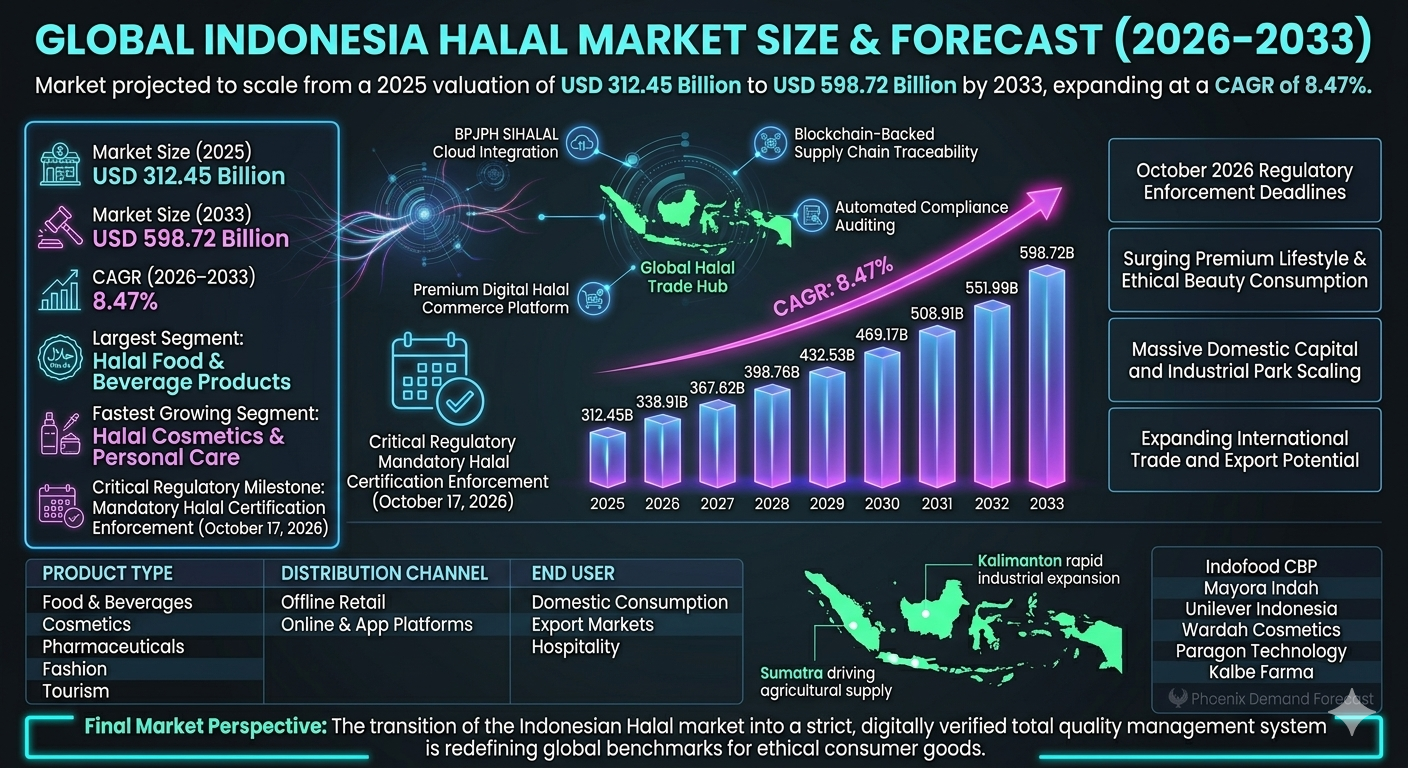
| Market Size (2025) | USD 312.45 Billion |
| Market Size (2033) | USD 598.72 Billion |
| CAGR (2026–2033) | 8.47% |
| Largest Segment | Halal Food & Beverage Products |
| Fastest Growing Segment | Halal Cosmetics & Personal Care |
| Leading End-Use Segment | Domestic Consumer Consumption |
| Key Trend | Digital Halal Certification Platforms & Premium Halal Lifestyle Expansion |
| Regulatory Influence | Mandatory Halal Certification Regulations, BPJPH Compliance & Export Trade Standards |
| Future Outlook | Growth Driven by Certification Expansion, Export Development & Halal Digital Commerce |
Market Size & Forecast
The Global Indonesia Halal Market is expected to witness strong expansion during the forecast period from 2026 to 2033. The market was valued at USD 312.45 billion in 2025 and is projected to reach approximately USD 598.72 billion by 2033, registering a CAGR of 8.47%.
The market growth is primarily driven by Indonesia’s large Muslim population, expanding halal certification infrastructure, rising consumer awareness regarding halal authenticity, and increasing domestic and international demand for halal-certified products.
Halal-certified products are increasingly critical across food, beverages, pharmaceuticals, cosmetics, fashion, tourism, and financial services. Rising adoption of digital halal verification systems, traceability platforms, and premium halal branding is accelerating market growth.
In addition, growing export opportunities, rising middle-class consumption, and government-backed halal ecosystem development are supporting long-term market expansion.
Global Indonesia Halal Market Overview
The Indonesia halal market encompasses products and services certified as compliant with Islamic dietary, ethical, and processing standards.
The market includes halal food products, beverages, cosmetics, pharmaceuticals, personal care, Islamic fashion, halal tourism, and halal-certified consumer goods.
Halal products are widely utilized across domestic retail, hospitality, exports, healthcare, and digital commerce channels.
The market is shifting from traditional certification processes toward digital verification systems, blockchain-based traceability, integrated halal supply chains, and premium halal lifestyle ecosystems.
Structural Drivers of Market Growth
1. Innovation and Commercialization Acceleration
Rapid innovation in halal certification technology, product traceability systems, digital retail integration, and premium halal product development is accelerating service expansion.
Digital verification and transparency tools are improving consumer confidence and market accessibility.
Market Implications
Companies investing in digital halal ecosystems, certification innovation, and premium halal branding are expected to strengthen market leadership.
2. Compliance and Risk Repricing
Mandatory halal certification laws, BPJPH compliance requirements, export certification protocols, and product traceability standards are influencing market modernization.
Government agencies are increasingly promoting stricter halal assurance systems.
Market Implications
Firms offering compliant, traceable, and digitally verified halal solutions are likely to gain stronger market trust.
3. Competitive and Value-Chain Reconfiguration
The market is highly competitive as food manufacturers, cosmetics brands, pharmaceutical firms, exporters, and digital commerce platforms expand halal-certified offerings.
Integrated halal supply chains and strategic certification partnerships are altering value-chain economics.
Market Implications
Companies focusing on vertical integration, digital commerce, and export-oriented halal solutions may gain stronger margins.
4. Capital and Capacity Scaling
Rising investment in halal industrial parks, digital certification systems, export infrastructure, and halal logistics networks is supporting market expansion.
Government initiatives and international trade agreements are increasing demand.
Market Implications
Operators scaling certification capabilities and halal production infrastructure are expected to capture future opportunities.
Market Segmentation Analysis
By Product Type
1. Halal Food & Beverage Products
This remains the largest segment due to strong daily consumption demand and mandatory certification requirements.
2. Halal Cosmetics & Personal Care
Fastest-growing due to rising premium beauty consumption and ethical product demand.
3. Halal Pharmaceuticals
Growing adoption due to increasing healthcare compliance awareness.
4. Halal Fashion
Strong growth driven by modest fashion trends and lifestyle branding.
5. Halal Tourism Services
Expanding due to rising faith-based travel demand.
By Distribution Channel
1. Offline Retail Stores
Largest segment due to strong supermarket and traditional retail presence.
2. Online & App-Based Platforms
Fastest-growing segment due to digital commerce expansion.
By End User
1. Domestic Consumer Consumption
Largest segment due to Indonesia’s significant Muslim population base.
2. Export Markets
Growing demand for certified Indonesian halal products globally.
3. Hospitality & Tourism
Strong adoption across halal travel services.
4. Institutional Procurement
Used in schools, hospitals, and public service operations.
Regional Market Dynamics
Java
Java dominates the Indonesia halal market due to concentrated population, manufacturing infrastructure, and certification adoption.
Sumatra
Sumatra remains a major market supported by agricultural production and retail network expansion.
Kalimantan
Kalimantan is witnessing rapid growth due to infrastructure development and regional industrial expansion.
Sulawesi
Sulawesi is gradually expanding due to rising domestic consumption and halal food production.
Eastern Indonesia
The region is witnessing emerging adoption driven by improving logistics and digital commerce penetration.
Competitive Landscape
The Global Indonesia Halal Market is highly competitive with food producers, certification agencies, consumer brands, and digital halal ecosystem providers expanding rapidly.
Key Companies Operating in the Market Include:
- Indofood CBP
- Mayora Indah
- Unilever Indonesia
- Wardah Cosmetics
- Paragon Technology & Innovation
- Kalbe Farma
- Nestlé Indonesia
- Sari Roti
- GarudaFood
- Halal Quality Control Indonesia
Strategic Outlook
The future of the Indonesia halal market will be shaped by digital certification systems, blockchain traceability, export-focused halal manufacturing, and premium halal lifestyle products.
Integrated halal supply chains, automated compliance verification, and digital consumer trust platforms will significantly improve service efficiency.
The rise of halal exports, digital retail adoption, and premium certified products is expected to create strong long-term growth opportunities.
Final Market Perspective
The Global Indonesia Halal Market remains a major segment within food, consumer goods, and ethical commerce ecosystems. Rising halal awareness, certification expansion, digital verification, and export growth continue driving long-term market growth.
Companies capable of delivering scalable, compliant, digitally enabled, and consumer-centric halal ecosystems will be best positioned to capture future opportunities. The convergence of certification technology, digital commerce, halal lifestyle branding, and export competitiveness is expected to redefine the future of the Indonesia halal industry.
Table of Contents
Table of Contents
- 1. Executive Summary
- 1.1 Global Indonesia Halal Market Snapshot (2026–2033)
- 1.2 Market Size & CAGR Analysis
- 1.3 Largest & Fastest-Growing Segments
- 1.4 Key Regional Insights
- 1.5 Major Market Growth Drivers
- 1.6 Competitive Landscape Overview
- 1.7 Strategic Outlook Through 2033
- 2. Introduction & Market Overview
- 2.1 Definition of Halal Products and Services
- 2.2 Scope of the Study
- 2.3 Evolution of Indonesia’s Halal Ecosystem
- 2.4 Halal Supply Chain Ecosystem Analysis
- 2.5 Regulatory & Certification Compliance Framework
- 2.6 Consumer Demand Trends
- 2.7 Innovation Landscape in Halal Commerce
- 3. Research Methodology
- 3.1 Primary Research
- 3.2 Secondary Research
- 3.3 Market Size Estimation Model
- 3.4 Forecast Assumptions (2026–2033)
- 3.5 Data Validation & Market Triangulation
- 4. Market Dynamics
- 4.1 Drivers
- 4.1.1 Expanding Muslim Consumer Population
- 4.1.2 Mandatory Halal Certification Regulations
- 4.1.3 Growth of Digital Halal Verification Platforms
- 4.1.4 Rising Premium Halal Lifestyle Demand
- 4.1.5 Export Development Opportunities
- 4.2 Restraints
- 4.2.1 Certification Process Complexity
- 4.2.2 Compliance Cost Burden for SMEs
- 4.2.3 Supply Chain Traceability Challenges
- 4.2.4 Regional Infrastructure Disparities
- 4.3 Opportunities
- 4.3.1 Blockchain-Based Halal Traceability
- 4.3.2 Expansion of Halal Export Hubs
- 4.3.3 Growth in Halal Digital Commerce
- 4.3.4 Development of Halal Industrial Parks
- 4.4 Challenges
- 4.4.1 Regulatory Harmonization Issues
- 4.4.2 Limited Awareness Among Small Producers
- 4.4.3 Standardization Across Product Categories
- 4.4.4 Competitive Pricing Pressures
- 4.1 Drivers
- 5. Global Indonesia Halal Market Analysis (USD Billion), 2026–2033
- 5.1 Market Size Overview
- 5.2 CAGR Analysis
- 5.3 Regional Revenue Distribution
- 5.4 Certification Adoption Trends
- 5.5 Consumer Demand Analysis
- 5.6 Future Growth Projections
- 6. Market Segmentation (USD Billion), 2026–2033
- 6.1 By Product Type
- 6.1.1 Halal Food & Beverage Products
- 6.1.2 Halal Cosmetics & Personal Care
- 6.1.3 Halal Pharmaceuticals
- 6.1.4 Halal Fashion
- 6.1.5 Halal Tourism Services
- 6.2 By Distribution Channel
- 6.2.1 Offline Retail Stores
- 6.2.2 Online & App-Based Platforms
- 6.3 By End User
- 6.3.1 Domestic Consumer Consumption
- 6.3.2 Export Markets
- 6.3.3 Hospitality & Tourism
- 6.3.4 Institutional Procurement
- 6.1 By Product Type
- 7. Market Segmentation by Geography
- 7.1 Java
- 7.2 Sumatra
- 7.3 Kalimantan
- 7.4 Sulawesi
- 7.5 Eastern Indonesia
- 8. Competitive Landscape
- 8.1 Market Share Analysis
- 8.2 Certification Benchmarking
- 8.3 Strategic Partnerships & Collaborations
- 8.4 Digital Commerce Expansion Analysis
- 8.5 Brand Positioning Strategies
- 9. Company Profiles
- 9.1 Indofood CBP
- 9.2 Mayora Indah
- 9.3 Unilever Indonesia
- 9.4 Wardah Cosmetics
- 9.5 Paragon Technology & Innovation
- 9.6 Kalbe Farma
- 9.7 Nestlé Indonesia
- 9.8 Sari Roti
- 9.9 GarudaFood
- 9.10 Halal Quality Control Indonesia
- 10. Strategic Intelligence & Pheonix AI Insights
- 10.1 Halal Market Forecast Engine
- 10.2 Certification Analytics Dashboard
- 10.3 Consumer Trust Intelligence Tracker
- 10.4 Export Opportunity Analyzer
- 10.5 Automated Porter’s Five Forces Analysis
- 11. Future Outlook & Strategic Recommendations
- 11.1 Investment in Digital Certification Platforms
- 11.2 Expansion of Export-Oriented Halal Manufacturing
- 11.3 Strengthening Traceability Systems
- 11.4 Scaling Halal Digital Commerce Ecosystems
- 11.5 Long-Term Market Outlook (2033+)
- 12. Appendix
- 13. About Pheonix Research
- 14. Disclaimer
Competitive Landscape
Global Indonesia Halal Market Competitive Intensity & Market Structure Overview
The global Indonesia halal market is highly competitive and moderately fragmented, characterized by strong competition among food manufacturers, cosmetics brands, pharmaceutical companies, certification agencies, halal exporters, and digital halal ecosystem providers. Competitive intensity is driven by certification compliance capabilities, product authenticity, digital traceability infrastructure, export readiness, brand trust, and integrated halal supply chain management.
The market structure consists of large established consumer goods companies with extensive halal-certified product portfolios alongside specialized halal-focused brands and digital certification technology providers. Competition is increasingly shaped by premium halal positioning, blockchain-enabled verification systems, digital commerce penetration, and export-oriented product development.
Rising halal awareness, mandatory certification enforcement, increasing digital verification requirements, and expanding global demand for Indonesian halal products are significantly intensifying competition across the market.
Global Indonesia Halal Market Competitive Intensity & Market Structure Current Scenario
Leading Indonesia Halal Market Companies
Indofood CBP: Market-leading halal food manufacturer with broad domestic distribution and strong export capabilities.
Mayora Indah: Major consumer goods company recognized for diversified halal-certified packaged food offerings.
Unilever Indonesia: Leading multinational player with strong halal-certified personal care and consumer products portfolio.
Wardah Cosmetics: Dominant halal cosmetics brand with strong premium halal beauty positioning.
Paragon Technology & Innovation: Key innovator driving halal beauty and personal care product expansion.
Kalbe Farma: Major pharmaceutical participant with expanding halal-certified healthcare product offerings.
Nestlé Indonesia: Significant halal-certified food and beverage market participant.
Sari Roti: Strong branded halal bakery products provider.
GarudaFood: Established food producer with broad halal-certified snack product portfolio.
Halal Quality Control Indonesia: Important certification and compliance ecosystem player supporting halal verification infrastructure.
Key Competitive Intensity & Market Structure Drivers
Mandatory BPJPH certification requirements are increasing compliance-driven competition across all halal product categories.
The expansion of digital halal verification platforms is creating strong differentiation opportunities.
Growing international export demand for certified Indonesian halal products is strengthening global market competition.
Premium halal branding and lifestyle-focused product positioning are reshaping consumer preference dynamics.
Blockchain-based traceability and integrated halal supply chain transparency are becoming major competitive differentiators.
Strategic Implications of Competitive Intensity & Market Structure
Manufacturers are increasingly investing in digital certification systems and real-time halal verification capabilities.
Strategic partnerships with certification agencies and digital commerce platforms are becoming essential for market expansion.
Premium halal cosmetics and lifestyle product innovation are emerging as high-growth competitive segments.
Export-focused production scaling and compliance infrastructure modernization are strengthening international competitiveness.
Integrated halal logistics and traceable sourcing frameworks are becoming central to long-term market leadership.
Global Indonesia Halal Market Competitive Intensity & Market Structure Forward Outlook
The Indonesia halal market is expected to remain highly competitive as digital verification, export expansion, and premium halal lifestyle demand continue accelerating.
Future competition will increasingly focus on blockchain-enabled traceability, automated compliance verification, digital halal commerce ecosystems, and premium certified product innovation.
Java will remain the dominant competitive region, while emerging regions such as Kalimantan and Eastern Indonesia are expected to witness rapid competitive expansion.
Advancements in certification automation, AI-powered halal verification systems, and integrated export logistics are expected to significantly reshape market dynamics.
Overall, companies that successfully combine certification excellence, digital ecosystem integration, premium halal branding, and scalable export infrastructure will remain strongly positioned in the evolving Indonesia halal market.
Value Chain
Global Indonesia Halal Market Value Chain & Supply Chain Evolution Overview
Value Chain Overview
The Global Indonesia Halal Market operates through a certification-centric value chain supported by halal raw material sourcing, compliant production systems, digital verification platforms, logistics infrastructure, retail distribution channels, and end-user consumption ecosystems.
Valued at USD 312.45 Billion in 2025 and projected to reach USD 598.72 Billion by 2033, growing at a CAGR of 8.47%, the market’s supply chain transformation is being driven by mandatory certification expansion, digital traceability systems, premium halal product innovation, and export-oriented halal trade development.
The increasing integration of blockchain verification, digital halal certification systems, automated compliance monitoring, and halal e-commerce ecosystems is reshaping operational efficiency across Indonesia’s halal value chain.
Core Value Chain Components
1. Halal Raw Material Sourcing & Authentication
The value chain begins with sourcing halal-certified ingredients, raw materials, and production inputs across food, cosmetics, pharmaceuticals, and consumer goods.
Strategic Impact: Verified sourcing strengthens product authenticity and regulatory compliance.
2. Manufacturing & Halal-Compliant Processing
Dedicated halal production lines, contamination prevention systems, sanitation protocols, and quality-controlled manufacturing processes ensure compliance with Islamic standards.
Strategic Impact: Advanced compliant manufacturing enhances operational trust and product acceptance.
3. Certification & Regulatory Validation
BPJPH certification, MUI approval systems, audit mechanisms, and digital compliance documentation validate halal product integrity.
Strategic Impact: Certification infrastructure directly determines market access and consumer confidence.
4. Digital Traceability & Verification Systems
Blockchain-enabled authentication, QR-based product validation, and digital compliance platforms improve transparency across supply chains.
Strategic Impact: Digital trust systems reduce fraud risks and strengthen brand positioning.
5. Distribution & Commercial Access Networks
Products are distributed through supermarkets, traditional retail, e-commerce platforms, institutional procurement systems, and export logistics channels.
Strategic Impact: Multi-channel distribution improves accessibility and revenue scalability.
6. End-Use Consumption Ecosystem
The final stage includes domestic Muslim consumers, hospitality providers, healthcare institutions, exporters, and halal lifestyle consumers.
Strategic Impact: Expanding consumption diversity supports long-term market resilience.
Key Supply Chain Evolution Drivers
Digital Halal Certification Platforms
Automated digital certification systems are improving efficiency, reducing processing delays, and increasing transparency.
Evolution Impact: Faster certification accelerates market participation.
Blockchain-Based Traceability Expansion
Traceability technologies are strengthening product authenticity verification across domestic and export markets.
Evolution Impact: Enhanced transparency improves consumer trust and export competitiveness.
Export-Oriented Halal Logistics Development
Integrated halal logistics and trade facilitation systems are supporting international market access.
Evolution Impact: Export scalability increases revenue diversification opportunities.
Premium Halal Lifestyle Growth
Rising demand for halal cosmetics, personal care, and lifestyle products is expanding supply chain complexity.
Evolution Impact: Premiumization supports higher-margin product development.
Supply Chain Challenges
- Complex supplier verification requirements
- Archipelagic logistics infrastructure limitations
- Certification processing bottlenecks
- Export compliance alignment challenges
- Traceability system integration costs
- Regulatory enforcement variability
Strategic Optimization Opportunities
- Invest in blockchain-enabled halal traceability
- Expand digital certification automation
- Strengthen integrated halal industrial parks
- Develop export-ready compliance systems
- Enhance halal e-commerce infrastructure
- Build regional logistics resilience
Future Supply Chain Outlook
The Global Indonesia Halal Market is expected to evolve toward a digitally integrated and globally competitive halal ecosystem driven by:
- AI-driven compliance verification
- Automated halal certification workflows
- Blockchain-enabled product traceability
- Smart halal logistics systems
- Cross-border halal trade digitization
- Premium halal ecosystem expansion
Strategic Perspective
The Indonesia halal market’s evolving value chain offers strong long-term opportunities supported by regulatory modernization, digital transformation, and rising domestic and international halal demand.
Organizations investing in traceability technology, digital compliance infrastructure, integrated logistics systems, and premium halal ecosystem development are expected to secure strong competitive advantages in the evolving global halal economy.
Investment Activity
Global Indonesia Halal Market Investment & Funding Dynamics Overview
The Global Indonesia Halal Market is witnessing significant investment momentum driven by Indonesia’s expanding halal certification ecosystem, rising domestic and international demand for halal-certified products, digital transformation of halal verification systems, and rapid premium halal lifestyle adoption. Food manufacturers, cosmetics companies, pharmaceutical firms, certification agencies, digital commerce platforms, and government-backed halal ecosystem developers are actively investing in halal certification infrastructure, digital traceability systems, halal industrial parks, export-oriented production capabilities, and integrated halal commerce platforms.
Investment activity is accelerating due to growing demand for digitally verified halal products, export-ready halal manufacturing, blockchain-enabled supply chain traceability, and premium halal consumer experiences. The rapid shift toward digital halal ecosystems is significantly reshaping capital allocation across Indonesia’s halal economy.
Additionally, expanding investments in BPJPH compliance systems, halal logistics networks, digital certification platforms, export infrastructure, and AI-enabled halal verification technologies are strengthening long-term growth opportunities globally.
Global Indonesia Halal Market Investment & Funding Dynamics Current Scenario
Currently, the global Indonesia halal market demonstrates rising investment activity due to increasing capital requirements for mandatory certification compliance, digital halal verification infrastructure, export development, and halal production modernization. Major market participants are heavily investing in digital certification systems, traceability platforms, halal product innovation, premium halal branding strategies, and omnichannel retail expansion.
The market is attracting strong funding into halal technology startups, blockchain traceability providers, halal-focused digital commerce platforms, certification management software, and export-focused manufacturing expansion.
The industry is witnessing active partnerships, mergers, strategic alliances, and cross-sector collaborations as manufacturers, digital platform providers, regulators, and halal certification bodies pursue ecosystem integration and market scalability.
Key Investment & Funding Dynamics Signals in Global Indonesia Halal Market
- Rising demand for halal-certified food, cosmetics, pharmaceuticals, and lifestyle products is accelerating manufacturing investments.
- Expansion of digital halal certification and blockchain traceability systems is increasing technology-focused capital deployment.
- Growing adoption of online halal commerce platforms is strengthening digital ecosystem funding.
- Strategic investments in export-focused halal production and logistics infrastructure are reshaping market priorities.
- Partnerships between manufacturers, certification agencies, and technology firms are improving ecosystem efficiency.
- Increasing regulatory focus on BPJPH compliance and export certification standards is supporting investor confidence.
- Rising demand for premium halal lifestyle products and integrated halal supply chains is accelerating R&D spending.
Strategic Implications of Investment & Funding Dynamics in Global Indonesia Halal Market
- Continuous investment in digital certification infrastructure and halal traceability systems is essential for long-term competitiveness.
- Capital allocation toward halal industrial parks, export manufacturing, and digital commerce ecosystems will strengthen market positioning.
- Companies offering compliant, transparent, and digitally enabled halal solutions are expected to gain stronger market share.
- Strategic acquisitions and ecosystem partnerships will accelerate market integration and product diversification.
- Investments in AI-powered halal verification and blockchain-based compliance systems will remain major priorities.
- Compliance with mandatory certification regulations and international halal export standards will remain critical for sustained growth.
- Organizations scaling halal innovation, export readiness, and premium consumer engagement platforms are expected to capture substantial future opportunities.
Global Indonesia Halal Market Investment & Funding Dynamics Forward Outlook
Looking ahead, the Global Indonesia Halal Market is expected to maintain strong investment growth driven by certification expansion, export development, digital halal verification adoption, and premium halal lifestyle consumption.
Future capital deployment will increasingly focus on blockchain-enabled traceability, AI-based halal compliance verification, digital halal retail ecosystems, integrated halal logistics, and export-oriented manufacturing modernization.
Digital trust-building systems and automated certification technologies are expected to become major long-term innovation priorities.
In conclusion, the Global Indonesia Halal Market represents a high-growth ethical commerce investment landscape where digital certification, export competitiveness, premium halal innovation, and integrated compliance ecosystems will define future capital strategies.
Technology & Innovation
Global Indonesia Halal Market Technology & Innovation Landscape Overview
The global Indonesia halal market is experiencing significant technological transformation driven by advancements in digital halal certification systems, blockchain-enabled traceability platforms, artificial intelligence-powered compliance monitoring, smart supply chain management, and integrated halal verification technologies. The evolution of halal ecosystem technologies is increasingly focused on improving transparency, strengthening consumer trust, enhancing certification efficiency, and enabling scalable halal product authentication across domestic and international markets.
Modern halal market infrastructures are integrating cloud-based certification platforms, QR-enabled verification systems, digital compliance dashboards, automated audit technologies, and real-time traceability frameworks to streamline halal assurance processes. These innovations are significantly improving regulatory compliance, reducing verification complexity, and enhancing market accessibility.
The market is also witnessing rapid adoption of mobile halal authentication applications, AI-based ingredient screening systems, blockchain-secured supply chains, and digital halal commerce ecosystems that are redefining halal product management and consumer engagement globally.
Global Indonesia Halal Market Technology & Innovation Current Scenario
Currently, innovation in the Indonesia halal market is centered around digital certification modernization and supply chain transparency enhancement. Traditional paper-based halal certification processes are increasingly being replaced by integrated digital compliance platforms that improve efficiency and traceability.
Blockchain technology is gaining widespread adoption to enable end-to-end halal product traceability, ensuring transparency across sourcing, processing, logistics, and retail distribution stages.
Artificial intelligence and machine learning are being integrated into halal compliance systems to automate ingredient analysis, detect certification anomalies, and improve risk assessment capabilities.
Mobile verification technologies are becoming a major innovation area by allowing consumers to instantly authenticate halal product status through QR code scanning and real-time database access.
Cloud-based halal management systems are improving collaboration between certification bodies, manufacturers, retailers, and regulators.
Digital marketplace integration is also expanding rapidly, enabling halal-certified brands to reach wider consumer bases through dedicated halal e-commerce ecosystems.
Key Technology & Innovation Trends in Global Indonesia Halal Market
- Digital Halal Certification Platforms: Streamlining application, approval, and compliance verification processes.
- Blockchain-Based Traceability Systems: Enabling secure end-to-end halal supply chain transparency.
- AI-Powered Compliance Monitoring: Automating ingredient analysis and risk detection.
- Mobile Halal Authentication Apps: Providing instant consumer product verification.
- QR-Enabled Verification Systems: Supporting real-time halal product traceability.
- Cloud-Based Compliance Dashboards: Improving multi-stakeholder regulatory coordination.
- Digital Halal Commerce Ecosystems: Expanding access through specialized online marketplaces.
- Automated Audit Technologies: Enhancing inspection efficiency and certification accuracy.
- Smart Supply Chain Monitoring: Tracking halal integrity across logistics operations.
- Predictive Regulatory Analytics: Improving compliance forecasting and operational readiness.
Strategic Implications of Technology & Innovation
Technological advancements are significantly reshaping competitive dynamics in the Indonesia halal market by shifting competition from basic certification compliance toward digitally connected, transparent, and consumer-centric halal ecosystems.
Companies investing in digital verification infrastructure, blockchain traceability, and AI-driven compliance systems are achieving stronger competitive differentiation through enhanced consumer trust and operational efficiency.
The growing integration of digital technologies is enabling producers to strengthen export readiness, improve regulatory responsiveness, and accelerate certification processing timelines.
Advanced automation and digital transparency tools are helping organizations reduce compliance costs while improving audit accuracy and traceability assurance.
However, implementation complexity, digital infrastructure disparities, integration costs, and regulatory standard harmonization remain significant challenges for broader technology adoption.
Global Indonesia Halal Market Technology & Innovation Forward Outlook
The future of halal technology is expected to evolve toward fully automated, AI-driven, and blockchain-secured halal assurance ecosystems capable of supporting real-time global halal verification and intelligent compliance management.
Emerging innovations include self-learning halal compliance engines, biometric-enabled certification validation, digital twin supply chain simulation, and autonomous halal inspection systems.
Advanced federated data-sharing frameworks may enable secure cross-border halal certification interoperability while preserving regulatory sovereignty.
Smart packaging integrated with NFC and IoT-enabled sensors is expected to strengthen real-time product authenticity verification.
Connected halal commerce ecosystems supported by predictive analytics may further enhance personalized consumer engagement and export market intelligence.
Overall, the global Indonesia halal market is evolving toward a highly intelligent ecosystem combining digital certification, secure traceability, automated compliance verification, and connected halal commerce infrastructure to redefine trust, transparency, and market efficiency worldwide.
Market Risk
Global Indonesia Halal Market Risk Factors & Disruption Threats Overview
The Global Indonesia Halal Market operates within a high-growth but compliance-intensive ecosystem shaped by regulatory modernization, certification complexity, supply chain traceability requirements, digital commerce expansion, and shifting consumer trust dynamics.
While the market demonstrates strong long-term expansion driven by Indonesia’s large Muslim consumer base, government-backed halal ecosystem development, export opportunities, and rising premium halal consumption, it remains exposed to regulatory enforcement changes, certification bottlenecks, supply chain transparency risks, pricing pressures, and international standard fragmentation.
A defining structural characteristic of the market is its dependence on halal assurance integrity, certification scalability, raw material traceability, and consumer confidence in verified halal authenticity.
Halal food and beverage products continue to dominate market volume, while higher-value growth is increasingly shifting toward halal cosmetics, pharmaceuticals, premium halal lifestyle products, and digitally verified halal commerce platforms.
The market is also transitioning from traditional manual certification processes toward integrated digital halal verification, blockchain-enabled traceability systems, automated compliance monitoring, and export-oriented halal ecosystems, creating strategic pressure for market participants to digitize operations.
Global Indonesia Halal Market Current Risk Environment
The current market environment is characterized by strong demand expansion, increasing regulatory oversight, and rapid digital transformation.
One of the most significant disruption factors involves certification complexity and compliance execution risk.
Mandatory halal certification requirements, BPJPH regulatory frameworks, evolving audit standards, and certification renewal obligations can create operational delays and cost burdens for manufacturers.
Another major risk area is halal supply chain traceability and ingredient sourcing transparency.
Manufacturers must ensure compliance across sourcing, production, logistics, storage, and distribution processes, creating substantial operational complexity.
The market also faces fragmentation risks arising from differences between domestic halal standards and international export certification requirements.
Misalignment between regional halal regulatory frameworks may affect export scalability and international trade competitiveness.
Additionally, digital misinformation, counterfeit halal labeling, and consumer trust erosion remain structurally important risks.
Any perceived failure in halal integrity can significantly damage brand reputation and consumer confidence.
Key Market Risk & Disruption Signals in Global Indonesia Halal Market
- Certification Bottlenecks: Delays in halal certification processing may disrupt product commercialization timelines.
- Regulatory Compliance Complexity: Evolving BPJPH requirements and mandatory certification standards increase operational burden.
- Supply Chain Traceability Risk: Lack of end-to-end halal verification may compromise product authenticity.
- Export Standard Fragmentation: Differences across international halal frameworks create market access challenges.
- Counterfeit Halal Labeling: Fraudulent certification claims can weaken consumer trust.
- Digital Commerce Verification Risk: Online halal product authenticity remains difficult to validate consistently.
- Pricing Competition: Margin pressure from private-label and mass-market halal products.
- Raw Material Sourcing Disruption: Limited compliant ingredient availability may affect production continuity.
Strategic Implications of Market Risk & Disruption
The evolving disruption environment creates both significant growth opportunities and increasing compliance complexity.
One of the most important strategic implications is the need for digitally integrated halal assurance ecosystems.
Market participants increasingly must combine certification automation, blockchain traceability, digital verification tools, and transparent consumer engagement platforms to remain competitive.
Companies are required to invest in automated compliance systems, halal ingredient sourcing networks, export certification readiness, and digital consumer trust infrastructure.
Vertical integration across sourcing, certification, logistics, retail distribution, and digital verification is becoming increasingly valuable.
The convergence of premium halal branding, export development, regulatory technology, and digital commerce is also reshaping the value chain.
Organizations with stronger certification agility, compliance infrastructure, and traceability intelligence are expected to capture stronger long-term margins and market trust.
Global Indonesia Halal Market Forward Risk Outlook
Looking ahead to 2026–2033, the Global Indonesia Halal Market is expected to become increasingly digitalized, export-oriented, and compliance-driven.
- Expansion of Digital Halal Certification Platforms: Automated verification systems will become mainstream.
- Greater Blockchain Traceability Adoption: End-to-end halal supply chain visibility will strengthen trust.
- Rising Export Certification Alignment: Greater harmonization with global halal trade standards.
- Higher Premium Halal Lifestyle Penetration: Consumer demand for differentiated halal products will accelerate.
- Stronger Regulatory Enforcement: Compliance monitoring and certification scrutiny will intensify.
- Growth in Halal Digital Commerce: Online halal retail ecosystems will capture larger market share.
- Greater Institutional Halal Procurement: Public and private sector demand for certified products will expand.
- Industry Consolidation: Strategic partnerships and acquisitions may reshape market competition.
In conclusion, the Global Indonesia Halal Market represents a fast-expanding, trust-sensitive, and compliance-driven ecosystem, where certification integrity, digital traceability, export readiness, and consumer confidence will define long-term competitive success.
Regulatory Landscape
Global Indonesia Halal Market Regulatory & Policy Environment Overview
The regulatory and policy environment governing the global Indonesia halal market is shaped by mandatory halal certification laws, Islamic compliance frameworks, product traceability requirements, trade export standards, consumer protection regulations, and digital certification modernization initiatives. As Indonesia strengthens its position as a global halal economy leader, regulatory oversight is becoming increasingly comprehensive to ensure product authenticity, consumer confidence, and international market competitiveness.
Indonesia’s halal market operates under a structured legal framework that governs product certification, processing standards, supply chain compliance, labeling transparency, and halal assurance system implementation across food, beverages, pharmaceuticals, cosmetics, fashion, tourism, and consumer goods sectors.
The increasing integration of digital halal verification systems, blockchain-enabled traceability, export certification platforms, and automated compliance monitoring is accelerating policy development surrounding digital certification governance, data integrity, and cross-border halal standardization.
Global Indonesia Halal Market Regulatory & Policy Environment Current Scenario
The current regulatory framework for Indonesia’s halal market is centered around mandatory halal product assurance legislation and institutional oversight mechanisms designed to strengthen halal ecosystem governance.
Indonesia’s Halal Product Assurance Law and its implementation through the Halal Product Assurance Organizing Agency (BPJPH) require mandatory halal certification for products entering, circulating, and traded within the domestic market across regulated sectors.
The Indonesian Ulema Council (MUI) continues to play a critical role in halal fatwa issuance and religious compliance validation, while BPJPH oversees certification administration, supervision, and digital compliance processes.
Export-oriented halal businesses must also comply with international halal trade requirements, including destination-country certification recognition, product traceability, and documentation standards for global market access.
Regional governments across Indonesia are increasingly implementing local halal industry development programs, halal industrial zones, and SME certification acceleration initiatives to support nationwide compliance adoption.
Key Regulatory & Policy Environment Signals in Global Indonesia Halal Market
- Mandatory Halal Certification Requirements: Broad product categories are increasingly subject to compulsory halal certification compliance.
- BPJPH Regulatory Oversight: Centralized halal certification administration is strengthening procedural standardization and compliance enforcement.
- Product Traceability and Supply Chain Transparency: Enhanced verification requirements are driving digital traceability system adoption.
- Halal Labeling and Consumer Disclosure Standards: Strict labeling regulations are improving transparency and consumer trust.
- Digital Certification Platform Modernization: Regulatory support for digital halal verification is streamlining certification workflows and market access.
- Export Trade Standard Alignment: Harmonization with international halal certification frameworks is improving Indonesia’s export competitiveness.
Strategic Implications of Regulatory & Policy Environment
The evolving regulatory landscape is encouraging companies to invest heavily in halal assurance systems, certification readiness infrastructure, digital compliance platforms, and integrated traceability technologies.
Mandatory certification requirements are accelerating formalization across small and medium-sized enterprises, encouraging broader participation in regulated halal commerce.
Digital policy modernization is improving efficiency through automated certification processing, online verification tools, and real-time compliance monitoring systems.
Export-focused regulatory alignment is strengthening opportunities for Indonesian halal producers to access high-growth international halal markets.
Regulatory harmonization across sectors is also encouraging greater vertical integration within halal supply chains and premium halal product innovation.
Global Indonesia Halal Market Regulatory & Policy Environment Forward Outlook
Between 2026 and 2033, the regulatory environment for the global Indonesia halal market is expected to become increasingly digitized, standardized, and internationally integrated.
Regulators are likely to expand mandatory certification coverage, strengthen digital verification systems, and introduce stricter compliance monitoring across broader product categories.
Cross-border halal certification recognition frameworks are expected to improve, enhancing export efficiency and reducing market entry barriers for Indonesian halal producers.
Blockchain-based halal traceability and AI-driven compliance monitoring may gain stronger policy support as transparency requirements continue to evolve.
Overall, regulatory and policy developments will remain a defining market force, with companies investing in certification excellence, digital halal ecosystems, and export-ready compliance infrastructure expected to maintain long-term competitive advantage.