
Global Nutritional Food Market size and share Analysis 2026-2033
Global Nutritional Food Market Forecast Snapshot: 2026???2033
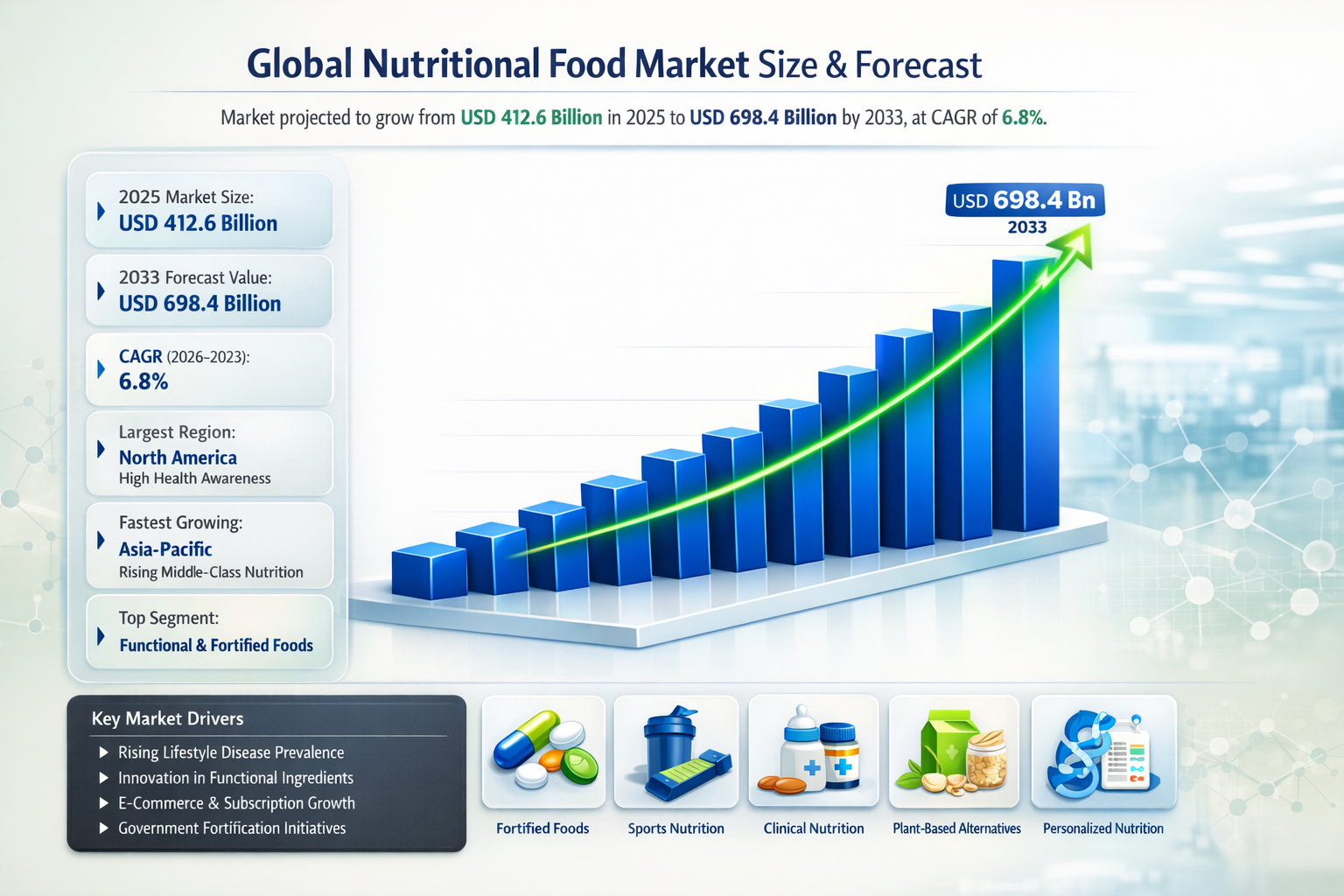
| Metric | Value |
| 2025 Market Size | USD 412.6 Billion |
| 2033 Market Size | USD 698.4 Billion |
| CAGR (2026???2033) | 6.8% |
| Largest Region | North America |
| Fastest Growing Region | Asia-Pacific |
| Top Segment | Functional & Fortified Foods |
| Key Trend | Personalized Nutrition & Functional Ingredients |
| Future Focus | Preventive Health Nutrition, Plant-Based Foods, and Clinical Nutrition |
Global Nutritional Food Market Overview
Global Nutritional Food Market is booming as people eat to live better. Folks focus on health, immunity, and preventing problems before they start, opting for foods packed with vitamins, proteins, probiotics ??? stuff that keeps you going strong. As wellness wins, this market's growing big time.
According to Pheonix Research, the Global Nutritional Food Market is valued at USD 412.6 billion in 2025 and is projected to reach USD 698.4 billion by 2033, registering a CAGR of 6.8% during 2026???2033. Market expansion is driven by rising health awareness, increasing demand for functional foods, and the growing prevalence of lifestyle-related diseases such as obesity, diabetes, and cardiovascular disorders.
North America currently represents the largest regional market, supported by high consumer awareness of health and wellness, strong demand for dietary supplements, and advanced retail and e-commerce distribution networks.
Meanwhile, Asia-Pacific is the fastest-growing region, driven by expanding middle-class populations, rising disposable incomes, and increasing awareness of preventive healthcare and nutrition across countries such as China, India, and Southeast Asia.
The post-2025 outlook highlights strong growth opportunities in clinical nutrition, functional food innovation, and personalized dietary products, positioning nutritional foods as a critical segment within the global health and wellness industry.
Key Drivers of Global Nutritional Food Market Growth
1. Rising Health Awareness & Lifestyle Diseases
Increasing cases of obesity, diabetes, cardiovascular disorders, and nutrient deficiencies are boosting demand for functional, fortified, and protein-rich foods that support better health management and overall wellness.
2. Innovation in Nutritional Formulations & Ingredients
Companies are introducing plant-based proteins, probiotics, omega-enriched foods, and superfood blends, enabling the development of premium nutritional products with proven health benefits.
3. Expansion of E-commerce & Modern Retail Channels
Growth of online grocery platforms, health-focused retail chains, and subscription nutrition services is improving product accessibility, convenience, and global market reach.
4. Government & Regulatory Support
Nutrition awareness programs, food fortification initiatives, and supportive regulatory policies are encouraging the development and adoption of high-quality nutritional food products.
5. Rising Consumer Focus on Preventive Healthcare
Consumers are increasingly adopting nutrient-dense, functional, and clean-label foods to strengthen immunity, improve long-term health, and reduce the risk of chronic diseases.
Global Nutritional Food Market Segmentation
1. By Product Type
1.1 Functional and Fortified Foods
1.1.1 Vitamin-Enriched Foods
1.1.1.1 Fortified Cereals
1.1.1.1.1 Whole Grain Fortified Cereals
1.1.1.1.2 Multivitamin Breakfast Cereals
1.1.1.2 Fortified Dairy Products
1.1.1.2.1 Vitamin-Enriched Milk
1.1.1.2.2 Calcium-Fortified Yogurt
1.1.2 Probiotic and Digestive Health Foods
1.1.2.1 Probiotic Yogurt
1.1.2.1.1 Digestive Health Yogurt
1.1.2.1.2 Low-Sugar Probiotic Yogurt
1.1.2.2 Prebiotic and Fiber-Enriched Foods
1.1.2.2.1 Fiber-Enriched Cereals
1.1.2.2.2 Digestive Wellness Snacks
1.2 Sports Nutrition Products
1.2.1 Protein Supplements
1.2.1.1 Whey Protein Products
1.2.1.1.1 Protein Powders
1.2.1.1.2 Protein Bars
1.2.1.2 Plant-Based Protein Products
1.2.1.2.1 Pea Protein Supplements
1.2.1.2.2 Soy Protein Products
1.2.2 Energy and Performance Nutrition
1.2.2.1 Energy Bars
1.2.2.1.1 High-Protein Energy Bars
1.2.2.1.2 Performance Nutrition Bars
1.2.2.2 Energy Drinks
1.2.2.2.1 Electrolyte Drinks
1.2.2.2.2 Sports Hydration Beverages
1.3 Medical and Clinical Nutrition
1.3.1 Infant Nutrition
1.3.1.1 Infant Formula
1.3.1.1.1 Standard Infant Formula
1.3.1.1.2 Specialized Infant Nutrition
1.3.2 Adult Medical Nutrition
1.3.2.1 Disease-Specific Nutrition
1.3.2.1.1 Diabetic Nutrition Products
1.3.2.1.2 Cardiac Health Nutrition
1.4 Plant-Based Nutritional Foods
1.4.1 Plant-Based Dairy Alternatives
1.4.1.1 Almond Milk
1.4.1.1.1 Fortified Almond Milk
1.4.1.1.2 Unsweetened Almond Milk
1.4.1.2 Oat Milk
1.4.1.2.1 Flavored Oat Milk
1.4.1.2.2 Barista Oat Milk
1.4.2 Plant-Based Protein Foods
1.4.2.1 Meat Alternatives
1.4.2.1.1 Plant-Based Burgers
1.4.2.1.2 Plant-Based Ready Meals
?? ??2. By Distribution Channel
2.1 Supermarkets & Hypermarkets
2.1.1 Health Food Sections
2.1.1.1 Functional Food Products
2.1.1.1.1 Fortified Food Products
2.1.1.1.2 Nutritional Snack Products
2.1.2 Packaged Nutrition Products
2.1.2.1 Protein Food Products
2.1.2.1.1 Protein Bars
2.1.2.1.2 Protein Drinks
2.2 Online Retail
2.2.1 E-commerce Grocery Platforms
2.2.1.1 Online Nutrition Stores
2.2.1.1.1 Health Food Marketplaces
2.2.1.1.2 Nutrition Brand Websites
2.2.2 Direct-to-Consumer Nutrition Brands
2.2.2.1 Subscription-Based Nutrition Products
2.2.2.1.1 Personalized Nutrition Kits
2.2.2.1.2 Wellness Supplement Programs
2.3 Specialty Nutrition Stores
2.3.1 Health and Wellness Stores
2.3.1.1 Sports Nutrition Retailers
2.3.1.1.1 Fitness Supplement Products
2.3.1.1.2 Protein Nutrition Products
2.3.2 Organic and Natural Food Stores
2.3.2.1 Organic Nutritional Foods
2.3.2.1.1 Clean Label Products
2.3.2.1.2 Natural Ingredient Foods
?? 3. By End User
3.1 Athletes and Fitness Enthusiasts
3.1.1 Sports Nutrition Consumers
3.1.1.1 Protein Food Consumers
3.1.1.1.1 Protein Supplements
3.1.1.1.2 Energy Nutrition Products
3.2 Health-Conscious Consumers
3.2.1 Preventive Healthcare Consumers
3.2.1.1 Immunity Boosting Foods
3.2.1.1.1 Vitamin-Enriched Products
3.2.1.1.2 Functional Wellness Foods
3.3 Medical Nutrition Consumers
3.3.1 Patients with Chronic Conditions
3.3.1.1 Disease-Specific Nutrition
3.3.1.1.1 Diabetic Nutrition Products
3.3.1.1.2 Heart Health Nutrition
?? 4.By Region
4.1 North America
4.2 Europe
4.3 Asia-Pacific
4.4 Middle East & Africa
4.5 South America
Regional Insights of Global Nutritional Food Market
North America ??? Largest Market
North America dominates the global nutritional food market due to high consumer awareness of health and wellness, strong demand for dietary supplements, and advanced retail and e-commerce distribution networks.
Asia-Pacific ??? Fastest Growing Market
Asia-Pacific is experiencing rapid growth driven by rising disposable incomes, expanding middle-class populations, and increasing awareness of nutrition and preventive healthcare.
Europe
The European market is expanding steadily due to growing demand for clean-label functional foods and strict regulatory standards for nutritional products.
Middle East & Africa
Increasing health awareness and rising demand for fortified foods are supporting market growth in the region.
South America
Growing adoption of functional foods and expanding health-conscious consumer segments are driving steady market expansion.
Leading Companies in Global Nutritional Food Market
Nestl?? Health Science
PepsiCo Inc.
Danone S.A.
Herbalife Nutrition Ltd.
Glanbia Plc
Amway Corporation
Abbott Laboratories
General Mills Inc.
Leading companies are focusing on functional ingredient innovation, personalized nutrition products, and expansion of plant-based nutritional foods to strengthen their global market presence. PepsiCo Inc. (USA) is the largest company Global Nutritional Food Market.
Strategic Intelligence & AI-Backed Insights
Pheonix Demand Forecast Engine identifies preventive healthcare trends, fitness culture expansion, and functional food innovation as key long-term growth drivers.
Consumer Behavior Analyzer highlights increasing demand for plant-based nutrition, protein-enriched foods, and immunity-boosting products.
Innovation Tracker emphasizes personalized nutrition, functional beverages, and clinical nutrition products as major competitive differentiators.
Porter???s Five Forces Analysis reveals moderate supplier power, strong brand competition, and increasing innovation-driven product differentiation.
Final Takeaway of Global Nutritional Food Market
The Global Nutritional Food Market is steadily evolving into a health-driven and preventive nutrition ecosystem as consumers increasingly prioritize balanced diets, functional ingredients, and wellness-oriented food products. The Nutritional Food Market CAGR 2026???2033 of 6.8% reflects consistent global expansion supported by rising health awareness and innovation in functional and plant-based nutrition.
Companies that invest in personalized nutrition solutions, plant-based food innovation, and advanced functional ingredients will be well positioned to capture long-term growth opportunities.
At Pheonix Research, our advanced forecasting frameworks deliver comprehensive revenue forecasts, competitive benchmarking, and strategic intelligence, enabling stakeholders to capitalize on the rapidly evolving global nutritional food market with confidence.
???? Social Mentions & Publication Channels
??Explore deeper insights and follow our cross-platform updates on LinkedIn and X??for continuous intelligence and market coverage.
LinkedIn : https://www.linkedin.com/feed/update/urn:li:activity:7437416830480109568
?? X: https://x.com/Pheonix_Insight/status/2031653584681709753?s=20Table of Contents
1. Executive Summary
1.1 Global Nutritional Food Market Forecast Snapshot (2026???2033)
1.2 Market Size and Growth Outlook
1.3 Key Market Trends in Nutritional Foods
1.4 Largest and Fastest-Growing Regions
1.5 Leading Product Segments
1.6 Competitive Landscape Overview
1.7 Strategic Outlook Through 2033
2. Introduction & Market Overview
2.1 Definition of the Global Nutritional Food Market
2.2 Scope of the Study
2.3 Evolution of Nutritional and Functional Food Products
2.4 Role of Preventive Healthcare and Balanced Nutrition
2.5 Rising Demand for Functional and Fortified Foods
2.6 Growth of Plant-Based Nutritional Products
2.7 Expansion of Clinical and Personalized Nutrition
3. Research Methodology??
3.1 Primary Research Approach
3.2 Secondary Research Sources
3.3 Phoenix Market Size Estimation Model
3.4 Forecast Assumptions (2026???2033)
3.5 Data Validation and Market Triangulation
4. Market Dynamics
4.1 Market Drivers
4.1.1 Rising Health Awareness and Lifestyle Diseases
4.1.2 Innovation in Nutritional Ingredients and Formulations
4.1.3 Expansion of E-commerce and Modern Retail Channels
4.1.4 Government Nutrition Programs and Food Fortification Initiatives
4.1.5 Increasing Consumer Focus on Preventive Healthcare
4.2 Market Restraints
4.2.1 High Cost of Premium Nutritional Food Products
4.2.2 Regulatory Compliance for Health Claims
4.2.3 Consumer Misconceptions About Nutritional Labels
4.2.4 Supply Chain Challenges for Functional Ingredients
4.3 Market Opportunities
4.3.1 Growth of Personalized Nutrition Solutions
4.3.2 Increasing Demand for Plant-Based Nutritional Foods
4.3.3 Development of Clinical and Medical Nutrition Products
4.3.4 Innovation in Functional Beverages and Protein Products
4.4 Market Challenges
4.4.1 Ensuring Ingredient Quality and Standardization
4.4.2 Rising Competition Among Global Nutrition Brands
4.4.3 Managing Raw Material Costs
4.4.4 Maintaining Clean-Label and Natural Formulations
5. Global Nutritional Food Market Analysis (USD Billion), 2026???2033
5.1 Market Size Overview
5.2 CAGR Growth Analysis
5.3 Regional Market Contribution
5.4 Product Segment Revenue Analysis
5.5 Distribution Channel Trends
5.6 End-User Demand Analysis
6. Market Segmentation by Product Type (USD Billion), 2026???2033
6.1 Functional and Fortified Foods
6.1.1 Vitamin-Enriched Foods
6.1.2 Probiotic and Digestive Health Foods
6.2 Sports Nutrition Products
6.2.1 Protein Supplements
6.2.2 Energy and Performance Nutrition
6.3 Medical and Clinical Nutrition
6.3.1 Infant Nutrition
6.3.2 Adult Medical Nutrition
6.4 Plant-Based Nutritional Foods
6.4.1 Plant-Based Dairy Alternatives
6.4.2 Plant-Based Protein Foods
7. Market Segmentation by Distribution Channel (USD Billion), 2026???2033
7.1 Supermarkets and Hypermarkets
7.1.1 Health Food Sections
7.1.1.1 Functional Nutritional Products
7.1.1.1.1 Fortified Cereals and Grain Products
7.1.1.1.2 Probiotic and Digestive Health Foods
7.1.1.2 Protein and Sports Nutrition Products
7.1.1.2.1 Protein Bars and Nutritional Snacks
7.1.1.2.2 Ready-to-Drink Protein Beverages
7.1.2 Packaged Nutritional Food Products
7.1.2.1 Functional Dairy and Plant-Based Foods
7.1.2.1.1 Fortified Milk and Yogurt Products
7.1.2.1.2 Plant-Based Dairy Alternatives
7.1.2.2 Nutritional Snack and Convenience Foods
7.1.2.2.1 Energy Bars and Functional Snacks
7.1.2.2.2 Nutrient-Enriched Ready-to-Eat Foods
7.2 Online Retail and E-commerce
7.2.1 E-commerce Grocery Platforms
7.2.1.1 Online Nutrition Product Stores
7.2.1.1.1 Functional Food Marketplaces
7.2.1.1.2 Nutritional Supplement Retail Platforms
7.2.1.2 Digital Health Food Marketplaces
7.2.1.2.1 Organic and Natural Food Platforms
7.2.1.2.2 Premium Nutritional Food Retailers
7.2.2 Direct-to-Consumer Nutrition Brands
7.2.2.1 Brand-Owned E-commerce Platforms
7.2.2.1.1 Subscription-Based Nutrition Programs
7.2.2.1.2 Personalized Nutrition Product Kits
7.2.2.2 Digital Wellness Retail Channels
7.2.2.2.1 Online Sports Nutrition Stores
7.2.2.2.2 Functional Beverage E-commerce Platforms
7.3 Specialty Nutrition Stores
7.3.1 Health and Wellness Stores
7.3.1.1 Sports Nutrition Retailers
7.3.1.1.1 Protein Supplement Stores
7.3.1.1.2 Performance Nutrition Product Retailers
7.3.1.2 Functional Nutrition Retail Stores
7.3.1.2.1 Immunity and Wellness Nutrition Products
7.3.1.2.2 Vitamin and Fortified Food Products
7.3.2 Organic and Natural Food Stores
7.3.2.1 Organic Nutritional Food Retailers
7.3.2.1.1 Organic Functional Food Products
7.3.2.1.2 Clean Label Nutritional Foods
7.3.2.2 Natural Ingredient Food Stores
7.3.2.2.1 Plant-Based Nutritional Products
7.3.2.2.2 Herbal and Botanical Nutrition Products
8. Market Segmentation by End User (USD Billion), 2026???2033
8.1 Athletes and Fitness Enthusiasts
8.1.1 Sports Nutrition Consumers
8.1.1.1 Protein Nutrition Products
8.1.1.1.1 Protein Powders and Supplements
8.1.1.1.2 Protein Bars and Functional Snacks
8.1.1.2 Performance and Energy Nutrition
8.1.1.2.1 Energy Drinks and Hydration Products
8.1.1.2.2 Pre-Workout and Recovery Nutrition
9. Market Segmentation by Geography
9.1 North America ??? Largest Market
9.2 Asia-Pacific ??? Fastest Growing Market
9.3 Europe
9.4 Middle East & Africa
9.5 South America
10. Competitive Landscape
10.1 Global Market Share Analysis
10.2 Product Portfolio Benchmarking
10.3 Functional Ingredient Innovation Strategies
10.4 Brand Positioning and Competitive Differentiation
10.5 Strategic Partnerships and Product Launches
11. Company Profiles
11.1 Nestl?? Health Science
11.2 PepsiCo Inc.
11.3 Danone S.A.
11.4 Herbalife Nutrition Ltd.
11.5 Glanbia Plc
11.6 Amway Corporation
11.7 Abbott Laboratories
11.8 General Mills Inc.
12. Strategic Intelligence & Pheonix AI Insights
12.1 Pheonix Demand Forecast Engine
12.2 Consumer Behavior Analyzer
12.3 Functional Food Innovation Tracker
12.4 Personalized Nutrition Market Intelligence
12.5 Automated Porter???s Five Forces Analysis
13. Future Outlook & Strategic Recommendations
13.1 Expansion of Preventive Health Nutrition
13.2 Growth of Plant-Based Nutritional Foods
13.3 Innovation in Functional Ingredients
13.4 Development of Personalized Nutrition Solutions
13.5 Long-Term Market Outlook (2033+)
14. Appendix
15. About Pheonix Research
16. Disclaimer
Competitive Landscape
Competitive Landscape of the Global Nutritional Food Market
Executive Framing
The Global Nutritional Food Market is moderately consolidated with high competitive intensity, dominated by multinational food, beverage, and nutraceutical companies. Leading players such as Nestl?? Health Science, PepsiCo Inc., Danone S.A., Abbott Laboratories, and Herbalife Nutrition Ltd. compete alongside companies like Glanbia Plc, Amway Corporation, and General Mills Inc. The competitive landscape is shaped by strong R&D capabilities, diversified product portfolios, and expansion across functional foods, clinical nutrition, and dietary supplements.
Current Market Reality
The market is evolving rapidly as consumers increasingly prioritize preventive healthcare, balanced nutrition, and functional food consumption. Functional and fortified foods represent the dominant segment, while plant-based nutrition and clinical nutrition are emerging as high-growth categories.
Large global players leverage strong brand equity, scientific research, and extensive global distribution networks, while regional and niche brands differentiate through clean-label formulations, organic products, and personalized nutrition offerings. The expansion of e-commerce, subscription-based nutrition services, and direct-to-consumer platforms is further intensifying market competition.
Key Signals and Evidence
- Strong global demand for functional, fortified, and protein-enriched food products.
- Rapid growth in plant-based nutrition and alternative protein markets.
- Increasing adoption of personalized nutrition and subscription-based wellness models.
- Expansion of clinical nutrition and disease-specific dietary products.
- Rising investment in R&D for functional ingredients such as probiotics, omega fatty acids, and superfoods.
Strategic Implications
- Product Innovation: Expanding functional foods, clinical nutrition, and plant-based product portfolios.
- Personalization Strategy: Leveraging AI-driven nutrition and customized dietary solutions.
- Omnichannel Expansion: Strengthening presence across retail, e-commerce, and DTC platforms.
- Scientific Validation: Investing in clinical research and health claims to build consumer trust.
- Clean-Label Focus: Prioritizing natural, organic, and minimally processed ingredients.
Forward Outlook
By 2033, the Global Nutritional Food Market is projected to reach approximately USD 698.4 billion, growing at a CAGR of ~6.8%. North America will remain the largest market due to strong consumer awareness and advanced retail infrastructure, while Asia-Pacific will be the fastest-growing region driven by rising disposable incomes and increasing health consciousness.
The competitive landscape will evolve through innovation in personalized nutrition, plant-based foods, and clinical nutrition solutions. Companies that successfully integrate scientific research, digital platforms, and sustainable product innovation will secure long-term leadership in the global nutritional food ecosystem.
Value Chain
Global Nutritional Food Market: Value Chain & Market Dynamics
Executive Framing
The Global Nutritional Food Market is evolving into a health-driven, innovation-led, and consumer-centric ecosystem. Increasing demand for functional foods, fortified nutrition, and preventive healthcare solutions is accelerating product innovation, ingredient advancement, and global distribution expansion.
The operational model is integrated, where large multinational companies leverage scale, R&D capabilities, and global supply chains, while emerging brands focus on plant-based, clean-label, and personalized nutrition products.
Current Market Reality
North America dominates the market due to strong consumer awareness and advanced retail infrastructure, while Asia-Pacific is the fastest-growing region driven by rising disposable income and expanding health-conscious populations. Upstream supply includes agricultural raw materials, functional ingredients, and nutritional additives, midstream involves processing, fortification, formulation, and packaging, and downstream distribution spans supermarkets, specialty stores, e-commerce platforms, and direct-to-consumer channels.
Key Signals and Evidence
- Market growth from USD 412.6 billion (2025) to USD 698.4 billion (2033) at a CAGR of 6.8%.
- Rising demand for functional and fortified food products.
- Expansion of plant-based, protein-rich, and clean-label nutrition solutions.
- Growth of e-commerce, subscription-based nutrition services, and DTC brands.
- Increasing focus on preventive healthcare and personalized nutrition.
Strategic Implications
Companies must balance product innovation, scalability, and global distribution reach. Established players focus on mass-market penetration, fortified products, and brand trust, while emerging brands can differentiate through functional ingredients, plant-based innovation, and niche health-focused offerings.
Technology adoption, including AI-driven product development, personalized nutrition platforms, and data-driven consumer insights, will enhance competitiveness and customer engagement.
Sustainability is becoming a strategic priority, emphasizing clean-label transparency, sustainable sourcing, and eco-friendly packaging solutions.
Forward Outlook
The Global Nutritional Food Market is expected to evolve into a technology-enabled, personalized, and preventive nutrition ecosystem. Key future trends include:
- Expansion of personalized and precision nutrition solutions
- Growth in plant-based, functional, and clinical nutrition products
- Rise of functional beverages and ready-to-consume health foods
- Integration of digital health platforms and subscription-based nutrition services
Companies aligning with consumer health trends, innovation, and omnichannel distribution strategies will capture long-term growth opportunities in the global nutritional food market.
Investment Activity
Investment & Funding Dynamics ??? Global Nutritional Food Market
Executive Framing
Current Market Reality
Valued at USD 412.6 billion in 2025 and projected to reach ~USD 698.4 billion by 2033 (CAGR ~6.8%), the market reflects strong and sustained investment activity. North America remains the dominant investment hub due to advanced R&D capabilities and strong consumer demand for nutritional products, while Asia-Pacific is emerging as the fastest-growing investment destination driven by expanding middle-class populations and rising awareness of preventive health. Leading companies such as Nestl?? Health Science, PepsiCo Inc., and Danone S.A. are investing heavily in functional ingredient innovation, clinical nutrition, and digital distribution ecosystems.
Key Signals and Evidence
- Functional & Fortified Food Innovation: Significant investments in vitamin-enriched, probiotic, and protein-based food products.
- Personalized Nutrition Platforms: Rising funding for AI-driven dietary solutions, customized nutrition kits, and health analytics.
- Plant-Based Nutrition Expansion: Strong capital flows into plant-based proteins, dairy alternatives, and clean-label food segments.
- Clinical & Medical Nutrition Growth: Increasing investments in disease-specific nutrition, infant formula, and therapeutic food products.
- E-Commerce & D2C Expansion: Growth of digital health food platforms and subscription-based nutrition services.
- Advanced Ingredient Development: R&D funding for bioactive compounds, superfoods, and functional ingredients.
- Supply Chain & Manufacturing Scale-Up: Investments in automation, global sourcing, and distribution networks.
Strategic Implications
Companies that combine strong R&D capabilities with scalable production and digital engagement strategies are best positioned to capture long-term growth. Investors are prioritizing platforms that offer differentiated functional benefits, clinical validation, and clean-label positioning. Strategic expansion into high-growth markets such as Asia-Pacific, along with partnerships in healthcare and nutrition ecosystems, will be critical for sustained competitive advantage.
Forward Outlook
From 2026 to 2033, investment activity in the Global Nutritional Food Market is expected to accelerate, particularly in personalized nutrition, plant-based innovation, and clinical nutrition solutions. Funding will increasingly focus on AI-driven consumer insights, preventive healthcare products, and sustainable ingredient sourcing. M&A activity and strategic collaborations are expected to intensify as companies aim to expand product portfolios and strengthen their global footprint in the evolving nutrition ecosystem.
Technology & Innovation
Global Nutritional Food Market: Technology & Innovation
Executive Framing
Technology and innovation in the Global Nutritional Food Market are centered on advancing functional ingredient development, enabling personalized nutrition, and improving large-scale food processing efficiency. As consumers increasingly adopt preventive healthcare approaches, companies are leveraging biotechnology, AI-driven formulation, and smart manufacturing systems to deliver targeted, nutrient-dense, and high-performance food products.
Current Market Reality
Valued at USD 412.6 billion in 2025 and projected to reach USD 698.4 billion by 2033 at a CAGR of 6.8%, the market is experiencing strong technological transformation across product innovation, clinical nutrition, and supply chain optimization. North America leads in advanced nutritional R&D and personalized nutrition platforms, while Asia-Pacific is rapidly scaling digital health ecosystems and plant-based food technologies to support growing demand.
Key Signals and Evidence
- Personalized Nutrition & AI Integration: Use of AI, wearable health data, and digital platforms to develop customized diet plans, nutrient formulations, and subscription-based nutrition services.
- Advanced Functional Ingredient Innovation: Development of probiotics, prebiotics, plant bioactives, omega-enriched compounds, and fortified micronutrients to target specific health benefits.
- Biotechnology & Protein Innovation: Growth in plant-based proteins, precision fermentation, and bioengineered ingredients to enhance nutritional value and sustainability.
- Clinical & Medical Nutrition Advancements: Expansion of disease-specific nutrition products supported by clinical trials and evidence-based formulations.
- Smart Manufacturing & Automation: Integration of robotics, IoT-enabled production systems, and AI-based quality control to improve efficiency and consistency.
- Digital Supply Chain & Smart Packaging: Adoption of blockchain traceability, smart labels, and sustainable packaging solutions to ensure product transparency, safety, and global scalability.
Strategic Implications
Companies investing in personalized nutrition platforms, advanced functional ingredients, and biotechnology-driven food innovation will gain a competitive advantage in the evolving market. Expanding into premium segments such as clinical nutrition, plant-based foods, and subscription-based wellness services can significantly enhance profitability. Additionally, digital transformation and sustainable practices will be critical for long-term growth and regulatory compliance.
Forward Outlook
The market is expected to evolve toward highly personalized, data-driven nutrition ecosystems, increased integration of clinical and functional foods, and scalable sustainable production systems. Future innovation will focus on improving nutrient absorption, enhancing product efficacy, and expanding accessibility across global markets. Nutritional foods are set to become a cornerstone of preventive healthcare and next-generation food systems.
Market Risk
Risk Factors and Disruption Threats in the Global Nutritional Food Market
Executive Framing
The Global Nutritional Food Market is experiencing robust growth, driven by increasing consumer focus on health, immunity, and preventive healthcare. Valued at USD 412.6 billion in 2025 and projected to reach USD 698.4 billion by 2033 at a CAGR of 6.8%, the market reflects strong demand for functional, fortified, and plant-based nutritional products.
Current Market Reality
North America leads the global market due to high health awareness, strong demand for dietary supplements, and advanced retail infrastructure. Asia-Pacific is the fastest-growing region, supported by rising disposable incomes and expanding middle-class populations. Functional and fortified foods dominate the market, while plant-based nutrition is gaining rapid traction.
Key Signals and Evidence
- Rising prevalence of lifestyle-related diseases driving demand for nutritional foods.
- Increasing adoption of plant-based, protein-rich, and functional food products.
- Expansion of e-commerce and modern retail distribution channels.
- Growing demand for personalized nutrition and clinical nutrition solutions.
- Government initiatives supporting food fortification and nutrition awareness.
Strategic Implications
- Invest in functional, fortified, and plant-based product innovation.
- Expand personalized nutrition and clinical nutrition offerings.
- Strengthen digital and e-commerce distribution strategies.
- Focus on clean-label and scientifically backed nutritional products.
- Target emerging markets with rising health awareness and income levels.
Forward Outlook
The market is expected to evolve into a highly advanced, innovation-driven ecosystem centered around preventive healthcare and personalized nutrition. Growth will be fueled by advancements in functional ingredients, plant-based foods, and clinical nutrition, with companies focusing on science-backed solutions and global expansion to capture long-term opportunities.
Regulatory Landscape
Regulatory & Policy Landscape: Global Nutritional Food Market
Executive Framing
The Global Nutritional Food Market operates within a highly regulated environment governed by authorities such as the U.S. FDA, European Food Safety Authority (EFSA), FSSAI (India), and other international food and health regulatory bodies. Nutritional foods???including functional and fortified foods, dietary supplements, clinical nutrition products, and plant-based alternatives???must comply with strict standards related to safety, efficacy, labeling, and health claims.
Given their direct link to health outcomes, nutritional food products are subject to rigorous scrutiny, particularly for claims such as ???immunity boosting,??? ???heart health,??? ???diabetes management,??? and ???protein-enriched.??? Regulatory frameworks require scientific substantiation, approved ingredient usage, and transparent labeling practices.
Current Market Reality
The market presents a moderate to high regulatory complexity due to varying global standards and product classifications. In North America, nutritional foods are often regulated under dietary supplement and food categories, while Europe enforces stricter approval processes for novel foods and health claims.
Clinical nutrition and infant nutrition segments face the highest regulatory scrutiny, requiring extensive testing, approvals, and compliance with medical-grade standards. Meanwhile, emerging markets in Asia-Pacific are strengthening regulations to align with global food safety and labeling norms.
Key Signals and Evidence
- Strict regulations governing health claims, requiring scientific validation and clinical evidence.
- Mandatory labeling standards including nutritional content, ingredients, allergens, and usage instructions.
- Approval requirements for fortified ingredients, probiotics, and novel food components.
- Higher regulatory scrutiny for infant nutrition and medical nutrition products.
- Certification requirements for organic, non-GMO, and clean-label nutritional foods.
- Increasing regulation of sugar, salt, and fat content aligned with public health policies.
Strategic Implications
Companies must invest in regulatory compliance, product testing, and clinical validation to support product claims and ensure market access. Developing region-specific strategies for labeling, certification, and ingredient approval is critical for global expansion.
As personalized nutrition and functional foods gain traction, aligning product innovation with regulatory standards will be essential. Companies that ensure transparency, quality assurance, and compliance with evolving global regulations will strengthen consumer trust and competitive positioning.
Forward Outlook
Regulatory frameworks are expected to become more stringent, particularly around health claims, ingredient transparency, and clinical validation of nutritional benefits. Governments will increasingly focus on preventive healthcare, driving tighter regulations on nutritional quality and product labeling.
Emerging technologies such as AI-driven compliance systems, digital labeling, and blockchain-based traceability will play a key role in ensuring regulatory adherence. Companies that proactively adapt to evolving standards and invest in compliance infrastructure will gain long-term advantages in the global nutritional food market.