
Global Healthy Snacks Market size and share Analysis 2026-2033
Global Healthy Snacks Market Forecast Snapshot: 2026???2033
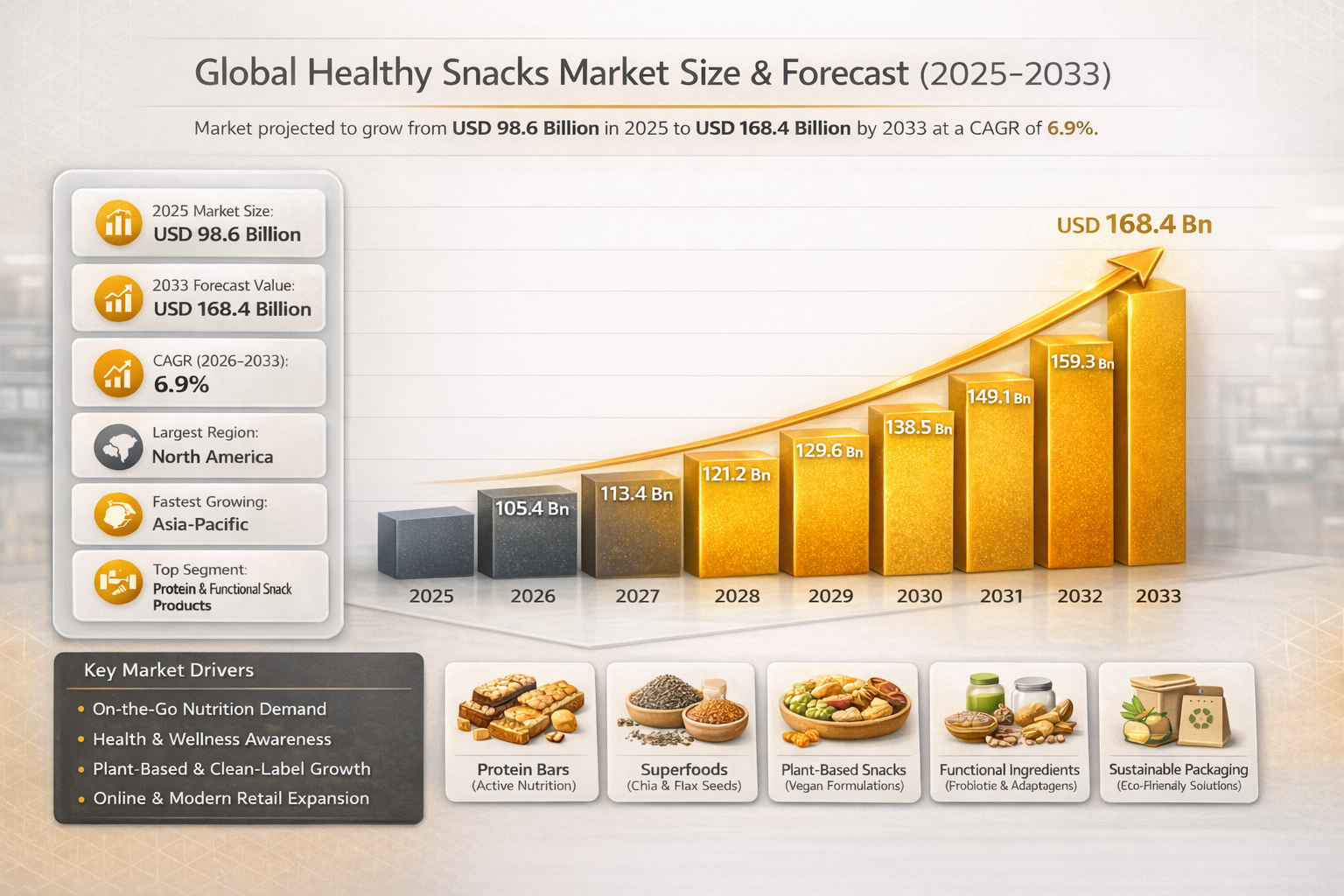
| Metric | Value |
| 2025 Market Size | USD 98.6 Billion |
| 2033 Market Size | USD 168.4 Billion |
| CAGR (2026???2033) | 6.9% |
| Largest Region | North America |
| Fastest Growing Region | Asia-Pacific |
| Top Segment | Protein & Functional Snack Products |
| Key Trend | Clean-Label, Plant-Based, and Functional Nutrition Snacks |
| Future Focus | Personalized Nutrition, Functional Ingredients, and Sustainable Snack Packaging |
Global Healthy Snacks Market Overview
The Global Healthy Snacks Market is experiencing strong expansion as consumers increasingly seek nutritious, convenient, and functional food options to support active and health-conscious lifestyles. Healthy snacks include products formulated with natural ingredients, balanced nutrients, reduced sugar, and functional components such as protein, fiber, vitamins, and antioxidants.According to Pheonix Research, the Global Healthy Snacks Market is valued at USD 98.6 billion in 2025 and is projected to reach USD 168.4 billion by 2033, registering a CAGR of 6.9% during 2026???2033. Market growth is primarily driven by rising health awareness, increasing demand for on-the-go nutrition, and growing interest in functional and plant-based foods.
Healthy snacks include a wide range of protein bars, granola bars, fruit snacks, nut-based snacks, baked snacks, and functional snack products. Manufacturers are increasingly using superfoods, plant-based proteins, whole grains, and natural sweeteners to create innovative and nutrient-dense snack products. North America dominates the market due to high consumer awareness of functional foods, sports nutrition, and clean-label ingredients. Meanwhile, Asia-Pacific is the fastest-growing region, supported by increasing urbanization, rising disposable income, and expanding demand for convenient healthy snack options. The post-2025 outlook highlights strong growth opportunities in plant-based snack products, protein-enriched snacks, and functional superfood ingredients, positioning healthy snacks as a critical segment within the global health and wellness food industry.Key Drivers of Global Healthy Snacks Market Growth
1. Rising Demand for Convenient and Nutritious Food
Busy lifestyles and urbanization are increasing the demand for portable and ready-to-eat healthy snack products.2. Increasing Health Awareness
Consumers are prioritizing low-calorie, low-sugar, high-protein, and fiber-rich snack alternatives to maintain healthy diets.3. Growth of Plant-Based and Clean-Label Foods
The growing preference for natural, organic, and plant-based snack products is accelerating product innovation.4. Expansion of Functional Foods
Manufacturers are incorporating superfoods, probiotics, and adaptogens to enhance the nutritional value of snack products.5. Growth of Online and Modern Retail Channels
Supermarkets, health stores, and e-commerce platforms are expanding accessibility of healthy snack products globally.Global Healthy Snacks Market Segmentation
?? 1. By Product Type
1.1 Snack Bars
1.1.1 Protein Bars
1.1.1.1 Plant-Based Protein Bars
1.1.1.2 Whey Protein Bars
1.1.2 Energy Bars
1.1.2.1 High-Carbohydrate Energy Bars
1.1.2.2 Natural Fruit Energy Bars
1.1.3 Granola Bars
1.1.3.1 Oat-Based Granola Bars
1.1.3.2 Nut and Seed Granola Bars
1.2 Fruit-Based Snacks
1.2.1 Dried Fruit Snacks
1.2.1.1 Dried Mango Snacks
1.2.1.2 Dried Berry Snacks
1.2.2 Fruit Chips
1.2.2.1 Apple Chips
1.2.2.2 Banana Chips
1.3 Nut & Seed Snacks
1.3.1 Nut-Based Snacks
1.3.1.1 Almond Snacks
1.3.1.2 Cashew Snacks
1.3.2 Seed-Based Snacks
1.3.2.1 Pumpkin Seed Snacks
1.3.2.2 Sunflower Seed Snacks
1.4 Baked & Whole Grain Snacks
1.4.1 Baked Chips
1.4.1.1 Vegetable Chips
1.4.1.2 Whole Grain Chips
1.4.2 Whole Grain Crackers
1.4.2.1 Multigrain Crackers
1.4.2.2 Oat Crackers
1.5 Functional & Fortified Snacks
1.5.1 Probiotic Snacks
1.5.1.1 Digestive Health Snacks
1.5.1.2 Gut Health Products
1.5.2 Vitamin-Fortified Snacks
1.5.2.1 Energy Nutrition Snacks
1.5.2.2 Immunity Support Snacks
?? 2. By Ingredient Type
2.1 Plant-Based Ingredients
2.1.1 Plant Protein Ingredients
2.1.1.1 Soy Protein
2.1.1.2 Pea Protein
2.1.2.1 Oats
2.1.2.2 Quinoa
2.2 Natural Sweeteners
2.2.1 Honey-Based Sweeteners2.2.2 Fruit-Based Sweeteners 2.2.3 Natural Sugar Alternatives
2.2.3.1 Stevia
2.2.3.2 Monk Fruit Extract
2.3 Superfood Ingredients
2.3.1 Chia Seeds2.3.2 Flax Seeds 2.3.3 Acai Berry
2.3.4 Spirulina
2.4 Functional Nutritional Ingredients
2.4.1 Probiotics
2.4.2 Prebiotics
2.4.3 Omega Fatty Acids
2.4.4 Antioxidants
?? 3. By Distribution Channel
3.1 Supermarkets & Hypermarkets
3.1.1 Health Food Sections
3.1.2 Packaged Snack Product Shelves
3.2 Online Retail & E-commerce
3.2.1 E-commerce Grocery Platforms
3.2.2 Direct-to-Consumer Healthy Snack Brands
3.3 Specialty Health Stores
3.3.1 Organic Food Stores
3.3.2 Sports Nutrition Retailers
3.4 Convenience Stores
3.4.1 Urban Convenience Stores
3.4.2 Travel Retail Snack Stores
??4. By Consumer Group
4.1 Health-Conscious Consumers
4.1.1 Clean Label Food Consumers
4.1.2 Organic Food Buyers
4.2 Fitness and Sports Nutrition Consumers
4.2.1 Gym Enthusiasts
4.2.2 Professional Athletes
4.3 Young Urban Consumers
4.3.1 Millennials
4.3.2 Gen Z Consumers
4.4 Weight Management Consumers
4.4.1 Low-Calorie Diet Followers
4.4.2 High-Fiber Diet Consumers
?? 5.By Region
5.1 North America
5.2 Europe
5.3 Asia-Pacific
5.4 Middle East & Africa
5.5 South America
Regional Insights of Global Healthy Snacks Market
North America ??? Largest Market
North America leads the market due to strong consumer demand for functional foods, sports nutrition products, and clean-label snack products.
Asia-Pacific ??? Fastest Growing Market
Asia-Pacific is witnessing rapid growth driven by increasing health awareness, urbanization, and growing demand for convenient healthy snack options.
Europe
The European market is expanding due to increasing demand for organic snacks, plant-based products, and functional food innovations.
Middle East & Africa
Rising awareness regarding healthy lifestyles and growing retail infrastructure is supporting market development.
South America
Increasing consumer interest in nutritious snack products and plant-based food options is supporting steady market growth.
Leading Companies in Global Healthy Snacks Market
Nestl?? S.A.
General Mills
PepsiCo Inc.
Kellogg Company
Kind LLC
Clif Bar & Company
Mondelez International
Nature???s Bakery
Strategic Intelligence & AI-Backed Insights
Pheonix Demand Forecast Engine identifies rising demand for convenient nutrition products, plant-based snacks, and functional foods as key long-term growth drivers.
Consumer Behavior Analyzer highlights increasing consumer preference for low-sugar, high-protein, and clean-label snack products.
Innovation Tracker emphasizes plant-based snack innovations, superfood ingredients, and personalized nutrition snacks as major competitive differentiators.
Porter???s Five Forces Analysis reveals strong competition among healthy snack brands, moderate supplier power, and growing opportunities for innovative snack product development.
Why the Global Healthy Snacks Market is Critical
-
Supports growing consumer demand for nutritious and convenient food options.
-
Encourages innovation in functional and plant-based food products.
-
Promotes healthier eating habits and balanced diets.
-
Strengthens the global health and wellness food industry.
-
Expands opportunities for superfood and functional ingredient innovation.
Final Takeaway of Global Healthy Snacks Market
The Global Healthy Snacks Market is steadily transitioning into a functional nutrition, clean-label, and plant-based snacking ecosystem. The Healthy Snacks Market CAGR 2026???2033 of 6.9% reflects strong expansion supported by rising demand for convenient healthy foods, protein-rich snacks, and functional nutrition products. Companies that invest in plant-based ingredients, functional food innovation, and sustainable packaging solutions will be well positioned to capture long-term value creation within the rapidly evolving healthy snack industry. At Pheonix Research, our advanced forecasting frameworks provide in-depth Healthy Snacks Market revenue forecast analysis, competitive benchmarking, and strategic intelligence ??? enabling stakeholders to capitalize on the Post-2025 outlook for the Global Healthy Snacks Market with data-backed confidence and sustainable growth strategies.???? Social Mentions & Publication Channels
Explore deeper insights and follow our cross-platform updates on??LinkedIn, and??X??for continuous intelligence and market coverage.
LinkedIn : https://www.linkedin.com/feed/update/urn:li:activity:7438546234962825216Table of Contents
1. Market Forecast Snapshot (2026???2033)
1.1 2025 Market Size ??? USD 98.6 Billion
1.2 2033 Market Size ??? USD 168.4 Billion
1.3 CAGR (2026???2033) ??? 6.9%
1.4 Largest Region ??? North America
1.5 Fastest Growing Region ??? Asia-Pacific
1.6 Top Segment ??? Protein & Functional Snack Products
1.7 Key Trend ??? Clean-Label, Plant-Based, and Functional Nutrition Snacks
1.8 Future Focus ??? Personalized Nutrition, Functional Ingredients, and Sustainable Snack Packaging
2. Global Healthy Snacks Market Overview
2.1 Market Definition & Scope
2.2 Evolution of the Healthy Snacking Industry
2.3 Rising Demand for Convenient and Nutritious Food
2.4 Growth of Plant-Based and Functional Snack Products
2.5 Expansion of On-the-Go Nutrition Trends
2.6 Post-2025 Market Outlook
3. Key Drivers of Global Healthy Snacks Market Growth
3.1 Rising Demand for Convenient and Nutritious Food
3.2 Increasing Health Awareness and Preventive Nutrition
3.3 Growth of Plant-Based and Clean-Label Foods
3.4 Expansion of Functional Foods and Superfood Ingredients
3.5 Growth of Online and Modern Retail Channels
4. Market Segmentation by Product Type
4.1 Snack Bars
4.1.1 Protein Bars
4.1.1.1 Plant-Based Protein Bars
4.1.1.2 Whey Protein Bars
4.1.2 Energy Bars
4.1.2.1 High-Carbohydrate Energy Bars
4.1.2.2 Natural Fruit Energy Bars
4.1.3 Granola Bars
4.1.3.1 Oat-Based Granola Bars
4.1.3.2 Nut and Seed Granola Bars
4.2 Fruit-Based Snacks
4.2.1 Dried Fruit Snacks
4.2.1.1 Dried Mango Snacks
4.2.1.2 Dried Berry Snacks
4.2.2 Fruit Chips
4.2.2.1 Apple Chips
4.2.2.2 Banana Chips
4.3 Nut & Seed Snacks
4.3.1 Nut-Based Snacks
4.3.1.1 Almond Snacks
4.3.1.2 Cashew Snacks
4.3.2 Seed-Based Snacks
4.3.2.1 Pumpkin Seed Snacks
4.3.2.2 Sunflower Seed Snacks
4.4 Baked & Whole Grain Snacks
4.4.1 Baked Chips
4.4.1.1 Vegetable Chips
4.4.1.2 Whole Grain Chips
4.4.2 Whole Grain Crackers
4.4.2.1 Multigrain Crackers
4.4.2.2 Oat Crackers
4.5 Functional & Fortified Snacks
4.5.1 Probiotic Snacks
4.5.1.1 Digestive Health Snacks
4.5.1.2 Gut Health Products
4.5.2 Vitamin-Fortified Snacks
4.5.2.1 Energy Nutrition Snacks
4.5.2.2 Immunity Support Snacks
5. Market Segmentation by Ingredient Type
5.1 Plant-Based Ingredients
5.1.1 Plant Protein Ingredients
5.1.1.1 Soy Protein
5.1.1.2 Pea Protein
5.1.2 Whole Grain Ingredients
5.1.2.1 Oats
5.1.2.2 Quinoa
5.2 Natural Sweeteners
5.2.1 Honey-Based Sweeteners
5.2.2 Fruit-Based Sweeteners
5.2.3 Natural Sugar Alternatives
5.2.3.1 Stevia
5.2.3.2 Monk Fruit Extract
5.3 Superfood Ingredients
5.3.1 Chia Seeds
5.3.2 Flax Seeds
5.3.3 Acai Berry
5.3.4 Spirulina
5.4 Functional Nutritional Ingredients
5.4.1 Probiotics
5.4.2 Prebiotics
5.4.3 Omega Fatty Acids
5.4.4 Antioxidants
6. Market Segmentation by Distribution Channel
6.1 Supermarkets & Hypermarkets
6.1.1 Health Food Sections
6.1.2 Packaged Snack Product Shelves
6.2 Online Retail & E-commerce
6.2.1 E-commerce Grocery Platforms
6.2.2 Direct-to-Consumer Healthy Snack Brands
6.3 Specialty Health Stores
6.3.1 Organic Food Stores
6.3.2 Sports Nutrition Retailers
6.4 Convenience Stores
6.4.1 Urban Convenience Stores
6.4.2 Travel Retail Snack Stores
7. Market Segmentation by Consumer Group
7.1 Health-Conscious Consumers
7.1.1 Clean Label Food Consumers
7.1.2 Organic Food Buyers
7.2 Fitness and Sports Nutrition Consumers
7.2.1 Gym Enthusiasts
7.2.2 Professional Athletes
7.3 Young Urban Consumers
7.3.1 Millennials
7.3.2 Gen Z Consumers
7.4 Weight Management Consumers
7.4.1 Low-Calorie Diet Followers
7.4.2 High-Fiber Diet Consumers
8. Market Segmentation by Region
8.1 North America
8.2 Europe
8.3 Asia-Pacific
8.4 Middle East & Africa
8.5 South America
9. Regional Insights
9.1 North America ??? Largest Market
9.2 Asia-Pacific ??? Fastest Growing Market
9.3 Europe ??? Growing Demand for Organic and Functional Snacks
9.4 Middle East & Africa ??? Emerging Healthy Snacking Market
9.5 South America ??? Increasing Demand for Nutritious Snack Products
10. Competitive Landscape
10.1 Market Share Analysis
10.2 Competitive Positioning Matrix
10.3 Product Innovation and Functional Ingredient Strategies
10.4 Plant-Based Snack Product Development
10.5 Distribution and Retail Expansion Strategies
11. Leading Companies
11.1 Nestl?? S.A.
11.2 General Mills
11.3 PepsiCo Inc.
11.4 Kellogg Company
11.5 Kind LLC
11.6 Clif Bar & Company
11.7 Mondelez International
11.8 Nature???s Bakery
12. Strategic Intelligence & AI-Backed Insights
12.1 Pheonix Demand Forecast Engine
12.2 Consumer Behavior & Health Trend Analytics
12.3 Innovation Tracker ??? Functional and Plant-Based Snacks
12.4 Porter???s Five Forces Analysis
13. Sustainability & Regulatory Landscape
13.1 Food Safety and Nutritional Labeling Regulations
13.2 Clean-Label and Organic Certification Standards
13.3 Sustainable Ingredient Sourcing
13.4 Eco-Friendly Snack Packaging Innovations
14. Market Significance
14.1 Supporting the Global Healthy Snacking Trend
14.2 Promoting Balanced Diets and Preventive Nutrition
14.3 Driving Innovation in Functional and Plant-Based Foods
14.4 Expanding Opportunities for Superfood and Functional Ingredients
14.5 Strengthening the Global Health and Wellness Food Industry
15. Final Takeaway
15.1 Market Growth Outlook (2026???2033)
15.2 Expansion of Plant-Based and Functional Snack Products
15.3 Growth of Personalized Nutrition Snacks
15.4 Innovation in Sustainable Packaging and Ingredient Technologies
15.5 Strategic Recommendations for Industry Stakeholders
16. Appendix
17. About Us
18. Disclaimer
Competitive Landscape
Competitive Landscape of the Global Healthy Snacks Market
Executive Framing
The Global Healthy Snacks Market is moderately fragmented with high competitive intensity, driven by the presence of multinational food corporations, specialized health snack brands, and emerging clean-label startups. Key players such as Nestl?? S.A., General Mills, PepsiCo Inc., Kellogg Company, Mondelez International, Kind LLC, Clif Bar & Company, and Nature???s Bakery dominate the competitive landscape through diversified product portfolios, strong global distribution networks, and continuous innovation in functional and plant-based snack categories.
Current Market Reality
The market is rapidly evolving as consumers increasingly prioritize convenience, nutrition, and clean-label ingredients. Protein and functional snack products remain the leading segment, while plant-based snacks, superfood-based products, and low-sugar alternatives are gaining strong traction.
North America leads due to high awareness of functional foods and established healthy snack brands, while Asia-Pacific is emerging as a high-growth region driven by urbanization, rising disposable incomes, and increasing demand for on-the-go nutrition. Manufacturers are focusing on incorporating plant proteins, whole grains, and functional ingredients such as probiotics and adaptogens to create differentiated products.
Key Signals and Evidence
- Rising demand for clean-label, plant-based, and protein-rich snack products.
- Strong growth in functional snacks enriched with probiotics, fiber, and superfoods.
- Expansion of healthy snack offerings across supermarkets, convenience stores, and e-commerce platforms.
- Increasing preference for low-sugar, low-calorie, and nutrient-dense snack alternatives.
- Growing influence of younger, health-conscious consumers seeking convenient nutrition.
Strategic Implications
- Product Innovation: Expanding portfolios with functional, protein-rich, and plant-based snack products.
- Clean-Label Positioning: Emphasizing natural ingredients, transparency, and minimal processing.
- Omnichannel Distribution: Strengthening presence across retail, convenience, and digital platforms.
- Targeted Consumer Segments: Catering to fitness enthusiasts, young urban consumers, and health-conscious buyers.
- Sustainability Focus: Investing in eco-friendly packaging and responsible sourcing practices.
Forward Outlook
By 2033, the Global Healthy Snacks Market is projected to reach approximately USD 168.4 billion, growing at a CAGR of ~6.9%. North America will continue to dominate due to strong brand presence and consumer awareness, while Asia-Pacific is expected to emerge as a key growth engine driven by evolving dietary habits and expanding retail infrastructure.
The competitive landscape will increasingly focus on functional nutrition, personalized snacking solutions, and sustainable product innovation. Companies that successfully integrate clean-label formulations, functional ingredients, and global distribution strategies will gain a strong competitive advantage in the evolving healthy snacks ecosystem.
Value Chain
Global Healthy Snacks Market: Value Chain & Market Dynamics
Executive Framing
The Global Healthy Snacks Market is evolving into a nutrition-focused, convenience-driven, and functional food ecosystem, supported by rising demand for clean-label, plant-based, and nutrient-dense snack products. Healthy snacks are increasingly positioned as essential components of modern dietary habits, catering to active and health-conscious consumers.
The market follows a hybrid operational model, where large multinational companies leverage global supply chains, mass production, and strong retail networks, while emerging brands focus on premium ingredients, functional benefits, and niche health positioning.
Current Market Reality
The supply chain exhibits a moderate complexity level, involving raw material sourcing (nuts, grains, fruits), ingredient processing, product formulation, packaging, and distribution. Increasing use of functional ingredients and plant-based inputs adds complexity to sourcing and quality control.
Distribution is highly multichannel, including supermarkets, hypermarkets, online platforms, specialty health stores, and convenience retail outlets, ensuring wide product availability and consumer reach.
Key Signals and Evidence
- Market growth from USD 98.6 billion (2025) to USD 168.4 billion (2033) at a CAGR of 6.9%.
- Rising demand for convenient, nutritious, and on-the-go snack products.
- Increasing adoption of plant-based, clean-label, and low-sugar foods.
- Expansion of functional and fortified snack categories.
- Growing innovation in superfood ingredients and personalized nutrition.
Strategic Implications
Companies are focusing on product innovation, clean-label transparency, and functional ingredient integration to enhance competitiveness. Established players emphasize scale, brand strength, and global distribution, while emerging brands compete through premiumization, plant-based innovation, and targeted health benefits.
Digital transformation, including e-commerce expansion, direct-to-consumer strategies, and personalized nutrition platforms, is becoming critical for consumer engagement and market growth.
Sustainability is gaining importance, with companies investing in eco-friendly packaging, responsible sourcing, and sustainable ingredient supply chains.
Forward Outlook
The Global Healthy Snacks Market is expected to evolve into a high-growth, innovation-led segment within the global health and wellness food industry, driven by changing consumer lifestyles and dietary preferences.
- Expansion of plant-based, protein-rich, and functional snack products
- Growth in personalized and targeted nutrition solutions
- Rising demand for clean-label and minimally processed foods
- Strengthening of omnichannel retail and global distribution networks
Companies that align with health trends, continuous innovation, and efficient supply chain strategies will be well-positioned to capture long-term growth opportunities in the global healthy snacks market.
Investment Activity
Investment & Funding Dynamics ??? Global Healthy Snacks Market
Executive Framing
Current Market Reality
Valued at USD 98.6 billion in 2025 and projected to reach USD 168.4 billion by 2033 (CAGR 6.9%), the market reflects consistent investment momentum. North America remains the leading investment hub due to strong demand for functional foods and established health snack brands, while Asia-Pacific is the fastest-growing region supported by urbanization, rising disposable incomes, and increasing health awareness. Major companies such as Nestl?? S.A., PepsiCo Inc., and General Mills are investing in product innovation, plant-based snacks, and expansion of global distribution networks.
Key Signals and Evidence
- Protein & Functional Snack Growth: Rising investments in high-protein, fiber-rich, and functional snack products.
- Plant-Based Snack Expansion: Strong funding for plant-based ingredients, vegan snacks, and clean-label formulations.
- On-the-Go Nutrition Demand: Increasing capital allocation toward convenient, ready-to-eat snack formats.
- Superfood & Functional Ingredients: Growing focus on probiotics, adaptogens, and antioxidant-rich snack innovations.
- E-Commerce & D2C Channels: Expansion of online retail platforms and direct-to-consumer healthy snack brands.
- Clean-Label Product Development: Investment in natural ingredients, reduced sugar, and additive-free snack products.
- Sustainable Packaging Innovation: Rising funding for eco-friendly and recyclable snack packaging solutions.
Strategic Implications
Companies that combine strong product innovation with clean-label positioning and functional nutrition benefits are best positioned for long-term growth. Investors are prioritizing brands offering differentiated snack portfolios, including plant-based, protein-enriched, and functional products. Strategic partnerships with retail chains, e-commerce platforms, and fitness ecosystems will be critical to scaling market reach and enhancing brand visibility.
Forward Outlook
From 2026 to 2033, investment in the Global Healthy Snacks Market is expected to accelerate across functional snack innovation, personalized nutrition, and sustainable product development. Funding will increasingly target AI-driven consumer insights, innovative ingredient sourcing, and premium health-focused snack brands. M&A activity is expected to rise as companies consolidate capabilities and expand their presence in the competitive healthy snacking landscape.
Technology & Innovation
Global Healthy Snacks Market: Technology & Innovation
Executive Framing
Technology and innovation in the Global Healthy Snacks Market are centered on delivering nutrient-dense, convenient, and personalized snacking solutions. As consumers increasingly prioritize health, wellness, and functional nutrition, companies are leveraging food science, digital technologies, and advanced ingredient innovation to create snacks that align with evolving dietary preferences and lifestyle needs.
Current Market Reality
Valued at USD 98.6 billion in 2025 and projected to reach USD 168.4 billion by 2033 at a CAGR of 6.9%, the market is witnessing rapid innovation across product development, ingredient sourcing, and manufacturing technologies. North America leads in functional snack innovation and premium product offerings, while Asia-Pacific is emerging as a high-growth region driven by urbanization, digital retail expansion, and increasing demand for convenient nutrition solutions.
Key Signals and Evidence
- Functional Ingredient Innovation: Integration of superfoods, probiotics, adaptogens, and plant-based proteins to enhance nutritional value and targeted health benefits.
- Plant-Based & Clean-Label Formulations: Increased use of natural ingredients, organic components, and minimal processing to meet consumer demand for transparency and health.
- Personalized Nutrition Solutions: Emergence of AI-driven dietary recommendations and customizable snack products tailored to individual health goals.
- Advanced Food Processing Technologies: Adoption of baking, extrusion, and low-temperature processing techniques to preserve nutrients and improve product quality.
- Smart Packaging & Sustainability: Development of eco-friendly packaging, biodegradable materials, and QR-enabled traceability systems to enhance sustainability and trust.
- Digital Retail & Direct-to-Consumer Models: Expansion of e-commerce platforms and subscription-based snack services enabling personalized and convenient purchasing experiences.
Strategic Implications
Companies investing in functional ingredient development, personalized nutrition technologies, and sustainable packaging solutions will gain a competitive advantage in the evolving market. Expanding into premium, plant-based, and performance-focused snack categories can drive higher margins and brand differentiation. Additionally, leveraging digital platforms for consumer engagement and data-driven product innovation will be critical for long-term success.
Forward Outlook
The market is expected to evolve toward highly personalized, functional, and sustainability-driven snacking ecosystems. Future innovation will focus on improving nutrient bioavailability, enhancing taste and texture of healthy formulations, and integrating digital health insights into snack development. Healthy snacks will continue to play a central role in supporting global wellness, preventive healthcare, and active lifestyles.
Market Risk
Risk Factors and Disruption Threats in the Global Healthy Snacks Market
Executive Framing
The Global Healthy Snacks Market is witnessing robust growth as consumers increasingly prioritize convenient, nutritious, and functional food options. Valued at USD 98.6 billion in 2025 and projected to reach USD 168.4 billion by 2033 at a CAGR of 6.9%, the market is emerging as a core pillar of the global health and wellness food ecosystem, driven by demand for clean-label, plant-based, and protein-rich snack products.
Current Market Reality
North America dominates the market due to high consumer awareness, strong demand for functional foods, and the presence of established snack brands. Asia-Pacific is the fastest-growing region, supported by rapid urbanization, rising disposable incomes, and increasing adoption of healthy snacking habits. Protein and functional snack products lead the market, reflecting strong consumer demand for performance-oriented and nutrient-dense foods.
Key Signals and Evidence
- Rising consumer demand for convenient, on-the-go nutrition products.
- Increasing preference for low-sugar, high-protein, and fiber-rich snacks.
- Growth in plant-based, clean-label, and organic snack product offerings.
- Expansion of e-commerce and modern retail channels for snack distribution.
- Innovation in functional ingredients such as probiotics, superfoods, and adaptogens.
Strategic Implications
- Invest in functional and protein-enriched snack product development.
- Expand plant-based and clean-label product portfolios.
- Strengthen omnichannel distribution including e-commerce and direct-to-consumer models.
- Focus on sustainable packaging and environmentally friendly product innovation.
- Leverage branding and consumer education to differentiate in a competitive market.
Forward Outlook
The market is expected to evolve into a highly dynamic and innovation-driven ecosystem centered around personalized nutrition, functional ingredients, and sustainable snacking solutions. Growth will be fueled by increasing health awareness, product diversification, and technological advancements in food processing. Companies that prioritize innovation, affordability, and sustainability will secure long-term competitive advantage in the global healthy snacks market.
Regulatory Landscape
Regulatory & Policy Landscape: Global Healthy Snacks Market
Executive Framing
The Global Healthy Snacks Market operates within a dynamic regulatory environment shaped by food safety standards, nutritional labeling requirements, and health claim regulations. Key authorities such as the U.S. FDA, EFSA (Europe), FSSAI (India), and other national food safety agencies govern product formulation, ingredient approvals, and labeling compliance.
Healthy snacks are regulated under food and functional food categories, with increasing scrutiny on claims related to ???low sugar,??? ???high protein,??? ???organic,??? and ???clean-label.??? As consumers demand transparency, regulatory bodies are strengthening rules around ingredient disclosure and nutritional accuracy.
Current Market Reality
The market faces moderate regulatory fragmentation across regions, particularly in labeling standards, permissible health claims, and ingredient approvals. Developed markets such as North America and Europe emphasize strict compliance with nutritional transparency and clinical validation for functional claims.
Emerging markets in Asia-Pacific are rapidly strengthening regulatory frameworks to align with global standards. Meanwhile, concerns regarding misleading health claims, hidden sugars, and ultra-processed ingredients are driving tighter regulations and higher compliance expectations for manufacturers.
Key Signals and Evidence
- Strict regulations on nutritional labeling, including calorie count, sugar content, and ingredient transparency.
- Increased scrutiny on ???clean-label,??? ???organic,??? and ???natural??? product claims.
- Mandatory compliance with food safety standards such as HACCP and GMP.
- Regulation of functional ingredients such as probiotics, superfoods, and plant proteins.
- Growing focus on front-of-pack labeling systems and warning labels for high sugar or salt content.
- Rising regulatory attention on sustainable packaging and environmental impact.
Strategic Implications
Companies must invest in transparent labeling practices, clean ingredient sourcing, and compliance with global food safety standards. Reformulation strategies focusing on low sugar, high protein, and natural ingredients are critical to meet both regulatory and consumer expectations.
Aligning product portfolios with region-specific regulations and obtaining certifications such as organic, non-GMO, and plant-based can enhance brand trust and facilitate global expansion. Digital traceability and supply chain transparency are becoming key differentiators in regulatory compliance.
Forward Outlook (2026???2033)
Regulatory frameworks are expected to become more stringent, particularly around sugar reduction, ultra-processed food classification, and sustainability practices. Governments are likely to introduce stricter front-of-pack labeling and impose limits on misleading health claims.
Technological advancements such as AI-driven nutritional analysis, blockchain-based traceability, and smart labeling will play a crucial role in ensuring compliance and building consumer trust. Companies proactively adapting to these evolving regulations will gain competitive advantages in the global market.