
Global Yoga Bar Market size and share Analysis 2026-2033
Global Yoga Bar Market Forecast Snapshot: 2026???2033
| Metric | Value |
| 2025 Market Size | USD 3.4 Billion |
| 2033 Market Size | USD 6.1 Billion |
| CAGR (2026???2033) | 7.6% |
| Largest Region | North America |
| Fastest Growing Region | Asia-Pacific |
| Top Segment | Protein & Functional Nutrition Bars |
| Key Trend | Clean-Label, Plant-Based, and High-Protein Snack Bars |
| Future Focus | Functional Ingredients, Personalized Nutrition Bars, and Healthy Snacking |
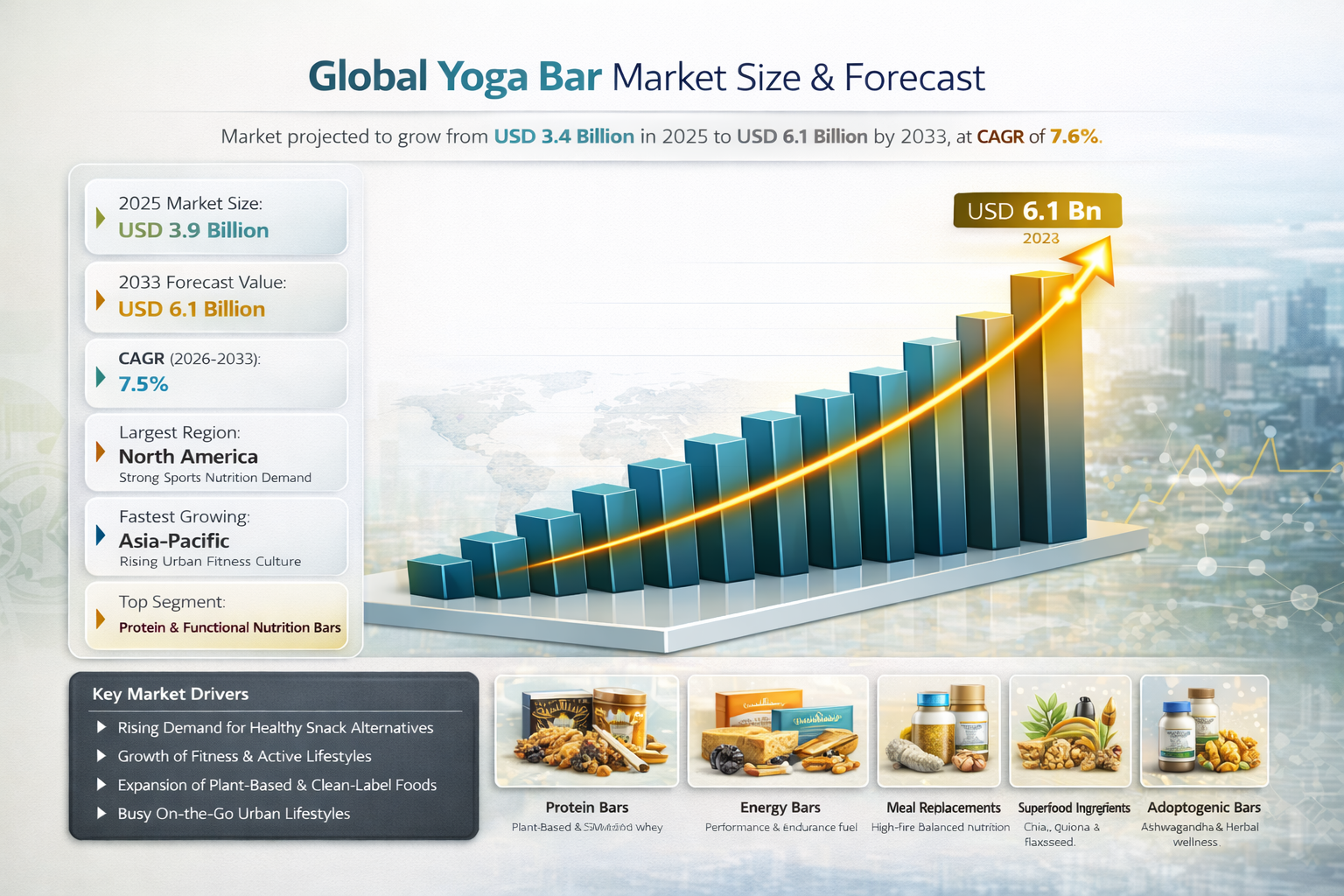
Global Yoga Bar Market Overview
Global Yoga Bar Market is buzzing. Yoga bars are trending ??? healthy, nutritious, and convenient ??? packing protein, fiber, and vitamins for fitness buffs, pros, and health lovers on-the-go. As people eat smarter, this market's growing, catering to active lifestyles and functional snacking needs.
According to Pheonix Research, the Global Yoga Bar Market is valued at USD 3.4 billion in 2025 and is projected to reach USD 6.1 billion by 2033, registering a CAGR of 7.6% during 2026???2033. Market expansion is driven by increasing awareness of balanced nutrition, rising demand for protein-rich snacks, and the growing popularity of on-the-go healthy food products.
Yoga bars are popular as energy, protein, or meal replacement bars ??? fitness and wellness folks love 'em! Now, plant-based proteins, natural sweeteners, and clean ingredients are making these snacks even healthier ??? innovation's on!
North America currently dominates the market due to strong consumer demand for functional foods, sports nutrition products, and healthy snack alternatives. Meanwhile, Asia-Pacific is emerging as the fastest-growing region, supported by rising fitness awareness, expanding middle-class populations, and the rapid growth of health-focused food brands.
The post-2025 outlook highlights strong opportunities in plant-based nutrition bars, personalized nutrition snacks, and functional superfood ingredients, positioning yoga bars as a key segment within the global health and wellness snack industry.
Key Drivers of Global Yoga Bar Market Growth
1. Rising Demand for Healthy Snack Alternatives
Consumers are increasingly replacing traditional high-calorie snacks with nutrient-dense snack bars that provide balanced nutrition.
2. Growing Fitness and Active Lifestyle Trends
Increasing participation in fitness activities, gym culture, and sports nutrition is boosting demand for protein and energy bars.
3. Expansion of Plant-Based and Clean-Label Foods
Consumers prefer snack bars made with natural ingredients, plant proteins, nuts, seeds, and superfoods.
4. Growth of On-the-Go Nutrition Products
Busy lifestyles and urbanization are increasing demand for convenient, portable, and ready-to-eat nutrition bars.
5. Innovation in Functional Ingredients
Manufacturers are incorporating functional ingredients such as probiotics, adaptogens, and superfoods to enhance nutritional benefits.
Global Yoga Bar Market Segmentation
1. By Product Type
1.1 Protein Bars
1.1.1 Plant-Based Protein Bars
1.1.1.1 Soy Protein Bars
1.1.1.2 Pea Protein Bars
1.1.2 Dairy-Based Protein Bars
1.1.2.1 Whey Protein Bars
1.1.2.2 Casein Protein Bars
1.2 Energy Bars
1.2.1 High-Carbohydrate Energy Bars
1.2.1.1 Athlete Performance Bars
1.2.1.2 Endurance Nutrition Bars
1.2.2 Natural Energy Bars
1.2.2.1 Fruit-Based Bars
1.2.2.2 Nut and Seed Bars
1.3 Meal Replacement Bars
1.3.1 Balanced Nutrition Bars
1.3.1.1 High-Fiber Nutrition Bars
1.3.1.2 Vitamin-Fortified Bars
1.3.2 Weight Management Bars
1.3.2.1 Low-Calorie Nutrition Bars
1.3.2.2 Keto-Friendly Snack Bars
1.4 Functional Snack Bars
1.4.1 Superfood Nutrition Bars
1.4.1.1 Chia and Flaxseed Bars
1.4.1.2 Quinoa and Oat Bars
1.4.2 Adaptogenic Bars
1.4.2.1 Ashwagandha-Enriched Bars
1.4.2.2 Herbal Wellness Bars
??2. By Ingredient Type
2.1 Plant-Based Ingredients
2.1.1 Plant Protein Ingredients
2.1.1.1 Soy Protein
2.1.1.2 Pea Protein
2.1.2 Plant-Based Nutritional Components
2.1.2.1 Nuts and Seeds
2.1.2.2 Whole Grain Ingredients
2.2 Natural Sweeteners
2.2.1 Honey-Based Sweeteners
2.2.2 Date and Fruit Syrups
2.2.3 Natural Sugar Alternatives
2.2.3.1 Stevia
2.2.3.2 Monk Fruit Extract
2.3 Functional Ingredients
2.3.1 Probiotics and Prebiotics
2.3.1.1 Digestive Health Ingredients
2.3.1.2 Gut Health Formulations
2.3.2 Adaptogenic Ingredients
2.3.2.1 Ashwagandha
2.3.2.2 Ginseng Extract
?? 3. By Distribution Channel
3.1 Supermarkets & Hypermarkets
3.1.1 Health and Wellness Food Sections
3.1.2 Functional Snack Product Shelves
3.2 Online Retail & E-commerce
3.2.1 E-commerce Marketplaces
3.2.2 Direct-to-Consumer Nutrition Brands
3.3 Specialty Health Stores
3.3.1 Organic Food Stores
3.3.2 Sports Nutrition Retailers
3.4 Convenience Stores
3.4.1 Urban Convenience Stores
3.4.2 Fitness Center Retail Counters
??4. By Consumer Group
4.1 Fitness and Sports Nutrition Consumers 4.1.1 Gym Enthusiasts4.1.2 Professional Athletes
4.2 Health-Conscious Consumers 4.2.1 Weight Management Consumers
4.2.2 Lifestyle Diet Followers
4.3 Young Urban Consumers 4.3.1 Millennials
4.3.2 Gen Z Consumers
4.4 Working Professionals 4.4.1 On-the-Go Snack Consumers
4.4.2 Meal Replacement Users
?? 5.By Region
5.1 North America
5.2 Europe
5.3 Asia-Pacific
5.4 Middle East & Africa
5.5 South America
Regional Insights of Global Yoga Bar Market
North America ??? Largest Market
North America dominates the market due to high consumer awareness of functional foods, sports nutrition, and healthy snack alternatives, along with strong presence of established nutrition bar brands.
Asia-Pacific ??? Fastest Growing Market
Asia-Pacific is witnessing rapid growth driven by rising fitness awareness, increasing disposable income, and growing demand for plant-based nutrition products in countries such as India, China, and Japan.
Europe
The European market is expanding through increasing demand for organic snack bars, clean-label ingredients, and functional nutrition products.
Middle East & Africa
Growing health awareness and expansion of modern retail channels are supporting gradual market development.
South America
Increasing demand for convenient and healthy snack options is contributing to steady market growth.
Leading Companies in Global Yoga Bar Market
Yoga Bar (India)
Clif Bar & Company
General Mills (Nature Valley)
Kellogg Company
Quest Nutrition
Kind LLC
RXBAR (Kellogg)
Oatein
Leading companies are focusing on plant-based formulations, clean-label ingredients, and functional nutrition innovations to strengthen their competitive position in the global market. The largest company among the listed companies is General Mills (Nature Valley).
Strategic Intelligence & AI-Backed Insights
Pheonix Demand Forecast Engine identifies rising demand for healthy snacking, plant-based protein products, and functional nutrition bars as key market growth drivers.
Consumer Behavior Analyzer highlights increasing consumer preference for clean-label ingredients, protein-rich snacks, and convenient nutrition products.
Innovation Tracker emphasizes plant-based protein bars, superfood snack bars, and adaptogenic functional ingredients as major competitive differentiators.
Porter???s Five Forces Analysis reveals strong competition among healthy snack brands, moderate supplier power, and growing opportunities for innovative nutrition-focused snack products.
Why the Global Yoga Bar Market is Critical
-
Supports the growing demand for convenient and healthy snack alternatives.
-
Strengthens the global functional food and sports nutrition industries.
-
Encourages innovation in plant-based and clean-label nutrition products.
-
Addresses rising consumer focus on fitness, wellness, and balanced diets.
-
Expands opportunities for functional ingredient and superfood innovation.
Final Takeaway of Global Yoga Bar Market
The Global Yoga Bar Market is steadily transitioning into a functional nutrition, healthy snacking, and plant-based wellness ecosystem. The Yoga Bar Market CAGR 2026???2033 of 7.6% reflects strong expansion supported by rising demand for protein-rich snacks, clean-label ingredients, and convenient on-the-go nutrition products.
Companies that effectively invest in functional ingredient innovation, plant-based protein formulations, personalized nutrition solutions, and sustainable product development will be well positioned to capture long-term value creation within the rapidly evolving healthy snack industry.
At Pheonix Research, our advanced forecasting frameworks provide in-depth Yoga Bar market revenue forecast analysis, competitive benchmarking, and strategic intelligence ??? enabling stakeholders to capitalize on the Post-2025 outlook for the Global Yoga Bar Market with data-backed confidence and sustainable growth strategies.
???? Social Mentions & Publication Channels
Explore deeper insights and follow our cross-platform updates on??LinkedIn, and??X??for continuous intelligence and market coverage.
LinkedIn : https://www.linkedin.com/feed/update/urn:li:activity:7438224867189186560
??X : https://x.com/Pheonix_Insight/status/2032460678850896132?s=20
Table of Contents
1. Market Forecast Snapshot (2026???2033)
1.1 2025 Market Size ??? USD 3.4 Billion
1.2 2033 Market Size ??? USD 6.1 Billion
1.3 CAGR (2026???2033) ??? 7.6%
1.4 Largest Region ??? North America
1.5 Fastest Growing Region ??? Asia-Pacific
1.6 Top Segment ??? Protein & Functional Nutrition Bars
1.7 Key Trend ??? Clean-Label, Plant-Based, and High-Protein Snack Bars
1.8 Future Focus ??? Functional Ingredients, Personalized Nutrition Bars, and Healthy Snacking
2. Global Yoga Bar Market Overview
2.1 Market Definition & Scope
2.2 Evolution of the Global Nutrition Bar Industry
2.3 Rising Demand for Healthy and Functional Snacks
2.4 Growth of Plant-Based and Clean-Label Nutrition Products
2.5 Expansion of On-the-Go Nutrition and Active Lifestyle Trends
2.6 Post-2025 Market Outlook
3. Key Drivers of Global Yoga Bar Market Growth
3.1 Rising Demand for Healthy Snack Alternatives
3.2 Growing Fitness and Active Lifestyle Trends
3.3 Expansion of Plant-Based and Clean-Label Foods
3.4 Growth of On-the-Go Nutrition Products
3.5 Innovation in Functional Ingredients
4. Market Segmentation by Product Type
4.1 Protein Bars
4.1.1 Plant-Based Protein Bars
4.1.1.1 Soy Protein Bars
4.1.1.2 Pea Protein Bars
4.1.2 Dairy-Based Protein Bars
4.1.2.1 Whey Protein Bars
4.1.2.2 Casein Protein Bars
4.2 Energy Bars
4.2.1 High-Carbohydrate Energy Bars
4.2.1.1 Athlete Performance Bars
4.2.1.2 Endurance Nutrition Bars
4.2.2 Natural Energy Bars
4.2.2.1 Fruit-Based Bars
4.2.2.2 Nut and Seed Bars
4.3 Meal Replacement Bars
4.3.1 Balanced Nutrition Bars
4.3.1.1 High-Fiber Nutrition Bars
4.3.1.2 Vitamin-Fortified Bars
4.3.2 Weight Management Bars
4.3.2.1 Low-Calorie Nutrition Bars
4.3.2.2 Keto-Friendly Snack Bars
4.4 Functional Snack Bars
4.4.1 Superfood Nutrition Bars
4.4.1.1 Chia and Flaxseed Bars
4.4.1.2 Quinoa and Oat Bars
4.4.2 Adaptogenic Bars
4.4.2.1 Ashwagandha-Enriched Bars
4.4.2.2 Herbal Wellness Bars
5. Market Segmentation by Ingredient Type
5.1 Plant-Based Ingredients
5.1.1 Plant Protein Ingredients
5.1.1.1 Soy Protein
5.1.1.2 Pea Protein
5.1.2 Plant-Based Nutritional Components
5.1.2.1 Nuts and Seeds
5.1.2.2 Whole Grain Ingredients
5.2 Natural Sweeteners
5.2.1 Honey-Based Sweeteners
5.2.2 Date and Fruit Syrups
5.2.3 Natural Sugar Alternatives
5.2.3.1 Stevia
5.2.3.2 Monk Fruit Extract
5.3 Functional Ingredients
5.3.1 Probiotics and Prebiotics
5.3.1.1 Digestive Health Ingredients
5.3.1.2 Gut Health Formulations
5.3.2 Adaptogenic Ingredients
5.3.2.1 Ashwagandha
5.3.2.2 Ginseng Extract
6. Market Segmentation by Distribution Channel
6.1 Supermarkets & Hypermarkets
6.1.1 Health and Wellness Food Sections
6.1.2 Functional Snack Product Shelves
6.2 Online Retail & E-commerce
6.2.1 E-commerce Marketplaces
6.2.2 Direct-to-Consumer Nutrition Brands
6.3 Specialty Health Stores
6.3.1 Organic Food Stores
6.3.2 Sports Nutrition Retailers
6.4 Convenience Stores
6.4.1 Urban Convenience Stores
6.4.2 Fitness Center Retail Counters
7. Market Segmentation by Consumer Group
7.1 Fitness and Sports Nutrition Consumers
7.1.1 Gym Enthusiasts
7.1.2 Professional Athletes
7.2 Health-Conscious Consumers
7.2.1 Weight Management Consumers
7.2.2 Lifestyle Diet Followers
7.3 Young Urban Consumers
7.3.1 Millennials
7.3.2 Gen Z Consumers
7.4 Working Professionals
7.4.1 On-the-Go Snack Consumers
7.4.2 Meal Replacement Users
8. Market Segmentation by Region
8.1 North America
8.2 Europe
8.3 Asia-Pacific
8.4 Middle East & Africa
8.5 South America
9. Regional Insights
9.1 North America ??? Largest Market
9.2 Asia-Pacific ??? Fastest Growing Market
9.3 Europe ??? Growing Demand for Clean-Label Snack Bars
9.4 Middle East & Africa ??? Emerging Healthy Snacking Market
9.5 South America ??? Expanding Functional Snack Industry
10. Competitive Landscape
10.1 Market Share Analysis
10.2 Competitive Positioning Matrix
10.3 Product Innovation & Functional Ingredient Strategies
10.4 Plant-Based Nutrition Bar Development
10.5 Pricing and Distribution Strategies
11. Leading Companies
11.1 Yoga Bar (India)
11.2 Clif Bar & Company
11.3 General Mills (Nature Valley)
11.4 Kellogg Company
11.5 Quest Nutrition
11.6 Kind LLC
11.7 RXBAR (Kellogg)
11.8 Oatein
12. Strategic Intelligence & AI-Backed Insights
12.1 Pheonix Demand Forecast Engine
12.2 Consumer Behavior & Trend Analytics
12.3 Innovation Tracker ??? Functional and Plant-Based Nutrition Bars
12.4 Porter???s Five Forces Analysis
13. Sustainability & Regulatory Landscape
13.1 Clean-Label Ingredient Standards
13.2 Sustainable Ingredient Sourcing
13.3 Food Safety Regulations and Compliance
13.4 Eco-Friendly Packaging Initiatives
14. Market Significance
14.1 Supporting the Global Healthy Snacking Trend
14.2 Strengthening the Functional Food and Sports Nutrition Industries
14.3 Encouraging Innovation in Plant-Based Nutrition Products
14.4 Addressing Rising Consumer Focus on Fitness and Wellness
14.5 Expanding Opportunities for Functional Ingredient Development
15. Final Takeaway
15.1 Growth Outlook (2026???2033)
15.2 Expansion of Plant-Based and Functional Snack Bars
15.3 Omnichannel Distribution Strategy ??? Retail and E-commerce
15.4 Innovation in Personalized Nutrition and Functional Ingredients
15.5 Strategic Recommendations for Industry Stakeholders
16. Appendix
17. About Us
18. Disclaimer
Competitive Landscape
Competitive Landscape of the Global Yoga Bar Market
Executive Framing
The Global Yoga Bar Market is moderately fragmented with high competitive intensity, driven by the presence of global snack manufacturers, specialized nutrition bar brands, and emerging health-focused startups. Key players such as General Mills (Nature Valley), Kellogg Company (RXBAR), Clif Bar & Company, Kind LLC, Quest Nutrition, Yoga Bar (India), and Oatein dominate the competitive landscape through strong brand positioning, diversified product portfolios, and continuous innovation in functional and plant-based nutrition bars.
Current Market Reality
The market is rapidly evolving as consumers increasingly demand convenient, healthy, and functional snack options. Protein and functional nutrition bars dominate the segment, while plant-based and clean-label bars are witnessing accelerated growth.
North America leads the market due to strong consumer adoption of healthy snacking and sports nutrition products, while Asia-Pacific is emerging as a high-growth region driven by rising fitness awareness and expanding urban populations. Companies are focusing on incorporating superfoods, natural sweeteners, and functional ingredients such as probiotics and adaptogens to differentiate their offerings.
Key Signals and Evidence
- Rising global demand for protein-rich and functional snack bars.
- Strong shift toward plant-based, clean-label, and natural ingredients.
- Expansion of functional ingredients such as probiotics, adaptogens, and superfoods.
- Rapid growth of on-the-go nutrition driven by busy lifestyles.
- Increasing influence of fitness-focused and health-conscious consumers.
Strategic Implications
- Functional Innovation: Developing bars enriched with protein, fiber, probiotics, and adaptogenic ingredients.
- Clean-Label Positioning: Emphasizing natural ingredients, low sugar content, and transparent labeling.
- Plant-Based Expansion: Increasing focus on vegan protein bars and plant-derived ingredients.
- Omnichannel Distribution: Strengthening presence across retail, e-commerce, and fitness centers.
- Targeting Young Consumers: Designing products for millennials and Gen Z with lifestyle-focused branding.
Forward Outlook
By 2033, the Global Yoga Bar Market is projected to reach approximately USD 6.1 billion, growing at a CAGR of ~7.6%. North America will continue to dominate due to strong demand for functional snacks, while Asia-Pacific is expected to emerge as a key growth engine driven by rising health awareness and urbanization.
The competitive landscape will increasingly focus on plant-based innovation, functional ingredient integration, and personalized nutrition bars. Companies that successfully combine nutritional value, convenience, and clean-label positioning will gain a strong competitive advantage in the evolving global healthy snacking ecosystem.
Value Chain
Global Yoga Bar Market: Value Chain & Market Dynamics
Executive Framing
The Global Yoga Bar Market is evolving into a functional nutrition, healthy snacking, and lifestyle-driven ecosystem, fueled by rising demand for clean-label, plant-based, and protein-rich food products. Yoga bars are increasingly positioned as convenient, nutrient-dense, and on-the-go meal solutions for modern consumers.
The market operates on a hybrid operational model, where global food companies leverage large-scale manufacturing, established supply chains, and strong brand equity, while emerging brands focus on innovative formulations, premium ingredients, and niche health positioning.
Current Market Reality
The market demonstrates a moderate supply chain complexity, involving raw material sourcing (nuts, grains, proteins), ingredient processing, bar formulation, packaging, and distribution. Increasing demand for plant-based and functional ingredients adds complexity to sourcing and quality standardization.
Distribution is highly multichannel, including supermarkets, hypermarkets, online retail platforms, specialty health stores, convenience stores, and fitness centers, ensuring strong product accessibility across diverse consumer segments.
Key Signals and Evidence
- Market growth from USD 3.4 billion (2025) to USD 6.1 billion (2033) at a CAGR of 7.6%.
- Rising demand for protein-rich, functional, and clean-label snack bars.
- Expansion of plant-based and natural ingredient-based formulations.
- Growth of on-the-go nutrition and meal replacement products.
- Increasing integration of superfoods, adaptogens, and functional ingredients.
Strategic Implications
Companies are focusing on product innovation, ingredient transparency, and clean-label positioning to enhance brand differentiation. Established players emphasize scale, global distribution, and product diversification, while emerging brands compete through premiumization, plant-based innovation, and targeted health benefits.
Digital transformation, including direct-to-consumer channels, e-commerce expansion, and personalized nutrition platforms, is playing a critical role in market penetration and consumer engagement.
Sustainability is gaining importance, with companies investing in eco-friendly packaging, responsible sourcing, and sustainable ingredient procurement.
Forward Outlook
The Global Yoga Bar Market is expected to evolve into a high-growth, innovation-driven segment within the global functional food industry, supported by increasing consumer focus on health, fitness, and convenience.
- Expansion of plant-based, high-protein, and clean-label snack bars
- Growth in functional and personalized nutrition products
- Rising demand for superfood and adaptogenic ingredient integration
- Strengthening of omnichannel retail and global distribution networks
Companies that align with consumer health trends, continuous innovation, and efficient supply chain strategies will be well-positioned to capture long-term growth opportunities in the global yoga bar market.
Investment Activity
Investment & Funding Dynamics ??? Global Yoga Bar Market
Executive Framing
Current Market Reality
Valued at USD 3.4 billion in 2025 and projected to reach ~USD 6.1 billion by 2033 (CAGR ~7.6%), the market demonstrates strong investment potential within the global functional food and snack industry. North America remains the leading investment hub due to high consumer awareness and strong demand for protein and energy bars, while Asia-Pacific is the fastest-growing region supported by increasing fitness awareness and expanding middle-class populations. Key players such as General Mills, Kellogg Company, and Clif Bar & Company are investing in product innovation, plant-based formulations, and global expansion strategies.
Key Signals and Evidence
- Protein & Functional Nutrition Growth: Strong investments in protein bars, meal replacement bars, and performance nutrition snacks.
- Plant-Based & Clean-Label Innovation: Increasing funding for natural, organic, and plant-based snack bar products.
- Functional Ingredient Integration: Rising use of probiotics, adaptogens, and superfoods in snack formulations.
- On-the-Go Nutrition Demand: Expansion of convenient, ready-to-eat snack products for busy urban consumers.
- E-commerce & D2C Expansion: Growth of online snack brands and direct-to-consumer nutrition platforms.
- Personalized Nutrition Trends: Emerging investments in customized and targeted nutrition snack solutions.
- Premiumization of Healthy Snacks: Shift toward high-quality, nutrient-dense, and value-added snack offerings.
Strategic Implications
Companies that focus on clean-label ingredients, plant-based protein innovation, and strong brand positioning will gain a competitive advantage. Investors are prioritizing scalable snack brands with diversified portfolios across protein, energy, and functional bars. Strategic partnerships with fitness platforms, retail chains, and digital commerce ecosystems will be critical to expanding global reach and consumer engagement.
Forward Outlook
From 2026 to 2033, investment in the Global Yoga Bar Market is expected to accelerate, particularly in plant-based snack innovation, functional ingredient development, and personalized nutrition solutions. Funding will increasingly focus on sustainable sourcing, clean-label formulations, and digital-first distribution strategies. M&A activity is expected to rise as large food companies acquire emerging healthy snack brands to strengthen their portfolios.
Technology & Innovation
Global Yoga Bar Market: Technology & Innovation
Executive Framing
Technology and innovation in the Global Yoga Bar Market are focused on enhancing functional nutrition, enabling ingredient optimization, and supporting personalized snacking solutions. As consumers increasingly demand convenient, healthy, and clean-label snack options, manufacturers are leveraging food technology, data analytics, and advanced processing techniques to develop high-performance nutrition bars tailored to diverse dietary needs and lifestyle preferences.
Current Market Reality
Valued at USD 3.4 billion in 2025 and projected to reach USD 6.1 billion by 2033 at a CAGR of 7.6%, the market is evolving rapidly with innovation in plant-based proteins, functional ingredients, and smart food processing. North America leads in product innovation and premium functional snack development, while Asia-Pacific is emerging as a fast-growing hub driven by increasing fitness awareness, expanding middle-class populations, and demand for affordable, health-focused snack alternatives.
Key Signals and Evidence
- Functional Ingredient Innovation: Integration of superfoods, adaptogens, probiotics, and high-protein formulations to enhance nutritional value and targeted health benefits.
- Plant-Based Protein Advancements: Development of pea, soy, and alternative plant protein blends to improve taste, texture, and amino acid profiles.
- Personalized Nutrition Bars: Emergence of customizable nutrition bars based on dietary preferences, fitness goals, and health conditions.
- Clean-Label and Natural Formulations: Increased use of natural sweeteners, organic ingredients, and minimally processed components to meet consumer demand for transparency.
- Smart Manufacturing & Automation: Adoption of automated production lines, AI-driven quality control, and precision mixing technologies for consistency and scalability.
- Smart Packaging & Shelf-Life Innovation: Use of sustainable packaging materials, oxygen barrier technologies, and QR-enabled traceability to enhance product freshness and consumer trust.
Strategic Implications
Companies investing in functional ingredient innovation, plant-based protein technologies, and personalized nutrition solutions will gain a competitive edge in the evolving market landscape. Expanding into premium, clean-label, and performance-focused snack segments can drive brand differentiation and higher margins. Additionally, leveraging digital platforms and direct-to-consumer models will enable deeper consumer engagement and data-driven product development.
Forward Outlook
The market is expected to transition toward highly customized, functional, and performance-driven snacking ecosystems. Future innovation will focus on improving ingredient bioavailability, enhancing taste and texture of plant-based formulations, and integrating digital nutrition insights into product offerings. Yoga bars will increasingly play a central role in the global shift toward convenient, health-oriented, and personalized nutrition solutions.
Market Risk
Risk Factors and Disruption Threats in the Global Yoga Bar Market
Executive Framing
The Global Yoga Bar Market is witnessing strong growth as demand for convenient, healthy, and functional snacking continues to rise globally. Valued at USD 3.4 billion in 2025 and projected to reach USD 6.1 billion by 2033 at a CAGR of 7.6%, the market is becoming a key segment within the
health and wellness food market. Growth is driven by increasing consumer preference for
plant-based nutrition, protein-rich snacks, and clean-label products.
Current Market Reality
North America dominates the market due to strong consumer awareness, established fitness culture, and high demand for functional foods. Meanwhile, Asia-Pacific is the fastest-growing region, supported by urbanization, rising disposable incomes, and increasing health consciousness. Protein and functional nutrition bars remain the leading segment, closely aligned with trends in the
sports nutrition market.
Key Signals and Evidence
- Rising demand for healthy snack alternatives across the
food and beverage industry. - Growing adoption of fitness and active lifestyles boosting demand for protein bars.
- Expansion of clean-label and plant-based products within the
clean-label food market. - Increasing demand for on-the-go nutrition supported by the
online grocery market. - Innovation in functional ingredients such as probiotics and adaptogens linked to the
nutraceuticals market.
Strategic Implications
- Invest in product innovation focusing on protein-rich and functional snack bars.
- Expand plant-based and clean-label product portfolios.
- Strengthen digital and e-commerce distribution channels.
- Target emerging markets in Asia-Pacific for high-growth opportunities.
- Leverage functional ingredients aligned with the
natural food ingredients market.
Forward Outlook
The market is expected to evolve into a highly dynamic segment driven by personalized nutrition, functional ingredients, and healthy snacking trends. Growth will be supported by innovation in plant-based protein bars, clean-label formulations, and convenient nutrition solutions. Companies focusing on differentiation, digital expansion, and consumer-centric innovation will secure long-term competitive advantage within the
functional snacks market.
Regulatory Landscape
Regulatory & Policy Landscape: Global Yoga Bar Market
Executive Framing
The Global Yoga Bar Market operates within a dynamic regulatory environment governed by food safety authorities and nutrition labeling standards. Key regulatory bodies such as the U.S. FDA, EFSA (Europe), FSSAI (India), and Codex Alimentarius establish guidelines for ingredient safety, nutritional claims, labeling, and product composition.
Yoga bars are primarily categorized under functional foods and dietary products, requiring compliance with regulations related to health claims, clean-label declarations, allergen disclosures, and ingredient transparency across different regions.
Current Market Reality
The market faces moderate regulatory complexity, as standards vary across regions regarding permissible ingredients, protein claims, sugar content, and labeling norms. Developed markets such as North America and Europe enforce strict compliance on nutritional claims, while emerging markets are strengthening food safety regulations.
Key regulatory concerns include sugar content limits, use of artificial additives, allergen labeling (nuts, soy, dairy), and validation of functional claims such as ???high-protein,??? ???low-calorie,??? or ???gut health support.??? Increasing demand for clean-label products has further intensified scrutiny on ingredient sourcing and transparency.
Key Signals and Evidence
- Mandatory compliance with food safety standards and nutritional labeling regulations.
- Strict validation requirements for health and functional claims (protein, fiber, immunity support).
- Regulations on sugar content, artificial additives, and preservatives.
- Allergen disclosure requirements for ingredients such as nuts, dairy, and soy.
- Certification standards for organic, non-GMO, and plant-based products.
- Growing oversight on e-commerce sales and cross-border distribution of packaged foods.
Strategic Implications
Companies must focus on transparent labeling, clean ingredient sourcing, and compliance with global food safety standards. Reformulating products to reduce sugar content and eliminate artificial additives can help meet evolving regulatory and consumer expectations.
Investing in certifications such as organic, non-GMO, and plant-based labeling can enhance brand trust and facilitate entry into premium markets. Additionally, aligning product claims with scientific validation and regulatory guidelines is critical to avoid compliance risks.
Forward Outlook (2026???2033)
Regulatory frameworks are expected to tighten, particularly around sugar reduction, front-of-pack labeling, and functional health claims. Governments are likely to introduce stricter policies to promote healthier food consumption and combat lifestyle-related diseases.
Emerging technologies such as blockchain for ingredient traceability, AI-driven nutritional analysis, and smart labeling solutions will support compliance and transparency. Companies that proactively adapt to evolving regulatory standards will gain a competitive advantage in the global yoga bar market.