
Rapport sur le marché mondial de l'esthétique médicale, taille et prévisions 2026-2033
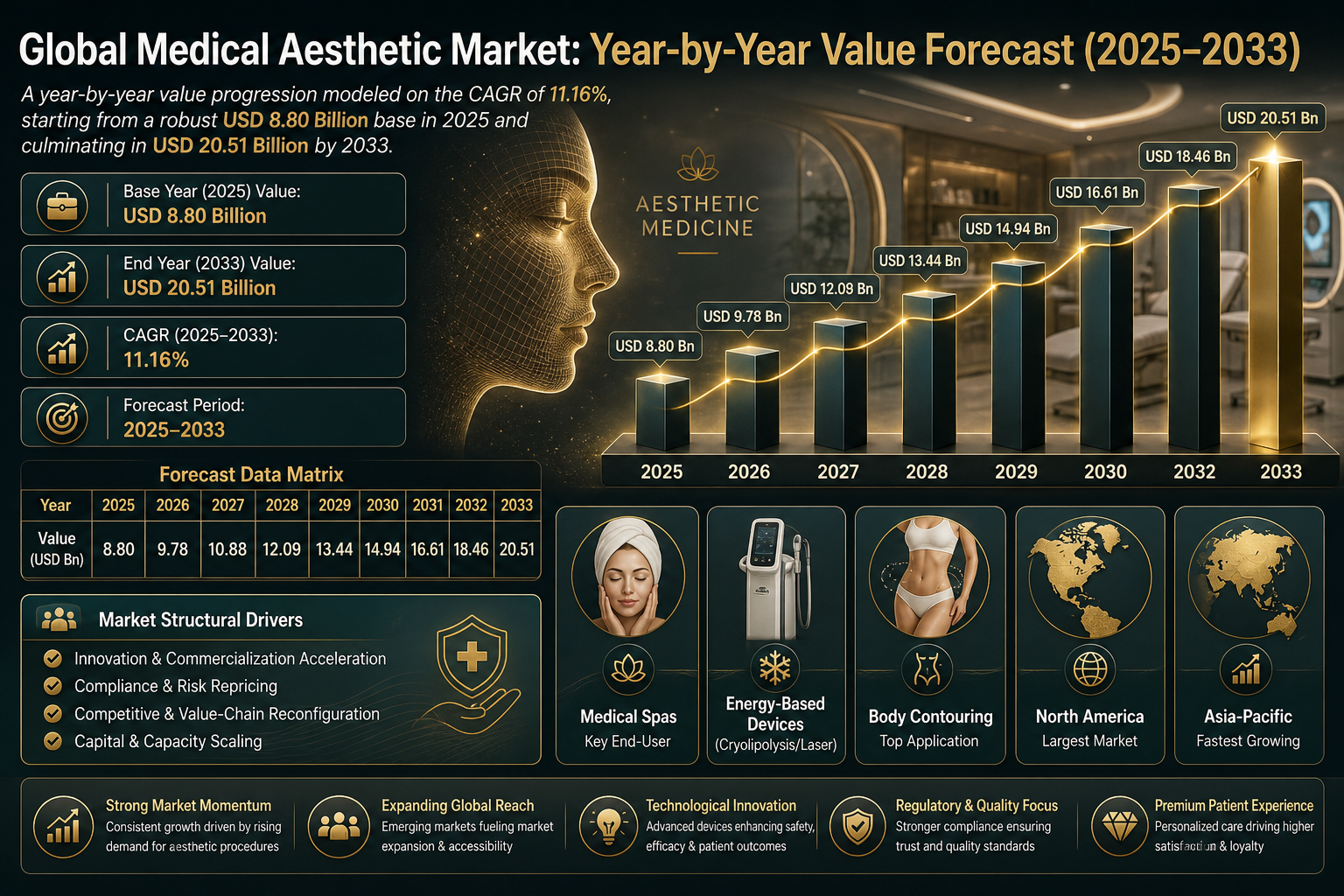
Le marché mondial des soins médicaux esthétiques devrait connaître une croissance significative pendant la période de prévision allant de 2026 à 2033. Évalué à 8,80 milliards de dollars en 2025, ce marché devrait s'étendre à un taux de croissance annuel composé (CAGR) de 11,16 %, atteignant environ 20,51 milliards de dollars d'ici 2033.
Le marché mondial des soins médicaux esthétiques opère dans un environnement dynamique et concurrentiel, caractérisé par une évolution rapide des technologies et des préférences changeantes des consommateurs.
Le marché est fragmenté, avec une intensité compétitive élevée, et comprend des acteurs clés tels que Bausch Health Companies Inc., Cutera, Inc., Venus Concept Inc. et AbbVie Inc..
Les avancées technologiques telles que la personnalisation des traitements basée sur l'intelligence artificielle et les innovations dans les plateformes laser et à ondes radiofréquence améliorent considérablement les résultats des traitements. En même temps, le durcissement des réglementations dans les marchés majeurs accroît les normes de conformité et influence les stratégies de développement de produits.
Rapport sur la taille et la prévision du marché mondial de la médecine esthétique 2026???2033
Aperçu de la prévision du marché (2025???2033)
| Indicateur | Valeur |
|---|---|
| Taille du marché (2025) | 8,80 milliard de dollars US |
| Taille du marché (2033) | 20,51 milliards de dollars américains |
| Taux de croissance annuel composé (2026???2033) | ~11.16% |
| Plus grande région | Amérique du Nord |
| Région en croissance la plus rapide | Asie-Pacifique |
| Segment principal | Procédures non invasives |
| Tendance clé | Traitements esthétiques personnalisés et minimement invasifs |
 Le marché mondial de l'esthétique médicale
Taille du marché & Prévision
Le marché mondial de la médecine esthétique devrait passer de 8,80 milliards de dollars en 2025 à 20,51 milliards de dollars d'ici 2033, enregistrant un taux de croissance annuel composé (CAGR) de 11,16 % pendant la période de prévision. Cette croissance est principalement entraînée par l'augmentation de la demande pour des procédures à faible invasivité, l'augmentation du revenu disponible et un changement sociétal croissant vers le bien-être esthétique et l'autocare. Les progrès dans les dispositifs basés sur l'énergie et les technologies d'injections accélèrent davantage l'expansion du marché.Aperçu du marché
Le marché mondial de la médecine esthétique opère dans un environnement hautement dynamique et concurrentiel, marqué par une évolution technologique rapide et des préférences des consommateurs en constante mutation. Le marché est fragmenté, avec une forte intensité concurrentielle, et compte des acteurs clés tels que Bausch Health Companies Inc., Cutera, Inc., Venus Concept Inc. et AbbVie Inc. Les avancées technologiques, telles que la personnalisation des traitements basée sur l'intelligence artificielle et les innovations dans les plateformes laser et à radiofréquence, améliorent significativement les résultats des traitements. En parallèle, le durcissement réglementaire dans les marchés majeurs augmente les normes de conformité et influence les stratégies de développement de produits.Principaux moteurs de la croissance du marché
- Croissance de la demande en faveur des procédures non invasives et à faible invasivité
- Revenus disponibles en hausse et dépenses des consommateurs en augmentation dans le domaine de l'esthétique
- Avancées technologiques dans les dispositifs à base d'énergie et les injectables
- Acceptation croissante des traitements esthétiques chez tous les sexes et tous les groupes d'âge
- Déplacement vers des solutions esthétiques personnalisées et sur mesure
Segmentation du marché
Par utilisateur final
- Hôpitaux
- Spas médicaux (croissance la plus rapide)
- Cliniques de dermatologie
Par application
- Traitements de la peau (segment le plus important)
- Traitements esthétiques
- Traitements esthétiques du visage
Par type de produit
- Appareils basés sur l'énergie (Laser, RF, Ultrasons, Cryolipolyse)
- Appareils de soins esthétiques
Par type de procédure
- Procédures non invasives (segment dominant)
- Procédures à faible invasivité
Par les produits injectables
- Remplisseurs cutanés
- Toxine botulique
Insights régionaux
- Amérique du Nord ??? Plus grand marché, tiré par une infrastructure de santé avancée et une forte conscience des consommateurs
- Europe ??? Croissance soutenue par l'adoption technologique et des cadres réglementaires solides
- Asie-Pacifique ??? Région en croissance la plus rapide en raison du revenu croissant et de la classe moyenne en expansion
- Amérique latine ??? Marché émergent avec une demande croissante pour les procédures à faible invasivité
- Moyen-Orient et Afrique ??? Marché en croissance alimenté par les changements de mode de vie et par une sensibilisation croissante
Paysage concurrentiel
- Bausch Health Companies Inc.
- Cutera, Inc.
- Venus Concept Inc.
- AbbVie Inc.
- Cynosure
- Alma Lasers
Insights stratégiques et tendances
- Adoption croissante des plans de traitement personnalisés basés sur l'intelligence artificielle
- Croissance des procédures de remodelage corporel non chirurgicales
- La demande croissante pour les soins esthétiques injectables à l'échelle mondiale
- Étendue des cliniques de dermatologie et des spas médicaux
- Une consolidation croissante par fusions et acquisitions
Pourquoi ce marché est important
- Reflet de la transition mondiale vers une santé et une esthétique orientées bien-être
- Permet des options de traitement plus sûres, plus rapides et moins invasives
- Impulser l'innovation dans les traitements médicaux personnalisés
- Étend la portée des procédures esthétiques sur les marchés émergents
- Soutient la croissance des segments de soins de santé préventifs et des soins de santé liés au mode de vie
Perspective du marché finale
Le marché mondial de la médecine esthétique est en forte croissance, soutenu par l'innovation technologique, l'évolution des comportements des consommateurs et l'accès accru aux soins de santé. Le passage vers des approches moins invasives, Propulsé par l'intelligence artificielle, ainsi que les traitements esthétiques personnalisés, redéfinissent le paysage concurrentiel. Les entreprises qui parviennent efficacement à équilibrer l'innovation, la conformité réglementaire et les stratégies axées sur le consommateur seront les mieux placées pour saisir les opportunités de croissance à long terme sur ce marché en constante évolution.Table des matières
Table des matières
- Résumé exécutif
- 1.1 Aperçu des prévisions du marché (2026-2033)
- 1.2 Analyse de la taille du marché mondial et du TCAC
- 1.3 Segments les plus importants et à la croissance la plus rapide
- 1.4 Tendances de leadership et de croissance au niveau régional
- 1.5 Principaux moteurs du marché
- 1.6 Aperçu du paysage concurrentiel
- 1.7 Perspectives stratégiques jusqu’en 2033
- 2. Introduction et Aperçu du Marché
- 2.1 Définition du marché mondial de l'esthétique médicale
- 2.2 Portée de l’étude
- 2.3 Évolution de l'industrie et développement du marché
- 2.4 Chaîne d'approvisionnement et infrastructure de distribution
- 2.5 Impact des tendances de consommation
- 2.6 Paysage de la durabilité et de la réglementation
- 2.7 Paysage technologique et de l'innovation
- 3. Méthodologie de recherche
- 3.1 Recherche primaire
- 3.2 Recherche secondaire
- 3.3 Modèle d'estimation de la taille du marché
- 3.4 Hypothèses de prévision (2026-2033)
- 3.5 Validation des données et triangulation
- 4. Dynamique du marché
- 4.1 Facteurs moteurs
- 4.1.1 Facteurs de demande croissants
- 4.1.2 Facteurs d'innovation dans le secteur
- 4.1.3 Facteurs d'expansion du marché
- 4.1.4 Soutien réglementaire ou politique
- 4.1.5 Facteurs d'adoption des technologies
- 4.2 Freins
- 4.2.1 Contraintes de coût
- 4.2.2 Limitations de l'infrastructure
- 4.2.3 Défis réglementaires
- 4.2.4 Obstacles liés à la notoriété du marché
- 4.3 Opportunités
- 4.3.1 Opportunités émergentes des marchés
- 4.3.2 Opportunités d’innovation produit
- 4.3.3 Opportunités d’expansion technologique
- 4.3.4 Améliorations de la chaîne d'approvisionnement
- 4.4 Défis
- 4.4.1 Complexité de la chaîne d'approvisionnement
- 4.4.2 Contrôle qualité et conformité
- 4.4.3 Fragmentation du marché régional
- 4.4.4 Pression concurrentielle
- 4.1 Facteurs moteurs
- 5. Analyse du marché mondial de l'esthétique médicale (en milliards USD), 2026-2033
- 5.1 Aperçu de la taille du marché
- Analyse du TCAC
- 5.3 Répartition régionale des revenus
- 5.4 Analyse des revenus par segment
- 5.5 Analyse des canaux de distribution
- 5.6 Analyse de l’impact sur les consommateurs
- 6. Segmentation du marché (en milliards USD), 2026-2033
- 6.1 Par Utilisateur Final
- 6.1.1 Hôpitaux
- 6.1.1.1 Services de chirurgie esthétique
- 6.1.1.1.1 Unités de chirurgie plastique
- 6.1.1.1.1.1 Centres de chirurgie esthétique du visage
- 6.1.1.1.1.2 Unités de chirurgie de remodelage corporel
- 6.1.1.1.1 Unités de chirurgie plastique
- 6.1.1.1 Services de chirurgie esthétique
- 6.1.2 Spas médicaux
- 6.1.2.1 Centres de traitement esthétique
- 6.1.2.1.1 Cliniques de traitements esthétiques non chirurgicaux
- 6.1.2.1.1.1 Centres de traitement de rajeunissement cutané
- 6.1.2.1.1.2 Cliniques de traitement esthétique au laser
- 6.1.2.1.1 Cliniques de traitements esthétiques non chirurgicaux
- 6.1.2.1 Centres de traitement esthétique
- 6.1.3 Cliniques de dermatologie
- 6.1.3.1 Cliniques de médecine esthétique
- 6.1.3.1.1 Centres de dermatologie esthétique
- 6.1.3.1.1.1 Cliniques de traitement anti-âge
- 6.1.3.1.1.2 Cliniques de rajeunissement cutané
- 6.1.3.1.1 Centres de dermatologie esthétique
- 6.1.3.1 Cliniques de médecine esthétique
- 6.1.1 Hôpitaux
- 6.2 Par application
- 6.2.1 Traitements de la peau
- 6.2.1.1 Procédures esthétiques dermatologiques
- 6.2.1.1.1 Traitement de la pigmentation
- 6.2.1.1.1.1 Procédures de réduction de l'hyperpigmentation
- 6.2.1.1.1.2 Procédures de traitement du mélasma
- 6.2.1.1.1 Traitement de la pigmentation
- 6.2.1.1 Procédures esthétiques dermatologiques
- 6.2.2 Traitements esthétiques du corps
- 6.2.2.1 Modelage du corps
- 6.2.2.1.1 Réduction des graisses non chirurgicale
- 6.2.2.1.1.1 Procédures de réduction de la graisse abdominale
- 6.2.2.1.1.2 Traitements de remodelage des cuisses et des bras
- 6.2.2.1.1 Réduction des graisses non chirurgicale
- 6.2.2.1 Modelage du corps
- 6.2.3 Traitements esthétiques du visage
- 6.2.3.1 Rajeunissement facial
- 6.2.3.1.1 Traitements anti-âge
- 6.2.3.1.1.1 Procédures de réduction des rides
- 6.2.3.1.1.2 Traitements de raffermissement cutané
- 6.2.3.1.1 Traitements anti-âge
- 6.2.3.1 Rajeunissement facial
- 6.2.1 Traitements de la peau
- 6.3 Par type de produit
- 6.3.1 Dispositifs esthétiques à base d'énergie
- 6.3.1.1 Appareils de cryolipolyse
- 6.3.1.1.1 Systèmes de cryolipolyse
- 6.3.1.1.1.1 Dispositifs non invasifs de réduction des graisses
- 6.3.1.1.1.2 Dispositifs de cryothérapie pour le remodelage corporel
- 6.3.1.1.1 Systèmes de cryolipolyse
- 6.3.1.2 Appareils esthétiques à ultrasons
- 6.3.1.2.1 Systèmes de focalisation par ultrasons
- 6.3.1.2.1.1 Dispositifs d’ultrasons focalisés de haute intensité (HIFU)
- 6.3.1.2.1.2 Systèmes de lifting cutané non invasifs
- 6.3.1.2.1 Systèmes de focalisation par ultrasons
- 6.3.1.3 Dispositifs esthétiques à base de laser
- 6.3.1.3.1 Systèmes laser ablatifs
- 6.3.1.3.1.1 Systèmes de resurfaçage au laser CO2
- 6.3.1.3.1.2 Lasers de resurfaçage cutané Er:YAG
- 6.3.1.3.2 Systèmes laser non ablatifs
- 6.3.1.3.2.1 Dispositifs de thérapie par laser fractionnel
- 6.3.1.3.2.2 Systèmes laser de rajeunissement cutané
- 6.3.1.3.1 Systèmes laser ablatifs
- 6.3.1.4 Appareils esthétiques à radiofréquence (RF)
- 6.3.1.4.1 Appareils de radiofréquence pour le raffermissement de la peau
- 6.3.1.4.1.1 Systèmes de raffermissement cutané par radiofréquence monopolaire
- 6.3.1.4.1.2 Appareils de rajeunissement cutané par radiofréquence bipolaire
- 6.3.1.4.1 Appareils de radiofréquence pour le raffermissement de la peau
- 6.3.1.1 Appareils de cryolipolyse
- 6.3.1 Dispositifs esthétiques à base d'énergie
- 6.4 Par type de procédure
- 6.4.1 Procédures non invasives
- 6.4.1.1 Procédures de remodelage corporel
- 6.4.1.1.1 Réduction non chirurgicale de la graisse
- 6.4.1.1.1.1 Cryolipolyse pour la réduction des graisses
- 6.4.1.1.1.2 Traitements de remodelage corporel par radiofréquence
- 6.4.1.1.1 Réduction non chirurgicale de la graisse
- 6.4.1.2 Procédures de rajeunissement cutané
- 6.4.1.2.1 Resurfaçage cutané au laser
- 6.4.1.2.1.1 Traitements au laser anti-âge
- 6.4.1.2.1.2 Procédures d’amélioration de la texture de la peau
- 6.4.1.2.1 Resurfaçage cutané au laser
- 6.4.1.1 Procédures de remodelage corporel
- 6.4.2 Procédures mini-invasives
- 6.4.2.1 Procédures d’injection de produits de comblement cutané
- 6.4.2.1.1 Traitements de contouring du visage
- 6.4.2.1.1.1 Procédures d'augmentation des lèvres
- 6.4.2.1.1.2 Traitements de restauration du volume facial
- 6.4.2.1.1 Traitements de contouring du visage
- 6.4.2.2 Traitements esthétiques injectables
- 6.4.2.2.1 Injections de toxine botulique
- 6.4.2.2.1.1 Réduction des ridules faciales
- 6.4.2.2.1.2 Traitements de relaxation des muscles faciaux
- 6.4.2.2.1 Injections de toxine botulique
- 6.4.2.1 Procédures d’injection de produits de comblement cutané
- 6.4.1 Procédures non invasives
- 6.5 Par Produits Esthétiques Injectables
- 6.5.1 Produits de comblement dermique
- 6.5.1.1 Remplisseurs à base de collagène
- 6.5.1.1.1 Produits de comblement des rides faciales
- 6.5.1.1.1.1 Produits de comblement des plis nasogéniens
- 6.5.1.1.1.2 Produits de comblement pour le contouring cutané
- 6.5.1.1.1 Produits de comblement des rides faciales
- 6.5.1.2 Comblements à l’acide hyaluronique
- 6.5.1.2.1 Restauration du volume facial
- 6.5.1.2.1.1 Produits de comblement pour l'augmentation des pommettes
- 6.5.1.2.1.2 Produits de comblement pour l'augmentation des lèvres
- 6.5.1.2.1 Restauration du volume facial
- 6.5.1.1 Remplisseurs à base de collagène
- 6.5.2 Produits à base de toxine botulique
- 6.5.2.1 Toxine botulique cosmétique
- 6.5.2.1.1 Traitements de réduction des rides
- 6.5.2.1.1.1 Traitements des lignes du front
- 6.5.2.1.1.2 Traitement des pattes d'oie
- 6.5.2.1.1 Traitements de réduction des rides
- 6.5.2.1 Toxine botulique cosmétique
- 6.5.1 Produits de comblement dermique
- 6.1 Par Utilisateur Final
- 7. Segmentation du marché par zone géographique
- 7.1 Amérique du Nord
- 7.2 Europe
- 7.3 Asie-Pacifique
- 7.4 Amérique latine
- 7.5 Moyen-Orient et Afrique
- 8. Paysage concurrentiel
- 8.1 Analyse des parts de marché
- 8.2 Analyse comparative du portefeuille de produits
- 8.3 Cartographie du positionnement produit
- 8.4 Partenariats de chaîne d'approvisionnement et de distribution
- 8.5 Intensité concurrentielle et différenciation
- 9. Profils des entreprises
- 10. Intelligence stratégique et aperçus Pheonix AI
- 10.1 Moteur de prévision de la demande Pheonix
- 10.2 Analyseur de chaîne d'approvisionnement et d'infrastructure
- 10.3 Suivi de la technologie et de l'innovation
- 10.4 Aperçus sur le développement de produits
- 10.5 Analyse automatisée des cinq forces de Porter
- 11. Perspectives d'avenir et recommandations stratégiques
- 11.1 Expansion sur les marchés émergents
- 11.2 Stratégies d’innovation technologique
- 11.3 Feuille de route du développement produit
- 11.4 Stratégies d’expansion régionale
- 11.5 Perspectives du marché à long terme (2033 et au-delà)
- 12. Annexe
- 13. À propos de Pheonix Research
- 14. Avis de non-responsabilité
Paysage concurrentiel
Structure: Fragmented
Joueurs de niveau 1: 5
Intensité: High
Paysage concurrentiel du marché mondial de l'esthétique médicale
Cadre exécutif
Dans l'évolution du paysage mondial de l'esthétique médicale, la dimension de l'intensité concurrentielle et de la structure du marché émerge comme un point focal crucial. Cette dimension ne concerne pas seulement le nombre d'acteurs sur le marché, mais aussi les dynamiques qui façonnent et influencent les stratégies concurrentielles et la positionnement sur le marché. Avec une structure de marché identifiée comme fragmentée et une intensité concurrentielle élevée, les parties prenantes naviguent dans un environnement complexe caractérisé par des innovations rapides, des collaborations stratégiques et des manœuvres agressives sur le marché. Comprendre ces dynamiques est essentiel pour les entreprises souhaitant sécuriser leur position stratégique et saisir les opportunités émergentes. La période actuelle, jusqu'en 2033, est particulièrement significative en raison de plusieurs tendances transformantes qui redéfinissent le paysage concurrentiel. Des entreprises comme AbbVie, Bausch Health Companies Inc. et Cynosure ne réagissent pas seulement aux demandes du marché ; elles façonnent activement l'avenir de l'industrie grâce à des initiatives stratégiques. Cela implique de lancer des produits de pointe, de former des partenariats stratégiques et d'utiliser les avancées technologiques pour répondre à la demande croissante de procédures esthétiques minimement invasives ou non invasives. Les enjeux sont élevés, et les décisions prises aujourd'hui auront des effets durables sur la position concurrentielle et la part de marché.Réalité actuelle du marché
Le marché mondial de l'esthétique médicale se caractérise par une structure fragmentée dans laquelle un petit nombre d'acteurs de premier plan, tels qu'AbbVie, Bausch Health Companies Inc. et Cutera, Inc., luttent pour la domination. Cette fragmentation n'affaiblit pas l'intensité de la concurrence ; elle la renforce même. Chaque acteur s'efforce de se différencier par l'innovation et des alliances stratégiques, ce qui rend le marché un terrain de forte activité et de concurrence. Une manifestation clé de cette intensité concurrentielle est la vague de lancements de produits et d'avancées technologiques. Par exemple, l'introduction par AbbVie d'un dispositif de réduction de la graisse basé sur une technologie à ondes radio de nouvelle génération en 2024 illustre la manière dont les entreprises utilisent la technologie pour se démarquer. De même, le lancement par Fotona d'un nouveau traitement laser 4D pour la conturation corporelle en 2023 souligne l'engagement des entreprises envers l'innovation technologique comme moyen de différenciation. Ces initiatives répondent non seulement à la croissante demande des consommateurs en solutions esthétiques avancées, mais elles établissent également de nouveaux standards pour les concurrents. En outre, les activités d'acquisition stratégique, telles que l'acquisition par Hologic de Gynesonics pour 350 millions de dollars, signalent une approche agressive visant à élargir les capacités et la portée du marché. Ces acquisitions ne concernent pas seulement l'acquisition de nouvelles technologies ou produits, mais aussi la consolidation des positions de marché et la réduction des menaces concurrentielles. En intégrant des technologies complémentaires et en élargissant leurs portefeuilles de produits, les entreprises sont mieux positionnées pour répondre aux préférences des consommateurs variées et renforcer leurs propositions de valeur. Le marché assiste également à une augmentation des collaborations stratégiques visant à améliorer la visibilité de la marque et à élargir la portée du marché. La collaboration de Cutera, Inc. avec des joueurs professionnels de tennis lors du tournoi de l'Open australien est un exemple frappant de la manière dont les entreprises utilisent des partenariats pour renforcer la notoriété de leur marque et attirer un public plus large. Cette stratégie est particulièrement efficace sur un marché fragmenté, où la différenciation de la marque peut avoir un impact significatif sur le choix des consommateurs. En outre, l'augmentation du nombre de procédures esthétiques, entraînée par une sensibilisation croissante des consommateurs et des avancées technologiques, transforme le paysage du marché. La demande croissante pour des procédures minimement invasives, comme en témoigne la popularité des procédures à base de toxine botulique, oblige les entreprises à innover et à étendre leurs offres de services. Cette tendance est encore accentuée par l'émergence des cliniques esthétiques spécialisées, qui redéfinissent l'expérience du consommateur en proposant des solutions esthétiques personnalisées et intégrées.Signaux clés et preuves
- Lancements de produits : Les dispositifs de réduction de la graisse basés sur la fréquence radio de prochaine génération d'AbbVie (2024), le traitement au laser 4D de Fotona (2023), le système Stellar M22 de Lumenis (2024) et le Harmony XL PRO d'Alma Lasers (2023) illustrent la différenciation technologique.
- Approbations réglementaires : L'approbation par la FDA des produits Evolysse Form et Evolysse Smooth, des gels injectables à l'acide hyaluronique de la société Evolus, Inc., démontre l'importance de la conformité pour renforcer la crédibilité et la position concurrentielle.
- Acquisitions stratégiques : L'acquisition par Hologic de Gynesonics (350 millions de dollars) illustre la consolidation du marché et l'expansion des capacités comme stratégie compétitive.
- Collaborations Stratégiques : Des partenariats comme celui de Cutera, Inc. avec des athlètes professionnels renforcent la visibilité et l'atteinte de la marque sur un marché fragmenté.
- Tendances des consommateurs : L'adoption croissante de procédures à faible invasivité, telles que les traitements au Botox, met en évidence le besoin de portefeuilles de produits diversifiés et innovants.
Implications stratégiques
- Innovation continue : Les entreprises doivent investir dans la recherche et le développement afin de maintenir un avantage concurrentiel et de répondre aux demandes des consommateurs en évolution.
- Collaborations Stratégiques : Les partenariats avec des influenceurs, des athlètes et d'autres parties prenantes renforcent l'équité de marque et élargissent la portée du marché dans un marché fragmenté.
- Acquisitions et investissements : L'acquisition de technologies ou de sociétés complémentaires élargit les capacités, diversifie les offres et renforce la position sur le marché.
- Navigation réglementaire : Obtenir l'approbation de nouveaux produits et traitements renforce la crédibilité et permet de se différencier dans un environnement concurrentiel serré.
- Stratégies axées sur le consommateur : Proposer des traitements personnalisés et peu invasifs s'aligne sur la croissance de la conscience esthétique des consommateurs, renforçant ainsi la fidélité et la part de marché.
Perspective à court terme
En perspective, l'intensité concurrentielle et la structure fragmentée du marché mondial de l'esthétique médicale devraient persister, soutenues par les progrès technologiques en cours et l'évolution des attentes des consommateurs. Les entreprises capables de naviguer efficacement dans ce paysage complexe en exploitant l'innovation, les partenariats stratégiques et la conformité réglementaire sont bien positionnées pour prospérer à court et moyen terme. L'essor des programmes de traitement personnalisés et des procédures non invasives devrait continuer, soutenu par une croissance de la sensibilisation des consommateurs et une demande croissante de solutions sur mesure. Les entreprises proposant des traitements adaptés aux préférences individuelles devraient capturer une part plus importante du marché. L'innovation technologique restera un moteur clé de l'évolution du marché, avec des entreprises qui investiront massivement dans la recherche et le développement pour améliorer leurs offres de produits et maintenir un avantage concurrentiel. Les collaborations stratégiques et les acquisitions continueront également à façonner le paysage du marché, permettant aux entreprises d'élargir leurs capacités, de pénétrer de nouveaux segments et de renforcer leur position.Chaîne de valeur
Modèle: Hybrid
Distribution: Direct_to_consumer
Complexité de l'approvisionnement: Moderate
Dynamiques de la chaîne de valeur et de la chaîne d'approvisionnement sur le marché mondial de la médecine esthétique
Cadre exécutif
Dans le marché mondial de l'esthétique médicale, la dimension de la chaîne de valeur joue un rôle central dans la structuration de l'industrie et ses dynamiques concurrentielles. À mesure que le marché évolue entre 2026 et 2033, comprendre les subtilités de la chaîne de valeur devient essentiel pour les parties prenantes. Le modèle opérationnel hybride, combiné à une structure de distribution directe aux consommateurs, met en évidence les transformations en cours dans la manière dont les produits et services atteignent les utilisateurs finaux. Cependant, cette transformation rencontre des défis tels que le manque de main-d'œuvre, la complexité réglementaire et l'intensité du capital, qui influencent collectivement les marges, le pouvoir de négociation et l'efficacité globale de la chaîne d'approvisionnement. La hausse de la demande pour des procédures minimement invasives est limitée par une capacité réduite en raison d'un manque de professionnels qualifiés, des exigences strictes en matière de conformité réglementaire et de sécurité, ainsi que des difficultés financières liées à l'adoption de technologies avancées. Ces facteurs réorganisent les dynamiques de pouvoir au sein de la chaîne de valeur, imposant aux entreprises une réévaluation stratégique afin d'optimiser leurs modèles opérationnels.Réalité actuelle du marché
Le marché mondial de l'esthétique médicale présente actuellement un niveau modéré de complexité des chaînes d'approvisionnement à travers des étapes telles que l'approvisionnement en matières premières, la fabrication, la distribution et l'engagement des consommateurs. Les entreprises prennent des mesures stratégiques pour s'adapter à ce paysage. Par exemple, le lancement par AbbVie d'un dispositif de réduction des graisses basé sur une technologie à ondes radio de nouvelle génération en 2024, ainsi que le traitement laser 4D de Fotona pour la contenance corporelle en 2023, illustrent les avancées technologiques qui façonnent les offres destinées aux consommateurs. Les défis opérationnels restent marqués en raison des couches administratives nécessaires pour respecter les normes réglementaires et de sécurité, en particulier pour les petites cliniques. Les seuils de conformité, les coûts élevés des dispositifs et les exigences de formation des professionnels spécialisés favorisent les entités bien ressources. L'émergence d'expériences de salons de beauté intégrant la numérisation reflète un changement vers une approche globale de l'engagement des consommateurs, offrant un avantage compétitif aux entreprises qui utilisent efficacement les outils numériques. Les consolidations stratégiques, telles que l'acquisition par Hologic de Gynesonics pour 350 millions de dollars, illustrent les réponses du marché à ces pressions. De même, l'approbation par l'FDA des gels d'acide hyaluronique injectables Evolysse d'Evolus, Inc. souligne l'importance de la conformité réglementaire dans le développement de produits et l'entrée sur le marché.Signaux clés et preuves
- Intensité du capital dans l'adoption des technologies : Des systèmes avancés tels que Lumenis® Stellar M22 et Alma Lasers® Harmony XL PRO reflètent l'impulsion de l'industrie vers l'innovation. Les exigences de capital élevées peuvent créer des barrières pour les petites entreprises, consolidant ainsi le pouvoir du marché auprès des acteurs établis.
- Pénurie de main-d'œuvre : L'insuffisance de praticiens esthétiques qualifiés limite l'utilisation des capacités, déplace le pouvoir de négociation en faveur des praticiens et augmente les coûts du travail.
- Conformité réglementaire et sécurité strictes : Les exigences réglementaires ajoutent des couches administratives et augmentent les coûts opérationnels. Les cliniques plus petites rencontrent des difficultés pour respecter les seuils de conformité, ce qui affecte leur viabilité et leurs marges.
- Conscience des consommateurs en hausse : La croissance de la demande en traitements à faible invasivité est motivée par le vieillissement de la population et l'augmentation des taux d'obésité. Des entreprises comme Evolus tirent parti de cette tendance grâce à des produits approuvés par la FDA qui correspondent aux préférences des consommateurs.
- Strates administratives issues des réglementations : Les tâches de conformité complexes détournent des ressources des opérations centrales, ralentissant la prise de décision et le lancement des produits, et affectant l'agilité de la chaîne d'approvisionnement.
Implications stratégiques
- Marges évolutives et pouvoir de négociation : Une forte intensité de capital et une pénurie de praticiens favorisent les grandes entreprises, leur permettant de maintenir un avantage concurrentiel et d'influencer les termes du marché.
- Utilisation de la capacité et efficacité opérationnelle : Le recrutement et la rétention de praticiens qualifiés sont essentiels pour optimiser le débit et réduire les temps d'attente, impactant directement le chiffre d'affaires et la satisfaction des consommateurs.
- La conformité réglementaire en tant que priorité stratégique : Allouer des ressources afin de garantir le respect des normes de sécurité et d'efficacité constitue un facteur de différenciation concurrentielle et renforce la confiance des consommateurs.
- La demande tirée par les consommateurs et la positionnement sur le marché : Les entreprises doivent aligner leurs offres sur les attentes des consommateurs en matière de traitements peu invasifs et efficaces, en tirant parti de l'innovation pour rester compétitives.
Perspective à court terme
En perspective, le marché mondial de la médecine esthétique est appelé à continuer son évolution, soutenu par les avancées technologiques, les développements réglementaires et les changements dans les dynamiques des consommateurs. Les parties prenantes doivent rester vigilantes, adaptables et capables de naviguer dans les contraintes liées au personnel, la complexité réglementaire et l'adoption de technologies coûteuses. Les entreprises qui optimisent leurs chaînes de valeur, investissent dans du personnel qualifié et s'alignent sur les attentes réglementaires seront bien placées pour profiter de la croissance du marché et maintenir un avantage concurrentiel.Activité d'investissement
Tendance: Rising
Intensité capitalistique: Medium
M&A récentes: Yes
Activité d'investissement du marché mondial de la médecine esthétique
Cadre exécutif
Dans le paysage en évolution de la médecine esthétique mondiale, les dynamiques d'investissement et de financement jouent un rôle clé dans la structuration et la trajectoire du marché. Alors que la demande des consommateurs en procédures esthétiques augmente, l'intérêt des investisseurs souhaitant capitaliser sur ce secteur en pleine croissance s'accroît également. L'orientation de la tendance d'investissement montre une hausse notable, indiquant un flux important de capitaux qui réforme les comportements concurrentiels, la concentration du marché et les allocations d'actifs stratégiques. Avec un niveau moyen d'intensité de capital, les investisseurs positionnent stratégiquement leurs fonds dans des secteurs promettant des rendements élevés et une croissance durable. L'augmentation récente des activités de fusions et acquisitions (M&A) souligne cette tendance, mettant en évidence l'attractivité du marché à la fois pour les fonds de capital-investissement et les investisseurs stratégiques. Cette dimension est plus que jamais cruciale, car elle influence l'allocation des ressources, le rythme de l'innovation et, finalement, la valeur délivrée aux consommateurs. L'allocation stratégique du capital est essentielle pour maintenir la croissance, favoriser l'innovation et capter une part de marché dans un industrie fragmentée caractérisée par des marges bénéficiaires élevées et une croissante attention portée aux solutions de bien-être personnalisées et intégrées. Alors que la beauté traditionnelle évolue vers un paradigme plus large de bien-être, les dynamiques d'investissement et de financement deviennent centrales pour comprendre la position concurrentielle et la viabilité à long terme du marché.Réalité actuelle du marché
L'état actuel du marché mondial de la médecine esthétique révèle un paysage propice à l'investissement, porté par plusieurs acteurs clés et des tendances émergentes. Des investisseurs actifs tels que VSS Capital Partners, BC Partners, Incline Equity Partners et d'autres occupent une place de premier plan, orientant des capitaux vers des projets et des technologies prometteurs. Ces investisseurs sont attirés par le potentiel de rendement élevé du secteur, alimenté par une sensibilisation accrue des consommateurs et des avancées technologiques. Les récentes activités de fusion et d'acquisition, telles que l'acquisition par Hologic de Gynesonics pour 350 millions de dollars, illustrent des mouvements stratégiques visant à consolider et à améliorer les offres du marché. Ces acquisitions ne se contentent pas d'étendre les capacités opérationnelles, mais s'alignent également sur des thèmes d'investissement plus larges, tels que les traitements non invasifs et l'esthétique régénérative. L'adoption croissante des technologies se manifeste clairement, avec des entreprises comme Lumenis qui lancent le système Stellar M22 et Alma Lasers qui introduit le Harmony XL PRO, démontrant des avancées qui séduisent à la fois les consommateurs et les investisseurs technophiles. Le marché connaît une fragmentation propice à la consolidation, offrant aux investisseurs des opportunités de s'acquérir stratégiquement des acteurs niche et de les intégrer à des entités plus grandes. Cette consolidation est soutenue par l'expansion des options de traitement et des cliniques, répondant à une base de patients croissante et à une demande accrue des consommateurs. Cependant, le manque de dermatologues représente un défi, augmentant ainsi la nécessité d'investir dans la formation et la technologie pour satisfaire cette demande croissante. En outre, l'expansion des centres esthétiques et des cliniques de dermatologie est une réponse directe à l'adoption croissante de plans anti-âge personnalisés et de thérapies de rajeunissement de la peau. Les investisseurs soutiennent des modèles d'entreprise qui mettent l'accent sur la personnalisation, la santé intégrative et les modèles de revenus basés sur l'abonnement, s'alignant sur les préférences des consommateurs pour des traitements esthétiques adaptés et accessibles.Signaux clés et preuves
- Croissance de la demande des consommateurs et beauté personnalisée : L'intérêt croissant pour les thérapies de réjuvénation de la peau et la normalisation des procédures esthétiques, notamment chez les générations plus jeunes, stimule l'investissement dans des solutions personnalisées.
- Élargissement des options de traitement et adoption des technologies : Les lancements tels que le dispositif de réduction de la graisse basé sur la technologie RF d'AbbVie et le traitement au laser 4D de Fotona illustrent les avancées technologiques qui attirent l'intérêt des investisseurs.
- Investissements en capital-investissement et consolidation du marché : Des entreprises comme Shore Capital Partners et The Thurston Group poursuivent activement la consolidation, en exploitant des marges bénéficiaires élevées pour acquérir des acteurs spécialisés et les intégrer afin de réaliser des synergies.
- Étendue des centres médicaux esthétiques et des cliniques de dermatologie : Les croissances des bases de patients et le manque de dermatologues stimulent les investissements dans des modèles alternatifs de livraison des services et l'expansion des cliniques.
- Traitements non invasifs et bien-être intégratif : Les investissements se concentrent sur les procédures non invasives et l'intégration de la bienveillance, reflétant la préférence des consommateurs pour des solutions holistiques, moins invasives, présentant un potentiel de croissance durable.
Implications stratégiques
- Consolidation du marché et comportement concurrentiel : Une forte activité d'investissement stimule les fusions et acquisitions, permettant aux entreprises d'atteindre des économies d'échelle, de diversifier leurs portefeuilles de produits et d'améliorer leurs capacités technologiques.
- Private Equity et Positionnement Stratégique : Les sociétés de capital-investissement apportent du financement et des conseils stratégiques, accélérant l'innovation et l'expansion dans des domaines tels que les traitements non invasifs et l'esthétique régénérative.
- Adoption des technologies et alignement des consommateurs : L'investissement dans des technologies avancées (ex. : Stellar M22, Harmony XL PRO) améliore l'efficacité, la sécurité et l'adéquation des procédures avec les préférences personnelles des consommateurs.
- Étendue des centres médicaux esthétiques et des cliniques de dermatologie : Le financement de l'expansion du centre médical répond à la demande croissante et aux pénuries en dermatologie, en soutenant une livraison décentralisée des services et une plus grande pénétration sur le marché.
- Risques et opportunités sur un marché fragmenté : La fragmentation permet aux investisseurs stratégiques d'acquérir des actifs sous-évalués et de les intégrer dans des portefeuilles cohérents, mais exige une évaluation soigneuse des risques et de l'évolutivité.
Perspective à court terme
Envisageant la période de prévision 2026-2033, le marché mondial de la médecine esthétique est destiné à continuer son évolution, soutenu par des investissements stratégiques et des dynamiques de financement. La tendance croissante d'allocation de capitaux devrait maintenir le momentum, alimentée par la demande des consommateurs, les avancées technologiques et la recherche de solutions de bien-être personnalisées et intégratives. Investissements soutenus et trajectoires de croissance : Les flux continus provenant des investisseurs de capital-investissement et des investisseurs stratégiques stimuleront l'innovation, élargiront les options de traitement et amélioreront les expériences des consommateurs, soutenant ainsi la croissance du marché. Évolution des préférences des consommateurs et adaptation du marché : Les entreprises intégreront de plus en plus le bien-être et l’esthétique, adopteront des modèles basés sur l’abonnement et proposeront des solutions personnalisées afin de correspondre aux attentes des consommateurs et de renforcer leur fidélisation. Considérations réglementaires et économiques : Les parties prenantes doivent naviguer dans les cadres réglementaires et les facteurs économiques afin d'assurer une croissance durable, tout en tirant parti des opportunités émergentes. Le rôle de l'innovation dans la façade de l'avenir : Une poursuite des investissements dans la recherche et le développement conduira à de nouvelles solutions, améliorera les traitements existants et permettra de créer une différenciation technologique, positionnant ainsi les entreprises pour un succès à long terme. En conclusion, les dynamiques d'investissement et de financement sont centrales à la détermination de l'évolution du marché mondial de l'esthétique médicale. Une allocation stratégique des capitaux stimulera l'innovation, l'engagement des consommateurs et une croissance durable, déterminant finalement la direction et le succès futurs du marché.Technologie et innovation
Innovation: High
Activité des brevets: Moderate
Maturité: Growth
Paysage technologique et d'innovation sur le marché mondial de la médecine esthétique
Cadre exécutif
À mesure que la technologie continue de transformer le marché mondial de l'esthétique médicale, son influence est à la fois profonde et multifacette. Cette dimension revêt une importance particulière en raison de sa capacité à redéfinir l'économie des procédures, à améliorer les résultats cliniques et à transformer le débit des patients. Le paysage technologique du secteur de l'esthétique médicale est marqué par une intensité d'innovation élevée et un niveau modéré d'activité brevetière, ce qui indique un environnement dynamique mais concurrentiel. Actuellement, la technologie se trouve en phase de maturité de croissance, offrant des opportunités uniques aux entreprises de s'appuyer sur des solutions émergentes pour conquérir une part du marché. L'intégration de technologies clés telles que la cryolipolyse, la radiofréquence et l'ultrason focalisé à haute intensité (HIFU) provoque un changement de paradigme du côté des solutions invasives vers des solutions non invasives, répondant à la demande croissante de traitements moins intrusifs tout en s'alignant sur l'accent mis par la société sur la santé de la peau et les plans de traitement personnalisés. Des entreprises comme Candela Corporation, Lumenis Ltd., Cynosure, Alma Lasers et Cutera occupent une place de premier plan, explorant de nouvelles technologies pour maintenir leur avantage concurrentiel. Des tendances émergentes telles que la personnalisation des traitements basée sur l'intelligence artificielle et une sensibilisation accrue des consommateurs à la dermatologie soulignent davantage l'importance stratégique de la technologie dans la formation de l'avenir du marché.Réalité actuelle du marché
Le marché mondial de l'esthétique médicale évolue rapidement, porté par les avancées technologiques qui améliorent l'efficacité, la sécurité et l'accessibilité des traitements. L'adoption de procédures non invasives et à faible invasivité se trouve au premier plan, soutenue par des plateformes multi-technologies telles que le système Stellar M22 de Lumenis et le dispositif Harmony XL PRO d'Alma Lasers. Ces plateformes permettent aux professionnels d'adapter les traitements aux besoins individuels des patients, reflétant une tendance vers la polyvalence des appareils et la personnalisation. La préférence des consommateurs pour les traitements non invasifs se traduit par une augmentation de 92 % de la demande en traitements de remodelage corporel depuis 2019. En parallèle, la prise de conscience de l'impact mondial des maladies de la peau stimule la demande de solutions favorisant une santé de la peau à long terme. Des technologies telles que les lasers verts non thermiques et les dispositifs stimulant les muscles améliorent la texture de la peau et la production de collagène, complétant ainsi l'amélioration esthétique par une santé globale de la peau. L'intégration de l'intelligence artificielle permet davantage de plans de traitement personnalisés, optimisant les résultats cliniques et la satisfaction des patients. Des études cliniques montrent une amélioration de 86 % des résultats lorsqu'on applique des approches guidées par l'intelligence artificielle, soulignant leur efficacité dans la personnalisation des soins et l'amélioration de l'efficacité opérationnelle.Signaux clés et preuves
- Marché des dispositifs basés sur l'énergie : Prévu à 6 milliards de dollars américains d'ici 2024, mettant en évidence l'adoption rapide de technologies telles que les ondes radiofréquence et l'échographie pour des procédures non invasives.
- Conscience des consommateurs et santé de la peau à long terme : La croissance de la demande en solutions de soins préventifs pousse à l'adoption de technologies améliorant la texture de la peau et stimulant la production de collagène.
- Intégration de l'intelligence artificielle : L'utilisation de l'IA pour la personnalisation des traitements améliore l'efficacité, l'efficience opérationnelle et la satisfaction des patients.
- Approvals de la FDA : La validation réglementaire des nouveaux appareils garantit la sécurité, renforce la confiance des consommateurs et facilite l'adoption sur le marché.
Implications stratégiques
- Passage vers une prise en charge personnalisée et préventive : Les entreprises doivent utiliser l'intelligence artificielle et les données des patients pour proposer des plans de traitement personnalisés, améliorant ainsi les résultats et l'efficacité opérationnelle.
- Traitements non invasifs : moteur de croissance Une opportunité de marché importante existe dans les solutions à intervention minimale, avec une demande de remodelage corporel en hausse de 92 % depuis 2019. Les investissements dans des technologies compatibles sont essentiels pour conserver une part de marché.
- Alignement réglementaire : Les approbations de la FDA sont cruciales pour l'adoption, la confiance et l'expansion du marché. Les entreprises qui obtiennent des approbations pour leurs dispositifs acquièrent un avantage concurrentiel.
- Efficacité opérationnelle et impact économique : L'intégration de l'intelligence artificielle et des technologies avancées rationalise les processus, réduit les coûts opérationnels, améliore les marges et renforce la satisfaction des patients.
- Différenciation concurrentielle : L'adoption précoce par des entreprises comme Candela, Lumenis et Evolus de plateformes innovantes renforce leur position sur le marché et leur durabilité à long terme.
Perspective à court terme
Le marché mondial de l'esthétique médicale est sur le point de connaître une transformation impulsée par les progrès technologiques en cours. Les entreprises qui sauront efficacement utiliser l'intelligence artificielle, les solutions non invasives et les soins personnalisés émergeront probablement comme leaders du marché. La collaboration entre les entreprises technologiques et les entreprises d'esthétique médicale accélérera l'innovation, aboutissant à de nouvelles solutions qui amélioreront les résultats et la satisfaction des patients. La demande des consommateurs en matière de santé de la peau à long terme et de soins préventifs continuera à façonner les dynamiques du marché, favorisant les entreprises proposant des programmes de traitement holistiques. La conformité réglementaire, notamment les approbations de la FDA, restera cruciale pour l'entrée sur le marché, la confiance des consommateurs et la position concurrentielle. En conclusion, les implications stratégiques de la technologie sur le marché mondial de l'esthétique médicale sont profondes. Les entreprises qui alignent l'innovation sur la demande des consommateurs, les exigences réglementaires et l'efficacité opérationnelle définiront l'avenir de l'industrie. La technologie, la personnalisation et la santé de la peau à long terme seront les moteurs principaux de la croissance et de l'avantage concurrentiel.Risque de marché
Risque global: High
Geopolitical Exposure: Moderate
Risque de substitution: Moderate
Facteurs de risque et menaces de disruption sur le marché mondial de la médecine esthétique
Cadre exécutif
Le marché mondial de l'esthétique médicale entre actuellement dans une phase critique marquée par des contraintes structurelles importantes et des risques de marché pouvant redéfinir le paysage industriel entre 2026 et 2033. Parmi ces défis, le niveau global élevé de risque de marché est en tête, poussé par les complications liées aux procédures, le manque de réglementation et la présence de praticiens non qualifiés. Ces facteurs menacent collectivement la confiance des consommateurs et la stabilité du marché, pouvant perturber la demande et les structures de prix. L'exposition géopolitique et le risque de substitution sont modérés mais significatifs. Le manque de réglementation stricte, combiné à des tactiques de vente à pression et à des complications telles que les infections et les dommages nerveux, aggravent la vulnérabilité du marché. Ces risques se manifestent par une augmentation des appels à la réglementation, une demande publique de transparence dans les sanctions disciplinaires des médecins et des avertissements aux consommateurs. Les implications stratégiques pour les entreprises, les régulateurs et les consommateurs sont profondes, nécessitant une reconsidération des priorités opérationnelles et stratégiques.Réalité actuelle du marché
L'industrie mondiale de l'esthétique médicale fait actuellement face à un vide réglementaire ayant des implications étendues sur la structure du marché et la résilience opérationnelle. Des professionnels non qualifiés peuvent exercer avec un contrôle minimal, créant un risque structurel amplifié par des complications potentielles telles que les infections, les hématomes et les lésions nerveuses. Cette situation contribue à une augmentation des poursuites judiciaires liées à la malpractice médicale et à des préoccupations croissantes en matière de sécurité publique. Des initiatives gouvernementales, telles que les amendements à la loi sur la santé et les soins de 2022, visent à combler ces lacunes, mais ne sont pas encore pleinement efficaces. En parallèle, les avancées technologiques, telles que les dispositifs de réduction de la graisse basés sur la fréquence radio d'AbbVie et les traitements laser 4D de Fotona, introduisent à la fois un potentiel de croissance et de nouveaux risques. Les rapports sur les événements indésirables et les avertissements de la FDA concernant la microneedling à fréquence radio mettent en lumière l'urgence d'une supervision réglementaire rigoureuse afin de garantir que l'innovation ne dépasse pas la sécurité.Signaux clés et preuves
- Manque de réglementation : Les lacunes réglementaires permettent à des praticiens non qualifiés et à des procédures non supervisées d'exister, augmentant ainsi les risques du marché et les préoccupations en matière de sécurité des patients.
- Demande publique de transparence : Une prise de conscience croissante des consommateurs entraîne des demandes d'une surveillance plus stricte, reflétant un passage à une plus grande responsabilité.
- Prix inférieurs à la moyenne : Les segments de marché sensibles aux prix compromettent souvent les normes de sécurité, ce qui peut nuire à la confiance des consommateurs et augmenter la responsabilité légale.
- Risques liés aux progrès technologiques : Les nouveaux appareils de Lumenis (Stellar M22) et Alma Lasers (Harmony XL PRO) élargissent les capacités mais introduisent des risques procéduraux, soulignant ainsi la nécessité de conformité à la sécurité et d'opérateurs qualifiés.
- Initiatives réglementaires : Des amendements tels que la Loi sur la santé et les soins de 2022 indiquent l'intention législative d'améliorer la surveillance, avec un succès dépendant de la mise en œuvre efficace et de la conformité de l'industrie.
Implications stratégiques
- Conformité réglementaire et sécurité : L'alignement avec des installations accréditées et des praticiens certifiés est crucial pour atténuer les risques, renforcer la confiance des consommateurs et se prémunir contre les dommages à la réputation.
- Équilibre entre prix et qualité : Le prix concurrentiel doit être évalué en tenant compte des normes de sécurité et de qualité, en communiquant clairement la valeur pour justifier les offres premium.
- Intégration technologique et gestion des risques : Investir dans la recherche et le développement ainsi que tester de nouvelles technologies garantit l'innovation tout en maintenant la conformité avec les normes réglementaires en évolution.
- Résilience opérationnelle : Les entreprises doivent élaborer des stratégies pour gérer les complications, assumer les responsabilités et préserver la confiance des consommateurs sur un marché volatil et partiellement régulé.
Perspective à court terme
En perspective, le marché mondial de l'esthétique médicale est destiné à connaître une transformation significative. L'augmentation de la demande publique en matière de réglementation devrait pousser à l'adoption de cadres plus stricts, réinventant ainsi les dynamiques du marché. Les entreprises qui adopteront proactivement des protocoles de sécurité solides, qui emploieront du personnel qualifié et qui se conformeront aux réglementations en évolution gagneront un avantage concurrentiel. L'innovation technologique continuera à façonner l'évolution du marché, mais son adoption doit s'accompagner d'évaluations rigoureuses de la sécurité et de la conformité réglementaire. Des entreprises comme Lumenis et Alma Lasers mèneront l'innovation, mais tous les acteurs doivent s'assurer que ces avancées ne compromettent pas la sécurité des patients. En conclusion, le marché se trouve à un carrefour où les contraintes structurelles et les risques créent à la fois des défis et des opportunités. L'agilité stratégique, axée sur la conformité réglementaire, la sécurité et l'innovation responsable, sera cruciale pour maintenir la croissance et conserver un avantage concurrentiel. Les entreprises qui s'adapteront aux réglementations en évolution et aux attentes des consommateurs seront bien positionnées pour réussir à long terme dans ce secteur dynamique.Paysage réglementaire
Complexité: High
Approval Pathway: Standardized_commercial
Paysage réglementaire et politique du marché mondial de la médecine esthétique
Cadre exécutif
Le marché mondial de la médecine esthétique navigue dans un environnement réglementaire et politique complexe et en constante évolution, qui devrait profondément transformer sa structure d'ici 2033. Alors que la demande des consommateurs en procédures esthétiques continue d'augmenter, les organismes réglementaires à travers le monde introduisent de nouvelles directives et renforcent les réglementations existantes pour répondre aux préoccupations persistantes concernant la sécurité des patients et la publicité éthique de ces services. Cette dimension réglementaire est cruciale, car elle influence directement les barrières à l'entrée du marché, les coûts opérationnels et les dynamiques de concurrence. L'augmentation de la surveillance des procédures esthétiques non chirurgicales, accompagnée d'une intensification des actions de mise en conformité, devrait redéfinir la manière dont les entreprises opèrent dans ce secteur. Les implications sont vastes, touchant tout, des stratégies de publicité aux coûts de conformité, ce qui rend essentiel pour les parties prenantes de rester informées de ces développements afin de naviguer efficacement sur le marché.Réalité actuelle du marché
L'état actuel du marché mondial de la médecine esthétique se caractérise par un mélange d'opportunités et de prudence. La demande croissante pour des améliorations cosmétiques non invasives s'accompagne d'une surveillance réglementaire accrue visant à garantir la sécurité des patients et les pratiques éthiques. Des organismes réglementaires clés tels que la FDA américaine et l'Agence australienne de régulation des professionnels de la santé (Ahpra) sont à l'avant-garde de la mise en œuvre de nouvelles lignes directrices qui façonneront l'avenir de l'industrie. Aux États-Unis, la FDA renforce sa surveillance des réglementations sur la publicité en santé, en particulier pour les procédures cosmétiques non chirurgicales, afin de répondre aux préoccupations en matière de sécurité publique et de marketing trompeur. De même, en Australie, le Conseil médical australien et Ahpra mettent en œuvre des réglementations concernant les procédures cosmétiques non chirurgicales, applicables à partir du 2 septembre 2025, exigeant des qualifications des praticiens plus strictes et des normes des installations, ce qui augmentera ainsi les coûts d'opérationalité liés à la conformité. Les variations régionales, telles que les lois sur les centres esthétiques médicaux en Floride et le modèle de supervision du Kentucky, créent des paysages concurrentiels inégaux, où les entreprises situées dans des États soumis à une réglementation plus stricte peuvent faire face à des coûts de conformité plus élevés et à des délais de livraison des services plus longs.Signaux clés et preuves
- Règlements émergents : Nouvelles règles pour les procédures non chirurgicales mettent en évidence des lacunes dans la supervision et obligent les entreprises à garantir la conformité grâce à la formation du personnel, des technologies plus sûres et des audits internes.
- Défis liés au personnel : Des réglementations plus strictes augmentent le besoin de personnel qualifié, alors que le nombre de professionnels certifiés ne s'accroît pas dans la même mesure, ce qui stimule les investissements dans le recrutement et la formation.
- Global Benchmarks : Les réglementations strictes sur les procédures esthétiques en Corée du Sud servent de modèle pour les tendances mondiales futures, en mettant l'accent sur la sécurité des patients et le marketing éthique.
- Surveillance de la publicité : L'assouplissement des règles de publicité dans le secteur de la santé par la FDA garantit une communication précise des risques et des bénéfices, et protège les consommateurs contre les affirmations trompeuses.
- Changements réglementaires fédéraux : Les changements continus de politique peuvent modifier les dynamiques de concurrence, obligeant les entreprises à renforcer leurs cadres de conformité et à adopter les meilleures pratiques en matière de sécurité des patients et de marketing.
Implications stratégiques
- Cadres de conformité : L'investissement dans des systèmes de conformité solides est crucial pour éviter les répercussions juridiques, maintenir les licences et construire la confiance des consommateurs.
- Marketing Éthique : Une publicité transparente et fondée sur des preuves permet de différencier les entreprises et d'attirer des clients informés.
- Stratégies de personnel : Les entreprises doivent relever les défis liés à la rémunération, à la formation et aux environnements de travail favorables, imposés par les réglementations, en offrant des conditions de travail compétitives.
- Positionnement concurrentiel : L'adaptation proactive aux changements réglementaires peut offrir un avantage concurrentiel, comme en témoignent l'appareil de réduction de la graisse basé sur la fréquence radio d'AbbVie et les gels à base d'acide hyaluronique approuvés par la FDA d'Evolus, Inc.
Perspective à court terme
L'environnement réglementaire et politique du marché mondial de la médecine esthétique est susceptible de continuer à évoluer, en raison de l'augmentation de la préoccupation publique, ce qui entraînera une surveillance plus stricte. Les entreprises qui mettent l'accent sur la conformité, la sécurité des patients et les pratiques éthiques acquerront un avantage concurrentiel. La collaboration avec les autorités réglementaires par le biais de consultations publiques et d'une engagement proactif permettra aux entreprises d'aider à façonner des politiques réalisables tout en assurant la protection des consommateurs. L'innovation technologique continuera, mais son adoption doit être équilibrée avec des normes rigoureuses de sécurité et de conformité pour atténuer les risques. En conclusion, le marché entre dans une période de transformation réglementaire significative. Les entreprises qui restent vigilantes, adaptables et centrées sur le patient, tout en s'alignant sur les réglementations en évolution, atteindront une croissance durable et maintiendront leur compétitivité dans cette industrie dynamique.Questions fréquemment posées
Quelle est la taille de marché attendue du marché mondial de l'esthétique médicale d'ici 2033 ?
Le marché mondial de l'esthétique médicale devrait atteindre une taille de 20,51 milliards USD d'ici 2033.
Quel est le TCAC du marché mondial de l'esthétique médicale de 2026 à 2033 ?
Le TCAC du marché mondial de l'esthétique médicale de 2026 à 2033 est de 11,16 %.
Quels sont les principaux facteurs de croissance du marché mondial de l'esthétique médicale ?
Les principaux facteurs incluent la demande croissante pour les procédures non invasives, les avancées technologiques, l'augmentation des revenus disponibles et l'évolution des attitudes sociétales envers la beauté.
Quelles entreprises sont leaders sur le marché mondial de l'esthétique médicale ?
Les principales entreprises incluent Bausch Health Companies Inc., Cutera, Inc. et Venus Concept Inc.