
Global Blockchain Market Size and Share Analysis 2026-2033
Global Blockchain Market Forecast Snapshot (2026???2033)
| Metric | Value |
|---|---|
| Market Size (2025) | USD 28.4 Billion |
| Market Size (2033) | USD 421.6 Billion |
| CAGR (2026???2033) | 42.8% |
| Largest Component Segment | Blockchain Platforms |
| Fastest Growing Blockchain Type | Hybrid & Consortium Blockchain Solutions |
| Leading End-Use Industry | BFSI (Banking, Financial Services & Insurance) |
| Largest Application Segment | Payments & Digital Transactions |
| Fastest Growing Application | Asset Tokenization & Decentralized Finance (DeFi) |
| Key Growth Driver | Rising Enterprise Adoption of Secure and Transparent Decentralized Systems |
| Major Technology Trend | Integration of Blockchain with AI, IoT, and Cloud Infrastructure |
| Emerging Opportunity | Blockchain-Based Digital Identity and Real-World Asset Tokenization |
| Top Investment Area | Blockchain-as-a-Service (BaaS) and Enterprise Blockchain Platforms |
| Dominant Region | North America |
| Fastest Growing Region | Asia-Pacific |
| Key Challenge | Regulatory Uncertainty, Scalability Constraints, and Interoperability Issues |
| Strategic Outlook | Exceptional Long-Term Growth Driven by Enterprise Digitalization, DeFi Expansion, Smart Contracts, and Secure Data Exchange Applications |
Global Blockchain Market Size & Forecast
The global blockchain market is projected to witness exponential growth during the forecast period from 2026 to 2033. The market was valued at approximately USD 28.4 billion in 2025 and is expected to reach nearly USD 421.6 billion by 2033, expanding at a remarkable CAGR of around 42.8%. This rapid expansion is driven by increasing enterprise adoption of decentralized technologies, rising demand for secure and transparent transaction systems, and expanding use cases across finance, supply chain, healthcare, and government sectors. Blockchain is a distributed ledger technology that enables secure, immutable, and transparent record-keeping across decentralized networks. It eliminates the need for intermediaries in many transaction processes, improving efficiency, reducing costs, and enhancing trust in digital ecosystems. The market is experiencing strong momentum due to growing investments in cryptocurrency infrastructure, decentralized finance (DeFi), non-fungible tokens (NFTs), smart contracts, and enterprise blockchain solutions. Organizations are increasingly leveraging blockchain to enhance data integrity, traceability, and cybersecurity. Additionally, integration of blockchain with emerging technologies such as artificial intelligence (AI), Internet of Things (IoT), and cloud computing is unlocking new enterprise applications and accelerating mainstream adoption globally.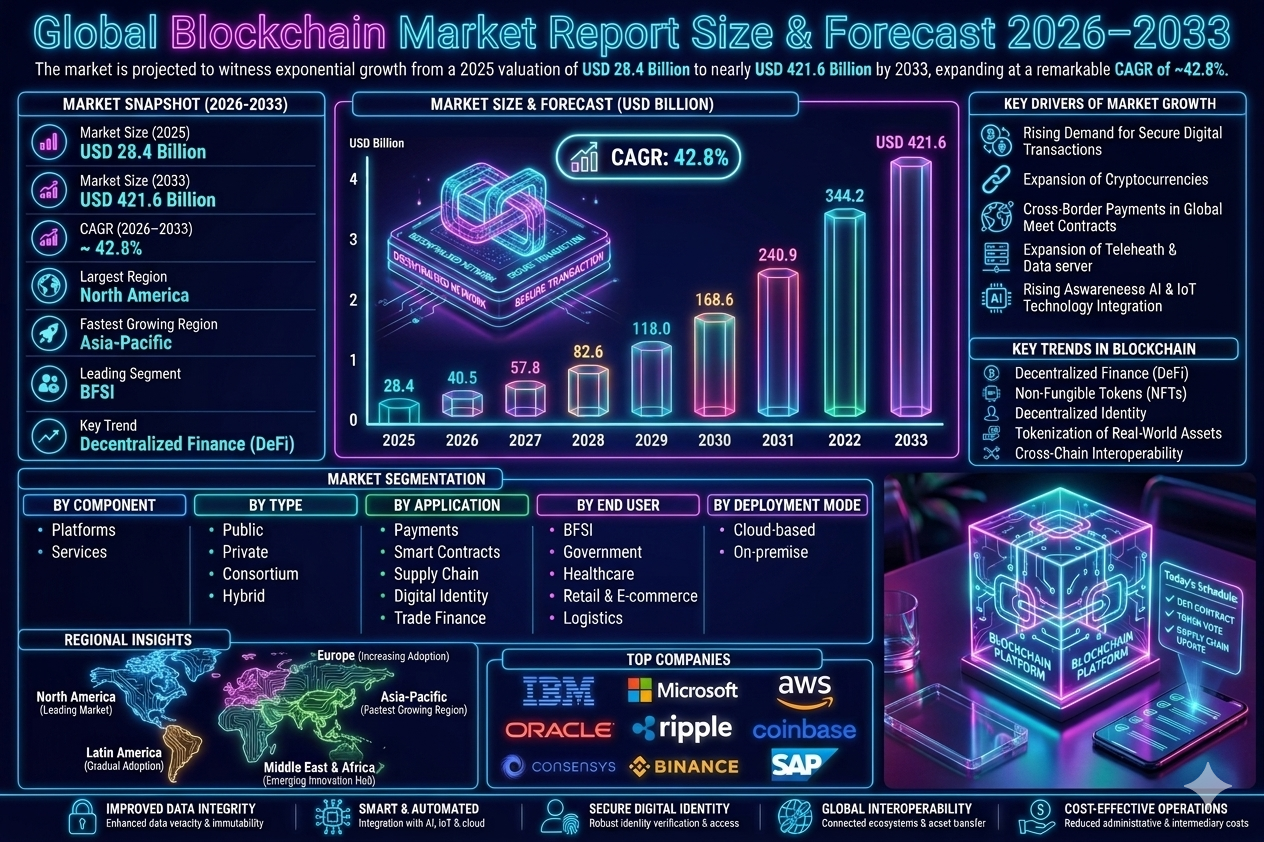
Global Blockchain Market Overview
The blockchain market represents a foundational technology layer for next-generation digital infrastructure. It is widely used for secure data sharing, decentralized applications (dApps), digital identity management, cross-border payments, and supply chain traceability systems. The ecosystem includes public blockchains, private blockchains, and consortium blockchains, each serving different use cases based on transparency, control, and scalability requirements. Public blockchains dominate cryptocurrency applications, while private and consortium blockchains are widely used in enterprise environments. Key industry participants include IBM, Microsoft, Amazon Web Services (AWS), Oracle, Ripple, Coinbase, Consensys, Binance ecosystem companies, SAP, and emerging blockchain startups focused on DeFi, infrastructure, and enterprise solutions. The market is evolving rapidly from experimental pilots to large-scale enterprise deployments, particularly in financial services, logistics, healthcare data management, and digital identity verification systems.Key Drivers of Global Blockchain Market Growth
Rising Demand for Secure Digital Transactions
Blockchain provides enhanced security and immutability for digital transactions, reducing fraud and increasing trust in financial and data exchange systems.Growth of Cryptocurrency and Digital Assets
The expansion of cryptocurrencies, stablecoins, and tokenized assets is driving infrastructure demand for blockchain networks and exchange platforms.Increasing Adoption of Smart Contracts
Smart contracts enable automated, self-executing agreements without intermediaries, improving efficiency across financial, legal, and supply chain processes.Supply Chain Transparency Requirements
Organizations are using blockchain to track goods, verify authenticity, and ensure transparency across complex global supply chains.Integration with Emerging Technologies
Blockchain integration with AI, IoT, and cloud computing is enabling advanced use cases such as autonomous systems, secure data sharing, and intelligent automation.Global Blockchain Market Segmentation
By Component
The market is segmented into platforms and services. Platforms dominate due to widespread deployment of blockchain infrastructure, while services include consulting, integration, and support.By Type
The market includes public blockchain, private blockchain, consortium blockchain, and hybrid blockchain. Public blockchain dominates crypto applications, while private blockchain is widely used in enterprises.By Application
Applications include payments, smart contracts, supply chain management, digital identity, trade finance, healthcare data management, and asset tokenization.By End User
End users include BFSI, government, healthcare, retail & e-commerce, logistics, IT & telecom, and energy & utilities. BFSI remains the largest segment due to strong demand for secure financial transactions.By Deployment Mode
The market includes cloud-based blockchain and on-premise blockchain solutions. Cloud-based deployment is growing rapidly due to scalability and lower infrastructure costs.Regional Market Dynamics
North America leads the global blockchain market due to strong fintech innovation, high cryptocurrency adoption, and presence of major technology companies in the United States and Canada. Asia-Pacific is the fastest-growing region driven by government-backed blockchain initiatives, rapid digitalization, and strong adoption in countries such as China, India, Singapore, Japan, and South Korea. Europe is witnessing strong adoption supported by regulatory frameworks, digital identity initiatives, and increasing enterprise blockchain deployments. Middle East is emerging as a blockchain innovation hub with strong government support for smart cities, digital governance, and financial technology transformation. Latin America is gradually adopting blockchain solutions in banking, remittances, and supply chain applications.Competitive Landscape
The global blockchain market is highly dynamic and innovation-driven, with participation from major technology corporations, fintech companies, and blockchain-native startups. Key players include IBM, Microsoft, Amazon Web Services (AWS), Oracle, Ripple, Consensys, Coinbase, SAP, Binance ecosystem companies, and emerging DeFi infrastructure providers. Companies are focusing on expanding blockchain-as-a-service (BaaS) offerings, improving scalability through layer-2 solutions, and enhancing interoperability between blockchain networks. Strategic partnerships between financial institutions, technology firms, and government agencies are accelerating enterprise adoption of blockchain solutions. Competition is driven by scalability, security, transaction speed, ecosystem strength, and regulatory compliance capabilities.Strategic Outlook
The strategic outlook for the blockchain market remains extremely strong as industries increasingly move toward decentralized digital infrastructure and trustless systems. Future growth opportunities include tokenized real-world assets, decentralized finance (DeFi) expansion, blockchain-based digital identity systems, and integration with AI-driven autonomous systems. Enterprise blockchain adoption is expected to accelerate as organizations prioritize transparency, efficiency, and data security in multi-party ecosystems.Final Market Perspective
The global blockchain market is transitioning from early-stage adoption to mainstream enterprise integration. Its ability to provide secure, transparent, and decentralized solutions is reshaping industries ranging from finance to supply chain management. As regulatory clarity improves and scalability challenges are addressed, blockchain is expected to become a core infrastructure layer for the global digital economy. Companies investing in scalable blockchain platforms, interoperability solutions, and enterprise-grade security will remain strongly positioned in this rapidly evolving market.Table of Contents
Table of Contents
- 1. Executive Summary
- 1.1 Global Blockchain Market Snapshot (2026???2033)
- 1.2 Market Size & CAGR Analysis
- 1.3 Largest & Fastest-Growing Segments
- 1.4 Key Regional Insights
- 1.5 Major Market Growth Drivers
- 1.6 Competitive Landscape Overview
- 1.7 Strategic Outlook Through 2033
- 2. Introduction & Market Overview
- 2.1 Definition of Blockchain Technology
- 2.2 Scope of the Study
- 2.3 Evolution of Distributed Ledger Systems
- 2.4 Blockchain Ecosystem & Value Chain
- 2.5 Public, Private & Consortium Blockchain Landscape
- 2.6 Regulatory & Compliance Environment
- 2.7 Integration with AI, IoT & Cloud Computing
- 3. Research Methodology
- 3.1 Primary Research
- 3.2 Secondary Research
- 3.3 Market Size Estimation Model
- 3.4 Forecast Assumptions (2026???2033)
- 3.5 Data Validation & Market Triangulation
- 4. Market Dynamics
- 4.1 Drivers
- 4.1.1 Rising Demand for Secure Digital Transactions
- 4.1.2 Growth of Cryptocurrency & Digital Asset Ecosystem
- 4.1.3 Increasing Adoption of Smart Contracts
- 4.1.4 Supply Chain Transparency & Traceability Needs
- 4.1.5 Integration with Emerging Technologies (AI, IoT, Cloud)
- 4.2 Restraints
- 4.2.1 Regulatory Uncertainty Across Jurisdictions
- 4.2.2 Scalability & Transaction Speed Limitations
- 4.2.3 Energy Consumption Concerns (Public Blockchains)
- 4.2.4 Cybersecurity & Smart Contract Vulnerabilities
- 4.3 Opportunities
- 4.3.1 Tokenization of Real-World Assets
- 4.3.2 Expansion of Decentralized Finance (DeFi)
- 4.3.3 Blockchain-as-a-Service (BaaS) Growth
- 4.3.4 Enterprise Blockchain Adoption at Scale
- 4.4 Challenges
- 4.4.1 Interoperability Between Blockchain Networks
- 4.4.2 Regulatory Compliance Complexity
- 4.4.3 Integration with Legacy Enterprise Systems
- 4.4.4 Market Volatility in Crypto-Linked Segments
- 4.1 Drivers
- 5. Global Blockchain Market Analysis (USD Billion), 2026???2033
- 5.1 Market Size Overview
- 5.2 CAGR Analysis
- 5.3 Regional Revenue Distribution
- 5.4 Segment Revenue Analysis
- 5.5 Public vs Private Blockchain Adoption Trends
- 5.6 Enterprise vs Crypto Application Demand Trends
- 6. Market Segmentation (USD Billion), 2026???2033
- 6.1 By Component
- 6.1.1 Platforms
- 6.1.2 Services
- 6.2 By Type
- 6.2.1 Public Blockchain
- 6.2.2 Private Blockchain
- 6.2.3 Consortium Blockchain
- 6.2.4 Hybrid Blockchain
- 6.3 By Application
- 6.3.1 Payments
- 6.3.2 Smart Contracts
- 6.3.3 Supply Chain Management
- 6.3.4 Digital Identity
- 6.3.5 Trade Finance
- 6.3.6 Healthcare Data Management
- 6.3.7 Asset Tokenization
- 6.4 By End User
- 6.4.1 BFSI
- 6.4.2 Government
- 6.4.3 Healthcare
- 6.4.4 Retail & E-commerce
- 6.4.5 Logistics
- 6.4.6 IT & Telecom
- 6.4.7 Energy & Utilities
- 6.5 By Deployment Mode
- 6.5.1 Cloud-Based Blockchain
- 6.5.2 On-Premise Blockchain
- 6.1 By Component
- 7. Market Segmentation by Geography
- 7.1 North America
- 7.2 Europe
- 7.3 Asia-Pacific
- 7.4 Latin America
- 7.5 Middle East & Africa
- 8. Competitive Landscape
- 8.1 Market Share Analysis
- 8.2 Ecosystem & Platform Benchmarking
- 8.3 Enterprise Adoption Strategies
- 8.4 Strategic Partnerships & Alliances
- 8.5 Blockchain-as-a-Service (BaaS) Expansion Trends
- 9. Company Profiles
- 9.1 IBM
- 9.2 Microsoft
- 9.3 Amazon Web Services (AWS)
- 9.4 Oracle
- 9.5 Ripple
- 9.6 Coinbase
- 9.7 Consensys
- 9.8 SAP
- 9.9 Binance Ecosystem Companies
- 9.10 Emerging DeFi & Blockchain Startups
- 10. Strategic Intelligence & Pheonix AI Insights
- 10.1 Blockchain Network Adoption Forecast Engine
- 10.2 Crypto & Digital Asset Flow Analyzer
- 10.3 Enterprise Blockchain Deployment Tracker
- 10.4 Smart Contract Risk & Security Monitor
- 10.5 Automated Porter???s Five Forces Analysis
- 11. Future Outlook & Strategic Recommendations
- 11.1 Expansion of Tokenized Economies
- 11.2 Enterprise-Grade Blockchain Standardization
- 11.3 Interoperability & Cross-Chain Infrastructure
- 11.4 AI-Integrated Blockchain Systems
- 11.5 Long-Term Market Outlook (2033+)
- 12. Appendix
- 13. About Pheonix Research
- 14. Disclaimer
Competitive Landscape
Global Blockchain Market Competitive Intensity & Market Structure Overview
The Global Blockchain Market is highly competitive and rapidly evolving, driven by a mix of technology giants, fintech leaders, cryptocurrency exchanges, and blockchain-native startups. Competitive intensity is primarily shaped by platform scalability, network security, transaction throughput, interoperability capabilities, and ecosystem adoption across enterprise and decentralized applications.
The market structure is dual-layered, with highly concentrated control at the infrastructure level dominated by major cloud and enterprise technology providers, while remaining fragmented at the application and protocol level due to the large number of public chains, DeFi platforms, and specialized blockchain solutions. This creates a highly dynamic ecosystem where innovation and standardization coexist in parallel.
A key competitive feature of the market is the coexistence of public, private, consortium, and hybrid blockchain models. Public blockchain ecosystems dominate crypto and decentralized finance applications, while private and consortium blockchains are widely adopted by enterprises seeking controlled environments for secure data exchange and compliance-driven operations.
Global Blockchain Market Competitive Intensity & Market Structure Current Scenario
Leading Blockchain Ecosystem & Technology Providers
IBM: Strong presence in enterprise blockchain solutions through IBM Blockchain Platform, focusing on supply chain, trade finance, and regulated industry applications.
Microsoft (Azure Blockchain / enterprise integrations): Offers blockchain-as-a-service capabilities integrated with Azure cloud infrastructure and enterprise application ecosystems.
Amazon Web Services (AWS): Provides managed blockchain services supporting enterprise deployment, scalability, and secure distributed ledger infrastructure.
Oracle: Focused on enterprise blockchain applications integrated with ERP systems, supply chain management, and financial services platforms.
Ripple: Major player in cross-border payments and remittance solutions leveraging blockchain-based financial infrastructure.
Coinbase: Leading cryptocurrency exchange with strong ecosystem influence in digital asset trading and blockchain infrastructure services.
Consensys: Key Ethereum ecosystem developer focused on decentralized applications, smart contract infrastructure, and Web3 solutions.
Binance ecosystem companies: Dominant force in crypto trading, blockchain infrastructure, DeFi services, and token ecosystems.
SAP: Enterprise software leader integrating blockchain for supply chain traceability, procurement transparency, and enterprise data integrity.
Emerging DeFi and Layer-1/Layer-2 startups: Rapidly expanding segment focused on decentralized applications, scalability solutions, and interoperability protocols.
Key Competitive Intensity & Market Structure Signals in Global Blockchain Market
A major competitive signal is the growing competition between centralized enterprise blockchain platforms and decentralized public blockchain ecosystems. Enterprises prioritize compliance, scalability, and governance, while decentralized platforms focus on openness, innovation, and user-driven ecosystems.
Interoperability has emerged as a critical competitive factor, with platforms competing to enable seamless communication between multiple blockchain networks. Solutions that reduce fragmentation across ecosystems are gaining significant strategic advantage.
Scalability remains a defining challenge, driving intense competition in layer-2 solutions, sidechains, and high-performance blockchain architectures designed to support large-scale transaction volumes.
Security and regulatory compliance are increasingly influencing enterprise adoption. Blockchain providers that offer strong identity management, auditability, and regulatory alignment are gaining higher trust in BFSI and government sectors.
The rise of tokenized assets, decentralized finance (DeFi), and Web3 ecosystems is intensifying competition among infrastructure providers, exchanges, and application developers for ecosystem dominance and liquidity control.
Strategic Implications of Competitive Intensity & Market Structure in Global Blockchain Market
The market is evolving toward platform consolidation at the infrastructure level, where major cloud providers and enterprise technology firms are building integrated blockchain ecosystems to support enterprise adoption at scale.
At the same time, application-layer innovation remains highly fragmented, with startups and decentralized protocols continuously introducing new use cases in finance, gaming, identity management, and supply chain tracking.
Strategic partnerships between financial institutions, technology companies, and government agencies are accelerating enterprise blockchain adoption, particularly in areas such as digital identity, trade finance, and cross-border payments.
Mergers, acquisitions, and ecosystem integrations are increasing as large technology firms acquire blockchain startups to strengthen capabilities in DeFi, smart contracts, and Web3 infrastructure development.
Competitive advantage is increasingly determined by ecosystem scale, developer community strength, transaction efficiency, and ability to support real-world enterprise use cases beyond cryptocurrency applications.
Global Blockchain Market Competitive Intensity & Market Structure Forward Outlook
The Global Blockchain Market is expected to transition toward more mature, regulated, and enterprise-integrated ecosystems, while maintaining strong innovation in decentralized applications and Web3 infrastructure.
Future competition will be defined by interoperability across chains, integration with artificial intelligence systems, and the development of scalable infrastructure capable of supporting high-volume enterprise transactions and global digital asset ecosystems.
Regulatory clarity will play a significant role in shaping competitive dynamics, particularly in cryptocurrency, tokenized assets, and decentralized finance applications. Providers with strong compliance frameworks will gain a competitive edge in institutional adoption.
The convergence of blockchain with AI, IoT, and cloud computing will further intensify competition, enabling more autonomous, intelligent, and secure digital ecosystems across industries.
Overall, the market will remain highly dynamic and innovation-driven, with leadership determined by scalability, security, interoperability, ecosystem adoption, and regulatory readiness. Companies that successfully bridge enterprise blockchain needs with decentralized innovation will lead the Global Blockchain Market through 2033.
Value Chain
Global Blockchain Market Value Chain & Supply Chain Evolution Overview
The Global Blockchain Market value chain is evolving into a multi-layered digital trust ecosystem that supports decentralized data management, secure transaction processing, and next-generation enterprise applications across finance, supply chain, healthcare, government, and digital identity systems. Blockchain technology is increasingly positioned as a foundational infrastructure layer for the global digital economy, enabling immutable record-keeping, peer-to-peer value exchange, and transparent multi-party coordination without reliance on traditional intermediaries. This evolution is being driven by accelerating adoption of decentralized finance (DeFi), tokenization of real-world assets, smart contract automation, and enterprise-grade distributed ledger systems designed to enhance data integrity, cybersecurity, and operational efficiency across global networks.
The blockchain value chain consists of a complex ecosystem that includes protocol developers, core blockchain infrastructure providers, distributed ledger technology (DLT) platforms, cloud infrastructure companies, cybersecurity solution providers, smart contract developers, decentralized application (dApp) creators, and enterprise integration specialists. Major companies such as IBM, Microsoft, Amazon Web Services (AWS), Oracle, Ripple, Consensys, SAP, Coinbase, Binance ecosystem participants, and emerging blockchain-native startups are continuously investing in scalable blockchain architectures, interoperability frameworks, and advanced cryptographic systems to support enterprise adoption and global network expansion.
Upstream supply chain components in the blockchain ecosystem are heavily dependent on high-performance computing infrastructure, cryptographic algorithms, distributed network protocols, cloud computing environments, data storage systems, and secure node infrastructure that collectively enable blockchain networks to operate at scale. The availability of scalable computing resources, energy-efficient consensus mechanisms, and secure decentralized architectures plays a critical role in determining network performance, transaction speed, and overall system reliability across public, private, consortium, and hybrid blockchain networks.
The operational structure of the market is also being shaped by increasing integration of blockchain technology with artificial intelligence (AI), Internet of Things (IoT), cloud computing, and enterprise software systems. This convergence is enabling advanced use cases such as autonomous transaction execution, real-time supply chain tracking, secure machine-to-machine communication, decentralized identity verification, and intelligent data exchange across interconnected digital ecosystems. However, the industry continues to face challenges related to scalability limitations, energy consumption concerns in certain consensus mechanisms, interoperability barriers between blockchain networks, regulatory uncertainty, and cybersecurity risks associated with decentralized applications.
Despite strong technological advancement, the blockchain ecosystem is still undergoing maturation as enterprises transition from pilot projects to large-scale production deployments. Organizations are increasingly prioritizing regulatory compliance, governance frameworks, data privacy protection, and secure infrastructure design to ensure reliable blockchain implementation across sensitive industries such as banking, healthcare, and government services. These requirements are driving demand for enterprise-grade blockchain platforms with enhanced security, scalability, and interoperability capabilities.
Global Blockchain Market Value Chain & Supply Chain Evolution Current Scenario
The current blockchain ecosystem is characterized by rapid expansion of enterprise blockchain adoption, increasing maturity of decentralized finance platforms, and growing institutional participation in digital asset markets. Organizations across industries are increasingly leveraging blockchain technology to improve transparency, reduce fraud, automate contractual processes, and enhance traceability across complex multi-party ecosystems. Financial institutions, in particular, are actively deploying blockchain-based solutions for cross-border payments, trade finance, clearing and settlement systems, and digital asset management platforms.
Blockchain infrastructure providers are focusing on expanding blockchain-as-a-service (BaaS) offerings to simplify deployment and reduce entry barriers for enterprises. Cloud providers such as AWS, Microsoft Azure, and Oracle Cloud are integrating blockchain frameworks into their platforms, enabling organizations to deploy distributed ledger systems without requiring deep technical expertise in blockchain architecture. This is significantly accelerating enterprise adoption across sectors such as logistics, healthcare data management, retail supply chains, and government digital identity systems.
The rise of decentralized applications (dApps) and smart contract ecosystems is further expanding the application scope of blockchain technology. Smart contracts are increasingly being used to automate financial agreements, insurance claims processing, supply chain verification, and digital rights management. At the same time, non-fungible tokens (NFTs) and tokenized asset platforms are creating new digital ownership models for art, gaming, real estate, and intellectual property assets.
However, the current market also faces significant operational and regulatory challenges. Scalability limitations in certain blockchain networks, high energy consumption in proof-of-work systems, fragmented regulatory frameworks across countries, and interoperability issues between different blockchain protocols continue to restrict widespread adoption. In response, industry participants are increasingly shifting toward energy-efficient consensus mechanisms, layer-2 scaling solutions, and cross-chain interoperability protocols to address these limitations and improve system performance.
Key Value Chain & Supply Chain Evolution Signals in Global Blockchain Market
One of the most significant evolution signals in the blockchain market is the rapid transition from speculative cryptocurrency applications toward enterprise-focused blockchain infrastructure and real-world utility-driven use cases. Organizations are increasingly prioritizing blockchain solutions that deliver measurable improvements in transparency, efficiency, cost reduction, and data security rather than purely financial or speculative applications. This shift is accelerating enterprise blockchain adoption across industries such as supply chain management, healthcare data exchange, digital identity verification, and trade finance.
Another major trend shaping the value chain is the growing importance of interoperability between blockchain networks. As multiple blockchain ecosystems continue to emerge, the need for seamless communication and data exchange across networks is becoming critical. Cross-chain technologies, interoperability protocols, and multi-chain architectures are increasingly being developed to enable unified blockchain ecosystems capable of supporting complex enterprise workflows and decentralized applications operating across multiple networks.
The integration of blockchain with artificial intelligence and IoT systems is also emerging as a key transformation signal. AI-driven analytics combined with blockchain-based data integrity is enabling more secure, automated, and intelligent decision-making systems. Similarly, IoT devices integrated with blockchain networks are facilitating secure machine-to-machine communication, real-time tracking, and automated data verification across industrial environments, logistics networks, and smart infrastructure systems.
Regulatory evolution is another critical factor influencing the blockchain value chain. Governments and regulatory bodies are increasingly developing frameworks for digital assets, stablecoins, decentralized finance platforms, and blockchain-based identity systems. While regulatory clarity is improving in some regions, global inconsistency remains a challenge, influencing how blockchain solutions are designed, deployed, and scaled across international markets.
The rise of energy-efficient blockchain architectures is also a key trend, with increasing adoption of proof-of-stake and other low-energy consensus mechanisms. This shift is being driven by environmental sustainability concerns, regulatory pressure, and enterprise demand for greener digital infrastructure solutions, particularly in regions with strict carbon reduction targets.
Strategic Implications of Value Chain & Supply Chain Evolution in Global Blockchain Market
Leading companies such as IBM, Microsoft, AWS, Oracle, Ripple, Consensys, Coinbase, SAP, and Binance ecosystem participants are actively strengthening their competitive positioning by expanding blockchain infrastructure capabilities, enhancing interoperability frameworks, and investing in enterprise-grade distributed ledger solutions. Competitive differentiation in the blockchain market is increasingly driven by scalability, transaction speed, security architecture, ecosystem adoption, and regulatory compliance capabilities.
Organizations capable of delivering end-to-end blockchain ecosystems that integrate infrastructure, smart contract platforms, enterprise applications, and secure cloud deployment models are expected to capture significant market opportunities. Companies are increasingly focusing on industry-specific blockchain solutions tailored for financial services, supply chain logistics, healthcare data management, government digital identity systems, and energy trading platforms.
Strategic partnerships between technology providers, financial institutions, cloud service providers, and government agencies are becoming increasingly important for accelerating blockchain adoption and ensuring system interoperability across industries. These collaborations are enabling the development of standardized frameworks, shared infrastructure models, and regulatory-compliant blockchain ecosystems capable of supporting large-scale enterprise deployment.
At the same time, increasing emphasis on cybersecurity, digital asset protection, and smart contract auditing is shaping competitive dynamics within the market. Blockchain providers are investing heavily in cryptographic security enhancements, decentralized identity frameworks, and advanced monitoring tools to mitigate risks associated with hacking, smart contract vulnerabilities, and network attacks.
Global Blockchain Market Value Chain & Supply Chain Evolution Forward Outlook
Between 2026 and 2033, the blockchain value chain is expected to evolve into a fully integrated decentralized digital infrastructure layer supporting global economic, financial, and industrial systems. Blockchain networks will increasingly transition from isolated platforms to interconnected multi-chain ecosystems capable of supporting real-time data exchange, automated transactions, and cross-industry digital workflows at scale.
The expansion of tokenized real-world assets is expected to become a major growth driver, enabling fractional ownership of assets such as real estate, commodities, financial instruments, and intellectual property. This will significantly enhance liquidity, accessibility, and transparency across global financial markets while expanding blockchain utility beyond traditional cryptocurrency applications.
Decentralized finance (DeFi) ecosystems are also expected to mature significantly, with increasing institutional participation and regulatory integration. This will likely lead to the development of hybrid financial systems that combine decentralized infrastructure with traditional banking and financial services, creating more efficient and inclusive global financial ecosystems.
Advancements in scalability solutions such as layer-2 networks, sharding, and high-performance consensus algorithms are expected to significantly improve transaction throughput and reduce operational costs, making blockchain technology more viable for large-scale enterprise applications. In parallel, improved interoperability frameworks will enable seamless integration across multiple blockchain networks and traditional enterprise systems.
Ultimately, the future blockchain value chain will evolve into a decentralized trust infrastructure layer that underpins digital identity systems, financial transactions, supply chain networks, and autonomous digital ecosystems, fundamentally reshaping how value, data, and trust are exchanged across the global digital economy.
Market-Specific Value Chain
- Blockchain Infrastructure & Protocol Development: Distributed ledger protocols, consensus mechanisms, cryptographic algorithms, node infrastructure, and core blockchain network development.
- Cloud & Blockchain-as-a-Service Platforms: BaaS platforms, cloud deployment frameworks, API gateways, node hosting services, and scalable blockchain infrastructure solutions.
- Smart Contract & dApp Development: Smart contract programming, decentralized application development, DeFi protocols, NFT platforms, and digital asset ecosystems.
- Enterprise Integration & Industry Solutions: Supply chain tracking systems, digital identity platforms, trade finance solutions, healthcare data management systems, and ERP/CRM integration.
- Operations, Security & Network Governance: Blockchain monitoring systems, cybersecurity frameworks, smart contract auditing, compliance tools, and network governance mechanisms.
- Long-Term Decentralized Digital Ecosystem: Tokenized asset ecosystems, decentralized finance networks, cross-chain interoperability systems, and autonomous blockchain-based digital economies.
Company-to-Stage Mapping
- Blockchain Infrastructure & Protocol Development: Ethereum ecosystem, Solana, Polkadot, Avalanche, Hyperledger (Linux Foundation), Cardano.
- Cloud & Blockchain-as-a-Service Platforms: Microsoft Azure Blockchain, AWS Managed Blockchain, Oracle Blockchain Platform, IBM Blockchain Platform.
- Smart Contract & dApp Development: Consensys, OpenZeppelin, Uniswap ecosystem, Aave, Chainlink, Polygon ecosystem developers.
- Enterprise Integration & Industry Solutions: IBM, SAP, Accenture blockchain solutions, Deloitte blockchain services, Oracle enterprise blockchain deployments.
- Operations, Security & Network Governance: CertiK, Quantstamp, Chainalysis, Fireblocks, blockchain security and compliance firms.
- Long-Term Decentralized Digital Ecosystem: Coinbase ecosystem, Binance ecosystem, Web3 infrastructure startups, decentralized autonomous organizations (DAOs), and metaverse platforms.
Investment Activity
Global Blockchain Market Investment & Funding Dynamics Overview
Investment and funding activity in the Global Blockchain Market is expanding rapidly as decentralized technologies move from early experimentation toward large-scale enterprise and institutional adoption. Between 2026 and 2033, capital flows are expected to intensify across blockchain infrastructure development, decentralized finance (DeFi) platforms, tokenization ecosystems, Web3 applications, and enterprise blockchain integration solutions. Venture capital firms, sovereign wealth funds, hedge funds, and corporate investors are increasingly allocating capital to blockchain-native startups and established technology companies building scalable distributed ledger systems.
A significant portion of funding is being directed toward blockchain infrastructure providers, including layer-1 and layer-2 protocols, interoperability platforms, and scalability solutions designed to improve transaction throughput and reduce network congestion. Investments are also accelerating in blockchain-as-a-service (BaaS) platforms offered by major technology companies such as IBM, Microsoft, Amazon Web Services, Oracle, and SAP, which are enabling enterprises to deploy blockchain solutions without building underlying infrastructure from scratch.
Another key investment theme is the rapid expansion of digital asset ecosystems, including cryptocurrency exchanges, stablecoin infrastructure, tokenized asset platforms, and decentralized finance applications. Institutional participation in digital assets is increasing, driving demand for secure custody solutions, regulatory-compliant trading platforms, and blockchain-based settlement systems. At the same time, growing integration of blockchain with artificial intelligence, IoT, and cloud computing is opening new investment opportunities in hybrid digital infrastructure systems.
Global Blockchain Market Investment & Funding Dynamics Current Scenario
Currently, investment activity in the blockchain market is highly concentrated in North America, followed by increasing momentum in Asia-Pacific and Europe. Funding rounds are primarily targeting scalability improvements, enterprise adoption tools, decentralized application development, and regulatory-compliant blockchain frameworks. Governments and enterprises are also increasing direct investments in blockchain-based digital identity systems, supply chain tracking platforms, and financial infrastructure modernization initiatives.
- North America: Dominates global funding activity due to strong venture capital ecosystems, advanced fintech innovation, and widespread adoption of blockchain in financial services and enterprise applications.
- Asia-Pacific: Witnesses strong investment growth driven by government-backed blockchain initiatives, rapid fintech expansion, and increasing adoption in countries such as China, India, Singapore, Japan, and South Korea.
- Europe: Attracts steady investments focused on regulatory-compliant blockchain systems, digital identity frameworks, and enterprise blockchain deployments across banking, logistics, and government sectors.
- Middle East & Africa: Emerging as a growing investment hub supported by smart city initiatives, digital transformation programs, and blockchain adoption in public administration and financial services.
Key Investment & Funding Dynamics Signals in Global Blockchain Market
- Rising institutional adoption of digital assets is accelerating funding in cryptocurrency infrastructure, custody services, and regulated trading platforms.
- Expansion of decentralized finance (DeFi) ecosystems is driving investments in lending protocols, liquidity platforms, and automated financial applications.
- Growing demand for enterprise blockchain solutions is increasing funding in supply chain traceability, digital identity, and trade finance platforms.
- Scalability challenges are fueling investments in layer-2 networks, interoperability protocols, and high-performance blockchain architectures.
- Integration of blockchain with AI, IoT, and cloud computing is unlocking cross-sector investment opportunities in next-generation digital infrastructure.
Strategic Implications of Investment & Funding Dynamics in Global Blockchain Market
- The market is increasingly consolidating around large blockchain ecosystems offering integrated infrastructure, applications, and developer tools.
- Startups focused on real-world asset tokenization, DeFi innovation, and enterprise blockchain integration are attracting high valuations and acquisition interest.
- Strategic partnerships between financial institutions, technology providers, and blockchain startups are becoming essential for scaling adoption.
- Regulatory clarity and compliance capabilities are emerging as key differentiators influencing investor confidence and capital allocation.
- Long-term investment value is shifting toward interoperable blockchain networks and enterprise-grade decentralized infrastructure rather than speculative applications.
Global Blockchain Market Investment & Funding Dynamics Forward Outlook
Looking ahead, investment in the Global Blockchain Market is expected to remain strong as blockchain evolves into a foundational layer of the global digital economy. Capital allocation will increasingly focus on scalable infrastructure, interoperable blockchain networks, tokenized real-world asset ecosystems, and secure enterprise blockchain platforms capable of supporting high-volume institutional use cases.
Future funding trends will also emphasize regulatory compliance, energy-efficient consensus mechanisms, cross-chain interoperability, and integration with emerging technologies such as artificial intelligence and quantum-resistant cryptography. Institutional investors are expected to play a larger role in shaping the market as blockchain adoption expands across banking, supply chain, healthcare, and government sectors.
- North America: Will continue leading global blockchain investment due to strong institutional participation and advanced fintech ecosystems.
- Asia-Pacific: Will experience the fastest growth in funding activity driven by government support and rapid digital financial innovation.
- Europe: Will strengthen investments in regulated blockchain infrastructure and enterprise adoption frameworks.
Overall, the blockchain investment landscape is transitioning from speculative funding cycles toward infrastructure-driven, utility-focused capital deployment. Organizations that build scalable, interoperable, and compliant blockchain solutions are expected to attract sustained long-term investment and play a central role in the evolution of global digital infrastructure.
Technology & Innovation
Global Blockchain Market Technology & Innovation Landscape Overview
The technology and innovation landscape of the Global Blockchain Market is evolving rapidly as organizations shift from experimental deployments toward large-scale enterprise adoption of decentralized infrastructure. Innovation is centered around distributed ledger technologies (DLT), smart contracts, consensus mechanisms, interoperability protocols, layer-2 scaling solutions, and blockchain integration with emerging technologies such as artificial intelligence (AI), Internet of Things (IoT), and cloud computing.
Blockchain innovation is primarily focused on improving scalability, transaction speed, security, and energy efficiency across decentralized networks. Next-generation blockchain architectures are being designed to support high-volume enterprise transactions while maintaining decentralization and data integrity. These advancements are enabling broader adoption across financial services, supply chain management, healthcare systems, and government applications.
Smart contract automation is a major innovation driver in the blockchain ecosystem. These self-executing digital contracts are increasingly being enhanced with AI-based logic layers, enabling more complex, adaptive, and autonomous decision-making processes. This is significantly expanding blockchain applications beyond simple transactions into multi-step enterprise workflows.
Interoperability solutions are also a key area of innovation, allowing different blockchain networks to communicate and exchange data seamlessly. Cross-chain protocols and multi-chain architectures are helping eliminate fragmentation in the blockchain ecosystem and enabling unified digital infrastructure across public, private, and consortium blockchains.
In addition, scalability innovations such as layer-2 networks, sidechains, and sharding technologies are improving transaction throughput and reducing network congestion. These solutions are critical for supporting enterprise-grade blockchain applications and high-frequency digital asset transactions.
Global Blockchain Market Technology & Innovation Landscape Current Scenario
Currently, the global blockchain market is transitioning from pilot projects to full-scale enterprise implementations, particularly in banking, supply chain, digital identity, and decentralized finance (DeFi). Major technology providers such as IBM, Microsoft, Amazon Web Services (AWS), Oracle, SAP, Ripple, Consensys, Coinbase, and Binance ecosystem participants are actively expanding blockchain infrastructure and enterprise solutions.
Blockchain-as-a-Service (BaaS) platforms are gaining strong traction as enterprises seek simplified deployment and management of blockchain networks without requiring deep technical expertise. Cloud providers are integrating blockchain services into their ecosystems, enabling faster adoption and seamless integration with existing enterprise applications.
Public blockchain networks continue to dominate cryptocurrency and digital asset applications, while private and consortium blockchains are increasingly being used for enterprise workflows requiring higher control, privacy, and governance.
Decentralized finance (DeFi) platforms are expanding rapidly, offering blockchain-based lending, trading, staking, and liquidity services without traditional financial intermediaries. This is reshaping global financial infrastructure and increasing demand for secure, scalable blockchain systems.
Supply chain blockchain applications are also becoming widely adopted, enabling real-time tracking, product authentication, and transparency across global logistics networks. These systems are helping reduce fraud, improve traceability, and enhance operational efficiency.
Additionally, blockchain-based digital identity systems are being deployed to enhance authentication, reduce identity fraud, and improve secure access across digital platforms and government services.
Key Technology & Innovation Trends in Global Blockchain Market
- Smart Contract Automation: Self-executing digital agreements enabling automated enterprise workflows and transactions.
- Layer-2 Scaling Solutions: Technologies improving blockchain scalability, reducing congestion, and lowering transaction costs.
- Cross-Chain Interoperability: Protocols enabling seamless communication between multiple blockchain networks.
- Blockchain-as-a-Service (BaaS): Cloud-based platforms simplifying enterprise blockchain deployment and management.
- Decentralized Finance (DeFi): Blockchain-based financial ecosystems enabling lending, trading, and asset management without intermediaries.
- Tokenization of Assets: Digital representation of real-world assets including real estate, commodities, and securities.
- AI-Integrated Blockchain Systems: Combined AI and blockchain solutions enabling intelligent, automated decision-making.
- Enterprise Consortium Blockchains: Permissioned networks enabling secure multi-organization collaboration.
- Digital Identity Management: Blockchain-based identity verification systems improving security and privacy.
- Advanced Consensus Mechanisms: Energy-efficient and high-speed protocols improving blockchain performance and sustainability.
Strategic Implications of Technology & Innovation
Technological innovation is fundamentally reshaping blockchain from a niche cryptographic technology into a foundational layer of global digital infrastructure. Enterprises are increasingly leveraging blockchain to enhance transparency, security, and trust in multi-party ecosystems where traditional centralized systems are inefficient or vulnerable.
For organizations, blockchain adoption is improving data integrity, reducing operational friction, and enabling automated trust-based transactions without intermediaries. This is particularly impactful in financial services, logistics, healthcare, and government sectors where secure data exchange is critical.
The convergence of blockchain with AI and IoT is enabling new autonomous systems capable of secure data sharing, real-time decision-making, and decentralized automation. This is expanding blockchain applications into smart cities, autonomous supply chains, and machine-to-machine economies.
At the same time, enterprises are increasingly focused on scalability, regulatory compliance, and interoperability as key strategic priorities. Successful blockchain adoption depends on overcoming fragmentation across networks and ensuring alignment with evolving global regulatory frameworks.
However, challenges such as scalability limitations, regulatory uncertainty, energy consumption concerns (for certain consensus models), and integration complexity continue to impact market maturity. Organizations must invest in robust governance models, scalable architectures, and compliant blockchain frameworks to unlock long-term value.
Global Blockchain Market Technology & Innovation Forward Outlook
Looking ahead, the global blockchain market is expected to evolve into a fully integrated decentralized digital infrastructure layer supporting finance, trade, identity, and enterprise data systems worldwide. Interoperable multi-chain ecosystems will become standard, enabling seamless value and data exchange across platforms.
Smart contracts will become increasingly intelligent and autonomous through integration with AI, enabling self-operating digital systems capable of executing complex business logic with minimal human intervention.
Tokenization of real-world assets is expected to expand significantly, enabling fractional ownership of physical and financial assets such as real estate, commodities, and intellectual property. This will transform global capital markets and investment structures.
Blockchain-based identity systems will become more widely adopted across government and enterprise applications, improving cybersecurity, reducing fraud, and enabling secure digital interactions at scale.
In conclusion, the Global Blockchain Market is undergoing a major technological transformation driven by decentralization, interoperability, scalability innovations, and integration with AI and cloud ecosystems. Organizations that successfully adopt secure, scalable, and interoperable blockchain platforms will play a central role in shaping the future of the global digital economy.
Market Risk
Global Blockchain Market Risk Factors & Disruption Threats Overview
The global blockchain market is expanding rapidly as enterprises and governments adopt decentralized systems for financial transactions, supply chain tracking, digital identity, and asset tokenization. However, despite strong long-term growth potential, the market is exposed to significant technological, regulatory, operational, and market-driven risks. These risks are amplified by the experimental nature of blockchain adoption, fragmented regulatory frameworks, and the high dependency on cryptographic security mechanisms that underpin decentralized systems.
One of the most critical risk factors in the blockchain market is regulatory uncertainty. Governments across different regions are still defining their stance on cryptocurrencies, decentralized finance (DeFi), tokenized assets, and blockchain-based financial systems. Inconsistent regulations, sudden policy shifts, and restrictive compliance requirements can significantly disrupt market operations, limit cross-border blockchain applications, and create uncertainty for enterprises investing in blockchain infrastructure.
Another major disruption threat is cybersecurity and smart contract vulnerability risk. Although blockchain itself is designed to be secure and immutable, vulnerabilities often arise in smart contracts, wallet infrastructure, exchange platforms, and decentralized applications (dApps). Coding errors, exploits, phishing attacks, and protocol-level vulnerabilities can result in irreversible financial losses, reputational damage, and loss of user trust. As blockchain ecosystems grow more complex, attack surfaces expand significantly.
Scalability and performance limitations also represent a key structural risk. Many blockchain networks face challenges related to transaction speed, network congestion, energy consumption, and high transaction fees during peak usage. These limitations can restrict mass adoption, particularly for enterprise-grade applications that require high throughput, low latency, and cost-efficient transaction processing.
Additionally, market volatility and speculative behavior in cryptocurrency-driven blockchain ecosystems introduce financial instability risks. The dependence on digital assets and tokenized incentives can lead to extreme price fluctuations, liquidity risks, and reduced investor confidence during downturn cycles. This volatility can indirectly impact enterprise adoption of blockchain solutions.
Global Blockchain Market Risk Factors & Disruption Threats Current Scenario
The current blockchain market environment is characterized by strong innovation momentum, but also heightened regulatory scrutiny and market fragmentation. Enterprises are increasingly experimenting with private and consortium blockchain models, while public blockchain ecosystems continue to evolve through decentralized finance and tokenization applications. However, inconsistent maturity levels across platforms create interoperability challenges and integration complexity.
Regulatory pressure is intensifying globally, particularly in areas such as cryptocurrency exchanges, anti-money laundering (AML) compliance, and know-your-customer (KYC) requirements. Governments are focusing on strengthening oversight of digital asset transactions, which is increasing compliance costs for blockchain service providers and reducing operational flexibility for decentralized platforms.
Energy consumption concerns remain a significant issue, especially for proof-of-work-based blockchain networks. Although many ecosystems are transitioning toward proof-of-stake and more energy-efficient consensus mechanisms, sustainability concerns continue to influence public perception and regulatory decisions. This shift is forcing blockchain networks to prioritize environmental efficiency and carbon neutrality strategies.
Enterprise adoption is also facing challenges related to integration complexity and lack of standardized frameworks. Many organizations struggle to integrate blockchain systems with legacy IT infrastructure, ERP platforms, and existing data management systems. This slows down deployment cycles and limits the scalability of enterprise blockchain solutions.
Furthermore, talent shortages in blockchain development, cryptography, and distributed systems engineering are constraining market growth. The complexity of blockchain architecture requires highly specialized skills, which are still limited in global labor markets, increasing project costs and development timelines.
Global Blockchain Market Key Risk Factors & Disruption Threat Signals
One of the most important disruption signals in the blockchain market is the rapid evolution of Layer-2 scaling solutions and cross-chain interoperability protocols. While these technologies improve scalability and connectivity, they also introduce new layers of technical complexity and security dependencies between networks, increasing systemic risk exposure.
Another major signal is the accelerating convergence of blockchain with artificial intelligence, IoT, and cloud computing. While this integration enables advanced automation and decentralized intelligence systems, it also creates hybrid security risks where vulnerabilities can span multiple interconnected technologies.
The rise of central bank digital currencies (CBDCs) represents a significant structural disruption to traditional blockchain ecosystems, particularly in the cryptocurrency segment. Government-backed digital currencies may compete with decentralized assets, potentially reshaping market demand and regulatory frameworks.
Interoperability challenges across blockchain networks remain a critical risk factor. The lack of universal standards for data exchange between different blockchain platforms limits scalability and creates fragmentation, reducing the efficiency of multi-chain ecosystems.
Additionally, increasing institutional participation is reshaping market dynamics. While institutional adoption brings stability and liquidity, it also introduces centralized influence into decentralized ecosystems, potentially altering the fundamental principles of blockchain decentralization.
Global Blockchain Market Strategic Implications of Risk Factors
To address growing regulatory risk, blockchain companies must prioritize compliance-ready architectures that support AML, KYC, and cross-border regulatory frameworks. Building transparent governance models will be essential for maintaining institutional trust and enabling global scalability.
Security must remain a top priority, with continuous auditing of smart contracts, robust encryption protocols, and advanced threat detection systems. Companies should invest in formal verification methods and automated vulnerability detection tools to reduce exploit risks across decentralized applications.
Improving scalability through Layer-2 solutions, sharding, and alternative consensus mechanisms will be critical for supporting enterprise-grade adoption. Without addressing performance constraints, blockchain networks may struggle to achieve mainstream integration in high-volume transaction environments.
Interoperability development will play a key strategic role in enabling seamless cross-chain communication. Standardization efforts and multi-chain infrastructure solutions will be essential for reducing fragmentation and improving ecosystem efficiency.
Additionally, blockchain firms should focus on talent development and ecosystem partnerships to overcome skill shortages and accelerate innovation. Collaboration with academic institutions, cloud providers, and enterprise software vendors can strengthen technological maturity and market reach.
Global Blockchain Market Forward Risk Outlook
Looking ahead, the blockchain market will continue to evolve rapidly, but its risk landscape will remain highly complex and dynamic. Regulatory frameworks are expected to become more structured, but also more restrictive in certain jurisdictions, influencing global adoption patterns.
Technological advancements in scalability, interoperability, and energy efficiency will support broader adoption, but security risks will remain a persistent challenge due to the decentralized and open nature of blockchain systems. Market volatility in crypto-related segments may continue to influence investor sentiment and enterprise adoption cycles.
Overall, while blockchain is positioned as a foundational technology for the next generation of digital infrastructure, long-term success will depend on achieving a balance between decentralization, regulatory compliance, security resilience, and scalable system architecture across global ecosystems.
Regulatory Landscape
Global Blockchain Market Regulatory & Policy Environment Overview
The regulatory and policy environment for the global blockchain market is evolving rapidly as governments, financial regulators, and international standard-setting bodies respond to the widespread adoption of decentralized technologies, digital assets, and distributed ledger systems. Blockchain operates across highly sensitive domains such as finance, identity management, supply chains, healthcare data, and cross-border transactions, making it subject to increasing regulatory scrutiny related to financial integrity, consumer protection, data privacy, anti-money laundering (AML), and cybersecurity compliance.
Governments are actively working to balance innovation with risk control, particularly in areas involving cryptocurrencies, tokenized assets, decentralized finance (DeFi), and smart contract automation. As blockchain systems reduce reliance on intermediaries, regulators are focusing on ensuring accountability, transparency, and legal enforceability of blockchain-based transactions while preventing illicit financial activities and systemic risks in digital asset markets.
International cooperation is also becoming more important as blockchain networks operate globally without geographic boundaries. Regulatory alignment efforts are emerging around digital asset classification, taxation frameworks, cross-border payment standards, and legal recognition of smart contracts. These developments are gradually shaping a more structured global governance framework for blockchain adoption.
In addition, the integration of blockchain with emerging technologies such as artificial intelligence (AI), Internet of Things (IoT), and cloud computing is creating new regulatory considerations related to data ownership, algorithmic accountability, and decentralized infrastructure governance. This is pushing regulators to develop more adaptive and technology-neutral policy frameworks.
Global Blockchain Market Regulatory & Policy Environment Current Scenario
The current regulatory landscape for blockchain is highly fragmented, with significant variation across regions depending on their stance toward digital assets and decentralized technologies. Developed economies are generally focusing on structured regulatory frameworks, while emerging economies are still defining their policy approaches toward blockchain adoption and cryptocurrency regulation.
In North America, regulatory oversight is primarily focused on financial compliance, securities classification of digital assets, taxation of crypto transactions, and anti-money laundering enforcement. Agencies such as the SEC, CFTC, and FinCEN are actively shaping the legal boundaries of blockchain-based financial products and services, particularly in the cryptocurrency and DeFi sectors.
Europe is moving toward a more unified regulatory framework through initiatives such as the Markets in Crypto-Assets (MiCA) regulation, which aims to standardize rules for digital asset issuance, trading, and service providers across EU member states. Strong emphasis is placed on consumer protection, market integrity, and financial stability within blockchain-based ecosystems.
Asia-Pacific presents a mixed regulatory environment, with countries like Singapore and Japan adopting structured and innovation-friendly frameworks, while others such as China impose strict restrictions on cryptocurrency activities while supporting blockchain development in enterprise and government applications. India and South Korea are progressively developing regulatory clarity for digital assets and blockchain infrastructure.
In the Middle East, governments are actively supporting blockchain innovation through regulatory sandboxes, fintech licensing frameworks, and national blockchain strategies aimed at improving digital governance and financial modernization. Latin America and Africa are gradually adopting blockchain regulations, particularly in areas such as remittances, banking inclusion, and supply chain transparency.
Key Regulatory & Policy Environment Signals in Global Blockchain Market
- Cryptocurrency Regulation & Digital Asset Classification: Governments are defining whether digital assets are securities, commodities, or utility tokens, directly impacting trading and issuance frameworks.
- Anti-Money Laundering (AML) & Know Your Customer (KYC) Compliance: Blockchain-based financial platforms are increasingly required to implement strict identity verification and transaction monitoring systems.
- Taxation & Financial Reporting Rules: Regulators are introducing frameworks for taxation of crypto gains, token transactions, and blockchain-based financial activities.
- Smart Contract Legal Recognition: Legal systems are gradually evolving to recognize smart contracts as enforceable digital agreements under specific conditions.
- Data Privacy & Decentralized Data Governance: Blockchain systems must comply with privacy laws such as GDPR while balancing immutability with data deletion requirements.
- Cybersecurity & Network Integrity Standards: Regulators are emphasizing secure blockchain infrastructure, protection against hacks, and resilience of decentralized networks.
Strategic Implications of Regulatory & Policy Environment
The evolving regulatory landscape is significantly shaping the development trajectory of blockchain technologies. Companies are increasingly designing compliance-ready blockchain architectures that integrate identity verification, transaction monitoring, and auditability features directly into decentralized systems.
Regulatory uncertainty in certain jurisdictions continues to influence investment patterns, with enterprises favoring regions that provide clearer legal frameworks for digital assets and blockchain infrastructure deployment. This is accelerating geographic shifts in blockchain innovation hubs toward more regulation-friendly environments.
The growing emphasis on AML, KYC, and financial compliance is also driving the development of permissioned blockchain networks for enterprise use cases, particularly in banking, insurance, and supply chain finance, where regulatory oversight is more stringent.
At the same time, privacy regulations are pushing innovation in cryptographic techniques such as zero-knowledge proofs and privacy-preserving computation, enabling compliance without compromising decentralization principles.
Global Blockchain Market Regulatory & Policy Environment Forward Outlook
Between 2026 and 2033, the regulatory environment for blockchain is expected to become significantly more standardized, globally coordinated, and enforcement-driven as digital asset adoption expands across mainstream financial and enterprise systems. Governments are likely to introduce clearer global frameworks for token classification, DeFi governance, and cross-border blockchain interoperability.
International regulatory cooperation is expected to increase, particularly in areas such as taxation, AML enforcement, and digital asset reporting standards. This will help reduce fragmentation and improve legal certainty for global blockchain operations.
Central Bank Digital Currencies (CBDCs) are expected to play a major role in shaping blockchain-related regulation, as governments develop sovereign digital currency systems that coexist with private blockchain networks while maintaining monetary control and financial stability.
Smart contract regulation is also expected to evolve further, with legal frameworks increasingly recognizing programmable contracts while defining liability structures, dispute resolution mechanisms, and compliance requirements for automated transactions.
Overall, the regulatory and policy environment will play a decisive role in determining the long-term scalability and mainstream adoption of blockchain technology. Organizations that prioritize regulatory compliance, secure infrastructure design, and transparent governance models will be best positioned to succeed in the evolving global blockchain ecosystem.