
Global Dietary Supplements Market size and share Analysis 2026-2033
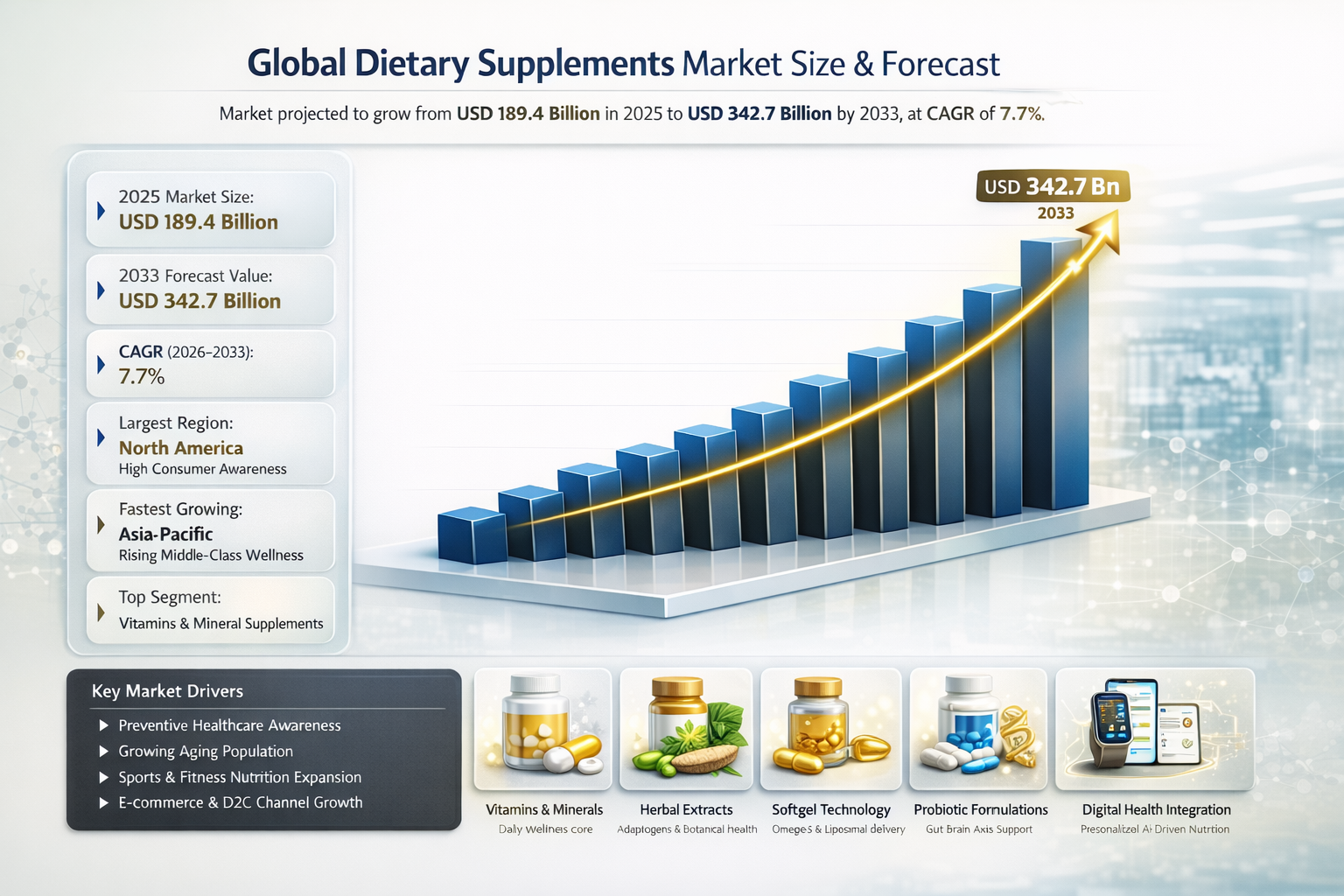
Table of Contents
1. Executive Summary
1.1 Global Dietary Supplements Market Forecast Snapshot (2026–2033)
1.2 Market Size and CAGR Analysis
1.3 Key Market Trends in Dietary Supplements
1.4 Largest and Fastest-Growing Regions
1.5 Leading Product Segments
1.6 Competitive Landscape Overview
1.7 Strategic Outlook Through 2033
2. Introduction & Market Overview
2.1 Definition of the Global Dietary Supplements Market
2.2 Scope of the Study
2.3 Evolution of the Dietary Supplements Industry
2.4 Role of Supplements in Preventive Healthcare
2.5 Rising Demand for Functional and Nutritional Supplements
2.6 Growth of Plant-Based and Herbal Supplements
2.7 Integration of Personalized Nutrition and Digital Health
3. Research Methodology – Pheonix Research
3.1 Primary Research Approach
3.2 Secondary Research Sources
3.3 Pheonix Market Size Estimation Model
3.4 Forecast Assumptions (2026–2033)
3.5 Data Validation and Market Triangulation
4. Market Dynamics
4.1 Market Drivers
4.1.1 Rising Health Awareness and Preventive Healthcare
4.1.2 Growing Aging Population
4.1.3 Expansion of Sports and Fitness Nutrition
4.1.4 Rapid Growth of E-commerce and Direct-to-Consumer Channels
4.1.5 Increasing Demand for Plant-Based and Natural Supplements
4.2 Market Restraints
4.2.1 Regulatory Challenges for Supplement Products
4.2.2 Safety and Quality Concerns
4.2.3 High Cost of Premium Supplements
4.2.4 Consumer Misinterpretation of Health Claims
4.3 Market Opportunities
4.3.1 Growth of Personalized Nutrition Solutions
4.3.2 Increasing Demand for Herbal and Botanical Supplements
4.3.3 Expansion of Functional and Immunity-Boosting Supplements
4.3.4 Digital Health and Smart Supplement Platforms
4.4 Market Challenges
4.4.1 Raw Material Supply Chain Management
4.4.2 Maintaining Product Quality and Ingredient Transparency
4.4.3 Increasing Competition Among Global Supplement Brands
4.4.4 Managing Regulatory Compliance Across Regions
5. Global Dietary Supplements Market Analysis (USD Billion), 2026–2033
5.1 Market Size Overview
5.2 CAGR Growth Analysis
5.3 Regional Market Contribution
5.4 Product Segment Revenue Analysis
5.5 Distribution Channel Trends
5.6 End-User Demand Analysis
6. Market Segmentation by Product Type (USD Billion), 2026–2033
6.1 Vitamin Supplements
6.1.1 Multivitamins
6.1.2 Single Vitamin Supplements
6.2 Mineral Supplements
6.2.1 Calcium Supplements
6.2.2 Iron Supplements
6.3 Herbal Supplements
6.3.1 Botanical Extract Supplements
6.3.2 Adaptogenic Herbal Supplements
6.4 Protein and Amino Acid Supplements
6.4.1 Protein Supplements
6.4.2 Amino Acid Supplements
6.5 Probiotic and Digestive Health Supplements
6.5.1 Probiotic Supplements
6.5.2 Prebiotic Supplements
7. Market Segmentation by Form (USD Billion), 2026–2033
7.1 Tablets
7.2 Capsules
7.3 Powders
7.4 Liquid Supplements
8. Market Segmentation by Distribution Channel (USD Billion), 2026–2033
8.1 Pharmacies and Drug Stores
8.1.1 Retail Pharmacies
8.1.1.1 Prescription and Clinical Supplements
8.2 Supermarkets and Hypermarkets
8.2.1 Health and Wellness Product Sections
8.2.1.1 Multivitamin and Mineral Supplements
8.3 Online Retail and E-commerce
8.3.1 E-commerce Marketplaces
8.3.1.1 Online Supplement Retail Platforms
8.4 Specialty Nutrition Stores
8.4.1 Sports Nutrition Retail Stores
8.4.1.1 Protein Supplements
9. Market Segmentation by End User (USD Billion), 2026–2033
9.1 Adults
9.1.1 Daily Wellness Consumers
9.1.1.1 Multivitamin Supplements
9.2 Geriatric Population
9.2.1 Age-Related Health Support
9.2.1.1 Bone and Joint Health Supplements
9.3 Athletes and Fitness Enthusiasts
9.3.1 Sports Nutrition Consumers
9.3.1.1 Protein Supplements
10. Market Segmentation by Geography
10.1 North America – Largest Market
10.2 Asia-Pacific – Fastest Growing Market
10.3 Europe
10.4 Middle East & Africa
10.5 South America
11. Competitive Landscape
11.1 Global Market Share Analysis
11.2 Product Portfolio Benchmarking
11.3 R&D and Innovation Strategies
11.4 Brand Positioning and Competitive Differentiation
11.5 Strategic Partnerships and Product Launches
12. Company Profiles
12.1 Abbott Laboratories
12.2 Amway Corporation
12.3 Herbalife Nutrition Ltd.
12.4 Nestlé Health Science
12.5 Glanbia Plc
12.6 Pfizer Inc.
12.7 Nature’s Bounty
12.8 GNC Holdings LLC
13. Strategic Intelligence & Pheonix AI Insights
13.1 Pheonix Demand Forecast Engine
13.2 Consumer Behavior Analyzer
13.3 Nutritional Supplement Innovation Tracker
13.4 Digital Health and Personalized Nutrition Insights
13.5 Automated Porter’s Five Forces Analysis
14. Future Outlook & Strategic Recommendations
14.1 Growth of Preventive Healthcare Nutrition
14.2 Expansion of Plant-Based Supplements
14.3 Development of Personalized Nutrition Solutions
14.4 Increasing Role of Digital Health Integration
14.5 Long-Term Market Outlook (2033+)
15. Appendix
16. About Pheonix Research
17. Disclaimer
Competitive Landscape
Competitive Landscape of the Global Dietary Supplements Market
Executive Framing
The Global Dietary Supplements Market is moderately consolidated with high competitive intensity, dominated by multinational pharmaceutical, nutraceutical, and wellness companies. Leading players such as Abbott Laboratories, Amway Corporation, Herbalife Nutrition Ltd., Nestlé Health Science, and Pfizer Inc. compete alongside companies like Glanbia Plc, Nature’s Bounty, and GNC Holdings LLC. The competitive landscape is shaped by strong product innovation, clinical research capabilities, and expansion across preventive healthcare and personalized nutrition segments.
Current Market Reality
The market is evolving rapidly as consumers increasingly prioritize preventive healthcare, immunity enhancement, and personalized nutrition. Vitamins and mineral supplements dominate the market, while plant-based supplements, probiotics, and sports nutrition products are emerging as high-growth segments.
Large players leverage strong brand equity, scientific validation, and global distribution networks, while smaller and emerging brands differentiate through clean-label formulations, herbal ingredients, and direct-to-consumer models. The rapid growth of e-commerce platforms and digital health ecosystems is further intensifying competition and enabling personalized supplement solutions.
Key Signals and Evidence
- Strong global demand for vitamins, minerals, and immunity-boosting supplements.
- Rapid growth in plant-based, herbal, and clean-label supplement products.
- Increasing adoption of personalized nutrition and subscription-based supplement models.
- Expansion of sports nutrition and performance-enhancing supplements.
- Rising integration of digital health platforms with supplement consumption tracking.
Strategic Implications
- Product Innovation: Expanding plant-based, probiotic, and functional supplement portfolios.
- Personalization Strategy: Leveraging AI-driven nutrition and customized supplement solutions.
- Scientific Validation: Investing in clinical trials and evidence-based health claims.
- Omnichannel Expansion: Strengthening presence across pharmacies, e-commerce, and DTC platforms.
- Clean-Label Positioning: Focusing on natural, organic, and transparent ingredient sourcing.
Forward Outlook
By 2033, the Global Dietary Supplements Market is projected to reach approximately USD 342.7 billion, growing at a CAGR of ~7.7%. North America will remain the largest market due to strong consumer awareness and advanced healthcare infrastructure, while Asia-Pacific will be the fastest-growing region driven by rising health consciousness and expanding middle-class populations.
The competitive landscape will evolve through innovation in personalized nutrition, plant-based supplement development, and digital health integration. Companies that successfully combine scientific research, consumer-centric innovation, and omnichannel distribution strategies will secure long-term leadership in the global dietary supplements ecosystem.
Value Chain
Global Dietary Supplements Market: Value Chain & Market Dynamics
Executive Framing
The Global Dietary Supplements Market is evolving into a science-driven, preventive healthcare-focused, and innovation-led ecosystem. Rising consumer demand for immunity enhancement, wellness optimization, and personalized nutrition is driving product diversification, digital health integration, and global supply chain expansion.
The operational model is integrated, where leading companies leverage large-scale manufacturing, clinical research, and global distribution networks, while emerging brands focus on personalized, plant-based, and niche functional supplement offerings.
Current Market Reality
North America dominates the market due to strong consumer awareness and advanced healthcare infrastructure, while Asia-Pacific is emerging as the fastest-growing region driven by rising incomes and expanding health-conscious populations. Upstream supply includes raw material sourcing such as botanical extracts, vitamins, minerals, and probiotics, midstream involves formulation, clinical validation, manufacturing, and packaging, and downstream distribution spans pharmacies, retail stores, e-commerce platforms, and direct-to-consumer channels.
Key Signals and Evidence
- Market growth from USD 189.4 billion (2025) to USD 342.7 billion (2033) at a CAGR of 7.7%.
- Rising adoption of preventive healthcare and immunity-boosting supplements.
- Expansion of plant-based, herbal, and clean-label supplement products.
- Growth of e-commerce, subscription-based models, and DTC supplement brands.
- Increasing investment in clinical research, personalized nutrition, and digital health platforms.
Strategic Implications
Companies must balance scientific validation, product innovation, and global distribution capabilities. Established players focus on clinical research, premium formulations, and brand trust, while emerging companies can differentiate through personalized nutrition, plant-based ingredients, and digital-first business models.
Technology adoption, including AI-driven personalization, health tracking integration, and data-driven marketing, will enhance consumer engagement and product effectiveness.
Sustainability and transparency are becoming critical, emphasizing clean-label ingredients, ethical sourcing, and environmentally responsible packaging.
Forward Outlook
The Global Dietary Supplements Market is projected to evolve into a personalized, technology-enabled, and preventive healthcare ecosystem. Key future trends include:
- Expansion of personalized and precision nutrition solutions
- Growth in plant-based, herbal, and functional supplement innovations
- Adoption of digital health platforms and subscription-based supplement services
- Integration of AI-driven analytics for nutrition tracking and product recommendations
Companies integrating scientific innovation, digital transformation, and omnichannel distribution will capture long-term growth opportunities in the global dietary supplements market.
Investment Activity
Investment & Funding Dynamics – Global Dietary Supplements Market
Executive Framing
Current Market Reality
Valued at USD 189.4 billion in 2025 and projected to reach ~USD 342.7 billion by 2033 (CAGR ~7.7%), the market reflects strong and sustained investment inflows. North America leads investment activity due to advanced healthcare infrastructure and strong supplement consumption, while Asia-Pacific is emerging as the fastest-growing investment destination supported by rising health awareness and expanding middle-class populations. Major players such as Abbott Laboratories, Amway Corporation, and Nestlé Health Science are investing in clinical validation, product innovation, and global distribution expansion.
Key Signals and Evidence
- Personalized Nutrition Platforms: Rising investments in AI-driven supplement customization and digital health integration.
- Plant-Based & Herbal Supplements: Strong capital flows into botanical extracts, organic formulations, and clean-label products.
- Clinical Research & Validation: Increasing funding for efficacy testing, bioavailability studies, and regulatory compliance.
- Probiotic & Gut Health Innovation: Expansion of microbiome-based supplements and digestive health products.
- E-Commerce & D2C Growth: Investment in online supplement platforms and subscription-based wellness models.
- Sports & Performance Nutrition: Rising demand for protein supplements, amino acids, and fitness nutrition products.
- Global Supply Chain Expansion: Investments in ingredient sourcing, manufacturing scale-up, and distribution networks.
Strategic Implications
Companies that combine scientific validation, strong branding, and digital engagement strategies are best positioned to capture long-term growth. Investors are prioritizing companies with diversified product portfolios, personalized nutrition capabilities, and strong presence in high-growth markets. Strategic partnerships with healthcare providers, fitness platforms, and e-commerce channels will be critical for scaling operations and enhancing market penetration.
Forward Outlook
From 2026 to 2033, investment in the Global Dietary Supplements Market is expected to accelerate, particularly in personalized nutrition, plant-based formulations, and digital health ecosystems. Funding will increasingly focus on AI-driven health insights, preventive healthcare solutions, and sustainable ingredient sourcing. M&A activity is expected to rise as companies consolidate capabilities and expand their global footprint in the competitive supplements landscape.
Technology & Innovation
Global Dietary Supplements Market: Technology & Innovation
Executive Framing
Technology and innovation in the Global Dietary Supplements Market are focused on advancing personalized nutrition, improving ingredient efficacy, and integrating digital health ecosystems. As demand for preventive healthcare rises, companies are leveraging biotechnology, AI-driven formulation, and novel delivery systems to develop targeted, high-performance supplement solutions tailored to individual health needs.
Current Market Reality
Valued at USD 189.4 billion in 2025 and projected to reach USD 342.7 billion by 2033 at a CAGR of 7.7%, the market is undergoing rapid technological evolution. North America leads in clinical research, advanced supplement formulations, and personalized nutrition platforms, while Asia-Pacific is emerging as a high-growth innovation hub driven by herbal supplement integration, digital health adoption, and expanding manufacturing capabilities.
Key Signals and Evidence
- Personalized Nutrition Platforms: Integration of AI, genetic testing, and wearable health data to create customized supplement plans and subscription-based wellness solutions.
- Advanced Delivery Systems: Development of liposomal delivery, time-release capsules, gummies, and nano-encapsulation to enhance nutrient absorption and bioavailability.
- Biotechnology & Ingredient Innovation: Use of precision fermentation, plant-based actives, and clinically validated compounds to improve supplement efficacy and safety.
- Probiotic & Microbiome Research: Expansion of gut-health-focused supplements supported by microbiome analysis and targeted probiotic formulations.
- Digital Health Integration: Integration of supplements with mobile health apps, telehealth platforms, and digital wellness tracking systems.
- Smart Packaging & Traceability: Adoption of QR-based tracking, blockchain verification, and sustainable packaging to ensure transparency and product authenticity.
Strategic Implications
Companies investing in personalized nutrition technologies, clinically validated formulations, and innovative delivery systems will gain a strong competitive advantage. Expanding into high-growth areas such as plant-based supplements, immunity boosters, and digital wellness ecosystems can drive long-term revenue growth. Transparency, traceability, and regulatory compliance will also be critical in building consumer trust and brand differentiation.
Forward Outlook
The dietary supplements market is expected to evolve toward fully personalized, data-driven nutrition ecosystems supported by AI and digital health platforms. Future innovation will focus on enhancing nutrient absorption, improving clinical efficacy, and expanding global accessibility. Dietary supplements will continue to play a central role in preventive healthcare and next-generation wellness solutions.
Market Risk
Executive Framing
The Global Dietary Supplements Market is experiencing strong and sustained growth, driven by increasing consumer focus on preventive healthcare, immunity enhancement, and overall wellness. Valued at USD 189.4 billion in 2025 and projected to reach USD 342.7 billion by 2033 at a CAGR of 7.7%, the market reflects rising adoption of vitamins, minerals, herbal supplements, and functional nutrition products across global populations.
Current Market Reality
North America dominates the global dietary supplements market due to high consumer awareness, advanced healthcare infrastructure, and widespread supplement usage. Asia-Pacific is the fastest-growing region, supported by rising disposable incomes, expanding middle-class populations, and increasing demand for traditional and herbal supplements. Vitamins and mineral supplements lead the market, while plant-based and personalized nutrition products are rapidly gaining traction.
Key Signals and Evidence
- Increasing global focus on preventive healthcare and immunity support.
- Rising demand for plant-based, herbal, and clean-label supplements.
- Growth in sports nutrition and performance-enhancing dietary products.
- Rapid expansion of e-commerce and direct-to-consumer supplement brands.
- Advancements in personalized nutrition and digital health integration.
Strategic Implications
- Invest in plant-based, herbal, and scientifically validated supplement formulations.
- Expand personalized nutrition and digital health-enabled product offerings.
- Strengthen global distribution through e-commerce and direct-to-consumer channels.
- Focus on clean-label, transparency, and regulatory compliance to build consumer trust.
- Target high-growth markets in Asia-Pacific and emerging economies.
Forward Outlook
The market is expected to evolve into a highly advanced, technology-driven ecosystem centered on personalized nutrition, preventive healthcare, and functional wellness. Growth will be fueled by innovations in plant-based supplements, probiotic formulations, and digital health integration, with companies focusing on scientific validation, product differentiation, and global expansion to secure long-term competitive advantage.
Regulatory Landscape
Regulatory & Policy Landscape: Global Dietary Supplements Market
Executive Framing
The Global Dietary Supplements Market operates under a highly regulated framework governed by authorities such as the U.S. Food and Drug Administration (FDA), European Food Safety Authority (EFSA), Food Safety and Standards Authority of India (FSSAI), and other national regulatory bodies. Dietary supplements—including vitamins, minerals, herbal extracts, amino acids, and probiotics—are regulated to ensure product safety, quality, labeling accuracy, and permissible health claims.
As products directly linked to health outcomes, dietary supplements are subject to strict oversight regarding ingredient safety, dosage limits, manufacturing practices, and substantiation of claims such as “immune support,” “bone health,” “energy enhancement,” and “cognitive performance.”
Current Market Reality
The dietary supplements market presents a high regulatory complexity due to varying classification systems and compliance requirements across regions. In North America, supplements are regulated under dietary supplement frameworks with post-market surveillance, while Europe enforces stricter pre-market approvals and health claim validations.
Asia-Pacific markets are rapidly strengthening regulatory frameworks, particularly in China, India, and Japan, focusing on product registration, ingredient approvals, and labeling compliance. The rapid expansion of e-commerce and cross-border supplement sales has further increased regulatory scrutiny on product authenticity, safety, and traceability.
Key Signals and Evidence
- Strict regulations on health claims requiring scientific evidence and regulatory approval.
- Mandatory labeling standards including ingredients, dosage, allergens, and usage instructions.
- Good Manufacturing Practice (GMP) compliance for supplement production facilities.
- Approval requirements for novel ingredients, herbal extracts, and probiotic strains.
- High scrutiny on products targeting immunity, weight management, and disease prevention.
- Increased regulatory focus on online sales, counterfeit products, and cross-border compliance.
Strategic Implications
Companies must invest in regulatory compliance, clinical validation, and quality assurance to ensure product safety and market access. Developing region-specific strategies for labeling, ingredient approval, and certification is essential for global expansion.
As personalized nutrition gains traction, aligning product innovation with regulatory frameworks will be critical. Brands that ensure transparency, traceability, and adherence to international standards will strengthen consumer trust and competitive positioning.
Forward Outlook (2026–2033)
Regulatory frameworks are expected to become more stringent, particularly around health claims, ingredient transparency, and product efficacy. Governments are increasingly focusing on preventive healthcare, leading to tighter control over supplement quality and marketing practices.
Emerging technologies such as blockchain-based traceability, AI-driven compliance systems, and digital health integration will support regulatory adherence. Companies that proactively adapt to evolving regulations and invest in compliance infrastructure will gain a competitive advantage in the global dietary supplements market.