
Global Imitation Jewellery Market Size and Share Analysis 2026-2033
Global Imitation Jewellery Market Size & Forecast
The global imitation jewellery market is projected to witness substantial growth during the forecast period from 2026 to 2033. The market was valued at approximately USD 18.7 billion in 2025 and is expected to reach nearly USD 33.5 billion by 2033, expanding at a CAGR of around 7.5%. The market growth is driven by rising fashion consciousness, increasing demand for affordable luxury accessories, rapid expansion of e-commerce fashion retail, and changing consumer preferences toward trend-based jewellery products. Imitation jewellery, also known as fashion jewellery or costume jewellery, includes accessories made from non-precious metals, synthetic stones, beads, pearls, plastics, and other alternative materials designed to replicate the appearance of fine jewellery. The market is witnessing strong demand from younger consumers seeking stylish, affordable, and versatile jewellery products for everyday wear, special occasions, and social media-driven fashion trends. Technological advancements in jewellery design, lightweight manufacturing materials, sustainable alternatives, and digital customization platforms are further reshaping the global imitation jewellery industry.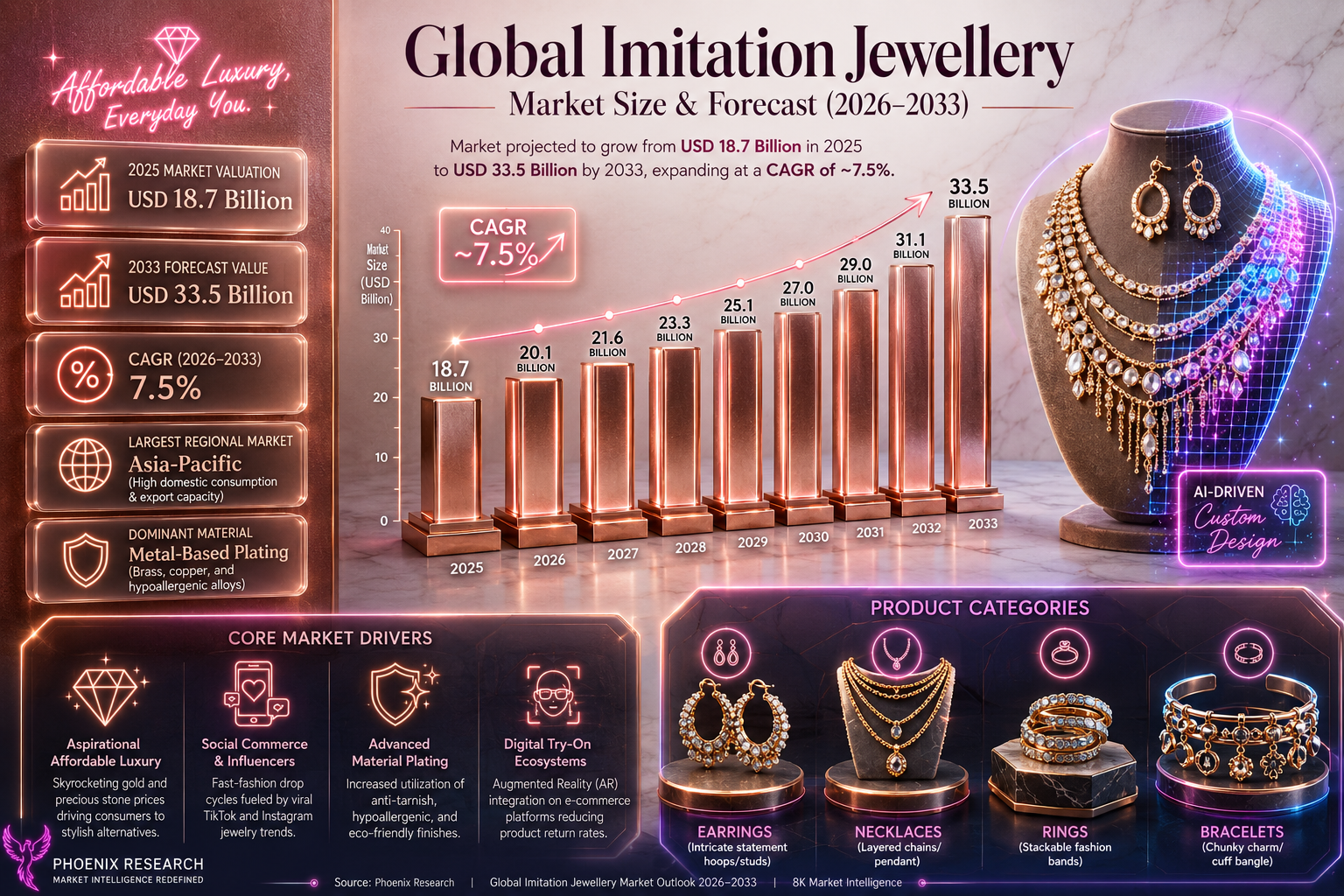
Global Imitation Jewellery Market Overview
The imitation jewellery market forms a significant segment of the global fashion accessories and lifestyle products industry. The market includes necklaces, earrings, bracelets, rings, anklets, brooches, hair accessories, and customized fashion jewellery products. Fashion jewellery brands are increasingly focusing on trend-driven collections, celebrity collaborations, influencer marketing, and fast-fashion integration to attract consumers across multiple demographics. The rise of online retail platforms, social commerce, and direct-to-consumer business models is significantly improving product accessibility and market penetration worldwide. Manufacturers are also investing in hypoallergenic materials, eco-friendly production methods, and premium plating technologies to enhance product quality and durability. Major market participants include Pandora A/S, Swarovski AG, H&M Group, Zara (Inditex), Avon Products Inc., Buckley London, Lovisa Holdings, Accessorize, Tanishq Fashion Jewelry Division, and Forever 21.Key Drivers of Global Imitation Jewellery Market Growth
Rising Fashion Consciousness Among Consumers
Consumers are increasingly adopting fashion jewellery to complement changing clothing styles and seasonal fashion trends. Frequent product launches and affordable pricing encourage repeat purchases and trend experimentation.Growing Popularity of Affordable Luxury Products
Imitation jewellery offers consumers luxury-inspired designs at significantly lower prices compared to precious jewellery. This affordability is expanding the customer base among middle-income and younger consumers.Expansion of E-commerce and Social Media Retailing
Online marketplaces, social commerce platforms, and influencer-driven marketing campaigns are significantly boosting global sales of imitation jewellery products. Digital retail channels provide consumers with extensive product variety, customization options, and convenient shopping experiences.Increasing Demand for Occasion-Based and Customized Jewellery
Consumers are increasingly purchasing fashion jewellery for weddings, parties, festivals, corporate events, and gifting purposes. Personalized jewellery designs and custom-made collections are gaining popularity worldwide.Innovation in Materials and Design Technologies
Manufacturers are introducing lightweight metals, sustainable materials, advanced plating techniques, and 3D printing technologies to improve design flexibility and product durability. These innovations are enhancing product aesthetics and consumer appeal.Global Imitation Jewellery Market Segmentation
By Product Type
The market is segmented into necklaces, earrings, rings, bracelets, anklets, brooches, and other accessories. Earrings and necklaces account for a major market share due to high consumer demand across fashion categories.By Material Type
The market includes metal-based jewellery, plastic jewellery, glass jewellery, crystal jewellery, and synthetic gemstone jewellery. Metal-based imitation jewellery dominates due to durability and premium appearance.By Distribution Channel
The market includes online retail, specialty jewellery stores, department stores, fashion boutiques, and supermarkets/hypermarkets. Online retail channels are witnessing the fastest growth due to increasing digital shopping adoption.By End User
The market includes women, men, and children. Women represent the largest consumer segment due to extensive product variety and higher fashion accessory spending.Regional Market Dynamics
Asia-Pacific
Asia-Pacific dominates the imitation jewellery market due to large consumer populations, growing middle-class income, and strong fashion retail industries. India and China are major contributors supported by cultural demand for jewellery and expanding e-commerce platforms.North America
North America represents a significant market driven by strong fashion consciousness, celebrity-driven trends, and widespread online retail adoption. The United States leads regional growth with high demand for premium fashion accessories.Europe
Europe holds a strong market share due to established fashion industries, luxury-inspired consumer preferences, and high demand for sustainable jewellery products. Countries such as the United Kingdom, France, Germany, and Italy are major regional markets.Latin America
Latin America is witnessing gradual growth driven by increasing urbanization, rising fashion awareness, and expanding retail infrastructure. Brazil and Mexico remain key growth markets.Middle East & Africa
The region is experiencing growing demand for imitation jewellery due to rising disposable incomes, tourism growth, and increasing fashion retail investments. GCC countries are major contributors to regional demand.Competitive Landscape
The global imitation jewellery market is highly fragmented and competitive, with participation from international fashion brands, regional jewellery manufacturers, and online fashion retailers. Key companies include Pandora A/S, Swarovski AG, H&M Group, Zara (Inditex), Avon Products Inc., Lovisa Holdings, Buckley London, Accessorize, and Forever 21. Companies are increasingly focusing on fast-fashion collections, influencer collaborations, sustainable materials, and omnichannel retail strategies. Competition is driven by product design innovation, pricing, customization capabilities, brand visibility, and digital marketing effectiveness.Strategic Outlook
The strategic outlook for the global imitation jewellery market remains highly positive due to increasing consumer demand for affordable fashion accessories and trend-based jewellery products. Future growth opportunities include AI-driven jewellery customization, sustainable fashion jewellery collections, augmented reality (AR) virtual try-on technologies, and direct-to-consumer digital platforms. Manufacturers investing in eco-friendly materials, premium plating technologies, and fast product innovation cycles are expected to strengthen their market positioning. Expansion into emerging markets and influencer-driven brand building strategies will continue shaping the competitive landscape.Final Market Perspective
The global imitation jewellery market is evolving rapidly as fashion trends, digital retailing, and affordable luxury preferences reshape consumer purchasing behavior. Growing demand for stylish, customizable, and accessible jewellery products will continue driving strong market expansion throughout the forecast period. Organizations that successfully combine design innovation, digital engagement, and sustainable manufacturing capabilities will remain strongly positioned in the evolving global imitation jewellery market.Table of Contents
Table of Contents
1. Executive Summary
- 1.1 Global Imitation Jewellery Market Snapshot (2026???2033)
- 1.2 Market Size & CAGR Analysis
- 1.3 Key Growth Drivers & Emerging Opportunities
- 1.4 Largest & Fastest-Growing Segments
- 1.5 Regional Market Highlights
- 1.6 Competitive Landscape Overview
- 1.7 Strategic Outlook Through 2033
2. Introduction & Market Overview
- 2.1 Definition of Imitation Jewellery
- 2.2 Scope of the Global Imitation Jewellery Market
- 2.3 Market Size & Forecast (2026???2033)
- 2.4 Evolution of Fashion Jewellery Industry
- 2.5 Consumer Trends & Fashion Dynamics
- 2.6 Impact of Digital Commerce & Social Media
- 2.7 Regulatory & Sustainability Landscape
3. Research Methodology
- 3.1 Primary Research
- 3.2 Secondary Research
- 3.3 Data Collection & Validation Framework
- 3.4 Market Estimation Methodology
- 3.5 Forecast Assumptions (2026???2033)
- 3.6 Data Triangulation & Analytical Modeling
4. Market Dynamics
4.1 Market Drivers
- 4.1.1 Rising Fashion Consciousness Among Consumers
- 4.1.2 Growing Popularity of Affordable Luxury Products
- 4.1.3 Expansion of E-Commerce & Social Media Retailing
- 4.1.4 Increasing Demand for Occasion-Based & Customized Jewellery
- 4.1.5 Innovation in Materials & Design Technologies
4.2 Market Restraints
- 4.2.1 Intense Market Competition & Pricing Pressure
- 4.2.2 Product Quality & Durability Concerns
- 4.2.3 Availability of Counterfeit Products
- 4.2.4 Volatility in Raw Material Costs
4.3 Market Opportunities
- 4.3.1 AI-Driven Jewellery Customization Platforms
- 4.3.2 Sustainable & Eco-Friendly Fashion Jewellery
- 4.3.3 AR-Based Virtual Try-On Technologies
- 4.3.4 Expansion in Emerging Fashion Markets
4.4 Market Challenges
- 4.4.1 Maintaining Product Differentiation
- 4.4.2 Managing Fast-Changing Fashion Trends
- 4.4.3 Supply Chain & Inventory Management Complexity
- 4.4.4 Balancing Affordability with Product Quality
5. Global Imitation Jewellery Market Analysis (USD Billion), 2026???2033
- 5.1 Market Revenue Analysis
- 5.2 CAGR Analysis
- 5.3 Market Share Analysis
- 5.4 Regional Revenue Distribution
- 5.5 Consumer Buying Behavior Analysis
- 5.6 Fashion Trend & Product Innovation Analysis
6. Market Segmentation (USD Billion), 2026???2033
6.1 By Product Type
- 6.1.1 Necklaces
- 6.1.2 Earrings
- 6.1.3 Rings
- 6.1.4 Bracelets
- 6.1.5 Anklets
- 6.1.6 Brooches
- 6.1.7 Other Accessories
6.2 By Material Type
- 6.2.1 Metal-Based Jewellery
- 6.2.2 Plastic Jewellery
- 6.2.3 Glass Jewellery
- 6.2.4 Crystal Jewellery
- 6.2.5 Synthetic Gemstone Jewellery
6.3 By Distribution Channel
- 6.3.1 Online Retail
- 6.3.2 Specialty Jewellery Stores
- 6.3.3 Department Stores
- 6.3.4 Fashion Boutiques
- 6.3.5 Supermarkets & Hypermarkets
6.4 By End User
- 6.4.1 Women
- 6.4.2 Men
- 6.4.3 Children
7. Market Segmentation by Region
- 7.1 Asia-Pacific
- 7.2 North America
- 7.3 Europe
- 7.4 Latin America
- 7.5 Middle East & Africa
8. Regional Market Insights
- 8.1 Asia-Pacific Market Analysis
- 8.2 North America Market Analysis
- 8.3 Europe Market Analysis
- 8.4 Latin America Market Analysis
- 8.5 Middle East & Africa Market Analysis
9. Competitive Landscape
- 9.1 Market Share Analysis
- 9.2 Competitive Benchmarking
- 9.3 Fast-Fashion Jewellery Strategies
- 9.4 Influencer & Celebrity Collaboration Trends
- 9.5 Sustainability & Product Innovation Strategies
- 9.6 Omnichannel Retail Expansion
10. Company Profiles
- 10.1 Pandora A/S
- 10.2 Swarovski AG
- 10.3 H&M Group
- 10.4 Zara (Inditex)
- 10.5 Avon Products Inc.
- 10.6 Lovisa Holdings
- 10.7 Buckley London
- 10.8 Accessorize
- 10.9 Tanishq Fashion Jewelry Division
- 10.10 Forever 21
11. Strategic Intelligence & AI Insights
- 11.1 AI-Based Jewellery Design & Customization Trends
- 11.2 Consumer Fashion Analytics
- 11.3 AR/VR Virtual Try-On Technology Insights
- 11.4 Sustainable Fashion Jewellery Outlook
- 11.5 Porter???s Five Forces Analysis
12. Future Outlook & Strategic Recommendations
- 12.1 Future of Fast-Fashion Jewellery
- 12.2 Expansion of Sustainable Jewellery Collections
- 12.3 Growth of Digital-First & DTC Business Models
- 12.4 Emerging Market Expansion Strategies
- 12.5 Long-Term Market Outlook (2033+)
13. Appendix
14. About Pheonix Research
15. Disclaimer
Competitive Landscape
Global Imitation Jewellery Market Competitive Intensity & Market Structure Overview
The global imitation jewellery market is highly fragmented and intensely competitive, characterized by the presence of international fashion brands, regional jewellery manufacturers, fast-fashion retailers, designer labels, and digital-first direct-to-consumer companies. Competition is primarily driven by product design innovation, pricing strategies, fashion trend responsiveness, brand visibility, and omnichannel retail capabilities.
The market structure is highly dynamic due to low entry barriers, rapid product turnover cycles, and constantly evolving consumer fashion preferences. Companies compete aggressively through seasonal collections, influencer partnerships, celebrity endorsements, and social media-driven marketing campaigns.
The increasing convergence of fashion retail, digital commerce, and personalized consumer experiences is reshaping the competitive landscape, particularly among younger demographics seeking affordable and trend-driven accessories.
Global Imitation Jewellery Market Competitive Intensity & Market Structure Current Scenario
Leading Fashion Jewellery & Accessories Companies
Pandora A/S: One of the leading global jewellery brands with strong presence in fashion-inspired collections, customizable jewellery, and premium lifestyle accessories.
Swarovski AG: Major player known for crystal-based fashion jewellery and premium imitation jewellery collections targeting luxury-inspired consumer segments.
H&M Group: Global fast-fashion retailer offering trend-based imitation jewellery products integrated into seasonal fashion collections.
Zara (Inditex): Strong participant in the fast-fashion jewellery segment with rapidly changing fashion accessory lines aligned with global style trends.
Avon Products Inc.: Established beauty and fashion accessories company with extensive direct-selling and online jewellery distribution networks.
Lovisa Holdings: International fashion jewellery retailer focused on affordable trend-driven accessories and rapid product innovation cycles.
Buckley London: Premium fashion jewellery brand recognized for designer-inspired collections and gifting-oriented products.
Accessorize: Leading fashion accessories retailer offering diverse jewellery collections targeting youth and lifestyle consumers.
Forever 21: Fast-fashion retailer actively competing in affordable imitation jewellery and youth fashion accessories markets.
Tanishq Fashion Jewelry Division: Expanding presence in premium imitation and fashion-inspired jewellery products within emerging markets.
Key Competitive Intensity & Market Structure Drivers
Fast-changing fashion trends and seasonal consumer preferences are major competitive drivers, requiring companies to maintain rapid product development and inventory refresh cycles.
Digital marketing and influencer-driven brand engagement have become critical competitive differentiators, particularly across Instagram, TikTok, Pinterest, and social commerce platforms.
The rapid expansion of e-commerce and direct-to-consumer retail models is intensifying competition by increasing product accessibility and lowering global market entry barriers.
Price competitiveness remains highly important, especially in mass-market segments where consumers frequently purchase affordable jewellery products for trend-based styling.
Sustainability and ethical sourcing are becoming increasingly influential competitive factors as consumers demand eco-friendly materials, recyclable packaging, and responsible manufacturing practices.
Strategic Implications of Competitive Intensity & Market Structure
Companies are increasingly adopting fast-fashion business models that enable rapid design adaptation and quicker response to evolving consumer trends.
Strategic collaborations with fashion influencers, celebrities, designers, and lifestyle brands are becoming essential for strengthening brand recognition and consumer engagement.
Technology integration including AI-driven personalization, augmented reality (AR) virtual try-on tools, and digital customization platforms is reshaping the customer purchasing experience.
Manufacturers are investing in lightweight materials, hypoallergenic metals, advanced plating technologies, and sustainable raw materials to improve product quality and differentiation.
Omnichannel retail strategies combining physical stores, online marketplaces, mobile commerce, and social selling are becoming increasingly important for market expansion and customer retention.
Global Imitation Jewellery Market Competitive Intensity & Market Structure Forward Outlook
The global imitation jewellery market is expected to remain highly innovation-driven as digital fashion trends, affordable luxury demand, and social media influence continue reshaping consumer behavior.
Future competition is likely to intensify around sustainable jewellery production, personalized fashion accessories, and AI-powered trend forecasting capabilities.
Online retail platforms and direct-to-consumer brands are expected to gain increasing market share due to growing digital purchasing adoption and global accessibility.
Emerging markets in Asia-Pacific, Latin America, and the Middle East are expected to create strong growth opportunities for international and regional jewellery brands.
Overall, companies that successfully combine rapid design innovation, digital consumer engagement, sustainable manufacturing, and strong omnichannel distribution capabilities will remain strongly positioned in the evolving global imitation jewellery market.
Value Chain
Global Imitation Jewellery Market Value Chain & Supply Chain Evolution Overview
The global imitation jewellery market value chain is evolving into a highly fashion-driven, digitally connected, and trend-responsive ecosystem supported by rapid product innovation, fast-fashion retailing, e-commerce expansion, and changing consumer lifestyle preferences. The industry is transitioning from traditional low-cost accessory manufacturing toward design-centric, sustainable, and technology-enabled fashion accessory ecosystems.
The value chain begins with upstream raw material sourcing, including non-precious metals, alloys, beads, crystals, synthetic gemstones, plastics, glass, pearls, resins, and plating chemicals. Suppliers of lightweight metals, eco-friendly materials, and decorative components play a critical role in determining product aesthetics, durability, and pricing competitiveness.
The design and product development stage forms the creative core of the value chain. Fashion designers, jewellery stylists, CAD modeling specialists, and trend forecasting teams develop seasonal collections aligned with celebrity fashion trends, social media aesthetics, and consumer purchasing behavior. Increasing use of AI-assisted design platforms and 3D modeling tools is accelerating product development cycles and enabling rapid customization.
The manufacturing and assembly segment includes casting, moulding, stone setting, electroplating, polishing, engraving, and finishing operations. Manufacturers are increasingly adopting automated production technologies, lightweight alloy processing, laser engraving systems, and advanced plating methods to improve production efficiency and product quality.
Post-production activities involve packaging, branding, inventory management, quality inspection, and customization services. Companies are focusing on premium packaging, hypoallergenic coatings, anti-tarnish treatments, and sustainable packaging solutions to improve brand differentiation and customer experience.
The distribution and commercialization layer includes online marketplaces, fashion retail chains, jewellery boutiques, social commerce platforms, direct-to-consumer websites, and influencer-driven marketing channels. Digital retail ecosystems are significantly transforming global product accessibility and consumer engagement strategies.
Sustainability and ethical sourcing are becoming increasingly important across the value chain. Manufacturers are investing in recycled metals, eco-friendly packaging, low-impact plating chemicals, and responsible sourcing practices to align with sustainable fashion trends and environmental regulations.
Global Imitation Jewellery Market Value Chain & Supply Chain Evolution Current Scenario
The current imitation jewellery supply chain is characterized by highly fragmented manufacturing networks, rapid fashion cycles, and strong dependence on global sourcing ecosystems. Asia-Pacific dominates manufacturing activities due to cost-efficient labor, large-scale production capabilities, and strong raw material availability.
China and India serve as major production hubs for imitation jewellery due to established jewellery manufacturing clusters, skilled craftsmanship, and strong export-oriented supply chains. These countries support both mass-market production and customized fashion jewellery manufacturing.
North America and Europe primarily dominate premium branding, fashion trend development, digital retailing, and influencer-based commercialization strategies. Consumer demand in these regions is increasingly driven by affordable luxury preferences and sustainable fashion awareness.
The market is rapidly transitioning toward fast-fashion jewellery production models where brands launch frequent seasonal collections aligned with changing fashion trends and social media-driven consumer behavior.
E-commerce platforms and social commerce channels are significantly reshaping supply chain structures by reducing dependence on traditional retail intermediaries and enabling direct-to-consumer sales models. Influencer marketing and livestream commerce are becoming major product discovery and customer acquisition channels.
However, the market continues to face challenges related to counterfeit products, inconsistent quality standards, fluctuating raw material costs, and environmental concerns associated with low-cost manufacturing and chemical plating processes.
Key Value Chain & Supply Chain Evolution Signals in Global Imitation Jewellery Market
One of the most significant transformation signals is the rapid expansion of online fashion retail and social commerce platforms, which are accelerating global product visibility and enabling small brands to reach international consumers directly.
Another major signal is the increasing integration of AI-driven design tools, 3D printing technologies, and digital customization platforms that allow brands to rapidly create personalized and trend-responsive jewellery collections.
The growing demand for sustainable and eco-friendly fashion accessories is reshaping material sourcing and manufacturing practices. Brands are increasingly adopting recycled metals, biodegradable packaging, and environmentally responsible plating techniques.
Influencer collaborations, celebrity endorsements, and fast-fashion partnerships are becoming central to commercialization strategies, significantly shortening product lifecycle timelines and increasing demand for agile manufacturing capabilities.
Omnichannel retail integration is also accelerating, with brands combining physical stores, online platforms, social commerce, and mobile shopping experiences to strengthen customer engagement and purchasing convenience.
Additionally, premiumization trends within imitation jewellery are encouraging manufacturers to improve product quality through advanced plating technologies, hypoallergenic materials, anti-tarnish coatings, and luxury-inspired designs.
Strategic Implications of Value Chain & Supply Chain Evolution in Global Imitation Jewellery Market
The evolving value chain presents significant strategic implications for jewellery manufacturers, fashion brands, retailers, raw material suppliers, and digital commerce platforms. Companies capable of rapidly responding to changing fashion trends are gaining strong competitive advantages.
Supply chain agility is becoming increasingly important as brands seek shorter product development cycles, flexible manufacturing systems, and real-time inventory management capabilities to support fast-fashion business models.
Investment in digital retail ecosystems, AI-driven trend forecasting, and influencer-led marketing strategies is emerging as a key differentiator in customer acquisition and brand visibility.
Vertical integration across design, manufacturing, branding, and online retail operations is becoming strategically important for improving profit margins, inventory control, and product launch speed.
Sustainability investment in eco-friendly materials, recycled metals, and ethical sourcing practices is helping brands strengthen premium positioning and align with environmentally conscious consumer preferences.
Long-term competitiveness in the imitation jewellery market will depend on balancing affordability, design innovation, product quality, digital engagement, and sustainable production capabilities.
Global Imitation Jewellery Market Value Chain & Supply Chain Evolution Forward Outlook
Between 2026 and 2033, the imitation jewellery value chain is expected to become increasingly digitalized, customization-oriented, and sustainability-focused. AI-powered trend forecasting and automated product design systems will accelerate fashion cycle responsiveness and improve personalization capabilities.
3D printing and advanced manufacturing technologies are expected to improve design flexibility, reduce production lead times, and support mass customization of jewellery products.
Social commerce, virtual storefronts, and influencer-driven retail ecosystems will continue expanding, enabling brands to engage directly with global consumers through immersive digital shopping experiences.
Augmented reality (AR) virtual try-on technologies and AI-based recommendation engines are expected to transform online jewellery shopping and improve conversion rates across digital platforms.
Sustainable fashion initiatives will accelerate adoption of recyclable materials, biodegradable packaging, low-emission production systems, and ethical sourcing frameworks throughout the supply chain.
Ultimately, the future imitation jewellery value chain will evolve into a highly agile, digitally integrated, and consumer-centric fashion ecosystem where trend responsiveness, customization, sustainability, and omnichannel engagement define long-term market competitiveness.
Market-Specific Value Chain
- Raw Material Sourcing: Non-precious metal suppliers, synthetic gemstone manufacturers, crystal suppliers, resin producers, plating chemical providers
- Design & Product Development: Fashion designers, CAD modelling teams, AI-based trend forecasting platforms, customization specialists
- Manufacturing & Assembly: Casting units, electroplating facilities, jewellery assemblers, polishing and finishing operators, 3D printing manufacturers
- Branding & Packaging: Fashion accessory brands, packaging suppliers, quality inspection providers, customization service companies
- Distribution & Retail: E-commerce marketplaces, fashion boutiques, department stores, social commerce platforms, direct-to-consumer channels
- End-Use Applications: Everyday fashion wear, weddings, party accessories, gifting, corporate events, influencer fashion styling, seasonal collections
Investment Activity
Global Imitation Jewellery Market Investment & Funding Dynamics Overview
Investment and funding activity in the global imitation jewellery market is accelerating steadily due to rising demand for affordable fashion accessories, rapid growth of e-commerce fashion retail, increasing social media influence on consumer purchasing behavior, and expanding adoption of sustainable fashion products. Between 2026 and 2033, investments are expected to increasingly focus on digital retail expansion, AI-driven jewellery customization, sustainable material sourcing, advanced manufacturing technologies, and omnichannel brand development.
The imitation jewellery industry is evolving from a traditional low-cost accessories market into a dynamic fashion-driven consumer segment supported by influencer marketing, fast-fashion integration, and digital personalization trends. Major fashion brands, jewellery retailers, and online platforms are actively increasing investments in product innovation, lightweight materials, premium plating technologies, and global supply chain optimization.
A major structural transformation influencing investment patterns is the global shift toward affordable luxury and trend-based consumer lifestyles. Consumers increasingly prefer versatile and budget-friendly jewellery collections that complement changing fashion trends without the high cost associated with precious metals and gemstones.
The market is also benefiting from rising investments in sustainable fashion initiatives, recycled materials, direct-to-consumer retail models, augmented reality (AR) virtual try-on technologies, and AI-powered product recommendation systems. Expansion of influencer-driven marketing ecosystems and social commerce platforms is further strengthening global funding activity across the imitation jewellery industry.
Global Imitation Jewellery Market Investment & Funding Dynamics Current Scenario
Current investment activity in the imitation jewellery market is strongly supported by increasing consumer spending on fashion accessories, rapid expansion of online fashion marketplaces, and growing demand for customized jewellery products. Companies are actively investing in sustainable sourcing, advanced jewellery finishing technologies, digital retail infrastructure, and fast product development cycles to improve market competitiveness and customer engagement.
- Asia-Pacific: Dominates global investment activity due to large consumer populations, strong manufacturing ecosystems, expanding middle-class income levels, and rapid growth of online fashion retail across India, China, South Korea, and Southeast Asia.
- North America: Continues attracting major investments driven by strong fashion-conscious consumer bases, influencer-driven jewellery trends, and increasing demand for personalized and sustainable fashion accessories.
- Europe: Witnessing strong investment growth supported by premium fashion industries, sustainability-focused consumer behavior, and increasing adoption of eco-friendly jewellery materials and ethical sourcing practices.
- Middle East & Latin America: Emerging as developing investment regions supported by growing urbanization, rising disposable income, tourism growth, and expansion of organized fashion retail infrastructure.
Key Investment & Funding Dynamics Signals in Global Imitation Jewellery Market
- Rising demand for affordable luxury fashion products is driving investments into premium imitation jewellery collections and celebrity-inspired accessory lines.
- Expansion of e-commerce and social commerce platforms is attracting funding into digital jewellery retailing, influencer partnerships, and AI-powered customer engagement technologies.
- Growing consumer preference for sustainable fashion is increasing investments in recycled metals, biodegradable packaging, and eco-friendly jewellery production processes.
- Technological advancements in 3D printing, advanced plating techniques, and lightweight materials are supporting investments in innovative jewellery manufacturing systems.
- Augmented reality (AR) virtual try-on solutions and AI-driven customization platforms are emerging as important innovation areas attracting retail technology investments.
- Fashion brands are increasingly investing in direct-to-consumer business models to improve brand control, customer experience, and profit margins.
- Expansion of occasion-based and personalized jewellery demand is encouraging investments into custom design platforms and made-to-order jewellery production capabilities.
Strategic Implications of Investment & Funding Dynamics in Global Imitation Jewellery Market
- The investment landscape increasingly favors companies capable of combining fast-fashion responsiveness, digital retail capabilities, and efficient global supply chains.
- Product innovation and rapid trend adaptation are becoming major competitive differentiators, particularly among younger consumers influenced by social media and celebrity culture.
- Strategic collaborations between fashion brands, influencers, online marketplaces, and jewellery manufacturers are becoming increasingly important for market expansion and customer acquisition.
- Regional diversification strategies remain critical, with Asia-Pacific leading manufacturing and consumption growth, North America driving influencer-led retail expansion, and Europe emphasizing sustainability and premium design innovation.
- Companies investing in sustainable materials, hypoallergenic coatings, and premium-quality finishing technologies are expected to achieve stronger long-term brand positioning.
- Digital transformation initiatives including AR shopping experiences, AI-powered trend forecasting, and omnichannel retail integration are emerging as major investment priorities.
- Organizations with strong digital marketing ecosystems, agile production networks, and scalable e-commerce infrastructure are expected to maintain stronger competitive leadership globally.
Global Imitation Jewellery Market Investment & Funding Dynamics Forward Outlook
Looking ahead, the global imitation jewellery market is expected to attract strong long-term investment supported by rising fashion consumption, increasing digital retail penetration, and growing demand for affordable personalized accessories.
Future capital allocation will prioritize AI-driven jewellery customization platforms, sustainable material innovation, AR-enabled shopping technologies, advanced manufacturing automation, influencer-led digital branding strategies, and expansion of direct-to-consumer retail ecosystems.
- Asia-Pacific: Will remain the leading investment region due to strong manufacturing capabilities, expanding online fashion ecosystems, and rising demand for affordable luxury products.
- North America: Will continue strengthening its market position through investments in social commerce, digital personalization technologies, and premium fashion accessory brands.
- Europe: Will increasingly focus on ethical sourcing, eco-friendly jewellery manufacturing, and sustainable fashion innovation initiatives.
Future funding activity is also expected to accelerate across smart jewellery integration, sustainable fashion collaborations, AI-powered design platforms, and global cross-border e-commerce expansion.
Sustainability initiatives, fashion technology innovation, and digital consumer engagement strategies will remain central investment priorities across the imitation jewellery industry. The growing convergence of fashion, social media, and digital retail ecosystems will continue reshaping competitive dynamics globally.
Overall, the market is expected to maintain strong long-term investment momentum due to its expanding role within affordable luxury fashion, personalized accessories, and digital commerce ecosystems. Companies that successfully combine trend-driven product innovation, scalable manufacturing, sustainability leadership, and omnichannel retail capabilities will remain strongly positioned to lead the global imitation jewellery market through 2033.
Technology & Innovation
Global Imitation Jewellery Market Technology & Innovation Landscape Overview
The global imitation jewellery market is undergoing rapid technological transformation driven by digital design innovation, advanced material engineering, AI-powered customization, and sustainable manufacturing technologies. The industry is increasingly integrating modern production techniques, e-commerce technologies, and data-driven fashion analytics to improve product development speed, personalization capabilities, and customer engagement.
Innovation within the market is primarily focused on lightweight material development, premium plating technologies, 3D jewellery design systems, augmented reality (AR) virtual try-on solutions, and AI-assisted trend forecasting platforms. These technologies are enabling manufacturers and fashion brands to launch trend-responsive collections with improved durability, aesthetics, and affordability.
The rise of digital-first fashion retail ecosystems and social commerce platforms is also significantly reshaping the imitation jewellery market. Companies are leveraging AI-driven recommendation engines, virtual styling technologies, and influencer-integrated shopping experiences to improve online conversion rates and enhance customer personalization.
Global Imitation Jewellery Market Technology & Innovation Current Scenario
Currently, imitation jewellery manufacturers are increasingly adopting computer-aided design (CAD) software and 3D modeling platforms to accelerate product prototyping and reduce manufacturing lead times. These technologies allow designers to create intricate jewellery patterns with greater precision and customization flexibility.
3D printing technology is gaining traction across the industry for rapid sample development, mold creation, and customized jewellery production. Additive manufacturing enables brands to quickly launch trend-driven collections while minimizing material waste and production costs.
Advanced electroplating and coating technologies are becoming essential innovation areas within the market. Manufacturers are investing in anti-tarnish coatings, hypoallergenic plating systems, nano-coating technologies, and long-lasting color preservation methods to improve product durability and consumer satisfaction.
Artificial intelligence and big data analytics are increasingly being used for fashion trend forecasting and inventory optimization. AI-powered systems analyze social media activity, celebrity trends, consumer purchasing behavior, and online engagement patterns to identify emerging jewellery styles and demand patterns.
Augmented reality (AR) and virtual try-on technologies are also transforming online jewellery retail experiences. Consumers can now digitally visualize jewellery products before purchase through smartphone apps and e-commerce platforms, significantly improving customer engagement and reducing product return rates.
Sustainability-focused innovation is gaining strong momentum within the industry. Manufacturers are increasingly adopting recycled metals, bio-based plastics, eco-friendly stones, and low-emission production systems to align with growing consumer demand for sustainable fashion accessories.
Key Technology & Innovation Trends in Global Imitation Jewellery Market
- 3D Jewellery Design & Printing: CAD software and additive manufacturing technologies enabling rapid prototyping and customized jewellery production.
- AI-Driven Trend Forecasting: Artificial intelligence systems analyzing fashion trends, influencer activity, and consumer behavior to optimize product launches.
- Augmented Reality (AR) Virtual Try-On: Digital visualization technologies improving online jewellery shopping experiences and customer engagement.
- Advanced Plating Technologies: Nano-coatings, anti-tarnish finishes, and hypoallergenic plating systems improving durability and premium appearance.
- Lightweight Material Engineering: Development of lightweight alloys, resin-based materials, and synthetic gemstones enhancing comfort and design flexibility.
- Sustainable Manufacturing Solutions: Use of recycled materials, eco-friendly packaging, and low-carbon production technologies supporting sustainability goals.
- Digital Customization Platforms: Online design interfaces allowing consumers to personalize jewellery designs, colors, and engravings.
- Omnichannel Retail Technologies: Integration of social commerce, influencer marketing tools, and AI-powered recommendation systems.
- Smart Inventory & Supply Chain Systems: Real-time inventory tracking and predictive demand analytics improving operational efficiency.
- High-Precision Laser Cutting: Advanced laser manufacturing systems enabling intricate design detailing and precision finishing.
Strategic Implications of Technology & Innovation
Technology and innovation are fundamentally transforming the imitation jewellery market by accelerating product development cycles, improving design personalization, and enhancing digital customer experiences. Brands adopting AI-powered trend forecasting and rapid manufacturing technologies are gaining competitive advantages through faster response to changing fashion preferences.
The integration of AR virtual try-on systems and AI recommendation engines is significantly improving online conversion rates and customer engagement across e-commerce platforms. This is particularly important as digital retail channels become the dominant sales medium for fashion accessories globally.
At the same time, innovation in sustainable materials and eco-friendly production technologies is becoming increasingly important for brand positioning and regulatory compliance. Consumers are showing growing preference for environmentally responsible fashion products, encouraging manufacturers to adopt recyclable and ethically sourced materials.
Advanced plating technologies and material engineering are also helping companies improve product quality, durability, and premium appeal while maintaining affordability. However, rising investments in digital infrastructure, automation technologies, and sustainable manufacturing systems may create operational challenges for smaller market participants.
Global Imitation Jewellery Market Technology & Innovation Forward Outlook
Looking ahead, the imitation jewellery market is expected to become increasingly digitalized, personalized, and sustainability-focused. AI-driven fashion intelligence platforms, automated production systems, and virtual shopping ecosystems will continue reshaping the industry???s competitive landscape.
Future innovation is likely to focus on hyper-personalized jewellery design platforms powered by artificial intelligence and consumer preference analytics. Customers will increasingly be able to create fully customized jewellery products through digital interfaces integrated with real-time 3D visualization systems.
The adoption of blockchain-enabled supply chain traceability may also expand as brands seek greater transparency regarding material sourcing, sustainability claims, and ethical manufacturing practices.
Wearable fashion technology integration could emerge as a new growth opportunity, with smart imitation jewellery products incorporating sensors, NFC functionality, and connected lifestyle applications.
Advancements in biodegradable materials, recycled metals, and green coating technologies are expected to further support the shift toward sustainable fashion ecosystems. Companies investing in circular manufacturing models and low-carbon production processes are likely to strengthen long-term competitive positioning.
Overall, the technology and innovation landscape of the global imitation jewellery market is evolving toward a highly digital, design-driven, and sustainability-oriented ecosystem supported by AI, AR, advanced manufacturing technologies, and omnichannel retail transformation.
Market Risk
Global Imitation Jewellery Market Risk Factors & Disruption Threats Overview
The global imitation jewellery market is experiencing strong growth driven by rising fashion consciousness, digital retail expansion, and increasing demand for affordable luxury accessories. Despite favorable long-term growth prospects, the industry faces several significant risk factors including rapidly changing fashion trends, intense market competition, counterfeit products, raw material price volatility, sustainability concerns, and shifting consumer purchasing behavior.
One of the primary disruption threats affecting the imitation jewellery market is the highly trend-sensitive nature of the fashion industry. Consumer preferences in jewellery designs, colors, materials, and styles change rapidly due to influencer culture, celebrity endorsements, seasonal fashion cycles, and social media trends. Companies that fail to respond quickly to changing fashion dynamics may experience inventory obsolescence and declining product demand.
The market is also highly fragmented and intensely competitive, with thousands of regional manufacturers, fast-fashion brands, online retailers, and unorganized players competing on pricing, product variety, and digital visibility. This intense competition creates downward pricing pressure and reduces profit margins, particularly in mass-market product categories.
Counterfeit products and low-quality imitation jewellery represent another major challenge for established brands. Unauthorized replicas and substandard products can damage brand reputation, reduce consumer trust, and increase market saturation with low-cost alternatives.
Raw material price fluctuations also impact profitability across the industry. Although imitation jewellery uses non-precious materials, production still depends on metals, synthetic stones, plastics, glass, plating chemicals, and packaging materials that remain vulnerable to supply chain disruptions and commodity price volatility.
Environmental sustainability and ethical sourcing concerns are becoming increasingly important risk factors. Consumers and regulators are placing greater scrutiny on waste generation, non-recyclable materials, chemical coatings, and environmentally harmful manufacturing practices used in fashion accessory production.
The growing popularity of minimalism, capsule wardrobes, and sustainable fashion consumption patterns may also reduce long-term purchasing frequency among certain consumer groups, particularly in developed markets.
Global Imitation Jewellery Market Risk Factors & Disruption Threats Current Scenario
The current imitation jewellery market environment reflects strong consumer demand driven by e-commerce growth, influencer marketing, social commerce, and rising participation in fashion-oriented lifestyle spending.
Online retail platforms and direct-to-consumer brands are rapidly reshaping the competitive landscape by improving product accessibility, accelerating trend adoption, and enabling global market penetration for smaller brands.
However, the market is increasingly characterized by shorter product life cycles and fast-changing fashion demand patterns. Brands must continuously introduce new collections and maintain strong digital engagement to retain consumer attention.
At the same time, inflationary pressures and economic uncertainty are affecting discretionary spending behavior in several regions. While imitation jewellery benefits from affordability compared to fine jewellery, consumer spending slowdowns may still impact premium fashion accessory purchases.
Sustainability expectations are also rising rapidly, particularly in Europe and North America, where consumers are increasingly demanding recyclable materials, ethical sourcing transparency, and eco-friendly packaging solutions.
Manufacturers are additionally facing rising logistics costs, e-commerce fulfillment challenges, and digital advertising expenses, which may affect profitability for online-focused business models.
Global Imitation Jewellery Market Key Risk Factors & Disruption Threat Signals
- Rapidly Changing Fashion Trends: Short product life cycles increasing inventory and demand forecasting risks.
- Intense Market Competition: Highly fragmented market with strong pricing pressure from fast-fashion brands and online retailers.
- Counterfeit & Low-Quality Products: Unauthorized replicas affecting brand trust and market pricing stability.
- Raw Material Price Volatility: Fluctuating costs of metals, synthetic stones, coatings, and packaging materials.
- Economic & Consumer Spending Uncertainty: Discretionary fashion spending vulnerable to inflation and economic slowdowns.
- Sustainability & Environmental Concerns: Increasing scrutiny regarding waste generation and non-recyclable materials.
- Supply Chain Disruptions: Global logistics instability impacting sourcing and product delivery timelines.
- Digital Advertising Cost Inflation: Rising customer acquisition costs across social media and e-commerce platforms.
- Changing Consumer Preferences: Growth of minimalism and sustainable fashion reducing impulse purchasing behavior.
- Brand Differentiation Challenges: Difficulty maintaining uniqueness in highly saturated fashion accessory markets.
Strategic Implications of Risk Factors
Imitation jewellery companies must prioritize fast product innovation cycles, trend forecasting capabilities, and agile supply chain management to remain competitive in rapidly evolving fashion markets.
Strengthening digital engagement strategies through influencer partnerships, AI-driven personalization, and social commerce integration will remain essential for customer acquisition and brand visibility.
Manufacturers should increasingly invest in sustainable materials, recyclable packaging, and ethical sourcing certifications to align with changing consumer expectations and regulatory requirements.
Companies are also expected to focus on premium product positioning, hypoallergenic materials, and improved durability to differentiate from low-cost counterfeit and low-quality competitors.
Advanced inventory analytics, demand prediction systems, and localized manufacturing strategies may help reduce inventory risks and improve responsiveness to changing fashion trends.
Global Imitation Jewellery Market Forward Risk Outlook
Looking ahead to 2026???2033, the imitation jewellery market is expected to remain highly dynamic, digitally driven, and fashion-sensitive. Growth opportunities will continue expanding through e-commerce, influencer marketing, and affordable luxury demand, but competitive intensity is expected to increase further.
Future market dynamics will increasingly be shaped by AI-powered fashion personalization, augmented reality virtual try-on technologies, sustainable fashion initiatives, and direct-to-consumer digital ecosystems.
The convergence of fashion retail, social media, and creator-driven commerce will continue accelerating product turnover rates and increasing pressure on brands to innovate continuously.
At the same time, sustainability regulations, environmental activism, and evolving consumer values may force the industry to transition toward more responsible manufacturing and circular fashion models.
Overall, while the global imitation jewellery market offers strong long-term growth potential, durable competitive advantage will depend on balancing trend responsiveness, digital brand engagement, sustainability practices, pricing competitiveness, and operational flexibility.
Regulatory Landscape
Global Imitation Jewellery Market Regulatory & Policy Environment Overview
The regulatory and policy environment governing the global imitation jewellery market is increasingly focused on consumer safety, material compliance, product labeling, environmental sustainability, and international trade standards. As imitation jewellery products are widely distributed across fashion retail, e-commerce platforms, and global supply chains, manufacturers and retailers must comply with multiple regulations related to chemical content, metal composition, product safety, and ethical sourcing.
Imitation jewellery products are commonly manufactured using metals, alloys, plastics, synthetic stones, coatings, and chemical finishes, making regulatory oversight particularly important for skin safety, allergen prevention, and hazardous substance control. Governments and regulatory bodies are strengthening restrictions on toxic materials such as lead, cadmium, and nickel used in jewellery production.
In parallel, sustainability policies and ethical sourcing standards are increasingly influencing the industry, particularly in developed markets where consumers are demanding eco-friendly fashion accessories and responsible manufacturing practices.
The rapid growth of online retail and cross-border e-commerce is also increasing the importance of international compliance frameworks, import/export regulations, and digital consumer protection policies within the imitation jewellery market.
Global Imitation Jewellery Market Regulatory & Policy Environment Current Scenario
The current regulatory landscape for the imitation jewellery market is characterized by growing emphasis on chemical safety, consumer protection, and sustainable manufacturing standards. Regulatory requirements vary by region, but most major markets enforce strict controls on hazardous materials and product labeling.
In the United States, imitation jewellery products are regulated under the Consumer Product Safety Improvement Act (CPSIA), Federal Trade Commission (FTC) jewelry guidelines, and state-level heavy metal regulations. Restrictions on lead and cadmium content are particularly stringent for children???s jewellery products.
Europe maintains some of the world???s strictest standards through REACH (Registration, Evaluation, Authorisation and Restriction of Chemicals) regulations, which limit the use of nickel, cadmium, and other harmful substances in jewellery products. The European Union also emphasizes sustainability, recycling, and extended producer responsibility (EPR) initiatives.
Asia-Pacific remains a major manufacturing hub for imitation jewellery, particularly China and India. Governments in these countries are gradually strengthening export quality standards, workplace safety regulations, and environmental compliance requirements to improve global competitiveness and support international trade.
Online marketplaces and global retailers are increasingly implementing their own compliance verification systems, requiring suppliers to meet safety certifications, ethical sourcing standards, and restricted substance policies before product listings are approved.
Key Regulatory & Policy Environment Signals in Global Imitation Jewellery Market
- Heavy Metal & Chemical Restrictions: Regulations increasingly limit the use of lead, cadmium, nickel, and toxic coatings in imitation jewellery manufacturing.
- Consumer Product Safety Standards: Product testing, labeling, and skin-safety compliance are becoming mandatory in major retail markets.
- Sustainability & Eco-Friendly Manufacturing Policies: Governments and retailers are promoting recyclable materials, low-impact production methods, and sustainable packaging solutions.
- E-Commerce & Cross-Border Trade Compliance: Online fashion retailers must comply with digital product safety standards, import/export regulations, and consumer protection laws.
- Ethical Sourcing & Labor Compliance: Supply chains are increasingly monitored for responsible sourcing practices and labor standards within manufacturing facilities.
- Packaging & Waste Reduction Regulations: Fashion accessory brands are facing growing pressure to reduce plastic packaging and improve environmental sustainability.
Strategic Implications of Regulatory & Policy Environment
The evolving regulatory landscape is significantly influencing sourcing strategies, manufacturing processes, and product development across the imitation jewellery industry. Companies are increasingly investing in hypoallergenic materials, non-toxic coatings, and compliant plating technologies to meet international safety standards.
Sustainability regulations and consumer expectations are encouraging brands to adopt recycled metals, biodegradable packaging, and environmentally responsible production systems. As sustainable fashion becomes a major industry trend, regulatory compliance is increasingly aligned with brand positioning and market competitiveness.
E-commerce platforms are also intensifying compliance verification requirements, forcing manufacturers and suppliers to improve traceability, testing documentation, and quality assurance systems to maintain access to global online marketplaces.
At the same time, stricter chemical regulations are increasing operational costs for some manufacturers, particularly smaller producers that rely on low-cost materials and traditional plating methods. Companies capable of balancing affordability with compliance and sustainability are expected to gain long-term competitive advantages.
Global Imitation Jewellery Market Regulatory & Policy Environment Forward Outlook
Between 2026 and 2033, the regulatory environment for the global imitation jewellery market is expected to become increasingly focused on sustainability, product transparency, and stricter chemical safety enforcement.
Governments are likely to strengthen restrictions on hazardous substances, improve product traceability requirements, and expand sustainability regulations affecting fashion accessories and fast-fashion supply chains.
Environmental policies targeting waste reduction, recyclable materials, and carbon footprint disclosure are expected to reshape manufacturing and packaging strategies across the industry.
Digital commerce regulations governing online consumer protection, counterfeit prevention, and cross-border product compliance are also expected to become more stringent as global e-commerce continues expanding rapidly.
Technological advancements such as blockchain-enabled supply chain traceability, AI-driven quality inspection systems, and digital product authentication may become increasingly important for regulatory compliance and consumer trust.
Overall, the regulatory and policy landscape will remain a critical factor shaping product innovation, sourcing decisions, and international market expansion within the imitation jewellery industry. Companies that proactively align with evolving safety standards, sustainability expectations, and digital compliance frameworks will remain strongly positioned in the competitive global fashion accessories market.