
Global Industrial & Specialty Tyres Market size, share & forecast 2026-2033
Market Forecast Snapshot (2026???2033)
| Metric | Value |
|---|---|
| 2025 Market Size | USD 118.9 Billion |
| 2033 Market Size | USD 178.6 Billion |
| CAGR (2026???2033) | ~5.3% |
| Largest Region | Asia-Pacific |
| Fastest-Growing Region | Europe |
| Largest Segment | Industrial & material handling tyres |
| Fastest-Growing Segment | EV & smart industrial tyres |
| Key Trend | TCO-focused & connected tyres |
Global Industrial & Specialty Tyres Market Overview
The Global Industrial & Specialty Tyres Market makes tyres for tough, non-road vehicles like forklifts, cranes, loaders, and port equipment . These tyres focus on strength, carrying heavy loads, stability, and efficiency, not speed or comfort. You???ll find them in construction sites, mines, farms, warehouses, airports, and factories . They???re built to handle rough use and keep machines running smoothly.
The Global Industrial & Specialty Tyres Market makes tyres for tough machines like forklifts, cranes, and loaders, used in construction, mines, farms, warehouses, and airports . These tyres aren???t like regular car tyres???they face heavy loads, sharp debris, extreme heat or cold, and rough, uneven ground for long hours every day. To handle that, they???re built with super-strong casings, cut- and heat-resistant rubber, and designed to carry huge weights without wearing out quickly . They also last much longer than normal tyres, which is crucial because downtime costs money.
The Global Industrial & Specialty Tyres Market is growing steadily as factories, construction, mining, farming and warehouses expand worldwide . More electric forklifts, automated guided vehicles (AGVs), and smart machines are changing what tyres need to do. Now, tyres must have low rolling resistance to save energy, be super durable, and sometimes even include sensors for better performance . This shift helps industries work faster and smarter. So, tyre makers are adapting to keep up with these new tech trends and growing demands .
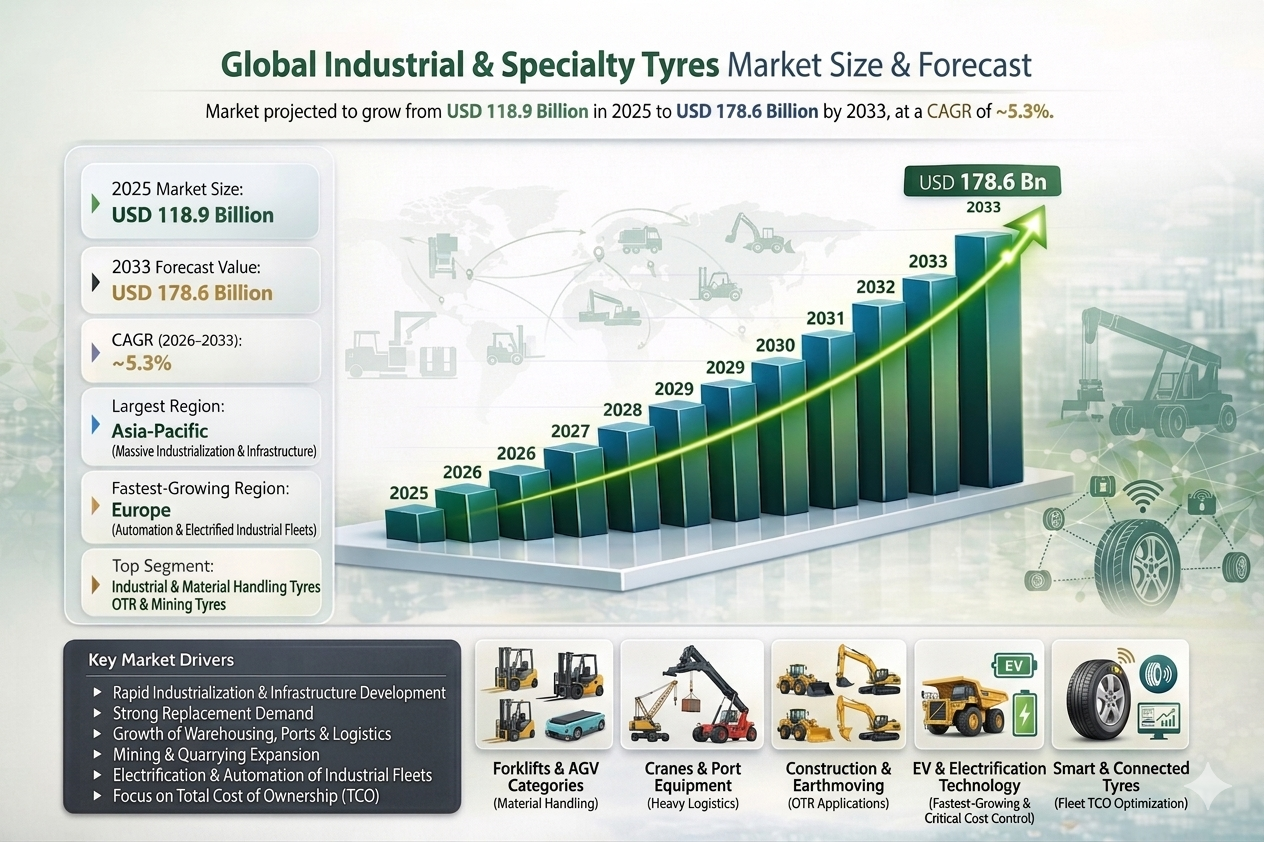
According to the Pheonix Demand Forecast Engine, the Global Industrial & Specialty Tyres Market size is estimated at USD 118.9 billion in 2025 and is projected to reach USD 178.6 billion by 2033, expanding at a CAGR of ~5.3% during the forecast period (2026???2033).
Asia-Pacific represents the largest market due to rapid industrialization and infrastructure investments, while Europe is the fastest-growing region, driven by automation, sustainability regulations, and electrification of industrial fleets.
Key Drivers of Global Industrial & Specialty Tyres Market Growth
Rapid Industrialization & Infrastructure Development
Large-scale construction projects, mining expansion, and industrial growth directly increase demand for heavy-duty and specialty tyres.
Strong Replacement Demand
Industrial tyres wear out fast ???cause they???re always running under heavy loads and rough surfaces . That???s why aftermarket sales make up the biggest chunk of revenue in this market. As industries expand and use more machines, demand for replacements keeps rising, driving steady market growth .
Growth of Warehousing, Ports & Logistics
Expansion of ports, airports, e-commerce warehouses, and container terminals fuels demand for forklifts, reach stackers, and port equipment tyres.
Mining & Quarrying Expansion
Rising demand for minerals, metals, and construction materials boosts demand for ultra-durable OTR and mining tyres.
Electrification & Automation of Industrial Fleets
Electric forklifts, AGVs, and autonomous industrial vehicles require low rolling resistance, long-life, and sensor-enabled tyres.
Focus on Total Cost of Ownership (TCO)
Industrial operators prioritize tyre lifespan, retreadability, and uptime to reduce operating costs.
Global Industrial & Specialty Tyres Market Segmentation
1. By Tyre Construction
1.1 Radial Tyres (Fastest-Growing Segment)
1.1.1 Steel-Belted Radial Tyres
1.1.2 Fabric-Belted Radial Tyres
1.1.3 Performance Characteristics
1.2 Bias (Cross-Ply) Tyres
1.2.1 Nylon Bias Tyres
1.2.2 Polyester Bias Tyres
1.2.3 Application Focus
1.3 Solid & Cushion Tyres
1.3.1 Solid Rubber Tyres
1.3.2 Cushion Tyres
1.3.3 Usage Environment
2. By Equipment Type
2.1 Construction Equipment
2.1.1 Loaders
2.1.2 Excavators
2.1.3 Bulldozers
2.1.4 Graders
2.2 Mining Equipment
2.2.1 Haul Trucks
2.2.2 Wheel Loaders
2.2.3 Underground Mining Vehicles
2.3 Agricultural & Forestry Equipment
2.3.1 Tractors
2.3.2 Harvesters
2.3.3 Forestry Equipment
2.4 Industrial & Material Handling Equipment (Largest Segment)
2.4.1 Forklifts
2.4.2 Cranes
2.4.3 Industrial Trailers
2.5 Port & Airport Ground Support Equipment
2.5.1 Port Handling Equipment
2.5.2 Airport Ground Support Equipment
3. By Application
3.1 Construction & Infrastructure
3.1.1 Road construction projects
3.1.2 Urban infrastructure development
3.1.3 Industrial & commercial construction
3.2 Mining & Quarrying
3.2.1 Surface mining operations
3.2.2 Underground mining operations
3.3 Agriculture & Forestry
3.3.1 Tillage & harvesting operations
3.3.2 Timber extraction & logging
3.4 Ports, Airports & Industrial Logistics
3.4.1 Container handling operations
3.4.2 Heavy material movement & stacking
4. By Tyre Size
4.1 Below 25 Inches
4.1.1 Forklifts & warehouse equipment
4.1.2 Compact construction machinery
4.2 25???49 Inches (Largest Segment)
4.2.1 Loaders & dumpers
4.2.2 Large industrial equipment
4.3 Above 49 Inches
4.3.1 Ultra-large mining tyres
4.3.2 Open-pit haul truck tyres
5. By Sales Channel
5.1 OEM (Original Equipment Manufacturer)
5.1.1 Construction equipment OEMs
5.1.2 Mining machinery OEMs
5.1.3 Industrial equipment OEMs
5.2 Aftermarket / Replacement (Largest Segment)
5.2.1 Authorized dealer networks
5.2.2 Industrial tyre specialists
5.2.3 On-site tyre management & service contracts
6. By Tyre Technology
6.1 Conventional Industrial Tyres
6.1.1 Standard rubber compound tyres
6.2 Heat-Resistant & Cut-Resistant Tyres
6.2.1 High-temperature mining tyres
6.2.2 Sharp-terrain quarry tyres
6.3 Low Rolling Resistance Tyres
6.3.1 Energy-efficient industrial tyres
6.3.2 Electric equipment optimized tyres
6.4 Retreadable Tyres
6.4.1 Multi-life industrial casings
6.4.2 Retread-ready mining tyres
6.5 Smart & Connected Tyres (Emerging)
6.5.1 Embedded pressure sensors
6.5.2 Temperature monitoring systems
6.5.3 Predictive maintenance analytics platforms
7. By Geography
7.1 Asia-Pacific (Largest Region)
7.1.1 China
7.1.2 India
7.1.3 Japan
7.1.4 Southeast Asia
7.2 Europe (Fastest-Growing)
7.2.1 Germany
7.2.2 France
7.2.3 U.K.
7.2.4Italy
7.3 North America
7.3.1 U.S.
7.3.2 Canada
7.4 Latin America
7.4.1 Brazil
7.4.2 Mexico
7.5 Middle East & Africa
7.5.1 UAE
7.5.2 Saudi Arabia
7.5.3 South Africa
Regional Insights of Global Industrial & Specialty Tyres Market
Asia-Pacific ??? Largest Market
Driven by large-scale infrastructure development, mining activity, manufacturing expansion, and strong aftermarket demand.
Europe ??? Fastest-Growing Region
Growth supported by warehouse automation, electrified industrial fleets, sustainability regulations, and premium tyre adoption.
North America
Strong demand from mining, construction, logistics hubs, and replacement-heavy industrial operations.
Latin America
Mining expansion and infrastructure investment support steady growth.
Middle East & Africa
Demand driven by construction megaprojects, mining, ports, and industrial logistics.
Leading Companies in the Global Industrial & Specialty Tyres Market
-
Goodyear Tire & Rubber Company
-
Continental AG
-
Yokohama Rubber Company
-
Pirelli & C. S.p.A.
-
Apollo Tyres
-
BKT (Balkrishna Industries)
-
Trelleborg Group
-
Nokian Tyres
Michelin is the largest company in the Global Industrial & Specialty Tyres Market
Strategic Intelligence & Pheonix AI-Backed Insights
Pheonix Demand Forecast Engine
Models industrial equipment parc growth, replacement cycles, infrastructure spending, and mining activity.
Electrification Impact Analyzer
Assesses tyre demand shifts from diesel to electric forklifts, cranes, and industrial vehicles.
Raw Material Sensitivity Model
Tracks natural rubber, synthetic rubber, steel cord, and oil price volatility.
Automated Porter???s Five Forces (Concise)
-
Buyer Power: Moderate ??? large fleet operators negotiate pricing
-
Supplier Power: Moderate ??? dependence on rubber and steel inputs
-
Threat of New Entrants: Low ??? capital-intensive and technology-driven
-
Threat of Substitutes: Low ??? tyres are mission-critical consumables
-
Competitive Rivalry: High ??? global majors and regional specialists compete
Why the Industrial & Specialty Tyres Market Remains Critical
-
Essential for industrial productivity and equipment uptime
-
Strong and predictable replacement-driven demand
-
Direct impact on operational efficiency and safety
-
Key enabler of automation, electrification, and smart logistics
Final Takeaway of Global Industrial & Specialty Tyres Market
The Global Industrial & Specialty Tyres Market is a mission-critical, replacement-driven, and technology-evolving market supported by industrial growth, infrastructure development, and logistics expansion. Electrification, automation, and smart tyre technologies are reshaping product requirements, while durability and cost efficiency remain core buying criteria. Manufacturers that deliver long-life, retreadable, EV-compatible, and sensor-enabled tyres, while strengthening aftermarket and on-site service capabilities, will be best positioned to lead the market through 2033.
Competitive Landscape
Industrial & Specialty Tyres Competitive Intensity & Market Structure Overview
The Global Industrial & Specialty Tyres Market is characterized by a highly engineered and service-intensive competitive structure, where performance reliability, lifecycle durability, and operational uptime are more critical than pricing alone. The market is strongly driven by industrial end-users such as construction, mining, warehousing, ports, and manufacturing, all of which demand tyres capable of withstanding extreme load conditions and continuous operation.
Competitive intensity is elevated due to the mission-critical nature of industrial applications. Equipment downtime directly translates into financial losses, pushing buyers to prioritize reliability, retreadability, and total cost of ownership (TCO). As a result, manufacturers compete through advanced material science, reinforced construction technologies, and integrated tyre management services rather than simple product differentiation.
The market is moderately consolidated at the global level, with Tier 1 players dominating premium industrial and OTR (off-the-road) segments. However, fragmentation persists in regional aftermarket and mid-scale industrial segments, where local suppliers compete on availability, pricing, and on-site service capabilities.
Industrial & Specialty Tyres Competitive Intensity & Market Structure Current Scenario
Leading Company Profiles
Michelin: Global Tyre Manufacturer. Leader in high-performance OTR and industrial tyres with strong focus on durability, efficiency, and lifecycle optimization.
Bridgestone Corporation: Global Tyre Manufacturer. Strong industrial tyre portfolio supported by advanced fleet service and tyre management systems.
Goodyear Tire & Rubber Company: Tyre Manufacturer. Focused on durable industrial solutions and predictive maintenance technologies.
Continental AG: Technology-Driven Tyre Manufacturer. Strong in smart tyre systems and industrial mobility solutions.
Yokohama Rubber Company: Industrial Tyre Manufacturer. Known for robust construction and mining tyre solutions.
Pirelli & C. S.p.A.: Premium Tyre Manufacturer. Focused on high-performance industrial and specialty applications.
Apollo Tyres: Emerging Global Competitor. Strong in cost-effective industrial tyre solutions.
BKT (Balkrishna Industries): Global Off-Highway Leader. Strong presence in agricultural, mining, and industrial tyre segments.
Trelleborg Group: Specialty Tyre Manufacturer. Leader in material handling and industrial application tyres.
Nokian Tyres: Specialty Tyre Manufacturer. Focused on extreme-condition industrial and specialty tyre performance.
Key Competitive Intensity & Market Structure Signals in Industrial & Specialty Tyres
A key structural driver in the market is the growing adoption of electric and automated industrial equipment, including electric forklifts, automated guided vehicles (AGVs), and autonomous port handling systems. This shift is increasing demand for low rolling resistance, energy-efficient, and sensor-enabled tyres.
Aftermarket dominance remains a defining feature of the industry. Industrial tyres undergo frequent replacement due to continuous usage under heavy loads, making service contracts, on-site maintenance, and fleet tyre management critical competitive differentiators.
Another major trend is the rising importance of smart tyre ecosystems. Manufacturers are increasingly integrating IoT-based monitoring systems to track pressure, temperature, wear patterns, and predictive maintenance cycles, enhancing operational efficiency for industrial clients.
Despite consolidation in premium segments, regional players maintain relevance in cost-sensitive industrial markets where procurement decisions are heavily influenced by pricing and local service availability.
Strategic Implications of Competitive Intensity & Market Structure in Industrial & Specialty Tyres
Manufacturers are shifting from product-centric models to service-integrated ecosystems, offering tyre lifecycle management, predictive maintenance, and on-site servicing. This transition is becoming essential for securing long-term industrial contracts.
Total cost of ownership (TCO) is the dominant purchasing metric, pushing manufacturers to focus on longer tyre life, retreadability, and reduced downtime rather than upfront pricing. This benefits players with strong engineering capabilities and durable product portfolios.
Electrification of industrial fleets is reshaping product development priorities. Tyres designed for electric forklifts and automated machinery require enhanced load capacity, reduced heat generation, and improved energy efficiency.
Digital transformation is becoming a key competitive battleground, with smart tyres and connected fleet systems enabling predictive analytics and real-time operational insights, creating new value-added revenue streams.
Industrial & Specialty Tyres Competitive Intensity & Market Structure Forward Outlook
The Industrial & Specialty Tyres Market is expected to remain structurally stable but highly competitive, with increasing concentration among global Tier 1 manufacturers and sustained fragmentation in regional aftermarket segments.
Future consolidation is likely as leading companies expand through acquisitions, strategic partnerships, and vertical integration into fleet management and industrial service ecosystems. This will strengthen their position in high-value industrial contracts.
Regulatory pressures around sustainability, emissions reduction, and energy efficiency will accelerate innovation in low rolling resistance and environmentally friendly tyre technologies.
In the long term, the market will be defined by three core competitive pillars: operational uptime efficiency, electrification readiness, and connected tyre intelligence. Companies that successfully integrate these elements while maintaining strong aftermarket service capabilities will lead the Global Industrial & Specialty Tyres Market through 2033.
Value Chain
Global Industrial & Specialty Tyres Market Value Chain & Supply Chain Evolution Overview
The value chain and supply chain structure of the Global Industrial & Specialty Tyres Market is highly integrated with construction, mining, warehousing, ports, agriculture, and industrial logistics ecosystems. The market operates through a multi-layer system involving raw material suppliers, tyre manufacturers, OEM equipment producers, industrial fleet operators, distributors, and specialized service providers.
This structure supports continuous demand across two major channels: OEM fitment for new industrial and construction equipment, and a large replacement aftermarket driven by intensive usage in harsh operating environments. Given the high load conditions and operational downtime costs, supply chain reliability, durability assurance, and service responsiveness are critical success factors.
The upstream supply chain is driven by natural rubber, synthetic rubber, carbon black, steel cord, and specialty compounds designed for heat resistance, cut resistance, and load durability. Leading manufacturers maintain diversified sourcing strategies and long-term supplier contracts to mitigate raw material volatility and ensure consistent quality across global markets.
Manufacturing in this segment is highly engineering-intensive, focusing on reinforced carcass structures, solid and cushion tyre technologies, radial construction, and advanced compound formulations. Increasing emphasis is placed on low rolling resistance designs, retreadable casings, and sensor-enabled smart tyres to support electrified and automated industrial fleets.
Distribution is dominated by OEM partnerships with construction and mining equipment manufacturers, alongside a strong aftermarket ecosystem supported by industrial tyre specialists, service contractors, and on-site tyre management programs. Fleet operators increasingly prefer service-based procurement models that include maintenance, monitoring, and lifecycle optimization.
Key supply chain challenges include raw material price volatility, high logistics costs for oversized tyres, extreme operating condition requirements, and increasing sustainability regulations. Manufacturers are also investing in circular economy practices such as retreading, recycling, and material recovery systems.
Global Industrial & Specialty Tyres Market Value Chain & Supply Chain Evolution Current Scenario
The Global Industrial & Specialty Tyres Market is currently undergoing a transition driven by automation, electrification, and digital industrial transformation.
At the upstream level, fluctuations in rubber, steel, and petrochemical inputs continue to impact production costs. Manufacturers are responding with multi-region sourcing strategies, long-term procurement contracts, and strategic inventory planning to stabilize supply chains.
In manufacturing, companies such as Michelin, Bridgestone, Goodyear, Continental, and BKT are focusing on high-durability compounds, heat-resistant materials, and low rolling resistance industrial tyres. There is increasing standardization across equipment categories to improve scalability and reduce production complexity.
OEM integration remains a critical growth pillar, with equipment manufacturers in construction, mining, and material handling sectors collaborating closely with tyre producers to optimize performance, durability, and safety standards. These partnerships increasingly include lifecycle service agreements.
The aftermarket segment continues to dominate due to high wear rates in industrial environments such as mining sites, ports, and warehouses. Retreading and multi-life tyre systems are widely adopted to reduce operational costs and downtime.
Digital transformation is accelerating across the supply chain, with predictive maintenance systems, IoT-enabled tyre monitoring, and fleet analytics platforms improving uptime, reducing failures, and optimizing replacement cycles.
Key Value Chain & Supply Chain Evolution Signals in Global Industrial & Specialty Tyres Market
Several structural shifts are reshaping the Industrial & Specialty Tyres value chain.
First, electrification of industrial equipment such as forklifts, loaders, and automated guided vehicles is driving demand for low rolling resistance and energy-efficient tyre designs.
Second, automation and smart logistics are increasing the need for sensor-enabled tyres that support predictive maintenance and real-time performance monitoring.
Third, rising infrastructure development and mining activity are reinforcing demand for ultra-durable tyres capable of operating in extreme conditions with minimal downtime.
Fourth, the dominance of the aftermarket segment continues to strengthen due to rapid wear cycles and high utilization rates across industrial applications.
Finally, sustainability initiatives are encouraging adoption of retreadable tyres, recyclable materials, and circular economy-based manufacturing practices.
Strategic Implications of Value Chain & Supply Chain Evolution in Global Industrial & Specialty Tyres Market
Leading manufacturers such as Michelin, Bridgestone, Goodyear, Continental, and BKT benefit from strong OEM partnerships, global manufacturing footprints, and advanced material engineering capabilities.
High entry barriers exist due to capital-intensive production processes, technical complexity, and stringent performance requirements across industrial applications, resulting in a consolidated competitive landscape.
Fleet operators and industrial companies are increasingly adopting long-term service contracts, including tyre management, monitoring, and maintenance solutions, creating recurring revenue opportunities for manufacturers.
Cost optimization remains a core priority, with manufacturers balancing raw material inflation against investments in durable compounds, EV-ready designs, and smart tyre technologies.
The shift toward electrified and automated industrial fleets presents both challenges and opportunities, requiring innovations in load handling, energy efficiency, and digital integration across tyre systems.
Global Industrial & Specialty Tyres Market Value Chain & Supply Chain Evolution Forward Outlook
Between 2026 and 2033, the Industrial & Specialty Tyres value chain is expected to become more digitalized, sustainability-driven, and performance-optimized.
Manufacturers will increasingly focus on EV-compatible industrial tyres, advanced retreading systems, and smart sensor integration to align with next-generation industrial automation trends.
The aftermarket segment will remain the dominant revenue contributor due to continuous equipment utilization in mining, construction, warehousing, and logistics operations.
Digital ecosystems will expand significantly, with AI-driven predictive maintenance, IoT-based tyre monitoring, and fleet optimization platforms becoming standard across industrial operations.
Overall, the future value chain will be defined by electrification, automation, durability engineering, and circular economy integration, with companies aligning innovation with operational efficiency gaining long-term leadership advantage.
Market-Specific Value Chain
- Raw Material Procurement: Natural rubber, synthetic rubber, carbon black, steel cord, and specialty compound sourcing
- Research & Development: Heat resistance engineering, cut-resistant compounds, EV industrial tyre design, and smart tyre technologies
- Manufacturing: High-strength radial, bias, solid, and cushion tyre production with industrial-grade testing and quality control
- OEM Integration: Supply of tyres for construction equipment, mining machinery, forklifts, cranes, and port handling equipment
- Distribution & Fleet Supply: OEM contracts, industrial distributors, equipment dealers, and on-site tyre service providers
- Aftermarket Services: Replacement tyres, retreading, fleet maintenance, predictive monitoring, and lifecycle management services
Company-to-Stage Mapping
- Raw Material Procurement: Michelin, Bridgestone Corporation, Continental AG, Goodyear Tire & Rubber Company
- Research & Development: Michelin, Continental AG, Pirelli & C. S.p.A., Nokian Tyres
- Manufacturing: Bridgestone Corporation, Goodyear Tire & Rubber Company, Yokohama Rubber Company, BKT (Balkrishna Industries)
- OEM Integration: Michelin, Bridgestone Corporation, Continental AG, Trelleborg Group
- Distribution & Fleet Supply: Apollo Tyres, BKT, Yokohama Rubber Company, Goodyear Tire & Rubber Company
- Aftermarket Services: Michelin, Bridgestone Corporation, Continental AG, Trelleborg Group
Investment Activity
Global Industrial & Specialty Tyres Market Investment & Funding Dynamics Overview
Investment and funding dynamics in the Global Industrial & Specialty Tyres Market are being shaped by rapid industrialization, expansion of mining and construction activities, and the growing shift toward automation and electrification of industrial fleets. Between 2026 and 2033, capital deployment is expected to concentrate on durable, heat-resistant, and smart tyre technologies designed for high-load, non-road applications across warehouses, ports, mining sites, and construction environments.
The market is moderately capital-intensive, requiring sustained investment in advanced rubber compounding, reinforced casing structures, and application-specific tread engineering. Leading players such as Michelin, Bridgestone, Continental, Goodyear, and BKT are increasing R&D spending and expanding manufacturing capacities to serve rising demand from material handling, mining, and infrastructure sectors.
A major structural shift influencing funding is the electrification of industrial equipment, including forklifts, cranes, and automated guided vehicles (AGVs). This is accelerating investments in low rolling resistance tyres, energy-efficient solid tyres, and sensor-enabled solutions that support predictive maintenance and operational efficiency.
Global Industrial & Specialty Tyres Market Investment & Funding Dynamics Current Scenario
Currently, investment activity is strongly supported by growth in warehousing, logistics hubs, construction megaprojects, and mining operations. These sectors require high-performance tyres capable of withstanding extreme loads, continuous operation, and harsh terrain conditions.
Asia-Pacific leads as the largest investment hub due to rapid industrial expansion in China and India, alongside large-scale infrastructure development and manufacturing growth.
Europe is the fastest-growing investment region, driven by automation in warehouses, strict sustainability regulations, and the adoption of electric industrial fleets requiring advanced tyre solutions.
North America continues to attract strong investments in mining, construction, and logistics operations, with a focus on premium and high-durability industrial tyres.
Latin America and Middle East & Africa are witnessing steady investment inflows supported by infrastructure development, port expansion, and mining-driven industrial activity.
Key Investment & Funding Dynamics Signals in Global Industrial & Specialty Tyres Market
A key investment signal is the rising demand from automated and electrified industrial fleets, which require tyres optimized for energy efficiency, durability, and smart monitoring capabilities.
Expansion of global logistics infrastructure, including ports, airports, and e-commerce warehouses, is significantly increasing demand for forklift, reach stacker, and material handling tyres.
Strong replacement demand remains a consistent driver of investment, as industrial tyres experience high wear rates due to continuous heavy-duty operations.
Mining and construction sector growth continues to attract capital into ultra-durable OTR tyres designed for extreme environments and heavy payload operations.
The integration of smart tyre technologies, including embedded sensors and predictive maintenance systems, is creating new investment opportunities in digital fleet management solutions.
Strategic Implications of Investment & Funding Dynamics in Global Industrial & Specialty Tyres Market
The investment landscape strongly favors established global manufacturers with advanced R&D capabilities and robust industrial distribution networks, creating significant entry barriers for new players.
OEM partnerships with construction equipment, mining machinery, and industrial vehicle manufacturers are critical for securing long-term supply contracts and stable revenue streams.
Innovation in tyre durability, heat resistance, and load-bearing capacity is becoming a key competitive differentiator in securing industrial contracts.
Regional diversification is essential, with Asia-Pacific driving volume growth, Europe leading in automation and sustainability adoption, and North America focusing on mining and large-scale industrial applications.
Volatility in raw material prices, particularly natural rubber, synthetic rubber, steel cord, and energy costs, continues to influence profitability, requiring strategic sourcing and cost optimization initiatives.
Global Industrial & Specialty Tyres Market Investment & Funding Dynamics Forward Outlook
Looking ahead, the Global Industrial & Specialty Tyres Market is expected to attract consistent investment driven by infrastructure expansion, mining growth, and increasing automation across industrial operations.
Future capital allocation will prioritize smart tyres, EV-compatible industrial tyres, and high-durability solutions designed for next-generation material handling and mining equipment.
Asia-Pacific will remain the dominant investment region, while Europe will lead innovation in electrification and sustainability-focused industrial tyre technologies. North America will continue to support demand for high-performance and heavy-duty applications.
Digital transformation across industrial sectors will further accelerate investment in connected tyre systems, predictive maintenance platforms, and AI-driven fleet optimization solutions.
Overall, the market will maintain steady growth due to its essential role in global industrial productivity. Companies that align innovation with durability, efficiency, and smart technology integration will be best positioned to lead through 2033.
Technology & Innovation
Global Industrial & Specialty Tyres Market Technology & Innovation Landscape Overview
The technology and innovation landscape within the global industrial & specialty tyres market is driven by the need for extreme durability, load-bearing strength, operational safety, and lifecycle cost optimization. These tyres operate in harsh environments such as construction sites, mines, ports, warehouses, and industrial yards, where downtime directly impacts productivity and cost efficiency. Innovation intensity in this market is moderate but steadily advancing, supported by improvements in compound engineering, structural reinforcement, and heat-resistant materials. While core tyre architectures such as bias, radial, and solid tyres are mature, ongoing enhancements in cut-resistant tread compounds, reinforced casing structures, and retreadable designs are significantly extending service life and operational efficiency. Leading manufacturers such as Michelin, Bridgestone Corporation, Goodyear Tire & Rubber Company, Continental AG, Yokohama Rubber Company, and BKT are focusing on high-load endurance solutions, electrification-ready tyres, and smart tyre integration for industrial fleets. A key technological shift is the rising adoption of EV and automation-compatible industrial tyres, driven by electrification of forklifts, AGVs (automated guided vehicles), cranes, and port equipment. These tyres require low rolling resistance, high energy efficiency, and enhanced durability under continuous operation. Smart tyre technologies are also emerging, enabling real-time monitoring of pressure, temperature, load, and wear for predictive maintenance and reduced downtime.
Global Industrial & Specialty Tyres Market Technology & Innovation Landscape Current Scenario
Currently, the technology landscape is focused on durability enhancement, uptime optimization, and total cost of ownership reduction. Manufacturers are developing advanced rubber compounds that resist cuts, abrasions, and heat buildup, particularly for mining, construction, and heavy industrial applications. Solid and cushion tyre technologies are widely used in indoor industrial environments such as warehouses and manufacturing units, where puncture resistance and stability are essential. Meanwhile, radial industrial tyres are gaining adoption in heavy-duty applications due to improved heat dissipation, longer tread life, and better energy efficiency. Retreadable tyre technology remains a major innovation pillar. Multi-life casing designs allow tyres to be reused multiple times, significantly reducing lifecycle costs’especially important in mining and construction operations where tyre replacement costs are high. Low rolling resistance technologies are increasingly integrated into industrial tyres used in electric forklifts and automated equipment, helping improve energy efficiency and extend battery life. Smart and connected tyre solutions are gradually expanding in high-value industrial applications. Embedded sensors enable real-time monitoring of pressure, temperature, and wear conditions, supporting predictive maintenance and minimizing equipment failures in critical operations such as ports and mining. Manufacturing innovation is also progressing through automation, precision curing, and AI-based quality inspection systems. Sustainability initiatives, including recycled materials and energy-efficient production processes, are becoming more prominent due to regulatory and ESG requirements.
Key Technology & Innovation Landscape Signals in Global Industrial & Specialty Tyres Market
- EV & Automation-Compatible Tyres: Growing demand for tyres designed for electric forklifts, AGVs, and smart industrial equipment.
- Cut- & Heat-Resistant Compounds: Advanced materials for mining, construction, and quarry environments.
- Retreadable Multi-Life Designs: Focus on extending tyre lifecycle and reducing operating costs.
- Smart & Connected Tyres: IoT-enabled sensors for real-time monitoring and predictive maintenance.
- Solid & Cushion Tyre Innovation: Improved puncture resistance, stability, and load handling.
- Low Rolling Resistance Solutions: Energy-efficient designs for electrified industrial equipment.
- Sustainability Initiatives: Increased use of recycled materials and eco-efficient manufacturing processes.
Strategic Implications of Technology & Innovation Landscape in Global Industrial & Specialty Tyres Market
The evolving technology landscape has strong strategic implications for manufacturers, OEMs, and industrial operators. Continuous R&D investment is essential to improve durability, load capacity, and energy efficiency while reducing total operating costs. The shift toward electrification and automation is reshaping product development priorities. Tyres must now support heavier loads, continuous operation cycles, and improved energy efficiency, driving closer collaboration between tyre manufacturers and OEMs of industrial equipment. Smart tyre technologies are enabling a transition toward service-oriented business models. Predictive maintenance, fleet analytics, and performance monitoring are creating new value-added revenue streams beyond traditional tyre sales. Sustainability is becoming a key strategic pillar, with increased adoption of retreading programs, circular economy practices, and eco-friendly materials. ESG compliance is increasingly influencing procurement decisions in industrial sectors. For industrial operators, tyre innovation directly impacts uptime, safety, and cost efficiency. Advanced tyres help reduce downtime, extend service life, and optimize energy consumption in electrified and automated operations.
Global Industrial & Specialty Tyres Market Technology & Innovation Landscape Forward Outlook
Looking ahead, the market is expected to evolve toward more intelligent, durable, and energy-efficient tyre solutions. Electrification and automation will remain key growth drivers, significantly increasing demand for EV-compatible and smart industrial tyres. Smart tyre systems are expected to become more widely adopted across industrial fleets, enabling real-time analytics, AI-driven maintenance scheduling, and improved operational efficiency. Material innovation will continue to advance, focusing on ultra-durable compounds, heat-resistant formulations, and sustainable raw materials that improve performance while reducing environmental impact. Manufacturing will become more automated and digitally integrated, with AI-powered inspection systems and smart factories accelerating innovation cycles and improving product consistency. In conclusion, the Global Industrial & Specialty Tyres Market is undergoing a steady technological transformation where durability, electrification readiness, and smart connectivity are emerging as core innovation pillars. Companies that integrate EV compatibility, sensor-enabled solutions, and lifecycle cost optimization will be best positioned to lead the market through 2033.
Market Risk
Global Industrial & Specialty Tyres Market Risk Factors & Disruption Threats Overview
The Global Industrial & Specialty Tyres Market operates in a highly demanding and capital-intensive environment, driven by industrialization, infrastructure expansion, mining activity, and global logistics growth. While the market benefits from strong replacement demand and essential end-use applications, it carries a moderate to high risk profile due to raw material volatility, equipment cyclicality, and intense operational conditions. A major structural risk is raw material price volatility, particularly natural rubber, synthetic rubber, steel cords, and energy inputs. Since industrial tyres are large, material-heavy products, even small cost fluctuations can significantly impact production margins, especially in long-term OEM and fleet contracts. Another key disruption factor is cyclical demand exposure linked to construction, mining, and manufacturing industries. Downturns in infrastructure spending or commodity markets can quickly reduce equipment utilization rates, directly affecting tyre replacement cycles and new demand. Harsh operating conditions also create continuous risk pressure. Industrial tyres are exposed to extreme loads, sharp debris, heat stress, and continuous operation, leading to rapid wear, punctures, and downtime risks that push manufacturers toward highly durable and specialized compounds. The accelerating shift toward electrification and automation of industrial fleets further disrupts the market. Electric forklifts, AGVs, and automated machinery require low rolling resistance, heat-efficient, and sensor-enabled tyres, increasing R&D intensity and shortening product life cycles.
Global Industrial & Specialty Tyres Market Risk Factors & Disruption Threats Current Scenario
The current market scenario reflects steady expansion supported by infrastructure development, mining operations, warehouse automation, and global trade activity. However, growth is balanced by rising input costs, supply chain constraints, and increasing technological complexity. Raw material inflation remains a persistent concern, directly affecting manufacturing costs and forcing tyre producers to balance profitability with competitive pricing in highly negotiated B2B contracts. The aftermarket segment dominates due to heavy wear and continuous usage cycles. However, increasing adoption of fleet management contracts and on-site service models is reshaping traditional distribution structures. Supply chain disruptions, especially in heavy rubber components and steel reinforcement materials, can impact delivery timelines for large industrial projects, affecting OEM partnerships and fleet uptime. At the same time, electrification of material handling equipment and industrial vehicles is creating a dual-product requirement, increasing complexity for manufacturers managing both conventional and EV-optimized tyre portfolios.
Key Risk Factors & Disruption Threats Signals in Global Industrial & Specialty Tyres Market
A key risk signal is the rapid growth of automation and smart warehousing systems. As AGVs and robotics replace traditional equipment, demand shifts toward precision-engineered, low-noise, and energy-efficient tyres. Consolidation in industrial procurement is another major signal. Large logistics, mining, and construction companies are increasingly centralizing tyre procurement, increasing buyer power and intensifying price negotiations. The transition toward electrified industrial fleets is accelerating, driving demand for tyres that offer higher energy efficiency, heat resistance, and longer lifecycle performance under continuous operation. Sustainability and ESG regulations are also influencing procurement decisions, encouraging adoption of retreadable, long-life, and eco-efficient tyre solutions. Additionally, increasing use of IoT-enabled fleet management systems is driving demand for smart tyres with embedded sensors for real-time monitoring and predictive maintenance.
Strategic Implications of Risk Factors & Disruption Threats in Global Industrial & Specialty Tyres Market
Manufacturers must prioritize durability, load capacity, and heat resistance to meet the demanding requirements of industrial applications where downtime directly impacts operational costs. Developing strong partnerships with OEMs and large fleet operators is critical, as integrated service models and long-term contracts are becoming more important than one-time product sales. Investment in EV-compatible and automation-ready tyre technologies is essential to align with the ongoing transformation of industrial mobility and logistics ecosystems. Supply chain resilience and raw material diversification strategies are necessary to manage cost volatility and ensure consistent delivery to large-scale industrial clients. Digital transformation through smart tyres and predictive maintenance platforms is emerging as a key differentiator, enabling manufacturers to offer value-added services beyond traditional tyre supply.
Global Industrial & Specialty Tyres Market Risk Factors & Disruption Threats Forward Outlook
Looking ahead to 2026-2033, the Global Industrial & Specialty Tyres Market will continue to expand steadily, supported by infrastructure growth, mining expansion, and global industrialization. However, the risk environment will become increasingly technology-driven and cost-sensitive. Electrification and automation will remain the most significant disruptive forces, reshaping tyre design requirements toward efficiency, durability, and sensor integration. Fleet digitalization and predictive maintenance adoption will increase, shifting competition toward integrated service ecosystems rather than standalone tyre products. Sustainability pressures will further influence material innovation, encouraging development of retreadable, low-waste, and energy-efficient tyre solutions. Overall, the market will remain structurally strong but operationally complex, with success dependent on manufacturers’ ability to balance cost efficiency, innovation, and long-life performance while adapting to rapidly evolving industrial requirements.
Regulatory Landscape
Global Industrial & Specialty Tyres Market Regulatory & Policy Environment Overview
The regulatory and policy environment governing the Global Industrial & Specialty Tyres Market is shaped by strict safety, operational efficiency, and environmental compliance requirements across construction, mining, warehousing, ports, and industrial logistics sectors. Since these tyres operate under extreme loads and harsh environments, regulators focus heavily on durability standards, workplace safety, and lifecycle performance. Key regulatory frameworks such as the European Union Tyre Labelling Regulation (EU) 2020/740 and UNECE tyre safety standards set baseline requirements for rolling resistance, structural integrity, and noise performance. Although originally designed for road tyres, these frameworks increasingly influence industrial tyre design, particularly for electrified and automated industrial equipment. In addition, occupational safety and industrial equipment regulations play a major role in shaping tyre adoption. Agencies such as OSHA in the United States and equivalent bodies in Europe and Asia enforce strict safety compliance for forklifts, cranes, mining vehicles, and port equipment, indirectly driving demand for high-durability, cut-resistant, and heat-resistant tyres. Environmental regulations are also becoming increasingly important as industries shift toward sustainability. Carbon reduction mandates, electrification incentives, and energy efficiency policies are encouraging the adoption of low rolling resistance and retreadable industrial tyres that reduce operational emissions and improve lifecycle efficiency. Emerging economies including India, China, Brazil, and Gulf countries are strengthening industrial safety standards, mining regulations, and infrastructure development policies. These initiatives are improving equipment standardization and accelerating demand for certified, high-performance industrial tyre solutions.
Global Industrial & Specialty Tyres Market Regulatory & Policy Environment Current Scenario
The current regulatory landscape is defined by rising industrial safety requirements, increasing automation, and growing emphasis on sustainability in heavy industries. Europe leads in regulatory maturity, with strong workplace safety laws and environmental compliance frameworks influencing equipment and tyre procurement decisions. In Europe, strict emissions and sustainability regulations are driving adoption of energy-efficient industrial equipment, which in turn increases demand for low rolling resistance and smart industrial tyres. Warehouse automation and electrification of material handling fleets are further accelerating this shift. In Asia-Pacific, rapid industrialization in China and India is supported by government-led infrastructure and manufacturing expansion programs. These initiatives are boosting demand for construction, mining, and logistics equipment, directly increasing the consumption of industrial tyres. North America maintains strong regulatory oversight through OSHA safety standards and EPA-driven sustainability programs. Large-scale mining, construction, and logistics operations are increasingly adopting advanced tyre technologies to improve uptime and reduce operational costs. Globally, the rise of electric and autonomous industrial vehicles is influencing regulatory expectations, introducing new performance requirements such as torque resistance, heat management, and sensor compatibility in industrial tyre design.
Key Regulatory & Policy Environment Signals in Global Industrial & Specialty Tyres Market
- EU Tyre Labelling Regulation (EU 2020/740): Influences efficiency, durability, and noise performance benchmarks.
- UNECE Tyre Safety Standards: Define structural integrity and load-bearing performance requirements.
- Occupational Safety Regulations (OSHA & equivalents): Mandate safe operation standards for industrial vehicles and equipment.
- Industrial Emissions & Sustainability Policies: Promote adoption of low rolling resistance and retreadable tyres.
- Mining & Construction Safety Standards: Drive demand for cut-resistant and heat-resistant tyre solutions.
- Industrial Electrification Policies: Encourage EV-compatible tyres for forklifts, cranes, and automated equipment.
Strategic Implications of Regulatory & Policy Environment in Global Industrial & Specialty Tyres Market
The regulatory environment increases entry barriers due to strict safety certifications, durability requirements, and performance testing standards. This favors established global manufacturers with strong engineering capabilities and compliance infrastructure. Innovation is increasingly driven by regulatory compliance and operational efficiency needs. Manufacturers are investing in advanced rubber compounds, heat-resistant materials, smart sensors, and retreadable casing technologies to meet evolving industrial demands. Industrial operators are becoming more cost- and compliance-focused, prioritizing tyres that reduce downtime, extend lifecycle, and improve safety. This is strengthening demand for premium, long-life, and technologically advanced tyre solutions. Regional regulatory differences are also influencing market strategies, encouraging localized production, on-site service models, and partnerships with OEMs and industrial fleet operators to ensure compliance and operational efficiency.
Global Industrial & Specialty Tyres Market Regulatory & Policy Environment Forward Outlook
Between 2026 and 2033, the regulatory landscape is expected to become more stringent and sustainability-driven, aligned with global decarbonization, automation, and industrial efficiency goals. Governments will continue tightening safety, emissions, and energy efficiency standards across industrial sectors. Europe is expected to expand sustainability reporting requirements and lifecycle emissions regulations for industrial operations, while Asia-Pacific will accelerate infrastructure safety standards and industrial modernization policies. The rapid adoption of electric and autonomous industrial equipment will introduce new regulatory frameworks focused on torque handling, thermal resistance, and sensor-enabled tyre performance, accelerating demand for smart industrial tyres. Overall, the regulatory environment will act as a dual force’enhancing safety and sustainability while increasing compliance complexity. Manufacturers that integrate durability, electrification readiness, and smart monitoring capabilities into their industrial tyre portfolios will be best positioned to lead the Global Industrial & Specialty Tyres Market through 2033.