
Global Off-the-Road (OTR) Tyres Market Report Size and Forecast 2026-2033
Global Off-the-Road (OTR) Tyres Market Forecast Snapshot: 2026???2033
| Parameter | Value |
|---|---|
| Base Year | 2025 |
| Base Year Market Size | USD 32.6 Billion |
| Forecast Period | 2026???2033 |
| Forecasted CAGR | ~5.1% |
| Forecasted Market Size (2033) | USD 48.6 Billion |
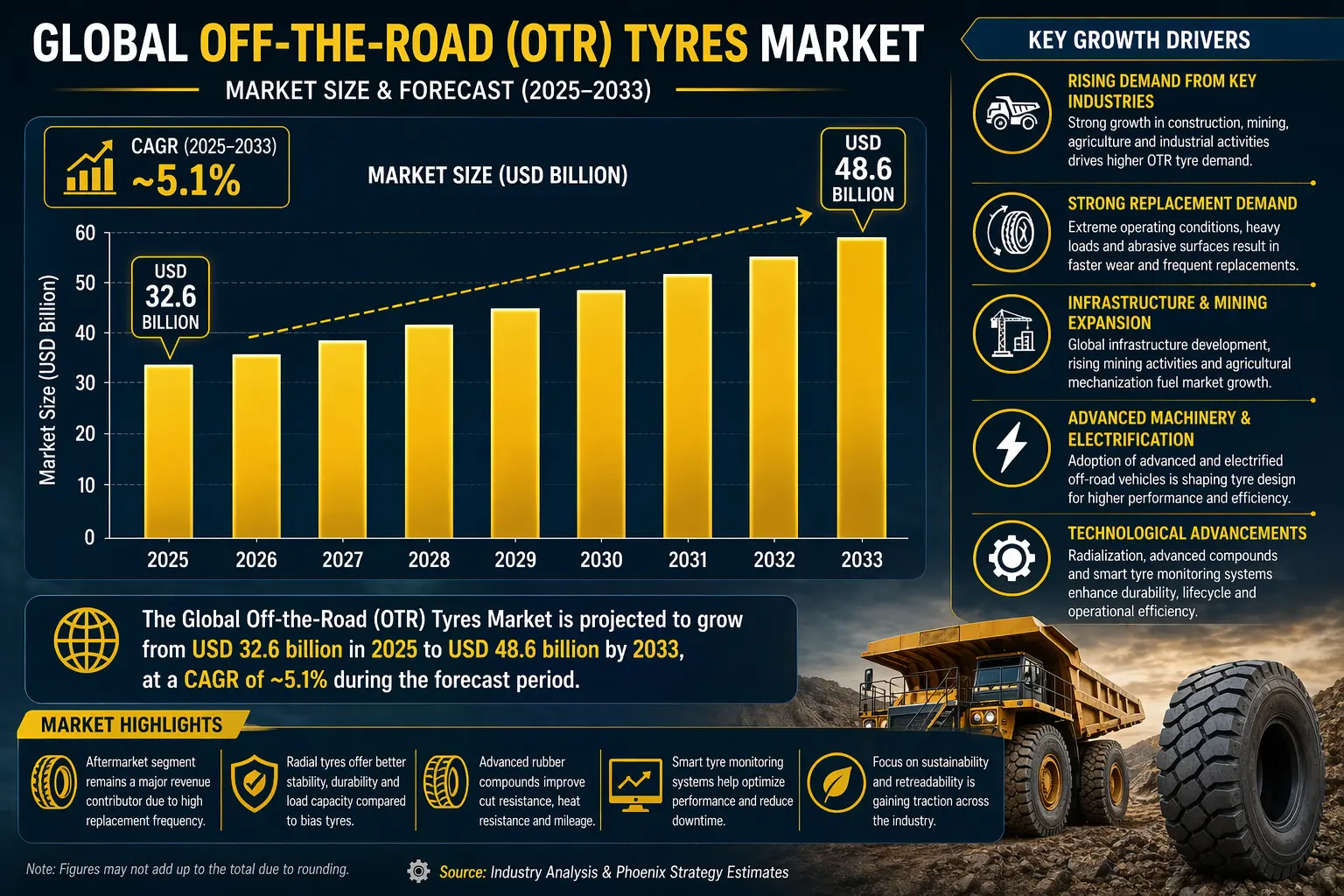
Market Size & Forecast
The Global Off-the-Road (OTR) Tyres Market is projected to grow from USD 32.6 billion in 2025 to approximately USD 48.6 billion by 2033, reflecting a CAGR of ~5.1% over the forecast period. This growth is driven by increasing demand from construction, mining, agriculture, and industrial sectors, where heavy-duty vehicles operate in challenging terrains. A defining structural characteristic of this market is its strong dependence on replacement demand. OTR tyres operate under extreme conditions, including heavy loads, abrasive surfaces, and harsh environments, leading to faster wear and frequent replacement cycles. As a result, the aftermarket segment remains a major contributor to revenue. Market expansion is further supported by global infrastructure development, rising mining activities, and mechanization in agriculture. Additionally, the adoption of advanced machinery and electrified off-road vehicles is influencing tyre design, emphasizing durability, load capacity, and efficiency. Technological advancements such as radialization, advanced rubber compounds, and smart tyre monitoring systems are enhancing performance, extending lifecycle, and improving operational efficiency.Market Overview?? ??
The Global OTR Tyres Market is characterized by moderate competitive intensity and high capital intensity, with strong reliance on industrial and infrastructure activity cycles. The market operates through OEM supply to equipment manufacturers and a dominant aftermarket driven by replacement demand. OTR tyres are designed for specialized applications across construction, mining, agriculture, and port operations. These tyres must withstand heavy loads, rough terrain, and extreme operating conditions, making durability, traction, and heat resistance critical performance factors. Technological innovation is gradually transforming the market, with increasing adoption of radial tyres, advanced tread designs, and sensor-enabled monitoring systems. These innovations help improve productivity, reduce downtime, and lower total cost of ownership. Regionally, Asia-Pacific dominates the market due to large-scale infrastructure projects and mining activities, while Europe is emerging as a high-growth region driven by automation, sustainability initiatives, and advanced machinery adoption.Structural Drivers of Market Growth
- Expansion of Infrastructure & Construction Activities Large-scale infrastructure development projects globally are driving demand for construction equipment and associated OTR tyres.
- Growth in Mining & Natural Resource Extraction Increasing mining activities for metals, minerals, and energy resources are boosting demand for heavy-duty OTR tyres.
- Agricultural Mechanization Rising adoption of tractors, harvesters, and other farm equipment is supporting growth in agricultural OTR tyre demand.
- Strong Replacement Demand Harsh operating environments lead to faster wear, ensuring consistent replacement cycles and aftermarket revenue.
- Electrification & Automation of Off-Road Equipment Emerging electric and autonomous machinery require specialized tyres with enhanced load capacity and efficiency.
Market Segmentation Analysis
Top-Level Segment Share Split
- By Application: 30%
- By Tyre Construction: 20%
- By Equipment Type: 20%
- By Sales Channel: 15%
- By Technology: 15%
Regional Market Dynamics
- Asia-Pacific ??? Largest Market Driven by large-scale infrastructure development, mining operations, and agricultural mechanization in countries like China and India.
- Europe ??? Fastest Growing Region Growth supported by advanced machinery adoption, automation, and sustainability-driven regulations.
- North America Stable demand driven by mining activities, construction projects, and agricultural operations.
- Latin America Growth supported by mining expansion and agricultural development in countries such as Brazil and Chile.
- Middle East & Africa Demand driven by infrastructure investments, mining projects, and oil & gas sector activities.
Competitive Landscape
The Global Off-the-Road (OTR) Tyres Market includes leading players such as:- Michelin
- Bridgestone Corporation
- Goodyear Tire & Rubber Company
- Continental AG
- Yokohama Rubber Company
- BKT (Balkrishna Industries)
- Apollo Tyres
- Titan International
- Trelleborg AB
- Nokian Tyres
Strategic Outlook
- Radialization of OTR Tyres Shift from bias to radial tyres to improve durability, fuel efficiency, and performance.
- Smart & Connected Tyre Technologies Adoption of sensor-enabled tyres for real-time monitoring and predictive maintenance.
- Sustainability & Eco-Friendly Materials Increasing focus on sustainable materials and energy-efficient manufacturing processes.
- Electrification of Off-Road Equipment Development of tyres optimized for electric machinery with higher load capacity and efficiency.
Final Market Perspective
The Global Off-the-Road (OTR) Tyres Market represents a high-value, industrial-driven segment with strong replacement demand and long-term growth potential. Its performance is closely tied to global economic activity, infrastructure investment, and commodity cycles. While the market is capital-intensive, technological advancements and sustainability trends are reshaping competitive dynamics. The shift toward radial tyres, smart monitoring systems, and EV-compatible designs will define future growth. Manufacturers that combine durability, innovation, and strong service networks will be best positioned to capture market opportunities through 2033.Research Methodology
This study adopts a comprehensive mixed-methods research approach integrating primary and secondary data sources. Primary research includes insights from tyre manufacturers, equipment OEMs, distributors, and industry experts, providing real-time understanding of demand patterns, technological advancements, and market dynamics. Secondary research involves data triangulation from industry reports, regulatory frameworks, industrial databases, and economic analyses to ensure accurate market sizing and forecasting. This methodology provides a robust and reliable foundation for strategic decision-making within the Global Off-the-Road (OTR) Tyres Market ecosystem.Table of Contents
Executive Summary
1.1 Market Forecast Snapshot (2026-2033) 1.2 Global Market Size & CAGR Analysis 1.3 Largest & Fastest-Growing Segments 1.4 Region-Level Leadership & Growth Trends 1.5 Key Market Drivers 1.6 Competitive Landscape Overview 1.7 Strategic Outlook Through 2033
Introduction & Market Overview
1.1 Definition of the Global Off-the-Road (OTR) Tyres Market 1.2 Scope of the Study 1.3 Industry Evolution & Market Development 1.4 Supply Chain & Distribution Infrastructure 1.5 Impact of Industrial & Infrastructure Trends 1.6 Regulatory & Compliance Landscape 1.7 Technology & Innovation Landscape
Research Methodology
1.1 Primary Research 1.2 Secondary Research 1.3 Market Size Estimation Model 1.4 Forecast Assumptions (2026-2033) 1.5 Data Validation & Triangulation
Market Dynamics
1.1 Drivers 1.1.1 Expansion of Infrastructure & Construction Activities 1.1.2 Growth in Mining & Natural Resource Extraction 1.1.3 Agricultural Mechanization 1.1.4 Strong Replacement Demand 1.1.5 Electrification & Automation of Off-Road Equipment 1.2 Restraints 1.2.1 High Capital Intensity 1.2.2 Raw Material Price Volatility 1.2.3 Cyclicality of End-Use Industries 1.2.4 High Maintenance & Replacement Costs 1.3 Opportunities 1.3.1 Radialization of OTR Tyres 1.3.2 Smart & Connected Tyre Technologies 1.3.3 Sustainable & Eco-Friendly Materials 1.3.4 Growth in Emerging Infrastructure Markets 1.4 Challenges 1.4.1 Harsh Operating Conditions Impacting Lifespan 1.4.2 Supply Chain & Logistics Complexity 1.4.3 Limited Adoption in Cost-Sensitive Markets 1.4.4 Technological Integration Complexity
Global Off-the-Road (OTR) Tyres Market Analysis (USD Billion), 2026-2033
1.1 Market Size Overview 1.2 CAGR Analysis 1.3 Regional Revenue Distribution 1.4 Segment Revenue Analysis 1.5 Sales Channel Analysis 1.6 Technology Adoption Analysis
Market Segmentation (USD Billion), 2026-2033
1.1 By Application 1.1.1 Construction 1.1.1.1 Earthmoving Equipment 1.1.1.1.1 Excavators & Loaders 1.1.2 Mining 1.1.2.1 Surface Mining Equipment 1.1.2.1.1 Underground Mining Equipment 1.1.3 Agriculture 1.1.3.1 Tractors 1.1.3.1.1 Harvesters 1.1.4 Industrial & Port Operations 1.1.4.1 Material Handling Equipment 1.1.4.1.1 Container Handling Vehicles 1.2 By Tyre Construction 1.2.1 Bias Tyres 1.2.1.1 Cross-Ply Tyres 1.2.1.1.1 Heavy-Duty Bias Tyres 1.2.2 Radial Tyres 1.2.2.1 Steel-Belted Radials 1.2.2.1.1 High-Performance Radial Tyres 1.3 By Equipment Type 1.3.1 Earthmoving Equipment 1.3.1.1 Dump Trucks 1.3.1.1.1 Wheel Loaders 1.3.2 Agricultural Equipment 1.3.2.1 Tractors 1.3.2.1.1 Sprayers 1.3.3 Mining Equipment 1.3.3.1 Haul Trucks 1.3.3.1.1 Drilling Equipment 1.3.4 Industrial Equipment 1.3.4.1 Forklifts 1.3.4.1.1 Cranes 1.4 By Sales Channel 1.4.1 OEM (Original Equipment Manufacturer) 1.4.1.1 Equipment Manufacturer Supply 1.4.1.1.1 Strategic OEM Partnerships 1.4.2 Aftermarket 1.4.2.1 Replacement Tyres 1.4.2.1.1 Retreading & Service Networks 1.5 By Technology 1.5.1 Conventional Tyres 1.5.1.1 Standard OTR Tyres 1.5.1.1.1 Heavy-Duty Tyres 1.5.2 Smart Tyres 1.5.2.1 Sensor-Integrated Tyres 1.5.2.1.1 IoT-Enabled Monitoring Systems 1.5.3 EV-Compatible Tyres 1.5.3.1 High Load Capacity Tyres 1.5.3.1.1 Energy-Efficient Tyres
Market Segmentation by Geography
1.1 Asia-Pacific 1.2 Europe 1.3 North America 1.4 Latin America 1.5 Middle East & Africa
Competitive Landscape
1.1 Market Share Analysis 1.2 Product Portfolio Benchmarking 1.3 Product Positioning Mapping 1.4 Distribution & Supply Chain Partnerships 1.5 Competitive Intensity & Differentiation
Company Profiles
Strategic Intelligence & Pheonix AI Insights
1.1 Pheonix Demand Forecast Engine 1.2 Supply Chain & Infrastructure Analyzer 1.3 Technology & Innovation Tracker 1.4 Product Development Insights 1.5 Automated Porter’s Five Forces Analysis
Future Outlook & Strategic Recommendations
1.1 Radialization Strategy Expansion 1.2 Smart Tyre Technology Integration 1.3 Sustainability & Material Innovation 1.4 Aftermarket Service & Retreading Growth 1.5 Long-Term Market Outlook (2033+)
Appendix
About Pheonix Research
Disclaimer
Competitive Landscape
Global Off-the-Road (OTR) Tyres Market Competitive Intensity & Market Structure Overview
The Global Off-the-Road (OTR) Tyres Market is characterized by a moderately consolidated structure with moderate competitive intensity, driven by the presence of global Tier 1 manufacturers alongside specialized regional and niche players. The market exhibits a technology- and capital-intensive competitive environment, where scale, engineering capability, and OEM partnerships play a critical role in determining market leadership. Leading companies such as Michelin, Bridgestone Corporation, Goodyear Tire & Rubber Company, and Continental AG dominate the premium and high-performance segments through advanced technology, global manufacturing capabilities, and strong relationships with equipment OEMs. At the same time, companies like Balkrishna Industries Limited and Titan International play a significant role in value-driven and specialized segments. Competitive intensity is primarily driven by product durability, performance under extreme conditions, technological innovation, and lifecycle cost efficiency. The market’s dependence on heavy industries such as mining and construction further reinforces a structured yet competitive ecosystem.
Global Off-the-Road (OTR) Tyres Market Competitive Intensity & Market Structure Current Scenario
Leading Company Profiles
- Michelin: Leader in advanced OTR tyre technologies and premium mining solutions.
- Bridgestone Corporation: Global leader with strong OEM partnerships and diversified OTR portfolio.
- Goodyear Tire & Rubber Company: Key player focusing on performance and industrial tyre solutions.
- Continental AG: Technology-driven manufacturer with focus on smart tyre systems.
- Yokohama Rubber Company: Strong presence in industrial and off-highway tyre segments.
- Balkrishna Industries Limited: Major player in cost-efficient agricultural and construction tyres.
- Apollo Tyres: Expanding footprint in off-highway segments.
- Titan International: Specialist in agricultural and construction equipment tyres.
- Trelleborg AB: Focused on high-performance agricultural and industrial tyres.
- Nokian Tyres: Known for durable tyres designed for extreme conditions.
Key Competitive Intensity & Market Structure Signals in Global Off-the-Road (OTR) Tyres Market
Several signals define the competitive dynamics of the market:
- The dominance of Tier 1 manufacturers highlights a technology- and scale-driven competitive advantage, particularly in mining and high-load applications.
- High capital intensity and engineering requirements create significant entry barriers, limiting new entrants and supporting market consolidation.
- The strong reliance on replacement demand ensures a stable, recurring revenue model, intensifying competition in aftermarket services and lifecycle management.
- Product differentiation is heavily based on durability, load capacity, traction, and heat resistance, rather than pricing alone.
- Increasing adoption of radial tyres and smart monitoring systems is shifting competition toward performance optimization and predictive maintenance.
- Dependence on industrial activity cycles introduces demand volatility, requiring companies to maintain flexible production and pricing strategies.
Strategic Implications of Competitive Intensity & Market Structure in Global Off-the-Road (OTR) Tyres Market
The competitive structure leads to several strategic implications:
- Technological innovation is critical, particularly in radialization, smart tyres, and advanced material development.
- OEM partnerships are a key competitive advantage, enabling long-term contracts and stable demand.
- Aftermarket services and retreading solutions are essential, enhancing lifecycle value and customer retention.
- Scale and manufacturing capability provide cost advantages, especially in high-volume industrial applications.
- Customization is necessary, as tyres must be tailored to specific applications such as mining, agriculture, and construction.
- Sustainability and efficiency are emerging priorities, influencing product design and regulatory compliance.
Global Off-the-Road (OTR) Tyres Market Competitive Intensity & Market Structure Forward Outlook
Looking ahead, the Global Off-the-Road (OTR) Tyres Market is expected to maintain its moderately consolidated structure with sustained moderate competitive intensity, with gradual evolution driven by technological and industrial trends.
- Radialization will continue to expand, improving performance, durability, and operational efficiency.
- Smart tyre technologies will enable real-time monitoring and predictive maintenance, enhancing value propositions.
- Electrification and automation of off-road equipment will create demand for specialized, high-load, and energy-efficient tyres.
- Premium players will focus on innovation and OEM integration, while regional players will compete on cost efficiency and niche specialization.
- Selective consolidation and partnerships may occur to strengthen technological capabilities and global reach.
In conclusion, the Global OTR Tyres Market represents a high-value, technology-driven, and industrially linked competitive landscape, where durability, innovation, and lifecycle efficiency determine long-term success.
Value Chain
Global Off-the-Road (OTR) Tyres Market Value Chain & Supply Chain Evolution Overview
The Global Off-the-Road (OTR) Tyres Market is undergoing a structural transformation driven by industrial expansion, infrastructure development, and increasing mechanization across construction, mining, and agriculture sectors. The market’s value chain is characterized by a hybrid operational model, supported by a hybrid distribution structure that integrates OEM supply with a dominant aftermarket ecosystem. This dual-channel framework plays a critical role in shaping pricing dynamics, lifecycle value, and competitive positioning among manufacturers. A defining feature of this value chain is its strong reliance on replacement demand. OTR tyres operate in extreme environments’characterized by heavy loads, abrasive terrains, and continuous usage’resulting in accelerated wear and frequent replacement cycles. This makes the aftermarket the primary revenue driver, requiring robust service networks, efficient logistics, and lifecycle management solutions such as retreading. Supply chain complexity is moderate but capital-intensive and globally interconnected. The sourcing of key raw materials such as natural rubber, synthetic compounds, steel reinforcements, and specialty chemicals introduces cost volatility and procurement challenges. Additionally, the increasing adoption of radial tyres, advanced tread technologies, and smart monitoring systems is adding layers of technological complexity to manufacturing and distribution processes. In response, manufacturers are focusing on supply chain optimization, localized production, and digital integration to enhance operational efficiency, reduce downtime, and improve total cost of ownership for end users. The value chain is evolving into a performance-driven and service-oriented ecosystem aligned with durability, efficiency, and long lifecycle requirements.
Global Off-the-Road (OTR) Tyres Market Value Chain & Supply Chain Evolution Current Scenario
Market-Specific Value Chain
- Raw Material Sourcing: Natural rubber, synthetic rubber, steel cords, carbon black, and specialty compounds
- Manufacturing: Tyre production, compounding, radial and bias construction, durability and stress testing
- Technology Integration: Radialization, advanced tread engineering, sensor-enabled smart tyres
- Distribution: OEM supply to equipment manufacturers and global aftermarket logistics networks
- Aftermarket Services: Dealers, service providers, retreading solutions, maintenance support
- End User Utilization: Construction firms, mining operators, agricultural enterprises, industrial users
Company-to-Stage Mapping
- Raw Material Sourcing: Global rubber and chemical suppliers
- Manufacturing: Michelin, Bridgestone Corporation, Goodyear Tire & Rubber Company, BKT (Balkrishna Industries)
- Technology Integration: Continental AG, Trelleborg AB, Nokian Tyres
- Distribution: OEM partnerships, industrial distributors, logistics providers
- Aftermarket Services: Service networks, tyre dealers, retreading specialists
- End User Utilization: Mining companies, construction contractors, agricultural operators
Key Value Chain & Supply Chain Evolution Signals in Global OTR Tyres Market
- High Replacement Demand in Extreme Conditions Continuous exposure to heavy loads and harsh terrains ensures frequent replacement cycles and strong aftermarket dependence.
- Infrastructure & Mining Activity Dependence Demand is closely linked to construction projects and resource extraction cycles, influencing production and inventory planning.
- Shift Toward Radial Tyres Increasing adoption of radial tyres improves durability, fuel efficiency, and lifecycle performance.
- Adoption of Smart Tyre Monitoring Systems Sensor-enabled tyres enable predictive maintenance, reduce downtime, and improve operational efficiency.
- Electrification of Off-Road Equipment Electric and autonomous machinery require specialized tyres with higher load capacity and optimized efficiency.
- Growing Importance of Retreading & Lifecycle Services Retreading solutions are gaining traction to reduce costs and extend tyre lifespan in industrial applications.
Strategic Implications of Value Chain & Supply Chain Evolution
- Strengthening Aftermarket & Service Networks Expanding service capabilities and retreading infrastructure is essential to capture long-term value.
- Raw Material Risk Management Diversifying sourcing strategies and securing supply contracts are critical to manage cost volatility.
- Investment in Advanced & Smart Tyre Technologies Integration of sensors and advanced materials enhances product differentiation and operational efficiency.
- Supply Chain Digitization & Predictive Analytics Data-driven systems improve demand forecasting, inventory optimization, and maintenance scheduling.
- Localization of Production & Distribution Regional manufacturing and distribution hubs reduce logistics costs and improve responsiveness.
- Focus on Sustainability & Lifecycle Optimization Eco-friendly materials and retreading practices support regulatory compliance and cost efficiency.
Global Off-the-Road (OTR) Tyres Market Value Chain & Supply Chain Evolution Forward Outlook
Looking ahead, the value chain is expected to evolve into a highly integrated, technology-driven, and service-centric ecosystem.
Key future developments include:
- Expansion of smart tyre monitoring and predictive maintenance systems
- Increased adoption of radial and EV-compatible OTR tyres
- Growth of retreading and lifecycle management services
- Integration of digital supply chain platforms for real-time tracking
- Adoption of sustainable materials and energy-efficient production processes
As the market evolves, success will depend on the ability to balance durability, cost efficiency, and technological innovation. Companies that effectively integrate advanced manufacturing, strong aftermarket service ecosystems, and data-driven supply chain capabilities will achieve superior operational performance, customer retention, and long-term competitive advantage in the Global Off-the-Road (OTR) Tyres Market.
Investment Activity
Global Off-the-Road (OTR) Tyres Market Investment & Funding Dynamics Overview
The investment and funding landscape within the Global Off-the-Road (OTR) Tyres Market is characterized by steadily rising investment activity and high capital intensity, driven by the market’s strong linkage to infrastructure development, mining operations, and agricultural mechanization. Structural drivers such as increasing global construction projects, expansion of mining activities, and the adoption of advanced off-road machinery are attracting sustained capital inflows into the sector. These investments are primarily directed toward enhancing manufacturing capabilities, improving tyre durability, and advancing technology integration for heavy-duty applications. A critical factor shaping investment dynamics in this market is the specialized and performance-intensive nature of OTR tyres. These tyres are engineered to operate under extreme conditions, including heavy loads, rough terrains, and high-temperature environments. As a result, manufacturers are required to allocate substantial capital toward research and development, advanced materials, and precision engineering. Increasing adoption of radial tyres, high-performance compounds, and reinforced structures further elevates the need for continuous investment in product innovation and manufacturing infrastructure. Additionally, capital allocation is influenced by operational challenges such as raw material price volatility and the need for lifecycle cost optimization. Companies are investing in supply chain resilience, retreading solutions, and sustainable material sourcing to enhance cost efficiency and ensure long-term profitability in a cyclical demand environment.
Global Off-the-Road (OTR) Tyres Market Investment & Funding Dynamics Current Scenario
In the current scenario, the Global OTR Tyres Market is witnessing a stable yet significant flow of investments, supported by its replacement-driven revenue model and strong demand from industrial sectors. The high capital intensity reflects the substantial financial commitments required for large-scale production facilities, advanced manufacturing technologies, and continuous product development. Investment activity is particularly concentrated in areas such as radial tyre adoption, smart tyre monitoring systems, and high-durability product innovations. Manufacturers are allocating capital toward automation, digital quality control systems, and sensor-enabled tyre technologies aimed at improving operational efficiency, reducing downtime, and enhancing total cost of ownership for end users. The market is also experiencing selective merger and acquisition (M&A) activity, as companies seek to strengthen their product portfolios, expand geographic presence, and enhance technological capabilities. Strategic partnerships and acquisitions are increasingly focused on accessing advanced materials technology, expanding in high-growth mining and construction regions, and strengthening aftermarket service networks. Furthermore, the funding landscape is driven largely by long-term strategic investments rather than short-term capital deployment, given the infrastructure-heavy nature of the industry. Companies are prioritizing capacity expansion, modernization of manufacturing facilities, and development of service-oriented solutions such as retreading and maintenance support.
Key Investment & Funding Dynamics Signals in Global Off-the-Road (OTR) Tyres Market
The investment and funding dynamics in the Global OTR Tyres Market are shaped by several key signals reflecting evolving industry priorities. One of the primary signals is the strong dependence on replacement demand, driven by harsh operating conditions that lead to rapid tyre wear. This ensures stable and recurring revenue streams, encouraging continuous investment in manufacturing capacity and aftermarket services. Another critical signal is the growth of infrastructure and mining activities, which directly influences demand for heavy-duty tyres. Large-scale construction projects and resource extraction operations are prompting companies to invest in high-performance tyre solutions capable of handling extreme environments. The increasing adoption of advanced machinery, including electric and automated off-road equipment, is also influencing investment patterns. These machines require specialized tyres with enhanced load capacity, efficiency, and durability, driving capital allocation toward innovation and product development. Sustainability and cost optimization are additional key investment signals. Companies are investing in eco-friendly materials, energy-efficient manufacturing processes, and retreading technologies to reduce environmental impact and improve lifecycle economics. Moreover, the emergence of smart tyre technologies is driving investment in digital integration. Sensor-enabled tyres and real-time monitoring systems are enabling predictive maintenance, improved fleet management, and enhanced operational efficiency, further strengthening the case for technology-driven investments.
Strategic Implications of Investment & Funding Dynamics in Global Off-the-Road (OTR) Tyres Market
The current investment dynamics have significant strategic implications for market participants. One of the primary implications is the necessity for continuous innovation to meet the demanding performance requirements of OTR applications. Companies must invest in advanced materials, engineering capabilities, and smart technologies to maintain competitiveness. High capital intensity also necessitates disciplined capital allocation and cost management. Companies must balance substantial upfront investments in manufacturing and R&D with long-term returns driven by replacement demand and industrial activity cycles. This creates a strategic focus on operational efficiency, supply chain optimization, and margin stability. The increasing role of M&A activity highlights the importance of strategic consolidation and capability enhancement. Companies are leveraging acquisitions and partnerships to expand into high-growth regions, access new technologies, and strengthen their position in specialized segments such as mining and construction tyres. Additionally, the shift toward service-oriented business models is becoming more prominent. Investments in aftermarket services, including maintenance, monitoring, and retreading, are enabling companies to create recurring revenue streams and enhance customer retention.
Global Off-the-Road (OTR) Tyres Market Investment & Funding Dynamics Forward Outlook
Looking ahead, the investment and funding dynamics in the Global OTR Tyres Market are expected to remain strong, driven by ongoing global infrastructure development, increasing mining activities, and technological advancements in off-road equipment. The continued expansion of construction and resource extraction sectors will act as a major catalyst for sustained capital inflows. Technological innovation will remain a central focus, with increasing investment in radial tyre technology, smart monitoring systems, and advanced materials designed to enhance durability and performance. These innovations are expected to improve operational efficiency and reduce downtime, creating significant value for end users. Sustainability will play an increasingly important role in shaping future investment trends. Companies are likely to intensify investments in recyclable materials, low-emission manufacturing processes, and circular economy initiatives such as retreading to align with environmental regulations and cost optimization goals. Furthermore, the electrification and automation of off-road equipment will drive demand for next-generation tyres, prompting further investment in specialized designs and engineering capabilities. In summary, the Global OTR Tyres Market is positioned for sustained investment activity, supported by its strong industrial demand base and evolving technological landscape. Companies that strategically invest in innovation, sustainability, and service capabilities will be best positioned to capture long-term growth opportunities and maintain a competitive advantage in this capital-intensive market.
Technology & Innovation
Global Off-the-Road (OTR) Tyres Market Technology & Innovation Landscape Overview
The Global Off-the-Road (OTR) Tyres Market is experiencing a steady transformation driven by technology and innovation, aimed at enhancing durability, operational efficiency, and lifecycle performance under extreme working conditions. This landscape is characterized by a growth-stage technology maturity and a moderate-to-high innovation intensity, reflecting increasing investment in advanced materials, engineering, and digital monitoring solutions. At the core of this transformation is the shift toward radial tyre technology, which offers superior durability, improved load distribution, and enhanced fuel efficiency compared to traditional bias tyres. Radialization is becoming a key industry trend, particularly in mining and construction applications where operational efficiency and cost optimization are critical. Another major innovation area is the development of advanced rubber compounds and tread designs. These innovations improve resistance to abrasion, heat, and cuts, significantly extending tyre lifespan in harsh terrains such as mines, construction sites, and agricultural fields. This directly reduces downtime and lowers total cost of ownership for end users. The integration of smart tyre technologies is further reshaping the market. Sensor-enabled tyres allow real-time monitoring of parameters such as pressure, temperature, and wear, enabling predictive maintenance and reducing the risk of unexpected failures. These technologies are particularly valuable in large-scale industrial operations where downtime can be costly. Additionally, the emergence of electrified and automated off-road equipment is influencing tyre innovation. OTR tyres are increasingly being designed to support higher load capacities, torque requirements, and energy efficiency associated with electric and autonomous machinery.
Global Off-the-Road (OTR) Tyres Market Technology & Innovation Landscape Current Scenario
Currently, the Global OTR Tyres Market demonstrates a moderate level of patent activity, with innovation primarily focused on performance optimization and lifecycle enhancement rather than disruptive breakthroughs.
- Radialization Trend Increasing adoption of radial tyres is improving durability, traction, and fuel efficiency across heavy-duty applications.
- Advanced Material Engineering Development of high-performance rubber compounds enhances resistance to wear, heat, and mechanical stress.
- Smart Monitoring Systems Growing use of IoT-enabled sensors enables real-time tyre performance tracking and predictive maintenance.
- Heavy-Load Optimization Tyre designs are being refined to handle extreme loads and operating pressures in mining and construction environments.
- Sustainability-Oriented Innovation Early adoption of eco-friendly materials and energy-efficient production processes is gaining momentum.
Key Technology & Innovation Landscape Signals in Global Off-the-Road (OTR) Tyres Market
The market is evolving through several critical innovation signals:
- Shift Toward Radial Tyre Dominance Continuous transition from bias to radial tyres across major applications.
- Digitalization of Tyre Performance Monitoring Increasing integration of smart sensors for data-driven fleet management.
- Durability & Lifecycle Optimization Focus Strong emphasis on extending tyre lifespan in extreme operating conditions.
- Electrification-Driven Design Changes Emergence of tyres tailored for electric and autonomous off-road machinery.
- Sustainability & Material Innovation Growing focus on environmentally sustainable materials and processes.
Strategic Implications of Technology & Innovation Landscape in Global Off-the-Road (OTR) Tyres Market
The evolving technology landscape is shifting the competitive focus from purely product-based competition to performance, lifecycle value, and digital capabilities. Manufacturers must invest in advanced materials, smart technologies, and engineering capabilities to meet the demanding requirements of industrial applications. Radialization and smart tyre systems are becoming critical differentiators, enabling companies to offer higher efficiency and lower total cost of ownership. Additionally, the rise of electrified equipment is creating new opportunities for specialized tyre solutions. Companies that integrate durability, digital monitoring, and sustainability into their product offerings will gain a competitive edge. Strong aftermarket services, including predictive maintenance and retreading solutions, will further enhance value creation.
Global Off-the-Road (OTR) Tyres Market Technology & Innovation Landscape Forward Outlook
Looking ahead to 2026-2033, the technology and innovation landscape is expected to advance toward greater digital integration, sustainability, and performance optimization. Future developments will include wider adoption of smart connected tyres, enhanced use of advanced and sustainable materials, and continued innovation in EV-compatible tyre designs. Automation and data-driven fleet management will further accelerate the adoption of intelligent tyre solutions. While the market will remain focused on durability and cost efficiency, the integration of digital technologies and sustainable practices will redefine long-term competitive dynamics. Manufacturers that proactively invest in these innovation areas will be best positioned to capture growth opportunities in the Global OTR Tyres Market.
Market Risk
Global Off-the-Road (OTR) Tyres Market Risk Factors & Disruption Threats Overview
The Global Off-the-Road (OTR) Tyres Market operates within a capital-intensive and industrially linked ecosystem, making it highly sensitive to macroeconomic cycles and sector-specific volatility. The overall market risk level is moderate-to-high, driven by its dependence on construction, mining, and agriculture activities, along with high exposure to raw material costs and operational complexity. While strong replacement demand provides structural stability, cyclical end-use industries elevate overall market risk. Geopolitical exposure is high, as the market is closely tied to global commodity flows, mining operations, and infrastructure investments, which are often influenced by trade policies, political stability, and regional conflicts. Disruptions in mining regions, export restrictions, or sanctions can significantly impact demand, supply chains, and pricing dynamics. Substitution risk is low, given the highly specialized nature of OTR tyres. These tyres are specifically engineered for heavy-duty equipment operating in extreme conditions, and there are no direct substitutes that can replace their function in construction, mining, or agricultural applications.
Global Off-the-Road (OTR) Tyres Market Risk Factors & Disruption Threats Current Scenario
Currently, the market is navigating a complex risk landscape shaped by economic cyclicality, supply chain pressures, and technological transition. One of the primary risk factors is the strong dependence on infrastructure and mining cycles. Any slowdown in construction projects or commodity demand can directly reduce equipment utilization and tyre replacement demand. Raw material price volatility remains a critical challenge. Fluctuations in natural rubber, synthetic rubber, and steel cord prices significantly impact manufacturing costs, particularly in a segment where production is capital-intensive and margins are closely managed. Another major risk is operational intensity and high downtime costs. OTR tyres are used in mission-critical applications where failure can halt operations, making performance reliability essential. This increases pressure on manufacturers to maintain high quality standards while managing costs. Additionally, supply chain disruptions’particularly in sourcing raw materials and delivering large, specialized tyres’can affect availability and lead times, especially in remote mining and construction locations.
Key Risk Factors & Disruption Threats Signals in Global Off-the-Road (OTR) Tyres Market
- Economic Cyclicality: Dependence on construction, mining, and agricultural activity cycles affecting demand stability.
- Raw Material Price Volatility: Fluctuations in rubber, steel, and petrochemical inputs impacting cost structures.
- High Geopolitical Sensitivity: Exposure to mining regions, trade restrictions, and global commodity flows.
- Operational Downtime Risk: Tyre failure in critical operations leading to high economic losses and reliability pressure.
- Supply Chain Complexity: Challenges in manufacturing, transporting, and delivering large specialized tyres.
- Capital Intensity: High investment requirements for production, R&D, and advanced machinery.
Strategic Implications of Risk Factors & Disruption Threats in Global Off-the-Road (OTR) Tyres Market
The moderate-to-high risk profile necessitates a strong focus on durability, reliability, and lifecycle optimization. Manufacturers must invest in advanced materials, radialization, and smart tyre technologies to enhance performance and reduce downtime risks for end users. Diversification across end-use sectors such as construction, mining, and agriculture can help mitigate demand volatility. Companies are also increasingly focusing on aftermarket services, including retreading and maintenance solutions, to create stable revenue streams. Supply chain resilience is critical, requiring localized production, strategic inventory management, and strong logistics networks to ensure timely delivery to remote operational sites. Additionally, partnerships with equipment OEMs and fleet operators are becoming essential for long-term contracts and integrated service offerings.
Global Off-the-Road (OTR) Tyres Market Risk Factors & Disruption Threats Forward Outlook
Looking ahead to 2026-2033, the market’s risk environment is expected to remain elevated, with disruptions driven by economic cycles, technological transformation, and geopolitical developments.
- Continued volatility in global commodity and infrastructure investment cycles
- Increasing raw material cost fluctuations affecting profitability
- Rising geopolitical tensions impacting mining and supply chain operations
- Growing adoption of electric and autonomous off-road equipment requiring advanced tyre solutions
- Expansion of smart tyre technologies introducing new operational and integration challenges
Despite these risks, the market’s essential role in industrial operations and strong replacement demand provide long-term stability. Companies that effectively balance innovation, cost management, and service integration will be best positioned to navigate disruptions and capture growth in the Global Off-the-Road (OTR) Tyres Market.
Regulatory Landscape
Global Off-the-Road (OTR) Tyres Market Regulatory & Policy Environment Overview
The regulatory and policy environment plays a critical role in shaping the operational and competitive dynamics of the Global Off-the-Road (OTR) Tyres Market. Regulatory frameworks establish standards for product safety, durability, environmental compliance, and industrial usage, directly influencing manufacturing practices, product design, and market entry requirements. Given the heavy-duty applications of OTR tyres across construction, mining, agriculture, and industrial sectors, regulatory authorities emphasize stringent performance and safety standards to ensure operational reliability under extreme conditions. Globally, regulations are enforced by transportation authorities, industrial safety bodies, and environmental agencies, focusing on parameters such as load-bearing capacity, heat resistance, traction performance, and structural integrity. In addition, increasing environmental concerns are driving policies related to emissions reduction, sustainable materials, and energy-efficient manufacturing processes. These regulatory pressures are pushing manufacturers to innovate in areas such as advanced rubber compounds, radial tyre construction, and lifecycle optimization. Furthermore, the growing adoption of electrified and automated off-road equipment is influencing regulatory evolution. Authorities are beginning to incorporate guidelines addressing new performance requirements such as higher torque handling, energy efficiency, and compatibility with smart monitoring systems, thereby adding complexity to the regulatory landscape.
Global Off-the-Road (OTR) Tyres Market Regulatory & Policy Environment Current Scenario
Currently, the Global OTR Tyres Market operates within a moderately complex regulatory environment characterized by a combination of industrial safety standards, environmental regulations, and application-specific compliance requirements.
- Industrial Safety & Performance Standards Regulations mandate strict compliance with safety parameters such as load capacity, durability, traction, and resistance to extreme operating conditions, particularly in mining and construction applications.
- Environmental & Sustainability Regulations Governments are increasingly enforcing policies related to emissions reduction, material sustainability, and energy-efficient manufacturing, encouraging the use of eco-friendly compounds and processes.
- Application-Specific Compliance Requirements OTR tyres must meet specialized standards depending on their application (e.g., mining, agriculture, construction), adding layers of regulatory complexity.
- Standardized Certification & Homologation Defined testing and certification processes ensure product quality and facilitate international trade, although requirements may vary across regions.
- Monitoring of Aftermarket & Retreading Practices Regulatory bodies are placing greater emphasis on the quality and safety of retreaded tyres, given their widespread use in cost-sensitive industrial operations.
Key Regulatory & Policy Environment Signals in Global Off-the-Road (OTR) Tyres Market
The regulatory landscape is evolving with several key signals that are shaping market dynamics:
- Increasing Emphasis on Industrial Safety Compliance Stricter enforcement of safety standards is driving demand for high-performance, durable tyres capable of operating under extreme conditions.
- Expansion of Environmental Regulations Growing focus on sustainability is encouraging adoption of recyclable materials, low-emission production processes, and longer-lasting tyre solutions.
- Electrification & Automation-Driven Policy Evolution The rise of electric and autonomous off-road equipment is prompting regulators to define new performance and safety standards.
- Growing Focus on Lifecycle Efficiency Regulations are increasingly considering total lifecycle performance, including durability, retreading, and waste reduction.
- Regional Variation in Compliance Requirements Differences in regulatory frameworks across regions add complexity for global manufacturers, requiring localized compliance strategies.
Strategic Implications of Regulatory & Policy Environment in Global Off-the-Road (OTR) Tyres Market
The regulatory environment has significant strategic implications for market participants. Manufacturers must invest heavily in R&D, testing, and compliance systems to meet stringent safety and environmental standards. This increases operational costs but also creates barriers to entry, favoring established players with advanced technological capabilities. The growing emphasis on sustainability and lifecycle efficiency is driving innovation in durable tyre designs, retreading solutions, and eco-friendly materials. Companies that align with these regulatory trends can achieve competitive differentiation and long-term cost advantages. Additionally, the increasing complexity of application-specific regulations requires manufacturers to develop specialized product portfolios tailored to different industries and operating conditions. Strong compliance capabilities also enhance brand credibility, particularly in safety-critical sectors such as mining and construction.
Global Off-the-Road (OTR) Tyres Market Regulatory & Policy Environment Forward Outlook
Looking ahead to the 2026-2033 period, the regulatory environment for OTR tyres is expected to become more stringent and multi-dimensional. Future regulations are likely to focus on sustainability, digital monitoring, and safety enhancements across industrial applications. The integration of smart tyre technologies may lead to new compliance standards related to real-time performance monitoring and predictive maintenance. Additionally, stricter environmental policies will drive the adoption of sustainable materials and circular economy practices, including recycling and retreading. As electrification and automation in off-road equipment continue to expand, regulatory bodies will introduce new guidelines tailored to these technologies, further increasing complexity. Manufacturers will need to adopt a proactive and adaptive approach, balancing compliance, innovation, and cost efficiency. Overall, companies that effectively navigate regulatory complexities, invest in advanced technologies, and align with sustainability and safety standards will be best positioned to achieve long-term success in the Global Off-the-Road (OTR) Tyres Market.