
Global Ultra-High Performance (UHP) Tyres Market size and share Analysis 2026-2033
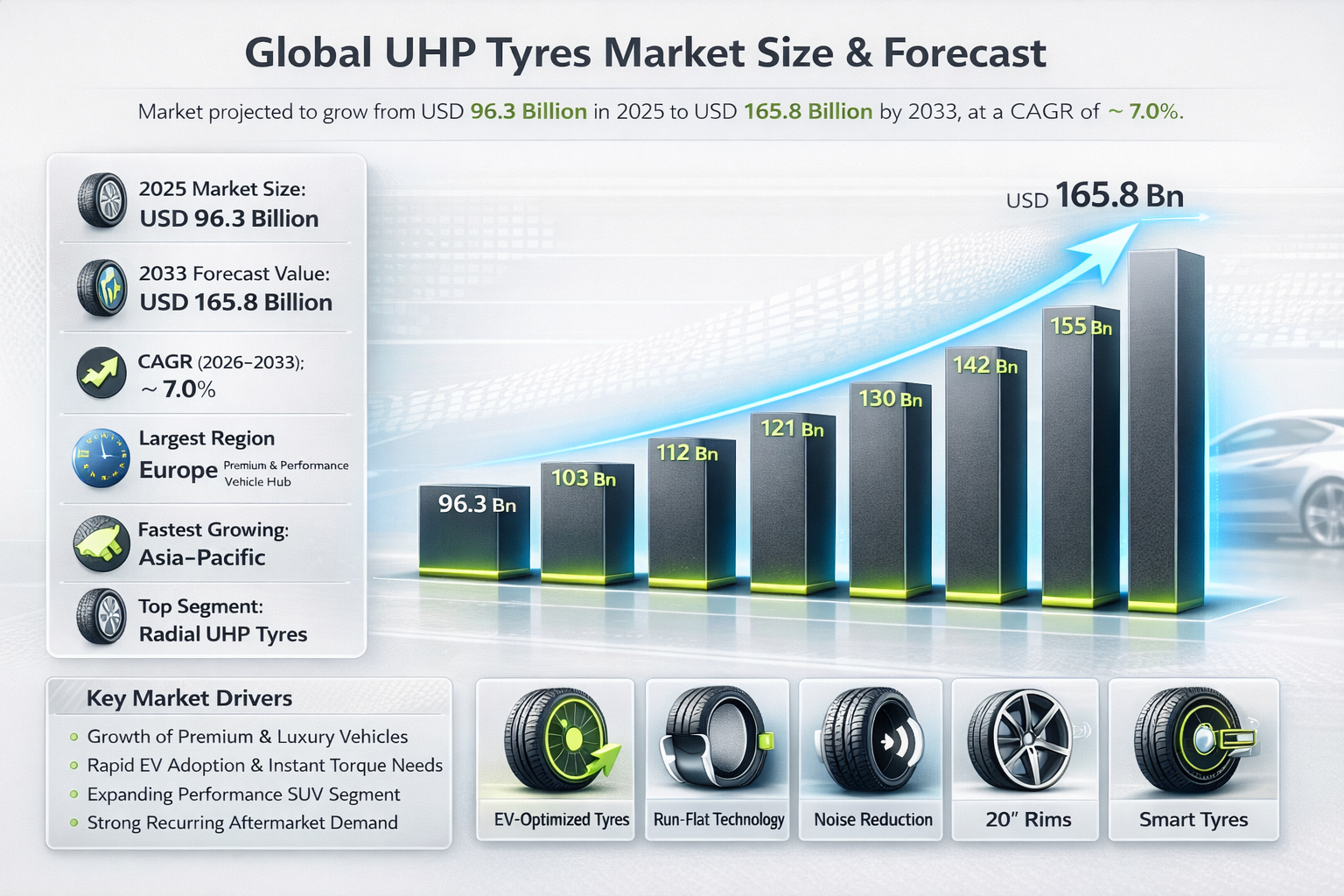
Market Forecast Snapshot (2025???2033)
| Metric | Value |
|---|---|
| 2025 Market Size | USD 96.3 Billion |
| 2033 Market Size | USD 165.8 Billion |
| CAGR (2026???2033) | ~7.0% |
| Largest Region | Europe |
| Fastest-Growing Region | Asia-Pacific |
| Largest Segment | Radial UHP tyres |
| Fastest-Growing Segment | EV-optimized UHP tyres |
| Key Trend | Premiumization & EV performance tyres |
Global Ultra-High Performance (UHP) Tyres Market Overview
The Global Ultra-High Performance (UHP) Tyres Market is all about making tyres for speed demons . These tyres are built for premium rides, luxury cars, and high-end electric vehicles where performance, safety, and looks matter most. They're designed to handle crazy speeds, bigger rims, and tough driving conditions.UHP tyres are a cut above the rest. They're made with special rubber, have stronger sidewalls, and clever tread patterns for grip and handling. Plus, they're designed to be quieter, can run even when punctured, and some are even tailored for electric vehicles - basically, they're built for top-notch performance and premium rides.
The UHP tyres market gets a boost from car makers and replacement sales . These tyres wear out faster 'cause they are built for speed and performance, so people buy 'em again and again. And folks who buy UHP tyres aren't really price-shopping - they're after performance, safety, and a good brand.
According to the Pheonix Demand Forecast Engine, the Global Ultra-High Performance (UHP) Tyres Market size is estimated at USD 96.3 billion in 2025 and is projected to reach approximately USD 165.8 billion by 2033, expanding at a CAGR of ~7.0% during the forecast period (2026???2033). Growth is driven by premium vehicle sales, SUV performance variants, and rapid electrification of high-end passenger vehicles.
Europe represents the largest market, supported by strong penetration of premium and performance vehicles, mandatory speed-rating standards, and seasonal tyre regulations. Asia-Pacific is the fastest-growing region, fueled by rising luxury car ownership, expanding performance SUV demand, and increasing EV adoption in China and India.
Key Drivers of Global Ultra-High Performance (UHP) Tyres Market Growth
Growth of Premium, Luxury & Performance Vehicles
Rising sales of luxury sedans, sports cars, and premium SUVs directly increase demand for UHP tyres as standard or optional OEM fitment.
SUV & Performance Variant Expansion
High-powered SUVs and crossovers are fuelling growth in UHP tyre sales . They need these top-tier tyres for stability, braking, and handling heavy loads.
Electric Vehicle Adoption
Electric vehicles generate high instant torque and greater weight, driving demand for EV-optimized UHP tyres with reinforced structures and low rolling resistance.
Strong Replacement & Aftermarket Demand
Low-profile UHP tyres wear faster due to performance driving and road conditions, ensuring recurring aftermarket demand.
Technological Innovation & Premiumization
Innovations like run-flat tech, acoustic foam, and eco-friendly materials are driving growth in the UHP tyre market . These features help tyre makers stand out and charge a premium.
Global Ultra-High Performance (UHP) Tyres Market Segmentation
1. By Vehicle Type
1.1 Passenger Cars
1.1.1 Sports Cars
-
Entry-level sports cars
-
Mid-range performance sports cars
-
Super sports cars
1.1.2 Performance Sedans
-
Compact performance sedans
-
Mid-size performance sedans
-
Executive performance sedans
1.1.3 Luxury Sedans
-
Premium luxury sedans
-
High-performance luxury sedans
1.2 SUVs & Crossovers (Fastest-Growing Segment)
1.2.1 Performance SUVs
-
Compact performance SUVs
-
Mid-size performance SUVs
1.2.2 Coupe-Style SUVs
-
Luxury coupe SUVs
-
Performance-oriented coupe SUVs
1.2.3 Luxury Crossovers
-
Premium urban crossovers
-
Sport-tuned luxury crossovers
1.3 Electric & Hybrid Vehicles
1.3.1 Battery Electric Vehicles (BEVs)
-
Electric performance sedans
-
Electric performance SUVs
1.3.2 Plug-in Hybrid Electric Vehicles (PHEVs)
-
Performance PHEVs
-
Luxury hybrid vehicles
2. By Tyre Construction
2.1 Radial Tyres (Largest Segment)
2.1.1 Steel-Belted Radial Tyres
-
Single steel-belt construction
-
Double steel-belt construction
2.1.2 Multi-Layer Reinforced Radial Tyres
-
High-speed rated radials
-
Track-oriented reinforced radials
2.2 Run-Flat Tyres
2.2.1 Self-Supporting Run-Flat Tyres
-
Zero-pressure driving capability
2.2.2 Support-Ring Run-Flat Tyres
-
Reinforced inner-ring systems
3. By Seasonality
3.1 Summer UHP Tyres (Largest Segment)
3.1.1 Track-Focused Performance Tyres
-
Semi-slick track tyres
-
Competition-grade UHP tyres
3.1.2 Road-Oriented UHP Tyres
-
Daily-use performance tyres
-
Touring-performance hybrids
3.2 Winter UHP Tyres
3.2.1 Studless Performance Winter Tyres
-
Snow-optimized compounds
3.2.2 High-Speed Winter-Rated Tyres
-
V- and W-rated winter tyres
3.3 All-Season UHP Tyres
3.3.1 Performance All-Season Tyres
-
Balanced grip all-weather tyres
4. By Rim Size
4.1 17???18 Inches
4.1.1 Entry-Level Performance Vehicles
-
Compact sports sedans
4.2 18???20 Inches (Largest Segment)
4.2.1 Premium Sedans
-
Executive and luxury sedans
4.2.2 Performance SUVs
-
Mid-size performance SUVs
4.3 Above 20 Inches (Fastest-Growing Segment)
4.3.1 Luxury SUVs
-
Full-size luxury SUVs
4.3.2 Sports & Electric Performance Vehicles
-
High-torque EVs
-
Super-performance vehicles
5. By Technology
5.1 Conventional UHP Tyres
5.2 EV-Optimized UHP Tyres
5.2.1 Low Rolling Resistance Designs
-
Energy-efficient tread compounds
5.2.2 High Load-Bearing Constructions
-
Reinforced sidewalls for EV torque
5.3 Noise-Reduction UHP Tyres
5.3.1 Acoustic Foam Technology
-
Cabin noise suppression
5.3.2 Optimized Tread Pitch Sequencing
-
Reduced road resonance
5.4 Smart & Connected UHP Tyres
5.4.1 Embedded Sensors
-
Pressure monitoring
-
Temperature monitoring
6. By Sales Channel
6.1 OEM (Original Equipment)
6.1.1 Luxury & Performance Vehicle Manufacturers
6.1.2 Premium EV OEMs
6.2 Aftermarket / Replacement (Largest Segment)
6.2.1 Authorized Performance Dealers
6.2.2 Independent Tyre Retailers
6.2.3 Online Premium Tyre Platforms
7. By Geography
7.1 Europe (Largest Market)
-
Germany
-
U.K.
-
France
-
Italy
7.2 Asia-Pacific (Fastest-Growing Region)
-
China
-
India
-
Japan
-
South Korea
7.3 North America
-
United States
-
Canada
7.4 Middle East
-
UAE
-
Saudi Arabia
7.5 Latin America
-
Brazil
-
Mexico
Regional Insights of Global UHP Tyres Market
Europe ??? Largest Market
Strong luxury vehicle base, winter tyre mandates, and performance-focused consumer preferences.
Asia-Pacific ??? Fastest Growing
Rapid luxury car penetration, expanding EV adoption, and rising disposable incomes.
North America
High demand for performance SUVs, sports cars, and aftermarket upgrades.
Middle East
Strong demand for high-speed rated tyres due to premium vehicle concentration and driving conditions.
Leading Companies in the Global UHP Tyres Market
-
Continental AG
-
Goodyear Tire & Rubber Company
-
Hankook Tire
-
Yokohama Rubber Company
-
Sumitomo Rubber Industries
Michelin, Pirelli, and Bridgestone are the largest company in the Global UHP Tyres Market.
Strategic Intelligence & Pheonix AI-Backed Insights
Pheonix Demand Forecast Engine
Models premium vehicle sales, EV penetration, rim-size trends, and replacement cycles.
Performance Tyre Adoption Analyzer
Tracks demand for UHP tyres across ICE, hybrid, and electric platforms.
Raw Material Sensitivity ModelAssesses impact of silica, synthetic rubber, and advanced compound costs.
Why the Global Ultra-High Performance (UHP) Tyres Market Is Critical
The Global Ultra-High Performance (UHP) Tyres Market is critical as it directly supports vehicle safety, high-speed stability, and performance control for luxury cars, performance sedans, SUVs, and electric vehicles. With rising vehicle power, heavier curb weights, and instant EV torque, standard tyres are no longer sufficient.
UHP tyres enable superior grip, precise handling, shorter braking distances, and enhanced cornering performance, making them essential for modern premium mobility. They also play a strategic role in OEM vehicle engineering, influencing ride quality, efficiency, and brand differentiation, while generating high-margin aftermarket demand due to faster wear and performance-driven replacement cycles.
Final Takeaway of Global Ultra-High Performance (UHP) Tyres Market
The Global Ultra-High Performance Tyres Market is a fast-growing, premium-driven segment of the global tyre industry. Rising demand for luxury vehicles, performance SUVs, and electric cars is accelerating adoption of advanced UHP tyre technologies. Market leaders will be those that combine high-performance engineering, EV-ready designs, noise-reduction innovation, and strong premium aftermarket presence. With sustained premium vehicle growth and electrification trends, the UHP tyres market is set to outperform the broader tyre industry through 2033.
Competitive Landscape
Competitive Landscape of the Global Ultra-High Performance (UHP) Tyres Market
Executive Framing
The Global Ultra-High Performance (UHP) Tyres Market is relatively consolidated with very high competitive intensity, dominated by a handful of global tyre giants such as Michelin, Bridgestone Corporation, Continental AG, Pirelli & C. S.p.A., and Goodyear Tire & Rubber Company. These players leverage advanced R&D capabilities, strong OEM partnerships with premium automakers, and global distribution networks to maintain leadership. Competition is driven by continuous innovation in performance, safety, EV compatibility, and premium positioning.
Current Market Reality
The market is highly technology-driven, with performance, safety, and durability acting as key differentiators. OEM relationships play a critical role, as premium and luxury automakers often co-develop UHP tyres tailored to specific vehicle models, particularly in the EV and high-performance segments.
While Tier 1 players dominate OEM supply, Tier 2 brands such as Hankook, Yokohama, and Sumitomo are strengthening their presence through competitive pricing, technological upgrades, and expansion in the aftermarket segment. The replacement market remains a major revenue driver due to faster wear rates of UHP tyres.
Europe leads due to strong premium vehicle penetration and regulatory frameworks, while Asia-Pacific is emerging as a competitive battleground with rising luxury car sales and local manufacturing expansion.
Key Signals and Evidence
- Strong OEM partnerships between tyre manufacturers and luxury automotive brands.
- Increasing R&D investments in EV-optimized tyre technologies.
- Rising demand for larger rim sizes and performance SUVs.
- Expansion of premium aftermarket and replacement tyre sales.
- Technological advancements in run-flat, noise-reduction, and smart tyre systems.
Strategic Implications
- OEM Collaboration: Strengthening co-development partnerships with premium and EV automakers.
- Technology Leadership: Investing in EV-specific tyres, smart sensors, and sustainable materials.
- Premium Positioning: Focusing on high-margin segments with performance and safety differentiation.
- Aftermarket Expansion: Leveraging high replacement cycles through strong dealer and digital networks.
- Regional Manufacturing: Expanding production capabilities in Asia-Pacific to capture growth opportunities.
Forward Outlook
By 2033, the Global Ultra-High Performance (UHP) Tyres Market is projected to reach approximately USD 165.8 billion, growing at a CAGR of ~7.0%. Europe will continue to lead due to premium vehicle demand and regulatory standards, while Asia-Pacific will emerge as the fastest-growing region driven by rising EV adoption and luxury vehicle penetration.
The competitive landscape will increasingly revolve around EV optimization, sustainable materials, and intelligent tyre technologies. Companies that combine advanced engineering, strong OEM integration, and premium aftermarket strategies will secure long-term leadership in the evolving UHP tyres market.
Value Chain
Global Ultra-High Performance (UHP) Tyres Market: Value Chain & Market Dynamics
Executive Framing
The Global Ultra-High Performance (UHP) Tyres Market operates within a premium, performance-driven and technology-intensive automotive ecosystem, fueled by rising demand for high-speed stability, superior handling, and advanced vehicle dynamics. UHP tyres are a critical component in luxury vehicles, performance SUVs, and electric vehicles, where safety, precision, and driving experience are paramount.
Current Market Reality
The market is witnessing strong growth, expanding from USD 96.3 billion in 2025 to USD 165.8 billion by 2033 at a CAGR of ~7.0%. Growth is driven by increasing sales of premium vehicles, expansion of performance SUVs, and rising adoption of EV-optimized tyres, with Europe leading and Asia-Pacific emerging as the fastest-growing region.
Key Signals and Evidence
- Rising demand for luxury, performance, and high-speed vehicles globally.
- Strong growth in SUV and crossover performance segments.
- Increasing adoption of electric vehicles requiring specialized UHP tyres.
- High replacement demand due to faster wear rates of low-profile performance tyres.
- Technological advancements in run-flat systems, noise reduction, and smart tyre solutions.
Strategic Implications
Companies are focusing on innovation in materials, EV-specific designs, and premium branding strategies to maintain competitive advantage. Investments in advanced rubber compounds, sustainable materials, and OEM partnerships are critical to align with evolving automotive and regulatory trends.
Forward Outlook
The market is expected to evolve into a technology-driven, EV-integrated, and premium-dominated segment. Future growth will be driven by:
- Expansion of EV-optimized and low rolling resistance UHP tyres
- Growth in premium and performance SUV segments
- Advancements in smart tyres with embedded sensors and connectivity
- Increased focus on sustainable materials and eco-friendly tyre production
Companies that prioritize performance innovation, EV readiness, and premium aftermarket strategies will capture long-term growth in the global UHP tyres market.
Investment Activity
Investment & Funding Dynamics – Global Ultra-High Performance (UHP) Tyres Market
Executive Framing
Current Market Reality
Valued at USD 96.3 billion in 2025 and projected to reach USD 165.8 billion by 2033 (CAGR ~7.0%), the market reflects steady, premium-driven investment growth. Europe leads as the largest market due to strong luxury vehicle penetration and regulatory standards, while Asia-Pacific is the fastest-growing region driven by rising disposable income, EV adoption, and expanding automotive production. Leading companies such as Michelin, Bridgestone, Continental AG, and Pirelli are investing heavily in EV-specific tyres, sustainable materials, and advanced performance technologies.
Key Signals and Evidence
- Premium Vehicle Expansion: Increasing demand for luxury cars and performance SUVs is driving OEM tyre investments.
- EV-Optimized Tyre Development: Strong capital flow toward tyres designed for high torque, load capacity, and low rolling resistance.
- Aftermarket Growth: High replacement cycles due to faster wear rates ensure recurring revenue streams.
- Advanced Material Innovation: Investments in silica compounds, synthetic rubber, and sustainable materials.
- Smart & Connected Tyres: Integration of sensors for real-time pressure and temperature monitoring.
- Noise Reduction Technologies: Growing focus on acoustic foam and tread optimization for enhanced driving comfort.
- Sustainability Focus: Increasing investments in eco-friendly production and circular economy initiatives.
Strategic Implications
Companies investing in EV-specific tyre innovation, premium product positioning, and advanced materials will capture significant long-term value. Vertical integration across raw materials, manufacturing, and distribution will enhance margins and supply chain resilience. Strategic collaborations with automotive OEMs, EV manufacturers, and mobility tech firms will further strengthen competitive positioning.
Forward Outlook
From 2026 to 2033, investment activity in the UHP tyres market will remain strong and technology-driven. EV-optimized tyres, smart tyre systems, and sustainable materials will dominate capital allocation. M&A activity is expected to increase as leading tyre manufacturers acquire niche technology firms and regional players to expand capabilities and global footprint.
Technology & Innovation
Global Ultra-High Performance (UHP) Tyres Market: Technology & Innovation
Executive Framing
Technology and innovation in the Global Ultra-High Performance (UHP) Tyres Market are focused on enhancing speed capability, grip performance, durability, and compatibility with next-generation vehicles, particularly electric and high-performance models. As vehicles become more powerful, heavier, and digitally integrated, tyre manufacturers are investing in advanced materials science, smart tyre technologies, and precision engineering to deliver superior handling, safety, and efficiency. Innovation is also being driven by the need for noise reduction, sustainability, and performance optimization under extreme driving conditions.
Current Market Reality
Valued at USD 96.3 billion in 2025 and projected to reach USD 165.8 billion by 2033 at a CAGR of ~7.0%, the market is witnessing strong growth supported by premium vehicle sales, performance SUVs, and rapid EV adoption. Europe leads in innovation and adoption due to strict performance standards, while Asia-Pacific is the fastest-growing region driven by luxury vehicle demand and electrification trends.
Key Signals and Evidence
- Advanced Rubber Compounds: Development of silica-based and multi-compound tread formulations to enhance grip, reduce rolling resistance, and improve durability.
- EV-Optimized Tyre Engineering: Reinforced sidewalls, low rolling resistance designs, and high load-bearing capacity to handle instant torque and heavier EV structures.
- Run-Flat & Self-Sealing Technologies: Innovations enabling continued driving after punctures, improving safety and reducing downtime.
- Noise Reduction Technologies: Integration of acoustic foam and optimized tread patterns to minimize cabin noise, especially critical for electric vehicles.
- Smart & Connected Tyres: Embedded sensors for real-time monitoring of pressure, temperature, wear, and road conditions, enhancing safety and predictive maintenance.
- High-Precision Manufacturing: Use of automation, AI-driven quality control, and advanced moulding techniques for consistent high-speed performance.
- Sustainable Materials & Circular Innovation: Adoption of bio-based rubber, recycled materials, and eco-friendly production processes to meet sustainability goals.
Strategic Implications
Companies investing in EV-specific tyre innovations, smart tyre technologies, and premium material development will gain a competitive edge in the evolving UHP tyres market. Strengthening OEM partnerships with luxury and electric vehicle manufacturers will be critical for long-term growth. Additionally, expanding high-margin aftermarket channels and focusing on sustainability will enhance brand positioning and regulatory compliance.
Forward Outlook
The Global UHP Tyres Market is expected to evolve toward intelligent, EV-optimized, and sustainable tyre solutions. Future innovations will focus on fully connected tyres, adaptive tread technologies, and advanced materials that enhance both performance and environmental efficiency. As vehicle performance standards continue to rise, UHP tyres will remain a critical component in enabling next-generation mobility and premium driving experiences.
Market Risk
Risk Factors and Disruption Threats in the Global Ultra-High Performance (UHP) Tyres Market
Executive Framing
The Global Ultra-High Performance (UHP) Tyres Market operates within a premium, innovation-driven, and performance-centric ecosystem, making it moderately to highly exposed to macroeconomic cycles, raw material volatility, and technological disruption. While the market is projected to grow from USD 96.3 billion in 2025 to USD 165.8 billion by 2033, its dependence on luxury vehicle sales, EV evolution, and high-cost materials introduces a complex and evolving risk landscape.
Current Market Reality
Europe leads the market due to strong premium vehicle penetration and regulatory frameworks, while Asia-Pacific is emerging rapidly with increasing luxury car ownership and EV adoption. However, the market remains closely tied to automotive industry cycles, making it vulnerable to economic slowdowns, fluctuating demand for high-end vehicles, and regional trade disruptions. Additionally, the transition toward EVs is reshaping product requirements, forcing manufacturers to continuously invest in innovation and re-engineering.
Key Risk Signals and Evidence
- Volatility in raw materials such as synthetic rubber, silica, and oil impacting production costs.
- Dependence on luxury and performance vehicle sales, which are sensitive to economic downturns.
- Rapid technological shifts driven by EV requirements, increasing R&D and production costs.
- Supply chain disruptions due to geopolitical tensions and global trade uncertainties.
- Intense competition among premium tyre manufacturers leading to pricing pressure and margin challenges.
Strategic Risk Implications
- Manufacturers must invest in EV-optimized tyre technologies to remain competitive.
- Diversification of raw material sourcing is essential to mitigate cost volatility risks.
- Strengthening aftermarket distribution channels can stabilize revenue against OEM demand fluctuations.
- Continuous innovation in noise reduction, durability, and energy efficiency is critical for differentiation.
- Strategic partnerships with OEMs and EV manufacturers can reduce market uncertainty and secure long-term demand.
Forward Risk Outlook
The risk profile of the Global UHP Tyres Market is expected to remain moderate to high, driven by ongoing technological disruption, premium market dependency, and global economic uncertainties. However, companies that proactively invest in advanced materials, EV-focused innovation, and resilient supply chains will be well-positioned to mitigate risks and capitalize on long-term growth opportunities in the evolving high-performance mobility landscape.
Regulatory Landscape
Regulatory & Policy Landscape: Global Ultra-High Performance (UHP) Tyres Market
Executive Framing
The Global Ultra-High Performance (UHP) Tyres Market operates under stringent regulatory frameworks governed by authorities such as the European Commission (ECE regulations), U.S. Department of Transportation (DOT), National Highway Traffic Safety Administration (NHTSA), and international standards such as ISO and UNECE.
Regulations focus on safety standards, speed ratings, rolling resistance, labeling, and environmental compliance, ensuring that UHP tyres meet high-performance and safety benchmarks required for premium and high-speed vehicles.
Current Market Reality
The market is highly regulated due to the critical role tyres play in vehicle safety, especially for high-speed and high-performance applications. Regulations around wet grip, braking performance, and durability are becoming increasingly strict.
Additionally, growing environmental concerns are driving regulatory focus on fuel efficiency, carbon emissions, tyre wear particles, and noise reduction, particularly in Europe and North America.
Key Signals and Evidence
- Implementation of EU Tyre Labeling Regulations for fuel efficiency, wet grip, and noise levels.
- Strict compliance requirements under DOT and ECE safety standards.
- Increasing regulatory focus on rolling resistance and emission reduction.
- Adoption of EV-specific tyre standards for load capacity and noise control.
- Growing emphasis on sustainable materials and recycling regulations.
- Rising development of standards for tyre wear particles and environmental impact.
Strategic Implications
Manufacturers must invest in advanced materials, R&D, and compliance capabilities to meet evolving global safety and environmental regulations. Adopting eco-friendly materials and energy-efficient designs is becoming essential.
Companies focusing on EV-compatible tyres, noise reduction technologies, and regulatory-compliant labeling systems will gain a competitive advantage in premium and OEM segments.
Forward Outlook
Regulatory frameworks are expected to become more stringent, particularly in areas related to sustainability, emission control, and tyre performance standards. Governments will increasingly push for eco-friendly and energy-efficient tyre solutions.
Digital monitoring, smart tyres, and real-time performance tracking may also introduce new regulatory considerations, including data standards and safety compliance.