
Global manganese mining market Report, Size & Forecast 2026-2033
Global manganese mining market Forecast Snapshot 2026–2033
| Metric | Value |
|---|---|
| Base Year | 2025 |
| Base Market Size | 20.51 billion USD |
| Forecast Window | 2026–2033 |
| Market Direction | Strong positive |
| Baseline CAGR | 16.87% |
| Optimistic CAGR | 19.37% |
| Conservative CAGR | 14.37% |
| Baseline 2033 Endpoint | 71.38 billion USD |
| Largest Producing Regions | South Africa, Gabon, Australia |
| Fastest-Growing Region (Indicative) | India (MOIL record production, policy-driven mineral auctions) |
| Top Segment by Volume | Metallurgical-grade ore (steelmaking) |
| Fastest-Growing Segment | Battery-grade manganese (EV supply chain diversification) |
| Key Trends | Supply tightness from South Africa logistics and Australian cyclone disruptions; policy-driven new capacity in India, Oman, and US; environmental scrutiny of EV-linked supply chains |
| Future Focus | Battery-grade premium segment growth; infrastructure investment (Ngqura terminal); domestic processing mandates in Gabon |
Global manganese mining market Overview
The Global manganese mining market covers the extraction and beneficiation of manganese ore through to its first commercial sale. It includes both metallurgical-grade ore used in ferroalloy production for the steel industry and battery-grade ore processed into high-purity manganese compounds for lithium-ion battery cathodes. The market does not include downstream ferroalloy smelting, chemical manufacturing, recycling, or other battery metals such as cobalt and nickel.
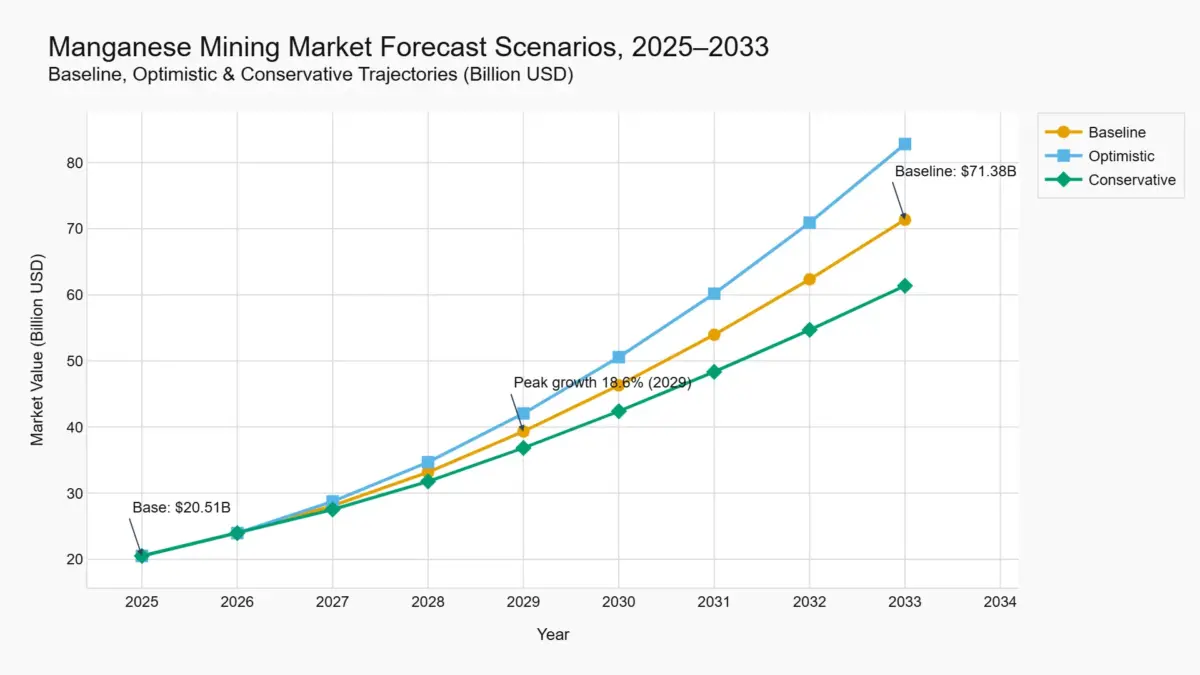
The market was valued at USD 20.51 billion in 2025. It is projected to grow at a CAGR of 16.87% from 2026 to 2033, reaching approximately USD 71.38 billion by 2033. Growth is expected to be strongest during the middle years of the forecast period, driven by rising steel production and increasing demand for electric vehicle batteries, before gradually moderating toward the end of the forecast window.
Key Takeaways
- Supply constraints caused by logistics bottlenecks in South Africa and weather disruptions in Australia are tightening near-term manganese ore availability. These challenges are supporting market value growth despite a 5.4% overall contraction in South African mining output in May 2026 and South32's guidance cut of more than 6% for Australian manganese production.
- Policy-driven supply expansion is expected to strengthen long-term market growth. India's eighth tranche of critical mineral auctions, covering 20 mineral blocks including manganese, a new mining concession in Oman with Manganese Majan Company, and streamlined deep-seabed permitting in the United States are expected to add new production capacity after 2028, supporting the optimistic CAGR scenario of 19.37%.
- Rising demand for battery-grade manganese is creating a premium market segment. However, environmental allegations at a Ghana mine linked to Tesla present reputational and operational risks for EV-related supply chains. According to the available information, more than 150 community members interviewed reported chronic health problems and exposure to toxic metals.
- The baseline CAGR of 16.87% assumes that logistics constraints are gradually resolved and production recovers steadily. The conservative CAGR scenario of 14.37% reflects the possibility of persistent supply disruptions, weather-related challenges, and regulatory uncertainty affecting market growth.
-
Year-by-Year Market Values and Growth Rates
Baseline manganese mining market values and annual growth rates, 2025–2033 Year Market Value (billion USD) Annual Growth Rate (%) 2025 20.51 — 2026 23.97 16.87 2027 28.11 17.29 2028 33.17 18.02 2029 39.34 18.60 2030 46.31 17.70 2031 53.97 16.55 2032 62.34 15.51 2033 71.38 14.50
Global manganese mining market Growth Shape and Scenario Analysis
The baseline growth path is front-loaded, with annual growth rates accelerating from 16.87% in 2026 to a peak of 18.60% in 2029 before decelerating to 14.50% by 2033. This shape is driven by early capital expenditure and technology ramp-up in the first half of the forecast period, as investment in new mining capacity and beneficiation technology yields the highest marginal returns before base effects and supply-side maturation temper growth in later years. The optimistic scenario (19.37% CAGR) assumes that early capex and technology deployment proceed without major delays, that regulatory catalysts in the United States, India, and Oman bring new supply online as expected, and that logistics constraints in South Africa are resolved through infrastructure investment such as the proposed Ngqura manganese ore export terminal. The conservative scenario (14.37% CAGR) accounts for persistent supply disruptions from weather events, environmental regulatory pushback, and slower-than-expected resolution of logistics bottlenecks in key producing regions.
| Scenario | CAGR (%) |
|---|---|
| Optimistic | 19.37 |
| Baseline | 16.87 |
| Conservative | 14.37 |
Drivers, Restraints, Opportunities, and Threats of Global manganese mining market
Key Drivers
Supply Tightness from Production Disruptions and Logistics Bottlenecks
Near-term manganese ore supply is under pressure from multiple converging factors. In South Africa, overall mining output fell 5.4% year-on-year in May 2026, with manganese ore production declining 5.8% in the three-month period ended May 2026, contributing -0.5 percentage points to the quarterly contraction. In Australia, South32 cut its full-year fiscal 2026 manganese production guidance by over 6% to 3 million wet metric tons after Tropical Cyclone Narelle forced a temporary halt at the Gemco mine in the Northern Territory. The March quarter produced 589,000 wmt, compared to nil in the prior-year period. These supply-side constraints support market value growth by tightening ore availability and supporting prices, even as broader economic headwinds affect demand.
Policy-Led Supply Diversification
Government initiatives across multiple jurisdictions are expanding the geographic footprint of manganese supply. India’s Ministry of Mines launched the eighth tranche of e-auctions for 20 critical mineral blocks across nine states in July 2026, bringing the total offered to 88, of which 56 have been successfully auctioned. Manganese is included among the minerals targeted for clean energy and electric mobility applications. In Oman, the Government of Oman signed a mining concession agreement with Manganese Majan Company for a 747 sq km area in North Al Sharqiyah, granting exploration and extraction rights for manganese, with a 25-year term covering exploration, mining, and processing plant development. In the United States, NOAA issued final rules effective January 21, 2026, streamlining the deep seabed mining exploration license and commercial recovery permit process under the Deep Seabed Hard Mineral Resources Act—the first major update to these regulations since the 1980s. These policy catalysts add new supply potential after 2028, supporting the optimistic scenario.
Battery-Grade Manganese Demand Growth
The emergence of high-purity manganese as a critical input for lithium-ion battery cathodes—particularly lithium-manganese-oxide and lithium-manganese-iron-phosphate chemistries—is creating a demand premium for battery-grade ore. The first commercial high-purity manganese sulphate monohydrate (HPMSM) crystallisation plant in Africa achieved hot commissioning in 2026, marking a milestone in diversifying the EV battery materials supply chain away from China. While quantitative demand forecasts for battery-grade manganese are not available in the supplied data, the regulatory and investment signals across the EV value chain point to sustained growth in this segment throughout the forecast period.
Restraints
Operational and Weather-Related Disruptions
Beyond the supply-tightening effect, production disruptions introduce uncertainty that may deter investment and raise risk premiums. South32’s experience with Tropical Cyclone Narelle in Australia demonstrates the vulnerability of high-grade manganese supply to extreme weather events, which are expected to increase in frequency and intensity. In Ghana, environmental allegations by Global Witness—based on interviews with 150+ community members and water sampling that found toxic metals including arsenic—could trigger regulatory scrutiny or supply chain audits by EV manufacturers, creating reputational and operational risk for battery-grade supply chains.
Energy Costs and Smelter Capacity Rationalisation
Rising electricity costs in South Africa have structurally undermined the viability of domestic manganese processing. Transalloys, the country’s last manganese smelter, ceased ferroalloys production at its Mpumalanga plant in July 2026 and warned of permanent closure unless a sustainable electricity tariff solution is agreed by July 31. The shutdown places approximately 600 direct jobs and an estimated 7,000 downstream livelihoods at risk. If permanent, this closure eliminates domestic ferromanganese capacity and shifts value addition offshore, leaving South Africa solely as an ore exporter and reducing downstream demand for locally mined ore.
Logistics Infrastructure Constraints
South Africa’s export logistics remain a critical bottleneck. A consortium of South African manganese miners, the Manganese Producers Consortium (MPC), announced plans in March 2026 to bid for the design, build, and operation of a dedicated Ngqura Manganese Ore Export Terminal, which would add 16 million metric tons of annual export capacity. Transnet is expected to invite formal bids around April 2026, but the process remains in the bidding stage with no committed timeline for completion. In the interim, logistics constraints—including rail capacity and port congestion—continue to limit export volumes from the world’s top manganese producer.
Opportunities
Battery-Grade Supply Chain Premium
The growing divergence between metallurgical-grade and battery-grade manganese supply chains creates opportunities for producers who can deliver high-purity products. Manganese Metal Company in South Africa operates the world’s largest selenium-free electrolytic manganese metal plant, producing 99.9% pure EMM with over 90% exported to more than 20 countries. The hot commissioning of Africa’s first commercial HPMSM crystallisation plant further strengthens the non-Chinese battery-grade supply chain. Producers that can certify responsible sourcing and high purity are well positioned to capture the EV-linked premium.
New Supply Development in Diversified Jurisdictions
The Indian auction programme, Oman concession, and NOAA regulatory streamlining collectively open new avenues for supply development beyond the traditional producing regions of South Africa, Gabon, and Australia. India’s 56 successfully auctioned blocks out of 88 offered reflect growing industry confidence. Oman’s 25-year concession provides long-term tenure security. The US deep seabed framework, while early-stage, offers a potential pathway for entirely new supply from polymetallic nodules. These developments reduce geographic concentration risk and create opportunities for first-mover investors.
Infrastructure Investment as a Competitive Differentiator
Investment in logistics infrastructure offers a pathway to margin improvement. Exxaro Resources’ R10.6 billion acquisition of manganese assets from Ntsimbintle and OMH, completed in February 2026, includes plans to shift more than 1.5 million tonnes of freight from road to rail. Road transport costs are approximately 37% higher than rail, and logistics account for 43% of FOB export costs at Tshipi Borwa. The proposed Ngqura terminal, if realised, would meaningfully reduce export costs for the broader South African manganese industry.
Threats
Extreme Weather Disruptions in Concentrated Production Geographies
Australia’s manganese production is concentrated in cyclone-prone regions of the Northern Territory. South32’s experience demonstrates that a single weather event can reduce annual guidance by over 6%. With climate models projecting more intense tropical cyclones, this risk is expected to persist and potentially escalate, adding volatility to the supply of high-grade ore that is critical for both steelmaking and battery applications.
Environmental and Social Compliance Risk
The Global Witness investigation into a Ghana manganese mine linked to Tesla highlights the reputational and operational risks facing battery-grade supply chains. Allegations of toxic waste, including arsenic contamination of mine pit water seeping into surface and groundwater, could lead to regulatory action, community opposition, or supply chain audits by EV manufacturers. No regulatory response data is available, leaving the outcome uncertain but the risk material.
Chinese Demand and Production Data Gap
China represents an estimated 60% of global manganese demand and is a major producer in its own right, but no Chinese production, consumption, or trade flow data is available in the supplied packet. This gap means the forecast may not fully capture shifts in Chinese steel production, which directly affects metallurgical-grade ore demand, or changes in China’s battery-grade manganese strategy. Any significant demand shock from or supply rationalisation in China would materially alter the forecast trajectory.
Global Manganese Mining Market Segmentation
- 1.1 By Ore Grade
- 1.1.1 Metallurgical-Grade Manganese Ore
- 1.1.2 Battery-Grade Manganese Ore
- 1.2 By Application
- 1.2.1 Steel Manufacturing
- 1.2.2 Battery Manufacturing
- 1.2.3 Chemical Production
- 1.3 By Mining Method
- 1.3.1 Open-Pit Mining
- 1.3.2 Underground Mining
- 1.3.3 Beneficiation Operations
- 1.3.4 Ore Processing Facilities
- 1.4 By End User
- 1.4.1 Steel Manufacturers
- 1.4.2 Battery Material Producers
- 1.4.3 Chemical Manufacturers
- 1.4.4 Ferroalloy Producers
Regional Insights
Global manganese supply is concentrated in a few key jurisdictions, each exhibiting distinct dynamics. South Africa remains the largest producer but faces structural headwinds: overall mining output contracted 5.4% year-on-year in May 2026, with manganese ore production declining 5.8% in the three-month period ended May 2026. The country’s logistics bottlenecks, rising energy costs, and the potential permanent closure of the Transalloys smelter are shifting the value chain toward raw ore exports. Gabon, through Eramet’s Comilog subsidiary, presents a contrasting picture: while mine output fell 11% year-on-year in Q1 2026, transported ore volumes rose 16% to 1.6 million tonnes due to rail improvements, and external sales increased 10% to 1.4 million tonnes. Gabon’s 2029 raw manganese export ban creates a medium-term catalyst for domestic processing investment.
Australia, home to South32’s high-grade operations, is exposed to cyclone risk; the company’s fiscal 2026 guidance was cut by over 6% to 3 million wmt after Tropical Cyclone Narelle. India is emerging as a growth region: MOIL Limited posted a record Q1 production of 5.08 lakh tonnes in fiscal 2026-27, and the government’s critical mineral auction programme (88 blocks offered, 56 auctioned to date) signals strong policy support for domestic supply development. The United States is advancing regulatory frameworks for both deep seabed mining (NOAA streamlined rules effective January 2026) and onshore projects (South32 Hermosa draft Record of Decision in March 2026), though neither has reached production.
Leading Companies in the Market
The competitive landscape is dominated by a small number of diversified and specialised producers. Eramet, headquartered in France, operates the Moanda mine in Gabon and transported 1.6 million tonnes of ore in Q1 2026 (+16% YoY), with a full-year transport target of 6.4–6.8 million tonnes. South32, an Australian-headquartered diversified miner, produced 1.09 million wet metric tonnes combined across its Australian and South African operations in the March 2026 quarter, though Australian guidance was cut due to cyclone disruption. MOIL Limited, India’s largest domestic manganese ore supplier, achieved a record Q1 production of 5.08 lakh tonnes in fiscal 2026-27. Manganese Metal Company in South Africa operates the world’s largest selenium-free electrolytic manganese metal plant, producing 99.9% pure EMM. Exxaro Resources completed a R10.6 billion acquisition of manganese assets in February 2026, becoming the fourth-largest manganese producer in South Africa. Vale, the Brazilian diversified miner, reported Q1 2026 manganese production and sales but no numeric details are available in the supplied packet.
Why the Market Is Moving Upward
Table of Contents
1. Executive Summary
1.1 Market Snapshot (2026–2033)
1.2 Key Market Highlights
1.3 Forecast Scenario Framework
1.4 Supply-Demand Overview
1.5 Analyst Perspective
2. Market Overview
2.1 Introduction to the Global Manganese Mining Market
2.2 Market Definition & Scope
2.3 Industry Value Chain Analysis
2.4 Market Evolution & Historical Trends
2.5 Global Supply Chain Overview
2.6 Steel Industry Demand vs Battery-Grade Manganese Demand
3. Global Manganese Mining Market Forecast Snapshot (USD Billion), 2026–2033
3.1 Base Year Market Size (2025)
3.2 Baseline Market Forecast (2033)
3.3 CAGR Analysis (2026–2033)
3.4 Largest Producing Regions
3.5 Fastest Growing Region
3.6 Largest Market Segment
3.7 Key Market Trends
3.8 Future Market Outlook
4. Market Forecast Scenario Analysis
4.1 Baseline Forecast Scenario
4.2 Optimistic Forecast Scenario
4.3 Conservative Forecast Scenario
4.4 Year-by-Year Market Forecast (2025–2033)
4.5 Growth Inflection Analysis (2027–2029)
5. Key Drivers of Market Growth
5.1 Supply Tightness from Logistics Bottlenecks
5.2 Policy-Led Supply Diversification
5.3 Rising Battery-Grade Manganese Demand
5.4 Steel Industry Expansion
5.5 Infrastructure Investments Supporting Exports
6. Market Challenges
6.1 Operational & Weather-Related Disruptions
6.2 Energy Cost & Smelter Rationalization
6.3 Export Logistics Constraints
6.4 Environmental & Regulatory Risks
7. Market Segmentation by Ore Grade (USD Billion), 2026–2033
7.1 Metallurgical-Grade Manganese Ore
7.1.1 High-Grade Ore
7.1.2 Medium-Grade Ore
7.1.3 Low-Grade Ore
7.1.4 Ferroalloy Feedstock
7.2 Battery-Grade Manganese Ore
7.2.1 High-Purity Manganese Sulphate (HPMSM)
7.2.2 Electrolytic Manganese Metal (EMM)
7.2.3 High-Purity Manganese Oxide
7.2.4 EV Battery Feedstock
8. Market Segmentation by Application (USD Billion), 2026–2033
8.1 Steel Manufacturing
8.2 Battery Manufacturing
8.3 Chemical Production
9. Market Segmentation by Mining Method (USD Billion), 2026–2033
9.1 Open-Pit Mining
9.2 Underground Mining
9.3 Beneficiation Operations
9.4 Ore Processing Facilities
10. Market Segmentation by End User (USD Billion), 2026–2033
10.1 Steel Manufacturers
10.2 Battery Material Producers
10.3 Chemical Manufacturers
10.4 Ferroalloy Producers
11. Deep Market Segmentation Analysis
11.1 Product Hierarchy: Metallurgical vs Battery-Grade Ore
11.2 Battery-Grade Value Chain & High-Purity Processing
11.3 Steel Industry Value Chain
11.4 End-Use Demand Structure
11.5 Supply Chain Ecosystem
12. Regional Market Analysis (USD Billion), 2026–2033
12.1 South Africa
12.2 Gabon
12.3 Australia
12.4 India
12.5 United States
12.6 Oman
12.7 Latin America
12.8 Middle East & Africa
13. Regional Supply Chain & Infrastructure Analysis
13.1 South African Logistics Network
13.2 Australian Production Risk
13.3 Indian Critical Mineral Expansion
13.4 Gabon Domestic Processing Strategy
13.5 U.S. Deep Seabed Mining Framework
13.6 Cross-Border Ore Transportation Network
14. Capacity Expansion & Supply Chain Analysis
14.1 Global Mining Capacity Expansion
14.2 Critical Mineral Auction Programs
14.3 New Mining Concessions
14.4 Battery-Grade Processing Capacity
14.5 Export Infrastructure Projects
14.6 Supply Chain Risks & Dependencies
15. Competitive Landscape
15.1 Market Share Analysis
15.2 Competitive Positioning Matrix
15.3 Strategic Developments
15.4 Mining Expansion Projects
15.5 Production & Processing Benchmarking
16. Company Profiles
16.1 South32
16.2 Eramet (Comilog)
16.3 MOIL Limited
16.4 Manganese Metal Company
16.5 Exxaro Resources
16.6 Vale S.A.
16.7 Manganese Majan Company
16.8 Transalloys
17. Strategic Intelligence & AI-Driven Insights
17.1 Pheonix Forecast Engine
17.2 Global Manganese Mining Dashboard
17.3 Supply Chain Intelligence
17.4 Battery Materials Intelligence
17.5 Mining Risk Intelligence
18. Investment & Growth Opportunities
18.1 Battery-Grade Manganese Processing
18.2 New Mining Projects
18.3 Export Infrastructure Investments
18.4 Domestic Processing Opportunities
18.5 Critical Mineral Development
19. Why the Global Manganese Mining Market Remains Critical
19.1 Steel Industry Demand
19.2 EV Battery Supply Chain Growth
19.3 Critical Mineral Security
19.4 Global Supply Diversification
19.5 Long-Term Growth Outlook
20. Appendix
21. About Pheonix Research
22. Disclaimer
Competitive Landscape
Competitive Landscape : Global manganese mining market
The manganese mining competitive landscape entering mid-2026 is defined by a structural divergence. Integrated ore producers in Gabon and India are scaling production to capture market share, while high-cost processing capacity in South Africa is being eliminated. Weather-related supply disruptions in Australia add another layer of complexity, benefiting operators with diversified, low-cost geographies and penalising those reliant on exposed assets.
Scope of Analysis
This chapter covers competition in manganese ore mining and primary smelting among publicly disclosed major producers — Eramet, MOIL Limited, South32, and Vale — and the impact of operational disruptions caused by weather and power costs near mid-2026. It excludes recycling, manganese chemical manufacturing, battery cathode production, and junior mining companies due to insufficient granular data in the supplied evidence.
Key Takeaways
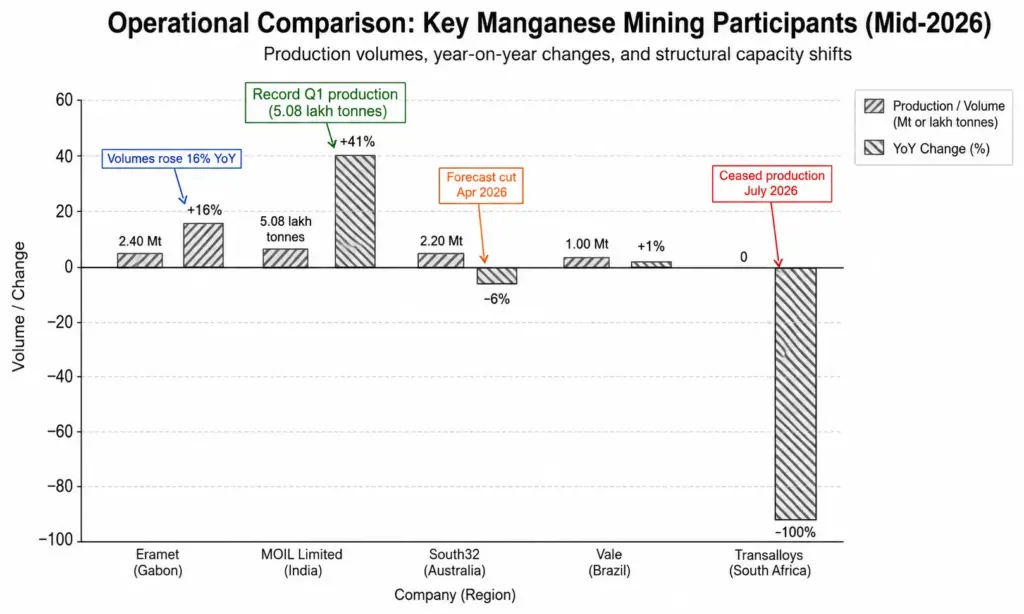
- Eramet’s Gabon operations achieved a 16% increase in ore transport in Q1 2026 to 1.6 Mt, but currency headwinds and rising input costs limited revenue growth to 2%.
- MOIL posted a record Q1 production of 5.08 lakh tonnes, signalling strong growth from India’s largest domestic manganese supplier.
- Transalloys’ closure of South Africa’s last manganese smelter in July 2026 eliminates domestic processing capacity, endangering 600 direct jobs and 7,000 downstream roles and threatening R6bn in investment, and shifts the value chain toward raw ore exports.
- South32 cut its full-year Australia manganese guidance by 6% to 3 Mt after cyclone disruption, while South African output grew modestly.
- Rising power costs in South Africa create a structural disadvantage for smelting, potentially concentrating downstream processing in lower-cost regions.
Production Growth and Regional Divergence
Eramet’s operations in Gabon represent a clear growth vector. In Q1 2026, the company transported 1.6 million tonnes of manganese ore, a 16% increase over Q1 2025, driven by successful rail debottlenecking. External ore sales rose 10% to 1.4 Mt, and ore turnover increased 8% to €271 million, demonstrating healthy volume-driven demand. However, the headline growth masks margin compression from currency and freight costs, which is examined in the following section.
Simultaneously, MOIL Limited, India’s largest domestic manganese ore supplier, posted a record-breaking operational performance. For the first quarter of fiscal year 2026-27 (April-June 2026), MOIL achieved production of 5.08 lakh tonnes, a massive operational milestone. The company scaled its output month-over-month from 3.56 lakh tonnes to 3.68 lakh tonnes across the quarter, reflecting steady capacity augmentation across its underground and opencast mining properties.
In contrast, South32’s operations present a mixed picture. Its Australian manganese unit faced significant weather disruptions from Tropical Cyclone Narelle, producing 589,000 wmt in Q3 2026. This forced a downward revision of full-year FY2026 guidance by over 6% to 3 million wmt. South32’s South African operations fared better, producing 500,000 wmt, up from 476,000 wmt in the prior year, resulting in combined group output of 1.09 million wmt for the quarter.
| Participant | Relationship | Competitive Dimension | Product / Segment | Geography | Volume | Measured Basis |
|---|---|---|---|---|---|---|
| Eramet | Competitor | Scale & Growth | Transported Ore | Gabon | 1.6 Mt | Q1 2026, +16% YoY |
| MOIL Limited | Competitor | Scale & Growth | Ore Production | India | 5.08 lakh tonnes | Q1 FY2026-27, record high |
| South32 | Competitor | Supply Disruption | Ore Production | Australia | 589,000 wmt | Q3 2026, cyclone impact |
| South32 | Competitor | Modest Growth | Ore Production | South Africa | 500,000 wmt | Q3 2026, +5% YoY |
| Transalloys | Capacity Exit | Cost & Closure | Smelting | South Africa | Ceased production | July 2026 |
Cost Pressures and Capacity Closures Restructure Supply
Production volume trends alone do not define the competitive landscape; cost structures and external shocks are actively reshaping the playing field and determining which participants can compete effectively.
Despite strong volume growth, Eramet’s margins are under pressure. Its FOB cash cost in Gabon rose to $2.5 per dmtu, up from $2.4 in Q1 2025. More significantly, an unfavourable US dollar currency effect created an 11% headwind on revenues, and rising sea freight costs added an 8% drag on the average selling price. While total manganese activity turnover held steady at €464 million, a 2% increase, the alloy segment declined 7%, penalised by mix and currency effects. This indicates that the benefits of operational scale are being partially eroded by macro input inflation.
The most severe competitive shock originates from South Africa, where escalating electricity costs have structurally undermined the viability of domestic processing. Transalloys, the country’s last manganese smelter, ceased production in July 2026. The company stated it was left with no choice after years of mounting financial losses, frustrated by the slow pace of electricity tariff relief from Eskom compared to its ferrochrome peers. This suspension places approximately 600 direct jobs and 7,000 downstream roles at risk and threatens R6 billion in investment. Unless a permanent solution is secured by the end of July 2026, Transalloys faces permanent closure. This event fundamentally shifts the South African value chain from domestic smelting toward raw ore exports, eliminating a key downstream customer for domestic miners and concentrating smelting capacity in lower-cost regions.
South32’s Australian operations add a supply-side risk dimension. The impact of Tropical Cyclone Narelle demonstrates the vulnerability of concentrated production in cyclone-prone regions. While the company’s South African operations showed modest growth, the overall group outlook is constrained by this weather exposure.
These dynamics create distinct competitive advantages. Producers with access to low-cost ore, captive power, or favourable currency regimes are better positioned to capture market share, while those reliant on expensive grid power or exposed to severe weather face structural handicaps.
Value Chain
Value Chain: Global manganese mining market
The manganese mining value chain centres on the extraction, beneficiation, and transport of manganese ore from mine to downstream consumers—primarily ferroalloy smelters and, ultimately, steelmakers and battery-material producers. The chain’s near‑term dynamics are shaped by supply concentration in Gabon and South Africa, where operational and logistical pressures affect ore availability, while demand growth is shifting toward alloy producers in India and other non‑China markets.
Key takeaways
- Gabon ore production fell 11 % year‑on‑year in Q1 2026, but transported volumes rose 16 % due to logistics improvements, keeping delivered supply relatively stable.
- South Africa’s manganese ore output declined 5.8 % in the three‑month period ended May 2026, contributing −0.5 percentage points to the broader mining slump.
- Eramet’s full‑year 2026 transport target (6.4–6.8 Mt) implies a modest annual increase; delivery hinges on Moanda mine recovery and continued logistics performance.
- Demand growth for manganese ore in 2026 is expected from alloy producers in India and other non‑China markets, partially offsetting weakness elsewhere.
- The divergence between mine output and delivered volumes in Gabon highlights the importance of logistics and inventory management in ore supply security.
Supply Concentration and Regional Production Trends
Global manganese ore supply is heavily concentrated in a few jurisdictions. The two largest producing regions—Gabon (through Eramet’s Comilog subsidiary) and South Africa—show distinct production trajectories in early‑2026 data, revealing different pressures on each.
Gabon: mine output declines, logistics offset
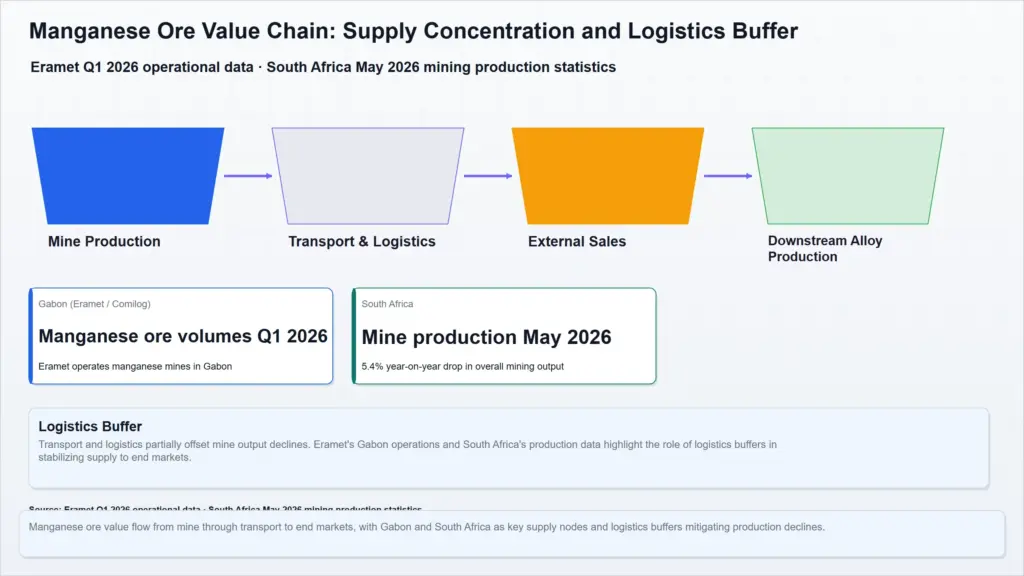
In the first quarter of 2026, Eramet’s Moanda mine in Gabon produced 1.59 million tonnes of manganese ore, an 11 % decrease compared with the same period in 2025. Despite this decline, transported ore volumes reached 1.61 million tonnes, up 16 % year‑on‑year, driven by improvements in rail transport and progress on railway renovation. External ore sales rose 10 % to 1.36 million tonnes, indicating that market deliveries remained resilient even as mine output softened.
Eramet confirmed its full‑year 2026 transport target of 6.4–6.8 million tonnes, with an FOB cash cost of $2.4–$2.6 per dry metric tonne unit. The company’s ability to move more ore than it produced in Q1 suggests that inventory drawdown and logistics efficiency are buffering near‑term supply to customers.
South Africa: output contraction persists
Statistics South Africa reported that the country’s total mining production fell 5.4 % year‑on‑year in May 2026. In the three‑month period ended May 2026, seasonally adjusted manganese ore production declined 5.8 %, contributing −0.5 percentage points to the quarterly mining output contraction. This makes manganese ore one of the largest drags on South Africa’s mining sector, alongside other metallic minerals and coal.
The May 2026 data shows a continued downward trend; on a month‑on‑month basis, overall mining output fell 5.2 % from April to May, following a 3.1 % rise in April. The quarterly decline in manganese ore underscores supply risk from a producer that, alongside Gabon, accounts for a significant share of global seaborne ore.
| Stage | Participant | Activity | Geography | Status (latest period) |
|---|---|---|---|---|
| Mine production | Eramet / Comilog | Moanda mine output | Gabon | 1.59 Mt in Q1 2026, −11 % YoY |
| Mine production | South Africa (aggregate) | Manganese ore output | South Africa | −5.8 % quarterly (3 months to May 2026) |
| Transport / logistics | Eramet / Comilog | Transported ore volumes | Gabon | 1.61 Mt in Q1 2026, +16 % YoY |
| External sales | Eramet / Comilog | Ore sold to third parties | Gabon | 1.36 Mt in Q1 2026, +10 % YoY |
Logistics, Downstream Demand, and Market Implications
The supply‑side data from Gabon and South Africa connect to downstream demand and price/cost dynamics through the role of logistics and the shift in ore consumption toward non‑China markets.
Transportation as a buffer
In Gabon, the divergence between mine output (−11 %) and transported volumes (+16 %) indicates that logistics improvements and inventory management can temporarily insulate customers from production dips. Eramet’s rail renovation programme and operational execution allowed the company to deliver more ore than it mined in Q1 2026, keeping external sales growth at 10 %. However, the sustainability of this buffer depends on continued logistics performance and eventual recovery of Moanda mine output to meet the 6.4–6.8 Mt annual transport target.
Demand outlook: India and non‑China markets
Eramet’s assessment for 2026 is that manganese ore demand will increase slightly, driven by higher alloy production in India and other non‑China markets. The company’s exposure to this downstream demand is vertically integrated: it operates six manganese alloy production sites across Norway, the United States, France, and Gabon, giving it a direct link to ferroalloy consumption outside China. The stated demand growth from Indian alloy producers and other non‑China markets partially offsets any weakness in Chinese steel production, though the available data provide no quantitative forecasts for those end‑use segments.
Cost floor and supply‑chain resilience
Eramet’s FOB cash cost guidance of $2.4–$2.6/dmtu for Gabon ore establishes a production‑cost floor for that jurisdiction. For South Africa, the quarterly manganese ore decline of −5.8 % and its −0.5 p.p. contribution to the mining sector contraction highlight the ore’s significance as a drag on South Africa’s production base.
The combination of lower Gabon mine output (partly offset by logistics) and persistent South African decline suggests that global ore supply in early‑2026 is under pressure from the two largest seaborne sources. Near‑term security depends on the ability of Gabon’s logistics buffer to hold and on a stabilisation of South African output, while demand growth from India and other non‑China markets may tighten the market if production fails to catch up.
Why manganese is a battery ore now
Manganese has been a steel alloying metal for a century; the reason its demand forecast is now partly a battery forecast is LMFP — lithium manganese iron phosphate — which puts manganese into the same cathode family that consumes most of the world’s purified phosphoric acid. Adding manganese to the olivine structure raises the operating voltage without moving to cobalt or nickel, so it is the cheapest route to a higher-energy LFP cell rather than a substitute for it.
The consequence for this market is that a share of manganese demand is now set by cathode chemistry rather than by steel output, which is why the reading that matters is in LFP cathode active material and, behind it, global EV battery. The upstream input cost — ore, sinter and ferromanganese — still behaves like a steel market.
Investment Activity
Key takeaways
- Battery-grade manganese projects face significant capital cost escalation (88% at K.Hill) and extended timelines, but still offer post-tax IRRs near 20%.
- Exxaro’s R10.6 billion acquisition consolidates South African manganese assets and targets logistics cost reduction of about 37% per tonne by shifting from road to rail.
- South African miners are pooling resources to bid for a new 16‑million‑tonne export terminal at Ngqura, aiming to alleviate bottlenecks that account for 43% of FOB costs.
- Government policy support via mineral auctions (India) and rising exploration expenditure (Australia, +6.3% quarterly) indicate growing confidence in future manganese demand, though new supply will take years to materialize.
- Project development milestones for K.Hill (construction early 2027, production 2029) align with expected EV battery demand growth but remain contingent on securing full financing for the US$535 million initial capex.
Battery‑grade manganese project financing
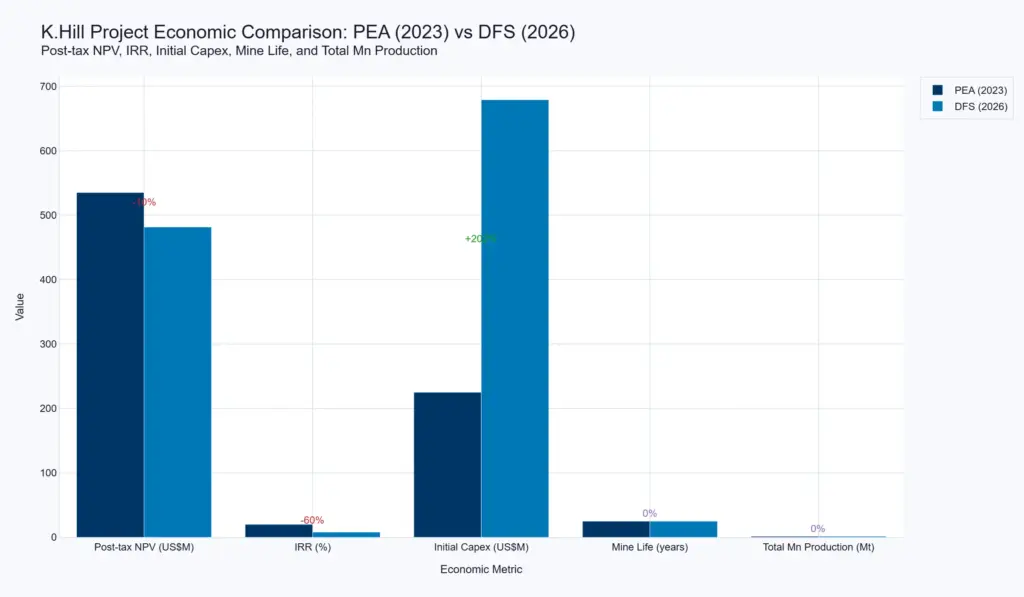
The definitive feasibility study (DFS) for Giyani Metals’ 100‑owned K.Hill battery‑grade manganese project in Botswana, announced in May 2026 and filed as a NI 43‑101 technical report on 10 July 2026, provides the most detailed public investment case for a greenfield battery‑grade manganese operation. The DFS, prepared in constant January 2026 US dollars and discounted at 8% to a planned start date of 1 April 2027, reports a post‑tax net present value of US$481.5 million (US$482 million in the technical report) and a post‑tax internal rate of return of 20.3%. Net free cash flow over the 25‑year life of mine is estimated at US$1.6 billion, with an operating margin of 46% and manganese recovery of 87%.
The economics have shifted materially from the 2023 preliminary economic assessment (PEA). Initial capital expenditure rose 88% to US$535 million, the internal rate of return fell by 9 percentage points to 20.3%, total manganese production declined 57% to 1.5 million tonnes, and the mine life was cut by more than half to 25 years. The higher capital requirement—and the accompanying increase in development risk—is reflected in the financing structure being assembled.
| Metric | 2026 DFS value | Change vs 2023 PEA |
|---|---|---|
| Post‑tax NPV (8% discount) | US$481.5 million | Not calculated in 2023 PEA |
| Post‑tax IRR | 20.3% | ‑9 percentage points (from ~29%) |
| Initial capital expenditure | US$535 million | +88% |
| Mine life | 25 years | Cut by more than half |
| Total manganese production | 1.5 million t | ‑57% |
Financing sources and remaining gap
Giyani has secured or advanced several financing instruments. South Africa’s Industrial Development Corporation (IDC) provided US$16 million in debt finance. African Rainbow Minerals, through its ARCH Emerging Markets Partners, acquired a 19.99% equity stake and a royalty agreement. A letter of intent for potential financing of US$225 million was issued by the Export‑Import Bank of the United States. The total initial capex of US$535 million therefore still requires additional funding; the company is courting global strategic partners and has not disclosed the amount or timing of remaining capital commitments. The IDC debt, ARM equity‑plus‑royalty, and Exim Bank LOI represent a blend of concessional debt, corporate equity, and export credit agency support.
Development timeline
The DFS outlines a staged path: construction could begin in early 2027, commissioning in late 2028, and process plant ramp‑up in 2029. The technical report (NI 43‑101) was filed on 10 July 2026, confirming the DFS results. No front‑end engineering and design (FEED) contracts or construction financing have been announced. The project is positioned to supply high‑purity manganese sulphate monohydrate and high‑purity manganese oxide to the global battery materials market, but the 88% capital cost increase and extended timeline raise the bar for final investment decision.
Corporate consolidation and logistics infrastructure
South Africa’s manganese landscape has been reshaped by Exxaro Resources’ acquisition of select manganese assets from Ntsimbintle Holdings and OMH, concluded on 27 February 2026 for R10.6 billion in cash funded from available reserves. Through wholly‑owned subsidiaries, Exxaro now holds 100% of Ntsimbintle Mining (which owns 50.1% of the Tshipi Borwa Mine, with the remaining 49.9% held by Jupiter), 19.99% of Jupiter, 100% of Ntsimbintle Marketing, and 9% of Hotazel Manganese Mines. The deal makes Exxaro the fourth‑largest manganese producer in South Africa and gives it control over a world‑class resource base of about 163 million tonnes at Tshipi Borwa.
Logistics cost reduction
Integration of these assets is explicitly tied to logistics optimization. At Exxaro’s Capital Markets Day on 22 June 2026, management announced plans to shift more than 1.5 million tonnes of manganese freight from road to rail. Currently, 46% of Tshipi Borwa’s annual volumes (3.5 million tonnes) move by road through the ports of Gqeberha and Saldanha. Road transport costs are about 37% higher than rail costs, and logistics account for 43% of free‑on‑board (FOB) export costs. Exxaro is engaging with Transnet Freight Rail for additional capacity; full rail conversion would meaningfully improve FOB margins, though no capital expenditure figure for the modal shift has been disclosed.
New export terminal bid
In March 2026, the Manganese Producers Consortium (MPC)—whose members include African Rainbow Minerals and Assmang—announced it would bid for the design, build, construction, and operation of the Ngqura Manganese Ore Export Terminal. Transnet is expected to issue a request for quotation around April 2026 for the terminal, which would add 16 million tonnes of manganese export capacity. The MPC intends to partner with Transnet as a joint‑venture partner. The bid reflects a coordinated industry effort to relieve port and rail bottlenecks that currently constrain South African manganese export competitiveness. No bid value or timeline for terminal commissioning has been disclosed.
Policy‑led exploration and capacity expansion
Government‑backed mineral auctions and rising exploration expenditure signal growing industry confidence in future manganese demand, though the supply response will be gradual.
India’s critical mineral auctions
In July 2026, the Indian Ministry of Mines launched the eighth tranche of e‑auctions for critical and strategic mineral blocks. Twenty blocks across nine states were offered—13 newly identified and 7 re‑bid. This brings the total number of critical mineral blocks offered since the programme began to 88, of which 56 have been successfully auctioned. The statement does not specify how many of the 20 blocks are manganese, but manganese is listed among the minerals targeted for clean energy technologies, electric mobility, and advanced manufacturing. The auctions are part of India’s strategy to secure domestic supply of raw materials for battery and steel value chains.
Australian exploration expenditure
Mineral exploration expenditure in Australia rose 6.3% on a seasonally adjusted basis in the March 2026 quarter to A$1,093.7 million, and was up 16.1% year‑on‑year. The trend estimate (which smooths volatility) increased 3.8% quarter‑on‑quarter to A$1,079.3 million. However, the Australian Bureau of Statistics data is aggregate and does not provide a manganese‑specific breakdown. The largest movements were in gold (−5.8%) and iron ore (+5.0%). The overall increase in exploration spending suggests a positive environment for future manganese discoveries, but the direct link to manganese investment cannot be isolated from the aggregate figures.
Together, the Indian auctions and Australian exploration data point to policy and market support for new supply, but both are early‑stage: auctioned blocks require years of permitting and development, and exploration expenditure is a lead indicator rather than a commitment to mine construction.
Technology & Innovation
Technology & Innovation : Global Manganese Mining Market
Emerging technologies for low-grade and sustainable manganese processing
Declining ore grades in established mining regions are spurring research into beneficiation and extraction methods that can economically upgrade lower-quality resources and reduce environmental footprint.
Physical beneficiation of siliceous ores
Researchers at the University of Peshawar, Pakistan, published a 2026 study combining petrography, geochemistry and X‑ray diffraction to design an integrated beneficiation flowsheet for low-grade manganese ores from the Mohmand district. The ores, containing braunite and pyrolusite as the main manganese minerals with quartz as the dominant gangue, were subjected to gravity and magnetic separation. At coarser grain sizes, the manganese content was elevated from 24 wt % to 43.6 wt %, and the Mn:Fe ratio was substantially improved. The study concluded that such physical methods are effective for upgrading siliceous ores.
Microwave-roasting for iron–manganese separation
A separate 2026 paper published in Minerals Engineering (Qin et al.) introduced a microwave-roasting and pulverized-coal synergistic recovery technology for iron‑manganese ore. The method uses mineral phase transformation theory to selectively separate iron and manganese minerals. While the published source does not disclose specific recovery percentages, the approach aims to improve the efficiency of iron‑manganese separation compared to conventional roasting.
Biomass‑reductant hydrometallurgical leaching
Ma et al. (2026) described a hydrometallurgical process that uses bamboo powder as a biomass reductant in sulfuric acid to leach manganese from pyrolusite. Under optimised conditions—90 °C, 5 h leaching time, 3.5 mol/L H₂SO₄, a 2:1 ore‑to‑biomass ratio, and a 5:1 liquid‑to‑solid ratio—the manganese reduction efficiency reached 97.80 %. The authors present this as a circular‑economy solution for low‑carbon manganese extraction.
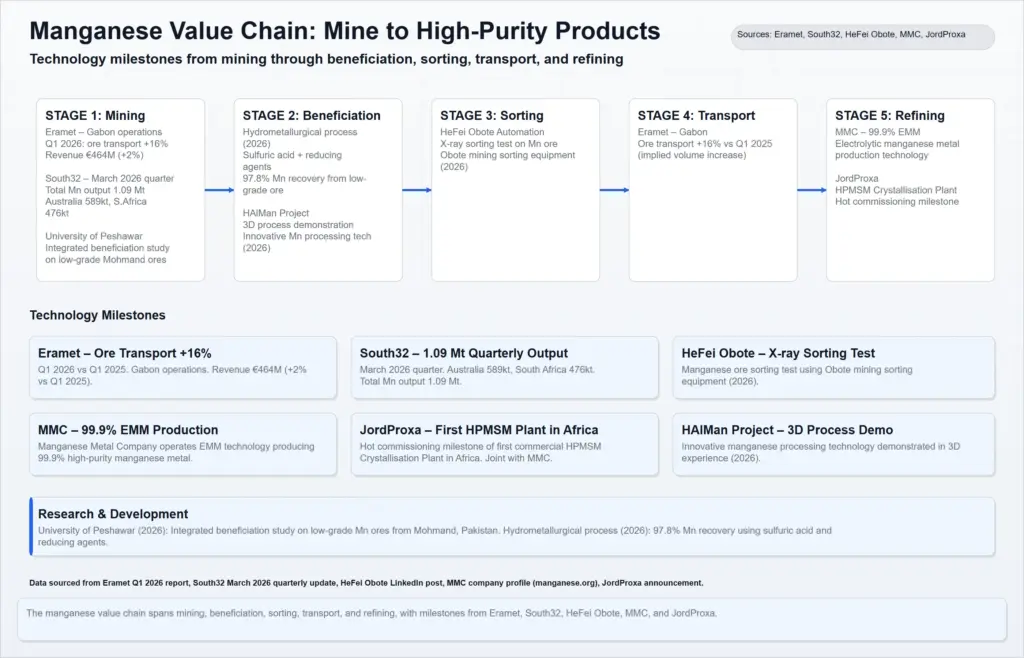
Hydrogen‑aluminium reduction (HAlMan) process
The HAlMan project consortium has released a 3D interactive model of its hydrogen‑aluminothermic reduction process for manganese production. By replacing carbon with hydrogen and integrating secondary aluminium sources, the process aims to significantly reduce CO₂ emissions and energy consumption while supporting circular resource use. The consortium copyright spans 2024‑2026, indicating the process is at a late demonstration or early design stage; no production‑scale data have been published.
| Technology | Participants | Supplied metric | Period | Application | Evidence‑based implication |
|---|---|---|---|---|---|
| Integrated gravity + magnetic separation | Researchers at University of Peshawar | Mn grade from 24 wt % to 43.6 wt % | 2026 | Low‑grade siliceous ore upgrading | Physical beneficiation can substantially upgrade ore, potentially extending mine life. |
| Microwave‑roasting + pulverized‑coal separation | Qin et al. | No recovery data in supplied source | 2026 | Iron‑manganese ore separation | Novel roasting route may reduce energy consumption compared to conventional methods. |
| Bamboo‑powder reductive leaching | Ma et al. | 97.80 % Mn reduction efficiency | 2026 | Pyrolusite processing | Biomass‑based leaching offers a low‑carbon alternative to traditional reductants. |
| HAlMan H₂‑Al reduction | HAlMan consortium | Claims significant CO₂ reduction (no quantitative data) | 2024‑2026 (demonstration) | Manganese metal and alloy production | If scaled, could replace carbon‑intensive smelting routes. |
Technology adoption in current manganese operations
Major producers and equipment suppliers are deploying incremental innovations to improve throughput, lower costs, and deliver higher‑purity products for the battery sector.
Transport and throughput improvements at Eramet
Eramet’s Q1 2026 report showed that rail transport of manganese ore in Gabon rose 16 % year‑on‑year to 1.6 Mt, driven by ongoing investments to debottleneck capacity. External ore sales increased 10 % to 1.4 Mt, while the FOB cash cost (ex‑export duties) held at $2.5/dmtu, up 5 % from Q1 2025. The company confirmed full‑year guidance of 6.4‑6.8 Mt of transported ore.
South32 output and weather disruptions
South32’s March 2026 quarter produced 589,000 wet metric tonnes (wmt) from Australia (versus zero in the prior‑year period when the concentrator was paused) and combined with South African operations for total output of 1.09 Mt wmt. However, wet‑season rainfall and Tropical Cyclone Narelle forced a temporary halt and evacuation, prompting a 6 % reduction in full‑year Australia guidance to 3 Mt wmt.
X‑ray ore sorting for pre‑concentration
HeFei Obote Automation Equipment Co. completed a series of manganese ore sorting tests using its proprietary X‑ray sorting technology. The equipment is designed to pre‑reject waste rock in the initial processing stage, thereby reducing the load on downstream beneficiation and upgrading ore grade. While specific grade improvements were not disclosed, the tests demonstrate a pathway to lower processing costs.
High‑purity EMM and HPMSM production
Manganese Metal Company (MMC) in South Africa operates the world’s largest selenium‑free electrolytic manganese metal plant, producing 99.9 % pure EMM. Over 90 % of output is exported to more than 20 countries, with growing supply to the lithium‑ion battery industry. In a major milestone for non‑Chinese supply chains, JordProxa and MMC achieved hot commissioning of the first commercial high‑purity manganese sulphate monohydrate (HPMSM) crystallisation plant in Africa. This plant addresses the stringent purity requirements for battery‑grade manganese sulphate, marking a significant step in diversifying the EV battery materials supply chain.
| Participant | Technology type | Supplied metric | Period | Application | Evidence‑based implication |
|---|---|---|---|---|---|
| Eramet (Gabon) | Rail transport optimisation, beneficiation | 1.6 Mt transported (+16 % YoY); FOB cash cost $2.5/dmtu | Q1 2026 | Bulk manganese ore supply | Infrastructure investments support volume growth and cost containment. |
| South32 (Australia & South Africa) | Concentrator operations, mine planning | Combined output 1.09 Mt wmt; guidance cut 6 % to 3 Mt wmt | March 2026 quarter | Manganese ore production | Weather disruptions remain a significant risk to production reliability. |
| HeFei Obote | X‑ray ore sorting | Tests completed; no grade data disclosed | 2026 | Pre‑concentration of run‑of‑mine ore | Potential to reduce downstream processing costs by rejecting waste rock early. |
| Manganese Metal Company (MMC) | Closed‑loop hydrometallurgical EMM production | 99.9 % purity; >90 % exported | Ongoing commercial | Li‑ion battery and specialty alloy supply | One of only two non‑Chinese EMM producers; key supplier of high‑purity Mn. |
| JordProxa / MMC | HPMSM crystallisation | First hot commissioning in Africa achieved | 2026 | Battery‑grade manganese sulphate production | Diversifies HPMSM supply away from China; addresses purity requirements. |
Market Risk
Risk : Global manganese mining market
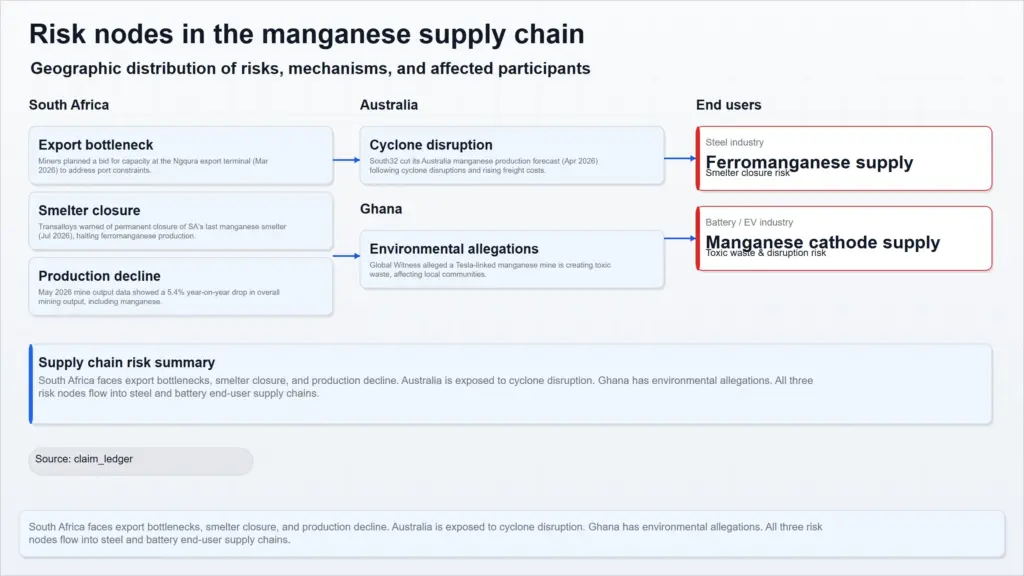
- South African export logistics are a critical bottleneck; miners are pursuing a dedicated terminal at Ngqura to add 16 million metric tons of capacity, but timing remains uncertain.
- South32’s Australian production cut (over 6%) highlights vulnerability of high-grade manganese supply to tropical weather, tightening near-term availability.
- Environmental allegations at a Ghana mine could trigger regulatory scrutiny or supply chain audits by EV manufacturers, posing reputational risk for battery-linked producers.
- Permanent closure of Transalloys smelter would eliminate South Africa’s domestic ferromanganese capacity, shifting value addition and jobs offshore.
- Despite an 8.7% rise in South African manganese ore output in May 2026, broader mining contraction (-5.4% overall) signals systemic constraints that may undermine future production consistency.
- Map of manganese supply chain risk nodes: South Africa (export bottleneck, smelter closure), Australia (cyclone disruption), Ghana (environmental allegations), with arrows indicating flow to steel and battery end-users. Supplied claims on Ngqura terminal bid, South32 cyclone impact, Transalloys closure, Ghana toxic waste allegations, and South Africa production data. Geographic distribution of risks, mechanisms, and affected participants
Export Infrastructure and Logistics Risk
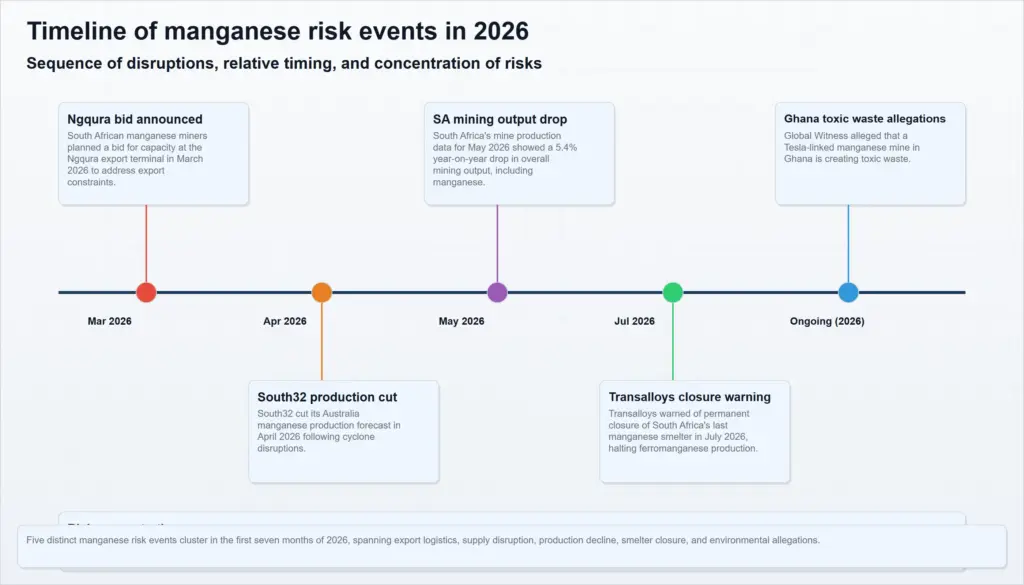
South Africa’s ability to export manganese ore is structurally constrained by capacity at the Ngqura export terminal in the Eastern Cape. In March 2026, a consortium of South African manganese miners—the Manganese Producers Consortium (MPC), which includes Assmang, a subsidiary of African Rainbow Minerals (ARM)—announced its intention to bid for the design, build, construction, and operation of a dedicated Ngqura Manganese Ore Export Terminal. State-owned logistics operator Transnet is expected to invite formal bids around April 2026 as part of broader reforms to open rail and port infrastructure to private investment.
According to ARM, the planned terminal would add approximately 16 million metric tons of annual manganese export capacity, directly addressing transport constraints that have slowed mineral shipments. The bid represents a joint venture between the MPC and Transnet. The timing of capacity addition remains uncertain, as the process is in the bidding stage, but the proposal signals the mining industry’s recognition of a bottleneck that threatens South Africa’s position as a top global manganese producer. Any delay in terminal construction or operation would continue to limit export volumes and could affect supply commitments to steel and battery end-users.
Operational and Production Risks
Multiple disruptions at key production nodes have reduced the reliability of global manganese supply in 2026. In Australia, South32’s manganese operations faced a production cut as the diversified miner revised its fiscal 2026 guidance for the Australia manganese unit to 3 million wet metric tons (wmt) in April 2026, down over 6% from the previously announced guidance. The reduction followed cyclone disruptions from wet-season rainfall and Tropical Cyclone Narelle, which forced a temporary halt at the Gemco mine in the Northern Territory and evacuation of non-essential personnel. For the March quarter, Australia Manganese produced 589,000 wmt, compared to no output in the same period a year earlier when the primary concentrator was paused. The cyclone disruption directly affected high-grade manganese ore supply, tightening near-term availability for steel and battery markets.
In South Africa, the risk of permanent domestic ferromanganese capacity loss materialised in July 2026 when Transalloys, the country’s last manganese smelter, fully stopped ferroalloys production at its Mpumalanga plant. The company warned that unless a sustainable electricity tariff solution is agreed with Eskom, the National Energy Regulator of South Africa, and the Department of Electricity and Energy by July 31, the smelter will close permanently. Section 189 consultations and a collective retrenchment agreement have already been concluded. The shutdown places about 600 permanent jobs and an estimated 7,000 downstream livelihoods at risk. If permanent, the closure would shift value addition and employment offshore, leaving South Africa solely as an ore exporter.
Contrasting these negative signals, South Africa’s official mining production data for May 2026 showed that manganese ore output rose 8.7% year-on-year, while overall mining output fell 5.4%. The decline in overall production—the steepest since February 2025—was driven by iron ore (-12.7%), coal (-6.1%), platinum group metals (-4.4%), and other commodities. On a seasonally adjusted monthly basis, mining output dropped 5.2% in May. The divergence between rising manganese ore production and broad sector contraction suggests that manganese’s operational stress is concentrated in downstream smelting and in weather-exposed jurisdictions, while some mine-level output in South Africa remains resilient. However, systemic constraints such as logistics bottlenecks and energy costs may undermine future consistency.
| Entity or commodity | Indicator | Value |
|---|---|---|
| South32 Australia Manganese | Fiscal 2026 production guidance (revised) | 3 million wet metric tons (down over 6% from prior guidance) |
| South Africa – Manganese ore | May 2026 year-on-year output change | +8.7% |
| South Africa – All mining | May 2026 year-on-year output change | -5.4% |
| South Africa – Iron ore | May 2026 year-on-year output change | -12.7% |
| South Africa – Coal | May 2026 year-on-year output change | -6.1% |
| South Africa – PGMs | May 2026 year-on-year output change | -4.4% |
Environmental and Reputational Risk
An investigation by Global Witness alleged that a manganese mine in Ghana supplying material critical to EV battery technology is creating toxic waste that endangers local communities. The investigation involved meetings with more than 150 people living near the mine, who reported chronic health problems and poisoned water supplies. A study by Dr. Emmanuel Daanoba Sunkari, cited in the investigation, found that mine pit water was highly concentrated with toxic metals such as arsenic, which were seeping into surface water and groundwater. Ingesting the manganese wastewater could cause cancer, stillbirths, and DNA alteration in unborn children. In November 2025, dozens of community members interviewed testified to skin, eye, and breathing conditions.
The mine is alleged to be linked to Tesla as a supplier of material for electric vehicle batteries. If these allegations are substantiated, the mine could face regulatory action, community opposition, or supply chain audits by EV manufacturers. This risk adds reputational exposure for battery-grade manganese supply chains, particularly those marketed as responsible or sustainable. The outcome of any regulatory review or corporate due diligence process remains uncertain, but the allegations themselves create a source of reputational and operational risk that may affect off-take agreements and investor confidence.
| Risk | Mechanism | Exposed participant or geography | Timing | Supported consequence |
|---|---|---|---|---|
| Australian production cut | Cyclone forced temporary mine halt; wet-season impact | South32 (producer); high-grade manganese supply to steel and battery markets | April 2026 guidance cut; Q1 2026 disruption | Fiscal 2026 guidance reduced over 6% to 3 million wmt |
| Transalloys smelter closure | Unsustainable electricity tariffs lead to shutdown of last South African ferromanganese smelter | Transalloys, its 600 direct employees and 7,000 downstream workers; South African ferromanganese supply | Production halted July 1, 2026; permanent closure risk if no tariff solution by July 31 | Loss of domestic ferromanganese capacity; retrenchments; offshoring of value addition |
Regulatory Landscape
Regulatory Landscape: Global manganese mining market
Key takeaways
- NOAA’s streamlined deep seabed mining regulations, effective January 21, 2026, reduce the two-step permitting process for U.S. entities, potentially accelerating deep seabed manganese projects.
- The U.S. Forest Service’s draft approval for South32’s Hermosa mine (March 2026) paves the way for the only advanced manganese project in the United States, supporting critical mineral self‑sufficiency.
- India’s eighth tranche auction of 20 critical mineral blocks, including manganese, brings the total offered to 88 with 56 already auctioned, reflecting growing industry confidence in India’s mining reforms.
- Gabon’s firm insistence on the 2029 raw manganese export ban, despite energy concerns, forces operators to invest in domestic refining or risk losing access to the country’s 9.4 million ton export stream.
US Permitting Streamlining and Project Acceleration
The United States is actively reducing regulatory barriers for both deep seabed and domestic manganese projects in 2026, improving the investment outlook for domestic supply.
NOAA deep seabed mining regulation update
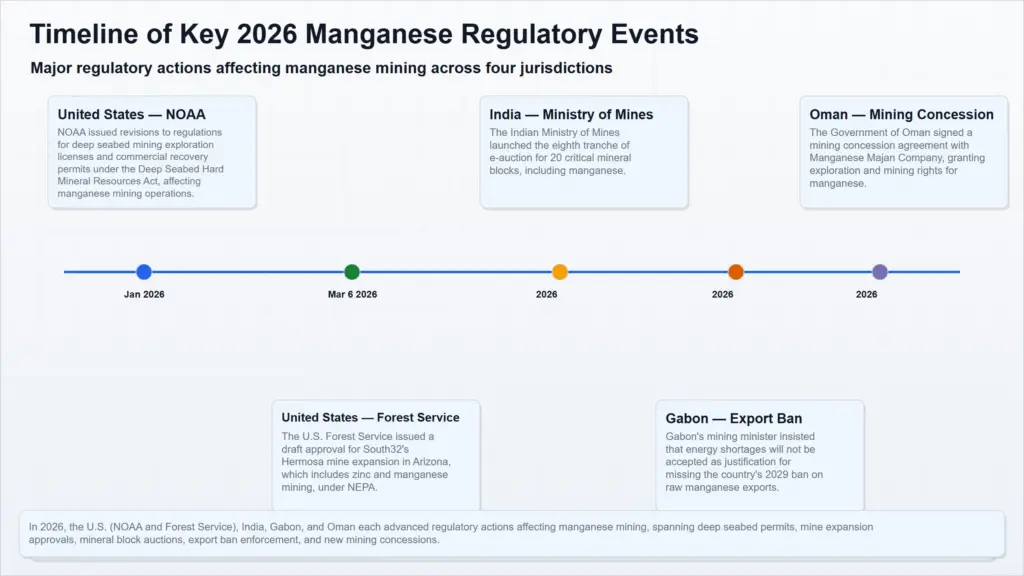
Under the Deep Seabed Hard Mineral Resources Act (DSHMRA), NOAA introduced a final rule effective January 21, 2026, updating the regulations for exploration licenses and commercial recovery permits (91 FR 13). The rule replaces the previous two-step sequential process with a single application pathway and updates regulations that had not been meaningfully revised since the 1980s. The changes apply to U.S. citizens seeking to explore or commercially recover hard minerals, including manganese, from the deep seabed in areas beyond national jurisdiction. The streamlined process is expected to reduce administrative lead time for deep seabed manganese projects, although no new licenses or permits have been announced under the revised framework.
South32 Hermosa mine expansion draft approval
On March 6, 2026, the U.S. Forest Service released a draft Record of Decision and final Environmental Impact Statement for South32’s Hermosa mine expansion in Arizona. The draft approval would allow the project to expand from private land onto federal land in the Coronado National Forest, including infrastructure such as a primary access road and a dry-stack tailings facility. Hermosa is the only advanced mine development project in the United States capable of producing manganese and zinc, both of which are federally designated critical minerals. The project is part of the FAST-41 federal permitting program, which is intended to accelerate environmental reviews.
A final decision on the Hermosa expansion has not yet been issued, but the draft approval points to strong regulatory momentum toward developing domestic manganese production in the United States. Together, the NOAA rule change and the Hermosa permitting process indicate a broader effort to simplify or accelerate pathways for projects involving strategically important minerals such as manganese.
International Supply Diversification: India’s Auction System and Oman’s Concession
India’s competitive auction mechanism and Oman’s bilateral concession are expanding the geographic footprint of manganese exploration and production, with different implications for investor access and project lead times.
India’s eighth tranche of critical mineral auctions
India’s Ministry of Mines launched the eighth tranche of e‑auction for 20 critical and strategic mineral blocks across nine states on July 15, 2026. Of these, 13 are newly identified and 7 are offered for rebidding. The blocks include manganese along with molybdenum, graphite, vanadium, rare earth elements, lithium, and others. The auction brings the total number of critical mineral blocks offered to 88, of which 56 have already been successfully auctioned, reflecting growing industry confidence in India’s mining reforms. The minerals are targeted for clean energy technologies, electric mobility, advanced manufacturing, defense, and aerospace. Successful bidders gain exploration and mining rights, though specific manganese‑block sizes and resource estimates were not disclosed.
Oman’s mining concession with Manganese Majan
On April 25, 2026, the Government of Oman signed a mining concession agreement with Manganese Majan Company for Concession Area No 25B in North Sharqiyah Governorate. The concession covers approximately 747 square kilometers and has a 25‑year term. Manganese Majan is a joint venture between Al Ferdous Mining Company (Omani) and Farco Iranian Company, both with expertise in manganese exploration, mining, and processing. The rights include exploration, mining, and construction of processing plants and mineral beneficiation equipment. The site was awarded through a competitive tender via the Ministry’s Taqa platform. The concession is part of Oman Vision 2040’s objective to diversify mineral‑sector activity.
Comparison of supply‑access models
India’s auction system provides transparent, competitive access with a proven track record (56 blocks auctioned), but investors face lead times from auction to production that can extend several years. Oman’s bilateral concession offers longer‑term certainty (25 years) and includes explicit processing infrastructure requirements, but is limited to a single block and joint‑venture structure. Both models impose local content or processing obligations—India through strategic mineral end‑use requirements and Oman through mandatory processing plant development.
| Jurisdiction | Instrument | Requirement | Effective date | Affected participants |
|---|---|---|---|---|
| United States (federal) | NOAA final rule under DSHMRA | Consolidated exploration license and commercial recovery permit application process for deep seabed mining | January 21, 2026 | U.S. entities seeking deep seabed manganese or other hard mineral rights |
| United States (Arizona) | U.S. Forest Service draft Record of Decision for South32 Hermosa | Draft approval for mine expansion onto federal land; infrastructure for manganese and zinc production | March 6, 2026 (draft); final pending | South32 and its contractors; Coronado National Forest users |
| India | Eighth tranche e‑auction of critical mineral blocks | 20 blocks offered (including manganese) for exploration and mining; 13 new, 7 rebid | July 15, 2026 (launch) | Indian and foreign mining companies; Ministry of Mines |
| Oman | Mining concession agreement for Area 25B | Exploration and mining rights; 25‑year term; processing plant development required | April 25, 2026 (signed) | Manganese Majan Company (Al Ferdous Mining / Farco Iranian) |
| Gabon | Export ban on raw manganese ore | Ban on raw ore exports from 2029; mandatory domestic refining; | 2029 (announced; implementation timelines required from all miners) | All manganese operators in Gabon, including Eramet |
Downstream Processing Mandates and Compliance Pressure: The Gabon Export Ban
Timeline and scope of the ban
Gabon’s mining minister stated on February 11, 2026, that energy shortages would not be accepted as a reason for missing the 2029 deadline. The restriction applies to exports of raw manganese ore, and mining companies are required to submit detailed implementation timelines showing measurable progress toward domestic processing. Gabon exported 9.4 million metric tons of manganese in 2024, down 5.3% from the previous year, with the vast majority shipped in raw form. If the policy is implemented as stated, it could significantly change future supply flows by shifting a larger share of manganese toward domestic processing.
Government response to industry concerns
Operators, including France’s Eramet, have indicated a willingness to cooperate while also pointing to power limitations as a constraint on expanding refining capacity. The mining minister rejected energy availability as a sufficient reason for delaying the policy, stating that “energy is a false debate” and pointing to existing processes that can reduce energy use by 40 to 60% in manganese processing. Companies are expected to submit implementation timelines and demonstrate measurable progress. The government’s position therefore creates strong pressure for operators to invest in domestic refining capacity as the 2029 deadline approaches.
Implications for major operators
Eramet, the dominant operator in Gabon, faces significant compliance pressure because of its position in the country’s manganese industry. The 9.4 million metric ton export base indicates that substantial investment could be required if a large share of production is to be processed domestically. The 40–60% energy reduction potential cited by the minister suggests that lower-energy processing options may be available, although their commercial-scale deployment in Gabon’s energy-constrained environment remains uncertain. The 2029 deadline provides a clear timeframe for operators to increase domestic processing, consistent with the government’s broader objective of capturing more value from Gabon’s mineral resources.