
Global Single Cell Genomics and Proteomics Market Report, Size & Forecast 2026-2033
Global Single Cell Genomics and Proteomics Market Report, Size, Share and Forecast 2026???2033
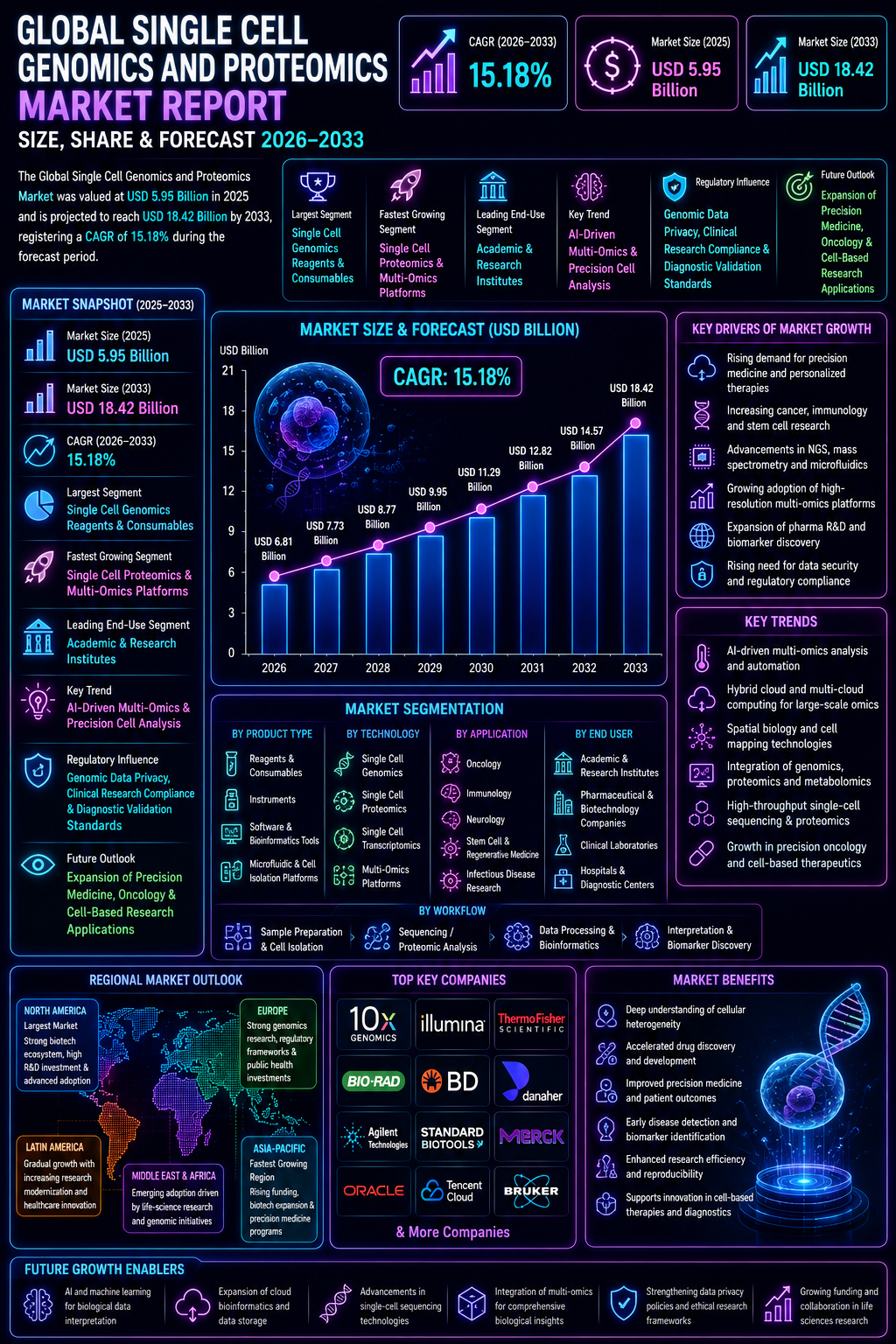
Market Forecast Snapshot (2025???2033)
| Metric | Value |
|---|---|
| Market Size (2025) | USD 5.95 Billion |
| Market Size (2033) | USD 18.42 Billion |
| CAGR (2026???2033) | 15.18% |
| Largest Segment | Single Cell Genomics Reagents & Consumables |
| Fastest Growing Segment | Single Cell Proteomics & Multi-Omics Platforms |
| Leading End-Use Segment | Academic & Research Institutes |
| Key Trend | AI-Driven Multi-Omics & Precision Cell Analysis |
| Regulatory Influence | Genomic Data Privacy, Clinical Research Compliance & Diagnostic Validation Standards |
| Future Outlook | Expansion of Precision Medicine, Oncology & Cell-Based Research Applications |
Market Size & Forecast
The Global Single Cell Genomics and Proteomics Market is expected to witness substantial growth during the forecast period from 2026 to 2033. The market was valued at USD 5.95 billion in 2025 and is projected to reach approximately USD 18.42 billion by 2033, registering a CAGR of 15.18%. The market growth is primarily driven by rising demand for precision medicine, increasing cancer and immunology research, rapid expansion of cell-based diagnostics, and growing adoption of high-resolution omics technologies. Single cell genomics and proteomics technologies are increasingly critical for understanding cellular heterogeneity, tumor micro-environments, immune response profiling, stem cell biology, and drug discovery. Growing adoption of next-generation sequencing (NGS), flow cytometry, mass spectrometry, microfluidics, and spatial omics platforms is accelerating market expansion. In addition, increasing research funding, pharmaceutical R&D expansion, and biomarker-based therapeutics development are supporting long-term industry growth.Global Single Cell Genomics and Proteomics Market Overview
Single cell genomics and proteomics involve the analysis of genetic, transcriptomic, and protein-level information at the individual cell level to understand biological complexity and cellular behavior. The market includes reagents & consumables, instruments, microfluidic systems, cell isolation tools, sequencing solutions, single-cell protein analysis platforms, bioinformatics software, and integrated multi-omics systems. These technologies are widely used in oncology, immunology, neurology, stem cell research, infectious disease studies, and personalized medicine. The market is shifting from bulk-sample biological analysis toward high-throughput single-cell sequencing, AI-based interpretation, spatial biology, proteogenomics, and integrated transcriptomic-proteomic workflows.Structural Drivers of Market Growth
1. Innovation and Commercialization Acceleration
Rapid innovation in single-cell sequencing, microfluidics, AI-based bioinformatics, spatial transcriptomics, and proteogenomics is accelerating commercialization. Advanced cell isolation, multiplexing, and high-throughput proteomic profiling are improving analytical precision.Market Implications
Companies investing in multi-omics platforms, automation, and AI-driven biological interpretation are expected to strengthen market leadership.2. Compliance and Risk Repricing
Genomic data security, clinical trial protocols, biobanking standards, research ethics, and diagnostic validation requirements are shaping the market. Organizations are increasingly focusing on patient data privacy, reproducibility, and quality-controlled molecular diagnostics.Market Implications
Firms offering compliant, validated, and secure genomic-proteomic workflows are likely to gain stronger market trust.3. Competitive and Value-Chain Reconfiguration
The market is highly competitive as sequencing companies, biotech firms, diagnostics developers, and AI-bioinformatics platforms expand offerings. Integrated software ecosystems, sequencing workflows, and precision-diagnostic platforms are altering value-chain economics.Market Implications
Companies focusing on end-to-end multi-omics solutions, software integration, and biomarker discovery may gain stronger margins.4. Capital and Capacity Scaling
Rising investment in genomics labs, sequencing infrastructure, proteomics platforms, and cloud bioinformatics is supporting market expansion. Public-private partnerships and precision medicine programs are also increasing globally.Market Implications
Manufacturers scaling high-throughput systems, automated workflows, and AI-driven research tools are expected to capture future opportunities.Market Segmentation Analysis
By Product Type
1. Reagents & Consumables
This remains the largest segment due to recurring use in sequencing and sample processing.2. Instruments
Critical for cell sorting, sequencing, and protein detection.3. Software & Bioinformatics Tools
Rapidly growing due to AI-assisted interpretation and data analytics.4. Microfluidic & Cell Isolation Platforms
Used in sample preparation and cellular separation.By Technology
1. Single Cell Genomics
Largest segment due to broad use in NGS and transcriptomics.2. Single Cell Proteomics
Fastest-growing due to protein-level precision analysis.3. Single Cell Transcriptomics
Widely used in disease pathway research.4. Multi-Omics Platforms
Growing due to integrated genomic-proteomic workflows.By Application
1. Oncology
Largest application segment due to tumor heterogeneity studies and biomarker discovery.2. Immunology
Strong growth in immune profiling and vaccine research.3. Neurology
Used in neurodegenerative disease analysis.4. Stem Cell & Regenerative Medicine
Increasingly important in cellular therapy research.5. Infectious Disease Research
Growing due to pathogen-host interaction analysis.By End User
1. Academic & Research Institutes
Largest segment due to large-scale biological research.2. Pharmaceutical & Biotechnology Companies
Growing rapidly due to drug discovery and precision medicine development.3. Clinical Laboratories
Used in translational diagnostics.4. Hospitals & Diagnostic Centers
Increasingly adopting precision-cell diagnostics.Regional Market Dynamics
North America
North America dominates the global single cell genomics and proteomics market due to advanced biotech ecosystems, high research funding, and strong precision medicine adoption.Europe
Europe remains a major market supported by genomics research, life sciences innovation, and public health investments.Asia-Pacific
Asia-Pacific is the fastest-growing region due to expanding biotech infrastructure, precision medicine programs, and rising genomics investments.Latin America
Latin America is gradually expanding due to research modernization and healthcare innovation.Middle East & Africa
The region is witnessing emerging adoption driven by life-science research and genomic healthcare initiatives.Competitive Landscape
The Global Single Cell Genomics and Proteomics Market is highly competitive with sequencing firms, proteomics companies, diagnostics providers, and bioinformatics platforms expanding globally. Key companies operating in the market include:- 10x Genomics
- Illumina
- Thermo Fisher Scientific
- Bio-Rad Laboratories
- Becton Dickinson (BD)
- Danaher Corporation
- Agilent Technologies
- Standard BioTools
- Bruker Corporation
- Merck KGaA
Strategic Outlook
The future of the single cell genomics and proteomics market will be shaped by AI-powered omics interpretation, spatial biology, proteogenomics, cloud bioinformatics, and integrated multi-omics systems. High-throughput sequencing, personalized oncology, immune profiling, and cell-based therapeutic research are expected to significantly improve precision healthcare and translational medicine. The expansion of biomarker discovery, rare-cell analysis, and precision therapeutics is expected to create strong long-term growth opportunities.Final Market Perspective
The Global Single Cell Genomics and Proteomics Market remains one of the fastest-growing segments within life sciences, biotechnology, and precision medicine. Rising demand for cellular-resolution analysis, oncology research, and personalized therapeutics continues driving long-term market growth. Companies capable of delivering scalable, AI-enabled, precise, and integrated omics solutions will be best positioned to capture future opportunities. The convergence of genomics, proteomics, cloud analytics, and precision diagnostics is expected to redefine the future of biological research and next-generation medicine.Table of Contents
Table of Contents
1. Executive Summary
1.1 Market Snapshot
1.2 Key Growth Highlights
1.3 Largest Segment Analysis
1.4 Fastest Growing Segment Analysis
1.5 Regional Outlook
1.6 Competitive Landscape Snapshot
1.7 Future Market Outlook
2. Global Single Cell Genomics and Proteomics Market Introduction
2.1 Market Definition
2.2 Scope of Study
2.3 Research Assumptions
2.4 Research Methodology
2.5 Forecast Parameters
3. Global Single Cell Genomics and Proteomics Market Overview
3.1 Market Evolution
3.2 Industry Ecosystem Analysis
3.3 Value Chain Analysis
3.4 Pricing & Cost Structure Analysis
3.5 Supply Chain & Research Infrastructure Overview
3.6 Technology Landscape
3.6.1 Single Cell Sequencing Platforms
3.6.1.1 High-Throughput Cell Analysis
3.6.1.1.1 NGS-Based Cellular Profiling
3.6.1.1.1.1 High-Resolution Molecular Detection
3.6.1.1.1.2 Precision Cell Mapping Systems
3.6.2 Single Cell Proteomics Technologies
3.6.2.1 Protein-Level Cell Characterization
3.6.2.1.1 Mass Spectrometry Integration
3.6.2.1.1.1 Multiplex Protein Quantification
3.6.2.1.1.2 Biomarker Discovery Platforms
3.6.3 Multi-Omics & Spatial Biology
3.6.3.1 Integrated Transcriptomic-Proteomic Workflows
3.6.3.1.1 Spatial Cell Analysis
3.6.3.1.1.1 Cellular Interaction Mapping
3.6.3.1.1.2 Tumor Microenvironment Profiling
3.6.4 AI & Cloud Bioinformatics
3.6.4.1 Automated Omics Interpretation
3.6.4.1.1 Predictive Molecular Analytics
3.6.4.1.1.1 AI-Based Data Integration
3.6.4.1.1.2 Precision Diagnostic Algorithms
3.7 Regulatory Landscape
3.7.1 Genomic Data Privacy Regulations
3.7.1.1 Clinical Research Compliance
3.7.1.1.1 Diagnostic Validation Standards
3.7.1.1.1.1 Ethical Genomic Data Handling
3.7.1.1.1.2 Molecular Research Quality Assurance
3.8 Market Trends & Innovation Outlook
3.8.1 Precision Medicine Expansion
3.8.1.1 Oncology-Based Cell Analysis
3.8.1.1.1 Personalized Therapeutic Research
3.8.1.1.1.1 Biomarker-Led Drug Discovery
3.8.1.1.1.2 Rare Cell Research Development
4. Global Single Cell Genomics and Proteomics Market Dynamics
4.1 Market Drivers
4.1.1 Rising Demand for Precision Medicine
4.1.1.1 Personalized Therapeutics Growth
4.1.1.1.1 Cell-Level Diagnostics
4.1.1.1.1.1 Molecular Precision Treatment
4.1.2 Increasing Cancer & Immunology Research
4.1.2.1 Tumor Heterogeneity Studies
4.1.2.1.1 Immune Response Profiling
4.1.2.1.1.1 Advanced Cellular Biomarkers
4.1.3 Expansion of Cell-Based Diagnostics
4.1.3.1 Clinical Genomic Testing
4.1.3.1.1 Translational Medicine Growth
4.1.3.1.1.1 Disease-Specific Cellular Profiling
4.1.4 Growing Adoption of High-Resolution Omics Technologies
4.1.4.1 Single Cell Sequencing
4.1.4.1.1 Proteogenomics Platforms
4.1.4.1.1.1 Multi-Omics Integration
4.1.5 Rising Pharmaceutical R&D Investments
4.1.5.1 Drug Discovery Programs
4.1.5.1.1 Precision Biomarker Research
4.1.5.1.1.1 Next-Generation Therapeutic Development
4.2 Market Restraints
4.2.1 High Cost of Single Cell Analysis Tools
4.2.1.1 Expensive Sequencing Systems
4.2.1.1.1 Advanced Instrumentation Cost
4.2.1.1.1.1 Research Accessibility Constraints
4.2.2 Complex Data Interpretation
4.2.2.1 High-Density Omics Data
4.2.2.1.1 Computational Complexity
4.2.2.1.1.1 Bioinformatics Skill Gaps
4.2.3 Regulatory Compliance Challenges
4.2.3.1 Patient Data Protection
4.2.3.1.1 Validation Requirements
4.2.3.1.1.1 Multi-Regional Regulatory Complexity
4.2.4 Sample Preparation & Standardization Issues
4.2.4.1 Reproducibility Challenges
4.2.4.1.1 Quality Control Variability
4.2.4.1.1.1 Workflow Standardization Needs
4.3 Market Opportunities
4.3.1 AI-Driven Multi-Omics Analysis
4.3.1.1 Predictive Cellular Intelligence
4.3.1.1.1 Automated Data Correlation
4.3.1.1.1.1 Precision Pathway Analysis
4.3.2 Expansion of Oncology Research Applications
4.3.2.1 Cancer Biomarker Discovery
4.3.2.1.1 Immunotherapy Development
4.3.2.1.1.1 Tumor Cell Mapping
4.3.3 Growth in Spatial Biology Platforms
4.3.3.1 Tissue-Level Mapping
4.3.3.1.1 Cell Interaction Studies
4.3.3.1.1.1 High-Resolution Imaging Tools
4.3.4 Expansion of Precision Diagnostics
4.3.4.1 Molecular Testing Platforms
4.3.4.1.1 Rare Disease Analysis
4.3.4.1.1.1 Personalized Diagnostic Models
4.4 Market Challenges
4.4.1 Data Integration Complexity
4.4.2 High Research Capital Requirements
4.4.3 Skilled Bioinformatics Workforce Shortage
4.4.4 Reproducibility & Validation Barriers
5. Global Single Cell Genomics and Proteomics Market Size Analysis (USD Billion), 2026???2033
5.1 Revenue Forecast Analysis
5.2 CAGR Analysis
5.3 Demand-Supply Analysis
5.4 Segment Contribution Analysis
5.5 Pricing Trend Analysis
6. Global Single Cell Genomics and Proteomics Market Segmentation Analysis
6.1 By Product Type
6.1.1 Reagents & Consumables
6.1.1.1 Cell Processing Kits
6.1.1.1.1 Sequencing Reagents
6.1.1.1.1.1 Precision Consumables
6.1.2 Instruments
6.1.2.1 Cell Sorting Systems
6.1.2.1.1 Sequencing Equipment
6.1.2.1.1.1 Protein Detection Platforms
6.1.3 Software & Bioinformatics Tools
6.1.3.1 AI-Based Interpretation Software
6.1.3.1.1 Cloud Analytics Platforms
6.1.3.1.1.1 Integrated Omics Data Systems
6.1.4 Microfluidic & Cell Isolation Platforms
6.1.4.1 Sample Preparation Tools
6.1.4.1.1 Cell Capture Systems
6.1.4.1.1.1 High-Purity Isolation Devices
6.2 By Technology
6.2.1 Single Cell Genomics
6.2.1.1 NGS-Based Analysis
6.2.1.1.1 Transcriptomics
6.2.1.1.1.1 Cellular Sequencing Workflows
6.2.2 Single Cell Proteomics
6.2.2.1 Protein Quantification Platforms
6.2.2.1.1 Molecular Detection Systems
6.2.2.1.1.1 High-Sensitivity Protein Analysis
6.2.3 Single Cell Transcriptomics
6.2.3.1 RNA Expression Analysis
6.2.3.1.1 Cell-Specific Pathway Profiling
6.2.3.1.1.1 Transcriptomic Mapping Systems
6.2.4 Multi-Omics Platforms
6.2.4.1 Integrated Genomic-Proteomic Tools
6.2.4.1.1 Cross-Omics Interpretation
6.2.4.1.1.1 Unified Biological Analysis Systems
6.3 By Application
6.3.1 Oncology
6.3.2 Immunology
6.3.3 Neurology
6.3.4 Stem Cell & Regenerative Medicine
6.3.5 Infectious Disease Research
6.4 By End User
6.4.1 Academic & Research Institutes
6.4.2 Pharmaceutical & Biotechnology Companies
6.4.3 Clinical Laboratories
6.4.4 Hospitals & Diagnostic Centers
7. Regional Market Analysis
7.1 North America
7.1.1 U.S.
7.1.2 Canada
7.1.3 Mexico
7.2 Europe
7.2.1 Germany
7.2.2 U.K.
7.2.3 France
7.2.4 Italy
7.2.5 Spain
7.2.6 Rest of Europe
7.3 Asia-Pacific
7.3.1 China
7.3.2 Japan
7.3.3 India
7.3.4 South Korea
7.3.5 Australia
7.3.6 Rest of Asia-Pacific
7.4 Latin America
7.4.1 Brazil
7.4.2 Argentina
7.4.3 Rest of Latin America
7.5 Middle East & Africa
7.5.1 GCC Countries
7.5.2 South Africa
7.5.3 Rest of Middle East & Africa
8. Competitive Landscape
8.1 Market Share Analysis
8.2 Competitive Intensity Overview
8.3 Strategic Developments
8.4 Product Innovation & Platform Expansion
8.5 Partnerships, Mergers & Acquisitions
8.6 Multi-Omics Ecosystem Positioning Analysis
9. Company Profiles
9.1 10x Genomics
9.2 Illumina
9.3 Thermo Fisher Scientific
9.4 Bio-Rad Laboratories
9.5 Becton Dickinson (BD)
9.6 Danaher Corporation
9.7 Agilent Technologies
9.8 Standard BioTools
9.9 Bruker Corporation
9.10 Merck KGaA
10. Strategic Intelligence & Pheonix AI Insights
10.1 Pheonix Demand Forecast Engine
10.2 Multi-Omics Innovation Analyzer
10.3 AI-Bioinformatics Tracker
10.4 Precision Medicine Opportunity Insights
10.5 Automated Porter???s Five Forces Analysis
11. Future Outlook & Strategic Recommendations
11.1 Growth in AI-Driven Multi-Omics
11.2 Precision Oncology Expansion
11.3 Cloud Bioinformatics Opportunities
11.4 Biomarker Discovery & Rare Cell Analysis
11.5 Long-Term Market Outlook (2033+)
12. Appendix
12.1 Abbreviations
12.2 Research References
12.3 Data Sources
13. About Pheonix
14. Market Research
14. Disclaimer
Competitive Landscape
Global Single Cell Genomics and Proteomics Market Competitive Intensity & Market Structure Overview
The Global Single Cell Genomics and Proteomics Market is characterized by a moderately consolidated and innovation-driven competitive structure, where specialized genomics, proteomics, life science instrumentation, and molecular diagnostics companies compete through technological differentiation, workflow integration, and research scalability. Competition is primarily driven by single-cell sequencing accuracy, multi-omics integration, microfluidics innovation, AI-driven bioinformatics, high-throughput automation, reagent ecosystems, and precision research capabilities.
The market is dominated by leading players such as 10x Genomics, Illumina, Thermo Fisher Scientific, Bio-Rad Laboratories, Becton Dickinson (BD), Danaher Corporation, Agilent Technologies, Standard BioTools, Bruker Corporation, and Merck KGaA, which compete through proprietary platforms, reagent portfolios, sequencing infrastructure, proteomic tools, and cloud-enabled analytics ecosystems.
Growing demand across oncology, immunology, stem cell biology, neurology, infectious disease research, pharmaceutical R&D, and precision medicine is intensifying competition. Companies are increasingly investing in spatial transcriptomics, proteogenomics, AI-based cell analysis, rare-cell profiling, cloud bioinformatics, and end-to-end multi-omics workflows.
Global Single Cell Genomics and Proteomics Market Competitive Landscape
Leading Company Profiles
- 10x Genomics ??? Major leader in single-cell sequencing, spatial biology, and microfluidic-based genomics platforms.
- Illumina ??? Strong player in next-generation sequencing (NGS), genomic analytics, and integrated sequencing workflows.
- Thermo Fisher Scientific ??? Broad life sciences leader with cell analysis tools, sequencing solutions, and proteomics platforms.
- Bio-Rad Laboratories ??? Key provider in droplet-based PCR, cell sorting, and molecular biology instrumentation.
- Becton Dickinson (BD) ??? Strong presence in flow cytometry, cell analysis, and clinical research platforms.
- Danaher Corporation ??? Major life science conglomerate with genomics, diagnostics, and precision biology capabilities.
- Agilent Technologies ??? Focused on analytical instruments, cell analysis, and proteomics research solutions.
- Standard BioTools ??? Expanding in microfluidics, proteomics, and high-throughput biological analysis systems.
- Bruker Corporation ??? Strong in mass spectrometry, proteomics instrumentation, and molecular diagnostics research.
- Merck KGaA ??? Significant player in reagents, cell culture solutions, and molecular life science tools.
Key Competitive Intensity Signals
- Competition in single-cell sequencing and transcriptomics platforms is rapidly intensifying.
- Multi-omics integration (genomics + proteomics + transcriptomics) is becoming a major technology differentiator.
- AI-driven bioinformatics and cloud analytics platforms are reshaping value-chain competitiveness.
- Proprietary reagent ecosystems and consumables create strong recurring revenue barriers.
- Spatial biology and rare-cell analysis are expanding premium innovation competition.
- Pharmaceutical collaborations and biomarker discovery partnerships are strengthening commercial positioning.
- High-throughput automation and workflow integration are increasing switching barriers for research institutions.
Strategic Implications
- Companies with end-to-end multi-omics ecosystems will likely gain stronger market share.
- AI-enabled interpretation and cloud bioinformatics can significantly improve competitive differentiation.
- Reagent and consumable ecosystems will remain core recurring-revenue drivers.
- Spatial transcriptomics and proteogenomics may become premium growth segments.
- Partnerships with pharma, biotech, and academic research institutes can strengthen long-term commercialization.
Forward Outlook
The Global Single Cell Genomics and Proteomics Market is expected to remain moderately consolidated with very high competitive intensity, supported by precision medicine expansion, oncology research growth, and next-generation biological analytics.
Future competition will increasingly focus on:
- AI-driven omics interpretation
- Spatial biology and transcriptomics
- Single-cell proteomics and rare-cell detection
- Cloud bioinformatics and automated workflows
- End-to-end multi-omics integration
- Precision diagnostics and biomarker discovery
- High-throughput scalable research platforms
The convergence of genomics, proteomics, AI, cloud analytics, precision medicine, and molecular diagnostics will continue reshaping the long-term competitive landscape.
Value Chain
Global Single Cell Genomics and Proteomics Market Value Chain & Supply Chain Evolution Overview
The Global Single Cell Genomics and Proteomics Market operates through a high-precision life sciences ecosystem supported by reagent development, instrument manufacturing, bioinformatics integration, molecular diagnostics workflows, and research-driven deployment networks. The market is increasingly shaped by AI-driven multi-omics, spatial biology, high-throughput sequencing, and precision medicine applications.
The value chain is heavily dependent on advanced biotechnology inputs, sequencing systems, microfluidic devices, software analytics, cloud-based bioinformatics, and specialized laboratory infrastructure. As the industry shifts toward integrated transcriptomics-proteomics workflows, end-to-end platform interoperability becomes increasingly important.
Supply chain complexity is high due to stringent clinical-grade validation, sensitive reagent handling, instrument precision requirements, genomic data security, laboratory dependency, software-hardware integration, and regulatory oversight.
Global Single Cell Genomics and Proteomics Market Value Chain & Supply Chain Evolution Current Scenario
Market-Specific Value Chain
1. Raw Material & Biotech Input Sourcing
Antibodies, enzymes, reagents, assay kits, microfluidic chips, sequencing chemicals, biosensors, lab plastics, and molecular-grade consumables.
2. Platform Development & Bioinformatics Integration
Sequencing software, AI-based analytics, proteomic data tools, cloud bioinformatics, multi-omics platforms, and automation systems.
3. Precision Instrument & Consumable Manufacturing
Sequencers, cell sorters, mass spectrometry systems, flow cytometers, microfluidic devices, proteomics tools, and consumables.
4. Validation, Compliance & Quality Assurance
Clinical research validation, genomic data privacy controls, calibration, reproducibility testing, regulatory compliance, and diagnostic workflow quality control.
5. Distribution & Laboratory Supply Networks
Direct sales, biotech distributors, research suppliers, hospital procurement, laboratory partners, and specialized life-science channels.
6. End-Use Research & Clinical Ecosystem
Academic institutes, pharmaceutical companies, biotech firms, hospitals, diagnostic centers, and clinical laboratories.
Key Value Chain Evolution Signals
1. Rise of Multi-Omics Platforms
Integrated genomics + proteomics workflows are expanding rapidly.
2. AI-Driven Bioinformatics
Data interpretation and precision-cell analysis are becoming core differentiators.
3. High Consumables Dependency
Reagents and kits create recurring revenue and supply chain sensitivity.
4. Clinical Validation Pressure
Diagnostic reliability and reproducibility are critical.
5. Cloud-Based Genomic Analysis
Scalable bioinformatics ecosystems are improving research speed.
6. Precision Research Expansion
Oncology, immunology, and stem-cell applications are increasing demand.
Strategic Implications
1. Platform Integration Advantage
Hardware + software + analytics ecosystems improve competitiveness.
2. Consumables Scale
Recurring reagent supply strengthens margins.
3. Research Network Partnerships
Academic and pharma collaborations accelerate adoption.
4. Compliance & Data Security
Genomic privacy and validated workflows build trust.
5. Automation & Throughput
High-throughput systems improve productivity and scalability.
Forward Outlook
The market is expected to evolve toward a more AI-enabled, integrated, and precision-biotech ecosystem driven by:
- AI-powered omics analysis
- Spatial biology expansion
- Multi-omics convergence
- Automated cell isolation
- Cloud bioinformatics scaling
- Precision oncology workflows
- Advanced proteogenomics platforms
Investment Activity
Global Single Cell Genomics and Proteomics Market Investment & Funding Dynamics Overview
The Global Single Cell Genomics and Proteomics Market is witnessing strong investment momentum driven by rapid expansion of precision medicine, oncology research, AI-driven biological analytics, and high-throughput omics technologies. Biotechnology firms, sequencing companies, diagnostics developers, pharmaceutical companies, and bioinformatics providers are actively investing in single-cell sequencing platforms, proteomics workflows, microfluidic systems, spatial biology, and integrated multi-omics infrastructure.
Investment activity is accelerating due to rising demand for cellular-resolution analysis, biomarker discovery, immune profiling, rare-cell diagnostics, and personalized therapeutic development. The growing shift toward AI-powered omics interpretation, cloud bioinformatics, proteogenomics, and automated research workflows is significantly reshaping capital allocation across the market.
Additionally, expanding public-private partnerships, life-science R&D funding, clinical genomics programs, and translational research infrastructure are strengthening long-term growth opportunities globally.
Global Single Cell Genomics and Proteomics Market Investment & Funding Dynamics Current Scenario
Currently, the Global Single Cell Genomics and Proteomics Market demonstrates rising investment activity with high capital intensity due to advanced sequencing infrastructure, proteomics instrumentation, bioinformatics platforms, cloud analytics, and laboratory automation requirements. Major players are heavily investing in NGS workflows, single-cell protein analysis systems, AI-based interpretation tools, spatial omics, and integrated transcriptomic-proteomic platforms.
The market is attracting strong funding into biomarker discovery, precision oncology, immune-cell profiling, stem-cell analytics, and translational diagnostics. Rising adoption of personalized medicine and cell-based therapeutic research is further strengthening investment flow.
The industry is witnessing active merger and partnership activity as sequencing firms, biotech companies, diagnostics developers, and bioinformatics providers pursue platform expansion, workflow integration, and precision medicine ecosystem growth.
Key Investment & Funding Dynamics Signals in Global Single Cell Genomics and Proteomics Market
- Rising adoption of precision medicine, oncology research, and immune profiling is accelerating investments in single-cell analysis technologies.
- Expansion of NGS platforms, microfluidic systems, proteomics tools, and cloud bioinformatics is increasing long-term capital deployment.
- Growing demand for AI-driven omics interpretation, biomarker discovery, and integrated multi-omics solutions is strengthening research and platform funding.
- Strategic investments in spatial biology, proteogenomics, rare-cell analysis, and automation-led workflows are reshaping innovation priorities.
- Partnerships between biotech firms, pharmaceutical companies, diagnostics providers, and academic research institutes are strengthening translational research ecosystems.
- Increasing regulatory focus on genomic data privacy, diagnostic validation, and clinical compliance standards is improving investor confidence.
- Rising demand for scalable, precise, and end-to-end omics platforms is accelerating R&D and infrastructure spending.
Strategic Implications of Investment & Funding Dynamics in Global Single Cell Genomics and Proteomics Market
- Continuous investment in AI-powered bioinformatics, multi-omics integration, and precision diagnostics is essential for long-term competitiveness.
- High capital intensity requires strong allocation toward sequencing systems, proteomics instrumentation, automation, and cloud analytics.
- Companies capable of delivering integrated genomic-proteomic workflows and scalable research platforms will strengthen market positioning significantly.
- Strategic M&A and cross-platform integration are accelerating biomarker discovery and diagnostic innovation.
- Investments in precision oncology, translational medicine, and automated cell-based research infrastructure will remain major priorities.
- Compliance with genomic privacy, clinical validation, and reproducibility standards is critical for research trust and long-term adoption.
- Companies investing in high-throughput systems, AI-enabled analysis, and next-generation molecular workflows are expected to capture substantial future opportunities.
Global Single Cell Genomics and Proteomics Market Investment & Funding Dynamics Forward Outlook
Looking ahead, the Global Single Cell Genomics and Proteomics Market is expected to maintain strong investment growth driven by precision medicine expansion, AI-driven omics analytics, spatial biology adoption, and integrated multi-omics development.
Future capital deployment will increasingly focus on automated sequencing workflows, proteogenomics, cloud-based molecular analytics, rare-cell diagnostics, cell-based therapeutic research, and personalized oncology platforms. AI-assisted interpretation and scalable omics infrastructure are expected to become major innovation priorities.
In conclusion, the Global Single Cell Genomics and Proteomics Market represents a high-growth, research-intensive investment landscape where biomarker innovation, multi-omics integration, AI analytics, and precision diagnostics will define future capital strategies.
Technology & Innovation
Global Single Cell Genomics and Proteomics Market Technology & Innovation Landscape Overview
The Global Single Cell Genomics and Proteomics Market is witnessing rapid technological transformation driven by advances in single-cell sequencing, spatial omics, proteogenomics, AI-powered bioinformatics, microfluidics, cloud-based analytics, and integrated multi-omics platforms. The market reflects a high innovation intensity level, supported by strong research funding, rising precision medicine demand, oncology expansion, and increasing pharmaceutical R&D.
At the center of this innovation shift is the transition from conventional bulk-cell molecular analysis toward single-cell resolution biology, enabling researchers to analyze genetic, transcriptomic, and proteomic behavior at the individual cell level. This significantly improves understanding of tumor heterogeneity, immune-cell profiling, stem-cell behavior, disease progression, and biomarker discovery.
A major innovation area is AI-driven multi-omics integration, where genomics, proteomics, transcriptomics, and epigenomics are combined into unified analytical workflows. These systems improve therapeutic targeting, precision diagnostics, and drug discovery efficiency.
The market is also seeing rapid advancements in microfluidic cell isolation systems, droplet-based sequencing, automated sample preparation, and high-throughput cellular analysis, improving reproducibility, speed, and scalability.
Spatial biology remains a major innovation frontier, with increasing adoption of spatial transcriptomics, imaging mass cytometry, tissue-level mapping, and localized protein-expression analysis, enabling deeper biological understanding within native tissue environments.
Manufacturers are increasingly developing AI-enabled bioinformatics software, predictive biomarker modeling, cloud omics platforms, and automated research workflows, improving large-scale biological data interpretation.
Additionally, advances in single-cell proteomics, multiplex assays, mass spectrometry sensitivity, rare-cell profiling, and immune-cell phenotyping are reshaping competitive differentiation.
The convergence of genomics, proteomics, AI, cloud computing, precision diagnostics, and laboratory automation is redefining the future technology landscape of the global single cell genomics and proteomics market.
Global Single Cell Genomics and Proteomics Market Technology & Innovation Landscape Current Scenario
Currently, the Global Single Cell Genomics and Proteomics Market demonstrates high patent activity and strong commercialization across sequencing tools, proteomics systems, AI bioinformatics, and integrated molecular analysis platforms.
1. Single-Cell Sequencing Platforms
High-throughput NGS and transcriptomic technologies are significantly improving cellular-level resolution.
2. Multi-Omics Workflow Integration
Unified genomic-proteomic systems are accelerating biomarker and therapeutic discovery.
3. AI-Powered Bioinformatics
Machine learning and predictive modeling are enhancing biological interpretation.
4. Spatial Omics & Tissue Mapping
Spatial transcriptomics and tissue-level analytics are improving disease-pathway understanding.
5. Microfluidics & Cell Isolation Innovation
Advanced droplet and sorting systems are strengthening precision sample handling.
6. Cloud Bioinformatics & Omics Analytics
Cloud-native genomic storage and distributed analysis are improving scalability and collaboration.
Key Technology & Innovation Landscape Signals in Global Single Cell Genomics and Proteomics Market
Several innovation signals are shaping the market:
1. Rising Precision Medicine & Oncology Applications
Single-cell analysis is becoming central to personalized therapeutics and tumor biology.
2. Expansion of AI-Driven Omics Interpretation
AI tools are accelerating complex molecular-data analysis.
3. Increasing Multi-Omics Integration
End-to-end omics workflows are improving research precision and speed.
4. Growth of Single Cell Proteomics
Protein-level cellular analysis is becoming a major high-growth innovation segment.
5. Cloud-Based Research Ecosystems
Remote analytics and collaborative bioinformatics platforms are expanding.
6. Lab Automation & High-Throughput Systems
Robotic workflows are improving laboratory productivity and throughput.
7. Rare-Cell & Immune Profiling Innovation
Advanced cell-phenotyping tools are supporting diagnostics and immunotherapy research.
Strategic Implications of Technology & Innovation Landscape in Global Single Cell Genomics and Proteomics Market
The evolving innovation landscape is significantly reshaping competition across the market. Companies are increasingly competing on sequencing accuracy, proteomic sensitivity, AI-driven analytics, automation, multi-omics integration, spatial biology, and cloud scalability.
Organizations investing in single-cell proteomics, AI bioinformatics, spatial omics, automated microfluidic systems, high-throughput sequencing, and precision-cell diagnostics are expected to strengthen long-term market positioning.
Strategic collaborations between sequencing companies, biotech firms, pharmaceutical manufacturers, diagnostics developers, AI-bioinformatics providers, and cloud analytics platforms are accelerating commercialization and transforming precision healthcare ecosystems globally.
The growing convergence of genomics, proteomics, AI, automation, biomarker discovery, precision medicine, and cloud analytics is creating strong long-term differentiation opportunities.
Additionally, regulatory emphasis on genomic privacy, reproducibility, clinical validation, data security, research ethics, and molecular workflow standardization is encouraging stronger innovation and trusted adoption.
Global Single Cell Genomics and Proteomics Market Technology & Innovation Landscape Forward Outlook
Looking ahead to 2026???2033, the Global Single Cell Genomics and Proteomics Market is expected to evolve toward highly automated, AI-driven, and precision-focused cellular analysis ecosystems.
Future technological developments are likely to include:
1. AI-Driven Multi-Omics Interpretation
Automated biological intelligence will improve therapeutic and research precision.
2. Advanced Single Cell Proteomics
Ultra-sensitive protein detection will accelerate biomarker and drug discovery.
3. Spatially Resolved Molecular Biology
Integrated tissue-level analysis will strengthen translational medicine.
4. Cloud-Native Omics Infrastructure
Scalable cloud bioinformatics will improve accessibility and research collaboration.
5. Automated High-Throughput Research Labs
Robotic sequencing and sample automation will improve workflow efficiency.
6. Rare-Cell Precision Diagnostics
Rare-cell detection and liquid biopsy innovation may improve early disease diagnosis.
7. Personalized Cell-Based Therapeutic Research
Precision oncology, immunology, and regenerative medicine tools will improve clinical outcomes.
In conclusion, companies capable of combining AI bioinformatics, advanced sequencing, proteomics precision, microfluidics, automation, cloud analytics, and validated multi-omics workflows will be best positioned to lead the future evolution of the Global Single Cell Genomics and Proteomics Market.
Market Risk
Global Single Cell Genomics and Proteomics Market Risk & Disruption Analysis
The Global Single Cell Genomics and Proteomics Market operates within a high innovation-driven and moderate-to-high disruption environment, driven by rapid multi-omics advancement, genomic data privacy regulations, high capital intensity, AI-bioinformatics dependency, clinical validation complexity, and competitive platform consolidation. While the market demonstrates exceptional long-term growth due to precision medicine expansion, oncology research, and increasing pharmaceutical R&D, it remains exposed to regulatory scrutiny, reimbursement uncertainty, workflow complexity, and technology obsolescence.
A defining structural characteristic of the market is its transition from traditional bulk biological analysis toward integrated single-cell, multi-omics, and precision-cellular analytics ecosystems. Reagents and consumables remain dominant due to recurring workflow demand, but strategic value is increasingly shifting toward proteomics, AI-driven bioinformatics, spatial omics, and cloud-enabled analytical platforms.
The market is also increasingly dependent on high-throughput sequencing infrastructure, advanced instruments, computational biology software, and data-intensive research environments, creating pressure for providers to deliver end-to-end scalable scientific ecosystems.
Global Single Cell Genomics and Proteomics Market Current Risk Environment
The current market environment is characterized by rapid scientific innovation, strong research demand, and elevated operational complexity.
One of the most significant disruption factors involves high technology obsolescence and platform evolution risk. Single-cell genomics, spatial biology, proteogenomics, and multi-omics workflows are evolving rapidly. Instrument platforms, software pipelines, and analytical models may become outdated quickly, increasing upgrade cycles and R&D pressure.
Another major risk area is genomic data privacy and research compliance complexity. These solutions increasingly process sensitive biological, genomic, and patient-linked data. Regulations around privacy, biobanking, ethics, cross-border genomic data transfer, and clinical research validation are increasing operational burdens.
The market also faces high capital expenditure and funding sensitivity. Instruments such as sequencing systems, microfluidics, mass spectrometry, and cell isolation platforms require major investments. Research institutions, biotech firms, and clinical labs remain sensitive to grant funding, public-private investments, and pharmaceutical R&D cycles.
Additionally, bioinformatics and AI workflow dependency is increasing. Omics interpretation increasingly relies on AI-based analytics, cloud bioinformatics, computational modeling, and interoperable data systems. This creates cybersecurity, interoperability, and software lock-in risks.
In parallel, supply concentration in reagents, chips, sequencing tools, specialty antibodies, and microfluidic components may affect manufacturing continuity and cost structures.
Key Market Risk & Disruption Signals in Global Single Cell Genomics and Proteomics Market
1. Rapid Technology Obsolescence
Sequencing, proteomics, spatial biology, and AI analytics platforms evolve quickly, shortening innovation cycles.
2. Genomic Data Privacy & Ethical Compliance
Sensitive biological and patient-linked data increase regulatory and research-governance complexity.
3. High Capital Intensity
Sequencing systems, proteomic instruments, and high-throughput lab infrastructure require major investment.
4. AI & Bioinformatics Dependency
Cloud analytics, machine learning models, and omics software ecosystems create workflow dependency.
5. Research Funding Sensitivity
Academic and translational research demand is linked to grants, biotech investment, and pharma R&D.
6. Supply Chain Dependence on Specialized Inputs
Reagents, antibodies, chips, microfluidics, and sequencing consumables create sourcing concentration risks.
7. Clinical Validation & Reproducibility Pressure
Precision diagnostics and translational workflows require strong reproducibility and validation.
8. Platform Consolidation & Competitive Pressure
Integrated life-science platforms may increase ecosystem dominance and pricing pressure.
Strategic Implications of Market Risk & Disruption in Global Single Cell Genomics and Proteomics Market
The evolving disruption environment creates significant scientific opportunity alongside high ecosystem complexity.
One of the most important strategic implications is the need for integrated multi-omics ecosystems. Companies increasingly must combine instruments, reagents, software, cloud analytics, and AI-driven biological interpretation.
Manufacturers are required to invest in single-cell proteomics, spatial transcriptomics, automated workflows, AI bioinformatics, and end-to-end precision-cell platforms to remain competitive.
Vertical integration across sequencing, reagents, computational biology, cloud infrastructure, and diagnostics validation is becoming increasingly valuable.
The convergence of genomics, proteomics, AI, spatial biology, and precision therapeutics is also reshaping the value chain. Firms with stronger interoperability across pharma, research institutes, diagnostics labs, and clinical ecosystems may gain stronger recurring revenue and platform stickiness.
Additionally, translational medicine, oncology biomarker discovery, immunology, and cell therapy research may create major premium-growth opportunities.
Companies focusing on AI-driven omics interpretation, multi-omics integration, high-throughput automation, validated diagnostics workflows, and scalable life-science ecosystems are expected to strengthen long-term market leadership.
Global Single Cell Genomics and Proteomics Market Risk & Disruption Forward Outlook
Looking ahead to 2026???2033, the Global Single Cell Genomics and Proteomics Market is expected to become increasingly data-intensive, clinically integrated, and platform-driven.
1. Expansion of Multi-Omics Platforms
Integrated genomics, transcriptomics, and proteomics workflows will capture increasing market value.
2. Greater AI-Driven Biological Interpretation
Machine learning and predictive analytics will improve biomarker and cellular-resolution analysis.
3. Rising Clinical & Translational Diagnostics Use
Single-cell workflows may expand into clinical labs and precision diagnostics.
4. Higher Data Privacy & Cross-Border Regulation
Genomic governance, cloud security, and research ethics standards will strengthen.
5. Growth in Oncology & Immunology Applications
Tumor heterogeneity and immune profiling will remain major growth drivers.
6. Increased Automation & High-Throughput Labs
Scalable workflows will improve productivity and recurring consumables demand.
7. Competitive Consolidation Across Omics Platforms
Strategic M&A and ecosystem integration may intensify among life-science leaders.
8. Stronger Precision Medicine & Cell Therapy Adoption
Cell-based research and personalized therapeutics will expand long-term demand.
In conclusion, the Global Single Cell Genomics and Proteomics Market represents a high-growth, research-intensive, and highly transformative life-science ecosystem, where AI integration, data governance, workflow scalability, scientific precision, and multi-omics platform strength will define long-term competitive success.
Regulatory Landscape
Global Single Cell Genomics and Proteomics Market Regulatory & Policy Environment Overview
The regulatory and policy environment plays a highly critical role in shaping the Global Single Cell Genomics and Proteomics Market due to increasing oversight around genomic data privacy, clinical research compliance, diagnostic validation, laboratory quality controls, and ethical biological data usage. Regulatory frameworks governing sequencing workflows, biomarker validation, molecular diagnostics, patient consent, biobanking, and translational medicine significantly influence commercialization, research scalability, and adoption across healthcare and life sciences.
Single cell genomics and proteomics technologies are central to oncology, immunology, neurology, stem cell research, infectious disease studies, and precision medicine. As these platforms increasingly move from research-only applications into clinical and diagnostic workflows, regulatory scrutiny around reproducibility, patient safety, and validated analytical accuracy is becoming stronger.
The market is also influenced by evolving genomic governance, AI-assisted bioinformatics regulation, data-sharing standards, laboratory accreditation requirements, and companion diagnostic approval pathways. Governments and health regulators are increasingly balancing innovation in omics research with ethical, privacy, and medical compliance frameworks.
In addition, precision medicine initiatives, translational research programs, and public-private genomics investments are further strengthening regulatory support for secure and validated adoption globally.
Global Single Cell Genomics and Proteomics Market Regulatory & Policy Environment Current Scenario
Currently, the Global Single Cell Genomics and Proteomics Market operates under a highly regulated, compliance-intensive, and research-validation-driven framework involving genomic privacy laws, clinical laboratory standards, research ethics, diagnostic validation, and bioinformatics governance.
One of the most important regulatory trends is genomic data privacy and patient-consent protection. Organizations handling sequencing and cellular-level patient data must maintain secure storage, anonymization, and ethical use compliance.
Another major regulatory factor involves diagnostic validation and laboratory compliance. Single-cell analysis platforms used in clinical or translational settings require strong quality controls, reproducibility, assay validation, and laboratory-grade performance standards.
Cross-border genomic data governance is also increasingly important. Multi-country collaborations in research, drug development, and biomarker discovery face jurisdiction-specific privacy, sample-sharing, and research compliance requirements.
Sector-specific compliance is particularly strong in pharmaceutical R&D, clinical diagnostics, oncology, and biomarker-driven therapeutic development.
Additionally, AI-driven bioinformatics and cloud genomic analytics are creating growing oversight around algorithm transparency, traceability, and secure molecular data interpretation.
Key Regulatory & Policy Environment Signals in Global Single Cell Genomics and Proteomics Market
1. Rising Genomic Data Privacy & Ethical Governance
Patient consent, anonymization, and secure biological data handling are increasingly critical.
2. Expansion of Clinical Validation & Laboratory Standards
Reproducibility, assay quality, and validated molecular workflows are essential.
3. Growing Cross-Border Research Compliance Complexity
Global genomic collaborations must adapt to jurisdiction-specific privacy and sample-transfer regulations.
4. Diagnostic & Companion Testing Oversight Expansion
Precision diagnostics and biomarker-based workflows require stronger validation pathways.
5. AI Bioinformatics & Cloud Analytics Governance
Algorithm transparency and secure omics interpretation are gaining regulatory focus.
Strategic Implications of Regulatory & Policy Environment in Global Single Cell Genomics and Proteomics Market
The evolving regulatory environment creates major strategic implications for sequencing companies, proteomics providers, diagnostics developers, biotech firms, and research institutes. One major implication is the growing need for secure, validated, and compliance-ready omics ecosystems.
Companies must invest heavily in genomic privacy safeguards, laboratory-grade validation, AI-governed bioinformatics, diagnostic reproducibility, and audit-ready molecular workflows to remain globally competitive.
The increasing convergence of multi-omics, cloud bioinformatics, AI-based interpretation, and precision diagnostics is also pushing firms toward compliance-led innovation.
Organizations capable of balancing scalability, scientific precision, ethical governance, and diagnostic-grade reliability will likely strengthen long-term market positioning.
Additionally, firms with strong clinical validation capabilities, secure cross-border data strategies, and biomarker-focused regulatory readiness will gain stronger competitive advantages.
Global Single Cell Genomics and Proteomics Market Risk & Disruption Analysis
The Global Single Cell Genomics and Proteomics Market operates within a high innovation-driven and moderate-to-high disruption environment, driven by rapid multi-omics advancement, genomic data privacy regulations, high capital intensity, AI-bioinformatics dependency, clinical validation complexity, and competitive platform consolidation. While the market demonstrates exceptional long-term growth due to precision medicine expansion, oncology research, and increasing pharmaceutical R&D, it remains exposed to regulatory scrutiny, reimbursement uncertainty, workflow complexity, and technology obsolescence.
A defining structural characteristic of the market is its transition from traditional bulk biological analysis toward integrated single-cell, multi-omics, and precision-cellular analytics ecosystems. Reagents and consumables remain dominant due to recurring workflow demand, but strategic value is increasingly shifting toward proteomics, AI-driven bioinformatics, spatial omics, and cloud-enabled analytical platforms.
The market is also increasingly dependent on high-throughput sequencing infrastructure, advanced instruments, computational biology software, and data-intensive research environments, creating pressure for providers to deliver end-to-end scalable scientific ecosystems.
Global Single Cell Genomics and Proteomics Market Current Risk Environment
The current market environment is characterized by rapid scientific innovation, strong research demand, and elevated operational complexity.
One of the most significant disruption factors involves high technology obsolescence and platform evolution risk. Single-cell genomics, spatial biology, proteogenomics, and multi-omics workflows are evolving rapidly. Instrument platforms, software pipelines, and analytical models may become outdated quickly, increasing upgrade cycles and R&D pressure.
Another major risk area is genomic data privacy and research compliance complexity. These solutions increasingly process sensitive biological, genomic, and patient-linked data. Regulations around privacy, biobanking, ethics, cross-border genomic data transfer, and clinical research validation are increasing operational burdens.
The market also faces high capital expenditure and funding sensitivity. Instruments such as sequencing systems, microfluidics, mass spectrometry, and cell isolation platforms require major investments. Research institutions, biotech firms, and clinical labs remain sensitive to grant funding, public-private investments, and pharmaceutical R&D cycles.
Additionally, bioinformatics and AI workflow dependency is increasing. Omics interpretation increasingly relies on AI-based analytics, cloud bioinformatics, computational modeling, and interoperable data systems. This creates cybersecurity, interoperability, and software lock-in risks.
In parallel, supply concentration in reagents, chips, sequencing tools, specialty antibodies, and microfluidic components may affect manufacturing continuity and cost structures.
Key Market Risk & Disruption Signals in Global Single Cell Genomics and Proteomics Market
1. Rapid Technology Obsolescence
Sequencing, proteomics, spatial biology, and AI analytics platforms evolve quickly, shortening innovation cycles.
2. Genomic Data Privacy & Ethical Compliance
Sensitive biological and patient-linked data increase regulatory and research-governance complexity.
3. High Capital Intensity
Sequencing systems, proteomic instruments, and high-throughput lab infrastructure require major investment.
4. AI & Bioinformatics Dependency
Cloud analytics, machine learning models, and omics software ecosystems create workflow dependency.
5. Research Funding Sensitivity
Academic and translational research demand is linked to grants, biotech investment, and pharma R&D.
6. Supply Chain Dependence on Specialized Inputs
Reagents, antibodies, chips, microfluidics, and sequencing consumables create sourcing concentration risks.
7. Clinical Validation & Reproducibility Pressure
Precision diagnostics and translational workflows require strong reproducibility and validation.
8. Platform Consolidation & Competitive Pressure
Integrated life-science platforms may increase ecosystem dominance and pricing pressure.
Strategic Implications of Market Risk & Disruption in Global Single Cell Genomics and Proteomics Market
The evolving disruption environment creates significant scientific opportunity alongside high ecosystem complexity.
One of the most important strategic implications is the need for integrated multi-omics ecosystems. Companies increasingly must combine instruments, reagents, software, cloud analytics, and AI-driven biological interpretation.
Manufacturers are required to invest in single-cell proteomics, spatial transcriptomics, automated workflows, AI bioinformatics, and end-to-end precision-cell platforms to remain competitive.
Vertical integration across sequencing, reagents, computational biology, cloud infrastructure, and diagnostics validation is becoming increasingly valuable.
The convergence of genomics, proteomics, AI, spatial biology, and precision therapeutics is also reshaping the value chain. Firms with stronger interoperability across pharma, research institutes, diagnostics labs, and clinical ecosystems may gain stronger recurring revenue and platform stickiness.
Additionally, translational medicine, oncology biomarker discovery, immunology, and cell therapy research may create major premium-growth opportunities.
Companies focusing on AI-driven omics interpretation, multi-omics integration, high-throughput automation, validated diagnostics workflows, and scalable life-science ecosystems are expected to strengthen long-term market leadership.
Global Single Cell Genomics and Proteomics Market Risk & Disruption Forward Outlook
Looking ahead to 2026???2033, the Global Single Cell Genomics and Proteomics Market is expected to become increasingly data-intensive, clinically integrated, and platform-driven.
1. Expansion of Multi-Omics Platforms
Integrated genomics, transcriptomics, and proteomics workflows will capture increasing market value.
2. Greater AI-Driven Biological Interpretation
Machine learning and predictive analytics will improve biomarker and cellular-resolution analysis.
3. Rising Clinical & Translational Diagnostics Use
Single-cell workflows may expand into clinical labs and precision diagnostics.
4. Higher Data Privacy & Cross-Border Regulation
Genomic governance, cloud security, and research ethics standards will strengthen.
5. Growth in Oncology & Immunology Applications
Tumor heterogeneity and immune profiling will remain major growth drivers.
6. Increased Automation & High-Throughput Labs
Scalable workflows will improve productivity and recurring consumables demand.
7. Competitive Consolidation Across Omics Platforms
Strategic M&A and ecosystem integration may intensify among life-science leaders.
8. Stronger Precision Medicine & Cell Therapy Adoption
Cell-based research and personalized therapeutics will expand long-term demand.
In conclusion, the Global Single Cell Genomics and Proteomics Market represents a high-growth, research-intensive, and highly transformative life-science ecosystem, where AI integration, data governance, workflow scalability, scientific precision, and multi-omics platform strength will define long-term competitive success.
Market Risk & Disruption Details (Global Single Cell Genomics and Proteomics Market)
- Overall Market Risk Level: Moderate-High
- Geopolitical Exposure Level: Moderate
- Substitution Risk Level: Low-Moderate
- Regulatory Complexity Level: High
- Approval Pathway Structure: Research, Clinical Validation & Data Compliance Driven
Proteomics Market Regulatory & Policy Environment Forward Outlook
Looking ahead to 2026???2033, the regulatory environment for single cell genomics and proteomics is expected to become increasingly privacy-driven, validation-intensive, and precision-diagnostic-focused as next-generation biological analysis continues expanding.
Future regulations are likely to place stronger emphasis on genomic privacy, AI transparency, clinical utility validation, rare-cell diagnostics, molecular reproducibility, and secure biological cloud infrastructure.
Governments may continue strengthening genomic ethics laws, laboratory accreditation, diagnostic oversight, and personalized medicine governance.
The expansion of precision oncology, biomarker therapeutics, translational medicine, and integrated multi-omics platforms may further increase regulatory complexity.
Overall, the regulatory and policy environment will remain a major factor influencing trust, research scalability, commercialization, diagnostic adoption, and competitive positioning within the Global Single Cell Genomics and Proteomics Market