
Indonesia Health and Wellness Food Market size and share Analysis 2026-2033
Indonesia Health and Wellness Food Market Forecast Snapshot: 2026???2033
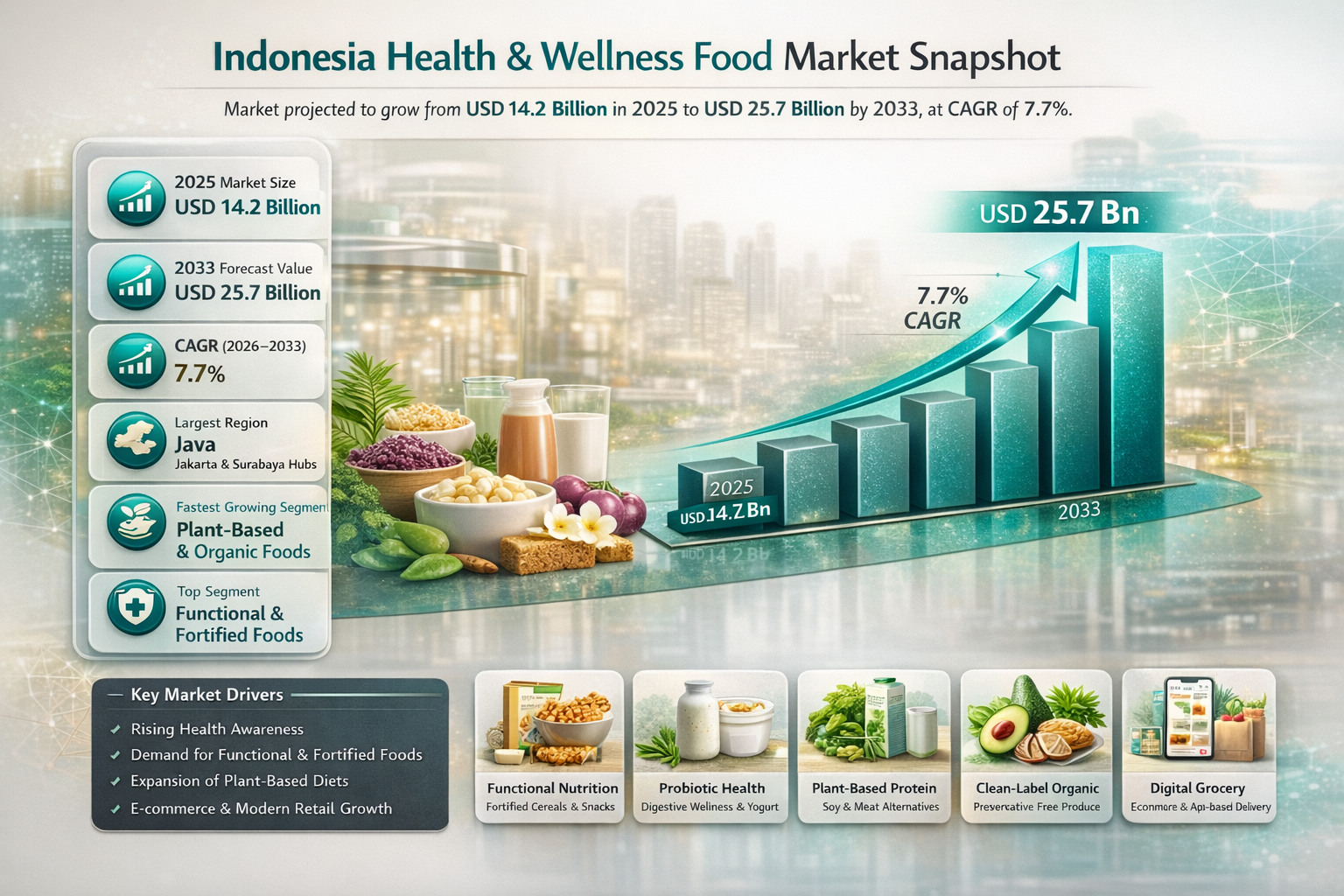
| Metric | Value |
| 2025 Market Size | USD 14.2 Billion |
| 2033 Market Size | USD 25.7 Billion |
| CAGR (2026???2033) | 7.7% |
| Largest Segment | Functional & Fortified Foods |
| Fastest Growing Segment | Plant-Based & Organic Foods |
| Key Trend | Rising Demand for Natural and Nutrient-Dense Foods |
| Future Focus | Functional Nutrition, Clean-Label Products, and Plant-Based Innovation |
Indonesia Health and Wellness Food Market Overview
Indonesia Health and Wellness Food Market is buzzing. Indonesians are getting health-conscious, focusing on nutrition, avoiding sickness, and living better. With worries about obesity, diabetes, and heart issues, folks are switching to healthier food ??? organic, functional, and nutrient-packed options are in demand. The market's growing as people choose food that's good for them.
According to Pheonix Research, the Indonesia Health and Wellness Food Market is valued at USD 14.2 billion in 2025 and is projected to reach USD 25.7 billion by 2033, registering a CAGR of 7.7% during 2026???2033. Market growth is supported by increasing disposable income, expanding urban populations, and growing consumer interest in natural and minimally processed foods.
Indonesia???s large population and evolving middle-class consumer base are driving demand for functional beverages, fortified foods, organic products, and plant-based alternatives. Additionally, the rapid expansion of modern retail channels and e-commerce platforms is improving accessibility and accelerating market adoption. The post-2025 outlook highlights growing innovation in functional nutrition products, plant-based protein foods, clean-label ingredients, and personalized health-oriented diets, positioning the health and wellness food sector as a key growth segment within Indonesia???s food industry.Key Drivers of Indonesia Health and Wellness Food Market Growth
1. Rising Health Awareness Among Consumers
Growing awareness of nutrition and preventive healthcare is encouraging consumers to choose healthier food options.
2. Increasing Demand for Functional and Fortified Foods
Foods enriched with vitamins, minerals, and probiotics are gaining popularity among health-conscious consumers.
3. Expansion of Plant-Based Diets
Consumers are increasingly adopting plant-based diets, supporting demand for plant-based proteins and alternative dairy products.
4. Growth of E-Commerce and Modern Retail
Online grocery platforms and supermarkets are improving accessibility of health and wellness food products.
5. Government Initiatives Promoting Healthy Eating
Public health campaigns and nutritional awareness programs are supporting the adoption of healthier diets.
Indonesia Health and Wellness Food Market Segmentation
?? 1. By Product Type
1.1 Functional and Fortified Foods
1.1.1 Vitamin-Enriched Foods
1.1.1.1 Fortified Cereals
1.1.1.1.1 Whole Grain Cereals
1.1.1.1.2 Multivitamin-Enriched Cereals
1.1.1.2 Nutritional Snack Bars
1.1.1.2.1 Protein-Enriched Snack Bars
1.1.1.2.2 Energy and Wellness Bars
1.1.2 Probiotic and Digestive Health Foods
1.1.2.1 Yogurt and Fermented Dairy
1.1.2.1.1 Probiotic Yogurt
1.1.2.1.2 Fermented Milk Drinks
1.1.2.2 Digestive Health Functional Foods
1.1.2.2.1 Prebiotic-Enriched Foods
1.1.2.2.2 Fiber-Enriched Snack Products
1.2 Organic Foods
1.2.1 Organic Fruits and Vegetables
1.2.1.1 Fresh Organic Produce
1.2.1.1.1 Organic Vegetables
1.2.1.1.2 Organic Fruits
1.2.2 Organic Packaged Foods
1.2.2.1 Organic Snacks
1.2.2.1.1 Organic Chips
1.2.2.1.2 Organic Crackers
1.2.2.2 Natural Ingredient Foods
1.2.2.2.1 Clean Label Packaged Foods
1.2.2.2.2 Preservative-Free Foods
1.3 Plant-Based Foods
1.3.1 Plant-Based Dairy Alternatives
1.3.1.1 Soy-Based Beverages
1.3.1.1.1 Soy Milk
1.3.1.1.2 Soy Yogurt
1.3.1.2 Other Plant-Based Milk Alternatives
1.3.1.2.1 Almond Milk
1.3.1.2.2 Oat Milk
1.3.2 Plant-Based Protein Foods
1.3.2.1 Meat Alternatives
1.3.2.1.1 Soy Protein Products
1.3.2.1.2 Textured Vegetable Protein
1.3.2.2 Pea Protein Products
1.3.2.2.1 Plant-Based Burgers
1.3.2.2.2 Plant-Based Ready Meals
1.4 Low-Calorie and Diet Foods
1.4.1 Sugar-Free Foods
1.4.1.1 Low-Sugar Snacks
1.4.1.1.1 Sugar-Free Biscuits
1.4.1.1.2 Sugar-Free Snack Bars
1.4.1.2 Reduced-Sugar Desserts
1.4.1.2.1 Low-Calorie Ice Cream
1.4.1.2.2 Diet Bakery Products
1.4.2 Low-Fat Foods
1.4.2.1 Healthy Dairy Products
1.4.2.1.1 Low-Fat Milk
1.4.2.1.2 Reduced-Fat Yogurt
?? 2. By Distribution Channel
2.1 Supermarkets & Hypermarkets
2.1.1 Health Food Sections
2.1.1.1 Functional Food Shelves
2.1.1.1.1 Nutritional Food Products
2.1.1.1.2 Functional Beverage Products
2.1.2 Packaged Wellness Food Products
2.1.2.1 Health-Oriented Packaged Foods
2.1.2.1.1 Functional Snack Products
2.1.2.1.2 Organic Snack Products
2.2 Online Retail
2.2.1 E-commerce Grocery Platforms
2.2.1.1 Online Health Food Stores
2.2.1.1.1 Marketplace Grocery Platforms
2.2.1.1.2 Specialized Health Marketplaces
2.2.2 Direct-to-Consumer Health Food Brands
2.2.2.1 Brand-Owned E-commerce Stores
2.2.2.1.1 Nutrition Brand Platforms
2.2.2.1.2 Organic Product Brand Stores
2.3 Specialty Health Stores
2.3.1 Organic Food Stores
2.3.1.1 Certified Organic Product Retailers
2.3.1.1.1 Organic Fruit Retailers
2.3.1.1.2 Organic Vegetable Retailers
2.3.2 Nutritional Supplement Retailers
2.3.2.1 Functional Nutrition Stores
2.3.2.1.1 Sports Nutrition Products
2.3.2.1.2 Functional Health Products
2.4 Traditional Retail
2.4.1 Local Grocery Stores
2.4.1.1 Neighborhood Convenience Stores
2.4.1.1.1 Packaged Wellness Foods
2.4.1.1.2 Healthy Snack Products
2.4.2 Independent Food Retailers
2.4.2.1 Specialty Food Shops
2.4.2.1.1 Local Organic Farmers
2.4.2.1.2 Health Food Vendors
?? ??3. By Consumer Group
3.1 Health-Conscious Consumers 3.1.1 Fitness Enthusiasts3.1.1.1 Gym and Sports Nutrition Consumers
3.1.1.1.1 Protein Food Consumers
3.1.1.1.2 Energy Food Consumers 3.1.2 Lifestyle Diet Followers
3.1.2.1 Keto Diet Consumers
3.1.2.1.1 Low-Carb Food Products
3.1.2.1.2 High-Protein Diet Foods
3.2 Medical Nutrition Consumers 3.2.1 Diabetic Patients
3.2.1.1 Low-Glycemic Food Products
3.2.1.1.1 Sugar-Free Foods
3.2.1.1.2 Diabetic Diet Products 3.2.2 Weight Management Consumers
3.2.2.1 Low-Calorie Diet Consumers
3.2.2.1.1 Weight Loss Meal Products
3.2.2.1.2 Portion-Control Foods
3.3 Young Urban Consumers 3.3.1 Millennials
3.3.1.1 Health-Oriented Lifestyle Consumers
3.3.1.1.1 Organic Food Buyers
3.3.1.1.2 Plant-Based Food Consumers 3.3.2 Gen Z Consumers
3.3.2.1 Trend-Driven Health Food Buyers
3.3.2.1.1 Functional Beverage Consumers
3.3.2.1.2 Healthy Snack Consumers
?? 4.By Region
4.1 Java
4.2 Sumatra
4.3 Kalimantan
4.4 Sulawesi
4.5 Other Indonesia Regions
Regional Insights of Indonesia Health and Wellness Food Market
Java ??? Largest Market
Java dominates the market due to its high population density, strong urbanization, and concentration of modern retail outlets in cities such as Jakarta and Surabaya.
Sumatra ??? Fastest Growing Market
Sumatra is witnessing rapid growth supported by increasing disposable income and expanding retail infrastructure.
Kalimantan
Growing urban development and improving distribution networks are supporting demand for health and wellness food products.
Sulawesi
Rising consumer awareness of nutrition and expanding supermarket chains are driving regional market growth.
Other Regions
Other regions are gradually adopting health-focused food products as modern retail and e-commerce expand nationwide.
Leading Companies in Indonesia Health and Wellness Food Market
-
Danone Indonesia
-
Unilever Indonesia
-
Kalbe Nutritionals
-
Mayora Indah
-
Frisian Flag Indonesia
-
Kino Indonesia
Leading companies are focusing on functional food innovation, clean-label ingredients, and plant-based product development to strengthen their market presence. Indofood Sukses Makmur is the largest company in Indonesia Health and Wellness Food Market.
Strategic Intelligence & AI-Backed Insights
Pheonix Demand Forecast Engine identifies rising health awareness and urban lifestyle changes as key long-term growth drivers.
Consumer Behavior Analyzer highlights increasing preference for natural, organic, and minimally processed foods.
Innovation Tracker emphasizes the development of plant-based protein products, fortified foods, and functional beverages.
Porter???s Five Forces Analysis reveals strong competition among global and domestic food companies, moderate supplier power, and growing opportunities in premium health food segments.
Why the Indonesia Health and Wellness Food Market is Critical
-
Supports preventive healthcare through improved nutrition.
-
Drives innovation in functional and fortified food products.
- Expands opportunities for organic and plant-based foods.
-
Strengthens the country???s modern food retail ecosystem.
-
Encourages sustainable and health-focused food consumption.
Final Takeaway of Indonesia Health and Wellness Food Market
The Indonesia Health and Wellness Food Market is evolving rapidly as consumers increasingly prioritize nutrition, natural ingredients, and healthier lifestyles. The Health and Wellness Food Market CAGR 2026???2033 of 7.7% reflects strong expansion supported by rising health awareness, growing middle-class consumption, and increasing availability of functional food products. Companies that invest in plant-based innovation, functional nutrition products, and digital retail channels will be well positioned to capture emerging opportunities in Indonesia???s evolving food ecosystem. At Pheonix Research, our advanced forecasting frameworks provide comprehensive revenue forecasts, consumer insights, and competitive benchmarking, enabling stakeholders to capitalize on the rapidly growing health and wellness food market in Indonesia with confidence.???? Social Mentions & Publication Channels
??Explore deeper insights and follow our cross-platform updates on??LinkedIn and X for continuous intelligence and market coverage.
LinkedIn : https://www.linkedin.com/feed/update/urn:li:activity:7437157934175907840
X??: https://x.com/Pheonix_Insight/status/2031394571620593745?s=20
Table of Contents
1. Executive Summary
1.1 Indonesia Health and Wellness Food Market Forecast Snapshot (2026???2033)
1.2 Market Size & CAGR Analysis
1.3 Key Market Trends
1.4 Largest and Fastest-Growing Segments
1.5 Competitive Landscape Overview
1.6 Consumer Demand Trends
1.7 Strategic Outlook Through 2033
2. Introduction & Market Overview
2.1 Definition of the Indonesia Health and Wellness Food Market
2.2 Scope of the Study
2.3 Evolution of Health-Oriented Food Consumption in Indonesia
2.4 Role of Functional Nutrition and Preventive Healthcare
2.5 Impact of Urbanization and Rising Middle-Class Consumers
2.6 Growth of Clean-Label and Natural Food Products
2.7 Expansion of Plant-Based and Organic Food Innovation
3. Research Methodology
3.1 Primary Research
3.2 Secondary Research
3.3 Market Size Estimation Model
3.4 Forecast Assumptions (2026???2033)
3.5 Data Validation and Triangulation
4. Market Dynamics
4.1 Market Drivers
4.1.1 Rising Health Awareness Among Consumers
4.1.2 Increasing Demand for Functional and Fortified Foods
4.1.3 Expansion of Plant-Based Diets
4.1.4 Growth of E-Commerce and Modern Retail
4.1.5 Government Initiatives Promoting Healthy Eating
4.2 Market Restraints
4.2.1 High Price of Premium Health Foods
4.2.2 Limited Consumer Awareness in Rural Areas
4.2.3 Supply Chain and Distribution Challenges
4.2.4 Regulatory Compliance for Organic Products
4.3 Market Opportunities
4.3.1 Expansion of Organic Food Production
4.3.2 Development of Functional Nutrition Products
4.3.3 Increasing Demand for Plant-Based Protein Foods
4.3.4 Growth of Digital Food Retail Platforms
4.4 Market Challenges
4.4.1 Maintaining Product Authenticity and Certification
4.4.2 Competition Between Global and Local Brands
4.4.3 Managing Supply Chain for Fresh Organic Products
4.4.4 Consumer Price Sensitivity
5. Indonesia Health and Wellness Food Market Analysis (USD Billion), 2026???2033
5.1 Market Size Overview
5.2 CAGR Growth Analysis
5.3 Product Category Revenue Analysis
5.4 Distribution Channel Revenue Trends
5.5 Consumer Group Demand Analysis
5.6 Regional Market Contribution
6. Market Segmentation by Product Type (USD Billion), 2026???2033
6.1 Functional and Fortified Foods
6.1.1 Vitamin-Enriched Foods
6.1.2 Probiotic and Digestive Health Foods
6.2 Organic Foods
6.2.1 Organic Fruits and Vegetables
6.2.2 Organic Packaged Foods
6.3 Plant-Based Foods
6.3.1 Plant-Based Dairy Alternatives
6.3.2 Plant-Based Protein Foods
6.4 Low-Calorie and Diet Foods
6.4.1 Sugar-Free Foods
6.4.2 Low-Fat Foods
7. Market Segmentation by Distribution Channel (USD Billion), 2026???2033
7.1 Supermarkets and Hypermarkets
7.2 Online Retail and E-Commerce
7.3 Specialty Health Stores
7.4 Traditional Retail
8. Market Segmentation by Consumer Group (USD Billion), 2026???2033
8.1 Health-Conscious Consumers
8.1.1 Fitness Enthusiasts
8.1.2 Lifestyle Diet Followers
8.2 Medical Nutrition Consumers
8.2.1 Diabetic Consumers
8.2.2 Weight Management Consumers
8.3 Young Urban Consumers
8.3.1 Millennials
8.3.2 Gen Z Consumers
9. Market Segmentation by Geography
9.1 Java ??? Largest Market
9.2 Sumatra ??? Fastest Growing Market
9.3 Kalimantan
9.4 Sulawesi
9.5 Other Indonesian Regions
10. Competitive Landscape
10.1 Market Share Analysis
10.2 Product Portfolio Benchmarking
10.3 Innovation Strategies in Functional Nutrition
10.4 Brand Positioning and Consumer Engagement
10.5 Competitive Differentiation Strategies
11. Company Profiles
11.1 Nestl?? Indonesia
11.2 Indofood Sukses Makmur
11.3 Danone Indonesia
11.4 Unilever Indonesia
11.5 Kalbe Nutritionals
11.6 Mayora Indah
11.7 Frisian Flag Indonesia
11.8 Kino Indonesia
12. Strategic Intelligence & Pheonix AI Insights
12.1 Pheonix Demand Forecast Engine
12.2 Consumer Behavior Analyzer
12.3 Functional Food Innovation Tracker
12.4 Retail Expansion & Distribution Insights
12.5 Automated Porter???s Five Forces Analysis
13. Future Outlook & Strategic Recommendations
13.1 Expansion of Functional Nutrition Products
13.2 Growth of Plant-Based and Organic Food Segments
13.3 Development of Clean-Label Food Products
13.4 Strengthening E-Commerce and Digital Retail Channels
13.5 Long-Term Market Outlook (2033+)
14. Appendix
15. About Pheonix Research
16. Disclaimer
Competitive Landscape
Competitive Landscape of the Indonesia Health and Wellness Food Market
Executive Framing
The Indonesia Health and Wellness Food Market is moderately fragmented with high competitive intensity, driven by a mix of multinational FMCG giants and strong domestic food manufacturers. Leading companies such as Nestl?? Indonesia, Indofood Sukses Makmur, Danone Indonesia, Unilever Indonesia, and Kalbe Nutritionals compete alongside emerging organic and plant-based brands. The competitive landscape is shaped by product innovation, strong distribution networks, affordability strategies, and increasing penetration of digital retail platforms.
Current Market Reality
The market is evolving rapidly as Indonesian consumers increasingly prioritize health, nutrition, and preventive healthcare. Functional and fortified foods dominate due to their alignment with immunity, energy, and overall wellness needs, while plant-based and organic products are gaining strong traction among urban consumers.
Large players leverage extensive retail reach, brand recognition, and R&D capabilities to introduce fortified and functional food products at scale, while smaller brands differentiate through clean-label positioning, organic certification, and niche product offerings. The rapid expansion of e-commerce platforms and direct-to-consumer models is further transforming the competitive landscape.
Key Signals and Evidence
- Strong growth in functional and fortified food categories across urban markets.
- Increasing demand for plant-based, organic, and clean-label products.
- Expansion of e-commerce and digital grocery platforms across Indonesia.
- Rising influence of health awareness campaigns and social media trends.
- Growing innovation in protein-rich foods, functional beverages, and diet-specific products.
Strategic Implications
- Product Innovation: Expanding portfolios with functional, fortified, and plant-based food products.
- Omnichannel Distribution: Strengthening presence across supermarkets, e-commerce, and DTC platforms.
- Affordability Strategy: Offering cost-effective health food options to penetrate mass-market segments.
- Localization: Developing products aligned with local tastes and dietary preferences.
- Digital Engagement: Leveraging online platforms, influencers, and subscription models to drive consumer engagement.
Forward Outlook
By 2033, the Indonesia Health and Wellness Food Market is projected to reach approximately USD 25.7 billion, growing at a CAGR of ~7.7%. Java will continue to dominate due to its population density and retail infrastructure, while Sumatra and other regions will emerge as high-growth markets driven by increasing urbanization and expanding distribution networks.
The competitive landscape will evolve through increased focus on functional nutrition, plant-based innovation, clean-label product development, and digital commerce expansion. Companies that successfully combine product innovation, strong distribution, affordability, and consumer-centric strategies will secure long-term leadership in Indonesia???s health and wellness food ecosystem.
Value Chain
Indonesia Health and Wellness Food Market: Value Chain & Market Evolution
Executive Framing
The Indonesia Health and Wellness Food Market is emerging as a high-growth, consumer-centric ecosystem, driven by increasing demand for functional nutrition, clean-label foods, and plant-based alternatives. Rising health awareness and lifestyle shifts are transforming food consumption patterns across urban and semi-urban populations.
The market operates through an integrated operational model, combining product innovation, food processing, branding, and multi-channel distribution to meet evolving consumer expectations and scale efficiently.
Current Market Reality
The industry exhibits a high supply chain complexity, influenced by diverse product categories, import dependency for specialty ingredients, regulatory requirements, and cold-chain logistics for perishable health products.
Distribution is omnichannel, encompassing modern retail, e-commerce platforms, specialty health stores, and traditional retail outlets, ensuring broad accessibility across Indonesia???s diverse geographic regions.
Key Signals and Evidence
- Market projected to grow from USD 14.2 billion (2025) to USD 25.7 billion (2033) at a CAGR of 7.7%.
- Strong demand for functional and fortified food products.
- Rapid growth in plant-based and organic food segments.
- Expansion of modern retail and digital commerce platforms.
- Increasing preference for natural, clean-label, and minimally processed foods.
Strategic Implications
Companies are focusing on product innovation, premiumization, and localized health solutions to capture a wide consumer base. Investments in digital channels, supply chain optimization, and brand positioning are critical for maintaining competitive advantage.
Market leaders are also expanding into emerging regions beyond major urban centers while strengthening plant-based portfolios, functional nutrition offerings, and organic product lines.
Forward Outlook
The Indonesia Health and Wellness Food Market is expected to become a key pillar of the country???s food industry, driven by long-term trends in preventive healthcare, nutrition awareness, and lifestyle transformation.
- Growth in functional and fortified food categories
- Expansion of plant-based and organic product segments
- Increasing adoption of e-commerce and digital health platforms
- Rising demand for clean-label and nutrient-dense foods
Companies that integrate innovation, accessibility, and sustainability will be best positioned to capture long-term growth opportunities in this dynamic market.
Investment Activity
Investment & Funding Dynamics ??? Indonesia Health and Wellness Food Market
Executive Framing
Current Market Reality
Valued at USD 14.2 billion in 2025 and projected to reach ~USD 25.7 billion by 2033 (CAGR ~7.7%), the market reflects robust and consistent investment activity. Java remains the primary investment hub due to its dense population and advanced retail infrastructure, while regions such as Sumatra are emerging as high-growth investment destinations. Major companies including Nestl?? Indonesia, Indofood Sukses Makmur, and Danone Indonesia are investing in functional food innovation, plant-based product lines, and omnichannel distribution strategies to strengthen their competitive positioning.
Key Signals and Evidence
- Functional & Fortified Food Innovation: Strong investments in vitamin-enriched, probiotic, and nutrient-dense food products.
- Plant-Based & Organic Expansion: Rising capital allocation toward plant-based proteins, dairy alternatives, and organic food categories.
- E-Commerce & Digital Retail Growth: Increasing funding for online grocery platforms and direct-to-consumer health brands.
- Modern Retail Infrastructure: Expansion of supermarkets, hypermarkets, and specialty health stores improving accessibility.
- Clean-Label Product Development: Investments in natural, minimally processed, and preservative-free food products.
- Supply Chain & Distribution Enhancement: Focus on logistics optimization, cold-chain expansion, and nationwide distribution networks.
- AI & Consumer Analytics: Adoption of data-driven insights, demand forecasting, and personalized nutrition platforms.
Strategic Implications
Companies that integrate strong product innovation with efficient distribution and digital engagement strategies are best positioned to capture long-term growth. Investors are prioritizing scalable business models that combine functional nutrition, clean-label positioning, and plant-based innovation. Expansion into emerging regions beyond Java, along with partnerships across retail and e-commerce ecosystems, will be critical for market penetration and sustained revenue growth.
Forward Outlook
From 2026 to 2033, investment activity in the Indonesia Health and Wellness Food Market is expected to accelerate, particularly in plant-based food innovation, functional nutrition products, and digital retail infrastructure. Funding will increasingly focus on AI-driven consumer insights, personalized nutrition solutions, and supply chain optimization. Strategic collaborations, product diversification, and expansion of premium health food offerings will shape the next phase of market evolution.
Technology & Innovation
Indonesia Health & Wellness Food Market: Technology & Innovation
Executive Framing
Technology and innovation in the Indonesia Health & Wellness Food Market are driving the rapid evolution of functional nutrition, plant-based alternatives, and clean-label food production. As consumers increasingly prioritize health, immunity, and natural ingredients, companies are leveraging advanced food technologies, digital platforms, and data-driven insights to develop nutrient-dense products, enhance accessibility, and scale operations efficiently across a diverse and growing population.
Current Market Reality
Valued at USD 14.2 billion in 2025 and projected to reach USD 25.7 billion by 2033 at a CAGR of 7.7%, the market is witnessing strong technological adoption across product innovation, manufacturing, and distribution. Java leads in modern retail infrastructure and product innovation, while regions such as Sumatra and Sulawesi are experiencing increased penetration of e-commerce platforms and improved supply chain technologies, enabling broader access to health-focused food products.
Key Signals and Evidence
- Functional & Fortification Technologies: Increasing use of advanced micronutrient fortification, probiotics, and bioactive ingredients to enhance immunity, digestion, and overall health benefits.
- Plant-Based Innovation & Protein Engineering: Development of plant-based dairy alternatives, meat substitutes, and protein-enriched foods using improved formulation and texturization technologies.
- Digital & E-Commerce Integration: Rapid growth of online grocery platforms and direct-to-consumer models supported by AI-driven demand forecasting and personalized nutrition offerings.
- Clean-Label & Natural Ingredient Processing: Adoption of minimal processing techniques, natural preservatives, and transparent labeling aligned with consumer demand for healthier products.
- Smart Packaging & Traceability: Implementation of QR codes, blockchain tracking, and sustainable packaging to ensure product authenticity, safety, and environmental compliance.
- Cold Chain & Distribution Innovation: Expansion of refrigerated logistics, last-mile delivery optimization, and warehouse automation to maintain product quality across Indonesia???s geographically dispersed regions.
Strategic Implications
Companies investing in functional ingredient innovation, plant-based product development, and digital retail ecosystems will gain a strong competitive edge in Indonesia???s fast-growing market. Leveraging AI-driven consumer insights and expanding into premium segments such as organic foods and personalized nutrition can significantly enhance profitability. Additionally, building robust cold-chain infrastructure and sustainable packaging solutions will be critical for long-term scalability and brand differentiation.
Forward Outlook
The market is expected to evolve toward personalized nutrition, increased adoption of plant-based technologies, and fully digitalized health food ecosystems. Future innovation will focus on improving nutrient bioavailability, enhancing convenience, and expanding product reach across emerging regions. Indonesia is set to become a key Southeast Asian hub for health and wellness food innovation, driven by technology-enabled growth and rising consumer demand.
Market Risk
Risk Factors and Disruption Threats in the Indonesia Health and Wellness Food Market
Executive Framing
The Indonesia Health and Wellness Food Market is experiencing strong growth, driven by rising health awareness, increasing disposable income, and growing demand for natural and nutrient-dense food products. Valued at USD 14.2 billion in 2025 and projected to reach USD 25.7 billion by 2033 at a CAGR of 7.7%, the market is emerging as a key segment within Indonesia???s evolving food industry.
Current Market Reality
Java dominates the market due to its large population base, urbanization, and strong presence of modern retail infrastructure. Sumatra is the fastest-growing region, supported by rising income levels and expanding retail networks. Functional and fortified foods lead the market, while plant-based and organic foods are gaining rapid traction among urban consumers.
Key Signals and Evidence
- Increasing consumer focus on preventive healthcare and nutrition.
- Rising demand for functional, fortified, and probiotic food products.
- Rapid growth in plant-based diets and organic food consumption.
- Expansion of e-commerce platforms and modern retail channels.
- Government initiatives promoting healthy eating and nutrition awareness.
Strategic Implications
- Invest in plant-based and functional food product innovation.
- Expand distribution through e-commerce and modern retail channels.
- Focus on clean-label, organic, and minimally processed product offerings.
- Target emerging regions beyond Java for growth opportunities.
- Leverage branding and consumer education to drive adoption.
Forward Outlook
The market is expected to evolve into a highly dynamic and innovation-driven ecosystem, supported by growing demand for functional nutrition, plant-based foods, and clean-label products. Companies focusing on affordability, accessibility, and product innovation will be well-positioned to capture long-term growth opportunities in Indonesia???s health and wellness food market.
Regulatory Landscape
Regulatory & Policy Landscape: Indonesia Health & Wellness Food Market
Executive Framing
The Indonesia Health & Wellness Food Market operates under a structured regulatory framework governed by the National Agency of Drug and Food Control (BPOM), the Ministry of Health (MoH), and the Ministry of Agriculture. These authorities oversee food safety, product registration, halal certification, labeling standards, and nutritional compliance across functional foods, organic products, plant-based alternatives, and dietary supplements.
Health and wellness food products???including fortified foods, probiotic beverages, and plant-based nutrition???are subject to strict regulations regarding ingredient safety, health claims, and labeling transparency. Claims such as ???immune-boosting,??? ???low-sugar,??? ???organic,??? and ???functional??? require scientific validation and regulatory approval to ensure consumer protection and compliance.
Current Market Reality
Indonesia presents a moderately high regulatory environment, with increasing enforcement of food safety and halal compliance standards. Java, particularly Jakarta and surrounding urban centers, demonstrates the highest level of regulatory enforcement due to strong presence of multinational brands and modern retail infrastructure.
Other regions such as Sumatra, Kalimantan, and Sulawesi are witnessing gradual improvements in regulatory implementation as government initiatives strengthen food safety awareness and retail expansion increases. However, challenges remain in ensuring consistent compliance across traditional and informal retail channels.
Key Signals and Evidence
- Mandatory BPOM product registration and approval for health and wellness food products.
- Halal certification requirements under the Halal Product Assurance Law for a wide range of food products.
- Strict labeling regulations including nutritional information, ingredient disclosure, and health claims validation.
- Regulations governing functional claims such as digestive health, immunity, and energy enhancement.
- Monitoring of sugar, salt, and fat content aligned with national public health initiatives.
- Growing oversight of e-commerce food sales and digital product traceability systems.
Strategic Implications
Regulatory compliance is critical for market entry and expansion in Indonesia, particularly due to mandatory halal certification and BPOM approvals. Companies must invest in product testing, certification processes, and transparent labeling practices to meet regulatory standards and build consumer trust.
As demand for functional and plant-based foods grows, manufacturers must align with evolving regulations on health claims and ingredient transparency. Leveraging digital distribution channels while maintaining compliance in online retail environments will be essential for sustainable growth.
Forward Outlook
Regulatory complexity is expected to increase as Indonesia strengthens its focus on food safety, halal compliance, and public health. Stricter controls on sugar reduction, clean-label standards, and functional food claims are likely to be implemented.
Emerging technologies such as blockchain-based traceability, AI-driven compliance monitoring, and digital supply chain systems will play a growing role in regulatory adherence. Companies that proactively align with evolving regulations and invest in compliance infrastructure will gain long-term competitive advantages.