
Global Olive Oil Market size and share Analysis 2026-2033
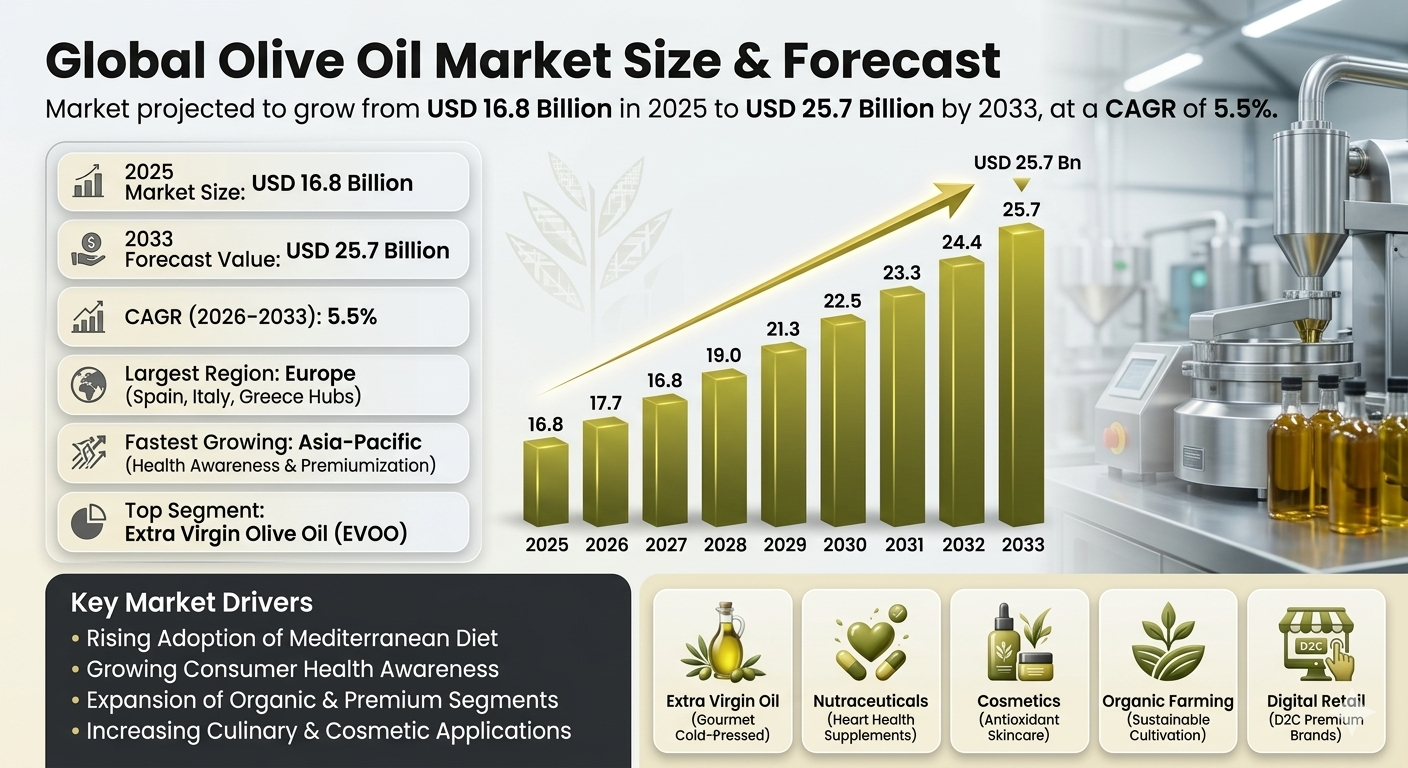
Global Olive Oil Market Forecast Snapshot: 2026???2033
| Metric | Value |
| 2025 Market Size | USD 16.8 Billion |
| 2033 Market Size | USD 25.7 Billion |
| CAGR (2026???2033) | 5.5% |
| Largest Region | Europe |
| Fastest Growing Region | Asia-Pacific |
| Top Segment | Extra Virgin Olive Oil |
| Key Trend | Premiumization, Organic Olive Oil, and Health-Focused Cooking Oils |
| Future Focus | Sustainable Olive Farming, Cold-Pressed Oils, and Functional Food Applications |
Global Olive Oil Market Overview
Global Olive Oil Market is buzzing. Olive oil's trending. People are switching to this heart-healthy, natural oil for cooking and wellness. Packed with antioxidants and good fats, it's a Mediterranean staple now global ??? perfect for foodies and health buffs alike.
According to Pheonix Research, the Global Olive Oil Market is valued at USD 16.8 billion in 2025 and is projected to reach USD 25.7 billion by 2033, registering a CAGR of 5.5% during 2026???2033. Market expansion is driven by rising consumer awareness regarding healthy fats, increasing demand for organic food products, and the growing popularity of Mediterranean diets worldwide.
Olive oil is widely used across cooking oils, salad dressings, processed foods, nutraceutical products, and cosmetic formulations. Increasing interest in cold-pressed oils, organic olive oil, and premium gourmet products is further accelerating product innovation within the industry.
Europe dominates the market due to large-scale olive cultivation in countries such as Spain, Italy, and Greece, along with strong consumer demand for traditional Mediterranean food products. Meanwhile, Asia-Pacific is emerging as the fastest-growing region, supported by increasing health awareness, expanding middle-class populations, and growing adoption of premium cooking oils.
The post-2025 outlook highlights strong opportunities in organic olive oil production, functional food ingredients, and sustainable agricultural practices, positioning olive oil as a key segment within the global healthy edible oil industry.
Key Drivers of Global Olive Oil Market Growth
1. Rising Adoption of Mediterranean Diet
The Mediterranean diet, which heavily incorporates olive oil, is widely associated with heart health and longevity, boosting global demand.
2. Growing Health Awareness
Consumers are increasingly shifting toward healthy fats and natural oils, replacing traditional cooking oils with olive oil.
3. Expansion of Organic and Premium Food Products
Demand for organic, cold-pressed, and premium extra virgin olive oils is rising significantly in developed markets.
4. Increasing Applications in Food and Cosmetics
Olive oil is widely used in processed foods, nutraceuticals, skincare, and hair care products, expanding market opportunities.
5. Growth of Global Culinary and Gourmet Food Trends
Rising popularity of international cuisines and gourmet cooking is driving demand for premium olive oil varieties.
Global Olive Oil Market Segmentation
?? 1. By Product Type
1.1 Extra Virgin Olive Oil
1.1.1 Cold-Pressed Extra Virgin Olive Oil
1.1.1.1 Premium Gourmet Olive Oil
1.1.1.2 Organic Extra Virgin Olive Oil
1.1.2 Filtered Extra Virgin Olive Oil
1.1.2.1 Culinary Cooking Applications
1.1.2.2 Salad and Dressing Applications
1.2 Virgin Olive Oil
1.2.1 Traditional Virgin Olive Oil
1.2.1.1 Household Cooking Oil
1.2.1.2 Restaurant Food Preparation
1.2.2 Blended Virgin Olive Oil
1.2.2.1 Food Processing Applications
1.2.2.2 Packaged Food Manufacturing
1.3 Refined Olive Oil
1.3.1 Pure Olive Oil
1.3.1.1 Cooking Oil Applications
1.3.1.2 Frying Oil Applications
1.3.2 Light Olive Oil
1.3.2.1 Low-Flavor Cooking Oil
1.3.2.2 Food Processing Ingredient
1.4 Olive Pomace Oil
1.4.1 Industrial Cooking Oil
1.4.1.1 Large-Scale Food Service
1.4.1.2 Restaurant Chains
1.4.2 Food Processing Applications
1.4.2.1 Snack Manufacturing
1.4.2.2 Packaged Food Production
??2. By Application
2.1 Food and Beverage Industry
2.1.1 Cooking Oil Applications
2.1.1.1 Household Cooking
2.1.1.2 Restaurant Food Preparation
2.1.2 Salad and Dressing Applications
2.1.2.1 Salad Dressings
2.1.2.2 Gourmet Sauces
2.2 Food Processing Industry
2.2.1 Packaged Food Production
2.2.1.1 Ready-to-Eat Meals
2.2.1.2 Processed Snack Foods
2.2.2 Bakery and Confectionery
2.2.2.1 Olive Oil Baked Goods
2.2.2.2 Gourmet Bakery Products
2.3 Nutraceutical Applications
2.3.1 Functional Food Ingredients
2.3.1.1 Heart Health Supplements
2.3.1.2 Antioxidant Products
2.3.2 Dietary Supplements
2.3.2.1 Omega-Enriched Products
2.3.2.2 Wellness Capsules
2.4 Cosmetics and Personal Care
2.4.1 Skincare Products
2.4.1.1 Moisturizing Creams
2.4.1.2 Anti-Aging Products
2.4.2 Hair Care Products
2.4.2.1 Hair Oils
2.4.2.2 Conditioning Products
??3. By Distribution Channel
3.1 Supermarkets & Hypermarkets
3.1.1 Cooking Oil Retail Sections
3.1.2 Premium Gourmet Food Sections
3.2 Online Retail & E-commerce
3.2.1 E-commerce Grocery Platforms
3.2.2 Direct-to-Consumer Olive Oil Brands
3.3 Specialty Food Stores
3.3.1 Organic Food Retailers
3.3.2 Gourmet Food Stores
3.4 Food Service & Wholesale Distribution
3.4.1 Restaurants and Hotels
3.4.2 Catering and Institutional Buyers
??4. By End-User
4.1 Household Consumers
4.1.1 Health-Conscious Consumers
4.1.2 Gourmet Cooking Consumers
4.2 Food Service Industry
4.2.1 Restaurants
4.2.2 Hotels and Catering Services
4.3 Food Processing Companies
4.3.1 Packaged Food Manufacturers
4.3.2 Snack Food Producers
4.4 Cosmetic and Personal Care Companies
4.4.1 Skincare Product Manufacturers
4.4.2 Hair Care Product Manufacturers
??5.By Region
5.1 North America
5.2 Europe
5.3 Asia-Pacific
5.4 Middle East & Africa
5.5 South America
Regional Insights of Global Olive Oil Market
Europe ??? Largest Market
Europe dominates the market due to large-scale olive cultivation in Spain, Italy, and Greece, along with strong demand for Mediterranean cuisine.Asia-Pacific ??? Fastest Growing Market
Asia-Pacific is witnessing rapid growth due to rising health awareness, expanding middle-class populations, and increasing adoption of premium cooking oils.North America
The region shows strong demand driven by health-conscious consumers and increasing adoption of Mediterranean diets.Middle East & Africa
Traditional culinary use of olive oil and growing premium food markets are supporting steady market expansion.
South America
Increasing consumer awareness regarding healthy cooking oils is driving gradual market growth.
Leading Companies in Global Olive Oil Market
Deoleo S.A.
Sovena Group
Borges International Group
Salov Group
Conagra Brands
Del Monte Foods
Filippo Berio USA Ltd.
Pompeian Inc.
Strategic Intelligence & AI-Backed Insights
Pheonix Demand Forecast Engine identifies rising demand for healthy cooking oils, Mediterranean diet adoption, and organic food consumption as key long-term growth drivers. Consumer Behavior Analyzer highlights increasing consumer preference for cold-pressed, organic, and premium olive oil products. Innovation Tracker emphasizes functional olive oil products, gourmet flavor infusions, and sustainable olive farming technologies as major competitive differentiators. Porter???s Five Forces Analysis reveals moderate supplier power, strong competition among global edible oil brands, and growing opportunities for premium olive oil producers.Why the Global Olive Oil Market is Critical
- Supports global demand for healthy cooking oils and balanced diets.
- Strengthens the Mediterranean diet and functional food industry.
- Encourages sustainable agricultural practices in olive cultivation.
- Expands applications across food, nutraceutical, and cosmetic industries.
- Drives innovation in premium and organic edible oils.
Final Takeaway of Global Olive Oil Market
The Global Olive Oil Market is steadily transitioning into a premium, health-focused, and sustainable edible oil ecosystem. The Olive Oil Market CAGR 2026???2033 of 5.5% reflects stable growth supported by rising consumer demand for healthy fats, organic food products, and Mediterranean dietary patterns. Companies that invest in organic olive cultivation, cold-pressed production methods, and premium product innovations will be well positioned to capture long-term value creation within the global healthy cooking oil industry. At Pheonix Research, our advanced forecasting frameworks provide in-depth Olive Oil Market revenue forecast analysis, competitive benchmarking, and strategic intelligence ??? enabling stakeholders to capitalize on the Post-2025 outlook for the Global Olive Oil Market with data-backed confidence and sustainable growth strategies.???? Social Mentions & Publication Channels
Explore deeper insights and follow our cross-platform updates on??LinkedIn, and??X??for continuous intelligence and market coverage.
LinkedIn : https://www.linkedin.com/feed/update/urn:li:activity:7438615231934742528 X : https://x.com/Pheonix_Insight/status/2032855348844048523?s=20Table of Contents
1. Market Forecast Snapshot (2026???2033)
1.1 2025 Market Size ??? USD 16.8 Billion
1.2 2033 Market Size ??? USD 25.7 Billion
1.3 CAGR (2026???2033) ??? 5.5%
1.4 Largest Region ??? Europe
1.5 Fastest Growing Region ??? Asia-Pacific
1.6 Top Segment ??? Extra Virgin Olive Oil
1.7 Key Trend ??? Premiumization, Organic Olive Oil, and Health-Focused Cooking Oils
1.8 Future Focus ??? Sustainable Olive Farming, Cold-Pressed Oils, and Functional Food Applications
2. Global Olive Oil Market Overview
2.1 Market Definition & Scope
2.2 Evolution of the Global Olive Oil Industry
2.3 Health Benefits and Nutritional Profile of Olive Oil
2.4 Expansion of Mediterranean Diet Trends
2.5 Rising Demand for Premium and Organic Cooking Oils
2.6 Post-2025 Market Outlook
3. Key Drivers of Global Olive Oil Market Growth
3.1 Rising Adoption of Mediterranean Diet
3.2 Growing Health Awareness and Demand for Healthy Fats
3.3 Expansion of Organic and Premium Food Products
3.4 Increasing Applications in Food and Cosmetics
3.5 Growth of Global Culinary and Gourmet Food Trends
4. Market Segmentation by Product Type
4.1 Extra Virgin Olive Oil
4.1.1 Cold-Pressed Extra Virgin Olive Oil
4.1.1.1 Premium Gourmet Olive Oil
4.1.1.2 Organic Extra Virgin Olive Oil
4.1.2 Filtered Extra Virgin Olive Oil
4.1.2.1 Culinary Cooking Applications
4.1.2.2 Salad and Dressing Applications
4.2 Virgin Olive Oil
4.2.1 Traditional Virgin Olive Oil
4.2.1.1 Household Cooking Oil
4.2.1.2 Restaurant Food Preparation
4.2.2 Blended Virgin Olive Oil
4.2.2.1 Food Processing Applications
4.2.2.2 Packaged Food Manufacturing
4.3 Refined Olive Oil
4.3.1 Pure Olive Oil
4.3.1.1 Cooking Oil Applications
4.3.1.2 Frying Oil Applications
4.3.2 Light Olive Oil
4.3.2.1 Low-Flavor Cooking Oil
4.3.2.2 Food Processing Ingredient
4.4 Olive Pomace Oil
4.4.1 Industrial Cooking Oil
4.4.1.1 Large-Scale Food Service
4.4.1.2 Restaurant Chains
4.4.2 Food Processing Applications
4.4.2.1 Snack Manufacturing
4.4.2.2 Packaged Food Production
5. Market Segmentation by Application
5.1 Food and Beverage Industry
5.1.1 Cooking Oil Applications
5.1.1.1 Household Cooking
5.1.1.2 Restaurant Food Preparation
5.1.2 Salad and Dressing Applications
5.1.2.1 Salad Dressings
5.1.2.2 Gourmet Sauces
5.2 Food Processing Industry
5.2.1 Packaged Food Production
5.2.1.1 Ready-to-Eat Meals
5.2.1.2 Processed Snack Foods
5.2.2 Bakery and Confectionery
5.2.2.1 Olive Oil Baked Goods
5.2.2.2 Gourmet Bakery Products
5.3 Nutraceutical Applications
5.3.1 Functional Food Ingredients
5.3.1.1 Heart Health Supplements
5.3.1.2 Antioxidant Products
5.3.2 Dietary Supplements
5.3.2.1 Omega-Enriched Products
5.3.2.2 Wellness Capsules
5.4 Cosmetics and Personal Care
5.4.1 Skincare Products
5.4.1.1 Moisturizing Creams
5.4.1.2 Anti-Aging Products
5.4.2 Hair Care Products
5.4.2.1 Hair Oils
5.4.2.2 Conditioning Products
6. Market Segmentation by Distribution Channel
6.1 Supermarkets & Hypermarkets
6.1.1 Cooking Oil Retail Sections
6.1.2 Premium Gourmet Food Sections
6.2 Online Retail & E-commerce
6.2.1 E-commerce Grocery Platforms
6.2.2 Direct-to-Consumer Olive Oil Brands
6.3 Specialty Food Stores
6.3.1 Organic Food Retailers
6.3.2 Gourmet Food Stores
6.4 Food Service & Wholesale Distribution
6.4.1 Restaurants and Hotels
6.4.2 Catering and Institutional Buyers
7. Market Segmentation by End-User
7.1 Household Consumers
7.1.1 Health-Conscious Consumers
7.1.2 Gourmet Cooking Consumers
7.2 Food Service Industry
7.2.1 Restaurants
7.2.2 Hotels and Catering Services
7.3 Food Processing Companies
7.3.1 Packaged Food Manufacturers
7.3.2 Snack Food Producers
7.4 Cosmetic and Personal Care Companies
7.4.1 Skincare Product Manufacturers
7.4.2 Hair Care Product Manufacturers
8. Market Segmentation by Region
8.1 North America
8.2 Europe
8.3 Asia-Pacific
8.4 Middle East & Africa
8.5 South America
9. Regional Insights
9.1 Europe ??? Largest Market
9.2 Asia-Pacific ??? Fastest Growing Market
9.3 North America ??? Rising Demand for Healthy Cooking Oils
9.4 Middle East & Africa ??? Traditional Olive Oil Consumption
9.5 South America ??? Growing Health Awareness and Premium Oil Demand
10. Competitive Landscape
10.1 Market Share Analysis
10.2 Competitive Positioning Matrix
10.3 Premium Product Branding Strategies
10.4 Organic Olive Oil Production and Sustainability Strategies
10.5 Distribution and Global Supply Chain Strategies
11. Leading Companies
11.1 Deoleo S.A.
11.2 Sovena Group
11.3 Borges International Group
11.4 Salov Group
11.5 Conagra Brands
11.6 Del Monte Foods
11.7 Filippo Berio USA Ltd.
11.8 Pompeian Inc.
12. Strategic Intelligence & AI-Backed Insights
12.1 Pheonix Demand Forecast Engine
12.2 Consumer Behavior & Health Trend Analytics
12.3 Innovation Tracker ??? Premium and Functional Olive Oil Products
12.4 Porter???s Five Forces Analysis
13. Sustainability & Regulatory Landscape
13.1 Sustainable Olive Farming Practices
13.2 Organic Certification and Food Safety Regulations
13.3 Environmental Impact of Olive Oil Production
13.4 Sustainable Packaging Innovations
14. Market Significance
14.1 Supporting Global Demand for Healthy Cooking Oils
14.2 Strengthening the Mediterranean Diet and Functional Food Industry
14.3 Encouraging Sustainable Agricultural Practices
14.4 Expanding Applications Across Food, Nutraceutical, and Cosmetic Industries
14.5 Driving Innovation in Premium and Organic Edible Oils
15. Final Takeaway
15.1 Market Growth Outlook (2026???2033)
15.2 Premiumization of Olive Oil Products
15.3 Expansion of Organic and Cold-Pressed Olive Oils
15.4 Growth of Functional Food Applications
15.5 Strategic Recommendations for Industry Stakeholders
16. Appendix
17. About Us
18. Disclaimer
Competitive Landscape
Competitive Landscape of the Global Olive Oil Market
Executive Framing
The Global Olive Oil Market is moderately consolidated, with strong dominance from established European producers and branded multinational edible oil companies. Key players such as Deoleo S.A., Sovena Group, Borges International Group, Salov Group, Filippo Berio (Salov), Pompeian Inc., Conagra Brands, and Del Monte Foods dominate the competitive landscape through large-scale olive sourcing networks, premium brand positioning, and strong global distribution across retail and foodservice channels.
Current Market Reality
The market is evolving toward premiumization, with increasing consumer preference for extra virgin, cold-pressed, and organic olive oil products. Extra virgin olive oil remains the leading segment due to its perceived health benefits and alignment with Mediterranean diet trends.
Europe continues to dominate due to deep-rooted olive cultivation ecosystems in Spain, Italy, and Greece. However, Asia-Pacific is emerging as a high-growth region driven by rising health awareness, urbanization, and increasing adoption of premium cooking oils. Product innovation is increasingly focused on functional nutrition, gourmet applications, and sustainable production methods.
Key Signals and Evidence
- Rising global demand for Mediterranean diet???inspired healthy fats.
- Strong shift toward extra virgin and cold-pressed olive oil variants.
- Growing consumer preference for organic and sustainably sourced oils.
- Expansion of olive oil usage in nutraceutical and cosmetic applications.
- Increasing premiumization across global edible oil categories.
Strategic Implications
- Premiumization Strategy: Focus on extra virgin, cold-pressed, and gourmet olive oil variants.
- Sustainability Focus: Investment in sustainable olive farming and traceable supply chains.
- Geographic Expansion: Strengthening presence in Asia-Pacific and North America.
- Product Diversification: Expanding into functional foods, nutraceuticals, and cosmetics.
- Brand Differentiation: Emphasizing authenticity, origin labeling, and organic certification.
Forward Outlook
By 2033, the Global Olive Oil Market is projected to reach approximately USD 25.7 billion, growing at a CAGR of ~5.5%. Europe will remain the dominant region due to established production infrastructure, while Asia-Pacific will emerge as the fastest-growing market driven by increasing health awareness and premium food adoption.
The competitive landscape will increasingly focus on sustainability, premium branding, and functional applications of olive oil across food, nutraceutical, and personal care industries. Companies that successfully integrate organic cultivation, cold-pressed production, and global branding strategies will maintain a strong competitive advantage in the evolving olive oil ecosystem.
Value Chain
Global Olive Oil Market: Value Chain & Market Dynamics
Executive Framing
The Global Olive Oil Market is evolving into a premium, health-driven, and sustainability-focused edible oil ecosystem, supported by rising demand for natural fats, clean-label cooking oils, and Mediterranean diet adoption. Olive oil is increasingly positioned as a functional food ingredient across culinary, nutraceutical, and personal care applications.
The market operates through a vertically integrated operational model, spanning olive cultivation, harvesting, cold-press extraction, refining, packaging, and global distribution. Producers are increasingly focusing on quality certification, origin traceability, and premium branding to differentiate offerings.
Current Market Reality
The supply chain demonstrates a moderate complexity level, driven by seasonal agricultural cycles, climate dependency, labor-intensive harvesting, and quality grading requirements. Advanced cold-pressing and storage technologies are improving yield efficiency and product consistency.
Distribution is highly multichannel, including supermarkets, hypermarkets, specialty gourmet stores, e-commerce platforms, and food service channels, ensuring strong penetration across both mass and premium consumer segments.
Key Signals and Evidence
- Market growth from USD 16.8 billion (2025) to USD 25.7 billion (2033) at a CAGR of 5.5%.
- Rising adoption of the Mediterranean diet worldwide.
- Increasing demand for extra virgin, cold-pressed, and organic olive oil.
- Expansion of olive oil applications in nutraceuticals and cosmetics.
- Growing focus on sustainable olive farming and premiumization trends.
Strategic Implications
Companies are prioritizing premium branding, origin certification, and sustainable sourcing practices to enhance market competitiveness. Large players focus on global scale, distribution strength, and portfolio diversification, while niche producers emphasize organic farming, cold-pressed quality, and gourmet positioning.
Digital channels, including e-commerce expansion, D2C gourmet brands, and subscription-based premium oil offerings, are becoming increasingly important for consumer engagement and margin expansion.
Sustainability is a key differentiator, with rising investment in water-efficient irrigation, regenerative agriculture, and carbon-conscious olive farming practices.
Forward Outlook
The Global Olive Oil Market is expected to evolve into a premium health oil and functional food ingredient ecosystem, driven by long-term dietary shifts and sustainability priorities.
- Expansion of organic and cold-pressed olive oil segments
- Growth in functional food and nutraceutical applications
- Increasing demand for premium gourmet and flavored olive oils
- Strengthening adoption of sustainable and traceable supply chains
Companies that focus on quality differentiation, sustainability, and premium product innovation will be best positioned to capture long-term value in the global olive oil market.
Investment Activity
Investment & Funding Dynamics ??? Global Olive Oil Market
Executive Framing
Current Market Reality
Valued at USD 16.8 billion in 2025 and projected to reach USD 25.7 billion by 2033 (CAGR 5.5%), the market reflects stable and quality-driven investment growth. Europe remains the dominant investment hub due to large-scale olive cultivation in Spain, Italy, and Greece, while Asia-Pacific is emerging as the fastest-growing region supported by rising health awareness and increasing demand for premium edible oils. Leading players such as Deoleo S.A., Sovena Group, and Borges International Group are investing in premiumization, organic production, and global distribution expansion.
Key Signals and Evidence
- Premium Olive Oil Demand: Rising investments in extra virgin, cold-pressed, and organic olive oil products.
- Health & Wellness Shift: Increasing capital flow toward heart-healthy edible oils replacing refined alternatives.
- Organic Farming Expansion: Growth in sustainable olive cultivation and eco-friendly agricultural practices.
- Food & Nutraceutical Applications: Expanding use of olive oil in functional foods, supplements, and nutraceuticals.
- Cosmetics Industry Integration: Increasing demand for olive oil in skincare, haircare, and personal care products.
- Gourmet & Culinary Trends: Strong growth in premium culinary oils and Mediterranean cuisine adoption.
- E-Commerce Expansion: Rising online sales of branded and specialty olive oil products globally.
Strategic Implications
Companies that focus on premium branding, organic certification, and sustainable production will capture the strongest long-term value. Investors are prioritizing vertically integrated olive oil producers with control over cultivation, processing, and global distribution. Strategic partnerships with gourmet food brands, retail chains, and wellness product companies will enhance market penetration and brand equity.
Forward Outlook
From 2026 to 2033, investment in the Global Olive Oil Market is expected to remain steady, with increasing focus on organic olive farming, cold-pressed technologies, and functional food applications. Premiumization trends and Mediterranean diet adoption will continue to attract capital. M&A activity is likely to grow as companies consolidate production capabilities and expand global distribution networks.
Technology & Innovation
Global Olive Oil Market: Technology & Innovation
Executive Framing
Technology and innovation in the Global Olive Oil Market are increasingly focused on premiumization, sustainability, and quality enhancement across the value chain. As consumer demand shifts toward healthier fats and natural ingredients, producers are investing in cold-press extraction technologies, advanced filtration systems, and sustainable olive farming practices to improve yield quality and preserve nutritional value. Digital traceability and smart agriculture solutions are also becoming integral to ensuring authenticity and transparency in premium olive oil products.
Current Market Reality
Valued at USD 16.8 billion in 2025 and projected to reach USD 25.7 billion by 2033 at a CAGR of 5.5%, the market is steadily evolving toward premium, organic, and functional applications. Europe continues to dominate due to its strong olive cultivation base in Spain, Italy, and Greece, while Asia-Pacific is emerging as the fastest-growing region driven by rising health awareness and adoption of Mediterranean dietary patterns.
Key Signals and Evidence
- Premiumization of Olive Oil: Rising demand for extra virgin, cold-pressed, and gourmet olive oil products across global markets.
- Sustainable Olive Farming: Increasing adoption of water-efficient irrigation, organic farming, and regenerative agriculture practices.
- Cold-Press & Advanced Extraction: Improved mechanical extraction methods preserving antioxidants and nutritional compounds.
- Expansion into Functional Foods: Growing use of olive oil in nutraceuticals, heart-health supplements, and wellness products.
- Cosmetic Industry Integration: Increased use of olive oil in skincare, anti-aging formulations, and hair care products.
- Digital Traceability Systems: Blockchain and QR-based labeling improving authenticity, origin tracking, and consumer trust.
Strategic Implications
Companies focusing on organic certification, premium branding, and sustainable production methods are likely to gain a competitive edge. Expansion into high-value segments such as functional foods, cosmetics, and gourmet culinary oils will enhance revenue diversification. Additionally, investments in supply chain transparency and agricultural technology will be critical for maintaining product authenticity and meeting evolving consumer expectations.
Forward Outlook
The market is expected to move further toward premium, health-oriented, and sustainability-driven consumption patterns. Future innovation will center on bioactive-enriched olive oils, climate-resilient olive cultivation, and expanded applications in functional nutrition and wellness industries. Olive oil will continue to strengthen its position as a global staple in healthy cooking and preventive health diets.
Market Risk
Risk Factors and Disruption Threats in the Global Olive Oil Marke
Executive Framing
The Global Olive Oil Market is experiencing steady expansion as consumers increasingly shift toward healthier cooking oils and natural dietary fats. Valued at USD 16.8 billion in 2025 and projected to reach USD 25.7 billion by 2033 at a CAGR of 5.5%, the market is being driven by rising awareness of cardiovascular health, growing adoption of Mediterranean diets, and increasing demand for premium and organic edible oils.
Current Market Reality
Europe dominates the global olive oil market due to large-scale production in Spain, Italy, and Greece, along with deep-rooted culinary traditions. Asia-Pacific is the fastest-growing region, supported by rising disposable income, increasing health consciousness, and growing adoption of premium cooking oils. Extra virgin olive oil remains the leading segment, driven by strong demand for high-quality and minimally processed oils.
Key Signals and Evidence
- Rising global adoption of Mediterranean dietary patterns.
- Increasing consumer preference for cold-pressed and organic olive oils.
- Growing use of olive oil in food, nutraceutical, and cosmetic applications.
- Expansion of premium and gourmet food culture worldwide.
- Rising awareness of healthy fats and antioxidant-rich diets.
Strategic Implications
- Invest in organic olive farming and sustainable agricultural practices.
- Expand premium extra virgin and cold-pressed olive oil product lines.
- Strengthen branding around health benefits and Mediterranean lifestyle positioning.
- Diversify applications into cosmetics and nutraceutical sectors.
- Enhance global distribution through e-commerce and gourmet retail channels.
Forward Outlook
The market is expected to evolve into a premium and health-driven ecosystem, with strong emphasis on sustainability, organic production, and functional food applications. Growth will be supported by rising demand for clean-label oils, expansion of gourmet food culture, and increasing integration of olive oil into wellness and personal care products. Companies focusing on innovation, quality differentiation, and sustainable sourcing will gain long-term competitive advantage.
Regulatory Landscape
Regulatory & Policy Landscape: Global Olive Oil Market
Executive Framing
The Global Olive Oil Market is governed by a well-established but increasingly stringent regulatory framework focused on food quality standards, authenticity verification, labeling transparency, and sustainability compliance. Key regulatory bodies such as the International Olive Council (IOC), U.S. FDA, European Food Safety Authority (EFSA), and national food safety agencies oversee production standards and trade practices.
Olive oil classification???particularly Extra Virgin, Virgin, Refined, and Pomace Oil???is strictly regulated to ensure purity, acidity levels, sensory quality, and authenticity. Increasing global demand for premium and organic olive oil has intensified regulatory scrutiny on adulteration, mislabeling, and origin certification.
Current Market Reality
The market is characterized by strong regulatory harmonization in Europe, where olive oil standards are highly developed, and comparatively variable enforcement in emerging regions. Europe maintains strict grading systems and geographic indication (GI) protections, while North America and Asia-Pacific continue strengthening labeling and import regulations.
Rising cases of olive oil adulteration and counterfeit labeling have led to increased inspections, stricter import testing, and greater emphasis on traceability. Additionally, sustainability concerns related to water usage, land management, and carbon footprint are becoming more prominent in regulatory discussions.
Key Signals and Evidence
- Strict classification standards defined by acidity levels and sensory testing for Extra Virgin Olive Oil.
- Geographical Indication (GI) protections for origin-based labeling (e.g., Spain, Italy, Greece).
- Increased testing for adulteration with lower-grade vegetable oils.
- Mandatory labeling requirements for nutritional content and origin traceability.
- Growing certification demand for organic and cold-pressed olive oils.
- Rising sustainability regulations targeting carbon footprint and water-efficient olive farming.
Strategic Implications
Producers must prioritize authenticity verification, supply chain traceability, and compliance with international grading standards to maintain market credibility. Investment in advanced testing technologies and certification systems is essential to prevent fraud and protect premium brand positioning.
Companies focusing on organic certification, sustainable farming practices, and geographically protected branding (GI labels) are better positioned to capture premium market segments and build long-term consumer trust in competitive global markets.
Forward Outlook (2026???2033)
Regulatory frameworks are expected to become more harmonized globally, particularly around authenticity testing, labeling transparency, and sustainability benchmarks. Digital traceability solutions such as blockchain-based origin tracking will play a key role in combating fraud and ensuring compliance.
Additionally, climate-related agricultural policies and sustainability reporting requirements will increasingly influence olive oil production practices, pushing the industry toward eco-friendly cultivation and resource-efficient farming models.