
Global Sunflower Seeds Market size and share Analysis 2026-2033
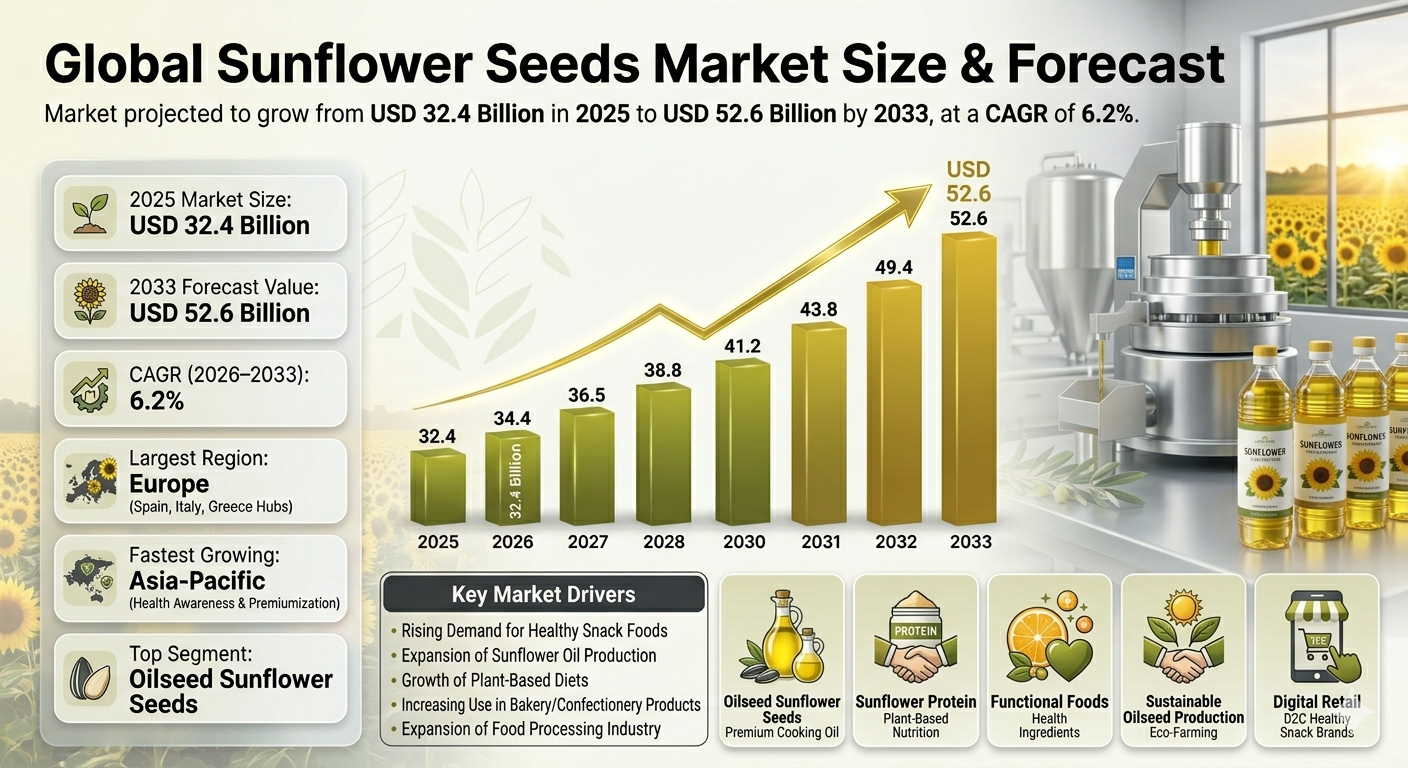
Global Sunflower Seeds Market Forecast Snapshot: 2026???2033
| Metric | Value |
| 2025 Market Size | USD 32.4 Billion |
| 2033 Market Size | USD 52.6 Billion |
| CAGR (2026???2033) | 6.2% |
| Largest Region | Europe |
| Fastest Growing Region | Asia-Pacific |
| Top Segment | Oilseed Sunflower Seeds |
| Key Trend | Plant-Based Nutrition and Healthy Snack Consumption |
| Future Focus | Functional Food Ingredients, Sunflower Protein, and Sustainable Oilseed Production |
Global Sunflower Seeds Market Overview
The Global Sunflower Seeds Market is experiencing steady growth as consumers increasingly adopt nutritious, plant-based, and protein-rich foods as part of healthier dietary habits. Sunflower seeds are widely recognized for their high nutritional value, including healthy fats, protein, fiber, vitamin E, and antioxidants, making them an important ingredient in the global food and oilseed industries.
According to Pheonix Research, the Global Sunflower Seeds Market is valued at USD 32.4 billion in 2025 and is projected to reach USD 52.6 billion by 2033, registering a CAGR of 6.2% during 2026???2033. Market growth is driven by rising demand for healthy snack products, plant-based ingredients, and sunflower oil production.
Sunflower seeds are widely used across snack foods, edible oil production, bakery products, confectionery, and plant-based food applications. The increasing popularity of protein-rich snacks, vegan diets, and functional foods is further expanding the market.
Europe currently dominates the market, supported by strong sunflower cultivation in countries such as Ukraine, Russia, and Romania. Meanwhile, Asia-Pacific is emerging as the fastest-growing region, driven by increasing health awareness, expanding food processing industries, and rising consumption of plant-based foods.
The post-2025 outlook highlights strong growth opportunities in sunflower protein ingredients, functional food applications, and sustainable oilseed agriculture, positioning sunflower seeds as an important segment within the global plant-based nutrition industry.
Key Drivers of Global Sunflower Seeds Market Growth
1. Rising Demand for Healthy Snack Foods
Consumers are increasingly choosing nutritious snacks rich in protein, fiber, and healthy fats, driving demand for sunflower seeds.
2. Expansion of Sunflower Oil Production
Growing global consumption of sunflower oil as a healthier cooking oil alternative is supporting increased sunflower seed cultivation.
3. Growth of Plant-Based Diets
Sunflower seeds are widely used in vegan food products, plant-based protein foods, and dairy alternatives.
4. Increasing Use in Bakery and Confectionery Products
Sunflower seeds are increasingly incorporated into bread, cereals, granola bars, and snack products.
5. Expansion of Food Processing and Ingredient Industries
Food manufacturers are using sunflower seeds as functional ingredients in health foods and processed food products.
Global Sunflower Seeds Market Segmentation
?? 1. By Product Type
1.1 Oilseed Sunflower Seeds
1.1.1 Conventional Oilseed Sunflower Seeds
1.1.1.1 High-Oil Content Seeds
1.1.1.2 Industrial Oil Processing Seeds
1.1.2 High-Oleic Sunflower Seeds
1.1.2.1 Premium Cooking Oil Production
1.1.2.2 Functional Oil Ingredients
1.2 Non-Oilseed (Confectionery) Sunflower Seeds
1.2.1 In-Shell Sunflower Seeds
1.2.1.1 Roasted Sunflower Seeds
1.2.1.2 Flavored Sunflower Seed Snacks
1.2.2 Shelled Sunflower Kernels
1.2.2.1 Raw Sunflower Kernels
1.2.2.2 Roasted Sunflower Kernels
1.3 Organic Sunflower Seeds
1.3.1 Certified Organic Seeds
1.3.1.1 Organic Snack Seeds
1.3.1.2 Organic Oilseed Production
1.3.2 Non-GMO Sunflower Seeds
1.3.2.1 Natural Food Ingredients
1.3.2.2 Organic Food Processing
?? 2. By Application
2.1 Edible Oil Production
2.1.1 Cooking Oil Manufacturing
2.1.1.1 Refined Sunflower Oil
2.1.1.2 Cold-Pressed Sunflower Oil
2.1.2 Food Processing Oils
2.1.2.1 Snack Manufacturing
2.1.2.2 Packaged Food Production
2.2 Snack Food Industry
2.2.1 Roasted Seed Snacks
2.2.1.1 Salted Sunflower Seeds
2.2.1.2 Flavored Snack Seeds
2.2.2 Healthy Snack Products
2.2.2.1 Seed Mix Snacks
2.2.2.2 Protein Snack Mixes
2.3 Bakery and Confectionery
2.3.1 Bakery Ingredient Applications
2.3.1.1 Bread and Rolls
2.3.1.2 Granola and Cereals
2.3.2 Confectionery Products
2.3.2.1 Chocolate-Coated Seeds
2.3.2.2 Snack Bars
2.4 Plant-Based Food Products
2.4.1 Plant-Based Protein Foods
2.4.1.1 Sunflower Protein Powder
2.4.1.2 Vegan Meat Alternatives
2.4.2 Dairy Alternatives
2.4.2.1 Sunflower Seed Milk
2.4.2.2 Plant-Based Yogurt
2.5 Animal Feed
2.5.1 Livestock Feed Products
2.5.2 Poultry Feed Ingredients
?? 3. By Distribution Channel
3.1 Supermarkets & Hypermarkets
3.1.1 Packaged Snack Products
3.1.2 Cooking Oil Retail Sections
3.2 Online Retail & E-commerce
3.2.1 Online Grocery Platforms
3.2.2 Direct-to-Consumer Healthy Snack Brands
3.3 Specialty Health Stores
3.3.1 Organic Food Retailers
3.3.2 Natural Health Food Stores
3.4 Wholesale & Foodservice Distribution
3.4.1 Restaurants and Catering
3.4.2 Food Processing Companies
?? 4. By End-User
4.1 Household Consumers
4.1.1 Healthy Snack Consumers
4.1.2 Home Cooking Applications
4.2 Food Processing Industry
4.2.1 Snack Manufacturers
4.2.2 Bakery Product Manufacturers
4.3 Foodservice Industry
4.3.1 Restaurants
4.3.2 Hotels and Catering Services
4.4 Nutraceutical and Health Food Companies
4.4.1 Functional Food Manufacturers
4.4.2 Plant-Based Nutrition Companies
??5.By Region
5.1 North America
5.2 Europe
5.3 Asia-Pacific
5.4 Middle East & Africa
5.5 South America
Regional Insights of Global Sunflower Seeds Market
Europe ??? Largest Market
Europe dominates the market due to extensive sunflower cultivation in Ukraine, Russia, and Eastern European countries, along with strong demand for sunflower oil.Asia-Pacific ??? Fastest Growing Market
Asia-Pacific is experiencing rapid growth driven by increasing demand for plant-based foods, rising snack consumption, and expanding food processing industries.North America
The region shows strong demand for healthy snack foods and plant-based protein ingredients.Middle East & Africa
Increasing consumption of edible oils and healthy snack foods is supporting market growth.
South America
Growing agricultural production and increasing demand for sunflower oil and snack seeds are supporting regional expansion.
Leading Companies in Global Sunflower Seeds Market
Cargill Inc.
Archer Daniels Midland (ADM)
Bunge Limited
Syngenta AG
Bayer CropScience
Conagra Brands
CHS Inc.
Limagrain Group
Strategic Intelligence & AI-Backed Insights
Pheonix Demand Forecast Engine identifies rising demand for plant-based foods, healthy snack products, and sunflower oil as key long-term growth drivers. Consumer Behavior Analyzer highlights increasing consumer preference for nutritious snacks, natural food ingredients, and plant-based protein foods. Innovation Tracker emphasizes sunflower protein products, functional food ingredients, and organic sunflower seeds as major competitive differentiators. Porter???s Five Forces Analysis reveals moderate supplier power, strong competition among global oilseed producers, and increasing opportunities for value-added sunflower seed products.Why the Global Sunflower Seeds Market is Critical
- Supports the growing global demand for healthy edible oils and plant-based foods.
- Provides essential nutrients such as protein, fiber, and healthy fats.
- Strengthens the global healthy snack and functional food industry.
- Promotes sustainable oilseed agriculture and food ingredient innovation.
- Expands opportunities for plant-based protein and nutraceutical products.
Final Takeaway of Global Sunflower Seeds Market
The Global Sunflower Seeds Market is steadily transitioning into a plant-based nutrition, healthy snack, and functional food ingredient ecosystem. The Sunflower Seeds Market CAGR 2026???2033 of 6.2% reflects stable expansion supported by rising demand for healthy oils, plant-based protein foods, and nutritious snack products.
Companies that invest in high-quality seed varieties, sustainable farming practices, and plant-based food innovation will be well positioned to capture long-term value creation within the global oilseed and healthy food industry.
At Pheonix Research, our advanced forecasting frameworks provide in-depth Sunflower Seeds Market revenue forecast analysis, competitive benchmarking, and strategic intelligence ??? enabling stakeholders to capitalize on the Post-2025 outlook for the Global Sunflower Seeds Market with data-backed confidence and sustainable growth strategies.
Table of Contents
1. Market Forecast Snapshot (2026???2033)
1.1 2025 Market Size ??? USD 32.4 Billion
1.2 2033 Market Size ??? USD 52.6 Billion
1.3 CAGR (2026???2033) ??? 6.2%
1.4 Largest Region ??? Europe
1.5 Fastest Growing Region ??? Asia-Pacific
1.6 Top Segment ??? Oilseed Sunflower Seeds
1.7 Key Trend ??? Plant-Based Nutrition and Healthy Snack Consumption
1.8 Future Focus ??? Functional Food Ingredients, Sunflower Protein, and Sustainable Oilseed Production
2. Global Sunflower Seeds Market Overview
2.1 Market Definition & Scope
2.2 Evolution of the Global Oilseed and Sunflower Industry
2.3 Nutritional Profile and Health Benefits of Sunflower Seeds
2.4 Rising Demand for Plant-Based Food Ingredients
2.5 Expansion of Healthy Snack and Edible Oil Markets
2.6 Post-2025 Market Outlook
3. Key Drivers of Global Sunflower Seeds Market Growth
3.1 Rising Demand for Healthy Snack Foods
3.2 Expansion of Sunflower Oil Production
3.3 Growth of Plant-Based Diets
3.4 Increasing Use in Bakery and Confectionery Products
3.5 Expansion of Food Processing and Ingredient Industries
4. Market Segmentation by Product Type
4.1 Oilseed Sunflower Seeds
4.1.1 Conventional Oilseed Sunflower Seeds
4.1.1.1 High-Oil Content Seeds
4.1.1.2 Industrial Oil Processing Seeds
4.1.2 High-Oleic Sunflower Seeds
4.1.2.1 Premium Cooking Oil Production
4.1.2.2 Functional Oil Ingredients
4.2 Non-Oilseed (Confectionery) Sunflower Seeds
4.2.1 In-Shell Sunflower Seeds
4.2.1.1 Roasted Sunflower Seeds
4.2.1.2 Flavored Sunflower Seed Snacks
4.2.2 Shelled Sunflower Kernels
4.2.2.1 Raw Sunflower Kernels
4.2.2.2 Roasted Sunflower Kernels
4.3 Organic Sunflower Seeds
4.3.1 Certified Organic Seeds
4.3.1.1 Organic Snack Seeds
4.3.1.2 Organic Oilseed Production
4.3.2 Non-GMO Sunflower Seeds
4.3.2.1 Natural Food Ingredients
4.3.2.2 Organic Food Processing
5. Market Segmentation by Application
5.1 Edible Oil Production
5.1.1 Cooking Oil Manufacturing
5.1.1.1 Refined Sunflower Oil
5.1.1.2 Cold-Pressed Sunflower Oil
5.1.2 Food Processing Oils
5.1.2.1 Snack Manufacturing
5.1.2.2 Packaged Food Production
5.2 Snack Food Industry
5.2.1 Roasted Seed Snacks
5.2.1.1 Salted Sunflower Seeds
5.2.1.2 Flavored Snack Seeds
5.2.2 Healthy Snack Products
5.2.2.1 Seed Mix Snacks
5.2.2.2 Protein Snack Mixes
5.3 Bakery and Confectionery
5.3.1 Bakery Ingredient Applications
5.3.1.1 Bread and Rolls
5.3.1.2 Granola and Cereals
5.3.2 Confectionery Products
5.3.2.1 Chocolate-Coated Seeds
5.3.2.2 Snack Bars
5.4 Plant-Based Food Products
5.4.1 Plant-Based Protein Foods
5.4.1.1 Sunflower Protein Powder
5.4.1.2 Vegan Meat Alternatives
5.4.2 Dairy Alternatives
5.4.2.1 Sunflower Seed Milk
5.4.2.2 Plant-Based Yogurt
5.5 Animal Feed
5.5.1 Livestock Feed Products
5.5.2 Poultry Feed Ingredients
6. Market Segmentation by Distribution Channel
6.1 Supermarkets & Hypermarkets
6.1.1 Packaged Snack Products
6.1.2 Cooking Oil Retail Sections
6.2 Online Retail & E-commerce
6.2.1 Online Grocery Platforms
6.2.2 Direct-to-Consumer Healthy Snack Brands
6.3 Specialty Health Stores
6.3.1 Organic Food Retailers
6.3.2 Natural Health Food Stores
6.4 Wholesale & Foodservice Distribution
6.4.1 Restaurants and Catering
6.4.2 Food Processing Companies
7. Market Segmentation by End-User
7.1 Household Consumers
7.1.1 Healthy Snack Consumers
7.1.2 Home Cooking Applications
7.2 Food Processing Industry
7.2.1 Snack Manufacturers
7.2.2 Bakery Product Manufacturers
7.3 Foodservice Industry
7.3.1 Restaurants
7.3.2 Hotels and Catering Services
7.4 Nutraceutical and Health Food Companies
7.4.1 Functional Food Manufacturers
7.4.2 Plant-Based Nutrition Companies
8. Market Segmentation by Region
8.1 North America
8.2 Europe
8.3 Asia-Pacific
8.4 Middle East & Africa
8.5 South America
9. Regional Insights
9.1 Europe ??? Largest Market
9.2 Asia-Pacific ??? Fastest Growing Market
9.3 North America ??? Rising Demand for Healthy Snack Products
9.4 Middle East & Africa ??? Growing Edible Oil Consumption
9.5 South America ??? Expanding Agricultural Production
10. Competitive Landscape
10.1 Market Share Analysis
10.2 Competitive Positioning Matrix
10.3 Seed Variety Development Strategies
10.4 Sustainable Farming and Supply Chain Strategies
10.5 Plant-Based Ingredient Innovation
11. Leading Companies
11.1 Cargill Inc.
11.2 Archer Daniels Midland (ADM)
11.3 Bunge Limited
11.4 Syngenta AG
11.5 Bayer CropScience
11.6 Conagra Brands
11.7 CHS Inc.
11.8 Limagrain Group
12. Strategic Intelligence & AI-Backed Insights
12.1 Pheonix Demand Forecast Engine
12.2 Consumer Behavior & Nutrition Trend Analytics
12.3 Innovation Tracker ??? Plant-Based Protein and Functional Ingredients
12.4 Porter???s Five Forces Analysis
13. Sustainability & Regulatory Landscape
13.1 Sustainable Oilseed Farming Practices
13.2 Agricultural Biotechnology and Seed Development
13.3 Food Safety and Ingredient Regulations
13.4 Environmental Impact of Oilseed Agriculture
14. Market Significance
14.1 Supporting Global Demand for Healthy Edible Oils
14.2 Promoting Plant-Based Nutrition and Protein Foods
14.3 Strengthening the Healthy Snack and Functional Food Industry
14.4 Encouraging Sustainable Oilseed Agriculture
14.5 Expanding Opportunities for Nutraceutical and Food Ingredient Innovation
15. Final Takeaway
15.1 Market Growth Outlook (2026???2033)
15.2 Expansion of Plant-Based Protein Ingredients
15.3 Growth of Healthy Snack and Edible Oil Applications
15.4 Innovation in Functional Food Ingredients
15.5 Strategic Recommendations for Industry Stakeholders
16. Appendix
17. About Us
18. Disclaimer
Competitive Landscape
Competitive Landscape of the Global Sunflower Seeds Market
Executive Framing
The Global Sunflower Seeds Market is characterized by a dual-layer competitive ecosystem comprising global agribusiness conglomerates, seed technology leaders, and large-scale edible oil processors. Companies such as Cargill, ADM, Bunge, Syngenta, Bayer CropScience, and CHS Inc. dominate upstream seed production and oilseed processing, while downstream FMCG and food brands leverage sunflower seeds for snacks, bakery products, and plant-based food applications. Competition is intensifying due to rising demand for plant-based proteins, healthy snack alternatives, and sunflower oil as a preferred healthy cooking oil.
Current Market Reality
The market is evolving rapidly as consumers shift toward plant-based nutrition, clean-label foods, and protein-rich snacking. Sunflower seeds are no longer limited to oil extraction; they are increasingly used in functional foods, snack bars, bakery products, and plant-based protein formulations. Europe remains the production powerhouse due to large-scale cultivation in Eastern Europe, while Asia-Pacific is emerging as a consumption-led growth hub driven by rising health awareness and expanding processed food industries.
Key Signals and Evidence
- Rising demand for plant-based protein ingredients and vegan food products.
- Increasing consumption of sunflower oil as a healthier edible oil alternative.
- Expansion of sunflower-based snack and bakery product categories.
- Growing adoption of non-GMO and organic sunflower seed variants.
- Strong integration of sunflower seeds in functional food formulations.
Strategic Implications
- Value-Added Processing: Shift from raw seed supply to high-margin protein, oil, and functional ingredient extraction.
- Plant-Based Innovation: Expansion into sunflower protein powders and vegan food applications.
- Premiumization Strategy: Focus on organic, non-GMO, and high-oleic sunflower seed varieties.
- Supply Chain Integration: Strengthening backward integration in seed cultivation and forward integration in FMCG applications.
- Geographic Expansion: Targeting Asia-Pacific demand growth through packaged snacks and edible oil distribution.
Forward Outlook
By 2033, the Global Sunflower Seeds Market is expected to evolve into a diversified plant-based nutrition and functional ingredient ecosystem, moving beyond traditional oilseed usage. Growth will be driven by sunflower protein innovation, sustainable agriculture practices, and increasing demand for clean-label snack products.
Europe will remain the dominant production region, while Asia-Pacific will emerge as the fastest-growing consumption market. Companies investing in high-yield hybrid seed development, sustainable farming technologies, and value-added sunflower-based food innovations will secure long-term competitive advantage in the evolving global oilseed and plant-based nutrition landscape.
Value Chain
Global Sunflower Seeds Market: Value Chain & Market Dynamics
Executive Framing
The Global Sunflower Seeds Market is evolving into a plant-based nutrition, functional food ingredient, and healthy snacking ecosystem, driven by rising consumer demand for protein-rich, fiber-dense, and nutrient-packed natural foods. Sunflower seeds are increasingly positioned as a dual-purpose commodity supporting both edible oil production and value-added food applications.
The market operates through a agriculture-led integrated value chain, spanning seed cultivation, harvesting, oil extraction, kernel processing, roasting, packaging, and global distribution. Producers are increasingly focusing on yield optimization, non-GMO cultivation, and premium seed grading to enhance value realization.
Current Market Reality
The supply chain exhibits a moderate-to-high complexity level, influenced by climatic dependency, geopolitical production concentration (Eastern Europe), storage sensitivity, and commodity price fluctuations. Despite these challenges, mechanization and improved hybrid seed varieties are enhancing productivity and stability.
Distribution follows a strong multichannel structure, including supermarkets, hypermarkets, online retail platforms, specialty health stores, and industrial foodservice channels, ensuring balanced penetration across consumer and industrial segments.
Key Signals and Evidence
- Market expansion from USD 32.4 billion (2025) to USD 52.6 billion (2033) at a CAGR of 6.2%.
- Rising demand for plant-based protein and healthy snack alternatives.
- Strong growth in sunflower oil consumption globally.
- Increasing use of sunflower seeds in bakery, confectionery, and functional foods.
- Expansion of organic, non-GMO, and value-added seed products.
Strategic Implications
Market players are prioritizing seed innovation, yield improvement, and value-added processing to strengthen competitiveness. Large agribusiness firms focus on scale, commodity trading, and oilseed processing efficiency, while niche players emphasize organic certification, premium snack seeds, and plant-based protein development.
Digitalization and direct-to-consumer channels are gradually gaining traction, especially for roasted, flavored, and packaged sunflower seed snacks, improving brand differentiation and consumer engagement.
Sustainability is becoming a core priority, with emphasis on regenerative agriculture, reduced pesticide usage, water-efficient farming, and sustainable oilseed supply chains.
Forward Outlook
The Global Sunflower Seeds Market is expected to strengthen its position as a core plant-based nutrition and functional ingredient ecosystem, supported by long-term dietary shifts and industrial diversification.
- Growth in sunflower protein ingredients and plant-based alternatives
- Expansion of functional snack and superfood applications
- Increasing demand for organic and non-GMO sunflower seed products
- Stronger integration into health food and nutraceutical industries
Companies focusing on agricultural innovation, value-added processing, and sustainable production systems will be best positioned to capture long-term growth in the sunflower seeds market.
Investment Activity
Investment & Funding Dynamics ??? Global Sunflower Seeds Market
Executive Framing
Current Market Reality
Valued at USD 32.4 billion in 2025 and projected to reach USD 52.6 billion by 2033 (CAGR 6.2%), the market reflects stable agricultural and food-sector investment growth. Europe remains the dominant production and investment hub due to large-scale sunflower cultivation in Ukraine, Russia, and Eastern Europe, while Asia-Pacific is the fastest-growing region driven by rising health awareness and expanding food processing industries. Key players such as Cargill Inc., ADM, and Bunge Limited are investing in seed innovation, sustainable farming practices, and global supply chain expansion.
Key Signals and Evidence
- Plant-Based Nutrition Growth: Increasing investments in sunflower protein and plant-based food ingredients.
- Sunflower Oil Expansion: Rising capital flow into edible oil production and cold-pressed oil innovation.
- Healthy Snacking Demand: Strong growth in roasted seeds, flavored snacks, and seed-based nutrition products.
- Functional Food Integration: Expanding use of sunflower seeds in bakery, cereals, and fortified foods.
- Seed Innovation & R&D: Investments in high-oleic and high-yield sunflower seed varieties.
- Sustainable Agriculture: Growing focus on eco-friendly cultivation and regenerative farming practices.
- E-Commerce Expansion: Increasing online distribution of packaged sunflower seed snacks and oils.
Strategic Implications
Companies that integrate agricultural innovation with downstream food processing capabilities are best positioned for long-term growth. Investors are prioritizing firms with control over seed development, oil extraction, and branded consumer products. Strategic partnerships across agriculture, food manufacturing, and retail distribution will be critical for scaling global market presence and improving margins through value-added products.
Forward Outlook
From 2026 to 2033, investment in the Global Sunflower Seeds Market is expected to strengthen, with increasing focus on sunflower protein development, functional food applications, and sustainable farming technologies. Growth in plant-based diets and healthy snacking will continue to attract capital. M&A activity is expected to rise as major agribusiness firms consolidate seed production and expand into consumer food product segments.
Technology & Innovation
Global Sunflower Seeds Market: Technology & Innovation
Executive Framing
Technology and innovation in the Global Sunflower Seeds Market are increasingly focused on improving yield efficiency, enhancing nutritional profiles, and enabling value-added applications across food, oil, and plant-based protein industries. With rising global demand for healthy snacks and functional ingredients, stakeholders are investing in advanced seed breeding technologies, precision agriculture, and oil extraction innovations to improve productivity, sustainability, and end-use versatility.
Current Market Reality
Valued at USD 32.4 billion in 2025 and projected to reach USD 52.6 billion by 2033 at a CAGR of 6.2%, the market is expanding steadily across both food and industrial applications. Europe remains the dominant region due to large-scale cultivation in Eastern Europe, while Asia-Pacific is emerging as the fastest-growing market driven by increasing demand for plant-based foods, edible oils, and healthy snack alternatives.
Key Signals and Evidence
- Advanced Seed Breeding: Development of high-oleic and high-yield sunflower seed varieties to improve oil quality and agricultural productivity.
- Precision Agriculture Adoption: Use of AI, IoT sensors, and satellite monitoring to optimize irrigation, soil health, and crop yield efficiency.
- Sunflower Protein Expansion: Growing extraction of sunflower seed protein for use in plant-based meat alternatives and nutritional supplements.
- Cold-Press Oil Innovation: Increasing adoption of cold-pressed and minimally processed sunflower oil to preserve nutrients and antioxidants.
- Sustainable Farming Practices: Shift toward regenerative agriculture, reduced chemical usage, and climate-resilient cultivation methods.
- Functional Food Integration: Rising use of sunflower seeds in granola bars, bakery products, and fortified health foods.
Strategic Implications
Companies investing in seed genetics, sustainable agriculture, and plant-based protein innovation are likely to gain a competitive edge. Expansion into high-value segments such as functional foods, nutraceutical ingredients, and premium cold-pressed oils will enhance revenue diversification. Additionally, integrating digital agriculture tools and supply chain transparency will be critical for improving efficiency and meeting global sustainability expectations.
Forward Outlook
The market is expected to evolve toward a fully integrated plant-based nutrition ecosystem, where sunflower seeds play a central role in edible oils, protein ingredients, and functional foods. Future innovation will focus on biofortified seed varieties, climate-resilient farming systems, and expanded applications in vegan and clean-label food products. Sunflower seeds will continue to strengthen their position as a core ingredient in global healthy food systems.
Market Risk
Risk Factors and Disruption Threats in the Global Olive Oil Market
Executive Framing
The Global Olive Oil Market is evolving as a premium health-focused edible oil category, driven by rising consumer awareness of healthy fats, cardiovascular benefits, and natural food consumption patterns. Valued at USD 16.8 billion in 2025 and projected to reach USD 25.7 billion by 2033 at a CAGR of 5.5%, the market reflects steady global demand supported by the expansion of Mediterranean diets, organic food consumption, and premium cooking oil preferences.
Current Market Reality
Europe remains the dominant market due to established olive cultivation ecosystems in Spain, Italy, and Greece, combined with strong domestic consumption. Asia-Pacific is emerging as the fastest-growing region, fueled by increasing health awareness, rising disposable incomes, and rapid adoption of premium cooking oils. Extra virgin olive oil continues to lead the market due to its high nutritional value, antioxidant content, and widespread culinary use.
Key Signals and Evidence
- Rising global shift toward Mediterranean and heart-healthy diets.
- Increasing demand for cold-pressed, organic, and premium olive oils.
- Expansion of olive oil applications in nutraceutical and cosmetic industries.
- Growing consumer preference for clean-label and minimally processed foods.
- Rising adoption of gourmet cooking trends across urban populations.
Strategic Implications
- Expand investments in organic olive cultivation and sustainable farming techniques.
- Develop premium extra virgin and specialty flavored olive oil variants.
- Strengthen branding around health benefits and Mediterranean lifestyle positioning.
- Diversify product applications into skincare, haircare, and nutraceutical sectors.
- Enhance global distribution through digital retail and gourmet specialty stores.
Forward Outlook
The olive oil market is expected to transition further into a premium, wellness-driven, and sustainability-focused ecosystem. Growth will be supported by rising demand for organic and cold-pressed oils, increasing integration into functional foods and cosmetics, and expanding global awareness of healthy dietary fats. Companies focusing on product authenticity, traceability, and sustainable sourcing will gain a strong competitive advantage in the long term.
Regulatory Landscape
Regulatory & Policy Landscape: Global Sunflower Seeds Market
Executive Framing
The Global Sunflower Seeds Market operates under a dual regulatory framework covering agricultural production and food processing standards. Regulatory oversight is driven by agencies such as the U.S. FDA, European Food Safety Authority (EFSA), Codex Alimentarius Commission, and national agricultural ministries that govern seed quality, food safety, and edible oil standards.
Sunflower seeds are regulated across multiple end-use categories including oilseed production, snack foods, animal feed, and plant-based food ingredients. This multi-application nature requires compliance with both agricultural seed certification standards and food-grade safety regulations.
Current Market Reality
The market is influenced by strong agricultural policy interventions, especially in major producing regions such as Europe and Eastern Europe. Subsidies, trade policies, and crop protection regulations significantly impact production volumes and pricing structures.
On the food side, rising demand for clean-label and non-GMO products is pushing manufacturers toward stricter quality control, organic certification, and residue-free farming practices. Global supply chains are also exposed to volatility due to climate change and geopolitical disruptions in key sunflower-producing regions.
Key Signals and Evidence
- Seed certification regulations ensuring high-yield and disease-resistant sunflower varieties.
- Strict food safety standards for edible oil extraction and processing.
- Increasing demand for Non-GMO, organic, and pesticide-free certifications.
- Trade regulations impacting sunflower oil and seed exports, particularly in Europe and Asia.
- Quality standards for aflatoxin and contaminant control in edible seed products.
- Rising emphasis on sustainable agriculture and soil health regulations.
Strategic Implications
Producers must invest in high-quality hybrid seed development, precision agriculture, and compliance with international food safety standards. Vertical integration across farming, processing, and packaging is becoming increasingly important to ensure traceability and cost control.
Companies focusing on organic certification, sustainable farming, and value-added sunflower seed products (such as protein powders and functional snacks) are better positioned to capture premium segments and mitigate commodity price volatility.
Forward Outlook (2026???2033)
Regulatory frameworks are expected to tighten around pesticide usage, carbon emissions in agriculture, and sustainability reporting. Governments will increasingly support climate-resilient crop varieties and sustainable oilseed production practices.
Technological advancements such as AI-based crop monitoring, blockchain traceability systems, and precision farming tools will become critical for regulatory compliance and yield optimization. Global harmonization of food safety standards will also facilitate smoother international trade.