
Rapport sur le marché mondial des services d'hébergement web IP-VPN, taille et prévision 2026-2033
Le marché mondial des services d'hébergement web via le réseau IP-VPN est sur le point de connaître une croissance substantielle pendant la période de prévision allant de 2026 à 2033, soutenue par une demande croissante des entreprises en matière de connectivité réseau sécurisée, d'infrastructures d'hébergement basées sur le cloud et de solutions d'hébergement gérées fiables. Évalué à 18,75 milliards de dollars en 2025, le marché est prévu pour atteindre environ 39,85 milliards de dollars d'ici 2033, enregistrant un taux de croissance annuel composé (CAGR) de 9,90 % pendant la période de prévision.
L'adoption croissante d'environnements cloud hybrides, des cadres de sécurité Zero Trust, des initiatives de transformation numérique, ainsi que le besoin croissant d'accès distant sécurisé et de continuité des activités commerciales devraient soutenir une expansion durable du marché. En outre, l'augmentation des investissements dans les réseaux d'entreprise, la modernisation des centres de données et les solutions de cybersécurité devraient créer des opportunités de croissance significatives à la fois dans les marchés développés et les marchés émergents.
Aperçu de la prévision du marché mondial des services d'hébergement web IP-VPN (2026–2033)
| Métrique | Valeur |
|---|---|
| Taille du marché (2025) | 18,75 milliards de dollars américains |
| Taille du marché (2033) | 39,85 milliards de dollars américains |
| Taux de croissance annuel composé (2026–2033) | 9.90% |
| Plus grand segment | Services d'hébergement IP-VPN gérés |
| Segment en plus forte croissance | Services d'hébergement web sécurisés basés en nuage |
| Segment d'utilisation final dominant | Grandes entreprises |
| Tendance clé | Sécurité Zero Trust, intégration SD-WAN, hébergement en nuage hybride, Surveillance des réseaux pilotée par l'intelligence artificielle et accès distant sécurisé |
| Influence réglementaire | Règlements sur la protection des données, normes de cybersécurité, politiques de protection des données transfrontalières et cadres de conformité en nuage |
| Perspective future | Croissance entraînée par la transformation numérique, la connectivité sécurisée des entreprises, l'adoption du nuage hybride et l'augmentation des investissements en cybersécurité |
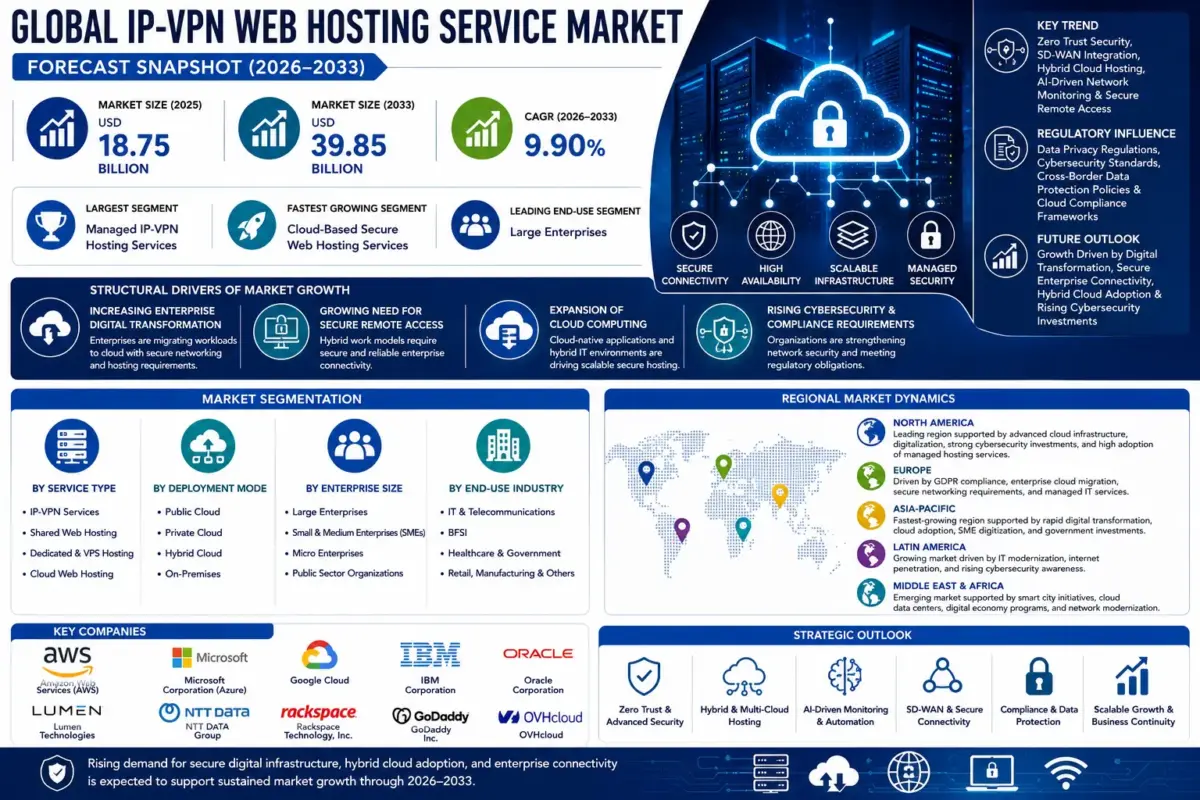
Taille et prévision du marché mondial des services d'hébergement web IP-VPN
Le marché mondial des services d'hébergement web IP-VPN devrait connaître une croissance forte pendant la période de prévision, de 2026 à 2033. Le marché était estimé à 18,75 milliards de dollars américains en 2025 et devrait atteindre environ 39,85 milliards de dollars américains d'ici 2033, enregistrant un taux de croissance annuel composé (CAGR) de 9,90 %. La croissance du marché est principalement entraînée par l'augmentation de la transformation numérique des entreprises, la demande croissante d'une connectivité à distance sécurisée, l'adoption croissante d'applications d'entreprise hébergées en nuage, l'expansion des environnements de travail hybrides et l'augmentation des investissements dans la cybersécurité et les services d'hébergement.Aperçu du marché mondial des services d'hébergement web IP-VPN
Le marché des services d'hébergement web IP-VPN comprend des solutions d'hébergement sécurisées intégrées aux technologies de Réseau Privé Virtuel sur Internet (IP-VPN) pour fournir une communication chiffrée, un hébergement d'applications sécurisées, la gestion de sites web, l'infrastructure en nuage et des services de réseau d'entreprise. Ces services sont largement adoptés dans les secteurs bancaires, de la santé, gouvernementaux, de l'industrie, du commerce de détail, des télécommunications et des technologies de l'information afin d'assurer un accès sécurisé, une disponibilité réseau élevée, la conformité réglementaire, et une continuité des activités commercialesfiable. Les progrès continus en informatique en nuage, en SD-WAN, en architecture Zero Trust, en sécurité pilotée par l'intelligence artificielle et en services d'hébergement gérés transforment le marché.Facteurs structurels de la croissance du marché
1. Augmentation de la transformation numérique des entreprises Digital Transformation
Les organisations migrent rapidement leurs charges de travail vers les plateformes en nuage tout en nécessitant une infrastructure de réseau et d'hébergement sécurisée. Implications du marché : La demande en solutions intégrées IP-VPN et en services d'hébergement gérés continue d'augmenter.2. Besoin croissant d'accès à distance sécurisé
Les modèles de travail hybrides et les opérations réparties géographiquement exigent une connectivité d'entreprise sécurisée et fiable. Implications du marché : Les entreprises investissent de plus en plus dans des environnements d'hébergement activés par le VPN et des réseaux d'entreprise sécurisés.3. Expansion de la mise en cloud
Les applications natives du cloud et les environnements informatiques hybrides accélèrent l'adoption de plateformes d'hébergement évolutives dotées d'une sécurité réseau intégrée. Implications du marché : Les services d'hébergement IP-VPN basés sur le cloud deviennent un modèle de déploiement préféré.4. Augmentation des exigences de cybersécurité et de conformité
Les organisations renforcent la sécurité réseau pour protéger les données sensibles et respecter les obligations réglementaires. Implications du marché : Les fournisseurs d'hébergement gérés proposant des services de sécurité intégrés gagnent en avantage compétitif.Segmentation du marché mondial des services d'hébergement web IP-VPN
1. Par type de service
1.1 Services IP-VPN
1.1.1 MPLS IP-VPN 1.1.1.1 Réseaux MPLS d'entreprise 1.1.1.1.1 Réseau MPLS de niveau 3 1.1.1.1.2 Réseau MPLS de niveau 2 1.1.1.1.3 Services MPLS gérés 1.1.1.1.4 Réseaux MPLS hybrides 1.1.2 VPN basés sur Internet 1.1.3 VPN activés par SD-WAN 1.1.4 Services de VPN cloud1.2 Hébergement partagé
1.2.1 Hébergement partagé Linux 1.2.2 Hébergement partagé Windows 1.2.3 Hébergement partagé géré 1.2.4 Forfaits d'hébergement illimités1.3 Hébergement dédié & VPS
1.3.1 Serveur privé virtuel (VPS) 1.3.2 Hébergement sur serveur dédié 1.3.3 Hébergement VPS géré 1.3.4 Hébergement en métal nu1.4 Hébergement web en cloud
1.4.1 Hébergement en cloud public 1.4.2 Hébergement en cloud privé 1.4.3 Hébergement en cloud hybride 1.4.4 Hébergement en multi-cloud2. Par mode de déploiement
2.1 Cloud public
2.1.1 Infrastructure multi-locataire 2.1.1.1 Plateformes d'hébergement en cloud 2.1.1.1.1 Infrastructure auto-échelonnée 2.1.1.1.2 Services de répartition de charge 2.1.1.1.3 Intégration de stockage en cloud 2.1.1.1.4 Services de récupération après sinistre 2.1.2 Cloud public géré 2.1.3 VPN basé sur le cloud 2.1.4 Hébergement SaaS2.2 Cloud privé
2.2.1 Cloud privé d'entreprise 2.2.2 Infrastructure dédiée 2.2.3 Hébergement privé sécurisé 2.2.4 Réseaux de VPN privés2.3 Cloud hybride
2.3.1 Solutions d'hébergement hybrides 2.3.2 Déploiement hybride de VPN 2.3.3 Gestion multi-environnement 2.3.4 Solutions de bursting cloud2.4 En interne
2.4.1 Centres de données d'entreprise 2.4.2 Infrastructure gérée par l'utilisateur 2.4.3 Environnements d'hébergement privés 2.4.4 Réseaux de VPN internes3. Par taille d'entreprise
3.1 Grandes entreprises
3.1.1 Entreprises mondiales 3.1.1.1 Connectivité réseau multisite 3.1.1.1.1 Réseaux de VPN internationaux 3.1.1.1.2 Hébergement web mondial 3.1.1.1.3 Échange sécurisé de données 3.1.1.1.4 Récupération après sinistre d'entreprise 3.1.2 Entreprises du Fortune 500 3.1.3 Organisations gouvernementales 3.1.4 Multinationales3.2 Petites et moyennes entreprises (PME)
3.2.1 Petites entreprises 3.2.2 Entreprises moyennes 3.2.3 Startups 3.2.4 Entreprises en croissance3.3 Microentreprises
3.3.1 Indépendants 3.3.2 Entreprises à domicile 3.3.3 Professionnels indépendants 3.3.4 Entrepreneurs numériques3.4 Organisations du secteur public
3.4.1 Agences gouvernementales 3.4.2 Institutions éducatives 3.4.3 Organisations de santé 3.4.4 Services publics4. Par secteur d'application
4.1 Informatique et télécommunications
4.1.1 Fournisseurs de services gérés 4.1.1.1 Services de connectivité d'entreprise 4.1.1.1.1 Réseaux de centres de données 4.1.1.1.2 Accès distant sécurisé 4.1.1.1.3 Hébergement web d'entreprise 4.1.1.1.4 Services d'infrastructure cloud 4.1.2 Fournisseurs de services Internet 4.1.3 Opérateurs de télécommunications 4.1.4 Fournisseurs de services cloud4.2 BFSI
4.2.1 Banque 4.2.2 Assurance 4.2.3 Services financiers 4.2.4 Entreprises de FinTech4.3 Santé et gouvernement
4.3.1 Hôpitaux 4.3.2 Agences gouvernementales 4.3.3 Systèmes de santé publique 4.3.4 Organisations de défense4.4 Commerce, industrie et autres
4.4.1 Commerce et e-commerce 4.4.2 Industrie 4.4.3 Éducation 4.4.4 Médias et divertissementDynamique régionale du marché
Amérique du Nord
Région dominante soutenue par une infrastructure cloud avancée, une numérisation d'entreprise généralisée, des investissements forts en cybersécurité et une forte adoption des services d'hébergement gérés.Europe
Mouvement impulsé par la conformité au RGPD, la migration vers le cloud d'entreprise, les exigences de réseau sécurisé et la demande croissante de services informatiques gérés.Asie-Pacifique
Région à la croissance la plus rapide soutenue par une transformation numérique rapide, une adoption croissante du cloud, une numérisation des PME croissante et des investissements gouvernementaux dans l'infrastructure numérique.Amérique latine
Marché en croissance impulsé par la modernisation de l'infrastructure informatique d'entreprise, une pénétration croissante d'Internet et une sensibilisation croissante à la cybersécurité.Moyen-Orient et Afrique
Marché émergent soutenu par les initiatives de ville intelligente, l'expansion des centres de données cloud, les programmes de l'économie numérique et la modernisation des réseaux d'entreprise.Paysage concurrentiel
Le marché mondial des services d'hébergement web IP-VPN est très concurrentiel, avec des fournisseurs de services cloud, des entreprises de télécommunications, des fournisseurs d'hébergement gérés, des entreprises de cybersécurité et des fournisseurs de réseaux d'entreprise qui se concentrent sur l'hébergement cloud sécurisé, l'infrastructure gérée, l'intégration SD-WAN et des solutions de sécurité réseau avancées. Les principales entreprises opérant sur le marché comprennent :- Amazon Web Services (AWS)
- Microsoft Corporation (Azure)
- Google Cloud
- IBM Corporation
- Oracle Corporation
- Lumen Technologies
- NTT DATA Group
- Rackspace Technology, Inc.
- GoDaddy Inc.
- OVHcloud
Perspective stratégique
L'avenir du marché des services d'hébergement web IP-VPN sera façonné par le Zero Trust networking, la détection des menaces guidée par l'intelligence artificielle, l'intégration SD-WAN, le calcul en périphérie, les plateformes d'hébergement cloud-native et la gestion automatisée de l'infrastructure. Les fournisseurs de services investissent de plus en plus dans la surveillance intelligente du réseau, des environnements cloud hybrides sécurisés, des technologies de chiffrement avancées et des services d'hébergement axés sur la conformité afin d'améliorer la résilience opérationnelle et la confiance des clients. L'accent croissant sur la cybersécurité, le travail à distance sécurisé, la transformation numérique, l'infrastructure cloud-native et la continuité des activités continuera à créer des opportunités de marché significatives. Les entreprises se concentrant sur le réseau intégré, les services de sécurité gérés, l'hébergement cloud évolutif et l'optimisation de l'infrastructure alimentée par l'intelligence artificielle renforceront leur position concurrentielle dans l'industrie mondiale des services d'hébergement.Perspective finale du marché
Le marché mondial des services d'hébergement web IP-VPN devient un composant essentiel de l'infrastructure informatique d'entreprise sécurisée. La demande croissante pour des environnements numériques protégés, l'adoption croissante des technologies cloud, l'expansion des modèles de travail hybrides et les progrès continus en matière de cybersécurité devraient soutenir une croissance durable du marché pendant toute la période de prévision. Les organisations offrant des solutions d'hébergement web IP-VPN sécurisées, évolutives et intelligentes seront bien positionnées pour tirer parti des opportunités à long terme à travers l'écosystème de l'infrastructure numérique mondiale.Table des matières
1. Résumé exécutif
1.1 Aperçu du marché (2026–2033) 1.2 Points clés de croissance 1.3 Aperçu de la demande et de l'offre 1.4 Principales perspectives stratégiques 1.5 Point de vue de l'analyste2. Aperçu du marché
2.1 Introduction au marché mondial des services d'hébergement web IP-VPN 2.2 Analyse de la chaîne de valeur industrielle 2.3 Évolution du marché et tendances historiques 2.4 Analyse de l'impact macro-économique 2.5 Écosystème d'hébergement en nuage d'entreprise et infrastructure réseau sécurisée 2.6 Tendances liées à la sécurité Zero Trust, à l'intégration SD-WAN, à l'hébergement en nuage hybride et à la surveillance du réseau pilotée par l'IA3. Aperçu de la prévision du marché mondial des services d'hébergement web IP-VPN (en milliards de dollars), 2026–2033
3.1 Taille du marché en 2025 3.2 Taille du marché en 2033 3.3 Taux de croissance annuel composé (2026–2033) 3.4 Segment le plus important 3.5 Segment le plus rapide de croissance 3.6 Segment d'utilisation final dominant 3.7 Tendance clé 3.8 Influence réglementaire 3.9 Perspective future4. Principaux moteurs de croissance du marché
4.1 Augmentation de la transformation numérique des entreprises 4.2 Augmentation de la demande d'accès distant sécurisé 4.3 Expansion du cloud computing 4.4 Augmentation des exigences de cybersécurité et de conformité 4.5 Augmentation de l'adoption d'infrastructures en nuage hybride5. Défis du marché
5.1 Augmentation des menaces de cybersécurité 5.2 Exigences complexes de conformité réglementaire 5.3 Coûts élevés d'infrastructure et d'exploitation 5.4 Défis d'intégration dans les environnements informatiques hérités6. Segmentations du marché par type de service (en milliards de dollars), 2026–2033
6.1 Services IP-VPN 6.1.1 IP-VPN MPLS 6.1.1.1 Réseaux MPLS d'entreprise 6.1.1.1.1 Réseau MPLS de niveau 3 6.1.1.1.2 Réseau MPLS de niveau 2 6.1.1.1.3 Services MPLS gérés 6.1.1.1.4 Réseaux MPLS hybrides 6.1.2 VPN basé sur Internet 6.1.3 VPN activé par SD-WAN 6.1.4 Services de VPN en nuage 6.2 Hébergement partagé 6.2.1 Hébergement partagé Linux 6.2.2 Hébergement partagé Windows 6.2.3 Hébergement partagé géré 6.2.4 Forfaits d'hébergement illimités 6.3 Hébergement dédié et VPS 6.3.1 Serveur virtuel privé (VPS) 6.3.2 Hébergement de serveur dédié 6.3.3 Hébergement VPS géré 6.3.4 Hébergement sur métal nu 6.4 Hébergement web en nuage 6.4.1 Hébergement en nuage public 6.4.2 Hébergement en nuage privé 6.4.3 Hébergement en nuage hybride 6.4.4 Hébergement en nuage multi7. Segmentations du marché par mode de déploiement (en milliards de dollars), 2026–2033
7.1 Cloud public 7.1.1 Infrastructure multi-locataire 7.1.1.1 Plateformes d'hébergement en nuage 7.1.1.1.1 Infrastructure auto-échelle 7.1.1.1.2 Services de répartition de charge 7.1.1.1.3 Intégration de stockage en nuage 7.1.1.1.4 Services de récupération après sinistre 7.1.2 Cloud public géré 7.1.3 VPN basé sur le cloud 7.1.4 Hébergement SaaS 7.2 Cloud privé 7.2.1 Cloud privé d'entreprise 7.2.2 Infrastructure dédiée 7.2.3 Hébergement privé sécurisé 7.2.4 Réseaux de VPN privés 7.3 Cloud hybride 7.3.1 Solutions d'hébergement hybrides 7.3.2 Déploiement hybride de VPN 7.3.3 Gestion multi-environnement 7.3.4 Solutions de bursting en nuage 7.4 Sur site 7.4.1 Centres de données d'entreprise 7.4.2 Infrastructure auto-gérée 7.4.3 Environnements d'hébergement privés 7.4.4 Réseaux de VPN internes8. Segmentations du marché par taille d'entreprise (en milliards de dollars), 2026–2033
8.1 Grandes entreprises 8.1.1 Entreprises mondiales 8.1.1.1 Connectivité réseau multisite 8.1.1.1.1 Réseaux de VPN internationaux 8.1.1.1.2 Hébergement web mondial 8.1.1.1.3 Échange sécurisé de données 8.1.1.1.4 Récupération après sinistre d'entreprise 8.1.2 Entreprises du Fortune 500 8.1.3 Organisations gouvernementales 8.1.4 Multinationales 8.2 Petites et moyennes entreprises (PME) 8.2.1 Petites entreprises 8.2.2 Moyennes entreprises 8.2.3 Start-ups 8.2.4 Entreprises en croissance 8.3 Microentreprises 8.3.1 Indépendants 8.3.2 Entreprises à domicile 8.3.3 Professionnels indépendants 8.3.4 Entrepreneurs numériques 8.4 Organisations du secteur public 8.4.1 Agences gouvernementales 8.4.2 Institutions éducatives 8.4.3 Organisations de santé 8.4.4 Services publics9. Segmentations du marché par secteur d'utilisation (en milliards de dollars), 2026–2033
9.1 Informatique et télécommunications 9.1.1 Fournisseurs de services gérés 9.1.1.1 Services de connectivité d'entreprise 9.1.1.1.1 Réseaux de centres de données 9.1.1.1.2 Accès distant sécurisé 9.1.1.1.3 Hébergement web d'entreprise 9.1.1.1.4 Services d'infrastructure en nuage 9.1.2 Fournisseurs de services Internet 9.1.3 Opérateurs de télécommunications 9.1.4 Fournisseurs de services en nuage 9.2 BFSI 9.2.1 Banque 9.2.2 Assurance 9.2.3 Services financiers 9.2.4 Entreprises FinTech 9.3 Santé et gouvernement 9.3.1 Hôpitaux 9.3.2 Agences gouvernementales 9.3.3 Systèmes de santé publics 9.3.4 Organisations de défense 9.4 Commerce, fabrication et autres 9.4.1 Commerce et e-commerce 9.4.2 Fabrication 9.4.3 Éducation 9.4.4 Médias et divertissement10. Segmentations du marché par région (en milliards de dollars), 2026–2033
10.1 Amérique du Nord 10.2 Europe 10.3 Asie-Pacifique 10.4 Amérique latine 10.5 Moyen-Orient et Afrique11. Analyse du marché régional
11.1 Amérique du Nord – Leader en infrastructure cloud avancée 11.2 Europe – Centre de sécurité cloud et conformité RGPD 11.3 Asie-Pacifique – Marché d'infrastructure numérique en croissance la plus rapide 11.4 Amérique latine – Modernisation en cours de l'informatique d'entreprise 11.5 Moyen-Orient et Afrique – Marché émergent d'infrastructure numérique12. Paysage concurrentiel
12.1 Analyse de la part de marché 12.2 Matrice de positionnement concurrentiel 12.3 Développements stratégiques (fusions-acquisitions, lancements de produits, partenariats) 12.4 Benchmarking de l'innovation 12.5 Évaluation de la sécurité réseau et de l'infrastructure en hébergement en nuage13. Profils d'entreprises
13.1 Amazon Web Services (AWS) 13.2 Microsoft Corporation (Azure) 13.3 Google Cloud 13.4 IBM Corporation 13.5 Oracle Corporation 13.6 Lumen Technologies 13.7 Groupe NTT DATA 13.8 Rackspace Technology, Inc. 13.9 GoDaddy Inc. 13.10 OVHcloud14. Intelligence stratégique et insights pilotés par l'IA
14.1 moteur de prévision de la demande de Pheonix 14.2 Tableau de bord du marché des services d'hébergement web IP-VPN 14.3 Analyse de la sécurité réseau et de l'infrastructure pilotée par l'IA 14.4 moteur d'intelligence sur l'hébergement en nuage et la connectivité d'entreprise 14.5 Intelligence du marché de la cybersécurité et de la conformité15. Opportunités d'investissement et de croissance
15.1 Services d'hébergement IP-VPN gérés 15.2 Services d'hébergement web sécurisés basés en nuage 15.3 Intégration Zero Trust et SD-WAN 15.4 Expansion de l'infrastructure en nuage hybride 15.5 Surveillance du réseau pilotée par l'IA et services de sécurité gérés16. Pourquoi le marché mondial des services d'hébergement web IP-VPN reste critique
16.1 Augmentation de la transformation numérique des entreprises 16.2 Augmentation de la demande d'une connectivité distante sécurisée 16.3 Augmentation de l'adoption d'infrastructures en nuage hybride 16.4 Expansion des exigences de cybersécurité et de conformité 16.5 Croissance à long terme dans le cloud d'entreprise et l'infrastructure numérique17. Annexe
18. À propos de Pheonix Research
19. Avertissement
Paysage concurrentiel
Structure: Fragmented
Joueurs de niveau 1: 10
Intensité: High
Global IP-VPN Web Hosting Service Market Competitive Intensity & Market Structure Overview
Le marché mondial des services d'hébergement Web IP-VPN est très concurrentiel et se caractérise par la présence de fournisseurs de services cloud, de sociétés de télécommunications, de fournisseurs d'hébergement gérés, de sociétés de cybersécurité, de fournisseurs de solutions de réseau d'entreprise et de fournisseurs d'infrastructures. L'intensité de la concurrence est déterminée par l'hébergement cloud sécurisé, les services IP-VPN gérés, la sécurité Zero Trust, l'intégration SD-WAN, le déploiement en cloud hybride, la surveillance du réseau basée sur l'intelligence artificielle, et l'innovation continue dans l'infrastructure numérique. Les entreprises concourent sur plusieurs segments de services, notamment les services d'hébergement IP-VPN gérés, l'hébergement Web partagé, l'hébergement dédié et VPS, l'hébergement Web en cloud, l'IP-VPN MPLS, le VPN SD-WAN, l'hébergement en cloud hybride, et les solutions de sécurité réseau d'entreprise. La demande croissante pour une connectivité sécurisée d'entreprise, l'expansion des environnements de travail hybrides, l'adoption croissante du cloud et les investissements croissants en cybersécurité intensifient la concurrence tout en encourageant l'innovation continue dans les plateformes d'hébergement et les technologies de gestion réseau. La structure du marché évolue vers les réseaux Zero Trust, la détection des menaces alimentée par l'intelligence artificielle, les plateformes d'hébergement natives cloud, le calcul en périphérie, la gestion automatisée de l'infrastructure, l'intégration en cloud hybride, et les environnements d'hébergement basés sur la conformité. Les participants du marché investissent massivement dans les technologies de chiffrement avancées, les plateformes de surveillance intelligentes, l'infrastructure cloud évolutif, et les partenariats stratégiques afin de renforcer leur position sur le marché et d'améliorer leur résilience opérationnelle.Global IP-VPN Web Hosting Service Market Competitive Intensity & Market Structure Current Scenario
Leading Global IP-VPN Web Hosting Service Companies
- Amazon Web Services (AWS): Un leader mondial de l'infrastructure cloud offrant un hébergement cloud sécurisé, des solutions de réseau d'entreprise, une connectivité VPN, des services en cloud hybride et des capacités de sécurité avancées.
- Microsoft Corporation (Azure): Un principal fournisseur de plateformes cloud délivrant un hébergement web sécurisé, des services de réseau virtuel Azure, une infrastructure cloud hybride, des solutions de sécurité Zero Trust, et des capacités de réseau d'entreprise.
- Google Cloud: Un principal fournisseur de services cloud offrant un hébergement cloud évolutif, un réseau sécurisé, une gestion d'infrastructure alimentée par l'intelligence artificielle, et des solutions de sécurité cloud d'entreprise.
- IBM Corporation: Une entreprise technologique mondiale offrant une infrastructure cloud hybride, des services d'hébergement sécurisés, des solutions de réseau d'entreprise, et des capacités de cybersécurité alimentées par l'intelligence artificielle.
- Oracle Corporation: Un principal fournisseur de cloud d'entreprise spécialisé dans l'infrastructure cloud, les environnements d'hébergement sécurisés, les services de base de données, et les solutions de réseau d'entreprise intégrées.
- Lumen Technologies: Une entreprise mondiale de communications et de réseaux délivrant des services IP-VPN, un réseau géré, le calcul en périphérie, et des solutions de connectivité sécurisée d'entreprise.
- NTT DATA Group: Un principal fournisseur de services IT offrant un hébergement géré, des services cloud d'entreprise, une infrastructure réseau sécurisée, et des solutions hybrides IT pour les organisations mondiales.
- Rackspace Technology, Inc.: Un fournisseur de services cloud gérés spécialisé dans l'hébergement en cloud hybride, l'infrastructure gérée, les services de cybersécurité, et l'optimisation du cloud d'entreprise.
- GoDaddy Inc.: Un fournisseur mondial d'hébergement web délivrant un hébergement de site web, la gestion des domaines, des services d'hébergement gérés, et des solutions d'infrastructure numérique basées sur le cloud.
- OVHcloud: Un fournisseur d'infrastructure cloud offrant des services d'hébergement évolutifs, des solutions de cloud privé et public, un réseau sécurisé, et une infrastructure cloud durable.
Key Competitive Intensity & Market Structure Drivers
L'augmentation de la demande des entreprises pour un hébergement cloud sécurisé, des services IP-VPN gérés, une infrastructure cloud hybride et une connectivité à distance fiable intensifie la concurrence parmi les fournisseurs de services à l'échelle mondiale. Les avancées en matière de sécurité Zero Trust, d'intégration SD-WAN, de surveillance du réseau alimentée par l'intelligence artificielle, d'infrastructure native cloud, de gestion automatisée de la sécurité, et d'optimisation intelligente des charges de travail deviennent des différenciateurs majeurs sur le marché. La demande croissante en cybersécurité, en conformité réglementaire, en continuité d'activité, en accès distant sécurisé et en infrastructure cloud évolutif renforce la compétitivité du marché tout en accélérant l'innovation dans les services d'hébergement et de réseau. Les collaborations stratégiques entre fournisseurs de cloud, entreprises de télécommunications, sociétés de cybersécurité, fournisseurs de logiciels d'entreprise, fournisseurs de services gérés et opérateurs de centres de données accélèrent l'innovation technologique, étendent les capacités de service et améliorent la connectivité d'entreprise. Les investissements continus dans les plateformes de cloud hybride, l'analyse de sécurité alimentée par l'intelligence artificielle, les technologies de chiffrement avancées, les services d'hébergement gérés, l'infrastructure de calcul en périphérie et la gestion réseau intégrée permettent aux entreprises d'améliorer leur efficacité opérationnelle et leur compétitivité à long terme.Strategic Implications of Competitive Intensity & Market Structure
Les entreprises disposant de portefeuilles d'hébergement cloud complets, de capacités de cybersécurité avancées, de solutions de réseau d'entreprise intégrées et d'infrastructures globales évolutives sont censées maintenir des avantages concurrentiels significatifs. Les investissements dans l'architecture Zero Trust, les technologies SD-WAN, la surveillance alimentée par l'intelligence artificielle, l'infrastructure cloud hybride, les services de sécurité gérés, et l'automatisation intelligente deviennent de plus en plus importants pour le leadership à long terme sur le marché. Les organisations se concentrant sur l'expansion des capacités d'hébergement sécurisé, le renforcement de l'infrastructure cloud, l'amélioration de la conformité réglementaire et l'amélioration de la connectivité d'entreprise sont susceptibles d'augmenter leur croissance des revenus et leur part de marché. Les partenariats stratégiques avec les fournisseurs de cloud, les opérateurs de télécommunications, les entreprises de cybersécurité, les fournisseurs de logiciels d'entreprise et les fournisseurs de services gérés soutiennent l'innovation, l'efficacité opérationnelle et l'expansion du marché international. Les entreprises capables de combiner une infrastructure sécurisée, l'innovation en cloud, l'évolutivité opérationnelle, l'intelligence réseau alimentée par l'intelligence artificielle, et des capacités complètes d'hébergement géré seront les mieux positionnées pour concurrencer efficacement sur le marché mondial des services d'hébergement Web IP-VPN en évolution.Global IP-VPN Web Hosting Service Market Competitive Intensity & Market Structure Forward Outlook
Le paysage concurrentiel du marché mondial des services d'hébergement Web IP-VPN est censé devenir de plus en plus axé sur le cloud, orienté sécurité et alimenté par l'intelligence artificielle à mesure que la demande des entreprises pour une infrastructure numérique sécurisée continue d'augmenter à l'échelle mondiale. La concurrence future sera façonnée par les réseaux Zero Trust, l'intégration SD-WAN, la détection des menaces alimentée par l'intelligence artificielle, le calcul en périphérie, l'hébergement en cloud hybride, la gestion automatisée de l'infrastructure, et les plateformes de connectivité d'entreprise sécurisée. Les participants du marché sont censés augmenter leurs investissements dans l'infrastructure d'hébergement native cloud, les plateformes de cybersécurité intelligentes, l'analyse du réseau alimentée par l'intelligence artificielle, les environnements de cloud hybride sécurisés, et l'expansion des centres de données mondiaux afin de renforcer leur position concurrentielle. Pendant la période de prévision, les entreprises qui réussiront à combiner l'innovation technologique, l'expertise en cybersécurité, l'infrastructure cloud évolutif, la résilience opérationnelle et des capacités d'hébergement gérées complètes seront les mieux positionnées pour mener le marché mondial des services d'hébergement Web IP-VPN en évolution.Chaîne de valeur
Modèle: Hybrid
Distribution: Direct_to_consumer
Complexité de l'approvisionnement: High
Aperçu de l'évolution de la chaîne de valeur et de la chaîne d'approvisionnement du marché des services d'hébergement web de type IP-VPN mondial
Le marché mondial des services d'hébergement web IP-VPN fonctionne grâce à une chaîne de valeur numérique hautement intégrée, comprenant le développement des infrastructures réseau, la construction de centres de données, le déploiement de plateformes cloud, la mise en œuvre des réseaux IP-VPN, la gestion de l'infrastructure d'hébergement web, l'intégration de la cybersécurité, la livraison de services gérés, le déploiement en entreprise et un soutien technique continu. L'écosystème inclut les fournisseurs de télécommunications, les fournisseurs de services cloud, les opérateurs de centres de données, les fabricants d'équipements réseau, les fournisseurs de cybersécurité, les fournisseurs d'hébergement gérés, les développeurs de logiciels, les intégrateurs de systèmes, les fournisseurs d'accès internet et les clients entreprises qui collaborent pour offrir des solutions d'hébergement et de réseautage sécurisées, évolutives et performantes à travers les différents secteurs. Ce marché est porté par une transformation numérique croissante des entreprises, une demande croissante de connectivité sécurisée à distance, une adoption croissante d'environnements cloud hybrides, une expansion des applications cloud-native et une augmentation des investissements en cybersécurité. Les fournisseurs de services investissent de plus en plus dans des architectures de sécurité Zero Trust, une intégration SD-WAN, une surveillance réseau pilotée par l'intelligence artificielle, une infrastructure d'hébergement basée sur le cloud, des technologies de chiffrement avancées et une gestion automatisée de l'infrastructure afin d'améliorer la fiabilité du réseau, la conformité réglementaire, l'efficacité opérationnelle et l'expérience client. L'intégration du calcul en nuage, de la virtualisation, des réseaux définis par logiciel (SDN), de SD-WAN, de la sécurité Zero Trust, de l'intelligence artificielle, de l'apprentissage automatique, du calcul en périphérie, des plateformes d'automatisation et des technologies d'orchestration cloud-native a considérablement renforcé la chaîne de valeur de l'hébergement web IP-VPN. Les organisations renforcent la collaboration entre les fournisseurs de cloud, les opérateurs de télécommunications, les entreprises d'hébergement gérées, les entreprises de cybersécurité, les équipes informatiques d'entreprises et les fournisseurs de logiciels tout en améliorant la disponibilité des services, la connectivité sécurisée et la résilience de l'infrastructure numérique. Les avancées dans l'hébergement cloud hybride, la surveillance de l'infrastructure alimentée par l'intelligence artificielle, la gestion automatisée des charges de travail, l'accès distant sécurisé, l'analyse réseau intelligente, le calcul en périphérie, les cadres de conformité cloud, et les solutions de cybersécurité intégrées transforment la chaîne d'approvisionnement de l'hébergement web IP-VPN, tout en améliorant la fiabilité des services, la continuité des activités, l'évolutivité opérationnelle et la sécurité des entreprises sur les marchés mondiaux des infrastructures numériques.Chiffre d'affaires du marché mondial des services d'hébergement web IP-VPN, chaîne de valeur et évolution de la chaîne d'approvisionnement, scénario actuel
Chaîne de valeur spécifique au marché
- Infrastructure réseau et développement de plateformes cloud : Déploiement des réseaux en fibre optique, infrastructure du noyau IP, développement des réseaux MPLS, infrastructure des plateformes cloud, technologies de virtualisation, infrastructure serveur, systèmes de stockage, infrastructure de calcul en périphérie et construction de centres de données.
- Intégration de la plateforme d'hébergement et des services réseau : Déploiement IP-VPN, services MPLS VPN, intégration SD-WAN, plateformes d'hébergement cloud, hébergement VPS, hébergement dédié, déploiement hybride cloud, gestion de l'hébergement web, services DNS, équilibrage de charge, récupération après sinistre et hébergement d'applications.
- Cybersécurité et gestion de l'infrastructure : Architecture Zero Trust, déploiement de pare-feu, détection d'intrusion, technologies de chiffrement, gestion de l'identité et des accès (IAM), sécurité des terminaux, détection des menaces pilotée par l'IA, surveillance du réseau, évaluation des vulnérabilités et opérations de sécurité.
- Assurance qualité et conformité réglementaire : Test de l'infrastructure, surveillance des performances réseau, validation de la disponibilité, gestion de la conformité cloud, audit de la cybersécurité, surveillance des accords de niveau de service (SLA), conformité à la protection des données privées, protection des données transfrontalières et validation de la continuité des activités.
- Distribution et déploiement d'entreprise : Services d'hébergement gérés, intégration des entreprises, services de migration vers le cloud, intégration réseau, déploiement d'infrastructure gérée, conseil technique, habilitation des partenaires canaux et services d'implémentation clients.
- Support technique et gestion du cycle de vie : Support technique 24/7, surveillance de l'infrastructure, maintenance prédictive, analyse pilotée par l'IA, mise à jour du logiciel, planification de la capacité, service client, opérations de sécurité gérées et optimisation des performances.
- Applications pour les utilisateurs finaux : Déploiement dans le secteur des technologies de l'information et des télécommunications, BFSI, santé, gouvernement, industrie, commerce de détail, éducation, médias et divertissement, et projets de transformation numérique d'entreprise.
Cartographie entreprise-étape
- Infrastructure réseau et développement de plateformes cloud : Opérateurs de centres de données, entreprises de télécommunications, fournisseurs d'infrastructures cloud, fabricants d'équipements réseau, fabricants de serveurs, fournisseurs de solutions de stockage, entreprises de technologies de virtualisation et fournisseurs d'infrastructures de calcul en périphérie.
- Intégration de la plateforme d'hébergement et des services réseau : Amazon Web Services (AWS), Microsoft Corporation (Azure), Google Cloud, IBM Corporation, Oracle Corporation, Lumen Technologies, NTT DATA Group, Rackspace Technology, Inc., GoDaddy Inc., et OVHcloud.
- Cybersécurité et gestion de l'infrastructure : Fournisseurs de solutions de cybersécurité, fournisseurs de services de sécurité gérés (MSSPs), fournisseurs de pare-feu, fournisseurs de plateformes de sécurité basées sur l'IA, fournisseurs de gestion d'identité, entreprises de sécurité cloud et fournisseurs de solutions de surveillance réseau.
- Distribution et déploiement d'entreprise : Fournisseurs de solutions cloud, fournisseurs d'hébergement gérés, opérateurs de télécommunications, intégrateurs de systèmes, cabinets de conseil en informatique, revendeurs à valeur ajoutée, fournisseurs de solutions d'entreprise et partenaires canaux.
- Support technique et gestion du cycle de vie : Fournisseurs de services gérés, équipes d'opérations cloud, centres d'opérations réseau (NOC), centres d'opérations de sécurité (SOC), fournisseurs de surveillance de l'infrastructure, organisations de service client et fournisseurs de services informatiques d'entreprise.
- Assurance qualité et conformité réglementaire : Autorités de protection des données, agences réglementaires de cybersécurité, organisations de conformité cloud, organismes de certification, équipes d'assurance qualité, organismes d'audit et organisations de développement des normes.
- Applications pour les utilisateurs finaux : Entreprises d'informatique et de télécommunications, organisations du secteur BFSI, hôpitaux, organismes gouvernementaux, entreprises du secteur manufacturier, détaillants, institutions éducatives, entreprises des médias et divertissement et entreprises multinationales.
Signaux clés de l'évolution de la chaîne de valeur et de la chaîne d'approvisionnement sur le marché mondial des services d'hébergement web IP-VPN
Développement de l'infrastructure d'hébergement cloud hybride
Les organisations adoptent de plus en plus des environnements d'hébergement cloud hybride qui intègrent le cloud public, le cloud privé et l'infrastructure locale pour améliorer l'évolutivité, la flexibilité et la continuité des activités.Adoption croissante de la sécurité Zero Trust
Les entreprises mettent en œuvre des cadres de sécurité Zero Trust, un contrôle d'accès basé sur l'identité, un chiffrement avancé et une authentification continue pour renforcer la sécurité réseau et protéger les applications critiques.Intégration croissante de SD-WAN et de réseaux intelligents
Les fournisseurs de services intègrent les technologies SD-WAN aux services IP-VPN pour améliorer les performances des applications, l'optimisation du réseau, la gestion du trafic et la connectivité sécurisée à distance.Développement de la surveillance d'infrastructure pilotée par l'IA
L'intelligence artificielle, l'apprentissage automatique, l'analyse prédictive et les plateformes de surveillance automatisées améliorent la visibilité de l'infrastructure, la détection des menaces, l'optimisation du réseau et l'entretien proactif.Croissance des services de sécurité et de conformité gérés
Les fournisseurs d'hébergement gérés étendent les services de cybersécurité, la surveillance de la conformité, la gouvernance cloud et la gestion réglementaire pour aider les organisations à répondre aux exigences évolutives en matière de sécurité et de protection des données privées.Augmentation des investissements dans le calcul en périphérie et l'automatisation
Les plateformes de calcul en périphérie, la gestion automatisée de l'infrastructure, l'orchestration native cloud et l'optimisation intelligente des charges de travail améliorent les performances des services et réduisent la complexité opérationnelle.Implications stratégiques de l'évolution de la chaîne de valeur et de la chaîne d'approvisionnement
Investissement dans l'infrastructure cloud sécurisée
L'hébergement cloud hybride, la surveillance pilotée par l'IA, l'architecture Zero Trust et les solutions de cybersécurité avancées renforcent la fiabilité des services, la sécurité d'entreprise et la compétitivité à long terme.Élargissement de la gestion intelligente du réseau
L'intégration SD-WAN, les plateformes d'automatisation, l'analyse prédictive et le réseau natif cloud améliorent l'efficacité opérationnelle, l'évolutivité et l'expérience client.Renforcement de la résilience de l'infrastructure numérique
L'infrastructure cloud distribuée, la récupération après sinistre, la planification de la continuité des activités, le réseau redondant et la surveillance proactive améliorent la disponibilité des services et la résilience opérationnelle.Optimisation de la connectivité d'entreprise
L'accès sécurisé à distance, les services VPN cloud, les plateformes d'hébergement intégrés et les services de réseau gérés améliorent la productivité d'entreprise, la mobilité du personnel et les initiatives de transformation numérique.Amélioration de la conformité réglementaire et de la cybersécurité
Les réglementations sur la confidentialité des données, les normes de cybersécurité, les cadres de conformité cloud, les politiques de protection des données transfrontalières et la surveillance continue de la sécurité améliorent la conformité réglementaire et la confiance des clients.Exploitation de l'intelligence d'infrastructure basée sur l'IA
L'intelligence artificielle, l'automatisation, l'entretien prédictif, la planification intelligente de la capacité et l'analyse avancée permettent aux fournisseurs de services d'optimiser les performances de l'infrastructure tout en améliorant l'efficacité opérationnelle.Chaine de valeur et évolution de la chaîne d'approvisionnement du marché mondial des services d'hébergement web IP-VPN
À l'avenir, la chaîne de valeur des services d'hébergement web IP-VPN est prévue pour devenir de plus en plus intelligente, automatisée, sécurisée et native cloud. Les progrès continus dans les réseaux Zero Trust, l'intégration SD-WAN, la surveillance de l'infrastructure basée sur l'IA, l'hébergement en cloud hybride, le calcul en périphérie, la gestion du réseau automatisée et les technologies de cybersécurité amélioreront davantage la connectivité d'entreprise, la résilience opérationnelle, la conformité réglementaire et les capacités de transformation numérique.Les développements clés à venir comprennent :
- L'élargissement des cadres de sécurité Zero Trust et des plateformes de cybersécurité basées sur l'IA.
- Une adoption croissante de l'hébergement en cloud hybride, de l'infrastructure multi-cloud et d'applications cloud natif sécurisées.
- Une intégration accrue de SD-WAN, du réseau défini par logiciel et des technologies d'optimisation intelligente du trafic.
- Un déploiement plus large du calcul en périphérie, de la gestion automatisée de l'infrastructure et de l'analyse prédictive du réseau.
- Un investissement croissant dans les services d'hébergement gérés, les plateformes de conformité cloud et les solutions d'accès à distance sécurisées.
- Un renforcement de la collaboration entre les fournisseurs de cloud, les entreprises de télécommunications, les fournisseurs de cybersécurité, les fournisseurs d'hébergement gérés et les organisations informatiques d'entreprise.
Activité d'investissement
Tendance: Rising
Intensité capitalistique: High
M&A récentes: Yes
Aperçu des dynamiques d'investissement et de financement du marché mondial des services d'hébergement web IP-VPN (2026–2033)
Le marché mondial des services d'hébergement web IP-VPN connait un fort momentum d'investissement, impulsé par la transformation numérique croissante des entreprises, la demande croissante d'une connectivité sécurisée à distance, l'adoption croissante d'applications d'entreprise hébergées en cloud, l'expansion des environnements de travail hybrides, et l'augmentation des investissements dans les services de cybersécurité et d'hébergement gérés. Les fournisseurs de services cloud, les entreprises de télécommunications, les fournisseurs d'hébergement gérés, les entreprises de cybersécurité, les fournisseurs de solutions de réseau d'entreprise, les sociétés de capital-investissement, les investisseurs institutionnels et les entreprises technologiques investissent activement dans l'infrastructure d'hébergement sécurisée en cloud, les technologies IP-VPN, l'intégration SD-WAN, la sécurité Zero Trust, le suivi réseau piloté par l'intelligence artificielle, les plateformes cloud hybrides, les technologies d'encodage avancées et les services d'hébergement gérés. L'activité d'investissement s'accélère alors que les organisations se concentrent sur le renforcement de la connectivité sécurisée d'entreprise, l'expansion de l'infrastructure cloud, l'amélioration de la résilience réseau, l'amélioration des capacités de cybersécurité et le soutien à la continuité des activités. L'allocation de capital est de plus en plus orientée vers des services d'hébergement web sécurisés basés sur le cloud, la gestion d'infrastructure alimentée par l'intelligence artificielle, l'hébergement cloud hybride, les opérations réseau automatisées, les plateformes d'accès distant sécurisé, les environnements d'hébergement orientés conformité et les solutions de surveillance réseau intelligentes. En outre, l'augmentation des investissements dans l'infrastructure de calcul en périphérie, les plateformes d'hébergement natifs cloud, les environnements multi-cloud, les services de récupération après sinistre, l'automatisation de la conformité, la modernisation de l'infrastructure numérique et les technologies de réseau d'entreprise sécurisées créent des opportunités importantes à long terme à travers l'écosystème mondial des services d'hébergement web IP-VPN.Paysage actuel des investissements et du financement
Le paysage actuel des investissements reflète une participation active des fournisseurs de services cloud, des entreprises de télécommunications, des fournisseurs d'hébergement gérés, des entreprises de cybersécurité, des fournisseurs de solutions de réseau d'entreprise, des investisseurs institutionnels, des sociétés de capital-investissement, des entreprises technologiques et des opérateurs de centres de données. Les acteurs du secteur investissent massivement dans l'infrastructure d'hébergement sécurisée en cloud, les services IP-VPN gérés, l'intégration SD-WAN, les cadres de sécurité Zero Trust, le suivi réseau alimenté par l'intelligence artificielle, les environnements cloud hybrides et les plateformes d'hébergement d'entreprise. Des financements significatifs sont orientés vers l'infrastructure avancée des centres de données, les technologies natives cloud, la gestion automatisée de l'infrastructure, les plateformes de récupération après sinistre, les solutions de sécurité réseau, les systèmes de gestion de conformité et les architectures d'hébergement évolutives pour améliorer l'efficacité opérationnelle, renforcer la cybersécurité et soutenir la croissance du marché à long terme. Les collaborations stratégiques entre les fournisseurs de services cloud, les entreprises de télécommunications, les entreprises de cybersécurité, les fournisseurs de solutions de réseau d'entreprise, les opérateurs de centres de données, les fournisseurs de logiciels et les intégrateurs de systèmes accélèrent l'innovation technologique, améliorent l'interopérabilité des services et étendent les capacités d'hébergement sécurisé à l'échelle mondiale.Signaux clés des dynamiques d'investissement et de financement
- L'augmentation des investissements dans les services d'hébergement web sécurisés basés sur le cloud, les solutions gérées IP-VPN et l'infrastructure cloud hybride renforce la connectivité d'entreprise et la continuité des activités.
- L'expansion de cadres de sécurité Zero Trust, technologies SD-WAN, suivi réseau piloté par l'intelligence artificielle et plateformes d'accès distant sécurisé attire des financements substantiels dans les environnements informatiques d'entreprise.
- L'augmentation de l'allocation de capital vers la gestion automatisée de l'infrastructure, les plateformes d'hébergement natives cloud, les technologies d'encodage avancées et les opérations réseau intelligentes améliore l'évolutivité des services et l'efficacité opérationnelle.
- L'augmentation des investissements dans l'infrastructure de cybersécurité, les solutions de récupération après sinistre, les services d'hébergement axés sur la conformité et les plateformes de déploiement multi-cloud soutient la conformité réglementaire et la résilience d'entreprise.
- Le financement stratégique de l'infrastructure de calcul en périphérie, les initiatives de transformation numérique, l'optimisation de l'infrastructure pilotée par l'intelligence artificielle et les services de sécurité gérés renforce la compétitivité du marché à long terme.
- La collaboration croissante entre les fournisseurs de services cloud, les entreprises de télécommunications, les entreprises de cybersécurité, les fournisseurs de solutions de réseau d'entreprise, les développeurs de logiciels et les intégrateurs de systèmes accélère l'innovation et l'expansion du marché mondial.
- L'expansion de l'infrastructure d'hébergement sécurisée dans les secteurs des technologies de l'information et des télécommunications, des services financiers et d'assurance (BFSI), de la santé, du gouvernement, du commerce de détail, de la fabrication et des services cloud crée des opportunités d'investissement à long terme attrayantes à l'échelle mondiale.
Implications stratégiques des dynamiques d'investissement et de financement
- Investissement continu dans l'hébergement cloud sécurisé, les services IP-VPN gérés, la sécurité Zero Trust et les technologies cloud hybrides sera essentiel pour maintenir un avantage concurrentiel à long terme.
- L'allocation de capital vers la surveillance réseau pilotée par l'intelligence artificielle, l'intégration SD-WAN, l'infrastructure cloud, les plateformes de récupération après sinistre et l'automatisation de la conformité renforcera l'efficacité opérationnelle et la sécurité de l'entreprise.
- Les entreprises développant des écosystèmes d'hébergement intégrés, des plateformes de gestion réseau intelligente, une infrastructure cloud évolutif et des capacités de cybersécurité avancées sont censées sécuriser des positions concurrentielles plus fortes.
- Les partenariats stratégiques entre les fournisseurs de cloud, les entreprises de télécommunications, les fournisseurs de cybersécurité, les fournisseurs de réseaux d'entreprise, les développeurs de logiciels et les intégrateurs de systèmes accéléreront l'innovation et la transformation de l'infrastructure numérique.
- Les investissements dans l'intelligence artificielle, le calcul en cloud, l'architecture Zero Trust, le SD-WAN, les technologies d'automatisation, l'analyse prédictive et le chiffrement avancé renforceront la fiabilité des services, les performances du réseau et la continuité des activités commerciales.
- La conformité avec les réglementations sur la protection de la vie privée, les normes de cybersécurité, les politiques de protection des données transfrontalières et les cadres de conformité cloud continueront à influencer les décisions d'investissement.
- Les organisations qui construisent des capacités intégrées sur l'infrastructure d'hébergement sécurisée, le réseau cloud, la cybersécurité, la gestion de la conformité, la transformation digitale et la connectivité d'entreprise sont censées capturer une valeur significative à long terme.
Perspective d'avenir
En perspective, le marché mondial des services d'hébergement web IP-VPN devrait maintenir un fort momentum d'investissement, alimenté par la transformation numérique des entreprises, la connectivité sécurisée des entreprises, l'adoption du cloud hybride et les investissements croissants en cybersécurité. L'allocation de capital future se concentrera de plus en plus sur les services d'hébergement web sécurisés basés sur le cloud, la sécurité Zero Trust, l'intégration SD-WAN, la surveillance réseau pilotée par l'intelligence artificielle, l'infrastructure cloud hybride, les plateformes d'accès distant sécurisé et la gestion automatisée des infrastructures. Alors que les organisations continuent d'investir dans la modernisation du cloud et dans l'infrastructure numérique sécurisée, l'activité d'investissement est censée s'étendre sur l'infrastructure des centres de données, les plateformes d'hébergement intelligentes, les opérations réseau pilotées par l'intelligence artificielle, les écosystèmes de récupération après sinistre, les environnements natifs cloud et les solutions de réseau d'entreprise intégrées. En conclusion, le marché mondial des services d'hébergement web IP-VPN représente un paysage d'investissement très attrayant où l'hébergement cloud sécurisé, les services IP-VPN gérés, la sécurité Zero Trust, l'intégration SD-WAN, la surveillance réseau pilotée par l'intelligence artificielle et l'infrastructure cloud hybride définiront les priorités futures des financements, la différenciation concurrentielle et la croissance du marché à long terme.Technologie et innovation
Innovation: High
Activité des brevets: Moderate
Maturité: Emerging
Aperçu du paysage technologique et de l'innovation du marché mondial des services d'hébergement web IP-VPN
Le marché mondial des services d'hébergement web IP-VPN connaît une avancée technologique rapide, alors que les innovations dans la sécurité Zero Trust, le SD-WAN, l'infrastructure cloud hybride, l'intelligence artificielle, l'automatisation réseau, le calcul en périphérie et les plateformes d'hébergement natives au cloud transforment la connectivité sécurisée des entreprises et la gestion de l'infrastructure numérique. Les fournisseurs de services cloud, les entreprises de télécommunications, les fournisseurs d'hébergement gérés, les entreprises de cybersécurité et les fournisseurs de solutions de réseau d'entreprises investissent massivement dans des solutions d'hébergement intelligentes pour améliorer la sécurité réseau, les performances des applications, l'évolutivité de l'infrastructure, la conformité réglementaire et la continuité des activités. Ces innovations permettent aux organisations opérant sur des réseaux d'entreprises répartis d'avoir des environnements d'hébergement hautement sécurisés, automatisés et résilients. Le marché bénéficie également des avancées dans la surveillance réseau pilotée par l'intelligence artificielle, le réseau défini par logiciel, l'orchestration cloud, les technologies de chiffrement avancées, l'infrastructure conteneurisée, l'infrastructure comme code (IaC) et les plateformes de cybersécurité automatisées. Ces progrès améliorent la gestion de l'infrastructure, la détection des menaces, l'optimisation des charges de travail, la connectivité à distance, la récupération après sinistre et l'efficacité opérationnelle dans les environnements informatiques d'entreprises. Alors que les organisations continuent d'accélérer leur transformation numérique et l'adoption du cloud hybride, la technologie devient un moteur critique de différenciation des services, de la confiance des clients et de l'expansion du marché à long terme.Paysage actuel de la technologie et de l'innovation du marché mondial des services d'hébergement web IP-VPN
L'innovation actuelle sur le marché des services d'hébergement web IP-VPN se concentre principalement sur l'architecture Zero Trust, l'intégration SD-WAN, la surveillance réseau pilotée par l'intelligence artificielle, l'hébergement cloud hybride, l'accès distant sécurisé et la gestion de l'infrastructure native au cloud. Les fournisseurs de services utilisent de plus en plus l'automatisation intelligente, le réseau défini par logiciel, le chiffrement avancé et les plateformes de cybersécurité intégrées pour renforcer la fiabilité réseau, la connectivité sécurisée des entreprises et les performances des applications. L'intelligence artificielle joue un rôle croissant dans la gestion prédictive de l'infrastructure, la détection d'anomalies, la planification de la capacité et la réponse automatisée aux incidents. Les plateformes d'infrastructure basées sur le cloud, les environnements de calcul en périphérie, l'orchestration de conteneurs, la gestion intelligente du trafic, la surveillance de la conformité automatisée et l'analyse de la cybersécurité renforcent les capacités d'hébergement des entreprises tout en soutenant des initiatives de transformation numérique sécurisée. En outre, les avancées dans l'orchestration des charges de travail, la gestion multi-cloud, l'infrastructure pilotée par API et les opérations réseau autonomes permettent de proposer des services d'hébergement évolutifs, résilients et hautement disponibles à travers plusieurs secteurs d'activité.Tendances clés de la technologie et de l'innovation dans le marché mondial des services d'hébergement web IP-VPN
- Architecture de sécurité Zero Trust : Renforcer la protection du réseau d'entreprise grâce à une vérification continue de l'identité, un accès au minimum nécessaire et des cadres d'authentification avancés.
- Intégration SD-WAN : Améliorer la connectivité sécurisée, les performances des applications, la flexibilité réseau et la gestion centralisée du trafic dans les environnements d'entreprise répartis.
- Hébergement cloud hybride : Permettre une distribution fluide des charges de travail entre les infrastructures cloud public, privé et hybride tout en améliorant l'évolutivité et la résilience opérationnelle.
- Surveillance réseau pilotée par l'intelligence artificielle : Utiliser l'intelligence artificielle pour l'analyse prédictive, la détection automatisée des pannes, l'optimisation de l'infrastructure et la gestion proactive du réseau.
- Infrastructure native au cloud : Accélérer le déploiement grâce à la conteneurisation, à l'orchestration Kubernetes, à l'architecture microservices et à la provisioning automatisé de l'infrastructure.
- Intégration du calcul en périphérie : Réduire la latence et améliorer les performances des applications en traitant les charges de travail plus près des utilisateurs d'entreprise et des appareils connectés.
- Technologies de chiffrement avancées : Renforcer la transmission sécurisée des données et la communication d'entreprise grâce à des protocoles de chiffrement modernes et des technologies de réseau privé virtuel sécurisées.
- Gestion automatisée de l'infrastructure : Améliorer l'efficacité opérationnelle grâce à l'infrastructure comme code, aux plateformes d'orchestration, à la provisioning automatisé et aux systèmes auto-réparateurs.
- Automatisation de la sécurité et de la conformité cloud : Améliorer la conformité réglementaire grâce à la surveillance de la sécurité automatisée, aux cadres de gouvernance et à la validation continue de la conformité.
- Services de cybersécurité gérés : Étendre l'intelligence de menace intégrée, la protection des points de terminaison, la gestion des vulnérabilités et les opérations de sécurité dans les plateformes d'hébergement gérés.
Implications stratégiques de la technologie et de l'innovation
Les avancées technologiques permettent aux fournisseurs de services de renforcer la sécurité d'entreprise, d'améliorer les performances de l'infrastructure et d'améliorer l'expérience client. Les organisations qui investissent dans les réseaux Zero Trust, les technologies SD-WAN, l'intelligence artificielle, l'hébergement natif au cloud et l'automatisation de la cybersécurité améliorent l'efficacité opérationnelle tout en délivrant des services d'hébergement sécurisés, évolutifs et hautement disponibles. L'innovation permet aux fournisseurs de se différencier grâce à la gestion intelligente de l'infrastructure, aux capacités de conformité améliorées, aux environnements cloud résilients et à une protection réseau avancée. Alors que la transformation numérique des entreprises, l'adoption du cloud hybride et la connectivité à distance sécurisée continuent de s'étendre dans les secteurs d'activité, les entreprises se concentrent de plus en plus sur les investissements technologiques stratégiques et les écosystèmes cloud intégrés. Les entreprises réussissant à intégrer la gestion d'infrastructure pilotée par l'intelligence artificielle, l'automatisation cloud, le réseau intelligent, les plateformes de cybersécurité et l'orchestration multi-cloud sont attendues pour gagner un avantage concurrentiel significatif. Cependant, les réglementations sur la confidentialité des données, les normes de cybersécurité, les politiques de protection des données transfrontalières et les cadres de conformité cloud restent des facteurs critiques influençant le déploiement et la commercialisation technologique.Aperçu prospectif de la technologie et de l'innovation du marché mondial des services d'hébergement web IP-VPN
L'avenir du marché mondial des services d'hébergement web IP-VPN devrait être façonné par des avancées continues dans les réseaux Zero Trust, l'intelligence d'infrastructure pilotée par l'intelligence artificielle, l'évolution du SD-WAN, le calcul en périphérie, les plateformes d'hébergement natives au cloud, les opérations réseau autonomes et les écosystèmes de cybersécurité intelligents. Les innovations émergentes telles que la détection des menaces assistée par l'intelligence artificielle, les réseaux auto-réparateurs, l'analyse prédictive de l'infrastructure, le calcul confidentiel, le chiffrement résistant aux quantums et la gestion automatisée multi-cloud devraient redéfinir les environnements d'hébergement d'entreprise sécurisés. Les fournisseurs de services sont vraisemblablement amenés à augmenter leurs investissements dans une infrastructure numérique évolutible qui renforce la sécurité, l'efficacité opérationnelle, la continuité des activités et l'expérience client. Alors que la demande en connectivité sécurisée des entreprises, en infrastructure cloud hybride, en habilitation des travailleurs à distance, en résilience de la cybersécurité et en services d'hébergement intelligents continue d'augmenter, la technologie jouera un rôle de plus en plus important dans le développement du marché. La combinaison de l'intelligence artificielle, de l'automatisation cloud, de la sécurité Zero Trust, des technologies de réseau avancées, de la gestion intelligente de l'infrastructure et des plateformes d'hébergement de nouvelle génération devrait créer des opportunités de croissance substantielles tout en renforçant l'évolution à long terme du marché mondial des services d'hébergement web IP-VPN.Risque de marché
Risque global: High
Geopolitical Exposure: Moderate
Risque de substitution: High
Aperçu des facteurs de risque et des menaces de déséquilibre du marché mondial des services d'hébergement web IP-VPN
Le marché mondial des services d'hébergement web IP-VPN connaît une croissance forte, alors que les organisations accélèrent leur transformation numérique, étendent leurs environnements cloud hybrides, renforcent leurs stratégies de cybersécurité et augmentent leurs investissements dans la connectivité d'entreprise sécurisée. Malgré les conditions du marché favorables, les fournisseurs de services cloud, les entreprises de télécommunications, les fournisseurs d'hébergement gérés et les fournisseurs de solutions de réseau d'entreprise font face à une gamme de risques technologiques, réglementaires, opérationnels, de cybersécurité et liés à l'infrastructure, qui peuvent influencer la croissance à long terme du marché. L'augmentation des cyberattaques, l'évolution des réglementations sur la protection des données, la complexité de l'infrastructure cloud, les exigences de gouvernance des données transfrontalières, ainsi que l'augmentation des coûts opérationnels continuent de redéfinir le paysage concurrentiel. Les entreprises investissent dans des architectures de sécurité Zero Trust, une intégration SD-WAN, une surveillance réseau basée sur l'intelligence artificielle, des technologies d'encodage avancées, des plateformes d'hébergement natives cloud et une gestion intelligente de l'infrastructure afin de renforcer leur résilience opérationnelle, leur conformité réglementaire et la fiabilité des services.Facteurs de risque et menaces de déséquilibre du marché mondial des services d'hébergement web IP-VPN - Scénario actuel
L'environnement actuel du marché se caractérise par une adoption croissante des services IP-VPN gérés, de l'hébergement cloud hybride, de l'hébergement web sécurisé basé sur le cloud et des solutions d'accès distant sécurisé au sein des entreprises, des organisations gouvernementales, des fournisseurs de soins de santé, des institutions financières et des fournisseurs de services informatiques. Toutefois, les organisations continuent de faire face à des défis liés à l'augmentation des menaces de cybersécurité, aux attaques par rançonnage, aux temps d'arrêt du réseau, à la complexité de la migration vers le cloud, aux problèmes d'interopérabilité entre les infrastructures héritées et modernes, ainsi qu'aux pénuries de professionnels qualifiés en cybersécurité. La conformité avec les réglementations sur la protection des données, les normes de cybersécurité, les politiques de protection des données transfrontalières et les cadres de conformité cloud exige des investissements continus dans l'infrastructure sécurisée, la gouvernance et les capacités de gestion des risques.Principaux facteurs de risque et signaux de menaces de déséquilibre dans le marché mondial des services d'hébergement web IP-VPN
Les principaux facteurs de risque incluent l'augmentation des menaces cybernétiques ciblant l'infrastructure des réseaux privés virtuels d'entreprise, les environnements d'hébergement cloud, les applications web et les systèmes critiques pour les affaires, ce qui pourrait entraîner des interruptions de service, des fuites de données et des pertes financières. Les changements réglementaires liés à la souveraineté des données, à la législation sur la confidentialité, à la conformité en matière de sécurité cloud et aux exigences de transfert de données transfrontalières peuvent augmenter la complexité opérationnelle et les coûts de conformité pour les fournisseurs de services. La dépendance à l'infrastructure cloud, aux réseaux de télécommunications, à la disponibilité des semi-conducteurs et à l'expansion des centres de données mondiaux peut exposer les organisations à des ruptures de chaîne d'approvisionnement et à des goulots d'étranglement de l'infrastructure. De plus, les progrès rapides dans les réseaux Zero Trust, la cybersécurité alimentée par l'intelligence artificielle, le calcul en périphérie, les technologies SD-WAN, l'encodage résistant aux ordinateurs quantiques et la croissante concurrence entre les fournisseurs de cloud mondiaux représentent des signaux importants de déséquilibre capables de redéfinir les dynamiques du marché.Implications stratégiques des facteurs de risque et des menaces de déséquilibre dans le marché mondial des services d'hébergement web IP-VPN
Les fournisseurs de services renforcent leur résilience commerciale en investissant dans la détection des menaces basée sur l'intelligence artificielle, les cadres de sécurité Zero Trust, la connectivité SD-WAN, la gestion automatisée de l'infrastructure et des architectures d'hébergement natives cloud afin d'améliorer l'efficacité opérationnelle et la continuité du service. Les organisations étendent leur intégration avec les plateformes cloud hybrides, les systèmes de sécurité d'entreprise, les solutions de gestion des identités et des accès, les services de reprise après sinistre et l'analyse en temps réel du réseau afin de fournir des environnements d'hébergement sécurisés, évolutifs et hautement disponibles. Les investissements stratégiques dans l'encodage avancé, la surveillance du trafic intelligente, le déploiement multi-cloud, l'automatisation de la conformité et les technologies d'accès distant sécurisé permettent aux fournisseurs d'améliorer les performances du réseau, la conformité réglementaire, la confiance des clients et la continuité des activités. Les partenariats avec les fournisseurs d'infrastructures cloud, les fournisseurs de cybersécurité, les opérateurs de télécommunications et les entreprises de logiciels d'entreprise continuent de soutenir l'innovation, l'évolutivité de l'infrastructure et la transformation numérique sécurisée.Aperçu futur des facteurs de risque et des menaces de déséquilibre du marché mondial des services d'hébergement web IP-VPN
À l'avenir, le marché mondial des services d'hébergement web IP-VPN devrait maintenir une croissance forte malgré les risques émergents de cybersécurité, les développements réglementaires, les défis d'infrastructure et les exigences en matière de réseau d'entreprise en constante évolution. L'innovation continue dans la sécurité Zero Trust, la surveillance réseau alimentée par l'intelligence artificielle, l'intégration SD-WAN, le calcul en périphérie, l'hébergement natif cloud et la gestion automatisée de l'infrastructure créera des opportunités significatives dans les environnements informatiques d'entreprise. Cependant, les participants du marché doivent continuellement surveiller les menaces de cybersécurité, les cadres de conformité émergents, la résilience de l'infrastructure cloud, les réglementations sur la confidentialité des données et les normes de réseau en développement pour minimiser les risques opérationnels. Les organisations qui mettent l'accent sur la connectivité d'entreprise sécurisée, l'hébergement cloud intelligent, la conformité réglementaire, l'infrastructure évolutible et les capacités de sécurité alimentées par l'intelligence artificielle seront bien positionnées pour naviguer dans les futurs déséquilibres et capitaliser sur les opportunités à long terme à travers l'écosystème mondial des services d'hébergement web IP-VPN.Paysage réglementaire
Complexité: Moderate
Approval Pathway: Standardized_commercial
Aperçu du paysage réglementaire du marché mondial des services d'hébergement web IP-VPN
Le marché mondial des services d'hébergement web IP-VPN fonctionne dans un cadre réglementaire complet façonné par les réglementations sur la protection des données, les normes de cybersécurité, les politiques de protection des données transfrontalières et les cadres de conformité en matière de cloud. Alors que les services d'hébergement web IP-VPN continuent d'évoluer grâce à la Sécurité Zero Trust, l'intégration SD-WAN, l'hébergement en cloud hybride, la surveillance des réseaux basée sur l'intelligence artificielle et l'accès distant sécurisé, la conformité réglementaire devient de plus en plus importante pour garantir la sécurité des données, la protection des réseaux d'entreprise, la conformité réglementaire et l'infrastructure numérique sécurisée. Les gouvernements et les autorités réglementaires du monde entier mettent en œuvre des politiques qui favorisent la protection des données, la cybersécurité, l'infrastructure cloud sécurisée, la transformation numérique, la connectivité d'entreprise et l'adoption responsable des technologies d'hébergement avancées. Ces cadres réglementaires encouragent l'innovation tout en soutenant la communication sécurisée, la conformité standardisée, la continuité des activités, la gouvernance du cloud et la croissance durable dans l'industrie des services d'hébergement mondiaux.Domaines réglementaires clés influençant le marché
- Réglementations sur la protection des données : Exigences réglementaires encadrant la collecte, le stockage, le traitement, le transfert et la protection des données d'entreprise et des clients dans les environnements d'hébergement web IP-VPN.
- Normes de cybersécurité : Normes favorisant la connectivité d'entreprise sécurisée, la communication chiffrée, la sécurité réseau, les services de cybersécurité gérés et la protection contre les menaces cybernétiques.
- Politiques de protection des données transfrontalières : Règlements encadrant les transferts internationaux de données, la connectivité transfrontalière sécurisée, l'échange de données d'entreprise et la conformité réglementaire pour les opérations mondiales.
- Cadres de conformité en matière de cloud : Exigences favorisant l'hébergement cloud sécurisé, le déploiement en cloud hybride, la gestion de l'infrastructure cloud, la gestion des risques et la conformité d'entreprise.
- Exigences de sécurité des réseaux d'entreprise : Politiques encourageant l'accès distant sécurisé, l'architecture Zero Trust, l'intégration SD-WAN, la protection de l'identité et l'hébergement d'applications sécurisées.
- Normes de continuité des activités et de récupération après sinistre : Lignes directrices favorisant une infrastructure d'hébergement résiliente, des services de récupération après sinistre, la continuité opérationnelle et une disponibilité réseau élevée.
- Infrastructure numérique et réglementations de conformité : Cadres réglementaires favorisant les environnements d'hébergement sécurisés, les services d'infrastructure gérés, la transformation numérique d'entreprise et la gouvernance du cloud.
Paysage réglementaire régional
Amérique du Nord maintient des cadres réglementaires complets favorisant la protection des données, les normes de cybersécurité, l'infrastructure cloud avancée, la connectivité d'entreprise sécurisée et les services d'hébergement gérés. Europe met l'accent sur la conformité au RGPD, les politiques de protection des données transfrontalières, la migration sécurisée vers le cloud, la cybersécurité d'entreprise et la conformité des services informatiques gérés. Asie-Pacifique renforce la supervision réglementaire grâce aux initiatives de transformation numérique, à l'adoption du cloud, aux réglementations en matière de cybersécurité, à la protection des données d'entreprise et aux investissements gouvernementaux dans l'infrastructure numérique. Amérique latine continue d'améliorer le soutien réglementaire grâce à la modernisation de l'infrastructure informatique d'entreprise, à l'augmentation de la sensibilisation à la cybersécurité et au renforcement des politiques de protection des données. Moyen-Orient et Afrique avance dans le développement réglementaire grâce aux initiatives de villes intelligentes, aux programmes économiques numériques, à l'expansion des centres de données cloud, à la modernisation des réseaux d'entreprise et aux investissements en cybersécurité.Impact réglementaire sur la croissance du marché
- Les réglementations sur la protection des données renforcent la confiance des entreprises tout en soutenant l'hébergement cloud sécurisé et les environnements numériques protégés.
- Les normes de cybersécurité encouragent l'adoption de la Sécurité Zero Trust, de la sécurité basée sur l'intelligence artificielle et des services de cybersécurité gérés sur les réseaux d'entreprise.
- Les politiques de protection des données transfrontalières soutiennent la connectivité internationale sécurisée des entreprises et la conformité réglementaire.
- Les cadres de conformité en matière de cloud accélèrent l'adoption du cloud hybride tout en assurant une infrastructure d'hébergement sécurisée et une gouvernance d'entreprise.
- Les exigences de sécurité des réseaux d'entreprise stimulent les investissements dans l'intégration SD-WAN, l'accès distant sécurisé et la communication chiffrée.
- Les normes de continuité des activités et de la récupération après sinistre encouragent les plateformes d'hébergement résilientes et les opérations d'entreprise fiables.
- Les réglementations sur l'infrastructure numérique favorisent des solutions d'hébergement web via IP-VPN sécurisées, évolutives et intelligentes à travers les secteurs d'activité.
Aperçu réglementaire futur
L'environnement réglementaire pour le marché mondial des services d'hébergement web IP-VPN devrait de plus en plus se concentrer sur la confidentialité des données, la cybersécurité, les réseaux Zero Trust, l'infrastructure cloud hybride, la surveillance réseau pilotée par l'intelligence artificielle et la conformité cloud. Les autorités réglementaires continueront d'approfondir les politiques qui encouragent la transformation numérique tout en assurant la connectivité sécurisée des entreprises, la conformité réglementaire et la continuité des activités. Les développements réglementaires futurs sont attendus pour étendre le soutien à la sécurité Zero Trust, l'intégration SD-WAN, l'hébergement cloud hybride, la surveillance réseau pilotée par l'intelligence artificielle, l'accès distant sécurisé, les services de cybersécurité gérés et les plateformes d'hébergement cloud-native. Les entreprises offrant des services d'hébergement web via IP-VPN conformes, sécurisés, évolutifs et intelligents seront bien positionnées pour répondre aux exigences réglementaires en évolution et soutenir la transformation continue de l'écosystème de l'infrastructure numérique mondiale.Questions fréquemment posées
Quelle est la taille prévue du marché mondial des services d'hébergement Web IP-VPN d'ici 2033 ?
Le marché mondial des services d'hébergement Web IP-VPN est estimé à 39,85 milliards de dollars américains d'ici 2033, en croissant depuis 18,75 milliards de dollars américains en 2025, avec un taux de croissance annuelle composé (CAGR) de 9,90 % pendant la période 2026-2033.
Quels sont les principaux facteurs qui entraînent la croissance du marché mondial des services d'hébergement Web IP-VPN ?
La croissance du marché est entraînée par la transformation numérique des entreprises, la demande croissante d'une connectivité à distance sécurisée, l'expansion des applications d'entreprise hébergées en cloud, les environnements de travail hybrides, ainsi qu'une augmentation des investissements dans les services de cybersécurité et d'hébergement gérés.
Quelle région mène le marché mondial des services d'hébergement Web IP-VPN ?
L'Amérique du Nord mène le marché, soutenue par une infrastructure cloud avancée, une numérisation généralisée des entreprises, des investissements forts en cybersécurité et une forte adoption des services d'hébergement gérés.
Quelle est la perspective d'avenir du marché mondial des services d'hébergement Web IP-VPN ?
L'avenir du marché reste positif, soutenu par la transformation numérique, la connectivité d'entreprise sécurisée, l'adoption du cloud hybride, les investissements en cybersécurité, les réseaux Zero Trust, la gestion d'infrastructure alimentée par l'intelligence artificielle, ainsi qu'une augmentation de la demande en solutions d'hébergement évolutives et axées sur la conformité.