
Global Artificial Intelligence Market Report, Size & Forecast 2026-2033
Global Artificial Intelligence Market Forecast Snapshot (2026-2033)
| Metric | Value |
|---|---|
| Market Size (2025) | USD 315.80 Billion |
| Market Size (2033) | USD 1,285.60 Billion |
| CAGR (2026-2033) | 19.20% |
| Largest Segment | Software |
| Fastest Growing Segment | Generative Artificial Intelligence |
| Leading End-Use Segment | BFSI |
| Key Trend | Generative AI, Large Language Models (LLMs), Edge AI & AI-Powered Enterprise Automation |
| Regulatory Influence | AI Governance Frameworks, Data Privacy Regulations, Ethical AI Standards & Responsible AI Policies |
| Future Outlook | Growth Driven by Enterprise AI Adoption, Generative AI Innovation, Cloud Computing & Digital Transformation |
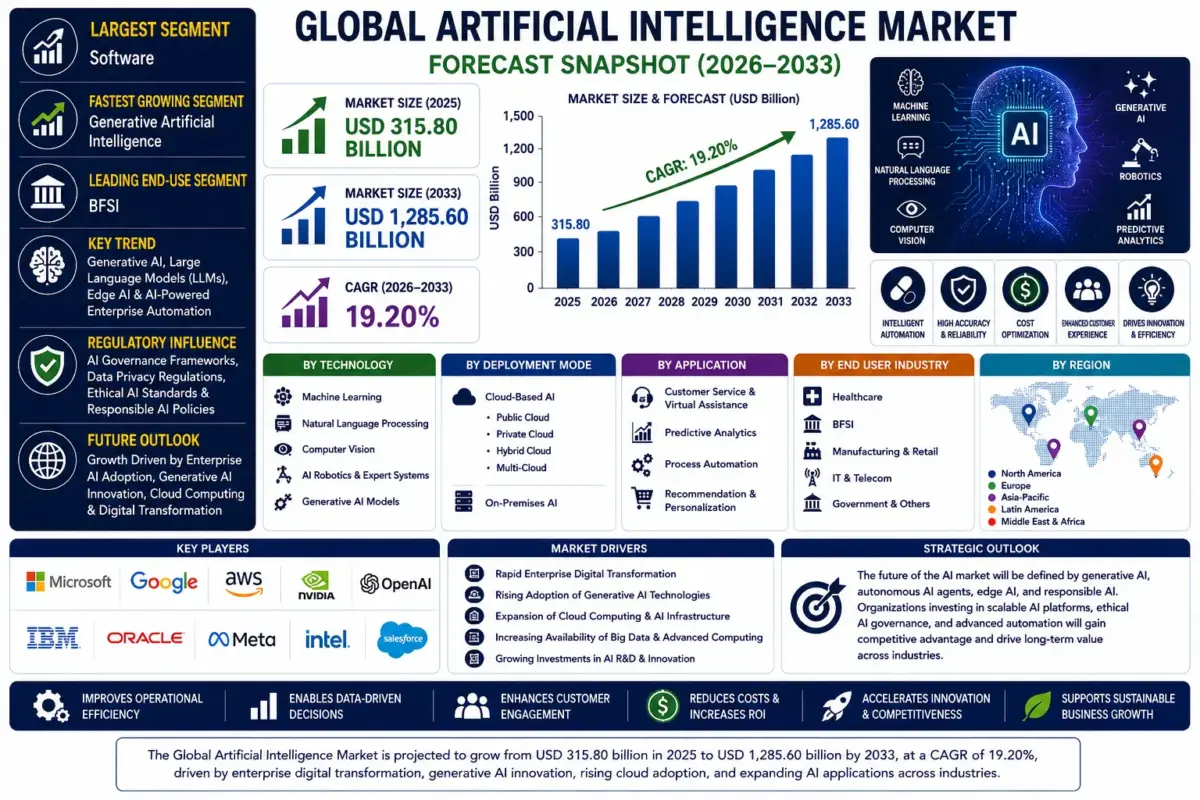
Global Artificial Intelligence Market Size & Forecast
The Global Artificial Intelligence Market is expected to witness exceptional growth during the forecast period from 2026 to 2033. The market was valued at USD 315.80 billion in 2025 and is projected to reach approximately USD 1,285.60 billion by 2033, registering a CAGR of 19.20%. Market growth is primarily driven by rapid enterprise digital transformation, increasing adoption of generative AI technologies, growing investments in cloud computing infrastructure, rising deployment of machine learning models, and expanding applications of artificial intelligence across healthcare, finance, manufacturing, retail, automotive, and government sectors.Global Artificial Intelligence Market Overview
Artificial Intelligence (AI) refers to computer systems capable of performing tasks that typically require human intelligence, including learning, reasoning, perception, language understanding, decision-making, and problem-solving. The market encompasses AI software, hardware, and services supporting machine learning, deep learning, natural language processing (NLP), computer vision, generative AI, robotics, predictive analytics, and intelligent automation. AI technologies are transforming enterprise operations by improving productivity, operational efficiency, customer engagement, and data-driven decision-making.Structural Drivers of Market Growth
1. Rapid Enterprise Digital Transformation
Organizations are increasingly integrating artificial intelligence into business processes to automate operations, improve productivity, and enhance customer experiences. Market Implications: Enterprise demand for AI-powered software and intelligent automation platforms continues to expand globally.2. Rising Adoption of Generative AI Technologies
Generative AI models are transforming content generation, software development, customer support, research, and business intelligence across multiple industries. Market Implications: Investments in foundation models and enterprise AI applications are accelerating market growth.3. Expansion of Cloud Computing and AI Infrastructure
Cloud platforms provide scalable computing resources for AI model training, deployment, and enterprise integration. Market Implications: Cloud-native AI services are enabling faster adoption across organizations of all sizes.4. Increasing Availability of Big Data and Advanced Computing
Growing data volumes and advances in GPUs, AI accelerators, and high-performance computing are enhancing AI model performance. Market Implications: Organizations are leveraging AI to extract actionable insights and optimize strategic decision-making.Global Artificial Intelligence Market Segmentation
1. By Technology
1.1 Machine Learning
1.1.1 Supervised Learning 1.1.1.1 Classification Algorithms 1.1.1.1.1 Decision Trees 1.1.1.1.2 Support Vector Machines 1.1.1.1.3 Random Forest 1.1.1.1.4 Gradient Boosting 1.1.2 Unsupervised Learning 1.1.3 Reinforcement Learning 1.1.4 Deep Learning1.2 Natural Language Processing (NLP)
1.2.1 Text Analytics 1.2.2 Speech Recognition 1.2.3 Machine Translation 1.2.4 Conversational AI1.3 Computer Vision
1.3.1 Image Recognition 1.3.2 Facial Recognition 1.3.3 Object Detection 1.3.4 Video Analytics1.4 AI Robotics & Expert Systems
1.4.1 Intelligent Robotics 1.4.2 Autonomous Systems 1.4.3 Expert Systems 1.4.4 Generative AI Models2. By Deployment Mode
2.1 Cloud-Based AI
2.1.1 Public Cloud AI 2.1.1.1 AI-as-a-Service (AIaaS) 2.1.1.1.1 AI Development Platforms 2.1.1.1.2 Cloud AI APIs 2.1.1.1.3 AI Model Hosting 2.1.1.1.4 Managed AI Services 2.1.2 Private Cloud AI 2.1.3 Hybrid Cloud AI 2.1.4 Multi-Cloud AI Platforms2.2 On-Premises AI
2.2.1 Enterprise AI Infrastructure 2.2.2 High-Performance Computing 2.2.3 Edge AI Systems 2.2.4 Dedicated AI Servers3. By Application
3.1 Customer Service & Virtual Assistance
3.1.1 AI Chatbots 3.1.1.1 Intelligent Customer Support 3.1.1.1.1 Text-Based Assistants 3.1.1.1.2 Voice Assistants 3.1.1.1.3 Multilingual AI Agents 3.1.1.1.4 Generative AI Assistants 3.1.2 Contact Center Automation 3.1.3 Intelligent Helpdesk Systems 3.1.4 Customer Sentiment Analysis3.2 Predictive Analytics
3.2.1 Demand Forecasting 3.2.2 Fraud Detection 3.2.3 Risk Analytics 3.2.4 Predictive Maintenance3.3 Process Automation
3.3.1 Robotic Process Automation (RPA) 3.3.2 Intelligent Document Processing 3.3.3 Workflow Automation 3.3.4 Decision Intelligence3.4 Recommendation & Personalization
3.4.1 Product Recommendation Engines 3.4.2 Personalized Marketing 3.4.3 Content Recommendation 3.4.4 Dynamic Pricing Systems4. By End User Industry
4.1 Healthcare
4.1.1 Hospitals & Healthcare Providers 4.1.1.1 Clinical AI Applications 4.1.1.1.1 Medical Imaging AI 4.1.1.1.2 Clinical Decision Support 4.1.1.1.3 Drug Discovery AI 4.1.1.1.4 Remote Patient Monitoring 4.1.2 Pharmaceutical Companies 4.1.3 Diagnostic Laboratories 4.1.4 Telehealth Providers4.2 BFSI
4.2.1 Banking 4.2.2 Insurance 4.2.3 Investment Management 4.2.4 FinTech Companies4.3 Manufacturing & Retail
4.3.1 Smart Manufacturing 4.3.2 Automotive 4.3.3 E-Commerce 4.3.4 Consumer Goods4.4 IT & Telecom, Government & Others
4.4.1 IT & Software Companies 4.4.2 Telecommunications 4.4.3 Government & Defense 4.4.4 Education, Media & Entertainment5. By Region
5.1 North America 5.2 Europe 5.3 Asia-Pacific 5.4 Latin America 5.5 Middle East & AfricaRegional Market Dynamics
North America
Leading region supported by advanced digital infrastructure, strong investments in AI research and development, widespread enterprise adoption, and the presence of major AI technology companies.Europe
Driven by increasing AI adoption across industries, supportive digital innovation programs, responsible AI regulations, and growing investments in enterprise automation.Asia-Pacific
Fastest-growing region supported by rapid digital transformation, government AI initiatives, expanding cloud infrastructure, and increasing investments in smart manufacturing and intelligent technologies.Latin America
Growing market driven by digital modernization, expanding AI adoption in financial services, healthcare, and retail sectors.Middle East & Africa
Emerging market supported by smart city initiatives, digital economy strategies, government AI investments, and enterprise technology adoption.Competitive Landscape
The Global Artificial Intelligence Market is highly competitive with technology companies, cloud service providers, semiconductor manufacturers, enterprise software vendors, and AI startups focusing on generative AI, intelligent automation, cloud-native AI platforms, and advanced machine learning solutions. Key Companies Operating in the Market Include:- Microsoft Corporation
- Alphabet Inc. (Google)
- Amazon Web Services, Inc.
- NVIDIA Corporation
- OpenAI
- IBM Corporation
- Oracle Corporation
- Meta Platforms, Inc.
- Intel Corporation
- Salesforce, Inc.
Strategic Outlook
The future of the artificial intelligence market will be shaped by generative AI, multimodal foundation models, autonomous AI agents, edge AI, explainable AI, and responsible AI governance. Organizations are increasingly investing in AI-powered automation, enterprise copilots, intelligent decision-support systems, cybersecurity applications, and AI-enabled customer engagement platforms to improve operational efficiency and business innovation. Integration of AI with cloud computing, IoT, robotics, and high-performance computing will continue expanding AI adoption across industries. Growing emphasis on ethical AI, regulatory compliance, model transparency, data security, and sustainable AI infrastructure will create significant opportunities for market participants. Companies focusing on scalable AI platforms, enterprise-grade security, continuous innovation, and responsible AI deployment will strengthen their competitive position in the global artificial intelligence ecosystem.Final Market Perspective
The Global Artificial Intelligence Market is transforming industries by enabling intelligent automation, advanced analytics, and data-driven innovation. Rising enterprise adoption, continuous technological advancements, expanding cloud infrastructure, and increasing investments in generative AI are expected to support sustained market growth throughout the forecast period. Organizations delivering secure, scalable, and high-performance AI solutions will be well-positioned to capitalize on long-term opportunities across the global digital economy.Table of Contents
1. Executive Summary
1.1 Market Snapshot (2026-2033) 1.2 Key Growth Highlights 1.3 Demand-Supply Overview 1.4 Key Strategic Insights 1.5 Analyst Viewpoint
2. Market Overview
2.1 Introduction to Global Artificial Intelligence Market 2.2 Industry Value Chain Analysis 2.3 Market Evolution & Historical Trends 2.4 Macro-Economic Impact Analysis 2.5 Enterprise AI Adoption & Digital Transformation 2.6 Generative AI, Large Language Models (LLMs), Cloud AI & Intelligent Automation
3. Global Artificial Intelligence Market Forecast Snapshot (USD Billion), 2026-2033
3.1 2025 Market Size 3.2 2033 Market Size 3.3 CAGR (2026-2033) 3.4 Largest Region 3.5 Fastest Growing Region 3.6 Largest Segment 3.7 Key Trend 3.8 Future Outlook
4. Key Drivers of Market Growth
4.1 Rapid Enterprise Digital Transformation 4.2 Rising Adoption of Generative AI Technologies 4.3 Expansion of Cloud Computing & AI Infrastructure 4.4 Increasing Availability of Big Data & Advanced Computing 4.5 Integration of AI Across Enterprise Applications & Industry Verticals
5. Market Challenges
5.1 Data Privacy & Regulatory Compliance 5.2 High Infrastructure & Implementation Costs 5.3 AI Skills Gap & Talent Shortages 5.4 Ethical AI, Model Transparency & Bias Management
6. Market Segmentation by Technology (USD Billion), 2026-2033
6.1 Machine Learning 6.1.1 Supervised Learning 6.1.1.1 Classification Algorithms 6.1.1.1.1 Decision Trees 6.1.1.1.2 Support Vector Machines 6.1.1.1.3 Random Forest 6.1.1.1.4 Gradient Boosting 6.1.2 Unsupervised Learning 6.1.3 Reinforcement Learning 6.1.4 Deep Learning 6.2 Natural Language Processing (NLP) 6.2.1 Text Analytics 6.2.2 Speech Recognition 6.2.3 Machine Translation 6.2.4 Conversational AI 6.3 Computer Vision 6.3.1 Image Recognition 6.3.2 Facial Recognition 6.3.3 Object Detection 6.3.4 Video Analytics 6.4 AI Robotics & Expert Systems 6.4.1 Intelligent Robotics 6.4.2 Autonomous Systems 6.4.3 Expert Systems 6.4.4 Generative AI Models
7. Market Segmentation by Deployment Mode (USD Billion), 2026-2033
7.1 Cloud-Based AI 7.1.1 Public Cloud AI 7.1.1.1 AI-as-a-Service (AIaaS) 7.1.1.1.1 AI Development Platforms 7.1.1.1.2 Cloud AI APIs 7.1.1.1.3 AI Model Hosting 7.1.1.1.4 Managed AI Services 7.1.2 Private Cloud AI 7.1.3 Hybrid Cloud AI 7.1.4 Multi-Cloud AI Platforms 7.2 On-Premises AI 7.2.1 Enterprise AI Infrastructure 7.2.2 High-Performance Computing 7.2.3 Edge AI Systems 7.2.4 Dedicated AI Servers
8. Market Segmentation by Application (USD Billion), 2026-2033
8.1 Customer Service & Virtual Assistance 8.1.1 AI Chatbots 8.1.1.1 Intelligent Customer Support 8.1.1.1.1 Text-Based Assistants 8.1.1.1.2 Voice Assistants 8.1.1.1.3 Multilingual AI Agents 8.1.1.1.4 Generative AI Assistants 8.1.2 Contact Center Automation 8.1.3 Intelligent Helpdesk Systems 8.1.4 Customer Sentiment Analysis 8.2 Predictive Analytics 8.2.1 Demand Forecasting 8.2.2 Fraud Detection 8.2.3 Risk Analytics 8.2.4 Predictive Maintenance 8.3 Process Automation 8.3.1 Robotic Process Automation (RPA) 8.3.2 Intelligent Document Processing 8.3.3 Workflow Automation 8.3.4 Decision Intelligence 8.4 Recommendation & Personalization 8.4.1 Product Recommendation Engines 8.4.2 Personalized Marketing 8.4.3 Content Recommendation 8.4.4 Dynamic Pricing Systems
9. Market Segmentation by End User Industry (USD Billion), 2026-2033
9.1 Healthcare 9.1.1 Hospitals & Healthcare Providers 9.1.1.1 Clinical AI Applications 9.1.1.1.1 Medical Imaging AI 9.1.1.1.2 Clinical Decision Support 9.1.1.1.3 Drug Discovery AI 9.1.1.1.4 Remote Patient Monitoring 9.1.2 Pharmaceutical Companies 9.1.3 Diagnostic Laboratories 9.1.4 Telehealth Providers 9.2 BFSI 9.2.1 Banking 9.2.2 Insurance 9.2.3 Investment Management 9.2.4 FinTech Companies 9.3 Manufacturing & Retail 9.3.1 Smart Manufacturing 9.3.2 Automotive 9.3.3 E-Commerce 9.3.4 Consumer Goods 9.4 IT & Telecom, Government & Others 9.4.1 IT & Software Companies 9.4.2 Telecommunications 9.4.3 Government & Defense 9.4.4 Education, Media & Entertainment
10. Market Segmentation by Region (USD Billion), 2026-2033
10.1 North America 10.2 Europe 10.3 Asia-Pacific 10.4 Latin America 10.5 Middle East & Africa
11. Regional Market Analysis
11.1 North America-Market Leader 11.2 Asia-Pacific-Fastest Growing Region 11.3 Europe-Responsible AI & Enterprise Automation Market 11.4 Latin America-Expanding AI Adoption Across Industries 11.5 Middle East & Africa-Emerging AI Innovation & Smart Economy Market
12. Competitive Landscape
12.1 Market Share Analysis 12.2 Competitive Positioning Matrix 12.3 Strategic Developments (M&A, Product Launches, Partnerships) 12.4 Innovation Benchmarking 12.5 Generative AI, Cloud AI & Enterprise Intelligence Assessment
13. Company Profiles
13.1 Microsoft Corporation 13.2 Alphabet Inc. (Google) 13.3 Amazon Web Services, Inc. 13.4 NVIDIA Corporation 13.5 OpenAI 13.6 IBM Corporation 13.7 Oracle Corporation 13.8 Meta Platforms, Inc. 13.9 Intel Corporation 13.10 Salesforce, Inc.
14. Strategic Intelligence & AI-Driven Insights
14.1 Pheonix Demand Forecast Engine 14.2 Artificial Intelligence Market Dashboard 14.3 Generative AI & Enterprise Automation Intelligence 14.4 AI Performance Optimization Engine 14.5 Intelligent Business Analytics & Decision Intelligence
15. Investment & Growth Opportunities
15.1 Generative Artificial Intelligence 15.2 AI-as-a-Service (AIaaS) & Cloud AI Platforms 15.3 Enterprise AI Automation Solutions 15.4 Edge AI & Intelligent Computing Infrastructure 15.5 AI-Powered Industry Digital Transformation
16. Why the Global Artificial Intelligence Market Remains Critical
16.1 Rapid Enterprise AI Adoption 16.2 Increasing Demand for Intelligent Automation 16.3 Expansion of Generative AI & Large Language Models 16.4 Growing Investments in Cloud AI & Digital Transformation 16.5 Long-Term Growth Across Global Artificial Intelligence & Enterprise Technology Markets
17. Appendix
18. About Pheonix Research
19. Disclaimer
Competitive Landscape
Global Artificial Intelligence Market Competitive Intensity & Market Structure Overview
The Global Artificial Intelligence Market is highly competitive and characterized by the presence of technology companies, cloud service providers, semiconductor manufacturers, enterprise software vendors, AI platform developers, and artificial intelligence startups. Competitive intensity is driven by generative AI innovation, machine learning capabilities, cloud-native AI platforms, AI infrastructure, enterprise automation solutions, advanced computing power, and responsible AI governance.
Companies compete across multiple artificial intelligence segments including machine learning, natural language processing, computer vision, generative AI, intelligent robotics, predictive analytics, conversational AI, edge AI, enterprise automation, and AI-powered decision support systems. Rising enterprise AI adoption, increasing cloud investments, growing demand for intelligent automation, and continuous advancements in foundation models are intensifying competition while encouraging ongoing investment in AI technologies.
The market structure is evolving toward multimodal foundation models, AI copilots, autonomous AI agents, edge AI deployment, explainable AI, AI-as-a-Service (AIaaS), high-performance AI infrastructure, and integrated enterprise AI ecosystems. Market participants are investing heavily in AI research and development, cloud infrastructure, semiconductor innovation, responsible AI frameworks, and strategic partnerships to strengthen market positioning and accelerate enterprise AI adoption.
Global Artificial Intelligence Market Competitive Intensity & Market Structure Current Scenario
Leading Global Artificial Intelligence Companies
- Microsoft Corporation: A global technology company providing enterprise AI platforms, cloud-based artificial intelligence services, generative AI solutions, AI copilots, and intelligent business applications through Microsoft Azure AI.
- Alphabet Inc. (Google): A leading AI innovator delivering machine learning platforms, generative AI models, cloud AI services, search intelligence, and enterprise AI solutions through Google Cloud and DeepMind technologies.
- Amazon Web Services, Inc.: A global cloud computing provider offering AI infrastructure, machine learning services, foundation models, generative AI platforms, and scalable AI development environments.
- NVIDIA Corporation: A leading AI computing company providing GPUs, AI accelerators, high-performance computing platforms, AI software frameworks, and infrastructure supporting generative AI and deep learning workloads.
- OpenAI: An artificial intelligence research and deployment company developing large language models, generative AI technologies, enterprise AI solutions, and advanced conversational AI platforms.
- IBM Corporation: A global enterprise technology company offering AI software, hybrid cloud solutions, intelligent automation platforms, AI governance capabilities, and business analytics through IBM watsonx.
- Oracle Corporation: A technology company providing enterprise AI applications, AI-enabled databases, cloud infrastructure, analytics platforms, and intelligent business process automation solutions.
- Meta Platforms, Inc.: A global technology company developing open AI models, generative AI technologies, computer vision systems, recommendation engines, and AI-powered digital experiences.
- Intel Corporation: A semiconductor company providing AI processors, AI accelerators, edge AI technologies, high-performance computing solutions, and infrastructure supporting enterprise AI deployments.
- Salesforce, Inc.: A cloud software company delivering AI-powered CRM platforms, generative AI assistants, predictive analytics, customer intelligence, and enterprise automation solutions.
Key Competitive Intensity & Market Structure Drivers
Increasing enterprise adoption of artificial intelligence, rapid digital transformation, and growing investment in cloud computing infrastructure are intensifying competition among AI technology providers worldwide.
Advancements in generative AI, large language models (LLMs), machine learning, computer vision, edge AI, and intelligent automation are becoming major competitive differentiators across the market.
Growing demand for AI-powered business automation, predictive analytics, intelligent decision-making, cybersecurity, and personalized customer experiences is strengthening market competitiveness while accelerating enterprise AI adoption.
Strategic collaborations among cloud service providers, semiconductor companies, enterprise software vendors, research institutions, AI startups, and industry organizations are accelerating innovation, expanding AI capabilities, and improving commercial AI deployment.
Continuous investment in AI infrastructure, foundation models, responsible AI governance, cloud-native AI platforms, advanced computing technologies, and enterprise AI ecosystems is enabling companies to improve scalability, operational efficiency, and long-term competitiveness.
Strategic Implications of Competitive Intensity & Market Structure
Companies with advanced AI platforms, scalable cloud infrastructure, comprehensive AI software portfolios, and strong research capabilities are expected to maintain significant competitive advantages.
Investment in generative AI, machine learning, AI accelerators, intelligent automation, edge AI, and responsible AI governance is becoming increasingly important for long-term market leadership.
Organizations focusing on expanding enterprise AI capabilities, improving AI model performance, strengthening intelligent automation, and enhancing AI-powered business applications are likely to increase revenue growth and market share.
Strategic partnerships with cloud providers, enterprise software companies, semiconductor manufacturers, research organizations, governments, and industry partners are supporting innovation, operational scalability, and international market expansion.
Businesses capable of combining technological innovation, AI expertise, responsible governance, scalable infrastructure, and integrated enterprise AI solutions will be best positioned to compete effectively in the evolving global artificial intelligence market.
Global Artificial Intelligence Market Competitive Intensity & Market Structure Forward Outlook
The competitive landscape of the global artificial intelligence market is expected to become increasingly AI-driven, cloud-native, and innovation-focused as enterprise demand for intelligent technologies continues to expand globally.
Future competition will be shaped by multimodal AI models, autonomous AI agents, next-generation generative AI, edge AI deployment, explainable AI, AI infrastructure innovation, and enterprise-grade intelligent automation platforms.
Market participants are expected to increase investments in foundation models, AI accelerators, cloud AI ecosystems, responsible AI frameworks, enterprise AI platforms, and intelligent automation technologies to strengthen competitive positioning.
Over the forecast period, companies that successfully combine technological innovation, enterprise AI expertise, responsible AI governance, operational scalability, and comprehensive artificial intelligence solutions will be best positioned to lead the evolving global artificial intelligence market.
Value Chain
Global Artificial Intelligence Market Value Chain & Supply Chain Evolution Overview
The Global Artificial Intelligence Market operates through a highly integrated digital value chain comprising data acquisition, semiconductor and AI hardware manufacturing, cloud infrastructure, AI model development, software platforms, system integration, enterprise deployment, application development, AI operations (MLOps), cybersecurity, and lifecycle support. The ecosystem includes semiconductor manufacturers, cloud service providers, AI software companies, enterprise technology vendors, research organizations, system integrators, consulting firms, and industry end users collaborating to deliver intelligent AI solutions across healthcare, BFSI, manufacturing, retail, telecommunications, automotive, education, government, and other industries.
The industry is being driven by rapid enterprise digital transformation, increasing adoption of generative AI, expanding cloud computing infrastructure, growing investments in AI accelerators, rising availability of big data, and increasing demand for intelligent automation. Organizations are investing in foundation models, AI development platforms, machine learning infrastructure, cloud-native AI services, and enterprise AI applications to improve operational efficiency, decision-making, customer engagement, and business innovation.
The integration of artificial intelligence, machine learning, large language models (LLMs), cloud computing, GPUs, AI accelerators, edge computing, MLOps platforms, automation frameworks, and cybersecurity technologies has significantly optimized the AI value chain. Organizations are strengthening collaboration between cloud providers, AI developers, semiconductor companies, enterprise software vendors, and industry-specific solution providers while accelerating deployment of scalable and secure AI ecosystems.
Advancements in generative AI, multimodal foundation models, edge AI, explainable AI, intelligent automation, AI-powered analytics, autonomous AI agents, and responsible AI governance are transforming the supply chain while improving enterprise productivity, software innovation, digital transformation, regulatory compliance, and business intelligence across the global artificial intelligence ecosystem.
Global Artificial Intelligence Market Value Chain & Supply Chain Evolution Current Scenario
Market-Specific Value Chain
- Data Acquisition & Computing Infrastructure: Collection of structured and unstructured data, data labeling, AI datasets, cloud infrastructure, GPUs, AI accelerators, edge devices, storage systems, networking infrastructure, and high-performance computing resources.
- AI Model Development & Platform Engineering: Development of machine learning models, deep learning algorithms, large language models, natural language processing engines, computer vision models, AI software platforms, APIs, MLOps pipelines, and model optimization frameworks.
- System Integration & Enterprise Deployment: AI platform integration with ERP, CRM, cloud environments, enterprise software, IoT ecosystems, business intelligence platforms, workflow automation systems, cybersecurity infrastructure, and digital transformation initiatives.
- Quality Assurance & Regulatory Compliance: AI model validation, performance testing, bias detection, cybersecurity assessment, explainability verification, data privacy compliance, governance frameworks, and compliance with AI governance frameworks, data privacy regulations, ethical AI standards, and responsible AI policies.
- Distribution & Professional Services: Cloud deployment, AI-as-a-Service (AIaaS), software licensing, enterprise consulting, implementation services, managed AI services, technical support, and AI solution customization.
- Operations, Maintenance & Customer Support: AI model monitoring, continuous learning, software updates, infrastructure optimization, cloud operations, security monitoring, predictive maintenance, customer support, and lifecycle management.
- End User Applications: Deployment of AI solutions across healthcare, BFSI, manufacturing, retail, IT & telecom, government, automotive, education, media, and other enterprise sectors.
Company-to-Stage Mapping
- Data Acquisition & Computing Infrastructure: Semiconductor manufacturers, GPU providers, cloud infrastructure providers, networking companies, data platform providers, storage vendors, and AI hardware manufacturers.
- AI Model Development & Platform Engineering: Microsoft Corporation, Alphabet Inc. (Google), Amazon Web Services, Inc., NVIDIA Corporation, OpenAI, IBM Corporation, Oracle Corporation, Meta Platforms, Inc., Intel Corporation, and Salesforce, Inc.
- System Integration & Enterprise Deployment: Enterprise software vendors, cloud integration partners, AI consulting firms, digital transformation companies, cybersecurity providers, MLOps platform vendors, and enterprise technology integrators.
- Distribution & Professional Services: Cloud service providers, AI platform vendors, enterprise consulting firms, managed service providers, implementation partners, software distributors, and system integration companies.
- Operations, Maintenance & Customer Support: Microsoft Corporation, Amazon Web Services, Inc., IBM Corporation, Oracle Corporation, Google Cloud, OpenAI, Salesforce, Inc., managed cloud providers, and enterprise AI support organizations.
- Quality Assurance & Regulatory Compliance: Regulatory authorities, cybersecurity agencies, AI governance organizations, standards bodies, certification agencies, data protection authorities, and compliance auditing firms.
- End User Applications: Healthcare organizations, BFSI institutions, manufacturing enterprises, retailers, IT & telecom companies, government agencies, automotive companies, educational institutions, and media organizations.
Key Value Chain & Supply Chain Evolution Signals in Global Artificial Intelligence Market
Expansion of Generative AI Platforms
Organizations are increasingly deploying generative AI and large language models to automate content creation, software development, customer service, research, and enterprise productivity.
Growing Adoption of Cloud-Native AI Infrastructure
Cloud computing platforms are enabling scalable AI model development, enterprise deployment, AI-as-a-Service offerings, and faster integration across industries.
Rapid Advancement of AI Hardware and Accelerators
High-performance GPUs, AI accelerators, specialized semiconductor chips, and edge AI processors are improving model training efficiency, inference speed, and enterprise scalability.
Increasing Investment in Enterprise AI Automation
Organizations are integrating AI into business processes, intelligent workflows, predictive analytics, decision support systems, and customer engagement platforms to improve operational efficiency.
Strengthening Responsible AI and Governance Frameworks
Organizations are investing in explainable AI, ethical AI practices, model transparency, bias mitigation, cybersecurity, and regulatory compliance to support trustworthy AI deployment.
Expansion of AI Ecosystem Collaboration
Technology companies, cloud providers, semiconductor manufacturers, enterprise software vendors, and research institutions are strengthening strategic partnerships to accelerate AI innovation and commercialization.
Strategic Implications of Value Chain & Supply Chain Evolution
Investment in Advanced AI Infrastructure
Cloud computing, AI accelerators, high-performance computing, and scalable infrastructure improve AI development, deployment, and enterprise performance.
Expansion of Enterprise AI Platforms
Cloud-native AI platforms, AI-as-a-Service, MLOps solutions, and enterprise integration strengthen business agility while accelerating digital transformation.
Strengthening Intelligent Automation Capabilities
Machine learning, generative AI, workflow automation, predictive analytics, and intelligent decision support improve productivity and operational efficiency.
Optimization of AI Development Ecosystems
Integrated AI platforms, model lifecycle management, enterprise software connectivity, cloud orchestration, and continuous learning improve scalability and innovation.
Enhancement of Security and Regulatory Compliance
Responsible AI governance, cybersecurity frameworks, data privacy management, explainability tools, and compliance monitoring strengthen enterprise trust and regulatory adherence.
Leveraging Data-Driven Business Intelligence
AI-powered analytics, predictive insights, enterprise dashboards, and intelligent decision-making platforms enable organizations to optimize business operations and strengthen long-term competitiveness.
Global Artificial Intelligence Market Value Chain & Supply Chain Evolution Forward Outlook
Looking ahead, the artificial intelligence value chain is expected to become increasingly intelligent, scalable, cloud-native, and governance-driven. Continued advancements in generative AI, multimodal foundation models, AI accelerators, edge AI, cloud infrastructure, MLOps, and responsible AI frameworks will further improve enterprise productivity, automation, operational efficiency, and business innovation across industries.
Key Future Developments Include:
- Expansion of generative AI platforms, enterprise copilots, and autonomous AI agents.
- Increasing adoption of cloud-native AI infrastructure and AI-as-a-Service platforms.
- Greater integration of AI accelerators, GPUs, edge AI devices, MLOps platforms, and high-performance computing.
- Broader deployment of intelligent automation, predictive analytics, and enterprise decision intelligence.
- Growing investment in responsible AI governance, explainable AI, cybersecurity, and regulatory compliance frameworks.
- Strengthening collaborations between AI software providers, cloud service providers, semiconductor manufacturers, enterprise software vendors, research institutions, and industry partners.
As the market evolves, competitive advantage will increasingly depend on scalable AI infrastructure, intelligent automation, cloud-native deployment, responsible AI governance, secure data ecosystems, enterprise integration capabilities, and continuous AI innovation.
Companies that successfully integrate generative AI, cloud computing, advanced machine learning platforms, AI accelerators, intelligent automation, responsible AI practices, and enterprise-scale AI ecosystems will be well-positioned to achieve long-term growth in the Global Artificial Intelligence Market.
Investment Activity
Global Artificial Intelligence Market Investment & Funding Dynamics Overview (2026-2033)
The Global Artificial Intelligence (AI) Market is witnessing unprecedented investment momentum driven by rapid enterprise digital transformation, accelerating adoption of generative AI, increasing cloud computing investments, and expanding deployment of intelligent automation across industries. Technology companies, cloud service providers, semiconductor manufacturers, venture capital firms, private equity investors, sovereign wealth funds, enterprise software vendors, governments, and AI startups are actively investing in Generative AI, Large Language Models (LLMs), foundation models, AI infrastructure, edge AI, AI-powered enterprise automation, machine learning platforms, and intelligent analytics solutions. Investment activity is accelerating as organizations focus on improving operational efficiency, automating business processes, strengthening decision intelligence, enhancing customer engagement, and developing next-generation AI applications. Capital allocation is increasingly directed toward AI supercomputing infrastructure, GPU clusters, AI accelerators, cloud-native AI platforms, multimodal AI models, AI copilots, enterprise AI software, autonomous AI agents, and AI cybersecurity solutions. Additionally, growing investments in responsible AI governance, explainable AI, AI model optimization, AI semiconductor development, edge computing, digital twins, intelligent robotics, and AI-enabled cloud ecosystems are creating substantial long-term opportunities across the global artificial intelligence ecosystem.
Current Investment & Funding Landscape
The current investment landscape reflects active participation from global technology companies, cloud infrastructure providers, semiconductor manufacturers, enterprise software vendors, venture capital firms, institutional investors, government innovation agencies, research institutions, and AI-focused startups. Industry participants are investing heavily in foundation models, generative AI platforms, enterprise AI software, AI infrastructure, cloud-based machine learning services, intelligent automation platforms, and advanced AI research. Significant funding is being directed toward large language models (LLMs), AI accelerators, GPU infrastructure, multimodal AI systems, autonomous AI agents, AI development platforms, cloud computing infrastructure, and enterprise AI deployment frameworks to improve computational capabilities and strengthen long-term competitive positioning. Strategic collaborations among technology companies, semiconductor manufacturers, cloud service providers, enterprise software vendors, research institutions, governments, and AI startups are accelerating innovation, improving AI scalability, strengthening ecosystem interoperability, and expanding enterprise AI adoption worldwide.
Key Investment & Funding Dynamics Signals
- Growing investment in Generative AI, Large Language Models (LLMs), and multimodal foundation models is transforming enterprise productivity and digital innovation.
- Expansion of AI cloud infrastructure, AI-as-a-Service (AIaaS), cloud-native machine learning platforms, and enterprise AI ecosystems is attracting substantial funding across global technology markets.
- Increasing capital allocation toward GPU infrastructure, AI accelerators, semiconductor innovation, high-performance computing, and AI model training platforms is strengthening next-generation AI capabilities.
- Rising investment in AI-powered enterprise automation, predictive analytics, intelligent business applications, cybersecurity AI, and autonomous AI agents is improving business efficiency and decision-making.
- Strategic funding for edge AI, intelligent robotics, computer vision, digital twins, explainable AI, and responsible AI governance frameworks is supporting long-term technological advancement.
- Growing collaboration between technology companies, cloud providers, semiconductor manufacturers, enterprise software vendors, AI startups, research organizations, and government agencies is accelerating AI innovation and commercial deployment.
- Expansion of AI infrastructure across healthcare, BFSI, manufacturing, retail, automotive, telecommunications, government, and smart city applications is creating attractive long-term investment opportunities globally.
Strategic Implications of Investment & Funding Dynamics
- Continuous investment in Generative AI, enterprise AI platforms, intelligent automation, and foundation models will be essential for sustaining long-term competitive advantage.
- Capital allocation toward AI infrastructure, cloud computing, GPU clusters, AI accelerators, and high-performance computing will strengthen computational capabilities and enterprise scalability.
- Companies developing integrated AI ecosystems, scalable cloud-native AI platforms, enterprise copilots, and advanced machine learning solutions are expected to secure stronger competitive positions.
- Strategic partnerships among technology companies, cloud providers, semiconductor manufacturers, enterprise software vendors, AI developers, research institutions, and governments will accelerate AI innovation and digital transformation.
- Investments in artificial intelligence, machine learning, natural language processing, computer vision, edge AI, intelligent robotics, and predictive analytics will enhance operational performance, customer experiences, and business intelligence.
- Compliance with AI governance frameworks, data privacy regulations, ethical AI standards, and responsible AI policies will continue influencing investment decisions.
- Organizations building integrated capabilities across AI software, cloud infrastructure, semiconductor technologies, intelligent automation, enterprise AI platforms, cybersecurity, and responsible AI governance are expected to capture significant long-term value.
Forward Outlook
Looking ahead, the Global Artificial Intelligence Market is expected to maintain exceptional investment momentum driven by accelerating enterprise AI adoption, expanding Generative AI applications, continuous cloud infrastructure expansion, and growing demand for intelligent digital transformation solutions. Future capital deployment will increasingly focus on Generative AI, Large Language Models (LLMs), multimodal AI systems, autonomous AI agents, cloud-native AI platforms, edge AI, AI-powered enterprise automation, and intelligent decision-support systems. As enterprises and governments continue investing in AI infrastructure and digital innovation, investment activity is expected to expand across AI supercomputing infrastructure, semiconductor technologies, enterprise AI software, intelligent robotics, cloud AI ecosystems, cybersecurity AI, digital twins, and integrated AI platforms. In conclusion, the Global Artificial Intelligence Market represents one of the world’s most attractive investment landscapes where Generative AI, Large Language Models (LLMs), enterprise AI platforms, intelligent automation, cloud computing, and responsible AI innovation will define future funding priorities, competitive differentiation, and long-term market growth.
Technology & Innovation
Global Artificial Intelligence Market Technology & Innovation Landscape Overview
The Global Artificial Intelligence Market is experiencing unprecedented technological advancement as innovations in generative artificial intelligence, large language models (LLMs), machine learning, deep learning, edge AI, and cloud computing reshape enterprise operations and digital transformation. Technology companies, cloud service providers, semiconductor manufacturers, research institutions, and enterprises are investing heavily in advanced AI technologies to improve decision-making, automate complex business processes, enhance customer experiences, and accelerate innovation across industries. These advancements are enabling intelligent automation, predictive analytics, autonomous systems, and next-generation AI applications that are transforming the global digital economy.
The market is also benefiting from breakthroughs in high-performance computing, AI accelerators, multimodal foundation models, natural language processing (NLP), computer vision, and AI development platforms. These innovations are improving model accuracy, accelerating AI deployment, optimizing enterprise workflows, and enabling scalable AI adoption across healthcare, BFSI, manufacturing, retail, government, and telecommunications. As organizations increasingly embrace AI-driven digital transformation, technology is becoming a critical driver of competitive advantage and long-term market expansion.
Global Artificial Intelligence Market Technology & Innovation Current Scenario
Current innovation within the artificial intelligence market is primarily focused on generative AI, large language models (LLMs), edge AI, AI-powered enterprise automation, multimodal AI models, and intelligent decision-support systems. Organizations are increasingly utilizing foundation models, machine learning algorithms, natural language processing, and computer vision technologies to automate workflows, generate content, improve customer engagement, enhance cybersecurity, and optimize business intelligence. Artificial intelligence is playing an expanding role in software development, enterprise productivity, predictive analytics, and autonomous decision-making.
Cloud-native AI platforms, AI-as-a-Service (AIaaS), AI accelerators, intelligent robotics, and high-performance computing infrastructure are enhancing AI scalability and enterprise accessibility. In addition, advancements in explainable AI (XAI), responsible AI frameworks, autonomous AI agents, and edge computing are improving AI transparency, governance, security, and real-time processing capabilities. These innovations are strengthening the industry’s ability to deliver secure, scalable, and intelligent AI solutions across diverse business environments.
Key Technology & Innovation Trends in Global Artificial Intelligence Market
- Generative Artificial Intelligence: Transforming content creation, software development, research, and enterprise productivity through advanced generative AI models.
- Large Language Models (LLMs): Enabling intelligent conversational AI, knowledge management, coding assistance, and enterprise copilots through foundation language models.
- Edge AI Computing: Supporting real-time AI processing on edge devices to improve performance, reduce latency, and enhance data privacy.
- AI-Powered Enterprise Automation: Automating business workflows, decision-making, document processing, and operational processes using intelligent AI systems.
- Multimodal Artificial Intelligence: Integrating text, images, audio, video, and structured data to deliver more comprehensive and context-aware AI capabilities.
- Natural Language Processing (NLP): Advancing language understanding, speech recognition, machine translation, and conversational AI applications.
- Computer Vision Technologies: Enhancing image recognition, object detection, facial recognition, and intelligent visual analytics across industries.
- AI Accelerators & High-Performance Computing: Improving AI model training and inference through specialized processors, GPUs, and scalable computing infrastructure.
- Explainable & Responsible AI: Supporting transparent, ethical, and accountable AI deployment through governance frameworks and model interpretability.
- AI-as-a-Service (AIaaS) Platforms: Delivering scalable cloud-based AI capabilities, pre-trained models, and enterprise AI development tools through managed cloud services.
Strategic Implications of Technology & Innovation
Technological advancements are enabling artificial intelligence providers to accelerate innovation, improve enterprise productivity, and strengthen competitive positioning. Organizations investing in generative AI, large language models, cloud computing, edge AI, and intelligent automation are enhancing operational efficiency, improving customer engagement, and enabling data-driven decision-making. Innovation is helping enterprises differentiate through intelligent digital transformation, scalable AI platforms, and advanced automation capabilities.
As AI adoption continues to expand across industries, organizations are increasingly focusing on enterprise AI ecosystems, responsible AI governance, cloud-native AI infrastructure, and intelligent automation platforms. Businesses that successfully integrate advanced AI technologies, predictive analytics, multimodal models, and secure AI deployment strategies are expected to gain significant competitive advantages. However, AI governance frameworks, data privacy regulations, ethical AI standards, and responsible AI policies remain critical factors influencing technology adoption and commercialization.
Global Artificial Intelligence Market Technology & Innovation Forward Outlook
The future of the Global Artificial Intelligence Market is expected to be shaped by continued advancements in generative AI, multimodal foundation models, autonomous AI agents, edge AI, explainable AI, quantum-enhanced AI, and intelligent automation technologies. Emerging innovations such as AI-powered digital coworkers, self-learning enterprise systems, agentic AI, advanced robotics, and next-generation AI accelerators are expected to redefine enterprise intelligence and digital transformation. Organizations are likely to increase investments in scalable AI platforms that accelerate innovation, improve operational agility, and expand intelligent automation capabilities.
As demand for enterprise AI adoption, cloud computing, intelligent automation, and digital transformation continues to grow, technology will play an increasingly important role in driving market development. The combination of generative AI, large language models, edge AI, cloud-native AI platforms, high-performance computing, and responsible AI frameworks is expected to create substantial growth opportunities while strengthening the long-term evolution of the global artificial intelligence market.
Market Risk
Global Artificial Intelligence Market Risk Factors & Disruption Threats Overview
The global artificial intelligence market is experiencing exceptional growth as enterprises accelerate digital transformation, expand generative AI adoption, and invest heavily in cloud computing, machine learning, and intelligent automation. Despite strong market momentum, AI technology providers and enterprise adopters face a range of technological, regulatory, cybersecurity, ethical, and operational risks that may influence deployment, scalability, and long-term adoption. Rapid evolution of AI models, increasing data privacy requirements, high infrastructure costs, cybersecurity threats, and evolving global AI governance frameworks continue to reshape the competitive landscape. Organizations are investing in responsible AI practices, secure cloud infrastructure, explainable AI technologies, advanced cybersecurity frameworks, and scalable computing platforms to strengthen resilience and support sustainable market growth.
Global Artificial Intelligence Market Risk Factors & Disruption Threats Current Scenario
The current market environment is characterized by widespread enterprise adoption of generative AI, large language models (LLMs), predictive analytics, intelligent automation, and cloud-based AI platforms across healthcare, BFSI, manufacturing, retail, government, and telecommunications sectors. However, organizations continue to face challenges related to data quality, model bias, high computational requirements, talent shortages, cybersecurity vulnerabilities, and integration with legacy enterprise systems. Compliance with evolving AI governance frameworks, data privacy regulations, ethical AI standards, intellectual property requirements, and responsible AI policies has become increasingly important, requiring continuous investment in secure, transparent, and compliant AI solutions.
Key Risk Factors & Disruption Threat Signals in Global Artificial Intelligence Market
Major risk factors include cybersecurity attacks targeting AI platforms, cloud infrastructure, enterprise data environments, and AI training models, potentially resulting in data breaches, service disruption, and intellectual property loss. Poor data quality, algorithmic bias, lack of explainability, and inaccurate AI outputs may reduce enterprise trust and decision-making effectiveness. Regulatory changes related to AI governance, data privacy, cross-border data transfers, and ethical AI deployment may increase compliance costs and implementation complexity. Furthermore, rapid advancements in generative AI, multimodal foundation models, open-source AI ecosystems, semiconductor innovation, and increasing competition among global technology providers represent significant disruption signals capable of reshaping market dynamics.
Strategic Implications of Risk Factors & Disruption Threats in Global Artificial Intelligence Market
Artificial intelligence providers are strengthening business resilience by investing in responsible AI frameworks, explainable AI technologies, advanced cybersecurity solutions, secure cloud-native architectures, and continuous model governance to improve platform reliability and enterprise trust. Organizations are expanding integration with cloud computing, IoT, enterprise software, high-performance computing, and data management platforms to enhance AI scalability and operational efficiency. Strategic investments in AI governance, model monitoring, intelligent automation, edge AI, data security, and enterprise AI platforms are enabling organizations to improve productivity, regulatory compliance, and business innovation. Partnerships with cloud providers, semiconductor manufacturers, research institutions, and enterprise software vendors are further supporting AI ecosystem expansion and digital transformation.
Global Artificial Intelligence Market Risk Factors & Disruption Threats Forward Outlook
Looking ahead, the global artificial intelligence market is expected to maintain exceptional growth despite evolving regulatory, cybersecurity, and technological challenges. Continued innovation in generative AI, large language models, edge AI, autonomous AI agents, cloud computing, and intelligent automation will create significant opportunities for enterprise modernization across industries. However, market participants must continuously monitor changing AI governance regulations, cybersecurity risks, ethical AI requirements, data privacy standards, and evolving enterprise adoption strategies to minimize operational risks. Organizations that prioritize responsible AI deployment, secure cloud infrastructure, scalable AI platforms, regulatory compliance, and continuous technological innovation will be well positioned to navigate future disruptions and capitalize on long-term opportunities across the global artificial intelligence ecosystem.
Regulatory Landscape
Global Artificial Intelligence Market Regulatory Landscape Overview
The Global Artificial Intelligence Market operates within a rapidly evolving regulatory framework shaped by AI governance frameworks, data privacy regulations, ethical AI standards, and responsible AI policies. As artificial intelligence becomes increasingly integrated across enterprise software, cloud computing, healthcare, finance, manufacturing, government, and consumer applications, regulatory compliance is becoming essential for ensuring trustworthy AI deployment, responsible data usage, algorithmic transparency, and secure digital innovation.
Governments and regulatory authorities worldwide are implementing policies that promote responsible artificial intelligence, data protection, algorithm accountability, cybersecurity, AI risk management, and ethical technology development. These regulatory frameworks encourage innovation while ensuring fairness, transparency, human oversight, privacy protection, and the safe adoption of AI technologies across industries.
Key Regulatory Areas Influencing the Market
- AI Governance Frameworks: National and international policies establishing governance principles for AI development, deployment, accountability, and risk management.
- Data Privacy Regulations: Regulations governing the collection, processing, storage, transfer, and protection of personal and enterprise data used for AI model training and deployment.
- Ethical AI Standards: Guidelines promoting fairness, transparency, explainability, non-discrimination, and human oversight in artificial intelligence systems.
- Responsible AI Policies: Regulatory initiatives encouraging secure, reliable, and trustworthy AI deployment while minimizing societal, operational, and cybersecurity risks.
- Cybersecurity & AI Security Regulations: Standards supporting secure AI infrastructure, protection against cyber threats, model integrity, and resilience of AI-enabled systems.
- Industry Compliance Requirements: Sector-specific regulations governing AI implementation across healthcare, BFSI, manufacturing, government, telecommunications, and other regulated industries.
- Cloud & Cross-Border Data Governance: Policies addressing cloud computing compliance, international data transfers, digital sovereignty, and secure AI infrastructure management.
Regional Regulatory Landscape
North America maintains comprehensive regulatory initiatives supporting responsible AI innovation, data privacy, cybersecurity, enterprise AI adoption, and risk-based governance across public and private sectors.
Europe emphasizes ethical AI, data protection, transparency, human-centric AI governance, and comprehensive regulatory frameworks supporting trustworthy artificial intelligence deployment.
Asia-Pacific is strengthening AI governance through national AI strategies, digital economy initiatives, data governance policies, cloud infrastructure investments, and responsible AI development programs.
Latin America continues expanding digital governance through emerging AI strategies, data protection regulations, enterprise digital transformation initiatives, and public sector technology modernization.
Middle East & Africa is advancing regulatory support through national AI strategies, smart city initiatives, digital economy programs, cybersecurity regulations, and investments in AI-enabled public services.
Regulatory Impact on Market Growth
- AI governance frameworks are accelerating enterprise adoption by providing greater regulatory clarity and promoting responsible AI deployment.
- Data privacy regulations are driving investments in secure AI platforms, privacy-preserving machine learning, and compliant data management practices.
- Ethical AI standards are encouraging development of transparent, explainable, and trustworthy AI solutions across industries.
- Responsible AI policies are supporting wider enterprise adoption while reducing operational, legal, and reputational risks.
- Cybersecurity regulations are increasing demand for secure AI infrastructure, protected model deployment, and resilient digital ecosystems.
- Industry-specific compliance requirements are expanding AI implementation across regulated sectors while ensuring operational safety and accountability.
- Cloud governance and cross-border data regulations are strengthening enterprise adoption of scalable, compliant, and globally deployable AI platforms.
Future Regulatory Outlook
The regulatory environment for the Global Artificial Intelligence Market is expected to increasingly focus on responsible AI governance, ethical model development, algorithm transparency, data privacy, cybersecurity, and risk-based AI oversight. Governments will continue strengthening policies that encourage innovation while ensuring safe, secure, and accountable deployment of artificial intelligence technologies.
Future regulatory developments are expected to expand support for generative AI governance, explainable AI, enterprise AI compliance, secure cloud AI platforms, cross-border data governance, and responsible AI ecosystems. Companies delivering compliant, transparent, secure, and innovative AI solutions will be well positioned to meet evolving regulatory requirements and support the continued transformation of the global artificial intelligence industry.