
Global Immunoassay Market Report, Size, Share and Forecast 2026-2033: The Volume Grew and the Revenue Didn't
Market Forecast Snapshot, 2025-2033
| Indicator | Value |
|---|---|
| Market value, 2025 | USD 26.4 billion |
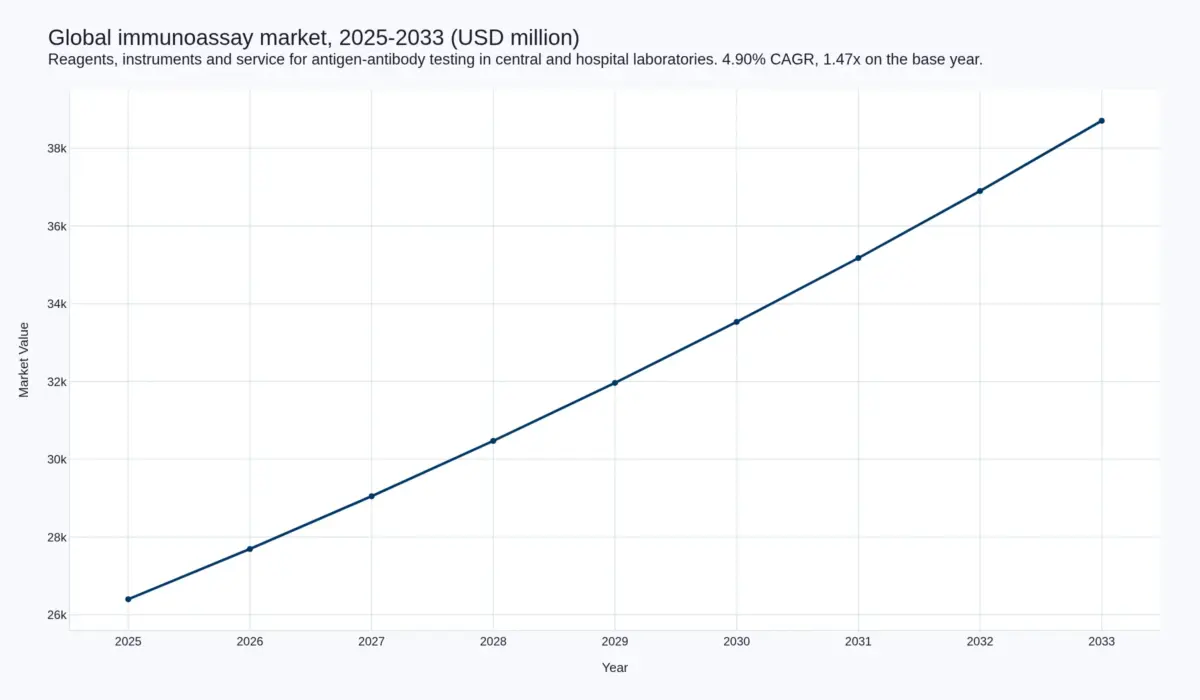
| Market value, 2033 | USD 38.7 billion (USD 38,710 million) |
| Compound annual growth rate, 2025-2033 | 4.90% |
| Growth multiple | 1.47x |
| Incremental annual revenue created, 2025-2033 | USD 12.3 billion |
| Share of the global in vitro diagnostics market, 2025 | 24.44% |
| Share of the global in vitro diagnostics market, 2033 | 22.93% |
| Immunoassay revenue attributed to nine disclosed corporate pools, 2025 | USD 17,583 million (66.6%) |
| Stated residual covering unlisted, Chinese domestic and open-platform supply, 2025 | USD 8,817 million (33.4%) |
| Change in price per domestic chemiluminescence test at the largest listed Chinese vendor, 2025 | -16.44% |
| Change in price per overseas reagent sale at the same vendor, 2025 | -6.00% |
| Fastest-growing application, 2025-2033 | Neurodegeneration and other emerging analytes |
| Largest technology, 2025 and 2033 | Chemiluminescence (62.0% rising to 64.6%) |
| Currency and basis | USD, nominal, 2025 average exchange rates (EUR 1.00 = USD 1.13; CHF 1.00 = USD 1.15; JPY 148 = USD 1.00; CNY 7.20 = USD 1.00) |
| Forecast horizon | 2026-2033 |
The global immunoassay market was worth USD 26.4 billion in 2025 and is forecast to reach USD 38.7 billion by 2033, a compound annual growth rate of 4.90%. That is 1.47x on the base year, or USD 12.3 billion of incremental annual revenue across eight years.
Immunoassay is the largest single discipline inside in vitro diagnostics, and on this construction it is also one of the slowest-growing. Its share of the diagnostics market falls from 24.44% to 22.93% over the window, while molecular diagnostics rises to a quarter of it. That is not a demand forecast. It is a price forecast, and the base year is where the evidence for it sits.
The thesis: the volume grew, the revenue did not, and a tender set the price
In 2025 the two largest reagent categories in Chinese chemiluminescence - tumour markers and thyroid function - were priced by a provincial procurement alliance rather than by a vendor. The Anhui-led group published its 2024 results on 30 December 2024: sixteen tumour marker items and nine thyroid function items, awarded at an average of 50% below the published ceiling price in Group A, with every winning bidder receiving 100% of its intended volume. The ceilings themselves had been set at 34% and 45% respectively of the Beijing public hospital test price. The prior year's Anhui round, covering sex hormones and infectious disease serology, averaged 51%.
That is the whole of the base-year story, and it shows up in the disclosures with unusual precision.
Roche's core laboratory business was flat at CHF 7.6 billion for the year - and the flatness is an average of two lines moving in opposite directions. Immuno-diagnostics fell 3%. Clinical chemistry rose 7%. The same company, the same customers, the same tender exposure, the same quarter: one discipline deflated and the other grew. Diagnostics sales in China fell 24% for the year and took Asia-Pacific down 12% while every other region grew at a mid-single-to-low-double-digit rate.
Abbott's Core Laboratory revenue was USD 5,360 million, up 2% from USD 5,240 million, and in the fourth quarter it grew 5.3% on a reported basis and 3.6% organically - a result the company explicitly hedged by naming "challenging market conditions in China, including the impact of volume-based procurement programs."
QuidelOrtho's Labs revenue was USD 1,505.7 million, up 5.7% in constant currency. Almost all of it is Vitros, a clinical chemistry and immunoassay franchise sold overwhelmingly into the United States, where no alliance sets a reagent price. It is the cleanest available control group: same product category, same year, no administered price, and it grew roughly eight percentage points faster than Roche's immunoassay line.
DiaSorin's ex-COVID immunodiagnostics revenue was EUR 821 million, up 7% at constant exchange rates and up 5% at current rates - and up 8% at constant rates excluding China. The company attributed the Chinese contraction directly to volume-based procurement, and guided 2026 to 5-6% at constant rates. A pure-play immunoassay company, disclosing in one paragraph both the mechanism and the size of the drag it creates.
Snibe, the largest listed Chinese chemiluminescence specialist, is where the mechanism becomes arithmetic. Domestic reagent revenue fell 13.77% while domestic chemiluminescence reagent volume rose 3.20%. Divide one by the other and the realised price per test fell 16.44%. Overseas, reagent revenue rose 34.96% against reagent volume growth of 43.57% - a price decline of 6.00%, in a geography where no alliance sets the price. Two continents, one disclosure, two deflation rates, and in neither of them is demand the problem.
Mindray's in vitro diagnostics revenue fell 9.41% to RMB 12,241 million while its domestic business fell 22.97%, and the company named four causes in the same sentence: DRG/DIP payment reform, reagent volume-based procurement, mutual recognition of test results across institutions, and medical service price governance. Two of those are price policies. Two are volume policies - and the second pair is the part of the Chinese reset that most forecasts miss.
So the forecast is not an extrapolation of 2025. It is a statement that a one-time reset in the two densest parts of the menu laps out of the comparison, that volume keeps compounding at mid-single digits, and that the menu migrates toward analytes no alliance has yet priced. 4.90% is what those three forces produce when they are added rather than assumed.
The 2025 disclosures this report is built on
| Participant | Disclosed 2025 measure | What it says about immunoassay |
|---|---|---|
| Roche Diagnostics | Core Lab CHF 7,600m, flat; immuno-diagnostics -3%; clinical chemistry +7%; China diagnostics -24% | The category was reset while the discipline next to it grew |
| Abbott | Core Laboratory USD 5,360m, +2%; Q4 +5.3% reported, +3.6% organic | Growth, but explicitly net of Chinese volume-based procurement |
| Danaher | Diagnostics USD 9,941m; operating profit USD 2,650m at 26.7%; DxI 9000 menu expanded into neurodegenerative assays | The margin is in the menu, and the menu is being re-pointed |
| Siemens Healthineers | Diagnostics EUR 4,347m; adjusted EBIT EUR 333m at 7.7%; Q4 comparable -0.3%; China low-double-digit decline | A broad installed base converting price pressure into margin repair |
| QuidelOrtho | Labs USD 1,505.7m, +5.7% constant currency; adjusted EBITDA USD 597m at 22% | What the category does without an administered price |
| bioMerieux | Sales EUR 4,070m; VIDAS menu of more than 80 tests | A mid-throughput fluorescent immunoassay franchise built on menu breadth |
| DiaSorin | Revenue EUR 1,195m, +4% CER; ex-COVID immunodiagnostics EUR 821m, +7% CER, +8% CER ex-China; adjusted EBITDA EUR 394m at 33% | The pure-play read on category economics, and the China drag isolated |
| Snibe | Revenue RMB 4,576.8m, +0.91%; domestic reagent -13.77% on volume +3.20%; overseas reagent +34.96% on volume +43.57%; net profit RMB 1,620.3m | The price of a test, measured twice |
| Mindray | IVD revenue RMB 12,241m, -9.41%; domestic revenue -22.97% | Volume-side policy - DRG/DIP, panel unbundling, result mutual recognition |
| Sysmex | Net sales JPY 508,643m; immunochemistry 5.1% of sales; Alzheimer's reagent launched in Japan 2022 and rolling into Europe and the United States | An immunoassay line attached to a haematology installed base |
Three findings that carry the forecast
One: the price of an immunoassay test is now a measured quantity, and it is falling in both geographies
Snibe discloses reagent revenue and reagent volume growth separately, which almost nobody does. In China the two diverge by 16.44 percentage points against the revenue line. Overseas they diverge by 6.00 points. The overseas divergence is not a procurement effect - there is no alliance setting prices in Latin America or Southeast Asia - so it is either mix or competition. Either way, the direction is the same and the magnitude is smaller. The lesson is that price per test is eroding everywhere and being destroyed in one place, and a forecast that treats the Chinese reset as the only deflation in the model will overstate the recovery.
Two: Roche's core lab flat at 70/30 is not an assumption, it is a derivation
Roche reports core laboratory as one number and discloses the growth of two of its lines. Immuno-diagnostics fell 3%, clinical chemistry rose 7%, and the total was flat. There is only one weight on those two lines that produces zero growth: 70% immunoassay, 30% chemistry. That is where the attribution in this report's base construction comes from - the disclosed growth rates solve for it, rather than a share being assumed and buried. It also means Roche's immunoassay line is worth roughly CHF 5.3 billion, which is why a single vendor's category decline moves the global number.
Three: the menu is migrating to analytes nobody has priced yet
The platform generation is finished. Chemiluminescence is forty years old and no one is replacing it. What changed in 2025 is what goes on it:
- Roche's Elecsys Phospho-Tau (217P) Plasma received 510(k) clearance as K261686, a Class II device under 21 CFR 866.5840, running as a fully automated electrochemiluminescence immunoassay on cobas e analysers, indicated for patients aged 55 and over with signs of cognitive decline. It reports three bands - positive above 0.378 pg/mL, intermediate between 0.223 and 0.378, negative at or below 0.223. It is the first single-biomarker blood test cleared to aid identification of amyloid pathology, and it converts a PET scan into a reagent on an installed base that already exists.
- Danaher's Beckman Coulter expanded the DxI 9000 immunoassay menu, with disclosed progress in neurodegenerative disease assays.
- bioMerieux's VIDAS TBI runs GFAP and UCH-L1 for mild traumatic brain injury, alongside NEPHROCHECK for acute kidney injury and a fully automated TB IGRA - all on a platform that also carries thyroid, fertility, tumour marker and cardiac tests.
- Sysmex launched an Alzheimer's reagent in Japan in 2022 and is rolling it into Europe and the United States on its HISCL immunochemistry line.
None of those analytes sits inside a volume-based procurement category. That is the point of them. The growth in this market is not a new instrument cycle; it is the migration of the menu toward tests with no comparable price reference, and it explains why the category can deflate in its dense middle and still compound at 4.90% overall.
What is inside the perimeter, and why the level is where it is
Inside: reagents, instruments, calibration, service and software sold for the detection and quantification of antigens and antibodies in central and hospital laboratories - chemiluminescence (CLIA, CMIA, ECLIA), microplate ELISA, immunoturbidimetric and latex-enhanced assays run on chemistry analysers, fluorescent enzyme-linked formats, and multiplex bead and flow arrays. Both the reagent annuity and the instrument placement are counted, because in a closed system they are one commercial transaction.
Outside: lateral-flow and rapid point-of-care immunoassay, which belongs to the point-of-care discipline and is sized separately in the cluster; molecular diagnostics; blood banking immunohematology, which is a donor and transfusion market with its own regulator; donor screening; veterinary and food-safety immunoassay, including the industrial VIDAS applications that share bioMerieux's instrument but not its buyer; self-testing; and laboratory-developed tests sold as a service rather than a product.
The perimeter matters because two honest analysts can arrive at USD 26 billion or USD 42 billion for "immunoassay" and both be right. The larger number includes lateral flow and point-of-care, which is the fastest-growing part of antigen-antibody testing and is not in this report.
How the 2025 base was constructed
The base is built from disclosed revenue, not inherited from a published aggregate. Nine corporate pools are attributed to immunoassay, at the shares shown, and the remainder is stated rather than distributed.
| Participant | Disclosed 2025 base | Immunoassay attribution | USD million |
|---|---|---|---|
| Roche Diagnostics | Core Lab CHF 7,600m | 70% - derived from the two disclosed growth rates (see finding two), CHF 5,320m | 6,118 |
| Abbott | Core Laboratory USD 5,360m | 60% | 3,216 |
| Danaher | Diagnostics USD 9,941m | 22% - Beckman Coulter immunoassay within a segment that also holds Cepheid molecular and clinical chemistry | 2,187 |
| Siemens Healthineers | Diagnostics EUR 4,347m | 55% | 2,702 |
| DiaSorin | Ex-COVID immunodiagnostics EUR 821m | 100% | 928 |
| bioMerieux | Group sales EUR 4,070m | 20% - VIDAS and serology within a microbiology-led group | 920 |
| QuidelOrtho | Labs USD 1,505.7m | 55% | 828 |
| Snibe | Revenue RMB 4,576.8m | 80% - the group also sells biochemistry analysers | 509 |
| Sysmex | Immunochemistry at 5.1% of JPY 508,643m | 100% of the disclosed field | 175 |
| Attributed total | 17,583 | ||
| Stated residual | Chinese domestic vendors other than the two named, ELISA and open-platform suppliers, Indian, Korean, Japanese and Brazilian specialists, hospital in-house microplate work | 8,817 | |
| Market, 2025 | 26,400 |
The residual is 33.4% of the base and it is the least defensible number in this report, deliberately. It contains a Chinese domestic immunoassay industry that is large, fast-growing and almost entirely unlisted, which is precisely why it is stated as a block rather than guessed at line by line. An ELISA reagent sold by a distributor into a research hospital is a real transaction and there is no filing that records it.
The segment build: technology, application and region
| Technology | 2025 (USD m) | 2033 (USD m) | Share 2025 | Share 2033 |
|---|---|---|---|---|
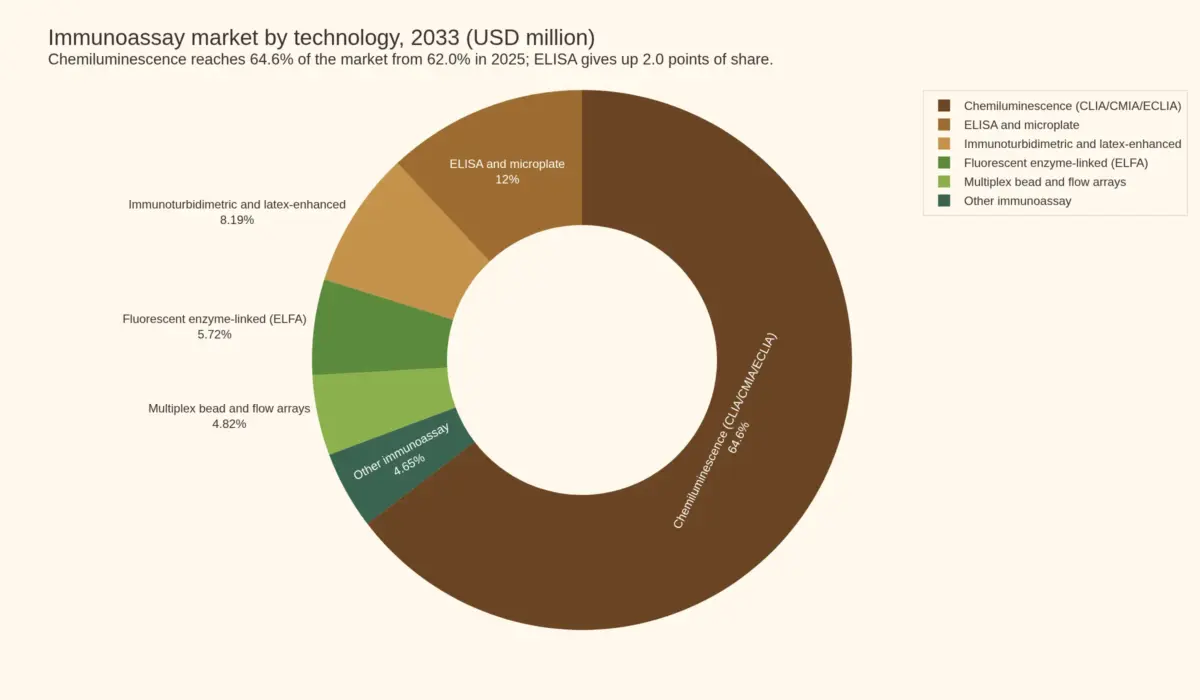
| Chemiluminescence (CLIA, CMIA, ECLIA) | 16,368 | 25,020 | 62.0% | 64.6% |
| ELISA and microplate | 3,696 | 4,640 | 14.0% | 12.0% |
| Immunoturbidimetric and latex-enhanced | 2,376 | 3,170 | 9.0% | 8.2% |
| Fluorescent enzyme-linked (ELFA) and other fluorescence | 1,584 | 2,215 | 6.0% | 5.7% |
| Multiplex bead and flow arrays | 1,056 | 1,865 | 4.0% | 4.8% |
| Other immunoassay (agglutination, nephelometry, blot-based confirmation) | 1,320 | 1,800 | 5.0% | 4.7% |
| Total | 26,400 | 38,710 | 100% | 100% |
| Application | 2025 (USD m) | 2033 (USD m) | Share 2025 | Share 2033 |
|---|---|---|---|---|
| Tumour markers | 5,808 | 7,700 | 22.0% | 19.9% |
| Thyroid function | 4,224 | 5,500 | 16.0% | 14.2% |
| Cardiac markers | 3,696 | 5,850 | 14.0% | 15.1% |
| Infectious disease serology | 3,168 | 4,620 | 12.0% | 11.9% |
| Hormones and fertility | 2,904 | 4,150 | 11.0% | 10.7% |
| Inflammation, sepsis and critical care | 1,848 | 3,250 | 7.0% | 8.4% |
| Autoimmune and allergy | 1,584 | 2,560 | 6.0% | 6.6% |
| Neurodegeneration and other emerging analytes | 528 | 1,520 | 2.0% | 3.9% |
| Other routine (vitamins, bone, anaemia, HbA1c) | 2,640 | 3,560 | 10.0% | 9.2% |
| Total | 26,400 | 38,710 | 100% | 100% |
The two categories that were priced by tender in 2024 - tumour markers and thyroid function - are 38% of the 2025 market and lose 3.9 points of share by 2033. Cardiac markers overtake thyroid function to become the second-largest application, because troponin and natriuretic peptide testing is driven by guideline-defined care pathways and by emergency departments that cannot batch. Neurodegeneration is small, grows fastest, and is the only application in the table whose growth is a regulatory event rather than a demographic one.
| Region | 2025 (USD m) | 2033 (USD m) | CAGR | Share 2033 |
|---|---|---|---|---|
| North America | 8,712 | 13,161 | 5.3% | 34.0% |
| Europe | 6,996 | 9,678 | 4.1% | 25.0% |
| China | 5,016 | 6,968 | 4.2% | 18.0% |
| Rest of Asia-Pacific | 3,564 | 5,807 | 6.3% | 15.0% |
| Rest of world | 2,112 | 3,096 | 4.9% | 8.0% |
| Total | 26,400 | 38,710 | 4.9% | 100% |
China is 19.0% of the market in 2025 and 18.0% in 2033. That is the single most contestable judgement in this report and it is deliberate: Chinese immunoassay volume grows faster than the global average, and Chinese immunoassay revenue does not, because the price is administered and the ceiling has been lowered twice. The fastest-growing region is the rest of Asia-Pacific, which is where the Chinese vendors are taking the model they perfected at home.
This construction reconciles to the discipline split published in the cluster's in vitro diagnostics hub, where immunoassay and clinical chemistry together reach USD 61.2 billion by 2033. Immunoassay is USD 38.7 billion of that and clinical chemistry the remaining USD 22.5 billion - which implies chemistry at roughly 3.8% and makes the point that the two disciplines inside core laboratory are no longer the same business.
How to read this report
Every growth rate used here is a participant's own disclosed constant-currency or organic figure, or is implied by the endpoints in this document. Every price-per-test figure is derived from two disclosed numbers and the arithmetic is shown. Where a share is an attribution rather than a disclosure, the share is printed in the table. The methodology note records the secondary and primary layers separately, and the risk chapter states what would have to be true for the forecast to be wrong - including the case where the Chinese mechanism extends to cardiac markers, which is the outcome this report regards as more likely than a reversal.
Sources and disclosure base
Every figure in this report traces to primary corporate or regulatory disclosure. No third-party market research estimate has been used at any point, and no market-research competitor is cited anywhere in this document.
- Roche Annual Report 2025 - Diagnostics division sales of CHF 13.8 billion, core laboratory at CHF 7.6 billion, immuno-diagnostics -3%, clinical chemistry +7%, China -24%.
- Abbott Form 8-K, fourth quarter and full year 2025 - Core Laboratory USD 5,360 million, quarterly reported and organic growth, and the volume-based procurement commentary.
- Danaher fourth quarter and full year 2025 results - Diagnostics revenue of USD 9,941 million, segment operating profit, and the DxI 9000 menu expansion.
- Siemens Healthineers quarterly statement, Q4 fiscal 2025 - Diagnostics revenue of EUR 1,098 million in the quarter, comparable growth of -0.3%, and the Chinese procurement effect.
- QuidelOrtho fourth quarter and full year 2025 results - Labs revenue of USD 1,505.7 million, adjusted EBITDA of USD 597 million, and the goodwill impairment.
- DiaSorin FY2025 results - revenue of EUR 1,195 million and ex-COVID immunodiagnostics of EUR 821 million, with the Chinese procurement drag isolated.
- bioMerieux Universal Registration Document 2025 - group sales and the VIDAS menu and throughput specification.
- Snibe (Shenzhen New Industries Biomedical) 2025 Annual Report - domestic and overseas reagent revenue against reagent volume, analyser placements and installed base.
- Mindray 2025 Annual Report summary - in vitro diagnostics segment revenue and the domestic decline, with the four named policy causes.
- Sysmex Report 2025 - immunochemistry at 5.1% of net sales, and the Alzheimer's reagent rollout from Japan.
- FDA 510(k) K261686 decision summary, Elecsys Phospho-Tau (217P) Plasma - device classification, intended use and the three-band cutoff structure.
The Chinese procurement parameters - item counts, ceiling construction, Group A reduction and the volume award - are taken from the 2024 provincial award results published by the Anhui pharmaceutical procurement centre on 30 December 2024, together with the 2023 round's published outcome.
Further reading in this cluster
This report is the discipline-level spoke beneath the Global In Vitro Diagnostics (IVD) Market 2026-2033, which constructs the USD 108.0 billion base this market is measured against and attributes 56.97% of it to twelve participant disclosures. The segment page for Molecular Diagnostics carries the full cluster index.
- Global Diagnostic Tests Market - the volume-denominated view of laboratory testing across disciplines.
- Global PCR and Digital PCR Market - the molecular discipline that grows at roughly twice this market's rate.
- Global Next-Generation Sequencing Market - the sequencing layer, and the platform that protein-based testing is most often compared to in investment decisions.
- Global Oncology Molecular Diagnostics and Tumour Profiling Market - the molecular counterpart to the tumour marker category priced in 2024.
- Global Virus Testing Kits Market - the reagent-format economics that sit next to infectious disease serology.
- Global Home-Based Molecular Testing Market - the setting shift that removes a test from a hospital analyser altogether.
Three editorial analyses extend the argument: China's Price Cut Is Worth Half a Point of the IVD Forecast, Not Four on how a base-year distortion dilutes through a CAGR; Two Diagnostics Businesses, the Same Operating Profit, a Quarter of the Revenue on the margin consequence of menu breadth; and Fifteen Per Cent a Year: How the Price Schedule Decides Diagnostic Growth on the reimbursement rate as the binding variable.
About the method
This report is 70% secondary and 30% primary. The secondary layer is corporate and regulatory disclosure read in full and reconciled line by line. The primary layer is Pheonix's own fieldwork in the category - depth interviews with laboratory directors, clinical biochemists and immunoassay commercial leaders, open-ended interviews with laboratory managers who have run a reagent tender, a structured survey of laboratory operations and procurement decision-makers, and direct observation at the major diagnostics conferences. It is used for mechanism: how a tender is sequenced, what a laboratory actually does when a reagent price is reset, why a menu is rationalised after a placement. It is never used to carry a figure. Every number in this document is disclosed, derived from disclosed numbers with the arithmetic shown, or stated as a model assumption with its sensitivity printed in the risk chapter.
Further reading in this cluster: Global Clinical Chemistry and Urinalysis Market, 2026-2033 — the companion discipline report. Chemistry and urinalysis is the other half of the routine core of the laboratory, and the reason this report's 4.90% and that report's 3.71% reconcile: the two together are USD 43.2 billion of the USD 108.0 billion diagnostics base, or 40.0% of it in 2025.
Further reading in this cluster
Global Haematology and Coagulation Diagnostics Market — the third discipline report, USD 7.62 billion in 2025. It carries the same method applied to the discipline where a closed reagent system makes attribution nearly complete: 87.28% of value to named vendors, against 66.6% here. The contrast is the finding. Immunoassay has a 33.4% residual because open-platform supply and Chinese domestic vendors can reach the market; haematology has a 12.72% residual because they cannot. The discipline that could not be unbundled is the one that a Chinese provincial tender repriced by 40%.
Global Clinical Chemistry and Urinalysis Market — USD 16.8 billion in 2025, and the companion on the same price documents. Where this report reads Roche’s flat core laboratory as a 70/30 immunoassay-to-chemistry weight, that report reads the chemistry half of the same number.
Global In Vitro Diagnostics Market — the USD 108.0 billion base and the discipline split all three reports reconcile to.
Further reading: Global IVD Reagents and Consumables Market, 2026–2033 measures the USD 78.4 billion consumable layer this discipline's reagents sit inside. Immunoassay reagents are 27.60% of that layer — USD 21,638 million, growing 4.55% a year against a 5.31% layer average, because the reagent is the only part of a closed chemiluminescence system a provincial alliance can specify.
Table des matières
Table of Contents
- Market Forecast Snapshot, 2025-2033
- The thesis: the volume grew, the revenue did not, and a tender set the price
- The 2025 disclosures this report is built on
- Three findings that carry the forecast
- What is inside the perimeter, and why the level is where it is
- How the 2025 base was constructed
- The segment build: technology, application and region
- Competitive Landscape
- Value Chain and Margin Structure
- Technology Insight: The Menu, the Cutoff and the Blood Test
- Investment and Capital Formation
- Market Risk Assessment
- Regulatory and Policy Environment
Paysage concurrentiel
Competitive Landscape
Nine disclosed pools account for 66.6% of this market and no single participant holds anything close to a dominant share: Roche’s attributed immunoassay revenue is USD 6,118 million against a market of USD 26,400 million. That combination – a high fixed cost of entry, a low ceiling on share – is what produces a market that is simultaneously hard to enter and impossible to monopolise.
Two business models that share a category
Closed-system platform vendors sell the analyser and the reagent together, and the reagent is where the money is. Snibe states the model in its own annual report without decoration: the chemiluminescence reagent and the instrument must be used together, and the company earns by selling instruments to drive reagent sales and reagent sales to drive instrument sales. Every one of the nine pools above runs that model, and it is why a placement decision is a multi-year revenue decision.
Open-platform suppliers sell antibodies, antigens, plates, conjugates and kits to laboratories and to the vendors themselves. They carry no annuity and no placement cost, and they set the reference price against which a closed-system reagent is compared.
The distinction matters more than the technology does. A closed system competes on switching cost; an open platform competes on unit price. When a procurement authority wants a lower price, it is the existence of the open-platform alternative that makes the demand credible.
Menu breadth is the competitive variable
| Participant | Disclosed menu or placement position |
|---|---|
| Snibe | 250 chemiluminescence reagent items sold globally, 207 of them with European market access; MAGLUMI X8 installed base of 4,761 units; 1,930 Chinese tertiary hospitals served (46.95% coverage), 63.38% of the top-tier 3A hospitals |
| bioMerieux | More than 80 VIDAS tests spanning emergency and critical care, infectious disease serology and immunochemistry |
| Roche Diagnostics | 61 diagnostic products launched in 2025 across the division – two platforms, six digital solutions and 53 tests |
| Danaher | DxI 9000 immunoassay menu expanded during 2025, with disclosed progress in neurodegenerative disease assays |
| Mindray | Nearly 300 new high-end clients won in 2025; more than 20 MT8000 laboratory automation pipelines installed globally |
The competitive question in this market is never whether a vendor can measure an analyte. It is whether the vendor can put the analyte on a menu that a laboratory has already installed. That is why the Roche example inside finding two is so instructive: a 3% decline in one line was enough to hold an entire CHF 7.6 billion business flat, because that one line is 70% of it.
Where the Chinese challengers actually compete
Snibe’s disclosure is the clearest available picture of a domestic vendor’s strategy, and it is not a price war at home. Domestic reagent revenue fell 13.77% while domestic reagent volume rose 3.20%; overseas reagent volume rose 43.57% and overseas reagent revenue rose 34.96%, with reagents reaching 65.12% of overseas main-business revenue. The growth moved abroad because that is where the price is not administered, and it moved into mid-to-large analysers – 75.34% of the 3,357 overseas placements – because the reagent annuity only exists once the instrument is on the bench.
Mindray’s numbers describe the same market from the other side: in vitro diagnostics revenue of RMB 12,241 million, down 9.41%, with domestic revenue down 22.97% against a group decline of 9.38%. The domestic decline is not a share loss to a competitor. It is a smaller market.
Portfolio reshaping is substitution for consolidation
No material immunoassay acquisition closed in 2025. What happened instead was separation and write-down: BD’s proposal to combine its diagnostics businesses with Waters, expected to close around the end of the first quarter of 2026, and QuidelOrtho’s USD 701 million non-cash goodwill impairment against a business that still produced a 22% adjusted EBITDA margin. Both are statements about where a diagnostics asset belongs, not about what it can do. For a competitor, the read is that the scarce asset in this market is not capability. It is the placement.
Chaîne de valeur
Value Chain and Margin Structure
The chain runs from biological input to administered price: recombinant antigens and antibodies, magnetic beads and luminescent labels, reagent formulation and calibration, instrument manufacture, placement, the reagent annuity and field service, the laboratory, and finally the payer who decides whether the test can be billed at all. Every margin in this market is earned in the middle of that chain and can be removed at either end of it.
The three links that decide the economics
Inputs. Immunoassay is a biological supply chain. The analyte-specific component – a recombinant antibody or antigen – is the part that is hard to second-source, and the bead, label and wash chemistry around it determines reproducibility lot to lot. Supply chain complexity in this category is high, and it is why a menu of 250 items is a decade of work rather than a catalogue decision.
The placement. Analysers are sold, leased or placed at or near cost. The instrument is not the product; it is the toll gate. This is where capital is committed and where the return is decided, and it is why every participant reports placements separately from revenue.
The annuity. Reagents recur for as long as the instrument stays installed. A closed system means the reagent cannot be sourced elsewhere, so the annuity is a contractual claim on a physical asset that someone else can win back at the next tender cycle.
What the margin actually looks like
| Participant | Disclosed 2025 margin measure | What it reflects |
|---|---|---|
| Danaher Diagnostics | Operating profit USD 2,650m at 26.7% of USD 9,941m | A segment that spans molecular and immunoassay with a large recurring reagent base |
| DiaSorin | Adjusted EBITDA EUR 394m at 33% of EUR 1,195m | A pure-play immunoassay company at the top of the observed range |
| QuidelOrtho | Adjusted EBITDA USD 597m at 22%, up 240 basis points | Margin held while revenue fell, because 84% of it was recurring |
| Siemens Healthineers Diagnostics | Adjusted EBIT EUR 333m at 7.7% of EUR 4,347m | A broad diagnostics estate mid-transformation |
| Snibe | Net profit RMB 1,620.3m on revenue of RMB 4,576.8m | A domestic CLIA specialist with a 250-item menu and rising overseas mix |
The measures are not identical – adjusted EBITDA, adjusted EBIT, segment operating profit and net profit are four different things – so the table is not a ranking. What it does show is a spread from 7.7% to 33% inside a single product category, and the explanation is not assay quality. It is menu density per placement. DiaSorin at 33% EBITDA runs a specialised CLIA menu on a narrow installed base. Siemens at 7.7% EBIT runs a wide estate that includes chemistry, automation and service obligations, and spent 2025 taking cost out of it to move the number from 5.3% to 7.7%.
Where the value leaks
At the tender. A procurement award sets the reagent price for the term of the award, and a vendor that declines to participate leaves the province. The Anhui-led 2024 round awarded 25 items at an average 50% below the ceiling in Group A; the ceiling was already 34% to 45% of the Beijing test price. The manufacturer carries that reduction, and it cannot recover it on volume, because volume was already fully allocated to the winners.
At the distributor. In unconsolidated markets the distributor holds the laboratory relationship and therefore part of the margin. Where laboratories consolidate, that margin moves to the buyer.
At the payer. A registered assay is not a reimbursed assay. The gate that decides whether a laboratory can afford to run a test – a code, a rate, a coverage policy, a DRG payment – sits with a different institution from the one that cleared it.
The structural consequence
An immunoassay franchise with a large installed base and a deep menu converts revenue into cash reliably. A vendor trying to displace it does not, at any size, because the displacement cost is a placement plus a menu. That is why this market’s value chain produces a stable oligopoly at the top and a long, fragmented tail below it – and why the tail, not the top, is where the growth in this forecast actually sits.
Activité d'investissement
Investment and Capital Formation
This is a capital-light market in which the capital that matters is not plant. It is the placement. Reagent manufacturing scales with volume at incremental cost; an analyser on a bench is a fixed commitment made years before the reagent revenue arrives, and the whole return profile of a franchise follows from how many of them are installed and how deep the menu on them is.
Placements as the capital allocation decision
Snibe’s 2025 disclosure makes the mechanics unusually visible. It installed 1,462 chemiluminescence analysers in China, 79.14% of them large-frame, and 3,357 overseas, 75.34% mid-to-large – and the mix shift is the strategy, because a large-frame analyser carries the menu and the menu carries the annuity. The lag between the two is also visible in the same document: overseas reagent revenue grew 34.96% and overseas reagent volume 43.57% against an installed base that had been built the year before.
Mindray won nearly 300 new high-end clients and installed more than 20 MT8000 automation pipelines, and guided to a significant increase in pipeline installations in 2026. Roche launched 61 diagnostic products in 2025 – two platforms, six digital solutions and 53 tests – and delivered 31 billion diagnostic tests to customers. DiaSorin committed EUR 10 million of investment in the United States and is working toward 600 hospital facilities by 2027, with 2026 guidance of 5-6% revenue growth at constant exchange rates.
Where the money is now going
Three patterns are consistent across every participant.
Into assays, not instruments. The DxI 9000 expansion, the pTau217 clearance, the VIDAS traumatic brain injury assay and the Sysmex amyloid reagent are all menu investments on installed hardware. The instrument generation is finished; the analyte generation is where the return is.
Into the sample journey. Automation tracks and laboratory information platforms are being bought to defend placements, not to sell analysers.
Out of China, and into everywhere else. Snibe’s overseas reagent revenue grew 34.96% while its domestic reagent revenue fell 13.77%; DiaSorin grew 8% at constant rates excluding China against 7% overall. Capital follows the price, and the price is not administered outside China.
The cautionary case
QuidelOrtho recorded a USD 701 million non-cash goodwill impairment in the third quarter of 2025, against a business that still produced a USD 597 million adjusted EBITDA at a 22% margin. The impairment is an accounting judgement about a past acquisition rather than a statement about 2025 trading, but it carries the lesson this market teaches repeatedly: an immunoassay asset cannot be underwritten on the revenue it brings. It has to be underwritten on the installed base it inherits and the menu that can be put on that base, because those two things, and not the purchase price, decide the annuity.
Capital intensity, returns and the absence of deal flow
Capital intensity is moderate and falling. What is expensive is the menu and the regulatory programme that clears it – a fixed cost paid before any revenue exists – and that is the real barrier to entry, not the factory.
No material immunoassay acquisition closed in 2025. The portfolio moves were separations and write-downs: BD’s proposed combination of its diagnostics businesses with Waters, expected to close around the end of the first quarter of 2026, and the QuidelOrtho impairment. For a strategic buyer, the implication is that an immunoassay asset should be valued on installed-base density and menu coverage, and the observable to watch is reagent revenue per placement – the one number that shows whether an annuity is deepening or being repriced.
Technologie et innovation
Technology Insight: The Menu, the Cutoff and the Blood Test
The detection chemistry in this market is mature. Chemiluminescence, whether acridinium-ester direct, enzyme-amplified or electrochemiluminescent, has been the reference principle for four decades and nothing in 2025 displaced it. What moved was the analyte list and the speed at which a large laboratory can process it.
Four generations, one survivor
Microplate ELISA is open, manual or semi-automated, priced per plate, and carries no annuity. It remains the correct choice for low volume, research use and assays where no closed-system reagent exists.
Automated chemiluminescence is closed, random access and throughput-tiered. Snibe’s trajectory is the clearest illustration of the tiering: the MAGLUMI X8 was the first single unit to break 600 tests per hour, and the X10, registered in China in 2025 and sold from the third quarter, runs at 1,000 tests per hour with a 10 microlitre sample precision of 1% or better.
Fluorescent enzyme-linked formats occupy the mid-throughput tier – bioMerieux’s VIDAS reaches up to 72 tests per hour with six KUBE modules – and are used either as a primary platform in unconsolidated laboratories or as a complementary platform for high-medical-value tests in consolidated ones.
Multiplex bead and flow arrays are the smallest format and the fastest-growing per unit, because they answer a question a single-analyte cartridge cannot: many antibodies, one sample.
The analyte layer is where the innovation actually is
Four launches in 2025 and 2026 define the direction, and all four are new analytes on existing analysers rather than new instruments.
| Analyte | Platform and status | Why it matters commercially |
|---|---|---|
| Phospho-Tau 217 plasma | Roche Elecsys, cleared as 510(k) K261686, a Class II device under 21 CFR 866.5840, fully automated ECLIA on cobas e analysers for patients aged 55 and over | Converts a PET scan into a reagent on an installed base, with no comparable price reference |
| GFAP and UCH-L1 | bioMerieux VIDAS TBI, for mild traumatic brain injury including concussion | Creates a laboratory test where the alternative was a CT decision |
| Neurodegeneration panel expansion | Beckman Coulter DxI 9000 menu extension | Puts a premium menu on an existing chemistry-adjacent placement |
| Amyloid markers | Sysmex Alzheimer’s reagent, launched in Japan in 2022 and rolling into Europe and the United States on the HISCL immunochemistry line | The same logic executed from a haematology installed base |
The pTau217 clearance is worth reading as a regulatory object, because it shows what a premium immunoassay now has to carry. The assay reports three bands rather than a number: positive above 0.378 pg/mL, intermediate between 0.223 and 0.378, negative at or below 0.223, with an explicit warning that positive predictive value falls in low-prevalence primary care settings and that results near the upper cutoff may need specialist follow-up. A cutoff table is not a technical detail. It is the thing that makes the test billable and the thing that makes it defensible, and it is the reason a new analyte takes years to reach a menu while a new analyser takes months.
Why ELISA keeps losing ground
ELISA falls from 14.0% to 12.0% of this market not because it stops working but because its economics do not survive volume. A plate has no annuity, no random access and more labour per result; every additional sample makes the closed system relatively cheaper. The floor is real, though. Research use, esoteric analytes, low-volume sites and in-house hospital work will still be running plates in 2033, and none of that appears in any vendor’s disclosed revenue.
Automation is the next switching cost
The competitive frontier has moved from the analyser to the track. Mindray installed more than 20 MT8000 laboratory automation pipelines globally in 2025 and expects a significant increase in 2026; Snibe is pushing its SATLARS T8 line and the iXLAB laboratory platform. A track that connects a pre-analytical system to an immunoassay analyser makes the analyser harder to replace than any reagent contract does, because replacing it means re-engineering the laboratory. Expect the placement battle of the next five years to be fought over the sample journey rather than over chemiluminescence.
Risque de marché
Market Risk Assessment
The risks that decide this market are administrative rather than clinical. The assays work, the volume is growing and the installed base is expanding. What can remove revenue is a procurement award, a payment reform, a coverage rule or a tariff – and every one of those is decided by an institution rather than by a competitor.
Risk one: the mechanism extends to cardiac markers
Tumour markers and thyroid function were priced in 2024. Cardiac markers are the obvious next candidate: they are 14.0% of this market, they are the second-largest application by 2033 in this forecast, and they run on the same analysers as the categories already reset. If cardiac testing prices the way tumour markers did, the terminal market is USD 37,727 million and the CAGR 4.56%. This is the largest single exposure in the model and the one this report regards as more likely than not to occur inside the forecast window.
Risk two: the volume policies, which no price model captures
Mindray named four causes of its domestic decline in one sentence: DRG/DIP payment reform, reagent volume-based procurement, mutual recognition of test results across institutions, and medical service price governance. Two of those four are volume mechanisms. Panel unbundling removes the bundled order that fills an immunoassay menu, and mutual recognition means a result obtained in one hospital is accepted in another instead of being repeated. A repeated test is a reagent sale. This is the least modelled and most underappreciated risk in the category, and it acts on the numerator of price times volume rather than on the price.
Risk three: China does not recover
This forecast already assumes China grows at 4.2%, below the global rate, and loses share from 19.0% to 18.0%. If the administered price keeps falling faster than volume recovers and China grows at 1.5%, the terminal market is USD 37,392 million and the CAGR 4.45%. Note that even the base case is not a China recovery story. It is a story about the rest of the world growing while China transacts.
Risk four: the premium menu scales faster than modelled (upside)
The mirror of risk one. If neurodegeneration grows at 18% rather than 14% and inflammation and sepsis at 8.5% rather than 7.2%, the terminal market is USD 39,474 million and the CAGR 5.16%. The evidence for this case is the 2025 clearance and launch record: four premium analytes put onto existing analysers in eighteen months, none of them inside a procurement category.
Risk five: open-platform deflation sets a reference price
ELISA and immunoturbidimetric reagents price against nothing but each other. They are the credible alternative that a procurement authority uses to argue a closed-system reagent down, and their unit prices are visible in a way that a chemiluminescence cartridge price is not. A sustained fall in open-platform pricing does not remove much revenue directly – the segment is 23% of the market – but it compresses the reference price for everything above it.
Risk six: the installed base can be displaced, and attrition is undisclosed
Every growth rate above volume growth requires either a new placement or a richer menu on an existing one. Switching costs are falling as laboratories move to multi-vendor arrangements specifically so they can re-tender without losing the platform, and as automation tracks make interoperability a purchasing requirement rather than a technical nicety. No participant in this market discloses placement attrition in a form that would let a reader measure it, which means the durability of the annuity is asserted rather than evidenced by anyone.
Risk seven: currency, which is not a risk to demand
Roche’s diagnostics division grew 2% at constant exchange rates and fell 3% in Swiss francs – a five-point gap created entirely by translation. DiaSorin absorbed a EUR 34 million negative currency impact on EUR 1,195 million of revenue and still grew 1% at current rates against 4% at constant rates. A reader comparing reported growth rates across this market without adjusting for currency will conclude that demand collapsed when it did not.
What is not a risk
Demand. Roche delivered 31 billion diagnostic tests in 2025. Thyroid function, cardiac markers and fertility testing are defined by clinical guidelines rather than by consumer choice, and the installed base of analysers is larger at the end of 2025 than at the start in every region. The volume side of this market is not in question, which is precisely why this is a price forecast wearing a growth-rate label.
Overall market risk assessment: moderate. The demand base is among the most durable in healthcare and the installed base is growing. The revenue line is exposed to an administered price in the largest volume geography, to two payment mechanisms that suppress test volume directly, and to a reference price set by open platforms. Each of those is a policy variable, and policy variables can move in both directions.
Paysage réglementaire
Regulatory and Policy Environment
An immunoassay is regulated twice: once as a device before it can be sold, and once as a price after it can be. The first gate is a registration and the second is a procurement, and in this category the second has moved more revenue in the last three years than the first has in the last ten.
The operative frameworks
European Union. Regulation (EU) 2017/746 on in vitro diagnostic medical devices replaced the previous directive and reclassified a large part of the assay population upwards, requiring notified body involvement where self-certification was previously sufficient. The commercial consequence for immunoassay is that adding one analyte to a menu now carries a longer timeline and a higher cost per assay – which structurally favours the vendor with 250 items already placed and disadvantages the one trying to add a tenth.
United States. A test requires clearance or approval – 510(k), De Novo or premarket approval – unless it is a laboratory-developed test performed in a laboratory certified under CLIA and accredited by the College of American Pathologists. A rule issued in May 2024 that would have phased laboratory-developed tests into device regulation was vacated in March 2025 and the agency reverted to its pre-2024 framework in September 2025. That distinction is decisively commercial: a cleared device is a product a hospital buys and a laboratory-developed test is a service a laboratory sells, and only the first is inside this report’s perimeter.
The 2025 pTau217 clearance is the clearest worked example of what the device pathway now demands of a premium immunoassay. Roche’s Elecsys Phospho-Tau (217P) Plasma was cleared as K261686, a Class II device under 21 CFR 866.5840, intended for patients aged 55 and over presenting with signs or symptoms of cognitive decline, with a three-band interpretation – positive above 0.378 pg/mL, intermediate between 0.223 and 0.378, negative at or below 0.223 – and an explicit caution that predictive value falls in low-prevalence settings. The cutoff structure, not the antibody, is the regulatory object.
China. Registration through the National Medical Products Administration is the entry gate, and since 2023 centralised volume-based procurement has been the price gate. The sequencing is what matters. The 2023 Anhui-led round covered sex hormones and infectious disease serology and averaged a 51% reduction. The 2024 round extended to sixteen tumour marker items and nine thyroid function items – the two largest chemiluminescence categories in the country – and published results on 30 December 2024 at an average 50% below the published ceiling price in Group A, with ceilings set at 34% and 45% of the Beijing public hospital test price and 100% of intended volume awarded to every winning bidder.
Rest of world. WHO prequalification governs procurement by multilateral buyers and the International Medical Device Regulators Forum framework has largely harmonised classification. The significance for this market is that an assay cleared in one jurisdiction is rarely sellable everywhere without a further registration, which is an administrative advantage for the multi-regional manufacturer rather than a scientific one.
Three policy facts that move immunoassay revenue
The price is set by a buyer, not a seller. A manufacturer cannot decline to bid without leaving the province and cannot bid without accepting the ceiling. This is the defining regulatory feature of the largest growth geography in the world and it is not a device regulation at all.
Payment reform removes volume, not just price. China’s DRG/DIP hospital payment reform, panel unbundling and mutual recognition of test results across institutions all act on the number of tests ordered rather than on the price paid per test. Mindray named all four mechanisms – including volume-based procurement and medical service price governance – as the combined cause of a 22.97% domestic revenue decline. A model that captures only price will overstate this market.
Registration and reimbursement are separate clocks. A cartridge can be cleared in a quarter and remain unbillable for years, because the code, the rate and the coverage policy sit with a different institution from the one that cleared it.
What this means for the forecast
The regulatory environment does not threaten the 4.90%. It shapes who captures it. A stricter device regime raises the cost of adding an analyte, which protects the installed base of a large-menu vendor. A volume-based procurement lowers the price of a reagent and transfers value from the manufacturer to the laboratory, which favours the lowest-cost producer. The two forces push in opposite directions on margin and in the same direction on consolidation: in both cases, scale wins – and the participant that can afford the menu without the price is the one that ends the decade larger.