
Global Hyper-Personalized Technology Market Report, Size & Forecast 2026-2033
Global Hyper-Personalized Technology Market Forecast Snapshot (2026–2033)
| Metric | Value |
|---|---|
| Market Size (2025) | USD 24.60 Billion |
| Market Size (2033) | USD 92.85 Billion |
| CAGR (2026–2033) | 18.10% |
| Largest Segment | AI-Powered Customer Experience Platforms |
| Fastest Growing Segment | Real-Time Predictive Personalization Solutions |
| Leading End-Use Segment | Retail & E-Commerce |
| Key Trend | Generative AI, Real-Time Behavioral Analytics, Customer Data Platforms (CDPs) & Omnichannel Personalization |
| Regulatory Influence | Data Privacy Regulations, AI Governance Frameworks, Consumer Data Protection Laws & Cross-Border Data Compliance |
| Future Outlook | Growth Driven by AI Adoption, First-Party Data Strategies, Digital Customer Engagement & Intelligent Automation |
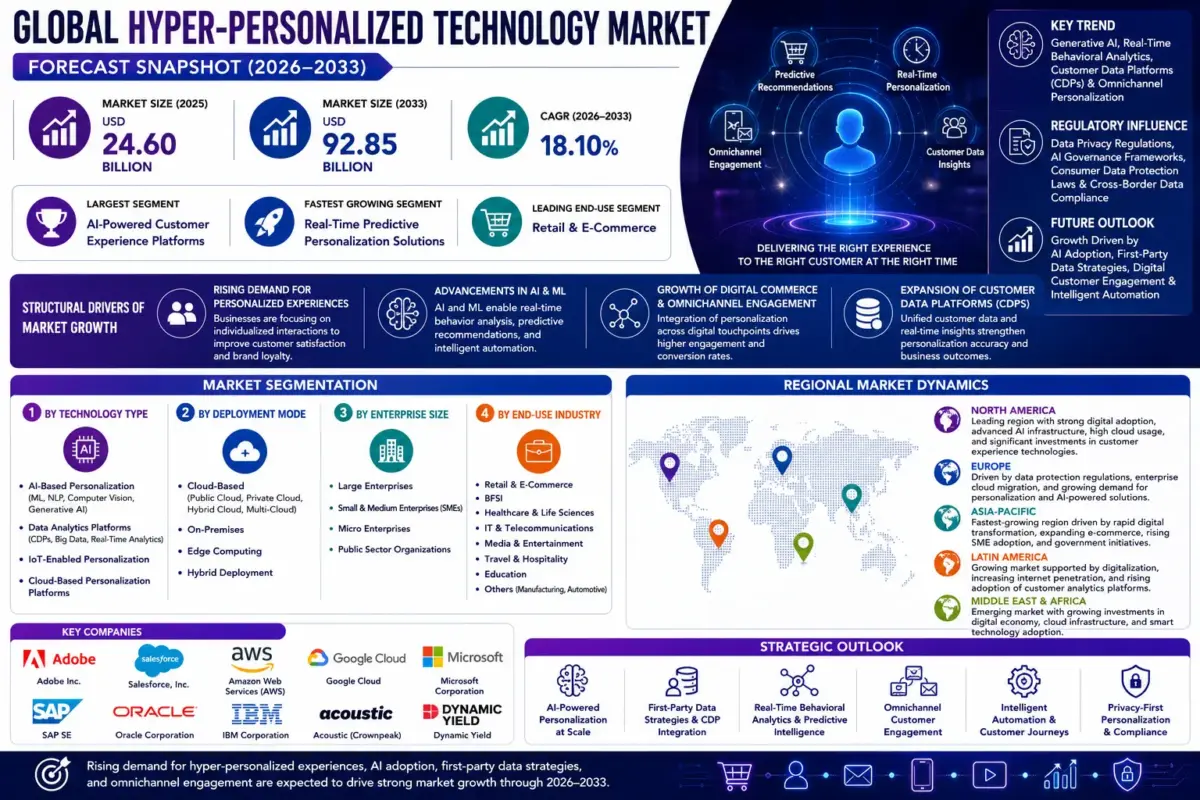
Global Hyper-Personalized Technology Market Size & Forecast
The Global Hyper-Personalized Technology Market is expected to witness robust growth during the forecast period from 2026 to 2033. The market was valued at USD 24.60 billion in 2025 and is projected to reach approximately USD 92.85 billion by 2033, registering a CAGR of 18.10%. Market growth is primarily driven by increasing adoption of artificial intelligence and machine learning, growing demand for individualized customer experiences, expansion of digital commerce platforms, rising use of customer data platforms (CDPs), and increasing investments in predictive analytics and marketing automation.Global Hyper-Personalized Technology Market Overview
Hyper-personalized technology utilizes artificial intelligence, machine learning, predictive analytics, customer data platforms, behavioral analytics, natural language processing, and real-time data processing to deliver highly individualized experiences across digital channels. These technologies are widely deployed across retail, banking, healthcare, telecommunications, media, travel, education, and enterprise applications to improve customer engagement, increase conversion rates, strengthen customer loyalty, and optimize operational performance. Integration of generative AI, cloud computing, edge analytics, and omnichannel engagement platforms continues to transform the hyper-personalization ecosystem.Structural Drivers of Market Growth
1. Rising Demand for Personalized Customer Experiences
Organizations are increasingly focusing on delivering individualized digital interactions to improve customer satisfaction and brand loyalty. Market Implications: Demand for AI-driven personalization platforms continues to expand across multiple industries.2. Advancements in Artificial Intelligence and Machine Learning
AI technologies enable real-time customer behavior analysis, predictive recommendations, automated content generation, and intelligent decision-making. Market Implications: Advanced analytics are significantly enhancing personalization accuracy and operational efficiency.3. Growth of Digital Commerce and Omnichannel Engagement
Businesses are integrating personalization capabilities across websites, mobile applications, social media, email, and customer support platforms. Market Implications: Omnichannel personalization is becoming a critical competitive differentiator.4. Expansion of Customer Data Platforms
Organizations are consolidating customer information from multiple sources to enable unified customer profiles and real-time engagement. Market Implications: Integrated data platforms are strengthening enterprise personalization capabilities.Global Hyper-Personalized Technology Market Segmentation
1. By Technology Type
1.1 Artificial Intelligence (AI)-Based Personalization
1.1.1 Machine Learning Personalization 1.1.1.1 Predictive Analytics Engines 1.1.1.1.1 Behavioral Analytics 1.1.1.1.2 Recommendation Engines 1.1.1.1.3 Real-Time Decision Engines 1.1.1.1.4 Customer Preference Modeling 1.1.2 Natural Language Processing (NLP) 1.1.3 Computer Vision-Based Personalization 1.1.4 Generative AI Solutions1.2 Data Analytics Platforms
1.2.1 Customer Data Platforms (CDPs) 1.2.2 Big Data Analytics 1.2.3 Predictive Customer Insights 1.2.4 Real-Time Analytics Platforms1.3 Internet of Things (IoT)-Enabled Personalization
1.3.1 Smart Connected Devices 1.3.2 Wearable Technology 1.3.3 Smart Home Ecosystems 1.3.4 Connected Vehicle Solutions1.4 Cloud-Based Hyper-Personalization Platforms
1.4.1 SaaS Personalization Platforms 1.4.2 Cloud AI Services 1.4.3 API-Based Personalization 1.4.4 Hybrid Cloud Platforms2. By Deployment Mode
2.1 Cloud-Based
2.1.1 Public Cloud 2.1.1.1 Enterprise Cloud Services 2.1.1.1.1 Multi-Tenant Platforms 2.1.1.1.2 AI-as-a-Service 2.1.1.1.3 Cloud Analytics 2.1.1.1.4 Customer Engagement Platforms 2.1.2 Private Cloud 2.1.3 Hybrid Cloud 2.1.4 Multi-Cloud Deployment2.2 On-Premises
2.2.1 Enterprise Infrastructure 2.2.2 Dedicated Data Centers 2.2.3 Private AI Systems 2.2.4 Secure Customer Data Platforms2.3 Edge Computing
2.3.1 Real-Time Edge Analytics 2.3.2 Smart Edge Devices 2.3.3 Distributed Computing 2.3.4 Edge AI Solutions2.4 Hybrid Deployment
2.4.1 Integrated Enterprise Solutions 2.4.2 Cloud-Edge Integration 2.4.3 Hybrid Analytics Platforms 2.4.4 Secure Hybrid Infrastructure3. By Enterprise Size
3.1 Large Enterprises
3.1.1 Global Enterprises 3.1.1.1 Enterprise Personalization Platforms 3.1.1.1.1 Omnichannel Customer Experience 3.1.1.1.2 Enterprise AI Integration 3.1.1.1.3 Customer Journey Optimization 3.1.1.1.4 Predictive Customer Engagement 3.1.2 Multinational Corporations 3.1.3 Fortune 500 Companies 3.1.4 Government Organizations3.2 Small & Medium Enterprises (SMEs)
3.2.1 Small Businesses 3.2.2 Medium Enterprises 3.2.3 Digital Startups 3.2.4 Growing Businesses3.3 Micro Enterprises
3.3.1 Retail Businesses 3.3.2 Independent Service Providers 3.3.3 E-Commerce Sellers 3.3.4 Online Content Creators3.4 Public Sector Organizations
3.4.1 Government Agencies 3.4.2 Educational Institutions 3.4.3 Healthcare Organizations 3.4.4 Public Utilities4. By End-Use Industry
4.1 Retail & E-Commerce
4.1.1 Personalized Shopping Experiences 4.1.1.1 AI-Based Product Recommendations 4.1.1.1.1 Dynamic Pricing 4.1.1.1.2 Personalized Promotions 4.1.1.1.3 Customer Loyalty Programs 4.1.1.1.4 Omnichannel Commerce 4.1.2 Digital Marketplaces 4.1.3 Direct-to-Consumer Brands 4.1.4 Subscription Commerce4.2 Healthcare
4.2.1 Personalized Medicine 4.2.2 Digital Therapeutics 4.2.3 Remote Patient Monitoring 4.2.4 Personalized Wellness Platforms4.3 BFSI
4.3.1 Digital Banking 4.3.2 Insurance Personalization 4.3.3 Wealth Management 4.3.4 Financial Advisory Services4.4 Media, Entertainment & Telecommunications
4.4.1 Video Streaming Platforms 4.4.2 Music Streaming Services 4.4.3 Social Media Platforms 4.4.4 Telecom Customer Experience SolutionsRegional Market Dynamics
North America
Leading region supported by strong AI adoption, advanced cloud infrastructure, high digital commerce penetration, and significant investments in customer experience technologies.Europe
Driven by enterprise digital transformation, increasing adoption of AI-powered analytics, strong data governance frameworks, and growing demand for customer engagement platforms.Asia-Pacific
Fastest-growing region supported by rapid digitalization, expanding e-commerce ecosystems, increasing smartphone penetration, and rising enterprise AI investments.Latin America
Growing market driven by expanding online retail, digital banking, and increasing investments in customer engagement technologies.Middle East & Africa
Emerging market supported by smart city initiatives, digital economy development, growing cloud adoption, and enterprise digital transformation strategies.Competitive Landscape
The Global Hyper-Personalized Technology Market is highly competitive with cloud technology providers, AI software companies, customer experience platform vendors, marketing technology providers, and enterprise analytics companies focusing on predictive intelligence, generative AI, real-time personalization, and omnichannel engagement solutions. Key Companies Operating in the Market Include:- Salesforce, Inc.
- Adobe Inc.
- Oracle Corporation
- SAP SE
- Microsoft Corporation
- Google LLC
- Amazon Web Services, Inc.
- IBM Corporation
- Dynamic Yield (Mastercard)
- Twilio Inc. (Segment)
Strategic Outlook
The future of the hyper-personalized technology market will be shaped by generative AI, large language models (LLMs), predictive customer intelligence, autonomous marketing platforms, first-party data ecosystems, and privacy-enhancing technologies. Enterprises are increasingly investing in AI-powered personalization engines, customer journey orchestration, real-time decision-making platforms, and intelligent automation to strengthen customer relationships and improve business performance. Integration of cloud computing, edge AI, conversational interfaces, and advanced analytics will continue accelerating market innovation. Growing emphasis on digital customer engagement, personalized commerce, ethical AI, privacy-first personalization, and omnichannel customer experiences will continue creating significant market opportunities. Companies focusing on AI innovation, secure data management, predictive analytics, and scalable personalization platforms will strengthen their competitive position within the global digital technology ecosystem.Final Market Perspective
The Global Hyper-Personalized Technology Market is becoming a critical pillar of modern digital transformation and customer experience management. Rising adoption of artificial intelligence, increasing demand for individualized digital interactions, expanding cloud-based personalization platforms, and continuous innovation in predictive analytics are expected to support sustained market growth throughout the forecast period. Organizations delivering intelligent, secure, and scalable hyper-personalization solutions will be well-positioned to capitalize on long-term opportunities across the global enterprise technology market.Table of Contents
1. Executive Summary
1.1 Market Snapshot (2026–2033)
1.2 Key Growth Highlights
1.3 Demand-Supply Overview
1.4 Key Strategic Insights
1.5 Analyst Viewpoint
2. Market Overview
2.1 Introduction to Global IP-VPN Web Hosting Service Market
2.2 Industry Value Chain Analysis
2.3 Market Evolution & Historical Trends
2.4 Macro-Economic Impact Analysis
2.5 Enterprise Networking & Cloud Hosting Ecosystem
2.6 Zero Trust Security, SD-WAN Integration, Hybrid Cloud Hosting, AI-Driven Network Monitoring & Secure Remote Access Trends
3. Global IP-VPN Web Hosting Service Market Forecast Snapshot (USD Billion), 2026–2033
3.1 2025 Market Size
3.2 2033 Market Size
3.3 CAGR (2026–2033)
3.4 Largest Region
3.5 Fastest Growing Region
3.6 Largest Segment
3.7 Key Trend
3.8 Future Outlook
4. Key Drivers of Market Growth
4.1 Increasing Enterprise Digital Transformation
4.2 Growing Need for Secure Remote Access
4.3 Expansion of Cloud Computing
4.4 Rising Cybersecurity and Compliance Requirements
4.5 Growing Adoption of Managed Hosting & Hybrid Cloud Infrastructure
5. Market Challenges
5.1 Rising Cybersecurity Threats
5.2 Regulatory Compliance Complexity
5.3 High Infrastructure & Operational Costs
5.4 Network Latency & Service Availability Challenges
6. Market Segmentation by Service Type (USD Billion), 2026–2033
6.1 IP-VPN Services
6.1.1 MPLS IP-VPN
6.1.1.1 Enterprise MPLS Networks
6.1.1.1.1 Layer 3 MPLS VPN
6.1.1.1.2 Layer 2 MPLS VPN
6.1.1.1.3 Managed MPLS Services
6.1.1.1.4 Hybrid MPLS Networks
6.1.2 Internet-Based VPN
6.1.3 SD-WAN Enabled VPN
6.1.4 Cloud VPN Services
6.2 Shared Web Hosting
6.2.1 Linux Shared Hosting
6.2.2 Windows Shared Hosting
6.2.3 Managed Shared Hosting
6.2.4 Unlimited Hosting Plans
6.3 Dedicated & VPS Hosting
6.3.1 Virtual Private Server (VPS)
6.3.2 Dedicated Server Hosting
6.3.3 Managed VPS Hosting
6.3.4 Bare Metal Hosting
6.4 Cloud Web Hosting
6.4.1 Public Cloud Hosting
6.4.2 Private Cloud Hosting
6.4.3 Hybrid Cloud Hosting
6.4.4 Multi-Cloud Hosting
7. Market Segmentation by Deployment Mode (USD Billion), 2026–2033
7.1 Public Cloud
7.1.1 Multi-Tenant Infrastructure
7.1.1.1 Cloud Hosting Platforms
7.1.1.1.1 Auto-Scaling Infrastructure
7.1.1.1.2 Load Balancing Services
7.1.1.1.3 Cloud Storage Integration
7.1.1.1.4 Disaster Recovery Services
7.1.2 Managed Public Cloud
7.1.3 Cloud-Based VPN
7.1.4 SaaS Hosting
7.2 Private Cloud
7.2.1 Enterprise Private Cloud
7.2.2 Dedicated Infrastructure
7.2.3 Secure Private Hosting
7.2.4 Private VPN Networks
7.3 Hybrid Cloud
7.3.1 Hybrid Hosting Solutions
7.3.2 Hybrid VPN Deployment
7.3.3 Multi-Environment Management
7.3.4 Cloud Bursting Solutions
7.4 On-Premises
7.4.1 Enterprise Data Centers
7.4.2 Self-Managed Infrastructure
7.4.3 Private Hosting Environments
7.4.4 Internal VPN Networks
8. Market Segmentation by Enterprise Size (USD Billion), 2026–2033
8.1 Large Enterprises
8.1.1 Global Enterprises
8.1.1.1 Multi-Site Network Connectivity
8.1.1.1.1 International VPN Networks
8.1.1.1.2 Global Web Hosting
8.1.1.1.3 Secure Data Exchange
8.1.1.1.4 Enterprise Disaster Recovery
8.1.2 Fortune 500 Companies
8.1.3 Government Organizations
8.1.4 Multinational Corporations
8.2 Small & Medium Enterprises (SMEs)
8.2.1 Small Businesses
8.2.2 Medium Enterprises
8.2.3 Startups
8.2.4 Growing Businesses
8.3 Micro Enterprises
8.3.1 Freelancers
8.3.2 Home-Based Businesses
8.3.3 Independent Professionals
8.3.4 Digital Entrepreneurs
8.4 Public Sector Organizations
8.4.1 Government Agencies
8.4.2 Educational Institutions
8.4.3 Healthcare Organizations
8.4.4 Public Utilities
9. Market Segmentation by End-Use Industry (USD Billion), 2026–2033
9.1 IT & Telecommunications
9.1.1 Managed Service Providers
9.1.1.1 Enterprise Connectivity Services
9.1.1.1.1 Data Center Networking
9.1.1.1.2 Secure Remote Access
9.1.1.1.3 Business Web Hosting
9.1.1.1.4 Cloud Infrastructure Services
9.1.2 Internet Service Providers
9.1.3 Telecom Operators
9.1.4 Cloud Service Providers
9.2 BFSI
9.2.1 Banking
9.2.2 Insurance
9.2.3 Financial Services
9.2.4 FinTech Companies
9.3 Healthcare & Government
9.3.1 Hospitals
9.3.2 Government Agencies
9.3.3 Public Healthcare Systems
9.3.4 Defense Organizations
9.4 Retail, Manufacturing & Others
9.4.1 Retail & E-Commerce
9.4.2 Manufacturing
9.4.3 Education
9.4.4 Media & Entertainment
10. Market Segmentation by Region (USD Billion), 2026–2033
10.1 North America
10.2 Europe
10.3 Asia-Pacific
10.4 Latin America
10.5 Middle East & Africa
11. Regional Market Analysis
11.1 North America – Advanced Cloud Infrastructure Leader
11.2 Asia-Pacific – Fastest Growing Region
11.3 Europe – GDPR & Secure Enterprise Connectivity Hub
11.4 Latin America – Expanding Digital Infrastructure
11.5 Middle East & Africa – Emerging Cloud & Smart City Market
12. Competitive Landscape
12.1 Market Share Analysis
12.2 Competitive Positioning Matrix
12.3 Strategic Developments (M&A, Product Launches, Partnerships)
12.4 Innovation Benchmarking
12.5 Enterprise Hosting & Secure Networking Competitive Assessment
13. Company Profiles
13.1 Amazon Web Services (AWS)
13.2 Microsoft Corporation (Azure)
13.3 Google Cloud
13.4 IBM Corporation
13.5 Oracle Corporation
13.6 Lumen Technologies
13.7 NTT DATA Group
13.8 Rackspace Technology, Inc.
13.9 GoDaddy Inc.
13.10 OVHcloud
14. Strategic Intelligence & AI-Driven Insights
14.1 Pheonix Demand Forecast Engine
14.2 IP-VPN Web Hosting Service Market Dashboard
14.3 AI-Powered Network Monitoring & Security Analytics
14.4 Zero Trust & Hybrid Cloud Intelligence Engine
14.5 Enterprise Connectivity & Cloud Hosting Market Intelligence
15. Investment & Growth Opportunities
15.1 Cloud-Based Secure Web Hosting Services
15.2 Managed Security & Zero Trust Solutions
15.3 Hybrid Cloud & SD-WAN Integration
15.4 AI-Driven Infrastructure Management
15.5 Enterprise Digital Transformation & Business Continuity Solutions
16. Why the Global IP-VPN Web Hosting Service Market Remains Critical
16.1 Increasing Enterprise Digital Transformation
16.2 Rising Demand for Secure Remote Connectivity
16.3 Expansion of Cloud & Hybrid IT Infrastructure
16.4 Growing Cybersecurity & Regulatory Compliance Requirements
16.5 Long-Term Growth Across Enterprise Networking & Cloud Hosting Services
17. Appendix
18. About Pheonix Research
19. Disclaimer
Competitive Landscape
Global Hyper-Personalized Technology Market Competitive Intensity & Market Structure Overview
The Global Hyper-Personalized Technology Market is highly competitive and characterized by the presence of cloud technology providers, AI software companies, customer experience platform vendors, marketing technology providers, enterprise analytics companies, and digital transformation solution providers. Competitive intensity is driven by generative AI, real-time behavioral analytics, customer data platforms (CDPs), omnichannel personalization, predictive intelligence, and continuous innovation in AI-powered customer engagement technologies.
Companies compete across multiple technology segments including AI-based personalization, customer data platforms, predictive analytics, cloud-based hyper-personalization platforms, generative AI solutions, behavioral analytics, recommendation engines, and omnichannel customer engagement platforms. Growing enterprise demand for individualized customer experiences, expanding digital commerce, increasing adoption of first-party data strategies, and rising investments in intelligent automation are intensifying competition while encouraging continuous platform innovation.
The market structure is evolving toward AI-driven customer journey orchestration, privacy-first personalization, cloud-native personalization platforms, edge AI, autonomous marketing technologies, real-time decision engines, and secure customer data ecosystems. Market participants are investing heavily in advanced analytics, intelligent automation, scalable cloud infrastructure, and strategic partnerships to strengthen market positioning and improve customer engagement outcomes.
Global Hyper-Personalized Technology Market Competitive Intensity & Market Structure Current Scenario
Leading Global Hyper-Personalized Technology Companies
- Salesforce, Inc.: A global customer relationship management leader providing AI-powered customer experience platforms, customer data solutions, marketing automation, and personalized engagement technologies.
- Adobe Inc.: A leading digital experience company offering customer journey orchestration, real-time personalization, AI-driven content management, and advanced marketing technology platforms.
- Oracle Corporation: A global enterprise technology provider delivering customer data platforms, AI-powered marketing solutions, cloud applications, and intelligent customer engagement capabilities.
- SAP SE: A leading enterprise software company specializing in customer experience platforms, predictive analytics, cloud-based personalization, and integrated business intelligence solutions.
- Microsoft Corporation: A global technology leader offering AI services, cloud computing platforms, enterprise analytics, intelligent automation, and customer engagement technologies.
- Google LLC: A major AI and cloud technology provider delivering machine learning platforms, behavioral analytics, digital advertising technologies, and personalized customer experience solutions.
- Amazon Web Services, Inc.: A leading cloud infrastructure provider offering AI services, data analytics platforms, personalization engines, and scalable cloud technologies for enterprise applications.
- IBM Corporation: A global technology company providing artificial intelligence platforms, hybrid cloud solutions, predictive analytics, and enterprise personalization capabilities.
- Dynamic Yield (Mastercard): A leading personalization technology company specializing in AI-powered recommendation engines, customer experience optimization, and real-time personalization solutions.
- Twilio Inc. (Segment): A customer engagement technology provider delivering customer data platforms, omnichannel communication solutions, and real-time customer personalization capabilities.
Key Competitive Intensity & Market Structure Drivers
Increasing enterprise demand for personalized customer experiences, AI-powered engagement platforms, predictive customer intelligence, and omnichannel personalization is intensifying competition among technology providers worldwide.
Advancements in generative AI, customer data platforms, behavioral analytics, machine learning, real-time decision engines, and intelligent automation are becoming major competitive differentiators across the market.
Growing demand for digital commerce, first-party data strategies, customer journey optimization, privacy-first personalization, and cloud-native customer engagement platforms is strengthening market competitiveness while accelerating innovation across enterprise technology ecosystems.
Strategic collaborations among cloud providers, AI software companies, marketing technology vendors, enterprise software providers, digital commerce platforms, and analytics companies are accelerating product innovation, expanding platform capabilities, and improving customer engagement outcomes.
Continuous investment in AI-powered personalization engines, predictive analytics, cloud infrastructure, customer data platforms, intelligent automation, and secure data management is enabling companies to improve operational efficiency and long-term competitiveness.
Strategic Implications of Competitive Intensity & Market Structure
Companies with comprehensive AI platforms, advanced analytics capabilities, scalable cloud infrastructure, and integrated customer engagement solutions are expected to maintain significant competitive advantages.
Investment in generative AI, predictive analytics, customer journey orchestration, cloud-native personalization platforms, intelligent automation, and privacy-enhancing technologies is becoming increasingly important for long-term market leadership.
Organizations focusing on expanding AI-powered personalization capabilities, strengthening first-party data ecosystems, improving omnichannel customer experiences, and enhancing intelligent automation are likely to increase revenue growth and market share.
Strategic partnerships with cloud technology providers, enterprise software companies, marketing technology vendors, digital commerce platforms, and AI solution developers are supporting innovation, operational efficiency, and global market expansion.
Businesses capable of combining artificial intelligence, predictive analytics, secure data management, operational scalability, and comprehensive personalization platforms will be best positioned to compete effectively in the evolving global hyper-personalized technology market.
Global Hyper-Personalized Technology Market Competitive Intensity & Market Structure Forward Outlook
The competitive landscape of the global hyper-personalized technology market is expected to become increasingly AI-driven, cloud-enabled, and data-centric as enterprise demand for intelligent customer engagement continues to expand globally.
Future competition will be shaped by generative AI, large language models (LLMs), predictive customer intelligence, autonomous marketing platforms, first-party data ecosystems, privacy-enhancing technologies, and real-time omnichannel personalization.
Market participants are expected to increase investments in AI-powered personalization engines, intelligent customer journey orchestration, advanced analytics platforms, cloud-native infrastructure, secure customer data ecosystems, and digital experience innovation to strengthen competitive positioning.
Over the forecast period, companies that successfully combine artificial intelligence, predictive analytics, cloud scalability, intelligent automation, and comprehensive customer engagement capabilities will be best positioned to lead the evolving global hyper-personalized technology market.
Value Chain
Global Hyper-Personalized Technology Market Value Chain & Supply Chain Evolution Overview
The Global Hyper-Personalized Technology Market operates through a highly integrated digital value chain comprising data collection, cloud infrastructure deployment, artificial intelligence model development, customer data platform integration, personalization engine development, application deployment, omnichannel delivery, performance analytics, and continuous optimization. The ecosystem includes cloud service providers, AI technology companies, customer data platform (CDP) vendors, software developers, enterprise application providers, system integrators, cybersecurity companies, data analytics providers, digital marketing technology firms, and enterprise customers working together to deliver intelligent, secure, and real-time personalized digital experiences across industries.
The market is being driven by increasing adoption of artificial intelligence and machine learning, growing demand for individualized customer experiences, expansion of digital commerce platforms, rising deployment of customer data platforms (CDPs), and increasing investments in predictive analytics and marketing automation. Organizations are increasingly investing in generative AI, real-time behavioral analytics, omnichannel engagement platforms, cloud-native personalization solutions, intelligent recommendation engines, and customer journey orchestration to improve customer engagement, operational efficiency, and business performance.
The integration of generative AI, machine learning, predictive analytics, natural language processing, cloud computing, edge analytics, customer data platforms, real-time data processing, and intelligent automation has significantly strengthened the hyper-personalized technology value chain. Organizations are enhancing collaboration between AI software providers, cloud platform vendors, analytics companies, digital marketing technology providers, enterprise IT teams, and cybersecurity firms while improving customer intelligence, digital engagement, and enterprise decision-making.
Advancements in AI-powered personalization, real-time predictive analytics, customer journey orchestration, cloud-native applications, conversational AI, privacy-enhancing technologies, and omnichannel engagement platforms are transforming the hyper-personalized technology supply chain while improving customer experiences, operational scalability, regulatory compliance, and enterprise digital transformation across global industries.
Global Hyper-Personalized Technology Market Value Chain & Supply Chain Evolution Current Scenario
Market-Specific Value Chain
- Data Collection & Digital Infrastructure: Customer data acquisition, first-party data collection, behavioral analytics, IoT data integration, CRM systems, cloud infrastructure deployment, edge computing infrastructure, API integration, and enterprise data management.
- AI Platform & Personalization Engine Development: Artificial intelligence model development, machine learning algorithms, recommendation engines, predictive analytics platforms, natural language processing, computer vision, generative AI models, customer segmentation, and real-time decision engines.
- Application Development & Platform Integration: Customer data platform (CDP) integration, omnichannel personalization, marketing automation, customer journey orchestration, SaaS platform deployment, cloud application integration, API management, and enterprise software customization.
- Quality Assurance & Regulatory Compliance: AI model validation, data quality management, cybersecurity assessment, privacy compliance, AI governance, customer consent management, cross-border data protection, cloud compliance, performance testing, and regulatory auditing.
- Deployment & Enterprise Implementation: Cloud deployment, hybrid infrastructure integration, enterprise onboarding, digital transformation consulting, system integration, workflow automation, customer engagement implementation, and managed platform services.
- Performance Analytics & Lifecycle Management: Real-time analytics, AI model optimization, customer behavior monitoring, campaign performance analysis, predictive insights, software updates, platform maintenance, intelligent automation, and continuous personalization optimization.
- End User Applications: Deployment across retail & e-commerce, healthcare, BFSI, media & entertainment, telecommunications, education, travel, government, and enterprise digital transformation initiatives.
Company-to-Stage Mapping
- Data Collection & Digital Infrastructure: Cloud infrastructure providers, customer data platform vendors, enterprise database providers, API management companies, cybersecurity providers, and enterprise IT infrastructure vendors.
- AI Platform & Personalization Engine Development: Salesforce, Inc., Adobe Inc., Oracle Corporation, SAP SE, Microsoft Corporation, Google LLC, Amazon Web Services, Inc., IBM Corporation, Dynamic Yield (Mastercard), and Twilio Inc. (Segment).
- Application Development & Platform Integration: Enterprise software vendors, SaaS platform providers, digital marketing technology companies, CRM solution providers, cloud application developers, and system integration companies.
- Deployment & Enterprise Implementation: Cloud service providers, IT consulting firms, managed service providers, digital transformation consultants, enterprise technology partners, and implementation specialists.
- Performance Analytics & Lifecycle Management: AI analytics providers, customer experience management companies, marketing automation providers, cloud operations teams, managed platform providers, and customer success organizations.
- Quality Assurance & Regulatory Compliance: Data privacy authorities, AI governance organizations, cybersecurity agencies, cloud compliance providers, certification bodies, regulatory consultants, and quality assurance organizations.
- End User Applications: Retail & e-commerce companies, healthcare providers, BFSI organizations, media companies, telecommunications providers, educational institutions, travel companies, government agencies, and enterprise organizations.
Key Value Chain & Supply Chain Evolution Signals in Global Hyper-Personalized Technology Market
Expansion of Generative AI-Powered Personalization
Organizations are increasingly integrating generative AI, large language models (LLMs), and intelligent content generation platforms to deliver personalized customer experiences across digital channels.
Growing Adoption of Customer Data Platforms (CDPs)
Enterprises are consolidating customer information from multiple touchpoints into unified customer data platforms to improve real-time personalization, customer insights, and predictive decision-making.
Increasing Integration of Real-Time Behavioral Analytics
Advanced behavioral analytics, predictive intelligence, and AI-powered recommendation engines are improving customer engagement, marketing effectiveness, and conversion optimization.
Expansion of Omnichannel Personalization
Businesses are deploying integrated personalization across websites, mobile applications, social media, email, digital advertising, customer service, and connected devices to create seamless customer experiences.
Growth of Privacy-First Personalization Strategies
Organizations are strengthening first-party data strategies, customer consent management, AI governance, privacy-enhancing technologies, and secure data management to comply with evolving regulations.
Increasing Investment in Intelligent Automation
Automation platforms, AI-powered workflows, predictive customer engagement, autonomous marketing technologies, and cloud-native personalization solutions are improving operational efficiency and business scalability.
Strategic Implications of Value Chain & Supply Chain Evolution
Investment in AI-Driven Personalization Platforms
Generative AI, predictive analytics, recommendation engines, and intelligent automation strengthen customer engagement, operational performance, and competitive differentiation.
Expansion of Unified Customer Data Ecosystems
Customer data platforms, first-party data strategies, behavioral analytics, and real-time customer intelligence improve personalization accuracy and enterprise decision-making.
Strengthening Cloud-Native Digital Infrastructure
Cloud computing, edge analytics, scalable SaaS platforms, API integration, and hybrid deployment improve platform flexibility, reliability, and business continuity.
Optimization of Omnichannel Customer Experiences
Customer journey orchestration, real-time personalization, intelligent marketing automation, conversational AI, and digital engagement platforms strengthen customer loyalty and lifetime value.
Enhancement of Data Privacy and Regulatory Compliance
Data privacy regulations, AI governance frameworks, consumer data protection laws, cross-border data compliance, and cybersecurity best practices improve customer trust and regulatory adherence.
Leveraging AI and Predictive Intelligence
Machine learning, predictive customer analytics, intelligent decision engines, automated optimization, and advanced analytics enable enterprises to improve personalization performance while accelerating digital transformation.
Global Hyper-Personalized Technology Market Value Chain & Supply Chain Evolution Forward Outlook
Looking ahead, the hyper-personalized technology value chain is expected to become increasingly AI-driven, data-centric, cloud-native, and privacy-focused. Continued advancements in generative AI, predictive customer intelligence, customer data platforms, edge analytics, intelligent automation, omnichannel engagement, and first-party data strategies will further improve customer experiences, enterprise agility, operational efficiency, and long-term digital innovation.
Key Future Developments Include:
- Expansion of generative AI, large language models, and autonomous personalization platforms.
- Increasing adoption of customer data platforms, first-party data ecosystems, and real-time behavioral analytics.
- Greater integration of cloud-native AI services, edge analytics, and intelligent automation platforms.
- Broader deployment of omnichannel customer engagement, conversational AI, and predictive decision engines.
- Growing investment in privacy-enhancing technologies, ethical AI, secure customer data management, and regulatory compliance frameworks.
- Strengthening collaboration between AI software providers, cloud service providers, enterprise technology companies, digital marketing platforms, cybersecurity vendors, and system integration partners.
As the market evolves, competitive advantage will increasingly depend on AI innovation, predictive intelligence, customer data integration, omnichannel engagement, privacy-first personalization, intelligent automation, and scalable cloud infrastructure.
Companies that successfully integrate generative AI, customer data platforms, predictive analytics, cloud-native personalization, intelligent automation, secure data management, and omnichannel customer engagement capabilities will be well-positioned to achieve long-term growth in the Global Hyper-Personalized Technology Market.
Investment Activity
Global Hyper-Personalized Technology Market Investment & Funding Dynamics Overview (2026–2033)
The Global Hyper-Personalized Technology Market is witnessing strong investment momentum driven by increasing adoption of artificial intelligence and machine learning, growing demand for individualized customer experiences, expansion of digital commerce platforms, rising use of customer data platforms (CDPs), and increasing investments in predictive analytics and marketing automation. Cloud technology providers, AI software companies, customer experience platform vendors, marketing technology providers, enterprise analytics companies, venture capital firms, private equity investors, and digital transformation companies are actively investing in AI-powered personalization platforms, customer data platforms, predictive analytics, generative AI solutions, real-time behavioral analytics, omnichannel engagement platforms, cloud-based personalization technologies, and intelligent automation solutions.
Investment activity is accelerating as organizations focus on improving customer engagement, increasing conversion rates, strengthening customer loyalty, optimizing digital experiences, and enhancing enterprise decision-making. Capital allocation is increasingly directed toward real-time predictive personalization solutions, AI-driven customer experience platforms, first-party data ecosystems, cloud-native personalization infrastructure, intelligent recommendation engines, customer journey orchestration, and privacy-enhancing technologies.
Additionally, growing investments in large language models (LLMs), edge AI, conversational AI platforms, privacy-first personalization, omnichannel commerce solutions, advanced analytics, and digital customer engagement technologies are creating substantial long-term opportunities across the global hyper-personalized technology ecosystem.
Current Investment & Funding Landscape
The current investment landscape reflects active participation from cloud technology providers, AI software companies, customer experience platform vendors, marketing technology providers, enterprise analytics companies, venture capital firms, private equity investors, and enterprise technology companies. Industry participants are investing heavily in AI-powered personalization platforms, customer data platforms, predictive customer intelligence, real-time analytics, cloud-based personalization infrastructure, intelligent automation, and omnichannel engagement solutions.
Significant funding is being directed toward generative AI technologies, machine learning platforms, cloud computing infrastructure, behavioral analytics, recommendation engines, data integration platforms, and privacy-enhancing technologies to improve operational efficiency, strengthen customer engagement, and support long-term market growth.
Strategic collaborations among cloud technology providers, AI software companies, customer experience platform vendors, enterprise analytics providers, digital marketing companies, system integrators, and technology consulting firms are accelerating innovation, improving platform interoperability, and expanding enterprise personalization capabilities worldwide.
Key Investment & Funding Dynamics Signals
- Growing investment in AI-powered customer experience platforms, predictive analytics, and real-time personalization solutions is strengthening customer engagement and business performance.
- Expansion of customer data platforms (CDPs), first-party data strategies, omnichannel engagement platforms, and cloud-based personalization technologies is attracting substantial funding across enterprise digital transformation initiatives.
- Increasing capital allocation toward generative AI, machine learning, behavioral analytics, recommendation engines, and intelligent automation is improving personalization accuracy and operational efficiency.
- Rising investment in privacy-enhancing technologies, secure data management, AI governance frameworks, and cloud-native infrastructure is supporting regulatory compliance and consumer trust.
- Strategic funding for large language models (LLMs), conversational AI, edge AI, customer journey orchestration, and predictive customer intelligence is accelerating innovation across digital engagement ecosystems.
- Growing collaboration between cloud technology providers, AI software companies, enterprise analytics vendors, marketing technology providers, system integrators, and consulting firms is accelerating technology innovation and global market expansion.
- Expansion of hyper-personalization infrastructure across retail & e-commerce, healthcare, BFSI, media, entertainment, telecommunications, and enterprise applications is creating attractive long-term investment opportunities worldwide.
Strategic Implications of Investment & Funding Dynamics
- Continuous investment in AI-powered personalization platforms, predictive analytics, customer data platforms, and intelligent automation will be essential for sustaining long-term competitive advantage.
- Capital allocation toward cloud infrastructure, first-party data ecosystems, omnichannel engagement, behavioral analytics, and privacy-enhancing technologies will strengthen operational efficiency and customer experience.
- Companies developing integrated hyper-personalization platforms, scalable AI technologies, real-time analytics capabilities, and secure data management solutions are expected to secure stronger competitive positions.
- Strategic partnerships among cloud technology providers, AI software companies, customer experience platform vendors, enterprise technology providers, consulting firms, and system integrators will accelerate innovation and enterprise digital transformation.
- Investments in artificial intelligence, machine learning, generative AI, edge AI, predictive analytics, conversational interfaces, and intelligent automation will enhance customer engagement, business intelligence, and operational performance.
- Compliance with data privacy regulations, AI governance frameworks, consumer data protection laws, and cross-border data compliance will continue influencing investment decisions.
- Organizations building integrated capabilities across artificial intelligence, customer data platforms, digital engagement, predictive analytics, cloud computing, regulatory compliance, and intelligent automation are expected to capture significant long-term value.
Forward Outlook
Looking ahead, the Global Hyper-Personalized Technology Market is expected to maintain strong investment momentum driven by AI adoption, first-party data strategies, digital customer engagement, and intelligent automation.
Future capital deployment will increasingly focus on AI-powered customer experience platforms, real-time predictive personalization solutions, generative AI, customer data platforms, omnichannel personalization, cloud-based personalization technologies, and advanced analytics.
As enterprises continue investing in digital transformation and intelligent customer engagement, investment activity is expected to expand across AI-driven personalization infrastructure, cloud-native platforms, behavioral analytics ecosystems, conversational AI solutions, customer journey orchestration, and integrated enterprise analytics platforms.
In conclusion, the Global Hyper-Personalized Technology Market represents a highly attractive investment landscape where AI-powered customer experience platforms, real-time predictive personalization solutions, generative AI, customer data platforms, omnichannel personalization, and intelligent automation will define future funding priorities, competitive differentiation, and long-term market growth.
Technology & Innovation
Global Hyper-Personalized Technology Market Technology & Innovation Landscape Overview
The Global Hyper-Personalized Technology Market is experiencing rapid technological advancement as innovations in artificial intelligence, machine learning, generative AI, customer data platforms (CDPs), predictive analytics, cloud computing, edge analytics, and omnichannel engagement technologies transform digital customer experiences. Technology providers, cloud service companies, enterprise software vendors, marketing technology firms, and analytics platform developers are investing heavily in intelligent personalization solutions to improve customer engagement, strengthen brand loyalty, optimize conversion rates, and enhance business performance. These innovations are enabling real-time individualized experiences, dynamic content delivery, intelligent customer journey orchestration, and data-driven decision-making across multiple industries.
The market is also benefiting from breakthroughs in large language models (LLMs), natural language processing, behavioral analytics, AI-powered recommendation engines, real-time data processing, privacy-enhancing technologies, and intelligent automation. These advancements are improving customer profiling, predictive decision-making, campaign optimization, cross-channel engagement, regulatory compliance, and operational efficiency across retail, banking, healthcare, telecommunications, media, travel, and enterprise applications. As organizations continue prioritizing personalized digital engagement and first-party data strategies, technology is becoming a critical driver of competitive differentiation and long-term market expansion.
Global Hyper-Personalized Technology Market Technology & Innovation Current Scenario
Current innovation within the hyper-personalized technology market is primarily focused on generative AI, real-time behavioral analytics, customer data platforms (CDPs), AI-powered recommendation engines, predictive personalization, and omnichannel customer engagement. Organizations are increasingly utilizing machine learning models, intelligent automation, natural language processing, and cloud-native analytics platforms to deliver highly personalized experiences across websites, mobile applications, social media, customer service platforms, and digital commerce ecosystems. Artificial intelligence is playing an expanding role in customer segmentation, dynamic content generation, predictive marketing, and automated decision-making.
Cloud-based personalization platforms, edge AI, API-driven integration frameworks, real-time customer intelligence, digital journey orchestration, and privacy-first data management solutions are strengthening enterprise personalization capabilities while supporting regulatory compliance and secure customer engagement. In addition, advancements in conversational AI, intelligent virtual assistants, predictive analytics, and scalable cloud infrastructure are accelerating the deployment of personalized digital experiences across multiple enterprise environments.
Key Technology & Innovation Trends in Global Hyper-Personalized Technology Market
- Generative AI: Enabling intelligent content creation, personalized communications, automated customer interactions, and dynamic digital experiences.
- Real-Time Predictive Personalization: Leveraging machine learning and behavioral analytics to deliver individualized recommendations and customer experiences instantly.
- Customer Data Platforms (CDPs): Integrating first-party customer data to build unified customer profiles and support omnichannel engagement strategies.
- AI-Powered Recommendation Engines: Improving customer engagement through intelligent product recommendations, personalized offers, and content optimization.
- Behavioral Analytics: Utilizing real-time customer behavior insights to optimize marketing campaigns, customer journeys, and conversion performance.
- Natural Language Processing (NLP): Enhancing conversational AI, virtual assistants, chatbots, and personalized customer support experiences.
- Cloud-Based Personalization Platforms: Supporting scalable AI-powered personalization through cloud-native infrastructure and Software-as-a-Service (SaaS) deployment models.
- Edge AI & Real-Time Analytics: Accelerating low-latency decision-making and personalized interactions through distributed intelligence and edge computing.
- Privacy-Enhancing Technologies: Strengthening secure customer data management, consent management, and compliance with evolving data privacy regulations.
- Omnichannel Customer Journey Orchestration: Delivering consistent, personalized experiences across websites, mobile applications, social media, email, and customer support platforms.
Strategic Implications of Technology & Innovation
Technological advancements are enabling organizations to improve customer engagement, optimize marketing effectiveness, and strengthen digital business performance. Companies investing in artificial intelligence, predictive analytics, customer data platforms, cloud computing, intelligent automation, and omnichannel personalization technologies are enhancing operational efficiency while delivering highly individualized customer experiences. Innovation is helping organizations differentiate through intelligent customer engagement, real-time decision-making, improved customer loyalty, and data-driven business strategies.
As enterprises continue accelerating digital transformation and AI adoption across customer-facing operations, organizations are increasingly focusing on strategic investments in scalable personalization platforms and integrated data ecosystems. Businesses successfully integrating generative AI, behavioral analytics, cloud infrastructure, customer intelligence, and privacy-first technologies are expected to gain significant competitive advantages. However, data privacy regulations, AI governance frameworks, consumer data protection laws, and cross-border data compliance remain critical factors influencing technology deployment and commercialization.
Global Hyper-Personalized Technology Market Technology & Innovation Forward Outlook
The future of the Global Hyper-Personalized Technology Market is expected to be shaped by continued advancements in generative AI, large language models (LLMs), autonomous customer intelligence, predictive analytics, edge AI, intelligent automation, and privacy-preserving personalization technologies. Emerging innovations such as AI-powered customer journey orchestration, multimodal AI, digital twins for customer behavior, autonomous marketing platforms, real-time decision intelligence, and advanced first-party data ecosystems are expected to redefine personalized digital engagement. Technology providers are likely to increase investments in scalable AI platforms that improve customer experience, operational efficiency, regulatory compliance, and business growth.
As demand for personalized digital experiences, intelligent customer engagement, omnichannel commerce, and secure data management continues to grow, technology will play an increasingly important role in driving market development. The combination of artificial intelligence, predictive analytics, customer data platforms, cloud computing, intelligent automation, and real-time behavioral analytics is expected to create substantial growth opportunities while strengthening the long-term evolution of the global hyper-personalized technology market.
Market Risk
Global Hyper-Personalized Technology Market Risk Factors & Disruption Threats Overview
The global hyper-personalized technology market is experiencing rapid growth as organizations accelerate artificial intelligence adoption, expand customer data platforms (CDPs), strengthen omnichannel engagement, and invest in real-time behavioral analytics to enhance customer experiences. Despite strong market momentum, AI software providers, cloud technology companies, customer experience platform vendors, and enterprise analytics providers face a range of technological, regulatory, cybersecurity, operational, and data governance risks that may influence commercialization and long-term market adoption. Increasing complexity of AI-driven personalization, evolving data privacy regulations, growing cybersecurity threats, integration challenges across enterprise systems, and rising concerns regarding ethical AI and consumer trust continue to reshape the competitive landscape. Companies are investing in generative AI, predictive analytics, privacy-enhancing technologies, cloud-native personalization platforms, and intelligent automation to strengthen operational resilience, regulatory compliance, and long-term market growth.
Global Hyper-Personalized Technology Market Risk Factors & Disruption Threats Current Scenario
The current market environment is characterized by increasing adoption of AI-powered customer experience platforms, real-time predictive personalization solutions, customer data platforms, and omnichannel engagement technologies across retail, healthcare, banking, media, telecommunications, and enterprise applications. However, organizations continue to face challenges associated with fragmented customer data, integration of legacy enterprise systems, increasing implementation costs, algorithm bias, shortages of AI-skilled professionals, and rising infrastructure requirements for large-scale data processing. Compliance with data privacy regulations, AI governance frameworks, consumer data protection laws, and cross-border data compliance requirements has become increasingly important, requiring continuous investment in secure, transparent, and responsible personalization technologies.
Key Risk Factors & Disruption Threat Signals in Global Hyper-Personalized Technology Market
Major risk factors include cybersecurity threats targeting customer data platforms, AI models, cloud infrastructure, and enterprise applications, potentially leading to data breaches, service disruptions, and reputational damage. Regulatory developments involving AI governance, consumer consent management, cross-border data transfers, and privacy legislation may increase compliance complexity and operational costs. Dependence on cloud infrastructure, third-party data ecosystems, AI model availability, and high-quality first-party data may expose organizations to operational and ecosystem-related risks. Furthermore, rapid advancements in generative AI, large language models (LLMs), edge AI, predictive analytics, autonomous marketing platforms, and increasing competition among global technology providers represent significant disruption signals capable of reshaping market dynamics.
Strategic Implications of Risk Factors & Disruption Threats in Global Hyper-Personalized Technology Market
Technology providers are strengthening business resilience by investing in privacy-first personalization, AI governance frameworks, secure cloud infrastructure, predictive intelligence platforms, and real-time analytics to improve customer engagement and operational efficiency. Organizations are expanding integration with customer data platforms, enterprise resource planning (ERP), customer relationship management (CRM), marketing automation systems, and omnichannel engagement platforms to deliver unified and intelligent customer experiences. Strategic investments in generative AI, behavioral analytics, first-party data strategies, intelligent automation, ethical AI, and scalable cloud-based personalization platforms are enabling enterprises to improve personalization accuracy, regulatory compliance, customer trust, and business performance. Partnerships with cloud service providers, AI technology companies, cybersecurity vendors, and enterprise software providers continue supporting innovation, digital transformation, and scalable personalization capabilities.
Global Hyper-Personalized Technology Market Risk Factors & Disruption Threats Forward Outlook
Looking ahead, the global hyper-personalized technology market is expected to maintain robust growth despite evolving cybersecurity threats, regulatory developments, AI governance requirements, and enterprise data management challenges. Continued innovation in generative AI, predictive customer intelligence, customer data platforms, cloud computing, edge AI, and intelligent automation will create significant opportunities across digital commerce and enterprise applications. However, market participants must continuously monitor changing data privacy regulations, AI governance frameworks, cybersecurity risks, consumer trust expectations, and cross-border data compliance requirements to minimize operational risks. Organizations that prioritize secure AI deployment, responsible data management, regulatory compliance, scalable cloud infrastructure, and intelligent personalization capabilities will be well positioned to navigate future disruptions and capitalize on long-term opportunities across the global hyper-personalized technology ecosystem.
Regulatory Landscape
Global Hyper-Personalized Technology Market Regulatory Landscape Overview
The Global Hyper-Personalized Technology Market operates within a comprehensive regulatory framework shaped by data privacy regulations, AI governance frameworks, consumer data protection laws, and cross-border data compliance. As hyper-personalized technologies continue to evolve through Generative AI, Real-Time Behavioral Analytics, Customer Data Platforms (CDPs), Omnichannel Personalization, and intelligent automation, regulatory compliance is becoming increasingly important for ensuring data privacy, responsible AI deployment, consumer trust, and secure digital experiences.
Governments and regulatory authorities worldwide are implementing policies that promote responsible artificial intelligence, consumer data protection, ethical digital innovation, secure data management, enterprise transparency, and privacy-first technology adoption. These regulatory frameworks encourage innovation while supporting regulatory compliance, ethical AI practices, secure customer engagement, standardized governance, and sustainable growth across the global hyper-personalized technology industry.
Key Regulatory Areas Influencing the Market
- Data Privacy Regulations: Regulatory requirements governing the collection, storage, processing, sharing, and protection of consumer and enterprise data used for hyper-personalization.
- AI Governance Frameworks: Standards supporting responsible artificial intelligence development, algorithm transparency, ethical AI deployment, explainability, and accountability in automated decision-making.
- Consumer Data Protection Laws: Regulations ensuring consumer consent, privacy rights, secure personal data management, and responsible use of behavioral and preference data.
- Cross-Border Data Compliance: Requirements governing international data transfers, cloud-based customer data management, digital sovereignty, and regulatory compliance across multiple jurisdictions.
- Cybersecurity & Digital Infrastructure Standards: Policies encouraging secure cloud platforms, identity protection, network security, data encryption, and resilient digital infrastructure.
- Digital Marketing & Consumer Transparency Regulations: Guidelines supporting transparent personalization practices, responsible digital advertising, consent management, and fair consumer engagement.
- Cloud Compliance & Enterprise Governance: Regulatory frameworks promoting secure cloud environments, enterprise risk management, AI-enabled platforms, and compliance-driven digital transformation.
Regional Regulatory Landscape
North America maintains comprehensive regulatory frameworks supporting data privacy, responsible AI adoption, cloud security, enterprise digital transformation, and consumer protection.
Europe emphasizes stringent data protection regulations, AI governance, digital transparency, cross-border data compliance, and ethical deployment of artificial intelligence technologies.
Asia-Pacific is strengthening regulatory oversight through expanding data protection laws, AI governance initiatives, digital economy strategies, cloud adoption, and cybersecurity regulations.
Latin America continues improving regulatory support through modernization of digital governance, stronger consumer data protection measures, and increasing enterprise cybersecurity standards.
Middle East & Africa is advancing regulatory development through smart city initiatives, digital transformation programs, cloud infrastructure investments, AI innovation strategies, and strengthened cybersecurity frameworks.
Regulatory Impact on Market Growth
- Data privacy regulations are strengthening consumer confidence while supporting secure and responsible hyper-personalization platforms.
- AI governance frameworks are encouraging transparent, ethical, and accountable deployment of artificial intelligence across customer engagement applications.
- Consumer data protection laws are promoting responsible collection and utilization of behavioral and preference data for personalized experiences.
- Cross-border data compliance is supporting secure global operations and enabling multinational enterprises to deliver compliant personalization services.
- Cybersecurity and digital infrastructure standards are driving investments in secure cloud platforms, identity management, and data protection technologies.
- Digital marketing regulations are encouraging transparent personalization practices and strengthening consumer trust in AI-powered engagement platforms.
- Cloud compliance frameworks are promoting secure, scalable, and compliant deployment of hyper-personalization technologies across industries.
Future Regulatory Outlook
The regulatory environment for the Global Hyper-Personalized Technology Market is expected to increasingly focus on data privacy, responsible AI governance, consumer data protection, cross-border data compliance, ethical artificial intelligence, and secure cloud ecosystems. Regulatory authorities will continue strengthening policies that encourage digital innovation while ensuring transparency, accountability, consumer trust, and regulatory compliance.
Future regulatory developments are expected to expand support for Generative AI, Real-Time Behavioral Analytics, Customer Data Platforms (CDPs), Omnichannel Personalization, intelligent automation, privacy-enhancing technologies, and responsible AI innovation. Companies delivering compliant, secure, transparent, and intelligent hyper-personalization solutions will be well positioned to address evolving regulatory requirements and support the continued transformation of the global digital technology ecosystem.