
Global Digital Banking Market Report, Size, Share and Forecast 2026–2033
Global Digital Banking Market Forecast Snapshot
| Metric | Value |
|---|---|
| Market Size (2025) | USD 15.84 Billion |
| Market Size (2033) | USD 48.92 Billion |
| CAGR (2026???2033) | 15.13% |
| Largest Segment | Retail Digital Banking Services |
| Fastest Growing Segment | Mobile-First & AI-Powered Banking Platforms |
| Leading End-Use Segment | Individual Consumers |
| Key Trend | AI-Driven Personal Banking & Embedded Financial Services |
| Regulatory Influence | Open Banking Regulations, Data Privacy Laws & Financial Compliance Standards |
| Future Outlook | Growth Driven by Mobile Banking Adoption, Fintech Innovation & Digital Financial Inclusion |
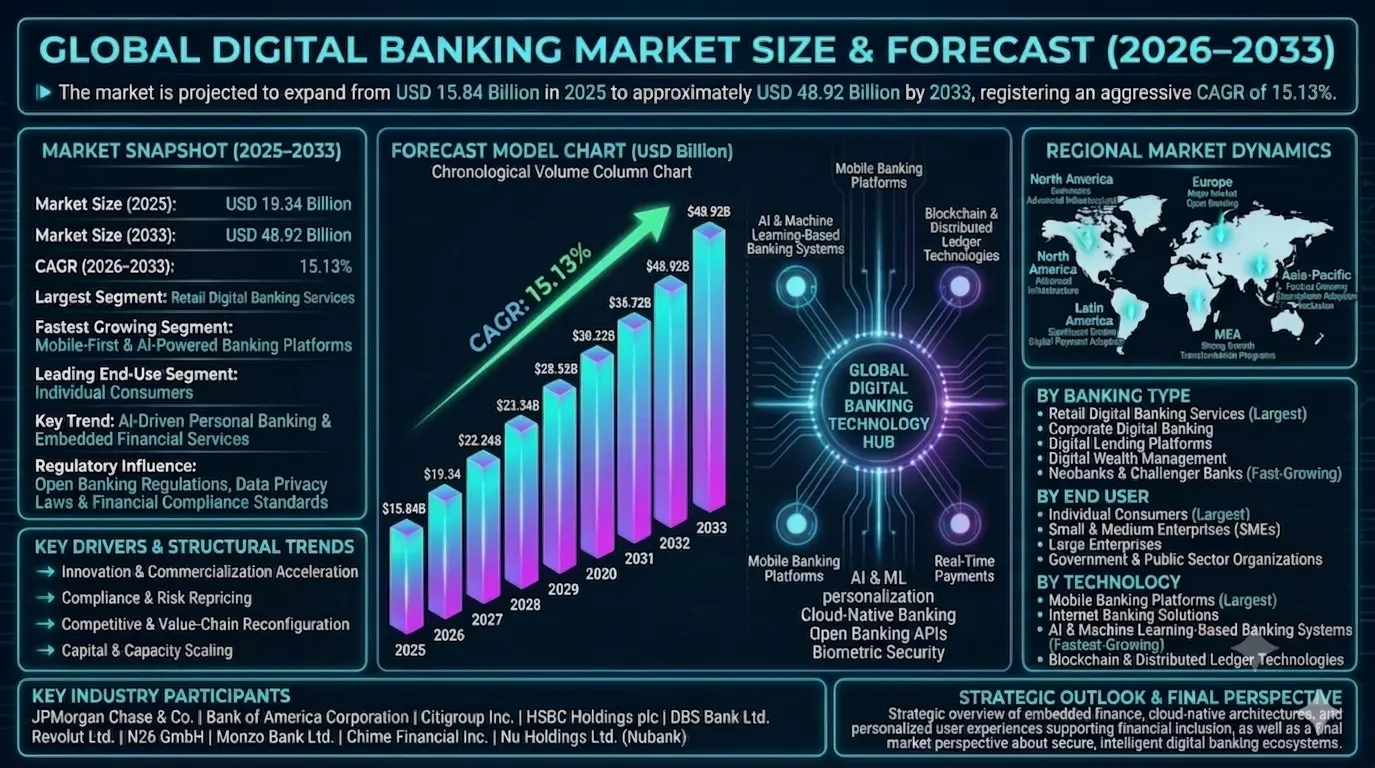
Global Digital Banking Market Size & Forecast
The Global Digital Banking Market is expected to witness robust growth during the forecast period from 2026 to 2033. The market was valued at USD 15.84 billion in 2025 and is projected to reach approximately USD 48.92 billion by 2033, registering a CAGR of 15.13%. The market growth is primarily driven by increasing smartphone penetration, rapid digital payment adoption, growing demand for convenient banking services, and the expansion of fintech ecosystems worldwide. Digital banking is transforming traditional financial services by enabling seamless online account management, digital payments, lending, wealth management, and personalized financial services through web and mobile platforms. In addition, advancements in artificial intelligence, cloud computing, open banking frameworks, and real-time payment infrastructure are supporting long-term market expansion.Global Digital Banking Market Overview
Digital banking refers to the delivery of banking products and financial services through digital channels without requiring physical branch interactions. The market includes mobile banking, internet banking, neobanks, digital wallets, digital lending platforms, and integrated financial service ecosystems. Digital banking solutions are widely utilized by individuals, businesses, financial institutions, and government entities for secure and efficient financial management. The market is rapidly shifting from branch-centric banking models toward mobile-first, AI-driven, and fully digital financial ecosystems.Structural Drivers of Market Growth
1. Innovation and Commercialization Acceleration
Rapid innovation in AI-powered banking assistants, biometric authentication, blockchain technologies, and embedded finance solutions is transforming customer experiences. Advanced analytics and automation technologies are enabling personalized financial products and real-time service delivery.Market Implications
Companies investing in AI-driven customer engagement, cloud-native banking platforms, and embedded financial services are expected to strengthen market leadership.2. Compliance and Risk Repricing
Open banking regulations, anti-money laundering requirements, cybersecurity mandates, and consumer data protection laws are shaping market development. Financial institutions are increasingly prioritizing secure digital infrastructure and compliance automation.Market Implications
Firms offering secure, compliant, and transparent digital banking platforms are likely to gain stronger customer trust and regulatory approval.3. Competitive and Value-Chain Reconfiguration
The market is highly competitive as traditional banks, fintech firms, neobanks, technology companies, and payment providers expand digital offerings. Platform-based banking ecosystems and API-driven financial services are reshaping industry value chains.Market Implications
Companies focusing on ecosystem partnerships, customer-centric innovation, and seamless digital experiences may gain stronger competitive advantages.4. Capital and Capacity Scaling
Rising investments in digital transformation, cloud infrastructure, cybersecurity systems, and financial technology innovation are supporting market growth. Governments and financial institutions are accelerating efforts to expand financial inclusion through digital banking channels.Market Implications
Organizations scaling digital infrastructure and financial technology capabilities are expected to capture future opportunities.Market Segmentation Analysis
By Banking Type
1. Retail Digital Banking Services
This remains the largest segment due to widespread consumer banking adoption.2. Corporate Digital Banking
Strong demand driven by business transaction management and treasury services.3. Digital Lending Platforms
Growing adoption due to faster credit approval and loan disbursement.4. Digital Wealth Management
Increasing utilization for investment and portfolio management services.5. Neobanks & Challenger Banks
Fast-growing segment due to fully digital banking experiences.By Technology
1. Mobile Banking Platforms
Largest segment due to widespread smartphone usage.2. Internet Banking Solutions
Widely utilized for personal and commercial banking activities.3. AI & Machine Learning-Based Banking Systems
Fastest-growing segment due to personalization and automation capabilities.4. Blockchain & Distributed Ledger Technologies
Growing adoption for secure transactions and transparency.By End User
1. Individual Consumers
Largest segment due to growing preference for digital financial services.2. Small & Medium Enterprises (SMEs)
Strong demand for digital payments and business banking solutions.3. Large Enterprises
Utilized for treasury management and corporate financial operations.4. Government & Public Sector Organizations
Growing use for digital financial service delivery and payment systems.Regional Market Dynamics
North America
North America dominates the global digital banking market due to advanced financial infrastructure, high fintech adoption, and strong digital payment ecosystems.Europe
Europe remains a major market supported by open banking regulations, digital innovation, and mature banking systems.Asia-Pacific
Asia-Pacific is the fastest-growing region due to rapid smartphone adoption, financial inclusion initiatives, and expanding fintech ecosystems.Latin America
Latin America is witnessing significant growth driven by increasing digital payment adoption and banking accessibility improvements.Middle East & Africa
The region is experiencing strong growth supported by digital transformation programs and mobile banking expansion.Competitive Landscape
The Global Digital Banking Market is highly competitive with traditional banks, fintech companies, neobanks, and technology providers expanding globally.Key Companies Operating in the Market Include:
- JPMorgan Chase & Co.
- Bank of America Corporation
- Citigroup Inc.
- HSBC Holdings plc
- DBS Bank Ltd.
- Revolut Ltd.
- N26 GmbH
- Monzo Bank Ltd.
- Chime Financial Inc.
- Nu Holdings Ltd. (Nubank)
Strategic Outlook
The future of the digital banking market will be shaped by AI-powered financial services, embedded finance, open banking ecosystems, and real-time payment innovations. Cloud-native banking architectures, digital identity verification, and hyper-personalized customer experiences will significantly improve operational efficiency and user engagement. The rise of fintech innovation, financial inclusion initiatives, and mobile-first banking platforms is expected to create strong long-term growth opportunities.Final Market Perspective
The Global Digital Banking Market remains a transformative segment within financial services, fintech, and digital economy ecosystems. Rising digital adoption, mobile banking penetration, and consumer demand for seamless financial experiences continue driving long-term market growth. Companies capable of delivering secure, intelligent, scalable, and customer-centric digital banking ecosystems will be best positioned to capture future opportunities. The convergence of AI, cloud computing, open banking, and embedded finance is expected to redefine the future of global banking services.Table of Contents
Table of Contents
- 1. Executive Summary
- 1.1 Global Digital Banking Market Snapshot (2026???2033)
- 1.2 Market Size & Growth Overview
- 1.3 Key Market Highlights
- 1.4 Largest & Fastest-Growing Segments
- 1.5 Regional Performance Summary
- 1.6 Competitive Landscape Overview
- 1.7 Strategic Outlook Through 2033
- 2. Market Introduction & Overview
- 2.1 Definition of Digital Banking
- 2.2 Scope of the Global Digital Banking Market
- 2.3 Evolution of Digital Financial Services
- 2.4 Digital Banking Value Chain Analysis
- 2.5 Regulatory & Compliance Framework
- 2.6 Emerging Trends in Fintech & Banking Innovation
- 2.7 Open Banking & Embedded Finance Ecosystem Development
- 3. Research Methodology
- 3.1 Primary Research Approach
- 3.2 Secondary Research Sources
- 3.3 Market Size Estimation Methodology
- 3.4 Forecasting Assumptions (2026???2033)
- 3.5 Data Validation & Triangulation
- 4. Market Dynamics
- 4.1 Market Drivers
- 4.1.1 Rising Smartphone & Internet Penetration
- 4.1.2 Growing Adoption of Digital Payments
- 4.1.3 Expansion of Fintech Ecosystems Worldwide
- 4.1.4 Increasing Demand for Convenient Banking Services
- 4.1.5 Advancements in AI, Cloud Computing & Open Banking
- 4.2 Market Restraints
- 4.2.1 Cybersecurity & Data Privacy Concerns
- 4.2.2 Regulatory Complexity Across Markets
- 4.2.3 Digital Infrastructure Gaps in Developing Regions
- 4.3 Market Opportunities
- 4.3.1 Expansion of Embedded Financial Services
- 4.3.2 Growth in Financial Inclusion Initiatives
- 4.3.3 AI-Powered Personalized Banking Solutions
- 4.3.4 Emerging Opportunities in Neobanking Platforms
- 4.4 Market Challenges
- 4.4.1 Rising Sophistication of Cyber Threats
- 4.4.2 Customer Trust & Digital Identity Verification Issues
- 4.4.3 Integration with Legacy Banking Systems
- 4.1 Market Drivers
- 5. Global Digital Banking Market Size & Forecast (USD Billion), 2026???2033
- 5.1 Market Revenue Analysis
- 5.2 CAGR Analysis
- 5.3 Demand-Supply Trends
- 5.4 Pricing Analysis
- 5.5 Investment Trends
- 5.6 Future Market Outlook
- 6. Market Segmentation Analysis (USD Billion), 2026???2033
- 6.1 By Banking Type
- 6.1.1 Retail Digital Banking Services (Largest Segment)
- 6.1.2 Corporate Digital Banking
- 6.1.3 Digital Lending Platforms
- 6.1.4 Digital Wealth Management
- 6.1.5 Neobanks & Challenger Banks (Fastest-Growing Segment)
- 6.2 By Technology
- 6.2.1 Mobile Banking Platforms (Largest Segment)
- 6.2.2 Internet Banking Solutions
- 6.2.3 AI & Machine Learning-Based Banking Systems (Fastest-Growing Segment)
- 6.2.4 Blockchain & Distributed Ledger Technologies
- 6.3 By End User
- 6.3.1 Individual Consumers (Largest Segment)
- 6.3.2 Small & Medium Enterprises (SMEs)
- 6.3.3 Large Enterprises
- 6.3.4 Government & Public Sector Organizations
- 6.1 By Banking Type
- 7. Regional Market Analysis
- 7.1 North America
- 7.2 Europe
- 7.3 Asia-Pacific
- 7.4 Latin America
- 7.5 Middle East & Africa
- 8. Competitive Landscape
- 8.1 Market Share Analysis
- 8.2 Competitive Benchmarking
- 8.3 Strategic Developments
- 8.4 Digital Innovation & Fintech Partnership Strategies
- 8.5 Mergers, Acquisitions & Expansion Analysis
- 9. Company Profiles
- 9.1 JPMorgan Chase & Co.
- 9.2 Bank of America Corporation
- 9.3 Citigroup Inc.
- 9.4 HSBC Holdings plc
- 9.5 DBS Bank Ltd.
- 9.6 Revolut Ltd.
- 9.7 N26 GmbH
- 9.8 Monzo Bank Ltd.
- 9.9 Chime Financial Inc.
- 9.10 Nu Holdings Ltd. (Nubank)
- 10. Strategic Intelligence & Pheonix AI Insights
- 10.1 Digital Banking Demand Forecast Model
- 10.2 AI-Powered Banking Adoption Analysis
- 10.3 Financial Inclusion Opportunity Tracker
- 10.4 Open Banking Ecosystem Assessment
- 10.5 Automated Porter???s Five Forces Analysis
- 11. Future Outlook & Strategic Recommendations
- 11.1 Expansion of AI-Driven Personal Banking Services
- 11.2 Investment in Cloud-Native Banking Infrastructure
- 11.3 Growth Opportunities in Embedded Finance & Neobanking
- 11.4 Strengthening Cybersecurity & Digital Trust Frameworks
- 11.5 Long-Term Market Outlook (2033+)
- 12. Appendix
- 13. About Pheonix Market Research
- 14. Disclaimer
Competitive Landscape
Global Digital Banking Market Competitive Intensity & Market Structure Overview
The global digital banking market is highly competitive and rapidly evolving, characterized by the presence of traditional banking institutions, fintech companies, neobanks, challenger banks, payment technology providers, and cloud-based financial service platforms. Competitive intensity is driven by digital innovation, customer experience, platform scalability, cybersecurity capabilities, regulatory compliance, and the ability to deliver personalized financial services across multiple digital channels.
Market participants are increasingly investing in artificial intelligence, open banking technologies, embedded finance solutions, cloud-native architectures, and real-time payment infrastructures to strengthen their market positions. As consumers increasingly shift toward mobile-first financial services, competition is intensifying among both incumbent banks and digital-native financial institutions.
The market structure is transitioning from traditional branch-centric banking models toward ecosystem-based digital banking platforms that integrate payments, lending, investments, wealth management, and financial advisory services into unified digital experiences. This transformation is creating significant opportunities for innovation-driven market participants.
Global Digital Banking Market Competitive Intensity & Market Structure Current Scenario
Leading Global Digital Banking Companies
JPMorgan Chase & Co.: One of the world’s largest financial institutions, offering advanced digital banking services supported by AI-driven customer engagement, digital payments, and integrated financial solutions.
Bank of America Corporation: Major banking leader known for its digital banking platform and AI-powered virtual assistant capabilities that enhance customer experience and operational efficiency.
Citigroup Inc.: Global banking organization providing comprehensive digital financial services, transaction banking solutions, and advanced digital payment capabilities.
HSBC Holdings plc: International banking group focused on digital transformation initiatives, mobile banking innovation, and cross-border financial service integration.
DBS Bank Ltd.: Widely recognized as a digital banking pioneer, leveraging cloud technologies, AI, and digital ecosystems to deliver innovative banking experiences.
Revolut Ltd.: Leading global fintech and neobank offering digital banking, payments, foreign exchange, investment services, and embedded financial products through a mobile-first platform.
N26 GmbH: Prominent European neobank providing fully digital banking services with a strong focus on user experience, automation, and mobile accessibility.
Monzo Bank Ltd.: Digital-only banking provider known for customer-centric mobile banking features, financial management tools, and innovative user engagement strategies.
Chime Financial Inc.: Major U.S.-based digital banking platform offering mobile-first banking services focused on accessibility, financial wellness, and low-cost account management.
Nu Holdings Ltd. (Nubank): One of the world’s largest digital banking platforms, driving financial inclusion through technology-enabled banking and digital payment solutions across Latin America.
Key Competitive Intensity & Market Structure Drivers
Growing consumer preference for mobile-first and branchless banking experiences is intensifying competition among financial institutions and fintech providers worldwide.
Advancements in artificial intelligence, machine learning, and predictive analytics are enabling highly personalized financial services and strengthening competitive differentiation.
Open banking regulations and API-driven financial ecosystems are increasing collaboration opportunities while simultaneously intensifying competition among service providers.
The rapid expansion of digital payments, embedded finance, and real-time transaction platforms is reshaping traditional banking value chains and creating new market entrants.
Cybersecurity capabilities, fraud prevention systems, and regulatory compliance frameworks have become critical competitive factors as digital transaction volumes continue to increase.
Strategic Implications of Competitive Intensity & Market Structure
Financial institutions investing in cloud-native infrastructure, AI-powered customer engagement tools, and data-driven banking services are expected to strengthen their long-term competitive positions.
Traditional banks are increasingly partnering with fintech companies and technology providers to accelerate digital transformation and enhance service innovation.
Neobanks and digital-first financial institutions are leveraging agile business models, lower operating costs, and superior user experiences to capture market share from established players.
The ability to integrate banking services into broader digital ecosystems through embedded finance and open banking frameworks is emerging as a significant strategic advantage.
Organizations that successfully combine regulatory compliance, cybersecurity excellence, and personalized customer experiences are expected to achieve stronger customer retention and revenue growth.
Global Digital Banking Market Competitive Intensity & Market Structure Forward Outlook
The competitive landscape of the global digital banking market is expected to become increasingly technology-driven as artificial intelligence, cloud computing, open banking, and embedded finance continue to transform financial services. Future competition will focus on delivering frictionless, intelligent, and highly personalized banking experiences.
Digital banking providers are expected to increase investments in generative AI, conversational banking, real-time financial analytics, and advanced digital identity verification systems to enhance customer engagement and operational efficiency.
North America is expected to remain a leading market due to advanced digital infrastructure and fintech innovation, while Asia-Pacific is projected to witness the fastest growth driven by expanding smartphone adoption, financial inclusion initiatives, and rapidly growing digital payment ecosystems.
Over the forecast period, companies that successfully balance technological innovation, regulatory compliance, cybersecurity resilience, and customer-centric service delivery will be best positioned to strengthen their leadership within the evolving global digital banking market.
Value Chain
Global Digital Banking Market Value Chain & Supply Chain Evolution Overview
The Global Digital Banking Market is undergoing rapid transformation driven by increasing smartphone adoption, fintech innovation, open banking initiatives, and the growing demand for seamless digital financial services. The market???s value chain is characterized by a highly interconnected digital ecosystem linking financial institutions, fintech companies, cloud infrastructure providers, payment networks, cybersecurity firms, regulatory authorities, and end users. This integrated framework is redefining how banking services are developed, delivered, and consumed worldwide.
A defining feature of the value chain is the convergence of traditional banking operations with advanced technologies such as artificial intelligence, cloud computing, blockchain, open APIs, and real-time payment systems. Digital banking providers are increasingly leveraging data analytics, automation, and embedded finance capabilities to deliver personalized, secure, and highly accessible financial services across mobile and web-based platforms.
Supply chain complexity within the digital banking ecosystem is largely technology-driven, requiring seamless integration between banking platforms, payment processors, identity verification systems, regulatory compliance solutions, cybersecurity infrastructure, and cloud service environments. Financial institutions must coordinate across multiple technology vendors and regulatory frameworks while maintaining security, scalability, and customer trust.
Industry participants are investing heavily in cloud-native banking platforms, AI-powered customer engagement tools, digital identity verification systems, and API-driven ecosystems to improve service delivery and operational efficiency. The value chain is evolving into a highly digital, customer-centric, and data-driven ecosystem focused on financial inclusion, convenience, and innovation.
Global Digital Banking Market Value Chain & Supply Chain Evolution Current Scenario
Market-Specific Value Chain
- Technology Infrastructure & Data Sources: Cloud computing platforms, data centers, cybersecurity infrastructure, customer data systems, payment networks, and digital identity databases.
- Banking Platform Development: Core banking systems, mobile banking applications, internet banking portals, digital lending platforms, digital wallets, and embedded finance solutions.
- AI & Advanced Technology Integration: Artificial intelligence, machine learning, fraud detection systems, biometric authentication, blockchain technologies, and predictive analytics engines.
- Compliance & Risk Management: KYC verification, AML compliance systems, regulatory reporting platforms, cybersecurity controls, and data privacy management solutions.
- Distribution & Service Delivery: Mobile applications, web banking platforms, fintech partnerships, API ecosystems, digital payment gateways, and open banking networks.
- End-User Engagement: Individual consumers, SMEs, large enterprises, government organizations, and institutional banking customers.
Company-to-Stage Mapping
- Technology Infrastructure & Data Sources: Cloud service providers, payment processors, cybersecurity firms, digital identity providers, and banking technology vendors.
- Banking Platform Development: JPMorgan Chase & Co., Bank of America Corporation, Citigroup Inc., HSBC Holdings plc, DBS Bank Ltd.
- AI & Advanced Technology Integration: Fintech innovators, AI platform providers, blockchain technology companies, and digital banking software developers.
- Compliance & Risk Management: AML solution providers, KYC verification companies, cybersecurity vendors, and regulatory technology (RegTech) firms.
- Distribution & Service Delivery: Revolut Ltd., N26 GmbH, Monzo Bank Ltd., Chime Financial Inc., Nu Holdings Ltd. (Nubank), fintech ecosystem partners.
- End-User Engagement: Consumers, businesses, government agencies, financial institutions, and digital banking subscribers.
Key Value Chain & Supply Chain Evolution Signals in Global Digital Banking Market
- Expansion of AI-Driven Banking Services:
AI-powered financial assistants, automated customer service, fraud detection, and personalized financial recommendations are transforming digital banking experiences. - Growth of Open Banking Ecosystems:
API-driven connectivity is enabling seamless collaboration between banks, fintech companies, and third-party financial service providers. - Rise of Embedded Finance Solutions:
Financial services are increasingly being integrated directly into non-banking digital platforms and customer journeys. - Increasing Adoption of Cloud-Native Banking Platforms:
Cloud infrastructure is improving scalability, operational efficiency, service agility, and innovation capabilities. - Advancement of Digital Identity & Biometric Verification:
Enhanced authentication technologies are improving security, onboarding efficiency, and regulatory compliance. - Growing Importance of Cybersecurity & Data Privacy:
Financial institutions are prioritizing cyber resilience and customer data protection amid rising digital threats.
Strategic Implications of Value Chain & Supply Chain Evolution
- Investment in AI & Hyper-Personalized Banking:
AI-driven insights and customer engagement tools will become key differentiators in competitive digital banking markets. - Expansion of Open Banking Partnerships:
Collaboration between banks, fintech firms, and technology providers enhances innovation and customer value creation. - Strengthening Cloud Infrastructure Capabilities:
Cloud-native platforms improve scalability, cost efficiency, and digital service deployment speed. - Enhancing Regulatory Compliance & Risk Management:
Integrated compliance automation supports adherence to evolving financial regulations and reduces operational risk. - Development of Embedded Finance Ecosystems:
Integrating banking services into digital commerce and consumer applications creates new revenue streams and customer acquisition opportunities. - Optimization of Digital Customer Journeys:
Seamless onboarding, instant payments, and personalized services improve customer retention and satisfaction.
Global Digital Banking Market Value Chain & Supply Chain Evolution Forward Outlook
Looking ahead, the digital banking value chain is expected to evolve into a fully connected, AI-powered, and open-finance ecosystem where banking services are seamlessly integrated into everyday digital experiences.
Key Future Developments Include:
- Expansion of AI-powered personal financial management and advisory services.
- Increased adoption of open banking and API-driven financial ecosystems.
- Growth of embedded finance across e-commerce, mobility, and digital platforms.
- Advancement of biometric authentication and digital identity technologies.
- Expansion of real-time payment infrastructure and instant banking services.
- Greater integration of blockchain technologies for security, transparency, and transaction efficiency.
As the market evolves, competitive advantage will increasingly depend on the ability to combine customer-centric innovation, regulatory compliance, cybersecurity resilience, and scalable digital infrastructure. Institutions capable of delivering intelligent, secure, and highly personalized financial experiences will be best positioned to capture future growth opportunities.
Organizations that successfully integrate AI-driven banking solutions, cloud-native architectures, open banking capabilities, and embedded financial services will achieve stronger customer engagement, operational efficiency, and long-term leadership in the Global Digital Banking Market.
Investment Activity
Global Digital Banking Market Investment & Funding Dynamics Overview
The Global Digital Banking Market is experiencing strong investment momentum driven by rapid fintech innovation, expanding mobile banking adoption, growing demand for personalized financial services, and the accelerating transition toward fully digital financial ecosystems. Banks, fintech companies, neobanks, payment service providers, technology firms, and venture capital investors are actively investing in AI-powered banking platforms, cloud-native financial infrastructure, embedded finance solutions, open banking technologies, and advanced cybersecurity systems.
Investment activity is increasing as financial institutions modernize legacy systems, improve customer experiences, and expand digital service offerings. Capital deployment is focused on mobile-first banking applications, real-time payment networks, digital identity verification platforms, API-driven banking ecosystems, and intelligent customer engagement technologies.
Additionally, growing investments in artificial intelligence, machine learning, blockchain technologies, financial automation platforms, and digital financial inclusion initiatives are creating significant long-term growth opportunities across the global digital banking landscape.
Global Digital Banking Market Investment & Funding Dynamics Current Scenario
Currently, the digital banking market is witnessing substantial funding activity as financial institutions and fintech firms compete to expand digital capabilities and enhance customer acquisition. Leading market participants are investing heavily in AI-driven personal banking assistants, cloud-based banking infrastructure, embedded finance ecosystems, fraud prevention technologies, and next-generation digital payment solutions.
The market is attracting significant venture capital, private equity, and strategic investments into neobanks, fintech startups, digital lending platforms, payment technology providers, and financial software innovators. Investors are increasingly supporting companies that offer scalable digital banking models and customer-centric financial solutions.
Furthermore, the industry is witnessing active mergers, acquisitions, strategic alliances, and technology partnerships as banks and fintech firms seek to accelerate digital transformation, strengthen market presence, and diversify service portfolios.
Key Investment & Funding Dynamics Signals in Global Digital Banking Market
- Growing adoption of mobile banking platforms and digital financial services is driving large-scale technology investments.
- Expansion of AI-powered banking solutions and personalized financial services is increasing capital allocation toward intelligent banking systems.
- Rising demand for embedded finance and API-driven banking ecosystems is accelerating fintech-focused funding activity.
- Strategic investments in real-time payments, digital wallets, and cloud-native banking infrastructure are strengthening digital transformation initiatives.
- Increasing focus on cybersecurity, fraud prevention, and digital identity verification is supporting long-term investor confidence.
- Partnerships between traditional banks, fintech companies, technology vendors, and payment providers are improving innovation scalability.
- Growing regulatory support for open banking frameworks and financial inclusion programs is creating favorable investment conditions.
Strategic Implications of Investment & Funding Dynamics in Global Digital Banking Market
- Continuous investment in AI-driven banking intelligence and digital customer engagement platforms is essential for maintaining competitive differentiation.
- Capital allocation toward cloud infrastructure, open banking technologies, and real-time financial services will strengthen long-term growth potential.
- Companies offering secure, scalable, and highly personalized digital banking experiences are expected to gain stronger market share.
- Strategic acquisitions and partnerships will accelerate technology integration, product innovation, and ecosystem development.
- Investments in financial inclusion solutions, embedded finance capabilities, and digital lending platforms will remain major growth priorities.
- Compliance with data privacy regulations, financial compliance standards, and open banking requirements will continue influencing investment decisions.
- Organizations developing integrated digital financial ecosystems and next-generation banking platforms are expected to capture substantial future opportunities.
Global Digital Banking Market Investment & Funding Dynamics Forward Outlook
Looking ahead, the Global Digital Banking Market is expected to maintain strong investment growth driven by increasing smartphone penetration, fintech ecosystem expansion, digital payment adoption, and ongoing financial sector digitization.
Future capital deployment will increasingly focus on AI-powered financial advisory services, embedded banking platforms, blockchain-enabled transaction systems, hyper-personalized customer experiences, and intelligent financial automation technologies.
As digital banking continues evolving toward platform-based and customer-centric models, investment activity is expected to expand across cloud-native banking architectures, real-time payment infrastructure, and advanced digital security frameworks.
In conclusion, the Global Digital Banking Market represents a high-growth financial technology investment landscape where artificial intelligence, open banking, embedded finance, cloud computing, and digital financial inclusion will define future funding priorities, innovation strategies, and long-term market expansion.
Technology & Innovation
Global Digital Banking Market Technology & Innovation Landscape Overview
The global digital banking market is experiencing rapid technological transformation driven by advancements in artificial intelligence (AI), cloud-native banking platforms, open banking APIs, blockchain technologies, biometric authentication systems, and real-time payment infrastructures. Financial institutions are increasingly adopting digital-first operating models to enhance customer experiences, improve operational efficiency, strengthen security, and expand financial accessibility.
Modern digital banking ecosystems integrate AI-powered virtual assistants, predictive analytics engines, digital identity verification solutions, API-driven financial services, and cloud-based banking architectures to deliver seamless and personalized banking experiences. These technologies are enabling faster transactions, improved fraud detection, enhanced customer engagement, and streamlined compliance management.
The market is also witnessing significant adoption of embedded finance solutions, mobile-first banking applications, intelligent automation platforms, and real-time financial data analytics, which are reshaping how consumers and businesses access and manage financial services globally.
Global Digital Banking Market Technology & Innovation Current Scenario
Current innovation in the digital banking market is centered around AI-driven customer engagement, mobile banking optimization, and real-time financial service delivery. Traditional banking models are rapidly evolving toward fully digital ecosystems capable of offering personalized, secure, and on-demand financial services.
Mobile banking platforms continue to dominate innovation efforts as banks focus on improving user experience, accessibility, and transaction convenience through intuitive digital interfaces.
Artificial intelligence and machine learning technologies are increasingly being used to automate customer support, personalize financial recommendations, detect fraud, and optimize credit assessment processes.
Open banking frameworks are enabling greater interoperability between banks, fintech companies, and third-party service providers, creating broader financial ecosystems and new revenue opportunities.
Cloud computing adoption is accelerating the modernization of banking infrastructure by improving scalability, operational flexibility, and service deployment efficiency.
Advanced cybersecurity technologies, including biometric authentication and behavioral analytics, are strengthening digital trust and protecting sensitive financial data.
Key Technology & Innovation Trends in Global Digital Banking Market
- AI-Powered Banking Assistants: Delivering personalized customer support and financial recommendations.
- Open Banking APIs: Enabling seamless integration between banks and fintech platforms.
- Cloud-Native Banking Platforms: Supporting scalable, agile, and cost-efficient banking operations.
- Real-Time Payment Systems: Facilitating instant fund transfers and transaction processing.
- Biometric Authentication: Enhancing account security through facial recognition and fingerprint verification.
- Blockchain-Based Financial Infrastructure: Improving transparency, security, and transaction efficiency.
- Embedded Finance Solutions: Integrating banking services directly into non-financial platforms.
- Digital Identity Verification: Streamlining customer onboarding and compliance processes.
- Predictive Financial Analytics: Supporting personalized banking and risk management.
- Automated Compliance & RegTech Platforms: Enhancing regulatory monitoring and reporting efficiency.
Strategic Implications of Technology & Innovation
Technological innovation is reshaping competition within the digital banking market by shifting industry focus toward intelligent, customer-centric, and platform-driven financial ecosystems.
Organizations investing in AI-powered personalization, cloud banking infrastructure, and integrated digital financial platforms are achieving stronger customer retention, improved operational efficiency, and enhanced competitive positioning.
The growing convergence of AI, open banking, and advanced analytics is enabling financial institutions to deliver proactive financial services while improving risk assessment and customer engagement.
Digital automation is helping banks reduce operational costs, accelerate service delivery, improve compliance management, and enhance overall customer satisfaction.
However, cybersecurity threats, regulatory complexity, legacy system integration challenges, and data privacy concerns remain key barriers to large-scale digital banking transformation.
Global Digital Banking Market Technology & Innovation Forward Outlook
The future of the digital banking market is expected to evolve toward fully intelligent, AI-orchestrated, and hyper-personalized financial ecosystems capable of delivering real-time financial services across multiple digital channels.
Emerging innovations include generative AI financial advisors, autonomous banking operations, decentralized finance integration, advanced digital identity ecosystems, and predictive financial wellness platforms.
Banks are expected to further integrate AI, blockchain, and cloud technologies to create seamless customer journeys while improving security, transparency, and operational agility.
Open finance ecosystems and embedded banking services will continue expanding access to financial products across retail, commercial, and enterprise segments.
Overall, the global digital banking market is progressing toward a highly connected and data-driven ecosystem where AI, cloud computing, real-time payments, cybersecurity, and open banking frameworks collectively redefine the future of financial services.
Market Risk
Digital Banking Market Risk Factors & Disruption Threats Overview
The global digital banking market operates within a high-growth but increasingly complex risk environment shaped by cybersecurity threats, regulatory changes, technology disruptions, competitive pressures, and evolving consumer expectations. As financial services continue shifting toward digital-first delivery models, institutions face growing challenges in maintaining security, regulatory compliance, operational resilience, and customer trust.
Digital banking platforms rely heavily on cloud infrastructure, application programming interfaces (APIs), artificial intelligence, mobile applications, and real-time payment networks. While these technologies enhance convenience and efficiency, they also increase exposure to cyberattacks, system outages, data privacy concerns, and technology integration risks.
The rapid expansion of fintech companies, neobanks, embedded finance providers, and digital payment platforms is intensifying market competition. Traditional financial institutions are under pressure to accelerate digital transformation while managing legacy infrastructure, regulatory obligations, and operational complexity.
In addition, increasing global regulatory scrutiny related to open banking, anti-money laundering (AML), data protection, and digital identity verification is creating a more demanding compliance environment. These factors collectively contribute to a moderately high-to-high risk profile across the digital banking ecosystem.
Digital Banking Market Risk Factors & Disruption Threats Current Scenario
The current digital banking landscape is characterized by rapid innovation, strong customer adoption, and expanding digital financial ecosystems. However, the increasing volume of online transactions and interconnected financial services has heightened exposure to operational and security risks.
Cybersecurity remains the most significant challenge for digital banking providers. Financial institutions face continuous threats from phishing attacks, ransomware, account takeover fraud, data breaches, identity theft, and sophisticated cybercrime networks. Any security incident can result in financial losses, regulatory penalties, and reputational damage.
Data privacy regulations continue to evolve globally, requiring banks and fintech companies to strengthen governance frameworks and ensure responsible handling of customer information. Compliance with regulations such as open banking mandates, consumer protection laws, and cross-border data transfer requirements increases operational complexity.
Technology integration challenges are also becoming more prominent. Many established banks continue to operate legacy systems that may not seamlessly integrate with cloud-native applications, AI platforms, and open banking architectures. These integration gaps can affect service reliability and innovation speed.
Furthermore, macroeconomic uncertainty, inflationary pressures, and changing interest rate environments may affect consumer borrowing behavior, digital lending activity, and overall banking profitability.
Key Risk Factors & Disruption Threats Signals in the Digital Banking Market
- Cybersecurity Threats: Increasing cyberattacks, fraud attempts, ransomware incidents, and digital identity theft remain major operational risks for financial institutions.
- Data Privacy and Protection Requirements: Strict privacy regulations and customer data management obligations increase compliance complexity and potential legal exposure.
- Regulatory Compliance Risk: Open banking regulations, AML requirements, KYC obligations, and consumer protection standards continue to evolve across jurisdictions.
- Legacy Infrastructure Challenges: Older banking systems may limit scalability, innovation, and integration with emerging digital technologies.
- Technology Outages and Service Disruptions: System failures, cloud service interruptions, and platform downtime can impact customer trust and operational continuity.
- Intensifying Market Competition: Competition from fintech firms, neobanks, technology companies, and digital payment providers may create pricing pressure and customer acquisition challenges.
- Third-Party Dependency Risk: Dependence on cloud providers, fintech partners, API ecosystems, and external technology vendors increases operational exposure.
- Fraud and Financial Crime Evolution: Sophisticated fraud techniques, synthetic identities, account manipulation, and money laundering activities require continuous monitoring and investment.
- Consumer Trust and Reputation Risk: Security incidents, poor user experiences, or privacy concerns can rapidly affect customer retention and brand reputation.
- Macroeconomic Volatility: Economic downturns, inflation, and changing interest rate environments may influence lending demand, consumer spending, and banking profitability.
Strategic Implications of Risk Factors & Disruption Threats in the Digital Banking Market
The evolving risk landscape is compelling banks, fintech companies, and technology providers to prioritize cybersecurity, compliance automation, and operational resilience. Investments in advanced fraud detection systems, AI-driven security analytics, and real-time threat monitoring are becoming critical competitive requirements.
Financial institutions are increasingly adopting cloud-native architectures, API-driven ecosystems, and digital identity verification solutions to improve scalability and customer experience while maintaining regulatory compliance. These initiatives support operational efficiency but require strong governance and risk management frameworks.
Strategic partnerships are becoming increasingly important as banks collaborate with fintech firms, payment providers, and technology companies to accelerate innovation and expand service offerings. Effective ecosystem management will be essential for maintaining service quality and operational security.
Institutions are also strengthening customer trust initiatives through enhanced transparency, secure authentication methods, privacy-focused product design, and continuous investment in digital infrastructure modernization.
Organizations that successfully balance innovation with regulatory compliance and risk management will be better positioned to capture market share in an increasingly competitive environment.
Digital Banking Market Risk Factors & Disruption Threats Forward Outlook
Looking ahead, the digital banking market is expected to maintain strong growth momentum driven by mobile banking adoption, embedded finance expansion, financial inclusion initiatives, and ongoing fintech innovation. However, the complexity of managing security, compliance, and operational risks will continue to increase.
Artificial intelligence and machine learning will play an increasingly important role in fraud prevention, customer engagement, risk assessment, and personalized financial services. While these technologies offer significant advantages, they will also require stronger governance frameworks to ensure transparency, fairness, and regulatory acceptance.
Open banking ecosystems and real-time payment infrastructures are expected to expand globally, creating new opportunities for innovation while increasing interconnectedness across financial networks. This may elevate systemic operational and cybersecurity risks if not managed effectively.
Digital identity solutions, biometric authentication, decentralized finance integrations, and embedded financial services are likely to become more prevalent, further transforming the competitive landscape. Companies that invest in secure, scalable, and customer-centric digital platforms will be better positioned to capitalize on these developments.
Overall, the global digital banking market is expected to remain highly dynamic and innovation-driven. Organizations that prioritize cybersecurity resilience, regulatory compliance, technology modernization, and customer trust will be best positioned to mitigate disruption threats and capture long-term growth opportunities in the evolving digital financial ecosystem.
Regulatory Landscape
Global Digital Banking Market Regulatory & Policy Environment Overview
The regulatory and policy environment governing the Global Digital Banking Market is evolving rapidly as financial institutions, fintech companies, and digital banking platforms expand their digital service offerings. Regulatory authorities worldwide are focused on ensuring financial stability, consumer protection, cybersecurity resilience, data privacy, and fair competition while encouraging innovation within digital financial ecosystems.
Digital banking providers must comply with a wide range of regulations covering open banking frameworks, anti-money laundering (AML) requirements, know-your-customer (KYC) obligations, digital identity verification standards, payment security regulations, and consumer data protection laws. These frameworks are designed to promote secure, transparent, and trustworthy digital financial services.
The increasing adoption of cloud-based banking platforms, AI-powered financial services, embedded finance solutions, and real-time payment systems is accelerating the development of new regulatory models aimed at balancing innovation with risk management and financial system integrity.
Global Digital Banking Market Regulatory & Policy Environment Current Scenario
The current regulatory landscape for digital banking is characterized by growing oversight of digital financial transactions, stronger cybersecurity mandates, and enhanced consumer protection requirements. Governments and central banks are actively modernizing financial regulations to accommodate emerging digital banking models and fintech innovations.
In North America and Europe, regulators are implementing stringent compliance standards related to customer authentication, data security, open banking APIs, and financial crime prevention. Frameworks such as PSD2 in Europe and evolving open banking initiatives in multiple jurisdictions are encouraging competition while ensuring secure access to financial data.
Asia-Pacific markets including India, China, Singapore, Australia, and South Korea are strengthening digital banking regulations while promoting financial inclusion, digital payments, and innovation-driven banking ecosystems. Regulatory sandboxes are increasingly being utilized to test emerging financial technologies under controlled environments.
Data privacy regulations, cybersecurity compliance requirements, and digital operational resilience standards are becoming increasingly important as banking services become more dependent on cloud infrastructure, artificial intelligence, and interconnected digital platforms.
Key Regulatory & Policy Environment Signals in Global Digital Banking Market
- Open Banking Regulations: Regulatory frameworks enable secure sharing of financial data through APIs to encourage innovation and competition.
- AML & KYC Compliance Requirements: Financial institutions must implement robust customer verification and transaction monitoring procedures.
- Data Privacy & Consumer Protection Laws: Digital banking providers are required to safeguard customer information and ensure transparent data usage practices.
- Cybersecurity & Digital Resilience Standards: Regulations mandate protection against cyber threats, fraud, and operational disruptions.
- Digital Identity Verification Frameworks: Governments are promoting secure electronic identity systems for seamless customer onboarding.
- Real-Time Payment & Financial Infrastructure Policies: Regulatory initiatives support faster, interoperable, and secure digital payment ecosystems.
Strategic Implications of Regulatory & Policy Environment
The evolving regulatory environment is encouraging banks, fintech firms, and technology providers to invest heavily in compliance automation, AI-driven fraud detection systems, cybersecurity infrastructure, and advanced identity verification technologies.
Open banking regulations are accelerating ecosystem partnerships between banks, fintech companies, and third-party service providers, creating opportunities for innovative financial products and personalized customer experiences.
Stricter AML, KYC, and financial crime prevention requirements are driving adoption of machine learning-based monitoring systems capable of detecting suspicious activities in real time while improving compliance efficiency.
Cybersecurity and data governance regulations are also supporting increased investment in secure cloud infrastructure, encryption technologies, biometric authentication systems, and digital operational resilience frameworks.
Organizations capable of integrating regulatory compliance with customer-centric innovation are expected to gain stronger market positioning and long-term competitive advantages.
Global Digital Banking Market Regulatory & Policy Environment Forward Outlook
Between 2026 and 2033, the regulatory environment for the global digital banking market is expected to become increasingly technology-focused, data-driven, and globally coordinated. Regulators are likely to introduce more comprehensive frameworks governing AI-powered banking services, embedded finance platforms, and digital asset-related financial activities.
Open banking initiatives are expected to expand globally, enabling greater interoperability between financial institutions and fostering innovation across digital financial ecosystems. Enhanced cybersecurity standards and digital resilience requirements will become increasingly critical as cyber risks continue to evolve.
Digital identity systems, biometric authentication technologies, and automated compliance solutions are expected to receive stronger regulatory support to improve customer onboarding, fraud prevention, and financial inclusion.
Cross-border cooperation among financial regulators is likely to strengthen, leading to greater harmonization of digital banking compliance standards, data-sharing protocols, and financial crime prevention frameworks.
Overall, regulatory and policy developments will remain a major driver of digital banking market evolution, with organizations investing in secure, compliant, and technologically advanced digital banking ecosystems expected to maintain a strong competitive advantage throughout the forecast period.