
Global Ashwagandha Market size and share Analysis 2026-2033
Global Ashwagandha Market Forecast Snapshot: 2026–2033
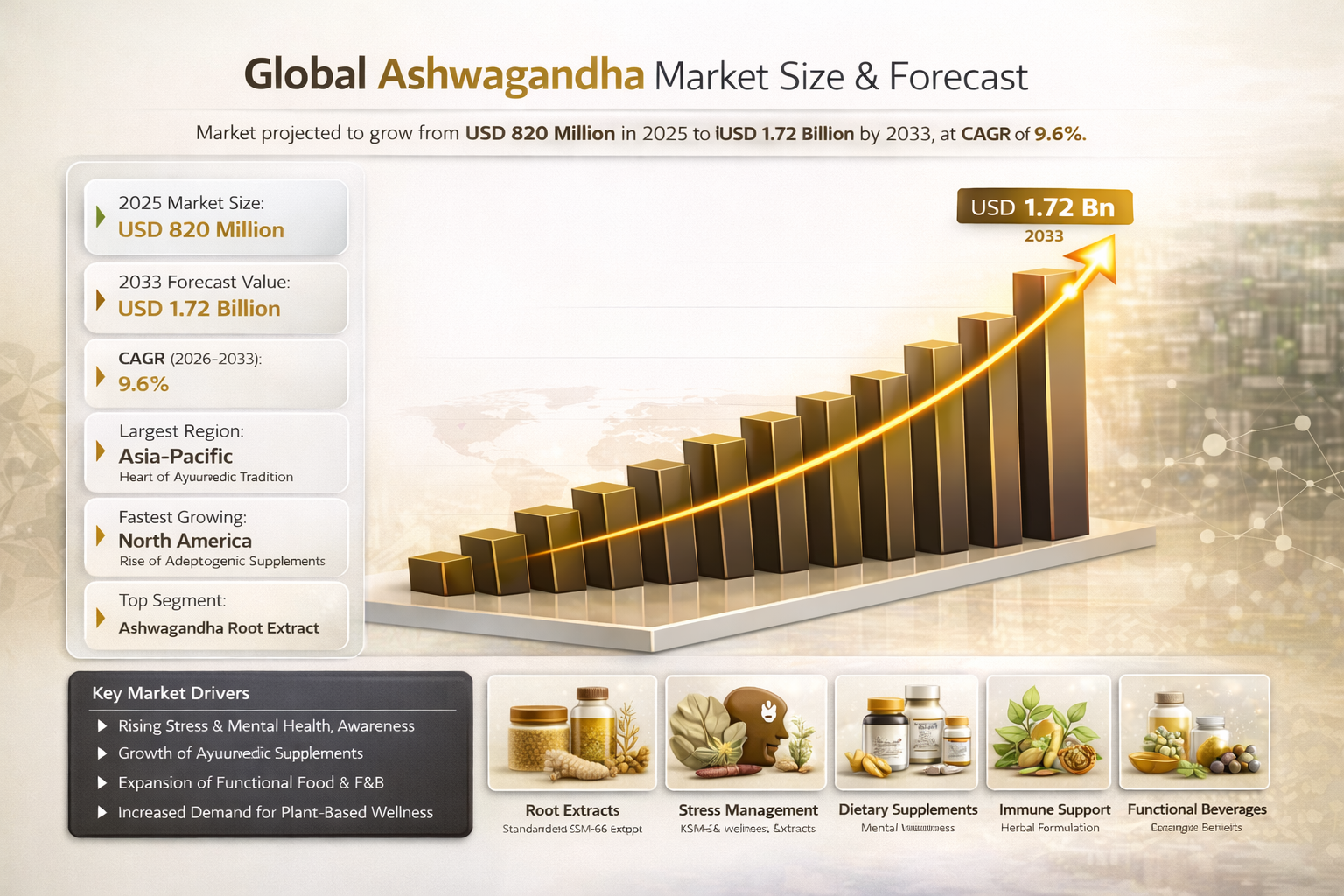
| Metric | Value |
| 2025 Market Size | USD 820 Million |
| 2033 Market Size | USD 1.72 Billion |
| CAGR (2026–2033) | 9.6% |
| Largest Region | Asia-Pacific |
| Fastest Growing Region | North America |
| Top Segment | Ashwagandha Root Extract |
| Key Trend | Adaptogenic Herbal Supplements & Stress Management Products |
| Future Focus | Functional Beverages, Nutraceuticals, and Plant-Based Wellness Products |
Global Ashwagandha Market Overview
Global Ashwagandha Market is booming. People are turning to this ancient Ayurvedic herb for stress, immunity, and overall wellness. Ashwagandha's adaptogenic powers are getting global love – it's natural, plant-based, and helps you cope with life's chaos. Ashwagandha's getting global love! This Ayurvedic herb (Withania somnifera) is known for tackling stress, inflammation, and boosting wellness – adaptogenic powers and more. People use it for energy, calm, and overall health – a natural fit for today's wellness trends.
According to Pheonix Research, the Global Ashwagandha Market is valued at USD 820 million in 2025 and is projected to reach USD 1.72 billion by 2033, registering a CAGR of 9.6% during 2026–2033. Market expansion is driven by rising awareness of mental health, stress management, immunity enhancement, and natural herbal supplements.
Asia-Pacific dominates the market due to the strong presence of Ayurvedic medicine traditions, large-scale cultivation in India, and high consumption of herbal supplements. Meanwhile, North America is the fastest-growing region, supported by increasing adoption of natural stress management supplements, sports nutrition products, and herbal wellness formulations.
The post-2025 outlook highlights strong opportunities in functional beverages, herbal dietary supplements, personalized nutrition, and adaptogenic wellness products, positioning ashwagandha as a key ingredient within the global nutraceutical and herbal wellness industry.
Key Drivers of Global Ashwagandha Market Growth
1. Rising Demand for Natural Stress Management Products
Increasing stress levels and mental health awareness are driving demand for adaptogenic herbs such as ashwagandha.
2. Growth of Herbal and Ayurvedic Supplements
Consumers are increasingly shifting toward herbal remedies and traditional medicinal systems such as Ayurveda.
3. Expansion of Nutraceutical and Functional Food Industries
Ashwagandha is increasingly incorporated into functional foods, energy drinks, and dietary supplements.
4. Increasing Popularity of Plant-Based Wellness Products
The global shift toward natural, organic, and plant-based ingredients is accelerating demand for ashwagandha products.
5. Growing Research and Clinical Studies
Scientific research supporting the benefits of ashwagandha in stress reduction, sleep improvement, and cognitive health is boosting market credibility.
Global Ashwagandha Market Segmentation
1. By Product Type
1.1 Ashwagandha Root Products
1.1.1 Ashwagandha Root Powder
1.1.1.1 Organic Ashwagandha Powder
1.1.1.2 Conventional Ashwagandha Powder
1.1.2 Ashwagandha Root Extract
1.1.2.1 Standardized Root Extract
1.1.2.2 High-Concentration Root Extract
1.2 Ashwagandha Leaf Products
1.2.1 Leaf Powder
1.2.1.1 Herbal Leaf Powder Supplements
1.2.1.2 Leaf-Based Herbal Formulations
1.2.2 Leaf Extract
1.2.2.1 Antioxidant Extracts
1.2.2.2 Functional Botanical Extracts
1.3 Ashwagandha Capsules & Tablets
1.3.1 Herbal Capsules
1.3.1.1 Standardized Extract Capsules
1.3.1.2 Full-Spectrum Herbal Capsules
1.3.2 Herbal Tablets
1.3.2.1 Stress Relief Tablets
1.3.2.2 Immunity Support Tablets
1.4 Liquid Ashwagandha Products
1.4.1 Herbal Tinctures
1.4.1.1 Concentrated Herbal Drops
1.4.1.2 Liquid Herbal Extracts
1.4.2 Functional Liquid Supplements
1.4.2.1 Wellness Tonics
1.4.2.2 Stress Relief Formulations
2. By Application
2.1 Dietary Supplements
2.1.1 Stress Management Supplements
2.1.2 Sleep Support Supplements
2.1.3 Cognitive Health Supplements
2.1.4 Immunity Support Supplements
2.2 Functional Food & Beverages
2.2.1 Herbal Functional Beverages
2.2.1.1 Adaptogenic Drinks
2.2.1.2 Herbal Wellness Drinks
2.2.2 Nutritional Food Products
2.2.2.1 Functional Snack Bars
2.2.2.2 Herbal Nutritional Powders
2.3 Pharmaceutical Applications
2.3.1 Herbal Medicines
2.3.2 Stress and Anxiety Treatment Products
2.3.3 Anti-Inflammatory Herbal Formulations
2.3.4 Cognitive Health Products
2.4 Personal Care & Cosmetics
2.4.1 Herbal Skincare Products
2.4.1.1 Anti-Aging Creams
2.4.1.2 Herbal Face Masks
2.4.2 Hair Care Products
2.4.2.1 Herbal Hair Oils
2.4.2.2 Hair Growth Formulations
3. By Distribution Channel
3.1 Pharmacies & Drug Stores
3.1.1 Retail Pharmacies
3.1.2 Herbal Medicine Stores
3.2 Online Retail & E-commerce
3.2.1 E-commerce Marketplaces
3.2.2 Direct-to-Consumer Herbal Brands
3.3 Supermarkets & Health Stores
3.3.1 Health & Wellness Retail Chains
3.3.2 Organic Food Stores
3.4 Specialty Herbal Stores
3.4.1 Ayurvedic Product Stores
3.4.2 Herbal Supplement Retailers
4. By End-User
4.1 Individual Consumers
4.1.1 Health-Conscious Consumers
4.1.2 Fitness and Sports Nutrition Consumers
4.2 Medical and Wellness Practitioners
4.2.1 Ayurvedic Practitioners
4.2.2 Herbal Medicine Specialists
4.3 Pharmaceutical & Nutraceutical Companies
4.3.1 Dietary Supplement Manufacturers
4.3.2 Functional Food Producers
5.By Region
5.1 North America
5.2 Europe
5.3 Asia-Pacific
5.4 Middle East & Africa
5.5 South America
Regional Insights of Global Ashwagandha Market
Asia-Pacific – Largest Market
Asia-Pacific dominates the market due to strong demand for Ayurvedic herbal products, large-scale cultivation in India, and widespread use of herbal medicine across South Asia.
North America – Fastest Growing Market
North America is experiencing rapid growth driven by increasing demand for adaptogenic supplements, natural stress relief products, and plant-based nutraceuticals.
Europe
Growing consumer awareness regarding herbal medicine, organic supplements, and natural wellness products is supporting market expansion.
Middle East & Africa
Rising adoption of herbal remedies and expanding nutraceutical markets are contributing to steady growth.
South America
Increasing interest in plant-based health products and herbal supplements is creating new growth opportunities.
Leading Companies in Global Ashwagandha Market
Himalaya Wellness Company
Dabur India Ltd.
Organic India
KSM-66 Ashwagandha (Ixoreal Biomed)
Banyan Botanicals
Gaia Herbs
NOW Foods
Nature’s Way
Leading companies are focusing on standardized herbal extracts, organic certifications, clinical research, and global distribution expansion to strengthen their competitive positioning. The largest company among the listed companies is Dabur India Ltd.
Strategic Intelligence & AI-Backed Insights
Pheonix Demand Forecast Engine identifies rising demand for natural stress management products, adaptogenic supplements, and herbal wellness solutions as major growth drivers.
Consumer Behavior Analyzer highlights increasing preference for clean-label, plant-based, and natural herbal supplements among health-conscious consumers.
Innovation Tracker emphasizes adaptogenic beverages, herbal supplement formulations, and personalized herbal nutrition as key competitive differentiators.
Porter’s Five Forces Analysis reveals moderate supplier power, strong competition among herbal supplement brands, and growing opportunities for premium natural wellness products.
Why the Global Ashwagandha Market is Critical
-
Supports natural stress management and mental wellness.
-
Strengthens the global herbal medicine and nutraceutical industries.
-
Drives innovation in adaptogenic functional foods and beverages.
-
Promotes plant-based and natural health solutions.
-
Expands opportunities for herbal cultivation and sustainable agriculture.
Final Takeaway of Global Ashwagandha Market
The Global Ashwagandha Market is steadily transitioning into a natural wellness, adaptogenic nutrition, and plant-based health ecosystem. The Ashwagandha Market CAGR 2026–2033 of 9.6% reflects strong expansion supported by rising demand for herbal supplements, stress management solutions, and immunity-boosting natural products.
Companies that effectively invest in standardized herbal extracts, organic cultivation, clinical validation, and functional product innovation will be well positioned to capture long-term value creation within the rapidly evolving herbal wellness industry.
At Pheonix Research, our advanced forecasting frameworks provide in-depth Ashwagandha market revenue forecast analysis, competitive benchmarking, and strategic intelligence — enabling stakeholders to capitalize on the Post-2025 outlook for the Global Ashwagandha Market with data-backed confidence and sustainable growth strategies.
📢 Social Mentions & Publication Channels
Explore deeper insights and follow our cross-platform updates on LinkedIn, and X for continuous intelligence and market coverage.
LinkedIn : https://www.linkedin.com/feed/update/urn:li:activity:7438188079766540288
X : https://x.com/Pheonix_Insight/status/2032423512078778627?s=20
Table of Contents
1. Market Forecast Snapshot (2026–2033)
1.1 2025 Market Size – USD 820 Million
1.2 2033 Market Size – USD 1.72 Billion
1.3 CAGR (2026–2033) – 9.6%
1.4 Largest Region – Asia-Pacific
1.5 Fastest Growing Region – North America
1.6 Top Segment – Ashwagandha Root Extract
1.7 Key Trend – Adaptogenic Herbal Supplements & Stress Management Products
1.8 Future Focus – Functional Beverages, Nutraceuticals, and Plant-Based Wellness Products
2. Global Ashwagandha Market Overview
2.1 Market Definition & Scope
2.2 Evolution of the Ashwagandha Industry
2.3 Rising Global Demand for Adaptogenic Herbs
2.4 Integration of Ayurvedic Medicine with Modern Wellness Trends
2.5 Expansion of Herbal Supplements and Nutraceutical Products
2.6 Post-2025 Market Outlook
3. Key Drivers of Global Ashwagandha Market Growth
3.1 Rising Demand for Natural Stress Management Products
3.2 Growth of Herbal and Ayurvedic Supplements
3.3 Expansion of Nutraceutical and Functional Food Industries
3.4 Increasing Popularity of Plant-Based Wellness Products
3.5 Growing Research and Clinical Studies Supporting Herbal Benefits
4. Market Segmentation by Product Type
4.1 Ashwagandha Root Products
4.1.1 Ashwagandha Root Powder
4.1.1.1 Organic Ashwagandha Powder
4.1.1.2 Conventional Ashwagandha Powder
4.1.2 Ashwagandha Root Extract
4.1.2.1 Standardized Root Extract
4.1.2.2 High-Concentration Root Extract
4.2 Ashwagandha Leaf Products
4.2.1 Leaf Powder
4.2.1.1 Herbal Leaf Powder Supplements
4.2.1.2 Leaf-Based Herbal Formulations
4.2.2 Leaf Extract
4.2.2.1 Antioxidant Extracts
4.2.2.2 Functional Botanical Extracts
4.3 Ashwagandha Capsules & Tablets
4.3.1 Herbal Capsules
4.3.1.1 Standardized Extract Capsules
4.3.1.2 Full-Spectrum Herbal Capsules
4.3.2 Herbal Tablets
4.3.2.1 Stress Relief Tablets
4.3.2.2 Immunity Support Tablets
4.4 Liquid Ashwagandha Products
4.4.1 Herbal Tinctures
4.4.1.1 Concentrated Herbal Drops
4.4.1.2 Liquid Herbal Extracts
4.4.2 Functional Liquid Supplements
4.4.2.1 Wellness Tonics
4.4.2.2 Stress Relief Formulations
5. Market Segmentation by Application
5.1 Dietary Supplements
5.1.1 Stress Management Supplements
5.1.2 Sleep Support Supplements
5.1.3 Cognitive Health Supplements
5.1.4 Immunity Support Supplements
5.2 Functional Food & Beverages
5.2.1 Herbal Functional Beverages
5.2.1.1 Adaptogenic Drinks
5.2.1.2 Herbal Wellness Drinks
5.2.2 Nutritional Food Products
5.2.2.1 Functional Snack Bars
5.2.2.2 Herbal Nutritional Powders
5.3 Pharmaceutical Applications
5.3.1 Herbal Medicines
5.3.2 Stress and Anxiety Treatment Products
5.3.3 Anti-Inflammatory Herbal Formulations
5.3.4 Cognitive Health Products
5.4 Personal Care & Cosmetics
5.4.1 Herbal Skincare Products
5.4.1.1 Anti-Aging Creams
5.4.1.2 Herbal Face Masks
5.4.2 Hair Care Products
5.4.2.1 Herbal Hair Oils
5.4.2.2 Hair Growth Formulations
6. Market Segmentation by Distribution Channel
6.1 Pharmacies & Drug Stores
6.1.1 Retail Pharmacies
6.1.2 Herbal Medicine Stores
6.2 Online Retail & E-commerce
6.2.1 E-commerce Marketplaces
6.2.2 Direct-to-Consumer Herbal Brands
6.3 Supermarkets & Health Stores
6.3.1 Health & Wellness Retail Chains
6.3.2 Organic Food Stores
6.4 Specialty Herbal Stores
6.4.1 Ayurvedic Product Stores
6.4.2 Herbal Supplement Retailers
7. Market Segmentation by End-User
7.1 Individual Consumers
7.1.1 Health-Conscious Consumers
7.1.2 Fitness and Sports Nutrition Consumers
7.2 Medical and Wellness Practitioners
7.2.1 Ayurvedic Practitioners
7.2.2 Herbal Medicine Specialists
7.3 Pharmaceutical & Nutraceutical Companies
7.3.1 Dietary Supplement Manufacturers
7.3.2 Functional Food Producers
8. Market Segmentation by Region
8.1 North America
8.2 Europe
8.3 Asia-Pacific
8.4 Middle East & Africa
8.5 South America
9. Regional Insights
9.1 Asia-Pacific – Largest Market
9.2 North America – Fastest Growing Market
9.3 Europe – Expanding Herbal Supplement Market
9.4 Middle East & Africa – Growing Herbal Remedy Adoption
9.5 South America – Emerging Plant-Based Health Product Demand
10. Competitive Landscape
10.1 Market Share Analysis
10.2 Competitive Positioning Matrix
10.3 Standardized Extract & Product Innovation Strategies
10.4 Global Distribution and Branding Strategies
10.5 Pricing and Market Penetration Strategies
11. Leading Companies
11.1 Himalaya Wellness Company
11.2 Dabur India Ltd.
11.3 Organic India
11.4 KSM-66 Ashwagandha (Ixoreal Biomed)
11.5 Banyan Botanicals
11.6 Gaia Herbs
11.7 NOW Foods
11.8 Nature’s Way
12. Strategic Intelligence & AI-Backed Insights
12.1 Pheonix Demand Forecast Engine
12.2 Consumer Behavior & Trend Analytics
12.3 Innovation Tracker – Adaptogenic Supplements & Functional Beverages
12.4 Porter’s Five Forces Analysis
13. Sustainability & Regulatory Landscape
13.1 Sustainable Herbal Cultivation Practices
13.2 Organic Certification and Quality Standards
13.3 Herbal Product Safety and Regulatory Compliance
13.4 Ethical Sourcing and Biodiversity Protection
14. Market Significance
14.1 Supporting Natural Stress Management and Mental Wellness
14.2 Strengthening the Global Herbal Medicine Industry
14.3 Driving Innovation in Adaptogenic Functional Foods and Beverages
14.4 Promoting Plant-Based and Natural Health Solutions
14.5 Expanding Opportunities for Herbal Cultivation and Agriculture
15. Final Takeaway
15.1 Growth Outlook (2026–2033)
15.2 Expansion of Adaptogenic and Herbal Supplement Markets
15.3 Integration of Herbal Ingredients into Functional Foods
15.4 Innovation in Plant-Based Wellness Products
15.5 Strategic Recommendations for Industry Stakeholders
16. Appendix
17. About Us
18. Disclaimer
Competitive Landscape
Competitive Landscape of the Global Ashwagandha Market
Executive Framing
The Global Ashwagandha Market is moderately fragmented with high competitive intensity, driven by the presence of established Ayurvedic companies, global nutraceutical brands, and specialized herbal extract manufacturers. Key players such as Dabur India Ltd., Himalaya Wellness Company, Organic India, KSM-66 Ashwagandha (Ixoreal Biomed), NOW Foods, Gaia Herbs, Nature’s Way, and Banyan Botanicals dominate the competitive landscape through strong brand credibility, standardized extract offerings, and expanding global distribution networks.
Current Market Reality
The market is rapidly evolving as global consumers increasingly prioritize natural stress management, mental wellness, and plant-based health solutions. Ashwagandha root extract remains the dominant segment due to its high efficacy and standardized formulations, while capsules, powders, and functional beverages are witnessing strong demand growth.
Asia-Pacific leads the market due to strong raw material availability and Ayurvedic heritage, while North America is emerging as a high-growth region driven by rising adoption of adaptogenic supplements and clean-label nutraceuticals. Companies are increasingly investing in clinical validation, organic certification, and advanced extraction technologies to enhance product differentiation and global acceptance.
Key Signals and Evidence
- Rising global demand for adaptogenic herbs and stress management supplements.
- Strong growth in standardized ashwagandha root extract formulations.
- Expansion of functional beverages and herbal nutraceutical products.
- Increasing clinical research supporting cognitive, stress, and immunity benefits.
- Growing demand for clean-label, organic, and plant-based herbal supplements.
Strategic Implications
- Standardization & Clinical Validation: Investing in scientifically validated extracts and efficacy-backed formulations.
- Product Innovation: Expanding into functional beverages, gummies, and ready-to-consume wellness formats.
- Clean-Label Positioning: Emphasizing organic certification, non-GMO ingredients, and transparency.
- Global Expansion: Strengthening distribution across North America and Europe via e-commerce and retail partnerships.
- Brand Differentiation: Leveraging Ayurvedic heritage and premium extract branding (e.g., KSM-66).
Forward Outlook
By 2033, the Global Ashwagandha Market is projected to reach approximately USD 1.72 billion, growing at a CAGR of ~9.6%. Asia-Pacific will continue to dominate due to strong cultivation and traditional medicine systems, while North America is expected to remain the fastest-growing region driven by nutraceutical innovation and consumer awareness.
The competitive landscape will increasingly focus on adaptogenic product innovation, functional beverage integration, and personalized herbal nutrition solutions. Companies that successfully combine scientific validation, sustainable sourcing, and premium product positioning will gain a strong competitive edge in the evolving global ashwagandha market ecosystem.
Value Chain
Global Ashwagandha Market: Value Chain & Market Dynamics
Executive Framing
The Global Ashwagandha Market is evolving into a natural, adaptogenic, and wellness-driven ecosystem. Rising consumer demand for stress management, immunity enhancement, and plant-based health solutions is accelerating product innovation, herbal integration, and nutraceutical expansion.
The operational model is hybrid, where large nutraceutical and pharmaceutical companies leverage standardized extraction, global supply chains, and clinical validation, while emerging brands focus on organic, clean-label, and premium herbal formulations.
Current Market Reality
Asia-Pacific dominates the market due to strong Ayurvedic traditions and large-scale cultivation in India, while North America is the fastest-growing region driven by rising demand for adaptogenic supplements. Upstream supply includes herbal cultivation, harvesting, and raw material sourcing, midstream involves extraction, processing, and formulation, and downstream distribution spans pharmacies, e-commerce platforms, health stores, and direct-to-consumer channels.
Key Signals and Evidence
- Market growth from USD 820 million (2025) to USD 1.72 billion (2033) at a CAGR of 9.6%.
- Rising demand for adaptogenic herbal supplements and stress management products.
- Expansion of functional beverages and nutraceutical applications.
- Growing preference for plant-based, clean-label, and natural wellness products.
- Increasing clinical research supporting ashwagandha’s health benefits.
Strategic Implications
Companies must focus on standardization, quality assurance, and brand differentiation. Established players emphasize large-scale production, clinical validation, and global distribution, while niche brands compete through organic certifications, premium positioning, and targeted wellness solutions.
Technology integration, including AI-driven formulation, personalized nutrition platforms, and digital marketing strategies, is becoming essential for competitive advantage and consumer engagement.
Sustainability is increasingly important, with focus on ethical sourcing, traceability, and sustainable herbal cultivation practices.
Forward Outlook
The Global Ashwagandha Market is expected to evolve into a high-growth, innovation-driven, and plant-based wellness ecosystem. Key future trends include:
- Expansion of adaptogenic functional beverages and ready-to-consume wellness drinks
- Growth in nutraceuticals and herbal supplement formulations
- Rising demand for clean-label, organic, and standardized herbal products
- Integration of personalized nutrition and digital wellness platforms
Companies aligning with consumer wellness trends, innovation, and omnichannel distribution strategies will capture long-term growth opportunities in the global ashwagandha market.
Investment Activity
Investment & Funding Dynamics – Global Ashwagandha Market
Executive Framing
Current Market Reality
Valued at USD 820 million in 2025 and projected to reach ~USD 1.72 billion by 2033 (CAGR ~9.6%), the market reflects strong investment potential within the broader herbal and nutraceutical industry. Asia-Pacific dominates due to large-scale cultivation and deep-rooted Ayurvedic practices, while North America is emerging as the fastest-growing investment hub driven by increasing demand for natural stress-relief and wellness supplements. Key players such as Dabur India Ltd., Himalaya Wellness Company, and KSM-66 (Ixoreal Biomed) are investing in standardized extracts, clinical validation, and global distribution expansion.
Key Signals and Evidence
- Adaptogenic Supplement Boom: Rising investments in stress management, sleep support, and cognitive wellness products.
- Functional Beverage Innovation: Increased funding for herbal drinks, wellness tonics, and adaptogenic beverages.
- Standardized Extract Development: Focus on high-potency, clinically validated ashwagandha extracts.
- Plant-Based Wellness Expansion: Growing capital allocation toward natural, organic, and clean-label herbal products.
- E-commerce & D2C Growth: Expansion of online herbal supplement brands and global distribution platforms.
- Clinical Research & Validation: Increased funding for scientific studies supporting stress reduction and cognitive health benefits.
- Global Nutraceutical Integration: Ashwagandha incorporation into dietary supplements, sports nutrition, and functional foods.
Strategic Implications
Companies that invest in standardized formulations, clinical validation, and strong branding will gain a competitive edge in the global market. Investors are prioritizing scalable nutraceutical brands, vertically integrated herbal supply chains, and companies with strong presence in both traditional and modern retail channels. Strategic collaborations with wellness platforms, healthcare providers, and digital nutrition ecosystems will be critical for long-term growth.
Forward Outlook
From 2026 to 2033, investment in the Global Ashwagandha Market is expected to accelerate, particularly in adaptogenic supplements, functional beverages, and personalized herbal nutrition. Funding will increasingly focus on organic cultivation, sustainable sourcing, and AI-driven personalized wellness solutions. M&A activity is likely to rise as global nutraceutical companies expand their herbal portfolios and strengthen market positioning.
Technology & Innovation
Global Ashwagandha Market: Technology & Innovation
Executive Framing
Technology and innovation in the Global Ashwagandha Market are centered on improving herbal extraction efficiency, enhancing bioavailability, and integrating traditional Ayurvedic knowledge with modern scientific validation. As global demand for adaptogenic and stress-management solutions rises, companies are leveraging biotechnology, AI-driven research, and advanced formulation techniques to develop high-quality, standardized ashwagandha-based products.
Current Market Reality
Valued at USD 820 million in 2025 and projected to reach USD 1.72 billion by 2033 at a CAGR of 9.6%, the market is witnessing strong innovation across nutraceuticals, functional beverages, and herbal supplement formulations. Asia-Pacific leads in cultivation and traditional applications, while North America is emerging as a key innovation hub driven by product development, clinical research, and increasing adoption of adaptogenic wellness products.
Key Signals and Evidence
- Standardized Herbal Extracts: Development of high-potency ashwagandha extracts (e.g., KSM-66, Sensoril) with consistent withanolide content for improved efficacy and quality control.
- Advanced Extraction Technologies: Use of solvent-free, water-based, and green extraction methods to enhance purity, safety, and bioactive compound concentration.
- Clinical Research & Scientific Validation: Increasing number of clinical trials supporting benefits related to stress reduction, sleep improvement, cognitive health, and immunity.
- Adaptogenic Functional Food Integration: Incorporation of ashwagandha into beverages, protein powders, snack bars, and wellness drinks targeting stress relief and energy balance.
- AI-Driven Herbal Formulation: Use of AI and data analytics to develop personalized herbal supplement combinations based on consumer health profiles.
- Sustainable Cultivation & Traceability: Adoption of organic farming, blockchain-based traceability, and certification systems to ensure quality, sustainability, and transparency.
Strategic Implications
Companies investing in standardized extract development, clinical validation, and innovative product formats will gain a competitive advantage. Expanding into high-growth segments such as functional beverages, personalized herbal nutrition, and premium organic supplements can drive long-term growth. Additionally, transparency in sourcing and sustainability practices will be essential to build consumer trust and global brand credibility.
Forward Outlook
The market is expected to evolve toward a scientifically validated, technology-enabled herbal wellness ecosystem. Future innovation will focus on improving bioavailability, expanding clinical applications, and integrating ashwagandha into personalized nutrition platforms. Ashwagandha is set to become a core ingredient in global stress management and preventive healthcare solutions.
Market Risk
Risk Factors and Disruption Threats in the Global Ashwagandha Market
Executive Framing
The Global Ashwagandha Market is experiencing strong growth, driven by rising demand for natural stress management solutions, adaptogenic supplements, and plant-based wellness products. The market is projected to grow from USD 820 million in 2025 to USD 1.72 billion by 2033, registering a CAGR of 9.6%.
Current Market Reality
Asia-Pacific dominates the market due to strong Ayurvedic traditions, large-scale cultivation in India, and widespread use of herbal medicine. North America is the fastest-growing region, supported by increasing consumer adoption of natural stress relief supplements and functional wellness products.
Key Signals and Evidence
- Rising global stress levels and mental health awareness driving demand for adaptogenic herbs.
- Increasing popularity of Ayurvedic and herbal supplements worldwide.
- Expansion of nutraceutical and functional beverage industries.
- Growing preference for plant-based and clean-label wellness products.
- Strengthening scientific research supporting ashwagandha’s health benefits.
Strategic Implications
- Invest in standardized extracts and clinically validated formulations.
- Expand into functional beverages and adaptogenic food products.
- Leverage e-commerce and direct-to-consumer distribution channels.
- Focus on organic certification and clean-label product positioning.
- Target high-growth markets with rising health awareness.
Forward Outlook
The market is expected to evolve into a dynamic, innovation-driven ecosystem centered on adaptogenic wellness and natural healthcare. Growth will be fueled by advancements in functional nutrition, personalized herbal supplements, and expanding global acceptance of Ayurvedic ingredients.
Regulatory Landscape
Regulatory & Policy Landscape: Global Ashwagandha Market
Executive Framing
The Global Ashwagandha Market operates within a multi-layered regulatory environment influenced by its classification across dietary supplements, herbal medicines, functional foods, and cosmetics. Regulatory authorities such as the U.S. FDA, European Medicines Agency (EMA), EFSA, WHO guidelines, and national bodies like FSSAI (India) and AYUSH oversee product safety, labeling, and health claims.
Given its Ayurvedic origin, ashwagandha (Withania somnifera) is widely accepted in traditional medicine systems but faces stricter scientific validation and compliance requirements in Western markets, particularly for therapeutic claims and standardized formulations.
Current Market Reality
The market is characterized by moderate regulatory fragmentation, with Asia-Pacific regions benefiting from established Ayurvedic frameworks, while North America and Europe require robust clinical validation and adherence to dietary supplement regulations.
Concerns related to product standardization, dosage consistency, contamination (heavy metals, pesticides), and authenticity of raw materials remain critical regulatory challenges. Increasing global demand and cross-border trade have intensified scrutiny on labeling accuracy, ingredient sourcing, and efficacy claims.
Key Signals and Evidence
- Classification of ashwagandha products as dietary supplements, herbal medicines, or functional food ingredients.
- Mandatory compliance with Good Manufacturing Practices (GMP) and Good Agricultural and Collection Practices (GACP).
- Standardization requirements for withanolide content in ashwagandha extracts.
- Regulatory scrutiny on health claims related to stress reduction, cognitive health, and immunity.
- Certification requirements for organic, non-GMO, and sustainably sourced herbal products.
- Increased monitoring of global e-commerce channels for herbal supplement compliance.
Strategic Implications
Companies must prioritize standardized extract formulations, transparent sourcing, and traceability across the supply chain. Investment in clinical trials and scientific validation is essential to support health claims, especially in regulated markets such as the U.S. and Europe.
Strategic alignment with Ayurveda certifications, organic labeling, and international quality standards will enhance brand credibility and facilitate global market expansion. Partnerships with certified growers and contract manufacturers can ensure consistent quality and regulatory compliance.
Forward Outlook (2026–2033)
Regulatory frameworks are expected to become more stringent, with increased emphasis on clinical validation, safety data, and standardized active compounds. Harmonization of global herbal supplement regulations may gradually improve cross-border trade efficiency.
Emerging technologies such as blockchain-enabled traceability, AI-based quality assessment, and biotech-driven standardization of herbal extracts will play a key role in ensuring compliance and product differentiation in the ashwagandha market.