
Global Digital Detox Solutions Market 2025-2033
 Key Drivers of Market Growth
- Rising Mental Health Awareness and Digital Fatigue Growing awareness of the psychological and cognitive toll of constant digital interaction is driving individuals to seek structured interventions to disconnect, recharge, and reclaim focus. Pheonix???s Sentiment Analyzer Tool highlights a global uptick in public discourse around digital well-being since 2022.
- Ubiquity of Smartphones and Digital Devices With mobile device penetration exceeding 85% globally, the need for accessible tools that promote healthy screen habits has never been greater. Apps and programs that help users track, manage, and limit usage are becoming essential digital wellness aids.
- Employer Demand for Productivity and Retention Corporate wellness programs now increasingly include digital detox strategies to reduce burnout and improve employee engagement. This shift is creating a strong business-to-business (B2B) segment within the digital detox market.
- Personalized Mobile-Centric Solutions Consumer preference for on-the-go wellness tools is fueling the dominance of mobile-based digital detox platforms. Customization features such as habit tracking, gamification, and goal-setting are enhancing adoption rates and retention.
- Lifestyle Trends Supporting Mindfulness and Work-Life Balance Global shifts toward slower living, minimalism, and mental clarity are creating fertile ground for retreats, workshops, and eco-travel experiences that encourage tech-free engagement.
- Enhanced App Capabilities Through AI and Data Analytics AI-driven nudges, predictive burnout detection, and real-time habit scoring are making digital detox apps more effective and measurable, leading to greater credibility and long-term usage.
- Apple Inc. (Focus and Screen Time integration) ??? Google LLC (Digital Wellbeing Suite) ??? AT&T (Acquired SelfCare) ??? Samsung Electronics (Samsung Digital Detox platform) ??? Verizon (Partnered with Space for digital mindfulness) ??? Forest, Flipd, OFFTIME, Freedom, Cleverest, AppDetox, OffScreen, and RescueTime (Top digital detox and productivity apps) ??? The Digital Detox Company and Unplugged (Leading retreat-based solution providers)
- Pheonix Demand Forecast Engine analyzed over 100M+ device usage patterns and behavioral data points to project solution demand by user segment and platform type. ??? Sentiment Analyzer Tool detects a 220% YoY increase in digital fatigue mentions across online health forums and employer surveys post-2023. ??? AI-powered personalization is emerging as a critical differentiator, with platforms like Freedom and RescueTime deploying real-time usage interventions based on predictive behavior models. ??? Automated Porter???s Five Forces modeling suggests low-to-moderate entry barriers, with user retention and brand credibility as key competitive forces.
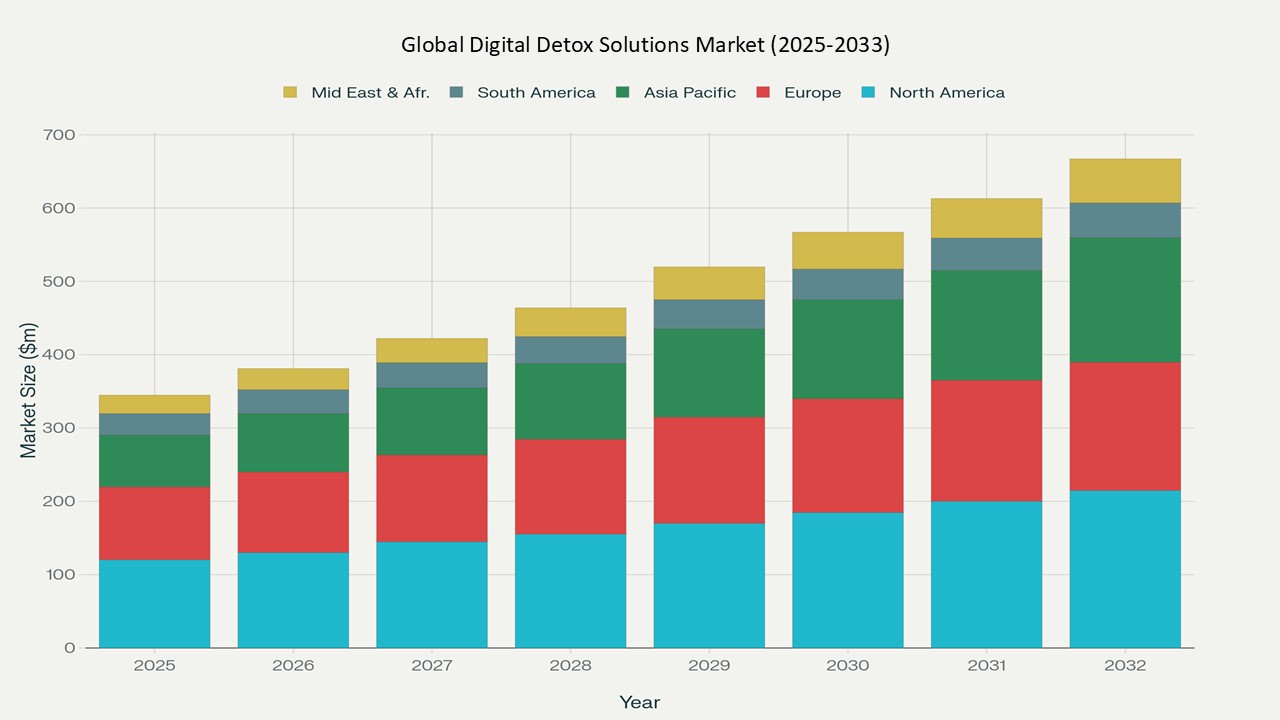
| Metric | Value |
| 2025 Market Size | USD 1,179.8 Million |
| 2033 Market Size | ~USD 3,654.4 Million |
| CAGR (2025???2033) | 15.3% |
| Largest Region (2024) | North America (39.2%) |
| Fastest Growing Region | Asia Pacific (18.1% CAGR) |
| Top Segment | Mobile-Based Solutions |
| Key Trend | AI-powered behavioral tracking |
| Future Growth Focus | Workplace wellness integration |
- Digital detox is no longer a luxury???it is becoming a public health priority as screen time reaches unsustainable levels across all age groups ??? As remote and hybrid work models dominate post-pandemic work culture, detox solutions are critical for reducing burnout and sustaining productivity ??? Global travel recovery is fueling interest in tech-free wellness retreats, particularly in Asia and Europe ??? The expansion of mobile-first interventions makes detox solutions universally accessible, regardless of geography or income
Table of Contents
Global Digital Detox Solutions Market ??? Table of Contents
- Executive Summary & Market Overview
- 1.1 Introduction to Digital Detox Solutions
- 1.2 Technology Overuse, Wellness, and the Rise of Detox Culture
- 1.3 Market Snapshot: Size, CAGR, and Forecast (2025???2033)
- 1.4 Key Trends Reshaping Digital Wellness
- 1.5 Pheonix Research Methodology & Tools Overview
- Key Drivers of Market Growth
- 2.1 Rising Mental Health Awareness and Digital Fatigue
- 2.2 Ubiquity of Smartphones and Digital Devices
- 2.3 Employer Demand for Productivity and Retention
- 2.4 Personalized Mobile-Centric Solutions
- 2.5 Lifestyle Trends Supporting Mindfulness and Work-Life Balance
- 2.6 Enhanced App Capabilities Through AI and Data Analytics
- Market Segmentation
- 3.1 By Application
- 3.1.1 Personal Users
- 3.1.2 Business/Corporate Users
- 3.2 By Platform
- 3.2.1 Mobile-Based Solutions
- 3.2.2 Desktop-Based Solutions
- 3.3 By Service Offering
- 3.3.1 Detox Retreats & Workshops
- 3.3.2 Mobile Applications
- 3.3.3 Workplace Wellness Integrations
- 3.3.4 Wellness Tourism Packages
- 3.4 By Geography
- 3.4.1 North America
- 3.4.2 Europe
- 3.4.3 Asia Pacific
- 3.4.4 Latin America
- 3.4.5 Middle East & Africa
- Region-Level Insights
- 4.1 North America
- 4.1.1 Largest Market with Mature Wellness Ecosystem
- 4.1.2 AI-Enabled Tools and Corporate Wellness Focus
- 4.2 Europe
- 4.2.1 Growing Demand for Workplace and Tourism Integration
- 4.2.2 Eco-Retreat Popularity in Germany, UK, and Scandinavia
- 4.3 Asia Pacific
- 4.3.1 Fastest Growing Region ??? CAGR 18.1%
- 4.3.2 Wellness-Driven Culture and Digital Innovation in India, South Korea, Japan
- 4.4 Latin America & Middle East
- 4.4.1 Early Adoption and Government-Backed Campaigns
- 4.4.2 Growth of Destination-Based Detox Offerings
- Leading Companies in the Market
- 5.1 Competitive Landscape Overview
- 5.2 Profiles of Key Companies and Solutions
- 5.2.1 Apple Inc. (Focus and Screen Time)
- 5.2.2 Google LLC (Digital Wellbeing Suite)
- 5.2.3 AT&T (Acquired SelfCare)
- 5.2.4 Samsung Electronics (Samsung Digital Detox)
- 5.2.5 Verizon (Partnership with Space)
- 5.2.6 Top Apps: Forest, Flipd, OFFTIME, Freedom, Cleverest, AppDetox, OffScreen, RescueTime
- 5.2.7 Retreat Providers: The Digital Detox Company, Unplugged
- 5.3 Innovation Focus Areas: Cross-Platform Design, AI, and Gamification
- 5.4 Strategic Alliances and User Base Expansion
- Strategic Intelligence and AI-Backed Insights
- 6.1 Pheonix Demand Forecast Engine: Behavioral Demand Modeling
- 6.2 Sentiment Analyzer Tool: 220% YoY Rise in Digital Fatigue Discussions
- 6.3 AI-Driven Personalization and Predictive Engagement Tools
- 6.4 Automated Porter???s Five Forces Assessment
- 6.4.1 Competitive Rivalry
- 6.4.2 Buyer Power
- 6.4.3 Supplier Power
- 6.4.4 Threat of Substitutes
- 6.4.5 Threat of New Entrants
- Forecast Snapshot: 2025???2033
| Metric | Value |
| 7.1 2025 Market Size | USD 1,179.8 Million |
| 7.2 2033 Market Size | USD 3,654.4 Million |
| 7.3 CAGR (2025???2033) | 15.3% |
| 7.4 Largest Region (2024) | North America (39.2%) |
| 7.5 Fastest Growing Region | Asia Pacific (18.1% CAGR) |
| 7.6 Top Segment | Mobile-Based Solutions |
| 7.7 Key Trend | AI-powered Behavioral Tracking |
| 7.8 Future Growth Focus | Workplace Wellness Integration |
- Why the Global Market Remains Critical
- 8.1 Addressing Global Public Health Concerns Around Screen Addiction
- 8.2 Enabling Mental Clarity in Remote and Hybrid Work Environments
- 8.3 Supporting Wellness Tourism Recovery with Tech-Free Experiences
- 8.4 Democratizing Access Through Mobile-First Interventions
- Final Takeaway
- 9.1 Market Evolution from Wellness Niche to Strategic Necessity
- 9.2 Tech and Lifestyle Convergence Reshaping Detox Delivery
- 9.3 Investment and Innovation Opportunities in Consumer and Enterprise Segments
- 9.4 Pheonix Intelligence Suite: Behavioral Tracking Meets Market Insight
- Appendices
- 10.1 Research Methodology
- 10.2 Data Sources and Modeling Frameworks
- 10.3 Glossary of Terms
- 10.4 About Pheonix???s AI Tools and Capabilities
10.5 Contact & Custom Request Support