
Editorial Article
Hot Yoga Sold a Room. Infrared Studios Sell the Same Sweat Without One.
CorePower Yoga’s price card does the analysis for you. One live class: USD 18. Five classes: USD 75. At Home membership: USD 19.99 a month, down from USD 49.
An entire month of unlimited instruction, therefore, costs 1.11 times one hour in a 40-degree room. That is not a promotion. It is a statement about what the heat is worth — written by the largest owner-operator in the category, with more than 220 locations, on its own pricing page.
Pheonix Research sizes the global hot yoga and infrared studio market at USD 2,390.2 million in 2025, across roughly 5,250 heated studios and 2.39 million paying members — an average of USD 455,279 of revenue a site. The base case reaches USD 3,640.5 million by 2033 at 5.4 per cent a year. The full build, with every assumption stated, is in the market report.
The growth rate is not the interesting part. This is.
What hot yoga actually sold
Bikram Choudhury’s contribution to the fitness industry was not the 26 postures. It was the discovery that a heated room is a product you can standardise, franchise and charge a premium for. The moat was the room, the heat and the script — and for about fifteen years it held, because nobody else had the room.
Then the heat became a component. An infrared panel is a purchase order. A 40-degree room is a fit-out. The script is on YouTube, and the certification takes 200 hours.
HOTWORX is what happens when you take the moat apart and sell the pieces. It runs 30-minute isometric sessions and 15-minute HIIT inside a patented infrared sauna, staffs the site for a few hours a day and lets members in around the clock on an app. Its own disclosure of 250,000+ members across 700+ studios works out to 357.1 members a site. At a modelled USD 59 a month that is USD 252,855 of revenue per studio — 50.6 per cent of a heated yoga studio’s USD 500,000, from a smaller box with no instructor on the payroll. The company has gone from 700 studios to 800+ locations, and from the United States into Dubai, Ireland and Saudi Arabia.
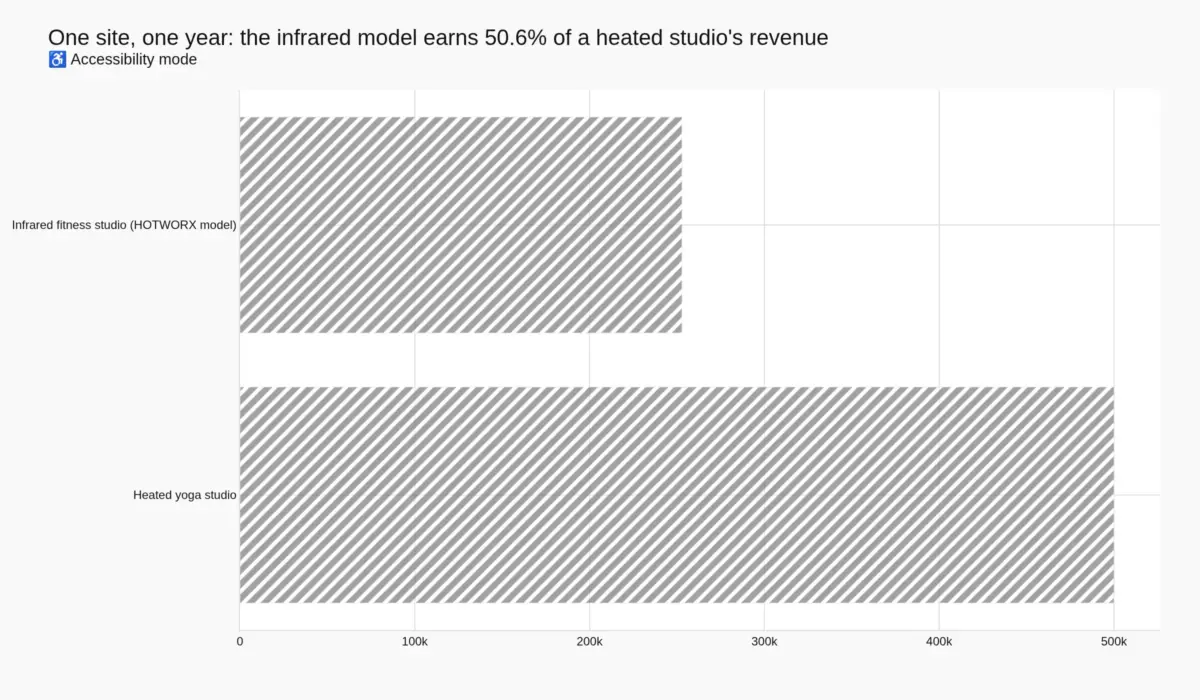
Infrared did not out-teach hot yoga. It separated the two things hot yoga was selling — the sweat and the teaching — and kept only the sweat, which is cheaper to deliver and easier to franchise.
Then the phone took the other half
At-home practice takes the teaching and leaves the room. It has no property cost, no heat plant, no instructor payroll, no front desk and no shower block, which is why it can be priced at USD 19.99 and still carry a margin. What it cannot sell is presence: the hour you cannot abandon halfway, the cohort, the ritual of going somewhere.
Every studio in this category is now arguing against its own price card, and the argument it makes is that presence is worth a large multiple of the digital substitute. Sometimes it is. But a large multiple is a much harder case to make in a month when rent and energy go up than “the only way to do this properly”, which is what the industry was selling in 2015.
The supply side has already voted
The clearest evidence is not in demand. It is in closures.
Xponential Fitness, which owns YogaSix and ran 3,233 studios globally at the end of 2024, closed 225 studios during the year — 6.96 per cent of its global open base, against 3 to 5 per cent guidance. It attributed the excess to StretchLab, CycleBar and YogaSix, and did not split the figure by brand, so the YogaSix share is not knowable from the filing. It also disclosed that roughly 30 per cent of licences contractually obligated to open were more than twelve months behind schedule and inactive.
The customer did not leave. The operator did. In a business where the room is the inventory and the lease is the sunk cost, that is the more consequential number, and it shows up in average unit volume before it shows up anywhere else.
Meanwhile the openings mix has moved. In 2025 Pilates is expected to take 46 per cent of new studio openings, yoga — largely hot — 27 per cent, cycling 4 per cent and barre 2 per cent. Pilates is not stealing hot yoga’s customers. It is taking its leases, its franchisees and its square footage, which for a fixed-cost box business amounts to the same thing two years later.
The demand never went away
This is the part that should worry the category more, not less. National Health Interview Survey data published by the CDC puts yoga practice at 16.9 per cent of American adults in 2022 — 23.3 per cent of women, 21.3 per cent of adults aged 18 to 44. A peer-reviewed analysis of five survey cycles puts it at 55.78 million adults, 16.8 per cent, against 5.0 per cent in 2002. The Sports & Fitness Industry Association counted 34.2 million participants in 2023, 19.1 per cent more than five years earlier.
The heated studio business reaches 4.29 per cent of that US practitioner pool. The market is not short of people who do yoga. It is short of people who will pay a four-figure annual subscription to do it in a hot room, and the price of not doing it that way keeps falling.
Japan is the control experiment
If you want to see the other business model, look at LAVA International: 540+ hot yoga studios across Japan, 12.6 per cent of the world’s heated yoga studios, run as an owner-operator rather than a franchise, with 6,009 social-insurance-insured employees — 11.1 per studio including head office.
Its disclosure that 2.5 million people have taken a trial class works out to 4,630 trialists per studio. That is a very different business: a huge funnel converted at a modest price, against the American model of a smaller funnel converted at a premium and franchised to somebody else. One model has to defend a price. The other has to fill a schedule.
So what is left to defend
The defensible assets in this market are the lease, the equipment, the local brand and the scheduled hour — not the heat. Heat is now available by panel, by app, or by neither, and the rest of the cost stack is the least flexible in boutique fitness: a 2,000-square-foot box held at 40 degrees with humidity control, inside a retail lease, with a payroll that cannot be cut below the class count.
Which is why the forecast is a pricing decision more than a demand story. Studios grow 3.0 per cent a year to roughly 6,650 by 2033 in our base case; revenue per studio grows 2.33 per cent; the 5.4 per cent headline is those two compounded. Take the price rise out and the market grows at 3.0 per cent, to USD 3,027.9 million. Add a scenario where at-home recruits rather than cannibalises, and it reaches USD 4,262.9 million. The spread between those two numbers is not a modelling artefact. It is the value of the moat.
The question for the next five years is narrow and answerable: will enough people keep paying a premium for a hot room now that the heat is a commodity and the instruction is nearly free? The studios that answer it well will be selling a schedule, a cohort and an hour they cannot skip. The ones that answer it by talking about detoxification will be selling something the phone already sells better.
Both of the formats this article is really about are sized separately on the platform: global cold plunge and recovery equipment, which competes for the same second membership in a similar footprint, and global meditation, the digital mind-body comparable that sets the price floor for at-home practice. The market release for the figures above, with the scenario band and the full source list, is here.
Figures in this article are Pheonix Research estimates from the Global Hot Yoga and Infrared Studio Market report, built bottom-up from disclosed operator scale; participation data is from the CDC’s National Health Interview Survey, a peer-reviewed analysis of five NHIS cycles, and the Sports & Fitness Industry Association. Pricing is taken from CorePower Yoga’s published price card.
Related Pheonix research
- Global Hot Yoga and Infrared Studio Market 2026–2033 — the full sizing build, revenue per studio, and the scenario band.
- Global Cold Plunge & Recovery Equipment Market 2026–2033 — the recovery format competing for the same second membership.
- Global Meditation Market 2026–2033 — the digital mind-body comparable, and the price benchmark for at-home practice.
- Global Climbing Gym Market 2026–2033 — the closest structural comparable in membership-priced, experience-led studio retail.
Frequently Asked Questions
Is the hot yoga market still growing?
Yes, but mostly through price. Pheonix Research sizes the market at USD 2,390.2 million in 2025, reaching USD 3,640.5 million by 2033 at a 5.4 per cent compound rate. Studio count grows 3.0 per cent a year and revenue per studio 2.33 per cent, so the headline rate is those two compounded - a market that needs a modest annual price rise to hit its forecast.
Why is at-home practice a threat to studios?
Because of the price ratio. CorePower Yoga, the largest owner-operator in the category, sells unlimited at-home instruction for USD 19.99 a month and a single live class for USD 18 - an entire month of instruction for 1.11 times one hour in the room. At-home practice removes the room, the heat plant and the instructor, so its marginal cost is close to zero and it can keep cutting price.
Which operators lead the hot yoga and infrared studio market?
The market is fragmented: four operators hold 31.5 per cent of the world's 5,250 heated studios - LAVA International 540, HOTWORX 700, CorePower Yoga 220 and YogaSix 194. LAVA runs its studios in Japan as an owner-operator, 10.3 per cent of all heated studios. HOTWORX reports 700+ studios at its August 2025 release and 800+ locations today. YogaSix has 194 operational studios out of 635 licences sold.