
Global Electronic Medical Records (EMR) Market Report, Size & Forecast 2026-2033
Global Electronic Medical Records (EMR) Market Forecast Snapshot (2025–2033)
| Metric | Value |
|---|---|
| Market Size (2025) | USD 31.8 Billion |
| Market Size (2033) | USD 58.6 Billion |
| CAGR (2026–2033) | 7.9% |
| Largest Segment | Hospital-Based EMR Systems |
| Fastest Growing Segment | Cloud-Based EMR Solutions |
| Leading Application | Patient Health Information Management and Clinical Documentation |
| Key Growth Driver | Increasing digital transformation across healthcare systems and government mandates for healthcare data digitization |
| Key Technology Trends | Artificial intelligence integration, cloud-native deployment, predictive analytics, interoperability standards, advanced cybersecurity frameworks |
| Major End-Use Industries | Hospitals, Clinics, Ambulatory Care Centers, Specialty Healthcare Facilities |
| Key Market Opportunity | Expansion of interoperable healthcare ecosystems and value-based care initiatives |
| Regional Leader | North America |
| Fastest Growing Region | Asia-Pacific |
| Sustainability & Innovation Focus | Enhanced healthcare efficiency through paperless records, real-time clinical decision support, telehealth integration, and secure health data management |
Global Electronic Medical Records Market Size & Forecast
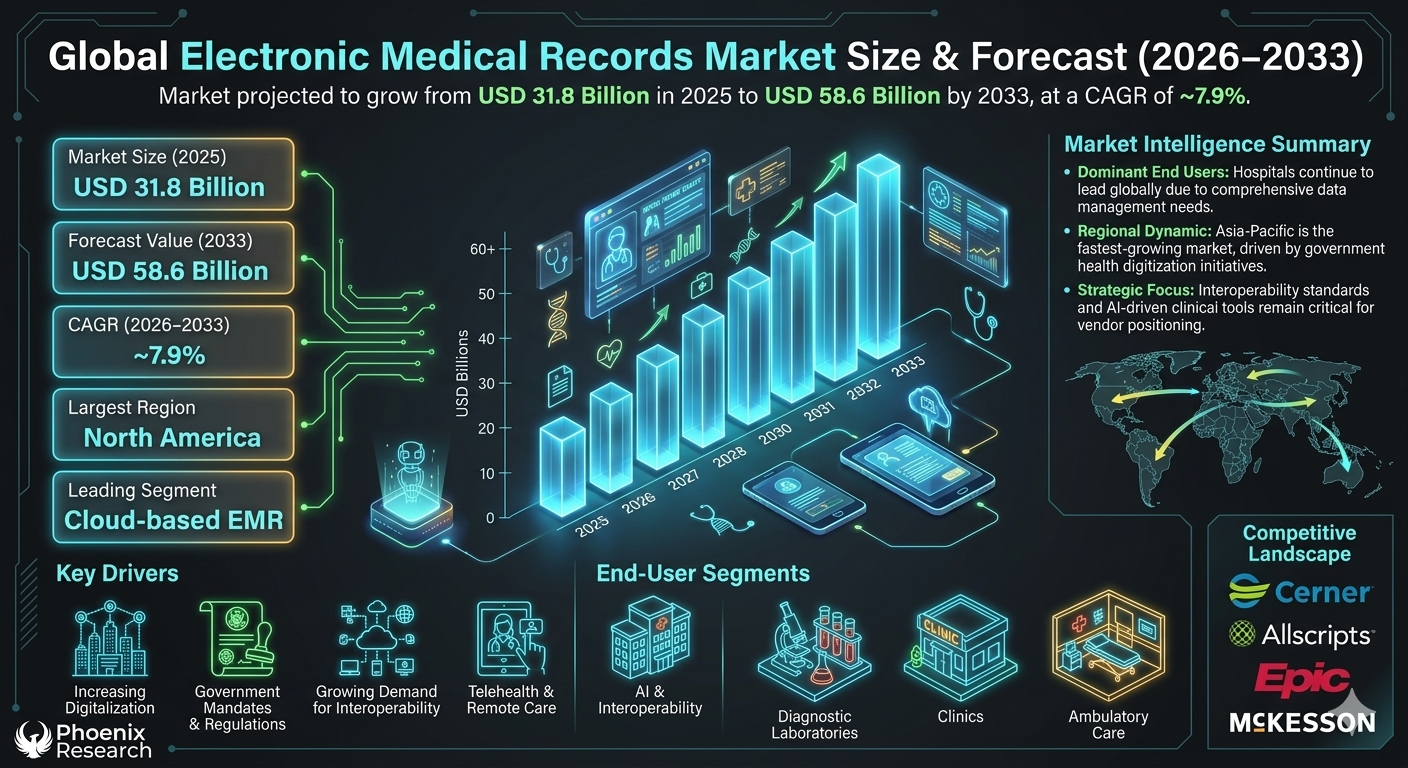
The global Electronic Medical Records (EMR) market is projected to witness substantial growth during the forecast period from 2026 to 2033. The market was valued at approximately USD 31.8 billion in 2025 and is expected to reach nearly USD 58.6 billion by 2033, expanding at a CAGR of around 7.9%.
The market growth is driven by increasing digital transformation across healthcare systems, rising government mandates for healthcare data digitization, growing demand for interoperability solutions, and the rapid adoption of cloud-based healthcare information systems worldwide.
Electronic Medical Records (EMRs) are digital versions of patients’ paper charts maintained within healthcare organizations. These systems store comprehensive patient health information, including medical history, diagnoses, treatment plans, medications, laboratory results, imaging records, and physician notes, enabling improved clinical workflows, patient care coordination, and healthcare efficiency.
The market is experiencing significant transformation through artificial intelligence integration, cloud-native deployment models, predictive analytics, interoperability standards, and advanced cybersecurity frameworks.
Additionally, rising emphasis on value-based care, telehealth expansion, and increasing demand for real-time clinical decision support are accelerating market expansion globally.
Global Electronic Medical Records Market Overview
The EMR market represents a critical segment of the global healthcare information technology ecosystem. EMR systems are foundational digital platforms that support healthcare providers in improving operational efficiency, patient outcomes, compliance management, and data-driven clinical decision-making.
The market includes cloud-based EMR systems, on-premise EMR platforms, specialty-specific EMR solutions, integrated hospital information systems, and mobile healthcare record access platforms.
Healthcare organizations are increasingly investing in advanced EMR systems to streamline clinical workflows, enhance patient engagement, reduce administrative burden, and improve interoperability across care settings.
Technological advancements in AI-powered clinical documentation, natural language processing, machine learning analytics, blockchain-enabled data security, and API-driven interoperability are significantly reshaping the EMR landscape.
Major market participants include Epic Systems Corporation, Oracle Health (Cerner Corporation), MEDITECH, Allscripts Healthcare Solutions, athenahealth, eClinicalWorks, NextGen Healthcare, GE HealthCare, McKesson Corporation, and Veradigm.
Key Drivers of Global Electronic Medical Records Market Growth
Increasing Healthcare Digitalization
Healthcare systems worldwide are accelerating digital transformation initiatives to improve operational efficiency and patient care delivery.
This is significantly driving EMR adoption across hospitals and clinics.
Government Regulations and Incentive Programs
Government mandates and financial incentives for electronic health record implementation are encouraging widespread EMR deployment.
Regulatory frameworks are strengthening market growth globally.
Growing Demand for Interoperability
Healthcare providers increasingly require seamless data exchange across hospitals, clinics, laboratories, pharmacies, and telehealth platforms.
Interoperability solutions are becoming central to EMR system development.
Expansion of Telehealth and Remote Care
The rapid growth of telemedicine is increasing the need for integrated digital patient records and real-time remote access to clinical information.
This is creating strong demand for cloud-based EMR solutions.
Integration of Artificial Intelligence
AI-powered analytics, predictive diagnostics, and automated clinical documentation are enhancing EMR system functionality and clinical decision support capabilities.
This is significantly improving healthcare efficiency.
Global Electronic Medical Records Market Segmentation
By Deployment Mode
The market is segmented into cloud-based EMR systems and on-premise EMR systems.
Cloud-based solutions are witnessing the fastest growth due to scalability and lower infrastructure costs.
By Component
The market includes software, hardware, and services.
Software accounts for the largest market share due to continuous platform upgrades and feature expansion.
By End User
End users include hospitals, specialty clinics, ambulatory care centers, diagnostic laboratories, and physician practices.
Hospitals represent the largest end-user segment globally.
By Application
Applications include patient management, e-prescribing, clinical documentation, scheduling, billing integration, decision support, and analytics.
Clinical documentation remains the dominant application segment.
Regional Market Dynamics
North America
North America dominates the global EMR market due to advanced healthcare IT infrastructure, strong regulatory mandates, and widespread digital health adoption.
The United States remains the leading regional market.
Europe
Europe holds a significant market share supported by healthcare modernization initiatives, interoperability standards, and increasing digital health investments.
Germany, the United Kingdom, and France are major contributors.
Asia-Pacific
Asia-Pacific is the fastest-growing region due to expanding healthcare infrastructure, government digitization programs, and rising adoption of cloud-based healthcare systems.
China, India, Japan, South Korea, and Australia are key growth markets.
Latin America
Latin America is gradually expanding due to improving healthcare IT infrastructure and increasing government support for digital health initiatives.
Brazil and Mexico are leading regional contributors.
Middle East & Africa
The region is witnessing moderate growth driven by healthcare infrastructure development and digital transformation investments.
Gulf Cooperation Council countries are major emerging markets.
Competitive Landscape
The global EMR market is highly competitive and technology-driven, with leading healthcare IT vendors competing through platform innovation, interoperability capabilities, cybersecurity frameworks, and cloud deployment solutions.
Key players include Epic Systems Corporation, Oracle Health, MEDITECH, Allscripts Healthcare Solutions, athenahealth, eClinicalWorks, NextGen Healthcare, GE HealthCare, McKesson Corporation, and Veradigm.
Companies are increasingly investing in AI-enabled clinical tools, cloud-native architecture, interoperability enhancement, and cybersecurity infrastructure.
Strategic acquisitions, partnerships with healthcare providers, and digital health ecosystem integrations are strengthening competitive positioning.
Strategic Outlook
The strategic outlook for the global EMR market remains highly favorable due to growing healthcare digitalization and increasing demand for connected care systems.
Future growth opportunities include AI-powered predictive care, blockchain-secured patient records, voice-enabled documentation, and integrated population health management platforms.
Regulatory compliance, interoperability innovation, and patient-centric digital experiences will remain central to long-term market development.
Organizations investing in intelligent automation, scalable cloud infrastructure, and advanced analytics are expected to strengthen market leadership.
Final Market Perspective
The global Electronic Medical Records market continues to play a transformative role in modern healthcare delivery and digital patient management worldwide.
Rising demand for efficient healthcare workflows, data-driven clinical decision-making, and integrated digital care will continue driving strong market expansion throughout the forecast period.
Companies that successfully combine technological innovation, regulatory compliance, and interoperability excellence will remain strongly positioned in the evolving global Electronic Medical Records market.
Table of Contents
Table of Contents
- 1. Executive Summary
- 1.1 Global Electronic Medical Records Market Snapshot (2026–2033)
- 1.2 Market Size & CAGR Analysis
- 1.3 Largest & Fastest-Growing Segments
- 1.4 Key Regional Insights
- 1.5 Major Market Growth Drivers
- 1.6 Competitive Landscape Overview
- 1.7 Strategic Outlook Through 2033
- 2. Introduction & Market Overview
- 2.1 Definition of Electronic Medical Records (EMR)
- 2.2 Scope of the Study
- 2.3 Evolution of Healthcare Digital Records
- 2.4 Healthcare Information Ecosystem Analysis
- 2.5 Regulatory & Compliance Framework
- 2.6 Digital Health Transformation Trends
- 2.7 Technology Innovation Landscape
- 3. Research Methodology
- 3.1 Primary Research
- 3.2 Secondary Research
- 3.3 Market Size Estimation Model
- 3.4 Forecast Assumptions (2026–2033)
- 3.5 Data Validation & Market Triangulation
- 4. Market Dynamics
- 4.1 Drivers
- 4.1.1 Increasing Healthcare Digitalization
- 4.1.2 Government Regulations and Incentive Programs
- 4.1.3 Growing Demand for Interoperability
- 4.1.4 Expansion of Telehealth and Remote Care
- 4.1.5 Integration of Artificial Intelligence
- 4.2 Restraints
- 4.2.1 High Implementation Costs
- 4.2.2 Data Privacy and Security Concerns
- 4.2.3 Workflow Integration Challenges
- 4.2.4 Limited Adoption in Small Healthcare Facilities
- 4.3 Opportunities
- 4.3.1 AI-Powered Predictive Care Systems
- 4.3.2 Blockchain-Secured Health Records
- 4.3.3 Voice-Enabled Clinical Documentation
- 4.3.4 Population Health Management Platforms
- 4.4 Challenges
- 4.4.1 Interoperability Standardization Barriers
- 4.4.2 Cybersecurity Threats
- 4.4.3 Regulatory Complexity Across Regions
- 4.4.4 Change Management Resistance
- 4.1 Drivers
- 5. Global Electronic Medical Records Market Analysis (USD Billion), 2026–2033
- 5.1 Market Size Overview
- 5.2 CAGR Analysis
- 5.3 Regional Revenue Distribution
- 5.4 Adoption Trends by Healthcare Facility Type
- 5.5 Technology Integration Analysis
- 5.6 Future Growth Projections
- 6. Market Segmentation (USD Billion), 2026–2033
- 6.1 By Deployment Mode
- 6.1.1 Cloud-Based EMR Systems
- 6.1.2 On-Premise EMR Systems
- 6.2 By Component
- 6.2.1 Software
- 6.2.2 Hardware
- 6.2.3 Services
- 6.3 By End User
- 6.3.1 Hospitals
- 6.3.2 Specialty Clinics
- 6.3.3 Ambulatory Care Centers
- 6.3.4 Diagnostic Laboratories
- 6.3.5 Physician Practices
- 6.4 By Application
- 6.4.1 Patient Management
- 6.4.2 E-Prescribing
- 6.4.3 Clinical Documentation
- 6.4.4 Scheduling
- 6.4.5 Billing Integration
- 6.4.6 Decision Support
- 6.4.7 Analytics
- 6.1 By Deployment Mode
- 7. Market Segmentation by Geography
- 7.1 North America
- 7.2 Europe
- 7.3 Asia-Pacific
- 7.4 Latin America
- 7.5 Middle East & Africa
- 8. Competitive Landscape
- 8.1 Market Share Analysis
- 8.2 Technology Benchmarking
- 8.3 Interoperability Capability Analysis
- 8.4 Strategic Partnerships & Collaborations
- 8.5 Cybersecurity & Compliance Strategies
- 9. Company Profiles
- 9.1 Epic Systems Corporation
- 9.2 Oracle Health (Cerner Corporation)
- 9.3 MEDITECH
- 9.4 Allscripts Healthcare Solutions
- 9.5 athenahealth
- 9.6 eClinicalWorks
- 9.7 NextGen Healthcare
- 9.8 GE HealthCare
- 9.9 McKesson Corporation
- 9.10 Veradigm
- 10. Strategic Intelligence & Pheonix AI Insights
- 10.1 Healthcare Digitalization Forecast Engine
- 10.2 EMR Adoption Analytics Dashboard
- 10.3 Interoperability Intelligence Tracker
- 10.4 Clinical Workflow Optimization Analyzer
- 10.5 Automated Porter’s Five Forces Analysis
- 11. Future Outlook & Strategic Recommendations
- 11.1 Investment in AI-Driven Clinical Automation
- 11.2 Expansion of Cloud-Native Infrastructure
- 11.3 Strengthening Interoperability Standards
- 11.4 Enhancing Cybersecurity Frameworks
- 11.5 Long-Term Market Outlook (2033+)
- 12. Appendix
- 13. About Pheonix Research
- 14. Disclaimer
Competitive Landscape
Global Electronic Medical Records Market Competitive Intensity & Market Structure Overview
The global Electronic Medical Records (EMR) market is highly competitive and moderately consolidated, characterized by intense competition among established healthcare IT vendors, cloud-based health technology providers, enterprise software companies, and specialty-focused digital healthcare solution developers. Competitive intensity is driven by interoperability capabilities, platform scalability, regulatory compliance, cybersecurity infrastructure, AI integration, and healthcare ecosystem connectivity.
The market structure consists of dominant enterprise EMR platform providers serving large hospital networks, alongside specialized vendors targeting ambulatory care, specialty clinics, and physician practices. Competition is increasingly shaped by cloud-native architecture, integrated analytics, telehealth compatibility, and advanced clinical workflow automation.
Rising healthcare digitalization, expanding interoperability requirements, increasing cloud migration, and growing demand for intelligent clinical decision support systems are significantly intensifying competition across the global EMR market.
Global Electronic Medical Records Market Competitive Intensity & Market Structure Current Scenario
Leading Global Electronic Medical Records Companies
Epic Systems Corporation: Market-leading EMR provider with strong enterprise hospital network penetration and advanced interoperability capabilities.
Oracle Health (Cerner Corporation): Major healthcare IT platform provider offering large-scale integrated digital health record systems.
MEDITECH: Established EMR vendor recognized for scalable hospital information systems and healthcare workflow optimization solutions.
Allscripts Healthcare Solutions: Prominent digital healthcare company focused on interoperability-driven EMR innovation.
athenahealth: Leading cloud-based EMR provider specializing in connected healthcare services and ambulatory care solutions.
eClinicalWorks: Strong market participant delivering integrated EMR and practice management solutions.
NextGen Healthcare: Specialized provider focused on ambulatory and specialty practice EMR systems.
GE HealthCare: Major healthcare technology company integrating EMR capabilities with broader clinical imaging and diagnostic ecosystems.
McKesson Corporation: Established healthcare technology provider with extensive digital record management capabilities.
Veradigm: Emerging digital health platform focused on data-driven EMR analytics and connected healthcare intelligence.
Key Competitive Intensity & Market Structure Drivers
Increasing healthcare digitization initiatives worldwide are significantly intensifying competition among EMR vendors.
Growing regulatory mandates for electronic records and interoperability compliance are accelerating platform innovation.
Rapid cloud adoption across healthcare systems is creating strong competition around scalable and secure cloud-native deployment models.
The integration of AI-powered clinical decision support and predictive analytics is emerging as a major product differentiation factor.
Rising cybersecurity concerns and patient data protection requirements are strengthening competition around security-focused platform architecture.
Strategic Implications of Competitive Intensity & Market Structure
EMR vendors are increasingly investing in AI-driven clinical automation and intelligent workflow optimization to strengthen competitive positioning.
Strategic acquisitions and ecosystem partnerships with telehealth providers, diagnostics platforms, and healthcare analytics companies are becoming essential.
Cloud migration and API-driven interoperability frameworks are emerging as critical enablers of long-term market expansion.
Advanced cybersecurity capabilities, blockchain-enabled data integrity, and zero-trust architecture are becoming key differentiators.
Patient engagement tools, mobile accessibility, and voice-enabled documentation solutions are reshaping platform competitiveness.
Global Electronic Medical Records Market Competitive Intensity & Market Structure Forward Outlook
The global EMR market is expected to remain highly competitive as healthcare systems continue accelerating digital transformation and connected care adoption.
Future competition will increasingly focus on AI-powered predictive care, intelligent automation, blockchain-secured patient data, and population health management integration.
North America will remain a dominant competitive region, while Asia-Pacific is expected to witness the fastest competitive expansion due to large-scale healthcare digitization initiatives.
Advancements in natural language processing, real-time interoperability standards, and clinical intelligence platforms are expected to significantly reshape market dynamics.
Overall, companies that successfully combine interoperability excellence, scalable cloud infrastructure, regulatory compliance, cybersecurity strength, and intelligent automation will remain strongly positioned in the evolving global Electronic Medical Records market.
Value Chain
Global Electronic Medical Records Market Value Chain & Supply Chain Evolution Overview
The global Electronic Medical Records (EMR) market value chain is undergoing rapid transformation as healthcare digitalization, cloud-native infrastructure, interoperability innovation, artificial intelligence integration, and data-driven care delivery reshape the broader healthcare information technology ecosystem. EMR systems have become foundational digital platforms that enable clinical workflow optimization, patient data management, care coordination, regulatory compliance, and intelligent healthcare decision-making.
The EMR market value chain spans software architecture development, healthcare data integration, cloud infrastructure deployment, cybersecurity framework implementation, interoperability standards integration, clinical workflow customization, deployment and training services, ecosystem integration, and long-term healthcare analytics optimization. This interconnected ecosystem includes healthcare software developers, cloud infrastructure providers, cybersecurity vendors, API interoperability specialists, implementation consultants, healthcare institutions, telehealth providers, and downstream patient engagement platforms.
Major companies including Epic Systems Corporation, Oracle Health (Cerner Corporation), MEDITECH, Allscripts Healthcare Solutions, athenahealth, eClinicalWorks, NextGen Healthcare, GE HealthCare, McKesson Corporation, and Veradigm are actively investing in AI-powered clinical automation, cloud-native architecture, interoperability enhancement, predictive analytics platforms, and cybersecurity resilience frameworks to strengthen market leadership.
Upstream supply chain activities depend on software platform engineering, cloud infrastructure provisioning, data standardization protocol development, cybersecurity architecture design, and clinical intelligence algorithm creation. Midstream operations focus on platform customization, healthcare workflow integration, interoperability implementation, deployment services, staff training, data migration, and regulatory compliance validation. Downstream activities include clinical usage optimization, telehealth integration, patient engagement enablement, analytics-driven care coordination, system maintenance, and continuous digital health ecosystem enhancement.
Operational priorities across the EMR value chain increasingly emphasize interoperability, system reliability, cybersecurity resilience, regulatory compliance, workflow usability, scalability, real-time accessibility, and long-term data intelligence generation. However, the market continues to face challenges related to implementation complexity, integration costs, physician adoption barriers, cybersecurity threats, fragmented healthcare IT infrastructure, and evolving regulatory requirements.
Global Electronic Medical Records Market Value Chain & Supply Chain Evolution Current Scenario
The current EMR market is being shaped by accelerating healthcare digital transformation, increasing cloud adoption, expanding telehealth ecosystems, rising emphasis on interoperability, and growing demand for AI-enhanced clinical decision support.
North America currently dominates the global EMR market due to mature healthcare IT infrastructure, strong regulatory mandates, widespread digital health adoption, and high investment in healthcare technology modernization. The United States remains the leading regional market.
Europe maintains a strong market position supported by healthcare modernization initiatives, digital health regulations, and growing interoperability standardization. Asia-Pacific is emerging as the fastest-growing region due to expanding healthcare digitization programs, cloud healthcare adoption, and increasing public-private digital health investments.
Cloud-based EMR solutions remain the fastest-growing deployment segment due to scalability, operational flexibility, and lower infrastructure costs.
Hospitals continue to represent the dominant end-user segment due to large-scale clinical workflow requirements and enterprise-level healthcare data management needs.
Key Value Chain & Supply Chain Evolution Signals in Global Electronic Medical Records Market
One of the most significant transformation signals is the rapid shift toward cloud-native EMR architecture. Healthcare organizations are increasingly prioritizing scalable and remotely accessible digital health platforms.
API-driven interoperability standards are becoming increasingly important, enabling seamless data exchange across hospitals, clinics, pharmacies, laboratories, and telehealth systems.
AI-powered clinical documentation and natural language processing are significantly improving physician productivity and reducing administrative burden.
Advanced cybersecurity frameworks and zero-trust security architectures are emerging as critical value chain innovations to protect increasingly sensitive patient data.
Voice-enabled clinical documentation systems are becoming more widely adopted to improve workflow efficiency and reduce clinician burnout.
Population health analytics integration is increasingly expanding the role of EMR systems from record management toward predictive care intelligence platforms.
Strategic Implications of Value Chain & Supply Chain Evolution in Global Electronic Medical Records Market
Leading EMR companies are increasingly prioritizing cloud scalability, interoperability leadership, AI automation, and cybersecurity resilience to maintain competitive advantage. Competitive differentiation increasingly depends on clinical usability, ecosystem connectivity, deployment flexibility, and intelligent analytics capabilities.
Companies capable of delivering integrated end-to-end digital healthcare ecosystems combining EMR functionality, telehealth integration, predictive analytics, patient engagement, and secure interoperability are expected to capture premium market opportunities.
Strategic collaborations between EMR vendors, healthcare institutions, cloud infrastructure providers, telehealth platforms, and analytics technology firms are becoming essential for accelerating market expansion.
Subscription-based software-as-a-service delivery models are emerging as important recurring revenue structures that improve long-term client retention and operational scalability.
Regulatory compliance agility and rapid adaptation to evolving healthcare data standards are becoming increasingly important strategic differentiators.
Healthcare IT vendors are increasingly localizing implementation support and regional compliance expertise to strengthen deployment efficiency across diverse global healthcare systems.
Global Electronic Medical Records Market Value Chain & Supply Chain Evolution Forward Outlook
Between 2026 and 2033, the EMR value chain is expected to become significantly more intelligent, connected, predictive, and patient-centric. EMR platforms will increasingly evolve from digital record repositories into intelligent clinical operating systems.
AI-driven predictive care models will continue improving real-time clinical decision support, risk stratification, and treatment optimization.
Advanced interoperability frameworks will enable increasingly seamless healthcare data portability across multi-provider care ecosystems.
Blockchain-enabled health data security architectures will strengthen record integrity, patient consent management, and secure data sharing.
Voice-first clinical workflows and ambient documentation systems will significantly enhance physician productivity and reduce administrative workload.
Integrated digital health ecosystems connecting EMRs with wearable devices, remote monitoring platforms, and personalized patient engagement systems will expand significantly.
Ultimately, the future EMR value chain will evolve into a highly connected, AI-driven, secure, and predictive healthcare intelligence ecosystem capable of transforming clinical care delivery worldwide.
Market-Specific Value Chain
- Software Architecture & Core Platform Development: EMR platform engineering, database architecture, cloud infrastructure integration, interoperability protocol development, and cybersecurity framework design.
- System Integration & Clinical Workflow Customization: Clinical module development, interoperability deployment, data migration, workflow optimization, and healthcare system integration.
- Implementation, Compliance & Deployment Services: Installation, training, regulatory validation, operational onboarding, and security certification.
- Healthcare Delivery Integration & Real-Time Operations: Clinical documentation, telehealth connectivity, decision support activation, patient record management, and operational analytics.
- Intelligent Analytics & Continuous Optimization: Predictive analytics, population health management, AI automation, cybersecurity monitoring, and workflow performance enhancement.
- Long-Term Connected Care Ecosystem Expansion: Integrated digital health platforms, remote monitoring interoperability, patient-centric engagement systems, and intelligent healthcare network orchestration.
Company-to-Stage Mapping
- Software Architecture & Core Platform Development: Epic Systems Corporation, Oracle Health, MEDITECH.
- System Integration & Clinical Workflow Customization: Allscripts Healthcare Solutions, NextGen Healthcare, eClinicalWorks.
- Implementation, Compliance & Deployment Services: McKesson Corporation, healthcare IT deployment and compliance specialists.
- Healthcare Delivery Integration & Real-Time Operations: athenahealth, GE HealthCare, clinical systems integration providers.
- Intelligent Analytics & Continuous Optimization: Veradigm, AI healthcare analytics and predictive care platform developers.
- Long-Term Connected Care Ecosystem Expansion: Cloud health infrastructure innovators, digital patient engagement platform providers, integrated healthcare ecosystem technology developers.
Investment Activity
Global Electronic Medical Records (EMR) Market Investment & Funding Dynamics Overview
The global Electronic Medical Records (EMR) market is witnessing strong investment momentum driven by accelerating healthcare digital transformation, rising demand for interoperable healthcare systems, increasing cloud adoption, and growing integration of artificial intelligence into clinical workflows. Between 2026 and 2033, funding activity is expected to intensify across cloud-native EMR platforms, AI-powered clinical documentation tools, interoperability frameworks, cybersecurity infrastructure, and predictive healthcare analytics solutions.
The EMR market represents a strategically critical segment within the broader healthcare information technology and digital health ecosystem. Venture capital firms, healthcare technology investors, institutional healthcare funds, private equity groups, and strategic healthcare IT corporations are increasingly allocating capital toward scalable EMR platforms and next-generation clinical data management systems.
A major structural transformation shaping investment dynamics is the shift from legacy on-premise record systems toward cloud-based, API-enabled, and intelligent healthcare information ecosystems. This transition is driving substantial capital deployment into SaaS-based EMR platforms, interoperability engines, automated clinical workflow tools, and real-time data integration technologies.
Growing convergence between EMR systems, telehealth platforms, clinical decision support tools, population health analytics, and patient engagement technologies is creating substantial cross-sector investment opportunities.
Current Investment & Funding Landscape
- North America: Leads global investment activity due to mature healthcare IT infrastructure, regulatory mandates, and high digital health funding volumes.
- Europe: Attracting strong investment through healthcare modernization programs and interoperability-focused digital health initiatives.
- Asia-Pacific: Emerging as a high-growth investment destination supported by healthcare digitization and expanding cloud adoption.
- Latin America: Witnessing gradual investment growth driven by healthcare infrastructure modernization.
- Middle East & Africa: Strategic investments are increasing through national digital healthcare transformation programs.
Key Investment Drivers
- Rising healthcare digital transformation initiatives globally.
- Government mandates for EMR implementation and healthcare digitization.
- Increasing demand for interoperability across healthcare systems.
- Expansion of telehealth and virtual care services.
- Growing adoption of cloud-based healthcare IT infrastructure.
- Rapid integration of AI and predictive analytics in clinical workflows.
- Increasing focus on healthcare cybersecurity and compliance.
- Demand for operational efficiency and value-based care delivery.
Strategic Investment Areas
Cloud-Based EMR Platforms: Scalable SaaS-based healthcare record management systems.
- AI Clinical Documentation: Automated physician note generation and intelligent workflow optimization.
- Interoperability Solutions: API-driven healthcare data exchange platforms.
- Cybersecurity Infrastructure: Advanced healthcare data protection and compliance solutions.
- Predictive Analytics: Clinical intelligence and decision support systems.
- Mobile Healthcare Access: Patient-centric digital record access platforms.
Strategic Investment Implications
- Cloud-native architecture is becoming a major determinant of investor confidence.
- Interoperability readiness significantly enhances platform valuation.
- AI integration strengthens long-term revenue growth potential.
- Cybersecurity resilience is increasingly influencing funding decisions.
- Regulatory compliance remains essential for investment sustainability.
- Strategic healthcare provider partnerships improve commercialization opportunities.
Forward Investment Outlook
The global EMR market is expected to remain one of the most resilient healthcare technology investment sectors throughout the forecast period due to continued digital transformation and growing demand for intelligent healthcare data systems.
Future funding activity is expected to prioritize AI-driven clinical automation, blockchain-secured patient records, voice-enabled clinical documentation, integrated population health management, and advanced interoperability ecosystems.
- North America: Will continue dominating capital inflows through advanced digital health innovation.
- Europe: Will maintain strong investment activity centered on healthcare interoperability modernization.
- Asia-Pacific: Will experience accelerated investment due to large-scale healthcare digitization initiatives.
- Emerging Markets: Will attract strategic early-stage investment as healthcare IT adoption expands.
Overall, the Electronic Medical Records market represents a high-growth investment opportunity positioned at the intersection of digital healthcare transformation, intelligent clinical automation, and next-generation connected care infrastructure.
Technology & Innovation
Global Electronic Medical Records Market Technology & Innovation Landscape Overview
The global Electronic Medical Records (EMR) market is undergoing rapid technological transformation driven by advancements in artificial intelligence, cloud computing, interoperability frameworks, predictive analytics, and advanced healthcare cybersecurity systems. The evolution of EMR technologies is increasingly focused on improving clinical workflow automation, enhancing real-time decision support, strengthening patient data accessibility, and enabling intelligent connected care ecosystems across healthcare systems.
Modern EMR platforms are integrating intelligent automation tools, cloud-native architectures, machine learning algorithms, and API-driven interoperability systems to deliver seamless data exchange and optimized clinical operations. These innovations are significantly improving healthcare efficiency, reducing administrative burden, and supporting more personalized patient care delivery.
The market is also witnessing strong adoption of voice-enabled clinical documentation, AI-assisted diagnostics, blockchain-secured record management, and mobile healthcare access solutions that are redefining digital healthcare infrastructure worldwide.
Global Electronic Medical Records Market Technology & Innovation Current Scenario
Currently, EMR innovation is centered around cloud-based scalability and intelligent workflow optimization. Cloud-native EMR systems are increasingly replacing traditional on-premise deployments due to improved flexibility, lower infrastructure costs, and easier system integration.
Artificial intelligence and machine learning are being widely integrated into EMR platforms to automate clinical documentation, support predictive diagnostics, and generate actionable decision-support insights for physicians.
Natural language processing technologies are becoming a major innovation area by enabling automated physician note transcription, voice-assisted record updates, and faster clinical documentation workflows.
Interoperability frameworks such as FHIR-based APIs are increasingly deployed to enable seamless data exchange across hospitals, laboratories, pharmacies, insurance providers, and telehealth platforms.
Blockchain technology is gaining traction as a secure infrastructure layer for enhancing patient data integrity, auditability, and controlled record sharing.
Mobile-first EMR access platforms are also expanding rapidly, allowing clinicians to securely retrieve and update patient information remotely across distributed care environments.
Key Technology & Innovation Trends in Global Electronic Medical Records Market
- AI-Powered Clinical Decision Support: Intelligent analytics improving diagnostic accuracy and treatment planning.
- Cloud-Native EMR Platforms: Scalable digital record systems enabling flexible healthcare deployment.
- Natural Language Processing: Automated documentation and voice-driven clinical workflows.
- FHIR-Based Interoperability Solutions: Standardized data exchange across healthcare systems.
- Blockchain-Secured Health Records: Enhanced patient data security and traceability.
- Predictive Healthcare Analytics: Data-driven insights for proactive patient management.
- Mobile EMR Access Platforms: Secure remote access to clinical records.
- Telehealth Integration: Unified digital care coordination through connected record systems.
- Robotic Process Automation: Streamlined administrative workflows and billing efficiency.
- Patient Portal Intelligence: Enhanced engagement through personalized digital health access.
Strategic Implications of Technology & Innovation
Technological advancements are significantly reshaping competitive dynamics in the EMR market by shifting competition from basic digital recordkeeping toward intelligent, predictive, and highly interoperable healthcare data ecosystems.
Companies investing in AI-driven analytics, cloud-native infrastructure, and secure interoperability frameworks are achieving stronger competitive differentiation through improved clinical outcomes, operational efficiency, and enhanced provider satisfaction.
The growing integration of digital healthcare ecosystems is creating new opportunities for providers to optimize care coordination, improve regulatory compliance, and support population health management initiatives.
Advanced automation and predictive intelligence are helping healthcare organizations reduce clinician burnout while improving decision-making speed and accuracy.
However, cybersecurity risks, integration complexity with legacy systems, regulatory compliance requirements, and implementation costs remain significant challenges for large-scale adoption of advanced EMR technologies.
Global Electronic Medical Records Market Technology & Innovation Forward Outlook
The future of EMR technology is expected to move toward fully autonomous, predictive, and AI-orchestrated healthcare information ecosystems capable of supporting proactive and personalized care delivery.
Emerging innovations include self-learning clinical decision engines, AI-powered population health forecasting, ambient voice documentation systems, and intelligent digital assistants for clinician workflow support.
Digital twin technologies may enable virtual patient modeling for treatment simulation and precision care planning.
Decentralized health data exchange frameworks and blockchain-enabled consent management systems are expected to strengthen patient control over medical information.
Advanced federated learning models may further enhance AI-powered clinical insights while preserving patient data privacy across distributed healthcare networks.
Overall, the global Electronic Medical Records market is evolving toward a highly intelligent ecosystem combining predictive analytics, secure interoperability, intelligent automation, and connected digital care infrastructure to redefine healthcare delivery, patient engagement, and clinical efficiency worldwide.
Market Risk
Global Electronic Medical Records (EMR) Market Risk Factors & Disruption Threats Overview
The global Electronic Medical Records (EMR) market is experiencing strong growth driven by accelerating healthcare digitalization, government-backed health IT initiatives, rising demand for interoperability, and increasing adoption of cloud-based healthcare information systems. Despite its favorable long-term growth outlook, the market faces several risks and disruption threats related to cybersecurity vulnerabilities, interoperability complexity, regulatory compliance burdens, implementation challenges, clinician resistance, and rapid technological evolution.
One of the most significant risks affecting the EMR market is cybersecurity exposure. EMR platforms store highly sensitive patient health information, making them prime targets for ransomware attacks, data breaches, unauthorized access, and advanced cyber threats. A major security incident can lead to severe financial, operational, and reputational consequences.
Interoperability challenges remain another major disruption factor. Healthcare systems often operate across fragmented legacy infrastructures with inconsistent data standards, creating integration barriers between hospitals, laboratories, pharmacies, insurers, and telehealth platforms.
Regulatory complexity presents substantial compliance risks. Evolving healthcare data privacy laws, regional compliance standards, and electronic health record certification requirements create operational and legal challenges for vendors and healthcare providers.
Implementation complexity and high deployment costs can delay system adoption, particularly among small and mid-sized healthcare providers with limited IT resources.
Clinician resistance and workflow disruption also remain important operational concerns, as poorly optimized EMR systems can increase administrative burden and reduce user satisfaction.
Additionally, rapid advances in artificial intelligence, cloud-native architectures, and digital care ecosystems are accelerating technological obsolescence risks for legacy EMR platforms.
Global Electronic Medical Records (EMR) Market Risk Factors & Disruption Threats Current Scenario
The current EMR market is benefiting from strong digital health investment, increasing cloud migration, and expanding integration with telehealth and remote patient monitoring systems.
However, cybersecurity threats targeting healthcare organizations have intensified significantly, increasing pressure for stronger data protection frameworks.
Healthcare providers continue to face operational challenges related to platform integration, user training, and workflow optimization.
Regulators are placing greater emphasis on interoperability compliance, patient data portability, and transparent data governance.
AI integration is advancing rapidly, but concerns regarding algorithm reliability, clinical validation, and ethical decision support remain unresolved.
Competitive pressure is increasing as established vendors and emerging cloud-native health technology companies compete aggressively on innovation and usability.
Global Electronic Medical Records (EMR) Market Key Risk Factors & Disruption Threat Signals
- Cybersecurity Threats: Increasing risk of ransomware attacks, data breaches, and unauthorized patient data access.
- Interoperability Challenges: Difficulty integrating fragmented healthcare systems and legacy platforms.
- Regulatory Compliance Complexity: Evolving healthcare privacy and certification requirements.
- High Implementation Costs: Significant financial burden for deployment, migration, and maintenance.
- Clinician Resistance: Workflow disruption and administrative fatigue impacting adoption.
- System Downtime Risks: Technical outages affecting patient care continuity.
- Data Migration Risks: Errors or loss during transition from legacy record systems.
- Technology Obsolescence: Legacy platforms struggling to keep pace with cloud and AI innovation.
- Vendor Lock-In Risks: Limited flexibility caused by proprietary system dependencies.
- AI Reliability Concerns: Risks associated with inaccurate clinical decision support outputs.
Strategic Implications of Risk Factors
EMR vendors must prioritize zero-trust cybersecurity architectures, continuous threat monitoring, and advanced encryption frameworks to strengthen platform resilience.
Investment in open API ecosystems and standards-based interoperability solutions will be essential for supporting connected healthcare environments.
Healthcare organizations should emphasize clinician-centered design and workflow optimization to improve adoption and reduce operational friction.
Cloud-native modernization and modular platform architecture will help mitigate obsolescence risks and improve system scalability.
Strategic collaboration with regulators, healthcare providers, and digital health ecosystem partners will remain critical for long-term compliance and innovation leadership.
Global Electronic Medical Records (EMR) Market Forward Risk Outlook
Looking ahead to 2026–2033, the EMR market is expected to maintain strong momentum as healthcare systems continue digital transformation and connected care adoption.
Future disruption will likely emerge from AI-driven autonomous documentation, blockchain-secured patient record ecosystems, voice-enabled clinical workflows, and fully interoperable digital care networks.
Companies unable to adapt to evolving cybersecurity demands, interoperability standards, and clinician usability expectations may face declining competitiveness.
The strongest opportunities will emerge for organizations delivering secure, intelligent, cloud-native, and highly interoperable EMR ecosystems.
Overall, sustained market leadership will depend on cybersecurity excellence, interoperability innovation, clinician-centric design, and scalable digital health infrastructure capabilities.
Regulatory Landscape
Global Electronic Medical Records (EMR) Market Regulatory & Policy Environment Overview
The regulatory and policy environment governing the global Electronic Medical Records (EMR) market is shaped by healthcare data privacy laws, digital health compliance frameworks, interoperability mandates, cybersecurity regulations, patient data governance standards, and healthcare digitization policies. As healthcare systems worldwide accelerate digital transformation, regulatory oversight is becoming increasingly comprehensive to ensure secure, interoperable, and patient-centric electronic health information management.
EMR systems are subject to strict regulatory requirements related to patient data confidentiality, system security, clinical documentation accuracy, data exchange standards, and operational compliance across healthcare institutions. Regulatory authorities worldwide are establishing clearer frameworks to govern the implementation, use, storage, transfer, and interoperability of electronic patient records.
The increasing integration of artificial intelligence, cloud computing, telehealth platforms, predictive analytics, and cross-border health information exchange is further accelerating policy development surrounding data protection, algorithm accountability, cybersecurity resilience, and interoperability certification.
Global Electronic Medical Records (EMR) Market Regulatory & Policy Environment Current Scenario
The current regulatory framework for EMR systems combines healthcare privacy legislation, interoperability standards, digital infrastructure modernization policies, and cybersecurity mandates.
In the United States, EMR systems are governed by HIPAA regulations, the HITECH Act, the 21st Century Cures Act, and interoperability requirements established by the Office of the National Coordinator for Health Information Technology (ONC). These regulations emphasize secure data exchange, patient access rights, and prevention of information blocking.
In Europe, EMR deployments are regulated under the General Data Protection Regulation (GDPR), national healthcare digitization frameworks, and EU-wide interoperability initiatives aimed at enabling cross-border healthcare data exchange.
Asia-Pacific countries including China, India, Japan, South Korea, and Australia are strengthening healthcare IT regulations through national digital health missions, electronic health record standardization programs, and cybersecurity compliance frameworks.
Emerging healthcare markets across Latin America, the Middle East, and Africa are increasingly introducing digital health policies and regulatory modernization initiatives to accelerate EMR adoption and healthcare system digitization.
Key Regulatory & Policy Environment Signals in Global EMR Market
- Healthcare Data Privacy Compliance: Stringent patient data protection laws are shaping EMR system architecture and access control mechanisms.
- Interoperability Standards: Regulatory mandates are driving adoption of standardized health data exchange protocols such as HL7, FHIR, and API-based connectivity.
- Cybersecurity Regulations: Increasing threats to healthcare systems are accelerating requirements for advanced security controls, encryption, and incident response readiness.
- Patient Data Access Rights: Policies are expanding patient control over health records, requiring secure access and portability across healthcare providers.
- Cloud Compliance Frameworks: Regulatory standards are evolving to govern cloud-hosted healthcare data storage and processing environments.
- AI Governance in Clinical Documentation: Emerging frameworks are addressing algorithm transparency, clinical decision support validation, and accountability in AI-enabled EMR systems.
Strategic Implications of Regulatory & Policy Environment
The evolving regulatory landscape is encouraging EMR vendors to invest heavily in compliance-driven system design, interoperability certification, secure cloud infrastructure, and advanced data governance frameworks.
Interoperability mandates are driving greater standardization across EMR platforms, encouraging open APIs and seamless integration with telehealth, laboratory systems, pharmacy networks, and healthcare analytics platforms.
Cybersecurity regulations are increasing investment in zero-trust security models, advanced encryption, identity management systems, and continuous threat monitoring capabilities.
Patient-centric regulatory frameworks are accelerating development of secure mobile record access, consent management tools, and digital health engagement platforms.
International regulatory harmonization efforts are also promoting greater alignment in EMR performance standards and cross-border healthcare data exchange protocols.
Global Electronic Medical Records (EMR) Market Regulatory & Policy Environment Forward Outlook
Between 2026 and 2033, the regulatory environment for the global EMR market is expected to become increasingly standardized, security-focused, and interoperability-driven.
Regulators are likely to introduce stronger frameworks governing AI-assisted clinical workflows, real-time health data exchange, and cloud-native healthcare information systems.
Cybersecurity requirements are expected to intensify significantly as healthcare systems become more interconnected and increasingly targeted by cyber threats.
Cross-border interoperability initiatives may expand further, particularly in developed healthcare ecosystems seeking integrated regional digital health infrastructure.
Overall, regulatory and policy developments will remain a critical market driver, with companies investing in certified interoperability, robust cybersecurity, patient-centric compliance, and intelligent data governance expected to maintain long-term competitive advantage.