
Global Gluten-Free Products Market size and share Analysis 2026-2033
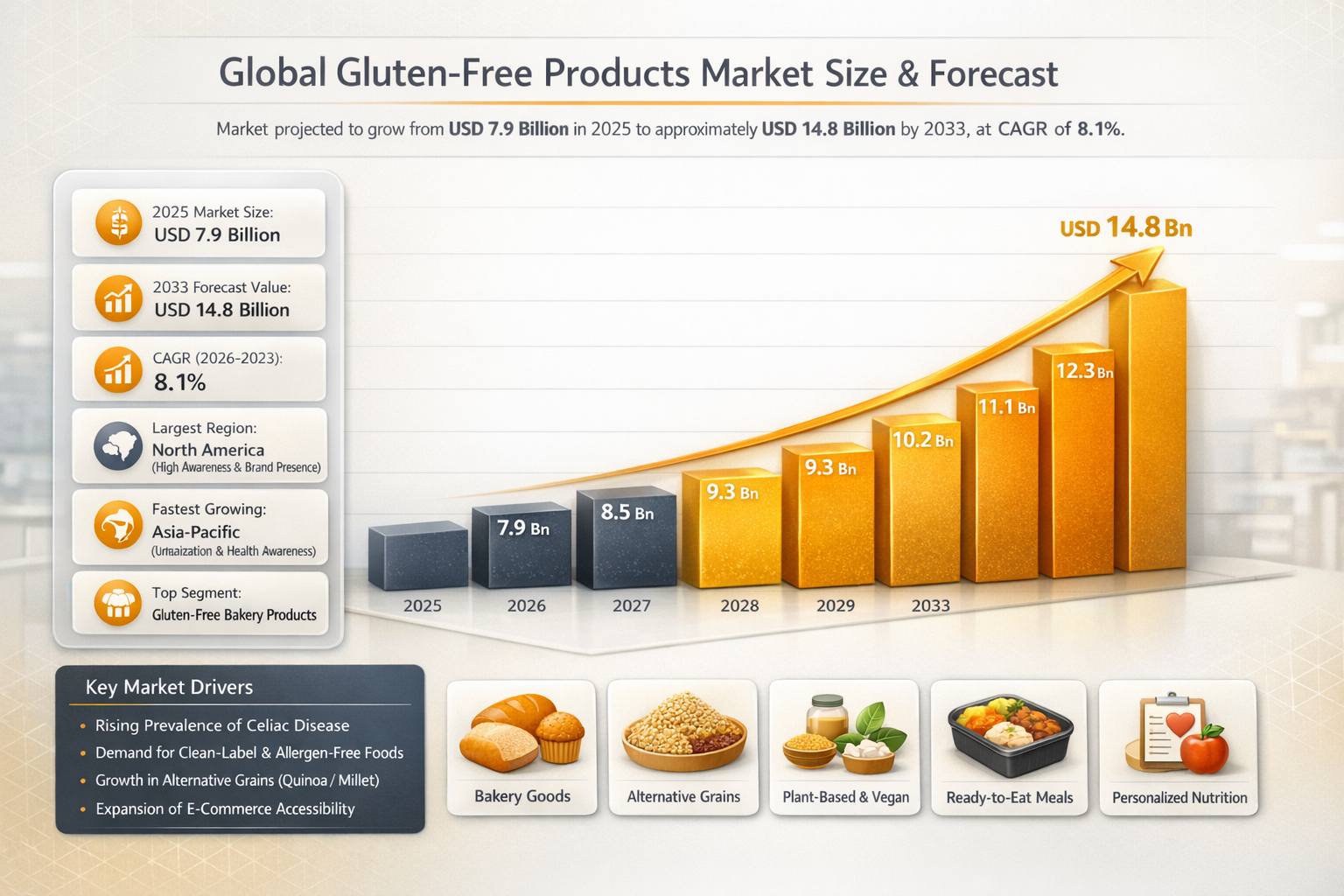
Table of Contents
1. Market Forecast Snapshot (2026–2033)
1.1 2025 Market Size – USD 7.9 Billion
1.2 2033 Market Size – USD 14.8 Billion
1.3 CAGR (2026–2033) – 8.1%
1.4 Largest Region – North America
1.5 Fastest Growing Region – Asia-Pacific
1.6 Top Segment – Gluten-Free Bakery Products
1.7 Key Trend – Clean-Label, Plant-Based, and Allergen-Free Food Innovation
1.8 Future Focus – Functional Gluten-Free Foods, Alternative Grain Products, and Personalized Nutrition
2. Global Gluten-Free Products Market Overview
2.1 Market Definition & Scope
2.2 Evolution of the Gluten-Free Food Industry
2.3 Rising Adoption of Specialized and Allergen-Free Diets
2.4 Growth of Functional and Clean-Label Food Products
2.5 Expansion of Alternative Grain-Based Food Products
2.6 Post-2025 Market Outlook
3. Key Drivers of Global Gluten-Free Products Market Growth
3.1 Rising Prevalence of Celiac Disease and Gluten Intolerance
3.2 Growing Health and Wellness Awareness
3.3 Expansion of Clean-Label and Allergen-Free Foods
3.4 Increasing Availability in Retail and Online Platforms
3.5 Innovation in Alternative Grain Ingredients
4. Market Segmentation by Product Type
4.1 Gluten-Free Bakery Products
4.1.1 Gluten-Free Bread
4.1.1.1 White Gluten-Free Bread
4.1.1.2 Whole Grain Gluten-Free Bread
4.1.2 Gluten-Free Cakes & Pastries
4.1.2.1 Gluten-Free Muffins
4.1.2.2 Gluten-Free Cupcakes
4.1.3 Gluten-Free Cookies & Biscuits
4.1.3.1 Chocolate Cookies
4.1.3.2 Oat-Based Cookies
4.2 Gluten-Free Snacks
4.2.1 Savory Snacks
4.2.1.1 Gluten-Free Chips
4.2.1.2 Gluten-Free Crackers
4.2.2 Sweet Snacks
4.2.2.1 Fruit-Based Snacks
4.2.2.2 Chocolate Snacks
4.3 Gluten-Free Pasta & Noodles
4.3.1 Rice-Based Pasta
4.3.1.1 Brown Rice Pasta
4.3.1.2 White Rice Pasta
4.3.2 Corn-Based Pasta
4.3.2.1 Corn Spaghetti
4.3.2.2 Corn Penne
4.4 Gluten-Free Ready-to-Eat Foods
4.4.1 Frozen Gluten-Free Meals
4.4.1.1 Frozen Pizza
4.4.1.2 Frozen Snacks
4.4.2 Packaged Ready Meals
4.4.2.1 Instant Gluten-Free Meals
4.4.2.2 Microwaveable Meals
5. Market Segmentation by Ingredient Type
5.1 Rice-Based Ingredients
5.1.1 Rice Flour
5.1.1.1 White Rice Flour
5.1.1.2 Brown Rice Flour
5.1.2 Rice Starch
5.1.2.1 Baking Applications
5.1.2.2 Processed Food Applications
5.2 Corn-Based Ingredients
5.2.1 Corn Flour
5.2.1.1 Snack Food Applications
5.2.1.2 Bakery Applications
5.2.2 Corn Starch
5.2.2.1 Thickening Agents
5.2.2.2 Processed Food Ingredients
5.3 Alternative Grain Ingredients
5.3.1 Quinoa-Based Products
5.3.1.1 Quinoa Flour
5.3.1.2 Quinoa Snacks
5.3.2 Millet-Based Products
5.3.2.1 Millet Flour
5.3.2.2 Millet Snacks
5.4 Plant-Based Protein Ingredients
5.4.1 Soy Protein
5.4.1.1 Functional Foods
5.4.1.2 Nutritional Supplements
5.4.2 Pea Protein
5.4.2.1 Protein-Enriched Snacks
5.4.2.2 Plant-Based Food Products
6. Market Segmentation by Distribution Channel
6.1 Supermarkets & Hypermarkets
6.1.1 Health Food Sections
6.1.2 Packaged Gluten-Free Products
6.2 Online Retail & E-commerce
6.2.1 E-commerce Grocery Platforms
6.2.2 Direct-to-Consumer Gluten-Free Brands
6.3 Specialty Health Stores
6.3.1 Organic Food Stores
6.3.2 Wellness Food Retailers
6.4 Traditional Retail Stores
6.4.1 Local Grocery Stores
6.4.2 Independent Food Retailers
7. Market Segmentation by Consumer Group
7.1 Medical Nutrition Consumers
7.1.1 Celiac Disease Patients
7.1.2 Gluten Intolerance Consumers
7.2 Health-Conscious Consumers
7.2.1 Lifestyle Diet Followers
7.2.2 Clean Label Food Consumers
7.3 Fitness and Sports Nutrition Consumers
7.3.1 Gym Enthusiasts
7.3.2 Professional Athletes
7.4 Weight Management Consumers
7.4.1 Low-Calorie Diet Followers
7.4.2 High-Fiber Diet Consumers
8. Market Segmentation by Region
8.1 North America
8.2 Europe
8.3 Asia-Pacific
8.4 Middle East & Africa
8.5 South America
9. Regional Insights
9.1 North America – Largest Market
9.2 Asia-Pacific – Fastest Growing Market
9.3 Europe – Strong Demand for Allergen-Free Foods
9.4 Middle East & Africa – Emerging Specialty Diet Market
9.5 South America – Growing Demand for Healthy Snack Alternatives
10. Competitive Landscape
10.1 Market Share Analysis
10.2 Competitive Positioning Matrix
10.3 Product Innovation & Alternative Grain Strategies
10.4 Clean-Label and Plant-Based Product Development
10.5 Distribution and Retail Expansion Strategies
11. Leading Companies
11.1 General Mills
11.2 Kellogg Company
11.3 Nestlé S.A.
11.4 The Hain Celestial Group
11.5 Dr. Schär AG
11.6 Bob’s Red Mill Natural Foods
11.7 Enjoy Life Foods
11.8 Amy’s Kitchen
12. Strategic Intelligence & AI-Backed Insights
12.1 Pheonix Demand Forecast Engine
12.2 Consumer Behavior & Health Trend Analytics
12.3 Innovation Tracker – Alternative Grain and Functional Foods
12.4 Porter’s Five Forces Analysis
13. Sustainability & Regulatory Landscape
13.1 Food Safety and Gluten-Free Labeling Regulations
13.2 Sustainable Ingredient Sourcing
13.3 Clean-Label and Organic Certification Standards
13.4 Eco-Friendly Packaging Innovations
14. Market Significance
14.1 Supporting Individuals with Celiac Disease and Gluten Intolerance
14.2 Driving Innovation in Allergen-Free and Specialty Diet Foods
14.3 Expanding Opportunities for Alternative Grain Agriculture
14.4 Strengthening the Global Health and Wellness Food Industry
14.5 Encouraging Clean-Label and Functional Food Development
15. Final Takeaway
15.1 Market Growth Outlook (2026–2033)
15.2 Expansion of Clean-Label and Allergen-Free Foods
15.3 Innovation in Alternative Grain Ingredients
15.4 Growth of Functional Gluten-Free Food Products
15.5 Strategic Recommendations for Industry Stakeholders
16. Appendix
17. About Us
18. Disclaimer
Competitive Landscape
Competitive Landscape of the Global Gluten-Free Products Market
Executive Framing
The Global Gluten-Free Products Market is moderately fragmented with high competitive intensity, driven by the presence of multinational food corporations, specialized gluten-free brands, and emerging clean-label startups. Key players such as Nestlé S.A., General Mills, Kellogg Company, The Hain Celestial Group, Dr. Schär AG, Bob’s Red Mill Natural Foods, Enjoy Life Foods, and Amy’s Kitchen dominate the competitive landscape through strong brand portfolios, extensive distribution networks, and continuous product innovation in allergen-free food categories.
Current Market Reality
The market is rapidly evolving as consumers increasingly prioritize digestive health, allergen-free diets, and clean-label nutrition. Gluten-free bakery products remain the leading segment, while gluten-free snacks, ready-to-eat meals, and functional foods are witnessing strong growth.
North America leads due to high awareness of celiac disease and strong product availability, while Asia-Pacific is emerging as a high-growth region driven by rising health awareness, urbanization, and expanding middle-class populations. Manufacturers are leveraging alternative grains such as quinoa, millet, sorghum, rice, and corn to develop innovative and nutritionally enhanced gluten-free products.
Key Signals and Evidence
- Increasing prevalence of celiac disease and gluten intolerance globally.
- Rising demand for clean-label, allergen-free, and plant-based food products.
- Strong innovation in alternative grain-based gluten-free formulations.
- Expansion of gluten-free product availability across supermarkets and e-commerce platforms.
- Growing adoption of gluten-free diets among health-conscious and lifestyle consumers.
Strategic Implications
- Product Innovation: Expanding gluten-free product portfolios using alternative grains and functional ingredients.
- Clean-Label Positioning: Emphasizing transparency, natural ingredients, and allergen-free certifications.
- Distribution Expansion: Strengthening omnichannel presence across retail, specialty stores, and online platforms.
- Targeted Consumer Segments: Catering to both medical nutrition consumers and lifestyle-driven health-conscious buyers.
- Global Expansion: Leveraging growth opportunities in emerging markets such as Asia-Pacific.
Forward Outlook
By 2033, the Global Gluten-Free Products Market is projected to reach approximately USD 14.8 billion, growing at a CAGR of ~8.1%. North America will continue to dominate due to strong consumer awareness and product penetration, while Asia-Pacific is expected to emerge as a key growth engine driven by rising health consciousness and dietary shifts.
The competitive landscape will increasingly focus on functional gluten-free foods, plant-based formulations, and personalized nutrition solutions. Companies that successfully combine clean-label innovation, alternative grain utilization, and global distribution strategies will gain a strong competitive advantage in the evolving gluten-free ecosystem.
Value Chain
Global Gluten-Free Products Market: Value Chain & Market Dynamics
Executive Framing
The Global Gluten-Free Products Market is evolving into a health-driven, allergen-free, and functional food ecosystem, fueled by increasing demand for digestive wellness, clean-label ingredients, and specialized diet solutions. Gluten-free products are increasingly positioned as essential dietary components for both medical and lifestyle consumers.
The market operates through a hybrid operational model, where multinational food companies leverage large-scale production, global sourcing, and retail distribution networks, while niche brands focus on premium formulations, alternative grains, and clean-label innovation.
Current Market Reality
The supply chain reflects a moderate complexity level, driven by specialized ingredient sourcing (rice, corn, quinoa, millet), strict gluten-free certification requirements, and cross-contamination controls. Manufacturing processes require dedicated gluten-free facilities and quality assurance protocols.
Distribution is highly multichannel, including supermarkets, hypermarkets, specialty health stores, online platforms, and direct-to-consumer channels, ensuring broad accessibility across global markets.
Key Signals and Evidence
- Market growth from USD 7.9 billion (2025) to USD 14.8 billion (2033) at a CAGR of 8.1%.
- Rising prevalence of celiac disease and gluten intolerance.
- Increasing demand for clean-label, allergen-free, and plant-based foods.
- Expansion of functional and fortified gluten-free products.
- Growing innovation in alternative grain-based formulations.
Strategic Implications
Companies are focusing on ingredient innovation, certification compliance, and brand trust to strengthen their competitive positioning. Large players emphasize scale, product diversification, and global distribution, while emerging brands compete through organic, non-GMO, and premium gluten-free offerings.
Digital transformation, including e-commerce growth, personalized nutrition platforms, and direct-to-consumer strategies, is becoming essential for consumer engagement and market expansion.
Sustainability and transparency are gaining importance, with increased focus on ethical sourcing, eco-friendly packaging, and clean-label product development.
Forward Outlook
The Global Gluten-Free Products Market is expected to evolve into a high-growth segment within the global health and wellness food industry, driven by rising consumer awareness and continuous product innovation.
- Expansion of functional gluten-free foods and fortified nutrition products
- Growth in alternative grain and plant-based formulations
- Rising demand for personalized and lifestyle-based nutrition solutions
- Strengthening of global retail and omnichannel distribution networks
Companies that align with health trends, innovation, and efficient supply chain strategies will be well-positioned to capture long-term growth opportunities in the global gluten-free products market.
Investment Activity
Investment & Funding Dynamics – Global Gluten-Free Products Market
Executive Framing
Current Market Reality
Valued at USD 7.9 billion in 2025 and projected to reach ~USD 14.8 billion by 2033 (CAGR ~8.1%), the market demonstrates strong and sustained investment potential. North America remains the leading investment hub due to high awareness of gluten intolerance and strong presence of established brands, while Asia-Pacific is the fastest-growing region supported by increasing health consciousness and expanding retail infrastructure. Major players such as Nestlé S.A., General Mills, and Kellogg Company are investing in alternative grain products, clean-label innovation, and product diversification strategies.
Key Signals and Evidence
- Alternative Grain Innovation: Increasing investments in quinoa, millet, sorghum, and rice-based product development.
- Clean-Label & Allergen-Free Foods: Strong capital allocation toward natural, preservative-free, and gluten-free formulations.
- Functional Gluten-Free Products: Rising demand for fortified, high-fiber, and protein-enriched gluten-free foods.
- Expansion of Gluten-Free Bakery Segment: Significant funding directed toward bread, cookies, and snack innovations.
- E-commerce & D2C Growth: Rapid expansion of online gluten-free brands and specialty food platforms.
- Plant-Based Integration: Growing investments in combining gluten-free and plant-based nutrition solutions.
- Retail Expansion: Increased shelf space and dedicated sections for gluten-free products in supermarkets globally.
Strategic Implications
Companies that focus on alternative grain sourcing, product innovation, and strong branding will gain a competitive edge. Investors are prioritizing scalable food brands with diversified gluten-free portfolios across bakery, snacks, and ready-to-eat segments. Strategic collaborations with retail chains, health food platforms, and digital commerce ecosystems will be critical for expanding market reach and consumer engagement.
Forward Outlook
From 2026 to 2033, investment in the Global Gluten-Free Products Market is expected to accelerate, particularly in functional foods, plant-based gluten-free products, and personalized nutrition solutions. Funding will increasingly focus on sustainable ingredient sourcing, clean-label innovation, and premium product development. M&A activity is expected to rise as large food companies acquire niche gluten-free brands to strengthen their health-focused portfolios.
Technology & Innovation
Global Gluten-Free Products Market: Technology & Innovation
Executive Framing
Technology and innovation in the Global Gluten-Free Products Market are focused on improving product quality, enhancing nutritional value, and enabling scalable production of allergen-free foods. As demand rises among both medical and lifestyle consumers, companies are leveraging food science, ingredient innovation, and digital technologies to develop gluten-free products that match or exceed the taste, texture, and functionality of traditional wheat-based foods.
Current Market Reality
Valued at USD 7.9 billion in 2025 and projected to reach USD 14.8 billion by 2033 at a CAGR of 8.1%, the market is undergoing rapid transformation driven by advancements in alternative grains, clean-label formulations, and processing technologies. North America leads in innovation and product commercialization, while Asia-Pacific is emerging as a high-growth region supported by increasing adoption of specialty diets and expansion of modern food processing infrastructure.
Key Signals and Evidence
- Alternative Grain Innovation: Increased use of quinoa, millet, sorghum, rice, and corn to enhance nutritional profiles and improve product diversity.
- Texture & Taste Enhancement Technologies: Development of hydrocolloids, enzyme systems, and novel binding agents to replicate gluten functionality in bakery products.
- Clean-Label & Allergen-Free Formulations: Growing focus on natural ingredients, minimal processing, and removal of artificial additives to meet consumer expectations.
- Functional Gluten-Free Foods: Integration of probiotics, fibers, proteins, and micronutrients to deliver added health benefits beyond basic nutrition.
- Advanced Food Processing Techniques: Adoption of extrusion technology, precision baking, and fermentation processes to improve consistency and scalability.
- Smart Packaging & Traceability: Use of QR codes, blockchain traceability, and sustainable packaging to ensure product authenticity and build consumer trust.
Strategic Implications
Companies investing in ingredient innovation, advanced food processing, and functional product development will gain a competitive edge in the gluten-free market. Expanding into premium clean-label segments, fortified gluten-free foods, and personalized diet solutions can drive higher margins and brand differentiation. Additionally, strengthening supply chains for alternative grains and enhancing transparency will be critical for long-term growth.
Forward Outlook
The market is expected to evolve toward highly functional, nutritionally enriched, and sensory-optimized gluten-free products. Future innovation will focus on improving product affordability, expanding alternative grain utilization, and integrating personalized nutrition insights. Gluten-free foods will increasingly play a central role in the broader shift toward allergen-free, health-focused, and inclusive dietary solutions worldwide.
Market Risk
Risk Factors and Disruption Threats in the Global Gluten-Free Products Market
Executive Framing
The Global Gluten-Free Products Market is experiencing strong expansion as a key segment within the health and wellness food industry. Valued at USD 7.9 billion in 2025 and projected to reach USD 14.8 billion by 2033 at a CAGR of 8.1%, the market is driven by increasing prevalence of gluten intolerance, rising health awareness, and growing demand for clean-label and allergen-free food products.
Current Market Reality
North America dominates the market due to high consumer awareness, strong presence of gluten-free brands, and widespread adoption of specialized diets. Asia-Pacific is the fastest-growing region, supported by rising health consciousness, expanding middle-class populations, and increasing availability of gluten-free products across modern retail channels. Gluten-free bakery products remain the leading segment due to high consumer demand and product variety.
Key Signals and Evidence
- Increasing diagnosis of celiac disease and gluten intolerance worldwide.
- Growing consumer preference for clean-label, allergen-free, and natural food products.
- Expansion of gluten-free product availability across supermarkets and e-commerce platforms.
- Rising use of alternative grains such as quinoa, millet, sorghum, and rice.
- Innovation in functional and fortified gluten-free food products.
Strategic Implications
- Invest in alternative grain sourcing and product innovation.
- Expand gluten-free product portfolios across bakery, snacks, and ready-to-eat segments.
- Strengthen distribution through online retail and specialty health stores.
- Focus on clean-label, plant-based, and functional ingredient formulations.
- Leverage branding and consumer education to build trust and product awareness.
Forward Outlook
The market is expected to evolve into a highly diversified, health-driven ecosystem supported by continuous innovation in alternative ingredients and functional foods. Growth will be fueled by increasing global awareness of dietary health, expansion of retail channels, and rising demand for personalized nutrition. Companies focusing on product differentiation, affordability, and supply chain optimization will secure long-term competitive advantage.
Regulatory Landscape
Regulatory & Policy Landscape: Global Gluten-Free Products Market
Executive Framing
The Global Gluten-Free Products Market operates within a highly regulated food safety and labeling framework governed by authorities such as the U.S. FDA, EFSA (Europe), Codex Alimentarius, and national agencies including FSSAI (India). These organizations define strict standards for gluten-free labeling, ingredient safety, and permissible health claims.
Gluten-free products must comply with defined gluten thresholds (typically less than 20 ppm) and require rigorous testing, certification, and labeling to ensure safety for consumers with celiac disease and gluten intolerance.
Current Market Reality
The market is characterized by stringent regulatory oversight, particularly in developed regions such as North America and Europe, where compliance with gluten-free labeling standards is mandatory. Emerging markets are also strengthening regulations to align with global standards.
Key regulatory challenges include cross-contamination risks during manufacturing, accurate labeling, verification of gluten-free claims, and maintaining consistency in alternative grain sourcing. Increasing consumer demand for transparency has intensified scrutiny on clean-label declarations and allergen disclosures.
Key Signals and Evidence
- Mandatory compliance with gluten-free labeling standards (less than 20 ppm gluten content).
- Strict food safety regulations and quality control requirements during production.
- Allergen labeling and cross-contamination prevention protocols.
- Certification requirements for gluten-free, organic, and non-GMO products.
- Regulatory validation of health claims related to digestive health and wellness.
- Increasing monitoring of e-commerce platforms and imported gluten-free products.
Strategic Implications
Companies must implement robust quality assurance systems, including dedicated gluten-free production lines, rigorous testing protocols, and certified supply chains to ensure compliance. Transparent labeling and third-party certifications can enhance consumer trust and brand credibility.
Investing in alternative grain sourcing, traceability technologies, and contamination prevention systems will be critical for maintaining regulatory compliance and ensuring product integrity across global markets.
Forward Outlook (2026–2033)
Regulatory frameworks are expected to become more stringent, with increased emphasis on labeling transparency, allergen safety, and product traceability. Governments may introduce stricter penalties for mislabeling and non-compliance.
Technological advancements such as blockchain-based traceability, advanced gluten detection methods, and AI-driven quality monitoring systems will play a key role in ensuring compliance and improving supply chain transparency.