
Global Distributed Antenna System Market size and share Analysis 2026-2033
Global Distributed Antenna System Market Forecast Snapshot: 2026???2033
| Metric | Value |
| 2025 Market Size | USD 10.8 Billion |
| 2033 Market Size | USD 22.6 Billion |
| CAGR (2026???2033) | 9.7% |
| Largest Region | North America |
| Fastest Growing Region | Asia-Pacific |
| Top Segment | Active Distributed Antenna Systems |
| Key Trend | 5G Network Expansion & Smart Building Connectivity |
| Future Focus | Indoor 5G Coverage, Smart Cities, and Private Cellular Networks |
Global Distributed Antenna System Market Overview
The Global Distributed Antenna System (DAS) Market is experiencing significant growth as demand for reliable indoor and outdoor wireless connectivity continues to increase. Distributed antenna systems improve cellular coverage and network capacity by distributing radio signals through a network of antennas installed across buildings, campuses, stadiums, and public infrastructure.
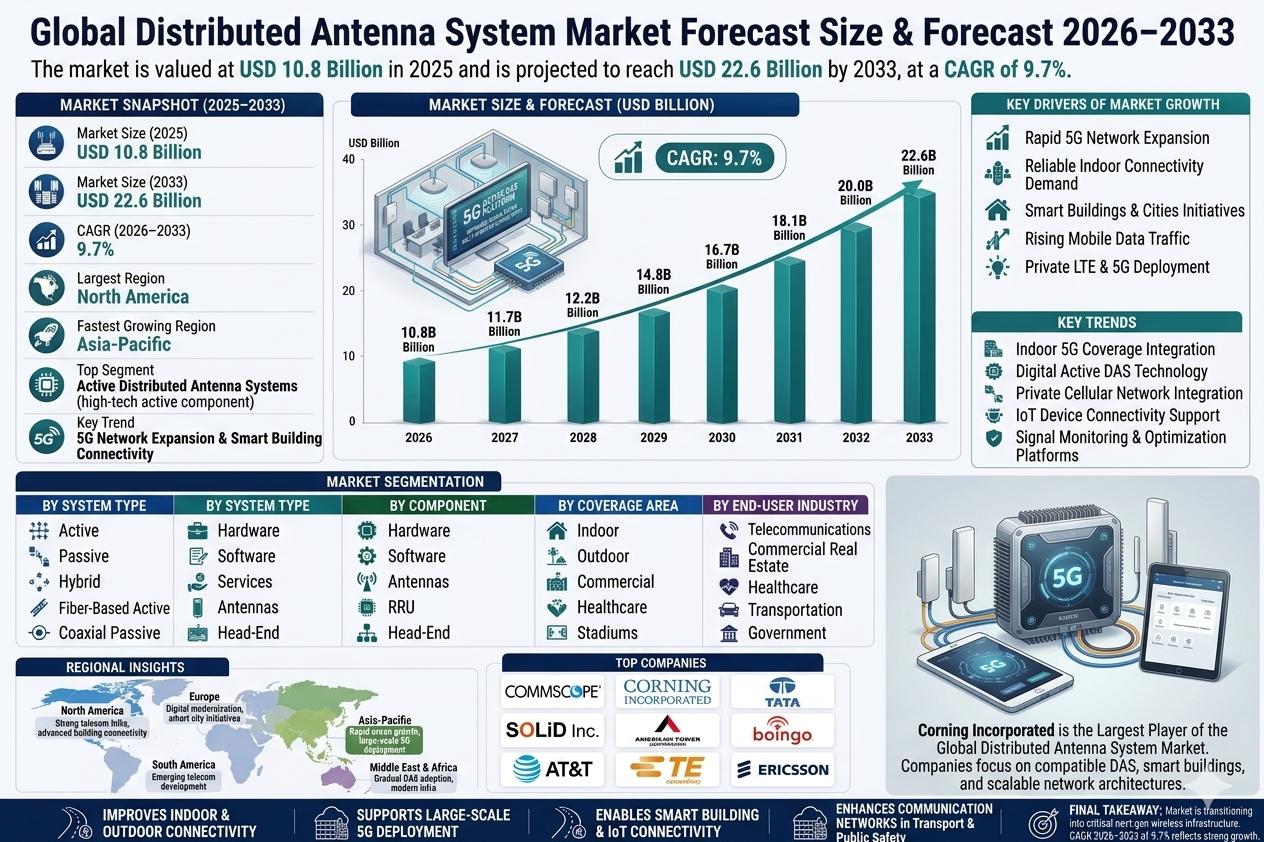
According to Pheonix Research, the Global Distributed Antenna System Market is valued at USD 10.8 billion in 2025 and is projected to reach USD 22.6 billion by 2033, registering a CAGR of 9.7% during 2026???2033. Market growth is primarily driven by rapid 5G deployment, increasing smartphone usage, and rising demand for seamless connectivity in high-density indoor environments.
North America currently leads the market due to early 5G adoption, advanced telecommunications infrastructure, and strong investments in smart building connectivity. Meanwhile, Asia-Pacific is the fastest-growing region, supported by rapid urbanization, expanding telecom networks, and large-scale smart city development initiatives. The post-2025 outlook indicates increasing integration of private 5G networks, IoT connectivity, and intelligent building infrastructure, positioning distributed antenna systems as a critical component of next-generation wireless communication networks.Key Drivers of Global Distributed Antenna System Market Growth
1. Rapid Expansion of 5G Networks
Telecom operators are deploying DAS solutions to support high-speed 5G connectivity and improve network coverage in indoor environments.
2. Increasing Demand for Reliable Indoor Connectivity
Large buildings such as airports, stadiums, hospitals, and commercial complexes require DAS infrastructure to maintain consistent wireless signals.
3. Growth of Smart Buildings and Smart Cities
Smart infrastructure initiatives are integrating advanced communication networks, including DAS, to support IoT devices and digital services.
4. Rising Mobile Data Traffic
The surge in smartphone usage, video streaming, and cloud applications is driving the need for improved network capacity and coverage.
5. Expansion of Private Cellular Networks
Enterprises are increasingly deploying private LTE and 5G networks supported by DAS infrastructure to enhance connectivity within industrial and commercial facilities.
Global Distributed Antenna System Market Segmentation
?? 1.By System Type
1.1 Active Distributed Antenna Systems
1.1.1 Fiber-Based Active DAS
1.1.1.1 High-Capacity Signal Distribution
1.1.1.1.1 Large Commercial Buildings
1.1.1.1.2 Transportation Hubs
1.1.2 Digital Active DAS
1.1.2.1 Digital Signal Processing Systems
1.1.2.1.1 Smart Building Networks
1.1.2.1.2 Stadium and Arena Deployments
1.2 Passive Distributed Antenna Systems
1.2.1 Coaxial Cable-Based Systems
1.2.1.1 Small and Medium Buildings
1.2.1.1.1 Office Buildings
1.2.1.1.2 Shopping Centers
1.2.2 Hybrid Passive Systems
1.2.2.1 Mixed Infrastructure Networks
1.2.2.1.1 Campus Deployments
1.2.2.1.2 Industrial Facilities
1.3 Hybrid Distributed Antenna Systems
1.3.1 Fiber-Coax Hybrid Systems
1.3.1.1 Medium to Large Facility Deployments
1.3.1.1.1 Hospitals
1.3.1.1.2 Universities
?? 2.By Component
2.1 Hardware
2.1.1 Antennas
2.1.1.1 Indoor Antennas
2.1.1.1.1 Ceiling-Mounted Antennas
2.1.1.1.2 Wall-Mounted Antennas
2.1.1.2 Outdoor Antennas
2.1.1.2.1 Macro Antennas
2.1.1.2.2 Small Cell Antennas
2.1.2 Remote Radio Units (RRU)
2.1.2.1 Signal Amplification Units
2.1.2.2 RF Distribution Units
2.1.3 Head-End Units
2.1.3.1 Signal Processing Units
2.1.3.2 Network Control Systems
2.2 Software
2.2.1 Network Management Software
2.2.1.1 Signal Monitoring Systems
2.2.1.2 Performance Optimization Platforms
2.2.2 Analytics Platforms
2.2.2.1 Network Performance Analytics
2.2.2.2 User Traffic Analysis
2.3 Services
2.3.1 Installation & Integration
2.3.1.1 Infrastructure Deployment
2.3.1.2 Network Integration
2.3.2 Maintenance & Support
2.3.2.1 Technical Support
2.3.2.2 System Upgrades
??3. By Coverage Area
3.1 Indoor DAS
3.1.1 Commercial Buildings
3.1.2 Healthcare Facilities
3.1.3 Airports and Transportation Hubs
3.1.4 Shopping Malls and Retail Centers
3.2 Outdoor DAS
3.2.1 Urban Public Areas
3.2.2 Stadiums and Event Venues
3.2.3 University Campuses
3.2.4 Industrial Parks
?? ?? 4. By End-User Industry
4.1 Telecommunications
4.1.1 Mobile Network Operators
4.1.1.1 4G LTE Network Coverage
4.1.1.2 5G Network Infrastructure
4.1.2 Internet Service Providers
4.1.2.1 Broadband Network Providers
4.1.2.2 Fiber-Based Internet Networks
4.2 Commercial Real Estate
4.2.1 Office Complexes
4.2.1.1 Corporate Office Buildings
4.2.1.2 Business Parks
4.2.2 Shopping Centers
4.2.2.1 Large Retail Malls
4.2.2.2 Mixed-Use Commercial Developments
4.3 Healthcare
4.3.1 Hospitals
4.3.1.1 Large Multi-Specialty Hospitals
4.3.1.2 Emergency Medical Centers
4.3.2 Medical Research Centers
4.3.2.1 Clinical Research Facilities
4.3.2.2 Biomedical Research Institutes
4.4 Transportation
4.4.1 Airports
4.4.1.1 Passenger Terminals
4.4.1.2 Airport Operational Facilities
4.4.2 Railway Stations
4.4.2.1 Metro Rail Stations
4.4.2.2 High-Speed Rail Networks
4.5 Government & Public Safety
4.5.1 Emergency Communication Systems
4.5.1.1 Disaster Response Communication
4.5.1.2 Public Safety Radio Networks
4.5.2 Smart City Infrastructure
4.5.2.1 Urban Surveillance Networks
4.5.2.2 Connected Public Infrastructure
?? ??5.By Region
5.1 North America
5.2 Europe
5.3 Asia-Pacific
5.4 Middle East & Africa
5.5 South America
Regional Insights of Global Distributed Antenna System Market
North America ??? Largest Market
North America leads the market due to strong telecom infrastructure, early adoption of 5G technology, and increasing investments in smart building connectivity across the United States and Canada.
Asia-Pacific ??? Fastest Growing Market
Asia-Pacific is witnessing rapid growth due to expanding urban infrastructure, large-scale 5G deployment, and increasing smartphone penetration across China, India, Japan, and South Korea.
Europe
Europe???s market growth is supported by increasing demand for high-speed mobile connectivity, digital infrastructure modernization, and expanding smart city initiatives.
Middle East & Africa
Investment in smart cities, modern transportation hubs, and large commercial developments is gradually boosting DAS deployment across the region.
South America
Growing telecom infrastructure development and rising mobile data consumption are supporting steady market expansion.
Leading Companies in Global Distributed Antenna System Market
-
SOLiD Inc.
-
American Tower Corporation
-
Boingo Wireless
-
AT&T Inc.
-
TE Connectivity
-
Ericsson
These companies are focusing on advanced 5G-compatible DAS infrastructure, smart building connectivity solutions, and scalable network architectures to strengthen their competitive positioning. Corning Incorporated is the largest player of the .Global Distributed Antenna System Market.
Strategic Intelligence & AI-Backed Insights
Pheonix Demand Forecast Engine identifies rapid 5G deployment, smart building connectivity demand, and growing mobile data traffic as primary growth drivers.
Infrastructure Investment Analyzer indicates increasing global investment in telecom infrastructure and private 5G networks.
Innovation Tracker highlights digital DAS platforms, intelligent signal optimization systems, and IoT-enabled connectivity infrastructure as major competitive differentiators.
Porter???s Five Forces Analysis reveals moderate entry barriers, strong competition among telecom infrastructure providers, and increasing technological differentiation.
Why the Global Distributed Antenna System Market is Critical
-
Enhances wireless network coverage in high-density environments.
-
Supports large-scale 5G network deployment.
-
Improves indoor connectivity for commercial and public infrastructure.
-
Enables smart building and IoT connectivity.
-
Strengthens communication networks in transportation and public safety systems.
Final Takeaway of Global Distributed Antenna System Market
The Global Distributed Antenna System Market is evolving into a critical infrastructure component for next-generation wireless connectivity. The Distributed Antenna System Market CAGR 2026???2033 of 9.7% reflects strong growth driven by 5G expansion, rising mobile data traffic, and increasing demand for reliable indoor connectivity.
Companies investing in advanced 5G-compatible DAS infrastructure, smart building connectivity platforms, and private cellular network integration will be well positioned to capture long-term market opportunities.
At Pheonix Research, our advanced forecasting frameworks deliver in-depth revenue forecasts, regional insights, infrastructure analysis, and innovation benchmarking, enabling stakeholders to capitalize on the evolving distributed antenna system market with confidence.
???? Social Mentions & Publication Channels
??Explore deeper insights and follow our cross-platform updates on??LinkedIn??and??X??for continuous intelligence and market coverage.
LinkedIn : https://www.linkedin.com/feed/update/urn:li:activity:7436367229534765056
X : https://x.com/Pheonix_Insight/status/2030603055507644735?s=20
Competitive Landscape
Global Distributed Antenna System Market Competitive Intensity & Market Structure Overview
The Global Distributed Antenna System (DAS) Market is characterized by a highly competitive and infrastructure-driven ecosystem, fueled by rapid 5G deployment, increasing mobile data traffic, and rising demand for seamless indoor wireless connectivity. The market is evolving from traditional signal amplification systems toward intelligent, software-driven, and 5G-ready connectivity infrastructure.
Competitive intensity is high due to the convergence of telecom infrastructure providers, network equipment manufacturers, and smart building technology companies. Vendors compete on scalability, signal quality, deployment flexibility, network integration capability, and support for private cellular and IoT ecosystems.
The market structure is moderately consolidated, with major telecom infrastructure companies dominating large-scale deployments across airports, stadiums, healthcare facilities, smart cities, and commercial buildings. However, emerging players and regional integrators continue to gain traction through specialized deployment capabilities and cost-competitive solutions.
Global Distributed Antenna System Market Competitive Intensity & Market Structure Current Scenario
Leading Company Profiles
CommScope Inc.: Global Connectivity Infrastructure Leader. Strong presence in 5G-ready DAS infrastructure, enterprise connectivity, and smart building wireless solutions.
Corning Incorporated: Leading DAS Infrastructure Provider. Known for fiber-based DAS systems, optical connectivity solutions, and large-scale indoor network deployments.
SOLiD Inc.: DAS Technology Specialist. Focused on scalable active DAS platforms and high-performance indoor wireless coverage systems.
American Tower Corporation: Telecom Infrastructure Provider. Expanding DAS and indoor connectivity services through strategic telecom partnerships.
Boingo Wireless: Wireless Connectivity Provider. Strong in airport, stadium, and public venue DAS deployments with carrier-neutral infrastructure expertise.
AT&T Inc.: Telecommunications Leader. Investing in enterprise DAS infrastructure and private 5G connectivity solutions.
TE Connectivity: Connectivity Technology Provider. Focused on advanced antenna systems, RF connectivity, and telecom infrastructure integration.
Ericsson: Global Telecom Equipment Manufacturer. Expanding intelligent DAS and 5G network optimization solutions for smart infrastructure applications.
Key Competitive Intensity & Market Structure Signals in Global Distributed Antenna System Market
A major structural signal in the market is the rapid acceleration of global 5G deployment. Telecom operators and enterprises are increasingly investing in DAS infrastructure to improve indoor coverage, network capacity, and low-latency connectivity across dense environments.
The transition toward smart buildings and connected infrastructure is intensifying competition among vendors. DAS systems are increasingly integrated with IoT ecosystems, building automation platforms, and private cellular networks, creating new technology-driven differentiation opportunities.
Another key competitive signal is the growing demand for carrier-neutral DAS deployments. Large venues, transportation hubs, and commercial complexes require multi-operator connectivity support, encouraging vendors to deliver highly scalable and interoperable network architectures.
The rise of private LTE and private 5G networks across industrial facilities, healthcare institutions, and enterprise campuses is also reshaping competitive dynamics. Vendors capable of delivering integrated enterprise wireless infrastructure are gaining strategic advantages.
Despite increasing innovation, large infrastructure providers continue to dominate due to strong telecom operator relationships, global deployment capabilities, and large-scale network integration expertise.
Strategic Implications of Competitive Intensity & Market Structure in Global Distributed Antenna System Market
The competitive environment is pushing companies toward end-to-end connectivity ecosystems rather than standalone DAS hardware offerings. Integrated solutions combining antennas, fiber infrastructure, software analytics, and network management platforms are becoming increasingly important.
Total cost of ownership (TCO) is emerging as a critical procurement factor, especially for enterprise and public infrastructure projects. Customers increasingly prioritize long-term scalability, operational efficiency, and simplified maintenance over upfront deployment costs.
5G and IoT expansion are reshaping product development priorities. DAS vendors are investing heavily in intelligent signal optimization, cloud-managed infrastructure, and AI-based network monitoring to support future smart infrastructure requirements.
Partnerships between telecom operators, infrastructure providers, and smart city developers are becoming strategically important. Collaborative deployment models help accelerate large-scale connectivity projects and strengthen long-term service revenues.
Additionally, software-defined network management and analytics capabilities are emerging as major competitive differentiators, particularly for high-density enterprise and public venue deployments.
Global Distributed Antenna System Market Competitive Intensity & Market Structure Forward Outlook
The Global Distributed Antenna System Market is expected to remain highly competitive and technology-driven as global 5G adoption, smart city development, and enterprise digital transformation continue accelerating.
Market consolidation is likely to increase as leading telecom infrastructure providers strengthen their portfolios through acquisitions, strategic alliances, and expansion into private network ecosystems.
5G-ready active DAS platforms, AI-enabled network optimization systems, and intelligent indoor connectivity solutions will become the primary drivers of future competitive differentiation.
Carrier-neutral infrastructure and private cellular networks are expected to create significant long-term opportunities across transportation, healthcare, industrial, and commercial real estate sectors.
In the long term, the market will be defined by three core competitive pillars: advanced 5G connectivity, intelligent network management, and scalable smart infrastructure integration. Companies that successfully combine telecom infrastructure expertise with software-driven connectivity solutions will lead the Global Distributed Antenna System Market through 2033.
Value Chain
Global Distributed Antenna System Market Value Chain & Supply Chain Evolution Overview
The Global Distributed Antenna System (DAS) Market value chain is evolving from conventional signal distribution infrastructure toward intelligent, software-integrated, and 5G-optimized wireless connectivity ecosystems. This transformation is being driven by rapid 5G deployment, increasing mobile data traffic, smart building development, and rising demand for seamless indoor and outdoor wireless coverage.
Distributed antenna systems are becoming critical infrastructure components for modern telecommunications networks by enhancing signal coverage, improving network capacity, and supporting next-generation connectivity applications. The value chain now extends beyond hardware manufacturing into software-defined networking, AI-driven signal optimization, IoT integration, and smart infrastructure connectivity.
The upstream supply chain depends on semiconductors, RF components, fiber optic systems, antennas, connectors, network processors, and advanced electronic modules. Telecommunications infrastructure providers are increasingly collaborating with cloud, IoT, and smart building technology companies to create scalable and integrated DAS ecosystems.
Manufacturing focuses on high-performance antenna systems, digital signal processing equipment, fiber-based communication infrastructure, and modular deployment architectures. Companies are increasingly investing in energy-efficient designs, software-controlled network systems, and scalable 5G-ready infrastructure.
Distribution includes telecom operators, system integrators, infrastructure providers, and enterprise connectivity partners serving commercial buildings, transportation hubs, healthcare facilities, stadiums, and smart city projects.
Key supply chain challenges include high infrastructure deployment costs, integration complexity with legacy telecom systems, spectrum management issues, and maintaining consistent performance in dense urban environments.
Global Distributed Antenna System Market Value Chain & Supply Chain Evolution Current Scenario
The current DAS ecosystem is shaped by accelerating 5G rollout, increasing smartphone penetration, and rising demand for uninterrupted connectivity across commercial and public infrastructure.
Upstream suppliers are prioritizing advanced RF technologies, fiber connectivity solutions, and compact high-performance antennas to support modern network architectures.
Manufacturers are integrating AI-enabled signal optimization, cloud-based monitoring systems, and intelligent network management platforms into DAS deployments.
Telecom operators and enterprises are increasingly deploying DAS infrastructure in high-density environments including airports, hospitals, shopping centers, and stadiums.
Private LTE and private 5G network deployments are expanding demand for customized DAS solutions across industrial and enterprise applications.
Software-defined networking, IoT connectivity integration, and predictive network analytics are emerging as major differentiators within the ecosystem.
Key Value Chain & Supply Chain Evolution Signals in Global Distributed Antenna System Market
Several transformative trends are reshaping the DAS ecosystem.
First, rapid 5G deployment is accelerating demand for high-capacity and low-latency indoor connectivity infrastructure.
Second, smart buildings and smart city projects are increasing adoption of intelligent DAS platforms integrated with IoT ecosystems.
Third, rising mobile data traffic is driving continuous network densification and advanced signal distribution investments.
Fourth, private cellular networks are creating new opportunities for enterprise-focused DAS deployments.
Fifth, AI-driven network optimization and software-defined infrastructure are improving operational efficiency and user experience.
Strategic Implications of Value Chain & Supply Chain Evolution in Global Distributed Antenna System Market
Leading companies such as CommScope, Corning Incorporated, Ericsson, and SOLiD Inc. are strengthening competitive positioning through advanced 5G-compatible infrastructure, intelligent network management, and scalable deployment solutions.
Competitive advantage increasingly depends on RF engineering expertise, software integration capabilities, deployment scalability, and ability to support evolving 5G and IoT ecosystems.
Companies with strong capabilities in fiber infrastructure, AI-based optimization, and private network integration are better positioned to capture long-term market opportunities.
Strategic partnerships between telecom operators, infrastructure developers, and smart building providers are becoming increasingly important for ecosystem expansion.
Balancing deployment cost, scalability, and high-performance coverage remains critical, particularly for emerging smart infrastructure projects.
Global Distributed Antenna System Market Value Chain & Supply Chain Evolution Forward Outlook
Between 2026 and 2033, the DAS value chain is expected to become increasingly software-defined, AI-optimized, and deeply integrated with smart infrastructure ecosystems.
Manufacturers will increasingly prioritize intelligent signal management, modular network architecture, cloud-based monitoring, and energy-efficient communication infrastructure.
Private 5G networks, edge computing integration, and IoT-enabled smart environments will continue expanding the addressable market for DAS solutions.
AI-powered traffic analytics, predictive maintenance, and autonomous network optimization will become standard capabilities across advanced deployments.
Smart cities, connected transportation systems, and digital public infrastructure projects will create sustained long-term infrastructure demand.
Ultimately, the DAS market will evolve from conventional connectivity infrastructure into an intelligent wireless communication backbone supporting next-generation digital ecosystems.
Market-Specific Value Chain
- Raw Material & Component Supply: RF components, semiconductors, fiber optic systems, antennas, connectors, network processors
- Research & Development: 5G optimization, AI-based signal analytics, software-defined networking, IoT connectivity integration
- Manufacturing: Antenna production, signal processing systems, fiber infrastructure assembly, modular DAS equipment manufacturing
- System Integration & Deployment: Telecom infrastructure integration, smart building deployment, private network installation, transportation connectivity systems
- Distribution & Commercialization: Telecom operators, infrastructure providers, enterprise connectivity partners, system integrators
- Network Operations & Lifecycle Services: Monitoring, predictive maintenance, software upgrades, network optimization, managed connectivity services
Company-to-Stage Mapping
- Raw Material & Component Supply: TE Connectivity, Corning Incorporated, semiconductor and RF component suppliers
- Research & Development: Ericsson, CommScope Inc., SOLiD Inc.
- Manufacturing: Corning Incorporated, CommScope Inc., SOLiD Inc., Ericsson
- System Integration & Deployment: AT&T Inc., American Tower Corporation, Boingo Wireless
- Distribution & Commercialization: Telecom operators, infrastructure integrators, enterprise connectivity providers
- Network Operations & Lifecycle Services: Ericsson, CommScope Inc., AT&T Inc., managed service providers
Investment Activity
Global Distributed Antenna System Market Investment & Funding Dynamics Overview
Investment and funding activity in the Global Distributed Antenna System (DAS) Market is accelerating rapidly as telecom operators, infrastructure providers, and enterprises expand next-generation wireless connectivity infrastructure. Between 2026 and 2033, capital allocation is expected to increase significantly toward 5G-compatible DAS deployments, smart building connectivity systems, private cellular networks, and intelligent signal optimization platforms.
The market is evolving into a high-growth infrastructure investment segment driven by rising mobile data consumption, indoor connectivity requirements, and expanding smart city ecosystems. Leading companies such as CommScope Inc., Corning Incorporated, SOLiD Inc., Ericsson, American Tower Corporation, and TE Connectivity are increasing investments in scalable DAS architectures, fiber-based signal distribution systems, and AI-enabled network management technologies.
A major structural trend influencing funding activity is the transition toward high-capacity indoor wireless infrastructure capable of supporting dense 5G traffic, IoT connectivity, and enterprise-grade communication systems. This is directing investment toward advanced active DAS platforms, digital signal processing technologies, and integrated smart infrastructure solutions.
Global Distributed Antenna System Market Investment & Funding Dynamics Current Scenario
Current investment momentum is being fueled by global 5G rollout initiatives, modernization of telecom infrastructure, and increasing demand for seamless indoor wireless coverage across commercial, healthcare, transportation, and industrial environments.
- North America: Leads investment activity due to aggressive 5G deployment, strong telecom infrastructure modernization, and rising smart building connectivity projects.
- Asia-Pacific: Fastest-growing investment region supported by rapid urbanization, smart city development, and expanding mobile network infrastructure across China, India, Japan, and South Korea.
- Europe: Strong investment activity driven by digital infrastructure upgrades, smart mobility initiatives, and increasing demand for high-capacity wireless networks.
- Middle East & Africa: Emerging investment landscape fueled by smart city megaprojects, airport modernization, and expanding public communication infrastructure.
Key Investment & Funding Dynamics Signals in Global Distributed Antenna System Market
- Rapid deployment of 5G networks is accelerating investment in active DAS and fiber-based signal distribution infrastructure.
- Rising demand for seamless indoor connectivity is increasing funding for DAS deployment in airports, hospitals, stadiums, and commercial complexes.
- Growth of private LTE and private 5G networks is driving investment into enterprise-grade DAS infrastructure.
- Expansion of smart buildings and IoT ecosystems is creating strong opportunities for intelligent DAS integration platforms.
- Increasing mobile data traffic is encouraging telecom operators to invest in scalable and high-capacity network coverage solutions.
- AI-enabled network analytics and real-time performance monitoring are emerging as key investment areas across advanced DAS ecosystems.
Strategic Implications of Investment & Funding Dynamics in Global Distributed Antenna System Market
- The investment landscape increasingly favors companies offering 5G-ready active DAS platforms with scalable architecture capabilities.
- Integration of AI-driven network optimization software with DAS hardware infrastructure is becoming a critical competitive differentiator.
- Strategic partnerships among telecom operators, infrastructure providers, and smart building developers are increasing globally.
- Regional diversification strategies are becoming essential as Asia-Pacific emerges as a long-term high-growth deployment market.
- Investment in private cellular network infrastructure is expanding across industrial facilities, campuses, healthcare institutions, and transportation hubs.
- Smart city initiatives and public safety communication systems are creating long-term infrastructure investment opportunities.
Global Distributed Antenna System Market Investment & Funding Dynamics Forward Outlook
Looking ahead, the Global Distributed Antenna System Market is expected to witness sustained investment growth as 5G adoption, smart infrastructure development, and enterprise digital transformation continue reshaping wireless communication ecosystems.
Future funding activity will increasingly focus on active DAS deployments, private 5G integration, intelligent signal optimization systems, edge connectivity infrastructure, and AI-powered network management platforms.
- North America: Will continue leading investments in advanced telecom infrastructure, private cellular networks, and smart building connectivity solutions.
- Asia-Pacific: Will dominate future deployment growth supported by rapid urban expansion, telecom modernization, and smart city investments.
- Europe: Will remain focused on digital infrastructure modernization, energy-efficient connectivity systems, and intelligent urban communication networks.
Technological advancements in digital DAS platforms, cloud-managed network systems, AI-driven traffic optimization, and IoT-enabled communication infrastructure will continue shaping funding strategies across the market.
Overall, the market will remain a strategically important infrastructure investment segment through 2033, supported by its critical role in enabling seamless wireless connectivity, supporting 5G ecosystems, and strengthening next-generation smart infrastructure. Companies that lead in scalable DAS innovation, intelligent connectivity integration, and network optimization technologies will shape the future competitive landscape.
Technology & Innovation
Global Distributed Antenna System Market Technology & Innovation Landscape Overview
The technology and innovation landscape within the Global Distributed Antenna System (DAS) Market is evolving rapidly as telecom operators, enterprises, and infrastructure developers accelerate deployment of high-capacity wireless connectivity solutions. Distributed antenna systems are becoming essential for ensuring seamless indoor and outdoor cellular coverage across commercial buildings, airports, stadiums, hospitals, campuses, industrial facilities, and smart city infrastructure.
Innovation intensity across the DAS ecosystem is increasing significantly due to rapid 5G rollout, rising mobile data traffic, IoT expansion, and growing demand for uninterrupted connectivity in high-density environments. Leading companies such as CommScope, Corning Incorporated, Ericsson, SOLiD, AT&T, and American Tower are investing heavily in advanced DAS architectures, intelligent signal management platforms, and scalable network infrastructure solutions.
A major technological transformation is the convergence of 5G radio technologies, cloud-native network management, AI-driven optimization, and edge connectivity. This evolution is enabling DAS solutions to move beyond traditional signal extension systems toward intelligent, software-defined wireless infrastructure capable of supporting ultra-low latency communication, high device density, and mission-critical connectivity applications.
Simultaneously, advancements in fiber-optic communication, digital signal processing, network virtualization, and private cellular networking are accelerating deployment flexibility while improving network scalability, energy efficiency, and operational performance.
Global Distributed Antenna System Market Technology & Innovation Landscape Current Scenario
Currently, the distributed antenna system industry is focused on improving network coverage, signal quality, deployment scalability, and support for next-generation 5G and IoT applications. Vendors are prioritizing technologies that enhance connectivity reliability while reducing infrastructure complexity and operational costs.
5G-compatible active DAS solutions are one of the most significant innovation areas. Advanced fiber-based and digital DAS platforms are enabling high-capacity signal distribution, enhanced spectral efficiency, and multi-operator connectivity across large commercial and public environments.
AI-powered network optimization technologies are gaining momentum through intelligent traffic management, predictive maintenance, and real-time performance analytics. These capabilities help operators optimize signal quality, reduce downtime, and improve user experience in high-density wireless environments.
Cloud-based DAS management platforms are transforming network operations by enabling centralized monitoring, remote configuration, automated troubleshooting, and software-driven infrastructure control. This shift supports scalable deployment across distributed enterprise and smart city ecosystems.
Private 5G and enterprise wireless networks are also emerging as a major innovation segment. Enterprises are increasingly integrating DAS infrastructure with private LTE and 5G systems to support industrial automation, smart manufacturing, healthcare connectivity, and campus-wide wireless communication.
Integration of IoT connectivity and smart building technologies is further reshaping the market. DAS platforms are increasingly supporting connected devices, building automation systems, public safety communication networks, and intelligent infrastructure applications.
Energy-efficient network components, compact antenna designs, and modular deployment architectures are improving installation flexibility while reducing power consumption and infrastructure costs across indoor and outdoor DAS environments.
Key Technology & Innovation Trends in Global Distributed Antenna System Market
- 5G-Enabled DAS Infrastructure: High-capacity signal distribution systems supporting advanced 5G network deployment.
- AI-Based Network Optimization: Intelligent analytics, predictive maintenance, and automated signal management platforms.
- Cloud-Native DAS Management: Centralized monitoring, remote configuration, and software-defined infrastructure control.
- Private LTE & 5G Networks: Enterprise wireless connectivity for industrial, healthcare, and campus applications.
- Fiber-Based Active DAS Systems: High-performance fiber-optic architectures improving scalability and coverage.
- IoT & Smart Building Integration: Connected infrastructure enabling intelligent building and smart city ecosystems.
- Digital Signal Processing Technologies: Enhanced signal quality, spectral efficiency, and multi-operator support.
- Energy-Efficient & Modular Deployments: Compact infrastructure reducing installation complexity and operational costs.
Strategic Implications of Technology & Innovation
The technological evolution of distributed antenna systems is reshaping wireless communication infrastructure from traditional coverage enhancement systems into intelligent connectivity ecosystems capable of supporting advanced digital services and next-generation mobility applications.
For telecom operators, advanced DAS technologies provide scalable solutions for improving indoor coverage, increasing network capacity, and supporting high-density 5G traffic environments. Enterprises and commercial property developers are increasingly leveraging DAS infrastructure to enhance tenant connectivity, operational efficiency, and smart building integration.
As 5G adoption accelerates globally, competitive barriers are rising due to high infrastructure investment requirements, spectrum management complexity, integration challenges, and evolving telecom standards.
Governments and infrastructure planners are increasingly viewing DAS deployment as strategic digital infrastructure essential for smart cities, transportation systems, emergency communication networks, and public safety modernization.
Cybersecurity, network reliability, and interoperability are also becoming strategic priorities as DAS platforms integrate with cloud-native architectures, IoT ecosystems, and mission-critical communication systems.
Global Distributed Antenna System Market Technology & Innovation Forward Outlook
Looking ahead, the Global Distributed Antenna System Market is expected to evolve toward AI-driven, software-defined, and fully integrated wireless connectivity ecosystems. Future DAS platforms will increasingly function as intelligent communication infrastructure supporting smart buildings, autonomous systems, industrial automation, and hyper-connected urban environments.
5G Advanced, private cellular networks, and edge computing integration will likely drive the next phase of innovation, enabling ultra-low latency communication, high-speed data transfer, and seamless connectivity across distributed digital infrastructure.
Mass deployment scalability will depend heavily on reducing installation complexity, improving interoperability, and expanding modular network architectures capable of supporting diverse enterprise and public infrastructure requirements.
Indoor 5G connectivity, transportation infrastructure, and smart city deployments are expected to become major growth areas, while enterprise private network integration may emerge as one of the most transformative opportunities in the market.
In conclusion, the Global Distributed Antenna System Market is transitioning from conventional signal distribution infrastructure into a scalable intelligent wireless connectivity ecosystem. Companies that lead in 5G infrastructure innovation, AI-powered network optimization, cloud-native management, and smart connectivity integration will shape the next generation of digital communication networks through 2033.
Regulatory Landscape
Global Distributed Antenna System Market Regulatory & Policy Environment Overview
The regulatory and policy environment for the Global Distributed Antenna System (DAS) Market is evolving rapidly as governments and telecommunications authorities prioritize high-speed wireless connectivity, 5G deployment, and digital infrastructure modernization. Distributed antenna systems are increasingly recognized as essential communication infrastructure for ensuring reliable indoor and outdoor network coverage across commercial buildings, transportation hubs, stadiums, healthcare facilities, and smart city ecosystems.
Regulatory frameworks across major regions are focusing on spectrum allocation, telecom infrastructure standards, public safety communication requirements, and network interoperability. Governments are actively supporting DAS deployment through policies promoting 5G rollout, smart city development, and expansion of broadband connectivity in densely populated urban areas.
In addition, building safety regulations and emergency communication mandates are increasing the adoption of DAS solutions capable of supporting public safety radio systems and uninterrupted wireless coverage during emergencies. Regulatory authorities are also encouraging integration of private LTE and private 5G networks within industrial and enterprise environments.
As wireless communication infrastructure becomes more critical to economic and digital development, operators and infrastructure providers are required to comply with region-specific telecom regulations, cybersecurity standards, and infrastructure deployment policies.
Global Distributed Antenna System Market Regulatory & Policy Environment Current Scenario
The current regulatory landscape is characterized by accelerated policy support for 5G expansion, digital connectivity, and smart infrastructure deployment. North America remains one of the most mature regulatory regions, supported by strong FCC-led spectrum management policies, telecom modernization programs, and public safety communication standards.
In the United States and Canada, regulatory authorities are promoting indoor wireless coverage standards, public safety DAS requirements, and streamlined approval processes for telecom infrastructure deployment. The increasing need for reliable connectivity in commercial buildings and transportation facilities is further strengthening DAS adoption.
Europe maintains a highly structured telecom regulatory environment focused on network interoperability, spectrum harmonization, cybersecurity, and digital infrastructure modernization. Smart city policies and digital connectivity targets are driving increased deployment of DAS infrastructure across urban centers and public facilities.
Asia-Pacific is witnessing rapid regulatory evolution driven by large-scale 5G rollout, urbanization, and smart city initiatives. Countries such as China, India, Japan, and South Korea are introducing supportive telecom infrastructure policies, spectrum reforms, and incentives for digital connectivity expansion.
In the Middle East & Africa and South America, governments are increasing investments in telecom infrastructure modernization, transportation connectivity, and smart public infrastructure, gradually strengthening the regulatory foundation for DAS deployment.
Across all regions, telecom operators, infrastructure providers, and enterprise network operators are prioritizing compliance-driven deployment strategies aligned with evolving telecom regulations and wireless communication standards.
Key Regulatory & Policy Environment Signals in Global Distributed Antenna System Market
- 5G Spectrum Allocation Policies: Governments are accelerating allocation of spectrum bands to support nationwide 5G deployment and DAS expansion.
- Telecom Infrastructure Regulations: Authorities are implementing standards for indoor and outdoor wireless infrastructure deployment.
- Public Safety Communication Mandates: Building codes increasingly require DAS systems to support emergency responder communication networks.
- Smart City & Digital Infrastructure Policies: Governments are promoting connected infrastructure and IoT-enabled communication ecosystems.
- Cybersecurity & Network Resilience Standards: Regulatory bodies are strengthening requirements for secure telecom infrastructure and data protection.
- Private LTE & 5G Network Policies: Enterprises are being encouraged to deploy private wireless networks supported by DAS architecture.
Strategic Implications of Regulatory & Policy Environment in Global Distributed Antenna System Market
Regulatory developments are transforming distributed antenna systems into a strategic component of next-generation telecom infrastructure. Companies must invest in standards-compliant, scalable, and 5G-ready DAS solutions capable of meeting evolving regulatory requirements.
Public safety mandates are increasing demand for DAS deployment in commercial buildings, airports, hospitals, and transportation infrastructure, creating long-term growth opportunities for infrastructure providers.
The expansion of smart city initiatives and private cellular networks is driving integration of DAS with IoT ecosystems, edge computing environments, and intelligent building management systems.
Cybersecurity regulations and network resilience standards are encouraging operators to adopt advanced monitoring, encryption, and network optimization technologies within DAS infrastructure.
Vendors that provide regulatory-compliant, energy-efficient, and future-ready DAS solutions will gain strong competitive positioning, while legacy systems may face challenges adapting to new wireless communication standards.
Global Distributed Antenna System Market Regulatory & Policy Environment Forward Outlook
Between 2026 and 2033, the regulatory environment for distributed antenna systems is expected to become increasingly supportive and standardized, particularly around 5G connectivity, public safety communication, and smart infrastructure integration.
North America and Europe will continue strengthening telecom modernization and cybersecurity frameworks, while Asia-Pacific will accelerate telecom infrastructure expansion through aggressive 5G and smart city policies.
Governments are expected to introduce faster permitting processes, stronger indoor connectivity standards, and enhanced public safety communication requirements, driving broader DAS deployment across commercial and public infrastructure.
Private 5G regulations, IoT connectivity policies, and edge network frameworks will further increase demand for flexible and intelligent DAS architectures capable of supporting high-density wireless environments.
Overall, the regulatory landscape will play a critical role in shaping the future of the Global Distributed Antenna System Market, accelerating adoption of advanced wireless infrastructure and supporting the transition toward highly connected digital ecosystems. Companies that proactively align with evolving telecom regulations and invest in scalable, 5G-enabled DAS technologies will be best positioned to lead in the post-2025 connectivity landscape.