
Editorial Article
A Peruvian Grower Can Follow the Label Exactly and Still Ship an Illegal Consignment
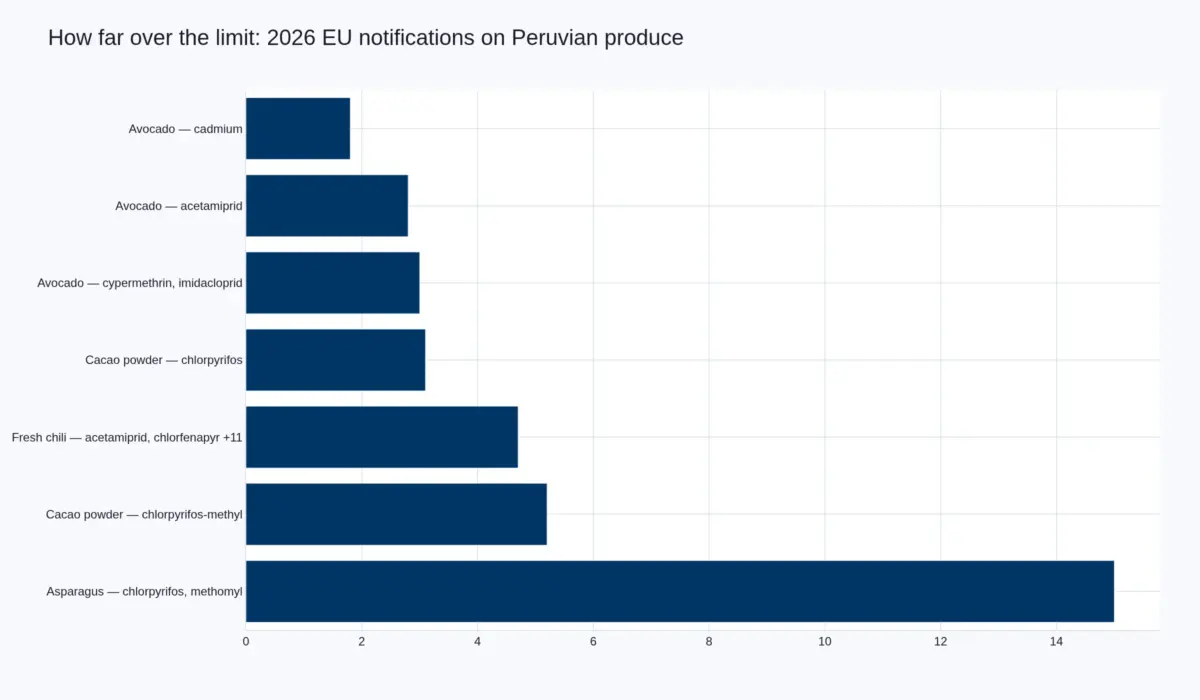
On 26 August 2026 the European Union logged notification 2026.7537: a consignment of Peruvian asparagus carrying chlorpyrifos and methomyl at 0.15 mg/kg against a permitted level of 0.01. Fifteen times the limit. Chlorpyrifos has been prohibited in Peru since SENASA’s re-evaluation programme withdrew it — one of 41 active ingredients removed since 2019, alongside metamidofos, paraquat, forato, dicofol and carbofuran.
That is the easy story, and it is a story about law enforcement. Someone sprayed a molecule the state had banned, the state’s own inspectors were not there to see it, and a border inspector in Europe was. The enforcement numbers back the picture: 15,327 inspection operations against pesticide commerce since 2019, 2,639 in 2024, more than 200 unannounced inspections in 2025 run jointly with the tax authority, the public prosecutor and the national police, and 964.27 litres plus 452.49 kilograms of prohibited product seized. Selling without sanitary authorisation carries up to eight years’ imprisonment.
Now the harder story, and the one this market actually turns on. Four days later, notification 2026.6848 recorded a consignment of Peruvian avocado at 0.028 mg/kg of acetamiprid against a limit of 0.01. Acetamiprid is not banned in Peru. It is registered, formulated, labelled, sold legally through a technical channel, and applied by a grower who read the label and did what it said. Nobody in that file broke a rule. The consignment was still nearly three times over a number that no Peruvian authority wrote, that no Peruvian registration had to anticipate, and that the Peruvian label does not have to satisfy.
Two documents, asking different questions
Peruvian approval and European rejection are not two stages of one process. They are unrelated instruments that happen to concern the same litre.
The registration asks whether a product is effective and acceptably safe when used as directed. Under the Reglamento del Sistema Nacional de Plaguicidas de Uso Agrícola — Decreto Supremo 001-2015-MINAGRI — an applicant must obtain three separate opinions before SENASA will pronounce at all: agronomic, toxicological, and ecotoxicological-environmental, each from a different authority, each paid for by the applicant, each capable of killing the file. The ministry quotes the environmental risk assessment alone at 60 to 80 business days. SENASA then has a statutory 30 business days to issue its dictamen. That is a review clock, not a development clock, and any planning assumption that treats Peruvian registration as a one-month administrative step is wrong by an order of magnitude.
The border asks something else entirely: whether a residue measured in a laboratory at harvest sits below a number in a regulation. Different moment, different data, different authority, different purpose. Where a substance-specific limit does not exist the default applies, and in the notifications reviewed for the new Pheonix Research report on Peru’s crop protection market that default is consistently 0.01 mg/kg.
Nothing in either instrument references the other. The registration was never required to demonstrate that a lawful application at a lawful interval would clear a foreign limit, and the foreign limit was never written with the Peruvian label in view.
The trap is lawful, which is why it is durable
Put the two documents together and you get a specific, entirely legal failure mode: a grower can comply with the Peruvian label in full and still produce a consignment that cannot be sold. The label’s pre-harvest interval was written to a domestic standard. The destination applies a limit that interval was never calibrated against. Between the two sits the export campaign, the container, and the test.
The record of how often this happens is not flattering. Peru was the origin of 141 EU food notifications between 2020 and 2025 — 0.55 per cent of 25,645 notifications and 34th of 160 origins. Fruits and vegetables account for 65.2 per cent of them, and pesticide residues are the most-cited hazard class. Fruit-and-vegetable border rejections ran at 92 across the six years, and at 38 in 2025 alone against 17 in 2024: an increase of 123.5 per cent, in a year when the export base was flat.
The 2026 file adds texture the aggregate hides. A fresh chili consignment (2026.8749) carried thirteen actives at 0.42 mg/kg against a limit of 0.09 — a dossier of overlapping chemistry, not a single mistake. Two organic cacao powder shipments (2026.6988 and 2026.7461) carried chlorpyrifos and chlorpyrifos-methyl at 5.2 and 3.1 times their limits. An avocado shipment (2026.7042) carried cypermethrin and imidacloprid at three times. And one entry is not a pesticide at all: cadmium at 0.09 mg/kg in avocado against a 0.05 limit — a soil-and-water problem that no registration, no label and no spray interval can solve, and that caps what crop protection can ever deliver in that orchard.
The instrument that actually closes the gap is private
Here is the part of this market that receives least attention and matters most. The gap between the label and the limit is not being closed by either government. It is being closed by the buyer, in a purchase specification: a shorter pre-harvest interval than the label requires, a list of actives the buyer will not accept regardless of registration status, and a pre-shipment residue test paid for by the seller.
Those private specifications now determine which products this market sells more than the public register does, and they are written in Rotterdam rather than in La Molina. The evidence is in the notification file itself. Two of the seven 2026 entries — both organic cacao, both chlorpyrifos-family — were raised by the Netherlands on the company’s own check. A buyer who tests voluntarily and finds a prohibited molecule does not need a public authority to end a relationship, and the commercial cost of an organic consignment carrying chlorpyrifos is out of all proportion to its value.
So the compliance function has migrated from the regulator to the procurement office. That is a reasonable response to a real risk, and it has a consequence nobody prices: the standard a Peruvian grower must meet now depends on which buyer is asking, and it can tighten without any change in Peruvian law, any notice, and any registration review.
Who pays, and why the number keeps rising
This is where the market’s structure becomes the story. When a consignment is rejected, the exporter absorbs the loss in full. The supplier was paid on shipment. The importer who sold the chemistry carries no continuing exposure to the residue outcome at the far border, and nothing returns the cost of the rejection to the party who chose the molecule and set the interval.
Compliance risk in this market is therefore externalised onto the participant with the least control over it. That is why the rejection count could move from 17 to 38 in a single year with no corresponding movement in the price of the inputs that produced it, and why the risk is invisible until it has already become a loss.
It is worth being precise about the size of what is at stake, because the arithmetic is counter-intuitive. Peru’s crop protection market was USD 387.0 million in 2025, measured as imports under HS 3808 on the customs record, and is forecast at USD 593.9 million by 2033 — a 5.5 per cent CAGR. Against an agricultural export base of roughly USD 15,103.4 million, that is 2.56 cents of chemistry for every export dollar. A sub-four-hundred-million-dollar import market is the condition of access for fifteen billion dollars of produce, and it carries essentially none of the compliance risk that fifteen billion depends on.
The obvious objection, and why it does not rescue the market
The natural reply is that the answer is simply newer chemistry: retire the old actives, register modern ones, shorten the intervals. Peru is already doing that, and the sequence reads as a history of the organophosphate and carbamate generation being unwound — 41 molecules removed since 2019, the oldest stratum of the registry being exactly the chemistry being withdrawn from it.
But withdrawal does not remove the pest problem, and the demand those products served did not disappear with the registration. It either migrated to a registered alternative, which is the intended outcome, or to an unregistered one, which is what the seizure figures describe. And a tonne and a half of seized product against a 39.9 kilo-ton import base tells you what enforcement can measure: inspections find what is on a shelf, not what was already sprayed.
Modern chemistry also does not carry a better price. The competitive chapter of the report finds the ten largest imported products worth USD 36.2 million between them — 9.35 per cent of the whole market. There is no blockbuster molecule here, because a registration portfolio, not a product, is the unit of competition: thirty products are thirty administrative files, each funded years before the first litre is invoiced. Glyphosate’s disappearance from the value ranking — several of the top ten three years ago, one today — is not a regulatory story, since glyphosate is not banned in Peru. It is the signature of a commodity molecule losing pricing power as Chinese technical supply, now 41.3 per cent of the market by origin, expands.
What the market is actually being asked to buy
Read the whole file and a coherent picture emerges. This is a market of modest value, structurally deflationary in price, concentrated at the top by administrative achievement rather than commercial strength, and capped not by what Peruvian growers need but by what foreign buyers will accept. Its growth rate is genuinely uncertain in level — which is why the report publishes USD 525.6 million to USD 675.1 million as the band around its 2033 point estimate, and notes that one percentage point of CAGR is worth USD 46.6 million of 2033 revenue, more than the country’s ten largest imported products are worth today combined.
But the uncertainty that matters is not in the growth rate. It is in the fact that the compliance instrument this market depends on has been privatised to the buyer, priced at zero to the supplier, and settled as a loss to the exporter. A grower following the label exactly is the market working as designed. The consignment still gets rejected. Until someone in the chain is paid for the residue outcome rather than merely exposed to it, the rejection count has no reason to fall — and the label will keep being written for a question no border is asking.
The full analysis — including the sizing method, the ten-product structure, the origin concentration and the destination residue regime — is in the Peru Crop Protection Market Report, Size, Share and Forecast 2026–2033. Residue figures are drawn from a compilation of official notifications covering 2020–2025 plus notification-level detail for 2026, cited by notification number so each line can be checked at source. Volume in that report is derived, not observed, at an assumed USD 9.7 per kilogram landed average; the value series is from the customs record.