
Global Automotive Wiring Harness Market size and share Analysis 2026-2033
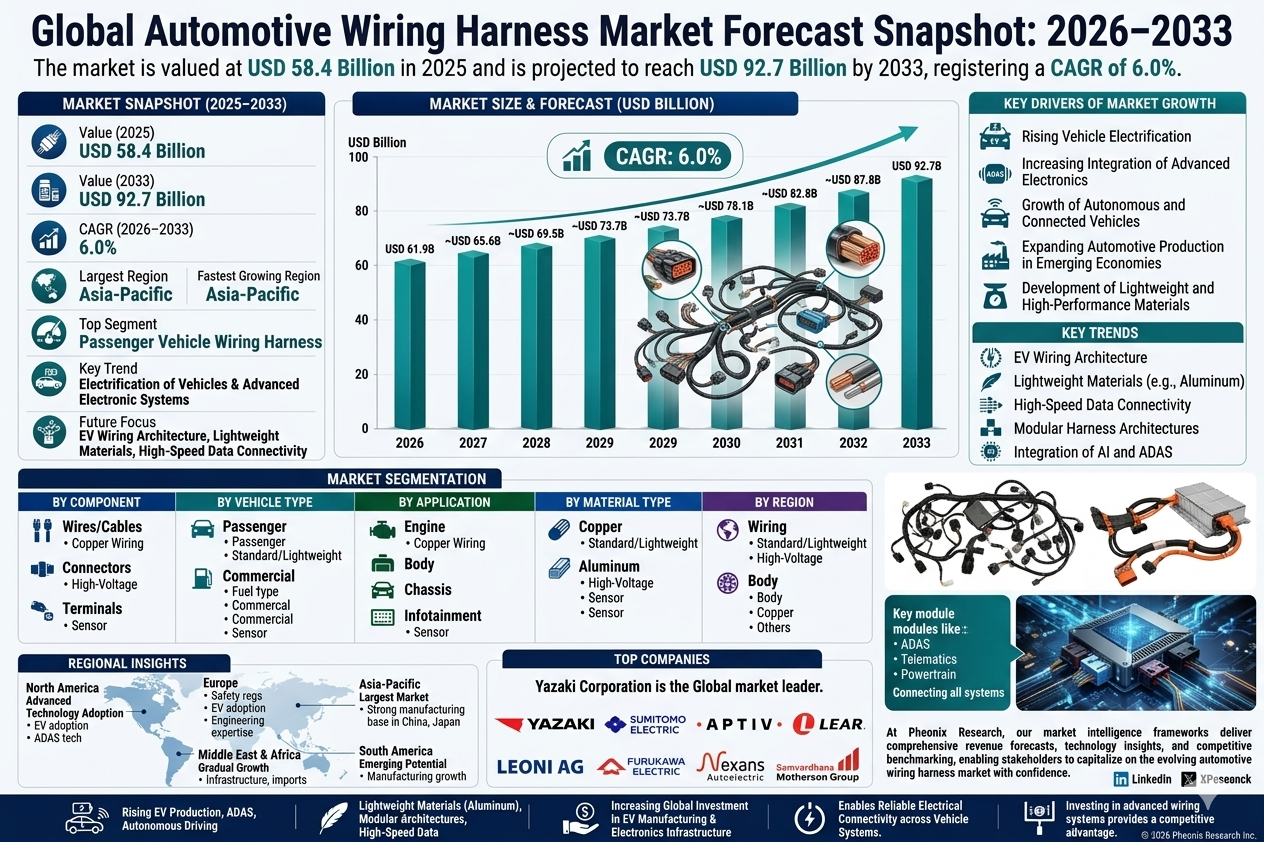
Global Automotive Wiring Harness Market Forecast Snapshot: 2026???2033
| Metric | Value |
| 2025 Market Size | USD 58.4 Billion |
| 2033 Market Size | USD 92.7 Billion |
| CAGR (2026???2033) | 6.0% |
| Largest Region | Asia-Pacific |
| Fastest Growing Region | Asia-Pacific |
| Top Segment | Passenger Vehicle Wiring Harness |
| Key Trend | Electrification of Vehicles & Advanced Electronic Systems |
| Future Focus | EV Wiring Architecture, Lightweight Materials, and High-Speed Data Connectivity |
Global Automotive Wiring Harness Market Overview
The Global Automotive Wiring Harness Market is growing steadily, with cars getting smarter and wiring harnesses being the unsung heroes. These bundles of wires connect everything ??? power systems, sensors, infotainment, lights, and safety tech. It's like a car's nervous system, supporting advanced tech and growing with EVs that need more wiring magic.
According to Pheonix Research, the Global Automotive Wiring Harness Market is valued at USD 58.4 billion in 2025 and is projected to reach USD 92.7 billion by 2033, registering a CAGR of 6.0% during 2026???2033. Market expansion is primarily driven by rising vehicle production, increasing adoption of electric vehicles (EVs), and growing integration of advanced driver assistance systems (ADAS).
Asia-Pacific dominates the market due to strong automotive manufacturing hubs in China, Japan, South Korea, and India. Meanwhile, the transition toward electric and connected vehicles is creating new opportunities for advanced wiring harness architectures capable of supporting high-voltage systems and high-speed data communication.
The post-2025 outlook highlights increasing demand for lightweight wiring solutions, modular harness architectures, and high-performance materials to support next-generation vehicle platforms.
Key Drivers of Global Automotive Wiring Harness Market Growth
1. Rising Vehicle Electrification
The rapid growth of electric and hybrid vehicles requires complex wiring harness systems to support high-voltage batteries, electric motors, and power electronics.
2. Increasing Integration of Advanced Electronics
Modern vehicles incorporate infotainment systems, sensors, cameras, and ADAS technologies, increasing demand for advanced wiring harness networks.
3. Growth of Autonomous and Connected Vehicles
Autonomous driving technologies require extensive sensor connectivity and high-speed data transmission, expanding wiring harness requirements.
4. Expanding Automotive Production in Emerging Economies
Automotive manufacturing growth in Asia-Pacific and Latin America is supporting higher demand for vehicle components.
5. Development of Lightweight and High-Performance Materials
Manufacturers are investing in lightweight wiring materials to improve fuel efficiency and vehicle performance.
Global Automotive Wiring Harness Market Segmentation
?? ??1.By Component
1.1 Wires and Cables
1.1.1 Copper Wiring Harness
1.1.1.1 Standard Copper Conductors
1.1.1.1.1 Passenger Vehicle Applications
1.1.1.1.2 Commercial Vehicle Applications
1.1.2 Aluminum Wiring Harness
1.1.2.1 Lightweight Conductors
1.1.2.1.1 Electric Vehicles
1.1.2.1.2 Hybrid Vehicles
1.2 Connectors
1.2.1 Power Connectors
1.2.1.1 High-Voltage Connectors
1.2.1.1.1 Electric Powertrain Systems
1.2.1.1.2 Battery Management Systems
1.2.2 Signal Connectors
1.2.2.1 Data Transmission Connectors
1.2.2.1.1 Sensor Connectivity
1.2.2.1.2 Infotainment Systems
1.3 Terminals
1.3.1 Crimp Terminals
1.3.1.1 Automotive Electrical Systems
1.3.1.2 Power Distribution Systems
1.3.2 Sealed Terminals
1.3.2.1 High-Temperature Applications
1.3.2.2 High-Reliability Systems
?? 2.By Vehicle Type
2.1 Passenger Vehicles
2.1.1 Internal Combustion Engine Vehicles
2.1.1.1 Compact Cars
2.1.1.2 Mid-Size Vehicles
2.1.2 Electric Vehicles
2.1.2.1 Battery Electric Vehicles (BEVs)
2.1.2.1.1 High-Voltage Wiring Harness
2.1.2.1.2 Battery Management Wiring
2.1.2.2 Hybrid Electric Vehicles (HEVs)
2.1.2.2.1 Powertrain Wiring
2.1.2.2.2 Energy Management Systems
2.2 Commercial Vehicles
2.2.1 Light Commercial Vehicles
2.2.1.1 Delivery Vans
2.2.1.2 Utility Vehicles
2.2.2 Heavy Commercial Vehicles
2.2.2.1 Trucks
2.2.2.2 Buses
?? 3.By Application
3.1 Engine Wiring Harness
3.1.1 Engine Control Systems
3.1.1.1 Fuel Injection Systems
3.1.1.2 Ignition Systems
3.2 Body Wiring Harness
3.2.1 Lighting Systems
3.2.1.1 Headlights
3.2.1.2 Interior Lighting
3.2.2 Comfort Systems
3.2.2.1 Power Windows
3.2.2.2 Climate Control Systems
3.3 Chassis Wiring Harness
3.3.1 Brake Systems
3.3.1.1 ABS Systems
3.3.1.2 Electronic Stability Control
3.3.2 Steering Systems
3.3.2.1 Electric Power Steering
3.3.2.2 Steering Sensors
3.4 Infotainment and Connectivity
3.4.1 Multimedia Systems
3.4.1.1 Audio Systems
3.4.1.2 Navigation Systems
3.4.2 Vehicle Connectivity
3.4.2.1 Telematics Systems
3.4.2.2 Connected Car Platforms
?? ??4. By Material Type
4.1 Copper Wiring Harness
4.1.1 High Conductivity Copper
4.1.1.1 Pure Copper Conductors
4.1.1.1.1 Passenger Vehicle Electrical Systems
4.1.1.1.2 Infotainment and Sensor Connectivity
4.1.1.2 Oxygen-Free Copper Wiring
4.1.1.2.1 High-Performance Vehicle Applications
4.1.1.2.2 Advanced Electronic Control Systems
4.1.2 Heat-Resistant Copper Wiring
4.1.2.1 High-Temperature Resistant Insulation
4.1.2.1.1 Engine Compartment Wiring
4.1.2.1.2 Exhaust System Proximity Wiring
4.1.2.2 Flame-Retardant Copper Wiring
4.1.2.2.1 Safety-Critical Electrical Systems
4.1.2.2.2 High-Voltage EV Applications
4.2 Aluminum Wiring Harness
4.2.1 Lightweight Aluminum Conductors
4.2.1.1 Weight-Optimized Electrical Wiring
4.2.1.1.1 Electric Vehicle Power Systems
4.2.1.1.2 Hybrid Vehicle Electrical Networks
4.2.1.2 Aluminum Alloy Conductors
4.2.1.2.1 High-Strength Automotive Wiring
4.2.1.2.2 Long-Distance Power Distribution
4.2.2 Cost-Effective Power Wiring
4.2.2.1 Low-Cost Aluminum Power Cables
4.2.2.1.1 Commercial Vehicle Electrical Systems
4.2.2.1.2 Fleet Vehicle Applications
4.2.2.2 High-Voltage Aluminum Wiring
4.2.2.2.1 EV Battery Systems
4.2.2.2.2 Charging Infrastructure Connectivity
??5.By Region
5.1 North America
5.2 Europe
5.3 Asia-Pacific
5.4 Middle East & Africa
5.5 South America
Regional Insights of Global Automotive Wiring Harness Market
Asia-Pacific ??? Largest Market
Asia-Pacific dominates the market due to strong automotive manufacturing presence and large vehicle production volumes in China, Japan, South Korea, and India.
North America ??? Advanced Technology Adoption
North America is witnessing steady growth driven by rising EV adoption, advanced automotive electronics, and strong automotive R&D investments.
Europe
Europe???s market is supported by strict vehicle safety regulations, increasing EV adoption, and strong automotive engineering expertise.
Middle East & Africa
Growing automotive imports and expanding transportation infrastructure are supporting steady market demand.
South America
Automotive manufacturing growth and increasing vehicle ownership are driving regional market expansion.
Leading Companies in Global Automotive Wiring Harness Market
-
Aptiv PLC
-
Lear Corporation
-
Leoni AG
-
Furukawa Electric Co., Ltd.
-
Nexans Autoelectric
-
Samvardhana Motherson Group
Strategic Intelligence & AI-Backed Insights
Pheonix Demand Forecast Engine identifies rising EV production, advanced vehicle electronics, and autonomous driving technologies as key growth catalysts. Innovation Tracker highlights lightweight aluminum wiring harnesses, modular wiring architectures, and high-speed data connectivity systems as major differentiators. Infrastructure Investment Analyzer indicates increasing global investment in EV manufacturing and automotive electronics infrastructure. Porter???s Five Forces Analysis reveals moderate supplier power, strong competition among global component manufacturers, and high barriers to entry due to technical expertise requirements.Why the Global Automotive Wiring Harness Market is Critical
-
Enables reliable electrical connectivity across vehicle systems.
-
Supports growing integration of advanced electronics and sensors.
-
Essential for electric vehicle power distribution.
-
Facilitates autonomous driving and connected vehicle technologies.
-
Enhances vehicle safety, efficiency, and performance.
Final Takeaway of Global Automotive Wiring Harness Market
The Global Automotive Wiring Harness Market is evolving as vehicles become increasingly electrified, connected, and software-driven. The Automotive Wiring Harness Market CAGR 2026???2033 of 6.0% reflects steady growth supported by rising EV adoption and expanding automotive electronics integration. Companies investing in high-voltage EV wiring systems, lightweight materials, and advanced data connectivity architectures will gain a strong competitive advantage. At Pheonix Research, our market intelligence frameworks deliver comprehensive revenue forecasts, technology insights, and competitive benchmarking, enabling stakeholders to capitalize on the evolving automotive wiring harness market with confidence.???? Social Mentions & Publication Channels
??Explore deeper insights and follow our cross-platform updates on??LinkedIn and??X??for continuous intelligence and market coverage.
LinkedIn : https://www.linkedin.com/feed/update/urn:li:activity:7436421359963897856
X : https://x.com/Pheonix_Insight/status/2030657357047619977?s=20
Competitive Landscape
Global Automotive Wiring Harness Market Competitive Intensity & Market Structure Overview
The Global Automotive Wiring Harness Market is characterized by a highly competitive and engineering-intensive ecosystem, driven by vehicle electrification, increasing electronic content in vehicles, and the rapid evolution of connected and autonomous mobility technologies. Wiring harnesses have become critical vehicle infrastructure components, enabling power distribution, sensor communication, infotainment integration, and advanced safety functionality.
Competitive intensity is high due to the growing complexity of automotive electrical architectures and rising demand for lightweight, high-performance, and high-voltage wiring systems. Manufacturers compete on technological capability, cost efficiency, material innovation, reliability, and long-term OEM partnerships.
The market structure is moderately consolidated, with major global Tier 1 suppliers dominating large automotive OEM contracts across passenger vehicles, electric vehicles (EVs), and commercial vehicle platforms. At the same time, regional suppliers and specialized component manufacturers continue to compete in localized production, aftermarket supply, and niche vehicle applications.
Global Automotive Wiring Harness Market Competitive Intensity & Market Structure Current Scenario
Leading Company Profiles
Yazaki Corporation: Global Market Leader. Strong presence in automotive electrical distribution systems, high-voltage EV wiring, and advanced vehicle connectivity architectures.
Sumitomo Electric Industries: Major Automotive Wiring Supplier. Focused on lightweight wiring systems, EV harness technologies, and high-reliability electrical components.
Aptiv PLC: Technology-Driven Automotive Supplier. Known for advanced vehicle electrical architectures, autonomous connectivity systems, and smart vehicle networking solutions.
Lear Corporation: Automotive Electronics and Connectivity Specialist. Expanding modular harness systems and intelligent vehicle communication platforms.
Leoni AG: European Wiring Harness Leader. Strong expertise in high-speed data cables, lightweight materials, and EV electrical systems.
Furukawa Electric Co., Ltd.: Advanced Automotive Cable Provider. Focused on high-performance automotive wiring and energy-efficient conductor technologies.
Nexans Autoelectric: Automotive Cable and Harness Manufacturer. Known for customized automotive electrical systems and durable wiring solutions.
Samvardhana Motherson Group: Global Automotive Component Supplier. Expanding wiring harness manufacturing capabilities across passenger and commercial vehicle segments.
Key Competitive Intensity & Market Structure Signals in Global Automotive Wiring Harness Market
A major structural signal in the market is the rapid transition toward electric vehicles. EV platforms require significantly more complex wiring architectures, including high-voltage power distribution systems, battery management connectivity, and thermal management integration.
Another major competitive signal is the increasing integration of advanced electronics and ADAS technologies. Modern vehicles require extensive sensor connectivity, infotainment integration, and high-speed data communication networks, intensifying competition among harness manufacturers.
Lightweight material adoption is becoming a key differentiator. Automotive OEMs are increasingly demanding aluminum wiring harnesses and optimized cable architectures to reduce vehicle weight and improve fuel efficiency and EV driving range.
The shift toward software-defined and connected vehicles is also reshaping competitive dynamics. Wiring harness manufacturers are increasingly required to support high-bandwidth communication protocols and centralized vehicle electrical architectures.
Despite increasing technological complexity, strong OEM relationships, large-scale manufacturing capabilities, and quality certification standards continue to favor established Tier 1 suppliers with global production networks.
Strategic Implications of Competitive Intensity & Market Structure in Global Automotive Wiring Harness Market
The competitive environment is driving manufacturers toward highly integrated electrical architecture solutions rather than standalone wiring products. Companies capable of delivering complete vehicle connectivity ecosystems are gaining strategic advantages.
Cost competitiveness is increasingly linked to total vehicle efficiency rather than component pricing alone. OEMs prioritize lightweight designs, durability, energy efficiency, and simplified installation processes to reduce long-term operational and manufacturing costs.
Electrification and autonomous mobility are reshaping product development priorities. Manufacturers are investing heavily in high-voltage wiring systems, modular harness architectures, and advanced shielding technologies for autonomous driving applications.
Strategic partnerships between automotive OEMs, EV manufacturers, and electronic system providers are becoming increasingly important. Collaborative engineering helps accelerate next-generation vehicle platform development and strengthens long-term supply agreements.
Additionally, automation in wiring harness manufacturing is emerging as a critical competitive factor, enabling higher production precision, reduced labor dependency, and scalable global manufacturing operations.
Global Automotive Wiring Harness Market Competitive Intensity & Market Structure Forward Outlook
The Global Automotive Wiring Harness Market is expected to remain highly competitive and innovation-driven as electric vehicles, connected mobility, and autonomous driving technologies continue reshaping vehicle architectures.
Market consolidation is likely to increase as leading suppliers expand technological capabilities through acquisitions, regional expansion, and strategic collaborations with EV and autonomous vehicle manufacturers.
High-voltage EV wiring systems, lightweight conductor materials, and high-speed vehicle communication networks will become the primary drivers of future competitive differentiation.
Software-defined vehicle platforms and centralized electrical architectures are expected to create significant long-term opportunities for advanced wiring harness manufacturers with strong engineering capabilities.
In the long term, the market will be defined by three core competitive pillars: vehicle electrification, lightweight electrical architecture, and high-speed data connectivity. Companies that successfully combine manufacturing scale with advanced automotive electronics expertise will lead the Global Automotive Wiring Harness Market through 2033.
Value Chain
Global Automotive Wiring Harness Market Value Chain & Supply Chain Evolution Overview
The Global Automotive Wiring Harness Market value chain is evolving from conventional electrical connectivity systems toward highly integrated, lightweight, high-voltage, and data-centric vehicle networking ecosystems. This transformation is primarily driven by vehicle electrification, rising adoption of advanced driver assistance systems (ADAS), connected vehicle technologies, and the rapid expansion of electric vehicles (EVs). Wiring harnesses are increasingly becoming mission-critical infrastructure enabling power distribution, sensor communication, infotainment integration, and autonomous driving functionality.
Automotive wiring harness systems are now engineered using lightweight materials, high-speed data cables, heat-resistant insulation, advanced connectors, and modular architectures designed to support increasingly complex electronic vehicle platforms. The value chain extends beyond traditional cable assembly into advanced materials engineering, EV power management, software-defined vehicle integration, and intelligent signal transmission technologies.
The upstream supply chain increasingly depends on copper and aluminum conductors, specialty polymers, shielding materials, semiconductor-compatible connectors, high-voltage insulation systems, and precision terminal manufacturing. Leading companies such as Yazaki Corporation, Sumitomo Electric Industries, Aptiv PLC, Lear Corporation, and Leoni AG are strengthening supplier ecosystems focused on lightweight engineering, EV-ready architectures, and scalable high-performance connectivity solutions.
Manufacturing is centered on automated wire processing, robotic harness assembly, precision crimping, modular architecture development, and high-voltage system integration. Factories are increasingly integrating digital quality control systems, AI-assisted defect detection, and flexible manufacturing platforms to support growing vehicle customization and EV production requirements.
Distribution includes direct OEM integration, Tier-1 automotive supply partnerships, aftermarket replacement channels, and EV-specific component ecosystems. OEM demand remains dominant due to increasing electronic complexity in modern vehicles, while aftermarket demand is supported by repair, maintenance, and vehicle upgrade requirements.
Key supply chain challenges include copper price volatility, rising complexity of EV wiring systems, thermal management requirements, semiconductor integration compatibility, and balancing lightweight design with durability and safety compliance.
Global Automotive Wiring Harness Market Value Chain & Supply Chain Evolution Current Scenario
The current automotive wiring harness ecosystem is shaped by accelerating EV adoption, connected vehicle expansion, autonomous driving development, and increasing electronic content per vehicle.
Upstream suppliers are increasingly focused on lightweight aluminum conductors, high-speed data cables, heat-resistant insulation materials, and advanced connector systems capable of supporting next-generation vehicle architectures.
Manufacturing strategies increasingly prioritize automation, modular harness assembly, digital quality inspection, robotic crimping systems, and scalable EV wiring production capabilities.
OEM integration is expanding rapidly as automakers increasingly deploy advanced infotainment systems, ADAS technologies, high-voltage EV platforms, and vehicle-to-everything (V2X) communication systems.
The aftermarket remains strategically important due to rising global vehicle ownership, repair demand, and increasing replacement requirements for aging vehicle electrical systems.
Digital diagnostics, smart harness monitoring systems, and software-defined electrical architectures are emerging as strategic differentiators across premium and next-generation vehicle platforms.
Key Value Chain & Supply Chain Evolution Signals in Global Automotive Wiring Harness Market
Several transformative trends are reshaping the automotive wiring harness ecosystem.
First, vehicle electrification is significantly increasing demand for high-voltage wiring harnesses capable of supporting batteries, inverters, charging systems, and electric powertrains.
Second, autonomous and connected vehicle technologies are accelerating demand for high-speed data transmission architectures and sensor connectivity systems.
Third, lightweight material innovation is driving adoption of aluminum wiring and optimized harness architectures to reduce vehicle weight and improve energy efficiency.
Fourth, modular and zonal electrical architectures are simplifying vehicle wiring complexity while improving scalability and assembly efficiency.
Fifth, increasing integration of AI-enabled manufacturing, predictive quality control, and digital testing systems is enhancing production efficiency and reliability.
Strategic Implications of Value Chain & Supply Chain Evolution in Global Automotive Wiring Harness Market
Industry leaders such as Yazaki Corporation, Sumitomo Electric Industries, Aptiv PLC, Lear Corporation, and Leoni AG are strengthening competitive positioning through EV-focused innovation, lightweight engineering, advanced connector technologies, and strategic OEM partnerships.
Competitive advantage increasingly depends on scalable manufacturing capabilities, high-voltage system expertise, lightweight material integration, and advanced electronic architecture support.
Manufacturers with superior capabilities in modular wiring design, high-speed data transmission, and EV platform integration are best positioned to capture premium automotive programs.
Long-term success will increasingly rely on balancing electrical performance, weight reduction, cost optimization, thermal durability, and software-defined vehicle compatibility.
Supply chain resilience remains critical due to fluctuating raw material costs, semiconductor ecosystem dependencies, and increasing global automotive production complexity.
Global Automotive Wiring Harness Market Value Chain & Supply Chain Evolution Forward Outlook
Between 2026 and 2033, the automotive wiring harness value chain is expected to become increasingly electrification-centric, lightweight, software-integrated, and data-driven.
Manufacturers will increasingly prioritize high-voltage EV architectures, zonal wiring systems, lightweight conductor technologies, AI-assisted production systems, and high-speed automotive Ethernet connectivity.
OEM partnerships will deepen as automakers seek next-generation harness systems that support autonomous driving, connected mobility, software-defined vehicles, and EV scalability.
The aftermarket will remain a steady growth engine due to increasing vehicle complexity, rising electronic repair requirements, and expanding EV maintenance ecosystems.
Digital diagnostics, predictive maintenance systems, and intelligent vehicle networking technologies will increasingly shape competitive differentiation.
Ultimately, the future automotive wiring harness value chain will evolve from traditional electrical connectivity manufacturing into integrated intelligent vehicle communication ecosystems.
Market-Specific Value Chain
- Raw Material Procurement: Copper conductors, aluminum wiring, specialty polymers, insulation materials, terminals, connectors, shielding materials
- Research & Development: EV wiring architecture, lightweight harness engineering, high-speed data connectivity, thermal management systems, modular wiring platforms
- Manufacturing: Automated wire processing, robotic harness assembly, precision crimping, modular production systems, AI-based quality inspection
- OEM Integration: Passenger vehicles, EV platforms, hybrid vehicles, ADAS systems, connected vehicle architectures
- Distribution & Aftermarket: OEM supply chains, Tier-1 suppliers, replacement components, dealer networks, automotive service providers
- Lifecycle & Support Services: Diagnostics, predictive maintenance, electrical repair services, harness upgrades, recycling & sustainability integration
Company-to-Stage Mapping
- Raw Material Procurement: Sumitomo Electric Industries, Leoni AG, Nexans Autoelectric, Furukawa Electric Co., Ltd.
- Research & Development: Aptiv PLC, Yazaki Corporation, Lear Corporation, Sumitomo Electric Industries
- Manufacturing: Yazaki Corporation, Samvardhana Motherson Group, Lear Corporation, Leoni AG
- OEM Integration: Aptiv PLC, Yazaki Corporation, Sumitomo Electric Industries, Lear Corporation
- Distribution & Aftermarket: Samvardhana Motherson Group, Nexans Autoelectric, Leoni AG, Furukawa Electric Co., Ltd.
- Lifecycle & Support Services: Aptiv PLC, Yazaki Corporation, automotive service ecosystem partners, OEM dealership networks
Investment Activity
Global Automotive Wiring Harness Market Investment & Funding Dynamics Overview
Investment and funding activity in the Global Automotive Wiring Harness Market is accelerating as automotive manufacturers transition toward electric, connected, and autonomous vehicle platforms. Between 2026 and 2033, capital allocation is expected to increase significantly toward high-voltage EV wiring systems, lightweight harness materials, modular electrical architectures, and high-speed vehicle data connectivity solutions.
The market is evolving into a technology-driven automotive infrastructure segment supported by rising EV production, advanced driver assistance systems (ADAS), and increasing integration of electronic control systems. Leading companies such as Yazaki Corporation, Sumitomo Electric Industries, Aptiv PLC, Lear Corporation, Leoni AG, and Samvardhana Motherson Group are investing heavily in next-generation wiring technologies, automated manufacturing capabilities, and smart vehicle electrical architectures.
A major structural shift influencing investment trends is the rapid electrification of vehicles, which is increasing the complexity and importance of wiring harness systems. This is directing funding toward lightweight conductors, high-voltage power distribution systems, thermal-resistant materials, and intelligent wiring solutions capable of supporting autonomous and connected vehicle ecosystems.
Global Automotive Wiring Harness Market Investment & Funding Dynamics Current Scenario
Current investment momentum is being driven by expanding electric vehicle production, increasing automotive electronics integration, and rising demand for intelligent vehicle connectivity infrastructure across global automotive markets.
- Asia-Pacific: Dominates investment activity due to large-scale automotive manufacturing, rapid EV adoption, and strong supply chain ecosystems across China, Japan, South Korea, and India.
- North America: Witnessing strong investment growth supported by EV manufacturing expansion, autonomous vehicle development, and advanced automotive R&D initiatives.
- Europe: Significant investment activity driven by strict emission regulations, rapid electrification strategies, and premium automotive innovation.
- Middle East & Africa: Emerging investment opportunities supported by expanding automotive imports, transportation modernization, and gradual EV infrastructure development.
Key Investment & Funding Dynamics Signals in Global Automotive Wiring Harness Market
- Rapid electric vehicle adoption is increasing investment in high-voltage wiring harness systems and battery connectivity infrastructure.
- Advanced driver assistance systems (ADAS) and autonomous driving technologies are driving funding toward high-speed data transmission architectures.
- Automotive manufacturers are increasing capital expenditure on lightweight aluminum wiring systems to improve vehicle efficiency and reduce weight.
- Growing integration of infotainment, telematics, and connected vehicle technologies is accelerating investment in intelligent wiring networks.
- Automation and robotics integration in harness manufacturing facilities are improving scalability and production efficiency.
- Expansion of EV manufacturing plants globally is creating strong long-term investment opportunities across automotive electrical component supply chains.
Strategic Implications of Investment & Funding Dynamics in Global Automotive Wiring Harness Market
- The investment environment increasingly favors companies with expertise in EV wiring architecture and advanced automotive electronics integration.
- Development of modular and scalable wiring harness platforms is becoming a major competitive differentiator.
- Strategic partnerships between automotive OEMs, semiconductor companies, and wiring harness manufacturers are increasing globally.
- Regional manufacturing diversification is becoming critical as automakers strengthen localized supply chain capabilities.
- Investment in lightweight and heat-resistant materials is becoming essential to support next-generation electric and autonomous vehicles.
- Companies focusing on high-speed in-vehicle data communication systems are expected to gain long-term competitive advantages.
Global Automotive Wiring Harness Market Investment & Funding Dynamics Forward Outlook
Looking ahead, the Global Automotive Wiring Harness Market is expected to attract sustained investment as vehicle electrification, software-defined mobility, and autonomous driving technologies continue reshaping automotive electrical architectures.
Future funding activity will increasingly focus on high-voltage EV wiring systems, lightweight conductor materials, modular harness platforms, AI-assisted manufacturing systems, and ultra-fast in-vehicle communication networks.
- Asia-Pacific: Will continue leading global investment supported by large-scale EV production capacity, automotive exports, and advanced manufacturing ecosystems.
- North America: Will strengthen investments in autonomous vehicle development, connected mobility infrastructure, and EV production expansion.
- Europe: Will remain focused on sustainable automotive technologies, advanced vehicle electronics, and low-emission mobility innovation.
Technological advancements in zonal vehicle architecture, software-defined vehicle platforms, lightweight aluminum harness systems, and AI-enabled automotive electronics integration will continue influencing funding strategies across the industry.
Overall, the market will remain a strategically important automotive infrastructure investment segment through 2033, supported by its critical role in enabling vehicle electrification, autonomous driving systems, and connected mobility ecosystems. Companies leading in advanced wiring technologies, lightweight material innovation, and scalable electrical architectures will shape the future competitive landscape.
Technology & Innovation
Global Automotive Wiring Harness Market Technology & Innovation Landscape Overview
The technology and innovation landscape within the Global Automotive Wiring Harness Market is evolving rapidly as modern vehicles become increasingly electrified, connected, autonomous, and software-driven. Automotive wiring harness systems serve as the critical electrical backbone of vehicles, enabling power distribution, sensor communication, infotainment connectivity, and advanced safety functionality across next-generation automotive platforms.
Innovation intensity across the automotive wiring harness ecosystem is accelerating due to rising electric vehicle (EV) adoption, integration of advanced driver assistance systems (ADAS), and expansion of connected vehicle technologies. Leading companies such as Yazaki Corporation, Sumitomo Electric Industries, Aptiv PLC, Lear Corporation, Leoni AG, and Samvardhana Motherson Group are investing heavily in lightweight materials, modular harness architectures, high-voltage connectivity, and high-speed data transmission systems.
A major technological transformation is the convergence of vehicle electrification, autonomous driving technologies, zonal vehicle architecture, and software-defined vehicle platforms. This shift is driving the development of advanced wiring harness systems capable of supporting higher power loads, complex sensor networks, ultra-fast data communication, and intelligent energy management.
Simultaneously, advancements in lightweight conductor materials, miniaturized connectors, high-performance insulation systems, and automated manufacturing technologies are improving efficiency, reducing vehicle weight, and enhancing overall wiring system reliability.
Global Automotive Wiring Harness Market Technology & Innovation Landscape Current Scenario
Currently, the automotive wiring harness industry is focused on improving electrical efficiency, reducing system complexity, supporting EV architectures, and enabling high-speed digital communication within vehicles. Manufacturers are prioritizing technologies that enhance performance while optimizing vehicle weight and manufacturing efficiency.
High-voltage EV wiring systems are among the most significant innovation areas. Electric vehicles require advanced wiring harness architectures capable of safely managing battery systems, electric powertrains, charging infrastructure, and power electronics under high-voltage operating conditions.
Lightweight aluminum wiring harnesses are gaining momentum as automakers seek to reduce vehicle weight and improve energy efficiency. Aluminum conductors and lightweight insulation materials are increasingly replacing traditional copper-based systems in selected automotive applications.
High-speed data connectivity technologies are transforming vehicle communication networks through Ethernet-based architectures, fiber-optic connectivity, and advanced signal transmission systems. These innovations support ADAS, autonomous driving, infotainment systems, and vehicle-to-everything (V2X) communication.
Modular and zonal wiring architectures are emerging as a major innovation trend, enabling simplified vehicle electrical layouts, reduced cable length, and improved scalability for software-defined vehicles and autonomous mobility platforms.
Automation and robotics integration in harness manufacturing are also improving production efficiency, quality consistency, and precision assembly. AI-enabled quality inspection systems and smart manufacturing technologies are increasingly being adopted across automotive component production facilities.
Heat-resistant materials, flame-retardant insulation systems, and high-durability connectors are enhancing reliability and safety in high-temperature engine environments and high-voltage EV applications.
Key Technology & Innovation Trends in Global Automotive Wiring Harness Market
- High-Voltage EV Wiring Systems: Advanced harness architectures supporting electric powertrains, battery systems, and charging infrastructure.
- Lightweight Aluminum Wiring: Weight-optimized conductor materials improving vehicle efficiency and EV range.
- High-Speed Data Connectivity: Ethernet networks, fiber-optic communication, and high-bandwidth signal transmission systems.
- Modular & Zonal Vehicle Architecture: Simplified electrical layouts reducing wiring complexity and improving scalability.
- ADAS & Autonomous Vehicle Connectivity: Sensor integration and real-time communication systems supporting intelligent mobility.
- Smart Manufacturing & Automation: Robotic assembly, AI-based inspection, and automated harness production technologies.
- Advanced Connector Technologies: Miniaturized, sealed, and high-durability connectors for modern vehicle systems.
- Heat-Resistant & Flame-Retardant Materials: Enhanced safety and durability in high-performance automotive environments.
Strategic Implications of Technology & Innovation
The technological evolution of automotive wiring harness systems is transforming vehicle electrical infrastructure from traditional mechanical connectivity frameworks into intelligent, high-performance communication and power distribution ecosystems.
For automotive manufacturers, advanced wiring technologies provide critical support for EV adoption, autonomous driving capabilities, and next-generation infotainment systems. Suppliers that deliver lightweight, scalable, and high-speed connectivity solutions are likely to strengthen their competitive positioning within global automotive supply chains.
As vehicles become more software-driven and electronically complex, competitive barriers are rising due to increasing R&D intensity, stringent safety standards, advanced material requirements, and manufacturing precision demands.
Governments and automotive regulators are increasingly emphasizing vehicle safety, energy efficiency, and emission reduction targets, further accelerating innovation in lightweight wiring systems and EV-specific electrical architectures.
Cybersecurity, system reliability, and thermal safety are also becoming strategic priorities as connected and autonomous vehicles require secure, uninterrupted, and high-bandwidth communication across vehicle networks.
Global Automotive Wiring Harness Market Technology & Innovation Forward Outlook
Looking ahead, the Global Automotive Wiring Harness Market is expected to evolve toward highly integrated, lightweight, and software-defined vehicle connectivity ecosystems. Future wiring harness systems will increasingly support autonomous mobility, electrified transportation, AI-enabled vehicle platforms, and ultra-fast data communication networks.
Zonal electrical architecture and centralized computing systems will likely drive the next phase of innovation, enabling automakers to reduce wiring complexity while improving vehicle scalability, software integration, and manufacturing efficiency.
Mass EV adoption will continue accelerating demand for high-voltage harness systems, lightweight conductor materials, and advanced thermal management technologies capable of supporting higher energy loads and faster charging infrastructure.
Connected vehicles, autonomous driving systems, and intelligent mobility platforms are expected to significantly increase demand for high-speed data communication and advanced sensor integration technologies.
In conclusion, the Global Automotive Wiring Harness Market is transitioning from traditional electrical connectivity infrastructure into an intelligent mobility enablement ecosystem. Companies that lead in high-voltage EV wiring, lightweight material innovation, modular architecture design, and high-speed vehicle communication technologies will shape the future of automotive electrical systems through 2033.
Regulatory Landscape
Global Automotive Wiring Harness Market Regulatory & Policy Environment Overview
The regulatory and policy environment for the Global Automotive Wiring Harness Market is evolving rapidly as governments and automotive regulatory agencies strengthen vehicle safety, emissions control, electrification, and connectivity standards. Wiring harness systems are critical to vehicle electrical architecture, enabling power distribution, sensor integration, infotainment connectivity, and advanced safety functions across modern vehicles.
Global automotive regulations related to electric vehicle (EV) safety, electromagnetic compatibility (EMC), autonomous driving technologies, and environmental sustainability are significantly influencing wiring harness design and manufacturing standards. Regulatory frameworks in North America, Europe, and Asia-Pacific are encouraging adoption of lightweight materials, high-voltage EV wiring systems, and advanced data transmission architectures.
Increasing integration of ADAS, connected vehicle systems, and software-defined vehicle platforms is also creating new compliance requirements for cybersecurity, electronic reliability, and functional safety. Automotive manufacturers and component suppliers are investing heavily in advanced wiring technologies capable of meeting stringent reliability and performance standards.
As vehicle electrification accelerates globally, automotive wiring harness manufacturers must align with evolving regulatory frameworks governing battery systems, charging infrastructure compatibility, fire safety, and sustainable manufacturing practices.
Global Automotive Wiring Harness Market Regulatory & Policy Environment Current Scenario
The current regulatory landscape is characterized by stricter emissions regulations, EV adoption incentives, and enhanced vehicle safety mandates. Europe remains one of the most heavily regulated automotive markets, led by stringent carbon emission reduction targets, vehicle electrification policies, and automotive safety directives that influence wiring harness specifications and material selection.
North America maintains strong regulatory oversight focused on vehicle safety, EV manufacturing standards, cybersecurity frameworks, and advanced mobility technologies. Regulations from agencies such as the National Highway Traffic Safety Administration (NHTSA) and automotive safety standards organizations are increasing demand for highly reliable and compliant wiring systems.
Asia-Pacific is experiencing rapid regulatory evolution driven by aggressive EV adoption targets, expanding automotive manufacturing capacity, and government-led smart mobility initiatives. China, Japan, South Korea, and India are implementing stricter standards related to EV safety, battery connectivity, and automotive electronics integration.
In the Middle East & Africa and South America, automotive regulations are gradually modernizing with increasing focus on vehicle safety standards, emissions compliance, and electrification readiness. Expanding automotive assembly operations and infrastructure development are also supporting demand for compliant automotive wiring systems.
Across all major regions, automotive OEMs and component suppliers are prioritizing compliance-ready wiring architectures capable of supporting electrified, connected, and autonomous vehicle platforms.
Key Regulatory & Policy Environment Signals in Global Automotive Wiring Harness Market
- Electric Vehicle Safety Regulations: Governments are enforcing high-voltage safety standards, battery connectivity regulations, and EV power distribution compliance requirements.
- Vehicle Emission Reduction Policies: Carbon reduction targets and fuel efficiency standards are accelerating adoption of lightweight wiring materials and optimized electrical architectures.
- Functional Safety Standards: ISO 26262 and related automotive safety standards require reliable electrical system performance and fail-safe wiring architectures.
- Cybersecurity & Connected Vehicle Regulations: Increasing connected vehicle adoption is driving compliance requirements for secure data transmission and electronic system protection.
- Autonomous Driving Regulations: ADAS and autonomous vehicle frameworks are increasing demand for high-speed data connectivity and sensor integration wiring systems.
- Environmental & Sustainability Compliance: Regulations related to recyclable materials, hazardous substance restrictions, and sustainable manufacturing are influencing wiring harness production.
Strategic Implications of Regulatory & Policy Environment in Global Automotive Wiring Harness Market
Regulatory complexity is transforming automotive wiring harness systems from basic electrical components into highly engineered, compliance-driven vehicle infrastructure solutions. Manufacturers must continuously innovate to meet evolving safety, electrification, and connectivity requirements.
Vehicle electrification policies are accelerating demand for high-voltage wiring harnesses, thermal-resistant insulation systems, and lightweight conductive materials capable of supporting EV powertrains and battery systems.
Autonomous driving and connected vehicle regulations are increasing the importance of high-speed data transmission wiring architectures that support cameras, sensors, radar systems, and AI-driven vehicle platforms.
Environmental compliance mandates are also pushing manufacturers toward sustainable production methods, recyclable materials, and energy-efficient manufacturing operations to align with global automotive sustainability goals.
Companies that provide advanced, regulation-compliant, lightweight, and high-performance wiring harness solutions will gain competitive advantage, while suppliers dependent on conventional architectures may face increasing adaptation challenges.
Global Automotive Wiring Harness Market Regulatory & Policy Environment Forward Outlook
Between 2026 and 2033, the regulatory environment for automotive wiring harness systems is expected to become increasingly stringent as governments accelerate EV adoption, autonomous mobility development, and connected vehicle infrastructure modernization.
Europe is expected to remain a global leader in emissions reduction policies, EV mandates, and automotive sustainability regulations, driving continued demand for lightweight and energy-efficient wiring systems. North America will strengthen cybersecurity, autonomous driving, and EV infrastructure standards, while Asia-Pacific will continue expanding EV manufacturing incentives and automotive electronics regulations.
Future automotive regulations will increasingly focus on software-defined vehicles, intelligent mobility ecosystems, and vehicle-to-everything (V2X) communication infrastructure, creating new opportunities for advanced high-speed wiring harness architectures.
Sustainability reporting and environmental compliance requirements will also intensify, encouraging adoption of recyclable materials, low-emission manufacturing processes, and energy-efficient automotive component production systems.
Overall, the regulatory landscape will play a central role in shaping the future of the Global Automotive Wiring Harness Market, pushing the industry toward safer, lighter, smarter, and more sustainable vehicle connectivity solutions. Companies that proactively align with evolving automotive regulations and invest in advanced electrical architecture innovation will be best positioned for long-term growth in the post-2025 mobility ecosystem.