
Global Low Rolling Resistance Tyres Market size, share & forecast 2026-2033
Market Forecast Snapshot (2026???2033)
| Metric | Value |
|---|---|
| 2025 Market Size | USD 98.4 Billion |
| 2033 Market Size | USD 189.7 Billion |
| CAGR (2026???2033) | ~8.5% |
| Largest Region | Asia-Pacific |
| Fastest-Growing Region | Europe |
| Largest Segment | Passenger vehicle LRR tyres |
| Fastest-Growing Segment | EV-optimized LRR tyres |
| Key Trend | Fuel efficiency & EV range optimization |
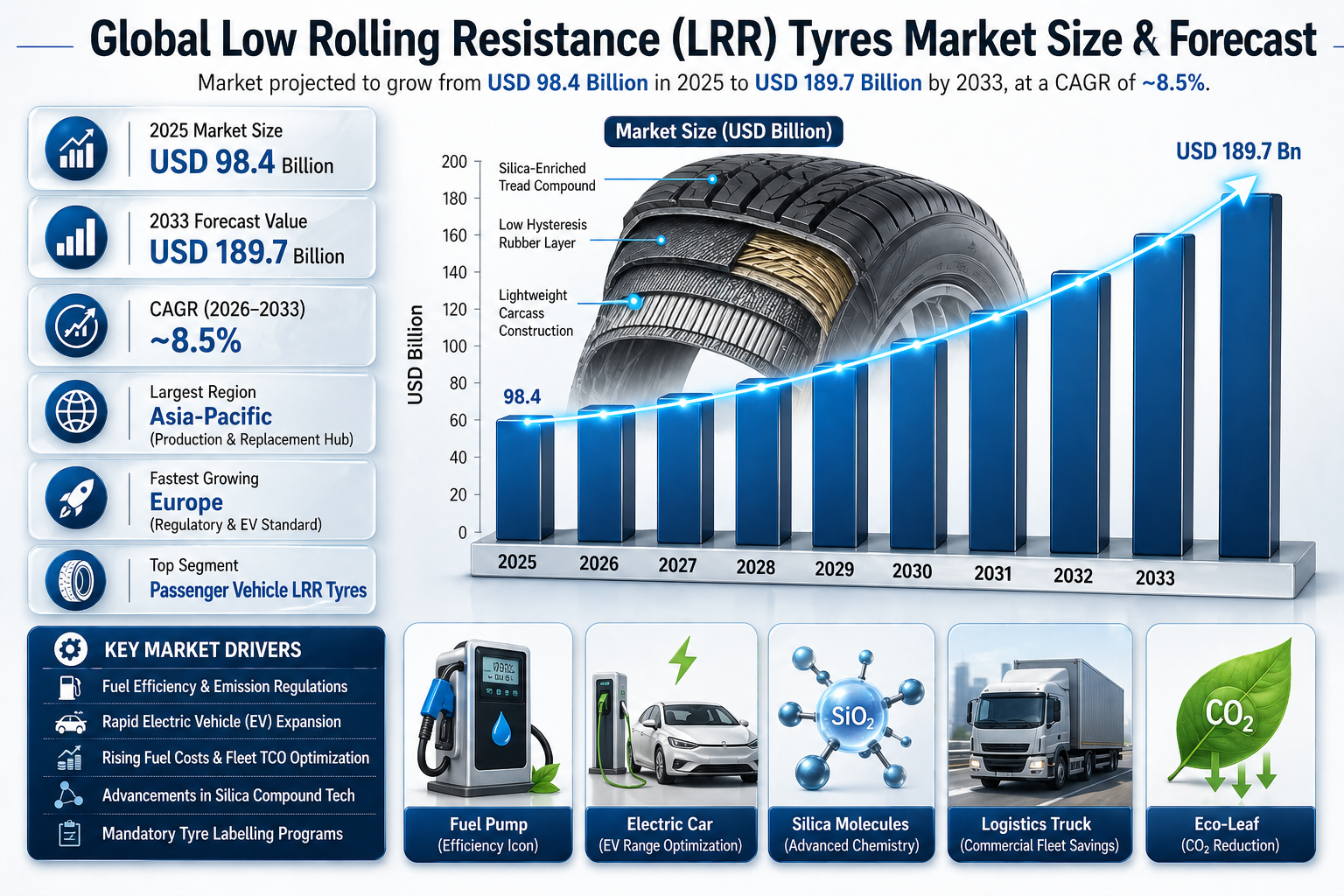
Global Low Rolling Resistance Tyres Market Overview
The Global Low Rolling Resistance (LRR) Tyres Market is all about boosting fuel efficiency, cutting emissions, and helping EVs go farther on a single charge . These tyres use fancy tread patterns, silica compounds, lightweight builds, and smart geometry to reduce energy waste while rolling. Basically, they make your ride smoother and greener without sacrificing performance.
Low rolling resistance tyres show up everywhere???cars, EVs, trucks, bikes, even some off-road rides . You???ll find them as original equipment or replacements in the aftermarket. They???re quickly becoming the go-to choice for new vehicles, especially with governments, manufacturers, and fleets pushing for lower costs and tighter emissions rules. Basically, they help save fuel, cut pollution, and keep your ride smooth.
The Global Low Rolling Resistance (LRR) Tyres Market is shifting from niche to mainstream, making fuel savings and lower emissions accessible to more drivers. It???s a solid step toward greener, cheaper rides for everyone.
According to the Pheonix Demand Forecast Engine, the Global Low Rolling Resistance Tyres Market size is valued at USD 98.4 billion in 2025 and is projected to reach USD 189.7 billion by 2033, growing at a CAGR of ~8.5% during the forecast period (2026???2033).
Asia-Pacific represents the largest market due to high vehicle production and replacement volumes, while Europe is the fastest-growing region, driven by aggressive fuel-efficiency regulations, tyre labeling norms, and EV adoption.
Key Drivers of Global Low Rolling Resistance Tyres Market Growth
Fuel Efficiency & Emission Reduction Regulations
Governments worldwide are enforcing fuel-economy standards and CO??? targets, driving market growth?? and making LRR tyres a regulatory necessity rather than an optional upgrade.
Electric Vehicle Expansion
EVs require tyres that reduce energy loss, extend driving range, and minimize noise???directly accelerating LRR tyre adoption.
Rising Fuel Costs & Fleet TCO Optimization
Fleet operators increasingly adopt LRR tyres to reduce fuel consumption, driving market growth?? and cut operating expenses over long mileage cycles.
Advancements in Tyre Compound Technology
Silica compounds, bio-based fillers, and optimized tread patterns enable performance parity with conventional tyres.
OEM Integration & Tyre Labelling Programs
Mandatory tyre labelling for rolling resistance, wet grip, and noise is pushing OEMs toward LRR fitment.
Global Low Rolling Resistance Tyres Market Segmentation
1. By Tyre Type
1.1 Fuel-Efficient Tyres
1.1.1 Silica-Based Compound Tyres
1.1.1.1 High-dispersion silica tyres
1.1.1.2 Low-energy-loss tread compounds
1.1.2 Lightweight Construction Tyres
1.1.2.1 Reduced mass carcass tyres
1.1.2.2 Optimized sidewall structures
1.2 EV-Optimized Low Rolling Resistance Tyres (Fastest-Growing Segment)
1.2.1 Low-Noise EV Tyres
1.2.1.1 Acoustic foam integrated tyres
1.2.1.2 Noise-dampening tread designs
1.2.2 High-Load EV Tyres
1.2.2.1 Reinforced EV-specific tyres
1.2.2.2 High torque resistance tyres
1.3 Long-Life Energy-Efficient Tyres
1.3.1 Extended Tread-Life Tyres
1.3.1.1 Wear-optimized LRR tyres
1.3.2 Low-Emission Lifecycle Tyres
1.3.2.1 Reduced CO??? footprint tyres
2. By Vehicle Category
2.1 Passenger Vehicles??
2.1.1 Hatchbacks
2.1.1.1 Compact city cars
2.1.2 Sedans
2.1.2.1 Mid-size sedans
2.1.2.2 Premium sedans
2.1.3 SUVs & Crossovers
2.1.3.1 Compact SUVs
2.1.3.4 Mid-size & full-size SUVs
2.2 Electric Vehicles (Fastest-Growing Segment)
2.2.1 Battery Electric Vehicles (BEVs)
2.2.1.1 Electric passenger cars
2.2.1.2 Electric SUVs
2.2.2 Plug-in Hybrid Vehicles (PHEVs)
2.2.2.1 Passenger PHEVs
2.2.2.2 Fleet PHEVs
2.3 Commercial Vehicles
2.3.1 Light Commercial Vehicles (LCVs)
2.3.1.1 Urban delivery fleets
2.3.2 Medium & Heavy Commercial Vehicles
2.3.2.1?? Regional freight trucks
2.3.2.2 Long-haul trucks
2.4 Two-Wheelers & Three-Wheelers
2.4.1 Motorcycles
2.4.1.1 Fuel-efficient motorcycle tyres
2.4.2 Scooters
2.4.2.1 Electric scooters
2.4.2.2 Urban mobility scooters
3. By Sales Channel
3.1 OEM (Original Equipment Manufacturer)
3.1.1 Passenger Vehicle OEM Fitment
3.1.1.1 ICE vehicle OEMs
3.1.1.2 EV OEMs
3.1.2 Commercial & Fleet OEM Contracts
3.1.2.1 Fuel-efficient fleet programs
3.2 Aftermarket / Replacement (Largest Segment)
3.2.1 Authorized Dealer Networks
3.2.1.1 Manufacturer-certified outlets
3.2.2 Independent Tyre Retailers
3.2.2.1 Multi-brand service stores
3.2.3 Fleet Service Providers
3.2.3.1 Mileage-based tyre contracts
3.2.4 Online & E-Commerce Platforms
3.2.4.1 Direct-to-consumer sales
4. By Tyre Technology
4.1 Conventional LRR Tyres
4.1.1 Optimized tread geometry
4.2 Smart Low Rolling Resistance Tyres
4.2.1 Embedded pressure sensors
4.2.2 Load & temperature monitoring
4.3 Sustainable LRR Tyres
4.3.1 Bio-based silica compounds
4.3.2 Recycled material integration
5. By Geography
5.1 Asia-Pacific (Largest Region)
China
India
Japan
South Korea
Southeast Asia
5.2 Europe (Fastest-Growing Region)
Germany
France
U.K.
Italy
5.3 North America
U.S.
Canada
5.4 Latin America
Brazil
Mexico
5.5 Middle East & Africa
Regional Insights of Global Low Rolling Resistance Tyres Market
Asia-Pacific ??? Largest Market
High vehicle production, strong replacement demand, and cost-driven fuel efficiency adoption support market leadership.
Europe ??? Fastest Growing
Strict CO??? targets, tyre labeling regulations, and high EV penetration make LRR tyres industry standard.
North America
Fuel economy regulations, large fleet operations, and growing EV sales drive steady growth.
Latin America
Rising fuel prices and expanding vehicle ownership encourage gradual LRR adoption.
Middle East & Africa
Early-stage adoption driven by fleet efficiency initiatives and premium vehicle growth.
Leading Companies in the Global Low Rolling Resistance Tyres Market
Michelin
Bridgestone Corporation
Goodyear Tire & Rubber Company
Continental AG
Pirelli & C. S.p.A.
Sumitomo Rubber Industries
Hankook Tire
Yokohama Rubber Company
Nokian Tyres
Apollo Tyres
Michelin is the largest company in the Global Low Rolling Resistance Tyres Market
Strategic Intelligence & Pheonix AI-Backed Insights
Pheonix Demand Forecast Engine
Models fuel prices, EV penetration, and regulatory impact.
EV Efficiency Tyre Analyzer
Evaluates range-extension benefits from LRR adoption.
Fleet Cost Optimization Model
Tracks cost-per-kilometer savings for commercial fleets.
Automated Porter???s Five Forces (Concise)
-
Buyer Power: Moderate
-
Supplier Power: Moderate
-
Threat of New Entrants: Low
-
Threat of Substitutes: Low
-
Competitive Rivalry: High
Why the Low Rolling Resistance Tyres Market Is Critical
-
Direct impact on fuel economy and EV driving range
-
Key enabler of automotive decarbonization
-
Strong aftermarket replacement potential
-
Essential for fleet TCO reduction
Final Takeaway of Global Low Rolling Resistance Tyres Market
The Global Low Rolling Resistance Tyres Market is moving from efficiency enhancement to strategic necessity. With rising fuel costs, stricter emission norms, and explosive EV growth, LRR tyres are becoming a standard requirement across vehicle categories. Manufacturers that lead in compound innovation, EV-focused design, and scalable production will capture the strongest growth opportunities through 2033.
Competitive Landscape
Global Low Rolling Resistance Tyres Competitive Intensity & Market Structure Overview
The Global Low Rolling Resistance (LRR) Tyres Market is characterized by an efficiency-driven, regulation-intensive competitive landscape where tyre manufacturers compete on fuel economy performance, EV range enhancement, advanced compound innovation, and OEM platform integration. As fuel-efficiency standards tighten and electric vehicle adoption accelerates, LRR tyres are transitioning from premium efficiency products into mainstream automotive requirements.
The market structure is shaped by the convergence of regulatory compliance, vehicle electrification, and total cost of ownership (TCO) optimization. OEM channels play a major strategic role due to vehicle efficiency mandates and tyre labelling standards, while the aftermarket remains the dominant revenue contributor through replacement cycles across passenger, EV, and fleet segments.
Competitive intensity is high, particularly among Tier 1 tyre manufacturers that possess advanced R&D capabilities in silica compounds, lightweight construction, aerodynamic tread geometry, and sustainable materials. Market competition increasingly extends beyond durability and pricing toward measurable energy savings, carbon reduction, and lifecycle efficiency.
Global Low Rolling Resistance Tyres Competitive Intensity & Market Structure Current Scenario
Leading Company Profiles
Michelin: Global market leader with advanced LRR technologies, strong OEM partnerships, and extensive EV-optimized tyre innovation.
Bridgestone Corporation: Major player in fuel-efficient tyre engineering with broad commercial and passenger LRR portfolios.
Goodyear Tire & Rubber Company: Innovation-focused manufacturer emphasizing silica-based compounds, smart efficiency technologies, and EV compatibility.
Continental AG: Strong regulatory-aligned manufacturer with advanced low-resistance designs and European efficiency leadership.
Pirelli & C. S.p.A.: Premium segment competitor focused on balancing performance, rolling resistance, and luxury EV applications.
Sumitomo Rubber Industries: Expanding LRR portfolio through fuel-efficient compound innovation and regional growth strategies.
Hankook Tire: Rapidly growing supplier in EV-compatible and high-efficiency tyre categories.
Yokohama Rubber Company: Active in sustainable and low rolling resistance commercial tyre solutions.
Nokian Tyres: Efficiency-focused specialist with strong sustainability alignment and regional regulatory expertise.
Key Competitive Intensity & Market Structure Signals in Global Low Rolling Resistance Tyres Market
A major structural signal is the increasing influence of global fuel economy and emissions regulations. Tyre manufacturers must continuously improve rolling resistance performance to meet OEM and regulatory efficiency requirements.
Electrification is another major market-shaping force. EV growth is accelerating competition around range optimization, load-bearing capability, and acoustic comfort, making EV-specific LRR tyres one of the fastest-growing strategic battlegrounds.
Technological differentiation increasingly depends on compound science, including high-dispersion silica, bio-based fillers, and lightweight construction systems that maintain safety and wet grip while reducing energy loss.
Regional regulatory asymmetry strongly shapes competitive positioning, with Europe leading due to tyre labeling mandates and carbon targets, while Asia-Pacific dominates through production scale and expanding fuel-efficiency adoption.
Strategic Implications of Competitive Intensity & Market Structure in Global Low Rolling Resistance Tyres Market
Manufacturers must prioritize R&D investment in rolling resistance reduction while maintaining performance parity in wet grip, durability, and safety. Efficiency gains without performance trade-offs are critical for long-term market leadership.
OEM partnerships are strategically essential, particularly as automakers seek LRR tyres to support fleet-average emissions targets and EV range benchmarks.
Commercial fleets represent a major opportunity, as fleet operators increasingly prioritize cost-per-kilometer optimization, fuel savings, and carbon reduction.
Sustainability integration is becoming increasingly important, with bio-based materials and recycled compounds creating competitive advantages as environmental scrutiny intensifies.
Global Low Rolling Resistance Tyres Competitive Intensity & Market Structure Forward Outlook
The Global Low Rolling Resistance Tyres Market is expected to experience sustained competitive intensity as fuel economy, electrification, and sustainability converge into a unified strategic priority. LRR technology will increasingly become a baseline expectation rather than a premium differentiator.
Tier 1 manufacturers are likely to strengthen dominance through advanced compound innovation, OEM platform integration, and EV-specific product ecosystems, while smaller players may compete primarily through regional cost advantages or niche specialization.
Future competition will be increasingly shaped by three strategic pillars: fuel-efficiency leadership, EV range optimization, and sustainable material integration.
Manufacturers that successfully combine regulatory compliance, energy-saving innovation, and scalable production will define long-term leadership in the Global Low Rolling Resistance Tyres Market through 2033.
Value Chain
Global Low Rolling Resistance Tyres Market Value Chain & Supply Chain Evolution Overview
The Global Low Rolling Resistance (LRR) Tyres Market value chain is evolving from conventional tyre manufacturing toward efficiency-driven, performance-optimized, and increasingly sustainability-aligned production ecosystems. This transformation is primarily fueled by rising fuel-efficiency mandates, EV adoption, stricter emissions regulations, and OEM demand for tyres that reduce rolling energy loss while maintaining safety, durability, and driving performance. LRR tyres are increasingly positioned as strategic products for automotive decarbonization, fleet cost optimization, and EV range enhancement.
Low rolling resistance tyres are engineered using advanced silica compounds, lightweight carcass structures, optimized tread geometry, low-hysteresis rubber formulations, and increasingly bio-based or sustainable fillers. Their value chain extends beyond traditional tyre production into material science innovation, fuel-efficiency engineering, smart design optimization, OEM efficiency partnerships, and digital performance validation.
The upstream supply chain increasingly depends on advanced raw materials including high-dispersion silica, synthetic and bio-based polymers, sustainable fillers, reinforced lightweight materials, and precision engineering compounds. Leading manufacturers such as Michelin, Bridgestone, Continental, Goodyear, and Pirelli are strengthening supplier ecosystems focused on material innovation, rolling resistance reduction, and scalable high-efficiency production.
Manufacturing is centered on precision compounding, lightweight engineering, advanced tread design, and low-energy-loss production technologies. Factories are increasingly integrating automation, sustainable chemistry, and energy-efficient production methods to improve tyre performance while aligning with regulatory and ESG expectations.
Distribution includes both OEM and aftermarket channels, with OEM adoption accelerating due to mandatory efficiency standards and EV integration, while aftermarket replacement remains dominant due to global tyre replacement cycles and consumer fuel-cost sensitivity.
Key supply chain challenges include balancing rolling resistance with wet grip and durability, managing advanced material costs, scaling EV-specific tyre production, and maintaining regulatory compliance across multiple regions.
Global Low Rolling Resistance Tyres Market Value Chain & Supply Chain Evolution Current Scenario
The current LRR tyre ecosystem is shaped by fuel-efficiency regulations, tyre labeling standards, EV growth, fleet TCO priorities, and rising global fuel costs.
Upstream suppliers are increasingly focused on advanced silica chemistry, lightweight reinforcement systems, bio-based fillers, and sustainable compounds to improve efficiency without compromising performance.
Manufacturing strategies increasingly prioritize low-hysteresis compounds, optimized tread architecture, digital simulation tools, and scalable EV tyre production.
OEM integration is expanding rapidly as automakers increasingly standardize LRR tyres across ICE, hybrid, and EV platforms to meet fuel economy and emissions mandates.
The aftermarket remains the largest commercial channel, driven by replacement demand from consumers and fleets seeking fuel savings, longer tread life, and lower operating costs.
Digital tyre labeling, lifecycle transparency, and smart tyre technologies are emerging as strategic differentiators in both premium OEM and replacement segments.
Key Value Chain & Supply Chain Evolution Signals in Global Low Rolling Resistance Tyres Market
Several transformative trends are reshaping the LRR tyre ecosystem.
First, fuel-efficiency and emissions regulations are transforming LRR tyres from premium upgrades into mainstream automotive requirements.
Second, EV expansion is accelerating demand for tyres optimized for range extension, torque handling, and acoustic comfort.
Third, advanced compound innovation is improving rolling resistance performance while preserving wet grip, safety, and longevity.
Fourth, tyre labeling regulations are increasing transparency and pushing OEMs and consumers toward performance-verified products.
Fifth, smart tyre integration and sustainability-enhanced LRR technologies are increasingly shaping next-generation product strategies.
Strategic Implications of Value Chain & Supply Chain Evolution in Global Low Rolling Resistance Tyres Market
Industry leaders such as Michelin, Bridgestone, Continental, Goodyear, and Pirelli are strengthening competitive positioning through compound innovation, lightweight engineering, EV partnerships, and efficiency-focused R&D.
Competitive advantage increasingly depends on access to advanced compounds, scalable precision manufacturing, regulatory compliance, and OEM partnerships.
Manufacturers with superior capabilities in silica chemistry, tread optimization, and EV-specific LRR design are best positioned to capture premium market share.
Long-term success will increasingly rely on balancing fuel savings, emissions reduction, durability, affordability, and evolving EV requirements.
Cost-performance balance remains critical, particularly in emerging markets where fuel savings matter but price sensitivity remains high.
Global Low Rolling Resistance Tyres Market Value Chain & Supply Chain Evolution Forward Outlook
Between 2026 and 2033, the LRR tyre value chain is expected to become increasingly efficiency-centric, EV-optimized, digitally validated, and sustainability-enhanced.
Manufacturers will increasingly prioritize ultra-low rolling resistance compounds, EV-specific architectures, sustainable materials, smart tyre technologies, and automated manufacturing systems.
OEM partnerships will deepen as automakers seek tyres that directly contribute to emissions compliance, EV range maximization, and software-defined mobility performance.
The aftermarket will remain a major growth engine due to rising fuel costs, fleet operating pressures, and consumer awareness of efficiency gains.
Digital tyre monitoring, smart sensors, and sustainable LRR innovations will increasingly shape competitive differentiation.
Ultimately, the future LRR tyre value chain will evolve from fuel-saving product manufacturing into integrated mobility efficiency ecosystems.
Market-Specific Value Chain
- Advanced Raw Material Procurement: High-dispersion silica, lightweight polymers, low-hysteresis compounds, sustainable fillers, reinforced materials
- Research & Development: Tread optimization, EV-specific LRR design, fuel-efficiency engineering, smart tyre integration, low-noise technologies
- Manufacturing: Precision compounding, lightweight tyre production, automated design validation, energy-efficient factories, scalable EV tyre production
- OEM Integration: ICE vehicles, hybrids, EVs, fleet efficiency programs, regulatory-compliant vehicle platforms
- Distribution & Retail: OEM channels, replacement markets, dealer networks, e-commerce, fleet service providers
- Performance Lifecycle Services: Fuel-efficiency validation, tyre monitoring, predictive maintenance, recycling integration, lifecycle optimization
Company-to-Stage Mapping
- Advanced Raw Material Procurement: Michelin, Bridgestone Corporation, Continental AG, Goodyear Tire & Rubber Company
- Research & Development: Michelin, Continental AG, Pirelli & C. S.p.A., Nokian Tyres
- Manufacturing: Bridgestone Corporation, Goodyear Tire & Rubber Company, Hankook Tire, Yokohama Rubber Company
- OEM Integration: Michelin, Bridgestone Corporation, Continental AG, Pirelli & C. S.p.A.
- Distribution & Retail: Apollo Tyres, Goodyear Tire & Rubber Company, Yokohama Rubber Company, Nokian Tyres
- Performance Lifecycle Services: Michelin, Bridgestone Corporation, Continental AG, fleet ecosystem partners
Investment Activity
Global Low Rolling Resistance (LRR) Tyres Market Investment & Funding Dynamics Overview
Investment and funding dynamics in the Global Low Rolling Resistance (LRR) Tyres Market are being driven by accelerating fuel-efficiency mandates, global vehicle electrification, tightening carbon emission regulations, and increasing demand for lower total cost of ownership across passenger and commercial mobility. Between 2026 and 2033, capital allocation is expected to increasingly prioritize advanced silica compounds, lightweight tyre construction, EV-optimized LRR platforms, smart tread engineering, and scalable energy-efficient tyre production systems. The market is highly technology- and performance-driven, requiring sustained investment in compound chemistry, tread pattern optimization, lightweight carcass materials, aerodynamic tyre geometry, and rolling resistance analytics. Leading manufacturers such as Michelin, Bridgestone, Goodyear, Continental, Pirelli, and Sumitomo are significantly expanding R&D investments focused on fuel-saving technologies, EV range optimization, and next-generation low-energy tyre systems. A major structural transformation shaping investment patterns is the shift of LRR tyres from fuel-efficiency upgrades into strategic mobility essentials for ICE, hybrid, and electric vehicles. This evolution is directing funding toward tyres that optimize energy consumption while maintaining safety, durability, and performance standards across vehicle categories.
Global Low Rolling Resistance (LRR) Tyres Market Investment & Funding Dynamics Current Scenario
Currently, investment activity is strongly supported by stricter global fuel economy regulations, mandatory tyre labeling systems, OEM sustainability strategies, and growing EV adoption. Strategic collaborations between tyre manufacturers, EV OEMs, material science companies, and fleet operators are central to current capital deployment.
- Asia-Pacific: Leads global investment activity due to high vehicle production scale, expanding replacement demand, and strong cost-driven fuel efficiency adoption across major automotive markets.
- Europe: Fastest-growing investment region, driven by aggressive CO reduction mandates, tyre labeling regulations, premium EV growth, and sustainability-led automotive innovation.
- North America: Strong investment momentum supported by fleet fuel-efficiency initiatives, rising EV penetration, and OEM commitments to energy optimization.
- Latin America & Middle East & Africa: Emerging markets seeing gradual investment growth through rising fuel cost sensitivity, commercial fleet modernization, and regulatory evolution.
Key Investment & Funding Dynamics Signals in Global Low Rolling Resistance (LRR) Tyres Market
- Rising fuel prices and fleet TCO optimization are accelerating capital inflows into advanced low rolling resistance tyre technologies.
- Rapid EV adoption is increasing investment in LRR tyres optimized for battery efficiency, noise reduction, and extended driving range.
- Technological advancements in silica-rich compounds, bio-based fillers, and lightweight construction are attracting major R&D funding.
- OEM fitment expansion is creating long-term revenue opportunities, encouraging production line expansion for energy-efficient tyres.
- Government regulations on fuel economy, emissions, and tyre labeling are strengthening investor confidence in long-term LRR adoption.
Strategic Implications of Investment & Funding Dynamics in Global Low Rolling Resistance (LRR) Tyres Market
- The investment landscape strongly favors global tyre manufacturers with advanced material science capabilities, OEM integration, and scalable production infrastructure.
- Strategic partnerships with EV manufacturers, commercial fleets, and sustainability ecosystems are becoming essential competitive advantages.
- Technological differentiation increasingly centers on balancing ultra-low rolling resistance with wet grip, safety, durability, and noise performance.
- Regional diversification remains critical, with Asia-Pacific leading scale, Europe driving regulatory innovation, and North America focusing on fleet and EV economics.
- Raw material cost volatility, performance certification, and balancing efficiency with safety remain major strategic investment priorities.
Global Low Rolling Resistance (LRR) Tyres Market Investment & Funding Dynamics Forward Outlook
Looking ahead, the Global Low Rolling Resistance Tyres Market is expected to attract robust and sustained investment as energy efficiency becomes a foundational requirement across global mobility ecosystems. Future capital allocation will increasingly prioritize EV-specific LRR tyre innovation, smart rolling resistance analytics, sustainable LRR compounds, advanced lightweight designs, and next-generation energy optimization systems.
- Asia-Pacific: Will remain the dominant investment hub due to manufacturing scale, broad vehicle production, and expanding fuel-efficiency demand.
- Europe: Will continue leading premium innovation in regulatory-compliant, EV-focused, and sustainability-enhanced LRR technologies.
- North America: Will expand investments in commercial fleet optimization, EV range enhancement, and premium fuel-saving tyre solutions.
Digital modeling tools, EV efficiency analytics, and lifecycle carbon optimization frameworks will increasingly shape future funding strategies across the market. Overall, the market will maintain strong long-term growth through 2033, supported by its critical role in fuel savings, EV efficiency, emissions reduction, and automotive decarbonization. Companies that align compound innovation, scalable production, EV partnerships, and performance optimization will be best positioned to lead the next phase of global tyre market evolution.
Technology & Innovation
Global Low Rolling Resistance (LRR) Tyres Market Technology & Innovation Landscape Overview
The technology and innovation landscape within the global low rolling resistance (LRR) tyres market is driven by the growing need for fuel efficiency, EV range optimization, emissions reduction, and total cost of ownership improvement. As governments tighten fuel economy regulations and automakers accelerate electrification, LRR tyres are becoming a critical innovation pillar across passenger vehicles, EVs, commercial fleets, and sustainable mobility platforms.
Innovation intensity in the market is high and rapidly evolving, supported by advancements in silica-rich compounds, lightweight structural engineering, tread geometry optimization, and sustainable material science. Unlike traditional tyres that prioritized grip and durability alone, LRR tyre innovation increasingly focuses on balancing rolling efficiency, wet grip, braking safety, noise reduction, and long-term tread life. Leading manufacturers such as Michelin, Bridgestone Corporation, Goodyear Tire & Rubber Company, Continental AG, and Pirelli & C. S.p.A. are aggressively investing in next-generation compound technologies, EV-specific tyre platforms, and smart energy-optimized tyre systems.
A major technological shift is the rise of EV-optimized LRR tyres, which are specifically engineered to support heavier battery loads, instant torque delivery, and reduced energy loss. These tyres increasingly integrate reinforced sidewalls, acoustic foam technologies, and advanced silica compounds to improve battery range while maintaining safety. Additionally, smart tyre integration is expanding, with embedded sensors and connected pressure systems improving real-time efficiency and maximizing rolling performance.
Global Low Rolling Resistance (LRR) Tyres Market Technology & Innovation Landscape Current Scenario
Currently, the technology landscape in the global LRR tyres market is centered on maximizing energy efficiency without compromising safety, durability, or consumer driving experience. Manufacturers are refining material science and digital engineering capabilities to produce tyres that significantly reduce rolling resistance while preserving braking, wet grip, and lifecycle performance.
Silica-based compound engineering is one of the most important innovation drivers. High-dispersion silica, advanced coupling agents, and functionalized polymers are replacing older carbon-black-heavy formulations to lower hysteresis while maintaining road traction. These compounds directly improve fuel savings in ICE vehicles and battery efficiency in EVs.
Lightweight tyre architecture is another major focus area. Optimized sidewalls, reduced-mass carcasses, reinforced belts, and AI-assisted structural simulation are helping reduce tyre weight and rotational inertia. This innovation improves fuel efficiency and extends EV range while preserving handling and durability.
EV-specific LRR tyres are becoming a major product development priority. These tyres are designed to manage heavier EV battery loads, increased torque demands, and lower cabin noise expectations. Acoustic foam layers, reinforced load-bearing structures, and low-noise tread patterns are increasingly common in premium EV tyre portfolios.
Smart and connected tyre technologies are gradually entering the LRR segment. Embedded sensors that track tyre pressure, temperature, and wear help optimize inflation efficiency and rolling resistance in real time. This is particularly valuable for fleets where small efficiency gains translate into large cost savings.
Sustainability innovation is also reshaping the market. Manufacturers are increasingly integrating bio-silica, soybean oil compounds, recycled fillers, and renewable elastomers to align LRR performance with environmental sustainability goals.
Key Technology & Innovation Landscape Signals in Global Low Rolling Resistance (LRR) Tyres Market
- Silica-Rich Compound Innovation: Advanced silica compounds and functional polymers are reducing energy loss while preserving safety performance.
- EV-Optimized LRR Tyres: Rising demand for reinforced, low-noise, high-efficiency tyres designed specifically for electric vehicles.
- Lightweight Structural Engineering: Reduced-mass carcasses and optimized sidewalls improve rotational efficiency and range.
- AI-Driven Tread Design: Digital twin simulation and predictive modeling accelerate performance optimization.
- Smart Efficiency Monitoring: Sensor-integrated tyres improve rolling resistance through real-time pressure and wear optimization.
- Sustainable Material Integration: Bio-based silica, plant oils, and recycled compounds align efficiency with ESG goals.
- Noise Reduction Technologies: Acoustic foam and optimized tread sequencing enhance EV and premium vehicle comfort.
Strategic Implications of Technology & Innovation Landscape in Global Low Rolling Resistance (LRR) Tyres Market
The evolving technology landscape has major strategic implications for tyre manufacturers, OEMs, fleet operators, and EV ecosystem participants. Continuous R&D investment is essential to balance efficiency, safety, durability, and sustainability as LRR tyres become standard across vehicle categories.
The transition toward electric mobility is reshaping tyre innovation priorities. Manufacturers that successfully engineer EV-compatible LRR tyres with range optimization, low noise, and high-load tolerance will gain significant OEM integration advantages.
Smart tyre technologies are gradually transforming LRR tyres from passive fuel-saving products into active energy-management tools. Connected efficiency monitoring can create service-based business models, fleet analytics opportunities, and predictive efficiency optimization.
Sustainability is becoming a strategic differentiator. Companies investing in renewable materials, low-carbon compounds, and circular production systems are likely to strengthen regulatory compliance and ESG competitiveness.
For fleets, advanced LRR tyre technologies offer measurable fuel savings, lower operating expenses, and improved lifecycle economics. Cost-per-kilometer performance is increasingly becoming a key competitive benchmark.
Global Low Rolling Resistance (LRR) Tyres Market Technology & Innovation Landscape Forward Outlook
Looking ahead, the global LRR tyres market is expected to evolve toward increasingly intelligent, electrification-ready, and sustainability-driven tyre ecosystems. EV adoption will remain the strongest innovation catalyst, accelerating demand for next-generation tyres that combine low rolling resistance, high durability, and smart performance monitoring.
AI-driven tyre design, predictive analytics, and digital engineering platforms are expected to shorten innovation cycles and improve customization for specific vehicle platforms. Connected tyres may increasingly integrate with broader vehicle software ecosystems.
Material innovation will continue advancing through bio-based elastomers, recycled fillers, advanced silica systems, and sustainable manufacturing processes. This will further align LRR tyres with decarbonization and circular economy objectives.
Manufacturing will become more automated and digitally optimized, with smart factories enabling precision curing, consistency improvements, and faster scale-up of innovative compounds.
In conclusion, the Global Low Rolling Resistance Tyres Market is transitioning from fuel-efficiency innovation to a strategic mobility technology platform. Companies that successfully combine efficiency, EV readiness, smart functionality, and sustainability will be best positioned to lead the market through 2033.
Market Risk
Global Low Rolling Resistance Tyres Market Risk Factors & Disruption Threats Overview
The Global Low Rolling Resistance (LRR) Tyres Market operates within an increasingly regulation-driven and efficiency-focused automotive ecosystem, where fuel economy mandates, EV range optimization, and lifecycle cost reduction are reshaping tyre technology priorities. While the market benefits from strong structural demand tied to decarbonization, rising fuel prices, and EV adoption, it carries a moderate strategic risk profile due to raw material volatility, performance trade-off perceptions, evolving regulatory standards, and premium pricing sensitivity. A major structural risk is advanced material dependency. LRR tyres rely heavily on silica-rich compounds, lightweight reinforcements, low-hysteresis rubber, and precision tread engineering, all of which are vulnerable to commodity price fluctuations, supply chain disruption, and specialty material shortages. Another critical disruption factor is performance balance complexity. While LRR tyres are optimized for fuel efficiency and lower rolling resistance, manufacturers must simultaneously maintain wet grip, braking performance, tread durability, and high-load capability. Any perceived compromise in safety or longevity can slow consumer and fleet adoption. Regulatory acceleration is also intensifying market pressure. Fuel-efficiency mandates, tyre labeling systems, emissions standards, and sustainability expectations are increasing compliance costs while shortening product redesign cycles. The rapid expansion of EVs adds further complexity, as EV-specific LRR tyres must balance range extension, noise reduction, battery load-bearing, and torque durability’raising R&D costs and innovation demands.
Global Low Rolling Resistance Tyres Market Risk Factors & Disruption Threats Current Scenario
The current market environment reflects strong long-term growth potential supported by regulatory momentum, OEM standardization, and fleet total cost of ownership optimization. However, these growth drivers are counterbalanced by supply chain instability, competitive pricing pressure, and evolving consumer expectations. Raw material sourcing remains a major operational concern, particularly for advanced silica, synthetic elastomers, and sustainable fillers, where cost fluctuations can materially impact profitability. OEMs are increasingly demanding higher efficiency standards while simultaneously pressuring suppliers on pricing, creating margin compression risks for tyre manufacturers. Consumer adoption continues to rise, but price-sensitive buyers in emerging markets may resist premium-priced LRR tyres despite long-term fuel savings benefits. At the same time, aftermarket competition from low-cost alternatives and counterfeit ???fuel-efficient tyres may create category trust challenges.
Key Risk Factors & Disruption Threats Signals in Global Low Rolling Resistance Tyres Market
A major disruption signal is the tightening of fuel economy and tyre labeling regulations globally, particularly across Europe, where compliance complexity continues to rise. Technological advances in EV tyre engineering, smart tyres, and sustainable compounds are reshaping competitive dynamics, potentially creating innovation gaps between global leaders and smaller manufacturers. Fleet electrification remains a major growth signal, as logistics and mobility operators increasingly prioritize LRR tyres for energy efficiency and cost savings. Raw material inflation and specialty compound shortages remain persistent supply-side warning signals that may impact scalability. Additionally, sustainability integration’including bio-based fillers and recycled content’may become a stronger market differentiator, creating disruption for manufacturers slow to adapt.
Strategic Implications of Risk Factors & Disruption Threats in Global Low Rolling Resistance Tyres Market
Manufacturers must prioritize compound innovation that balances fuel efficiency with safety, durability, and EV compatibility to sustain market leadership. Diversified raw material sourcing and supply chain resilience will be critical to reducing exposure to specialty material volatility. Scaling affordable LRR product portfolios for emerging markets will be essential for broader global penetration beyond premium segments. OEM partnerships will become increasingly strategic, particularly as automakers integrate LRR tyres more deeply into fuel economy and EV platform design. Companies that integrate sustainability, smart tyre features, and regulatory readiness into product development will be best positioned to defend long-term competitiveness.
Global Low Rolling Resistance Tyres Market Risk Factors & Disruption Threats Forward Outlook
Looking ahead to 2026-2033, the Global Low Rolling Resistance Tyres Market is expected to evolve from an efficiency-driven product category into a foundational pillar of sustainable mobility infrastructure. However, long-term market leadership will depend on manufacturers’ ability to manage technological sophistication, compliance evolution, and affordability. LRR tyres are likely to transition from optional efficiency upgrades to default OEM and fleet standards across major vehicle categories. EV-specific LRR tyres will become one of the highest-value growth segments, particularly in Europe and Asia-Pacific. Sustainability-linked LRR innovations, including recycled compounds and bio-based materials, may increasingly define competitive advantage. Overall, the market will remain highly attractive but operationally demanding, with future winners determined by advanced material science, balanced performance engineering, resilient supply ecosystems, and scalable regulatory compliance.
Regulatory Landscape
Global Low Rolling Resistance Tyres Market Regulatory & Policy Environment Overview
The regulatory and policy environment for the Global Low Rolling Resistance (LRR) Tyres Market is a major structural force accelerating the global transition toward fuel-efficient, low-emission, and energy-optimized mobility. Governments, automotive regulators, environmental agencies, and transportation policy frameworks worldwide are increasingly prioritizing fuel economy, carbon reduction, emissions compliance, and EV efficiency’positioning low rolling resistance tyres as a strategic compliance-driven technology rather than an optional performance upgrade. Global policy frameworks such as the European Union Tyre Labelling Regulation (EU 2020/740), UNECE tyre standards, Corporate Average Fuel Economy (CAFE) standards, EPA fuel efficiency regulations, EV range optimization frameworks, and global CO reduction mandates are significantly reshaping tyre industry priorities. These regulations increasingly favor tyre technologies that minimize energy loss, improve fuel economy, lower emissions, and enhance overall vehicle efficiency. Low rolling resistance tyres inherently align with these policy goals by reducing energy required for vehicle motion, improving ICE fuel efficiency, extending EV battery range, lowering CO emissions, and supporting sustainability objectives. Through advanced silica compounds, optimized tread geometry, lightweight construction, and intelligent tyre design, LRR tyres are increasingly becoming essential for regulatory compliance across global automotive markets. Emerging economies including China, India, Brazil, Southeast Asia, and Latin America are also strengthening fuel-efficiency mandates, tyre quality frameworks, and emissions standards. These regulatory developments are broadening adoption of LRR tyres across passenger vehicles, EVs, commercial fleets, and two-wheelers.
Global Low Rolling Resistance Tyres Market Regulatory & Policy Environment Current Scenario
The current regulatory landscape is defined by the convergence of fuel economy mandates, carbon reduction targets, vehicle electrification, and consumer transparency initiatives. Europe remains the global regulatory leader due to stringent tyre labeling regulations, aggressive CO reduction policies, and high EV penetration. In Europe, tyre labeling systems strongly influence OEM fitment and aftermarket purchasing by emphasizing rolling resistance, wet grip, and noise performance. Regulatory frameworks are increasingly making LRR tyres a baseline requirement for vehicle efficiency compliance. Asia-Pacific currently represents the largest production and demand region, with governments increasingly strengthening fuel economy policies and EV support frameworks. China’s New Energy Vehicle policies, India’s fuel-efficiency standards, and Japan’s advanced efficiency regulations are significantly accelerating LRR tyre adoption. North America maintains a strong policy environment through CAFE standards, EPA regulations, and rising EV adoption. Large fleet operators are also increasingly influenced by fuel-efficiency regulations and operational cost optimization strategies. EV expansion globally is significantly reinforcing LRR tyre policy relevance, as regulators and OEMs prioritize tyres capable of maximizing range, reducing battery energy loss, and minimizing acoustic impact.
Key Regulatory & Policy Environment Signals in Global Low Rolling Resistance Tyres Market
- EU Tyre Labelling Regulation (EU 2020/740): Drives rolling resistance transparency and fuel-efficiency prioritization.
- UNECE Tyre Standards: Reinforce efficiency, safety, and performance benchmarks.
- Corporate Average Fuel Economy (CAFE) Standards: Push OEMs toward fuel-saving tyre technologies.
- EPA & Global Emissions Regulations: Support low rolling resistance technologies to reduce fuel consumption.
- EV Efficiency Regulations: Prioritize range optimization and low-energy-loss tyre systems.
- Fleet Fuel Economy Compliance Programs: Encourage LRR adoption in logistics and commercial transport.
- Consumer Transparency & Tyre Labeling Programs: Increase awareness and purchasing preference for energy-efficient tyres.
Strategic Implications of Regulatory & Policy Environment in Global Low Rolling Resistance Tyres Market
The regulatory landscape is transforming LRR tyres from a premium efficiency segment into a mainstream strategic necessity. Manufacturers increasingly need to align product portfolios with tightening fuel economy, emissions, and EV performance standards to maintain competitiveness. Companies heavily dependent on conventional higher-resistance tyre technologies may face structural disadvantages as policy increasingly rewards efficiency leadership. This is accelerating investments in advanced silica compounds, lightweight materials, optimized carcass engineering, and EV-specific LRR designs. Compliance-led innovation is becoming a major competitive differentiator. Manufacturers that combine fuel efficiency, EV optimization, safety, durability, and sustainability are increasingly securing stronger OEM integration and aftermarket growth. Fleet operators are also reshaping procurement strategies around LRR tyres to reduce fuel costs, improve sustainability metrics, and meet operational compliance targets. Lifecycle savings and total cost of ownership are becoming critical policy-linked purchasing factors. Regional policy variation is influencing localization, certification pathways, and product engineering strategies, requiring manufacturers to develop region-specific LRR solutions aligned with local regulations.
Global Low Rolling Resistance Tyres Market Regulatory & Policy Environment Forward Outlook
Between 2026 and 2033, the regulatory environment is expected to become significantly more stringent, with fuel efficiency and emissions standards increasingly integrated into broader decarbonization, EV, and sustainable mobility frameworks. Europe is expected to remain the regulatory benchmark through stricter carbon reduction mandates, advanced tyre transparency systems, and sustainability integration. Asia-Pacific is projected to become the largest long-term regulatory growth engine due to rising motorization, EV growth, and tightening fuel economy standards. North America is expected to strengthen through fleet fuel-efficiency mandates, EV transition, and regulatory modernization. Future regulations are likely to evolve toward lifecycle carbon assessments, intelligent efficiency monitoring, advanced EV tyre performance standards, and sustainable LRR material requirements. Advanced technologies such as EV-specific LRR architectures, smart pressure optimization systems, bio-based silica compounds, AI-driven tread design, and intelligent tyre efficiency analytics are expected to gain increasing regulatory significance. Overall, the regulatory and policy environment will be a decisive enabler of adoption, innovation, and standardization across the Global Low Rolling Resistance Tyres Market. Manufacturers that proactively align with evolving fuel-efficiency, emissions, EV, and sustainability regulations while scaling advanced LRR innovation will be best positioned to lead this rapidly expanding market through 2033.