
Saudi Arabia Camel Milk Dairy Products Market size and share 2026 -2033
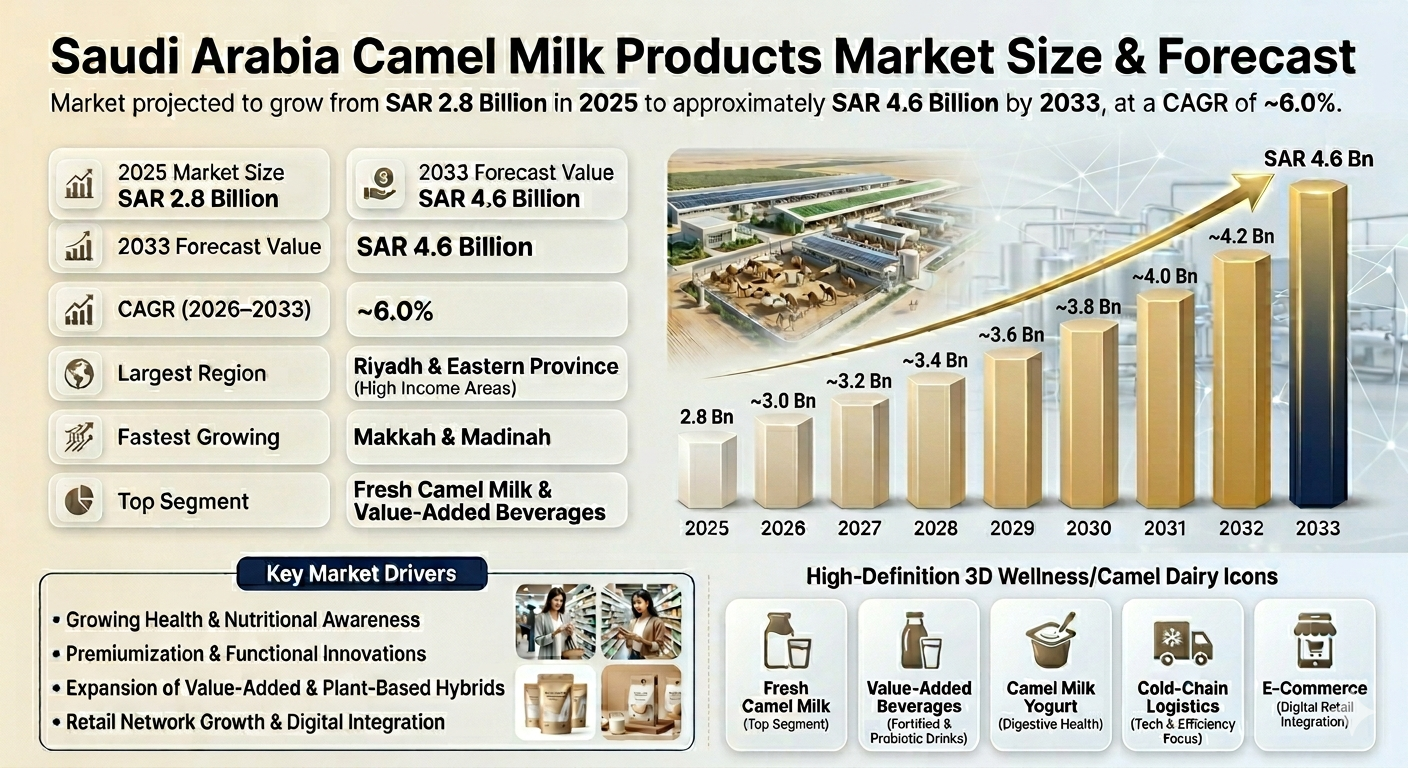
Saudi Arabia Camel Milk Products Market Forecast Snapshot: 2026???2033
| Metric | Value |
| 2025 Market Size | SAR 2.8 Billion |
| 2033 Market Size | ~SAR 4.6 Billion |
| CAGR (2026???2033) | ~6.0% |
| Largest Region | Riyadh & Eastern Province |
| Fastest Growing Region | Makkah & Madinah |
| Top Segment | Fresh Camel Milk & Value-Added Beverages |
| Key Trend | Functional Camel Milk Products, Premiumization & Dairy Innovation |
| Future Focus | Digital Retail Integration, Sustainable Camel Farming, and Value-Added Products |
Saudi Arabia Camel Milk Products Market Overview
The Saudi Arabia Camel Milk Products Market is buzzing.Camel milk is the new superfood in Saudi Arabia, driven by health-conscious consumers and a taste for premium dairy. Traditionally valued for its nutritional benefits, camel milk is now being transformed into cool products like flavoured drinks, fortified milk, and other functional goodies, thanks to its health perks (rich in nutrients and medicinal properties), premium appeal (gaining popularity among high-end consumers), and innovative products (from plain milk to flavoured drinks and fortified options).
According to Pheonix Research, the Saudi Arabia Camel Milk Products Market?? was valued at SAR 2.8 billion in 2025 and is projected to reach ~SAR 4.6 billion by 2033, growing at a CAGR of ~6.0% during 2026???2033. Urban centers such as Riyadh and the Eastern Province dominate market consumption due to higher income levels and advanced retail and e-commerce penetration.
Meanwhile, regions like Makkah and Madinah are emerging as high-growth areas, fueled by rising health-conscious consumer segments and expanding camel dairy farms.
Looking ahead, the post-2025 outlook indicates that companies that invest in product innovation, functional nutrition, and digital distribution channels will be well-positioned to capitalize on the growing camel milk market in Saudi Arabia, achieving long-term growth and market leadership.Key Drivers of Saudi Arabia Camel Milk Products Market Growth
-
Growing Health & Nutritional Awareness
Camel milk is naturally rich in vitamins, minerals, and bioactive compounds. Rising awareness of its digestive and immune-support benefits fuels demand among health-conscious adults, fitness enthusiasts, and pediatric nutrition markets. -
Premiumization & Functional Dairy Innovations
High-income urban populations drive demand for premium camel milk products, fortified beverages, flavored milk, and specialty camel dairy items. Functional innovations supporting immunity, digestion, and overall wellness are gaining traction. -
Expansion of Value-Added & Plant-Based Hybrids
Camel milk blends with plant-based alternatives (soy, almond) and flavored innovations attract lactose-sensitive and flexitarian consumers. -
Retail Network Growth & Digital Integration
Supermarkets, hypermarkets, convenience stores, and online grocery platforms expand accessibility. Subscription services and e-commerce facilitate convenient, tech-enabled delivery. -
Technological Advancements & Supply Chain Optimization
Smart processing, cold-chain logistics, AI-enabled demand forecasting, and sustainable farming practices reduce waste, enhance quality, and improve operational efficiency.
Saudi Arabia Camel Milk Products Market Segmentation
?? ?? ?? ?? 1. By Product Type
1.1 Fresh Camel Milk 1.1.1 Whole Camel Milk 1.1.1.1 Standard Whole Camel Milk 1.1.1.2 Premium/Organic Whole Camel Milk 1.1.1.3 Fortified Whole Camel Milk 1.1.2 Low-Fat & Skimmed Camel Milk 1.1.2.1 Low-Fat Camel Milk 1.1.2.2 Skimmed Camel Milk 1.1.2.3 Lactose-Free Camel Milk 1.1.3 Flavored Camel Milk 1.1.3.1 Chocolate / Cocoa Camel Milk 1.1.3.2 Fruit-Flavored Camel Milk 1.1.3.3 Specialty / Limited Edition Blends 1.2 Value-Added Camel Milk Beverages 1.2.1 Fortified Camel Milk Drinks 1.2.1.1 Vitamin & Mineral Enriched 1.2.1.2 Protein-Fortified 1.2.1.3 Immunity-Boosting Blends 1.2.2 Probiotic & Functional Camel Milk 1.2.2.1 Digestive Health Drinks 1.2.2.2 Gut-Friendly Fermented Beverages 1.2.2.3 Functional Wellness Blends 1.2.3 Ready-to-Drink Camel Milk Blends 1.2.3.1 Single-Serve Bottled Drinks 1.2.3.2 Multi-Flavor Packs 1.2.3.3 On-the-Go Functional Packs 1.3 Camel Milk Yogurt & Fermented Products 1.3.1 Regular Yogurt 1.3.1.1 Plain Yogurt 1.3.1.2 Flavored Yogurt 1.3.1.3 Low-Fat Yogurt 1.3.2 Greek / High-Protein Yogurt 1.3.2.1 Traditional Greek Yogurt 1.3.2.2 High-Protein Blends 1.3.2.3 Fortified Greek Yogurt 1.3.3 Probiotic & Functional Yogurt 1.3.3.1 Adult Digestive Support 1.3.3.2 Pediatric Probiotic Formulas 1.3.3.3 Immunity & Wellness Yogurt 1.4 Camel Milk Cheese & Butter 1.4.1 Hard Cheese 1.4.1.1 Cheddar-Style 1.4.1.2 Gouda & Specialty Varieties 1.4.1.3 Premium Artisan Hard Cheese 1.4.2 Soft Cheese & Spreads 1.4.2.1 Cream Cheese 1.4.2.2 Ricotta & Cottage Cheese 1.4.2.3 Flavored / Herb-Infused Spreads 1.4.3 Butter & Cream 1.4.3.1 Unsalted Butter 1.4.3.2 Salted Butter 1.4.3.3 Cream Products (Whipping / Dessert) 1.5 Camel Milk-Based Desserts 1.5.1 Ice Cream & Gelato 1.5.1.1 Traditional Flavors 1.5.1.2 Low-Sugar / Healthy Options 1.5.1.3 Premium & Artisan Gelato 1.5.2 Puddings & Custards 1.5.2.1 Standard Desserts 1.5.2.2 Fortified / Functional Puddings 1.5.2.3 Flavored / Seasonal Specials?? ?? ?? ??2. By Application
2.1 Retail Consumption 2.1.1 Supermarkets & Hypermarkets 2.1.1.1 Premium Dairy Sections 2.1.1.1.1 Greek & High-Protein Yogurt 2.1.1.1.2 Fortified Camel Milk Beverages 2.1.1.1.3 Specialty Camel Milk Cheeses 2.1.1.2 Mass-Market Aisles 2.1.1.2.1 Standard Fresh Camel Milk 2.1.1.2.2 Flavored Yogurts & Desserts 2.1.1.2.3 Processed Cheese & Spreads 2.1.2 Convenience Stores 2.1.2.1 Grab-and-Go Dairy Packs 2.1.2.1.1 Single-Serve Camel Milk Bottles 2.1.2.1.2 Ready-to-Drink Yogurt Cups 2.1.2.2 Refrigerated Snacks & Beverages 2.1.2.2.1 Protein-Enriched Drinks 2.1.2.2.2 Low-Sugar Yogurts 2.1.3 Specialty Health Stores 2.1.3.1 Organic & Lactose-Free Products 2.1.3.1.1 A2 Camel Milk 2.1.3.1.2 Plant-Based Hybrids 2.1.3.2 Probiotic & Fortified Functional Beverages 2.1.4 Online Grocery Platforms 2.1.4.1 Subscription-Based Delivery 2.1.4.1.1 Fresh Camel Milk Delivery 2.1.4.1.2 Curated Yogurt & Cheese Boxes 2.1.4.2 E-Commerce Marketplaces 2.1.4.2.1 Retailer-Hosted Online Stores 2.1.4.2.2 Brand-Owned Online Platforms 2.2 Foodservice & HoReCa 2.2.1 Hotels 2.2.1.1 Specialty Camel Milk Beverages 2.2.1.1.1 Dessert Applications 2.2.1.1.2 Mini-Bar Products 2.2.2 Restaurants 2.2.2.1 Cheese-Based Dishes & Sauces 2.2.2.1.1 Camel Milk Cheese Dishes 2.2.2.1.2 Dairy-Based Dressings & Sauces 2.2.2.2 Beverage Applications 2.2.2.2.1 Camel Milk Lassis 2.2.2.2.2 Milkshake & Coffee Integrations 2.2.3 Caf??s & Smoothie Bars 2.2.3.1 Camel Milk Smoothies & Drinks 2.2.3.1.1 Functional Wellness Smoothies 2.2.3.1.2 Plant-Based Blends 2.2.3.2 Specialty Coffee Applications 2.2.3.2.1 Lattes & Foam-Based Drinks 2.2.3.2.2 Creamer & Milk Alternatives 2.2.4 Institutional Catering 2.2.4.1 Hospitals & Clinics 2.2.4.1.1 Nutritional Camel Milk Beverages 2.2.4.1.2 Fortified Desserts 2.2.4.2 Schools & Colleges 2.2.4.2.1 Packaged Milk Programs 2.2.4.2.2 Yogurt & Dairy Snacks 2.3 Preventive & Functional Nutrition 2.3.1 Digestive Health Programs 2.3.1.1 Probiotic Drinks 2.3.1.1.1 Adult Digestive Support 2.3.1.1.2 Pediatric Probiotics 2.3.1.2 Fermented Camel Milk Beverages 2.3.1.2.1 Kefir-Based Drinks 2.3.1.2.2 Live-Culture Milk Drinks 2.3.2 Fitness & Protein Nutrition 2.3.2.1 High-Protein Camel Milk Products 2.3.2.1.1 Whey-Enriched Yogurts 2.3.2.1.2 Protein Shakes & Supplements 2.3.2.2 Functional Recovery Beverages 2.3.2.2.1 Electrolyte Drinks 2.3.2.2.2 Dairy-Based Smoothies 2.3.3 Pediatric Nutrition 2.3.3.1 Infant & Toddler Camel Milk Formulas 2.3.3.1.1 Fortified Cow-Camel Blends 2.3.3.1.2 Goat-Camel Hybrid Formulas 2.3.3.2 Early Childhood Snacks 2.3.3.2.1 Flavored Yogurt Cups 2.3.3.2.2 Calcium-Fortified Desserts 2.3.4 Senior Health Diets 2.3.4.1 Bone Health Supplements 2.3.4.1.1 High-Calcium Camel Milk 2.3.4.1.2 Fortified Snacks & Desserts 2.3.4.2 Easy-Digestion Camel Milk 2.3.4.2.1 Lactose-Free Beverages 2.3.4.2.2 Probiotic Drinks for Seniors?? ?? ?? ?? ?? ??3. By Distribution Channel
3.1 Offline Retail 3.1.1 Supermarkets & Hypermarkets 3.1.1.1 Premium Sections 3.1.1.1.1 Greek & High-Protein Camel Yogurts 3.1.1.1.2 Fortified & Functional Camel Milk Beverages 3.1.1.1.3 Specialty Camel Milk Cheeses & Butter 3.1.1.2 Mass-Market Sections 3.1.1.2.1 Standard Whole / Low-Fat Camel Milk 3.1.1.2.2 Flavored Camel Milk & Yogurt Cups 3.1.1.2.3 Processed Camel Milk Cheeses & Spreads 3.1.1.3 In-Store Promotions & Sampling 3.1.1.3.1 Taste Test Zones 3.1.1.3.2 Bundled Offers & Discounts 3.1.2 Convenience Stores 3.1.2.1 Grab-and-Go Camel Milk Packs 3.1.2.1.1 Single-Serve Camel Milk Bottles 3.1.2.1.2 Ready-to-Drink Yogurt Cups 3.1.2.2 Refrigerated Drinks & Snacks 3.1.2.2.1 Protein-Rich Camel Milk Drinks 3.1.2.2.2 Low-Sugar / Functional Yogurts 3.1.2.3 Travel-Size / On-The-Go Products 3.1.2.3.1 Miniature Camel Milk Bottles 3.1.2.3.2 Snack-Size Cheese & Yogurt 3.1.3 Specialty Organic Stores 3.1.3.1 Organic & Natural Camel Milk 3.1.3.1.1 A2 Camel Milk 3.1.3.1.2 Plant-Based Camel Milk Hybrids 3.1.3.2 Functional & Fortified Camel Milk 3.1.3.2.1 Probiotic Drinks & Yogurts 3.1.3.2.2 Fortified Wellness Beverages 3.1.3.3 Imported & Premium Camel Dairy Products 3.1.3.3.1 European Cheese & Butter 3.1.3.3.2 Artisan Camel Milk Specialties3.2 Online Channels 3.2.1 E-Commerce Marketplaces 3.2.1.1 Multi-Brand Platforms 3.2.1.1.1 Amazon.sa Camel Milk Sections 3.2.1.1.2 Noon.com Camel Milk Promotions 3.2.1.2 Hypermarket Online Stores 3.2.1.2.1 Tesco & Panda Online Milk / Yogurt 3.2.1.2.2 Subscription Bundles & Combos 3.2.2 Brand-Owned Websites 3.2.2.1 Direct-to-Consumer Stores 3.2.2.1.1 Fresh Camel Milk Delivery 3.2.2.1.2 Specialty Yogurt & Cheese Boxes 3.2.2.2 Loyalty & Membership Programs 3.2.2.2.1 Exclusive Online Offers 3.2.2.2.2 Reward Points & Digital Coupons 3.2.3 Quick-Commerce / On-Demand Apps 3.2.3.1 Instant Delivery Platforms 3.2.3.1.1 GrabFood / Foodpanda Express Camel Milk 3.2.3.1.2 Ready-to-Drink Yogurt & Functional Packs 3.2.3.2 Hyperlocal Farm-to-Door Supply 3.2.3.2.1 Fresh Milk from Local Farms 3.2.3.2.2 Specialty & Seasonal Camel Dairy
?? ?? ?? 4. By End-User
4.1 Infants & Toddlers4.1.1 Infant Formula Consumers
4.1.1.1 Fortified Camel Milk Formula
4.1.1.2 Goat-Camel Hybrid Formula
4.1.2 Pediatric Dietary Support
4.1.2.1 Nutritional Camel Milk Yogurts
4.1.2.2 Calcium-Fortified Drinks
4.1.3 Allergy-Sensitive Infants
4.1.3.1 Lactose-Free Camel Milk Options
4.1.3.2 Low-Allergen Camel Milk Blends
4.2 Health-Conscious Adults4.2.1 Lactose-Sensitive Consumers
4.2.1.1 Lactose-Free Camel Milk
4.2.1.2 A2 Camel Milk Beverages
4.2.2 Fitness & Protein-Focused Individuals
4.2.2.1 High-Protein Camel Milk Shakes
4.2.2.2 Functional Recovery Beverages
4.2.3 Digestive Health Seekers
4.2.3.1 Probiotic Camel Milk Drinks
4.2.3.2 Kefir & Fermented Milk Beverages
4.3 Geriatric Population4.3.1 Bone Health Support
4.3.1.1 High-Calcium Camel Milk
4.3.1.2 Fortified Dairy Snacks & Desserts
4.3.2 Easy Digestion Diets
4.3.2.1 Lactose-Free Beverages
4.3.2.2 Probiotic Yogurts for Seniors
4.3.3 Nutrient-Dense Supplementation
4.3.3.1 Protein-Rich Camel Milk
4.3.3.2 Fortified Wellness Drinks
4.4 Culinary & Foodservice Sector4.4.1 Hotels & Restaurants
4.4.1.1 Specialty Camel Milk Beverages
4.4.1.2 Cheese & Sauce Applications
4.4.2 Artisanal Cheese Producers
4.4.2.1 Premium Hard & Soft Cheeses
4.4.2.2 Specialty Butter & Cream Products
4.4.3 Bakery & Confectionery
4.4.3.1 Camel Milk-Based Desserts
4.4.3.2 Functional & Fortified Baked Goods
?? ?? ?? ?? ?? ?? ?? ??5. By Region (Saudi Arabia)
- Riyadh & Eastern Province
- Makkah & Madinah
- Jeddah & Northern Saudi Arabia
Leading Companies in Saudi Arabia Camel Milk Market
-
Al Ain Dairy s)
-
Najd Camel Milk Co.
-
Al Jazeera Camel Milk
-
Local Farm-Based Camel Milk Startups
These companies focus on premium, fortified, and functional camel milk products, while investing in digital distribution, cold-chain logistics, and sustainable camel farming. Almarai dominates the camel milk market in Saudi Arabia due to its scale, nationwide distribution, and trusted brand presence.
Strategic Intelligence & AI-Backed Insights
- Pheonix Demand Forecast Engine: Highlights growth from premium, functional, and fortified camel milk innovations.
- Consumer Behavior Analyzer: Rising preference for digestive health, protein enrichment, and natural functional beverages.
- Innovation Tracker: Cold-chain optimization, AI-enabled demand forecasting, sustainable packaging, and digital retail integration.
Porter???s Five Forces Analysis
- High Competitive Rivalry ??? Competition between local farms and international players drives innovation and pricing strategies.
- Moderate Supplier Power ??? Camel herders and specialized feed suppliers maintain moderate influence.
- Moderate Buyer Power ??? Health-conscious and premium consumers have moderate leverage.
- Moderate Threat of Substitutes ??? Cow milk and plant-based alternatives present substitution risk.
- Moderate Entry Barriers ??? Regulatory compliance, distribution networks, and quality standards present moderate challenges.
Why the Saudi Arabia Camel Milk Market is Critical
-
Rising health awareness and preference for functional dairy drive consistent demand.
-
Premium and fortified camel milk products meet evolving nutrition trends.
-
Digital and e-commerce channels expand accessibility and convenience.
-
Sustainable camel farming and eco-friendly packaging support regulatory and environmental commitments.
Final Takeaway of Saudi Arabia Camel Milk Market
The Saudi Arabia Camel Milk Products Market is transitioning into a premium, health-focused, and innovation-driven dairy ecosystem. The projected CAGR of ~6.0% (2026???2033) reflects stable long-term growth, supported by functional camel milk innovation, fortified beverages, flavored products, and digital retail adoption. Future competitive leadership will be defined by companies investing in R&D for functional and fortified camel milk, sustainable camel farming, AI-enabled demand forecasting, and digital distribution channels. At Pheonix Research, our advanced forecasting frameworks deliver comprehensive Saudi Arabia Camel Milk Products Market revenue projections, competitive benchmarking, and AI-backed strategic intelligence ??? empowering stakeholders to capitalize on the Post-2025 premium dairy landscape with data-driven precision and scalable growth strategies.?????? Social Mentions & Publication Channels
Explore deeper insights and follow our cross-platform updates on??LinkedIn,?? and??X??for continuous intelligence and market coverage. LinkedIn : https://www.linkedin.com/feed/update/urn:li:activity:7432686731675615232 X : https://x.com/Pheonix_Insight/status/2026925741041201351?s=20Table of Contents
1. Executive Summary
1.1 Saudi Arabia Market Forecast Snapshot (2026???2033)
1.2 Market Size & CAGR Overview
1.3 Largest & Fastest-Growing Regions
1.4 Leading Product Segments
1.5 Key Growth Drivers
1.6 Competitive Landscape Overview
1.7 Strategic Outlook Through 2033
2. Introduction & Market Overview
2.1 Definition of Camel Milk & Derived Products
2.2 Scope of the Study
2.3 Evolution of Camel Milk as a Functional & Premium Dairy Alternative
2.4 Nutritional & Medicinal Benefits Positioning
2.5 Infant & Pediatric Nutrition Expansion
2.6 Sustainable Camel Farming & Regional Livestock Economics
2.7 Post-2025 Market Transformation Trends
3. Research Methodology
3.1 Primary Research Approach
3.2 Secondary Research Sources
3.3 Market Size Estimation Model
3.4 Forecast Assumptions (2026???2033)
3.5 Data Validation & Triangulation
4. Market Dynamics
4.1 Drivers
4.1.1 Rising Health & Nutritional Awareness
4.1.2 Premiumization & Functional Dairy Innovations
4.1.3 Expansion of Value-Added & Plant-Based Hybrids
4.1.4 Retail Network Growth & Digital Integration
4.1.5 Technological Advancements & Supply Chain Optimization
4.2 Restraints
4.2.1 Higher Production Costs vs. Cow Milk
4.2.2 Limited Large-Scale Camel Dairy Farms
4.2.3 Cold-Chain & Distribution Limitations
4.2.4 Regulatory Compliance & Quality Standards
4.3 Opportunities
4.3.1 Functional & Fortified Camel Milk Innovations
4.3.2 Expansion in Emerging Regions (Makkah & Madinah)
4.3.3 Value-Added Dairy Product Diversification
4.3.4 E-Commerce & Digital Retail Growth
4.4 Challenges
4.4.1 Price Sensitivity in Mass-Market Segments
4.4.2 Competition from Cow Milk & Plant-Based Alternatives
4.4.3 Volatility in Raw Camel Milk Supply
4.4.4 Standardization & Certification Requirements
5. Saudi Arabia Camel Milk Market Analysis (SAR Billion), 2026???2033
5.1 Market Revenue Overview
5.2 Year-on-Year Growth Trends
5.3 Product-Level Revenue Distribution
5.4 Regional Revenue Analysis
5.5 Margin & Pricing Analysis
6. Market Segmentation by Product Type (SAR Billion), 2026???2033
6.1 Fresh Camel Milk
6.1.1 Whole Camel Milk (Standard, Premium/Organic, Fortified)???6.1.2 Low-Fat & Skimmed Camel Milk
6.1.3 Flavored Camel Milk (Chocolate, Fruit, Specialty)
6.2 Value-Added Camel Milk Beverages
6.2.1 Fortified Drinks (Vitamin, Protein, Immunity)
6.2.2 Probiotic & Functional Beverages
6.2.3 Ready-to-Drink Camel Milk Blends
6.3 Camel Milk Yogurt & Fermented Products
6.3.1 Regular Yogurt
6.3.2 Greek / High-Protein Yogurt
6.3.3 Probiotic & Functional Yogurt
6.4 Camel Milk Cheese & Butter
6.4.1 Hard Cheese (Cheddar, Gouda, Artisan)
6.4.2 Soft Cheese & Spreads
6.4.3 Butter & Cream
6.5 Camel Milk-Based Desserts
6.5.1 Ice Cream & Gelato
6.5.2 Puddings & Custards
7. Market Segmentation by Application (SAR Billion), 2026???2033
7.1 Retail Consumption
7.1.1 Supermarkets & Hypermarkets
7.1.1.1 Premium Dairy Sections
7.1.1.1.1 Greek & High-Protein Camel Yogurts
7.1.1.1.2 Fortified Camel Milk Beverages (Immunity, Protein, Vitamins)
7.1.1.1.3 Specialty Camel Milk Cheeses & Butters
7.1.1.2 Mass-Market Aisles
7.1.1.2.1 Standard Fresh Camel Milk (Whole, Low-Fat, Skimmed)
7.1.1.2.2 Flavored Yogurts & Desserts (Chocolate, Fruit, Seasonal)
7.1.1.2.3 Processed Cheese & Spreads
7.1.1.3 In-Store Promotions & Sampling
7.1.1.3.1 Taste Test Zones for New Flavors & Functional Drinks
7.1.1.3.2 Bundled Offers & Discounts on Premium Products
7.1.2 Convenience Stores
7.1.2.1 Grab-and-Go Camel Milk Packs
7.1.2.1.1 Single-Serve Camel Milk Bottles
7.1.2.1.2 Ready-to-Drink Yogurt Cups
7.1.2.2 Refrigerated Drinks & Snacks
7.1.2.2.1 Protein-Enriched Camel Milk Drinks
7.1.2.2.2 Low-Sugar Yogurts & Functional Beverages
7.1.2.3 Travel-Size / On-The-Go Products
7.1.2.3.1 Miniature Camel Milk Bottles
7.1.2.3.2 Snack-Size Cheese & Yogurt Packs
7.1.3 Specialty Health Stores
7.1.3.1 Organic & Lactose-Free Products
7.1.3.1.1 A2 Camel Milk
7.1.3.1.2 Plant-Based Camel Milk Hybrids (Soy, Almond, Mixed Blends)
7.1.3.2 Probiotic & Fortified Functional Beverages
7.1.3.2.1 Digestive Health Drinks
7.1.3.2.2 Immunity & Wellness Blends
7.1.3.3 Imported & Premium Camel Dairy Products
7.1.3.3.1 European Cheese & Butter
7.1.3.3.2 Artisan Camel Milk Specialties
7.1.4 Online Grocery Platforms
7.1.4.1 Subscription-Based Delivery
7.1.4.1.1 Fresh Camel Milk Home Delivery
7.1.4.1.2 Curated Yogurt & Cheese Boxes
7.1.4.2 E-Commerce Marketplaces
7.1.4.2.1 Retailer-Hosted Stores (Amazon.sa, Noon.com)
7.1.4.2.2 Brand-Owned Online Platforms with Loyalty Programs
8. Market Segmentation by Distribution Channel (SAR Billion), 2026???2033
8.1 Offline Retail
8.1.1 Supermarkets & Hypermarkets
8.1.1.1 Premium Sections
8.1.1.1.1 Greek & High-Protein Camel Yogurts
8.1.1.1.2 Fortified & Functional Camel Milk Beverages
8.1.1.1.3 Specialty Camel Milk Cheeses & Butters
8.1.1.2 Mass-Market Sections
8.1.1.2.1 Standard Whole / Low-Fat / Skimmed Camel Milk
8.1.1.2.2 Flavored Camel Milk & Yogurt Cups
8.1.1.2.3 Processed Camel Milk Cheeses & Spreads
8.1.1.3 In-Store Promotions & Sampling
8.1.1.3.1 Taste Test Zones for New Products
8.1.1.3.2 Bundled Offers & Discounts
8.1.2 Convenience Stores
8.1.2.1 Grab-and-Go Camel Milk Packs
8.1.2.1.1 Single-Serve Camel Milk Bottles
8.1.2.1.2 Ready-to-Drink Yogurt Cups
8.1.2.2 Refrigerated Drinks & Snacks
8.1.2.2.1 Protein-Rich Camel Milk Drinks
8.1.2.2.2 Low-Sugar / Functional Yogurts
8.1.2.3 Travel-Size / On-The-Go Products
8.1.2.3.1 Miniature Camel Milk Bottles
8.1.2.3.2 Snack-Size Cheese & Yogurt Packs
8.1.3 Specialty Organic Stores
8.1.3.1 Organic & Natural Camel Milk
8.1.3.1.1 A2 Camel Milk
8.1.3.1.2 Plant-Based Camel Milk Hybrids (Soy, Almond, Mixed)
8.1.3.2 Functional & Fortified Camel Milk
8.1.3.2.1 Probiotic Drinks & Yogurts
8.1.3.2.2 Fortified Wellness Beverages
8.1.3.3 Imported & Premium Camel Dairy Products
8.1.3.3.1 European Cheese & Butter
8.1.3.3.2 Artisan Camel Milk Specialties
8.2 Online Channels
8.2.1 E-Commerce Marketplaces
8.2.1.1 Multi-Brand Platforms
8.2.1.1.1 Amazon.sa Camel Milk Sections
8.2.1.1.2 Noon.com Camel Milk Promotions
8.2.1.2 Hypermarket Online Stores
8.2.1.2.1 Tesco & Panda Online Milk / Yogurt Sections
8.2.1.2.2 Subscription Bundles & Combos
8.2.2 Brand-Owned D2C Platforms
8.2.2.1 Direct-to-Consumer Stores
8.2.2.1.1 Fresh Camel Milk Home Delivery
8.2.2.1.2 Specialty Yogurt & Cheese Boxes
8.2.2.2 Loyalty & Membership Programs
8.2.2.2.1 Exclusive Online Offers
8.2.2.2.2 Reward Points & Digital Coupons
8.2.3 Quick-Commerce / On-Demand Apps
8.2.3.1 Instant Delivery Platforms
8.2.3.1.1 GrabFood / Foodpanda Express Camel Milk
8.2.3.1.2 Ready-to-Drink Yogurt & Functional Packs
8.2.3.2 Hyperlocal Farm-to-Door Supply
8.2.3.2.1 Fresh Milk from Local Farms
8.2.3.2.2 Specialty & Seasonal Camel Dairy
9. Market Segmentation by End-User (SAR Billion), 2026???2033
9.1 Infants & Toddlers
9.1.1 Infant Formula Consumers
9.1.1.1 Fortified Camel Milk Formula
9.1.1.2 Goat-Camel Hybrid Formula
9.1.2 Pediatric Dietary Support
9.1.2.1 Nutritional Camel Milk Yogurts
9.1.2.2 Calcium-Fortified Camel Milk Drinks
9.1.3 Allergy-Sensitive Infants
9.1.3.1 Lactose-Free Camel Milk Options
9.1.3.2 Low-Allergen Camel Milk Blends
9.2 Health-Conscious Adults
9.2.1 Lactose-Sensitive Consumers
9.2.1.1 Lactose-Free Camel Milk Beverages
9.2.1.2 A2 Camel Milk Drinks
9.2.2 Fitness & Protein-Focused Individuals
9.2.2.1 High-Protein Camel Milk Shakes & Powders
9.2.2.2 Functional Recovery Beverages
9.2.3 Digestive Health Seekers
9.2.3.1 Probiotic Camel Milk Drinks
9.2.3.2 Kefir & Fermented Camel Milk Beverages
9.3 Geriatric Population
9.3.1 Bone Health Support
9.3.1.1 High-Calcium Camel Milk
9.3.1.2 Fortified Dairy Snacks & Desserts
9.3.2 Easy Digestion Diets
9.3.2.1 Lactose-Free Camel Milk Beverages
9.3.2.2 Probiotic Yogurts for Seniors
9.3.3 Nutrient-Dense Supplementation
9.3.3.1 Protein-Rich Camel Milk Products
9.3.3.2 Fortified Wellness Drinks
9.4 Culinary & Foodservice Sector
9.4.1 Hotels & Restaurants
9.4.1.1 Specialty Camel Milk Beverages for Menus
9.4.1.2 Cheese & Sauce Applications
9.4.1.2.1 Camel Milk Cheese Dishes
9.4.1.2.2 Dairy-Based Dressings & Sauces
9.4.2 Artisanal Cheese Producers
9.4.2.1 Premium Hard & Soft Cheeses
9.4.2.2 Specialty Butter & Cream Products
9.4.3 Bakery & Confectionery
9.4.3.1 Camel Milk-Based Desserts
9.4.3.2 Functional & Fortified Baked Goods
10. Market Segmentation by Region (Saudi Arabia), 2026???2033
10.1 Riyadh & Eastern Province ??? Largest Market
10.2 Makkah & Madinah ??? Fastest-Growing Region
10.3 Jeddah & Northern Saudi Arabia
11. Competitive Landscape
11.1 Market Share Analysis
11.2 Brand Positioning Matrix
11.3 Product Benchmarking ??? Functional & Fortified Camel Milk
11.4 Mergers & Acquisitions
11.5 Strategic Partnerships & Expansions
12. Company Profiles
12.1 Almarai
12.2 Camelicious
12.3 Al Ain Dairy
12.4 Najd Camel Milk Co.
12.5 Al Jazeera Camel Milk
12.6 Local Farm-Based Camel Milk Startups
13. Strategic Intelligence & AI-Backed Insights
13.1 Pheonix Demand Forecast Engine
13.2 Consumer Behavior Analyzer
13.3 Innovation Tracker
13.4 Porter???s Five Forces Analysis
13.5 Supply Chain & Cold-Chain Optimization Trends
14. Future Outlook & Strategic Recommendations
14.1 Premium & Functional Product Expansion
14.2 Digital & E-Commerce Growth
14.3 Sustainable Camel Farming & ESG Alignment
14.4 Long-Term Market Outlook (2033+)
15. Appendix
16. About Pheonix Research
17. Disclaimer
Competitive Landscape
Competitive Landscape of the Saudi Arabia Camel Milk Products Market
Executive Framing
The Saudi Arabia Camel Milk Products Market is moderately concentrated with key domestic players such as Almarai, Camelicious, Al Ain Dairy, Najd Camel Milk Co., and Al Jazeera Camel Milk, alongside emerging local farm-based startups. Competition is high in functional, premium, and fortified camel milk products, with product innovation, cold-chain optimization, and digital distribution as critical differentiators.
Current Market Reality
Urban centers like Riyadh and the Eastern Province dominate market consumption due to high-income populations and advanced retail and e-commerce penetration. Makkah and Madinah are emerging high-growth regions fueled by expanding camel dairy farms and rising health-conscious consumer segments. Fresh camel milk, fortified beverages, functional drinks, flavored milk, and premium yogurt and cheese form the market’s core.
Key Signals and Evidence
- Rising demand for functional camel milk products supporting immunity, digestion, and overall wellness.
- Premiumization trends with flavored, fortified, and specialty camel milk beverages and cheeses.
- Adoption of plant-based and hybrid camel milk innovations.
- Expansion of modern retail, e-commerce, and subscription-based delivery services.
- Investment in AI-enabled demand forecasting, cold-chain logistics, and sustainable camel farming.
Strategic Implications
- Product Innovation: Launch fortified, functional, and flavored camel milk offerings to target health-conscious consumers.
- Digital Retail Expansion: Enhance e-commerce, subscription services, and on-demand delivery platforms.
- Premiumization Strategy: Focus on high-value segments such as Greek yogurt, specialty cheeses, and artisan camel milk products.
- Sustainable Operations: Strengthen eco-friendly packaging, traceable camel farming, and ethical sourcing.
- Regional Growth Targeting: Prioritize Makkah, Madinah, and secondary urban markets for accelerated adoption.
Forward Outlook
The Saudi Arabia Camel Milk Products Market is expected to grow from SAR 2.8 billion in 2025 to ~SAR 4.6 billion by 2033, at a CAGR of ~6.0%. Growth will be driven by rising health-consciousness, premium and fortified camel milk adoption, product innovation, and expanding digital and retail distribution networks.
Companies investing in R&D for functional camel milk, AI-backed supply chain optimization, sustainable farming practices, and digital consumer engagement will be well-positioned to capture long-term market leadership and growth.
Value Chain
Saudi Arabia Camel Milk Products Market: Value Chain & Market Dynamics
Executive Framing
The Saudi Arabia Camel Milk Products Market is evolving into a premium, functional, and innovation-driven dairy ecosystem. Driven by health-conscious consumers and rising demand for fortified, flavored, and functional camel milk, the market is witnessing rapid product diversification, digital retail integration, and supply chain modernization.
The operational model is hybrid, where large-scale producers focus on nationwide distribution and standardized production, while smaller farms and niche brands provide customized, value-added, and functional camel milk offerings.
Current Market Reality
Leading regions such as Riyadh and the Eastern Province dominate consumption due to higher income levels and retail penetration, while Makkah and Madinah are emerging as high-growth zones. Upstream supply involves camel farms, specialized feed, and plant-based blending ingredients, midstream includes processing, fortification, packaging, and cold-chain logistics, and downstream distribution spans offline retail, e-commerce, and subscription-based delivery.
Key Signals and Evidence
- Market growth from SAR 2.8 billion (2025) to ~SAR 4.6 billion (2033) at a CAGR of ~6.0%.
- Rising adoption of functional, fortified, and flavored camel milk products.
- Expansion of premium and plant-based hybrid offerings catering to lactose-sensitive and flexitarian consumers.
- Growth of digital retail, e-commerce, and subscription-based delivery.
- Investment in sustainable camel farming and cold-chain optimization.
Strategic Implications
Companies must balance product innovation, operational efficiency, and omnichannel reach. Established players focus on premium offerings, fortified products, and widespread distribution, while emerging brands can differentiate via functional blends, plant-based hybrids, and tech-enabled delivery models.
Technology adoption, including AI-driven demand forecasting, personalized marketing, and automated logistics, will enhance customer experience and operational efficiency.
Sustainability is increasingly critical, emphasizing eco-friendly packaging, responsible camel farming, and energy-efficient processing.
Forward Outlook
The Saudi Arabia Camel Milk Products Market is projected to evolve into a premium, functional, and digitally-enabled nutraceutical ecosystem. Key future trends include:
- Expansion of fortified, flavored, and functional camel milk products
- Growth in subscription-based, DTC, and e-commerce offerings
- Adoption of sustainable farming and cold-chain innovations
- Use of AI-driven analytics for personalized nutrition and demand forecasting
Companies integrating innovation, operational efficiency, and omnichannel distribution will capture long-term growth opportunities in the post-2025 premium camel milk market.
Investment Activity
Investment & Funding Dynamics ??? Saudi Arabia Camel Milk Products Market
Executive Framing
Current Market Reality
Valued at SAR 2.8 billion in 2025 and projected to reach ~SAR 4.6 billion by 2033 (CAGR ~6.0%), the market is driven by urban consumption in Riyadh and Eastern Province, while Makkah and Madinah are emerging as high-growth regions. Leading players such as Almarai, Camelicious, Al Ain Dairy, Najd Camel Milk Co., and Al Jazeera Camel Milk are investing in premium, functional, and fortified camel milk products to strengthen retail, e-commerce, and HoReCa presence.
Key Signals and Evidence
- Functional & Fortified Product Expansion: Increased investments in protein, vitamin, and probiotic-enriched camel milk drinks and yogurts.
- Premiumization & Flavored Innovations: Development of specialty, limited-edition, and flavored camel milk products.
- Production & Supply Chain Expansion: New camel dairy farms, cold-chain logistics, and AI-enabled demand forecasting.
- Retail, HoReCa & Digital Penetration: Partnerships with supermarkets, caf??s, hospitals, and e-commerce platforms.
- Plant-Based & Hybrid Camel Milk Products: Blends with soy, almond, and other alternatives targeting lactose-sensitive and flexitarian consumers.
- Sustainability Initiatives: Eco-friendly packaging, sustainable camel farming, and energy-efficient processing.
- M&A & Strategic Collaborations: Selective acquisitions and alliances to expand product portfolios and regional reach.
Strategic Implications
Companies focusing on functional camel milk, premiumization, fortified innovations, and sustainable practices are best positioned to capture long-term growth. Investors prioritize brands with strong digital, retail, and HoReCa integration, cold-chain capabilities, and alignment with evolving health-conscious and eco-friendly consumer trends.
Forward Outlook
Between 2026 and 2033, investment activity is expected to remain strong, with a focus on functional camel milk, premium beverages, fortified products, and digital distribution. Growth will be driven by rising urban consumption, expansion of health-focused retail channels, caf?? culture, and increasing demand for sustainable and eco-conscious products.
Technology & Innovation
Saudi Arabia Camel Milk Products Market: Technology & Innovation
Executive Framing
The Saudi Arabia Camel Milk Products Market is experiencing rapid transformation, driven by health-conscious consumer demand, premiumization, and dairy innovation. Functional, fortified, and value-added camel milk beverages are redefining traditional dairy consumption, while digital retail integration and sustainable camel farming practices are reshaping production and distribution. Innovation spans fresh camel milk, flavored and fortified beverages, probiotic yogurts, and eco-friendly packaging, enabling brands to differentiate in a competitive and health-focused landscape.
Current Market Reality
The Saudi Arabia Camel Milk Products Market was valued at SAR 2.8 billion in 2025 and is projected to reach ~SAR 4.6 billion by 2033, growing at a CAGR of ~6.0%. Urban centers such as Riyadh and the Eastern Province dominate market consumption due to higher income levels and advanced retail and e-commerce penetration. Emerging regions like Makkah and Madinah are witnessing strong growth, fueled by expanding camel dairy farms and rising health-conscious consumer segments. Key innovations include functional camel milk products, premiumization trends, and digital distribution channels.
Key Signals and Evidence
- Functional & Fortified Products: Growth in immunity-boosting, protein-enriched, and vitamin/mineral-fortified camel milk beverages.
- Premiumization & Specialty Offerings: High-end flavored milk, artisan cheeses, Greek-style yogurts, and low-fat/lactose-free products.
- Value-Added & Hybrid Innovations: Camel milk blends with plant-based alternatives (soy, almond) to serve lactose-sensitive and flexitarian consumers.
- Digital & E-Commerce Integration: Subscription models, online grocery platforms, and hyperlocal farm-to-door delivery enhance accessibility and convenience.
- Sustainability & Supply Chain Optimization: Smart processing, cold-chain logistics, and sustainable camel farming improve quality, reduce waste, and support environmental commitments.
Strategic Implications
Companies investing in R&D for functional, fortified, and premium camel milk products, along with sustainable farming and digital distribution, are better positioned for competitive advantage. AI-enabled demand forecasting, optimized cold-chain logistics, and e-commerce strategies enhance operational efficiency and consumer engagement. Brands that balance health benefits, taste, and sustainability will strengthen loyalty and capture high-value market segments.
Forward Outlook
The Saudi Arabia Camel Milk Products Market is expected to grow at ~6.0% CAGR through 2033. Future developments will emphasize functional and fortified camel milk, premium and flavored innovations, digital commerce, and sustainable farming practices. Companies integrating health-focused innovation, eco-friendly operations, and digital retail will achieve long-term growth and market leadership in the post-2025 premium dairy ecosystem.
Market Risk
Risk Factors and Disruption Threats in the Saudi Arabia Camel Milk Products Market
Executive Framing
The Saudi Arabia Camel Milk Products Market is projected to grow from SAR 2.8 Billion in 2025 to ~SAR 4.6 Billion by 2033, at a CAGR of ~6.0%. Growth is fueled by increasing health-consciousness, rising demand for functional dairy, and the premiumization of camel milk products. Key drivers include digestive health benefits, immunity-supporting properties, and innovative camel milk beverages and fortified formulations targeting infants, adults, and specialty nutrition segments.
Current Market Reality
Riyadh and the Eastern Province hold the largest market share due to higher income levels, established retail networks, and advanced e-commerce penetration. Makkah and Madinah are the fastest-growing regions, driven by expanding camel dairy farms and increasing adoption of functional camel milk products. Fresh camel milk and value-added beverages lead the product segment, with growing interest in flavored milk, fortified drinks, probiotic yogurts, and camel milk-based desserts.
Key Signals and Evidence
Market signals include increasing demand for A2 camel milk, probiotic and gut-friendly formulations, and fortified functional beverages. Premiumization trends, plant-based hybrid blends, and clean-label certifications highlight opportunities for differentiation. The rise in infant formula, functional wellness drinks, and high-protein adult nutrition products underlines structural market expansion and evolving consumer preferences.
Strategic Implications
Companies should prioritize premium and value-added offerings, fortified and functional innovations, and plant-based hybrid camel milk products. Investments in digital retail platforms, subscription models, cold-chain logistics, and traceable supply chains are critical to maintain competitiveness. Strategic focus on sustainable camel farming, regulatory compliance, and targeted regional expansion will support long-term growth and brand leadership.
Forward Outlook
The Saudi Arabia Camel Milk Products Market is expected to continue premium, health-focused, and innovation-led expansion. Brands emphasizing functional nutrition, fortified beverages, flavored camel milk, digital distribution, and sustainable farming practices will capture significant growth opportunities. Post-2025, the market trajectory indicates steady CAGR growth, with long-term potential for leadership through product innovation, consumer engagement, and operational excellence.
Regulatory Landscape
Regulatory & Policy Landscape: Saudi Arabia Camel Milk Products Market
Executive Framing
The Saudi Arabia Camel Milk Products Market operates under national food safety, labeling, and dairy regulations. Key authorities include the Saudi Food & Drug Authority (SFDA) and the Ministry of Environment, Water & Agriculture (MEWA). Camel milk products???including fresh camel milk, fortified beverages, yogurt, cheese, and functional dairy???must comply with hygiene standards, nutritional labeling, permissible additives, and packaging requirements.
Emerging trends such as functional camel milk, protein-fortified drinks, flavored and plant-based hybrid products are subject to additional regulatory scrutiny. Claims like ???immunity-boosting,??? ???low-lactose,??? ???organic,??? or ???premium??? require certification to ensure compliance and avoid penalties.
Current Market Reality
Saudi Arabia has a moderate regulatory environment for camel milk products. Urban regions like Riyadh and the Eastern Province enforce rigorous quality, labeling, and cold-chain standards. Premium and functional camel milk products face additional oversight regarding fortification, health claims, and ingredient validation.
Regions such as Makkah and Madinah are emerging high-growth areas, with expanding camel dairy farms and retail penetration. E-commerce and subscription-based sales channels introduce cross-regional compliance challenges, requiring adherence to both national and international food safety standards.
Key Signals and Evidence
- Mandatory hygiene, pasteurization, and cold-chain compliance for camel milk products.
- Nutritional labeling including fat, protein, sugar, and fortification disclosure.
- Regulations on probiotics, immunity-boosting, and functional health claims.
- Certification requirements for organic, A2, and clean-label camel milk products.
- Emerging focus on sustainable camel farming and eco-friendly packaging.
- Increasing regulatory attention on fortified, flavored, and hybrid camel milk products.
Strategic Implications
Compliance with Saudi Arabia???s regulatory framework is essential for market entry, product launch, and brand credibility. Companies must invest in quality control systems, cold-chain infrastructure, and documentation processes to meet national standards.
Functional, fortified, and flavored camel milk innovations require alignment with labeling, health claim validation, and certification requirements. Firms adopting sustainable farming practices, digital retail integration, and transparent labeling will strengthen consumer trust and gain competitive advantage.
Forward Outlook
Regulatory oversight is expected to increase, particularly for functional claims, fortified products, plant-based hybrids, and sustainable production. Digital traceability, blockchain-enabled supply chains, and AI-driven compliance monitoring are likely to become critical tools for manufacturers.
Companies that proactively align with regulations, invest in sustainable camel farming, and enhance operational transparency will be well-positioned to capture long-term growth in the Saudi Arabia Camel Milk Products Market.