
Global Goat Milk Market Size & Forecast 2026-2033
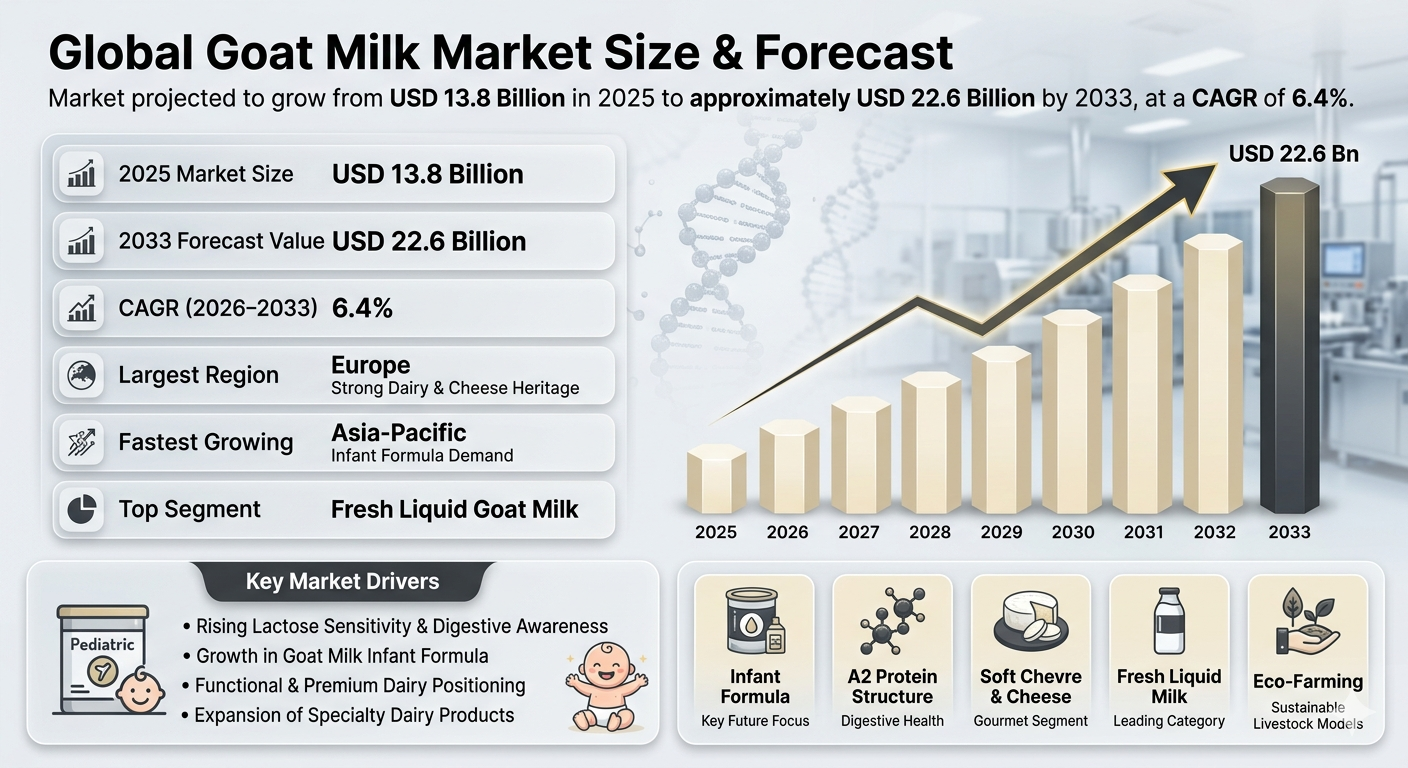
Global Goat Milk Market Forecast Snapshot: 2026???2033
| Metric | Value |
| 2025 Market Size | USD 13.8 Billion |
| 2033 Market Size | USD 22.6 Billion |
| CAGR (2026???2033) | 6.4% |
| Largest Region | Europe |
| Fastest Growing Region | Asia-Pacific |
| Top Segment | Fresh Liquid Goat Milk |
| Key Trend | Functional Nutrition & Digestive Health Positioning |
| Future Focus | Infant Nutrition, A2 Protein Demand & Value-Added Dairy Innovation |
Global Goat Milk Market Overview
The Global Goat Milk Market is experiencing structural expansion, supported by rising consumer awareness of digestive health, increasing lactose sensitivity prevalence, and growing demand for alternative dairy products. Goat milk is increasingly positioned as a premium, functional, and easier-to-digest alternative to conventional cow milk, particularly among health-conscious and pediatric-focused consumers.
According to Pheonix Research, the Global Goat Milk Market is valued at USD 13.8 billion in 2025 and is projected to reach USD 22.6 billion by 2033, registering a CAGR of 6.4% during 2026???2033. This revenue forecast reflects growing penetration in infant formula, specialty dairy products, and functional nutrition categories.
Europe holds the largest market share due to strong dairy heritage, established goat farming ecosystems, and high consumption of goat milk cheese and specialty dairy products. Meanwhile, Asia-Pacific is emerging as the fastest-growing region, supported by rising disposable income, infant nutrition demand, and expanding modern retail infrastructure.The Post-2025 outlook indicates increased integration of premiumization strategies, clean-label positioning, sustainable livestock practices, and advanced dairy processing technologies.
Key Drivers of Global Goat Milk Market Growth
1. Rising Lactose Sensitivity & Digestive Health Awareness
Consumers increasingly perceive goat milk as easier to digest due to smaller fat globules and A2-type protein structure, driving adoption among lactose-sensitive populations.
2. Growth in Goat Milk-Based Infant Formula
Demand for premium infant nutrition products made from goat milk is expanding globally, particularly in Asia-Pacific and Europe.
3. Functional & Premium Dairy Positioning
Goat milk is marketed as rich in calcium, potassium, and bioavailable nutrients, supporting immunity, bone health, and gut wellness.
4. Expansion of Specialty Dairy Products
Rising popularity of goat cheese, goat yogurt, and artisanal dairy products enhances value addition and revenue diversification.
5. Sustainable & Small-Scale Farming Ecosystems
Goat farming requires comparatively lower land and feed resources, supporting sustainability narratives in emerging markets.
Global Goat Milk Market Segmentation
?? ?? ?? ?? ?? 1. By Product Type
1.1 Fresh Liquid Goat Milk
1.1.1 Pasteurized Goat Milk
1.1.1.1 Whole Goat Milk
1.1.1.2 Low-Fat Goat Milk
1.1.1.3 Skimmed Goat Milk
1.1.1.4 Fortified Goat Milk
1.1.2 Raw & Farm-Fresh Goat Milk
1.1.2.1 Direct Farm Sales
1.1.2.2 Organic Certified Raw Milk
1.1.2.3 Local Cooperative Distribution
1.1.3 Flavored Goat Milk
1.1.3.1 Chocolate
1.1.3.2 Vanilla
1.1.3.3 Fruit-Infused
1.1.3.4 Functional Fortified Variants
1.2 Powdered Goat Milk
1.2.1 Whole Milk Powder
1.2.2 Skimmed Milk Powder
1.2.3 Infant Formula Base Powder
1.2.4 Nutraceutical-Grade Powder
1.3 Goat Milk-Based Dairy Products
1.3.1 Goat Cheese
1.3.1.1 Soft Cheese (Chevre)
1.3.1.2 Hard & Aged Cheese
1.3.1.3 Flavored & Herb-Infused
1.3.1.4 Organic Premium Cheese
1.3.2 Goat Yogurt
1.3.2.1 Plain
1.3.2.2 Greek-Style
1.3.2.3 Probiotic-Enriched
1.3.2.4 Drinkable Yogurt
1.3.3 Goat Butter & Cream
1.3.3.1 Culinary Cream
1.3.3.2 Spreadable Butter
1.3.3.3 Bakery Applications
1.4 Goat Milk Infant Formula
1.4.1 Stage 1 (0???6 Months)
1.4.2 Stage 2 (6???12 Months)
1.4.3 Toddler Formula (1???3 Years)
1.4.4 Specialized Hypoallergenic Formula
?? ?? ?? ?? 2.By Distribution Channel
2.1 Offline Retail
2.1.1 Supermarkets & Hypermarkets
2.1.1.1 National Chains
2.1.1.2 Premium Retailers
2.1.1.3 Private Label Brands
2.1.2 Specialty Health Stores
2.1.2.1 Organic Retailers
2.1.2.2 Infant Nutrition Stores
2.1.2.3 Functional Food Outlets
2.1.3 Traditional Grocery & Dairy Shops
2.1.3.1 Local Markets
2.1.3.2 Cooperative Stores
2.1.3.3 Farm-Based Direct Sales
2.2 Online Channels
2.2.1 E-Commerce Marketplaces
2.2.1.1 One-Time Purchase
2.2.1.2 Subscription Delivery
2.2.1.3 Bulk Purchase
2.2.2 Brand-Owned D2C Platforms
2.2.2.1 Infant Formula Direct Sales
2.2.2.2 Personalized Nutrition Packs
2.2.2.3 Loyalty Programs
2.2.3 Quick-Commerce Grocery Apps
2.2.3.1 Same-Day Delivery
2.2.3.2 Temperature-Controlled Logistics
?? ?? ?? ?? ??3. By End-User
3.1 Infants & Toddlers
3.1.1 Infant Formula Consumers
3.1.1.1 Age-Based Segmentation
3.1.1.1.1 Stage 1 (0???6 Months)
3.1.1.1.2 Stage 2 (6???12 Months)
3.1.1.1.3 Stage 3 (12???24 Months)
3.1.1.1.4 Growing-Up Milk (2+ Years)
3.1.1.2 Premium & Specialized Formula
3.1.1.2.1 Organic Goat Milk Formula
3.1.1.2.2 A2 Protein-Based Formula
3.1.1.2.3 DHA & Omega-3 Enriched
3.1.1.2.4 Iron & Vitamin-Fortified Variants
3.1.1.3 Distribution & Purchase Channels
3.1.1.3.1 Pediatrician-Recommended Products
3.1.1.3.2 Pharmacy & Medical Stores
3.1.1.3.3 Online D2C Infant Platforms
3.1.1.3.4 Cross-Border E-Commerce (Asia-Pacific Focus)
3.1.2 Pediatric Dietary Support
3.1.2.1 Digestive Health Support
3.1.2.1.1 Mild Digestion Formulations
3.1.2.1.2 Prebiotic & Probiotic Blends
3.1.2.1.3 Low-Allergen Dairy Options
3.1.2.2 Nutritional Fortification
3.1.2.2.1 Calcium & Bone Development
3.1.2.2.2 Immunity-Boosting Nutrients
3.1.2.2.3 Brain Development Supplements
3.1.2.3 Pediatric Functional Dairy
3.1.2.3.1 Goat Milk Yogurt for Kids
3.1.2.3.2 Flavored Nutrient-Enhanced Milk
3.1.2.3.3 On-the-Go Drinkable Formats
3.1.3 Allergy-Sensitive Infants
3.1.3.1 Cow Milk Protein Sensitivity
3.1.3.1.1 Partial Protein Sensitivity Cases
3.1.3.1.2 Pediatric Transition Formulas
3.1.3.2 Hypoallergenic Positioning
3.1.3.2.1 Limited Ingredient Formulas
3.1.3.2.2 Non-GMO Certified Products
3.1.3.2.3 Clean-Label Infant Nutrition
3.1.3.3 Clinical & Medical Nutrition Integration
3.1.3.3.1 Hospital-Recommended Products
3.1.3.3.2 Medical Nutrition Programs
3.1.3.3.3 Specialty Pediatric Clinics
3.2 Health-Conscious Adults
3.2.1 Lactose-Sensitive Consumers
3.2.1.1 Mild Lactose Intolerance
3.2.1.1.1 Fresh Liquid Goat Milk
3.2.1.1.2 Lactose-Reduced Goat Milk
3.2.1.2 Digestive-Friendly Dairy Alternatives
3.2.1.2.1 Goat Milk Yogurt
3.2.1.2.2 Goat Milk Cheese
3.2.1.2.3 Powdered Goat Milk Supplements
3.2.1.3 Clean-Label & Natural Seekers
3.2.1.3.1 Organic Certified Products
3.2.1.3.2 Hormone-Free & Antibiotic-Free
3.2.1.3.3 Farm-Traceable Milk
3.2.2 Fitness & Protein-Focused Individuals
3.2.2.1 High-Protein Dairy Consumers
3.2.2.1.1 Goat Milk Protein Powders
3.2.2.1.2 Greek-Style Goat Yogurt
3.2.2.1.3 Protein-Enriched Smoothies
3.2.2.2 Functional Performance Nutrition
3.2.2.2.1 Post-Workout Recovery Drinks
3.2.2.2.2 Electrolyte & Mineral Fortified Milk
3.2.2.2.3 Low-Fat & Lean Variants
3.2.2.3 Active Lifestyle Segments
3.2.2.3.1 Athletes
3.2.2.3.2 Gym Enthusiasts
3.2.2.3.3 Outdoor & Endurance Consumers
3.2.3 Digestive Health Seekers
3.2.3.1 Probiotic Consumers
3.2.3.1.1 Probiotic Goat Yogurt
3.2.3.1.2 Fermented Dairy Products
3.2.3.2 Gut Microbiome Support
3.2.3.2.1 Prebiotic-Enriched Milk
3.2.3.2.2 Functional Dairy Blends
3.2.3.3 Preventive Health Diets
3.2.3.3.1 Low-Sugar Dairy Options
3.2.3.3.2 Anti-Inflammatory Nutrition Trends
3.2.3.3.3 Holistic & Natural Diet Consumers
3.3 Geriatric Population
3.3.1 Bone Health Support
3.3.1.1 Calcium-Enriched Goat Milk
3.3.1.2 Vitamin D Fortified Variants
3.3.1.3 Osteoporosis-Focused Nutrition
3.3.1.4 Mineral-Rich Dairy Supplements
3.3.2 Easy Digestion Diets
3.3.2.1 Low-Fat Goat Milk
3.3.2.2 Soft Goat Cheese
3.3.2.3 Light Fermented Dairy
3.3.2.4 Lactose-Reduced Options
3.3.3 Nutrient-Dense Supplementation
3.3.3.1 Powdered Goat Milk Supplements
3.3.3.2 High-Calorie Clinical Nutrition
3.3.3.3 Protein & Energy Boosting Formulas
3.3.3.4 Hospital & Long-Term Care Supply
3.4 Culinary & Foodservice Sector
3.4.1 Hotels & Restaurants
3.4.1.1 Gourmet Cheese Applications
3.4.1.2 Goat Milk Sauces & Dressings
3.4.1.3 Premium Breakfast Dairy Options
3.4.1.4 Fusion & Mediterranean Cuisine
3.4.2 Artisanal Cheese Producers
3.4.2.1 Farmhouse Cheese Makers
3.4.2.2 Organic Cheese Brands
3.4.2.3 Aged & Specialty Cheese
3.4.2.4 Export-Oriented Premium Producers
3.4.3 Bakery & Confectionery
3.4.3.1 Goat Milk Cream Fillings
3.4.3.2 Premium Pastry & Dessert Applications
3.4.3.3 Functional Dairy Desserts
3.4.3.4 Ice Cream & Frozen Confections
?? ?? ?? ?? ?? ?? 4.By Region
4.1 Europe
4.2 Asia-Pacific
4.3 North America
4.4 Latin America
Regional Insights of Global Goat Milk Market
Europe ??? Largest Market
Europe leads the global market, supported by strong goat farming infrastructure, high cheese consumption, and established premium dairy brands. France, Spain, and the Netherlands are key contributors.
Asia-Pacific ??? Fastest Growing Market
Rapid growth is driven by infant formula demand in China and Southeast Asia, expanding middle-class income, and rising health awareness.
North America
Growth is supported by increasing adoption of alternative dairy products, organic farming expansion, and premium health-focused retail positioning.
Middle East & Africa
Traditional goat milk consumption, combined with expanding packaged dairy processing, supports moderate growth.
Latin America
Growing dairy modernization and expanding retail penetration are contributing to steady regional expansion.
Leading Companies in the Global Goat Milk Market
Prominent players include:
-
Meyenberg Goat Milk Products
-
Delamere Dairy
-
Holle Baby Food
-
Dairy Goat Co-operative (DGC)
-
AVH Dairy Trade
Leading companies focus on infant formula innovation, organic certification, sustainable farming practices, and geographic expansion strategies.
Strategic Intelligence & AI-Backed Insights
Pheonix Demand Forecast Engine indicates sustained growth driven by infant nutrition demand, lactose-sensitive consumer adoption, and premium dairy expansion. Consumer Behavior Analyzer highlights increasing preference for clean-label, A2 protein-based, organic-certified, and functional goat milk products. Innovation Tracker underscores advancements in spray-drying technology, cold-chain optimization, AI-driven dairy yield forecasting, and sustainable livestock management as competitive differentiators.Porter???s Five Forces analysis reflects moderate supplier power, high entry barriers in infant formula, and strong brand-driven competition in premium dairy segments.
Why the Global Goat Milk Market is Critical
Rising Demand for Digestive-Friendly Dairy AlternativesWith increasing prevalence of lactose sensitivity and digestive discomfort associated with conventional cow milk, goat milk serves as a clinically recognized alternative due to its smaller fat globules and A2-type protein structure. This positions the market at the intersection of mainstream dairy and functional nutrition..
Strategic Importance in Infant NutritionGoat milk-based infant formula represents one of the fastest-growing premium dairy categories globally. As parents increasingly seek gentle, hypoallergenic, and clean-label alternatives, goat milk has become a high-margin and innovation-driven segment within pediatric nutrition.
Premiumization & Value-Added Dairy ExpansionUnlike commoditized cow milk markets, goat milk operates largely within premium and specialty segments, including artisanal cheese, probiotic yogurt, fortified milk powders, and nutraceutical blends. This enhances pricing power, profitability, and brand differentiation.
Alignment with Functional & Preventive Health Trends
The global shift toward preventive healthcare, immunity support, and nutrient-dense diets strengthens demand for goat milk products rich in calcium, potassium, and bioavailable micronutrients. This supports long-term structural demand beyond cyclical dairy consumption.
??Sustainable & Scalable Livestock ModelGoat farming typically requires lower land, feed, and water resources compared to cattle farming, making it attractive in regions facing climate and resourc
Final Takeaway of Global Goat Milk Market
The Global Goat Milk Market is steadily evolving into a premiumized, health-centric, and innovation-led dairy segment. The projected CAGR of 6.4% during 2026???2033 underscores sustained momentum driven by expanding goat milk-based infant nutrition, rising digestive wellness awareness, and growing demand for value-added specialty dairy products.As consumer preferences shift toward clean-label, functional, and nutrient-dense alternatives, goat milk is gaining strategic relevance across both developed and emerging markets. Its positioning within high-margin categories such as infant formula, fortified powders, artisanal cheese, and probiotic yogurt enhances long-term profitability potential.
Companies that invest in advanced R&D, strengthen sustainable and traceable farming ecosystems, optimize cold-chain and digital distribution networks, and align with premium health positioning will be best positioned to capture future growth opportunities.
At Pheonix Research, our proprietary forecasting frameworks deliver comprehensive revenue projections, competitive intelligence, and forward-looking strategic insights ??? empowering stakeholders to navigate the evolving global goat milk landscape with precision, confidence, and sustainable growth strategies.?????? Social Mentions & Publication Channels
Explore deeper insights and follow our cross-platform updates on??LinkedIn,?? and??X??for continuous intelligence and market coverage. LinkedIn : https://www.linkedin.com/feed/update/urn:li:activity:7432405154705924096 X : https://x.com/Pheonix_Insight/status/2026644304060653812?s=20Table of Contents
1. Executive Summary
1.1 Global Market Forecast Snapshot (2026???2033)
1.2 Market Size & CAGR Overview
1.3 Largest & Fastest-Growing Regions
1.4 Leading Product Segments
1.5 Key Growth Drivers
1.6 Competitive Landscape Overview
1.7 Strategic Outlook Through 2033
2. Introduction & Market Overview
2.1 Definition of Goat Milk & Derived Products
2.2 Scope of the Study
2.3 Evolution of Goat Milk as a Functional Dairy Alternative
2.4 Digestive Health & A2 Protein Positioning
2.5 Infant Nutrition & Premium Dairy Expansion
2.6 Sustainability & Small-Scale Livestock Economics
2.7 Post-2025 Market Transformation Trends
3. Research Methodology
3.1 Primary Research Approach
3.2 Secondary Research Sources
3.3 Market Size Estimation Model
3.4 Forecast Assumptions (2026???2033)
3.5 Data Validation & Triangulation
4. Market Dynamics
4.1 Drivers
4.1.1 Rising Lactose Sensitivity & Digestive Health Awareness
4.1.2 Growth in Goat Milk-Based Infant Formula
4.1.3 Functional & Premium Dairy Positioning
4.1.4 Expansion of Specialty Dairy Products
4.1.5 Sustainable & Small-Scale Farming Ecosystems
4.2 Restraints
4.2.1 Higher Production Costs Compared to Cow Milk
4.2.2 Limited Large-Scale Farming Infrastructure
4.2.3 Supply Chain & Cold-Chain Limitations
4.2.4 Regulatory Barriers in Infant Formula
4.3 Opportunities
4.3.1 A2 Protein & Clean-Label Innovation
4.3.2 Expansion in Emerging Asia Markets
4.3.3 Value-Added Dairy Product Diversification
4.3.4 E-Commerce & Cross-Border Infant Nutrition Sales
4.4 Challenges
4.4.1 Price Sensitivity in Developing Markets
4.4.2 Competition from Plant-Based Alternatives
4.4.3 Volatility in Raw Milk Procurement
4.4.4 Quality Standardization & Certification Requirements
5. Global Goat Milk Market Analysis (USD Billion), 2026???2033
5.1 Market Revenue Overview
5.2 Year-on-Year Growth Trends
5.3 Product-Level Revenue Distribution
5.4 Regional Revenue Analysis
5.5 Margin & Pricing Analysis
6. Market Segmentation by Product Type (USD Billion), 2026???2033
6.1 Fresh Liquid Goat Milk
6.1.1 Pasteurized Goat Milk
6.1.1.1 Whole Goat Milk
6.1.1.2 Low-Fat Goat Milk
6.1.1.3 Skimmed Goat Milk
6.1.1.4 Fortified Goat Milk
6.1.2 Raw & Farm-Fresh Goat Milk
6.1.2.1 Direct Farm Sales
6.1.2.2 Organic Certified Raw Milk
6.1.2.3 Local Cooperative Distribution
6.1.3 Flavored Goat Milk
6.1.3.1 Chocolate
6.1.3.2 Vanilla
6.1.3.3 Fruit-Infused
6.1.3.4 Functional Fortified Variants
6.2 Powdered Goat Milk
6.2.1 Whole Milk Powder
6.2.2 Skimmed Milk Powder
6.2.3 Infant Formula Base Powder
6.2.4 Nutraceutical-Grade Powder
6.3 Goat Milk-Based Dairy Products
6.3.1 Goat Cheese
6.3.1.1 Soft Cheese (Chevre)
6.3.1.2 Hard & Aged Cheese
6.3.1.3 Flavored & Herb-Infused
6.3.1.4 Organic Premium Cheese
6.3.2 Goat Yogurt
6.3.2.1 Plain
6.3.2.2 Greek-Style
6.3.2.3 Probiotic-Enriched
6.3.2.4 Drinkable Yogurt
6.3.3 Goat Butter & Cream
6.3.3.1 Culinary Cream
6.3.3.2 Spreadable Butter
6.3.3.3 Bakery Applications
6.4 Goat Milk Infant Formula
6.4.1 Stage 1 (0???6 Months)
6.4.2 Stage 2 (6???12 Months)
6.4.3 Toddler Formula (1???3 Years)
6.4.4 Specialized Hypoallergenic Formula
7. Market Segmentation by Distribution Channel (USD Billion), 2026???2033
7.1 Offline Retail
7.1.1 Supermarkets & Hypermarkets
7.1.1.1 National Chains
7.1.1.2 Premium Retailers
7.1.1.3 Private Label Brands
7.1.2 Specialty Health Stores
7.1.2.1 Organic Retailers
7.1.2.2 Infant Nutrition Stores
7.1.2.3 Functional Food Outlets
7.1.3 Traditional Grocery & Dairy Shops
7.1.3.1 Local Markets
7.1.3.2 Cooperative Stores
7.1.3.3 Farm-Based Direct Sales
7.2 Online Channels
7.2.1 E-Commerce Marketplaces
7.2.1.1 One-Time Purchase
7.2.1.2 Subscription Delivery
7.2.1.3 Bulk Purchase
7.2.2 Brand-Owned D2C Platforms
7.2.2.1 Infant Formula Direct Sales
7.2.2.2 Personalized Nutrition Packs
7.2.2.3 Loyalty Programs
7.2.3 Quick-Commerce Grocery Apps
7.2.3.1 Same-Day Delivery
7.2.3.2 Temperature-Controlled Logistics
8. Market Segmentation by End-User (USD Billion), 2026???2033
8.1 Infants & Toddlers
8.1.1 Infant Formula Consumers
8.1.1.1 Age-Based Segmentation
8.1.1.1.1 Stage 1 (0???6 Months)
8.1.1.1.2 Stage 2 (6???12 Months)
8.1.1.1.3 Stage 3 (12???24 Months)
8.1.1.1.4 Growing-Up Milk (2+ Years)
8.1.1.2 Premium & Specialized Formula
8.1.1.2.1 Organic Goat Milk Formula
8.1.1.2.2 A2 Protein-Based Formula
8.1.1.2.3 DHA & Omega-3 Enriched
8.1.1.2.4 Iron & Vitamin-Fortified Variants
8.1.1.3 Distribution & Purchase Channels
8.1.1.3.1 Pediatrician-Recommended Products
8.1.1.3.2 Pharmacy & Medical Stores
8.1.1.3.3 Online D2C Infant Platforms
8.1.1.3.4 Cross-Border E-Commerce (Asia-Pacific Focus)
8.1.2 Pediatric Dietary Support
8.1.2.1 Digestive Health Support
8.1.2.1.1 Mild Digestion Formulations
8.1.2.1.2 Prebiotic & Probiotic Blends
8.1.2.1.3 Low-Allergen Dairy Options
8.1.2.2 Nutritional Fortification
8.1.2.2.1 Calcium & Bone Development
8.1.2.2.2 Immunity-Boosting Nutrients
8.1.2.2.3 Brain Development Supplements
8.1.2.3 Pediatric Functional Dairy
8.1.2.3.1 Goat Milk Yogurt for Kids
8.1.2.3.2 Flavored Nutrient-Enhanced Milk
8.1.2.3.3 On-the-Go Drinkable Formats
8.1.3 Allergy-Sensitive Infants
8.1.3.1 Cow Milk Protein Sensitivity
8.1.3.1.1 Partial Protein Sensitivity Cases
8.1.3.1.2 Pediatric Transition Formulas
8.1.3.2 Hypoallergenic Positioning
8.1.3.2.1 Limited Ingredient Formulas
8.1.3.2.2 Non-GMO Certified Products
8.1.3.2.3 Clean-Label Infant Nutrition
8.1.3.3 Clinical & Medical Nutrition Integration
8.1.3.3.1 Hospital-Recommended Products
8.1.3.3.2 Medical Nutrition Programs
8.1.3.3.3 Specialty Pediatric Clinics
8.2 Health-Conscious Adults
8.2.1 Lactose-Sensitive Consumers
8.2.1.1 Mild Lactose Intolerance
8.2.1.1.1 Fresh Liquid Goat Milk
8.2.1.1.2 Lactose-Reduced Goat Milk
8.2.1.2 Digestive-Friendly Dairy Alternatives
8.2.1.2.1 Goat Milk Yogurt
8.2.1.2.2 Goat Milk Cheese
8.2.1.2.3 Powdered Goat Milk Supplements
8.2.1.3 Clean-Label & Natural Seekers
8.2.1.3.1 Organic Certified Products
8.2.1.3.2 Hormone-Free & Antibiotic-Free
8.2.1.3.3 Farm-Traceable Milk
8.2.2 Fitness & Protein-Focused Individuals
8.2.2.1 High-Protein Dairy Consumers
8.2.2.1.1 Goat Milk Protein Powders
8.2.2.1.2 Greek-Style Goat Yogurt
8.2.2.1.3 Protein-Enriched Smoothies
8.2.2.2 Functional Performance Nutrition
8.2.2.2.1 Post-Workout Recovery Drinks
8.2.2.2.2 Electrolyte & Mineral Fortified Milk
8.2.2.2.3 Low-Fat & Lean Variants
8.2.2.3 Active Lifestyle Segments
8.2.2.3.1 Athletes
8.2.2.3.2 Gym Enthusiasts
8.2.2.3.3 Outdoor & Endurance Consumers
8.2.3 Digestive Health Seekers
8.2.3.1 Probiotic Consumers
8.2.3.1.1 Probiotic Goat Yogurt
8.2.3.1.2 Fermented Dairy Products
8.2.3.2 Gut Microbiome Support
8.2.3.2.1 Prebiotic-Enriched Milk
8.2.3.2.2 Functional Dairy Blends
8.2.3.3 Preventive Health Diets
8.2.3.3.1 Low-Sugar Dairy Options
8.2.3.3.2 Anti-Inflammatory Nutrition Trends
8.2.3.3.3 Holistic & Natural Diet Consumers
8.3 Geriatric Population
8.3.1 Bone Health Support
8.3.1.1 Calcium-Enriched Goat Milk
8.3.1.2 Vitamin D Fortified Variants
8.3.1.3 Osteoporosis-Focused Nutrition
8.3.1.4 Mineral-Rich Dairy Supplements
8.3.2 Easy Digestion Diets
8.3.2.1 Low-Fat Goat Milk
8.3.2.2 Soft Goat Cheese
8.3.2.3 Light Fermented Dairy
8.3.2.4 Lactose-Reduced Options
8.3.3 Nutrient-Dense Supplementation
8.3.3.1 Powdered Goat Milk Supplements
8.3.3.2 High-Calorie Clinical Nutrition
8.3.3.3 Protein & Energy Boosting Formulas
8.3.3.4 Hospital & Long-Term Care Supply
8.4 Culinary & Foodservice Sector
8.4.1 Hotels & Restaurants
8.4.1.1 Gourmet Cheese Applications
8.4.1.2 Goat Milk Sauces & Dressings
8.4.1.3 Premium Breakfast Dairy Options
8.4.1.4 Fusion & Mediterranean Cuisine
8.4.2 Artisanal Cheese Producers
8.4.2.1 Farmhouse Cheese Makers
8.4.2.2 Organic Cheese Brands
8.4.2.3 Aged & Specialty Cheese
8.4.2.4 Export-Oriented Premium Producers
8.4.3 Bakery & Confectionery
8.4.3.1 Goat Milk Cream Fillings
8.4.3.2 Premium Pastry & Dessert Applications
8.4.3.3 Functional Dairy Desserts
8.4.3.4 Ice Cream & Frozen Confections
9. Market Segmentation by Region (USD Billion), 2026???2033
9.1 Europe
9.2 Asia-Pacific
9.3 North America
9.4 Latin America
9.5 Middle East & Africa
10. Regional Insights
10.1 Europe ??? Largest Market
10.2 Asia-Pacific ??? Fastest Growing Market
10.3 North America
10.4 Latin America
10.5 Middle East & Africa
11. Competitive Landscape
11.1 Market Share Analysis
11.2 Brand Positioning Matrix
11.3 Infant Formula Competitive Benchmarking
11.4 Mergers & Acquisitions
11.5 Strategic Partnerships & Expansions
12. Company Profiles
12.1 Danone S.A.
12.2 Ausnutria Dairy Corporation Ltd.
12.3 Saputo Inc.
12.4 Meyenberg Goat Milk Products
12.5 Delamere Dairy
12.6 Holle Baby Food
12.7 Dairy Goat Co-operative (DGC)
12.8 AVH Dairy Trade
13. Strategic Intelligence & AI-Backed Insights
13.1 Pheonix Demand Forecast Engine
13.2 Consumer Behavior Analyzer
13.3 Innovation Tracker
13.4 Porter???s Five Forces Analysis
13.5 Supply Chain & Cold-Chain Optimization Trends
14. Future Outlook & Strategic Recommendations
14.1 Infant Nutrition Expansion Strategy
14.2 A2 Protein & Clean-Label Growth
14.3 Premium Dairy Product Diversification
14.4 Sustainable Livestock & ESG Alignment
14.5 Long-Term Market Outlook (2033+)
15. Appendix
16. About Pheonix Research
17. Disclaimer
Competitive Landscape
Competitive Landscape of the Global Goat Milk Market
Executive Framing
The Global Goat Milk Market is characterized by a fragmented competitive structure with a mix of global dairy companies, regional cooperatives, and specialized goat milk producers. Key players such as Danone S.A., Ausnutria Dairy Corporation Ltd., Saputo Inc., and Dairy Goat Co-operative (DGC) compete alongside niche premium brands focusing on infant nutrition and specialty dairy products.
Current Market Reality
The market operates within premium and niche dairy segments, with strong demand concentrated in infant formula, artisanal cheese, and functional dairy products. Unlike conventional dairy, goat milk remains less commoditized, allowing brands to maintain premium pricing and differentiation.
Regional players and cooperatives dominate raw milk sourcing and local distribution, while global companies focus on scaling infant nutrition products and expanding into high-growth Asia-Pacific markets.
Key Signals and Evidence
- Rapid growth in goat milk-based infant formula, especially in Asia-Pacific.
- Increasing consumer preference for A2 protein and digestive-friendly dairy.
- Expansion of artisanal and specialty goat cheese markets in Europe.
- Rising demand for clean-label, organic, and sustainably sourced dairy products.
- Technological advancements in dairy processing and powder formulation.
Strategic Implications
- Infant Nutrition Focus: Expand premium goat milk-based infant formula portfolios.
- Premium Product Development: Invest in artisanal cheese, probiotic yogurt, and fortified dairy products.
- Geographic Expansion: Target high-growth Asia-Pacific and emerging markets.
- Sustainability Positioning: Leverage eco-friendly farming and traceable supply chains.
- Functional Differentiation: Emphasize A2 protein, digestive health, and nutrient-rich formulations.
Forward Outlook
The Global Goat Milk Market is projected to reach USD 22.6 billion by 2033, growing at a CAGR of 6.4%. Europe will maintain its leadership due to established dairy ecosystems, while Asia-Pacific will emerge as the fastest-growing region driven by infant nutrition demand and rising disposable incomes.
Future competition will be shaped by infant formula innovation, premiumization strategies, sustainable livestock practices, and advanced processing technologies, with companies focusing on high-value segments to drive long-term growth.
Value Chain
Value Chain Analysis ??? Global Goat Milk Market
Upstream (Raw Material & Input Supply)
The value chain begins with goat breeding farms, genetic improvement programs, feed and forage suppliers, veterinary healthcare providers, livestock nutrition companies, milking equipment manufacturers, and dairy farming cooperatives. Organic certification bodies, animal welfare compliance, and sustainable farming practices play a critical role in ensuring high-quality raw milk production.
Midstream (Milk Collection, Processing & Manufacturing)
Fresh goat milk is collected through dairy cooperatives and private procurement networks before undergoing quality testing, pasteurization, homogenization, standardization, and processing. Manufacturers convert raw milk into fresh liquid milk, powdered milk, infant formula, cheese, yogurt, butter, cream, and functional dairy products. Advanced spray-drying, fermentation, fortification, packaging, cold-chain logistics, and food safety compliance (HACCP, ISO, GMP) ensure product quality and shelf stability.
Downstream (Distribution, Branding & End Users)
Finished products are distributed through supermarkets & hypermarkets, specialty health stores, pharmacies, traditional grocery stores, online marketplaces, direct-to-consumer (D2C) platforms, quick-commerce channels, foodservice distributors, hospitals, and export networks. Brand owners focus on premium positioning, organic certification, clean-label marketing, digital commerce, and consumer education. End users include infants, health-conscious adults, geriatric consumers, foodservice businesses, and nutraceutical manufacturers.
Value Chain Optimization Opportunities
- AI-based livestock health and milk yield monitoring
- Precision goat breeding and genetic improvement
- Sustainable feed and regenerative farming practices
- Cold-chain optimization and smart logistics
- Advanced spray-drying and infant formula processing
- Functional ingredient fortification (A2 protein, probiotics, prebiotics)
- Blockchain-enabled farm-to-consumer traceability
- Direct-to-consumer subscription and digital commerce expansion
- Eco-friendly packaging and carbon footprint reduction
- Expansion into premium infant nutrition and functional dairy products
Investment Activity
Investment & Funding Dynamics ??? Global Goat Milk Market
Executive Framing
Current Market Reality
Valued at USD 13.8 billion in 2025 and projected to reach USD 22.6 billion by 2033 (CAGR ~6.4%), the market is led by Europe, while Asia-Pacific is the fastest-growing region. Key players such as Danone, Ausnutria, and Saputo are investing in premium goat milk products, infant formula, and sustainable sourcing to strengthen their global presence.
Key Signals and Evidence
- Infant Nutrition Investment: Significant capital inflow into goat milk-based infant formula and pediatric nutrition products.
- Premium & Functional Product Development: Expansion of fortified milk powders, probiotic yogurt, and specialty dairy offerings.
- Sustainable Farming Practices: Investments in eco-friendly goat farming, traceability, and organic certification.
- Processing & Technology Advancement: Adoption of spray-drying, cold-chain optimization, and AI-based yield forecasting.
- Emerging Market Expansion: Strategic investments targeting Asia-Pacific for infant formula and premium dairy demand.
- M&A Activity: Active acquisitions and partnerships to strengthen product portfolios and regional reach.
- Distribution & D2C Channels: Growth in e-commerce, cross-border trade, and direct-to-consumer platforms.
Strategic Implications
Companies focusing on infant nutrition, functional dairy innovation, and sustainable farming ecosystems are best positioned for long-term growth. Investors are prioritizing brands with strong regulatory compliance, premium positioning, and scalable supply chains across global markets.
Forward Outlook
Between 2026 and 2033, investment activity is expected to remain strong, driven by increasing demand for A2 protein-based products, infant nutrition, and clean-label dairy. Sustainability, traceability, and premiumization will remain central to capital allocation strategies.
Technology & Innovation
Global Goat Milk Market: Technology & Innovation
Executive Framing
Innovation in the Global Goat Milk Market is driven by advancements in dairy processing, infant nutrition formulations, and functional fortification. Companies are leveraging spray-drying, probiotic integration, A2 protein enrichment, and AI-based supply chain solutions to deliver high-quality, digestible, and premium goat milk products.
Current Market Reality
The goat milk industry is experiencing technological evolution with widespread adoption of infant formula innovation, powdered milk fortification, and probiotic-enriched dairy products. Cold-chain logistics, sustainable farming practices, and AI-enabled production planning are improving product quality, shelf life, and market reach.
Key Signals and Evidence
- Infant Formula Innovation: Advanced hypoallergenic and A2-protein goat milk formulas targeting global infant nutrition markets.
- Spray-Drying & Powdered Milk Technology: Enhanced nutrient retention, solubility, and storage stability in goat milk powders.
- Functional Fortification: Integration of vitamins, minerals, and probiotics to support digestive health and immunity.
- Plant-Based & Hybrid Dairy Research: Limited but growing innovation in goat milk-plant hybrid products for niche premium consumers.
- AI-Driven Dairy Yield & Supply Forecasting: Predictive analytics improve herd management, milk output, and distribution planning.
- Sustainable Livestock & Traceable Sourcing: Digital monitoring of feed, water, and animal welfare to enhance brand credibility and compliance.
Strategic Implications
Companies investing in advanced infant formula, probiotic fortification, and A2-enriched goat milk products will achieve differentiation in premium dairy segments. Sustainable farm management, cold-chain optimization, and AI-enabled production planning will drive efficiency, reduce wastage, and strengthen global distribution networks.
Forward Outlook
Future innovation will focus on next-generation functional goat milk products, personalized infant nutrition solutions, and nutraceutical blends. Integration of AI-based supply chain systems, sustainable farming, and traceable sourcing will be critical to meet evolving consumer expectations and capture growth in high-margin, health-focused segments.
Market Risk
Risk Factors and Disruption Threats in the Global Goat Milk Market
Executive Framing
The Global Goat Milk Market is projected to grow from USD 13.8 Billion in 2025 to USD 22.6 Billion by 2033, at a CAGR of 6.4%. Growth is driven by rising lactose sensitivity, digestive health awareness, and increasing demand for premium and functional goat milk products, particularly in infant nutrition and specialty dairy segments.
Current Market Reality
Europe holds the largest market share due to established goat farming and premium dairy consumption, while Asia-Pacific is the fastest-growing region fueled by infant formula demand and rising health consciousness. Fresh liquid goat milk leads the segment, with expanding adoption of goat cheese, yogurt, and powdered milk products.
Key Signals and Evidence
Key signals include increasing demand for A2 protein-based products, functional dairy positioning, and clean-label certifications. Growth in infant formula, fortified milk powders, and digestive-friendly dairy alternatives highlights market opportunity and structural expansion.
Strategic Implications
Market participants should focus on premium and value-added offerings, infant nutrition innovation, plant-based integration, and sustainable farming practices. Investments in cold-chain logistics, digital retail, and traceable supply chains are essential for maintaining competitiveness.
Forward Outlook
The Goat Milk Market is expected to continue premium, health-focused, and innovation-led expansion. Companies prioritizing infant formula, functional nutrition, clean-label products, and sustainable farming will capture long-term growth opportunities and strengthen global market positioning.
Regulatory Landscape
Regulatory & Policy Landscape: Global Goat Milk Market
Executive Framing
The Global Goat Milk Market operates within a stringent regulatory environment driven by food safety, infant nutrition standards, and dairy compliance frameworks. Regulatory authorities such as the U.S. FDA, EFSA (Europe), FSSAI (India), and other national bodies oversee production, processing, labeling, and distribution of goat milk and related products.
Given its strong positioning in infant formula and functional nutrition, goat milk is subject to heightened scrutiny regarding ingredient safety, nutritional adequacy, and clinical validation. Claims related to digestibility, A2 protein benefits, and hypoallergenic properties must comply with strict regulatory guidelines.
Current Market Reality
Europe leads with well-established regulatory frameworks covering animal welfare, organic certification, and dairy traceability. Infant formula derived from goat milk must meet highly specific compositional and safety standards, making regulatory compliance particularly complex in this segment.
Asia-Pacific markets, especially China, enforce rigorous import regulations and approval processes for infant formula products, creating high entry barriers. North America maintains strict pasteurization, labeling, and safety standards, while emerging markets are gradually strengthening regulatory enforcement.
Key Signals and Evidence
- Strict regulatory approval requirements for goat milk-based infant formula.
- Mandatory pasteurization, hygiene, and microbial safety standards.
- Regulations governing A2 protein, digestive health, and hypoallergenic claims.
- Certification requirements for organic, non-GMO, and clean-label products.
- Animal welfare and traceability standards in developed markets.
- Import/export compliance and cross-border regulatory approvals.
Strategic Implications
Regulatory compliance plays a critical role in market entry, especially in high-value segments such as infant nutrition and functional dairy. Companies must invest in clinical research, certification processes, and traceable supply chains to meet global standards.
Brands that align with clean-label, organic, and sustainability regulations can strengthen consumer trust and premium positioning. Additionally, navigating regional regulatory variations is essential for global expansion and competitive differentiation.
Forward Outlook (2026???2033)
The regulatory landscape is expected to become more stringent, particularly for infant nutrition, health claims, and sustainability practices. Governments are likely to enforce stricter validation of functional claims related to digestion, immunity, and nutritional benefits.
Sustainability regulations focusing on livestock management, carbon footprint, and eco-friendly packaging will gain importance. Digital traceability systems and AI-driven compliance monitoring are expected to enhance transparency and regulatory adherence across the value chain.