
Rapport sur le marché mondial des drones militaires, taille et prévision 2026-2033
Les drones militaires sont devenus un élément critique des stratégies de défense modernes. Les forces armées du monde entier déployent de plus en plus des plateformes non pilotées pour améliorer la conscience des combats, réduire les risques opérationnels pour le personnel, effectuer une surveillance à longue durée et exécuter des missions de frappe précise. L'intégration de l'intelligence artificielle, de la navigation autonome, des communications par satellite, de capteurs avancés et de capacités de guerre électronique continue de redéfinir les opérations militaires de nouvelle génération.
Selon Pheonix Research, le marché mondial des drones militaires est estimé à environ 17,84 milliards de dollars en 2025 et devrait atteindre près de 35,90 milliards de dollars d'ici 2033, s'expandant à un taux de croissance annuelle composé (CAGR) d'environ 9,15 % pendant la période 2026-2033.
Aperçu de la prévision du marché mondial des drones militaires : 2026–2033
| Métrique | Valeur |
|---|---|
| Taille du marché en 2025 | 17,84 milliards de dollars américains |
| Taille du marché en 2033 | ~35,90 milliards de dollars américains |
| Taux de croissance annuelle composé (2026–2033) | ~9.15% |
| Plus grande région | Amérique du Nord |
| Région en plus rapide croissance | Asie-Pacifique |
| Segment principal | Drones d'intelligence, de surveillance et de reconnaissance (ISR) |
| Tendance clé | Systèmes autonomes de combat basés sur l'intelligence artificielle et la technologie de drones en essaim |
| Principaux axes de développement futur | Programmes de drones fidèles, systèmes de contrepouvoirs aux drones (C-UAS), intelligence artificielle en périphérie, guerre autonome et opérations multidomaines |
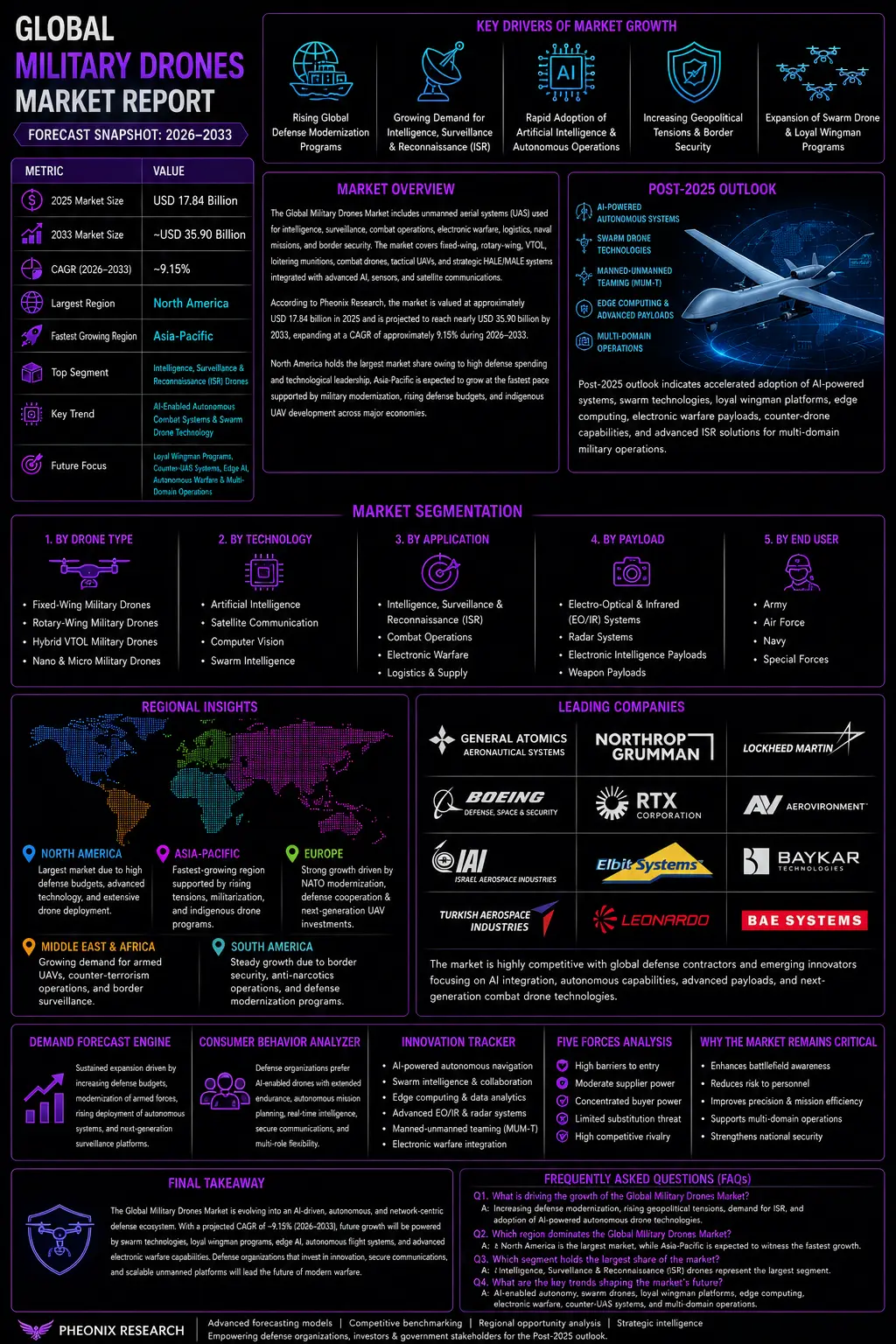
Aperçu du marché mondial des drones militaires
Le marché mondial des drones militaires comprend des systèmes aériens non pilotes (UAS) développés pour la défense, la collecte d'informations, les opérations militaires, la surveillance, la sécurité des frontières, la reconnaissance, l'armée électronique, l'acquisition de cibles, le soutien logistique, et les missions maritimes. Le marché comprend des drones à aile fixe, des drones à hélice tournante, des plateformes VTOL hybrides, des munitions de loitering, des drones de combat, des drones tactiques, des systèmes HALE/MALE stratégiques, et des drones autonomes en essaim intégrés avec des technologies avancées d'intelligence artificielle. Les drones militaires sont devenus un élément critique des stratégies de défense modernes. Les forces armées du monde entier déployent de plus en plus des plateformes non pilotes pour améliorer la conscience du champ de bataille, réduire les risques opérationnels pour le personnel, effectuer une surveillance à longue durée, et exécuter des missions de frappe précise. L'intégration de l'intelligence artificielle, de la navigation autonome, des communications par satellite, des capteurs avancés et des capacités de guerre électronique redéfinit continuellement les opérations militaires de nouvelle génération. Selon Pheonix Research, le marché mondial des drones militaires est estimé à environ 17,84 milliards de dollars américains en 2025 et devrait atteindre presque 35,90 milliards de dollars américains d'ici 2033, enregistrant un taux de croissance annuelle composé (CAGR) d'environ 9.15% pendant la période 2026–2033. L'Amérique du Nord représente la plus grande part de marché en raison des dépenses importantes en défense, des programmes continus de modernisation, des investissements gouvernementaux solides dans les systèmes militaires autonomes, et de la présence de fabricants de drones majeurs. L'Asie-Pacifique devrait connaître la croissance la plus rapide en raison de l'augmentation des tensions géopolitiques, des budgets de défense croissants, des programmes nationaux de développement de drones indigènes, et des initiatives de modernisation militaire étendues en Chine, en Inde, au Japon, en Corée du Sud et en Australie. L'aperçu post-2025 indique une adoption accélérée de systèmes de vol autonomes alimentés par l'intelligence artificielle , des technologies de drones en essaim, de l'équipe homme-machine (MUM-T), du calcul en périphérie, des charges utiles de guerre électronique, des capacités de contrepouvoirs aux drones, et des plateformes de drones fidèles de nouvelle génération conçues pour renforcer les opérations militaires multidomaines.Marché mondial des drones militaires
Principaux moteurs de croissance du marché mondial des drones militaires
1. Augmentation des programmes de modernisation militaire mondiale
Les gouvernements des principales économies continuent d'augmenter leurs investissements dans des systèmes aériens non pilotés de nouvelle génération, dans le cadre de stratégies plus larges de modernisation militaire. Les agences de défense priorisent les drones avancés pour améliorer la flexibilité opérationnelle, la précision du ciblage, la collecte d'intelligence et les capacités de multiplication des forces.2. Demande croissante d'intelligence, de surveillance et de reconnaissance (ISR)
Les drones militaires offrent une surveillance en temps réel continue dans les opérations terrestres, maritimes et aériennes. Les exigences croissantes en matière de sécurité des frontières, de surveillance maritime, de missions de lutte contre le terrorisme et d'intelligence de champ de bataille continuent d'entraîner l'acquisition de plateformes ISR à l'échelle mondiale.3. Adoption rapide de l'intelligence artificielle et des opérations autonomes
L'intelligence artificielle permet la navigation autonome, la reconnaissance des cibles, l'évaluation des menaces, la planification des missions et les opérations de swarm collaboratif. Ces technologies améliorent significativement l'efficacité des missions tout en réduisant la charge de travail des opérateurs et les temps de réponse.4. Augmentation des tensions géopolitiques et de la sécurité des frontières
L'augmentation des disputes territoriales, des conflits transfrontaliers, des défis de sécurité maritime et des guerres asymétriques encouragent les nations à renforcer leurs flottes de drones capables de surveillance continue, de déploiement rapide et d'engagement précis.5. Développement des programmes de drones de swarm et de loyal wingman
Les organisations de défense investissent de plus en plus dans des systèmes autonomes collaboratifs où plusieurs drones opèrent ensemble ou en tandem avec des avions de chasse. L'intelligence de swarm et les technologies de loyal wingman sont prévues pour devenir des multiplicateurs de forces clés dans les opérations militaires futures.Segmentation du marché mondial des drones militaires
1. Par type de drone
1.1 Drones militaires à ailes fixes 1.1.1 UAVs tactiques à ailes fixes 1.1.1.1 UAVs à courte durée 1.1.1.2 UAVs à moyenne durée 1.1.1.3 UAVs à longue durée 1.1.2 UAVs stratégiques à ailes fixes 1.1.2.1 MALE (Moyenne altitude, longue durée) 1.1.2.2 HALE (Haute altitude, longue durée) 1.1.2.3 UAVs de surveillance persistante 1.2 Drones militaires à rotor 1.2.1 UAVs à rotor unique 1.2.1.1 UAVs d'hélicoptère tactique 1.2.1.2 UAVs rotatifs maritimes 1.2.2 UAVs à plusieurs rotors 1.2.2.1 Quadricoptères 1.2.2.2 Hexacoptères 1.2.2.3 Octocoptères 1.3 Drones militaires hybrides VTOL 1.3.1 VTOL à ailes fixes 1.3.1.1 VTOL à longue portée 1.3.1.2 Plateformes VTOL ISR 1.3.2 UAVs hybrides tactiques 1.3.2.1 Surveillance des frontières 1.3.2.2 Opérations spéciales 1.4 Drones militaires nano et micro 1.4.1 UAVs lancés à la main 1.4.1.1 Reconnaissance intérieure 1.4.1.2 Missions de combat urbain 1.4.2 Drones portables par les soldats 1.4.2.1 ISR au niveau de l'escouade 1.4.2.2 Reconnaissance du champ de bataille2. Par technologie
2.1 Intelligence artificielle 2.1.1 Navigation autonome 2.1.1.1 Planification d'itinéraire 2.1.1.2 Évitement des obstacles 2.1.2 Reconnaissance cible par IA 2.1.2.1 Détection d'objets 2.1.2.2 Classification des menaces 2.2 Communication par satellite 2.2.1 Communication hors de portée visuelle 2.2.1.1 Communication par satellite militaire 2.2.1.2 Liens de données sécurisés 2.3 Vision par ordinateur 2.3.1 Intelligence d'image 2.3.1.1 Surveillance du champ de bataille 2.3.1.2 Reconnaissance faciale et d'objets 2.4 Intelligence de swarm 2.4.1 Opérations de drones collaboratifs 2.4.1.1 Swarm autonome 2.4.1.2 Coordination multi-agents3. Par application
3.1 Intelligence, surveillance et reconnaissance (ISR) 3.1.1 Surveillance des frontières 3.1.1.1 Frontières terrestres 3.1.1.2 Frontières maritimes 3.1.2 Surveillance du champ de bataille 3.1.2.1 ISR tactique 3.1.2.2 ISR stratégique 3.2 Opérations de combat 3.2.1 Frappe précise 3.2.1.1 Missions air-terre 3.2.1.2 Soutien aérien proche 3.3 Guerre électronique 3.3.1 Intelligence des signaux 3.3.1.1 Intelligence électronique (ELINT) 3.3.1.2 Intelligence des communications (COMINT) 3.4 Logistique et approvisionnement 3.4.1 Livraison de marchandises militaires 3.4.1.1 Fournitures médicales 3.4.1.2 Transport d'ammunitions4. Par charge utile
4.1 Systèmes électro-optiques et infrarouges (EO/IR) 4.1.1 Surveillance de jour et de nuit 4.1.1.1 Caméras infrarouges 4.1.1.2 Caméras électro-optiques haute définition 4.1.2 Suivi des cibles 4.1.2.1 Suivi des cibles en mouvement 4.1.2.2 Observation continue des cibles 4.2 Systèmes radar 4.2.1 Radar à synthèse d'ouverture (SAR) 4.2.1.1 Cartographie terrestre 4.2.1.2 Surveillance maritime 4.2.2 Indicateur de cibles terrestres en mouvement (GMTI) 4.2.2.1 Détection de véhicules 4.2.2.2 Surveillance du champ de bataille 4.3 Charges utiles d'intelligence électronique 4.3.1 Systèmes SIGINT 4.3.1.1 Intelligence électronique (ELINT) 4.3.1.2 Intelligence des communications (COMINT) 4.3.2 Charges utiles de guerre électronique 4.3.2.1 Systèmes de brouillage 4.3.2.2 Contre-mesures électroniques 4.4 Charges utiles de missiles 4.4.1 Munitions guidées précises 4.4.1.1 Missiles air-terre 4.4.1.2 Bombes guidées 4.4.2 Munitions de stationnement 4.4.2.1 Systèmes anti-chenilles 4.4.2.2 Systèmes de frappe tactique5. Par utilisateur final
5.1 Armée 5.1.1 Opérations tactiques 5.1.1.1 Missions de reconnaissance 5.1.1.2 Soutien au combat 5.1.2 Sécurité des frontières 5.1.2.1 Opérations de surveillance 5.1.2.2 Lutte contre l'insurrection 5.2 Armée de l'air 5.2.1 Surveillance stratégique 5.2.1.1 ISR à haute altitude 5.2.1.2 Soutien au combat aérien 5.2.2 Missions de frappe 5.2.2.1 Frappe précise 5.2.2.2 Guerre électronique 5.3 Marine 5.3.1 Surveillance maritime 5.3.1.1 Sécurité côtière 5.3.1.2 Opérations anti-piratage 5.3.2 Combat naval 5.3.2.1 UAVs basés sur porte-avions 5.3.2.2 UAVs lancés depuis les navires 5.4 Forces spéciales 5.4.1 Renseignement 5.4.1.1 Opérations urbaines 5.4.1.2 Missions de lutte contre le terrorisme 5.4.2 Soutien tactique 5.4.2.1 Reconnaissance précise 5.4.2.2 Planification de missionAnalyse régionale du marché mondial des drones militaires
Amérique du Nord – Marché le plus important
L'Amérique du Nord domine le marché mondial des drones militaires grâce à des budgets de défense importants, des investissements continus dans les capacités de guerre autonome et à la présence des principaux contractants de défense. Les États-Unis continuent de mener l'acquisition de drones de combat, de plateformes ISR, de programmes loyal wingman et de technologies de drones dotées d'intelligence artificielle pour renforcer les opérations militaires multi-domaines.Asie-Pacifique
L'Asie-Pacifique est censé enregistrer la plus rapide croissance pendant la période de prévision, soutenue par l'augmentation des tensions géopolitiques, les initiatives de modernisation militaire, l'expansion de la fabrication indigène de drones et l'augmentation des dépenses militaires en Chine, en Inde, au Japon, en Corée du Sud et en Australie. Les gouvernements investissent activement dans les drones de surveillance, les UAV armés et les technologies de swarm pour renforcer la sécurité nationale.Europe
L'Europe représente un marché significatif, entraîné par les programmes de modernisation de l'OTAN, la coopération de défense transfrontalière et les augmentations des investissements dans les avions sans pilote de combat de nouvelle génération (UCAVs). Les pays tels que le Royaume-Uni, la France, l'Allemagne et l'Italie continuent d'étendre le déploiement de drones pour la collecte d'intelligence, la surveillance maritime et la protection des frontières.Moyen-Orient et Afrique
Le marché du Moyen-Orient et d'Afrique connaît une croissance forte en raison des préoccupations de sécurité régionales, des opérations de lutte contre le terrorisme, des exigences de surveillance des frontières et de l'augmentation des achats de drones armés. Les agences de défense investissent dans des plateformes de surveillance à longue endurance et des capacités de frappe précise afin de renforcer leur préparation militaire.Amérique du Sud
L'Amérique du Sud connaît une expansion progressive du marché soutenue par la modernisation de la sécurité des frontières, les opérations anti-stupéfiants, la surveillance environnementale et les programmes de modernisation de la défense. Les gouvernements continuent de déployer des drones tactiques pour la collecte d'informations, la réponse aux catastrophes et la surveillance des infrastructures critiques.Principales entreprises du marché mondial des drones militaires
- General Atomics Aeronautical Systems
- Northrop Grumman Corporation
- Lockheed Martin Corporation
- Boeing Defense, Space & Security
- RTX Corporation
- AeroVironment, Inc.
- Israel Aerospace Industries (IAI)
- Elbit Systems Ltd.
- Baykar Technologies
- Turkish Aerospace Industries (TAI)
- Leonardo S.p.A.
- BAE Systems plc
Pourquoi le marché mondial des drones militaires reste critique
- Les programmes de modernisation de la défense croissants continuent d'accélérer l'achèvement mondial de drones militaires avancés.
- Les systèmes de vol autonomes alimentés par l'intelligence artificielle améliorent significativement l'intelligence sur le champ de bataille, l'efficacité des missions et la sécurité opérationnelle.
- L'augmentation des tensions géopolitiques et des défis de sécurité des frontières entraînent un investissement soutenu dans les drones d'observation et de combat (ISR).
- Les technologies de drones en essaim et les programmes d'avions fidèles transforment les opérations militaires de nouvelle génération.
- L'intégration de capteurs avancés, de communications par satellite et de capacités de guerre électronique renforce la préparation à la défense multi-domaine.
Intelligence stratégique et analyses basées sur l'intelligence artificielle – Marché mondial des drones militaires
Pheonix Demand Forecast Engine identifie une expansion durable du marché entraînée par l'augmentation des budgets de défense, la modernisation des forces armées, l'augmentation du déploiement de systèmes autonomes de combat et les investissements croissants dans des plateformes de surveillance de nouvelle génération. L'analyseur du comportement des consommateurs met en évidence une préférence croissante des organisations de défense pour des drones dotés d'intelligence artificielle, offrant une endurance prolongée, une planification de mission autonome, une intelligence sur le champ de bataille en temps réel, des communications sécurisées et une flexibilité opérationnelle multi-rôles. Le Suivi de l'Innovation met l'accent sur la navigation autonome alimentée par l'intelligence artificielle, l'intelligence en essaim, le calcul en périphérie, le commandement et le contrôle via satellite, les capteurs EO/IR avancés, l'intégration de la guerre électronique et l'équipe d'homme sans homme (MUM-T) en tant que différenciateurs clés façonnant l'écosystème futur des drones militaires. Analyse des Cinq Forces indique des barrières d'entrée élevées en raison des exigences technologiques avancées, des réglementations de défense et de la production capital intensive. Le pouvoir des fournisseurs reste modéré en raison des composants aéronautiques spécialisés, tandis que le pouvoir des acheteurs est concentré auprès des agences de défense gouvernementales. La concurrence reste élevée car les principaux contractants de défense rivalisent par l'innovation, les partenariats stratégiques et les capacités autonomes de nouvelle génération.Conclusion finale sur le marché mondial des drones militaires
Le marché mondial des drones militaires évolue vers un écosystème de défense piloté par l'intelligence artificielle, autonome et axé sur le réseau. Le taux de croissance annuel composé (CAGR) estimé à environ 9.15% pendant la période 2026–2033 reflète la demande croissante mondiale pour des systèmes non armés avancés capables de collecte d'informations, d'engagement précis, de guerre électronique et d'opérations militaires multi-domaines. La croissance future du marché sera entraînée par les technologies de drones en essaim, les avions fidèles, la planification de mission alimentée par l'intelligence artificielle, le calcul en périphérie, les communications basées sur satellite et les systèmes de guerre électronique de nouvelle génération. Alors que les tensions géopolitiques continuent d'augmenter et que la modernisation de la défense s'accélère à l'échelle mondiale, les organisations militaires sont attendues pour augmenter leurs investissements dans des plateformes non armées hautement capables qui améliorent l'efficacité opérationnelle tout en réduisant les risques pour le personnel. Les fabricants de défense qui réussiront à intégrer l'intelligence artificielle, les technologies de vol autonomes, les systèmes de charge utile avancés, les communications sécurisées en cybersécurité et les capacités de combat non armées évolutives seront bien positionnés pour obtenir un avantage concurrentiel à long terme dans le paysage de défense en évolution. Chez Pheonix Research, nos modèles de prévision avancés livrent des prévisions de revenus du marché mondial des drones militaires, une benchmarking compétitif, une analyse des opportunités régionales et une intelligence stratégique – permettant aux contractants de défense, aux organisations militaires, aux investisseurs et aux parties prenantes gouvernementales de capitaliser sur l'outlook Post-2025 avec confiance et une prise de décision basée sur des données.Table des matières
1. Résumé exécutif
1.1 Aperçu du marché 1.2 Points clés du marché 1.3 Taille du marché et prévisions (2026–2033) 1.4 Analyse du plus grand marché régional 1.5 Analyse du marché régional en croissance la plus rapide 1.6 Analyse du segment le plus important 1.7 Aperçu du paysage concurrentiel 1.8 Perspectives du marché futur2. Introduction du marché mondial des drones militaires
2.1 Définition du marché 2.2 Portée de l'étude 2.3 Hypothèses de recherche 2.4 Méthodologie de recherche 2.5 Paramètres de prévision3. Aperçu du marché mondial des drones militaires
3.1 Évolution du marché 3.2 Analyse de l'écosystème de l'industrie 3.3 Analyse de la chaîne de valeur 3.4 Analyse des prix et de l'approvisionnement 3.5 Aperçu de l'infrastructure des drones de défense 3.6 Paysage technologique des drones 3.6.1 Drones militaires à aile fixe 3.6.1.1 Drones tactiques UAV 3.6.1.1.1 Drones stratégiques UAV 3.6.1.1.1.1 Plateformes MALE 3.6.1.1.1.2 Plateformes HALE 3.6.2 Drones militaires à rotor tournant 3.6.2.1 Drones à rotor unique UAV 3.6.2.1.1 Drones à plusieurs rotors UAV 3.6.2.1.1.1 Drones navals UAV 3.6.2.1.1.2 Hélicoptères tactiques UAV 3.6.3 Drones militaires hybrides VTOL 3.6.3.1 Systèmes VTOL à aile fixe 3.6.3.1.1 Drones hybrides tactiques 3.6.3.1.1.1 Plateformes VTOL ISR 3.6.3.1.1.2 Drones de forces spéciales 3.6.4 Drones militaires nano et micro 3.6.4.1 Drones lancés à la main UAV 3.6.4.1.1 Drones portables par les soldats 3.6.4.1.1.1 Reconnaissance urbaine 3.6.4.1.1.2 Surveillance du champ de bataille4. Paysage réglementaire
4.1 Règlements de l'approvisionnement de défense 4.2 Espace aérien militaire et normes des drones 4.3 Contrôle des exportations et conformité au commerce de défense 4.4 Normes de cybersécurité et de communication sécurisée 4.5 Éthique de l'IA et gouvernance des armes autonomes5. Tendances du marché et perspectives d'innovation
5.1 Systèmes de vol autonomes alimentés par l'IA 5.2 Technologie des drones en essaim 5.3 Programmes Loyal Wingman 5.4 IA en périphérie et intelligence de champ de bataille en temps réel 5.5 Technologies de contrepoids aux drones (C-UAS) 5.6 Systèmes de guerre autonome 5.7 Intégration des opérations multidomaines 5.8 Charge utile avancée et systèmes de guerre électronique6. Dynamiques du marché mondial des drones militaires
6.1 Moteurs du marché
6.1.1 Augmentation des programmes de modernisation de la défense à l'échelle mondiale 6.1.2 Demande croissante d'intelligence, de surveillance et de reconnaissance (ISR) 6.1.3 Adoption rapide de l'intelligence artificielle et des opérations autonomes 6.1.4 Augmentation des tensions géopolitiques et de la sécurité des frontières 6.1.5 Développement des programmes de drones en essaim et de Loyal Wingman6.2 Freins du marché
6.2.1 Coûts élevés de développement et d'approvisionnement 6.2.2 Restrictions d'exportation et réglementations de défense 6.2.3 Vulnérabilités en matière de cybersécurité 6.2.4 Intégration complexe avec les systèmes de défense hérités6.3 Opportunités du marché
6.3.1 Systèmes de combat autonomes alimentés par l'IA 6.3.2 Plateformes ISR de nouvelle génération 6.3.3 Solutions de contrepoids aux drones (C-UAS) 6.3.4 Manned-Unmanned Teaming (MUM-T) 6.3.5 Modernisation de la défense dans les économies émergentes6.4 Défis du marché
6.4.1 Menaces en matière de guerre électronique 6.4.2 Brouillage GPS et interférence des signaux 6.4.3 Défis éthiques et juridiques des armes autonomes 6.4.4 Chaîne d'approvisionnement et disponibilité des composants avancés7. Analyse de la taille du marché mondial des drones militaires (en milliards de dollars), 2026–2033
7.1 Analyse de la prévision des revenus 7.2 Analyse du taux de croissance annuel composé (CAGR) 7.3 Analyse des tendances d'approvisionnement 7.4 Évaluation de la demande et de l'offre 7.5 Analyse de l'impact des dépenses de défense8. Analyse de la segmentation du marché mondial des drones militaires
8.1 Par type de drone
8.1.1 Drones militaires à aile fixe 8.1.2 Drones militaires à rotor tournant 8.1.3 Drones militaires hybrides VTOL 8.1.4 Drones militaires nano et micro8.2 Par technologie
8.2.1 Intelligence artificielle 8.2.2 Communication par satellite 8.2.3 Vision par ordinateur 8.2.4 Intelligence en essaim8.3 Par application
8.3.1 Intelligence, surveillance et reconnaissance (ISR) 8.3.2 Opérations de combat 8.3.3 Guerre électronique 8.3.4 Logistique et approvisionnement8.4 Par charge utile
8.4.1 Systèmes électro-optiques et infrarouges (EO/IR) 8.4.2 Systèmes radar 8.4.3 Charge utile d'intelligence électronique 8.4.4 Charge utile d'armes8.5 Par utilisateur final
8.5.1 Armée 8.5.2 Armée de l'air 8.5.3 Marine 8.5.4 Forces spéciales9. Analyse du marché régional
9.1 Amérique du Nord
9.1.1 États-Unis 9.1.2 Canada 9.1.3 Mexique9.2 Europe
9.2.1 Royaume-Uni 9.2.2 Allemagne 9.2.3 France 9.2.4 Italie 9.2.5 Espagne 9.2.6 Reste de l'Europe9.3 Asie-Pacifique
9.3.1 Chine 9.3.2 Inde 9.3.3 Japon 9.3.4 Corée du Sud 9.3.5 Australie 9.3.6 Reste de l'Asie-Pacifique9.4 Moyen-Orient et Afrique
9.4.1 Pays du Golfe coopératif (GCC) 9.4.2 Afrique du Sud 9.4.3 Reste du Moyen-Orient et de l'Afrique9.5 Amérique du Sud
9.5.1 Brésil 9.5.2 Argentine 9.5.3 Reste de l'Amérique du Sud10. Paysage concurrentiel
10.1 Analyse des parts de marché 10.2 Aperçu de l'intensité concurrentielle 10.3 Développements stratégiques 10.4 Innovation en matière d'intelligence artificielle et de systèmes autonomes 10.5 Partenariats, fusions et acquisitions 10.6 Analyse de la position des entreprises de défense11. Profils des entreprises
11.1 General Atomics Aeronautical Systems 11.2 Northrop Grumman Corporation 11.3 Lockheed Martin Corporation 11.4 Boeing Defense, Space & Security 11.5 RTX Corporation 11.6 AeroVironment, Inc. 11.7 Israel Aerospace Industries (IAI) 11.8 Elbit Systems Ltd. 11.9 Baykar Technologies 11.10 Turkish Aerospace Industries (TAI) 11.11 Leonardo S.p.A. 11.12 BAE Systems plc12. Intelligence stratégique & Insights Pheonix AI
12.1 Moteur de prévision de la demande Pheonix 12.2 Analyseur des achats de défense 12.3 Suivi de l'innovation 12.4 Cartographie des opportunités technologiques du champ de bataille 12.5 Analyse automatisée des cinq forces de Porter13. Perspectives d'avenir & recommandations stratégiques
13.1 Stratégies de guerre autonome basées sur l'intelligence artificielle 13.2 Plan d'implémentation des drones en essaim 13.3 Étendue du programme Loyal Wingman 13.4 Adoption des technologies de contrepouvoir aux drones (C-UAS) 13.5 Prévision à long terme du marché (2033+)14. À propos de Pheonix Market Research
15. Avertissement
Paysage concurrentiel
Structure: Fragmented
Joueurs de niveau 1: 9
Intensité: High
Global Military Drones Market Competitive Intensity & Market Structure Overview
Le marché mondial des drones militaires est hautement concurrentiel et se distingue par la présence de constructeurs de défense, de fabricants aéronautiques, de développeurs de systèmes aériens non pilotes (UAS), de sociétés d'intelligence artificielle, de fournisseurs de systèmes autonomes, de spécialistes de la guerre électronique et de sociétés de technologie de défense. L'intensité de la concurrence est déterminée par le vol autonome basé sur l'intelligence artificielle, les capacités avancées d'intelligence, de surveillance et de reconnaissance (ISR), la technologie des drones en essaim, les communications par satellite, le calcul en périphérie, l'intégration de la guerre électronique et les opérations de champ de bataille multi-domaines. Les entreprises concourent sur plusieurs segments de drones militaires, notamment les drones d'intelligence, de surveillance et de reconnaissance (ISR), les drones de combat UAV, les munitions de dérive, les drones tactiques, les drones stratégiques HALE/MALE UAV, les drones navals, les UAV à hélice tournante, les plateformes hybrides VTOL, les drones autonomes en essaim et les systèmes de drones fidèles. L'augmentation des tensions géopolitiques, l'augmentation des programmes de modernisation de la défense, l'élargissement des exigences de sécurité des frontières et l'investissement croissant dans les technologies de guerre autonome intensifient la concurrence tout en encourageant l'innovation continue dans les capacités de défense non pilotes. La structure du marché évolue vers des opérations autonomes alimentées par l'intelligence artificielle, une planification de mission basée sur l'apprentissage automatique, un traitement en IA en périphérie, une connectivité du champ de bataille numérique, des communications par satellite sécurisées, une intelligence en essaim, une équipe humain-machine et des écosystèmes de commandement et contrôle intégrés. Les participants du marché investissent massivement dans des capteurs avancés, la vision par ordinateur, les communications sécurisées, les systèmes résilients à la cyberattaque, les charges utiles de guerre électronique et des partenariats stratégiques de défense pour renforcer leur position sur le marché tout en améliorant l'efficacité opérationnelle et la prête à l'emploi.Global Military Drones Market Competitive Intensity & Market Structure Current Scenario
Leading Global Military Drone Companies
General Atomics Aeronautical Systems: Une entreprise aéronautique de défense de premier plan fournissant des UAV HALE/MALE, des plateformes ISR, des drones de frappe précise, des systèmes de missions autonomes et des solutions de drones militaires à longue endurance. Northrop Grumman Corporation: Un constructeur de défense mondial offrant des UAV de surveillance à haute altitude, des systèmes de combat autonomes, des technologies de mission alimentées par l'intelligence artificielle et des plateformes de défense multi-domaines intégrées. Lockheed Martin Corporation: Une entreprise majeure de l'aéronautique et de la défense livrant des systèmes non pilotes autonomes, des technologies ISR, des plateformes aéronautiques militaires avancées et des capacités de drones de combat de nouvelle génération. Boeing Defense, Space & Security: Un fournisseur de technologies de défense développant des aéronefs militaires autonomes, des programmes d'assistant fidèle, des systèmes de combat non pilotes et des solutions de défense aéronautique avancées. RTX Corporation: Une entreprise de défense mondiale fournissant des capteurs avancés, des communications sécurisées, des technologies de guerre électronique, des systèmes guidés avec précision et des solutions de charge utile intégrées pour les drones militaires. AeroVironment, Inc.: Un fabricant de premier plan de drones tactiques, de munitions de dérive, de drones portables par les soldats, de plateformes de reconnaissance autonomes et de systèmes d'intelligence de champ de bataille précis. Israel Aerospace Industries (IAI): Une entreprise aéronautique de défense fournissant des UAV éprouvés en combat, des systèmes de surveillance stratégique, des drones maritimes et des technologies de défense autonomes avancées. Elbit Systems Ltd.: Une entreprise électronique de défense offrant des drones tactiques, des solutions ISR, des charges utiles de guerre électronique, des systèmes de mission autonomes et des plateformes d'intelligence de champ de bataille intégrées. Baykar Technologies: Un fabricant de drones de premier plan spécialisé dans les drones de combat armés, les systèmes de vol autonomes, les plateformes UAV alimentées par l'intelligence artificielle et les solutions de surveillance à longue endurance. Turkish Aerospace Industries (TAI): Une organisation aéronautique de défense développant des UAV militaires indigènes, des systèmes aériens autonomes, des plateformes ISR et des technologies de combat non pilotes avancées. Leonardo S.p.A.: Une entreprise aéronautique et de défense mondiale livrant des systèmes UAV militaires, des capacités de guerre électronique, des technologies de surveillance et des solutions de défense intégrées. BAE Systems plc: Une entreprise de défense multinationale fournissant des technologies de combat autonomes, des électroniques militaires avancées, des systèmes de mission de drones et des solutions de champ de bataille alimentées par l'intelligence artificielle.Key Competitive Intensity & Market Structure Drivers
L'augmentation des programmes de modernisation de la défense, l'augmentation des achats de systèmes militaires autonomes et l'investissement croissant dans les capacités aériennes non pilotes de nouvelle génération intensifient la concurrence parmi les fabricants de drones militaires à l'échelle mondiale. Les avancées en intelligence artificielle, en apprentissage automatique, en navigation autonome, en vision par ordinateur, en communications par satellite, en calcul en périphérie et en technologies de guerre électronique deviennent des différenciateurs majeurs sur le marché. La demande croissante en intelligence, surveillance et reconnaissance (ISR), en capacités de frappe précise, en sécurité des frontières, en surveillance maritime, en guerre électronique et en opérations multi-domaines renforce la compétitivité du marché tout en améliorant l'efficacité opérationnelle. Les collaborations stratégiques entre les constructeurs de défense, les fabricants aéronautiques, les entreprises de technologie d'intelligence artificielle, les agences de défense gouvernementales, les fournisseurs de semi-conducteurs et les organisations de recherche militaire accélèrent l'innovation, étendent les capacités autonomes et améliorent les performances des missions. L'investissement continu dans les systèmes de vol autonomes alimentés par l'intelligence artificielle, les technologies de drones en essaim, les plateformes d'assistant fidèle, les réseaux de communication sécurisés, l'intégration du champ de bataille numérique et les architectures de défense sécurisées en cybersécurité permet aux entreprises d'améliorer l'efficacité opérationnelle et la compétitivité à long terme.Strategic Implications of Competitive Intensity & Market Structure
Les entreprises possédant des portefeuilles de drones militaires complets, des technologies autonomes avancées et des écosystèmes de défense intégrés sont censées maintenir des avantages compétitifs significatifs. L'investissement en intelligence artificielle, en intelligence en essaim, en guerre électronique, en communications par satellite sécurisées, en IA en périphérie, en planification de mission autonome et en systèmes de commandement et contrôle multi-domaines devient de plus en plus important pour la leadership sur le marché à long terme. Les organisations axées sur l'expansion des capacités ISR, l'amélioration de la prise de décision autonome, le renforcement de la résilience cyber, l'amélioration des performances de la guerre électronique et l'augmentation de l'endurance opérationnelle sont susceptibles d'augmenter les contrats de défense et la part de marché mondiale. Les partenariats stratégiques avec les ministères de la défense, les forces armées, les entreprises aéronautiques, les développeurs d'intelligence artificielle, les fournisseurs de communications par satellite et les institutions de recherche militaire soutiennent l'innovation technologique, la prête à l'emploi opérationnelle et l'expansion du marché de défense international. Les entreprises capables de combiner l'expertise en ingénierie aéronautique, les technologies autonomes, l'intelligence artificielle, la cybersécurité de défense, l'évolutivité opérationnelle et des solutions de combat non pilotes intégrées seront les mieux positionnées pour concurrencer efficacement sur le marché mondial des drones militaires en évolution.Global Military Drones Market Competitive Intensity & Market Structure Forward Outlook
Le paysage concurrentiel du marché mondial des drones militaires est censé devenir de plus en plus alimenté par l'intelligence artificielle, autonome et réseau-centré, à mesure que les organisations de défense continuent d'accélérer les investissements dans les systèmes de guerre non pilotes intelligents. La concurrence future sera façonnée par des plateformes de combat autonomes alimentées par l'intelligence artificielle, des technologies de drones en essaim, des avions d'assistant fidèle, un traitement en IA en périphérie, une intégration de la guerre électronique, des communications par satellite sécurisées, des systèmes de contrepouvoirs UAS, et des capacités opérationnelles multi-domaines. Les participants du marché sont censés augmenter les investissements dans des plateformes autonomes intelligentes, des systèmes ISR de nouvelle génération, des technologies de charge utile avancées, des logiciels de mission alimentés par l'intelligence artificielle, des communications sécurisées en cybersécurité et des écosystèmes de défense intégrés pour renforcer leur position concurrentielle. Pendant la période de prévision, les entreprises qui réussiront à combiner l'innovation technologique, l'intelligence autonome, l'ingénierie aéronautique, les électroniques de défense avancées, l'évolutivité opérationnelle et des solutions de combat non pilotes intégrées seront les mieux positionnées pour mener le marché mondial des drones militaires en évolution.Chaîne de valeur
Modèle: Vertically_integrated
Distribution: Direct_to_consumer
Complexité de l'approvisionnement: High
Analyse de la chaîne de valeur du marché mondial des drones militaires
1. Recherche, innovation de défense et développement des technologies de base
La chaîne de valeur commence par les organisations de recherche de défense, les laboratoires militaires, les entreprises aéronautiques et les entreprises de technologie qui développent des systèmes aériens non pilotes (UAS) de nouvelle génération. Cette phase se concentre sur l'intelligence artificielle (IA), le contrôle de vol autonome, l'intelligence de groupe, les avioniques avancées, les communications sécurisées, les technologies de camouflage, les systèmes de propulsion, les capacités de guerre électronique et les technologies de capteurs de haute performance. Les gouvernements et les agences de défense fournissent un financement significatif pour les programmes de recherche et développement visant à améliorer l'efficacité au champ de bataille et les capacités opérationnelles à plusieurs domaines.2. Fabrication des composants et sous-systèmes
Des fournisseurs spécialisés fabriquent des composants critiques des drones, notamment les fuselages, les moteurs de propulsion, les moteurs électriques, les batteries, les contrôleurs de vol, les systèmes de navigation, les modules de communication par satellite, les caméras EO/IR, les radars à synthèse d'ouverture (SAR), les charges utiles d'intelligence électronique (ELINT), les récepteurs GPS, les modules de cybersécurité, les processeurs embarqués et les ordinateurs de mission. La fabrication des composants est soumise à des normes strictes de qualité de défense, de cybersécurité et de réglementations de contrôle des exportations.3. Fabrication des drones et intégration des systèmes
Les contractants de défense et les fabricants aéronautiques assemblent les drones militaires en intégrant les plateformes structurelles, les systèmes de propulsion, les avioniques, les charges utiles de mission, le logiciel d'IA, les systèmes de navigation autonome, les réseaux de communication chiffrés et l'intégration d'armes si applicable. Des tests approfondis du système, une validation en vol, une qualification environnementale, une vérification de la cybersécurité et une certification militaire assurent l'aptitude opérationnelle avant le déploiement.4. Achat de défense, certification et gestion des programmes
Les drones militaires sont acquis par les ministères de la défense, les forces armées et les agences autorisées à l'acquisition. Cette phase inclut les approbations réglementaires, les licences d'exportation, la qualification militaire, les négociations de contrats, les tests d'acceptation, la conformité aux normes nationales de défense et la gestion du cycle de vie des programmes. Les contrats de fourniture à long terme et les partenariats stratégiques de défense jouent un rôle critique dans l'expansion du marché.5. Déploiement, opérations et soutien au cycle de vie
Les systèmes de drones militaires certifiés sont déployés dans l'armée, la marine, l'armée de l'air, les services de sécurité des frontières, les services de renseignement et les unités d'opérations spéciales pour l'intelligence, la surveillance, la reconnaissance (ISR), les missions de combat, la guerre électronique, le soutien logistique, la surveillance maritime et la protection des frontières. Un entretien continu, des mises à jour logicielles, des diagnostics prédictifs, un approvisionnement en pièces de rechange, une formation des opérateurs, un soutien à la planification des missions, des mises à jour de cybersécurité et des programmes de modernisation assurent une efficacité opérationnelle à long terme tout au long du cycle de vie de la plateforme.Acteurs clés de la chaîne de valeur
- Organisations de recherche de défense et laboratoires militaires
- Fournisseurs de composants aéronautiques et électroniques
- Développeurs de technologies d'IA, d'avioniques et de capteurs
- Fabricants de drones militaires et intégrateurs de systèmes
- Ministères de la défense et agences de procurement gouvernementales
- Forces armées et organisations de renseignement
- Fournisseurs de maintenance, réparation, révision (MRO), de formation et de soutien au cycle de vie
Opportunités d'optimisation de la chaîne de valeur
- Planification de mission autonome et coordination de groupes basée sur l'IA
- Fabrication indigène et localisation de la chaîne d'approvisionnement de défense
- Communications sécurisées et architectures résilientes à la cyberattaque avancées
- Jumeaux numériques et maintenance prédictive pour la gestion de flotte
- Intégration de l'IA en périphérie pour la prise de décision en temps réel sur le champ de bataille
- Architectures modulaires de charges utiles pour la reconfiguration rapide des missions
- Production durable, impression additive et programmes de modernisation au cycle de vie
Activité d'investissement
Tendance: Rising
Intensité capitalistique: High
M&A récentes: Yes
Activité d'investissement sur le marché mondial des drones militaires
Activité d'investissement sur le marché mondial des drones militaires s'accélère alors que les gouvernements, les agences de défense, les fabricants aéronautiques et les entreprises de technologie de défense augmentent significativement les financements destinés aux systèmes non pilotes autonomes, aux plateformes de combat dotées d'intelligence artificielle, aux capacités ISR avancées et aux technologies de champ de bataille de nouvelle génération. L'augmentation des tensions géopolitiques, les initiatives de modernisation de la défense et l'importance croissante des opérations à plusieurs domaines sont des moteurs d'investissements à long terme à travers l'écosystème des drones militaires. Les organisations de défense effectuent d'importants investissements dans les technologies de vol autonomes, l'intelligence artificielle, les systèmes de drones en essaim, le calcul en périphérie, les communications satellites sécurisées et les capacités de guerre électronique afin d'améliorer l'efficacité des missions tout en réduisant les risques opérationnels. Les programmes d'acquisition privilégient de plus en plus les plateformes ISR à longue endurance, les drones de combat, les avions de compagnie fidèle, les armes de surveillance prolongée et les drones tactiques capables d'opérer dans des environnements fortement contestés. Les grands contractants de défense augmentent leurs dépenses de recherche et développement dans les capteurs avancés, les charges utiles optiques et infrarouges (EO/IR), les radars à synthèse d'ouverture (SAR), les liens de données sécurisés, la reconnaissance de cibles assistée par l'intelligence artificielle et les logiciels de planification de missions autonomes. Ces investissements renforcent l'intelligence de champ de bataille, la ciblage en précision et les opérations collaboratives entre humains et machines dans les domaines aérien, terrestre et maritime. Les partenariats stratégiques, les contrats de défense, les fusions, les acquisitions et les programmes de développement conjoint entre les entreprises aéronautiques, les développeurs de logiciels d'intelligence artificielle, les entreprises de semi-conducteurs et les organisations de recherche gouvernementales transforment le paysage concurrentiel. Les entreprises collaborent pour accélérer l'innovation dans les systèmes autonomes, les technologies anti-drones, l'intégration du champ de bataille numérique et les réseaux de commandement et contrôle de nouvelle génération. Les gouvernements d'Amérique du Nord, d'Europe et de l'Asie-Pacifique allouent des budgets de défense plus élevés à la fabrication nationale de drones, au développement de chaînes d'approvisionnement nationales, aux technologies de propulsion avancées et aux électroniques militaires afin de renforcer la sécurité nationale et de réduire la dépendance envers les fournisseurs étrangers de défense. Les investissements dans les capacités de fabrication résilientes et la source sécurisée des composants deviennent de plus en plus importants face aux défis géopolitiques en évolution.Tendances clés d'investissement
- Augmentation des dépenses de défense concernant les drones autonomes dotés d'IA, les plateformes ISR et les aéronefs sans pilote de combat (UCAVs).
- Croissance des investissements dans les technologies de drones en essaim, les programmes d'accompagnement fidèle et l'équipe humaine-robot (MUM-T) les capacités.
- Élargissement des financements pour l'IA de bord, la navigation autonome, la vision par ordinateur et l'analyse en temps réel du champ de bataille.
- Augmentation de l'allocation de capital en faveur de charges utiles de guerre électronique, systèmes anti-UAS, communications satellites sécurisées et réseaux de drones résilients en cybersécurité.
- Partenariats stratégiques entre constructeurs de défense, fabricants aéronautiques, entreprises d'IA, fournisseurs de semi-conducteurs et agences de défense gouvernementales afin d'accélérer le développement des UAV de nouvelle génération.
- Investissement accru dans la fabrication nationale de drones, les systèmes de propulsion avancés, les architectures modulaires de charge utile et les chaînes d'approvisionnement de défense résilientes.
- Dépenses continues concernant l'ingénierie numérique, les environnements de simulation, les plateformes de maintenance prédictive et les logiciels de planification de missions autonomes afin d'améliorer la prête opérationnelle et l'efficacité du cycle de vie.
Perspective d'investissement stratégique
L'activité d'investissement devrait rester solide tout au long de la période de prévision, alors que les nations continuent de moderniser leurs forces armées et d'intégrer des capacités autonomes dans leurs stratégies de défense futures. L'affectation de capital se concentrera de plus en plus sur les systèmes de combat alimentés par l'IA, les opérations autonomes collaboratives, les technologies ISR de nouvelle génération, l'intégration de la guerre électronique, les communications résilientes et les écosystèmes de fabrication de drones avancés. Les fabricants de défense et fournisseurs de technologies qui investissent dans des plateformes autonomes évolutives, des architectures d'IA sécurisées, des technologies de détection avancées et des capacités opérationnelles multi-domaines intégrées seront bien positionnés pour saisir les opportunités de croissance à long terme qui émergent sur le marché mondial des drones militaires.Technologie et innovation
Innovation: High
Activité des brevets: High
Maturité: Growth
Aperçu du paysage technologique et innovant du marché mondial des drones militaires
Le marché mondial des drones militaires connait une évolution technologique rapide, alimentée par l'intelligence artificielle (IA), les systèmes de vol autonomes, l'intelligence en essaim, le calcul en périphérie, la fusion avancée de capteurs, les communications par satellite sécurisées, et les technologies de guerre électronique de nouvelle génération. Les forces militaires modernes intègrent de plus en plus des systèmes aériens non pilotés intelligents (UAS) capables de prise de décision autonome, d'opérations collaboratives et d'intelligence de champ de bataille en temps réel, afin d'améliorer l'efficacité opérationnelle dans des missions à travers plusieurs domaines. L'innovation technologique déplace les capacités des drones militaires au-delà de la simple surveillance vers le soutien de combat basé sur l'IA, la reconnaissance autonome des cibles, la coordination des frappes précises, les opérations de « loyal wingman », et la guerre centrée sur le réseau. La convergence de l'apprentissage automatique, de la vision par ordinateur, des communications résistantes au quantique, de la propulsion avancée et des architectures de charge utile modulaires permet des plateformes de drones hautement adaptatives et flexibles pour les environnements de défense modernes. Les investissements croissants dans les systèmes de combat autonomes, les technologies de contrepoids aux drones (counter-UAS), la planification de missions assistée par l'IA, et l'intégration du champ de bataille numérique accélèrent l'innovation chez les fabricants de défense, les agences gouvernementales et les organisations de recherche militaire.Paysage technologique et innovant du marché mondial des drones militaires - Situation actuelle
L'écosystème actuel des drones militaires se distingue par une large déploiement des systèmes de navigation alimentés par l'IA, de la fusion de capteurs électro-optiques et infrarouges (EO/IR), de la communication par satellite permettant des opérations hors de portée visuelle (BLOS), de charges utiles de guerre électronique et de logiciels de gestion de mission autonome. Les organisations de défense adoptent de plus en plus des processeurs IA en périphérie capables d'exécuter la détection des cibles, la classification des objets, l'optimisation des itinéraires et l'analyse des menaces directement à bord des plateformes non pilotes. Les technologies de drones en essaim avancent rapidement, permettant à plusieurs UAV de coordonner de manière autonome pour des missions de surveillance, d'attaque électronique, de reconnaissance et de frappe précise. En parallèle, la technologie des jumeaux numériques, des plateformes de maintenance prédictive, des systèmes de commandement basés en cloud sécurisés et des réseaux de communication renforcés par la cybersécurité améliorent la prêtesse de la flotte, la fiabilité des missions et la résilience opérationnelle.Tendances clés du paysage technologique et innovant du marché mondial des drones militaires
- Les systèmes de contrôle de vol autonomes alimentés par l'IA permettent une navigation intelligente, une évitation des obstacles, une planification de mission et une prise de décision adaptative sur le champ de bataille.
- Les algorithmes d'intelligence en essaim soutiennent des opérations coordonnées de multiples drones pour des missions de reconnaissance, d'attaque électronique et de frappe collaborative.
- Les programmes « loyal wingman » intègrent des drones autonomes avec des avions de chasse pilonnés pour renforcer l'efficacité de combat et réduire les risques pour les pilotes.
- Le calcul en IA en périphérie permet un traitement de données en temps réel à bord, la reconnaissance de cibles et l'évaluation des menaces sans dépendre exclusivement des centres de commandement distants.
- La fusion avancée de capteurs combinant des caméras EO/IR, un radar à synthèse d'ouverture (SAR), LiDAR, des informations de signaux (SIGINT) et une imagerie multispectrale améliore la situation de conscience.
- Les systèmes de communication par satellite sécurisés et les réseaux maillés résilients étendent les opérations hors de portée visuelle dans les environnements contestés.
- Les charges utiles de guerre électronique intégrant le brouillage, l'intelligence de signaux (SIGINT), l'intelligence des communications (COMINT) et les capacités de défense cybernétique deviennent de plus en plus sophistiquées.
- Les technologies de contrepoids aux drones (counter-UAS) utilisant des radars alimentés par l'IA, la détection RF, les systèmes d'énergie dirigée et les contre-mesures électroniques se développent rapidement.
- Les architectures ouvertes modulaires permettent une intégration rapide des charges utiles, des mises à jour logicielles et une personnalisation spécifique aux missions des drones.
- Les jumeaux numériques, la maintenance prédictive et les plateformes de gestion de flotte alimentées par l'IA améliorent la prêtesse opérationnelle tout en réduisant les coûts de cycle de vie.
Implications stratégiques de la technologie et de l'innovation dans le marché mondial des drones militaires
Les investissements continus dans les systèmes autonomes alimentés par l'IA, les technologies en essaim, le calcul en périphérie, les communications sécurisées, les capteurs avancés et les capacités de guerre électronique sont devenus critiques pour maintenir la supériorité militaire et la flexibilité opérationnelle. L'intégration de la planification de mission intelligente, des analyses prédictives et du réseau de champ de bataille à plusieurs domaines permet une prise de décision plus rapide, une réponse accrue aux menaces et un succès accru des missions tout en réduisant les risques opérationnels pour le personnel. Les fabricants de défense investissant dans l'autonomie de combat alimentée par l'IA, les architectures de drones modulaires, les programmes « loyal wingman », les systèmes de contrepoids aux drones et les technologies de communication résilientes au cyber-risques devraient renforcer leur position concurrentielle à long terme. La collaboration stratégique entre les constructeurs de défense, les développeurs de logiciels IA, les entreprises de semi-conducteurs, les fournisseurs de communications par satellite et les agences de recherche militaire accélère l'innovation et soutient les écosystèmes de défense non pilotes de nouvelle génération. Les investissements croissants dans les technologies de guerre autonome, les systèmes de propulsion avancés, la navigation résiliente et la connectivité sécurisée du champ de bataille sont attendus pour générer des opportunités importantes à long terme dans les programmes de modernisation de la défense mondiaux.Aperçu prospectif du paysage technologique et innovant du marché mondial des drones militaires
L'innovation future du marché mondial des drones militaires se concentrera de plus en plus sur des opérations de combat entièrement autonomes, des commandants de mission IA cognitifs, des communications résistantes au quantique, des avions « loyal wingman » de sixième génération, des plateformes non pilotes hypersoniques, une collaboration avancée entre humains et machines, et des réseaux de guerre autonome à plusieurs domaines. L'IA alimentée par des essaims, une intelligence de champ de bataille distribuée, des drones logistiques autonomes et des capacités intégrées de guerre cyber-électronique sont attendus pour redéfinir les opérations militaires modernes. Les technologies émergentes telles que la détection quantique, les processeurs IA neuromorphiques, les systèmes de propulsion de nouvelle génération, la navigation résistante à la perte de GPS, les charges utiles d'énergie dirigée et les plateformes de coordination du champ de bataille autonome transformeront davantage les capacités de défense. Alors que les organisations militaires continuent de prioriser la transformation numérique et la guerre autonome, l'innovation technologique restera la base des stratégies de défense non pilotes futures.Risque de marché
Risque global: High
Geopolitical Exposure: High
Risque de substitution: High
Analyse des risques et des disruptions du marché mondial des drones militaires
Le marché mondial des drones militaires connait une transformation rapide à mesure que les tensions géopolitiques, la guerre autonome, l'intelligence artificielle, la guerre électronique et la modernisation des défenses de nouvelle génération redéfinissent les stratégies militaires mondiales. Bien que les budgets de défense croissants et l'importance croissante des systèmes non pilotes continuent de soutenir l'expansion du marché à long terme, l'industrie fait face à des risques émergents liés aux contrôles d'exportation, à la cybersécurité, à la résilience des chaînes d'approvisionnement, aux restrictions réglementaires et aux technologies de contredrones en constante évolution. Les fabricants de drones militaires investissent de plus en plus dans l'autonomie alimentée par l'intelligence artificielle, les communications sécurisées, l'intelligence des essaims, le calcul en périphérie, des capteurs avancés et des systèmes de missions résilients à la cyberattaque pour répondre aux exigences des champs de bataille modernes. En même temps, les gouvernements renforcent les réglementations d'achats, les politiques de protection technologique et les cadres de licence d'exportation, rendant la conformité et l'innovation également importantes pour la compétitivité durable.Environnement actuel des risques du marché mondial des drones militaires
L'industrie des drones militaires opère actuellement dans un environnement géopolitique et technologique hautement dynamique. L'augmentation des conflits régionaux, des disputes de frontières et de la guerre asymétrique accélèrent les achats ; toutefois, ces mêmes facteurs augmentent l'incertitude concernant les budgets de défense, les restrictions d'exportation et la coopération internationale. Les progrès rapides des technologies autonomes raccourcissent les cycles de développement des produits, obligeant les fabricants à investir continuellement dans l'intelligence artificielle, la fusion des capteurs, les communications sécurisées et les capacités de guerre électronique. La cybersécurité est devenue une préoccupation opérationnelle majeure, car les drones militaires dépendent de plus en plus des communications centrées sur le réseau, des liens satellites, de la planification de missions basée sur le cloud et de l'autonomie pilotée par l'intelligence artificielle. Protéger les systèmes non pilotes contre le piratage, le spoofing GPS, le brouillage électronique et les intrusions cybernétiques devient une priorité stratégique. Le marché fait également face à des risques croissants liés aux chaînes d'approvisionnement, notamment en matière d'accessibilité des semi-conducteurs, des électro-équipements avancés, des systèmes de propulsion, des matériaux terres rares et des composants de défense soumis à des contrôles d'exportation.Signaux clés de risque et de disruption du marché
1. Augmentation des conflits géopolitiques et volatilité des dépenses de défense
Les conflits régionaux, les disputes de frontières et les priorités changeantes de défense continuent d'influencer les cycles d'achats, les opportunités d'exportation et les programmes de modernisation militaire à l'échelle mondiale.2. Évolution rapide de l'intelligence artificielle et de la guerre autonome
Les progrès continus en intelligence artificielle, en planification de missions autonome, en coordination d'essaims et en analyse du champ de bataille accélèrent la disruption technologique à travers les plateformes de drones militaires.3. Augmentation des menaces en matière de cybersécurité et de guerre électronique
Les menaces croissantes provenant des cyberattaques, du spoofing GPS, du brouillage des signaux, de l'interférence électronique et de la disruption des communications exigent des architectures de drones plus résilientes en matière de cybersécurité.4. Développement des technologies de contredrones
Le déploiement rapide des systèmes radar, des armes à énergie dirigée, des contre-mesures électroniques, des intercepteurs cinétiques et des solutions de contredrones alimentées par l'intelligence artificielle redéfinissent l'efficacité opérationnelle et la conception future des drones.5. Contrôles d'exportation et réglementations d'achats de défense
Les gouvernements continuent d'assurer des licences d'exportation, des restrictions sur la transfert technologique de défense, des réglementations de sécurité nationale et des conformités d'achats pour les technologies avancées de drones militaires.6. Risques liés aux chaînes d'approvisionnement et aux composants critiques
La dépendance aux semi-conducteurs, aux capteurs avancés, aux systèmes de propulsion, aux batteries et aux électro-équipements aéronautiques crée des vulnérabilités des chaînes d'approvisionnement et des risques de production.7. Innovation accélérée dans les systèmes d'essaims et d'avions fidèles
Les investissements croissants dans les drones autonomes collaboratifs, les équipes mixtes homme-machine (MUM-T) et les avions fidèles transforment les priorités d'achats de défense.8. Intégration des systèmes de combat multidomaines
Les drones militaires sont de plus en plus intégrés aux réseaux satellites, aux systèmes de commandement et contrôle, aux opérations cybernétiques, aux plateformes maritimes et aux forces terrestres, augmentant à la fois la capacité opérationnelle et la complexité du système.Implications stratégiques des risques et disruptions du marché
1. Investissement dans les systèmes autonomes alimentés par l'intelligence artificielle
Les fabricants de défense priorisent la navigation alimentée par l'intelligence artificielle, la prise de décision autonome, l'intelligence des essaims et l'adaptation en temps réel des missions pour améliorer l'efficacité sur le champ de bataille.2. Développement de plateformes de drones résilientes en matière de cybersécurité
Les entreprises renforcent les communications chiffrées, les technologies anti-brouillage, les liens satellites sécurisés et les systèmes de commandement et contrôle résilients pour contrer les menaces cybernétiques émergentes.3. Diversification des chaînes d'approvisionnement de défense
Les fabricants localisent la production, étendent leurs réseaux de fournisseurs et sécurisent l'accès aux composants stratégiques pour améliorer la résilience des chaînes d'approvisionnement.4. Développement d'écosystèmes de défense intégrés
Les partenariats stratégiques entre les constructeurs de défense, les développeurs d'intelligence artificielle, les fournisseurs de satellites, les entreprises de cybersécurité et les organisations militaires accélèrent le développement d'écosystèmes de combats non pilotes de nouvelle génération.Aperçu prospectif des risques et disruptions du marché mondial des drones militaires
1. L'intelligence artificielle deviendra le cœur des opérations des drones militaires
Les drones militaires futurs utiliseront de plus en plus la navigation autonome, la reconnaissance ciblée assistée par l'intelligence artificielle, la planification de mission adaptative et l'intelligence des essaims collaboratifs.2. Les systèmes de contredrones stimuleront l'innovation continue
À mesure que les technologies de contredrones s'améliorent, les fabricants développeront des plateformes de drones plus discrètes, plus rapides et plus résilientes électroniquement.3. La cybersécurité deviendra un critère principal d'achats
Les agences de défense prioriseront les drones équipés de chiffrement avancé, de résilience cybernétique, de communications sécurisées et de technologies anti-spoofing.4. Le déploiement de drones en essaim s'étendra
Les systèmes de swarm autonomes capables de collecte d'informations coordonnée, de guerre électronique et de missions de frappe précise deviendront de plus en plus importants.5. Les Programmes Loyal Wingman S'accéléreront
Les solutions de coopération entre aéronefs pilonnés et non pilonnés soutenant les avions de chasse, les bombardiers et les systèmes aériens de combat futurs verront un investissement important.6. L'IA en périphérie et l'analyse du champ de bataille en temps réel S'étendront
Le traitement de l'IA à bord, la fusion des capteurs et la prise de décision décentralisée réduiront la latence des communications et amélioreront l'autonomie opérationnelle.7. La Fabrication Nationale S'augmentera
Les gouvernements sont attendus pour étendre leurs programmes nationaux de production de drones afin de réduire la dépendance envers les fournisseurs étrangers et d'assurer des capacités de défense nationale renforcées.8. L'intégration Multi-domaine Définira le Combat Futur
Les drones militaires deviendront de plus en plus intégrés aux opérations terrestres, maritimes, aériennes, spatiales et cybernétiques, permettant des capacités de guerre multi-domaine coordonnées.Paysage réglementaire
Complexité: High
Approval Pathway: License_based
Aperçu de l'environnement réglementaire et politique du marché mondial des drones militaires
L'environnement réglementaire et politique joue un rôle déterminant dans la formation du marché mondial des drones militaires en régissant le développement, l'acquisition, le déploiement, l'exportation et l'utilisation opérationnelle des systèmes militaires non pilotes. Les gouvernements et les agences de défense réglementent les drones militaires via des politiques nationales d'acquisition de défense, des régimes de contrôle des exportations, des certifications de vol, des exigences en cybersécurité, la gouvernance des armes autonomes et le droit international humanitaire. À mesure que les capacités militaires autonomes et basées sur l'intelligence artificielle s'étendent, la surveillance réglementaire se concentre de plus en plus sur la sécurité opérationnelle, l'interopérabilité, le déploiement éthique et les communications sécurisées. Le marché est principalement influencé par les réglementations sur l'acquisition de défense, Règlementation internationale sur le commerce des armes (ITAR), le Accord de Wassenaar, Régime de contrôle des technologies des missiles (MTCR), les normes d'interopérabilité de l'OTAN, les cadres de certification de vol militaire, les exigences en cybersécurité et les lois internationales régissant les conflits armés. Ces cadres soutiennent le transfert sécurisé de technologies, les exportations responsables de la défense, la préparation opérationnelle et l'intégration militaire normalisée.Aperçu actuel de l'environnement réglementaire et politique du marché mondial des drones militaires
L'actuel paysage réglementaire met l'accent sur la sécurité nationale, la modernisation de la défense, les opérations autonomes sécurisées, la gouvernance de l'intelligence artificielle et la conformité aux exportations. Les gouvernements renforcent les normes d'acquisition pour les systèmes non pilotes dotés d'intelligence artificielle tout en mettant en place des exigences en cybersécurité plus strictes pour les communications militaires, les réseaux de commandement et contrôle, et les systèmes de missions autonomes. Les organisations de défense introduisent également des politiques régissant la surveillance humaine des capacités autonomes, la résilience aux guerres électroniques, la sécurité des données, les communications satellites sécurisées et l'interopérabilité dans les opérations militaires multidomaines. L'attention réglementaire augmente autour du déploiement responsable des technologies de combat autonomes et de la conformité au droit international humanitaire.Signaux clés de l'environnement réglementaire et politique dans le marché mondial des drones militaires
1. Acquisition de défense et certification militaire
Les gouvernements renforcent continuellement les réglementations d'acquisition, la certification de vol militaire et les normes d'habilitation pour garantir la sécurité opérationnelle, la fiabilité des missions et l'interopérabilité.2. Réglementations sur le contrôle des exportations et le transfert technologique
Les cadres internationaux de contrôle des exportations tels que l'ITAR, le MTCR et l'Accord de Wassenaar continuent de régir les transferts transfrontaliers des technologies de drones militaires, des capteurs et des systèmes de défense associés.3. Gouvernance de l'intelligence artificielle et politiques des armes autonomes
Les régulateurs renforcent la surveillance des systèmes autonomes basés sur l'intelligence artificielle, en mettant l'accent sur la surveillance humaine, la responsabilité, le déploiement éthique et l'exécution sécurisée des missions autonomes.4. Exigences en cybersécurité et communications sécurisées
La croissance des menaces cybernétiques entraîne des exigences plus strictes pour les communications chiffrées, les systèmes de commandement et contrôle résilients aux cybermenaces, les architectures logicielles sécurisées et la protection contre les guerres électroniques.5. Droit international humanitaire et conformité opérationnelle
Le déploiement de drones militaires continue d'être soumis au droit international humanitaire, aux règles d'engagement et aux politiques de défense abordant l'utilisation légale opérationnelle, la protection des civils et la proportionnalité pendant les opérations militaires.Implications stratégiques de l'environnement réglementaire et politique
L'évolution du paysage réglementaire encourage les fabricants de défense à développer des systèmes non pilotes sécurisés, dotés d'intelligence artificielle, résilients en cybersécurité et conformes aux normes, qui soutiennent l'interopérabilité militaire et l'efficacité des missions. Les entreprises augmentent leurs investissements dans la navigation autonome, les communications sécurisées, la résilience aux guerres électroniques, la conception de produits conformes aux exportations et les plateformes de défense prêtes à la certification afin de répondre aux exigences d'acquisition en évolution. Les fabricants capables de fournir des systèmes de drones militaires conformes, interopérables, sécurisés en cybersécurité et technologiquement avancés sont prévus pour renforcer leur position concurrentielle alors que les gouvernements accélèrent la modernisation de la défense et le développement des capacités autonomes.Aperçu prospectif de l'environnement réglementaire et politique du marché mondial des drones militaires
Entre 2026 et 2033, les cadres réglementaires devraient accorder une plus grande importance à la gouvernance de l'intelligence artificielle, à la certification des systèmes autonomes, à la résilience en cybersécurité, aux chaînes d'approvisionnement de défense sécurisées, à la modernisation du contrôle des exportations et au déploiement responsable des technologies militaires non pilotes. Les gouvernements renforceront probablement les normes d'acquisition de défense tout en élargissant les politiques régissant les opérations autonomes, les équipes humain-machine et l'interopérabilité multidomaine. Les développements politiques futurs devraient également promouvoir une coordination internationale accrue sur la gouvernance de l'intelligence artificielle militaire, les technologies de défense sécurisées et la guerre autonome éthique, soutenant ainsi l'évolution continue des écosystèmes de défense non pilotes avancés.Questions fréquemment posées
Quels sont les facteurs qui stimulent la croissance du marché mondial des drones militaires ?
Le marché est principalement tiré par l'augmentation des programmes de modernisation de la défense, l'augmentation des tensions géopolitiques, la croissance de la demande pour les missions d'intelligence, de surveillance et de reconnaissance (ISR), ainsi que l'adoption rapide des technologies de drones autonomes alimentées par l'intelligence artificielle.
Quelle région domine le marché mondial des drones militaires ?
L'Amérique du Nord détient la plus grande part du marché mondial des drones militaires en raison des dépenses de défense élevées, des capacités technologiques solides, d'une large déploiement de drones militaires, ainsi que de la présence des principaux fabricants de défense. L'Asie-Pacifique devrait connaître la plus rapide croissance pendant la période de prévision.
Quel segment représente la plus grande part du marché mondial des drones militaires ?
Les drones d'intelligence, de surveillance et de reconnaissance (ISR) représentent le segment le plus important, tiré par l'augmentation des besoins militaires en conscience du champ de bataille en temps réel, en surveillance des frontières, en surveillance maritime et en collecte d'intelligence.
Quelles sont les tendances clés qui façonnent l'avenir du marché mondial des drones militaires ?
Les tendances clés incluent le vol autonome alimenté par l'intelligence artificielle, la technologie de drones en essaim, les programmes de drones fidèles, le calcul en périphérie, l'intégration des guerres électroniques, les systèmes de contre-UAS, les communications basées sur les satellites, et les opérations militaires autonomes multidomaines.