
Global Black Soldier Fly (BSF) Market Report, Size & Forecast 2026-2033
Global Black Soldier Fly (BSF) Market Forecast Snapshot (2026???2033)
| Metric | Value |
|---|---|
| Market Size (2025) | USD 412.8 Million |
| Market Size (2033) | USD 1.28 Billion |
| CAGR (2026???2033) | 15.2% |
| Largest Segment | Animal Feed Ingredients |
| Fastest Growing Segment | Aquaculture Feed Applications |
| Leading Application | Sustainable Protein Production for Livestock and Aquaculture |
| Key Growth Driver | Increasing demand for sustainable protein alternatives and insect-based feed ingredients |
| Key Technology Trends | Automated insect farming systems, AI-driven breeding optimization, climate-controlled production, precision nutrient processing |
| Major End-Use Industries | Aquaculture, Poultry Feed, Pet Food, Livestock Nutrition, Agriculture, Waste Management |
| Key Market Opportunity | Expansion of circular bioeconomy models and waste-to-protein conversion technologies |
| Regional Leader | Europe |
| Fastest Growing Region | Asia-Pacific |
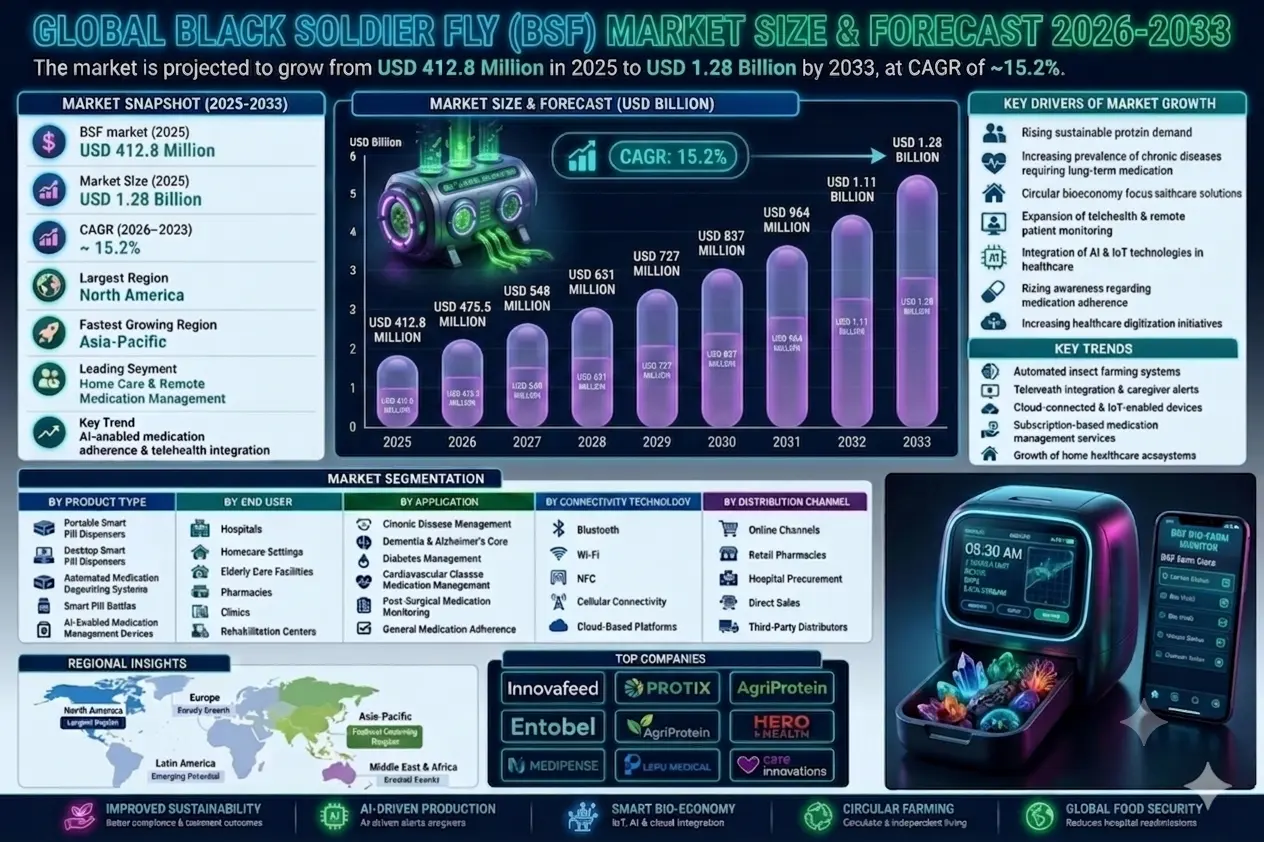
Global Black Soldier Fly (BSF) Market Size & Forecast
The global Black Soldier Fly (BSF) market is projected to witness substantial growth during the forecast period from 2026 to 2033. The market was valued at approximately USD 412.8 million in 2025 and is expected to reach nearly USD 1.28 billion by 2033, expanding at a CAGR of around 15.2%. The market growth is driven by increasing demand for sustainable protein alternatives, growing adoption of insect-based animal feed ingredients, rising focus on circular bioeconomy models, and expanding investments in waste-to-protein conversion technologies. Black Soldier Fly (Hermetia illucens) is widely recognized as one of the most efficient insect species for organic waste bioconversion and sustainable protein production. BSF larvae are utilized for producing high-protein feed ingredients, oils, frass-based fertilizers, and bio-based industrial products for applications across aquaculture, poultry feed, pet food, livestock nutrition, agriculture, and waste management. The market is undergoing significant transformation through advancements in automated insect farming systems, AI-driven breeding optimization, climate-controlled production facilities, and precision nutrient processing technologies. Additionally, increasing regulatory support for alternative feed ingredients, rising pressure to reduce environmental impact from conventional protein production, and growing global food security concerns are accelerating market expansion worldwide.Global Black Soldier Fly (BSF) Market Overview
The Black Soldier Fly market represents an emerging and rapidly expanding segment of the global sustainable agriculture, biotechnology, animal nutrition, and circular economy industries. BSF production systems enable efficient upcycling of organic waste into valuable nutritional and agricultural products. The market includes BSF protein meal, BSF oil, BSF frass fertilizer, live larvae, breeding systems, insect farming technologies, and processing equipment. BSF-derived ingredients are increasingly being integrated into aquafeed, poultry nutrition, swine feed, pet food formulations, soil enrichment products, and industrial biotechnology applications. Technological advancements in robotic insect farming, environmental monitoring systems, automated harvesting, AI-based lifecycle optimization, and nutrient extraction processes are significantly enhancing scalability and production efficiency. Major market participants include Innovafeed, Protix, AgriProtein, Entobel, InnovaFeed, EnviroFlight LLC, Enterra Feed Corporation, Hexafly, nextProtein, and Nutrition Technologies.Key Drivers of Global Black Soldier Fly (BSF) Market Growth
Rising Demand for Sustainable Alternative Proteins
The growing need for environmentally sustainable protein sources for animal feed is driving strong adoption of BSF-derived products. BSF offers high protein efficiency with significantly lower environmental impact compared to traditional protein sources such as fishmeal and soybean meal.Expansion of Circular Bioeconomy Models
BSF farming enables efficient conversion of organic waste streams into valuable nutritional products. This supports waste reduction, resource efficiency, and sustainable agricultural production systems.Increasing Pressure on Conventional Feed Supply Chains
Rising volatility in fishmeal, soybean, and other conventional feed ingredient markets is encouraging adoption of insect-based alternatives. BSF provides supply chain resilience and cost diversification opportunities.Technological Advancements in Insect Farming Automation
Automation technologies are improving production consistency, scalability, and operational efficiency across commercial BSF facilities. This is significantly lowering production costs and enhancing commercial viability.Growing Regulatory Support
Regulatory approvals for insect protein use in aquaculture, poultry feed, and pet nutrition are expanding globally. This is accelerating commercial market development.Global Black Soldier Fly (BSF) Market Segmentation
By Product Type
The market is segmented into BSF protein meal, BSF oil, BSF frass fertilizer, live larvae, and processed insect derivatives. BSF protein meal accounts for the largest market share due to strong demand in animal nutrition applications.By Application
Applications include aquaculture feed, poultry feed, livestock nutrition, pet food, fertilizers, waste management, and industrial biotechnology. Aquaculture feed remains the dominant application segment globally.By Production Method
The market includes industrial automated farming systems, semi-automated production facilities, and decentralized modular farming systems. Industrial automated systems are witnessing rapid adoption due to scalability advantages.By End User
End users include feed manufacturers, agricultural producers, waste management companies, fertilizer producers, and biotechnology firms. Feed manufacturers represent the largest end-user segment.Regional Market Dynamics
Europe
Europe dominates the global Black Soldier Fly market due to strong regulatory support, advanced insect farming infrastructure, and growing focus on circular agriculture solutions. France, the Netherlands, Germany, and Belgium are major regional contributors.North America
North America holds a significant market share supported by increasing investments in sustainable feed innovation and expanding commercial insect farming operations. The United States and Canada remain key regional markets.Asia-Pacific
Asia-Pacific is the fastest-growing region due to rising aquaculture demand, expanding livestock industries, and increasing focus on sustainable protein production. China, Thailand, Vietnam, India, and Indonesia are major growth markets.Latin America
Latin America is gradually emerging as a promising market due to growing agricultural modernization and increasing alternative feed ingredient adoption. Brazil and Mexico are key contributors.Middle East & Africa
The region is witnessing moderate growth supported by food security initiatives and sustainable agriculture investments. Gulf countries and South Africa are key emerging markets.Competitive Landscape
The global Black Soldier Fly market is highly innovation-driven and rapidly evolving, with companies competing through production scale, processing efficiency, product quality, and technological advancement. Key players include Innovafeed, Protix, AgriProtein, Entobel, EnviroFlight LLC, Enterra Feed Corporation, Hexafly, nextProtein, and Nutrition Technologies. Companies are increasingly investing in automated breeding facilities, advanced nutrient extraction technologies, AI-driven production optimization, and strategic feed industry partnerships. Collaborations with aquaculture producers, agricultural companies, and waste management firms are strengthening market positioning.Strategic Outlook
The strategic outlook for the global Black Soldier Fly market remains highly positive due to increasing demand for sustainable feed systems and circular bioeconomy solutions. Future growth opportunities include pharmaceutical-grade insect compounds, precision nutrition applications, bioplastics feedstock development, and carbon-negative waste conversion systems. Regulatory harmonization and large-scale industrial production will play critical roles in future market development. Organizations investing in automation, sustainability certification, and feed integration partnerships are expected to strengthen competitive advantage.Final Market Perspective
The global Black Soldier Fly market is emerging as a transformative force in sustainable protein production, circular agriculture, and resource-efficient biotechnology. Rising environmental concerns, growing demand for alternative feed ingredients, and continuous technological innovation will continue driving strong market expansion throughout the forecast period. Companies that successfully combine production scalability, regulatory compliance, and technological excellence will remain strongly positioned in the evolving global Black Soldier Fly market.Table of Contents
Table of Contents
- 1. Executive Summary
- 1.1 Global Black Soldier Fly (BSF) Market Snapshot (2026???2033)
- 1.2 Market Size & CAGR Analysis
- 1.3 Largest & Fastest-Growing Segments
- 1.4 Key Regional Insights
- 1.5 Major Market Growth Drivers
- 1.6 Competitive Landscape Overview
- 1.7 Strategic Outlook Through 2033
- 2. Introduction & Market Overview
- 2.1 Definition of Black Soldier Fly (BSF)
- 2.2 Scope of the Study
- 2.3 Evolution of Insect Protein Production
- 2.4 Circular Bioeconomy Ecosystem Analysis
- 2.5 Regulatory & Sustainability Framework
- 2.6 Alternative Protein Industry Trends
- 2.7 Technology Innovation Landscape
- 3. Research Methodology
- 3.1 Primary Research
- 3.2 Secondary Research
- 3.3 Market Size Estimation Model
- 3.4 Forecast Assumptions (2026???2033)
- 3.5 Data Validation & Market Triangulation
- 4. Market Dynamics
- 4.1 Drivers
- 4.1.1 Rising Demand for Sustainable Alternative Proteins
- 4.1.2 Expansion of Circular Bioeconomy Models
- 4.1.3 Increasing Pressure on Conventional Feed Supply Chains
- 4.1.4 Technological Advancements in Insect Farming Automation
- 4.1.5 Growing Regulatory Support
- 4.2 Restraints
- 4.2.1 High Initial Capital Investment Requirements
- 4.2.2 Regulatory Complexity Across Regions
- 4.2.3 Consumer Awareness Limitations
- 4.2.4 Production Standardization Challenges
- 4.3 Opportunities
- 4.3.1 Precision Nutrition Applications
- 4.3.2 Pharmaceutical and Bioactive Compound Development
- 4.3.3 Carbon-Negative Waste Conversion Systems
- 4.3.4 Bioplastics Feedstock Innovation
- 4.4 Challenges
- 4.4.1 Scaling Commercial Production
- 4.4.2 Feedstock Consistency Management
- 4.4.3 Supply Chain Infrastructure Development
- 4.4.4 Achieving Cost Competitiveness
- 4.1 Drivers
- 5. Global Black Soldier Fly (BSF) Market Analysis (USD Million), 2026???2033
- 5.1 Market Size Overview
- 5.2 CAGR Analysis
- 5.3 Regional Revenue Distribution
- 5.4 Production Capacity Analysis
- 5.5 Technology Adoption Trends
- 5.6 Future Growth Projections
- 6. Market Segmentation (USD Million), 2026???2033
- 6.1 By Product Type
- 6.1.1 BSF Protein Meal
- 6.1.2 BSF Oil
- 6.1.3 BSF Frass Fertilizer
- 6.1.4 Live Larvae
- 6.1.5 Processed Insect Derivatives
- 6.2 By Application
- 6.2.1 Aquaculture Feed
- 6.2.2 Poultry Feed
- 6.2.3 Livestock Nutrition
- 6.2.4 Pet Food
- 6.2.5 Fertilizers
- 6.2.6 Waste Management
- 6.2.7 Industrial Biotechnology
- 6.3 By Production Method
- 6.3.1 Industrial Automated Farming Systems
- 6.3.2 Semi-Automated Production Facilities
- 6.3.3 Decentralized Modular Farming Systems
- 6.4 By End User
- 6.4.1 Feed Manufacturers
- 6.4.2 Agricultural Producers
- 6.4.3 Waste Management Companies
- 6.4.4 Fertilizer Producers
- 6.4.5 Biotechnology Firms
- 6.1 By Product Type
- 7. Market Segmentation by Geography
- 7.1 Europe
- 7.2 North America
- 7.3 Asia-Pacific
- 7.4 Latin America
- 7.5 Middle East & Africa
- 8. Competitive Landscape
- 8.1 Market Share Analysis
- 8.2 Production Capacity Benchmarking
- 8.3 Product Portfolio Analysis
- 8.4 Strategic Partnerships & Collaborations
- 8.5 Innovation & Sustainability Strategies
- 9. Company Profiles
- 9.1 Innovafeed
- 9.2 Protix
- 9.3 AgriProtein
- 9.4 Entobel
- 9.5 EnviroFlight LLC
- 9.6 Enterra Feed Corporation
- 9.7 Hexafly
- 9.8 nextProtein
- 9.9 Nutrition Technologies
- 9.10 InnovaFeed
- 10. Strategic Intelligence & Pheonix AI Insights
- 10.1 Alternative Protein Forecast Engine
- 10.2 Production Optimization Dashboard
- 10.3 Circular Economy Analytics Tracker
- 10.4 Feed Innovation Opportunity Analyzer
- 10.5 Automated Porter???s Five Forces Analysis
- 11. Future Outlook & Strategic Recommendations
- 11.1 Expansion of Automated Insect Farming Infrastructure
- 11.2 Investment in Nutrient Extraction Innovation
- 11.3 Strengthening Feed Industry Partnerships
- 11.4 Advancing Sustainability Certification Programs
- 11.5 Long-Term Market Outlook (2033+)
- 12. Appendix
- 13. About Pheonix Research
- 14. Disclaimer
Competitive Landscape
Global Black Soldier Fly (BSF) Market Competitive Intensity & Market Structure Overview
The global Black Soldier Fly (BSF) market is highly fragmented and rapidly evolving, characterized by a strong mix of biotechnology startups, alternative protein innovators, waste-to-value companies, and emerging industrial-scale insect farming operators. Competitive intensity is primarily driven by production scalability, cost efficiency, feed conversion performance, automation capability, and regulatory approvals for animal feed applications.
The market structure is transitioning from early-stage pilot and modular farming systems toward large-scale industrial production facilities integrated with feed manufacturers, aquaculture producers, and agricultural supply chains. Companies are competing to achieve cost parity with traditional protein sources such as fishmeal and soybean meal while improving sustainability performance.
Increasing demand for circular bioeconomy solutions, regulatory acceptance of insect-based feed ingredients, and rapid advancements in automated insect rearing technologies are intensifying competition across the global BSF market.
Global Black Soldier Fly (BSF) Market Competitive Intensity & Market Structure Current Scenario
Leading Global BSF Companies
Innovafeed: One of the largest industrial-scale insect protein producers, focusing on high-volume BSF production for aquaculture and animal feed markets.
Protix: Leading European insect ingredient company specializing in sustainable protein meal, oil, and circular feed solutions.
AgriProtein: Pioneer in waste-to-protein conversion technologies using BSF larvae for sustainable animal feed production.
Entobel: Asia-focused insect protein producer scaling BSF production for aquaculture and livestock nutrition.
EnviroFlight LLC: Established North American player focused on BSF-based animal nutrition solutions and commercial-scale production systems.
Enterra Feed Corporation: Canadian company specializing in insect-based feed ingredients for aquaculture and pet food industries.
Hexafly: European biotechnology company developing insect-derived proteins, oils, and biofertilizers through BSF farming.
nextProtein: Innovation-driven company focused on sustainable insect protein production and waste valorization systems.
Nutrition Technologies: Southeast Asia-based BSF producer specializing in high-quality insect protein and organic fertilizer products.
Key Competitive Intensity & Market Structure Drivers
The rising demand for sustainable and low-carbon protein sources is significantly intensifying competition among BSF producers globally.
Expanding aquaculture and pet food industries are accelerating demand for high-quality insect protein meal and oil products.
Technological advancements in automated breeding, climate-controlled rearing systems, and AI-driven production optimization are enabling scalable commercial operations.
Increasing volatility in fishmeal and soybean markets is strengthening the value proposition of BSF as a stable alternative feed ingredient.
Growing regulatory approvals for insect-based feed in Europe, North America, and Asia-Pacific are improving commercialization pathways and attracting new entrants.
Strategic Implications of Competitive Intensity & Market Structure
Companies are increasingly focusing on large-scale industrialization of insect farming to achieve economies of scale and reduce production costs.
Strategic partnerships with aquaculture firms, poultry producers, and feed manufacturers are becoming critical for securing long-term demand contracts.
Automation, robotics, and AI-based lifecycle management systems are emerging as key differentiators in production efficiency and consistency.
Value-added product diversification, including BSF oil, frass fertilizer, and specialty bio-based ingredients, is enhancing revenue opportunities.
Sustainability certification, regulatory compliance, and traceability systems are becoming essential competitive requirements in global markets.
Global Black Soldier Fly (BSF) Market Competitive Intensity & Market Structure Forward Outlook
The global BSF market is expected to remain highly competitive as it transitions from an emerging niche industry to a mainstream alternative protein and circular economy solution.
Future competition will increasingly focus on cost parity with conventional feed ingredients, full automation of production systems, and integration with large-scale food and agriculture supply chains.
Asia-Pacific and Europe are expected to remain key competitive regions due to strong aquaculture demand and supportive regulatory frameworks.
Advancements in genetic optimization of insect strains, waste-stream integration technologies, and industrial-scale bioconversion systems will reshape market dynamics.
Overall, companies that successfully combine scalability, technological innovation, regulatory alignment, and efficient circular production models will remain strongly positioned in the evolving global Black Soldier Fly (BSF) market.
Value Chain
Global Black Soldier Fly (BSF) Market Value Chain & Supply Chain Evolution Overview
The global Black Soldier Fly (BSF) market value chain is undergoing rapid transformation as sustainable protein innovation, circular bioeconomy integration, precision insect farming, and waste-to-resource conversion technologies reshape the broader agricultural biotechnology ecosystem. Black Soldier Fly production has emerged as a highly efficient and scalable biological platform for converting organic waste into valuable protein, oil, fertilizer, and industrial bio-based products.
The BSF market value chain spans organic feedstock sourcing, breeding and genetics optimization, insect rearing infrastructure development, automated farming systems, nutrient extraction and processing, product formulation, regulatory certification, distribution integration, and downstream commercial application deployment. This interconnected ecosystem includes organic waste suppliers, insect farming technology developers, environmental monitoring system providers, feed processing companies, agricultural input manufacturers, biotechnology firms, and end-user feed and agricultural producers.
Major companies including Innovafeed, Protix, AgriProtein, Entobel, EnviroFlight LLC, Enterra Feed Corporation, Hexafly, nextProtein, and Nutrition Technologies are actively investing in AI-driven breeding optimization, industrial automation systems, nutrient recovery innovation, precision environmental control platforms, and scalable processing technologies to strengthen market leadership.
Upstream supply chain activities depend on organic substrate sourcing, microbial control systems, environmental sensor manufacturing, climate-control equipment production, genetics management, and automated farming hardware development. Midstream operations focus on larval breeding, controlled bioconversion processes, harvesting automation, drying and extraction systems, quality testing, nutrient standardization, and product processing. Downstream activities include feed ingredient formulation, fertilizer distribution, waste management service integration, agricultural application deployment, and long-term circular production optimization.
Operational priorities across the BSF value chain increasingly emphasize feed conversion efficiency, production scalability, biosecurity control, nutrient consistency, regulatory compliance, environmental sustainability, waste traceability, and lifecycle automation. However, the market continues to face challenges related to regulatory fragmentation, feedstock quality variability, production standardization, scaling economics, and commercialization infrastructure development.
Global Black Soldier Fly (BSF) Market Value Chain & Supply Chain Evolution Current Scenario
The current BSF market is being shaped by growing demand for sustainable feed ingredients, increasing pressure to reduce dependence on conventional protein sources, rising circular agriculture investments, and accelerated commercialization of industrial insect farming technologies.
Europe currently dominates the global BSF market due to strong regulatory support, advanced insect farming infrastructure, favorable sustainability policies, and extensive investment in alternative protein innovation. France, the Netherlands, Germany, and Belgium remain leading regional markets.
North America maintains a strong market position supported by increasing sustainable feed innovation and expanding commercial insect protein production. Asia-Pacific is emerging as the fastest-growing region due to rapidly expanding aquaculture demand, livestock industry modernization, and increasing adoption of sustainable feed solutions.
BSF protein meal remains the dominant product segment due to its widespread integration into aquaculture and livestock feed formulations.
Industrial automated farming systems are becoming the preferred production model as companies seek large-scale efficiency, process consistency, and lower operational costs.
Key Value Chain & Supply Chain Evolution Signals in Global Black Soldier Fly (BSF) Market
One of the most important transformation signals is the rapid deployment of fully automated insect farming systems. Robotics, environmental monitoring, and AI-driven lifecycle management are significantly improving operational consistency and scalability.
Precision breeding optimization is becoming increasingly important as producers focus on improving larval productivity, nutrient yield, and conversion efficiency.
Advanced feedstock traceability systems are emerging as critical supply chain innovations, ensuring quality consistency and regulatory compliance across industrial-scale operations.
Nutrient extraction and fractionation technologies are significantly evolving, enabling higher-value product diversification including specialized proteins, lipids, and bioactive compounds.
Integration with waste management infrastructure is becoming increasingly strategic, enabling direct circular feedstock sourcing and localized production efficiency.
Sustainability certification and carbon accounting capabilities are emerging as key competitive differentiators for commercial market expansion.
Strategic Implications of Value Chain & Supply Chain Evolution in Global Black Soldier Fly (BSF) Market
Leading BSF companies are increasingly prioritizing production automation, process optimization, product standardization, and regulatory alignment to maintain competitive advantage. Competitive differentiation increasingly depends on scalability, nutrient quality consistency, feedstock sourcing resilience, and processing efficiency.
Companies capable of delivering integrated end-to-end circular production ecosystems that combine feedstock conversion, precision farming, nutrient processing, and downstream commercial integration are expected to capture premium market opportunities.
Strategic collaborations between BSF producers, feed manufacturers, aquaculture companies, agricultural producers, and waste management operators are becoming essential for accelerating market adoption and supply chain expansion.
Long-term supply contracts with feed industry partners are emerging as critical revenue stabilizers as commercial adoption expands globally.
Regulatory certification and traceable sustainability performance are becoming increasingly important strategic differentiators as institutional buyers prioritize compliance and environmental accountability.
Manufacturers are increasingly localizing production infrastructure near organic waste sources and feed manufacturing hubs to improve logistics efficiency and strengthen supply resilience.
Global Black Soldier Fly (BSF) Market Value Chain & Supply Chain Evolution Forward Outlook
Between 2026 and 2033, the BSF value chain is expected to become significantly more industrialized, intelligent, decentralized, and integrated within broader circular bioeconomy ecosystems. BSF production will increasingly evolve from niche alternative protein production toward mainstream sustainable agricultural infrastructure.
Advanced AI systems will continue improving breeding optimization, environmental control, predictive yield management, and automated operational decision-making.
Large-scale modular production systems will enable geographically distributed insect farming networks aligned with regional feedstock availability and local agricultural demand.
Precision nutrient processing technologies will expand product diversification into pharmaceutical compounds, functional feed additives, specialty lipids, and advanced bio-based materials.
Carbon-negative production systems and circular waste conversion platforms will become increasingly central to future market competitiveness.
Regulatory harmonization across major global markets will significantly accelerate cross-border commercialization and industry scale-up.
Ultimately, the future BSF value chain will evolve into a highly automated, circular, and intelligent bio-production ecosystem capable of transforming global feed, agriculture, and waste management systems through sustainable resource conversion.
Market-Specific Value Chain
- Feedstock Sourcing & Biological Input Management: Organic waste collection, substrate preparation, microbial control systems, breeding genetics, and environmental monitoring input sourcing.
- Insect Farming Technology & Automation Development: Robotic farming systems, climate control engineering, AI lifecycle optimization, sensor integration, and automated production infrastructure.
- Larval Production & Nutrient Processing: Controlled rearing, harvesting automation, drying, oil extraction, protein meal processing, and frass conversion.
- Product Standardization & Regulatory Integration: Nutrient quality testing, certification, compliance validation, traceability systems, and product formulation optimization.
- Commercial Distribution & Application Deployment: Feed ingredient distribution, fertilizer market integration, waste conversion services, and industrial biotechnology deployment.
- Long-Term Circular Bioeconomy Optimization: Carbon accounting, decentralized production networks, precision bio-manufacturing, and integrated circular agricultural ecosystems.
Company-to-Stage Mapping
- Feedstock Sourcing & Biological Input Management: Organic waste network operators, agricultural feedstock suppliers, microbial systems providers.
- Insect Farming Technology & Automation Development: Innovafeed, Protix, insect farming automation technology developers.
- Larval Production & Nutrient Processing: AgriProtein, Entobel, Hexafly, Nutrition Technologies.
- Product Standardization & Regulatory Integration: nextProtein, certification and insect nutrient processing specialists.
- Commercial Distribution & Application Deployment: EnviroFlight LLC, Enterra Feed Corporation, feed integration and agricultural deployment partners.
- Long-Term Circular Bioeconomy Optimization: Advanced circular agriculture platform developers, industrial bioeconomy infrastructure providers.
Investment Activity
Global Black Soldier Fly (BSF) Market Investment & Funding Dynamics Overview
The global Black Soldier Fly (BSF) market is attracting strong investment momentum driven by rising demand for sustainable protein, circular economy adoption, and rapid expansion of alternative feed technologies. Investors are increasingly focusing on BSF-based waste-to-protein models as a scalable solution for food security and environmental sustainability challenges.
Funding activity across the BSF ecosystem is expanding rapidly, with venture capital firms, agritech investors, impact funds, and strategic food industry players actively participating in early-stage and growth-stage financing rounds. The market is also witnessing increased corporate investment in industrial-scale insect farming infrastructure and automated production systems.
A key investment trend is the shift toward fully automated and AI-enabled insect farming facilities. Capital is flowing into robotics-based breeding systems, climate-controlled production units, and advanced bioconversion technologies that improve yield efficiency and reduce operational costs.
Current Investment Landscape
- Europe: Leads global investment activity due to strong regulatory support for insect protein and circular agriculture initiatives.
- North America: Witnessing growing venture capital participation and expansion of commercial insect farming startups.
- Asia-Pacific: Emerging as a high-growth investment destination driven by aquaculture demand and feed industry expansion.
- Latin America: Early-stage investments are increasing in sustainable agriculture and waste valorization projects.
- Middle East & Africa: Strategic investments are focused on food security and sustainable agriculture initiatives.
Key Investment Drivers
- Rising global demand for alternative and sustainable protein sources.
- Increasing pressure on fishmeal and soybean supply chains.
- Strong growth in aquaculture and animal feed industries.
- Expansion of circular economy and waste-to-value business models.
- Advancements in automated insect farming technologies.
- Growing regulatory approvals for insect-based feed ingredients.
Strategic Investment Areas
- Automated Insect Farming Systems: Robotics, AI-driven breeding, and climate-controlled production facilities.
- Protein Processing Technologies: High-efficiency extraction of BSF meal, oil, and bioactive compounds.
- Waste-to-Protein Platforms: Scalable organic waste conversion infrastructure.
- Animal Feed Integration: Formulation technologies for aquaculture, poultry, and pet food markets.
- Bioproduct Development: Fertilizers, biofertilizers, and industrial applications from BSF byproducts.
Strategic Investment Implications
- Companies with large-scale automated production capabilities are attracting higher valuations.
- Technological differentiation in yield efficiency and lifecycle optimization is a key investment driver.
- Vertical integration across waste collection, farming, and feed production improves funding attractiveness.
- Long-term contracts with feed manufacturers enhance revenue stability and investor confidence.
- Regulatory alignment significantly reduces market entry risk for institutional investors.
Forward Investment Outlook
The BSF market is expected to remain one of the fastest-growing agritech investment segments, supported by increasing global emphasis on sustainable protein systems and circular bioeconomy infrastructure.
Future funding is likely to concentrate on large-scale industrial insect farms, AI-driven production optimization platforms, and integrated waste-to-protein ecosystems. Strategic partnerships between agritech companies, feed manufacturers, and waste management firms will further accelerate capital deployment.
Overall, the Black Soldier Fly sector presents a high-growth, impact-driven investment opportunity positioned at the intersection of food security, sustainability, and biotechnology innovation.
Technology & Innovation
Global Black Soldier Fly (BSF) Market Technology & Innovation Landscape Overview
The Global Black Soldier Fly (BSF) Market is undergoing rapid technological transformation driven by advancements in automated insect farming systems, artificial intelligence-powered lifecycle optimization, precision environmental control technologies, and advanced nutrient extraction processes. Innovation is increasingly focused on improving production scalability, feed conversion efficiency, waste bioconversion performance, and end-product quality across commercial BSF operations.
Modern BSF production systems are evolving into highly intelligent bioindustrial ecosystems capable of automated breeding, real-time environmental monitoring, optimized larval development, and precision nutrient processing. These technological developments are significantly improving operational consistency, reducing production costs, and enabling large-scale commercialization of insect-derived feed, oil, and fertilizer products.
The integration of robotics, IoT-enabled environmental sensing, machine learning analytics, and digital production management platforms is reshaping the BSF market by creating more efficient, data-driven, and sustainable insect farming operations.
Global Black Soldier Fly (BSF) Market Technology & Innovation Current Scenario
Currently, the BSF market is witnessing strong innovation through automated climate-controlled rearing systems that optimize temperature, humidity, airflow, and light conditions to maximize larval growth performance and breeding consistency.
Artificial intelligence and machine learning are increasingly being deployed to optimize feeding schedules, monitor larval development cycles, improve breeding efficiency, and predict production outcomes in real time.
Advanced robotic harvesting and automated separation technologies are improving operational efficiency by reducing manual labor requirements and enhancing production throughput.
Precision nutrient extraction systems are enabling higher-quality protein meal and oil production through optimized drying, processing, and separation technologies that preserve nutritional value.
IoT-based environmental monitoring systems are enhancing facility control by providing continuous performance data related to substrate quality, environmental stability, and production health metrics.
Additionally, modular insect farming infrastructure is gaining traction, enabling scalable deployment across decentralized waste-to-protein production facilities.
Key Technology & Innovation Trends in Global Black Soldier Fly (BSF) Market
- AI-Driven Lifecycle Optimization: Intelligent systems improving breeding efficiency and larval development performance.
- Automated Climate Control Systems: Precision environmental regulation for optimized production conditions.
- Robotic Harvesting Technologies: Automated collection and separation systems improving operational efficiency.
- IoT-Enabled Monitoring Platforms: Real-time environmental and production performance tracking.
- Precision Nutrient Extraction: Advanced processing technologies preserving protein and oil quality.
- Modular Farming Infrastructure: Scalable decentralized insect farming systems for flexible deployment.
- Digital Production Management Platforms: Centralized analytics for operational optimization and production forecasting.
- Sensor-Based Waste Conversion Analytics: Monitoring systems improving organic substrate utilization efficiency.
- Automated Feeding Systems: Precision substrate delivery supporting optimized larval growth.
- Bioinformatics for Genetic Optimization: Data-driven breeding enhancement for productivity improvement.
Strategic Implications of Technology & Innovation
Technological innovation is fundamentally reshaping competitive dynamics in the BSF market by shifting competition toward production automation, biological optimization, processing precision, and operational scalability.
Companies investing in AI-powered production analytics, automated facility management, and advanced nutrient extraction technologies are achieving stronger differentiation through improved output consistency, lower production costs, and superior product quality.
The integration of intelligent environmental control systems is enabling operators to improve production predictability and reduce operational risks across commercial insect farming facilities.
Modular production technologies are creating strategic opportunities for localized circular bioeconomy deployment and distributed waste conversion infrastructure.
However, challenges including high capital investment requirements, process standardization complexity, regulatory variability, and biological system sensitivity remain key barriers to widespread market adoption.
Global Black Soldier Fly (BSF) Market Technology & Innovation Forward Outlook
Looking ahead, the BSF market is expected to evolve toward fully autonomous, digitally orchestrated insect bioconversion ecosystems capable of self-optimizing production and predictive biological management.
Future innovation is likely to focus on self-learning production systems capable of continuously adjusting environmental and feeding conditions based on real-time biological response data.
Advanced genomic optimization and selective breeding technologies are expected to improve larval productivity, nutrient efficiency, and environmental resilience.
Digital twin platforms are anticipated to enable virtual simulation of production cycles, facility optimization, and predictive output modeling.
Blockchain-enabled traceability systems may gain importance in ensuring supply chain transparency, sustainability certification, and regulatory compliance for insect-derived products.
Overall, the Global Black Soldier Fly (BSF) Market is entering a new era of intelligent bioindustrial innovation characterized by automation, AI-driven biological optimization, precision nutrient processing, and circular production intelligence, positioning the market for sustained long-term technological advancement and commercial growth.
Market Risk
Global Black Soldier Fly (BSF) Market Risk Factors & Disruption Threats Overview
The global Black Soldier Fly (BSF) market is witnessing rapid growth driven by increasing demand for sustainable protein alternatives, circular bioeconomy adoption, expanding animal feed applications, and advancements in automated insect farming technologies. Despite strong long-term growth potential, the market faces multiple risks and disruption threats related to regulatory uncertainty, scalability limitations, production standardization challenges, feedstock variability, market acceptance barriers, and evolving competitive pressures.
One of the primary risks affecting the BSF market is regulatory fragmentation across different regions. While some countries have approved insect protein for aquaculture, poultry, and pet food applications, inconsistent approval frameworks and strict feed safety regulations continue to restrict broader commercialization.
Production scalability presents another significant challenge. Industrial-scale BSF farming requires substantial investment in automation systems, climate-controlled environments, waste processing infrastructure, and advanced breeding optimization technologies, which can create financial barriers for new entrants.
Feedstock consistency and organic waste input quality remain critical operational risks. Variability in waste stream composition can impact larvae growth performance, protein yield, nutrient consistency, and final product quality.
Consumer and industry acceptance also remains a challenge, particularly in regions where insect-derived ingredients face limited awareness or resistance from feed manufacturers and end-users.
Supply chain disruptions affecting specialized farming equipment, automation systems, environmental control technologies, and nutrient processing infrastructure can further slow market expansion.
Additionally, intensifying competition from alternative sustainable protein sources such as microbial protein, algae-based feed ingredients, precision fermentation products, and plant-based feed alternatives may challenge market penetration.
Global Black Soldier Fly (BSF) Market Risk Factors & Disruption Threats Current Scenario
The current BSF market is experiencing strong investment activity, regulatory progress, and rapid expansion of commercial production facilities across Europe, North America, and Asia-Pacific.
However, many producers are still navigating operational scale-up challenges, cost competitiveness concerns, and production efficiency optimization.
Regulatory approvals are expanding, but fragmented standards across international markets continue to create commercialization complexity.
Cost competitiveness relative to traditional feed proteins remains a critical pressure point, particularly during periods of commodity price volatility.
Technological innovation is accelerating automation and productivity gains, but implementation complexity and capital intensity remain major barriers for smaller producers.
The market is also facing increased investor scrutiny regarding long-term profitability, operational scalability, and commercial adoption timelines.
Global Black Soldier Fly (BSF) Market Key Risk Factors & Disruption Threat Signals
- Regulatory Uncertainty: Inconsistent approval standards for insect-based feed ingredients across global markets.
- High Capital Investment Requirements: Significant infrastructure costs for industrial-scale automated insect farming.
- Feedstock Variability: Fluctuating organic waste quality impacting nutrient consistency and larvae performance.
- Production Scalability Challenges: Operational difficulties in achieving large-scale commercial output.
- Market Acceptance Barriers: Limited awareness and resistance among traditional feed manufacturers.
- Supply Chain Dependencies: Vulnerability to disruptions in automation systems and processing equipment availability.
- Competitive Alternative Proteins: Pressure from algae, microbial protein, and precision fermentation technologies.
- Operational Biosecurity Risks: Disease outbreaks or contamination affecting larvae populations.
- Cost Competitiveness Pressure: Challenges in matching pricing of conventional feed proteins.
- Technology Obsolescence: Rapid innovation cycles requiring continuous infrastructure upgrades.
Strategic Implications of Risk Factors
BSF producers must prioritize automation-driven production optimization to improve yield consistency and lower operational costs.
Strengthening feedstock sourcing partnerships and waste input quality control systems will be essential for ensuring stable nutrient output.
Regulatory engagement and certification alignment across international markets will become critical for accelerating product acceptance.
Investment in biosecurity systems, environmental monitoring, and precision breeding technologies will help reduce operational risks.
Strategic collaborations with feed manufacturers, aquaculture operators, agricultural cooperatives, and waste management firms will strengthen market penetration and supply chain resilience.
Global Black Soldier Fly (BSF) Market Forward Risk Outlook
Looking ahead to 2026???2033, the BSF market is expected to maintain strong momentum as sustainability priorities and circular agriculture solutions gain global traction.
Future disruption will likely emerge from next-generation insect farming automation, AI-powered nutrient optimization, carbon-negative waste conversion technologies, and expanded regulatory harmonization.
Companies unable to achieve production efficiency, cost competitiveness, and regulatory scalability may face increasing market pressure.
The strongest opportunities will emerge for organizations delivering highly automated, scalable, biosecure, and economically competitive BSF production ecosystems.
Overall, long-term market leadership will depend on technological innovation, regulatory adaptability, feed integration capabilities, and sustainable production excellence.
Regulatory Landscape
Global Black Soldier Fly (BSF) Market Regulatory & Policy Environment Overview
The regulatory and policy environment governing the global Black Soldier Fly (BSF) market is evolving rapidly as insect-based proteins transition from emerging innovation to mainstream adoption in animal nutrition and circular bioeconomy systems. Regulatory frameworks primarily focus on feed safety standards, food chain integrity, biosecurity controls, waste utilization permissions, and environmental compliance.
Governments and food safety authorities across major regions are gradually establishing formal approval pathways for insect-derived products such as BSF protein meal, BSF oil, and frass-based fertilizers. However, regulatory consistency remains uneven, with significant variation in permitted applications, processing requirements, and quality control standards across geographies.
Key regulatory oversight bodies include the European Food Safety Authority (EFSA), the U.S. Food and Drug Administration (FDA), the Association of American Feed Control Officials (AAFCO), and equivalent national food safety and agricultural authorities across Asia-Pacific, Latin America, and the Middle East.
Global Black Soldier Fly (BSF) Market Regulatory & Policy Environment Current Scenario
The current regulatory landscape for BSF products is characterized by gradual acceptance and structured but fragmented policy development. Europe remains the most advanced region, with clearly defined approvals for insect protein in aquaculture and poultry feed under strict safety and hygiene conditions.
In North America, regulatory acceptance is expanding, particularly for aquafeed and pet food applications, although broader livestock feed approvals are still progressing through staged evaluation processes.
In Asia-Pacific, regulatory frameworks vary widely. Countries with strong aquaculture industries such as China, Thailand, Vietnam, and Indonesia are increasingly exploring insect protein integration, but formalized regulatory standards are still developing in many jurisdictions.
Emerging markets in Latin America, the Middle East, and Africa are gradually adopting international feed safety and environmental standards, often relying on imported regulatory frameworks and guidelines to govern BSF production and usage.
Key Regulatory & Policy Framework Areas in Global BSF Market
- Feed Safety Regulations: Strict controls on microbiological safety, contamination limits, and traceability of insect-derived feed ingredients.
- Approved Application Scope: Regulations define permissible use cases such as aquaculture feed, poultry feed, pet food, and livestock nutrition.
- Organic Waste Utilization Policies: Rules governing permissible feedstock sources for BSF farming, including restrictions on hazardous or contaminated waste streams.
- Biosecurity & Disease Control Standards: Requirements to prevent pathogen transmission and ensure controlled breeding environments.
- Environmental Compliance: Regulations addressing waste reduction, emissions control, and sustainable resource utilization in insect farming facilities.
- Product Labeling & Certification: Mandatory labeling standards and certification requirements for insect-based feed products in commercial markets.
Global BSF Market Regulatory Developments & Regional Policy Trends
In Europe, regulatory frameworks continue to evolve under the European Union???s feed hygiene and novel food regulations, supporting controlled expansion of insect protein use in sustainable agriculture systems.
In the United States, regulatory progress is driven by AAFCO ingredient definitions and FDA feed safety guidelines, enabling gradual expansion of insect protein approvals across multiple animal feed categories.
In Asia-Pacific, governments are increasingly integrating insect farming into national food security and waste management strategies, encouraging pilot regulatory programs and industry-specific guidelines.
In developing regions, regulatory development is closely tied to agricultural modernization initiatives and international sustainability programs promoting circular economy practices.
Strategic Implications of Regulatory Environment
The evolving regulatory landscape is encouraging BSF producers to invest in standardized production systems, traceability technologies, and certified quality assurance frameworks to ensure compliance across multiple jurisdictions.
Companies operating in multiple regions must adapt to non-uniform regulatory requirements, increasing the need for flexible production models and region-specific compliance strategies.
Regulatory approvals significantly influence market entry speed, product diversification, and commercial scalability, making compliance capability a key competitive differentiator in the BSF industry.
Overall, regulatory harmonization efforts are expected to improve long-term market efficiency, but short-term fragmentation will continue to shape global expansion strategies for BSF-based products.
Global Black Soldier Fly (BSF) Market Regulatory Outlook
Between 2026 and 2033, regulatory frameworks for the BSF market are expected to become more structured and internationally aligned as insect protein gains wider acceptance in global food and feed systems.
Authorities are likely to expand approved application categories, strengthen feed safety monitoring systems, and introduce clearer guidelines for industrial-scale insect farming operations.
Environmental and sustainability regulations are expected to further support BSF adoption as governments prioritize circular economy models and waste-to-protein conversion technologies.
However, differences in regulatory maturity across regions will continue to create transitional challenges for global manufacturers and limit full market standardization in the near term.