
Global NGS Library Preparation and Sample Preparation Market Size, Share, Trends and Forecast 2026-2033
Library preparation is priced per sample, and that is why it deflates
Every other layer of the sequencing stack is priced by the run. The instrument is bought once. The flow cell and sequencing reagents are bought per run. Library preparation is the only layer priced by the sample — and it is the only layer a laboratory must buy again before it can use anything it already owns.
That structure should make it the most durable revenue pool in genomics. What the 2025 filings show is that it makes it the most contested, and therefore the most deflationary.
The single cleanest measurement in this market
10x Genomics published two figures in the same release that, read together, describe this entire market. Consumable reactions rose from 357,100 in 2024 to 424,000 in 2025 — up 18.73%. Consumables revenue rose from USD 493.4 million to USD 507.2 million — up 2.79%. Realised revenue per reaction therefore fell from USD 1,381.78 to USD 1,196.19, a decline of 13.43%.
This is the cleanest public measurement of library preparation deflation that exists, because 10x is the one participant in this market that discloses both a unit count and the revenue those units produced. Every library built on a 10x instrument consumes a kit, and every kit is bought again for the next library. Volume grew six times faster than revenue in the same twelve months, and the gap between them is the price.
The mechanism is not a discount war. It is that the components of a library — enzymes, adapters, index primers, magnetic beads — are manufacturable at scale by anyone with a molecular biology operation and a quality system. New England Biolabs does not publish financial statements. Neither does most of the market.
What this report measures, and what it deliberately excludes
The perimeter is consumables consumed per sample, across all sequencing platforms and applications. That means nucleic acid extraction and sample preparation consumables, library preparation kits and reagents, target enrichment and capture panels with their probes and blockers, and the cleanup, size-selection and quality-control consumables that sit between those steps. Single-cell and spatial library construction is included, because those reagents build libraries that are sequenced on NGS instruments.
It excludes three things that would inflate the base without measuring the same market. First, flow cells and sequencing reagents — those belong to the sequencing market we size separately at USD 15.80 billion in 2025, and counting them here would double-count the largest line in the stack. Second, instruments and automation hardware — a liquid handler is capital equipment, and its consumables are already counted. Third, bioinformatics, software and services, including sequencing-as-a-service, because a laboratory that outsources its sequencing is not buying its own reagents.
Against that perimeter the base year reconciles to USD 3,340.0 million. Twelve attributed pools account for USD 2,790.9 million of it — 83.56% — and the residual of USD 549.1 million, or 16.44%, is the unlisted and regional supply that does not publish: MGI, BGI and the Chinese reagent makers, plus the private Western enzyme and bead suppliers.
Ten attributable pools and two labelled estimates
No participant discloses library preparation as a revenue line. The base is therefore a construction, and the largest judgement in it is 10x Genomics. Its consumables revenue of USD 507.2 million is attributable at 85%, or USD 431.1 million — the largest single named pool at 12.91% of the base — because those reagents construct single-cell and spatial libraries, net of gel beads and ancillary items. Removing 10x entirely takes the base to USD 2,908.9 million and the CAGR from 6.36% to 6.27%, a nine basis-point move. It is a level decision, not a rate decision, and the report says so rather than burying it.
The forecast: USD 3,340.0 million to USD 5,471.1 million
The market reaches USD 5,471.1 million by 2033, a CAGR of 6.36% — a 1.6381 times expansion, or USD 2,131.1 million of incremental annual revenue. The path is built from four segments rather than a single blended rate:
| Segment | 2025 (USD m) | Growth | 2033 (USD m) |
|---|---|---|---|
| Library preparation kits and reagents | 1,880.0 | 7.0% | 3,230.2 |
| Target enrichment and capture | 620.0 | 7.5% | 1,105.8 |
| Sample preparation and extraction | 560.0 | 4.0% | 766.4 |
| Cleanup, size selection and QC | 280.0 | 3.5% | 368.7 |
| Total | 3,340.0 | 6.36% CAGR | 5,471.1 |
The first forecast year grows 6.30% and the eight-year compound rate is 6.36%. The six basis-point gap is arithmetic: the fast segments are already large enough that their compounding barely moves the mix.
Why 6.36% is the right number and not a lower one
The bridge is units against price. If library volume grows about 12% a year and realised price per library falls about 5%, revenue grows 6.40% — 1.12 times 0.95. That is almost exactly the modelled rate, and the whole forecast rests on one assumption: that price decline narrows from the 13.43% measured at 10x in 2025 to roughly 5%.
There is a reason to expect narrowing and it is not optimism. Price falls hardest where the buyer is a researcher spending a grant and can substitute freely; it falls least where the buyer is a clinical laboratory whose reagent is written into a validated workflow and a reimbursement claim. As clinical becomes the larger half of the market, the blended deflation rate mechanically slows. The same shift is visible in Illumina's consumables disclosure, where clinical demand grew 12% for the full year while research and applied demand fell 7%.
If the assumption fails, the number fails with it. Hold unit growth at 12% and hold price decline at the 2025 rate of 13.43%, and the market does not grow at all — it contracts 3.04% a year, because 1.12 times 0.8657 is 0.9696. That arithmetic is in the risk chapter because it is the honest description of the downside, not a stress test bolted onto a forecast that cannot reach it.
The installed base decides this market with a lag
Library prep consumables are a derivative of instrument placements. A sequencer bought in 2026 consumes prep reagents from 2026 until it is retired or displaced, so the prep revenue of 2030 is already partly determined by the placements of 2025.
Those placements are falling. Illumina's sequencing instrument revenue was USD 465 million in 2025 against USD 484 million in 2024, down 4% — and down 1% even excluding Greater China, at USD 449 million against USD 453 million. 10x Genomics sold 1,007 instruments in 2025 against 1,073 in 2024, and instrument revenue fell from USD 92.7 million to USD 56.8 million, down 38.7%. Illumina's consumables now represent 74% of its revenue, against 68% in 2023, while instruments have fallen from 16% to 11%. That is a company harvesting an installed base it is placing more slowly.
For a market defined by per-sample consumption, a two-year placement trough becomes a demand trough three to five years later. The forecast reaches 6.36% partly because 2025 is a trough year, not a trend year.
The finding that reorganises the category
This is not one market. It is two, sold through the same catalogues, and their margins run in opposite directions.
The first is commodity chemistry — enzymes, adapters, index primers, beads, cleanup reagents. It is priced toward marginal cost, it is where the 13.43% decline lives, and it is where scale is the only defence.
The second is content — capture panels, validated workflows, automation-locked reagent sets, and cleared in-vitro diagnostics. It is priced on the answer it produces, not on what it is made of. Twist Bioscience demonstrates the split better than any argument: its NGS revenue grew 23.1% to USD 208.1 million while its gross margin rose from 42.6% to 50.7%, a 810 basis-point expansion in a year when every commodity reagent supplier was cutting price. Twist sells the capture panel — the component that must be redesigned as the knowledge base changes.
Both halves are growing. Only one of them is repricing.
The China finding: the ban separated the razor from the blade
On 4 February 2025 China's Ministry of Commerce placed Illumina on its unreliable entity list, and from 4 March 2025 it prohibited imports of the company's gene sequencers. The measure targeted high-throughput instruments. It did not explicitly restrict reagents, consumables or maintenance — and that asymmetry is the most consequential structural fact in this market.
Illumina's Greater China sequencing consumables fell from USD 227 million in 2024 to USD 189 million in 2025, a decline of 16.74%. Its instrument funnel into the same territory closed completely. The company cut USD 100 million of costs and guided down within days of the announcement.
What that produces is a decaying annuity: a reagent revenue stream still being harvested from an installed base that can no longer be renewed. It will not fall to zero quickly, because a sequencer placed in 2024 still needs kits in 2028. It will fall to zero eventually, because nothing replaces it. Domestic procurement in the first half of 2025 already shows the substitution: MGI and Berry Genomics together took 59.3% of Chinese sequencer procurement value, against a prior-year first half in which only MGI placed in the top three at 50%. MGI's long-read sales rose more than 60% to over 700 units in the same six months.
Everyone who reads this ban as an instrument story is reading it one layer too high. The instruments were the smaller line. The prep reagents are the annuity, and the annuity has been given a date.
The base year is presented as a trough for that reason as well. Three drags were active at once in 2025 and all three are policy or funding events rather than demand events: the China prohibition, the United States federal research environment, and tariff costs landing on imported reagents. The forecast requires those to stop dragging. It does not require any of them to reverse.
Two companion analyses carry the mechanisms this forecast rests on. Thirteen Point Four Three Per Cent a Reaction works through the only disclosed unit count and revenue pair in the market, 424,000 consumable reactions against USD 507.2 million, and shows what the 2033 level becomes if the 2025 decline in realised revenue per reaction persists rather than narrows. The Ban Took the Instrument and Left the Reagent Dying reads China's measure at the layer it was actually applied to, and explains why a reagent stream cut off from its instrument funnel declines slowly and then stops.
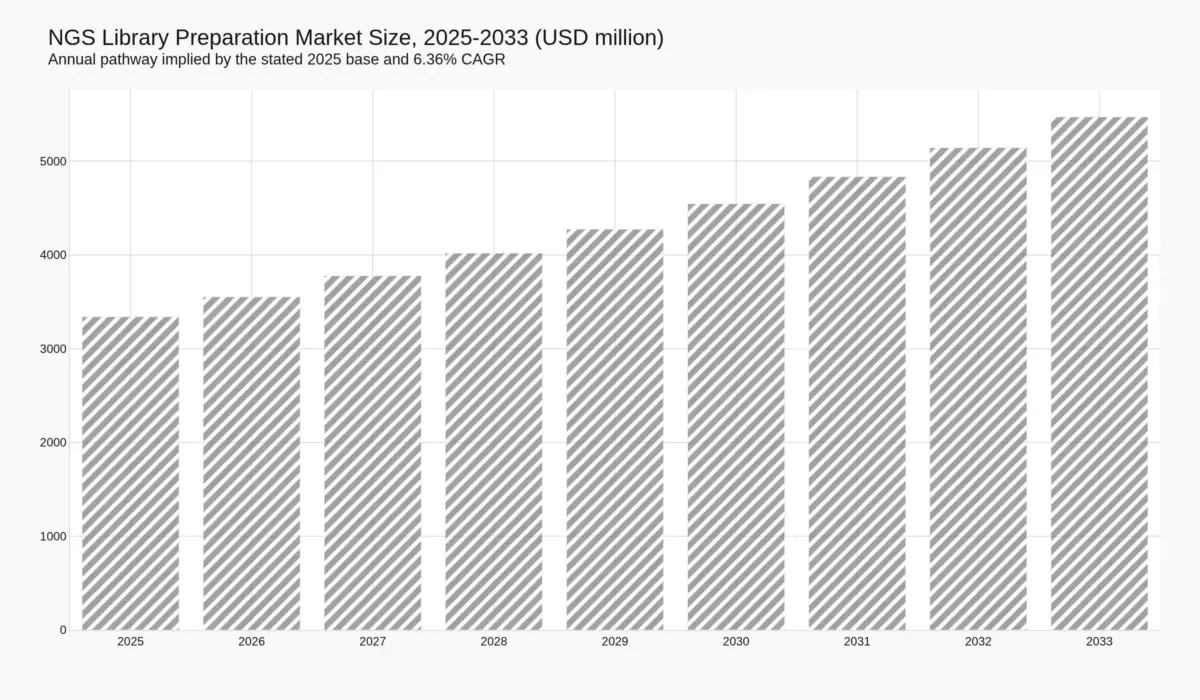
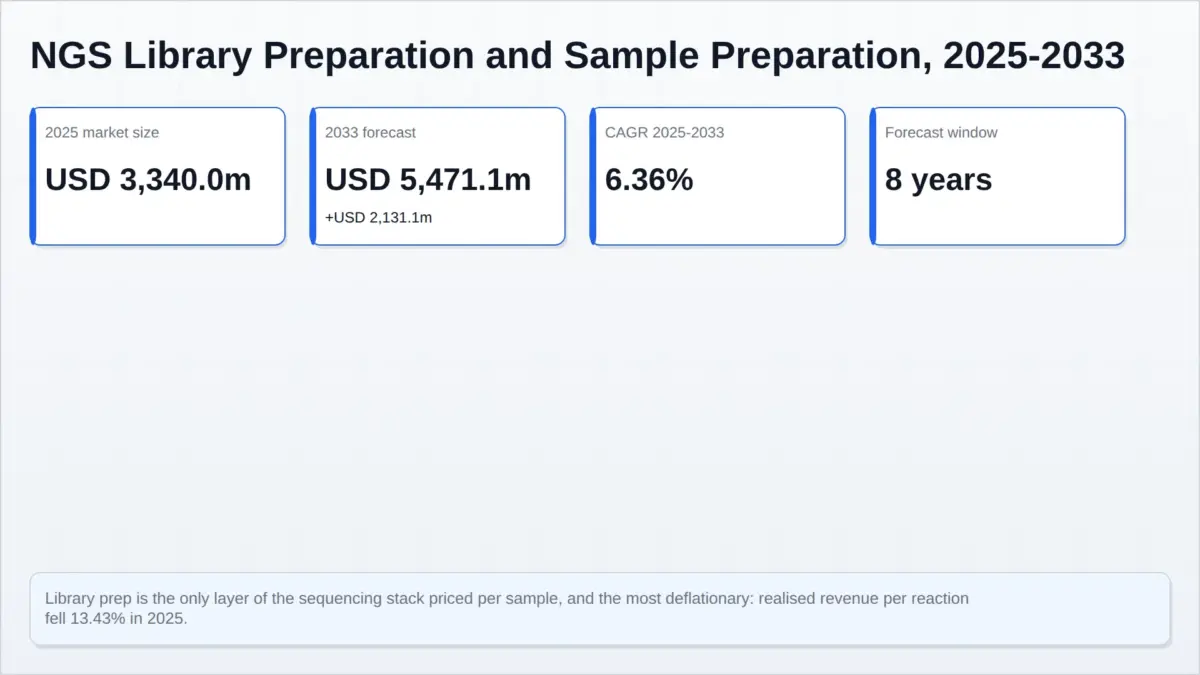
Table des matières
Paysage concurrentiel
The market’s structure turns on one question
Does the reagent work on somebody else’s instrument? That single question divides the nine Tier-1 participants in this market into two groups with different economics, different growth rates and different exposure to price.
Platform-captive preparation
Illumina, Oxford Nanopore, Pacific Biosciences and 10x Genomics sell preparation chemistry designed for their own adapter and their own instrument. The reagent is not interchangeable with a competitor’s, because the adapter sequence is the platform’s interface. A laboratory that switches platform must repurchase its preparation reagents — and a laboratory that stays must keep buying them from one supplier.
Illumina is the largest single pool. Its 2025 sequencing consumables revenue was USD 2,939 million against USD 2,872 million in 2024, up 2%, and consumables now represent 74% of total revenue against 68% in 2023. Within that, library preparation is a minority line: flow cells and sequencing reagents dominate, and the company does not disaggregate the preparation component. The figure used in this report’s base is a stated 13.0% attribution, or USD 382.1 million, which is 11.44% of the total market.
10x Genomics is the opposite case — its consumables are almost entirely library construction. Consumables revenue was USD 507.2 million in 2025 against USD 493.4 million, up 2.79%, on 424,000 consumable reactions against 357,100. Spatial consumables grew 18.9% to USD 144.0 million while single-cell consumables fell 2.4% to USD 363.2 million, so the growth inside the franchise is coming from the newer application, not the founding one.
Oxford Nanopore grew fastest and earned least. Revenue rose 24.2% at constant currency to GBP 223.9 million with gross margin of 58.6%, but the company still reported an adjusted EBITDA loss of GBP 86.7 million and a loss for the year of GBP 145.2 million. Its clinical revenue grew 59.9% and BioPharma 30.4%, against research growth of 15.1% on a base that is still 67% of revenue.
Pacific Biosciences is the only participant whose annuity shrank. Full-year consumables fell from USD 65.8 million to USD 53.8 million, down 18.2%, even as the fourth quarter set an all-time record for consumable revenue at USD 17.3 million. A record quarter inside a declining year is a statement about the installed base, not about demand.
Open preparation
Thermo Fisher, QIAGEN, Roche through Kapa, Agilent, Danaher through IDT and Beckman Coulter, New England Biolabs, Twist Bioscience and Takara sell reagents intended to work across platforms. This is where the deflation lives, and also where the content margin lives — the two are not the same business and should not be read as one.
Thermo Fisher reports Life Sciences Solutions at USD 10,374 million in 2025 against USD 9,631 million, up 7.7%, at a 36.3% segment margin. That segment contains Ion Torrent and Applied Biosystems preparation chemistry among a much larger set of products, so any attribution to this market is small: 2.5%, or USD 259.4 million, is the figure used here.
QIAGEN discloses closer to the line than anyone. Sample technologies was USD 661 million in 2025 against USD 642 million, up 2% at constant currency, and represents 31.63% of total company sales of USD 2,090 million. Genomics and NGS was USD 242 million against USD 234 million, also up 2% at constant currency — and the fourth-quarter commentary is the single most important disclosure in this report’s research file: QIAGEN Digital Insights grew at a double-digit rate while “consumables sales of universal NGS panels declined reflecting funding constraints.” Software grew and reagents shrank inside the same product group, in the same quarter.
Twist Bioscience is the content benchmark. NGS revenue grew 23.1% to USD 208.1 million against USD 169.1 million, and gross margin rose from 42.6% to 50.7% — 810 basis points — while selling, general and administrative expense rose to USD 247.0 million. Twist sells capture panels, which are content that must be redesigned as the knowledge base changes, and the margin reflects that.
Agilent used to be the cleanest read on open preparation revenue through its Diagnostics and Genomics segment. In November 2024 it reorganised, combining that segment with its liquid chromatography platforms into a single Life Sciences and Diagnostics Markets segment. The disclosure line that this market depended on no longer exists, which is why the Agilent contribution in the base is an estimate of USD 180.0 million rather than a reported figure.
New England Biolabs is private and publishes nothing, and it is probably the largest single supplier of library preparation enzymes in the world. It is carried in the residual at an estimated USD 400.0 million. That is the least comfortable number in this report and it is labelled as such.
What the margin spread actually shows
| Participant | Relevant 2025 revenue | Disclosed margin | Structure |
|---|---|---|---|
| Illumina | Sequencing consumables USD 2,939m | 66.1% GAAP gross, company | Platform-captive |
| Thermo Fisher | Life Sciences Solutions USD 10,374m | 36.3% segment income | Open |
| QIAGEN | Sample technologies USD 661m | 29.5% adjusted operating, company | Open |
| Twist Bioscience | NGS USD 208.1m | 50.7% gross, up 810bp | Open, content |
| 10x Genomics | Consumables USD 507.2m | 69.1% gross, company | Platform-captive |
| Oxford Nanopore | Total GBP 223.9m | 58.6% gross | Platform-captive |
| Pacific Biosciences | Consumables USD 53.8m | Not separately disclosed | Platform-captive |
The distribution is not random. The highest gross margins belong to the participants whose reagents are locked to an instrument or carry content — Illumina at 66.1%, 10x at 69.1%, Twist at 50.7% and rising. The broad-line suppliers carry lower segment margins because their reagent revenue competes against substitutes on price. Agilent and Thermo Fisher are not worse businesses; they are selling into a buyer who can compare.
Nobody is leaving
Nine Tier-1 participants are competing for a market of USD 3,340.0 million, and none of them has exited. Instead, the movement is inward: QIAGEN bought Parse Biosciences in December 2025 to enter single-cell analysis rather than build the capability, and the acquisition was placed inside Sample technologies rather than alongside it. Roche bought Kapa to own its preparation chemistry. Danaher owns both the adapter chemistry through IDT and the dominant cleanup bead through Beckman Coulter. The competitive logic for a broad-line supplier is coverage of the whole workflow, because the margin is not in any single step.
The competitive risk that matters is not a rival reagent. It is that the platform vendors decide to absorb the preparation step into a closed, sample-to-answer cartridge — which is precisely what Illumina’s own filing language describes as its ambition. The competitive landscape chapter of this market’s future is a chapter about vertical integration, not about price.
Chaîne de valeur
Where the value sits in ten steps, and where it does not
A sequencing library is built through a sequence of steps, and the margin distribution across those steps is the least intuitive thing about this market. The chemistry is the commodity. The workflow around it is not.
The steps
Sample collection leads to nucleic acid extraction, which is the sample preparation step proper: cells are lysed, proteins digested, nucleic acid bound to a solid phase, washed and eluted. The product is a purified nucleic acid solution of known concentration, and the consumable is a column, a bead slurry or a cartridge. Extraction is followed by quantification, then fragmentation — enzymatic or acoustic — then end-repair and A-tailing, adapter ligation, size selection and cleanup, amplification, and for targeted work a hybridisation capture in which biotinylated probes bind the regions of interest and streptavidin beads pull them out. Quality control closes the sequence before the library reaches an instrument.
Every step consumes reagents, and every step consumes them again for every sample. That is why this market exists as a separate pool from sequencing.
Extraction: the automation lock
Sample preparation is the step where the reagent decision is hardest to reverse, because it is usually bound to an instrument. QIAGEN’s sample technologies revenue of USD 661 million — 31.63% of the company — grew 2% at constant currency in 2025, and the fourth-quarter detail explains the mechanism: automated consumables grew at a double-digit rate while instrument placements continued “amid a challenging capital spending environment.” Automated consumables grew because the installed base of QIAsymphony, QIAcube Connect and EZ2 Connect systems is already placed and running.
That is the structural advantage of the extraction step. Once a laboratory has validated an extraction method on a QIAsymphony and written it into a standard operating procedure, a cheaper column does not displace it. The revalidation cost — new validation runs, new quality documentation, a regulatory filing in a clinical setting — exceeds any plausible reagent saving. The instrument is the lock and the consumable is the annuity.
QIAGEN is investing to deepen that lock rather than to change the chemistry. Three systems are scheduled: QIAsprint Connect in February 2026, QIAmini in autumn 2026, and QIAsymphony Connect with full IVDR commercialisation targeted for mid-2026. A new instrument generation resets the lock for another cycle.
Capture: the content margin
Target enrichment is where the money is. A capture panel is not a reagent in the commodity sense — it is a designed set of probes covering specific genomic regions, and it must be redesigned as the clinical knowledge base changes. A panel that covers the wrong exons is worthless regardless of how well it is manufactured.
Twist Bioscience’s NGS revenue of USD 208.1 million at a 50.7% gross margin, up 810 basis points in a single year, is the clearest evidence. Twist also shipped approximately 938,000 genes in fiscal 2025 against 772,000 in fiscal 2024, to about 3,800 customers against 3,550 — more content to more buyers, at a better margin. And it launched a comprehensive genomic profiling panel for oncology DNA during the year, which is content sold at a clinical price rather than an enzyme sold at a catalogue price.
QIAGEN’s Genomics and NGS line tells the same story from the other side. The product group held at USD 242 million and grew 2% at constant currency, but within it the software grew at a double-digit rate while universal NGS panel consumables declined on funding constraints. Content and commodity diverged inside one reported line.
Enzymes, adapters and beads: priced to marginal cost
The middle of the value chain — ligases, polymerases, transposases, index primers, magnetic beads — is where the 13.43% realised price decline measured at 10x Genomics originates. These are well-characterised reagents with multiple qualified suppliers. A laboratory with a validation budget can qualify a second source. Nothing about them is defensible except manufacturing scale and quality documentation.
New England Biolabs is the largest supplier in this layer and is private, which is itself informative: the commodity layer does not need public capital. Danaher’s Beckman Coulter AMPure XP bead is the de facto standard for cleanup and size selection and is effectively single-sourced across the industry. That is a supply risk rather than a margin opportunity — a bead shortage stops library construction regardless of how much enzyme is available.
Why the preparation step resists being consolidated
One structural fact keeps this market open: preparation workflows are validated locally. A clinical laboratory validates its own wet-lab process, and a research laboratory builds one that suits its sample type — ancient DNA, cell-free DNA, formalin-fixed tissue, single cells. Each requires a different input quantity, a different fragmentation approach and a different adapter strategy. That fragmentation of demand is why a single supplier has never consolidated the layer the way instrument vendors consolidated sequencing.
It is also why the same fragmentation protects the incumbents. Every validated workflow is a switching cost, and the switching cost is documentation rather than price.
The step that is quietly disappearing
Acoustic fragmentation required a dedicated instrument. Enzymatic fragmentation does not. Every step that removes a capital instrument from the workflow removes an instrument sale and adds reagent content per sample — it moves value from the per-run layer to the per-sample layer, which is this market.
The reverse is also true, and it is the real value-chain risk. If preparation collapses into a closed cartridge that a sample-to-answer instrument runs end to end, the buyer stops making twenty reagent decisions and starts making one instrument decision. The value chain would then look like PCR’s, where closed cartridge systems took the molecular testing market and open reagent chemistry was left with the research bench. That is the single most consequential question about this market’s ten-year value distribution, and it is the reason the competitive chapter closes where it does.
Activité d'investissement
Capital is buying the per-sample layer, not the per-run layer
The direction of capital in 2025 is unambiguous once the transactions are read together. The companies that own instruments sold assets or bought workflow; the companies that own workflow bought more of it.
Illumina shrank to become a platform company
Illumina completed the divestiture of GRAIL during 2025, and the arithmetic of that decision is visible in its own tables. Consolidated 2024 revenue was USD 4,372 million; the core business was USD 4,332 million. The gap is the testing business it gave up. The company also absorbed USD 456 million of legal contingency and settlement in 2025, which took GAAP operating margin to 18.6% against a non-GAAP 23.1%, and GAAP gross margin to 66.1% from 67.1%. Research and development was held at USD 967 million against USD 988 million.
The strategic reading is that Illumina chose to be the per-run layer. It divested a diagnostics business and kept the sequencers and the consumables that run on them.
QIAGEN moved the other way, and the placement is the message
QIAGEN acquired Parse Biosciences for approximately USD 225 million in cash, closing in December 2025 — and put it inside Sample technologies rather than alongside it. Parse brings Evercode single-cell chemistry. It also acquired Genoox into QIAGEN Digital Insights.
The reporting placement is the informative part. QIAGEN did not buy a single-cell instrument franchise; it bought a library construction chemistry and filed it in the product group that sells per sample. That is a company buying the layer this report sizes.
It funded that while returning more than USD 1.1 billion to shareholders: roughly USD 300 million through a synthetic share repurchase executed in January 2025, a first annual cash dividend of about USD 54 million paid in July 2025, and a USD 500 million synthetic repurchase completed in January 2026. Pro forma leverage sits at about 1.3 times net debt to adjusted EBITDA, against USD 1.1 billion of cash and short-term investments. Capital expenditure rose 20% to USD 201 million from USD 167 million, largely an ERP replacement, and there were approximately USD 54 million of cash restructuring payments under the efficiency programme begun in 2024.
Four balance sheets that show what the layer costs to hold
Twist Bioscience ended fiscal 2025 with USD 232.4 million of cash and short-term investments, an adjusted EBITDA loss of USD 46.9 million against USD 93.5 million, and a net loss of USD 77.7 million against USD 208.7 million. The improvement is instructive about where operating leverage actually comes from in this market: research and development fell to USD 80.3 million from USD 90.9 million while selling, general and administrative expense rose to USD 247.0 million from USD 218.4 million. The gain is gross margin — 50.7% against 42.6% — and cost discipline upstream, not scale in the sales channel. Twist is still spending more to sell than it spends to invent.
Oxford Nanopore held GBP 302.8 million of cash against GBP 403.8 million a year earlier, with an adjusted EBITDA loss of GBP 86.7 million improved from GBP 117.9 million. At the 2025 burn rate that is 3.49 years of runway before any further improvement, against a stated target of adjusted EBITDA breakeven in FY27 and cash flow positive in FY28. The trajectory reaches the target; the margin for error is thin.
10x Genomics is the case that requires the most careful reading. Its net loss narrowed from USD 182.6 million to USD 43.5 million, which looks like a turnaround. But USD 44.1 million of 2025 revenue was non-recurring patent litigation settlement income. Excluding it, revenue was USD 598.7 million against USD 610.5 million — a decline of 2% — and instrument revenue fell 38.76% from USD 92.7 million to USD 56.8 million. The loss improvement is real but it is not entirely operating.
Pacific Biosciences is the weakest position in the set, and the weakness is precisely where this market’s value sits. Consumables fell 18.24% from USD 65.8 million to USD 53.8 million while service and other revenue rose to USD 24.2 million from USD 17.9 million. The instruments were placed — the fourth quarter set a record for consumable revenue — but the annual annuity contracted.
What the pattern means
Two conclusions survive the detail. First, there is no acquisition premium left in instruments; the consolidation of the last decade is complete, and the current movement is in chemistry and content. Second, holding a position in this market requires either content margins or an instrument lock, and the companies with neither are the ones reporting consumable declines.
The capital risk for the forecast is not that investment stops. It is that investment concentrates. If the content layer consolidates the way the instrument layer did, the commodity reagent suppliers will be left selling into a buyer that has already been locked by somebody else’s workflow — which is a lower-margin position each year, and the mechanism by which a 6.36% market rate could be earned by three participants and lost by the rest.
Technologie et innovation
Content per library is the only thing that offsets price per library
Whether this market compounds at 6.36% or contracts at 3.04% is decided by one variable, and it is not volume. It is whether the sellable content inside a single library grows faster than the price of each component falls.
Illumina answered the question with three launches in ten months
Unusually, the answer is in the filings rather than the marketing. Illumina’s 2025 disclosures describe a sequence of launches, each adding a modality to what one library yields:
- January 2025 — Illumina Single Cell 3′ RNA Prep, an end-to-end single-cell workflow for transcriptome studies from hundreds to millions of cells.
- September 2025 — Illumina Protein Prep, a sequencing-based proteomics assay. Protein measurement read out on a DNA sequencer.
- October 2025 — the Illumina 5-base solution, interrogating genomic and epigenomic information simultaneously in one workflow.
The stated roadmap adds Constellation Mapped Reads and spatial solutions in 2026.
The economics of that cadence are the whole investment case for library preparation. A library that returns genomic, methylomic and proteomic data from one sample sells for more than a library that returns sequence alone, while the cost of the underlying reagents does not rise proportionally. Revenue per sample increases as cost per base falls. This is exactly why library preparation is modelled at 7.0% in this report while Illumina’s sequencing consumables as a whole grew 2% in 2025 — the preparation content is where the new modalities are sold.
Automation is a validation technology, not a labour technology
QIAGEN has three systems scheduled: QIAsprint Connect in February 2026, QIAmini in autumn 2026, and QIAsymphony Connect with full IVDR commercialisation targeted for mid-2026. The commercial purpose of automating a preparation workflow is not to save hands. It is to make the workflow documentable.
A manual preparation cannot scale into clinical volume, because clinical volume requires accreditation, audit and a standard operating procedure that a regulator will accept. Walkaway automation converts a laboratory process into a validated product, and a validated product is what a payer reimburses. That is why the automation instrument matters here even though this report excludes instrument revenue from the market size: the instrument is not the market, but it is the gate.
Three chemistry shifts that move value between layers
Enzymatic fragmentation removes the acoustic shearing instrument from the workflow. Value moves out of the per-run capital layer and into the per-sample reagent layer, which is this market. It also removes a supplier from the customer’s bench.
Tagmentation combines fragmentation and adapter addition in a single transposase step. Fewer steps mean fewer consumables per library, which is deflationary per sample, but it lowers the technical barrier to building a library at all. The net effect on market size is contested and probably positive: cheaper libraries mean more libraries, because the constraint on sequencing volume has always been the cost of the library, not the cost of the run.
Low-input and cell-free methods raise reagent content per sample rather than lowering it, because each conversion step loses material and must be compensated with more specialised chemistry. Cell-free DNA library preparation is materially more expensive per sample than genomic DNA preparation from the same mass.
Long read and spatial both consume more reagent per sample
Oxford Nanopore grew revenue 24.2% at constant currency in 2025 with clinical revenue up 59.9% and BioPharma up 30.4%. Long-read library preparation is more step-intensive than short-read preparation, so consumable content per sample is higher — a structurally favourable fact for this market.
It is not sufficient on its own. Pacific Biosciences, the other long-read platform, saw consumables fall 18.24% in the same year despite a record fourth quarter. More reagent per library only becomes more revenue if libraries are being built, and libraries are built on placed instruments.
In single cell, 10x Genomics grew spatial consumables 18.9% to USD 144.0 million while single-cell consumables fell 2.4% to USD 363.2 million. Spatial library construction consumes reagent per tissue section rather than per cell suspension, and it is the newer application of the two — the growth inside that franchise has moved from the founding product to the extension.
Platform proliferation is the open suppliers’ friend
Twist Bioscience launched its Trinity Freestyle Fast Hybridization workflow for Element Biosciences’ AVITI platform during fiscal 2025. That is an open preparation vendor building a validated product for a platform it does not own, and it is the mechanism by which open suppliers grow: every new sequencer that reaches an installed base becomes a new market for somebody else’s capture panel.
The counter-trend that could end all of it
Illumina’s own filing describes its ambition in a sentence that should be read as a warning by every open reagent supplier in this report: the company offers “sample-to-answer solutions… designed to help broaden access to NGS-based cancer testing by making workflows simpler and more cost-effective for laboratories seeking to bring advanced testing closer to patients.”
Sample-to-answer means the preparation step happens inside a cartridge that the platform vendor sells. That is precisely what happened in PCR, where closed cartridge systems took the molecular testing market and open reagent chemistry was left with the research bench. If the same consolidation occurs in sequencing, the market sized here does not disappear — it reverts to what the research budget will fund, and the clinical volume moves inside a cartridge with one supplier.
The technology file therefore describes a race between two strategies run by the same companies: content expansion, which grows the per-sample layer, and vertical integration, which absorbs it. Nothing in the 2025 evidence says which wins. Everything in it says the two are no longer being run separately.
Risque de marché
The downside is arithmetic, not sentiment
Every forecast in this market rests on one assumption: that the price decline measured in 2025 does not persist. If it does, the market does not grow slowly. It shrinks.
Hold unit growth at the 12% used in the base case and hold realised price decline at the 13.43% measured at 10x Genomics, and revenue changes by a factor of 0.9696 — a contraction of 3.04% a year. That is the bear case, and it is not a stress test invented to fill a page. It is the 2025 observed rate applied without a recovery assumption.
The base forecast reaches 6.36% because price decline is assumed to narrow toward 5%. Three things could prevent that narrowing: continued overcapacity in enzyme and bead manufacturing, a shift in mix back toward price-sensitive research buyers, and clinical procurement aggregating into tenders. The third is the most plausible and the least discussed.
Risk one: the installed base is contracting, and it is the leading indicator
Preparation consumables are a derivative of placements. Illumina’s sequencing instrument revenue fell from USD 484 million to USD 465 million in 2025, down 4% — and down 1% even excluding Greater China, at USD 449 million against USD 453 million. 10x Genomics instrument revenue fell 38.76% from USD 92.7 million to USD 56.8 million, on 1,007 instruments sold against 1,073.
This is the mechanism that makes a preparation market forecast credible or not. A sequencer placed in 2025 consumes reagents through roughly 2030. A sequencer not placed in 2025 consumes nothing. The 2030 preparation market is therefore already substantially determined, and what has been determined is a smaller placement cohort than the one that preceded it. The forecast survives this because per-sample content is rising and because the base year is a trough. It does not survive a third consecutive year of falling placements.
Risk two: the China annuity has a date on it
Illumina’s Greater China sequencing consumables fell 16.74% from USD 227 million to USD 189 million while the instrument funnel into the same territory closed entirely. What remains is reagent revenue from an installed base that cannot be renewed.
Two features make this worse than a normal decline. First, it decays to zero rather than to a new equilibrium, because replacement instruments will be domestic. In the first half of 2025, MGI and Berry Genomics together took 59.3% of Chinese sequencer procurement value, against a prior-year first half in which only MGI placed in the top three at 50%. MGI’s long-read sales rose more than 60% to over 700 units in six months. Second, domestic platforms pull domestic reagents: an Illumina adapter does not ligate onto an MGI flow cell. Each replacement converts a Western reagent annuity into a Chinese one, and the Chinese reagent suppliers are inside this report’s residual rather than its named pools — which means the substitution is invisible in the disclosed data and visible only in the base eroding.
Risk three: research funding constrains award count before it constrains dollars
The mechanism is more specific than “budgets are tight,” and it matters because preparation demand is per project rather than per dollar. NHGRI’s advisory council recorded in September 2025 that FY 2025 had run entirely under a continuing resolution and that FY 2026 was expected to begin under the same constraints, with the Administration’s budget proposing significant cuts and institute consolidations while House and Senate markups maintained level funding without consolidation. The same minutes record that the Office of Management and Budget required NIH in FY 2025 to fully fund 50% of competing research project grants from a single year’s appropriation, with the described effects of reduced numbers of new awards and lower success rates.
Fewer new awards means fewer new projects, and a new project is where a new library preparation workflow is specified and bought. That is why the revenue consequence outruns the budget consequence: Illumina’s research and applied consumables fell 7% for the full year while its clinical consumables grew 12%, and QIAGEN reported that universal NGS panel consumables declined on funding constraints in the same quarter its bioinformatics software grew at a double-digit rate.
The mitigating detail is in the same source: the legislative markups preserved level funding. The risk is a mechanism, not a collapse.
Risk four: tariff and currency costs land on the reagent, not the instrument
QIAGEN’s fourth-quarter adjusted gross margin fell to 65.8% from 67.1%, and for the full year tariffs reduced the adjusted operating margin by 80 basis points with currency taking a further 40. Those costs sit on imported consumables with complex supply chains — enzymes expressed in one jurisdiction, beads manufactured in another, kits assembled in a third. Unlike an instrument, a reagent has no installation to amortise the cost against, and unlike a drug it has no price increase mechanism. The cost is absorbed or the specification changes.
Risk five: a single bead supplier sits under the whole market
Cleanup and size selection across most library preparation workflows depends on one paramagnetic bead product from one supplier. This is a supply risk rather than a commercial one, it is not visible in any revenue line, and it is unhedged: a manufacturing interruption stops library construction at every laboratory using that chemistry, regardless of which enzyme or adapter supplier they chose. It is also an argument for the format-diversity that fragmented workflow demand currently provides.
Risk six: success creates its own exposure
As clinical becomes the larger half of this market, the determinants of volume shift from grant cycles to reimbursement, guideline inclusion and tender behaviour. That is better for volume stability and worse for price. A health system buying library preparation reagents at scale is a buyer with procurement leverage, a formulary and an alternative supplier qualification process — and it is the buyer that turns a 13% realised price decline from an anomaly into a policy.
There is one further risk specific to anyone reading this report: the disclosure is getting worse. Agilent removed the segment that used to disclose its NGS reagent revenue in a November 2024 reorganisation, Illumina bundles preparation into sequencing consumables, and the largest enzyme supplier in the world is private. The market is becoming harder to size at the same time as it is becoming more important. That is a risk to the estimate, and it is stated rather than smoothed.
Paysage réglementaire
Two price levels for the same chemistry
The regulatory boundary that matters in this market is not between products. It is between uses. The identical extraction chemistry sells at one price as a research-use-only reagent and at a materially higher price as a registered in-vitro diagnostic, and which side of the line a supplier can sell on determines its addressable market.
That is why the regulatory file for this market is really a commercial file. A research-use-only reagent carries a disclaimer and no premarket review. A reagent sold for clinical diagnosis requires a regulatory file, and a file requires clinical evidence, a quality management system and a notified body or a regulator willing to review it. The cost of holding the file is fixed; the price premium it earns is not.
Europe: IVDR is a commercial gate, not a compliance exercise
QIAGEN has targeted full IVDR commercialisation of QIAsymphony Connect for mid-2026 — and the word targeted is doing real work in that sentence. Under the In Vitro Diagnostic Regulation, a reagent intended for clinical use requires certification through a notified body, and notified-body capacity is finite. A supplier without a certified clinical pathway cannot sell extraction chemistry into a European hospital laboratory at any price, regardless of how good the chemistry is.
The consequence for market structure is consolidation at the clinical end. Broad-line suppliers with existing regulatory infrastructure — QIAGEN, Roche, Thermo Fisher, Agilent — can carry the file. A specialist enzyme house with excellent chemistry and no notified-body relationship cannot, and is confined to research, which is the half of the market that is shrinking. The regulation does not reduce competition so much as sort it: it converts a chemistry contest into a documentation contest at exactly the point where volume is growing.
The instrument lifecycle reinforces it. Each new instrument generation requires the reagent file to be re-established, so the certified supplier’s advantage renews with the hardware. QIAGEN’s staggered launches — QIAsprint Connect in February 2026, QIAmini in autumn 2026, QIAsymphony Connect mid-2026 — are simultaneously a product programme and a regulatory one.
China: industrial policy applied at the instrument layer, with a deliberate carve-out below it
China’s Ministry of Commerce placed Illumina on its unreliable entity list on 4 February 2025 and prohibited imports of the company’s gene sequencers from 4 March 2025. The measure is formally a trade countermeasure; commercially it is industrial policy, and the level at which it was applied is the important detail.
It restricts high-throughput sequencer exports. It does not explicitly restrict reagents, consumables or maintenance services. That asymmetry is not an oversight — it is the design. A ban on instruments creates a replacement market for domestic platform vendors over one procurement cycle. A simultaneous ban on reagents would have stranded the existing installed base mid-project, which would have harmed Chinese laboratories rather than the targeted supplier.
The forecasting consequence is a specific and unusual one: reagent revenue in China is less exposed to the measure than instrument revenue in the short run and more exposed in the long run. Illumina’s Greater China consumables fell 16.74% to USD 189 million in 2025, which is a gentle decline for a business whose instrument channel was closed. That gentleness is the carve-out working. It is also the shape of a decaying annuity, because every instrument not replaced is a reagent stream with an end date.
The substitution is already measurable in procurement data. In the first half of 2025, 123 Chinese entities signed contracts worth about CNY 249 million — roughly USD 35 million — for 179 sequencers. MGI and Berry Genomics together held 59.3% of procurement value and Thermo Fisher 14.4%. In the comparable prior-year period only MGI placed in the top three, at 50%, with Illumina and Thermo Fisher together at 16.2%. The instrument layer has already reallocated. The reagent layer has not, and that gap is where the forecast risk sits.
The direction of travel: the regulated perimeter is moving up the workflow
The regulatory question that decides this market’s ten-year structure is whether preparation stays a reagent business or becomes part of a registered device. Both Illumina and QIAGEN are moving toward the second, from opposite ends.
Illumina describes sample-to-answer solutions intended to bring NGS-based testing closer to patients by making workflows simpler and more cost-effective. QIAGEN is certifying an automated extraction platform to IVDR and launching purpose-built instruments for it. The common logic is that a regulated, automated, closed workflow commands a clinical price that no open reagent can match, and that the regulatory burden is the moat rather than the cost.
If that consolidation completes, the open reagent market that this report sizes does not vanish. It reverts to what research funding will support, and the clinical volume migrates inside a registered cartridge with a single supplier. That is the PCR outcome, and the PCR report in this segment documents it: closed cartridge chemistry took the clinical market while open quantitative PCR chemistry held the research bench at a fraction of the price.
Nothing in the 2025 evidence says the sequencing version of that transition has begun in earnest. The regulatory arbitrage still favours open reagents, because most library preparation is performed in laboratories that validate their own workflows rather than buying a registered device. The 6.36% forecast assumes that arbitrage persists through 2033. It is the single largest assumption in this report that is not a number.