
Global In-Building Wireless Market Report, Size, Share and Forecast 2026–2033
The question, and the answer that survives contact with the budget
"DAS versus CBRS versus 6 GHz Wi-Fi" is usually asked as a technology question. It is not one. The three systems do different jobs, sit in different budgets, and are bought by different people — which is why three integrators can give three different answers and all be right about their own book of business.
What can be measured is where the money goes. We size the global in-building wireless market bottom-up from building stock, code applicability and installed cost per square foot, rather than top-down from a growth rate. On that basis the market is USD 13.2 billion in 2025, rising to USD 24.4 billion by 2033, an 8.0 per cent compound annual growth rate.
| Technology family | 2025 (USD bn) | 2033 (USD bn) | 2025 share |
|---|---|---|---|
| Public-safety in-building coverage (ERCES, BDA, public-safety DAS) | 1.61 | 3.40 | 12.2% |
| Carrier and neutral-host cellular DAS | 1.74 | 2.87 | 13.2% |
| CBRS and private cellular in buildings | 0.19 | 0.95 | 1.5% |
| Building-owned 6 GHz Wi-Fi (Wi-Fi 6E / Wi-Fi 7) | 9.62 | 17.16 | 73.1% |
| Total | 13.2 | 24.4 | 100% |
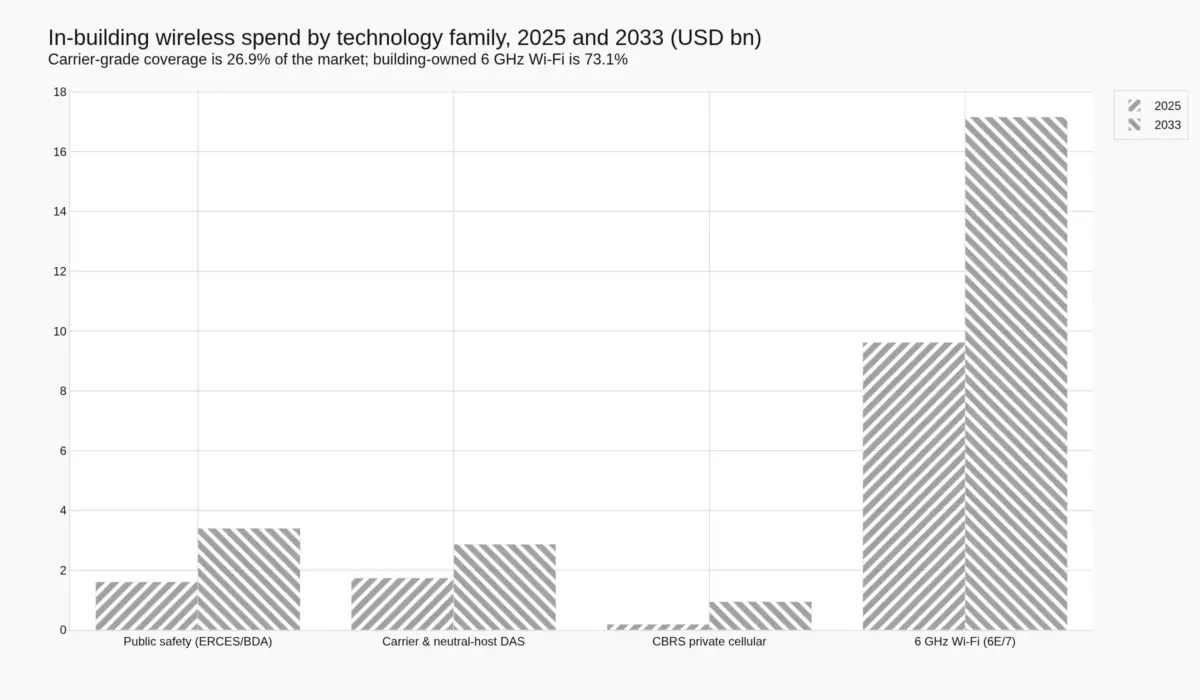
The first three lines are carrier-grade coverage: the money spent to make somebody else's network work inside the building envelope — the mobile operator's, or the fire service's. Together they are USD 3.54 billion, 26.9 per cent of the market. The fourth line is building-owned wireless: the money a landlord, hospital or school spends to run its own network. It is 73.1 per cent.
So the direct answer to who is winning in-building projects is this. 6 GHz Wi-Fi is winning by budget, DAS is winning by obligation, and CBRS is winning neither — it is winning a narrow, high-value argument that DAS cannot win and Wi-Fi cannot serve. Everything else in this report is the evidence for that sentence.
Why they are not competing for the same money
A distributed antenna system is not a wireless network in the sense a tenant means. It is a passive or active RF distribution layer that rebroadcasts licensed spectrum owned by a mobile operator, so that the operator's licensed coverage exists inside a building that blocks it. The building does not own the spectrum, cannot change it, and in the neutral-host model cannot even choose the equipment without the operator's approval. When the fire code forces the same architecture for emergency services on 700/800 MHz, the buyer is the developer and the payer is the construction budget — or increasingly, a state grant. When a mobile operator funds a venue system, it is a capex decision against churn and capacity, not against Wi-Fi.
CBRS is a different animal: 150 MHz of shared 3.5 GHz spectrum in the United States, from which a building owner can operate a private, licensed-quality cellular network without buying a licence. It is not a coverage remedy. It is a mobility and determinism product — handover at speed, bounded latency, priority and QoS that Wi-Fi's contention model cannot promise — and it costs a fraction of a DAS while doing a job a DAS does not do, and a job Wi-Fi does less well.
6 GHz Wi-Fi is a bigger pipe on spectrum nobody had before 2020: 1,200 MHz of it, eight times the depth of the entire CBRS band, unlicensed, indoor-friendly, and — critically — an upgrade inside a budget the building was going to spend anyway. That last point decides the contest. A DAS is a project. A CBRS network is a project. A 6 GHz Wi-Fi refresh is a line item.
The same building, three prices
The cleanest way to see the substitution is to price one building. Take 150,000 square feet — the size at which all three are technically viable and all three get quoted.
| Option | Basis | Installed cost, 150,000 sq ft | Cost per sq ft per year (asset life) |
|---|---|---|---|
| Public-safety DAS / ERCES | USD 0.70 per sq ft | USD 105,000 | USD 0.070 (10 years) |
| Carrier / neutral-host cellular DAS | USD 1.60 per sq ft | USD 240,000 | USD 0.200 (8 years) |
| CBRS private cellular | 4 radios at USD 15,000 installed | USD 60,000 | USD 0.056 (6 years) |
| 6 GHz Wi-Fi | 38 access points at USD 1,800 installed | USD 68,400 | USD 0.075 (6 years) |
The cellular DAS is 3.5 times the cost of the Wi-Fi upgrade for the same floorplate, and it is the only one of the four that a code can compel. But the table also kills a comfortable assumption: on a square-foot basis CBRS is the cheapest option here, not the most expensive. It is expensive per connected device and per unit of engineering effort — each radio needs a SIM-bearing client, a core, a SAS registration and a certified installer — not per square foot of coverage.
How the market was built
Every line above is a count of square feet multiplied by an installed cost, annualised over an asset life. The counts come from the US Energy Information Administration's Commercial Buildings Energy Consumption Survey, which is the only public inventory that breaks commercial floorspace by building size: 96.4 billion square feet across 5.9 million buildings, of which 33.1 billion square feet sits in buildings over 100,000 square feet and 48.4 billion in buildings over 50,000. New construction is taken from the same survey's year-built distribution — 6.1 billion square feet of new floorspace over 50,000 square feet was added between 2010 and 2018, or 679 million square feet a year.
Costs come from integrators who publish ranges and from actual contract awards, not from list prices: public-safety DAS at USD 0.25 to USD 1.50 per square foot, cellular DAS at USD 0.90 to USD 1.80, private CBRS at roughly USD 15,000 per radio installed, enterprise Wi-Fi access points at USD 945 to USD 1,595 list plus installation.
The United States is then scaled to the world at 2.85 times, the ratio implied by the US share of global telecom and enterprise IT capital spending. That is a modelling assumption, stated as one, and it is the single largest source of error in the forecast. The United States is roughly 70 per cent of the world's CBRS-equivalent activity and effectively all of its CBRS, so the private-cellular line is less exposed to that assumption than the other three.
Three findings that were not obvious before the build
1. The fire code, not the carrier, is the most reliable buyer in the market. Section 510.1 of the International Fire Code requires approved radio coverage for emergency responders in all new buildings, at 95 per cent of general areas and 99 per cent of designated critical areas, at a delivered audio quality of 3.0. That is a specification, not a preference, and it survives every downturn. Public-safety systems are 12.2 per cent of the market and the second-fastest-growing line at 9.8 per cent — and unlike every other line, the demand does not depend on anyone deciding wireless is important.
2. CBRS's celebrated 420,000 radios are almost none of them in buildings. The OnGo Alliance reports more than 420,000 Citizens Broadband Radio Service devices deployed in the United States by 2025 and over 1,000 private cellular networks live. Those two numbers cannot both describe the same deployment pattern: 420,000 radios across roughly a thousand operators is an average of several hundred radios each, which is the signature of fixed wireless access, not of enterprise buildings. On the evidence available, in-building private cellular is on the order of 1.4 per cent of installed CBRS radios and 1.5 per cent of the market.
3. The administrative layer under shared spectrum is thinner than the hype. Four companies were certified to run CBRS spectrum access systems in January 2020. One of them stopped operating in 2023 and now exists as a certification without a service. Google stopped accepting new CBRS customers in June 2026 and will switch its system off in June 2027. The FCC said in March 2026 that six of eight approved administrators still operate. Meanwhile the 6 GHz equivalent, automated frequency coordination, has seven approved operators and is drifting toward an open-source implementation. The control plane of Wi-Fi is commoditising; the control plane of CBRS is consolidating. That is not a technology verdict, but it is a procurement risk a buyer should price.
What would change the answer
Five things, all observable. A wave of fire-code enforcement against existing buildings would move public-safety DAS up faster than modelled — the retrofit pool is 60 per cent of large-building floorspace and currently assumed to turn over at 2 per cent a year. A Priority Access License holder monetising indoor deployments at scale would move CBRS. A retreat by mobile operators from funding venue systems would cut cellular DAS — and the USD 8.5 billion sale of Crown Castle's fibre and small-cell businesses in May 2026 is evidence pointing that way. Opening the full 1,200 MHz of 6 GHz in more countries would accelerate Wi-Fi; so far only a minority of adopting countries have opened the whole band rather than the upper 500 MHz. And an enforcement action or a high-profile in-building failure on shared spectrum would stall CBRS regardless of price.
Each of those is treated in the risk chapter with the figure that would falsify our position, rather than as a general caution.
Table des matières
- Competitive Landscape: who actually sells into buildings
- Value Chain: where the money sticks
- Investment Activity: USD 4.9 billion of spectrum and one exit
- Technology and Innovation: licensed, shared, unlicensed
- Regulatory Landscape: the fire code is the demand curve
- Market Risk: five falsifiers and one weak assumption
Paysage concurrentiel
Competitive Landscape: who actually sells into buildings
The competitive map of in-building wireless is not a map of three vendors fighting over one buyer. It is a map of four supply chains that rarely meet, and the most important movement in the last three years has been ownership churn at the top of two of them rather than any product breakthrough.
The DAS layer has consolidated into two names and a scattering of specialists
ANDREW, the ERA distributed antenna system, is what CommScope’s in-building business became. Amphenol closed its purchase of the CommScope unit that contained the DAS business and the CBRS spectrum access system on 3 February 2025, and the business now trades under the ANDREW name. That matters for buyers in a specific way: the ERA platform’s carrier access points are still sold and supported, but the sister service that told those radios which CBRS channels they could use was switched off in April 2023 and has not been restarted. A vendor that supplies both the radio and the coordination layer, and has stopped operating half of it, is a different counterparty risk than one that supplies only radios.
JMA Wireless is the second pole. Its pitch is explicitly the argument this report measures: a multi-operator, multi-band platform on a single fibre strand, with capacity reallocated event by event and a modular “pay as you grow” architecture, positioned against the closed, single-operator systems that dominated venue DAS for a decade. JMA also sells a private wireless platform with its own radios, radio software and core, which makes it one of the few suppliers that can bid both the DAS and the CBRS alternative on the same floorplate.
Behind those two sit the specialists that matter for public safety rather than capacity: SOLiD, ADRF, Cobham’s Axell line, Westell and a long tail of regional integrators. Public-safety ERCES work is less about brand than about certification — UL 2524 listing for the equipment, a NICET-certified or manufacturer-certified installer, and a commissioning test that a fire marshal will accept — and that is a barrier to entry that runs through labour, not silicon. It is also why the public-safety line is the only line in this market where a regional integrator with four crews can win against a national.
Neutral hosts have been selling, not buying
The neutral-host model — an independent owner builds the DAS, then leases capacity to two or three mobile operators — was the growth story of the 2010s and is now in retreat. Crown Castle closed the sale of its fibre solutions business to Zayo and its small-cell business to Arium Networks, an EQT fund, for USD 8.5 billion on 1 May 2026, receiving USD 8.4 billion net of preliminary adjustments and confirming it would use part of the proceeds to repay more than USD 7.0 billion of debt. The company’s own Form 8-K filing on the completion treats the whole fibre and small-cell complex as a disposition. Boingo Wireless, the other large indoor neutral host, has been privately held since 2021 and now sells private 5G as a service rather than venue DAS as an asset.
Read commercially, that is the single clearest signal in the market. The companies with the best view of in-building economics decided that owning the in-building asset was worth less than the capital tied up in it. Neutral host is not disappearing — airports, transit and stadiums still need multi-operator coverage, and somebody must own it — but the model is being re-rated from infrastructure to service contract.
CBRS: a crowded supply side around a thin administrative layer
The CBRS equipment market is genuinely competitive and genuinely commoditised at the radio level. Indoor CBRS radios list from USD 1,649 for a Baicells Neutrino430 LTE unit to USD 2,999 for a Stellar227 5G unit, which is Baicells competing against itself. Celona bundles an indoor access point with core software and SIMs from around USD 17,000 on a three-year subscription, which is the opposite strategy: sell the outcome, hide the bill of materials. Between them sit the complete-system vendors — Cisco, Ericsson, HPE Aruba (through Athonet), JMA, Nokia and Samsung — and the operators, AT&T among them, selling private cellular as a managed service.
Above the radio is the layer that is actually scarce. Every CBRS radio must register with a Spectrum Access System before it transmits, and the list of companies allowed to run one has been shrinking. The FCC certified CommScope, Federated Wireless, Google and Sony as SAS administrators on 27 January 2020. CommScope stopped SAS operations on 1 April 2023. Google stopped accepting new CBRS customers on 10 June 2026 and will shut its system down on 10 June 2027. The Wireless Innovation Forum’s administrator directory now lists Federated Wireless, Key Bridge Wireless, Nokia, RED Technologies and Sony, and the FCC said in March 2026 that six of the eight administrators it has approved still operate. A vendor census compiled in October 2026 puts the working list at five.
This is the least-discussed risk in the CBRS story. A building that installs a private CBRS network is not buying a self-contained system; it is buying a dependency on an intermediary that must keep a cloud service alive for the life of the radios. Two of the four original administrators have already exited or suspended that obligation. No CBRS deployment has yet been orphaned, because Google gave two years’ notice and radio fleets can be repointed, but the direction of travel is unambiguous and it should be priced in the procurement.
6 GHz Wi-Fi: where the money and the brands actually are
Enterprise Wi-Fi is the most consolidated and best-capitalised supply chain in this report, and the one least dependent on any single spectrum decision. Cisco, HPE Aruba, Juniper Mist, Extreme, Arista, Ubiquiti and CommScope’s RUCKUS line all ship 6 GHz tri-band access points today; Arista’s published list prices run from USD 945 for a tri-radio Wi-Fi 6 access point with a three-year management subscription to USD 1,595 for an 8×8 model. The 6 GHz capability is not the product. It is a radio inside a unit that also carries the switching, the management plane and the warranty the buyer was already buying — which is precisely why the Wi-Fi line in this market is 73 per cent of it.
The coordination layer here is commoditising rather than consolidating. The FCC approved seven 6 GHz automated frequency coordination systems for commercial operation on 23 February 2024 — Qualcomm, Federated Wireless, Sony, Comsearch, Wi-Fi Alliance Services, the Wireless Broadband Alliance and Broadcom — and the Wireless Broadband Alliance launched its own commercial AFC service in May 2025 built on the OpenAFC open-source specification. Seven operators, one of them open source and three of them non-profit or standards bodies, is the structural opposite of the CBRS administrator market. Where CBRS has five gatekeepers and falling, 6 GHz has seven and rising.
What the map implies
Two consolidations and one commoditisation. The DAS layer has gone from a spread of carrier-affiliated vendors to two platforms with specialists underneath. The neutral-host layer is being sold off by its largest owners. The CBRS administrative layer is contracting. The Wi-Fi layer is expanding and its coordination layer is being given away. A buyer choosing a technology for a building in 2026 is not choosing between three equal supply chains — one of them is being recapitalised, one is being de-risked, and one is being turned into a feature.
Chaîne de valeur
Value Chain: where the money sticks
The three technology families share a shape and differ in where the margin sits. All three run silicon to radio to system design to installation to commissioning to a recurring service. The differences are in the middle and at the end, and they explain why a DAS project and a Wi-Fi refresh of the same building are not just different sizes but different businesses.
Silicon and radios: the least defensible position
At the bottom, DAS and CBRS both depend on radio and baseband silicon from a small group of merchant suppliers, while Wi-Fi silicon is a three-way contest between Qualcomm, Broadcom and MediaTek, with an unusually low price floor because the same chipsets go into consumer equipment. That asymmetry shows up in price discovery. An indoor CBRS LTE radio lists at USD 1,649 and a 5G indoor radio at USD 2,999 from the same vendor; an enterprise Wi-Fi access point carries a management subscription and still lists at USD 945 to USD 1,595. Radios are commodities in all three cases. Nothing durable is earned here, and the vendors that lead the market are not silicon companies.
System design and the survey: the real barrier
The step that separates these markets from ordinary IT is the RF survey. A DAS cannot be priced before an on-site benchmark has been run, because the design depends on the building’s internal RF environment, its wall construction, its ceiling type, its rooftop situation and the carriers involved. Integrators are explicit that they will only quote ranges — USD 0.25 to USD 1.50 per square foot for public-safety work — until a survey is complete. The same is true of public-safety compliance: an existing-building retrofit begins with a grid test to establish where coverage fails, because a jurisdiction enforces 95 per cent of general floor area and 99 per cent of critical areas, and neither number can be assumed.
That is why labour, not equipment, sets the price of a DAS. Integrators put DAS components at roughly a quarter of total project cost, with design quality the swing factor — a weak design raises the component count, and a design written by an equipment seller raises it deliberately. CBRS inherits a lighter version of the same problem: a CBRS network needs an RF design, a core, SIM provisioning, a SAS registration and a certified professional installer to validate the installation data, which is why the software and services halo around a USD 1,649 radio is several times the radio’s price.
Wi-Fi is the exception that proves the rule. Site survey tools, predictive modelling and cloud-managed controllers have collapsed the marginal cost of designing a Wi-Fi network to hours rather than days, and the data is generated automatically by the access points themselves once deployed. The engineering has been moved into software and out of the labour line. That is the single largest reason the Wi-Fi budget is 73 per cent of this market: it is the only one of the three where design cost falls with scale.
Installation: the same electricians, three different jobs
All three end up in the same place — cable, containment, power, ceiling access, and a contractor working nights in an occupied building. For a DAS the cable is coaxial or fibre to remote antenna units and the install is a specialist trade. For CBRS it is Power over Ethernet to a handful of radios, which is close to a data-cabinet job. For Wi-Fi it is the same Power over Ethernet to thirty or forty access points, most of which are replacing thirty or forty older access points in the same ceiling tiles. That last detail is why the Wi-Fi line wins on cost: the containment already exists. A DAS project pays for its pathways. A Wi-Fi refresh reuses them.
Commissioning and the accountability gap
Commissioning is where public-safety work becomes a regulated service rather than a product. An ERCES must pass a grid test, deliver a usable signal at a defined audio quality, and be validated against the jurisdiction’s own radio system on the uplink — which means the integrator needs the frequency licence holder’s cooperation, not just the building owner’s. The City of Kirkland’s procurement for a replacement public-safety DAS in a 100,000 square foot former warehouse at the Kirkland Justice Center is instructive: a USD 77,162 contract wrapped around a single Class A 700/800 MHz bi-directional amplifier, battery backup, coaxial cabling, line sweeps, isolation testing, a 20-grid coverage test, a commissioning report, uplink validation against the regional PSERN system, and coordination with the fire alarm vendor. The hardware in that scope is trivial. What is being bought is a certificate.
Civilian cellular DAS commissioning is looser — the operators validate their own carriers — and CBRS commissioning is lighter still, since the SAS registration and the installer’s certification carry the compliance burden. Wi-Fi has no external commissioning at all. That gradient is the honest explanation for why the same square footage costs USD 0.070 per foot per year to keep compliant and USD 0.075 to keep current: one is buying a legal position, the other is buying throughput.
Recurring revenue: the part everyone is trying to reach
Traditional DAS is a poor annuity. Once the system is commissioned the integrator sells monitoring, maintenance and periodic re-testing, typically in the low single digits as a percentage of installed value, and the venue may go a decade without further capital spend. Neutral hosts tried to fix that by owning the asset and leasing capacity to operators, which converts capex into a subscription — and the Crown Castle exit suggests the market did not pay enough for the duration risk.
CBRS was designed around recurring revenue from the start. Celona’s pricing bundles access points, core software and SIMs into a per-access-point subscription, with up to 40 physical SIMs and 40 eSIMs included per subscription, so the buyer pays annually rather than once. Core software, SAS registration and radio support renew at roughly USD 2,500 to USD 5,000 a year for a one-radio network, and in our model about USD 18,000 a year for a six-radio building network. Public-safety DAS has the opposite profile: mandated, non-discretionary, and almost entirely capital with a thin maintenance tail.
Wi-Fi has the best of both. The management subscription is sold with the access point — three-year and five-year subscriptions are line items on the price list, not options — and the hardware is replaced on a cycle short enough that the renewal is effectively automatic. Every three to five years the customer buys again, and the reseller who holds the management plane holds the next refresh. That is the commercial engine underneath a 73 per cent share, and it is not really about spectrum at all.
The chain in one sentence
DAS sells a certificate and a design, CBRS sells a subscription wrapped around a commodity radio, and Wi-Fi sells a managed refresh into an installed base. Of the three, only the third has a recurring relationship with the person who signs the cheque — and that, more than any technical advantage, is why the money flows where it does.
Activité d'investissement
Investment Activity: USD 4.9 billion of spectrum and one exit
In-building wireless has attracted two very different kinds of capital, and comparing their returns is the most useful investment analysis available in this market. One is spectrum: money paid to the state for the right to transmit. The other is physical plant: money paid for fibre, antennas and leases. The first has been substantially written down in practice; the second has just been sold.
The CBRS auction: USD 4.86 billion for rights that mostly did not get used indoors
The Priority Access License auction for 3.5 GHz closed on 25 August 2020 after 76 rounds. The FCC’s own results record 271 qualified bidders, 228 winning bidders, 22,631 licences on offer across 3,233 county-based licence areas, 20,625 licences won, USD 4,858,663,345 in gross bids and USD 4,543,232,339 net. That is roughly USD 235,000 per licence won, for an unpaired 10 MHz block in a band where the remaining 70 MHz is free to anyone who registers a radio.
The design intent was that PALs would give an operator certainty in dense places — stadiums, downtown cores, industrial sites — while General Authorized Access served everyone else. What the data since then shows is that the volume went to General Authorized Access and to fixed wireless access: the OnGo Alliance counts more than 420,000 CBRS devices deployed by 2025, over 1,000 operators using GAA, more than 1,100 FCC-authorised device models and over 5,000 certified professional installers. None of those four numbers is an indoor number. Roughly a thousand operators sharing 420,000 radios is an average of several hundred radios each, which is the profile of a wireless ISP’s outdoor network, not of a building.
This is the central investment fact about CBRS and it is not widely stated: the spectrum cost money, the indoor use case did not materialise at the scale it was underwritten for, and the deployment that did happen is largely not in buildings. On the evidence available, in-building private cellular accounts for about 1.4 per cent of installed CBRS radios — on the order of six thousand radios out of 420,000 — and about 1.5 per cent of this market.
The exit: USD 8.5 billion, and what it says about owning the asset
The counter-case is the neutral-host model, and 2026 settled its valuation. Crown Castle completed the sale of its fibre solutions business to Zayo and its small-cell business to Arium Networks, an EQT Active Core Infrastructure fund, for USD 8.5 billion on 1 May 2026, receiving USD 8.4 billion in cash after USD 124 million of preliminary adjustments. The company said it would repurchase USD 1.0 billion of shares and reduce debt by more than USD 7.0 billion. The Form 8-K filed the same day records the whole complex as a discontinued operation sold to two purchasers under a stock purchase agreement originally dated 13 March 2025.
The strategic read matters more than the price. A tower company with the best sites, the best fibre routes and the deepest operator relationships decided that in-building and small-cell infrastructure was worth more to a private infrastructure fund than to itself. When the incumbent with the lowest cost of capital in the sector sells the asset, the asset’s returns are below that cost of capital. Everything downstream — integrator margins, neutral-host fees, venue lease economics — inherits that conclusion.
The bolt-on: Amphenol buys the DAS layer
The third transaction is smaller but structurally important. Amphenol completed its acquisition of the CommScope unit containing the DAS business and the CBRS spectrum access system on 3 February 2025; the business now operates as ANDREW. The CBRS certification transferred with it and was renewed through January 2030, but the company is not providing SAS service and must notify the FCC at least 30 days before resuming. So a diversified connector and interconnect manufacturer now owns one of the two leading DAS platforms in the world, plus a dormant licence to run shared-spectrum coordination.
This is a classic industrial-consolidation move: buy an installed base and a specification position, run it for cash, and treat the spectrum software as an option rather than a business. It is the opposite of how the spectrum incumbents behaved in 2020, and it is a fair summary of how the market now values the two halves of in-building wireless.
Where capital is actually being committed in 2026
Capital expenditure inside the market is now concentrated in three places, none of them large. First, code-driven retrofit: the retrofit pool is 60 per cent of large-building floorspace and every percentage point of conversion is worth roughly USD 140 million a year of public-safety work at USD 0.70 per square foot. Second, Wi-Fi generation replacement: the entire 48.4 billion square feet of US commercial space above 50,000 square feet turns over on a five-to-eight-year access point cycle, and each turn is a capex event the building owner has already budgeted. Third, the small but real private-cellular niche, where a distribution centre costs about USD 90,000 for six radios before devices — a figure low enough to be approved by a site manager rather than a board.
What is not being committed is new neutral-host construction without an anchor tenant. The direction of travel in 2026 is that the buyer of in-building wireless is increasingly the occupier of the building, not the operator of the network.
The capital intensity verdict
In-building wireless is medium capital intensity at the system level and low at the project level. A single building’s decision rarely exceeds USD 250,000 outside venues, which keeps the procurement inside an operating budget and out of a capital committee. That is a structural advantage for the Wi-Fi line and a structural disadvantage for both DAS lines: the larger the cheque, the more approvals between the problem and the purchase, and the more likely the problem gets solved with what is already in the ceiling.
Technologie et innovation
Technology and Innovation: licensed, shared, unlicensed
The technical differences between these systems are usually presented as a feature list. They are better understood as three different answers to the same question: who is allowed to transmit here, and who can be made to stop. That question determines the engineering, the procurement and the recurring cost.
Three property regimes, not three technologies
A DAS operates on spectrum the building does not own. Every band inside it belongs to a mobile operator under a licence, or to a public-safety agency under a licence, and the DAS is permitted only as an extension of that licensed network. The engineering consequence is that a DAS must be transparent: it cannot change the waveform, cannot add capacity that the carrier has not provisioned, and must be commissioned against the operator’s own signal. The political consequence is that the operator can refuse, delay or withdraw — and in the carrier-funded model, decide whether the building gets coverage at all.
CBRS is shared. In the United States, 150 MHz at 3,550–3,700 MHz is divided into three tiers: incumbent users (naval radar and fixed satellite earth stations), Priority Access Licensees, and General Authorized Access, which is free to anyone who registers. Every radio must register with a Spectrum Access System before transmitting, and the SAS assigns channels and maximum power at that location, then can order the radio to move or stop. That is a genuine capability — it is what allows an enterprise to run its own cellular network with a licensed-quality guarantee — but it is also a permanent dependency on a cloud service operated by somebody else.
6 GHz is unlicensed. The FCC’s 2020 order opened 5,925–7,125 MHz under two regimes: low-power indoor access points at up to 30 dBm EIRP and 5 dBm/MHz power spectral density, which need no coordination at all, and standard-power access points at up to 36 dBm EIRP and 23 dBm/MHz, which must consult an automated frequency coordination system before transmitting and must re-check at least once a day. No registration of the operator, no licence, no incumbent that can evict a building — only a query to a database that answers in milliseconds.
Spectrum depth, and why it decides the indoor case
The single most important physical fact in this comparison is that 6 GHz is 1,200 MHz wide and CBRS is 150 MHz wide — eight times the depth. Wi-Fi 7 can bond a 320 MHz channel, which is impossible in any other unlicensed band and impossible in CBRS. Indoors, where the problem is aggregate capacity across hundreds of clients rather than link distance, the wide channel does more for the user experience than any modulation improvement. The 3GPP feature set that matters — network slicing, quality-of-service flows, guaranteed latency — matters more in a warehouse where a robot must not drop a packet than in an office where a laptop can re-send.
One further regulatory asymmetry is worth stating precisely because it is frequently blurred. The Wi-Fi Alliance’s regulatory tracker shows most adopting countries have opened only the upper 500 MHz, 5,925 or 5,945 to 6,425 MHz, while a minority — the United States, Canada, Brazil, Costa Rica, Saudi Arabia and a handful of others — have opened the full 5,925–7,125 MHz. Standard power operation, which is the regime that makes 6 GHz useful outdoors and in high-ceiling spaces, is authorised and operational in five countries as of 2026: the United States, Canada, the United Kingdom, Saudi Arabia and Costa Rica, with Colombia proposing a framework and roughly thirty countries still only evaluating feasibility. A 6 GHz access point sold globally is therefore frequently a 6 GHz access point with a fifth of its band disabled.
What each architecture is actually good at
DAS wins on one thing above all: multi-operator neutrality. A venue that must serve every visitor’s phone needs every carrier’s spectrum distributed, and no other architecture does that. Its second advantage is physics — a passive system with no active electronics in the coverage path can be more reliable and more power-fail-tolerant than anything with a processor in it, which is exactly what the fire code cares about. Its weakness is generational: adding a band means new hardware throughout, and a system designed for LTE does not become a 5G system by software.
CBRS wins on determinism and on device mobility. Handover between radios at walking or vehicle speed, bounded latency, and grant-based uplink scheduling are the properties that make it suitable for autonomous mobile robots, connected scanners on a 300,000 square foot floor, and video backhaul from a camera that must not stutter. It also wins on simplicity of deployment relative to DAS: a six-radio distribution centre network at about USD 90,000 installed is a design-and-Ethernet job, not a construction project. Its weaknesses are the SIM requirement — every client needs cellular credentials, which excludes most laptops and phones from the private network unless configured — and the administrative dependency described above.
6 GHz Wi-Fi wins on capacity per dollar, client ubiquity and the absence of a gatekeeper. Anything with a Wi-Fi radio works, today, with no SIM and no carrier. Wi-Fi 7’s multi-link operation and 320 MHz channels make deterministic-ish latency achievable in a way that earlier generations could not, which has begun to erode CBRS’s differentiation at the margin. Its weakness is that it cannot offer the guarantees a safety or control system may require, and it operates on spectrum that any neighbour may also use.
Innovation intensity is high, but it is not where the money is
The rate of technical change in this market is genuinely high — digital DAS with fibre to the antenna and virtualised RAN software, 5G NR in shared spectrum, Wi-Fi 7 with multi-link operation, and standard-power 6 GHz under automated coordination. What is notable is how little of that innovation is rewarded commercially. The DAS platforms have been technically excellent for a decade and are being sold; the CBRS radios have improved faster than the market has grown; and the largest commercial gains have accrued to whoever made the 6 GHz radio a default component in a unit the customer was buying anyway.
That is the innovation finding worth carrying into a procurement: in this market, the winning technology is rarely the best technology. It is the one whose upgrade path runs through a budget line the buyer has already approved.
Risque de marché
Market Risk: five falsifiers and one weak assumption
Every forecast in this report rests on measured quantities — building counts, floorspace, code text, executed contract values, published list prices — with three exceptions, and the honest thing to do is to separate the two. This chapter states what would prove us wrong, line by line, and then states where the model is weakest.
Falsifier 1: fire-code enforcement turns from occupancy to audit
Our public-safety line grows at 9.8 per cent a year on a retrofit assumption of 2 per cent of non-compliant large-building floorspace annually. If even a handful of large jurisdictions moved from complaint-driven enforcement to a check at certificate of occupancy or at change of tenancy, the conversion rate triples and the line roughly doubles within four years. The observable signal is not a market statistic — it is the number of ERCES permits filed per quarter in a city that has just revised its fire code. Any jurisdiction that adds a sign-inspection requirement or an insurer that begins asking the question is a leading indicator. This is upside risk to our number, and it is the largest single asymmetry in the report.
Falsifier 2: a Priority Access licensee monetises indoor deployment
The USD 4.86 billion paid at Auction 105 has not produced an indoor business. If a PAL holder — particularly one of the smaller regional winners with spectrum concentrated in counties where it has no network — begins selling in-building capacity to enterprises or neutral hosts, the CBRS line grows faster than the 22 per cent we assume, because the marginal cost of that capacity has already been sunk. The signal to watch is a commercial indoor offer priced against DAS rather than against a carrier plan. Upside, and unlikely before 2028.
Falsifier 3: mobile operators stop funding venue systems
The cellular DAS line is the slowest-growing line in the report at 6.5 per cent, and it still depends on operators co-funding. The Crown Castle sale of its fibre and small-cell businesses for USD 8.5 billion is direct evidence that the infrastructure-owner side of that model has been re-rated; if operators also withdraw from funding venue coverage and shift the obligation to building owners and municipalities, the neutral-host line does not grow at all, it changes owner and shrinks in the transition. The signal is the number of new venue systems announced with two or more named operator partners. Downside, and the one we consider most likely to bite inside the forecast window.
Falsifier 4: standard-power 6 GHz goes outdoors instead of deeper indoors
Automated frequency coordination was designed for outdoor and high-power use, and outdoor fixed wireless is a larger addressable problem than in-building capacity in many markets. If AFC-enabled standard-power deployments concentrate on campus and metro-area links rather than inside buildings, part of the value of the 6 GHz regime leaves this market rather than expanding it. The signal is the mix of AFC registrations by device class. Neutral for the total, negative for the in-building share of the Wi-Fi line.
Falsifier 5: the coordination layer fails quietly
Two CBRS administrators have exited or suspended service, and the 6 GHz coordinator market has consolidated toward open-source implementations. A building’s network is only as durable as the database that authorises it. The risk is not an outage that makes headlines; it is a slow attrition in which the administrator a network was registered with stops answering, and the migration costs more than the network is worth in a small deployment. The signal is the number of approved administrators still accepting new customers, which has fallen from eight to five in six years. Downside, concentrated in the CBRS line, and materially under-priced by buyers.
The weak assumption: the global multiplier
The model is built from United States data because the United States is the only market with a public inventory of commercial floorspace by building size, a codified in-building coverage mandate, and both shared and unlicensed spectrum regimes in force. Everything else is the United States multiplied by 2.85 — the ratio implied by the US share of global telecom and enterprise IT capital spending. That single number is the largest source of error in the forecast, and it is wrong in a direction that varies by line.
It probably overstates the CBRS line, because CBRS does not exist outside the United States; the international equivalent is national local-licensing regimes, of which Germany’s 484 assignments are the largest published count and are two orders of magnitude below the CBRS device population. It probably understates the public-safety line, because building codes in the Gulf states and parts of Asia embed comparable emergency-coverage requirements while their construction volumes are growing faster than US construction. It is reasonable for the Wi-Fi line, because enterprise Wi-Fi is a genuinely global, standardised product market with similar deployment density across high-income economies.
Two other assumptions deserve to be named. Our installed-cost figures are midpoint estimates from published ranges rather than a sample of invoices; the ranges themselves span a factor of four on public-safety work, from USD 0.25 to USD 1.50 per square foot. And our split of CBRS radios between in-building and fixed-wireless use — about 1.4 per cent in buildings — is an inference from the ratio of operators to devices in the OnGo Alliance’s own disclosures, not a published statistic. No source we could find reports that split.
Risks we are not carrying
Three things could change the market and are deliberately outside this model. A change in the 6 GHz power limits that made indoor standard-power operation routine would compress the CBRS case further and we have not priced it. A successful commercial deployment of neutral-host CBRS in a large venue chain would validate a model that currently has no reference customer at scale. And a single serious in-building failure attributable to a private cellular network — a safety system that could not place a call — would set the CBRS line back by years regardless of its price advantage. Each is observable; none is currently in the numbers.
What a buyer should take away
The forecast is a planning number, not a promise. What survives every scenario in this chapter is the structural finding: the buying decision in an in-building project is set by which budget is open — code compliance, operator capex, or IT refresh — and only the third is growing reliably. Anyone selling into this market without a route into the IT refresh budget is selling into the two budgets that are flat or being sold.
Paysage réglementaire
Regulatory Landscape: the fire code is the demand curve
In-building wireless is unusual in that its most reliable demand is created by a building code rather than a consumer preference. That code is also the only part of the regulatory environment that can force a purchase, which is why public-safety systems are the one line in this market that does not fall when confidence does.
What the fire code actually requires
Section 510.1 of the International Fire Code requires approved radio coverage for emergency responders within all new buildings, measured against the jurisdiction’s existing public-safety system as received at the building’s exterior, and it expressly does not require the public-safety network itself to be improved. Three exceptions follow: an approved wired communications system instead, a determination by the fire code official that coverage is not needed, or an automatically activating system where an always-on one would interfere with facility operations. Section 1103.2 of the same code carries the equivalent requirement into existing buildings, on a timeline set by the adopting authority.
The performance test is where the money is. Jurisdictional guidelines issued against the 2024 code restate it as signal strength in 95 per cent of all areas and 99 per cent of areas the fire code official designates as critical, on every floor, with elevators measured at the primary recall floor, stairwell shafts, fire equipment rooms and the fire command centre all required to meet the minimum. The signal must deliver a delivered audio quality of 3.0 throughout, whether the system is narrowband analogue, digital, wideband LTE, or an equivalent bit-error-rate or signal-to-interference-plus-noise measurement. Equipment must be listed to UL 2524 and comply with NFPA 1225. A one-storey building of no more than 12,000 square feet with no below-grade area is commonly exempted.
Two things follow, and both are commercially decisive. First, the requirement is written against a delivered audio quality, not against a technology — so a vendor cannot win on specification, only on cost of compliance and certainty of sign-off. Second, the requirement is per floor and includes stairwells, which is why a DAS is the default answer: passive coax and a bi-directional amplifier remain the cheapest reliable way to light up a concrete stair shaft that no access point reaches.
The enforcement gap is the market’s largest variable
Adoption is not enforcement. Integrators have been blunt about it for years: most state, county and municipal ordinances are on the books, penalties for non-compliance can be expensive, but enforcement has been sporadic at best, and a large share of owners are either unaware of the requirement or have chosen to ignore it. That gap is why our model assumes 60 per cent of large-building floorspace currently lacks compliant coverage and turns over at 2 per cent a year. If a jurisdiction begins checking at certificate of occupancy, or an insurer begins asking, that rate is not a market forecast — it is a queue.
The retrofit pool is large enough to matter without any change in behaviour. US commercial floorspace in buildings over 100,000 square feet is 33.1 billion square feet; at 60 per cent non-compliant and USD 0.70 per square foot, every percentage point of annual conversion is worth roughly USD 139 million of public-safety work. That is a single lever, entirely in the hands of fire marshals, and no other line in this report has an equivalent.
Shared spectrum: a three-tier regime under active maintenance
CBRS is not a static rulebook. The 3.5 GHz band is administered in three tiers, with incumbent naval and satellite users protected dynamically, Priority Access Licenses sold by auction, and General Authorized Access available at no cost after registration. The operational burden falls on the Spectrum Access System, and the regulator has had to keep intervening in that market: certifications expire and are renewed, and administrators have exited. The original certification of four administrators in January 2020 has since become a list of five working operators against eight approvals, with Google’s withdrawal scheduled for 10 June 2027. A building that buys a CBRS network is therefore exposed to a regulatory dependency that is being actively re-papered, and buyers should ask for the migration path in writing.
Outside the United States the equivalent regimes are national and fragmented: Germany has issued 484 local 5G frequency assignments in the 3,700–3,800 MHz band as of November 2025, across telecommunications and IT services (28 per cent), metals and electronics (23 per cent), transport and logistics (6 per cent), research (31 per cent) and smaller shares in chemicals, energy, media and pharmaceuticals. Germany’s 484 assignments are the largest published national count outside the United States, and they are an order of magnitude below the CBRS device population — which is the clearest available evidence that the private-cellular model does not scale the way its advocates expected when it is left to enterprises to procure.
Unlicensed 6 GHz: expanding, and diverging by country
The US framework was set in April 2020 and has been widened twice since. Testing of automated frequency coordination systems began in August 2023 after thirteen entities were conditionally approved; seven were approved for commercial operation in February 2024. In January 2026 the Commission adopted a further order expanding unlicensed 6 GHz operations, including higher-power operation managed by geofencing systems. Standard power operation is now authorised and operational in the United States, Canada, the United Kingdom, Saudi Arabia and Costa Rica, with Costa Rica’s two resolutions adopted in July 2026 creating an AFC administrator accreditation route and device homologation rules explicitly modelled on the US framework.
The divergence matters more than the expansion. Most adopting countries have opened only 500 MHz of the 1,200 MHz available, which caps channel width and therefore caps the capacity advantage that makes 6 GHz worth deploying in the first place. A building in a 500 MHz country gets a better Wi-Fi network; a building in a full-band country gets a different class of network. That is a regulatory arbitrage that will show up in tenant expectations long before it shows up in any statistic.
The regulatory verdict
Two regimes create demand that can be compelled — the fire code for public safety, and building codes generally for anything that must work during an emergency. One regime creates capability without obligation — shared spectrum. One regime creates capability and forbids gatekeeping — unlicensed 6 GHz. The market’s shape follows that ordering exactly, which is the strongest available evidence that this is a regulatory market wearing a technical costume.