
Global meditation Market size, share & forecast 2026-2033
Market Forecast Snapshot (2026???2033)
| Metric | Value |
|---|---|
| 2025 Market Size | USD 8.6 Billion |
| 2033 Market Size | USD 15.4 Billion |
| CAGR | ~7.5% |
| Largest Region | Europe |
| Fastest-Growing Region | Asia-Pacific |
| Largest Segment | Mechanical Recycling |
| Fastest-Growing Segment | Pyrolysis & Closed-Loop Recycling |
| Key Trend | Tyre-to-Tyre Circularity |
Global Meditation Market Overview
The Global Meditation Market?? is booming. It is now a big part of how people manage stress, anxiety, and sleep issues. You can meditate anywhere through apps, wearables, or even at work. It???s become a go-to tool for mental health and helping people chill and stay balanced in their busy lives.Mediation is like a mental helper.Regular practice can also lower anxiety, improve mood, and build emotional resilience.
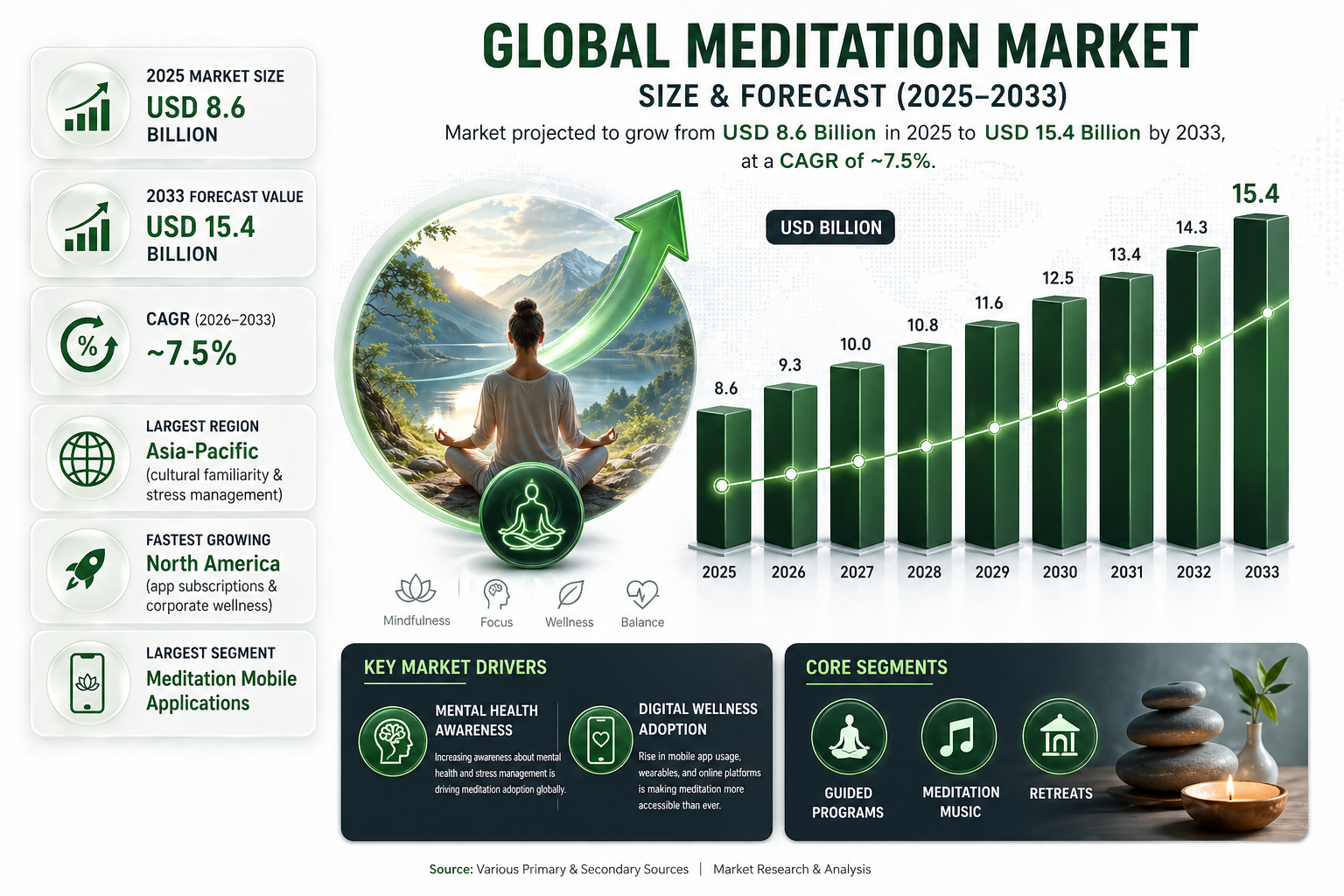
According to the Pheonix Demand Forecast Engine,, the Global Meditation Market size is valued at USD 8.6 billion in 2025 and is projected to reach USD 15.4 billion by 2033, expanding at a CAGR of approximately 7.5% during 2026???2033.
Asia-Pacific currently leads the Global Meditation Market, while North America represents the fastest-growing region driven by app-based subscriptions and corporate wellness spending.
The best meditation apps like Headspace, Calm, and Insight Timer offer guided sessions, personalized recommendations, and tracking features. Headspace is great for beginners, Calm is perfect for sleep and relaxation, and Insight Timer has thousands of free guided meditations. Other apps includes Breethe for sleep therapy and life coaching.These meditation apps make it easy to fit mindfulness into your lifestyle.
Meditation is simple nowadays. Easy steps help beginners. When it's a daily habit, people enjoy it.
The meditation techniques for anxiety focus on the mind; they reduce stress and overthinking. Key methods include deep belly breathing, body scans, mindful walking, and using mantras. These techniques are increasingly recommended by therapists and wellness professionals.
Sleep Meditation Music is needed by almost everyone. People use calming Sleep Meditation Music for Deep Relaxation and Insomnia Relief, nature sounds and sleep stories to reduce screen fatigue and sleep better. This music content makes users happy and also keeps them subscribed to apps.
Key Drivers of Global Meditation Market Growth
- Growing awareness of mental health and emotional resilience
- Rapid adoption of digital wellness platforms
- Expansion of corporate wellness and employee assistance programs
- Rising demand for meditation techniques for anxiety and stress management
- Increasing consumption of meditation music and sleep-focused content
- Strong penetration of the best meditation apps globally
Global Meditation Market Segmentation
1. By Product Type
1.1 Meditation Apps
1.1.1 Subscription-Based Apps
??1.1.1.1 Monthly/annual premium models
1.1.1.1 Tiered access (basic vs advanced content)
1.1.2 Freemium Apps
1.1.2.1 Free core sessions
1.1.2.2 In-app purchases & premium upgrades
1.1.3 AI-Personalized Meditation Apps
1.1.3.1 Mood-based recommendations
1.1.3.2 Adaptive session length & intensity
1.1.4 Sleep-Focused Meditation Apps
1.1.4.1 Sleep stories
1.1.4.2 Meditation music & ambient soundscapes
1.1.5 Anxiety & Stress Relief Apps
1.1.5.1 Breathwork modules
1.1.5.2 Short-form meditation techniques for anxiety
1.2 Guided Meditation Programs
1.2.1 Beginner Programs
1.2.1.1 Meditation for beginners (7???30 day courses)
1.2.1.2 Habit-building modules
1.2.2 Advanced Mindfulness Training
1.2.2.1 Long-duration sessions
1.2.2.2 Retreat-style digital programs
1.2.3 Therapist-Supported Programs
1.2.3.1 Clinical mindfulness-based stress reduction (MBSR)
1.2.3.2 Cognitive-behavioral meditation modules
1.3 Meditation Music & Audio Content
1.3.1 Ambient & Nature Soundscapes
1.3.2 Binaural Beats & Frequency-Based Audio
1.3.3 Guided Sleep Stories
1.3.4 Focus & Productivity Music
1.3.5 Anxiety-Calming Audio Sessions
1.4 Meditation Retreats & Workshops
1.4.1 Residential Retreats
1.4.2 Weekend Workshops
1.4.3 Corporate Mindfulness Retreats
1.4.4 Hybrid Virtual Retreat Models
1.5 Wearable-Integrated Meditation Solutions
1.5.1 Heart Rate Variability (HRV) Tracking
1.5.2 EEG-Based Meditation Headbands
1.5.3 Smartwatch Integration
1.5.4 Real-Time Stress Monitoring
2. By Meditation Type
2.1 Mindfulness Meditation
2.1.1 Present-moment awareness practices
2.1.2 Body scan meditation
2.1.3 Attention training modules
2.2 Breathing & Relaxation Techniques
2.2.1 Box breathing
2.2.2 4-7-8 breathing
2.2.3 Progressive muscle relaxation
2.3 Transcendental Meditation
2.3.1 Mantra-based meditation
2.3.2 Instructor-certified programs
2.4 Loving-Kindness Meditation
2.4.1 Compassion-based exercises
2.4.2 Emotional well-being programs
2.5 Sleep & Anxiety-Focused Meditation (Fastest-Growing Segment)
2.5.1 Meditation techniques for anxiety
2.5.2 Guided sleep meditations
2.5.3 Calming meditation music
2.5.4 Stress-reduction micro-sessions
3. By End User
3.1 Individuals
3.1.1 Beginners seeking meditation for beginners programs
3.1.2 Working professionals
3.13 Students
3.1.4 Sleep & stress management users
3.2 Corporate Wellness Programs
3.2.1 Enterprise subscription packages
3.2.2 Stress management training
3.2.3 Employee engagement dashboards
3.3 Educational Institutions
3.3.1 School mindfulness programs
3.3.2 Student anxiety reduction initiatives
3.3.3 University wellness integration
3.4 Healthcare & Therapy Centers
3.4.1 Clinical mindfulness therapy
3.4.2 Complementary anxiety treatment programs
3.4.3 Digital mental health integration
4. By Platform
4.1 Mobile Applications (Dominant Segment)
??4.1.1 iOS & Android ecosystems
4.1.2 AI-driven personalization
4.1.3 Offline downloadable sessions
4.1.4 Habit tracking & streak systems
4.2 Web-Based Platforms
4.2.1 Browser-access meditation libraries
4.2.2 Corporate dashboard integration
4.2.3 Long-form session streaming
4.3 Hybrid & Offline Programs
4.3.1 Downloadable content
4.3.2 Physical + digital retreat combinations
4.3.3 Instructor-led group sessions
5. By Geography
5.1 North America
5.1.1 High subscription penetration
5.2.2 Strong presence of best meditation apps
5.2.3 Corporate wellness adoption
5.2 Europe
5.2.1 Mental health awareness initiatives
5.2.2 Workplace wellness integration
5.2.3 Public healthcare collaboration
5.3 Asia-Pacific (Fastest-Growing Region)
5.3.1 Rising smartphone penetration
5.3.2 Increasing stress levels in urban populations
5.3.3 Cultural familiarity with meditation traditions
5.4 Latin America
5.4.1 Growing digital wellness adoption
5.4.2 Youth-driven mobile engagement
5.5 Middle East & Africa
5.5.1 Emerging wellness awareness
5.5.2 Gradual digital platform expansion
Regional Insights
North America leads in premium subscription-based meditation platforms and widespread adoption of the best meditation apps.
Europe shows strong growth through structured mental health initiatives and corporate adoption.
Asia-Pacific is the fastest-growing region, supported by smartphone penetration, urban stress levels, and increasing interest in meditation for beginners.
Why the Global Meditation Market Is Critical
The meditation market plays a vital role in addressing the global mental health challenge. As anxiety, burnout, and sleep disorders become more prevalent, accessible digital meditation tools provide scalable, affordable support. Meditation reduces stress hormones, improves focus, enhances sleep quality, and strengthens emotional resilience.
Additionally, the industry supports preventive healthcare models by promoting daily mindfulness habits. With growing integration into healthcare systems and workplace wellness strategies, meditation is becoming an essential component of holistic well-being.
Strategic Intelligence & Pheonix AI-Backed Insights
Pheonix Demand Forecast Engine
Analyzes active user growth, session frequency, subscription conversion rates, and churn dynamics across meditation apps, guided programs, and meditation music platforms.
User Engagement & Retention Intelligence Model
Evaluates daily active users (DAU), average session duration, completion rates, and habit streak formation.
Measures effectiveness of meditation for beginners onboarding flows and long-term engagement across mindfulness, sleep, and anxiety-focused modules.
Monetization & Subscription Value Analyzer
Assesses freemium-to-premium conversion, pricing elasticity, in-app purchases, bundled corporate subscriptions, and lifetime value (LTV).
Analyzes revenue contribution from best meditation apps, meditation music content libraries, and sleep-focused premium tiers.
Mental Wellness Demand Sensitivity Model
Tracks rising demand for meditation techniques for anxiety, stress management programs, and sleep improvement solutions.
Evaluates impact of macro stress indicators, workplace burnout trends, and mental health awareness campaigns on platform adoption.
Automated Porter???s Five Forces (Concise)
Buyer Power: Moderate ??? high app choice, but strong habit formation and subscription stickiness
Supplier Power: Low???Moderate ??? content creators, mindfulness instructors, and audio producers
Threat of New Entrants: Moderate ??? low technological barriers, but high brand trust and retention challenges
Threat of Substitutes: Moderate ??? therapy apps, fitness platforms, music streaming, and wellness content
Competitive Rivalry: High ??? global meditation apps competing on personalization, content depth, pricing, and partnerships
Final Takeaway
The Global Meditation Market is transitioning from a wellness trend to a structured digital health ecosystem. Driven by increasing demand for meditation techniques for anxiety, widespread adoption of meditation music, and the popularity of meditation for beginners, the industry is positioned for sustained long-term growth. As the best meditation apps continue to innovate through AI personalization and immersive content, meditation will remain a central tool in the future of global mental wellness.
Competitive Landscape
Global Meditation Market Competitive Intensity & Market Structure Overview
The Global Meditation Market is characterized by a rapidly expanding, digitally driven, and highly competitive wellness ecosystem where mobile meditation platforms, mindfulness content providers, sleep-focused applications, wearable-integrated wellness technologies, and corporate mental health solutions increasingly overlap. The market operates through a platform-centric model where subscription retention, user engagement, and content differentiation are the primary competitive levers.
Competitive intensity remains high due to relatively low technological barriers to entry, but long-term success is heavily influenced by brand trust, user retention, personalization quality, and ecosystem integration. Leading meditation platforms compete aggressively through guided content libraries, AI-personalized wellness journeys, sleep support modules, anxiety-focused meditation programs, and corporate wellness partnerships.
The market is moderately consolidated at the premium subscription level, where major platforms such as Calm and Headspace dominate through brand recognition, enterprise partnerships, and large-scale content ecosystems. However, the broader meditation and mindfulness space remains fragmented, with thousands of niche apps, independent mindfulness creators, music platforms, and wellness startups competing across freemium, specialized, and region-specific segments.
Global Meditation Market Competitive Intensity & Market Structure Current Scenario
Leading Company Profiles
Calm: Premium Meditation & Sleep Platform. Leader in sleep meditation, relaxation audio, celebrity-led sleep stories, and premium wellness subscriptions.
Headspace Health: Digital Mental Wellness Leader. Strong in meditation for beginners, structured mindfulness programs, and enterprise wellness solutions.
Insight Timer: Global Meditation Platform. Known for extensive free guided meditation libraries and broad instructor diversity.
Ten Percent Happier: Mindfulness Education Platform. Focused on practical meditation, skepticism-friendly content, and behavioral wellness.
Simple Habit: Mobile Meditation App. Strong in short-form daily mindfulness and busy lifestyle integration.
Aura Health: AI-Personalized Wellness Platform. Uses personalization for mood-based mindfulness and emotional health recommendations.
Breethe: Sleep & Life Coaching Platform. Combines meditation, sleep content, and motivational wellness tools.
Balance (Elevate Labs): Personalized Meditation App. Focused on adaptive meditation plans and habit-building.
Buddhify: Lifestyle Meditation Platform. Known for situational meditation sessions tailored to everyday activities.
Smiling Mind: Nonprofit Mindfulness Platform. Strong in youth, education, and mental wellness accessibility.
Key Competitive Intensity & Market Structure Signals in Global Meditation Market
A major competitive signal is the increasing dominance of subscription-based monetization models, where recurring revenue depends heavily on habit formation, retention, and content refresh cycles. This creates intense competition around user engagement, session completion, and long-term subscription stickiness.
AI-driven personalization is rapidly becoming a critical differentiator. Platforms that offer mood-based recommendations, adaptive meditation programs, sleep optimization, and stress-specific pathways gain stronger retention and premium conversion.
Corporate wellness integration is another major structural factor reshaping the market. Enterprise clients increasingly seek meditation platforms for workforce resilience, burnout prevention, and employee mental health, creating a B2B growth channel beyond individual consumers.
Wearable integration and biometric feedback are expanding competitive complexity. Meditation platforms connected to smartwatches, EEG headbands, HRV trackers, and sleep monitoring systems are moving toward data-backed mindfulness ecosystems.
Despite strong premium leaders, fragmented competition remains intense in freemium, meditation music, and regionally localized mindfulness platforms where content breadth and accessibility can outperform brand scale.
Strategic Implications of Competitive Intensity & Market Structure in Global Meditation Market
The competitive landscape increasingly rewards ecosystem development over standalone meditation content. Companies that combine meditation, sleep, anxiety relief, productivity, biometrics, and community features create stronger user lifetime value.
Content differentiation remains essential, but personalization and engagement science are becoming more important than sheer library size. AI-guided progression, emotional state adaptation, and behavioral psychology integration are key strategic advantages.
Corporate and healthcare partnerships are reshaping monetization priorities, shifting market leaders toward broader digital mental health ecosystems rather than consumer-only mindfulness apps.
As mental health awareness grows globally, meditation platforms are increasingly positioned as preventive healthcare tools, creating strategic opportunities in insurance partnerships, education systems, and healthcare provider integration.
Global Meditation Market Competitive Intensity & Market Structure Forward Outlook
The Global Meditation Market is expected to remain highly competitive, innovation-led, and moderately fragmented, with increasing consolidation among leading premium platforms and continued expansion of niche wellness providers.
Mergers, partnerships, and vertical integration across digital health, sleep technology, wearable ecosystems, and enterprise wellness are likely to intensify as market leaders seek stronger retention and diversified revenue streams.
AI personalization, biometric integration, and mental health platform convergence will define the next stage of competition. Meditation companies that evolve into full-spectrum emotional wellness ecosystems will hold stronger long-term strategic positioning.
In the long term, the market will be shaped by three core competitive pillars: personalized wellness intelligence, subscription retention power, and ecosystem expansion across consumer, enterprise, and healthcare channels. Companies that successfully align with these pillars while maintaining trusted brand authority will lead the Global Meditation Market through 2033.
Value Chain
Global Meditation Market Value Chain & Supply Chain Evolution Overview
The Global Meditation Market value chain is evolving from a niche wellness and mindfulness segment into a scalable, digitally integrated mental wellness ecosystem focused on stress reduction, emotional resilience, sleep improvement, and preventive mental healthcare. Unlike traditional wellness services that rely heavily on physical instruction or in-person retreats, the modern meditation market is increasingly powered by mobile apps, digital audio platforms, AI personalization, wearable integration, and subscription-based content ecosystems.
The meditation value chain spans mindfulness content creation, instructor-led program development, audio production, sleep content libraries, AI recommendation systems, wearable technology integration, platform distribution, enterprise wellness partnerships, healthcare collaborations, and user retention ecosystems. As consumer demand shifts from occasional meditation practice toward daily habit formation, the market is increasingly centered around engagement continuity, personalized experiences, and long-term subscription monetization.
Upstream supply chain dynamics are shaped by meditation instructors, psychologists, mindfulness experts, audio producers, sleep therapists, AI personalization engines, biometric technology developers, and content production teams. Increasingly, meditation platforms are integrating neuroscience-backed techniques, anxiety reduction frameworks, sleep science, and emotional wellness programs to strengthen both credibility and retention.
Platform development strategies increasingly prioritize app scalability, content diversity, multilingual accessibility, wearable compatibility, adaptive recommendations, and personalized user journeys. Meditation companies are moving beyond static guided sessions toward dynamic ecosystems that include meditation for beginners, sleep meditation music, anxiety-focused techniques, corporate wellness dashboards, and mental health analytics.
Distribution is increasingly platform-centric, with app stores, web-based ecosystems, corporate partnerships, schools, healthcare institutions, and direct-to-consumer subscription models driving expansion. Freemium models, premium subscriptions, and enterprise licensing are reshaping monetization structures globally.
Supply chain challenges include user churn, subscription fatigue, content commoditization, brand trust, scientific validation, mental health regulation, digital wellness competition, and balancing accessibility with premium monetization.
Global Meditation Market Value Chain & Supply Chain Evolution Current Scenario
The current meditation market is shaped by rising mental health awareness, smartphone penetration, workplace stress, sleep disorders, and digital health adoption.
Upstream, meditation platforms are increasingly investing in licensed mindfulness experts, therapists, sleep specialists, and AI systems to differentiate content quality and user outcomes.
Content ecosystems increasingly focus on meditation for beginners, sleep-focused audio, meditation techniques for anxiety, productivity enhancement, and corporate wellness integration.
Technology infrastructure increasingly includes AI-driven personalization, behavioral analytics, wearable synchronization, HRV tracking, and real-time stress adaptation tools.
Distribution networks are dominated by mobile applications, subscription ecosystems, corporate wellness programs, educational partnerships, and hybrid retreat models.
User retention increasingly depends on habit-building systems such as streaks, personalized reminders, adaptive recommendations, and bundled wellness ecosystems.
Key Value Chain & Supply Chain Evolution Signals in Global Meditation Market
Several structural transformations are reshaping the meditation ecosystem globally.
First, mobile meditation apps have become the dominant market gateway due to convenience, scalability, and recurring subscription monetization.
Second, sleep-focused meditation music and anxiety-reduction modules are emerging as the fastest-growing monetization segments due to widespread demand for insomnia and stress management solutions.
Third, AI personalization is increasingly improving session relevance through mood-based recommendations, adaptive durations, and personalized wellness journeys.
Fourth, wearable integration is expanding through HRV monitoring, EEG devices, smartwatch compatibility, and biometric stress management systems.
Fifth, enterprise and institutional wellness programs are becoming strategically important as corporations, schools, and healthcare providers increasingly integrate meditation into preventive wellness strategies.
Sixth, scientific validation and mental health credibility are becoming critical competitive differentiators as meditation platforms increasingly overlap with digital therapeutics.
Strategic Implications of Value Chain & Supply Chain Evolution in Global Meditation Market
Leading companies such as Calm, Headspace Health, Insight Timer, Aura Health, and Breethe are strengthening their market positions through content ecosystem expansion, AI personalization, sleep innovation, and enterprise partnerships.
Long-term competitive advantage increasingly depends on user retention, trust, content depth, and platform integration rather than simple guided meditation volume.
Companies with strong beginner onboarding, sleep category leadership, and anxiety-focused modules are better positioned to capture recurring user demand.
Wearable integration, healthcare partnerships, and evidence-backed mental wellness programs are becoming increasingly important for premium differentiation.
Supply chain resilience increasingly depends on balancing content scalability, personalization accuracy, subscription pricing, and global mental wellness relevance.
As competition intensifies, meditation companies must increasingly evolve from content providers into holistic mental wellness ecosystems.
Global Meditation Market Value Chain & Supply Chain Evolution Forward Outlook
Between 2026 and 2033, the meditation market value chain is expected to become more AI-personalized, healthcare-integrated, wearable-connected, and preventive-health oriented.
Meditation platforms will increasingly prioritize adaptive anxiety programs, sleep therapeutics, real-time biometric meditation guidance, and integrated emotional health ecosystems.
Distribution ecosystems will increasingly expand through healthcare systems, insurers, workplace wellness programs, schools, and hybrid virtual-offline meditation experiences.
Subscription ecosystems are likely to evolve toward tiered mental wellness memberships combining meditation, therapy-lite support, sleep optimization, and stress analytics.
Advanced analytics, behavioral health scoring, and personalized emotional resilience programs are expected to redefine user engagement models.
Ultimately, the meditation value chain will evolve from simple mindfulness delivery toward a broader digital mental wellness infrastructure supporting preventive healthcare, emotional resilience, and scalable global well-being.
Market-Specific Value Chain
- Content Creation & Wellness Expertise: Meditation instructors, psychologists, sleep specialists, therapists, mindfulness educators, audio producers
- Technology & Personalization Infrastructure: AI recommendation engines, app development, wearable integrations, HRV/EEG systems, behavioral analytics
- Platform Development & Productization: Meditation apps, guided programs, meditation music libraries, anxiety modules, sleep platforms, enterprise dashboards
- Distribution & User Acquisition: App stores, web platforms, corporate wellness contracts, schools, healthcare partnerships, digital marketing
- Monetization & Retention Systems: Freemium models, premium subscriptions, corporate licensing, in-app purchases, loyalty systems, habit-building features
- Preventive Wellness & Ecosystem Expansion: Healthcare integration, therapy partnerships, mental wellness analytics, wearable ecosystems, digital therapeutics
Company-to-Stage Mapping
- Content Creation & Wellness Expertise: Calm, Headspace Health, Insight Timer, Ten Percent Happier, Breethe
- Technology & Personalization Infrastructure: Aura Health, Balance (Elevate Labs), Calm AI systems, wearable technology partners
- Platform Development & Productization: Headspace, Calm, Insight Timer, Buddhify, Simple Habit
- Distribution & User Acquisition: Apple App Store, Google Play, enterprise wellness channels, healthcare providers, educational institutions
- Monetization & Retention Systems: Calm premium subscriptions, Headspace enterprise packages, Insight Timer memberships, freemium-to-premium ecosystems
- Preventive Wellness & Ecosystem Expansion: Headspace Health, Calm corporate wellness, healthcare partnerships, wearable-integrated meditation platforms
Investment Activity
Global Meditation Market Investment & Funding Dynamics Overview
Investment and funding dynamics in the Global Meditation Market are being driven by rising global mental health awareness, increasing stress and anxiety prevalence, expanding digital wellness adoption, and the rapid commercialization of mindfulness through subscription-based platforms. Between 2026 and 2033, capital allocation is expected to increasingly focus on meditation apps, AI-powered personalization engines, sleep and anxiety-focused content ecosystems, wearable-integrated mindfulness solutions, and enterprise wellness partnerships.
The market is becoming an increasingly attractive investment category within digital health and preventive wellness due to its scalable subscription economics, recurring user engagement, and low infrastructure requirements. Leading players such as Calm, Headspace, Insight Timer, Aura Health, and Balance are investing heavily in content expansion, behavioral analytics, corporate wellness integration, and retention-driven platform innovation to strengthen monetization and long-term user value.
A major structural transformation shaping investment flows is the evolution of meditation from a niche wellness practice into a broader digital mental wellness ecosystem. Consumers are increasingly shifting from casual mindfulness toward structured solutions for anxiety relief, sleep optimization, emotional resilience, and workplace wellness, directing funding toward premium mental health platforms with measurable outcomes.
Global Meditation Market Investment & Funding Dynamics Current Scenario
Currently, investment activity is strongly supported by rising burnout rates, mental health normalization, smartphone penetration, corporate wellness spending, and growing demand for accessible mental wellness tools. Subscription scalability, freemium monetization, and mental wellness integration with healthcare and enterprise ecosystems remain central to present funding strategies.
- North America: Leads global investment activity due to strong subscription penetration, high mental health spending, mature digital wellness ecosystems, and enterprise wellness budgets.
- Asia-Pacific: Fastest-growing investment region, driven by smartphone adoption, urban stress, culturally rooted meditation familiarity, and rising digital wellness participation.
- Europe: Strong investment momentum supported by mental health awareness initiatives, workplace wellness integration, and preventive healthcare strategies.
- Latin America & Middle East & Africa: Emerging markets seeing early-stage investment growth through mobile wellness expansion and increasing mental health awareness.
Key Investment & Funding Dynamics Signals in Global Meditation Market
- Growing global anxiety, stress, and sleep disorder prevalence is generating sustained long-term investment into meditation, sleep, and emotional wellness platforms.
- AI-powered personalization is driving capital inflows into adaptive meditation experiences, mood tracking, and individualized wellness journeys.
- Corporate wellness adoption is expanding investment in enterprise subscription models, employee resilience programs, and workplace mental health platforms.
- Sleep-focused monetization is accelerating funding into meditation music, sleep stories, insomnia relief, and integrated audio wellness ecosystems.
- Wearable integration and biofeedback innovation are unlocking funding opportunities in stress monitoring, HRV tracking, EEG-guided meditation, and connected wellness devices.
Strategic Implications of Investment & Funding Dynamics in Global Meditation Market
- The investment landscape strongly favors platforms with high retention, premium subscription scalability, and diversified monetization across mindfulness, sleep, and anxiety management.
- AI, behavioral analytics, and habit-formation design are becoming essential for investor confidence and sustainable competitive differentiation.
- Technological expansion is shifting toward integrated wellness ecosystems combining meditation, therapy-adjacent services, sleep optimization, and emotional resilience tools.
- Regional diversification remains critical, with North America leading monetization, Asia-Pacific driving user volume growth, and Europe supporting institutional integration.
- Brand trust, clinical credibility, and enterprise partnerships are emerging as major capital allocation priorities.
Global Meditation Market Investment & Funding Dynamics Forward Outlook
Looking ahead, the Global Meditation Market is expected to attract accelerating investment as mental wellness becomes a larger pillar of preventive healthcare, workplace productivity, and digital health strategy.
Future capital allocation will increasingly prioritize AI-guided meditation platforms, anxiety-specific mental wellness solutions, sleep optimization ecosystems, wearable biofeedback integration, multilingual expansion, and healthcare-linked mindfulness programs.
- North America: Will remain the dominant investment hub due to premium subscription monetization, enterprise wellness leadership, and strong behavioral health spending.
- Asia-Pacific: Will continue as the fastest-growing investment opportunity through mobile-first adoption, youth engagement, and scalable regional platforms.
- Europe: Will expand investments in preventive wellness integration, public health collaboration, and structured corporate mindfulness ecosystems.
AI personalization, mental health analytics, subscription ecosystem optimization, and platform diversification will increasingly shape future funding strategies across the market.
Overall, the market is positioned to become one of the most strategically important segments within digital wellness through 2033, supported by recurring consumer demand, growing mental health urgency, and expanding institutional adoption. Companies that dominate retention, trust, sleep integration, and personalized mindfulness ecosystems will lead the next phase of global meditation industry growth.
Technology & Innovation
Global Meditation Market Technology & Innovation Landscape Overview
The technology and innovation landscape within the global meditation market is rapidly evolving around personalization, digital therapeutics, behavioral engagement, and holistic mental wellness optimization. Unlike traditional meditation practices that relied on in-person instruction or static audio, modern meditation innovation is increasingly driven by AI-powered personalization engines, wearable integrations, immersive audio ecosystems, and scalable digital wellness platforms. As stress, burnout, anxiety, and sleep disorders become mainstream health concerns, meditation technology is transitioning from simple mindfulness content into a sophisticated mental health infrastructure.
Innovation intensity in the meditation market is high, fueled by advances in AI-guided meditation coaching, biometric feedback systems, adaptive session design, sleep-focused neuroacoustics, and enterprise wellness integrations. Leading players such as Calm, Headspace Health, Insight Timer, Aura Health, and Balance are investing heavily in personalized wellness ecosystems that combine meditation, sleep, stress reduction, and emotional resilience into a unified user experience.
A major technological shift is the emergence of intelligent mindfulness ecosystems, where meditation apps increasingly use machine learning, mood analytics, voice recognition, wearable biometrics, and behavioral psychology to optimize meditation outcomes. Simultaneously, innovations in sleep meditation music, real-time stress monitoring, VR meditation environments, and clinical-grade mindfulness modules are expanding meditation beyond relaxation into preventive mental healthcare.
Global Meditation Market Technology & Innovation Landscape Current Scenario
Currently, the technology landscape in the global meditation market is centered on improving accessibility, personalization, retention, and therapeutic effectiveness. Digital-first platforms dominate innovation, with mobile apps functioning as the primary gateway for users seeking meditation for beginners, anxiety management, emotional regulation, and sleep enhancement.
AI-powered personalization is a major innovation pillar. Advanced algorithms now analyze user mood, stress levels, meditation history, and behavioral patterns to recommend tailored meditation techniques for anxiety, focus, relaxation, or sleep. This significantly improves engagement and long-term habit formation.
Wearable-integrated meditation technologies are expanding rapidly. Smartwatches, EEG headbands, heart rate variability (HRV) monitors, and biofeedback devices increasingly provide real-time physiological data, enabling users to measure meditation effectiveness and stress reduction more scientifically.
Sleep innovation is one of the fastest-growing segments, driven by advanced sleep meditation music, binaural beats, AI-generated soundscapes, and guided sleep stories. Meditation platforms are increasingly combining neuroscience-backed sleep optimization with traditional mindfulness practices.
Corporate and healthcare integration is reshaping platform sophistication. Meditation solutions are now embedded into employee wellness programs, therapy support tools, and digital health ecosystems, creating recurring B2B monetization models beyond consumer subscriptions.
Immersive innovation is also accelerating through VR meditation, AR-assisted mindfulness, and gamified meditation journeys that increase user engagement through sensory-rich experiences and progression-based wellness models.
Multilingual and culturally adaptive content innovation is broadening accessibility, allowing meditation platforms to expand globally across diverse populations with localized wellness strategies.
Key Technology & Innovation Landscape Signals in Global Meditation Market
- AI-Personalized Meditation Engines: Machine learning is improving session customization, user retention, and mental wellness outcomes.
- Wearable & Biofeedback Integration: HRV, EEG, and smartwatch connectivity are enabling measurable mindfulness performance.
- Sleep Meditation Innovation: Binaural beats, adaptive soundscapes, and sleep-focused content are driving premium monetization.
- Digital Therapeutics Expansion: Meditation increasingly overlaps with preventive healthcare and mental wellness treatment pathways.
- VR/AR Meditation Environments: Immersive mindfulness experiences are creating next-generation engagement models.
- Corporate Wellness Technology: Enterprise dashboards and employee wellness subscriptions are strengthening B2B market growth.
- Behavioral Habit-Formation Systems: Streak tracking, gamification, and adaptive coaching are enhancing long-term retention.
Strategic Implications of Technology & Innovation Landscape in Global Meditation Market
The evolving technology landscape has major strategic implications for meditation platforms, healthcare providers, employers, and digital wellness investors. Meditation is increasingly shifting from content-based wellness into a data-driven behavioral health ecosystem.
Platforms investing in AI personalization, biometric analytics, and wearable integrations can significantly improve user retention, subscription conversion, and premium pricing power. This creates defensible competitive advantages in a highly crowded app ecosystem.
For healthcare and corporate wellness providers, meditation technology offers scalable, lower-cost mental wellness intervention tools that complement therapy, reduce burnout, and improve productivity outcomes.
Advanced sleep and anxiety modules are also creating higher-value monetization pathways, particularly as meditation apps increasingly compete with sleep tech, therapy platforms, and preventive health providers.
Data privacy, ethical AI, and clinical validation are becoming increasingly important strategic factors, especially as meditation platforms expand into healthcare-adjacent use cases.
Global scalability is also improving through localization technologies, multilingual voice libraries, and culturally adaptive wellness frameworks, enabling meditation platforms to penetrate emerging markets more effectively.
Ultimately, technology-led differentiation is transforming the meditation market from generalized mindfulness into a precision wellness industry.
Global Meditation Market Technology & Innovation Landscape Forward Outlook
Looking ahead, the global meditation market is expected to become increasingly AI-native, clinically integrated, and ecosystem-driven. Meditation platforms will likely evolve into broader mental wellness operating systems that combine mindfulness, sleep, stress reduction, emotional resilience, and behavioral optimization.
AI-enabled adaptive coaching, biometric meditation scoring, and predictive mental wellness analytics are expected to become standard, significantly improving personalization and therapeutic credibility.
Wearables and neurotechnology will likely play a larger role, particularly through EEG meditation devices, stress biomarkers, and emotion-sensing technologies that enhance real-time mindfulness guidance.
Corporate and healthcare integrations are expected to expand substantially, positioning meditation as a mainstream preventive mental health infrastructure rather than a niche wellness category.
Immersive technologies such as VR mindfulness, spatial audio meditation, and AI-generated therapeutic experiences are expected to create new premium product categories.
In conclusion, the Global Meditation Market is transitioning from traditional mindfulness practice into a technologically sophisticated digital mental wellness ecosystem. Companies that lead in AI personalization, wearable integration, sleep innovation, and clinical-grade engagement will be best positioned to dominate the next phase of meditation market growth through 2033.