
Global Citric Acid Market Size and Share Analysis 2026-2033
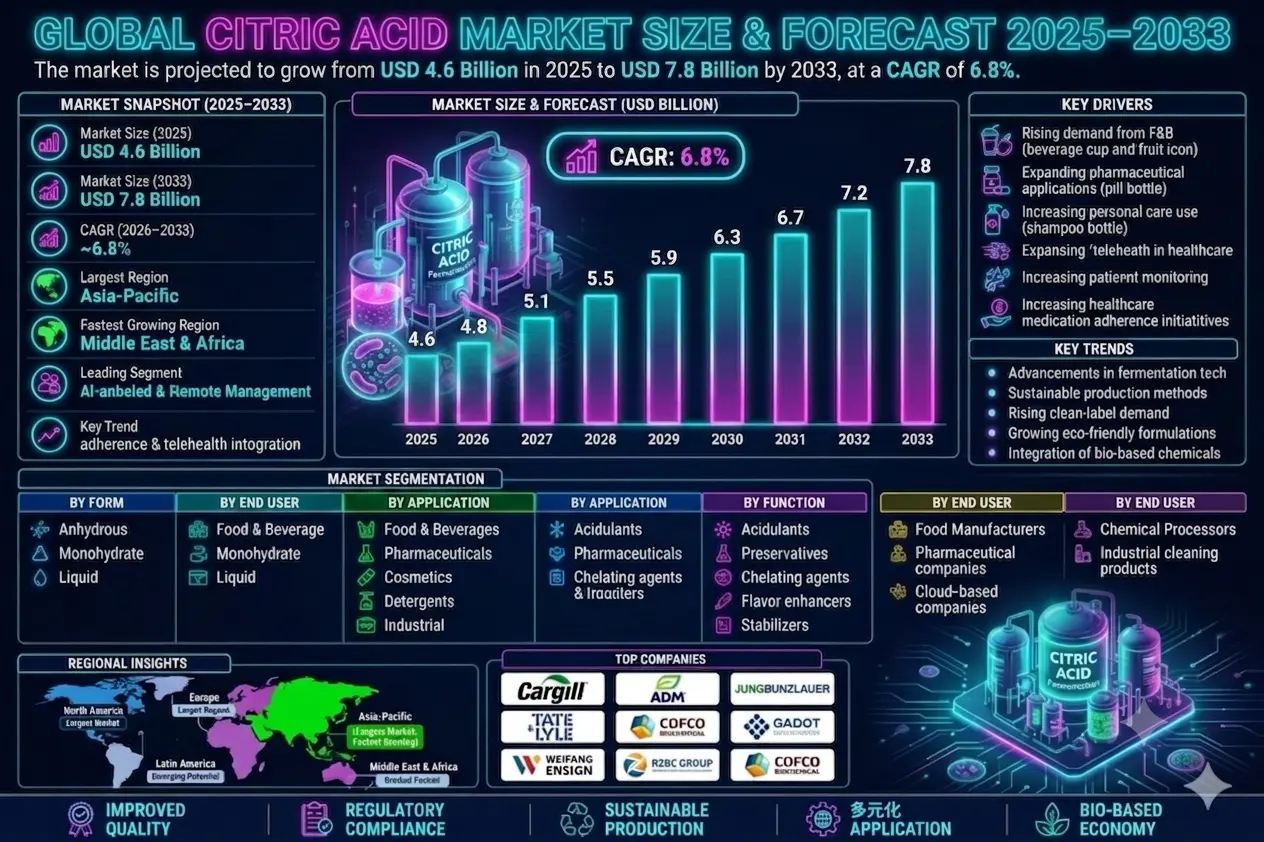
Global Citric Acid Market Size & Forecast
The global citric acid market is projected to witness steady growth during the forecast period from 2026 to 2033. The market was valued at approximately USD 4.6 billion in 2025 and is expected to reach nearly USD 7.8 billion by 2033, expanding at a CAGR of around 6.8%. The market growth is driven by rising demand from the food & beverage industry, expanding pharmaceutical applications, increasing use in personal care products, and growing industrial demand for biodegradable acidulants and preservatives. Citric acid is a weak organic acid naturally found in citrus fruits and widely produced through microbial fermentation processes. It is extensively used as an acidulant, preservative, flavor enhancer, buffering agent, and chelating agent across food processing, pharmaceuticals, cosmetics, detergents, and industrial applications. The market is experiencing significant transformation due to advancements in fermentation technologies, sustainable production methods, and increasing adoption of bio-based chemicals across industrial sectors. Additionally, growing consumer preference for natural ingredients, clean-label food products, and environmentally friendly formulations is accelerating demand for citric acid globally.Global Citric Acid Market Overview
The citric acid market forms a critical segment of the global specialty chemicals and food additives industry. It serves as an essential ingredient in food preservation, beverage acidification, pharmaceutical stabilization, cosmetic formulation, and industrial cleaning applications. The market includes anhydrous citric acid, liquid citric acid, monohydrate citric acid, and specialty citric acid formulations for industrial and pharmaceutical use. Manufacturers are increasingly investing in fermentation optimization, process automation, and sustainable production facilities to meet growing demand and regulatory requirements. Technological advancements in microbial fermentation, downstream purification, and bio-based chemical manufacturing are reshaping the competitive landscape. Major market participants include Cargill Incorporated, Archer Daniels Midland Company, Jungbunzlauer Suisse AG, Tate & Lyle PLC, COFCO Biochemical, Gadot Biochemical Industries Ltd., Weifang Ensign Industry Co., Ltd., and RZBC Group Co., Ltd.Key Drivers of Global Citric Acid Market Growth
Rising Demand from Food & Beverage Industry
Citric acid is extensively used as a flavor enhancer, preservative, and acidity regulator in beverages, confectionery, dairy products, and processed foods. The growing global consumption of convenience foods and beverages is significantly driving market demand.Expanding Pharmaceutical Applications
Citric acid is widely used in pharmaceutical formulations as an excipient, stabilizer, and buffering agent. The increasing pharmaceutical production worldwide is supporting market growth.Growing Demand for Natural and Clean-Label Ingredients
Consumers are increasingly preferring naturally derived food additives and clean-label products. Citric acid aligns with these preferences due to its natural occurrence and bio-based production methods.Increasing Use in Personal Care and Cosmetics
Citric acid is widely used in skincare products, shampoos, bath products, and cosmetics for pH adjustment and formulation stability. The expanding global cosmetics industry is creating strong growth opportunities.Rising Adoption of Eco-Friendly Industrial Chemicals
Citric acid is increasingly replacing harsh synthetic chemicals in cleaning agents and industrial formulations. Its biodegradable and environmentally friendly characteristics support sustainable product development.Global Citric Acid Market Segmentation
By Form
The market is segmented into anhydrous citric acid, citric acid monohydrate, and liquid citric acid. Citric acid monohydrate dominates the market due to widespread use in food and beverage applications.By Application
Applications include food & beverages, pharmaceuticals, cosmetics & personal care, detergents & cleaners, industrial processing, and chemical manufacturing. Food and beverage applications account for the largest market share globally.By Function
The market includes acidulants, preservatives, chelating agents, flavor enhancers, stabilizers, and buffering agents. Acidulants and preservatives represent dominant functional segments.By End User
End users include food manufacturers, pharmaceutical companies, personal care manufacturers, chemical processors, and industrial cleaning product manufacturers. Food processing companies remain the dominant end-user segment.Regional Market Dynamics
Asia-Pacific
Asia-Pacific dominates the global citric acid market due to large-scale production capacity, strong food processing industries, and rising industrial demand. China and India are major regional contributors supported by fermentation manufacturing infrastructure.North America
North America holds a significant market share due to strong demand from food & beverage processing, pharmaceuticals, and personal care industries. The United States leads regional consumption.Europe
Europe represents a mature market driven by stringent food safety standards, clean-label trends, and sustainable ingredient demand. Germany, France, Italy, and the United Kingdom are key regional markets.Latin America
Latin America is witnessing steady growth due to expanding food processing sectors and increasing industrialization. Brazil and Mexico are major regional contributors.Middle East & Africa
The region is gradually expanding due to increasing food manufacturing activities and growing consumer product demand.Competitive Landscape
The global citric acid market is moderately consolidated, with major players competing through production efficiency, pricing strategies, product quality, and sustainable manufacturing capabilities. Key companies include Cargill Incorporated, Archer Daniels Midland Company, Jungbunzlauer Suisse AG, Tate & Lyle PLC, COFCO Biochemical, Gadot Biochemical Industries Ltd., Weifang Ensign Industry Co., Ltd., and RZBC Group Co., Ltd. Companies are increasingly investing in advanced fermentation technologies, capacity expansion, and environmentally sustainable production processes. Strategic partnerships with food processors, pharmaceutical manufacturers, and industrial formulators are becoming increasingly important.Strategic Outlook
The strategic outlook for the global citric acid market remains positive due to growing demand for bio-based chemicals and natural ingredient solutions. Future growth opportunities include advanced fermentation optimization, sustainable packaging solutions, pharmaceutical excipient innovation, and eco-friendly industrial formulations. Increasing focus on circular bioeconomy initiatives and green chemistry practices will further shape market development. Manufacturers investing in production scalability, process sustainability, and high-purity citric acid solutions are likely to strengthen their competitive positioning.Final Market Perspective
The global citric acid market continues to evolve as industries increasingly prioritize natural, multifunctional, and environmentally sustainable ingredients. Growing demand from food processing, pharmaceuticals, cosmetics, and industrial applications will continue driving market expansion throughout the forecast period. Organizations that successfully combine production efficiency, innovation, and sustainable manufacturing practices will remain strongly positioned in the evolving global citric acid market.Table of Contents
Table of Contents
- 1. Executive Summary
- 1.1 Global Citric Acid Market Snapshot (2026-2033)
- 1.2 Market Size & CAGR Analysis
- 1.3 Largest & Fastest-Growing Segments
- 1.4 Key Regional Insights
- 1.5 Major Market Growth Drivers
- 1.6 Competitive Landscape Overview
- 1.7 Strategic Outlook Through 2033
- 2. Introduction & Market Overview
- 2.1 Definition of Citric Acid
- 2.2 Scope of the Study
- 2.3 Evolution of Citric Acid Production
- 2.4 Citric Acid Value Chain Analysis
- 2.5 Production Processes & Raw Material Overview
- 2.6 Regulatory & Sustainability Framework
- 2.7 Technological Advancements in Fermentation
- 3. Research Methodology
- 3.1 Primary Research
- 3.2 Secondary Research
- 3.3 Market Size Estimation Model
- 3.4 Forecast Assumptions (2026-2033)
- 3.5 Data Validation & Market Triangulation
- 4. Market Dynamics
- 4.1 Drivers
- 4.1.1 Rising Demand from Food & Beverage Industry
- 4.1.2 Expanding Pharmaceutical Applications
- 4.1.3 Growing Demand for Natural & Clean-Label Ingredients
- 4.1.4 Increasing Use in Personal Care & Cosmetics
- 4.1.5 Rising Adoption of Eco-Friendly Industrial Chemicals
- 4.2 Restraints
- 4.2.1 Volatility in Raw Material Prices
- 4.2.2 High Production Energy Requirements
- 4.2.3 Regulatory Compliance Challenges
- 4.2.4 Supply Chain Disruptions
- 4.3 Opportunities
- 4.3.1 Expansion of Bio-Based Chemical Production
- 4.3.2 Advanced Fermentation Technologies
- 4.3.3 Growth in Sustainable Cleaning Products
- 4.3.4 Pharmaceutical Excipient Innovation
- 4.4 Challenges
- 4.4.1 Competition from Alternative Acidulants
- 4.4.2 Environmental Emission Pressures
- 4.4.3 Maintaining Product Purity Standards
- 4.4.4 Capacity Expansion Constraints
- 4.1 Drivers
- 5. Global Citric Acid Market Analysis (USD Billion), 2026-2033
- 5.1 Market Size Overview
- 5.2 CAGR Analysis
- 5.3 Regional Revenue Distribution
- 5.4 Segment Revenue Analysis
- 5.5 Production Capacity Trends
- 5.6 Pricing Trend Analysis
- 6. Market Segmentation (USD Billion), 2026-2033
- 6.1 By Form
- 6.1.1 Anhydrous Citric Acid
- 6.1.1.1 High-Purity Industrial Grade
- 6.1.1.1.1 Specialty Processing Applications
- 6.1.1.1.1.1 Advanced Chemical Formulations
- 6.1.1.1.1 Specialty Processing Applications
- 6.1.1.1 High-Purity Industrial Grade
- 6.1.2 Citric Acid Monohydrate
- 6.1.2.1 Food & Beverage Grade Applications
- 6.1.3 Liquid Citric Acid
- 6.1.3.1 Industrial Liquid Formulations
- 6.1.1 Anhydrous Citric Acid
- 6.2 By Application
- 6.2.1 Food & Beverages
- 6.2.2 Pharmaceuticals
- 6.2.3 Cosmetics & Personal Care
- 6.2.4 Detergents & Cleaners
- 6.2.5 Industrial Processing
- 6.2.6 Chemical Manufacturing
- 6.3 By Function
- 6.3.1 Acidulants
- 6.3.2 Preservatives
- 6.3.3 Chelating Agents
- 6.3.4 Flavor Enhancers
- 6.3.5 Stabilizers
- 6.3.6 Buffering Agents
- 6.4 By End User
- 6.4.1 Food Manufacturers
- 6.4.2 Pharmaceutical Companies
- 6.4.3 Personal Care Manufacturers
- 6.4.4 Chemical Processors
- 6.4.5 Industrial Cleaning Product Manufacturers
- 6.1 By Form
- 7. Market Segmentation by Geography
- 7.1 North America
- 7.2 Europe
- 7.3 Asia-Pacific
- 7.4 Latin America
- 7.5 Middle East & Africa
- 8. Competitive Landscape
- 8.1 Market Share Analysis
- 8.2 Production Capacity Benchmarking
- 8.3 Strategic Partnerships & Collaborations
- 8.4 Sustainability Initiatives
- 8.5 Technology & Innovation Analysis
- 9. Company Profiles
- 9.1 Cargill Incorporated
- 9.2 Archer Daniels Midland Company
- 9.3 Jungbunzlauer Suisse AG
- 9.4 Tate & Lyle PLC
- 9.5 COFCO Biochemical
- 9.6 Gadot Biochemical Industries Ltd.
- 9.7 Weifang Ensign Industry Co., Ltd.
- 9.8 RZBC Group Co., Ltd.
- 9.9 TTCA Co., Ltd.
- 9.10 Huangshi Xinghua Biochemical Co., Ltd.
- 10. Strategic Intelligence & Pheonix AI Insights
- 10.1 Pheonix Demand Forecast Engine
- 10.2 Production Efficiency Analyzer
- 10.3 Fermentation Process Optimization Tracker
- 10.4 Sustainable Chemical Manufacturing Monitor
- 10.5 Automated Porter???s Five Forces Analysis
- 11. Future Outlook & Strategic Recommendations
- 11.1 Expansion of Bio-Based Manufacturing
- 11.2 Investment in Sustainable Fermentation Technologies
- 11.3 Growth in Clean-Label Food Applications
- 11.4 Innovation in Pharmaceutical & Industrial Formulations
- 11.5 Long-Term Market Outlook (2033+)
- 12. Appendix
- 13. About Pheonix Research
- 14. Disclaimer
Competitive Landscape
Global Citric Acid Market Competitive Intensity & Market Structure Overview
The global citric acid market is moderately consolidated and highly production-efficiency driven, with competition primarily centered around manufacturing scale, fermentation technology expertise, product purity, cost optimization, and supply chain reliability. Market participants compete aggressively through capacity expansion, pricing strategies, sustainable production practices, and long-term supply relationships with food, pharmaceutical, and industrial customers.
The market structure includes multinational specialty ingredient manufacturers, large-scale biochemical producers, regional fermentation companies, and integrated food additive suppliers. Asia-Pacific, particularly China, plays a dominant role in global production, creating a highly competitive environment characterized by scale-driven cost advantages and export-oriented manufacturing strategies.
Growing demand for clean-label ingredients, sustainable bio-based chemicals, and environmentally friendly industrial formulations is significantly reshaping competitive dynamics across the global citric acid industry.
Global Citric Acid Market Competitive Intensity & Market Structure Current Scenario
Leading Citric Acid & Specialty Ingredient Companies
Cargill Incorporated: A major global food ingredient and biochemical producer with strong capabilities in citric acid manufacturing, supply chain integration, and industrial ingredient solutions.
Archer Daniels Midland Company: Key market participant focused on fermentation-based ingredient production and large-scale specialty chemical manufacturing.
Jungbunzlauer Suisse AG: Leading producer of biodegradable ingredients and citric acid solutions with strong expertise in sustainable fermentation technologies.
Tate & Lyle PLC: Important supplier of food ingredients and specialty additives serving food processing and industrial application markets.
COFCO Biochemical: Major Chinese producer with significant large-scale citric acid production capacity supporting domestic and international demand.
Gadot Biochemical Industries Ltd.: Specialized manufacturer focused on food-grade and industrial citric acid solutions.
Weifang Ensign Industry Co., Ltd.: Prominent large-scale citric acid producer with strong export capabilities and cost-competitive manufacturing operations.
RZBC Group Co., Ltd.: Leading global citric acid supplier recognized for extensive fermentation production capacity and broad application-specific product offerings.
Key Competitive Intensity & Market Structure Drivers
The growing demand for citric acid in food and beverage preservation, acidity regulation, and flavor enhancement is intensifying competition among producers to expand production capacity and improve cost efficiency.
Clean-label product trends and consumer preference for naturally derived ingredients are increasing pressure on manufacturers to strengthen bio-based production capabilities and regulatory compliance.
Technological advancements in microbial fermentation and downstream purification are becoming major competitive differentiators for achieving higher production yields and enhanced product purity.
Price competitiveness remains a significant factor, particularly in high-volume commodity-grade citric acid segments where manufacturing scale directly influences market positioning.
Growing demand from pharmaceuticals, personal care products, and industrial cleaning applications is encouraging suppliers to diversify product portfolios and develop specialty-grade citric acid formulations.
Strategic Implications of Competitive Intensity & Market Structure
Manufacturers are increasingly investing in fermentation optimization, process automation, and production scalability to improve efficiency and strengthen profitability.
Sustainability is becoming a central strategic priority, with companies focusing on lower-carbon manufacturing processes, waste minimization, and renewable energy integration.
Strategic partnerships with food processors, pharmaceutical companies, and industrial formulators are becoming increasingly important for securing long-term supply agreements and ensuring stable demand.
Regional production diversification is emerging as a strategic response to supply chain risks, trade disruptions, and changing regulatory requirements.
Innovation in specialty citric acid formulations for pharmaceutical excipients, personal care applications, and advanced industrial cleaning solutions is creating higher-value competitive opportunities.
Global Citric Acid Market Competitive Intensity & Market Structure Forward Outlook
The global citric acid market is expected to remain highly efficiency-focused as producers compete through sustainable manufacturing innovation, production scalability, and specialty product differentiation.
Future competition will increasingly focus on advanced fermentation technologies, circular bioeconomy integration, and environmentally optimized manufacturing processes.
Asia-Pacific is expected to maintain production leadership, while North America and Europe will continue emphasizing premium-grade, sustainable, and regulatory-compliant citric acid solutions.
Emerging applications in eco-friendly industrial formulations, pharmaceutical stabilization systems, and natural preservative solutions are expected to create additional growth opportunities.
Overall, companies that successfully combine large-scale fermentation efficiency, sustainable production practices, specialty product innovation, and strong customer partnerships will remain strongly positioned in the evolving global citric acid market.
Value Chain
Global Citric Acid Market Value Chain & Supply Chain Evolution Overview
The global citric acid market value chain is evolving rapidly as increasing demand for natural food additives, bio-based chemicals, pharmaceutical excipients, and environmentally sustainable industrial ingredients drives transformation across production and distribution ecosystems. Citric acid has emerged as a highly versatile organic acid used extensively as an acidulant, preservative, buffering agent, flavor enhancer, and chelating agent across food and beverage processing, pharmaceuticals, cosmetics, detergents, and industrial cleaning applications. Its biodegradable nature and compatibility with clean-label product trends have positioned citric acid as a critical component of the global specialty chemicals and food additives industry.
The citric acid value chain encompasses agricultural feedstock sourcing, microbial fermentation, downstream purification, crystallization, formulation processing, packaging, distribution, and downstream industrial application integration. Modern production increasingly relies on advanced microbial fermentation technologies using carbohydrate-rich raw materials such as corn, sugarcane, molasses, and glucose syrups. Manufacturers are focusing on improving fermentation efficiency, reducing production costs, increasing purity levels, and strengthening environmentally sustainable manufacturing capabilities.
The market ecosystem includes agricultural raw material suppliers, fermentation technology providers, industrial biotechnology companies, chemical processors, food ingredient manufacturers, packaging providers, logistics operators, and downstream industrial users. Leading companies such as Cargill Incorporated, Archer Daniels Midland Company, Jungbunzlauer Suisse AG, Tate & Lyle PLC, COFCO Biochemical, Gadot Biochemical Industries Ltd., Weifang Ensign Industry Co., Ltd., and RZBC Group Co., Ltd. are investing heavily in capacity expansion, process optimization, energy-efficient manufacturing systems, and sustainable bio-based production infrastructure.
Upstream supply chain operations depend heavily on agricultural feedstock availability, microbial culture development, fermentation process control systems, industrial biotechnology infrastructure, water treatment systems, and energy-intensive processing equipment. Midstream activities focus on purification, crystallization, drying, formulation customization, and quality assurance processes to ensure product consistency across food-grade, pharmaceutical-grade, and industrial-grade applications. Downstream distribution supports broad end-use integration across processed foods, beverages, pharmaceuticals, personal care products, detergents, and industrial formulations.
Operational strategies across the citric acid value chain increasingly emphasize fermentation efficiency, feedstock security, process automation, sustainability compliance, product purity optimization, and supply chain resilience. However, the market continues to face challenges related to agricultural feedstock price volatility, energy cost fluctuations, regulatory compliance requirements, environmental restrictions, fermentation process efficiency constraints, and increasing competition from regional producers.
Global Citric Acid Market Value Chain & Supply Chain Evolution Current Scenario
The current citric acid market is being shaped by strong global demand from food and beverage manufacturing, expanding pharmaceutical production, growing clean-label product adoption, and increasing use of biodegradable ingredients across industrial sectors. Food and beverage manufacturers remain the largest consumers of citric acid due to its widespread application as an acidity regulator, preservative, and flavor enhancer in processed foods, soft drinks, confectionery, dairy products, and convenience foods.
Asia-Pacific dominates the global citric acid supply chain due to large-scale fermentation manufacturing capacity, strong agricultural feedstock availability, lower production costs, and expanding food processing industries. China remains the leading producer and exporter of citric acid globally, supported by extensive fermentation infrastructure and integrated biochemical manufacturing ecosystems.
North America and Europe maintain strong market demand driven by mature food processing sectors, stringent food safety regulations, pharmaceutical manufacturing growth, and rising consumer preference for natural ingredients. These regions are increasingly emphasizing sustainable ingredient sourcing, high-purity formulations, and environmentally compliant production processes.
Manufacturers are actively investing in advanced fermentation optimization systems, process automation technologies, renewable energy integration, and water-efficient purification methods to improve production economics and reduce environmental impact. Sustainability-focused investments are becoming increasingly important as governments and consumers place greater emphasis on green chemistry and low-carbon manufacturing practices.
Supply chain resilience has become a major strategic priority as agricultural feedstock fluctuations, transportation disruptions, and global trade uncertainties continue to affect production planning and distribution stability. Companies are diversifying sourcing strategies and strengthening regional production capabilities to improve operational continuity.
Key Value Chain & Supply Chain Evolution Signals in Global Citric Acid Market
One of the most significant transformation signals is the growing global shift toward clean-label and naturally derived food ingredients. Consumers increasingly prefer recognizable, naturally sourced additives, significantly boosting demand for citric acid as a preferred preservative and acidulant in food and beverage formulations.
Another major signal is the increasing adoption of bio-based and environmentally sustainable industrial chemicals. Citric acid is increasingly replacing synthetic acids and harsher chemical alternatives in cleaning products, industrial processing, and eco-friendly formulations due to its biodegradable characteristics and lower environmental impact.
Advancements in microbial fermentation technology are also reshaping market dynamics. Improved fermentation strains, automated bioprocess control systems, enhanced downstream purification technologies, and AI-assisted production optimization are enabling higher production efficiency, reduced waste generation, and improved product consistency.
The pharmaceutical industry’s growing use of citric acid as a stabilizer, excipient, buffering agent, and formulation enhancer is further strengthening market expansion. Rising global pharmaceutical production and increasing demand for high-purity excipient-grade citric acid are creating new growth opportunities for specialized manufacturers.
Sustainability and circular bioeconomy initiatives are also influencing the value chain. Manufacturers are increasingly adopting renewable feedstocks, waste valorization strategies, energy recovery systems, and low-emission production processes to improve environmental performance and align with ESG expectations.
Regional production diversification is emerging as another key signal as companies seek to reduce overreliance on concentrated manufacturing hubs and strengthen supply chain resilience through geographically distributed production networks.
Strategic Implications of Value Chain & Supply Chain Evolution in Global Citric Acid Market
Leading citric acid producers are increasingly prioritizing fermentation optimization, production scalability, sustainability investments, and strategic customer partnerships to strengthen market positioning. Competitive differentiation increasingly depends on production efficiency, product purity, supply reliability, regulatory compliance, and environmentally sustainable manufacturing capabilities.
Companies capable of producing high-purity food-grade, pharmaceutical-grade, and specialty citric acid products are expected to capture premium growth opportunities across high-value end-use applications. Investments in process automation, advanced purification technologies, and customized formulation capabilities are becoming essential for maintaining competitiveness.
Strategic partnerships with food processors, pharmaceutical manufacturers, personal care formulators, and industrial chemical producers are becoming increasingly important for securing long-term supply agreements and improving demand visibility. Collaborative innovation initiatives are also helping manufacturers develop application-specific citric acid solutions.
Environmental sustainability is becoming a critical strategic differentiator. Manufacturers adopting renewable energy-powered fermentation systems, water recycling technologies, low-carbon processing infrastructure, and circular production models are expected to strengthen long-term market positioning as sustainability standards become more stringent.
Supply chain diversification and regional manufacturing expansion are also emerging as strategic priorities. Companies with geographically distributed production capabilities and diversified agricultural feedstock sourcing strategies are likely to gain resilience advantages in an increasingly dynamic global market.
Global Citric Acid Market Value Chain & Supply Chain Evolution Forward Outlook
Between 2026 and 2033, the citric acid value chain is expected to become increasingly efficient, technologically advanced, sustainable, and integrated with circular bioeconomy principles. Rising global demand for natural ingredients, sustainable industrial chemicals, and multifunctional food additives will continue driving long-term market expansion.
Advanced fermentation technologies including genetically optimized microbial strains, AI-assisted bioprocess optimization, automated production systems, and next-generation purification technologies are expected to significantly improve manufacturing efficiency and product consistency. These innovations will support lower production costs and improved environmental performance.
Sustainability will become central to future citric acid manufacturing strategies. Producers are expected to invest heavily in renewable energy integration, carbon reduction initiatives, water conservation systems, waste valorization processes, and closed-loop fermentation infrastructure to align with evolving environmental regulations and corporate ESG commitments.
Regional production expansion is likely to accelerate as companies strengthen local manufacturing capabilities to improve supply chain resilience and reduce logistics dependency. North America, Europe, and emerging Asia-Pacific markets are expected to see increased investment in domestic citric acid production infrastructure.
The pharmaceutical and specialty applications segment is expected to witness particularly strong growth due to increasing demand for high-purity citric acid in advanced drug formulations, nutraceutical products, and precision chemical applications. Customized specialty-grade citric acid solutions will become an important growth driver.
Industrial applications including biodegradable cleaners, eco-friendly chemical processing agents, and green formulation systems are expected to create additional demand opportunities as industries continue transitioning toward sustainable chemistry solutions.
Ultimately, the future citric acid value chain will evolve into a highly optimized global bio-based manufacturing ecosystem focused on production efficiency, sustainable processing, supply chain resilience, application-specific innovation, and circular resource utilization.
Market-Specific Value Chain
- Agricultural Feedstock Sourcing: Corn, sugarcane, molasses, glucose syrup production, agricultural processing, feedstock logistics, and raw material quality management.
- Microbial Fermentation & Bioprocessing: Fermentation strain development, bioreactor operations, microbial cultivation, process control systems, industrial biotechnology optimization, and fermentation monitoring.
- Purification & Product Processing: Downstream purification, crystallization, drying, concentration systems, quality testing, formulation customization, and specialty product preparation.
- Packaging & Distribution: Industrial packaging solutions, bulk transportation, warehousing, export logistics, regional distribution networks, and supply chain coordination.
- Industrial Application Integration: Food processing, beverage manufacturing, pharmaceutical formulation, cosmetics production, detergent formulation, and industrial cleaning applications.
- Sustainability & Circular Bioeconomy Optimization: Renewable energy integration, waste valorization, water recycling systems, carbon reduction strategies, circular resource utilization, and environmentally sustainable manufacturing enhancement.
Company-to-Stage Mapping
- Agricultural Feedstock Sourcing: Cargill Incorporated, Archer Daniels Midland Company, agricultural commodity suppliers, sugar processing companies.
- Microbial Fermentation & Bioprocessing: Jungbunzlauer Suisse AG, COFCO Biochemical, Weifang Ensign Industry Co., Ltd., RZBC Group Co., Ltd.
- Purification & Product Processing: Tate & Lyle PLC, Gadot Biochemical Industries Ltd., specialty ingredient processing companies.
- Packaging & Distribution: Global logistics providers, industrial packaging suppliers, regional chemical distribution companies.
- Industrial Application Integration: Food manufacturers, pharmaceutical companies, cosmetics producers, industrial cleaning product manufacturers.
- Sustainability & Circular Bioeconomy Optimization: Green chemistry technology providers, renewable energy partners, environmental engineering firms, sustainable biotechnology innovators.
Investment Activity
Global Citric Acid Market Investment & Funding Dynamics Overview
Investment activity in the global citric acid market is steadily increasing due to rising demand for natural food additives, expanding pharmaceutical applications, growing use in personal care formulations, and increasing adoption of bio-based industrial chemicals. Between 2026 and 2033, funding is expected to increasingly focus on advanced fermentation technologies, production capacity expansion, sustainable manufacturing infrastructure, and high-purity citric acid product innovation.
The citric acid market has become an increasingly attractive investment segment within the global specialty chemicals and food ingredients ecosystem. Chemical manufacturers, food ingredient companies, private investors, and industrial biotechnology firms are allocating significant capital toward improving production efficiency, enhancing product quality, and expanding supply chain capabilities.
A major structural transformation influencing investment activity is the global shift toward clean-label ingredients, natural preservatives, and environmentally sustainable chemical alternatives. This transition is accelerating investments into microbial fermentation optimization, renewable feedstock utilization, and low-emission manufacturing processes.
The market is also benefiting from increased funding in green chemistry initiatives, process automation, downstream purification technologies, and circular bioeconomy projects. Growing regulatory support for biodegradable chemicals and consumer preference for natural ingredient solutions are further strengthening long-term investment opportunities.
Current Investment & Funding Landscape
Current investment activity in the citric acid market is strongly supported by rising demand across food processing, pharmaceuticals, personal care products, and industrial cleaning applications. Companies are actively investing in production capacity expansion, fermentation efficiency improvements, energy optimization systems, and sustainable raw material sourcing.
- Asia-Pacific: Dominates global investment activity due to large-scale fermentation manufacturing infrastructure, strong food processing industries, and significant production expansion initiatives across China and India.
- North America: Witnessing stable investment growth supported by clean-label food trends, pharmaceutical ingredient demand, and increasing focus on sustainable specialty chemical manufacturing.
- Europe: Attracting strong funding due to strict environmental regulations, rising green chemistry adoption, and growing consumer preference for natural additives.
- Latin America & Middle East: Emerging as developing investment regions due to expanding food manufacturing sectors and increasing industrial chemical demand.
Key Investment & Funding Drivers
- Growing clean-label food demand is increasing investments in natural citric acid production infrastructure.
- Expansion of pharmaceutical manufacturing is driving funding for high-purity citric acid production capabilities.
- Advancements in microbial fermentation technologies are attracting investments focused on process efficiency and production scalability.
- Increasing adoption of biodegradable industrial chemicals is supporting green chemistry-related capital allocation.
- Rising demand for sustainable personal care formulations is accelerating investments in specialty citric acid product development.
- Energy-efficient and automated manufacturing systems are becoming major areas of industrial modernization investment.
- Growing circular bioeconomy initiatives are creating opportunities for investments in renewable feedstock integration.
Strategic Investment Implications
- The investment landscape increasingly favors companies capable of combining production efficiency with sustainable manufacturing practices.
- Technological leadership in fermentation optimization and purification processes is emerging as a major competitive differentiator.
- Strategic partnerships with food, pharmaceutical, and personal care manufacturers are strengthening funding confidence.
- Regional diversification strategies are becoming critical for supply chain resilience and market expansion.
- Organizations investing in low-carbon production systems are expected to gain stronger long-term competitive positioning.
- Innovation in specialty citric acid formulations is creating new premium-margin investment opportunities.
- Companies with scalable, environmentally compliant manufacturing infrastructure are expected to attract stronger institutional investment.
Forward Investment Outlook
The global citric acid market is expected to maintain stable long-term investment momentum due to increasing global demand for natural ingredients, sustainable industrial chemicals, and multifunctional specialty additives.
Future funding activity is expected to prioritize next-generation fermentation systems, sustainable bio-based production facilities, advanced purification technologies, specialty citric acid applications, and process digitalization initiatives.
- Asia-Pacific: Will remain the leading investment hub due to production capacity expansion and strong downstream manufacturing demand.
- Europe: Will increasingly focus on green chemistry innovation and environmentally sustainable production systems.
- North America: Will strengthen its position through premium natural ingredient demand and advanced specialty chemical manufacturing investments.
Future innovation investments are also expected across enzyme-based fermentation enhancement, low-energy processing technologies, biodegradable industrial formulations, and integrated bio-refinery systems.
The growing convergence of sustainability goals, clean-label consumer preferences, and industrial biotechnology innovation will continue reshaping investment priorities across the citric acid market.
Overall, the market is expected to remain an attractive long-term investment opportunity as citric acid continues to play a critical role across food, pharmaceutical, personal care, and industrial applications worldwide.
Technology & Innovation
Global Citric Acid Market Technology & Innovation Landscape Overview
The global citric acid market is undergoing substantial technological transformation driven by innovations in microbial fermentation, bioprocess optimization, sustainable production systems, and digital manufacturing integration. As industries increasingly prioritize natural additives, bio-based chemicals, and environmentally responsible production methods, technology is playing a central role in enhancing citric acid manufacturing efficiency, purity levels, and scalability.
Modern citric acid production technologies are focused on improving fermentation yield, reducing production costs, minimizing environmental impact, and enabling high-purity product development for food, pharmaceutical, cosmetic, and industrial applications.
The integration of biotechnology, automation, artificial intelligence, process analytics, and circular manufacturing systems is significantly reshaping the technological landscape of the global citric acid industry.
Global Citric Acid Market Technology & Innovation Current Scenario
Currently, the citric acid market relies heavily on advanced microbial fermentation processes using Aspergillus niger as the primary production microorganism. Continuous improvements in strain engineering and fermentation optimization are increasing production efficiency and product consistency.
Automated bioreactor systems equipped with real-time monitoring technologies are enabling precise control over pH, temperature, oxygen transfer, nutrient concentration, and fermentation kinetics, significantly improving operational performance.
Advanced downstream purification technologies such as membrane filtration, crystallization optimization, ion exchange systems, and high-efficiency separation techniques are enhancing citric acid purity and reducing energy consumption.
Digital process control platforms integrated with industrial IoT sensors are allowing manufacturers to monitor production conditions continuously, detect deviations instantly, and improve process reliability.
Sustainable feedstock innovation is becoming increasingly important, with manufacturers exploring agricultural waste, biomass-derived sugars, and circular feedstock utilization to improve environmental sustainability.
Green chemistry innovations are also enabling cleaner production pathways with reduced wastewater generation, lower emissions, and improved resource utilization.
Key Technology & Innovation Trends in Global Citric Acid Market
- Advanced Fermentation Engineering: Optimized microbial fermentation processes improving citric acid yield and productivity.
- Microbial Strain Enhancement: Genetic engineering and strain selection improving fermentation efficiency and product consistency.
- Automated Bioprocess Control: Smart control systems enabling real-time process optimization and operational precision.
- AI-Driven Process Optimization: Artificial intelligence improving fermentation modeling, predictive process adjustments, and production forecasting.
- Industrial IoT Monitoring: Sensor-based monitoring platforms improving process visibility and reducing operational disruptions.
- Energy-Efficient Purification Technologies: Advanced crystallization and membrane filtration reducing energy consumption during downstream processing.
- Circular Bioeconomy Integration: Utilization of renewable feedstocks and industrial byproducts for sustainable citric acid production.
- Wastewater Recovery Systems: Closed-loop water management systems minimizing environmental footprint.
- High-Purity Specialty Citric Acid Production: Precision manufacturing for pharmaceutical and specialty industrial applications.
- Digital Twin Manufacturing Models: Virtual production simulations supporting process optimization and risk reduction.
Strategic Implications of Technology & Innovation
Technology-driven manufacturing is becoming a major competitive differentiator in the global citric acid market. Producers implementing advanced fermentation and digital process control systems are achieving higher yields, lower costs, and improved product quality.
Sustainable production innovation is increasingly essential as environmental regulations tighten and customers demand greener ingredient sourcing. Manufacturers investing in renewable feedstocks and low-emission production technologies are strengthening long-term market positioning.
AI and data analytics are enabling predictive process management, reducing downtime, improving production consistency, and optimizing resource allocation.
Advanced purification technologies are supporting expansion into premium pharmaceutical, nutraceutical, and specialty industrial applications requiring ultra-high purity citric acid.
At the same time, capital-intensive infrastructure upgrades, technological complexity, feedstock supply variability, and regulatory compliance requirements remain key operational challenges for market participants.
Global Citric Acid Market Technology & Innovation Forward Outlook
The future technological evolution of the citric acid market is expected to focus on intelligent biomanufacturing, carbon-neutral production systems, synthetic biology advancements, and next-generation bio-refinery integration.
Synthetic biology is expected to enable the development of highly optimized microbial strains capable of delivering superior fermentation performance and broader feedstock compatibility.
Artificial intelligence-powered autonomous production systems will increasingly support self-optimizing fermentation operations, improving efficiency and reducing human intervention.
Carbon capture integration and renewable energy-powered fermentation facilities are likely to accelerate the transition toward low-carbon citric acid manufacturing.
Advanced circular production systems utilizing agricultural residues and industrial biomass waste will strengthen sustainability and feedstock resilience.
Overall, the technology and innovation landscape of the global citric acid market is evolving toward highly efficient, sustainable, digitally optimized, and precision-controlled production ecosystems that will define future competitiveness across the industry.
Market Risk
Global Citric Acid Market Risk Factors & Disruption Threats Overview
The global citric acid market is positioned for steady growth due to increasing demand from food and beverage manufacturing, pharmaceutical applications, personal care products, and industrial cleaning formulations. Despite favorable long-term market prospects, the industry faces several critical risk factors including raw material price volatility, supply chain disruptions, regulatory compliance pressures, production concentration risks, and technological substitution threats.
One of the major disruption risks affecting the citric acid market is volatility in raw material availability and pricing. Citric acid production relies heavily on carbohydrate feedstocks such as corn, sugar, and molasses for microbial fermentation. Fluctuations in agricultural commodity prices, adverse weather events, crop shortages, and supply constraints can significantly increase production costs and impact manufacturer profitability.
Supply chain concentration represents another major challenge. A significant portion of global citric acid production is concentrated in Asia-Pacific, particularly China. Any geopolitical instability, trade restrictions, export regulations, production shutdowns, or transportation bottlenecks in key producing regions can disrupt global supply chains and create pricing instability.
Regulatory compliance is also a significant market risk. Citric acid manufacturers must comply with evolving food safety standards, pharmaceutical-grade purity requirements, environmental regulations, and chemical manufacturing compliance frameworks. Failure to meet these standards can result in operational disruptions, product recalls, and increased compliance costs.
The market also faces competitive pricing pressure due to high production competition among global manufacturers. Oversupply conditions and aggressive price competition may compress margins, particularly for producers lacking scale or operational efficiency.
In addition, increasing interest in alternative acidulants, synthetic preservatives, and multifunctional specialty additives may create substitution risks across certain application segments.
Global Citric Acid Market Risk Factors & Disruption Threats Current Scenario
The current citric acid market environment reflects stable demand growth supported by food processing expansion, clean-label ingredient trends, pharmaceutical manufacturing growth, and rising adoption of environmentally friendly industrial chemicals.
Food and beverage manufacturers continue to increase usage of citric acid as a preservative, flavor enhancer, and acidity regulator in processed foods, beverages, confectionery, and dairy applications.
At the same time, the industry is experiencing increased pressure from rising feedstock costs, energy price fluctuations, logistics disruptions, and environmental compliance requirements.
Global supply chains remain sensitive to geopolitical uncertainties and regional manufacturing concentration. Production disruptions in key exporting countries can create temporary shortages and cost fluctuations across downstream industries.
Manufacturers are increasingly investing in fermentation process optimization, energy-efficient production systems, and sustainable manufacturing technologies to mitigate operational risks and improve supply reliability.
Global Citric Acid Market Key Risk Factors & Disruption Threat Signals
- Raw Material Price Volatility: Fluctuating prices of corn, sugar, and molasses affecting production economics.
- Production Concentration Risk: Heavy dependence on Asia-Pacific manufacturing hubs creating supply vulnerability.
- Supply Chain Disruptions: Logistics delays, trade restrictions, and transportation bottlenecks impacting global availability.
- Regulatory Compliance Challenges: Stringent food safety, pharmaceutical quality, and environmental regulations.
- Energy Cost Fluctuations: Rising utility and processing energy costs increasing operational expenses.
- Intense Price Competition: Competitive global manufacturing environment compressing profit margins.
- Alternative Ingredient Substitution: Competition from synthetic acidulants and alternative food additives.
- Environmental Sustainability Pressure: Increasing demand for low-carbon and eco-friendly production methods.
- Quality Control Risks: Product contamination or purity inconsistencies affecting downstream applications.
- Demand Sensitivity Across End-Use Industries: Economic slowdowns impacting food, pharmaceutical, and personal care production.
Strategic Implications of Risk Factors
Citric acid manufacturers must prioritize supply chain diversification and reduce overdependence on concentrated regional production bases to improve resilience.
Investments in feedstock sourcing strategies, process automation, and fermentation optimization will be essential to manage cost volatility and maintain pricing competitiveness.
Regulatory compliance capabilities and advanced quality assurance systems will remain critical for maintaining customer trust across food, pharmaceutical, and industrial applications.
Manufacturers should accelerate adoption of sustainable production practices, lower-emission processing technologies, and circular bioeconomy initiatives to address environmental expectations.
Strategic partnerships with food processors, pharmaceutical companies, and industrial formulators can strengthen long-term demand visibility and reduce market exposure.
Global Citric Acid Market Forward Risk Outlook
Looking ahead to 2026???2033, the citric acid market is expected to maintain steady growth supported by clean-label product demand, pharmaceutical manufacturing expansion, and rising industrial use of biodegradable chemicals.
Future market dynamics will increasingly be influenced by sustainable fermentation innovation, bio-based production advancements, and supply chain regionalization efforts.
However, raw material volatility, regulatory tightening, production concentration risks, and competitive pricing pressure will remain important strategic challenges.
The transition toward greener chemical manufacturing and circular economy practices will create both growth opportunities and operational transformation requirements for market participants.
Overall, while the global citric acid market offers strong long-term opportunities, sustained competitiveness will depend on supply chain resilience, production efficiency, regulatory compliance, cost optimization, and sustainable manufacturing innovation.
Regulatory Landscape
Global Citric Acid Market Regulatory & Policy Environment Overview
The regulatory and policy environment governing the global citric acid market is shaped by food safety regulations, pharmaceutical ingredient compliance standards, environmental protection policies, industrial chemical handling requirements, and sustainability-focused manufacturing frameworks. As citric acid is widely used across food & beverages, pharmaceuticals, personal care products, and industrial applications, it is subject to multi-industry regulatory oversight across global markets.
Regulatory agencies primarily focus on product purity, food additive safety, manufacturing process controls, labeling requirements, and acceptable use concentrations across end-use sectors. Citric acid???s status as a widely accepted food-grade and pharmaceutical-grade additive makes compliance with regional health and safety standards critical for market participation.
The increasing global emphasis on clean-label ingredients, natural additives, sustainable production methods, and environmentally friendly industrial chemicals is also reshaping policy priorities across the citric acid market. Governments and regulatory bodies are encouraging bio-based production pathways and greener manufacturing processes to support circular bioeconomy objectives.
Global Citric Acid Market Regulatory & Policy Environment Current Scenario
The current regulatory landscape for citric acid is characterized by established food additive approvals, industrial chemical safety frameworks, pharmaceutical excipient standards, and environmental manufacturing regulations. Compliance requirements vary by region depending on intended applications and end-use sectors.
In the United States, citric acid is regulated by the Food and Drug Administration (FDA) as a Generally Recognized as Safe (GRAS) food additive. Pharmaceutical applications must comply with United States Pharmacopeia (USP) standards, while industrial production facilities are regulated under Environmental Protection Agency (EPA) environmental compliance frameworks and OSHA workplace safety regulations.
In Europe, citric acid is approved under the European Food Safety Authority (EFSA) and regulated as food additive E330. Manufacturers must comply with REACH (Registration, Evaluation, Authorisation and Restriction of Chemicals), Good Manufacturing Practice (GMP) requirements, and strict environmental emissions regulations for fermentation-based production facilities.
Asia-Pacific, particularly China and India, plays a major role in global citric acid production and is governed by food additive regulations, industrial fermentation standards, environmental compliance policies, and export quality certifications. Regulatory oversight is increasingly tightening to improve product consistency, sustainability, and international trade compliance.
Latin America and the Middle East & Africa are progressively aligning food additive standards and industrial production regulations with international quality and safety benchmarks to support global trade integration.
Key Regulatory & Policy Environment Signals in Global Citric Acid Market
- Food Additive Safety Regulations: Citric acid is subject to strict approval, labeling, purity, and permissible concentration requirements in food and beverage applications.
- Pharmaceutical Compliance Standards: Pharmaceutical-grade citric acid must meet pharmacopeia standards and stringent quality control regulations.
- Environmental Manufacturing Regulations: Fermentation-based production facilities must comply with emissions control, wastewater management, and waste disposal standards.
- Clean-Label and Natural Ingredient Policies: Regulatory trends increasingly favor naturally derived additives and transparent ingredient labeling practices.
- Chemical Handling and Workplace Safety Standards: Manufacturing and storage processes are regulated to ensure worker safety and operational compliance.
- Sustainability and Bioeconomy Initiatives: Governments are supporting bio-based chemical production through green manufacturing incentives and circular economy policies.
Strategic Implications of Regulatory & Policy Environment
The evolving regulatory landscape is significantly influencing manufacturing strategies, product development, and investment priorities across the citric acid market. Producers are increasingly investing in advanced fermentation technologies, energy-efficient production systems, and environmental compliance upgrades to meet tightening sustainability requirements.
Clean-label regulations and consumer transparency expectations are encouraging manufacturers to strengthen traceability systems, quality certifications, and natural sourcing claims across food and beverage applications.
Stricter pharmaceutical and food-grade quality standards are driving investments in high-purity production capabilities, automated process controls, and advanced testing infrastructure to ensure consistent compliance across global markets.
Environmental regulations are also accelerating the adoption of low-waste fermentation processes, water recycling systems, and circular production models that improve operational sustainability and reduce environmental impact.
Companies capable of aligning with global regulatory standards while maintaining cost-efficient production are expected to strengthen their competitive positioning in international markets.
Global Citric Acid Market Regulatory & Policy Environment Forward Outlook
Between 2026 and 2033, the regulatory environment for the global citric acid market is expected to become increasingly sustainability-driven and quality-focused. Governments are likely to strengthen environmental compliance standards for fermentation facilities while expanding support for bio-based industrial ingredient production.
Food labeling regulations and clean-label ingredient standards are expected to become more stringent, increasing demand for transparent sourcing documentation and traceable production systems.
Pharmaceutical regulatory frameworks will continue emphasizing excipient quality, consistency, and manufacturing validation, further supporting demand for high-purity citric acid production.
Circular bioeconomy policies and green chemistry initiatives are expected to encourage innovation in fermentation efficiency, renewable feedstock integration, and waste valorization across production facilities.
Global harmonization of food additive and industrial ingredient regulations may also improve international trade opportunities for compliant manufacturers.
Overall, the regulatory and policy environment will remain a key strategic driver for the citric acid market, with companies investing in sustainable manufacturing, regulatory compliance, and product quality innovation expected to maintain strong long-term competitive advantages.