
Global Instant Noodles Market size and share Analysis 2026-2033
Global Instant Noodles Market Forecast Snapshot: 2026???2033
| Metric | Value |
|---|---|
| 2025 Market Size | USD 56.3 Billion |
| 2033 Market Size | USD 82.9 Billion |
| CAGR (2026???2033) | 5.0% |
| Largest Region | Asia-Pacific |
| Fastest Growing Region | Asia-Pacific |
| Top Product Segment | Packet Noodles |
| Key Trend | Fortified Ingredients & Regional Flavor Innovation |
| Future Focus | Nutrition Enhancement, E-Commerce Expansion, and Sustainable Packaging |
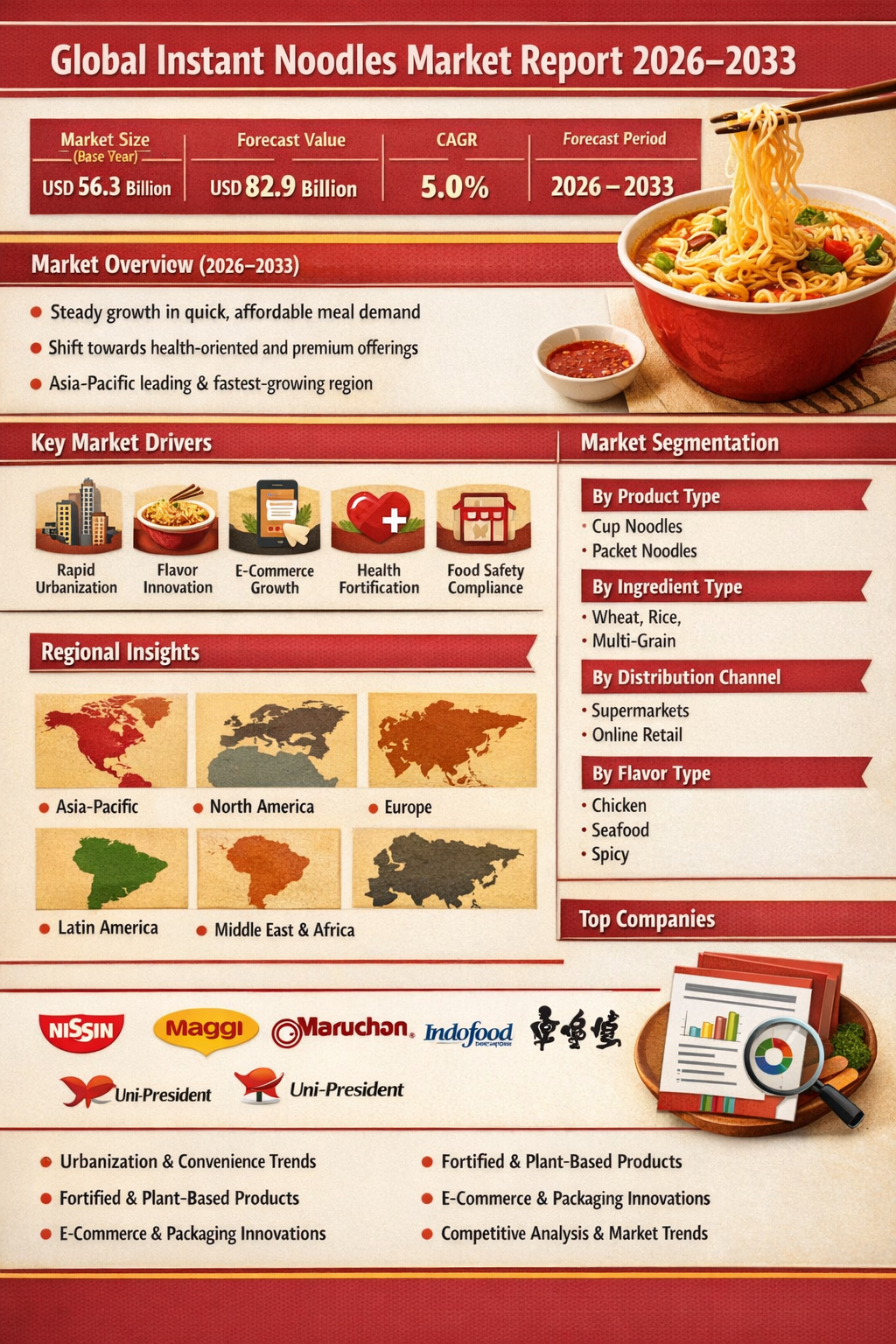
Global Instant Noodles Market Overview (2026???2033)
The Global Instant Noodles Market is experiencing steady growth during the 2026???2033 forecast period, supported by increasing consumer demand for quick, affordable, and easy-to-prepare meals. Instant noodles are widely consumed across both developed and emerging economies due to their cost-effectiveness, long shelf life, and convenience. The product is increasingly evolving from basic staple food to premium, health-oriented, and specialty food offerings. According to Pheonix Research, rising urban populations, busy work schedules, and changing dietary habits are significantly boosting demand for instant noodles globally. Manufacturers are actively investing in product innovation, including low-sodium noodles, fortified variants with vitamins and minerals, and plant-based formulations to align with evolving consumer preferences. Additionally, advancements in packaging, microwave-ready formats, and sustainable materials are enhancing product convenience and environmental sustainability. Asia-Pacific continues to dominate the market due to high consumption levels in countries such as China, Indonesia, India, and Japan, while also representing the fastest-growing region due to strong demand and expanding production capacity.Key Drivers of Global Instant Noodles Market Growth
Rapid Urbanization & Changing Lifestyles
Increasing urban population and busy lifestyles are driving demand for quick and convenient meal solutions.Flavor Innovation & Product Diversification
Manufacturers are introducing regional flavors, premium variants, and specialty noodles to attract diverse consumer segments.Expansion of E-Commerce & Modern Retail
Online grocery platforms and organized retail chains are improving accessibility and product availability.Health & Nutritional Fortification Trends
Companies are incorporating vitamins, minerals, and plant-based proteins to meet health-conscious consumer demand.Compliance with Food Safety & Halal Standards
Strict adherence to food safety regulations and halal certifications is building consumer trust globally.Global Instant Noodles Market Segmentation
1. By Product Type
1.1 Cup/Bowl Noodles 1.1.1 Ready-to-Eat Cup Noodles 1.1.1.1 Instant Consumption Products 1.1.1.1.1 On-the-Go Meal Solutions 1.2 Packet Noodles 1.2.1 Traditional Packet Noodles 1.2.1.1 Household Consumption 1.2.1.1.1 Bulk Retail Products2. By Ingredient Type
2.1 Wheat-Based Noodles 2.1.1 Standard Wheat Noodles 2.1.1.1 Mass Market Products 2.1.1.1.1 Affordable Meal Solutions 2.2 Rice-Based Noodles 2.2.1 Gluten-Free Alternatives 2.2.1.1 Health-Oriented Products 2.2.1.1.1 Specialty Diet Foods 2.3 Multi-Grain Noodles 2.3.1 Nutrient-Enriched Products 2.3.1.1 Functional Food Segment 2.3.1.1.1 Premium Offerings 2.4 Others 2.4.1 Corn & Oat-Based Noodles 2.4.1.1 Specialty Products 2.4.1.1.1 Health-Focused Alternatives3. By Distribution Channel
3.1 Supermarkets & Hypermarkets 3.1.1 Packaged Food Sections 3.1.1.1 Retail Sales 3.1.1.1.1 Bulk Purchasing 3.2 Convenience Stores 3.2.1 Ready-to-Consume Products 3.2.1.1 Single-Serve Packs 3.2.1.1.1 Instant Meals 3.3 Online Retail & E-Commerce 3.3.1 Online Grocery Platforms 3.3.1.1 Direct-to-Consumer Sales 3.3.1.1.1 Subscription Food Services 3.4 Specialty Stores 3.4.1 Ethnic Food Retailers 3.4.1.1 Premium Products 3.4.1.1.1 Imported Brands4. By Flavor Type
4.1 Chicken 4.1.1 Standard Flavor Variants 4.1.1.1 Mass Market Products 4.1.1.1.1 Ready-to-Eat Meals 4.2 Seafood 4.2.1 Regional Variants 4.2.1.1 Premium Flavors 4.2.1.1.1 Gourmet Products 4.3 Vegetable 4.3.1 Vegan-Friendly Options 4.3.1.1 Health-Oriented Products 4.3.1.1.1 Organic Variants 4.4 Beef/Pork 4.4.1 Traditional Flavors 4.4.1.1 Regional Recipes 4.4.1.1.1 Authentic Cuisine 4.5 Regional & Spicy Variants 4.5.1 Local Flavor Innovations 4.5.1.1 Country-Specific Products 4.5.1.1.1 Premium SegmentsGlobal Instant Noodles Market Regional Insights
Asia-Pacific ??? Largest & Fastest Growing Market
Asia-Pacific dominates due to high consumption levels and strong cultural integration of instant noodles.North America
Growing demand for premium, organic, and fortified noodles is driving steady market expansion.Europe
Rising adoption of convenience foods and multicultural cuisine trends are supporting growth.Latin America
Increasing disposable income and affordability of instant noodles are boosting market demand.Middle East & Africa
Expanding youth population and rising retail penetration are supporting market development.Leading Companies in the Global Instant Noodles Market
Nissin Foods Holdings Co., Ltd. Nestl?? S.A. (Maggi) Toyo Suisan Kaisha, Ltd. (Maruchan) PT Indofood Sukses Makmur Tbk Uni-President Enterprises Corporation Tingyi Holding Corp. (Master Kong) Acecook Vietnam Joint Stock Company ITC Limited (Yippee!) Ottogi Co., Ltd. Ajinomoto Co., Inc. These companies focus on flavor innovation, product diversification, sustainable packaging, and global distribution expansion.Strategic Intelligence & Market Insights
Pheonix Demand Forecast Engine identifies urbanization and convenience food demand as key growth drivers. Consumer Sentiment Analyzer highlights increasing demand for fortified and plant-based noodle products. Innovation Tracker monitors advancements in packaging, microwave-ready formats, and sustainable ingredients. Porter???s Five Forces Analysis indicates moderate competition with strong brand loyalty and innovation-led differentiation.Why the Global Instant Noodles Market Remains Critical
Supports demand for convenient and affordable meals Encourages innovation in flavor and product development Enhances accessibility through e-commerce and retail expansion Promotes nutritional fortification and healthier food options Strengthens global food supply and affordabilityFinal Takeaway of Global Instant Noodles Market
The Global Instant Noodles Market is expected to grow steadily through 2033, driven by increasing demand for convenience foods, evolving consumer preferences, and ongoing product innovation. Companies focusing on health-oriented formulations, regional flavor development, sustainable packaging, and digital retail expansion will be well positioned to capture long-term growth opportunities. At Pheonix Research, our advanced forecasting models and AI-driven market intelligence empower stakeholders to identify growth opportunities, optimize supply chains, and build competitive advantages in the global instant noodles market.???? Social Mentions & Publication Channels
??Explore deeper insights and follow our cross-platform updates on??LinkedIn??and??X??for continuous intelligence and market coverage.
LinkedIn??: https://www.linkedin.com/in/pheonix-research-media/
X??: https://x.com/Pheonix_Insight
Table of Contents
Table of Contents
1. Executive Summary
1.1 Market Forecast Snapshot (2026???2033)
The Global Instant Noodles Market is projected to grow from USD 56.3 Billion in 2025 to USD 82.9 Billion by 2033, registering a CAGR of 5.0% during 2026???2033.
1.2 Global Market Size & CAGR Analysis
The market reflects steady expansion driven by rising urbanization, increasing demand for convenient meal solutions, and continuous innovation in flavor and product formats.
1.3 Largest & Fastest-Growing Segments
Largest Segment: Packet Noodles
Fastest-Growing Segment: Cup/Bowl and Premium Instant Noodles
1.4 Region-Level Leadership & Growth Trends
Asia-Pacific leads the market due to high consumption and strong production capacity, while also being the fastest-growing region through 2033.
1.5 Key Market Drivers
Rising urbanization and busy consumer lifestyles
Growing demand for affordable and convenient meal options
Expansion of e-commerce and modern retail channels
Increasing product innovation and flavor diversification
Rising demand for fortified and health-oriented instant noodles
1.6 Competitive Landscape Overview
Highly competitive market with global and regional players focusing on product innovation, premiumization, and expansion of distribution networks.
1.7 Strategic Outlook Through 2033
Focus on nutritional fortification, sustainable packaging, premium product development, and expansion through digital retail platforms.
2. Introduction & Market Overview
2.1 Definition of the Global Instant Noodles Market
Covers instant noodle products including packet noodles and cup/bowl noodles across retail, foodservice, and institutional applications.
2.2 Scope of the Study
Comprehensive analysis of market size, product segmentation, distribution channels, consumer trends, and global forecasts during 2026???2033.
2.3 Evolution from Basic Staple Food to Value-Added Products
The market is evolving from low-cost staple foods to premium, fortified, and health-oriented instant noodle products.
2.4 Role of Modern Retail & Supply Chain Infrastructure
Expansion of supermarkets, convenience stores, and online platforms is improving accessibility and distribution efficiency.
2.5 Impact of Changing Food Consumption Trends
Increasing demand for quick meals and international flavors is driving instant noodle consumption globally.
2.6 Integration of Health & Nutrition Innovations
Manufacturers are introducing low-sodium, gluten-free, and fortified noodles to cater to health-conscious consumers.
2.7 Technological Advancements in Packaging & Processing
Innovations in packaging, shelf-life enhancement, and microwave-ready products are improving consumer convenience.
3. Research Methodology
3.1 Primary Research
Interviews with manufacturers, distributors, retailers, and industry experts.
3.2 Secondary Research
Industry reports, trade data, government statistics, and corporate filings.
3.3 Market Size Estimation Model
Combination of bottom-up consumption analysis and top-down revenue modeling.
3.4 Forecast Assumptions (2026???2033)
Based on urbanization trends, retail expansion, and increasing demand for convenience foods.
3.5 Data Validation & Triangulation
Cross-verification using supply chain data and regional consumption trends.
4. Market Dynamics
4.1 Drivers
4.1.1 Rising Demand for Convenient Food Products
Consumers increasingly prefer quick and easy meal solutions.
4.1.2 Urbanization and Changing Lifestyles
Busy schedules are boosting instant food consumption.
4.1.3 Product Innovation and Flavor Diversification
New flavors and premium products are attracting consumers.
4.1.4 Expansion of E-Commerce & Modern Retail
Online grocery platforms are improving product accessibility.
4.1.5 Nutritional Fortification Trends
Growing demand for healthier instant noodle options.
4.2 Restraints
4.2.1 Health concerns related to processed foods
4.2.2 Increasing competition from alternative meal options
4.2.3 Price sensitivity in developing regions
4.2.4 Regulatory compliance for food safety
4.3 Opportunities
4.3.1 Growth of premium and organic instant noodles
4.3.2 Expansion of plant-based and gluten-free products
4.3.3 Rising demand for ready-to-eat meals
4.3.4 Expansion of online grocery platforms
4.4 Challenges
4.4.1 Maintaining product quality and shelf life
4.4.2 Increasing raw material and production costs
4.4.3 Competition from fresh food alternatives
4.4.4 Supply chain and distribution challenges
5. Global Instant Noodles Market Analysis (USD Billion), 2026???2033
5.1 Market Size Overview
5.2 CAGR Analysis
5.3 Region-Wise Revenue Distribution
5.4 Product Type Revenue Split
5.5 Distribution Channel Revenue Trends
5.6 Ingredient Type Impact Analysis
6. Market Segmentation by Product Type (USD Billion), 2026???2033
6.1 Packet Noodles
6.1.1 Household Consumption
6.1.1.1 Retail Packaged Products
6.1.1.1.1 Bulk Purchases
6.2 Cup/Bowl Noodles
6.2.1 Ready-to-Eat Products
6.2.1.1 On-the-Go Meals
6.2.1.1.1 Convenience Foods
7. Market Segmentation by Distribution Channel (USD Billion), 2026???2033
7.1 Supermarkets & Hypermarkets
7.1.1 Retail Packaged Foods
7.1.1.1 Bulk Distribution
7.1.1.1.1 Consumer Packs
7.2 Convenience Stores
7.2.1 Ready-to-Consume Products
7.2.1.1 Single-Serve Packs
7.2.1.1.1 Instant Meals
7.3 Online Retail & E-Commerce
7.3.1 Online Grocery Platforms
7.3.1.1 Direct-to-Consumer Sales
7.3.1.1.1 Subscription Services
7.4 Specialty Stores
7.4.1 Premium & Imported Products
7.4.1.1 Ethnic Food Retail
7.4.1.1.1 Gourmet Offerings
8. Market Segmentation by Ingredient Type (USD Billion), 2026???2033
8.1 Wheat-Based
8.1.1 Standard Products
8.1.1.1 Mass Market
8.1.1.1.1 Affordable Products
8.2 Rice-Based
8.2.1 Gluten-Free Products
8.2.1.1 Health-Oriented
8.2.1.1.1 Specialty Foods
8.3 Multi-Grain
8.3.1 Nutrient-Enriched Products
8.3.1.1 Functional Foods
8.3.1.1.1 Premium Segment
9. Market Segmentation by Geography
9.1 Asia-Pacific ??? Largest & Fastest Growing Market
9.2 North America
9.3 Europe
9.4 Latin America
9.5 Middle East & Africa
10. Competitive Landscape ??? Global
10.1 Market Share Analysis
10.2 Product Portfolio Benchmarking
10.3 Pricing Strategy Analysis
10.4 Distribution Network Mapping
10.5 Competitive Intensity & Differentiation
11. Company Profiles
11.1 Nissin Foods Holdings Co., Ltd.
11.2 Nestl?? S.A.
11.3 Toyo Suisan Kaisha, Ltd.
11.4 PT Indofood Sukses Makmur Tbk
11.5 Uni-President Enterprises Corporation
11.6 Tingyi Holding Corp.
11.7 Acecook Vietnam Joint Stock Company
11.8 ITC Limited
11.9 Ottogi Co., Ltd.
11.10 Ajinomoto Co., Inc.
12. Strategic Intelligence & Pheonix AI-Backed Insights
12.1 Pheonix Demand Forecast Engine
12.2 Consumer Sentiment Analyzer
12.3 Product Innovation Tracker
12.4 Supply Chain Intelligence
12.5 Porter???s Five Forces Analysis
13. Future Outlook & Strategic Recommendations
13.1 Expansion of premium and fortified noodles
13.2 Growth of plant-based product offerings
13.3 E-commerce and digital retail expansion
13.4 Sustainable packaging initiatives
13.5 Long-Term Market Outlook (2033+)
14. Appendix
15. About Pheonix Research
16. Disclaimer
Competitive Landscape
Competitive Landscape of the Global Frozen Dumplings Market
Executive Framing
The Global Frozen Dumplings Market operates in a highly competitive environment driven by strong regional expertise and expanding global demand.
Leading companies such as Ajinomoto Co., Inc., COFCO Corporation, Wei Chuan Foods Corporation, Nestl?? S.A., and Ting Hsin International Group
maintain a strong market presence through large-scale production capabilities, authentic product portfolios, and well-established distribution networks.
Competition is intensifying due to rapid product innovation, increasing globalization of Asian cuisine, and rising consumer preference for
convenient, ready-to-cook meal solutions.
Current Market Reality
The market is undergoing a significant transformation as frozen dumplings evolve from traditional ethnic food staples into mainstream global convenience products.
Asia-Pacific remains the dominant production and consumption hub, while North America and Europe are emerging as key growth markets driven by increasing
exposure to international cuisines.
Manufacturers are focusing on premium-quality and restaurant-style dumplings, clean-label formulations, and plant-based product innovations to cater to
evolving consumer preferences. The rapid expansion of modern retail and e-commerce channels is further intensifying competition across global markets.
Key Drivers of Competitive Intensity
- Rising demand for convenient frozen and ready-to-cook meals
- Global expansion of Asian cuisine across Western markets
- Strong focus on plant-based, gluten-free, and fortified product innovation
- Advancements in cold-chain logistics and freezing technologies
- Rapid growth of e-commerce and direct-to-consumer distribution channels
Strategic Implications
- Product Diversification: Expansion into vegan, gluten-free, and functional dumpling variants
- Premiumization Strategy: Development of gourmet, restaurant-style frozen dumplings
- Cold-Chain Optimization: Investment in advanced freezing, packaging, and logistics systems
- Geographic Expansion: Targeting North America and Europe with localized flavor offerings
- Digital Transformation: Leveraging e-commerce and DTC channels for wider market penetration
Forward Outlook
By 2033, the Global Frozen Dumplings Market is expected to evolve into a premium, health-oriented, and globally integrated frozen food segment.
While Asia-Pacific will remain the dominant region, North America and Europe will contribute significantly to incremental growth.
Companies that invest in product innovation, sustainable packaging, advanced cold-chain systems, and localized product strategies will secure long-term
competitive advantages in the rapidly expanding global frozen food ecosystem.
Value Chain
Global Instant Noodles Market: Value Chain & Market Dynamics
Executive Framing
The Global Instant Noodles Market is evolving into a convenience-driven, affordability-focused, and increasingly premiumized packaged food ecosystem. Demand is strongly supported by urban lifestyles, busy schedules, and global acceptance of quick-serve meals. Instant noodles have transformed from a basic staple into a diversified product category featuring health-oriented, fortified, and gourmet variants.
The market operates through an integrated food manufacturing and distribution model, covering raw material sourcing, noodle processing, flavor development, packaging, and global retail distribution.
Current Market Reality
The market is valued at USD 56.3 billion in 2025 and is projected to reach USD 82.9 billion by 2033, growing at a CAGR of 5.0%. Asia-Pacific dominates both production and consumption, while also serving as the fastest-growing region due to strong cultural integration and expanding urban demand.
Manufacturers are increasingly focusing on product diversification, health-focused formulations, and premium positioning, including low-sodium, fortified, rice-based, and multi-grain noodle variants.
Key Signals and Evidence
- Market expansion driven by rapid urbanization and demand for convenience foods.
- Strong innovation in regional flavors and premium noodle variants.
- Growing adoption of fortified, plant-based, and health-oriented noodles.
- Expansion of e-commerce and modern retail distribution channels.
- Increasing compliance with food safety, halal, and quality standards.
Strategic Implications
Companies are focusing on flavor innovation, nutritional enhancement, and packaging modernization to strengthen competitiveness. Strong brand loyalty and large-scale production capabilities create high entry barriers, favoring established global players.
Growth opportunities are emerging in premium instant noodles, gluten-free formulations, and sustainable packaging solutions. Digital retail expansion and direct-to-consumer models are further enhancing market reach.
Forward Outlook
The Global Instant Noodles Market is expected to maintain steady growth through 2033, driven by evolving consumer preferences, affordability, and continuous product innovation.
- Expansion of health-oriented and fortified noodle products
- Growth in regional flavor customization and premium variants
- Increasing adoption of sustainable packaging and clean-label ingredients
- Strong contribution from Asia-Pacific manufacturing and consumption markets
Companies that invest in nutrition innovation, product diversification, and sustainable packaging will be well positioned to capture long-term opportunities in the global instant noodles market.
Investment Activity
Investment & Funding Dynamics ??? Global Instant Noodles Market
Executive Framing
Current Market Reality
Valued at USD 56.3 billion in 2025 and projected to reach USD 82.9 billion by 2033 (CAGR 5.0%), the market reflects stable, volume-led investment growth. Asia-Pacific dominates both consumption and production, led by China, India, Indonesia, and Japan, while also emerging as the fastest-growing region due to expanding middle-class populations and strong retail penetration. Leading players such as Nissin Foods Holdings, Nestl?? (Maggi), and Indofood are investing in product diversification, fortified nutrition variants, and sustainable packaging solutions.
Key Signals and Evidence
- Mass Market Consumption Scale: Strong and consistent demand driven by affordability and convenience across global markets.
- Flavor Innovation Investments: Rising capital flow into regional flavors, premium variants, and gourmet instant noodle formats.
- Fortification & Health Upgrades: Increasing development of vitamin-enriched, low-sodium, and plant-based noodle formulations.
- E-Commerce Expansion: Rapid growth in online grocery channels and subscription-based packaged food delivery models.
- Packaging Innovation: Investments in microwave-ready formats and sustainable, eco-friendly packaging solutions.
- Brand-Led Competition: Strong marketing-driven competition reinforcing brand loyalty and global expansion strategies.
- Emerging Market Penetration: Accelerated investments targeting Latin America, Middle East, and Africa growth corridors.
Strategic Implications
Companies that focus on scalable production, regional flavor adaptation, and strong retail distribution networks will capture the largest share of long-term value. Investors are prioritizing branded FMCG players with strong supply chain integration and high market penetration in Asia-Pacific. Strategic partnerships with retail chains, e-commerce platforms, and foodservice distributors will further enhance growth stability and margin expansion.
Forward Outlook
From 2026 to 2033, investment in the Global Instant Noodles Market is expected to remain steady, with strong emphasis on product innovation, health-oriented formulations, and packaging sustainability. While demand will remain robust due to affordability and convenience, competition will intensify as brands differentiate through nutrition enhancement and premiumization strategies. M&A activity is expected to remain moderate, focused on regional expansion and brand consolidation.
Technology & Innovation
Global Instant Noodles Market: Technology & Innovation
Executive Framing
The Global Instant Noodles Market is evolving rapidly with strong technological and product innovation shaping its transformation from a basic convenience food category into a premium, health-oriented, and functional food segment. Manufacturers are focusing on fortification, clean-label formulations, sustainable packaging, and digital retail expansion to meet changing consumer preferences across global markets.
Current Market Reality
Valued at USD 56.3 billion in 2025 and projected to reach USD 82.9 billion by 2033 at a CAGR of 5.0%, the market is witnessing steady expansion driven by urbanization, busy lifestyles, and rising demand for affordable and convenient meal solutions. Asia-Pacific dominates both consumption and production, while also emerging as the fastest-growing region due to strong demand across China, India, Indonesia, and Japan.
Key Signals and Evidence
- Fortified Product Innovation: Rising adoption of vitamin- and mineral-enriched noodles targeting health-conscious consumers.
- Flavor Localization: Expansion of regional and ethnic flavor variants to capture diverse consumer preferences.
- Plant-Based & Low-Sodium Formulations: Increasing shift toward healthier noodle alternatives driven by wellness trends.
- E-Commerce Expansion: Strong growth of online grocery platforms and direct-to-consumer noodle sales.
- Sustainable Packaging Innovation: Adoption of recyclable, biodegradable, and microwave-safe packaging formats.
- Automation in Manufacturing: Increased use of automated production lines to improve efficiency and consistency.
Strategic Implications
Companies investing in health-focused formulations, digital retail channels, and sustainable packaging solutions are expected to gain a competitive advantage. Product differentiation through regional flavors, premium offerings, and fortified nutrition will remain key to capturing long-term growth opportunities in both developed and emerging markets.
Forward Outlook
The market is expected to transition toward premiumized and health-oriented instant noodle offerings, supported by continuous innovation in ingredients, packaging, and distribution. Future growth will be driven by clean-label products, functional nutrition, and expansion across digital and modern retail channels.
Market Risk
Risk Factors and Disruption Threats in the Global Instant Noodles Market
Executive Framing
The Global Instant Noodles Market is evolving into a highly dynamic convenience food segment, driven by rapid urbanization, changing dietary habits, and rising demand for affordable ready-to-eat meals. Valued at USD 56.3 billion in 2025 and projected to reach USD 82.9 billion by 2033 at a CAGR of 5.0%, the market continues to expand across both emerging and developed economies, supported by strong retail penetration and product innovation.
Current Market Reality
Asia-Pacific dominates the global instant noodles landscape, with countries such as China, India, Indonesia, Japan, and South Korea representing the highest consumption levels. The region is also the fastest-growing due to large population bases and deeply embedded noodle consumption culture. North America and Europe are witnessing gradual growth as demand shifts toward premium, organic, and fortified noodle variants.
Key Signals and Evidence
- Increasing global urban population and rising demand for convenience foods.
- Strong consumer shift toward quick, affordable, and easy-to-prepare meals.
- Expansion of e-commerce grocery platforms and modern retail networks.
- Rising demand for fortified, low-sodium, and plant-based noodle variants.
- Growing popularity of regional flavors and premium instant noodle offerings.
Strategic Implications
- Invest in health-oriented formulations such as low-fat, low-sodium, and fortified noodles.
- Expand regional flavor innovation to capture localized consumer preferences.
- Strengthen sustainable packaging initiatives to meet environmental regulations.
- Enhance digital distribution through e-commerce and direct-to-consumer models.
- Develop premium instant noodle segments targeting urban middle-class consumers.
Forward Outlook
The Global Instant Noodles Market is expected to transition toward a more premium, health-conscious, and innovation-driven ecosystem. Growth will be supported by advancements in food technology, increasing demand for fortified nutrition, and expansion of global retail channels. Companies focusing on product differentiation, nutritional enhancement, and sustainable packaging solutions will gain a strong competitive advantage through 2033.
Regulatory Landscape
Regulatory & Policy Landscape: Global Instant Noodles Market
Executive Framing
The Global Instant Noodles Market operates within a highly structured regulatory environment shaped by food safety standards, labeling requirements, import-export regulations, and nutritional compliance frameworks. Key authorities such as the U.S. FDA, European Food Safety Authority (EFSA), Codex Alimentarius, and national food safety agencies govern ingredient usage, packaging norms, and product safety standards.
As instant noodles evolve from a basic convenience food to a fortified and premium nutrition category, regulatory scrutiny around sodium levels, preservatives, food additives, and nutritional claims is increasing across global markets.
Current Market Reality
The market is strongly influenced by food safety compliance, trade regulations, and evolving consumer health policies. Manufacturers must adhere to strict labeling norms, including nutritional disclosure, allergen identification, and ingredient transparency.
In several developed markets, rising concerns about obesity and sodium intake have led to increased regulatory pressure on processed foods, including instant noodles. This has driven reformulation efforts toward low-sodium, fortified, and plant-based variants.
Key Signals and Evidence
- Stricter food labeling regulations requiring full nutritional transparency.
- Increasing restrictions on sodium, MSG, and artificial additives in processed foods.
- Growth of halal, kosher, and clean-label certification requirements globally.
- Rising import-export compliance checks for packaged food safety standards.
- Government-led initiatives promoting healthier processed food reformulation.
- Expansion of packaging waste and sustainability regulations for FMCG products.
Strategic Implications
Manufacturers must prioritize product reformulation strategies, focusing on reduced sodium, clean-label ingredients, and fortified nutritional profiles to comply with evolving regulations. Investment in R&D for healthier instant noodle formulations is becoming a competitive necessity.
Additionally, companies that align with sustainability regulations???such as eco-friendly packaging, reduced plastic usage, and carbon-efficient production???will gain stronger market positioning and regulatory advantages in both developed and emerging markets.
Forward Outlook
Regulatory frameworks for instant noodles are expected to tighten further, particularly in developed economies, with stronger enforcement of nutritional labeling, health claims, and ingredient restrictions. Governments will increasingly push for reduced sodium content and improved nutritional profiles in processed foods.
At the same time, sustainability regulations targeting packaging waste reduction and supply chain transparency will reshape manufacturing and distribution practices. These changes will accelerate innovation in healthier, fortified, and environmentally sustainable instant noodle products.