
Indonesia Instant Noodles Market size and share Analysis 2026-2033
Indonesia Instant Noodles Market Forecast Snapshot: 2026???2033
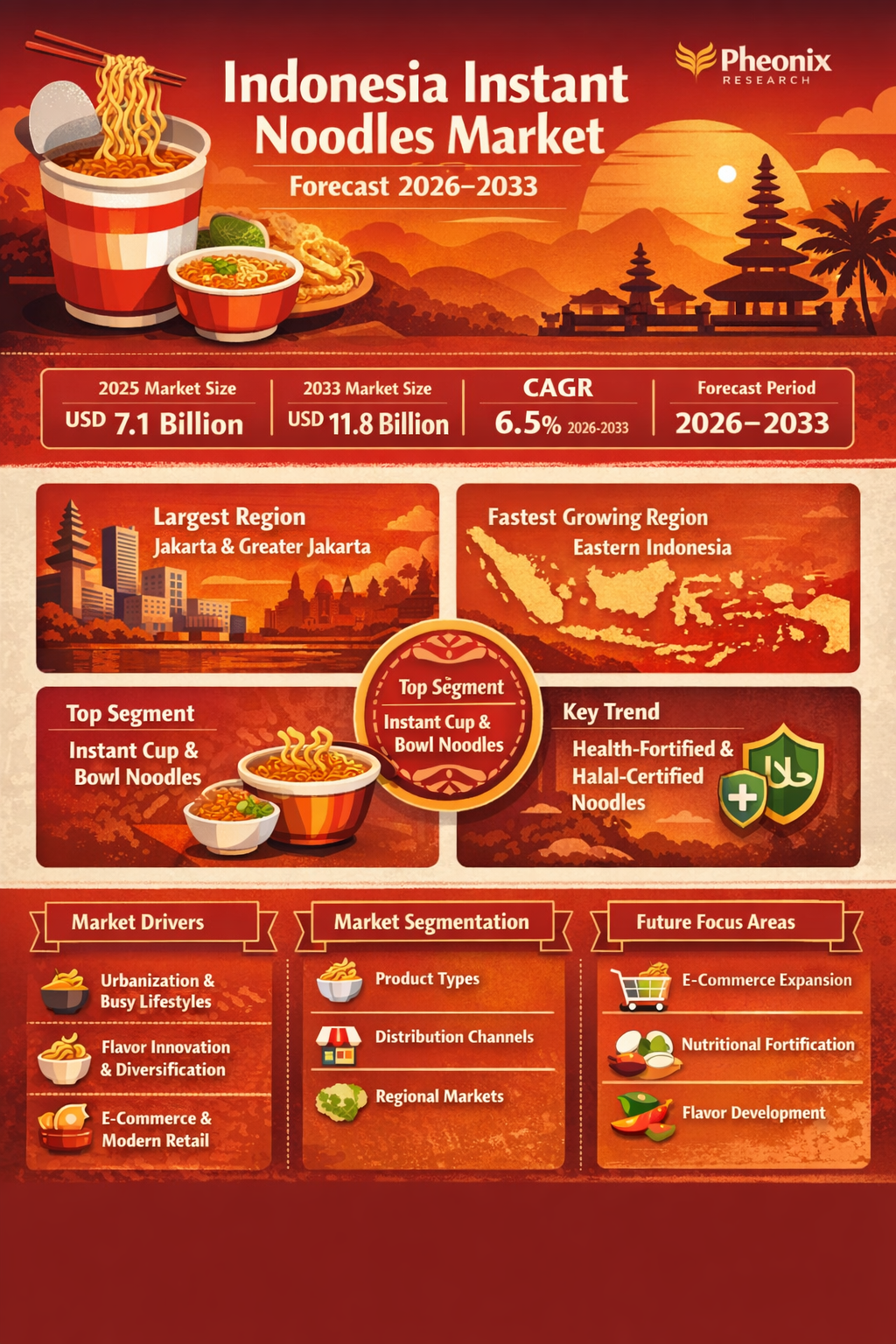
| Metric | Value |
|---|---|
| 2025 Market Size | USD 7.1 Billion |
| 2033 Market Size | USD 11.8 Billion |
| CAGR (2026???2033) | 6.5% |
| Largest Region | Jakarta & Greater Jakarta |
| Fastest Growing Region | Eastern Indonesia |
| Top Product Segment | Instant Cup & Bowl Noodles |
| Key Trend | Health-Fortified and Halal-Certified Noodles |
| Future Focus | E-Commerce Expansion, Flavor Innovation, and Nutritional Fortification |
Indonesia Instant Noodles Market Overview (2026???2033)
The Indonesia Instant Noodles Market is experiencing steady growth during the 2026???2033 forecast period, supported by rising urban populations, increasing disposable incomes, and evolving dietary habits.
Instant noodles are widely consumed due to their convenience, affordability, and variety of flavors, making them a preferred food option across different consumer segments.
According to Pheonix Research, increasing demand for quick meal solutions and expanding retail infrastructure are significantly boosting market growth.
Manufacturers are actively focusing on product innovation, including fortified noodles enriched with vitamins and minerals, plant-based formulations, and premium variants to meet evolving consumer expectations.
Additionally, advancements in packaging, supply chain efficiency, and distribution networks are improving product accessibility across both urban and rural areas.
Jakarta and Greater Jakarta remain the largest market, while regions such as Eastern Indonesia are emerging as high-growth areas due to improving logistics and increasing consumer awareness.
Key Drivers of Indonesia Instant Noodles Market Growth
Rapid Urbanization & Busy Lifestyles
Growing urban population and busy work schedules are driving demand for convenient and quick meal solutions.
Flavor Innovation & Product Diversification
Manufacturers are introducing regional flavors, premium variants, and fortified noodles to attract diverse consumer segments.
Expansion of E-Commerce & Modern Retail
Online grocery platforms and modern retail channels are improving product accessibility across regions.
Halal & Food Safety Compliance
Strong focus on halal certification and food safety standards is increasing consumer trust and product adoption.
Nutritional Fortification Trends
Increasing demand for fortified noodles enriched with vitamins and minerals is driving product innovation.
Indonesia Instant Noodles Market Segmentation
1. By Product Type
1.1 Instant Noodles (Standard)
1.1.1 Traditional Packet Noodles
1.1.1.1 Household Consumption
1.1.1.1.1 Mass Market Products
1.2 Cup Noodles
1.2.1 Ready-to-Eat Cup Products
1.2.1.1 On-the-Go Meals
1.2.1.1.1 Convenience Foods
1.3 Bowl & Packaged Noodles
1.3.1 Premium Packaged Products
1.3.1.1 Retail Segment
1.3.1.1.1 Value-Added Products
1.4 Premium & Fortified Noodles
1.4.1 Nutrient-Enriched Products
1.4.1.1 Health-Oriented Segment
1.4.1.1.1 Functional Food Products
2. By Distribution Channel
2.1 Modern Trade (Supermarkets & Hypermarkets)
2.1.1 Organized Retail Stores
2.1.1.1 Packaged Food Sections
2.1.1.1.1 Bulk Retail Sales
2.2 Traditional Trade
2.2.1 Local Grocery Stores
2.2.1.1 Neighborhood Retail
2.2.1.1.1 Small Retail Outlets
2.3 Online / E-Commerce Platforms
2.3.1 Online Grocery Platforms
2.3.1.1 Direct-to-Consumer Sales
2.3.1.1.1 Subscription Models
2.4 Institutional Sales
2.4.1 Schools and Offices
2.4.1.1 Catering Services
2.4.1.1.1 Bulk Supply
3. By Region
3.1 Jakarta & Greater Jakarta
3.1.1 Urban Consumption
3.1.1.1 High Demand Areas
3.1.1.1.1 Premium Product Adoption
3.2 Java (Other Regions)
3.2.1 Expanding Retail Markets
3.2.1.1 Middle-Class Consumers
3.2.1.1.1 Growing Demand
3.3 Sumatra
3.3.1 Emerging Urban Markets
3.3.1.1 Retail Expansion
3.3.1.1.1 Increased Accessibility
3.4 Sulawesi & Kalimantan
3.4.1 Developing Markets
3.4.1.1 Distribution Growth
3.4.1.1.1 Market Penetration
3.5 Bali & Nusa Tenggara
3.5.1 Tourism-Driven Demand
3.5.1.1 Retail Expansion
3.5.1.1.1 Consumption Growth
3.6 Eastern Indonesia
3.6.1 Emerging Markets
3.6.1.1 Logistics Improvement
3.6.1.1.1 Growing Adoption
Indonesia Instant Noodles Market Regional Insights
Jakarta & Greater Jakarta ??? Largest Market
High population density and strong urban consumption drive consistent demand.
Java (Other Regions)
Growing middle-class population and retail expansion support market growth.
Sumatra, Sulawesi & Kalimantan
Urbanization and improving distribution networks are boosting adoption.
Eastern Indonesia ??? Fastest Growing Region
Improving infrastructure and rising awareness are driving rapid market expansion.
Leading Companies in the Indonesia Instant Noodles Market
PT Indofood Sukses Makmur Tbk
PT Wings Food
PT Mayora Indah Tbk
PT Nippon Indosari Corpindo Tbk
PT Ajinomoto Indonesia
PT Sarimi Asli Makmur
PT Fajar Food
PT Mi Sedaap Indonesia
PT ABC Food Indonesia
Local Regional Brands
These companies focus on flavor innovation, fortified product development, and expanding distribution networks to strengthen their market presence.
Strategic Intelligence & Market Insights
Pheonix Demand Forecast Engine identifies urbanization and retail expansion as key growth drivers.
Consumer Sentiment Analyzer highlights demand for halal-certified and fortified products.
Innovation Tracker monitors advancements in flavors, packaging, and product formulations.
Porter???s Five Forces Analysis indicates moderate competition with strong opportunities for product differentiation.
Why the Indonesia Instant Noodles Market Remains Critical
Supports demand for affordable and convenient food solutions
Strengthens local food manufacturing and retail sectors
Encourages product innovation and nutritional fortification
Expands accessibility through e-commerce and modern trade
Promotes economic growth and employment in food processing
Final Takeaway of Indonesia Instant Noodles Market
The Indonesia Instant Noodles Market is expected to grow steadily through 2033, driven by urbanization, changing consumer lifestyles, and increasing demand for convenient meal solutions.
Companies focusing on flavor innovation, fortified products, halal compliance, and efficient distribution networks will be well positioned to capture long-term growth opportunities.
At Pheonix Research, our advanced forecasting models and strategic intelligence frameworks help stakeholders identify opportunities, optimize operations, and build competitive advantages in the Indonesia instant noodles market.
???? Social Mentions & Publication Channels
??Explore deeper insights and follow our cross-platform updates on??LinkedIn??and??X??for continuous intelligence and market coverage.
LinkedIn??: https://www.linkedin.com/in/pheonix-research-media/
X??: https://x.com/Pheonix_Insight
Table of Contents
Table of Contents
1. Executive Summary
1.1 Market Forecast Snapshot (2026???2033)
The Indonesia Instant Noodles Market is projected to grow from USD 7.1 Billion in 2025 to USD 11.8 Billion by 2033, registering a CAGR of 6.5% during 2026???2033.
1.2 Global Market Size & CAGR Analysis
The market reflects steady growth driven by rising urbanization, increasing demand for convenient meals, and expansion of retail and e-commerce channels across Indonesia.
1.3 Largest & Fastest-Growing Segments
Largest Segment: Standard Instant Packet Noodles
Fastest-Growing Segment: Cup & Fortified Instant Noodles
1.4 Region-Level Leadership & Growth Trends
Jakarta & Greater Jakarta leads the market due to high consumption and urban density, while Eastern Indonesia is projected to be the fastest-growing region through 2033.
1.5 Key Market Drivers
Rapid urbanization and increasing working-class population
Growing demand for affordable and convenient meal options
Expansion of e-commerce and modern retail channels
Increasing product innovation and flavor diversification
Strong demand for halal-certified and fortified food products
1.6 Competitive Landscape Overview
Highly competitive market with strong presence of local and regional players focusing on flavor innovation, pricing strategies, and distribution expansion.
1.7 Strategic Outlook Through 2033
Focus on product innovation, fortified nutrition, expansion into emerging regions, and strengthening digital retail and distribution networks.
2. Introduction & Market Overview
2.1 Definition of the Indonesia Instant Noodles Market
Covers instant noodles including packet, cup, bowl, and fortified noodle products across retail and institutional channels.
2.2 Scope of the Study
Comprehensive analysis of market size, segmentation, regional demand, distribution channels, and forecast for 2026???2033.
2.3 Evolution from Traditional Consumption to Packaged Convenience Foods
The market is evolving from basic staple consumption to premium, fortified, and health-oriented instant noodle products.
2.4 Role of Retail Expansion & Supply Chain Infrastructure
Expansion of supermarkets, convenience stores, and online platforms is improving accessibility and distribution efficiency.
2.5 Impact of Changing Consumer Lifestyles
Busy lifestyles and urbanization are driving demand for quick and convenient food solutions.
2.6 Integration of Halal and Nutritional Standards
Halal certification and fortified nutrition are becoming essential for consumer trust and product differentiation.
2.7 Technological Advancements in Packaging & Distribution
Improved packaging, shelf-life technologies, and logistics systems are enhancing product quality and reach.
3. Research Methodology
3.1 Primary Research
Interviews with manufacturers, distributors, retailers, and industry experts.
3.2 Secondary Research
Industry reports, trade data, government publications, and company filings.
3.3 Market Size Estimation Model
Combination of bottom-up consumption analysis and top-down revenue modeling.
3.4 Forecast Assumptions (2026???2033)
Based on urbanization trends, retail expansion, and rising demand for convenience foods.
3.5 Data Validation & Triangulation
Cross-verification using supply chain insights and regional consumption patterns.
4. Market Dynamics
4.1 Drivers
4.1.1 Rising Demand for Convenient Food Products
Consumers prefer quick and easy meal options.
4.1.2 Urbanization and Lifestyle Changes
Busy urban lifestyles are boosting instant noodle consumption.
4.1.3 Product Innovation and Flavor Diversification
Regional flavors and premium offerings are driving consumer interest.
4.1.4 Expansion of E-Commerce & Modern Retail
Online platforms and retail chains are improving accessibility.
4.1.5 Halal Certification and Food Safety Compliance
Ensuring quality and trust is critical for market growth.
4.2 Restraints
4.2.1 Health concerns related to processed foods
4.2.2 Price sensitivity in lower-income segments
4.2.3 Competition from fresh food alternatives
4.2.4 Regulatory compliance requirements
4.3 Opportunities
4.3.1 Growth of fortified and health-oriented noodles
4.3.2 Expansion into emerging regions
4.3.3 Rising demand for premium instant noodles
4.3.4 E-commerce growth and digital retail expansion
4.4 Challenges
4.4.1 Maintaining product quality across supply chains
4.4.2 Rising raw material and production costs
4.4.3 Managing distribution in remote regions
4.4.4 Increasing competition among local players
5. Indonesia Instant Noodles Market Analysis (USD Billion), 2026???2033
5.1 Market Size Overview
5.2 CAGR Analysis
5.3 Region-Wise Revenue Distribution
5.4 Product Type Revenue Split
5.5 Distribution Channel Trends
5.6 Regional Consumption Analysis
6. Market Segmentation by Product Type (USD Billion), 2026???2033
6.1 Standard Instant Noodles
6.1.1 Packet Noodles
6.1.1.1 Household Consumption
6.1.1.1.1 Mass Market Products
6.2 Cup Noodles
6.2.1 Ready-to-Eat Products
6.2.1.1 On-the-Go Meals
6.2.1.1.1 Convenience Foods
6.3 Bowl & Packaged Noodles
6.3.1 Premium Packaged Products
6.3.1.1 Retail Segment
6.3.1.1.1 Value-Added Products
6.4 Premium & Fortified Noodles
6.4.1 Nutrient-Enriched Products
6.4.1.1 Health-Oriented Segment
6.4.1.1.1 Functional Foods
7. Market Segmentation by Distribution Channel (USD Billion), 2026???2033
7.1 Modern Trade
7.1.1 Supermarkets & Hypermarkets
7.1.1.1 Organized Retail
7.1.1.1.1 Bulk Sales
7.2 Traditional Trade
7.2.1 Local Retail Stores
7.2.1.1 Small Grocery Shops
7.2.1.1.1 Neighborhood Sales
7.3 Online Retail & E-Commerce
7.3.1 Online Grocery Platforms
7.3.1.1 Direct Sales
7.3.1.1.1 Subscription Models
7.4 Institutional Sales
7.4.1 Schools & Offices
7.4.1.1 Catering Services
7.4.1.1.1 Bulk Purchases
8. Market Segmentation by Geography
8.1 Jakarta & Greater Jakarta ??? Largest Market
8.2 Java (Other Regions)
8.3 Sumatra
8.4 Sulawesi & Kalimantan
8.5 Bali & Nusa Tenggara
8.6 Eastern Indonesia ??? Fastest Growing Region
9. Competitive Landscape ??? Indonesia
9.1 Market Share Analysis
9.2 Product Portfolio Benchmarking
9.3 Pricing Strategy Analysis
9.4 Distribution Network Mapping
9.5 Competitive Intensity & Differentiation
10. Company Profiles
10.1 PT Indofood Sukses Makmur Tbk
10.2 PT Wings Food
10.3 PT Mayora Indah Tbk
10.4 PT Nippon Indosari Corpindo Tbk
10.5 PT Ajinomoto Indonesia
10.6 PT Sarimi Asli Makmur
10.7 PT Fajar Food
10.8 PT Mi Sedaap Indonesia
10.9 PT ABC Food Indonesia
10.10 Local Regional Brands
11. Strategic Intelligence & Pheonix AI-Backed Insights
11.1 Pheonix Demand Forecast Engine
11.2 Consumer Sentiment Analyzer
11.3 Product Innovation Tracker
11.4 Supply Chain Intelligence
11.5 Porter???s Five Forces Analysis
12. Future Outlook & Strategic Recommendations
12.1 Expansion of fortified and premium noodles
12.2 Growth of e-commerce and digital retail
12.3 Regional expansion into emerging markets
12.4 Product innovation and flavor diversification
12.5 Long-Term Market Outlook (2033+)
13. Appendix
14. About Pheonix Research
15. Disclaimer
Competitive Landscape
Competitive Landscape of the Indonesia Instant Noodles Market
Executive Framing
The Indonesia Instant Noodles Market is highly competitive and moderately consolidated, led by strong domestic players such as
PT Indofood Sukses Makmur Tbk, PT Wings Food, PT Mayora Indah Tbk, and PT ABC Food Indonesia.
These companies dominate the market through extensive distribution networks, strong brand recognition, and diverse product portfolios.
Competition is driven by continuous flavor innovation, pricing strategies, halal certification compliance, and the introduction of
fortified and premium noodle variants to meet evolving consumer preferences.
Current Market Reality
The market is characterized by high consumption levels and strong brand loyalty, particularly in urban regions such as Jakarta and Greater Jakarta.
Instant noodles are a staple food product, widely consumed across all income groups due to affordability and convenience.
While traditional packet noodles dominate volume sales, premium segments such as cup noodles and fortified products are gaining traction.
The rise of e-commerce platforms and modern retail formats is further intensifying competition by enabling wider product availability
across both urban and emerging regions such as Eastern Indonesia.
Key Drivers of Competitive Intensity
- Strong consumer demand for affordable and convenient meal solutions
- High brand competition among established domestic manufacturers
- Increasing focus on halal-certified and food safety-compliant products
- Rising demand for fortified and health-oriented noodle variants
- Expansion of e-commerce and modern retail distribution channels
Strategic Implications
- Flavor Innovation: Continuous development of localized and regional taste profiles
- Product Premiumization: Expansion into cup noodles, fortified, and value-added segments
- Distribution Expansion: Strengthening reach in rural and emerging regions
- Halal Compliance: Maintaining strong halal certification to build consumer trust
- Digital Channel Growth: Leveraging e-commerce and online grocery platforms for market penetration
Forward Outlook
By 2033, the Indonesia Instant Noodles Market is expected to evolve into a more diversified and value-driven ecosystem,
with increasing demand for premium, fortified, and health-oriented products.
While domestic players will continue to dominate, competition will intensify with innovation-led strategies, expansion into
emerging regions, and growing influence of digital retail channels shaping the future market landscape.
Value Chain
Indonesia Instant Noodles Market: Value Chain & Market Dynamics
Executive Framing
The Indonesia Instant Noodles Market operates within a high-volume, cost-efficient, and convenience-driven food ecosystem, supported by strong domestic consumption and well-established local manufacturing players. Instant noodles serve as a staple food product across urban and rural populations, driven by affordability, accessibility, and flavor diversity.
The market follows a locally integrated operational model, combining imported raw materials, domestic processing, and extensive multi-channel distribution networks.
Current Market Reality
The industry is characterized by a moderate supply chain complexity, supported by strong domestic production capabilities but influenced by import dependency for key inputs such as wheat.
Distribution is highly diversified, covering traditional retail (warungs), modern trade, e-commerce platforms, and institutional sales, ensuring deep market penetration across Indonesia???s archipelago.
Key Signals and Evidence
- Market growth from USD 7.1 billion (2025) to USD 11.8 billion (2033) at a CAGR of 6.5%.
- Dominance of local manufacturers with vertically integrated production systems.
- Strong expansion of modern retail and e-commerce distribution channels.
- Increasing demand for halal-certified and fortified noodle products.
- Logistical expansion into Eastern Indonesia and emerging regional markets.
Strategic Implications
Companies are focusing on supply chain efficiency, localized flavor innovation, and product fortification to strengthen competitive positioning. Strong distribution networks and brand loyalty create high entry barriers for new entrants.
Investment in logistics infrastructure, digital retail channels, and rural market penetration is becoming critical for long-term growth and national market expansion.
Forward Outlook
The Indonesia Instant Noodles Market is expected to evolve into a more diversified, health-oriented, and digitally distributed ecosystem, while maintaining its core strength as an affordable staple food category.
- Growth in fortified and health-focused noodle products
- Expansion of e-commerce and direct-to-consumer channels
- Increasing focus on halal compliance and food safety standards
- Improvement in logistics and distribution across remote regions
Companies that prioritize innovation, supply chain optimization, and regional expansion will be well positioned to capture long-term growth opportunities in Indonesia???s instant noodles market.
Investment Activity
Investment & Funding Dynamics ??? Indonesia Instant Noodles Market
Executive Framing
Current Market Reality
Valued at USD 7.1 billion in 2025 and projected to reach USD 11.8 billion by 2033 (CAGR 6.5%), the market reflects strong and consumption-driven investment growth. Jakarta & Greater Jakarta remain the primary investment hub due to dense urban demand, while Eastern Indonesia is emerging as a high-growth region supported by improving logistics and retail expansion. Leading players such as PT Indofood Sukses Makmur Tbk, PT Wings Food, and PT Mayora Indah Tbk are investing in capacity expansion, fortified products, and regional distribution strengthening.
Key Signals and Evidence
- Strong Domestic Consumption: High per capita consumption driving consistent investment in production capacity.
- Halal-Certified Production: Increasing investments in halal compliance and food safety standards.
- Product Innovation: Capital flow toward fortified, premium, and plant-based noodle variants.
- E-Commerce Expansion: Rising investments in online retail and direct-to-consumer distribution channels.
- Regional Market Expansion: Growing focus on Eastern Indonesia and tier-2/3 cities for market penetration.
- Packaging & Convenience Innovation: Development of cup and bowl noodles for on-the-go consumption.
- Supply Chain Optimization: Investments in logistics, warehousing, and last-mile delivery networks.
Strategic Implications
Companies that invest in localized flavor innovation, halal-certified production, and efficient distribution networks will capture the strongest growth opportunities. Investors are prioritizing companies with strong brand equity, scalable production capacity, and deep retail penetration. Strategic collaborations with e-commerce platforms, retail chains, and foodservice providers will further strengthen market positioning.
Forward Outlook
From 2026 to 2033, investment in the Indonesia Instant Noodles Market is expected to accelerate, particularly in fortified products, premium segments, and digital distribution channels. Regional expansion into emerging markets and continued innovation in flavors and packaging will attract capital. M&A activity is likely to focus on regional consolidation and strengthening supply chain capabilities.
Technology & Innovation
Indonesia Instant Noodles Market: Technology & Innovation
Executive Framing
Technology and innovation in the Indonesia Instant Noodles Market are focused on enhancing product nutrition, expanding flavor diversity, and improving large-scale manufacturing and distribution efficiency. As consumer demand shifts toward healthier, halal-certified, and convenient food options, manufacturers are leveraging food processing technologies, fortified ingredient integration, and digital retail ecosystems to deliver value-added instant noodle products across diverse regional markets.
Current Market Reality
Valued at USD 7.1 billion in 2025 and projected to reach USD 11.8 billion by 2033 at a CAGR of 6.5%, the market is experiencing steady growth driven by urbanization, rising disposable income, and increasing consumption of ready-to-eat meals. Jakarta & Greater Jakarta dominate in terms of consumption and innovation, while Eastern Indonesia is emerging as the fastest-growing region supported by improving logistics, retail penetration, and digital commerce expansion.
Key Signals and Evidence
- Fortified & Functional Noodles: Increasing adoption of vitamin- and mineral-enriched noodles to meet nutritional demands and health awareness.
- Halal Certification & Food Safety: Strong emphasis on halal compliance and quality assurance technologies to build consumer trust.
- Flavor Innovation & Localization: Development of regional Indonesian flavors and premium variants targeting diverse consumer preferences.
- E-Commerce & Digital Distribution: Rapid expansion of online grocery platforms and direct-to-consumer models improving accessibility.
- Advanced Packaging Solutions: Adoption of microwave-ready, sustainable, and durable packaging to enhance convenience and shelf life.
- Automated Manufacturing Systems: Integration of high-speed production lines and process automation to scale output and maintain consistency.
Strategic Implications
Companies investing in fortified product development, halal-certified production processes, and digital distribution channels will gain a competitive edge in Indonesia???s expanding market. Strengthening supply chain infrastructure and focusing on regional customization will be essential to capture growth in emerging regions such as Eastern Indonesia. Additionally, innovation in packaging and premium product offerings can drive higher margins and brand differentiation.
Forward Outlook
The market is expected to evolve toward health-oriented, premium, and regionally customized instant noodle products supported by digital retail growth and supply chain advancements. Future innovation will focus on nutritional enhancement, sustainable packaging, and expanding access across underserved regions, positioning Indonesia as a key growth hub in the global instant noodles industry.
Market Risk
Risk Factors and Disruption Threats in the Indonesia Instant Noodles Market
Executive Framing
The Indonesia Instant Noodles Market is evolving into a high-volume, innovation-driven convenience food segment, supported by strong domestic consumption, urbanization, and expanding retail infrastructure. Valued at USD 7.1 billion in 2025 and projected to reach USD 11.8 billion by 2033 at a CAGR of 6.5%, the market reflects robust growth fueled by affordability, cultural consumption patterns, and increasing demand for ready-to-eat meal solutions.
Current Market Reality
Jakarta and Greater Jakarta dominate the market due to dense urban populations, high purchasing power, and strong retail penetration. At the same time, Eastern Indonesia is emerging as the fastest-growing region, driven by improving logistics, infrastructure development, and rising consumer awareness. Instant cup and bowl noodles are gaining traction due to their convenience and suitability for on-the-go consumption.
Key Signals and Evidence
- Strong consumption of instant noodles as a staple food across income groups.
- Rapid expansion of modern retail and e-commerce platforms across Indonesia.
- Increasing demand for halal-certified and food safety-compliant products.
- Rising popularity of fortified noodles enriched with vitamins and minerals.
- Growing innovation in local and regional flavors to cater to diverse taste preferences.
Strategic Implications
- Invest in halal-certified production and compliance to maintain consumer trust.
- Expand fortified and functional noodle offerings targeting health-conscious consumers.
- Strengthen distribution networks in emerging regions such as Eastern Indonesia.
- Leverage e-commerce platforms to enhance direct-to-consumer reach.
- Develop localized flavor strategies to capture regional taste preferences.
Forward Outlook
The Indonesia Instant Noodles Market is expected to transition toward a more diversified, health-oriented, and digitally distributed ecosystem. Growth will be supported by rising demand for convenient meals, increasing adoption of fortified and premium products, and expansion into underserved regions. Companies focusing on innovation, affordability, halal compliance, and supply chain efficiency will secure long-term competitive advantages in this high-growth market.
Regulatory Landscape
Regulatory & Policy Landscape: Indonesia Instant Noodles Market
Executive Framing
The Indonesia Instant Noodles Market operates within a well-defined regulatory framework governed by key authorities such as the Indonesian Food and Drug Authority (BPOM), Ministry of Health, and halal certification bodies including the Indonesian Ulema Council (MUI).
Regulations emphasize food safety, halal compliance, labeling transparency, and nutritional standards, ensuring that instant noodle products meet both domestic consumption needs and international export requirements.
Current Market Reality
The market is strongly shaped by mandatory halal certification, which plays a critical role in consumer acceptance given Indonesia???s large Muslim population. Compliance is essential not only for regulatory approval but also for maintaining brand credibility.
Simultaneously, rising public health awareness is driving stricter scrutiny on sodium levels, preservatives, and additives, encouraging manufacturers to adopt healthier formulations and cleaner ingredient profiles.
Key Signals and Evidence
- Mandatory halal certification requirements under Indonesian regulatory law.
- Strict food safety, labeling, and quality standards enforced by BPOM.
- Increasing government focus on sodium reduction and healthier food products.
- Rising adoption of fortified food guidelines with vitamins and minerals.
- Enhanced compliance requirements for packaged food imports and exports.
- Government-led initiatives promoting balanced nutrition and healthier diets.
Strategic Implications
Companies must prioritize halal certification, regulatory compliance, and transparent labeling to sustain market access and consumer trust. Reformulation strategies focusing on low-sodium, fortified, and clean-label products are becoming essential.
Investments in local manufacturing capabilities, supply chain optimization, and compliance infrastructure will be key to expanding market presence across both urban centers and emerging regions.
Forward Outlook
Regulatory oversight is expected to intensify, particularly around nutritional standards, halal compliance, and food safety. Government initiatives promoting healthier consumption will accelerate innovation in fortified and reduced-sodium instant noodles.
Additionally, evolving regulations around sustainable packaging, digital traceability, and export compliance will shape the future of the market, encouraging companies to adopt more transparent and environmentally responsible practices.