
Global Frozen Dumplings Market size and share Analysis 2026-2033
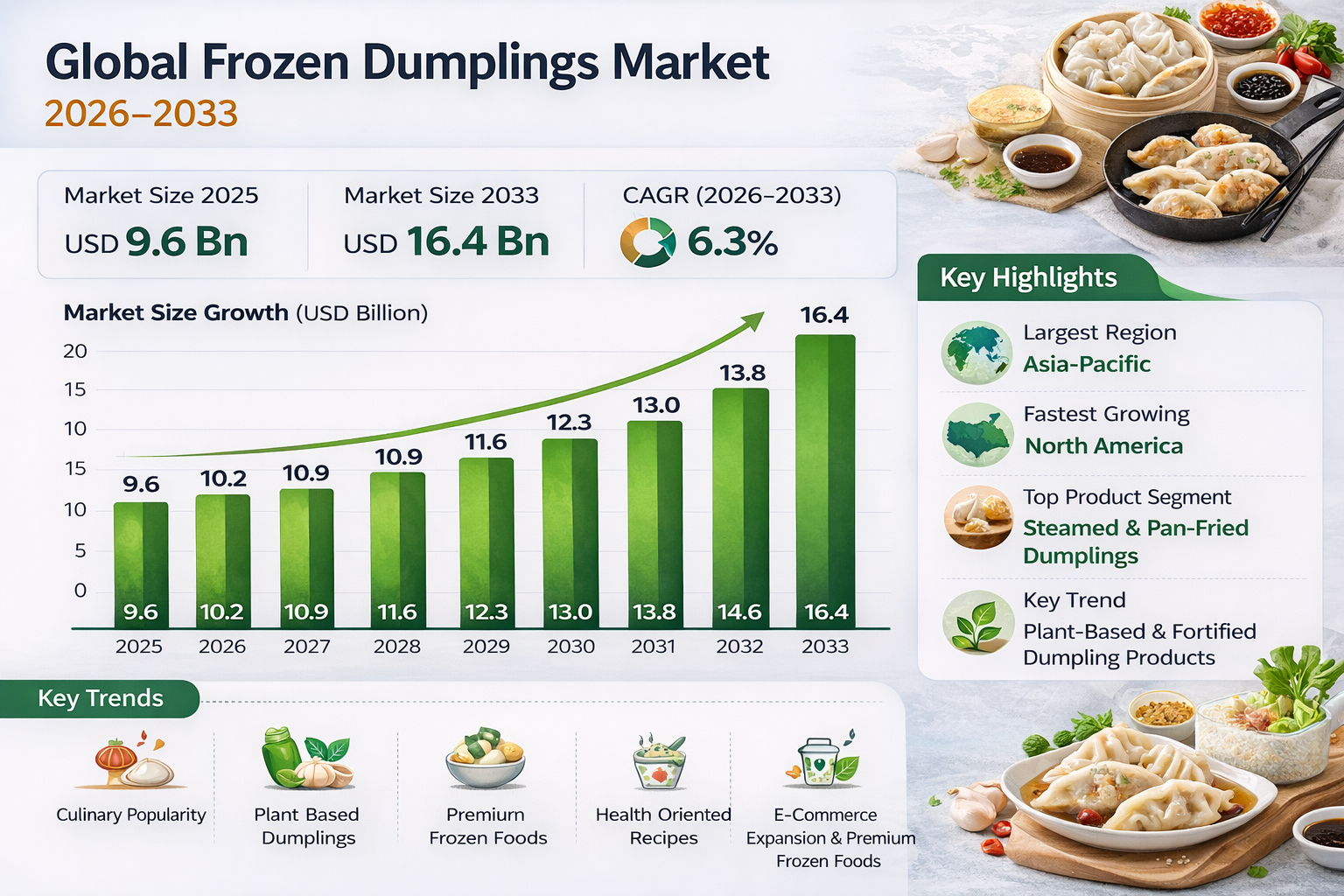
Global Frozen Dumplings Market Forecast Snapshot: 2026???2033
| Metric | Value |
|---|---|
| 2025 Market Size | USD 9.6 Billion |
| 2033 Market Size | USD 16.4 Billion |
| CAGR (2026???2033) | 6.3% |
| Largest Region | Asia-Pacific |
| Fastest Growing Region | North America |
| Top Product Segment | Steamed & Pan-Fried Dumplings |
| Key Trend | Plant-Based & Fortified Dumpling Products |
| Future Focus | E-Commerce Expansion, Premium Frozen Foods, and Health-Oriented Recipes |
Global Frozen Dumplings Market Overview (2026???2033)
The Global Frozen Dumplings Market is experiencing strong growth between 2026 and 2033, supported by increasing consumer demand for convenient meal solutions and expanding global exposure to Asian culinary traditions.
Frozen dumplings have become a popular choice among consumers seeking quick meal preparation without compromising taste and nutritional value. They are widely consumed across both household kitchens and foodservice establishments.
According to Pheonix Research, rising urban populations, busy lifestyles, and the expansion of modern retail channels are significantly boosting demand for frozen dumpling products worldwide.
Manufacturers are increasingly investing in advanced freezing technologies, modified atmosphere packaging, and efficient cold-chain distribution systems to ensure product freshness and long shelf life.
Additionally, the development of plant-based dumplings, gluten-free recipes, and fortified products is creating new opportunities within the premium frozen food segment.
Asia-Pacific remains the largest market, supported by traditional consumption patterns and strong production capabilities in countries such as China, Japan, and South Korea. Meanwhile, North America is emerging as the fastest-growing region, driven by increasing adoption of international cuisines and the rapid growth of frozen food retail.
Key Drivers of Global Frozen Dumplings Market Growth
Rising Urbanization and Busy Lifestyles
Growing urban populations and fast-paced lifestyles are driving demand for convenient frozen meal solutions.
Innovation in Flavors and Product Diversification
Manufacturers are introducing premium flavors, plant-based dumplings, and specialty stuffed varieties to attract diverse consumer groups.
Expansion of E-Commerce and Modern Retail Channels
Online grocery platforms, supermarkets, and hypermarkets are improving accessibility and distribution of frozen food products.
Increasing Focus on Health and Nutrition
Consumers are seeking gluten-free, organic, plant-based, and fortified frozen food options.
Technological Advancements in Freezing and Packaging
Improved freezing techniques and cold-chain logistics are ensuring better product quality and shelf life.
Global Frozen Dumplings Market Segmentation
1. By Product Type
1.1 Steamed Dumplings
1.1.1 Traditional Steamed Dumplings
1.1.1.1 Household Consumption
1.1.1.1.1 Retail Packaged Products
1.2 Boiled Dumplings
1.2.1 Classic Boiled Dumplings
1.2.1.1 Foodservice Applications
1.2.1.1.1 Restaurant Menu Offerings
1.3 Pan-Fried Dumplings
1.3.1 Crispy Dumpling Products
1.3.1.1 Street Food Applications
1.3.1.1.1 Retail Frozen Snacks
1.4 Specialty & Stuffed Dumplings
1.4.1 Meat-Based Dumplings
1.4.1.1 Pork & Chicken Dumplings
1.4.1.1.1 Premium Frozen Meals
1.4.2 Vegetarian and Vegan Dumplings
1.4.2.1 Plant-Based Ingredients
1.4.2.1.1 Health-Oriented Food Products
2. By Distribution Channel
2.1 Supermarkets & Hypermarkets
2.1.1 Frozen Food Sections
2.1.1.1 Retail Packaged Dumplings
2.1.1.1.1 Premium Frozen Meals
2.2 Convenience Stores
2.2.1 Ready-to-Cook Frozen Snacks
2.2.1.1 Single-Serve Packs
2.2.1.1.1 Instant Meal Options
2.3 Online & E-Commerce Platforms
2.3.1 Online Grocery Retail
2.3.1.1 Direct-to-Consumer Sales
2.3.1.1.1 Subscription Food Services
2.4 Specialty Asian Food Retailers
2.4.1 Ethnic Cuisine Stores
2.4.1.1 Imported Frozen Foods
2.4.1.1.1 Authentic Asian Dumplings
3. By End-User
3.1 Household Consumption
3.1.1 Family Meal Preparation
3.1.1.1 Retail Frozen Packs
3.1.1.1.1 Home Cooking Solutions
3.2 Restaurants & Catering Services
3.2.1 Asian Cuisine Restaurants
3.2.1.1 Dumpling Specialty Restaurants
3.2.1.1.1 Street Food Vendors
3.3 Institutional Buyers
3.3.1 Hotels and Resorts
3.3.1.1 Catering Services
3.3.1.1.1 Corporate Cafeterias
Global Frozen Dumplings Market Regional Insights
Asia-Pacific ??? Largest Market
Asia-Pacific dominates the market due to traditional consumption patterns and strong dumpling production capabilities in countries such as China, Japan, and South Korea.
North America ??? Fastest Growing Market
The increasing popularity of Asian cuisine, expanding frozen food retail networks, and rising demand for convenient meal solutions are driving growth in the United States and Canada.
Europe
Growing multicultural food trends and modern retail expansion are supporting the adoption of frozen dumpling products across Europe.
Latin America
Rising consumer interest in international cuisines and expanding supermarket networks are driving market growth.
Middle East & Africa
Increasing urbanization and the growth of modern food retail infrastructure are supporting frozen food consumption.
Leading Companies in the Global Frozen Dumplings Market
Ajinomoto Co., Inc.
Wei Chuan Foods Corporation
JFC International Inc.
COFCO Corporation
Nestl?? S.A.
Ting Hsin International Group
Huang's Foods
Twin Marquis Enterprises Ltd.
Din Tai Fung Group
Oriental Cuisine Co., Ltd.
These companies focus on product innovation, expanding production capacity, strengthening cold-chain distribution, and introducing premium frozen dumpling varieties.
Strategic Intelligence & Market Insights
Pheonix Demand Forecast Engine identifies urbanization and rising frozen food consumption as major growth catalysts.
Consumer Sentiment Analyzer highlights increasing demand for plant-based and health-oriented dumpling products.
Innovation Tracker monitors technological advancements in freezing systems, packaging solutions, and flavor development.
Porter???s Five Forces Analysis indicates moderate supplier power with strong opportunities for product innovation and brand differentiation.
Why the Global Frozen Dumplings Market Remains Critical
Supports demand for convenient ready-to-eat meals
Expands global adoption of Asian cuisine
Encourages innovation in frozen food technology
Strengthens modern retail and e-commerce food distribution
Promotes diversified product offerings including plant-based and fortified foods
Final Takeaway of Global Frozen Dumplings Market
The Global Frozen Dumplings Market is expected to maintain strong growth through 2033, driven by rising consumer demand for convenient meals, expanding frozen food retail infrastructure, and increasing global interest in Asian cuisine.
Companies focusing on innovative flavors, plant-based product development, advanced freezing technologies, and efficient distribution networks will be well positioned to capture emerging opportunities in the global frozen dumplings market.
At Pheonix Research, our advanced forecasting frameworks and strategic market intelligence help stakeholders identify growth opportunities, optimize supply chains, and build competitive advantages in the rapidly evolving frozen food industry.
???? Social Mentions & Publication Channels
??Explore deeper insights and follow our cross-platform updates on??LinkedIn??and??X??for continuous intelligence and market coverage.
LinkedIn??: https://www.linkedin.com/in/pheonix-research-media/
X??: https://x.com/Pheonix_Insight
Table of Contents
Table of Contents
1. Executive Summary
1.1 Market Forecast Snapshot (2026???2033)
The Global Frozen Dumplings Market is projected to grow from USD 9.6 Billion in 2025 to USD 16.4 Billion by 2033, registering a CAGR of 6.3% during 2026???2033.
1.2 Global Market Size & CAGR Analysis
The market reflects steady expansion driven by increasing demand for convenient ready-to-eat meals, rising urbanization, and the growing global popularity of Asian cuisine.
1.3 Largest & Fastest-Growing Segments
Largest Segment: Steamed Dumplings
Fastest-Growing Segment: Specialty & Plant-Based Dumplings
1.4 Region-Level Leadership & Growth Trends
Asia-Pacific leads the market due to traditional consumption patterns and strong manufacturing capacity, while North America is projected to be the fastest-growing region through 2033.
1.5 Key Market Drivers
Growing demand for convenient and ready-to-cook meal options
Rising urbanization and busy consumer lifestyles
Increasing popularity of Asian cuisine worldwide
Expansion of e-commerce grocery and frozen food retail
Advancements in freezing, packaging, and cold-chain logistics
1.6 Competitive Landscape Overview
Moderately competitive market with global frozen food manufacturers and regional Asian food brands focusing on product innovation, premium recipes, and expanded distribution networks.
1.7 Strategic Outlook Through 2033
Focus on plant-based dumpling innovations, premium frozen meal offerings, improved cold-chain logistics, and expansion of e-commerce frozen food distribution.
2. Introduction & Market Overview
2.1 Definition of the Global Frozen Dumplings Market
Covers frozen dumpling products including steamed, boiled, pan-fried, and stuffed dumplings sold through retail, foodservice, and institutional channels.
2.2 Scope of the Study
Comprehensive revenue analysis, product segmentation, distribution channels, regional demand patterns, and global forecast during 2026???2033.
2.3 Evolution from Traditional Dumpling Consumption to Frozen Food Products
The dumpling market has evolved from traditional freshly prepared foods to industrially produced frozen dumplings that offer convenience, longer shelf life, and consistent quality.
2.4 Role of Cold Chain Infrastructure & Supply Optimization
Advanced freezing technologies, cold-chain logistics, and improved packaging methods are enabling large-scale distribution of frozen dumplings globally.
2.5 Impact of Global Food Consumption Trends
Increasing consumer interest in international cuisines and convenience foods is driving demand for frozen dumplings.
2.6 Integration of Health-Oriented Product Development
Manufacturers are introducing gluten-free, plant-based, organic, and fortified dumpling varieties to attract health-conscious consumers.
2.7 Technological Innovations in Freezing & Packaging
Technologies such as blast freezing, modified atmosphere packaging, and improved cold storage systems are enhancing product quality and shelf life.
3. Research Methodology
3.1 Primary Research
Interviews with frozen food manufacturers, distributors, retailers, restaurant operators, and industry experts.
3.2 Secondary Research
Industry publications, trade statistics, retail data, government food databases, and corporate financial reports.
3.3 Market Size Estimation Model
Combination of bottom-up production analysis and top-down consumption modeling across major regional markets.
3.4 Forecast Assumptions (2026???2033)
Based on frozen food consumption growth, urbanization trends, expansion of modern retail channels, and increasing adoption of convenience foods.
3.5 Data Validation & Triangulation
Cross-verification of data using supply chain analysis, retail sales insights, and regional market benchmarks.
4. Market Dynamics
4.1 Drivers
4.1.1 Rising Demand for Convenient Meal Solutions
Consumers increasingly prefer ready-to-cook frozen food products due to busy lifestyles.
4.1.2 Increasing Global Popularity of Asian Cuisine
Dumplings are gaining global popularity through restaurants, street food culture, and international food trends.
4.1.3 Expansion of Frozen Food Retail Infrastructure
Supermarkets, hypermarkets, and e-commerce grocery platforms are improving accessibility to frozen foods.
4.1.4 Product Innovation and Flavor Diversification
Manufacturers are introducing premium, regional, and plant-based dumpling varieties.
4.1.5 Technological Advancements in Cold Chain Logistics
Improved freezing technologies and packaging solutions are supporting product quality and longer shelf life.
4.2 Restraints
4.2.1 High logistics costs for frozen food distribution
4.2.2 Limited cold storage infrastructure in developing regions
4.2.3 Concerns regarding processed frozen food consumption
4.2.4 Price sensitivity in emerging markets
4.3 Opportunities
4.3.1 Expansion of plant-based and vegan dumpling products
4.3.2 Growth of premium frozen ready-to-eat meals
4.3.3 Increasing adoption of e-commerce grocery platforms
4.3.4 Rising demand for international cuisine experiences
4.4 Challenges
4.4.1 Maintaining cold-chain efficiency across long supply chains
4.4.2 Product quality preservation during transportation
4.4.3 Competition from freshly prepared dumpling products
4.4.4 Managing rising raw material and packaging costs
5. Global Frozen Dumplings Market Analysis (USD Billion), 2026???2033
5.1 Market Size Overview
5.2 CAGR Analysis
5.3 Region-Wise Revenue Distribution
5.4 Product Type Revenue Split
5.5 Distribution Channel Revenue Trends
5.6 End-User Consumption Analysis
6. Market Segmentation by Product Type (USD Billion), 2026???2033
6.1 Steamed Dumplings
6.1.1 Traditional Steamed Dumplings
6.1.1.1 Retail Frozen Products
6.1.1.1.1 Household Consumption
6.2 Boiled Dumplings
6.2.1 Classic Boiled Dumplings
6.2.1.1 Restaurant Applications
6.2.1.1.1 Foodservice Products
6.3 Pan-Fried Dumplings
6.3.1 Crispy Dumpling Products
6.3.1.1 Retail Snack Products
6.3.1.1.1 Frozen Convenience Foods
6.4 Specialty / Stuffed Dumplings
6.4.1 Meat-Based Dumplings
6.4.1.1 Pork & Chicken Varieties
6.4.1.1.1 Premium Frozen Meals
6.4.2 Vegetarian & Vegan Dumplings
6.4.2.1 Plant-Based Ingredients
6.4.2.1.1 Health-Focused Food Products
7. Market Segmentation by Distribution Channel (USD Billion), 2026???2033
7.1 Supermarkets & Hypermarkets
7.1.1 Frozen Food Sections
7.1.1.1 Packaged Dumpling Products
7.1.1.1.1 Retail Frozen Meals
7.2 Convenience Stores
7.2.1 Ready-to-Cook Frozen Foods
7.2.1.1 Single-Serve Packs
7.2.1.1.1 Instant Meal Options
7.3 Online Retail & E-Commerce
7.3.1 Online Grocery Platforms
7.3.1.1 Direct-to-Consumer Food Brands
7.3.1.1.1 Subscription Food Services
7.4 Specialty Asian Food Retailers
7.4.1 Ethnic Food Stores
7.4.1.1 Imported Frozen Products
7.4.1.1.1 Authentic Asian Cuisine Products
8. Market Segmentation by End-User (USD Billion), 2026???2033
8.1 Household Consumers
8.1.1 Home Cooking Applications
8.1.1.1 Retail Frozen Packs
8.1.1.1.1 Family Meal Solutions
8.2 Restaurants & Catering Services
8.2.1 Asian Cuisine Restaurants
8.2.1.1 Foodservice Supply Chains
8.2.1.1.1 Catering Industry Demand
8.3 Institutional Buyers
8.3.1 Hotels and Resorts
8.3.1.1 Corporate Cafeterias
8.3.1.1.1 Educational Institutions
9. Market Segmentation by Geography
9.1 Asia-Pacific ??? Largest Market
9.2 North America ??? Fastest Growing Market
9.3 Europe
9.4 Latin America
9.5 Middle East & Africa
10. Competitive Landscape ??? Global
10.1 Market Share Analysis
10.2 Product Portfolio Benchmarking
10.3 Production Capacity Mapping
10.4 Distribution & Retail Partnerships
10.5 Competitive Intensity & Differentiation Strategies
11. Company Profiles
11.1 Ajinomoto Co., Inc.
11.2 Wei Chuan Foods Corporation
11.3 JFC International Inc.
11.4 COFCO Corporation
11.5 Nestl?? S.A.
11.6 Ting Hsin International Group
11.7 Huang’s Foods
11.8 Twin Marquis Enterprises Ltd.
11.9 Din Tai Fung Group
11.10 Oriental Cuisine Co., Ltd.
12. Strategic Intelligence & Pheonix AI-Backed Insights
12.1 Pheonix Demand Forecast Engine
12.2 Consumer Sentiment Analyzer
12.3 Frozen Food Innovation Tracker
12.4 Cold Chain Logistics Intelligence
12.5 Automated Porter???s Five Forces Analysis
13. Future Outlook & Strategic Recommendations
13.1 Expansion of plant-based frozen dumpling products
13.2 Growth of premium frozen ready-to-eat meals
13.3 Strengthening cold chain infrastructure
13.4 Expansion of e-commerce frozen food retail
13.5 Long-Term Market Outlook (2033+)
14. Appendix
15. About Pheonix Research
16. Disclaimer
Competitive Landscape
Competitive Landscape of the Global Frozen Dumplings Market
Executive Framing
The Global Frozen Dumplings Market operates within a moderately fragmented competitive environment, led by a mix of established Asian food manufacturers and global frozen food corporations. Key players such as Ajinomoto, COFCO Corporation, Wei Chuan Foods, Nestl??, and Ting Hsin International dominate through strong production capabilities, authentic product offerings, and extensive distribution networks. The market is highly competitive due to rapid product innovation, evolving consumer tastes, and increasing demand for convenient ethnic food options.
Current Market Reality
The market is undergoing rapid transformation as frozen dumplings shift from traditional ethnic staples to globally recognized convenience foods. Asia-Pacific continues to lead production and consumption, while North America and Europe are emerging as high-growth regions driven by the rising popularity of Asian cuisine. Companies are increasingly focusing on premiumization, clean-label ingredients, and plant-based dumpling varieties to cater to health-conscious consumers.
The expansion of modern retail formats and e-commerce platforms is further intensifying competition by enabling wider product accessibility and direct-to-consumer distribution models.
Key Signals and Evidence
- Strong global demand for convenient frozen meal solutions and ready-to-cook foods.
- Rapid expansion of Asian cuisine adoption in Western markets.
- Growing popularity of plant-based, vegan, and gluten-free dumpling products.
- Increased investment in cold-chain logistics and advanced freezing technologies.
- Rising influence of e-commerce and direct-to-consumer frozen food distribution.
Strategic Implications
- Product Diversification: Expansion into plant-based, gluten-free, and fortified dumpling offerings.
- Premiumization Strategy: Development of high-quality, restaurant-style frozen dumplings.
- Cold-Chain Optimization: Investment in advanced freezing technologies and logistics infrastructure.
- Global Market Expansion: Targeting North America and Europe through localized flavor adaptations.
- Digital & E-Commerce Growth: Leveraging online grocery platforms and DTC models to enhance reach.
Forward Outlook
By 2033, the Global Frozen Dumplings Market is expected to evolve into a premium, health-oriented, and globally integrated frozen food segment. While Asia-Pacific will remain the dominant market, North America and Europe will continue to drive incremental growth through rising demand for international cuisines and convenient meal solutions.
Companies that invest in product innovation, sustainable packaging, advanced cold-chain systems, and culturally adaptive product development will secure long-term competitive advantages in the rapidly expanding global frozen food ecosystem.
Value Chain
Global Frozen Dumplings Market: Value Chain & Market Dynamics
Executive Framing
The Global Frozen Dumplings Market is evolving into a convenience-driven, ready-to-cook, and global cuisine ecosystem, fueled by increasing demand for quick meal solutions, international flavors, and frozen food innovation. Dumplings are positioned as a versatile product category bridging traditional recipes with modern consumption patterns.
The market follows an integrated cold-chain operational model, involving ingredient sourcing, processing, freezing, packaging, storage, and temperature-controlled distribution to maintain product quality and shelf life.
Current Market Reality
The supply chain exhibits a high complexity level, driven by cold-chain logistics, perishable product handling, and strict temperature control requirements. Efficient infrastructure and logistics management are critical for ensuring product freshness and minimizing spoilage.
Distribution is multichannel, including supermarkets, hypermarkets, convenience stores, online grocery platforms, and foodservice channels, enabling broad accessibility across both retail and institutional consumers.
Key Signals and Evidence
- Market growth from USD 9.6 billion (2025) to USD 16.4 billion (2033) at a CAGR of 6.3%.
- Rising demand for convenient, ready-to-cook meal products.
- Expansion of plant-based, gluten-free, and fortified dumpling products.
- Growth of e-commerce and modern frozen food retail channels.
- Increasing global popularity of Asian cuisine and ethnic food products.
Strategic Implications
Market players are focusing on product innovation, flavor diversification, and premium positioning to differentiate offerings. Large companies leverage scale, brand recognition, and advanced cold-chain logistics, while niche brands emphasize authentic recipes, organic ingredients, and plant-based alternatives.
Investments in freezing technologies, packaging innovation, and digital distribution channels are enhancing operational efficiency and consumer reach. Sustainability initiatives, including eco-friendly packaging and energy-efficient cold storage, are gaining importance.
Forward Outlook
The Global Frozen Dumplings Market is expected to evolve into a high-growth, innovation-driven, and convenience-focused food segment, supported by changing lifestyles and globalization of food preferences.
- Expansion of premium and gourmet frozen dumpling products
- Growth in plant-based and health-oriented recipes
- Increasing adoption of online grocery and direct-to-consumer channels
- Advancements in cold-chain logistics and freezing technologies
Companies that focus on innovation, cold-chain efficiency, and consumer-centric product development will capture long-term growth opportunities in the frozen dumplings market.
Investment Activity
Investment & Funding Dynamics ??? Global Industrial Sugar Market
Executive Framing
Current Market Reality
Valued at USD 50.1 billion in 2025 and projected to reach USD 68.6 billion by 2033 (CAGR 3.9%), the market reflects steady but moderate investment growth. Asia-Pacific and Latin America remain key investment hubs due to large-scale sugarcane production and ethanol manufacturing, while Europe maintains strong beet sugar processing capabilities. Leading players such as Archer Daniels Midland Company, Tereos S.A., and Wilmar International Ltd are investing in production capacity expansion, refining technologies, and global distribution networks.
Key Signals and Evidence
- Food & Beverage Industry Demand: Continuous investments driven by large-scale consumption in processed foods and beverages.
- Expansion of Sugarcane Cultivation: Increasing capital allocation toward agricultural productivity and raw material supply stability.
- Biofuel and Ethanol Production: Rising investments in sugar-based ethanol production for energy and industrial applications.
- Industrial Processing Infrastructure: Growth in sugar refining, storage, and logistics capabilities.
- Pharmaceutical Applications: Steady demand for sugar in medicinal syrups and fermentation processes.
- Global Supply Chain Optimization: Investments in distribution networks and export capabilities.
- Shift Toward Sustainable Production: Emerging focus on eco-friendly sugar production and waste reduction technologies.
Strategic Implications
Companies that focus on cost efficiency, large-scale production, and vertical integration across farming, refining, and distribution will capture long-term value. Investors are prioritizing companies with strong supply chain control and diversified industrial applications, including ethanol and pharmaceuticals. Strategic collaborations with food and beverage manufacturers will further strengthen market positioning and demand stability.
Forward Outlook
From 2026 to 2033, investment in the Global Industrial Sugar Market is expected to remain steady, with increasing focus on sustainable sugar production, biofuel applications, and process optimization technologies. While demand from industrial applications will remain strong, evolving consumer preferences toward low-sugar diets may influence long-term investment strategies. M&A activity is expected to remain moderate, driven by consolidation in production and distribution capabilities.
Technology & Innovation
Global Frozen Dumplings Market: Technology & Innovation
Executive Framing
Technology and innovation in the Global Frozen Dumplings Market are centered on enhancing product quality, extending shelf life, and enabling large-scale production of diverse and premium offerings. As demand for convenient, ready-to-cook meals rises globally, manufacturers are leveraging advanced freezing technologies, automation, and ingredient innovation to deliver consistent taste, texture, and nutritional value while meeting evolving consumer preferences for healthier and plant-based options.
Current Market Reality
Valued at USD 9.6 billion in 2025 and projected to reach USD 16.4 billion by 2033 at a CAGR of 6.3%, the market is witnessing strong growth driven by urbanization and increasing adoption of frozen foods. Asia-Pacific remains the dominant region due to traditional consumption, while North America is the fastest-growing market, fueled by expanding interest in Asian cuisine and convenience foods.
Key Signals and Evidence
- Advanced Freezing Technologies: Adoption of IQF (Individually Quick Frozen) and blast freezing methods to preserve texture, flavor, and nutritional quality.
- Smart Packaging Solutions: Use of modified atmosphere packaging (MAP) and vacuum sealing to enhance shelf life and maintain product freshness.
- Automation in Production: Integration of robotics and automated dumpling forming systems for high-volume and consistent manufacturing.
- Plant-Based Product Innovation: Development of vegan and vegetarian dumplings using plant-based proteins and alternative ingredients.
- Cold Chain Optimization: Implementation of advanced logistics, temperature monitoring, and IoT-enabled cold storage systems.
- Flavor & Recipe Innovation: Introduction of global flavors, premium fillings, and fortified dumplings targeting health-conscious consumers.
Strategic Implications
Companies investing in advanced freezing technologies, automated production systems, and innovative product development will gain a competitive advantage. Expansion into premium and health-oriented segments such as plant-based, gluten-free, and fortified dumplings can drive higher margins. Additionally, strengthening cold-chain infrastructure and leveraging e-commerce distribution channels will be critical for scaling global reach.
Forward Outlook
The market is expected to evolve toward premium, health-focused, and globally diversified frozen food offerings. Future innovation will focus on clean-label formulations, improved freezing efficiency, and personalized meal solutions. Frozen dumplings will continue to play a significant role in the global convenience food market, bridging traditional cuisine with modern consumption patterns.
Market Risk
Executive Framing
The Global Frozen Dumplings Market is emerging as a high-growth segment within the convenience and frozen food industry, driven by increasing consumer demand for quick, ready-to-cook meal solutions and growing global exposure to Asian cuisine. Valued at USD 9.6 billion in 2025 and projected to reach USD 16.4 billion by 2033 at a CAGR of 6.3%, the market reflects strong momentum supported by urbanization, lifestyle shifts, and expanding modern retail infrastructure.
Current Market Reality
Asia-Pacific dominates the global market due to traditional consumption patterns, strong manufacturing capabilities, and high domestic demand in countries such as China, Japan, and South Korea. North America is the fastest-growing region, fueled by increasing adoption of international cuisines, expanding frozen food aisles, and rising demand for convenient meal options. Steamed and pan-fried dumplings remain the leading product segments due to their taste, versatility, and ease of preparation.
Key Signals and Evidence
- Rising global demand for convenient, ready-to-cook frozen meal solutions.
- Increasing popularity of Asian cuisine across North America and Europe.
- Growth in plant-based, gluten-free, and fortified dumpling product offerings.
- Expansion of e-commerce platforms and modern retail distribution channels.
- Advancements in freezing technology and cold-chain logistics ensuring product quality.
Strategic Implications
- Invest in product innovation including plant-based, premium, and health-focused dumplings.
- Expand distribution through e-commerce platforms and global retail partnerships.
- Enhance cold-chain logistics and packaging technologies to maintain product freshness.
- Develop region-specific flavors and customized offerings to target diverse consumer bases.
- Strengthen brand positioning through quality, authenticity, and convenience-focused marketing.
Forward Outlook
The Global Frozen Dumplings Market is expected to evolve into a dynamic, innovation-driven segment within the frozen food industry. Growth will be supported by increasing consumer preference for convenient meals, expansion of global food retail networks, and continuous innovation in product formulations. Companies focusing on premiumization, health-oriented recipes, and efficient distribution systems will be well positioned to capitalize on long-term growth opportunities in the global frozen dumplings market.
Regulatory Landscape
Regulatory & Policy Landscape: Global Frozen Dumplings Market
Executive Framing
The Global Frozen Dumplings Market operates within a multi-layered regulatory environment governed by food safety standards, cold-chain compliance, labeling requirements, and international trade policies. Regulatory authorities such as the U.S. FDA, European Food Safety Authority (EFSA), Codex Alimentarius, and regional food safety agencies play a critical role in ensuring product quality, hygiene, and consumer safety.
Frozen dumplings, as processed food products, must comply with strict regulations related to ingredient sourcing, food processing, packaging, storage, and transportation, particularly due to their perishable nature and reliance on cold-chain logistics.
Current Market Reality
The market is significantly influenced by stringent food safety and hygiene regulations, especially in developed regions where frozen food standards are highly regulated. Compliance with temperature-controlled storage and transportation is mandatory to maintain product quality and prevent contamination.
Additionally, increasing consumer demand for transparency is driving stricter labeling requirements, including ingredient disclosure, allergen information, nutritional content, and origin labeling. Regulations around clean-label, organic, and plant-based claims are also becoming more prominent.
Key Signals and Evidence
- Strict food safety and hygiene standards for frozen and processed foods globally.
- Regulations governing cold-chain logistics and temperature-controlled distribution.
- Mandatory labeling requirements including allergens, nutritional values, and ingredient transparency.
- Increasing regulatory scrutiny on plant-based and health-related product claims.
- Import-export regulations affecting international trade of frozen food products.
- Sustainability guidelines for packaging materials and food waste reduction.
Strategic Implications
Companies must invest in robust cold-chain infrastructure, quality assurance systems, and regulatory compliance frameworks to meet global food safety standards. Ensuring traceability and transparency across the supply chain is becoming a key competitive differentiator.
Manufacturers are also required to align with evolving consumer-driven regulations by developing clean-label, plant-based, and allergen-free dumpling products. Sustainable packaging and environmentally responsible practices are increasingly important for regulatory approval and brand positioning.
Forward Outlook
Regulatory frameworks are expected to become more stringent, particularly in areas related to food safety, labeling transparency, and sustainability. Governments will continue to emphasize consumer health, leading to tighter controls on additives, preservatives, and nutritional claims.
Furthermore, advancements in cold-chain technology and digital traceability systems are likely to be integrated into regulatory requirements. Sustainability regulations focusing on packaging waste, carbon emissions, and energy-efficient freezing processes will also shape the future of the market.