
Global Luxury Handbag Market Report, Size & Forecast 2026-2033
Global Luxury Handbag Market Forecast Snapshot (2025???2033)
| Metric | Value |
|---|---|
| Market Size (2025) | USD 34.7 Billion |
| Market Size (2033) | USD 58.9 Billion |
| CAGR (2026???2033) | 6.8% |
| Largest Segment | Leather Luxury Handbags |
| Fastest Growing Segment | Online Luxury Handbag Sales |
| Leading Application | Personal Luxury Fashion Accessories |
| Key Growth Driver | Rising disposable incomes and increasing consumer preference for premium fashion accessories |
| Key Technology Trends | AI-powered personalization, digital luxury retail platforms, virtual shopping experiences, sustainability-focused product innovation |
| Major End-Use Consumers | Affluent Consumers, Luxury Fashion Enthusiasts, Millennials, and Gen Z Buyers |
| Key Market Opportunity | Expansion of digital luxury commerce and growing luxury resale marketplace |
| Regional Leader | Europe |
| Fastest Growing Region | Asia-Pacific |
| Sustainability & Innovation Focus | Ethical sourcing, sustainable materials, circular fashion initiatives, and limited-edition luxury collections |
Global Luxury Handbag Market Size & Forecast
The global luxury handbag market is projected to witness substantial growth during the forecast period from 2026 to 2033. The market was valued at approximately USD 34.7 billion in 2025 and is expected to reach nearly USD 58.9 billion by 2033, expanding at a CAGR of around 6.8%. The market growth is driven by rising disposable incomes, increasing consumer preference for premium fashion accessories, expanding demand for heritage luxury brands, and growing influence of digital retail channels and social media-driven fashion trends worldwide. Luxury handbags represent high-end fashion accessories crafted using premium materials, superior craftsmanship, and exclusive design aesthetics. These products are positioned as status symbols and lifestyle statements, often associated with brand heritage, craftsmanship excellence, exclusivity, and long-term investment value. The market is undergoing significant transformation through digital luxury retail expansion, sustainability-focused product innovation, AI-powered personalization, and growing demand for limited-edition collections. Additionally, rising aspirational spending among younger consumers, increasing resale market activity, and growing global luxury tourism are accelerating market expansion globally.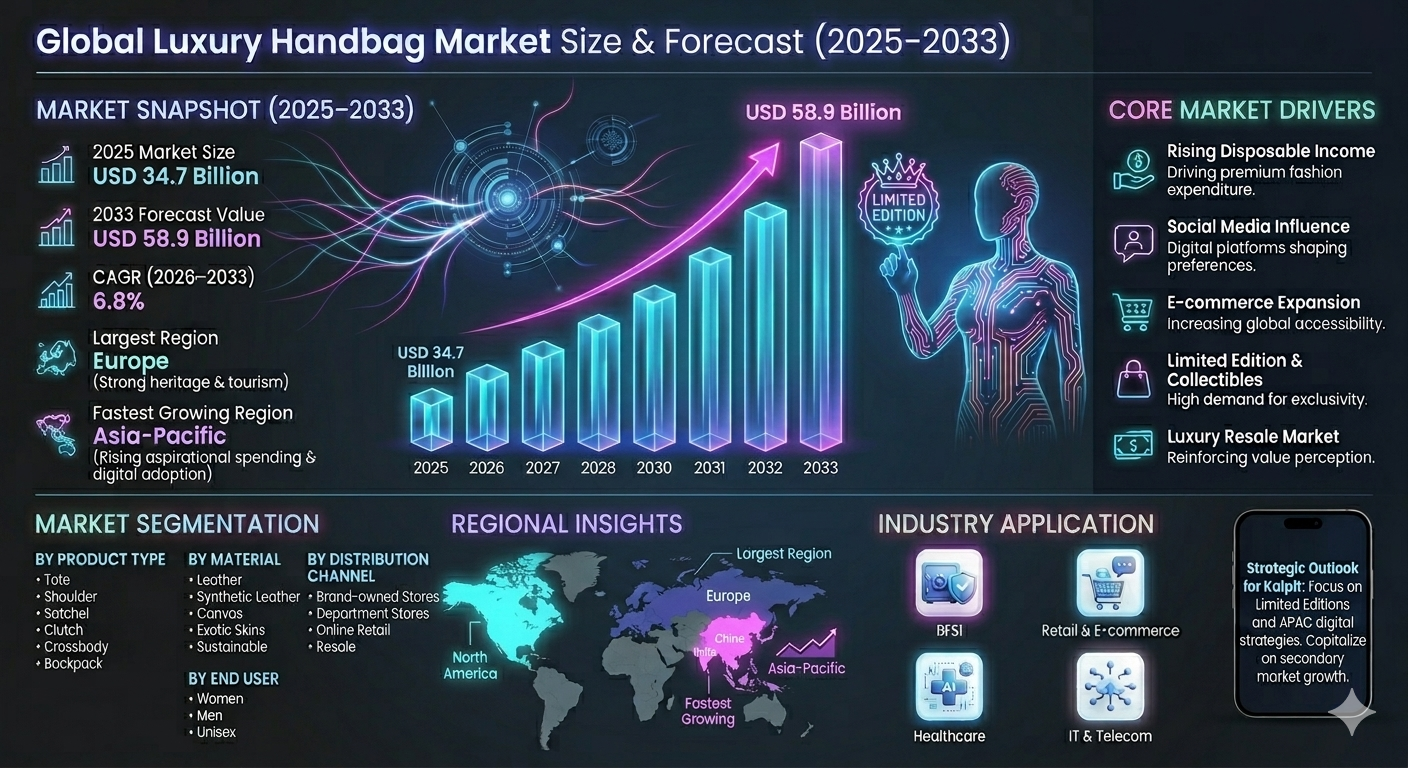
Global Luxury Handbag Market Overview
The luxury handbag market forms a vital segment of the global personal luxury goods and premium fashion accessories industry. Luxury handbags are increasingly viewed not only as fashion statements but also as collectible assets and long-term value-retaining investments. The market includes tote bags, shoulder bags, satchels, clutches, crossbody bags, backpacks, and limited-edition designer handbags. Luxury brands are increasingly investing in exclusive craftsmanship, innovative materials, omnichannel retail experiences, and digital consumer engagement strategies to strengthen brand equity. Technological advancements in supply chain traceability, digital authentication, smart retail experiences, and virtual try-on technologies are significantly reshaping customer interactions. Major market participants include Louis Vuitton, Chanel, Herm??s International, Gucci, Prada S.p.A., Dior, Burberry Group plc, Michael Kors, Saint Laurent, and Fendi.Key Drivers of Global Luxury Handbag Market Growth
Rising Global Disposable Income
Increasing purchasing power among affluent consumers and upper-middle-class populations is driving higher expenditure on premium fashion accessories. This trend is particularly prominent across emerging luxury markets.Growing Influence of Social Media and Celebrity Endorsements
Luxury handbag purchasing decisions are increasingly influenced by social media campaigns, influencer marketing, and celebrity endorsements. Digital platforms are significantly shaping consumer preferences.Expansion of Online Luxury Retail
The rapid growth of e-commerce and direct-to-consumer digital platforms is increasing accessibility to luxury handbags worldwide. Online retail channels are enhancing convenience and brand reach.Increasing Demand for Limited Edition and Collectible Products
Consumers are increasingly seeking exclusive and limited-production luxury handbags as status symbols and investment assets. This is driving premium pricing and brand differentiation.Growth of the Luxury Resale Market
The expanding secondary luxury goods market is increasing product accessibility while reinforcing long-term value perception. Authenticated resale platforms are strengthening consumer confidence.Global Luxury Handbag Market Segmentation
By Product Type
The market is segmented into tote bags, shoulder bags, satchels, clutches, crossbody bags, backpacks, and others. Tote bags and shoulder bags account for a major market share due to versatility and widespread consumer preference.By Material
The market includes leather, synthetic leather, canvas, exotic skins, and sustainable luxury materials. Leather handbags dominate due to superior durability and premium appeal.By Distribution Channel
The market includes brand-owned stores, department stores, specialty boutiques, online luxury retail, and resale platforms. Brand-owned stores remain the dominant distribution channel globally.By End User
The market serves women, men, and unisex luxury accessory segments. Women represent the largest consumer segment.Regional Market Dynamics
Europe
Europe dominates the global luxury handbag market due to strong brand heritage, established fashion capitals, and large tourist-driven luxury consumption. France and Italy remain the leading regional contributors.North America
North America represents a major luxury consumption hub driven by strong purchasing power and mature luxury retail infrastructure. The United States remains the largest regional market.Asia-Pacific
Asia-Pacific is the fastest-growing region due to rising affluent populations, increasing aspirational spending, and strong digital luxury adoption. China, Japan, South Korea, and India are major growth markets.Middle East
The Middle East represents a premium growth market supported by high disposable incomes and strong demand for exclusive luxury products. UAE and Saudi Arabia are major contributors.Latin America
Latin America is gradually expanding due to rising premium retail penetration and growing luxury consumer segments. Brazil and Mexico are leading regional markets.Competitive Landscape
The global luxury handbag market is highly competitive and brand-centric, with established fashion houses competing through heritage, exclusivity, craftsmanship, and innovation. Key players include Louis Vuitton, Chanel, Herm??s International, Gucci, Prada S.p.A., Dior, Burberry Group plc, Michael Kors, Saint Laurent, and Fendi. Companies are increasingly investing in digital luxury experiences, limited-edition launches, sustainable material innovation, and blockchain-based authentication systems. Strategic collaborations with artists, designers, and digital influencers are strengthening market positioning.Strategic Outlook
The strategic outlook for the global luxury handbag market remains highly favorable due to strong brand loyalty, rising digital luxury adoption, and growing aspirational spending. Future growth opportunities include NFT-linked luxury products, circular luxury initiatives, personalized customization platforms, and sustainable premium craftsmanship. Digital transformation, exclusivity strategies, and sustainable sourcing will significantly shape future market evolution. Brands investing in omnichannel engagement, product innovation, and authenticity assurance are expected to strengthen competitive advantage.Final Market Perspective
The global luxury handbag market continues to play a defining role in the premium fashion ecosystem worldwide. Rising consumer aspiration, digital luxury retail expansion, and evolving fashion preferences will continue driving sustained market growth throughout the forecast period. Companies that successfully combine heritage craftsmanship, digital innovation, and sustainable luxury positioning will remain strongly positioned in the evolving global luxury handbag market.Table of Contents
Table of Contents
- 1. Executive Summary
- 1.1 Global Luxury Handbag Market Snapshot (2026???2033)
- 1.2 Market Size & CAGR Analysis
- 1.3 Largest & Fastest-Growing Segments
- 1.4 Key Regional Insights
- 1.5 Major Market Growth Drivers
- 1.6 Competitive Landscape Overview
- 1.7 Strategic Outlook Through 2033
- 2. Introduction & Market Overview
- 2.1 Definition of Luxury Handbags
- 2.2 Scope of the Study
- 2.3 Evolution of the Global Luxury Accessories Industry
- 2.4 Luxury Value Chain & Consumer Ecosystem Analysis
- 2.5 Regulatory, Sustainability & Authentication Framework
- 2.6 Digital Luxury Retail Trends
- 2.7 Innovation Landscape in Premium Fashion Accessories
- 3. Research Methodology
- 3.1 Primary Research
- 3.2 Secondary Research
- 3.3 Market Size Estimation Model
- 3.4 Forecast Assumptions (2026???2033)
- 3.5 Data Validation & Market Triangulation
- 4. Market Dynamics
- 4.1 Drivers
- 4.1.1 Rising Global Disposable Income
- 4.1.2 Growing Influence of Social Media and Celebrity Endorsements
- 4.1.3 Expansion of Online Luxury Retail
- 4.1.4 Increasing Demand for Limited Edition and Collectible Products
- 4.1.5 Growth of the Luxury Resale Market
- 4.2 Restraints
- 4.2.1 High Product Pricing
- 4.2.2 Counterfeit Luxury Goods Proliferation
- 4.2.3 Economic Volatility Affecting Premium Spending
- 4.2.4 Supply Chain Sustainability Challenges
- 4.3 Opportunities
- 4.3.1 NFT-Linked Luxury Products
- 4.3.2 Circular Luxury & Resale Ecosystems
- 4.3.3 Personalized Customization Platforms
- 4.3.4 Sustainable Premium Craftsmanship Innovation
- 4.4 Challenges
- 4.4.1 Maintaining Brand Exclusivity at Scale
- 4.4.2 Managing Omnichannel Luxury Experiences
- 4.4.3 Balancing Heritage with Digital Innovation
- 4.4.4 Regulatory Pressures on Sustainable Sourcing
- 4.1 Drivers
- 5. Global Luxury Handbag Market Analysis (USD Billion), 2026???2033
- 5.1 Market Size Overview
- 5.2 CAGR Analysis
- 5.3 Regional Revenue Distribution
- 5.4 Consumer Spending Trends
- 5.5 Product Innovation Analysis
- 5.6 Future Growth Projections
- 6. Market Segmentation (USD Billion), 2026???2033
- 6.1 By Product Type
- 6.1.1 Tote Bags
- 6.1.2 Shoulder Bags
- 6.1.3 Satchels
- 6.1.4 Clutches
- 6.1.5 Crossbody Bags
- 6.1.6 Backpacks
- 6.1.7 Others
- 6.2 By Material
- 6.2.1 Leather
- 6.2.2 Synthetic Leather
- 6.2.3 Canvas
- 6.2.4 Exotic Skins
- 6.2.5 Sustainable Luxury Materials
- 6.3 By Distribution Channel
- 6.3.1 Brand-Owned Stores
- 6.3.2 Department Stores
- 6.3.3 Specialty Boutiques
- 6.3.4 Online Luxury Retail
- 6.3.5 Resale Platforms
- 6.4 By End User
- 6.4.1 Women
- 6.4.2 Men
- 6.4.3 Unisex
- 6.1 By Product Type
- 7. Market Segmentation by Geography
- 7.1 Europe
- 7.2 North America
- 7.3 Asia-Pacific
- 7.4 Middle East
- 7.5 Latin America
- 8. Competitive Landscape
- 8.1 Market Share Analysis
- 8.2 Brand Equity Benchmarking
- 8.3 Digital Retail Strategy Analysis
- 8.4 Strategic Partnerships & Collaborations
- 8.5 Sustainability & Authentication Strategies
- 9. Company Profiles
- 9.1 Louis Vuitton
- 9.2 Chanel
- 9.3 Herm??s International
- 9.4 Gucci
- 9.5 Prada S.p.A.
- 9.6 Dior
- 9.7 Burberry Group plc
- 9.8 Michael Kors
- 9.9 Saint Laurent
- 9.10 Fendi
- 10. Strategic Intelligence & Pheonix AI Insights
- 10.1 Luxury Consumer Forecast Engine
- 10.2 Premium Retail Analytics Dashboard
- 10.3 Brand Exclusivity Intelligence Tracker
- 10.4 Resale Market Opportunity Analyzer
- 10.5 Automated Porter???s Five Forces Analysis
- 11. Future Outlook & Strategic Recommendations
- 11.1 Investment in Omnichannel Luxury Experiences
- 11.2 Expansion of Sustainable Craftsmanship Programs
- 11.3 Strengthening Authentication Technologies
- 11.4 Leveraging Digital Personalization Platforms
- 11.5 Long-Term Market Outlook (2033+)
- 12. Appendix
- 13. About Pheonix Research
- 14. Disclaimer
Competitive Landscape
Global Luxury Handbag Market Competitive Intensity & Market Structure Overview
The global luxury handbag market is highly competitive and moderately consolidated, characterized by intense rivalry among established heritage luxury houses, premium fashion conglomerates, and emerging designer brands. Competitive intensity is primarily driven by brand equity, craftsmanship excellence, exclusivity, product innovation, pricing power, and omnichannel consumer engagement capabilities.
The market structure is dominated by globally recognized luxury fashion houses with strong historical brand legacy and vertically integrated production ecosystems, while niche premium designers compete through limited-edition craftsmanship, design differentiation, and targeted consumer exclusivity strategies. Competition is increasingly shaped by digital transformation, sustainable sourcing practices, and resale market positioning.
Rising aspirational luxury consumption, increasing digital retail penetration, expanding premium resale ecosystems, and evolving consumer preferences for personalized luxury experiences are intensifying competition across the global luxury handbag market.
Global Luxury Handbag Market Competitive Intensity & Market Structure Current Scenario
Leading Global Luxury Handbag Companies
Louis Vuitton: Global market leader recognized for iconic handbag collections, exceptional brand equity, and strong global retail presence.
Chanel: Prestigious luxury house known for timeless craftsmanship, exclusivity, and strong premium pricing power.
Herm??s International: Ultra-luxury market leader with unmatched exclusivity and high-value collectible handbag portfolios.
Gucci: Major luxury fashion house focused on contemporary design innovation and digital consumer engagement.
Prada S.p.A.: Premium luxury brand known for sophisticated design aesthetics and material innovation.
Dior: Leading luxury brand with strong handbag market positioning through heritage collections and fashion-forward design strategy.
Burberry Group plc: Established British luxury brand emphasizing craftsmanship, innovation, and digital luxury retail experiences.
Michael Kors: Accessible luxury player with strong global retail penetration and aspirational consumer appeal.
Saint Laurent: Fast-growing luxury fashion house recognized for minimalist premium handbag collections.
Fendi: Iconic luxury brand known for artisanal craftsmanship and innovative handbag design collections.
Key Competitive Intensity & Market Structure Drivers
The growing global affluent and aspirational consumer base is significantly intensifying competition among premium handbag brands.
Digital retail expansion and social media-driven luxury purchasing behavior are increasing competitive pressure around online consumer engagement.
The rising importance of limited-edition and collectible luxury products is strengthening exclusivity-based brand competition.
Sustainability expectations and ethical sourcing requirements are creating new differentiation opportunities in premium material innovation.
The rapid growth of authenticated luxury resale platforms is reshaping value retention strategies and secondary market competitiveness.
Strategic Implications of Competitive Intensity & Market Structure
Luxury brands are increasingly investing in limited-edition product launches and exclusive capsule collections to reinforce scarcity-driven demand.
Strategic collaborations with artists, celebrities, and digital influencers are becoming critical for expanding consumer reach and brand relevance.
Blockchain-based authentication systems and digital product passports are emerging as important tools for combating counterfeiting and strengthening trust.
Sustainable material innovation, circular luxury initiatives, and traceable supply chains are becoming essential competitive differentiators.
Omnichannel integration, immersive digital shopping experiences, and personalized luxury customization are reshaping customer acquisition strategies.
Global Luxury Handbag Market Competitive Intensity & Market Structure Forward Outlook
The global luxury handbag market is expected to remain highly competitive as consumer demand for premium fashion experiences continues to expand globally.
Future competition will increasingly focus on personalized craftsmanship, digital luxury ecosystems, NFT-linked authentication, and circular resale integration.
Asia-Pacific is expected to remain the fastest-growing competitive region due to rising affluent consumer populations and strong digital luxury adoption.
Advancements in smart retail technology, sustainable luxury materials, and AI-powered personalization platforms are expected to significantly reshape market dynamics.
Overall, companies that successfully combine heritage craftsmanship, digital innovation, exclusivity strategies, and sustainable luxury positioning will remain strongly positioned in the evolving global luxury handbag market.
Value Chain
Global Luxury Handbag Market Value Chain & Supply Chain Evolution Overview
The global luxury handbag market value chain is undergoing significant transformation as digital luxury commerce, sustainability initiatives, craftsmanship innovation, authentication technologies, and evolving consumer expectations reshape the broader premium fashion ecosystem. Luxury handbags have evolved beyond fashion accessories into high-value lifestyle assets that represent craftsmanship excellence, exclusivity, status signaling, and long-term collectible value.
The luxury handbag market value chain spans premium raw material sourcing, artisanal design and product development, manufacturing and craftsmanship execution, quality assurance, brand storytelling, omnichannel retail deployment, authentication systems, resale ecosystem integration, and long-term consumer relationship management. This interconnected ecosystem includes material suppliers, leather tanneries, luxury design houses, manufacturing ateliers, digital retail technology providers, authentication platform developers, luxury resale marketplaces, logistics specialists, and downstream consumer engagement channels.
Major companies including Louis Vuitton, Chanel, Herm??s International, Gucci, Prada S.p.A., Dior, Burberry Group plc, Michael Kors, Saint Laurent, and Fendi are actively investing in advanced craftsmanship technologies, blockchain-enabled product authentication, sustainable sourcing strategies, AI-powered personalization, and omnichannel luxury retail platforms to strengthen market leadership.
Upstream supply chain activities depend on premium leather sourcing, exotic material procurement, sustainable textile innovation, hardware component production, artisanal craftsmanship training, and design concept development. Midstream operations focus on pattern engineering, handcrafted assembly, finishing processes, quality inspection, packaging innovation, inventory management, and digital traceability integration. Downstream activities include flagship retail deployment, luxury e-commerce distribution, customer experience management, authentication verification, resale platform participation, and long-term brand loyalty engagement.
Operational priorities across the luxury handbag value chain increasingly emphasize product authenticity, material traceability, sustainability compliance, exclusivity preservation, craftsmanship consistency, digital customer engagement, inventory precision, and premium after-sales experiences. However, the market continues to face challenges related to counterfeit risks, raw material sourcing constraints, sustainability scrutiny, artisan workforce limitations, and increasing pressure for digital transformation.
Global Luxury Handbag Market Value Chain & Supply Chain Evolution Current Scenario
The current luxury handbag market is being shaped by rising aspirational spending, expanding luxury tourism, growing influence of digital commerce, increasing secondary resale activity, and heightened consumer demand for sustainable luxury practices.
Europe currently dominates the global luxury handbag market due to its strong heritage brand concentration, established luxury manufacturing expertise, and mature flagship retail ecosystems. France and Italy remain the leading regional markets.
North America represents a major luxury consumption hub driven by strong purchasing power and advanced omnichannel retail adoption. Asia-Pacific is emerging as the fastest-growing region due to expanding affluent populations, rapid digital luxury engagement, and increasing demand for premium branded accessories.
Tote bags and shoulder bags remain the dominant product categories due to their broad lifestyle versatility and consistent premium consumer demand.
Brand-owned flagship stores continue to dominate distribution, although direct-to-consumer digital channels and authenticated resale platforms are expanding rapidly.
Key Value Chain & Supply Chain Evolution Signals in Global Luxury Handbag Market
One of the most significant transformation signals is the rapid adoption of blockchain-enabled authentication systems. These technologies are significantly improving traceability, anti-counterfeiting capabilities, and resale market confidence.
Sustainable material innovation is becoming increasingly important as luxury brands invest in low-impact leather alternatives, recycled materials, and ethical sourcing frameworks.
AI-powered personalization and consumer analytics platforms are enabling more targeted product recommendations, bespoke design experiences, and premium digital customer engagement.
Luxury resale ecosystem integration is emerging as a critical supply chain evolution, extending product lifecycle value and strengthening circular luxury positioning.
Limited-edition production strategies and capsule collection launches are becoming increasingly central to preserving exclusivity and driving premium pricing.
Virtual retail experiences and immersive digital commerce technologies are significantly reshaping how luxury consumers interact with brands across online channels.
Strategic Implications of Value Chain & Supply Chain Evolution in Global Luxury Handbag Market
Leading luxury handbag companies are increasingly prioritizing supply chain transparency, craftsmanship excellence, authentication innovation, and omnichannel consumer engagement to maintain competitive advantage. Competitive differentiation increasingly depends on exclusivity, heritage storytelling, material innovation, and digital luxury experiences.
Companies capable of delivering integrated end-to-end luxury ecosystems combining sustainable sourcing, digital authentication, personalized retail experiences, and circular resale participation are expected to capture premium market opportunities.
Strategic collaborations between luxury houses, digital technology providers, artists, authentication specialists, and resale platforms are becoming essential for strengthening market positioning.
Clienteling-driven direct relationship models are emerging as important long-term value drivers that improve customer retention and repeat premium purchases.
Supply chain traceability and verifiable sustainability performance are becoming increasingly important strategic differentiators as consumer expectations evolve.
Luxury brands are increasingly localizing high-value artisanal production capabilities and investing in heritage craftsmanship preservation to maintain exclusivity and production consistency.
Global Luxury Handbag Market Value Chain & Supply Chain Evolution Forward Outlook
Between 2026 and 2033, the luxury handbag value chain is expected to become significantly more digital, transparent, sustainable, and experience-driven. Luxury handbags will increasingly evolve into authenticated connected assets within broader luxury lifestyle ecosystems.
Advanced digital product passports will continue improving traceability, ownership verification, sustainability reporting, and resale authentication.
Sustainable premium material technologies will expand significantly, enabling luxury-grade alternatives aligned with evolving environmental expectations.
AI-driven personalization engines will increasingly support customized product recommendations, bespoke design experiences, and predictive clienteling strategies.
Integrated circular luxury ecosystems will enable seamless transitions between primary ownership, authenticated resale, restoration, and product lifecycle extension.
Immersive omnichannel luxury experiences incorporating augmented reality and virtual concierge services will strengthen digital consumer engagement.
Ultimately, the future luxury handbag value chain will evolve into a highly connected, traceable, and sustainability-integrated premium ecosystem capable of balancing heritage craftsmanship with next-generation digital innovation.
Market-Specific Value Chain
- Raw Material Sourcing & Design Development: Premium leather procurement, sustainable material innovation, hardware sourcing, artisanal design creation, and collection concept development.
- Craftsmanship & Manufacturing Execution: Pattern engineering, handcrafted assembly, finishing, detailing, hardware integration, and quality assurance.
- Authentication & Product Traceability Integration: Blockchain tagging, serial identification, anti-counterfeit systems, and digital product passport deployment.
- Retail Deployment & Consumer Experience Delivery: Flagship retail operations, luxury e-commerce integration, personalized clienteling, and omnichannel brand engagement.
- Resale, Restoration & Lifecycle Management: Authenticated resale participation, refurbishment services, secondary ownership verification, and circular luxury optimization.
- Long-Term Brand Ecosystem Expansion: Personalized luxury ecosystems, digital ownership experiences, sustainability optimization, and premium relationship management.
Company-to-Stage Mapping
- Raw Material Sourcing & Design Development: Herm??s International, Chanel, premium material sourcing and luxury design innovation specialists.
- Craftsmanship & Manufacturing Execution: Louis Vuitton, Prada S.p.A., Dior, artisanal luxury manufacturing ateliers.
- Authentication & Product Traceability Integration: Blockchain authentication technology providers, luxury anti-counterfeit platform developers.
- Retail Deployment & Consumer Experience Delivery: Gucci, Burberry Group plc, Saint Laurent, omnichannel luxury retail innovators.
- Resale, Restoration & Lifecycle Management: Authenticated luxury resale marketplaces, restoration service specialists.
- Long-Term Brand Ecosystem Expansion: Fendi, Michael Kors, luxury personalization technology providers, premium digital client engagement platforms.
Investment Activity
Global Luxury Handbag Market Investment & Funding Dynamics Overview
The global luxury handbag market is witnessing strong investment activity driven by rising global luxury consumption, expanding digital retail ecosystems, increasing demand for premium craftsmanship, and evolving consumer preference for collectible and investment-grade fashion accessories. Between 2026 and 2033, funding activity is expected to accelerate across digital luxury platforms, sustainable material innovation, authentication technologies, and premium omnichannel retail infrastructure.
The luxury handbag market represents a strategically significant segment within the broader luxury fashion, premium accessories, and digital commerce ecosystem. Private equity firms, luxury-focused investment funds, fashion conglomerates, institutional investors, and venture capital firms are increasingly allocating capital toward high-growth luxury brands, digital resale platforms, and technology-enabled luxury retail solutions.
A major structural transformation shaping investment dynamics is the shift from traditional boutique-led retail models toward digitally integrated luxury commerce ecosystems. This transition is driving substantial capital deployment into e-commerce optimization, blockchain authentication systems, AI-powered consumer personalization, and direct-to-consumer luxury engagement platforms.
Growing convergence between luxury fashion, digital identity, sustainability initiatives, resale marketplaces, and personalized retail experiences is creating significant cross-sector investment opportunities.
Global Luxury Handbag MarketCurrent Investment & Funding Landscape
- Europe: Leads global investment activity due to established luxury brand heritage, strong fashion infrastructure, and sustained institutional investor confidence.
- North America: Attracting substantial investment across luxury resale, digital retail innovation, and omnichannel luxury platforms.
- Asia-Pacific: Emerging as a major investment destination driven by rising affluent consumer populations and rapid digital luxury adoption.
- Middle East: Experiencing increased capital deployment in premium retail expansion and luxury tourism infrastructure.
- Latin America: Witnessing selective investment growth supported by expanding luxury consumer segments.
Key Investment Drivers
- Rising disposable incomes among affluent and aspirational consumers.
- Rapid expansion of digital luxury retail channels.
- Growing demand for limited-edition and collectible handbags.
- Increasing consumer preference for authenticated resale luxury products.
- Rising investments in sustainable luxury materials and ethical sourcing.
- Strong brand equity and long-term value retention of iconic handbag collections.
- Expansion of AI-powered luxury consumer personalization.
- Growing influence of digital marketing and social commerce.
Strategic Investment Areas
- Digital Luxury Commerce: Premium e-commerce platforms and omnichannel retail ecosystems.
- Luxury Resale Platforms: Authentication-enabled secondary luxury marketplaces.
- Sustainable Material Innovation: Eco-friendly premium leather alternatives and ethical sourcing technologies.
- Blockchain Authentication: Digital traceability and anti-counterfeiting solutions.
- AI Personalization Platforms: Consumer behavior analytics and curated luxury shopping experiences.
- Exclusive Product Development: Limited-edition collaborations and collectible product launches.
Strategic Investment Implications
- Brands with strong heritage and exclusivity command premium valuations.
- Digital transformation capabilities are increasingly influencing investment decisions.
- Sustainability leadership is becoming a key long-term capital attraction factor.
- Resale ecosystem integration strengthens recurring value creation opportunities.
- Authentication technologies improve investor confidence and consumer trust.
- Strategic collaborations significantly enhance brand visibility and growth potential.
Forward Investment Outlook
The global luxury handbag market is expected to remain an attractive investment segment throughout the forecast period due to sustained premium consumption, digital retail transformation, and rising collectible luxury demand.
Future funding activity is expected to prioritize circular luxury platforms, NFT-linked authentication systems, personalized luxury retail technologies, and sustainable craftsmanship innovation.
- Europe: Will continue dominating capital inflows through heritage luxury brand expansion.
- North America: Will maintain strong investment activity centered on digital luxury innovation.
- Asia-Pacific: Will experience accelerated funding growth through expanding luxury consumer ecosystems.
- Emerging Markets: Will attract strategic investments through premium retail penetration.
Overall, the luxury handbag market represents a resilient and high-value investment opportunity positioned at the intersection of premium craftsmanship, digital transformation, sustainability, and evolving luxury consumer behavior.
Technology & Innovation
Global Luxury Handbag Market Technology & Innovation Landscape Overview
The global luxury handbag market is undergoing significant technological transformation driven by advancements in digital craftsmanship, smart retail technologies, blockchain authentication, AI-powered personalization, and sustainable material innovation. The evolution of luxury handbag technologies is increasingly focused on enhancing product authenticity, improving customer engagement, optimizing production efficiency, and enabling highly personalized luxury experiences.
Modern innovation across the luxury handbag ecosystem is integrating digital design tools, intelligent supply chain systems, virtual shopping experiences, and advanced traceability platforms to strengthen exclusivity and elevate consumer trust. These technological advancements are reshaping how luxury brands design, manufacture, market, and deliver premium handbag collections worldwide.
The market is also witnessing strong adoption of immersive digital retail experiences, data-driven consumer insights, circular luxury technologies, and AI-enabled customization platforms that are redefining luxury ownership and customer-brand interaction.
Global Luxury Handbag Market Technology & Innovation Current Scenario
Currently, innovation in the luxury handbag market is centered around digital authentication and consumer experience enhancement. Blockchain-enabled product passports are increasingly being deployed to verify authenticity, combat counterfeiting, and strengthen resale value across the secondary luxury market.
Artificial intelligence is playing a growing role in consumer behavior analysis, enabling brands to offer hyper-personalized product recommendations, limited-edition targeting strategies, and predictive inventory optimization.
Virtual try-on technologies powered by augmented reality are gaining rapid traction by allowing consumers to visualize luxury handbags before purchase through mobile applications and digital retail platforms.
Sustainable material innovation is emerging as a major technological focus area, with luxury brands investing in next-generation bio-based leathers, lab-grown materials, and environmentally responsible textile engineering.
Digital craftsmanship technologies, including 3D modeling and computer-assisted prototyping, are improving design precision while accelerating product development cycles.
Cloud-connected retail intelligence platforms are also enabling real-time customer engagement tracking, inventory visibility, and omnichannel purchasing optimization across global luxury networks.
Key Technology & Innovation Trends in Global Luxury Handbag Market
- Blockchain Authentication Systems: Secure digital product verification and counterfeit prevention.
- AI-Powered Personalization: Intelligent recommendation engines for tailored luxury experiences.
- Augmented Reality Virtual Try-On: Immersive handbag visualization for digital shopping.
- Digital Product Passports: Traceable ownership and authenticity records across product lifecycles.
- Sustainable Material Engineering: Bio-based and eco-conscious alternatives to conventional leather.
- 3D Digital Prototyping: Accelerated handbag design and precision development processes.
- Smart Omnichannel Retail Platforms: Connected online and offline luxury shopping experiences.
- RFID-Enabled Inventory Intelligence: Real-time product tracking and supply chain visibility.
- NFT-Linked Luxury Ownership Models: Digital asset integration with physical luxury products.
- Resale Authentication Technologies: Advanced verification tools supporting circular luxury commerce.
Strategic Implications of Technology & Innovation
Technological advancements are significantly reshaping competitive dynamics in the luxury handbag market by shifting competition from traditional craftsmanship alone toward digitally enhanced exclusivity, authenticity assurance, and personalized consumer engagement.
Luxury brands investing in blockchain verification, immersive digital retail, and sustainable material innovation are achieving stronger differentiation through enhanced trust, customer loyalty, and premium brand positioning.
The growing integration of digital ecosystems is creating new opportunities for brands to strengthen direct-to-consumer relationships, optimize product launches, and expand resale market participation.
Technology-driven traceability is also improving transparency across sourcing and production processes, supporting increasingly important sustainability commitments.
However, high implementation costs, integration complexity, cybersecurity risks, and maintaining exclusivity within digital environments remain key challenges for widespread technological adoption.
Global Luxury Handbag Market Technology & Innovation Forward Outlook
The future of luxury handbag technology is expected to move toward fully connected, immersive, and intelligence-driven luxury ecosystems capable of delivering seamless physical-digital ownership experiences.
Emerging innovations include AI-generated bespoke handbag designs, digital twin product modeling, smart connected handbags with embedded technology, and predictive consumer engagement systems.
Advanced circular luxury technologies are expected to further strengthen authenticated resale, rental ecosystems, and lifecycle product optimization.
Blockchain-secured ownership records and tokenized luxury assets may create entirely new models for collectible handbag investment and digital luxury commerce.
Next-generation sustainable biomaterials and precision manufacturing technologies are likely to redefine craftsmanship standards while supporting environmental responsibility.
Overall, the global luxury handbag market is evolving toward a highly intelligent and digitally integrated ecosystem combining heritage craftsmanship, advanced technology, immersive retail experiences, and sustainable innovation to redefine premium luxury consumption worldwide.
Market Risk
Global Luxury Handbag Market Risk Factors & Disruption Threats Overview
The global luxury handbag market is experiencing sustained growth driven by rising disposable incomes, increasing aspirational spending, expanding digital luxury retail channels, and strong demand for premium branded accessories. Despite its strong long-term growth outlook, the market faces several risks and disruption threats related to economic volatility, counterfeit proliferation, shifting consumer preferences, sustainability pressures, supply chain vulnerabilities, and intensifying competition from both established and emerging luxury brands.
One of the most significant risks impacting the luxury handbag market is macroeconomic uncertainty. Luxury handbag purchases are discretionary spending decisions and remain highly sensitive to inflation, economic slowdowns, currency fluctuations, and reduced consumer confidence among affluent and aspirational buyers.
Counterfeiting remains a major disruption threat across the luxury goods sector. The rapid growth of sophisticated counterfeit manufacturing and unauthorized digital resale platforms can damage brand exclusivity, dilute perceived value, and erode consumer trust.
Changing consumer preferences also present a critical challenge. Younger luxury buyers increasingly prioritize sustainability, ethical sourcing, digital engagement, and experiential luxury over traditional brand prestige alone.
Supply chain disruptions affecting premium raw materials such as high-grade leather, specialty hardware, and artisanal craftsmanship capacity may impact production timelines and product availability.
Sustainability-related regulatory scrutiny and consumer expectations regarding animal welfare, material traceability, and carbon footprint reduction are placing increasing pressure on luxury brands to adapt.
Additionally, the growth of luxury resale platforms and circular fashion ecosystems is reshaping primary market dynamics and influencing purchasing behavior.
Global Luxury Handbag Market Risk Factors & Disruption Threats Current Scenario
The current luxury handbag market is benefiting from strong digital luxury sales, growing demand in Asia-Pacific, and increasing investment in limited-edition and collectible handbag launches.
However, global inflationary pressures and economic uncertainty are influencing purchasing behavior across several mature luxury markets.
Brands are facing increasing pressure to balance exclusivity with broader digital accessibility.
Counterfeit detection remains a major operational challenge despite advancements in blockchain authentication and digital product traceability.
Sustainability expectations are accelerating innovation in alternative materials, circular luxury programs, and transparent sourcing practices.
Competitive intensity is rising as both legacy luxury houses and emerging digital-native premium brands compete for younger affluent consumers.
Global Luxury Handbag Market Key Risk Factors & Disruption Threat Signals
- Economic Slowdown Sensitivity: Reduced discretionary spending impacting premium luxury purchases.
- Counterfeit Market Expansion: Unauthorized products diluting brand equity and exclusivity.
- Changing Consumer Preferences: Rising demand for sustainability and digital-first luxury experiences.
- Supply Chain Constraints: Disruptions in premium materials and artisanal production capacity.
- Sustainability Compliance Pressure: Regulatory and consumer demands for ethical sourcing and transparency.
- Currency Exchange Volatility: Pricing instability affecting international luxury purchasing behavior.
- Resale Market Cannibalization: Secondary market growth influencing new product sales.
- Brand Reputation Risks: Negative publicity related to labor practices, sourcing, or exclusivity controversies.
- Digital Security Threats: Risks associated with e-commerce fraud and digital authentication breaches.
- Intensifying Competitive Saturation: Increased pressure from emerging premium and accessible luxury brands.
Strategic Implications of Risk Factors
Luxury handbag brands must strengthen digital authentication systems and blockchain-enabled traceability solutions to combat counterfeit activity.
Investment in sustainable material innovation, circular luxury initiatives, and transparent sourcing practices will be essential for maintaining relevance among younger luxury consumers.
Diversifying manufacturing networks and preserving artisanal craftsmanship capabilities will help reduce supply chain vulnerabilities.
Brands should balance exclusivity with digital engagement through personalized online experiences, limited-edition launches, and immersive omnichannel retail strategies.
Strategic collaborations with artists, digital creators, and luxury resale authentication platforms can strengthen brand positioning and consumer trust.
Global Luxury Handbag Market Forward Risk Outlook
Looking ahead to 2026???2033, the luxury handbag market is expected to maintain solid growth as digital luxury commerce expands and aspirational consumption increases globally.
Future disruption is likely to emerge from blockchain-authenticated ownership models, NFT-linked luxury products, circular luxury ecosystems, and next-generation sustainable premium materials.
Brands unable to adapt to sustainability expectations, digital transformation, and evolving consumer values may face declining competitiveness.
The strongest opportunities will emerge for companies delivering highly exclusive, digitally integrated, ethically sourced, and innovation-driven luxury handbag ecosystems.
Overall, long-term market leadership will depend on craftsmanship preservation, digital innovation, brand authenticity, and sustainability excellence.
Regulatory Landscape
Global Luxury Handbag Market Regulatory & Policy Environment Overview
The regulatory and policy environment governing the global luxury handbag market is shaped by international trade regulations, intellectual property protection laws, product labeling requirements, sustainability compliance frameworks, consumer protection standards, and material sourcing regulations. As the luxury fashion industry evolves toward greater transparency, ethical sourcing, and digital authentication, regulatory oversight is becoming increasingly important for global luxury handbag manufacturers and retailers.
Luxury handbag brands operate within a highly regulated global trade ecosystem involving customs regulations, anti-counterfeiting enforcement, import-export tariffs, environmental sustainability directives, and material certification standards. Regulatory compliance is especially critical due to the cross-border nature of luxury manufacturing, distribution, and retail operations.
The increasing use of sustainable materials, blockchain-based product authentication, digital commerce platforms, and circular resale models is further accelerating policy development surrounding traceability, product authenticity, environmental reporting, and consumer data protection.
Global Luxury Handbag Market Regulatory & Policy Environment Current Scenario
The current regulatory framework for luxury handbags combines international trade oversight, intellectual property enforcement, product safety requirements, and sustainability-driven policy initiatives.
In Europe, luxury handbag manufacturers are subject to strict environmental regulations, extended producer responsibility frameworks, leather sourcing compliance standards, and consumer transparency directives. The European Union also enforces strong intellectual property protections for luxury brands.
In North America, regulatory focus includes product labeling compliance, customs enforcement against counterfeit goods, sustainability disclosures, and digital consumer protection standards for luxury e-commerce channels.
Asia-Pacific markets, including China, Japan, South Korea, and India, are strengthening anti-counterfeiting enforcement, import compliance standards, and sustainability-related reporting requirements as luxury consumption expands.
Emerging luxury markets across the Middle East and Latin America are increasingly aligning with international trade compliance standards and intellectual property protection frameworks to support premium retail growth.
Key Regulatory & Policy Environment Signals in Global Luxury Handbag Market
- Intellectual Property Protection: Strong trademark enforcement and anti-counterfeit regulations remain essential for protecting luxury brand equity.
- Sustainable Material Sourcing Compliance: Increasing regulations are governing traceability and ethical sourcing of leather, exotic skins, and sustainable alternatives.
- Environmental Reporting Standards: Luxury brands are facing stricter sustainability disclosure and lifecycle impact reporting requirements.
- Product Labeling and Consumer Transparency: Regulatory mandates are expanding around origin disclosure, material composition labeling, and supply chain transparency.
- Digital Commerce & Data Privacy Compliance: Growth in online luxury retail is increasing focus on cybersecurity, consumer data protection, and digital transaction compliance.
- Resale and Authentication Policy Development: Regulatory attention is increasing around luxury resale platform authentication standards and consumer fraud prevention.
Strategic Implications of Regulatory & Policy Environment
The evolving regulatory environment is encouraging luxury handbag brands to invest heavily in supply chain transparency systems, blockchain authentication technologies, sustainability certification, and digital compliance frameworks.
Regulatory pressure around environmental and ethical sourcing practices is accelerating innovation in alternative premium materials, circular luxury initiatives, and traceable manufacturing processes.
Anti-counterfeiting regulations are driving increased deployment of digital product passports, RFID authentication, and secure product verification systems.
Luxury resale regulations are encouraging closer collaboration between primary luxury brands and certified resale platforms to ensure product authenticity and consumer trust.
International regulatory harmonization across sustainability reporting and product traceability is also promoting greater standardization in luxury manufacturing and retail operations.
Global Luxury Handbag Market Regulatory & Policy Environment Forward Outlook
Between 2026 and 2033, the regulatory environment for the global luxury handbag market is expected to become increasingly stringent, sustainability-focused, and digitally integrated.
Regulators are likely to introduce stricter environmental accountability frameworks, mandatory traceability standards, and expanded disclosure requirements for luxury goods manufacturing.
Digital authentication regulations are expected to strengthen significantly as counterfeit prevention and luxury resale market expansion become major policy priorities.
International trade policies may increasingly influence sourcing strategies, manufacturing localization decisions, and tariff structures affecting global luxury distribution.
Overall, regulatory and policy developments will remain a critical strategic factor, with brands investing in sustainability leadership, digital authenticity assurance, and transparent supply chains expected to maintain long-term competitive advantage.