
Global orthodontic supplies Market Report, Size & Forecast 2026-2033
Global Orthodontic Supplies Market Report, Size, Share and Forecast 2026–2033
Market Forecast Snapshot (2025–2033)
| Metric | Value |
|---|---|
| Market Size (2025) | USD 8.45 Billion |
| Market Size (2033) | USD 16.90 Billion |
| CAGR (2026–2033) | 9.06% |
| Largest Segment | Brackets & Archwires |
| Fastest Growing Segment | Clear Aligners & Digital Orthodontic Systems |
| Leading End-Use Segment | Dental Clinics & Orthodontic Centers |
| Key Trend | Digital Orthodontics & Aesthetic Treatment Adoption |
| Regulatory Influence | Dental Device Compliance, Biocompatibility Standards & Medical Material Regulations |
| Future Outlook | Growth in Customized Orthodontics & AI-Based Treatment Planning |
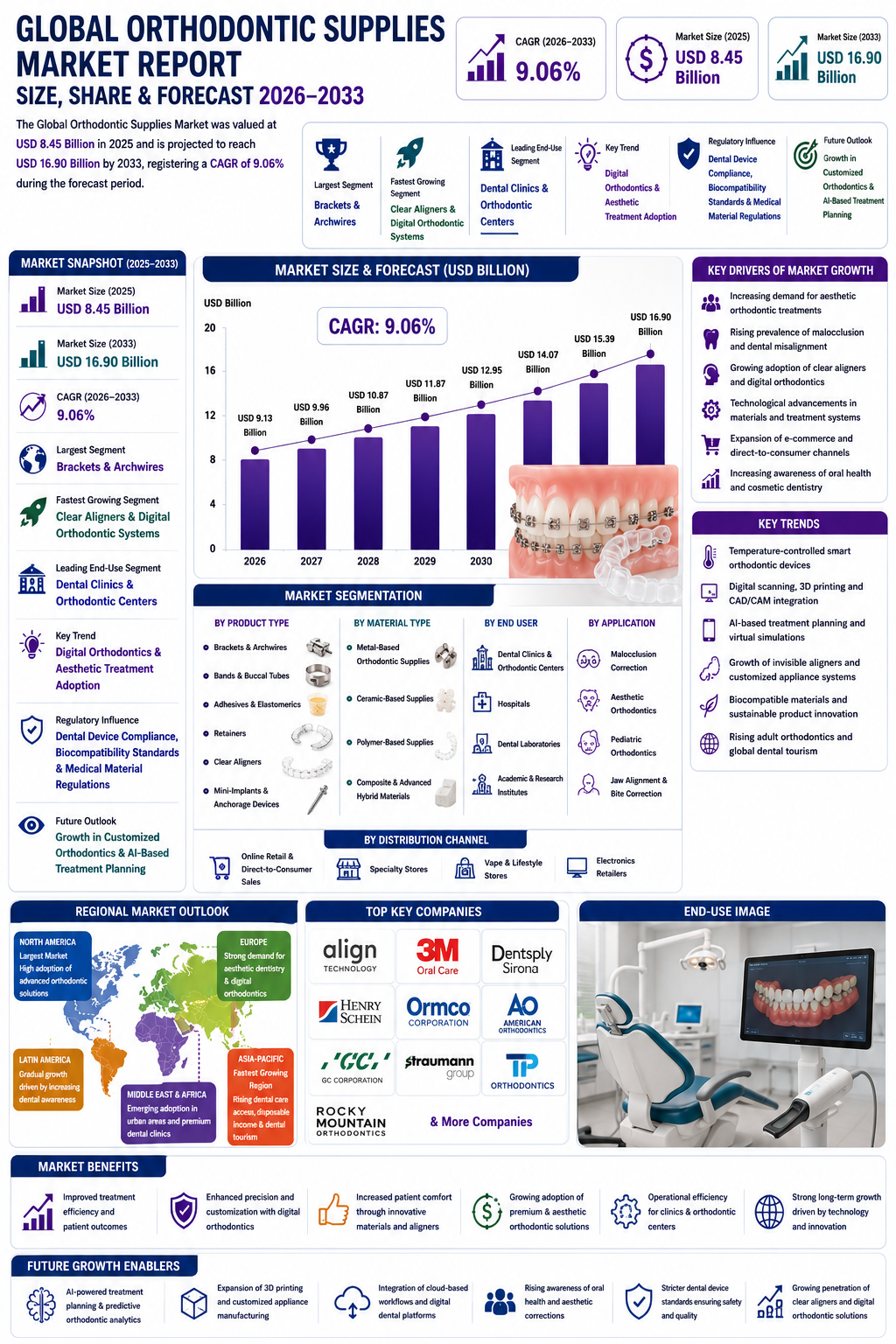
Market Size & Forecast
The Global Orthodontic Supplies Market is expected to witness strong expansion during the forecast period from 2026 to 2033. The market was valued at USD 8.45 billion in 2025 and is projected to reach approximately USD 16.90 billion by 2033, registering a CAGR of 9.06%.
The market growth is primarily driven by increasing demand for aesthetic dental treatments, rising prevalence of malocclusion, growing awareness of oral healthcare, and the rapid adoption of advanced orthodontic treatment solutions.
Orthodontic supplies are witnessing strong demand due to increasing adult orthodontics, pediatric dental care awareness, minimally invasive treatment options, and growing acceptance of clear aligners. Technological advancements in digital scanning, 3D printing, CAD/CAM systems, and AI-based orthodontic planning are also accelerating market development.
In addition, rising disposable income, expanding dental tourism, and growing penetration of personalized orthodontic treatment are supporting long-term industry expansion.
Global Orthodontic Supplies Market Overview
Orthodontic supplies include dental devices, materials, and accessories used to diagnose, prevent, and correct teeth and jaw alignment disorders.
The market includes brackets, archwires, bands & buccal tubes, adhesives, elastomerics, retainers, clear aligners, orthodontic mini-implants, and digital orthodontic planning tools.
These products are widely used in dental clinics, orthodontic specialty centers, hospitals, and dental laboratories for corrective and aesthetic dental procedures.
The market is shifting from conventional metal braces toward invisible aligners, self-ligating brackets, AI-assisted treatment simulation, digital impressions, and customized 3D-printed orthodontic solutions.
Structural Drivers of Market Growth
1. Innovation and Commercialization Acceleration
Rapid innovation in clear aligners, 3D-printed orthodontic models, CAD/CAM dentistry, and digital treatment planning is accelerating orthodontic market growth.
AI-based tooth movement simulation and customized aligner manufacturing are improving precision and patient comfort.
Market Implications
Companies investing in digital orthodontics, personalized aligners, and AI-assisted treatment workflows are expected to strengthen market leadership.
2. Compliance and Risk Repricing
Biocompatibility standards, dental device regulations, sterilization protocols, and orthodontic material safety requirements are reshaping product development.
Manufacturers are increasingly focusing on non-toxic materials, patient safety, and durable dental components.
Market Implications
Firms offering compliant, biocompatible, and precision-grade orthodontic supplies are likely to gain stronger market trust.
3. Competitive and Value-Chain Reconfiguration
The market is becoming increasingly competitive as dental technology firms, orthodontic device manufacturers, and digital dental platforms expand globally.
Direct-to-clinic solutions, digital dentistry ecosystems, and subscription aligner services are altering value-chain economics.
Market Implications
Companies focusing on digital integration, customized treatment systems, and clinic partnerships may gain stronger margins.
4. Capital and Capacity Scaling
Rising investment in dental laboratories, orthodontic software, 3D-printing systems, and AI-assisted diagnostics is supporting market expansion.
Emerging markets are also witnessing increasing dental infrastructure development.
Market Implications
Manufacturers scaling customized production, aligner capacity, and digital orthodontic workflows are expected to capture future opportunities.
Market Segmentation Analysis
By Product Type
1. Brackets & Archwires
This remains the largest segment due to broad use in traditional orthodontic treatments.
2. Bands & Buccal Tubes
Widely used in fixed appliance systems.
3. Adhesives & Elastomerics
Critical for bonding and treatment support.
4. Retainers
Used in post-treatment tooth stabilization.
5. Clear Aligners
Fastest-growing segment due to aesthetics, comfort, and digital customization.
6. Mini-Implants & Anchorage Devices
Increasingly used in complex orthodontic corrections.
By Material Type
1. Metal-Based Orthodontic Supplies
Common in conventional braces and structural devices.
2. Ceramic-Based Supplies
Growing in aesthetic orthodontics.
3. Polymer-Based Supplies
Widely used in aligners and retainers.
4. Composite & Advanced Hybrid Materials
Increasingly adopted in high-performance dental solutions.
By End User
1. Dental Clinics & Orthodontic Centers
Largest segment due to high patient volume and specialty treatment demand.
2. Hospitals
Used in oral surgery and corrective dental procedures.
3. Dental Laboratories
Critical for customized aligner and retainer production.
4. Academic & Research Institutes
Supporting orthodontic innovation and material research.
By Application
1. Malocclusion Correction
Largest application area.
2. Aesthetic Orthodontics
Rapidly growing due to adult treatment demand.
3. Pediatric Orthodontics
Strong growth due to preventive correction.
4. Jaw Alignment & Bite Correction
Important for advanced orthodontic interventions.
Regional Market Dynamics
North America
North America dominates the global orthodontic supplies market due to high dental spending, advanced orthodontic adoption, and strong clear-aligner penetration.
Europe
Europe remains a major market supported by aesthetic dentistry demand and strong dental care infrastructure.
Asia-Pacific
Asia-Pacific is the fastest-growing region due to rising dental awareness, increasing disposable income, and expanding dental tourism.
Latin America
Latin America is gradually expanding due to improving dental access and cosmetic dentistry growth.
Middle East & Africa
The region is witnessing emerging growth driven by urban dental clinics and premium orthodontic treatment adoption.
Competitive Landscape
The Global Orthodontic Supplies Market is highly competitive with dental device manufacturers, digital orthodontic companies, and clear-aligner solution providers expanding globally.
Key companies operating in the market include:
- Align Technology
- 3M Oral Care
- Dentsply Sirona
- Henry Schein
- Ormco Corporation
- American Orthodontics
- GC Corporation
- Straumann Group
- TP Orthodontics
- Rocky Mountain Orthodontics
Strategic Outlook
The future of the orthodontic supplies market will be shaped by digital dentistry, AI-driven treatment planning, clear aligner innovation, 3D-printing, and patient-specific orthodontic design.
Customized aligners, self-ligating braces, remote treatment monitoring, and virtual orthodontic consultation platforms are expected to significantly improve treatment accessibility and efficiency.
The expansion of aesthetic orthodontics, adult treatment demand, and digital dental workflows is expected to create strong long-term growth opportunities.
Final Market Perspective
The Global Orthodontic Supplies Market remains one of the fastest-growing segments within dental devices and oral healthcare. Rising demand for aesthetic correction, personalized treatment, and digital orthodontic innovation continues driving long-term market growth.
Manufacturers capable of delivering biocompatible, precise, AI-enabled, and customized orthodontic solutions will be best positioned to capture future opportunities. The convergence of digital scanning, clear aligners, 3D-printing, and smart treatment planning is expected to redefine the future of the global orthodontic supplies industry.
Table of Contents
Table of Contents
1. Executive Summary
1.1 Market Snapshot
1.2 Key Growth Highlights
1.3 Largest Segment Analysis
1.4 Fastest Growing Segment Analysis
1.5 Regional Outlook
1.6 Competitive Landscape Snapshot
1.7 Future Market Outlook
2. Global Orthodontic Supplies Market Introduction
2.1 Market Definition
2.2 Scope of Study
2.3 Market Assumptions
2.4 Research Methodology
2.5 Forecast Parameters
3. Global Orthodontic Supplies Market Overview
3.1 Market Evolution
3.2 Industry Ecosystem Analysis
3.3 Value Chain Analysis
3.4 Pricing Analysis
3.5 Supply Chain Structure
3.6 Technological Advancements in Orthodontic Supplies
3.6.1 Digital Orthodontics
3.6.1.1 AI-Based Treatment Planning
3.6.1.1.1 Smart Treatment Simulation
3.6.1.1.1.1 Predictive Tooth Movement Analysis
3.6.1.1.1.2 Remote Monitoring Solutions
3.7 Regulatory Landscape
3.7.1 Dental Device Regulations
3.7.1.1 Biocompatibility Standards
3.7.1.1.1 Sterilization & Safety Compliance
3.7.1.1.1.1 Material Validation Framework
3.8 Market Trends & Innovation Outlook
3.8.1 Personalized Orthodontic Treatment
3.8.1.1 Digital Workflow Optimization
3.8.1.1.1 3D Printed Orthodontic Solutions
3.8.1.1.1.1 Patient-Specific Aligners
4. Global Orthodontic Supplies Market Dynamics
4.1 Market Drivers
4.1.1 Rising Demand for Aesthetic Dental Treatments
4.1.1.1 Growth in Cosmetic Dentistry
4.1.1.1.1 Adult Orthodontic Adoption
4.1.1.1.1.1 Invisible Treatment Demand
4.1.2 Increasing Prevalence of Malocclusion
4.1.2.1 Jaw Alignment Disorders
4.1.2.1.1 Pediatric Orthodontic Growth
4.1.2.1.1.1 Preventive Dental Interventions
4.1.3 Growth in Adult Orthodontics
4.1.3.1 Rising Awareness of Smile Aesthetics
4.1.3.1.1 Personalized Treatment Adoption
4.1.3.1.1.1 Lifestyle-Oriented Orthodontic Demand
4.1.4 Expansion of Personalized Orthodontic Solutions
4.1.4.1 Customized Aligners
4.1.4.1.1 Digital Scanning Solutions
4.1.4.1.1.1 CAD/CAM Orthodontics
4.1.5 Rising Dental Tourism & Disposable Income
4.1.5.1 Emerging Treatment Destinations
4.1.5.1.1 Affordable Premium Dental Care
4.1.5.1.1.1 Cross-Border Orthodontic Demand
4.2 Market Restraints
4.2.1 High Cost of Advanced Orthodontic Treatments
4.2.1.1 Expensive Digital Solutions
4.2.1.1.1 Premium Treatment Cost Barriers
4.2.1.1.1.1 Limited Accessibility
4.2.2 Limited Access in Underdeveloped Regions
4.2.2.1 Low Dental Infrastructure
4.2.2.1.1 Specialist Shortages
4.2.2.1.1.1 Treatment Availability Gaps
4.2.3 Complex Regulatory Compliance
4.2.3.1 Material Safety Requirements
4.2.3.1.1 Product Approval Challenges
4.2.3.1.1.1 Regional Certification Delays
4.2.4 Treatment Duration & Patient Adherence Challenges
4.2.4.1 Long-Term Monitoring Needs
4.2.4.1.1 Compliance Issues
4.2.4.1.1.1 Therapy Completion Challenges
4.3 Market Opportunities
4.3.1 AI-Based Treatment Planning
4.3.1.1 Smart Imaging
4.3.1.1.1 Automated Diagnosis
4.3.1.1.1.1 Predictive Correction Systems
4.3.2 Growth in Clear Aligner Adoption
4.3.2.1 Cosmetic Orthodontics
4.3.2.1.1 Direct-to-Clinic Expansion
4.3.2.1.1.1 Premium Digital Aligners
4.3.3 Expansion of Digital Dentistry
4.3.3.1 CAD/CAM Systems
4.3.3.1.1 Virtual Consultation Platforms
4.3.3.1.1.1 Remote Treatment Workflows
4.3.4 3D Printing & Customized Orthodontics
4.3.4.1 Precision Fabrication
4.3.4.1.1 Rapid Prototyping
4.3.4.1.1.1 Mass Customization Models
4.4 Market Challenges
4.4.1 Material Safety & Biocompatibility Issues
4.4.2 Competitive Pressure from Direct-to-Consumer Brands
4.4.3 Skilled Orthodontic Workforce Limitations
4.4.4 Cost Management & Scalability
5. Global Orthodontic Supplies Market Size Analysis (USD Billion), 2026–2033
5.1 Market Revenue Forecast
5.2 CAGR Analysis
5.3 Segment Contribution Analysis
5.4 Demand-Supply Trends
5.5 Pricing & Cost Structure Analysis
6. Global Orthodontic Supplies Market Segmentation Analysis
6.1 By Product Type
6.1.1 Brackets & Archwires
6.1.1.1 Metal Brackets
6.1.1.1.1 Ceramic Brackets
6.1.1.1.1.1 Self-Ligating Systems
6.1.2 Bands & Buccal Tubes
6.1.2.1 Fixed Appliance Components
6.1.2.1.1 Orthodontic Stabilization Systems
6.1.2.1.1.1 Structural Support Devices
6.1.3 Adhesives & Elastomerics
6.1.3.1 Bonding Materials
6.1.3.1.1 Elastic Treatment Components
6.1.3.1.1.1 Precision Fixation Solutions
6.1.4 Retainers
6.1.4.1 Fixed Retainers
6.1.4.1.1 Removable Retainers
6.1.4.1.1.1 Long-Term Stabilization Systems
6.1.5 Clear Aligners
6.1.5.1 Invisible Orthodontics
6.1.5.1.1 Smart Aligner Platforms
6.1.5.1.1.1 Customized Digital Aligners
6.1.6 Mini-Implants & Anchorage Devices
6.1.6.1 Skeletal Anchorage Systems
6.1.6.1.1 Temporary Anchorage Devices
6.1.6.1.1.1 Precision Tooth Control Units
6.2 By Material Type
6.2.1 Metal-Based Orthodontic Supplies
6.2.2 Ceramic-Based Supplies
6.2.3 Polymer-Based Supplies
6.2.4 Composite & Advanced Hybrid Materials
6.3 By End User
6.3.1 Dental Clinics & Orthodontic Centers
6.3.2 Hospitals
6.3.3 Dental Laboratories
6.3.4 Academic & Research Institutes
6.4 By Application
6.4.1 Malocclusion Correction
6.4.2 Aesthetic Orthodontics
6.4.3 Pediatric Orthodontics
6.4.4 Jaw Alignment & Bite Correction
7. Regional Market Analysis
7.1 North America
7.2 Europe
7.3 Asia-Pacific
7.4 Latin America
7.5 Middle East & Africa
8. Competitive Landscape
8.1 Market Share Analysis
8.2 Competitive Intensity Overview
8.3 Strategic Developments
8.4 Product Innovation & Portfolio Expansion
8.5 Partnerships, Mergers & Acquisitions
8.6 Digital Orthodontics Competitive Positioning
9. Company Profiles
9.1 Align Technology
9.2 3M Oral Care
9.3 Dentsply Sirona
9.4 Henry Schein
9.5 Ormco Corporation
9.6 American Orthodontics
9.7 GC Corporation
9.8 Straumann Group
9.9 TP Orthodontics
9.10 Rocky Mountain Orthodontics
10. Strategic Intelligence & Pheonix AI Insights
10.1 Pheonix Demand Forecast Engine
10.2 Digital Orthodontics Adoption Analyzer
10.3 Material Innovation Tracker
10.4 Product Development Insights
10.5 Automated Porter’s Five Forces Analysis
11. Future Outlook & Strategic Recommendations
11.1 AI-Based Orthodontic Growth
11.2 Customized Treatment Expansion
11.3 Digital Workflow Adoption
11.4 Emerging Market Strategies
11.5 Long-Term Outlook (2033+)
12. Appendix
13. About Pheonix Market Research
14. Disclaimer
Competitive Landscape
Global Orthodontic Supplies Market Competitive Intensity & Market Structure Overview
The Global Orthodontic Supplies Market is characterized by a moderately consolidated and innovation-driven competitive structure, led by dental device manufacturers, orthodontic specialty companies, clear-aligner providers, and digital dentistry solution firms. Competition is primarily driven by clear aligner innovation, digital orthodontics, treatment customization, AI-based planning, biocompatible materials, and clinic integration capabilities.
The market is shaped by established players such as Align Technology, 3M Oral Care, Dentsply Sirona, Henry Schein, Ormco Corporation, American Orthodontics, GC Corporation, Straumann Group, TP Orthodontics, and Rocky Mountain Orthodontics, which compete through product innovation, orthodontic workflow digitization, material science, and strong dental clinic networks.
Rising demand across aesthetic orthodontics, adult dental correction, pediatric treatment, customized aligners, and digital treatment planning is intensifying global competition. Companies are increasingly focusing on 3D printing, CAD/CAM systems, AI-assisted simulation, remote monitoring, and patient-specific orthodontic devices.
Global Orthodontic Supplies Market Competitive Landscape
Leading Company Profiles
- Align Technology – Market leader in clear aligners and digital orthodontic workflows, with strong AI-driven treatment planning and scanner ecosystem integration.
- 3M Oral Care – Major provider of orthodontic brackets, adhesives, and dental treatment solutions with strong global clinical reach.
- Dentsply Sirona – Leading dental technology company with orthodontic systems, digital imaging, and CAD/CAM integration capabilities.
- Henry Schein – Strong distributor and provider of orthodontic supplies, digital dentistry products, and clinic-based solutions.
- Ormco Corporation – Specialized orthodontics company known for aligners, brackets, and advanced orthodontic systems.
- American Orthodontics – Major supplier of brackets, archwires, and fixed orthodontic treatment systems.
- GC Corporation – Active in dental materials, adhesives, and orthodontic consumables.
- Straumann Group – Expanding presence in digital dentistry, orthodontics, and personalized dental treatment solutions.
- TP Orthodontics – Focused on orthodontic appliances, aligner systems, and specialty treatment products.
- Rocky Mountain Orthodontics – Established manufacturer of brackets, wires, and orthodontic accessories.
Key Competitive Intensity Signals
- Rapid growth in clear aligners and digital orthodontic systems is increasing innovation-led competition.
- AI-based treatment simulation and customized aligners are becoming major differentiators.
- Direct-to-clinic solutions and digital dentistry ecosystems are reshaping value-chain dynamics.
- Material innovation in ceramic, polymer, and hybrid dental devices is strengthening product differentiation.
- Expansion of adult orthodontics and aesthetic dentistry is widening the competitive base.
- 3D printing and CAD/CAM integration are accelerating workflow efficiency competition.
- Regulatory compliance around biocompatibility and dental device safety remains a key barrier to entry.
Strategic Implications
- Clear aligner innovation and digital workflow integration will remain major competitive advantages.
- Companies with strong orthodontic clinic and dental lab partnerships are expected to gain higher market share.
- AI-assisted planning and remote treatment monitoring can improve long-term differentiation.
- Customized orthodontics and patient-specific solutions are strengthening premium market opportunities.
- Biocompatibility, precision, and clinical trust remain critical for sustained growth.
Forward Outlook
The Global Orthodontic Supplies Market is expected to remain moderately consolidated with high competitive intensity, supported by strong digital transformation and aesthetic treatment demand.
Future competition will increasingly focus on:
- Clear aligner innovation and scalability
- AI-based orthodontic treatment planning
- 3D printing and CAD/CAM integration
- Remote orthodontic monitoring platforms
- Self-ligating and low-friction bracket technologies
- Customized patient-specific orthodontic systems
- Digital dentistry ecosystem expansion
The convergence of AI, digital scanning, aesthetic dentistry, 3D-printing, clear aligners, and personalized treatment planning will continue reshaping the long-term competitive landscape.
Value Chain
Global Orthodontic Supplies Market Value Chain & Supply Chain Evolution Overview
The Global Orthodontic Supplies Market operates through a precision-driven dental device ecosystem supported by biomaterial sourcing, customized manufacturing, digital treatment planning, dental laboratory integration, and clinic-based treatment delivery. The value chain is increasingly shaped by digital orthodontics, clear aligners, AI-based treatment simulation, and patient-specific dental solutions.
The supply chain is highly specialized due to strict biocompatibility requirements, sterilization compliance, customized device manufacturing, digital workflow dependency, and clinic-laboratory coordination. Manufacturers are integrating 3D printing, CAD/CAM systems, and AI-driven treatment planning to improve efficiency, personalization, and treatment precision.
Global Orthodontic Supplies Market Value Chain & Supply Chain Evolution Current Scenario
Market-Specific Value Chain
1. Raw Material & Medical Input Sourcing
Dental-grade stainless steel, nickel-titanium alloys, polymers, ceramics, elastomers, adhesives, composites, and biocompatible materials.
2. Digital Design & Treatment Planning
AI-based tooth movement simulation, CAD/CAM systems, intraoral scanning, orthodontic software, and digital aligner planning.
3. Precision Manufacturing & Device Production
Brackets, archwires, retainers, mini-implants, clear aligners, bands, buccal tubes, and customized 3D-printed orthodontic systems.
4. Quality Testing & Regulatory Validation
Biocompatibility testing, sterilization, durability testing, dental device compliance, and material safety approvals.
5. Distribution & Clinical Supply Networks
Dental distributors, direct-to-clinic channels, orthodontic suppliers, hospitals, specialty dental networks, and dental laboratories.
6. End-Use Treatment Ecosystem
Dental clinics, orthodontic centers, hospitals, laboratories, and academic institutions.
Key Value Chain Evolution Signals
1. Shift Toward Clear Aligners & Customized Devices
Patient-specific manufacturing is reshaping workflows.
2. AI-Driven Digital Orthodontics
Treatment planning and remote monitoring are increasing efficiency.
3. Dental Lab Integration
Lab-clinic coordination is critical for custom appliances.
4. Regulatory & Biocompatibility Focus
Safety and medical-grade compliance remain essential.
5. 3D Printing Expansion
Rapid prototyping and precision customization are scaling.
6. Direct-to-Clinic Supply Growth
Manufacturers increasingly strengthen clinical partnerships.
Strategic Implications
1. Personalized Manufacturing Advantage
Custom aligner and retainer production improves margins.
2. Digital Ecosystem Integration
Software + hardware synergy is becoming critical.
3. Faster Lab-to-Clinic Turnaround
Improves treatment speed and customer retention.
4. Compliance-Led Differentiation
Certified, safe, and durable materials build trust.
5. Premium Aesthetic Treatment Growth
Invisible and digital orthodontics support premiumization.
Forward Outlook
The market is expected to evolve toward a more AI-enabled, digitally integrated, and customized orthodontic ecosystem driven by:
- AI treatment planning
- 3D-printed appliances
- Remote orthodontic monitoring
- Digital dental workflows
- Higher clear aligner adoption
- Advanced biomaterials
- Stronger lab-clinic integration
Investment Activity
Global Orthodontic Supplies Market Investment & Funding Dynamics Overview
The Global Orthodontic Supplies Market is witnessing strong investment momentum driven by rising adoption of aesthetic dentistry, digital orthodontics, and personalized treatment solutions. Dental device manufacturers, orthodontic technology firms, aligner producers, dental software providers, and medical material companies are actively investing in clear aligners, AI-based treatment planning, and advanced digital orthodontic ecosystems.
Investment activity is being accelerated by increasing demand for adult orthodontics, pediatric corrective treatments, minimally invasive dental solutions, and customized aligner systems. Rapid innovation in digital scanning, CAD/CAM dentistry, 3D printing, AI-assisted tooth movement simulation, and remote orthodontic monitoring is significantly reshaping capital allocation across the market.
Additionally, expanding investments in dental laboratories, orthodontic centers, digital treatment software, and customized dental manufacturing are strengthening long-term growth opportunities globally.
Global Orthodontic Supplies Market Investment & Funding Dynamics Current Scenario
Currently, the Global Orthodontic Supplies Market demonstrates rising investment activity with high capital intensity due to advanced dental device R&D, aligner manufacturing complexity, digital workflow integration, and orthodontic infrastructure expansion. Major players are heavily investing in clear aligners, self-ligating brackets, AI-based planning software, digital impressions, and 3D-printed orthodontic models.
The market is attracting strong funding into digital dentistry platforms, customized treatment systems, remote monitoring tools, and precision dental materials. Increasing expansion of dental tourism, specialty orthodontic clinics, and aligner capacity scaling is also strengthening investment flow.
The industry is witnessing active merger and acquisition activity as dental technology firms, orthodontic suppliers, and digital dental platform providers pursue strategic acquisitions, product diversification, and technology integration.
Key Investment & Funding Dynamics Signals in Global Orthodontic Supplies Market
- Rising adoption of clear aligners, digital scanning, AI planning, and 3D-printing technologies is accelerating orthodontic innovation investments.
- Expansion of digital dentistry ecosystems, dental laboratories, and customized aligner production is increasing long-term capital deployment.
- Growing demand for aesthetic orthodontics, adult treatment, and personalized dental correction systems is strengthening R&D spending.
- Strategic investments in direct-to-clinic models, remote monitoring, and orthodontic software platforms are reshaping market economics.
- Partnerships between dental device manufacturers, software providers, orthodontic centers, and laboratories are strengthening innovation ecosystems.
- Increasing regulatory focus on biocompatibility, sterilization, dental safety, and material compliance is improving investor confidence.
- Rising demand for precise, aesthetic, and patient-specific orthodontic solutions is accelerating manufacturing and software funding.
Strategic Implications of Investment & Funding Dynamics in Global Orthodontic Supplies Market
- Continuous investment in digital orthodontics, AI-assisted treatment planning, and customized dental solutions is essential for long-term competitiveness.
- High capital intensity requires strong allocation toward R&D, dental manufacturing systems, and software-driven treatment ecosystems.
- Companies capable of delivering biocompatible, customized, precise, and AI-enabled orthodontic products will strengthen market positioning significantly.
- Strategic M&A and digital dentistry integration are accelerating product ecosystem diversification.
- Investments in aligner production capacity, remote treatment monitoring, and dental workflow automation will remain major priorities.
- Compliance with dental safety, sterilization, and biocompatibility standards is critical for long-term adoption.
- Companies investing in aesthetic orthodontics, personalized aligners, and AI-driven dental diagnostics are expected to capture substantial future opportunities.
Global Orthodontic Supplies Market Investment & Funding Dynamics Forward Outlook
Looking ahead, the Global Orthodontic Supplies Market is expected to maintain strong investment growth driven by clear aligner expansion, digital dentistry adoption, AI-based treatment planning, and customized orthodontic manufacturing.
Future capital deployment will increasingly focus on smart aligner ecosystems, remote orthodontic monitoring, 3D-printing systems, CAD/CAM integration, virtual consultation platforms, and patient-specific treatment automation. Digital workflows and personalized orthodontics are expected to become major innovation priorities.
In conclusion, the Global Orthodontic Supplies Market represents a high-growth, innovation-intensive investment landscape where digital orthodontics, aligner scalability, AI integration, and customized treatment ecosystems will define future capital strategies.
Technology & Innovation
Global Orthodontic Supplies Market Technology & Innovation Landscape Overview
The Global Orthodontic Supplies Market is undergoing rapid transformation driven by advancements in digital orthodontics, AI-based treatment planning, 3D printing, CAD/CAM dentistry, intraoral scanning, and customized clear aligner technologies. The market demonstrates a high innovation intensity level, supported by rising demand for aesthetic dental correction, personalized orthodontics, and precision-based treatment workflows.
At the center of this transformation is the shift from traditional fixed appliances toward digitally designed orthodontic systems capable of improving treatment precision, patient comfort, and clinical efficiency. Manufacturers are increasingly investing in AI-powered tooth movement simulation, treatment prediction software, and customized aligner manufacturing to enhance orthodontic outcomes.
A major innovation area is clear aligner technology, where thermoformed polymers, transparent biocompatible materials, and digitally customized aligners are reshaping aesthetic orthodontics. These systems improve comfort, removability, and treatment personalization compared with conventional braces.
The market is also seeing rapid development in 3D printing and CAD/CAM-based orthodontic fabrication, allowing precise production of retainers, aligners, brackets, and dental models with faster turnaround times and reduced material waste.
Digital dentistry integration remains critical, with increasing adoption of intraoral scanners, cloud-based treatment planning, remote monitoring platforms, and virtual orthodontic simulations that improve workflow automation and patient engagement.
Manufacturers are innovating in self-ligating brackets, smart archwires, mini-implant anchorage systems, and advanced elastomeric materials, improving force control, efficiency, and biomechanical performance.
Additionally, advances in biocompatible ceramics, polymer composites, low-friction coatings, and AI-driven orthodontic analytics are reshaping competitive differentiation across the industry.
The convergence of digital dentistry, precision materials, orthodontic automation, and personalized treatment ecosystems is redefining the future technology landscape of the orthodontic supplies market.
Global Orthodontic Supplies Market Technology & Innovation Landscape Current Scenario
Currently, the Global Orthodontic Supplies Market demonstrates high patent activity and strong commercialization across digital orthodontics, aligner manufacturing, and smart treatment-planning ecosystems.
1. Clear Aligner & Customized Orthodontic Innovation
Digitally fabricated aligners and patient-specific treatment systems are driving rapid market growth.
2. AI-Based Orthodontic Planning
AI-powered tooth movement prediction and treatment simulation are improving precision.
3. 3D Printing & CAD/CAM Fabrication
Rapid prototyping and digital manufacturing are improving orthodontic supply customization.
4. Digital Scanning & Virtual Orthodontics
Intraoral scanning and virtual modeling are replacing conventional impressions.
5. Advanced Biocompatible Material Engineering
Ceramic, polymer, and hybrid materials are improving aesthetics and durability.
6. Remote Monitoring & Smart Orthodontic Platforms
Cloud-connected monitoring and virtual consultations are expanding treatment accessibility.
Key Technology & Innovation Landscape Signals in Global Orthodontic Supplies Market
Several innovation signals are shaping the market:
1. Rising Adoption of Aesthetic Orthodontics
Demand for invisible and low-visibility treatment systems is expanding rapidly.
2. Growth of AI & Digital Treatment Planning
AI-based orthodontic workflows are improving clinical efficiency and treatment prediction.
3. Increasing Use of 3D Printing Technologies
Customized production of aligners, retainers, and dental models is accelerating.
4. Expansion of Remote Orthodontic Monitoring
Tele-orthodontics and digital follow-up systems are improving patient convenience.
5. Advanced Material Innovation
Low-friction, transparent, and durable biocompatible materials are becoming key differentiators.
6. Personalized Orthodontic Workflows
Patient-specific treatment design is improving comfort and therapeutic precision.
Strategic Implications of Technology & Innovation Landscape in Global Orthodontic Supplies Market
The evolving technology landscape is significantly reshaping competition across the orthodontic supplies market. Companies are increasingly competing on digital precision, treatment customization, biocompatibility, workflow automation, AI simulation, and patient comfort.
Manufacturers investing in clear aligners, AI-driven planning systems, digital dentistry ecosystems, and scalable 3D fabrication technologies are expected to strengthen long-term market positioning.
Strategic collaborations between dental device firms, orthodontic clinics, digital dentistry software providers, and laboratory networks are accelerating commercialization and reshaping treatment ecosystems globally.
The growing convergence of AI, cloud dentistry, intraoral scanning, CAD/CAM, advanced biomaterials, and tele-orthodontics is creating strong long-term differentiation opportunities.
Additionally, regulatory emphasis on dental safety, biocompatibility, and precision medical materials is encouraging stronger R&D and quality-focused innovation.
Global Orthodontic Supplies Market Technology & Innovation Landscape Forward Outlook
Looking ahead to 2026–2033, the Global Orthodontic Supplies Market is expected to evolve toward highly personalized, AI-assisted, and fully digital orthodontic ecosystems.
Future technological developments are likely to include:
1. AI-Driven Predictive Orthodontics
Advanced treatment simulation and automated tooth-movement optimization will expand rapidly.
2. Next-Generation Clear Aligner Systems
Smarter, thinner, and more durable aligner materials will improve aesthetics and performance.
3. Full Digital Workflow Orthodontics
Scanning, planning, fabrication, and monitoring will become increasingly integrated.
4. Smart Orthodontic Monitoring Platforms
Wearables, remote tracking, and digital compliance tools may improve treatment adherence.
5. High-Precision 3D Printed Devices
Customized orthodontic products will become faster and more cost-efficient.
6. Advanced Biomaterials & Low-Friction Systems
Improved polymers, ceramics, and hybrid materials will enhance comfort and durability.
7. Virtual Orthodontics & Tele-Dentistry Expansion
Remote consultations and AI-supported monitoring will strengthen treatment accessibility.
Overall, companies capable of combining digital dentistry, AI innovation, biomaterial engineering, patient customization, scalable orthodontic manufacturing, and treatment automation will be best positioned to lead the future evolution of the Global Orthodontic Supplies Market.
Market Risk
Global Orthodontic Supplies Market Risk & Disruption Analysis
The Global Orthodontic Supplies Market operates within a moderate-to-high disruption environment, driven by digital orthodontics adoption, material innovation, evolving dental device regulations, pricing pressure from direct-to-consumer aligner models, reimbursement variability, and rapid treatment personalization. While the market demonstrates strong long-term growth due to rising aesthetic dentistry demand, malocclusion prevalence, and increasing adult orthodontic treatment adoption, it remains exposed to regulatory oversight, technology disruption, supply chain dependency, and competitive restructuring.
A defining structural characteristic of the market is its transition from traditional mechanical orthodontics toward digitally customized and software-assisted treatment ecosystems. Conventional brackets, archwires, and fixed appliances continue to dominate procedural volume, but high-growth value is shifting toward clear aligners, AI-based treatment simulation, intraoral scanning, CAD/CAM workflows, and 3D-printed orthodontic customization.
The market is also increasingly influenced by convergence between dental devices, biomaterials, digital imaging, software platforms, and remote monitoring technologies, creating pressure for manufacturers to move beyond physical products into integrated treatment ecosystems.
Global Orthodontic Supplies Market Current Risk Environment
The current market environment is characterized by strong procedural demand, digital disruption, and rising clinical standardization.
One of the most significant disruption factors involves competitive displacement from clear aligners and digital orthodontic systems. Traditional brackets and mechanical orthodontic supplies remain high-volume segments, but clear aligners are rapidly capturing value due to aesthetics, patient comfort, reduced chair time, and personalized workflows.
Another major risk area is regulatory and biocompatibility compliance pressure. Orthodontic supplies must meet strict medical-grade material safety, sterilization, biocompatibility, and dental device standards. Polymer-based aligners, adhesives, ceramic components, and mini-implants require rigorous quality assurance and clinical reliability.
The market also faces pricing compression and DTC (direct-to-consumer) disruption. Subscription-based aligner services, remote orthodontic monitoring, and online dental treatment models are reshaping pricing structures and clinic-centered value chains.
Additionally, digital workflow dependency is increasing. Orthodontic ecosystems increasingly rely on intraoral scanners, AI treatment planning, CAD/CAM design, digital imaging, cloud platforms, and 3D printing. This creates software integration risk, cybersecurity exposure, and platform dependency.
In parallel, raw material volatility in specialty metals, ceramics, polymers, and dental-grade composites may affect manufacturing cost structures.
Key Market Risk & Disruption Signals in Global Orthodontic Supplies Market
1. Clear Aligner Displacement of Traditional Orthodontics
Digital aligners are shifting market value away from conventional brackets and wire-based systems.
2. Medical Material & Biocompatibility Compliance
Dental-grade polymers, ceramics, adhesives, and implantable materials face strict safety and quality standards.
3. DTC & Subscription Orthodontics Disruption
Remote aligner platforms and online treatment ecosystems are increasing pricing competition and disintermediation risk.
4. Digital Workflow & Software Dependency
AI planning tools, scanners, CAD/CAM, cloud platforms, and digital treatment ecosystems create operational dependency.
5. Supply Chain Exposure to Specialty Dental Materials
Dependence on advanced polymers, orthodontic metals, ceramics, and dental composites increases cost and sourcing risk.
6. Reimbursement & Affordability Variability
Orthodontic treatment remains highly sensitive to private-pay models and insurance limitations.
7. Brand & Clinical Trust Sensitivity
Clinical precision, treatment predictability, and long-term patient outcomes strongly influence adoption.
8. Rapid Product Customization Pressure
Patient-specific aligners and personalized orthodontic design reduce relevance of standardized supply models.
Strategic Implications of Market Risk & Disruption in Global Orthodontic Supplies Market
The evolving disruption environment creates strong growth opportunities alongside structural transformation.
One of the most important strategic implications is the need for digital-first orthodontic ecosystems. Manufacturers increasingly must combine physical orthodontic supplies with treatment-planning software, AI-driven simulation, scanning integration, and patient-specific manufacturing.
Companies are required to invest in clear aligners, digital workflows, smart orthodontic monitoring, 3D printing, and clinic-based SaaS ecosystems to defend long-term competitiveness.
Vertical integration across scanning, aligner manufacturing, biomaterials, treatment planning, and cloud-based orthodontic platforms is becoming increasingly valuable.
The convergence of AI, tele-orthodontics, intraoral imaging, and digital dentistry is also reshaping the value chain. Firms with stronger interoperability across clinics, labs, and orthodontic specialists may gain higher recurring revenue and treatment ecosystem lock-in.
Additionally, growth in emerging dental tourism markets and adult cosmetic dentistry may significantly expand high-margin demand.
Companies focusing on digital orthodontics, customized aligners, high-performance biomaterials, clinic partnerships, and AI-driven treatment ecosystems are expected to strengthen long-term market leadership.
Global Orthodontic Supplies Market Risk & Disruption Forward Outlook
Looking ahead to 2026–2033, the Global Orthodontic Supplies Market is expected to become increasingly digital, personalized, and ecosystem-driven.
1. Expansion of Clear Aligners & Digital Orthodontics
Clear aligners and software-guided treatment systems will capture increasing market share.
2. AI-Based Treatment Planning Growth
Tooth-movement simulation, predictive analytics, and automated treatment design will improve precision and efficiency.
3. Greater 3D Printing & Custom Manufacturing
Patient-specific orthodontic production will accelerate across aligners, retainers, and anchorage systems.
4. Rising Remote Monitoring & Tele-Orthodontics
Virtual treatment supervision and digital consultation models will reshape patient engagement.
5. Higher Biocompatibility & Clinical Validation Standards
Material safety and treatment predictability requirements will become stronger.
6. Continued Competitive Consolidation
Strategic M&A and platform integration may increase among dental technology leaders.
7. Expansion of Adult Cosmetic Orthodontics
Aesthetic demand will continue strengthening premium orthodontic segments.
8. Growth in Emerging Markets & Dental Tourism
Asia-Pacific, Latin America, and selected MEA markets may accelerate adoption.
In conclusion, the Global Orthodontic Supplies Market represents a high-growth, clinically sensitive, and digitally transforming dental ecosystem, where customization, AI integration, regulatory compliance, treatment precision, and ecosystem-based orthodontic workflows will define long-term competitive success.
Regulatory Landscape
Global Orthodontic Supplies Market Regulatory & Policy Environment Overview
The regulatory and policy environment plays a critical role in shaping the Global Orthodontic Supplies Market as healthcare regulators, dental device authorities, and medical material compliance bodies increasingly emphasize patient safety, biocompatibility, sterilization, and dental treatment precision. Regulatory frameworks governing orthodontic devices, dental materials, clear aligners, implants, and digital orthodontic systems significantly influence manufacturing, commercialization, clinical adoption, and global market access.
Orthodontic supplies operate within the broader dental device and oral healthcare ecosystem. As products increasingly integrate digital scanning, CAD/CAM systems, AI-based treatment planning, 3D printing, and personalized aligner manufacturing, regulatory oversight on device quality, material safety, and treatment accuracy is becoming more important.
The market is also influenced by evolving medical device regulations related to biocompatibility testing, infection control, sterilization standards, digital dental software validation, and patient-specific treatment devices. International dental quality certifications and healthcare compliance frameworks continue shaping global product development.
In addition, rising demand for minimally invasive orthodontics, aesthetic correction, and remote treatment monitoring is expanding the regulatory scope of digital orthodontic solutions and AI-assisted workflows.
Global Orthodontic Supplies Market Regulatory & Policy Environment Current Scenario
Currently, the Global Orthodontic Supplies Market operates under a highly structured dental device and medical materials regulatory framework involving biocompatibility standards, clinical safety rules, sterilization compliance, digital treatment validation, and product-specific certifications.
One of the most important regulatory trends influencing the market is the growing focus on biocompatibility and patient safety. Orthodontic brackets, archwires, adhesives, aligners, and mini-implants must meet strict standards for non-toxicity, oral safety, durability, and tissue compatibility.
Another major regulatory development involves increasing oversight of digital orthodontics and AI-enabled treatment planning. As clear aligners, remote monitoring systems, and digital simulations become more common, compliance around software reliability, treatment precision, and clinical validation is becoming increasingly relevant.
Sterilization and infection-control standards also remain important, particularly in dental clinics, orthodontic centers, and laboratories handling reusable or invasive orthodontic components.
Additionally, 3D printing and customized aligner manufacturing are driving stronger quality-control expectations for patient-specific devices.
Healthcare reimbursement and dental treatment accessibility policies in developed regions are also influencing market expansion.
Key Regulatory & Policy Environment Signals in Global Orthodontic Supplies Market
1. Rising Biocompatibility & Dental Material Standards
Orthodontic materials require strict compliance for oral safety, durability, and tissue compatibility.
2. Expansion of Digital Orthodontic & AI Validation Oversight
AI-based treatment planning and clear aligner systems increase focus on software precision and treatment accuracy.
3. Growing Sterilization & Infection-Control Requirements
Dental device hygiene and sterilization compliance remain essential.
4. Customized Device & 3D Printing Quality Controls
Patient-specific aligners and printed orthodontic solutions require stronger quality assurance.
5. Medical Device Certification & Clinical Safety Influence
Global dental device approvals and clinical safety frameworks shape commercialization.
Strategic Implications of Regulatory & Policy Environment in Global Orthodontic Supplies Market
The evolving regulatory environment creates major strategic implications for orthodontic manufacturers, dental device firms, clear-aligner providers, and digital dentistry platforms. One of the most important implications is the increasing need for clinically validated, biocompatible, and precision-grade orthodontic solutions.
Manufacturers must invest heavily in material safety testing, dental certifications, sterilization compliance, AI validation, and customized production quality controls to remain competitive.
The increasing convergence of orthodontics, AI, digital dentistry, and personalized treatment is also pushing firms toward software-integrated and compliance-led innovation.
Companies capable of balancing aesthetics, clinical precision, digital treatment accuracy, and regulatory compliance will likely strengthen long-term market positioning.
Additionally, firms with strong dental-clinic partnerships, scalable aligner production, and digitally validated treatment ecosystems will gain stronger competitive advantages.
Global Orthodontic Supplies Market Regulatory & Policy Environment Forward Outlook
Looking ahead to 2026–2033, the regulatory environment for orthodontic supplies is expected to become increasingly digital-health-focused, patient-safety-driven, and precision-oriented as clear aligners, AI planning, and customized orthodontics continue expanding globally.
Future regulations are likely to place stronger emphasis on AI treatment transparency, patient-specific device validation, digital workflow accuracy, and long-term oral safety.
Regulatory agencies may continue strengthening standards for orthodontic materials, sterilization, software-based treatment systems, and remote orthodontic monitoring.
The expansion of virtual orthodontics, customized aligners, 3D-printed dental devices, and smart oral-health ecosystems may further increase compliance expectations.
Overall, the regulatory and policy environment will remain a critical factor influencing clinical trust, safety validation, digital transformation, treatment quality, and competitive positioning within the Global Orthodontic Supplies Market. Companies capable of balancing innovation, biocompatibility, regulatory compliance, digital precision, and scalable customization will be best positioned to capture long-term growth opportunities.
