
Global Run-Flat Tyres Market size , share & Analysis 2026-2033
Market Forecast Snapshot (2026???2033)
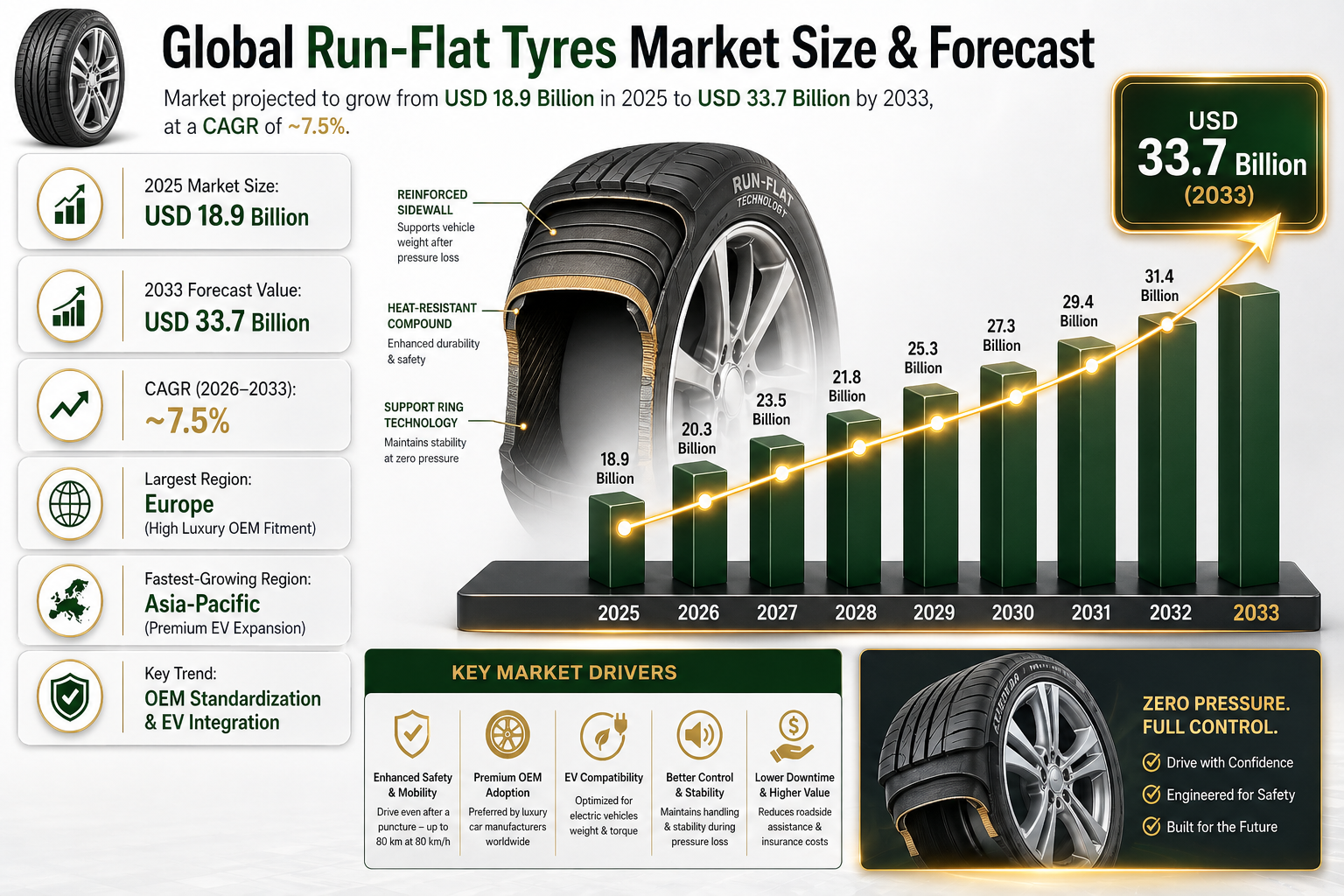
| Metric | Value |
|---|---|
| 2025 Market Size | USD 18.9 Billion |
| 2033 Market Size | USD 33.7 Billion |
| CAGR (2026???2033) | ~7.5% |
| Largest Region | Europe |
| Fastest-Growing Region | Asia-Pacific |
| Largest Segment | Self-supporting run-flat tyres |
| Fastest-Growing Segment | EV-compatible run-flat tyres |
| Key Trend | OEM standardization & EV integration |
Global Run-Flat Tyres Market Overview
The Global Run-Flat Tyres Market is all about tyres that keep you rolling even after a puncture???no need to stop and change it right away . You can safely drive for a limited distance and speed, which is super handy. They???re mostly found on passenger cars, luxury SUVs, performance rides, and electric vehicles. Basically, they give you peace of mind and extra safety on the road.
Run-flat tyres have super-strong sidewalls or internal rings that keep them from collapsing when air pressure drops . That means you can keep driving safely for a while after a puncture, no need to swap tyres on the spot. They also help car makers ditch the spare tyre, saving space and weight. Mostly seen in luxury and performance cars, but more people are catching on and buying them aftermarket too.
With rising focus on vehicle safety standards, premium vehicle sales, EV adoption, and smart mobility, run-flat tyres are transitioning from niche products to mainstream offerings in developed automotive markets.
According to the Pheonix Demand Forecast Engine, the Global Run-Flat Tyres Market size is valued at USD 18.9 billion in 2025 and is projected to reach USD 33.7 billion by 2033, expanding at a CAGR of ~7.5% during the forecast period (2026???2033).
Europe is the largest market, driven by luxury vehicle penetration and OEM fitment, while Asia-Pacific is the fastest-growing region, supported by rising premium car sales and EV adoption.
Key Drivers of Global Run-Flat Tyres Market Growth
Rising Vehicle Safety Standards
Automakers and regulators emphasize safety technologies that reduce roadside breakdown risks, supporting run-flat tyre adoption.
Growth in Luxury & Premium Vehicles
Run-flat tyres come as standard or optional on premium sedans, luxury SUVs, and sports cars . Their safety and convenience boost appeal in these high-end rides. This trend fuels market growth.
OEM Adoption & Platform Standardization
Leading OEMs increasingly design vehicle platforms optimized for run-flat tyres.
Electric Vehicle Adoption
EVs benefit from run-flat tyres due to space savings, weight reduction, and safety benefits.
Urban Mobility & Convenience Demand
Consumers prioritize convenience and uninterrupted mobility in dense urban environments.
Technological Advancements
Improved ride comfort, noise reduction, and durability have addressed earlier performance limitations.
Global Run-Flat Tyres Market Segmentation
1. By Run-Flat Technology
1.1 Self-Supporting Run-Flat Tyres (Largest Segment)
1.1.1 Reinforced Sidewall Tyres
1.1.1.1 Passenger cars
1.1.1.2 SUVs & crossovers
1.1.2 High-Load Sidewall Tyres
1.1.2.1 Performance vehicles
1.1.2.2 Electric vehicles
1.2 Support Ring Run-Flat Tyres
1.2.1 Internal Support Ring Systems
1.2.1.1 Luxury sedans
1.2.1.2 High-end sports cars
1.2.2 Composite Ring Systems
1.2.2.1 Specialized OEM applications
2. By Vehicle Category
2.1 Passenger Vehicles (Largest Segment)
2.1.1 Hatchbacks
2.1.1.1 Premium compact cars
2.1.2 Sedans
2.1.2.1 Mid-size sedans
2.1.2.2 Luxury sedans
2.1.3 SUVs & Crossovers
2.1.3.1 Compact SUVs
2.1.3.2 Mid-size SUVs
2.1.3.3 Luxury SUVs
2.2 Electric Vehicles (Fastest-Growing Segment)
2.2.1 Battery Electric Vehicles (BEVs)
2.2.1.1 Passenger EVs
2.2.1.2 Performance EVs
2.2.2 Plug-in Hybrid Electric Vehicles (PHEVs)
2.3 Commercial Vehicles
2.3.1 Light Commercial Vehicles (LCVs)
2.3.1.1 Premium delivery vans
2.3.1.2 Fleet-based service vehicles
3. By Tyre Construction
3.1 Radial Run-Flat Tyres (Dominant Segment)
3.1.1 Steel-Belted Radial Run-Flat Tyres
3.1.1.1 Multi-layer steel belts
3.1.2 Fabric-Belted Radial Run-Flat Tyres
3.1.2.1 Polyester-reinforced designs
3.2 Bias Run-Flat Tyres
3.2.1 Reinforced Bias Tyres
3.2.1.1 Niche & specialty vehicles
4. By Rim Size
4.1 Below 16 Inches
4.1.1.Compact premium cars
4.2 16???18 Inches (Largest Segment)
4.2.1 Sedans
4.2.2 Compact & mid-size SUVs
4.3 Above 18 Inches (Fastest-Growing)
4.3.1 Luxury SUVs
4.3.2 Performance vehicles
4.3.3 Sports cars
5. By Sales Channel
5.1 OEM (Original Equipment Manufacturer) (Largest Segment)
5.1.1 Luxury Passenger Vehicle OEM Fitment
5.1.2 Performance Vehicle OEM Fitment
5.1.3 EV OEM Fitment
5.2 Aftermarket / Replacement
5.2.1 Authorized Dealer Networks
5.2.2 Premium Tyre Retailers
5.2.3 OEM-Approved Service Centers
6. By Propulsion Type
6.1 Internal Combustion Engine (ICE) Vehicles
6.1.1 Petrol vehicles
6.1.2 Diesel vehicles
6.2 Electric Vehicles (Fastest-Growing Segment)
6.2.1 BEVs
6.2.2 PHEVs
7. By Region
7.1 Europe
High luxury vehicle penetration, strong OEM standardization, and stringent safety expectations.
7.1.1 Western Europe
7.1.1.1 Germany
7.1.1.2 France
7.1.1.3 U.K.
7.1.1.4 Italy
7.1.2 Northern Europe
7.1.2.1 Sweden
7.1.2.2 Norway
7.1.2.3 Denmark
7.1.3 Eastern Europe
7.1.3.1 Poland
7.1.3.2 Czech Republic
7.1.3.3 Hungary
7.2 Asia-Pacific (Fastest-Growing Region)
Driven by premium car expansion, EV adoption, and urban mobility growth.
7.2.1 East Asia
7.2.1.1 China
7.2.1.2 Japan
7.2.1.3 South Korea
7.2.2 South Asia
7.2.2.1 India
7.2.2.2 Premium urban vehicle markets
7.2.3 Southeast Asia
7.2.3.1 Thailand
7.2.3.2 Indonesia
7.2.3.3 Malaysia
7.3 North America
Strong demand from luxury SUVs, performance vehicles, and premium aftermarket replacements.
7.3.1 United States
7.3.1.1 Luxury OEM fitment
7.3.1.2 High-performance aftermarket
7.3.2 Canada
7.3.2.1 Premium passenger vehicle demand
7.4 Latin America
Gradual adoption led by premium vehicle imports.
7.4.1 Brazil
7.4.1.1. Luxury sedan and SUV segment
7.4.2 Mexico
7.4.2.1 OEM-linked premium tyre demand
7.4.3 Rest of Latin America
7.4.3.1 Argentina
7.4.3.2 Chile
7.5 Middle East & Africa
Demand concentrated in high-income and luxury vehicle markets.
7.5.1 Middle East
7.5.1.1 GCC countries (UAE, Saudi Arabia, Qatar)
7.5.2 Africa
7.5.2.1 South Africa
7.5.2.2 North African premium markets
Regional Insights of Global Run-Flat Tyres Market
Europe ??? Largest Market
High luxury vehicle penetration, stringent safety standards, and strong OEM adoption drive dominance.
Asia-Pacific ??? Fastest-Growing Region
Rapid growth in premium cars, EV adoption in China and South Korea, and rising urban mobility needs.
North America
Strong demand for luxury SUVs, performance cars, and premium aftermarket replacements.
Latin America
Gradual adoption driven by premium vehicle imports.
Middle East & Africa
Demand concentrated in luxury vehicle segments and high-income markets.
Leading Companies in the Global Run-Flat Tyres Market
-
Goodyear Tire & Rubber Company
-
Continental AG
-
Pirelli & C. S.p.A.
-
Sumitomo Rubber Industries
-
Hankook Tire
-
Yokohama Rubber Company
Michelin is the largest company in the Global Run-Flat Tyres Market
Why the Global Run-Flat Tyres Market Is Critical
-
Enhances vehicle safety and mobility continuity
-
Eliminates spare tyres, reducing vehicle weight
-
Supports EV platform design efficiency
-
Aligns with premium and smart mobility trends
Strategic Intelligence & Pheonix AI-Backed Insights
Pheonix Demand Forecast Engine
Models luxury vehicle sales, EV penetration, OEM fitment rates, and replacement cycles.
EV Tyre Compatibility Analyzer
Assesses load, noise, and efficiency requirements for EV-optimized run-flat tyres.
Cost vs Performance Optimization Model
Tracks reinforced material costs and consumer willingness to pay for safety features.
Automated Porter???s Five Forces (Concise)
-
Buyer Power: Moderate ??? strong OEM negotiation power
-
Supplier Power: Moderate ??? specialty rubber & reinforcement materials
-
Threat of New Entrants: Low ??? high R&D and OEM approval barriers
-
Threat of Substitutes: Moderate ??? sealant kits & mobility solutions
-
Competitive Rivalry: High ??? premium tyre brands dominate
Final Takeaway of Global Run-Flat Tyres Market
The Global Run-Flat Tyres Market is transitioning from a premium niche to a strategically important safety and mobility segment. Growth is driven by OEM standardization, EV adoption, and rising consumer preference for convenience and safety. While cost and ride comfort remain challenges, ongoing innovation is rapidly closing performance gaps. Manufacturers that invest in EV-optimized designs, noise reduction, and aftermarket education will be best positioned to lead the market through 2033.
Competitive Landscape
Global Run-Flat Tyres Competitive Intensity & Market Structure Overview
The Global Run-Flat Tyres Market is characterized by a premium-driven, technology-intensive competitive landscape, dominated by leading global tyre manufacturers with strong OEM affiliations. The market is structurally aligned with high-end passenger vehicles, luxury SUVs, and increasingly electric vehicles, where safety, performance, and convenience are key differentiators. The market operates through a dual-channel structure, with OEM fitment playing a critical role in adoption due to vehicle platform integration, while the aftermarket remains comparatively niche but steadily expanding. Competitive intensity is high, driven by innovation in reinforced tyre structures, ride comfort improvements, and EV compatibility. Market concentration is relatively high, with Tier 1 manufacturers controlling a significant share of OEM contracts. However, the aftermarket segment presents selective opportunities for premium and specialized players, particularly in developed automotive markets.
Global Run-Flat Tyres Competitive Intensity & Market Structure Current Scenario
Leading Company Profiles
Michelin: Global Tyre Leader. Pioneer in advanced run-flat technologies with strong OEM integration and EV-focused innovations. Bridgestone Corporation: Market Leader in run-flat adoption. Extensive OEM partnerships and a broad portfolio of self-supporting run-flat tyres. Goodyear Tire & Rubber Company: Innovation-driven manufacturer focusing on performance-oriented and EV-compatible run-flat solutions. Continental AG: Technology-focused player offering integrated safety and sensor-enabled tyre systems alongside run-flat innovations. Pirelli & C. S.p.A.: Premium segment specialist with strong presence in luxury and performance vehicle OEM fitment. Sumitomo Rubber Industries: Strong regional player with expanding global presence in premium tyre segments. Hankook Tire: Fast-growing OEM supplier, increasingly entering premium and EV run-flat tyre categories. Yokohama Rubber Company: Known for performance and durability-focused run-flat tyre offerings.
Key Competitive Intensity & Market Structure Signals in Global Run-Flat Tyres Market
A key structural signal is the strong dependence on OEM platform integration. Run-flat tyres are often designed as part of the vehicle architecture, limiting aftermarket substitution and increasing the importance of long-term OEM partnerships. Another major signal is the shift toward electric vehicles, where run-flat tyres offer advantages such as space optimization, weight reduction, and enhanced safety. This is intensifying competition in EV-compatible run-flat tyre development. Technological advancement remains a central competitive driver, particularly in improving ride comfort, reducing noise, and enhancing durability’areas where earlier run-flat tyres faced criticism. Regional concentration also plays a role, with Europe leading adoption due to premium vehicle penetration and regulatory focus on safety, while Asia-Pacific is emerging as a high-growth market driven by rising luxury vehicle demand.
Strategic Implications of Competitive Intensity & Market Structure in Global Run-Flat Tyres Market
Manufacturers must prioritize OEM partnerships as a core strategic pillar, given the high integration of run-flat tyres into vehicle design. Securing early-stage platform approvals is critical for long-term revenue stability. Innovation in comfort and performance is essential to overcome consumer concerns around ride quality and cost. Companies investing in next-generation materials and design improvements gain a competitive edge. Electrification is reshaping product development strategies, with EV-compatible run-flat tyres becoming a major growth opportunity. Manufacturers that align with EV requirements’such as low noise and high load capacity’will capture premium market share. The aftermarket represents a secondary but growing opportunity, requiring targeted consumer education and premium positioning strategies to drive adoption beyond OEM-fitted vehicles.
Global Run-Flat Tyres Competitive Intensity & Market Structure Forward Outlook
The Global Run-Flat Tyres Market is expected to witness sustained growth with increasing OEM standardization, particularly in premium and electric vehicle segments. Competitive intensity will remain high, driven by technological innovation and expanding EV adoption. Market consolidation among Tier 1 players is likely to strengthen, while smaller players may focus on niche or regional opportunities within the premium aftermarket. Advancements in material science, noise reduction, and structural design will redefine product performance, making run-flat tyres more accessible and widely accepted across vehicle categories. In the long term, the market will be shaped by three key competitive pillars: OEM integration, EV compatibility, and performance optimization. Manufacturers that successfully align with these trends will lead the Global Run-Flat Tyres Market through 2033.
Value Chain
Global Run-Flat Tyres Market Value Chain & Supply Chain Evolution Overview
The value chain of the Global Run-Flat Tyres Market is highly specialized and technology-intensive, driven by advanced material engineering, OEM integration, and premium automotive demand. The supply chain spans raw material sourcing, reinforced tyre manufacturing, OEM partnerships, distribution channels, and aftermarket service ecosystems, with strong alignment to luxury, performance, and electric vehicle segments.
Run-flat tyres require complex structural reinforcement through sidewall strengthening or internal support ring systems, making their production more sophisticated than conventional tyres. This elevates the importance of high-quality inputs, precision manufacturing, and strict quality control across the value chain.
The upstream supply chain depends on natural rubber, synthetic rubber, carbon black, silica, steel cords, and specialized reinforcement materials such as high-strength polymers and composites. Leading players like Michelin, Bridgestone, Continental, and Goodyear maintain integrated sourcing strategies and global supplier networks to ensure material consistency and manage cost volatility.
Manufacturing focuses on reinforced sidewall construction, heat resistance, durability under zero-pressure conditions, and ride comfort optimization. Continuous innovation is required to balance safety performance with comfort, as early-generation run-flat tyres faced criticism for stiffness and noise.
Distribution is strongly OEM-driven, with most run-flat tyres supplied as factory-fitted components in premium and luxury vehicles. The aftermarket is growing steadily but remains secondary, driven by replacement demand and increasing consumer awareness.
Supply chain challenges include high production costs, complex manufacturing processes, and the need for continuous R&D investment. Additionally, manufacturers must address evolving EV requirements and sustainability expectations.
Global Run-Flat Tyres Market Value Chain & Supply Chain Evolution Current Scenario
The current supply chain environment is evolving rapidly, shaped by OEM standardization, EV integration, and increasing demand for safety-focused mobility solutions.
Upstream, fluctuations in rubber and petrochemical prices continue to impact margins. Manufacturers are adopting long-term sourcing contracts, alternative materials, and advanced compounding techniques to mitigate these risks.
Manufacturing is increasingly focused on improving ride comfort, reducing noise, and enhancing durability. Companies are integrating EV-specific features such as low rolling resistance and high load-bearing capacity into run-flat tyre designs.
OEM partnerships remain the backbone of the market, with automakers incorporating run-flat tyres into vehicle platforms, particularly in luxury and electric vehicle segments. This trend is reinforced by the elimination of spare tyres in modern vehicle designs.
The aftermarket is expanding as more vehicles equipped with run-flat tyres enter the replacement cycle. However, higher costs and limited consumer awareness in some regions still restrict widespread adoption.
Digitalization is gradually influencing the supply chain, with online tyre retailing, digital service scheduling, and connected tyre monitoring systems enhancing customer experience and operational efficiency.
Key Value Chain & Supply Chain Evolution Signals in Global Run-Flat Tyres Market
Several key trends are shaping the evolution of the run-flat tyre value chain.
First, OEM standardization is accelerating, particularly in premium and electric vehicles, making run-flat tyres a default fitment in many models.
Second, EV integration is driving demand for run-flat tyres with enhanced load capacity, energy efficiency, and noise reduction.
Third, safety and convenience are becoming central value propositions, increasing consumer acceptance and aftermarket demand.
Fourth, technological advancements are addressing historical limitations related to ride comfort and noise, improving overall product performance.
Finally, the aftermarket segment is gradually expanding, supported by increasing vehicle parc equipped with run-flat tyres.
Strategic Implications of Value Chain & Supply Chain Evolution in Global Run-Flat Tyres Market
Leading manufacturers such as Michelin, Bridgestone, Continental, and Goodyear benefit from strong OEM relationships, advanced R&D capabilities, and premium brand positioning.
The high technical complexity and OEM approval requirements create significant entry barriers, limiting competition to established global players.
OEM-driven demand provides stable, long-term revenue streams, while the growing aftermarket offers incremental growth opportunities.
Cost management remains a critical challenge due to expensive materials and complex manufacturing processes, requiring continuous efficiency improvements.
The shift toward electric mobility creates new growth opportunities but also demands rapid innovation in tyre design and performance optimization.
Global Run-Flat Tyres Market Value Chain & Supply Chain Evolution Forward Outlook
Between 2026 and 2033, the run-flat tyre value chain is expected to become more advanced, EV-centric, and innovation-driven.
Manufacturers will focus on EV-compatible run-flat tyres with improved comfort, reduced noise, and enhanced energy efficiency. Integration with smart tyre technologies and sensor systems will further enhance product value.
OEM partnerships will continue to dominate, with increasing standardization across premium and electric vehicle platforms.
The aftermarket segment will expand steadily as the installed base of run-flat-equipped vehicles grows globally.
Sustainability will gain importance, with manufacturers investing in recyclable materials, energy-efficient production processes, and circular economy practices.
Overall, the future value chain will be defined by safety innovation, EV integration, and premium performance, with companies that balance cost, comfort, and durability gaining competitive advantage.
Market-Specific Value Chain
- Raw Material Procurement: Natural rubber, synthetic rubber, carbon black, silica, steel cords, reinforced polymers and composite materials
- Research & Development: Run-flat technologies, reinforced sidewalls, support ring systems, EV-compatible designs, noise reduction technologies
- Manufacturing: High-precision reinforced tyre production, curing, structural integration, and performance testing
- OEM Integration: Supply of run-flat tyres for luxury vehicles, performance cars, SUVs, and electric vehicle platforms
- Distribution & Retail: OEM channels, authorized premium dealers, specialty tyre retailers, and online platforms
- Aftermarket Services: Replacement tyres, inspection, maintenance, and performance optimization services
Company-to-Stage Mapping
- Raw Material Procurement: Michelin, Bridgestone Corporation, Continental AG, Goodyear Tire & Rubber Company
- Research & Development: Michelin, Continental AG, Pirelli & C. S.p.A., Hankook Tire
- Manufacturing: Bridgestone Corporation, Goodyear Tire & Rubber Company, Yokohama Rubber Company, Sumitomo Rubber Industries
- OEM Integration: Michelin, Bridgestone Corporation, Continental AG, Pirelli & C. S.p.A.
- Distribution & Retail: Goodyear Tire & Rubber Company, Apollo Tyres, Yokohama Rubber Company
- Aftermarket Services: Michelin, Bridgestone Corporation, Continental AG, Goodyear Tire & Rubber Company
Investment Activity
Global Run-Flat Tyres Market Investment & Funding Dynamics Overview
Investment and funding dynamics in the Global Run-Flat Tyres Market are shaped by rising safety standards, increasing premium vehicle adoption, and the growing integration of run-flat tyres into electric vehicle (EV) platforms. Between 2026 and 2033, capital allocation is expected to focus on reinforced sidewall technologies, lightweight materials, and EV-compatible designs that enhance safety, durability, and efficiency.
The market reflects moderate-to-high capital intensity, driven by the need for advanced material engineering, precision manufacturing, and continuous R&D. Leading players such as Michelin, Bridgestone, Continental, and Pirelli are investing heavily in improving ride comfort, reducing rolling resistance, and enhancing durability to overcome traditional limitations of run-flat tyres.
A major structural shift influencing investment is the transition toward EVs and premium vehicle platforms. This is accelerating funding toward lightweight construction, noise reduction technologies, and high-load-bearing tyre designs optimized for battery-electric vehicles.
Global Run-Flat Tyres Market Investment & Funding Dynamics Current Scenario
Currently, investment activity is strongly aligned with OEM partnerships, as automakers increasingly integrate run-flat tyres into vehicle platforms, particularly in luxury and performance segments. OEM fitment remains a key driver of long-term volume and technological advancement.
Europe leads as the largest investment hub, supported by high luxury vehicle penetration, stringent safety regulations, and strong OEM standardization of run-flat tyres.
Asia-Pacific is emerging as the fastest-growing investment region, driven by rising premium car sales, rapid EV adoption, and expanding urban mobility markets in China, Japan, and South Korea.
North America remains a significant market, with investments focused on premium SUVs, performance vehicles, and aftermarket expansion.
Latin America and the Middle East & Africa are witnessing gradual investment growth, primarily driven by increasing imports of premium vehicles and expanding high-income consumer segments.
Key Investment & Funding Dynamics Signals in Global Run-Flat Tyres Market
A key investment signal is the increasing OEM standardization of run-flat tyres, particularly in luxury and EV platforms, which ensures stable long-term demand.
The rapid growth of electric vehicles is another major signal, as EVs benefit from space-saving and safety advantages offered by run-flat tyre technologies.
Technological advancements aimed at improving ride comfort and reducing noise are attracting significant R&D investments, addressing historical consumer concerns.
Strong replacement demand in premium vehicle segments continues to provide recurring revenue streams, supporting sustained capital inflows.
Rising consumer preference for convenience and uninterrupted mobility is further driving investment in advanced safety-focused tyre solutions.
Strategic Implications of Investment & Funding Dynamics in Global Run-Flat Tyres Market
The investment landscape favors established players with strong OEM relationships, advanced R&D capabilities, and premium brand positioning, creating high barriers to entry for new participants.
OEM collaboration is critical, as early integration into vehicle platforms ensures long-term supply contracts and market stability.
The shift toward EV-compatible and high-performance run-flat tyres is increasing product differentiation, making innovation a key competitive factor.
Regional diversification remains essential, with Europe leading in adoption, Asia-Pacific driving growth, and North America focusing on premium and performance applications.
Volatility in raw material prices, particularly specialized rubber compounds and reinforcement materials, continues to impact margins and investment strategies.
Global Run-Flat Tyres Market Investment & Funding Dynamics Forward Outlook
Looking ahead, the Global Run-Flat Tyres Market is expected to attract sustained investment driven by increasing safety awareness, premium vehicle demand, and rapid EV adoption.
Future capital allocation will prioritize EV-optimized designs, lightweight structures, improved ride comfort technologies, and enhanced durability.
Asia-Pacific will continue to emerge as a high-growth investment destination, while Europe will maintain leadership in innovation and OEM integration.
Advancements in materials science and digital tyre technologies are expected to further influence investment patterns, including integration with smart mobility systems.
Overall, the market will maintain steady growth as run-flat tyres become increasingly mainstream. Companies that align innovation with safety, comfort, and EV compatibility will be best positioned to lead the market through 2033.
Technology & Innovation
Global Run-Flat Tyres Market Technology & Innovation Landscape Overview
The technology and innovation landscape in the global run-flat tyres market is driven by safety enhancement, mobility continuity, EV compatibility, and premium vehicle integration. Run-flat tyres are engineered to maintain structural integrity even after a loss of air pressure, making them a critical innovation in modern automotive safety systems.
Innovation in this segment is focused on reinforced sidewall technologies, advanced composite materials, and improved ride comfort solutions. Leading manufacturers such as Michelin, Bridgestone Corporation, Goodyear Tire & Rubber Company, Continental AG, and Pirelli & C. S.p.A. are investing heavily in next-generation run-flat systems that balance durability, performance, and comfort.
A major technological shift is the evolution of EV-compatible run-flat tyres, designed to support higher vehicle weight, instant torque, and low noise requirements. Additionally, integration of smart tyre sensors and lightweight reinforcement materials is transforming run-flat tyres from purely safety-focused components into intelligent, performance-optimized mobility solutions.
Global Run-Flat Tyres Market Technology & Innovation Landscape Current Scenario
Currently, the run-flat tyre market is centered around enhancing safety without compromising ride comfort and performance. Self-supporting run-flat tyres dominate the market, utilizing reinforced sidewalls that allow continued driving even after a puncture.
Material innovation plays a critical role, with high-strength rubber compounds, advanced polymers, and reinforced carcass structures improving durability while minimizing weight penalties. Manufacturers are also focusing on optimizing heat resistance, as run-flat tyres tend to generate more heat under deflated conditions.
Ride comfort improvements are a key innovation area, addressing earlier drawbacks of stiff sidewalls. Advanced tread designs, flexible reinforcement layers, and improved shock absorption technologies are helping enhance driving comfort.
Noise reduction technologies are increasingly integrated, especially for premium vehicles and EVs. Acoustic foam inserts and vibration-optimized tread patterns reduce cabin noise and improve overall driving experience.
Smart and connected tyre technologies are gradually emerging in the run-flat segment. Integration with tyre pressure monitoring systems (TPMS), embedded sensors, and real-time diagnostics enhances safety and enables predictive maintenance.
Manufacturing innovation includes automation, precision engineering, and AI-driven quality control systems, ensuring consistent performance and reliability while supporting large-scale production.
Key Technology & Innovation Landscape Signals in Global Run-Flat Tyres Market
- Reinforced Sidewall Technology: Enables continued mobility after air pressure loss.
- EV-Compatible Run-Flat Designs: Optimized for higher load, torque, and energy efficiency.
- Advanced Composite Materials: Improves durability while reducing weight.
- Heat Resistance Engineering: Enhances safety during extended run-flat operation.
- Noise Reduction Technologies: Acoustic foam and vibration-dampening tread designs.
- Smart Tyre Integration: Sensors for pressure, temperature, and performance monitoring.
- Comfort Optimization Innovations: Flexible structures to improve ride quality.
Strategic Implications of Technology & Innovation Landscape in Global Run-Flat Tyres Market
The evolving technology landscape in run-flat tyres has significant strategic implications for manufacturers and OEMs. Continuous R&D investment is essential to address performance trade-offs between safety, comfort, and cost.
OEM collaboration is becoming increasingly important, as vehicle platforms are being designed specifically for run-flat tyre compatibility. This includes suspension tuning, weight optimization, and integration with vehicle safety systems.
The rise of electric vehicles is reshaping innovation priorities, with a focus on reducing rolling resistance, enhancing load-bearing capacity, and minimizing noise. Run-flat tyres are becoming a natural fit for EV platforms due to their ability to eliminate spare tyres and improve space efficiency.
Smart tyre technologies are enabling new value propositions such as predictive maintenance, real-time monitoring, and enhanced safety analytics. These capabilities are particularly valuable for premium vehicles and fleet applications.
Cost remains a key strategic challenge, as run-flat tyres are more expensive than conventional tyres. Manufacturers must balance innovation with affordability to expand adoption beyond premium segments.
Global Run-Flat Tyres Market Technology & Innovation Landscape Forward Outlook
Looking ahead, the run-flat tyres market is expected to evolve toward more advanced, lightweight, and intelligent tyre systems. Innovation will focus on enhancing comfort, reducing cost, and improving compatibility with next-generation vehicle platforms.
EV integration will be a major growth driver, with increasing demand for run-flat tyres that support energy efficiency, low noise, and high load capacity. These tyres will play a key role in optimizing EV performance and design.
Smart tyre technologies are expected to become standard, enabling real-time monitoring, predictive maintenance, and seamless integration with vehicle control systems.
Material innovation will continue to advance, with the development of high-performance composites and sustainable materials that reduce environmental impact while maintaining strength and durability.
Manufacturing processes will become more automated and digitally controlled, improving consistency, reducing defects, and accelerating product development cycles.
In conclusion, the Global Run-Flat Tyres Market is undergoing a transformation driven by safety, electrification, and intelligent mobility trends. Companies that successfully integrate comfort-enhancing technologies, EV optimization, smart connectivity, and cost-efficient manufacturing will lead the run-flat tyre market through 2033.
Market Risk
Global Run-Flat Tyres Market Risk Factors & Disruption Threats Overview
The Global Run-Flat Tyres Market operates within a premium, technology-driven segment of the automotive industry, supported by rising safety standards, luxury vehicle demand, and EV adoption. While the market benefits from strong OEM integration and safety-driven demand, it carries a moderate to high risk profile due to cost sensitivity, technological complexity, and evolving mobility alternatives. A major structural risk is the higher cost of run-flat tyres compared to conventional tyres. Advanced materials, reinforced sidewalls, and complex engineering significantly increase production costs, which can limit adoption in price-sensitive markets and aftermarket segments. Another key risk factor is performance trade-offs, particularly related to ride comfort, noise levels, and limited repairability. Despite technological improvements, some consumers still perceive run-flat tyres as less comfortable, which can impact repeat demand. Dependence on OEM fitment is also a critical risk. A large portion of demand is tied to premium vehicle manufacturers, making the market sensitive to fluctuations in luxury vehicle sales and OEM platform strategies. Additionally, alternative mobility solutions such as tyre sealants, repair kits, and mobility services present substitution threats, particularly in cost-conscious and mass-market vehicle segments.
Global Run-Flat Tyres Market Risk Factors & Disruption Threats Current Scenario
The current market scenario reflects steady growth driven by premium vehicle sales, increasing EV adoption, and rising safety awareness. However, growth is moderated by high product costs and evolving consumer preferences. OEM adoption remains the dominant channel, with many luxury and performance vehicles factory-fitted with run-flat tyres. However, aftermarket penetration is comparatively limited due to higher replacement costs and availability constraints. Technological advancements are improving ride comfort and durability, helping address earlier limitations, but continuous R&D investment is required to remain competitive. Supply chain challenges related to specialty materials, including reinforced rubber compounds and structural components, can impact production efficiency and cost structures. At the same time, increasing EV adoption is creating new demand opportunities while also raising performance expectations for load-bearing capacity, energy efficiency, and noise reduction.
Key Risk Factors & Disruption Threats Signals in Global Run-Flat Tyres Market
A major disruption signal is the rapid growth of electric vehicles, which require tyres optimized for higher weight, low rolling resistance, and reduced noise, accelerating demand for EV-compatible run-flat solutions. OEM standardization trends are strengthening, with automakers increasingly integrating run-flat tyres into vehicle platforms, influencing long-term market structure. Consumer preference shifts toward convenience and safety are driving interest in puncture-resistant and maintenance-free tyre technologies. At the same time, increasing adoption of alternative solutions such as tyre repair kits and sealants highlights a competing trend that could limit broader market penetration. Sustainability and efficiency requirements are also emerging as key signals, pushing manufacturers to develop lighter, more energy-efficient run-flat designs.
Strategic Implications of Risk Factors & Disruption Threats in Global Run-Flat Tyres Market
Manufacturers must focus on reducing cost barriers through material innovation and scalable production to expand adoption beyond premium vehicle segments. Improving ride comfort, durability, and noise performance is critical to overcoming consumer perception challenges and enhancing aftermarket acceptance. Strengthening OEM partnerships remains essential, as vehicle platform integration is a key driver of long-term demand. Investment in EV-compatible run-flat technologies will be crucial to align with the accelerating shift toward electric mobility. Expanding distribution networks and consumer awareness in the aftermarket can unlock additional growth opportunities and reduce dependence on OEM channels.
Global Run-Flat Tyres Market Risk Factors & Disruption Threats Forward Outlook
Looking ahead to 2026-2033, the Global Run-Flat Tyres Market is expected to grow steadily, supported by increasing safety regulations, EV adoption, and premium vehicle expansion. However, the competitive landscape will remain shaped by cost pressures and technological advancements. Electric mobility will act as both a growth driver and a disruption factor, requiring continuous innovation in load-bearing capacity, efficiency, and acoustic performance. Advancements in materials and design are expected to reduce performance gaps, making run-flat tyres more accessible and appealing to a broader customer base. Competition from alternative mobility solutions will persist, requiring clear value differentiation focused on safety and convenience. Overall, the market will evolve toward more advanced, EV-compatible, and comfort-optimized solutions, with success dependent on balancing innovation, cost efficiency, and strong OEM and aftermarket positioning.
Regulatory Landscape
Global Tubeless Tyres Market Regulatory & Policy Environment Overview
The regulatory and policy environment for the Global Tubeless Tyres Market is a critical catalyst accelerating the transition from conventional tube-type tyres to advanced tubeless technologies. As governments and automotive regulatory bodies intensify their focus on road safety, fuel efficiency, and environmental sustainability, tubeless tyres are increasingly becoming the default standard across passenger vehicles, two-wheelers, and commercial fleets. Global regulatory frameworks such as the European Union Tyre Labelling Regulation (EU) 2020/740 and UNECE tyre safety standards establish stringent benchmarks for rolling resistance, wet grip, and external noise performance. Tubeless tyres inherently comply with these requirements due to superior heat dissipation, reduced rolling resistance, and enhanced structural integrity, positioning them as a preferred solution under evolving regulatory norms. Additionally, vehicle safety regulations across major automotive markets emphasize reduced risk of sudden air loss, improved stability, and enhanced puncture resistance. Tubeless tyres, with their ability to maintain air pressure after minor punctures, align closely with these safety mandates, further supporting their widespread adoption. Emerging economies including India, China, Brazil, and Southeast Asia are strengthening tyre quality standards, homologation frameworks, and vehicle inspection systems. These regulatory developments are accelerating tubeless tyre penetration, particularly in high-volume segments such as two-wheelers and entry-level passenger vehicles.
Global Tubeless Tyres Market Regulatory & Policy Environment Current Scenario
The current regulatory landscape is defined by a convergence of safety mandates, energy efficiency requirements, and electrification-driven policies. Europe remains the most mature regulatory market, where tyre labeling systems and compliance standards significantly influence OEM fitment strategies and aftermarket purchasing behavior. In Europe, stringent safety and environmental regulations have driven near-universal adoption of tubeless tyres in passenger vehicles, with increasing penetration in two-wheelers. Regulations focused on noise reduction and EV performance further support demand for technologically advanced tubeless tyre solutions. Asia-Pacific is witnessing rapid regulatory evolution driven by rising vehicle ownership, high two-wheeler volumes, and government-led safety initiatives. Countries such as India are strengthening safety compliance norms, which is accelerating the shift toward tubeless tyres across both OEM and replacement markets. North America maintains strong regulatory oversight through DOT and NHTSA frameworks, emphasizing durability, performance, and safety compliance. Tubeless tyres dominate the region due to their superior reliability and suitability for long-distance and high-speed driving conditions. The global rise of electric vehicles is further shaping regulatory priorities, with increased emphasis on low rolling resistance, high load capacity, and reduced noise levels’factors that strongly favor tubeless tyre adoption.
Key Regulatory & Policy Environment Signals in Global Tubeless Tyres Market
- EU Tyre Labelling Regulation (EU 2020/740): Drives transparency in fuel efficiency, wet grip, and noise performance, favoring high-performance tubeless tyres.
- UNECE Tyre Safety Standards: Establish global benchmarks for durability, structural integrity, and safety compliance.
- Vehicle Safety Regulations: Promote technologies that reduce blowout risks and improve vehicle control, accelerating tubeless tyre adoption.
- Fuel Efficiency & Emission Norms: Encourage low rolling resistance solutions, strengthening the shift toward tubeless technologies.
- Electric Vehicle Policies: Support EV-specific tyre requirements including energy efficiency, load optimization, and acoustic performance.
- Emerging Market Certification Programs: Enhance tyre quality standards and accelerate the transition from tube-type to tubeless systems.
Strategic Implications of Regulatory & Policy Environment in Global Tubeless Tyres Market
The regulatory landscape is decisively shifting the market toward tubeless tyre standardization, transforming them from a value-added feature into a baseline requirement across vehicle categories. This evolution is increasing entry barriers and compelling manufacturers to invest in advanced materials, airtight sealing technologies, and compliance-driven product development. Manufacturers heavily reliant on tube-type tyres face structural decline and must transition toward tubeless, self-sealing, and run-flat technologies to remain competitive in a regulation-driven market environment. Compliance-led innovation is emerging as a key competitive differentiator. Investments in low rolling resistance compounds, puncture-resistant designs, and smart tyre systems are becoming essential to meet both regulatory requirements and evolving consumer expectations. OEMs and fleet operators are increasingly guided by regulatory labeling systems and safety benchmarks, leading to procurement shifts toward certified, high-performance tubeless tyres that optimize safety, durability, and total cost of ownership. Regional regulatory variations are also influencing supply chain strategies, driving localization of production, stronger OEM partnerships, and development of region-specific product portfolios to ensure compliance and cost competitiveness.
Global Tubeless Tyres Market Regulatory & Policy Environment Forward Outlook
Between 2026 and 2033, the regulatory environment is expected to become progressively more stringent, reinforcing the global dominance of tubeless tyre technologies. Governments will continue tightening safety standards, fuel efficiency requirements, and emission regulations across all vehicle segments. Europe will remain at the forefront with advanced sustainability frameworks, including lifecycle emissions tracking and enhanced tyre performance transparency. Asia-Pacific will emerge as a key growth engine, supported by expanding regulatory enforcement and rapid motorization. The expansion of electric vehicles will introduce next-generation regulatory requirements focused on energy efficiency, noise reduction, and load optimization’further strengthening the role of tubeless tyres as the industry standard. Advanced technologies such as self-sealing, run-flat, and smart connected tubeless tyres are expected to gain stronger regulatory alignment, particularly in premium and EV segments. Overall, the regulatory landscape will act as a powerful enabler of innovation, standardization, and large-scale adoption. Manufacturers that proactively align with evolving safety, sustainability, and performance regulations while accelerating technological advancements will be best positioned to lead the Global Tubeless Tyres Market through 2033.