
Global Tobacco Products Market Report, Size & Forecast 2026-2033
Global Tobacco Products Market Report, Size, Share and Forecast 2026???2033
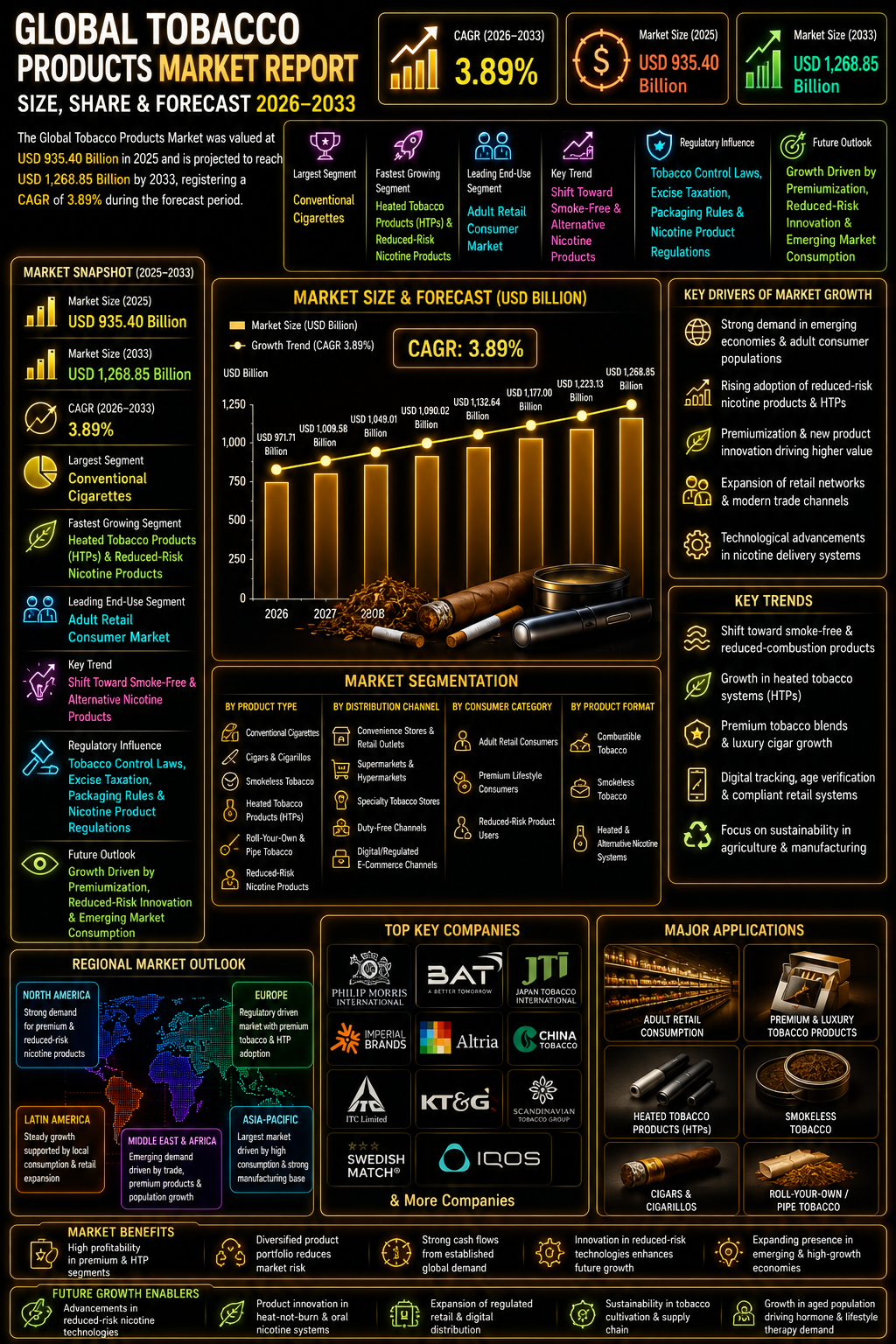
Market Forecast Snapshot (2025???2033)
| Metric | Value |
|---|---|
| Market Size (2025) | USD 935.40 Billion |
| Market Size (2033) | USD 1,268.85 Billion |
| CAGR (2026???2033) | 3.89% |
| Largest Segment | Conventional Cigarettes |
| Fastest Growing Segment | Heated Tobacco Products (HTPs) & Reduced-Risk Nicotine Products |
| Leading End-Use Segment | Adult Retail Consumer Market |
| Key Trend | Shift Toward Smoke-Free & Alternative Nicotine Products |
| Regulatory Influence | Tobacco Control Laws, Excise Taxation, Packaging Rules & Nicotine Product Regulations |
| Future Outlook | Growth Driven by Premiumization, Reduced-Risk Innovation & Emerging Market Consumption |
Market Size & Forecast
The Global Tobacco Products Market is expected to witness moderate growth during the forecast period from 2026 to 2033. The market was valued at USD 935.40 billion in 2025 and is projected to reach approximately USD 1,268.85 billion by 2033, registering a CAGR of 3.89%. The market growth is primarily driven by strong consumption across emerging economies, premium tobacco brands, rising demand for reduced-risk nicotine alternatives, expansion of heated tobacco products, and growth in smokeless tobacco segments. Tobacco products remain widely used across cigarettes, cigars, roll-your-own tobacco, smokeless tobacco, heated tobacco systems, and nicotine alternatives. Shifting consumer preferences toward reduced-combustion products and product innovation are reshaping the industry. In addition, technological innovation in heated tobacco, product premiumization, and expanding retail penetration are supporting long-term market evolution.Global Tobacco Products Market Overview
Tobacco products include processed nicotine-containing products derived from tobacco leaf and related nicotine-delivery systems used for smoking, chewing, heating, or oral consumption. The market includes conventional cigarettes, cigars, smokeless tobacco, pipe tobacco, roll-your-own products, heated tobacco products (HTPs), and reduced-risk nicotine systems. These products are distributed through retail stores, supermarkets, specialty tobacco outlets, duty-free stores, and digital-enabled regulated retail channels. The market is shifting from traditional combustible products toward smoke-free, heat-not-burn, oral nicotine, premium tobacco blends, and alternative reduced-risk product innovation.Structural Drivers of Market Growth
1. Innovation and Commercialization Acceleration
Rapid innovation in heat-not-burn systems, nicotine delivery technologies, premium blends, and smoke-free alternatives is accelerating product diversification. Digital tracking, consumer analytics, and product engineering are influencing category expansion.Market Implications
Manufacturers investing in reduced-risk innovation, premium products, and alternative nicotine technologies are expected to strengthen market competitiveness.2. Compliance and Risk Repricing
Tobacco taxes, public health restrictions, plain packaging mandates, advertising bans, and nicotine regulation are major forces shaping the market. Governments continue increasing oversight across production, marketing, and retail distribution.Market Implications
Companies capable of navigating regulatory compliance, taxation complexity, and diversified product portfolios are likely to sustain stronger market positions.3. Competitive and Value-Chain Reconfiguration
Large multinational tobacco firms, regional manufacturers, nicotine technology developers, and premium-product brands are competing aggressively. Supply-chain efficiency, agricultural sourcing, and smoke-free product investment are changing margin structures.Market Implications
Firms focusing on reduced-risk portfolios, global distribution, and brand differentiation may gain stronger profitability.4. Capital and Capacity Scaling
Rising investment in smoke-free manufacturing, premium product lines, supply chain automation, and regulated distribution systems is supporting market transformation. Emerging economies remain critical for production and demand.Market Implications
Manufacturers scaling reduced-risk technologies, premium brands, and diversified nicotine platforms are expected to capture future opportunities.Market Segmentation Analysis
By Product Type
1. Conventional Cigarettes
This remains the largest segment due to established global consumption.2. Cigars & Cigarillos
Used in premium and specialty tobacco markets.3. Smokeless Tobacco
Growing in oral-use and regional markets.4. Heated Tobacco Products (HTPs)
Fastest-growing due to reduced-combustion demand.5. Roll-Your-Own & Pipe Tobacco
Maintains niche but stable demand.By Distribution Channel
1. Convenience Stores & Retail Outlets
Largest segment due to broad consumer accessibility.2. Supermarkets & Hypermarkets
Strong retail penetration.3. Specialty Tobacco Stores
Important for premium and regulated sales.4. Duty-Free Channels
High value in travel retail.5. Digital/Regulated E-Commerce Channels
Growing where legally permitted.By Consumer Category
1. Adult Retail Consumers
Largest end-use segment globally.2. Premium Lifestyle Consumers
Growing demand for premium cigars and specialty tobacco.3. Reduced-Risk Product Users
Fast-growing segment shifting toward smoke-free systems.By Product Format
1. Combustible Tobacco
Currently dominates global volume.2. Smoke-Free Tobacco
Expanding steadily.3. Heated & Alternative Nicotine Systems
Fast-growing innovation-driven category.Regional Market Dynamics
Asia-Pacific
Asia-Pacific dominates the global tobacco products market due to high consumption, large adult user bases, and major manufacturing hubs in China, India, Indonesia, and Japan.Europe
Europe remains a major market supported by premium tobacco demand, reduced-risk products, and strong regulatory frameworks.North America
North America shows strong growth in heated tobacco, smokeless products, and premium alternatives.Latin America
Latin America is gradually expanding through regional consumption and brand diversification.Middle East & Africa
The region remains important due to tobacco trade, premium products, and growing smokeless adoption.Competitive Landscape
The Global Tobacco Products Market is highly consolidated with multinational tobacco corporations dominating production, innovation, and distribution. Key companies operating in the market include:- Philip Morris International
- British American Tobacco
- Japan Tobacco Inc.
- Imperial Brands
- Altria Group
- China National Tobacco Corporation
- ITC Limited
- KT&G Corporation
- Scandinavian Tobacco Group
- Swedish Match
Strategic Outlook
The future of the tobacco products market will be shaped by smoke-free innovation, heated tobacco expansion, nicotine alternatives, premiumization, and stricter regulatory environments. Reduced-risk products, digital age verification, supply chain automation, and sustainable agricultural sourcing are expected to improve operational resilience. Premium tobacco segments, oral nicotine systems, and heat-not-burn technologies are likely to create major long-term growth opportunities.Final Market Perspective
The Global Tobacco Products Market remains a major segment within consumer packaged goods, agricultural commodities, and nicotine delivery industries. Shifting consumer behavior, regulatory changes, and reduced-risk innovation continue driving market transformation. Companies capable of delivering compliant, diversified, premium, and alternative nicotine portfolios will be best positioned to capture future opportunities. The convergence of smoke-free technologies, premiumization, and global market adaptation is expected to redefine the future of the global tobacco products industry.Table of Contents
Table of Contents
1. Executive Summary
1.1 Market Snapshot
1.2 Key Growth Highlights
1.3 Largest Segment Analysis
1.4 Fastest Growing Segment Analysis
1.5 Regional Outlook
1.6 Competitive Landscape Snapshot
1.7 Future Market Outlook
2. Global Tobacco Products Market Introduction
2.1 Market Definition
2.2 Scope of Study
2.3 Research Assumptions
2.4 Research Methodology
2.5 Forecast Parameters
3. Global Tobacco Products Market Overview
3.1 Market Evolution
3.2 Industry Ecosystem Analysis
3.3 Value Chain Analysis
3.4 Pricing & Revenue Structure Analysis
3.5 Supply Chain & Agricultural Sourcing Overview
3.6 Product & Nicotine Delivery Landscape
3.6.1 Conventional Cigarettes
3.6.1.1 Filtered Cigarette Products
3.6.1.1.1 Mass-Market Consumption Trends
3.6.1.1.1.1 Premium Cigarette Brand Expansion
3.6.1.1.1.2 Product Standardization & Global Reach
3.6.2 Cigars & Cigarillos
3.6.2.1 Premium Tobacco Segments
3.6.2.1.1 Specialty Consumer Demand
3.6.2.1.1.1 Luxury Tobacco Product Innovation
3.6.2.1.1.2 High-Value Retail Penetration
3.6.3 Smokeless Tobacco
3.6.3.1 Oral Nicotine Products
3.6.3.1.1 Regional Market Expansion
3.6.3.1.1.1 Alternative Nicotine Consumption Trends
3.6.3.1.1.2 Reduced-Combustion Adoption
3.6.4 Heated Tobacco Products (HTPs)
3.6.4.1 Heat-Not-Burn Technologies
3.6.4.1.1 Reduced-Risk Nicotine Systems
3.6.4.1.1.1 Smoke-Free Product Innovation
3.6.4.1.1.2 Consumer Transition Trends
3.6.5 Roll-Your-Own & Pipe Tobacco
3.6.5.1 Niche Tobacco Segments
3.6.5.1.1 Traditional Consumption Markets
3.6.5.1.1.1 Specialty Retail Growth
3.6.5.1.1.2 Stable Demand Categories
3.7 Regulatory Landscape
3.7.1 Tobacco Control Laws
3.7.1.1 Excise Taxation Policies
3.7.1.1.1 Packaging & Labeling Rules
3.7.1.1.1.1 Advertising Restrictions
3.7.1.1.1.2 Nicotine Product Regulations
3.8 Market Trends & Innovation Outlook
3.8.1 Smoke-Free Product Innovation
3.8.1.1 Premiumization Strategies
3.8.1.1.1 Digital Age Verification Systems
3.8.1.1.1.1 Reduced-Risk Product Investment
3.8.1.1.1.2 Sustainable Tobacco Supply Chains
4. Global Tobacco Products Market Dynamics
4.1 Market Drivers
4.1.1 Growth in Emerging Market Consumption
4.1.1.1 Expanding Adult User Base
4.1.1.1.1 Regional Demand Expansion
4.1.1.1.1.1 Long-Term Consumption Support
4.1.2 Rising Demand for Reduced-Risk Products
4.1.2.1 Smoke-Free Alternatives
4.1.2.1.1 Heated Tobacco Growth
4.1.2.1.1.1 Product Diversification
4.1.3 Premium Tobacco Brand Expansion
4.1.3.1 Higher-Value Product Demand
4.1.3.1.1 Consumer Lifestyle Trends
4.1.3.1.1.1 Margin Expansion Opportunities
4.1.4 Retail & Distribution Expansion
4.1.4.1 Global Retail Access
4.1.4.1.1 Duty-Free & Specialty Stores
4.1.4.1.1.1 Regulated Digital Sales Channels
4.1.5 Product Innovation & Alternative Nicotine Systems
4.1.5.1 Nicotine Technology Development
4.1.5.1.1 Heat-Not-Burn Systems
4.1.5.1.1.1 Product Engineering Advances
4.2 Market Restraints
4.2.1 Strict Tobacco Control Policies
4.2.2 Increasing Excise Taxes
4.2.3 Advertising & Packaging Restrictions
4.2.4 Declining Smoking Rates in Developed Markets
4.3 Market Opportunities
4.3.1 Growth in Reduced-Risk Products
4.3.2 Premium Tobacco Segments
4.3.3 Expansion in Oral Nicotine Systems
4.3.4 Emerging Market Distribution Growth
4.4 Market Challenges
4.4.1 Regulatory Uncertainty
4.4.2 Public Health Pressure
4.4.3 Supply Chain Volatility
4.4.4 Shifting Consumer Preferences
5. Global Tobacco Products Market Size Analysis (USD Billion), 2026???2033
5.1 Revenue Forecast Analysis
5.2 CAGR Analysis
5.3 Demand-Supply Analysis
5.4 Segment Contribution Analysis
5.5 Pricing Trend Analysis
6. Global Tobacco Products Market Segmentation Analysis
6.1 By Product Type
6.1.1 Conventional Cigarettes
6.1.2 Cigars & Cigarillos
6.1.3 Smokeless Tobacco
6.1.4 Heated Tobacco Products (HTPs)
6.1.5 Roll-Your-Own & Pipe Tobacco
6.2 By Distribution Channel
6.2.1 Convenience Stores & Retail Outlets
6.2.2 Supermarkets & Hypermarkets
6.2.3 Specialty Tobacco Stores
6.2.4 Duty-Free Channels
6.2.5 Digital/Regulated E-Commerce Channels
6.3 By Consumer Category
6.3.1 Adult Retail Consumers
6.3.2 Premium Lifestyle Consumers
6.3.3 Reduced-Risk Product Users
6.4 By Product Format
6.4.1 Combustible Tobacco
6.4.2 Smoke-Free Tobacco
6.4.3 Heated & Alternative Nicotine Systems
7. Regional Market Analysis
7.1 Asia-Pacific
7.1.1 China
7.1.2 India
7.1.3 Japan
7.1.4 Indonesia
7.1.5 South Korea
7.1.6 Rest of Asia-Pacific
7.2 Europe
7.2.1 Germany
7.2.2 U.K.
7.2.3 France
7.2.4 Italy
7.2.5 Spain
7.2.6 Rest of Europe
7.3 North America
7.3.1 U.S.
7.3.2 Canada
7.3.3 Mexico
7.4 Latin America
7.4.1 Brazil
7.4.2 Argentina
7.4.3 Rest of Latin America
7.5 Middle East & Africa
7.5.1 GCC Countries
7.5.2 South Africa
7.5.3 Rest of Middle East & Africa
8. Competitive Landscape
8.1 Market Share Analysis
8.2 Competitive Intensity Overview
8.3 Strategic Developments
8.4 Product Innovation & Smoke-Free Expansion
8.5 Partnerships, Mergers & Acquisitions
8.6 Nicotine Product Positioning Analysis
9. Company Profiles
9.1 Philip Morris International
9.2 British American Tobacco
9.3 Japan Tobacco Inc.
9.4 Imperial Brands
9.5 Altria Group
9.6 China National Tobacco Corporation
9.7 ITC Limited
9.8 KT&G Corporation
9.9 Scandinavian Tobacco Group
9.10 Swedish Match
10. Strategic Intelligence & Pheonix AI Insights
10.1 Pheonix Market Growth Forecast Engine
10.2 Nicotine Demand Trend Analyzer
10.3 Regulatory Risk Tracker
10.4 Reduced-Risk Opportunity Mapping
10.5 Automated Porter???s Five Forces Analysis
11. Future Outlook & Strategic Recommendations
11.1 Smoke-Free Product Expansion
11.2 Premiumization Strategies
11.3 Emerging Market Growth Planning
11.4 Distribution Optimization Strategies
11.5 Long-Term Market Outlook (2033+)
12. Appendix
12.1 Abbreviations
12.2 Research References
12.3 Data Sources
13. About Pheonix
14. Market Research
15. Disclaimer
Competitive Landscape
Global Tobacco Products Market Competitive Intensity & Market Structure Overview
The Global Tobacco Products Market is characterized by a highly consolidated and brand-dominant competitive structure, where a limited number of multinational tobacco corporations control large portions of production, innovation, distribution, and reduced-risk nicotine ecosystems. Competition is primarily driven by brand equity, regulatory adaptability, smoke-free product innovation, excise tax management, agricultural sourcing, distribution scale, and alternative nicotine portfolio diversification.
The market is dominated by major players such as Philip Morris International, British American Tobacco, Japan Tobacco Inc., Imperial Brands, Altria Group, China National Tobacco Corporation, ITC Limited, KT&G Corporation, Scandinavian Tobacco Group, and Swedish Match, which compete through global brand portfolios, heated tobacco innovation, smokeless products, premium tobacco segments, and large-scale retail access.
Growing demand across conventional cigarettes, cigars, smokeless tobacco, heated tobacco products (HTPs), oral nicotine systems, roll-your-own tobacco, premium tobacco blends, and reduced-risk nicotine alternatives is intensifying competition. Companies are increasingly investing in heat-not-burn technologies, smoke-free nicotine systems, premiumization, digital retail compliance, supply chain automation, and lower-risk product diversification.
Global Tobacco Products Market Competitive Landscape
Leading Company Profiles
- Philip Morris International ??? Global leader in premium tobacco products, heated tobacco systems, and reduced-risk nicotine innovation.
- British American Tobacco ??? Major multinational player with strong combustible, vapor, and alternative nicotine portfolios.
- Japan Tobacco Inc. ??? Strong presence in cigarettes, heated tobacco, and international brand expansion.
- Imperial Brands ??? Significant global player in tobacco, cigars, and reduced-risk product diversification.
- Altria Group ??? Major North American tobacco company with strong combustible and oral nicotine market exposure.
- China National Tobacco Corporation ??? Largest tobacco producer by volume with dominant domestic manufacturing scale.
- ITC Limited ??? Strong regional player with cigarette brands and diversified FMCG integration.
- KT&G Corporation ??? Expanding in cigarettes, next-generation nicotine products, and Asian markets.
- Scandinavian Tobacco Group ??? Key player in premium cigars, pipe tobacco, and specialty tobacco segments.
- Swedish Match ??? Strong in smokeless tobacco and oral nicotine product innovation.
Key Competitive Intensity Signals
- Competition in heated tobacco products (HTPs) and reduced-risk nicotine alternatives is rapidly intensifying.
- Strong brand loyalty creates high switching barriers in mature tobacco markets.
- Regulatory complexity and excise taxation create major market-entry and profitability barriers.
- Premium tobacco and smoke-free portfolios are becoming major growth differentiators.
- Distribution dominance across retail, duty-free, and regulated channels strengthens incumbency.
- Product diversification into oral nicotine and heat-not-burn systems is reshaping competitive positioning.
- Emerging markets continue driving volume-based rivalry among global manufacturers.
Strategic Implications
- Companies with diversified nicotine portfolios can reduce dependence on combustible products.
- Smoke-free innovation may remain the strongest long-term strategic differentiator.
- Regulatory compliance strength can significantly improve global resilience.
- Premiumization strategies may enhance profitability despite volume pressure.
- Supply-chain control and agricultural sourcing efficiency can support long-term margin stability.
Forward Outlook
The Global Tobacco Products Market is expected to remain highly consolidated with very high competitive intensity, supported by reduced-risk product expansion, premiumization, and emerging-market demand.
Future competition will increasingly focus on:
- Heated tobacco products (HTPs)
- Smoke-free nicotine systems
- Oral nicotine and reduced-risk alternatives
- Premium tobacco product diversification
- Digital age-verification and regulated distribution
- Sustainable agricultural sourcing
- Supply chain automation and manufacturing efficiency
The convergence of smoke-free innovation, nicotine technology, premiumization, regulatory adaptation, supply-chain optimization, and emerging-market consumption will continue reshaping the long-term competitive landscape.
Value Chain
Global Tobacco Products Market Value Chain & Supply Chain Evolution Overview
The Global Tobacco Products Market operates through a large-scale agro-processing and consumer goods ecosystem supported by tobacco cultivation, leaf processing, nicotine-product manufacturing, packaging, regulated distribution, and retail-led consumer access. The market is increasingly shaped by reduced-risk nicotine innovation, heated tobacco products (HTPs), premiumization, and smoke-free alternatives.
The value chain depends heavily on agricultural sourcing, curing and blending, manufacturing precision, regulatory oversight, excise taxation systems, packaging compliance, and global retail penetration.
Supply chain complexity is high due to agricultural dependency, excise/tax regulation, product segmentation (combustible vs smoke-free), cross-border trade, age-restricted retail controls, packaging mandates, and large-scale global logistics.
Global Tobacco Products Market Value Chain & Supply Chain Evolution Current Scenario
Market-Specific Value Chain
1. Raw Material & Agricultural Sourcing
Tobacco leaf cultivation, curing, nicotine extraction, agricultural chemicals, filters, paper, packaging inputs, and specialty additives.
2. Processing & Product Development
Leaf blending, curing refinement, flavor engineering, nicotine processing, HTP technology, oral nicotine development, and reduced-risk product R&D.
3. Manufacturing & Packaging
Cigarettes, cigars, smokeless tobacco, HTP devices, nicotine systems, rolling tobacco, automated filling, labeling, and packaging compliance.
4. Regulatory Validation & Compliance
Excise tax compliance, age restrictions, health labeling, product safety validation, regional nicotine regulations, and anti-counterfeit systems.
5. Distribution & Retail Networks
Wholesalers, distributors, supermarkets, convenience stores, specialty tobacco outlets, duty-free, and regulated digital retail.
6. End-Use Consumer Ecosystem
Adult retail consumers, premium-product buyers, reduced-risk product users, and regulated nicotine consumption markets.
Key Value Chain Evolution Signals
1. Shift Toward Smoke-Free Products
HTPs and oral nicotine are rapidly expanding.
2. Agricultural Supply Dependency
Tobacco crop sourcing remains critical.
3. Regulatory Pressure
Taxation, health warnings, and packaging rules strongly shape operations.
4. Premiumization Growth
High-value tobacco and cigars improve margins.
5. Automation & Anti-Counterfeit
Manufacturing efficiency and traceability are increasing.
6. Retail-Led Consumer Access
Convenience and specialty stores remain dominant.
Strategic Implications
1. Agricultural Control
Stable tobacco sourcing improves resilience.
2. Reduced-Risk Innovation
Smoke-free alternatives improve future competitiveness.
3. Regulatory Navigation
Compliance leadership is critical for market access.
4. Brand & Retail Reach
Strong retail penetration improves volume.
5. Portfolio Diversification
Combustible + smoke-free mix reduces risk.
Forward Outlook
The market is expected to evolve toward a more diversified and technology-driven nicotine ecosystem through:
- Heated tobacco expansion
- Oral nicotine growth
- Sustainable agricultural sourcing
- Smart manufacturing automation
- Anti-counterfeit packaging
- Premium tobacco innovation
- Reduced-risk product diversification
Investment Activity
Global Tobacco Products Market Investment & Funding Dynamics Overview
The Global Tobacco Products Market is witnessing selective investment momentum driven by reduced-risk nicotine innovation, smoke-free product development, premiumization strategies, and expansion across emerging consumption markets. Tobacco manufacturers, nicotine technology developers, agricultural processors, and retail-distribution players are actively investing in heated tobacco systems, alternative nicotine products, automated manufacturing lines, and regulated distribution infrastructure.
Investment activity is being influenced by growing demand for heated tobacco products (HTPs), smokeless tobacco, oral nicotine systems, premium tobacco blends, and next-generation reduced-combustion technologies. The increasing shift toward smoke-free alternatives, digital tracking, and product diversification is reshaping capital allocation across the market.
Additionally, expanding investments in supply-chain automation, premium product lines, sustainable tobacco sourcing, and reduced-risk product manufacturing are supporting long-term market transformation.
Global Tobacco Products Market Investment & Funding Dynamics Current Scenario
Currently, the Global Tobacco Products Market demonstrates moderate investment activity with high capital intensity due to large-scale manufacturing infrastructure, agricultural sourcing, compliance requirements, product engineering, and global distribution systems. Major players are heavily investing in heat-not-burn technologies, smoke-free innovation, premium product differentiation, automated production, and alternative nicotine delivery systems.
The market is attracting funding into reduced-risk product R&D, sustainable packaging, digital age-verification systems, supply-chain optimization, and regulatory-compliant distribution channels. Rising demand in emerging economies and premium consumer segments is further supporting investment flow.
The industry is witnessing active merger, acquisition, and strategic partnership activity as multinational tobacco companies and nicotine-product developers pursue portfolio diversification, regional expansion, and reduced-risk ecosystem growth.
Key Investment & Funding Dynamics Signals in Global Tobacco Products Market
- Rising demand for heated tobacco products, reduced-risk nicotine systems, and premium tobacco products is supporting long-term capital investments.
- Expansion of smoke-free manufacturing facilities, automated production systems, and regulated retail infrastructure is increasing capital deployment.
- Growing focus on alternative nicotine technologies and reduced-combustion innovation is strengthening R&D investments.
- Strategic investments in premiumization, digital tracking, and supply-chain automation are reshaping operational priorities.
- Partnerships between tobacco firms, nicotine technology developers, and retail-distribution networks are improving ecosystem efficiency.
- Increasing regulatory focus on excise taxation, packaging mandates, and nicotine-product compliance is influencing investment decisions.
- Rising demand for diversified, compliant, and reduced-risk product portfolios is accelerating innovation spending.
Strategic Implications of Investment & Funding Dynamics in Global Tobacco Products Market
- Continuous investment in smoke-free innovation, reduced-risk products, and automated manufacturing is essential for long-term competitiveness.
- High capital intensity requires strong allocation toward production infrastructure, compliance systems, and alternative nicotine technologies.
- Companies capable of delivering diversified, premium, and regulation-compliant portfolios will strengthen market positioning.
- Strategic M&A and regional partnerships are accelerating portfolio expansion and reduced-risk product penetration.
- Investments in premium tobacco, oral nicotine systems, and heat-not-burn technologies will remain major priorities.
- Compliance with taxation, packaging, and tobacco-control regulations is critical for long-term market sustainability.
- Companies investing in product engineering, digital retail controls, and sustainable sourcing are expected to capture future growth opportunities.
Global Tobacco Products Market Investment & Funding Dynamics Forward Outlook
Looking ahead, the Global Tobacco Products Market is expected to maintain selective investment growth driven by smoke-free innovation, reduced-risk product adoption, premiumization, and emerging-market demand.
Future capital deployment will increasingly focus on heated tobacco technologies, oral nicotine platforms, sustainable sourcing, low-emission manufacturing, and automated regulatory-compliant distribution. Alternative nicotine systems and product diversification are expected to remain major long-term innovation priorities.
In conclusion, the Global Tobacco Products Market represents a mature but transformation-driven investment landscape where reduced-risk innovation, premium portfolios, manufacturing efficiency, and regulatory adaptation will define future capital strategies.
Technology & Innovation
Global Tobacco Products Market Technology & Innovation Landscape Overview
The Global Tobacco Products Market is undergoing strategic technological transformation driven by advancements in heated tobacco systems, reduced-risk nicotine delivery technologies, aerosol engineering, smart-device integration, filtration innovation, sustainable packaging, and digital supply-chain monitoring. The market reflects a moderate innovation intensity level, supported by rising demand for smoke-free alternatives, premium product diversification, regulatory adaptation, and ongoing product engineering.
At the center of this transformation is the shift from conventional combustible tobacco products toward reduced-combustion and alternative nicotine systems, particularly heat-not-burn technologies, oral nicotine formats, and controlled aerosol-based delivery devices. Companies are increasingly investing in precision-heating systems, nicotine absorption optimization, and combustion-reduction technologies to improve product differentiation and operational scalability.
A major innovation area is heated tobacco and aerosol-control technology, where improved heating chambers, temperature regulation systems, battery efficiency, and inhalation consistency are reshaping smoke-free product development.
The market is also seeing advancements in filter engineering and material innovation, including biodegradable filters, activated carbon filtration, improved particulate reduction systems, and reduced-residue product designs.
Manufacturers are increasingly investing in digital manufacturing automation, packaging traceability systems, age-verification integration, anti-counterfeit tracking, and regulated supply-chain analytics, improving compliance and retail efficiency.
Product innovation also includes premium tobacco blending, oral nicotine systems, pouch-based formats, flavor-control technologies (where legally permitted), and shelf-life optimization, helping diversify commercial offerings.
Additionally, sustainability-focused innovation such as eco-friendly packaging, agricultural traceability, low-waste processing, and carbon-reduction manufacturing systems is reshaping operational competitiveness.
The convergence of reduced-risk product engineering, aerosol science, filtration technology, smart-device systems, supply-chain automation, and sustainability adaptation is redefining the future technology landscape of the global tobacco products market.
Global Tobacco Products Market Technology & Innovation Landscape Current Scenario
Currently, the Global Tobacco Products Market demonstrates moderate patent activity and strong commercialization across heated tobacco systems, reduced-risk nicotine products, filtration materials, and automated manufacturing systems.
1. Heated Tobacco Product (HTP) Engineering
Heat-not-burn systems are significantly improving smoke-free product diversification.
2. Reduced-Risk Nicotine Platforms
Alternative nicotine delivery systems are becoming major growth drivers.
3. Filtration & Material Innovation
Improved filter designs and biodegradable materials are gaining attention.
4. Smart Manufacturing & Automation
Automated tobacco processing and packaging systems are improving efficiency.
5. Supply-Chain Traceability & Digital Compliance
Track-and-trace systems are strengthening regulatory control and product authenticity.
6. Sustainable Packaging & Agricultural Monitoring
Eco-focused production and traceability are becoming stronger priorities.
Key Technology & Innovation Landscape Signals in Global Tobacco Products Market
Several innovation signals are shaping the market:
1. Rising Shift Toward Smoke-Free Alternatives
Reduced-combustion products are becoming central to innovation.
2. Expansion of Heated Tobacco Systems
Temperature-controlled nicotine-delivery devices are expanding globally.
3. Increasing Product Premiumization
Premium tobacco blends and specialized reduced-risk formats are growing.
4. Sustainable Manufacturing Focus
Environmental pressure is increasing low-waste and traceable production.
5. Growth of Digital Supply Chains
Compliance tracking and anti-counterfeit systems are strengthening.
6. Battery & Device Efficiency Innovation
Portable heating-device performance improvements are supporting commercialization.
7. Retail Technology & Age Verification Systems
Regulated digital distribution is improving compliance and market control.
Strategic Implications of Technology & Innovation Landscape in Global Tobacco Products Market
The evolving innovation landscape is significantly reshaping competition across the market. Companies are increasingly competing on reduced-risk technologies, heating precision, product diversification, filtration efficiency, supply-chain transparency, compliance infrastructure, and sustainability adaptation.
Manufacturers investing in heated tobacco systems, aerosol engineering, biodegradable materials, smart manufacturing automation, digital traceability, and alternative nicotine portfolios are expected to strengthen long-term market positioning.
Strategic collaborations between tobacco firms, packaging providers, device-engineering companies, battery suppliers, agricultural sourcing networks, and compliance technology vendors are accelerating commercialization and operational modernization globally.
The growing convergence of aerosol science, heating systems, digital compliance, supply-chain intelligence, premium product development, and sustainability engineering is creating strong long-term differentiation opportunities.
Additionally, regulatory emphasis on packaging mandates, excise taxation, anti-counterfeit traceability, public-health compliance, age verification, and controlled distribution systems is encouraging stronger innovation and operational adaptation.
Global Tobacco Products Market Technology & Innovation Landscape Forward Outlook
Looking ahead to 2026???2033, the Global Tobacco Products Market is expected to evolve toward more regulated, diversified, and reduced-risk product ecosystems.
Future technological developments are likely to include:
1. Advanced Heat-Not-Burn Systems
Improved thermal precision and aerosol consistency will strengthen product efficiency.
2. Reduced-Risk Nicotine Diversification
Alternative oral and smoke-free nicotine systems may expand.
3. Sustainable Filter & Packaging Innovation
Eco-materials and waste-reduction technologies will become stronger priorities.
4. Smart Supply-Chain Monitoring
Digital traceability and anti-counterfeit technologies will improve control.
5. Automated Manufacturing Systems
AI-driven quality control and processing efficiency may improve scalability.
6. Battery & Portable Device Engineering
Heating-device optimization will improve portability and lifecycle efficiency.
7. Compliance-Centric Retail Technologies
Digital verification and regulated retail ecosystems may expand further.
In conclusion, companies capable of combining reduced-risk innovation, heating-device engineering, filtration science, digital compliance, sustainable production, and supply-chain intelligence will be best positioned to lead the future evolution of the Global Tobacco Products Market.
Market Risk
Global Tobacco Products Market Risk & Disruption Analysis
The Global Tobacco Products Market operates within a high-risk, highly regulated, and structurally disruptive environment, driven by tightening tobacco-control policies, excise taxation, public health pressure, declining combustible consumption in developed markets, rising reduced-risk product innovation, litigation exposure, and shifting adult consumer behavior. While the market maintains stable long-term revenue due to strong emerging-market demand, premium tobacco segments, and growth in heated tobacco products (HTPs) and reduced-risk nicotine products, it remains highly exposed to regulatory shocks, substitution trends, reputational pressure, and taxation volatility.
A defining structural characteristic of the market is its dependence on strictly regulated nicotine-consumption ecosystems, where pricing power, product accessibility, and market share are closely tied to taxation frameworks, packaging rules, retail restrictions, and adult-use regulatory boundaries. Conventional cigarettes remain the dominant segment by revenue and volume, while strategic growth is increasingly shifting toward HTPs, smoke-free tobacco, oral nicotine systems, and reduced-combustion alternatives.
The market is also transitioning from traditional combustible-product dependence toward reduced-risk innovation, smoke-free alternatives, premiumization, digital age-verification systems, and diversified nicotine portfolios, increasing strategic transformation pressure for major tobacco manufacturers.
Global Tobacco Products Market Current Risk Environment
The current market environment is characterized by strong regulatory disruption, mature-category pressure, and evolving nicotine substitution patterns.
One of the most significant disruption factors involves tobacco-control laws and excise taxation pressure. Governments continue implementing plain packaging mandates, public smoking restrictions, advertising bans, flavor restrictions, excise hikes, and distribution limitations, which directly influence pricing, accessibility, and profitability.
Another major risk area is substitution and reduced-combustion transition risk. Consumers in many markets are shifting from traditional combustible products toward heated tobacco, nicotine pouches, oral nicotine systems, or smoking cessation pathways, reshaping long-term product mix.
The market also faces litigation, ESG, and reputational pressure. Tobacco companies remain exposed to public health lawsuits, investor scrutiny, sustainability pressure, and social-risk positioning.
Additionally, illicit trade, counterfeit products, and cross-border taxation arbitrage remain structural concerns affecting legal-market stability.
In parallel, agricultural dependency, tobacco leaf sourcing, and geopolitical trade exposure continue influencing supply-chain resilience.
Key Market Risk & Disruption Signals in Global Tobacco Products Market
1. Tobacco Control & Regulatory Tightening
Excise taxes, packaging laws, flavor bans, and nicotine regulation strongly affect market structure.
2. Substitution Toward Reduced-Risk Products
HTPs, smoke-free alternatives, oral nicotine, and cessation trends are reshaping demand.
3. Litigation & Public Health Exposure
Legal liabilities and health-related scrutiny remain persistent strategic risks.
4. ESG & Reputational Pressure
Institutional investors and regulators increasingly assess tobacco through sustainability and ethical-risk frameworks.
5. Illicit Trade & Counterfeit Risk
Tax arbitrage, black-market sales, and counterfeit supply affect pricing and legal channels.
6. Agricultural & Raw Material Exposure
Tobacco leaf production, climate variability, and sourcing concentration influence supply.
7. Emerging Market Dependency
Growth relies heavily on regulatory and demographic stability in developing economies.
8. Pricing & Taxation Volatility
Frequent excise adjustments directly affect profitability and affordability.
Strategic Implications of Market Risk & Disruption in Global Tobacco Products Market
The evolving disruption environment creates both strong cash-flow resilience and long-term transformation pressure.
One of the most important strategic implications is the increasing need for portfolio diversification beyond conventional combustible tobacco. Companies increasingly must balance legacy cigarette revenue with reduced-risk innovation and adult-use regulatory compliance.
Manufacturers are required to invest in heated tobacco systems, smoke-free alternatives, supply-chain automation, digital age verification, compliance-driven packaging, and premium brand differentiation to sustain competitiveness.
Vertical integration across leaf sourcing, nicotine technology, manufacturing, regulated distribution, and adult-consumer retail ecosystems is becoming increasingly valuable.
The convergence of reduced-risk innovation, taxation strategy, ESG pressure, and digital compliance is also reshaping value chains. Firms with stronger multi-category nicotine portfolios and regional diversification may achieve stronger resilience.
Additionally, premiumization, adult consumer retention, and emerging-market consumption may continue supporting selective growth opportunities.
Companies focusing on regulated reduced-risk innovation, premium tobacco positioning, diversified nicotine ecosystems, compliance adaptability, and supply-chain resilience are expected to strengthen long-term market leadership.
Global Tobacco Products Market Risk & Disruption Forward Outlook
Looking ahead to 2026???2033, the Global Tobacco Products Market is expected to become increasingly regulated, diversified, and reduced-risk focused.
1. Expansion of Heated Tobacco & Reduced-Risk Products
HTPs and alternative nicotine products will capture growing strategic value.
2. Higher Taxation & Regulatory Oversight
Governments are likely to strengthen public-health restrictions.
3. Decline in Combustible Tobacco Dependence
Conventional cigarette share may gradually compress in developed regions.
4. Greater ESG & Litigation Pressure
Corporate governance and legal scrutiny will remain elevated.
5. Stronger Digital Age Verification & Retail Compliance
Regulated sales channels may increasingly adopt stricter digital oversight.
6. Supply Chain & Agricultural Sustainability Focus
Climate and sourcing resilience may become more important.
7. Premiumization & Brand Differentiation Growth
Higher-value products may support profitability.
8. Market Consolidation & Diversified Nicotine Ecosystems
Major players may strengthen multi-category portfolio integration.
In conclusion, the Global Tobacco Products Market represents a high-cash-flow, highly regulated, and structurally transforming consumer-products ecosystem, where regulatory adaptability, reduced-risk innovation, taxation resilience, portfolio diversification, and controlled market positioning will define long-term competitive sustainability.
Regulatory Landscape
Global Tobacco Products Market Regulatory & Policy Environment Overview
The regulatory and policy environment plays a highly critical role in shaping the Global Tobacco Products Market due to strong oversight around tobacco control laws, excise taxation, packaging mandates, nicotine product regulation, distribution restrictions, and public health compliance. Regulatory frameworks governing tobacco manufacturing, labeling, retail sales, age restrictions, marketing bans, and alternative nicotine product approvals significantly influence commercialization, product innovation, and global market expansion.
Tobacco products are widely used across combustible cigarettes, cigars, smokeless tobacco, heated tobacco products (HTPs), and reduced-risk nicotine systems. Due to major public health concerns, regulatory scrutiny is among the highest across consumer product industries.
The market is also influenced by evolving nicotine-content controls, smoke-free product frameworks, cross-border trade restrictions, health-warning requirements, plain packaging laws, and digital age-verification systems. Governments are increasingly balancing taxation revenue, harm-reduction innovation, and public health objectives.
In addition, anti-smoking initiatives, product traceability systems, and regulated retail frameworks are strengthening structured regulatory enforcement globally.
Global Tobacco Products Market Regulatory & Policy Environment Current Scenario
Currently, the Global Tobacco Products Market operates under a highly restricted, health-policy-driven, and multi-jurisdictional regulatory framework involving excise taxes, tobacco-control legislation, packaging compliance, marketing restrictions, and nicotine-product oversight.
One of the most important regulatory trends is tobacco-control and consumption reduction policy. Governments continue enforcing stricter advertising bans, warning-label mandates, and retail-sales restrictions.
Another major regulatory factor involves taxation and product pricing control. Excise taxes and duty structures heavily influence affordability, legal distribution, and market competitiveness.
Cross-border nicotine and tobacco-product governance also remain important, especially for heated tobacco, smokeless products, and reduced-risk alternatives where legal treatment varies significantly by jurisdiction.
Sector-specific compliance is especially strong in retail distribution, age-restricted sales, import/export controls, and reduced-risk product innovation.
Additionally, track-and-trace systems, anti-illicit-trade rules, and digital sales verification are creating stronger compliance oversight.
Key Regulatory & Policy Environment Signals in Global Tobacco Products Market
1. Rising Tobacco Control & Public Health Restrictions
Advertising bans, packaging rules, and consumption-limiting policies remain critical.
2. Expansion of Excise Taxation & Pricing Governance
Tax frameworks strongly influence legal market operations.
3. Growing Cross-Border Nicotine Product Complexity
Regional differences in HTPs, smokeless products, and nicotine systems require jurisdiction-specific compliance.
4. Age Verification & Retail Distribution Oversight
Restricted sales and traceable distribution are increasingly important.
5. Anti-Illicit Trade & Product Traceability Systems
Supply-chain visibility and lawful movement controls are strengthening.
Strategic Implications of Regulatory & Policy Environment in Global Tobacco Products Market
The evolving regulatory environment creates major strategic implications for tobacco manufacturers, reduced-risk nicotine developers, distributors, retailers, and multinational corporations. One major implication is the growing need for highly compliant, traceable, and jurisdiction-specific product ecosystems.
Companies must invest in excise compliance, packaging adaptation, retail verification, lawful distribution, product traceability, and alternative nicotine regulatory readiness to remain globally competitive.
The increasing convergence of smoke-free innovation, taxation complexity, digital age verification, and public-health-driven restrictions is also pushing firms toward compliance-led innovation.
Organizations capable of balancing market growth, harm-reduction portfolios, regulatory readiness, and distribution integrity will likely strengthen long-term market positioning.
Additionally, firms with strong reduced-risk product strategies, tax adaptability, and multi-market compliance capabilities will gain stronger competitive advantages.
Global Tobacco Products Market Regulatory & Policy Environment Forward Outlook
Looking ahead to 2026???2033, the regulatory environment for tobacco products is expected to become increasingly restriction-driven, taxation-focused, and harm-reduction-governed as alternative nicotine systems continue expanding.
Future regulations are likely to place stronger emphasis on nicotine-content oversight, smoke-free product approval, digital age verification, public-health labeling, anti-illicit trade systems, and sustainability in tobacco sourcing.
Governments may continue strengthening excise taxation, advertising bans, packaging laws, import restrictions, and youth-access prevention frameworks.
The expansion of HTPs, oral nicotine products, reduced-risk systems, and regulated e-commerce may further increase regulatory complexity.
Overall, the regulatory and policy environment will remain a major factor influencing commercialization, consumer access, product innovation, compliance costs, and competitive positioning within the Global Tobacco Products Market.