
Global Herb Vaporizers Market Report, Size & Forecast 2026-2033
Global Herb Vaporizers Market Report, Size, Share and Forecast 2026???2033
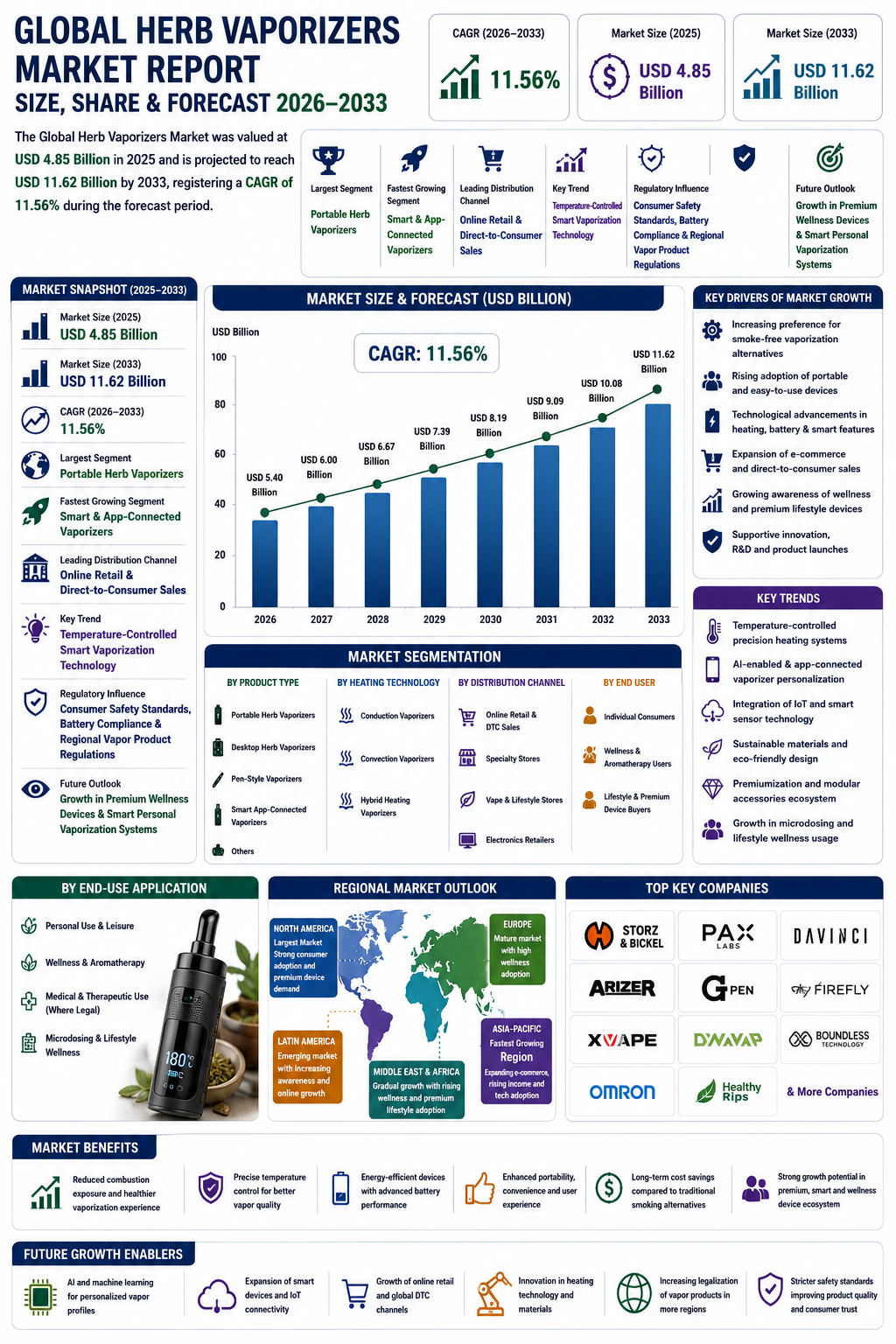
Market Forecast Snapshot (2025???2033)
| Metric | Value |
|---|---|
| Market Size (2025) | USD 4.85 Billion |
| Market Size (2033) | USD 11.62 Billion |
| CAGR (2026???2033) | 11.56% |
| Largest Segment | Portable Herb Vaporizers |
| Fastest Growing Segment | Smart & App-Connected Vaporizers |
| Leading Distribution Channel | Online Retail & Direct-to-Consumer Sales |
| Key Trend | Temperature-Controlled Smart Vaporization Technology |
| Regulatory Influence | Consumer Safety Standards, Battery Compliance & Regional Vapor Product Regulations |
| Future Outlook | Growth in Premium Wellness Devices & Smart Personal Vaporization Systems |
Market Size & Forecast
The Global Herb Vaporizers Market is expected to witness strong expansion during the forecast period from 2026 to 2033. The market was valued at USD 4.85 billion in 2025 and is projected to reach approximately USD 11.62 billion by 2033, registering a CAGR of 11.56%. The market growth is primarily driven by rising consumer preference for smoke-free vaporization alternatives, increasing adoption of portable wellness devices, growing demand for precision-heating systems, and technological innovation in personal vaporization equipment. Herb vaporizers are increasingly gaining traction due to controlled heating, reduced combustion exposure, improved portability, rechargeable battery systems, and digital customization. Growing product innovation around ceramic heating chambers, convection systems, OLED displays, and Bluetooth-based app control is further accelerating market adoption. Additionally, premiumization trends, e-commerce expansion, and consumer demand for compact lifestyle devices are supporting long-term market growth.Global Herb Vaporizers Market Overview
Global Herb vaporizers are portable or desktop electronic devices designed to heat dry herbs and botanical materials to controlled temperatures that release vapor without direct combustion. The market includes portable vaporizers, desktop vaporizers, convection vaporizers, conduction vaporizers, hybrid heating vaporizers, and smart app-enabled vaporization devices. These devices are increasingly used in consumer wellness, aromatherapy, botanical inhalation, and personal lifestyle applications due to improved control, portability, and thermal efficiency. The market is shifting from traditional manual heating devices toward digital precision heating, IoT-enabled personalization, USB-C fast charging, battery optimization, and premium modular device design.Structural Drivers of Market Growth
1. Innovation and Commercialization Acceleration
Rapid innovation in battery technology, ceramic heating systems, AI-assisted temperature control, and mobile-connected interfaces is accelerating product commercialization. Manufacturers are introducing compact, fast-heating, and customizable vaporizers to enhance user experience.Market Implications
Companies investing in smart-device integration, premium heating technology, and ergonomic product design are expected to strengthen market leadership.2. Compliance and Risk Repricing
Consumer electronics safety standards, lithium-ion battery regulations, thermal safety requirements, and regional vapor-device compliance are shaping product development. Manufacturers are increasingly focusing on safe charging systems, heat protection, and certified materials.Market Implications
Firms offering compliant, safer, and certified vaporizer systems are likely to gain stronger long-term consumer trust.3. Competitive and Value-Chain Reconfiguration
The market is highly competitive as portable electronics brands, vaporizer manufacturers, and lifestyle technology firms expand offerings. Direct-to-consumer sales, brand-led ecosystems, and premium accessories are altering value-chain economics.Market Implications
Companies focusing on premium positioning, direct sales channels, and strong device ecosystems may gain higher margins.4. Capital and Capacity Scaling
Rising investment in electronics manufacturing, battery optimization, premium accessories, and smart-device production is supporting market growth. Regional assembly expansion and component efficiency improvements are reducing cost barriers.Market Implications
Manufacturers scaling production efficiency and smart-device innovation are expected to capture future opportunities.Market Segmentation Analysis
By Product Type
1. Portable Herb Vaporizers
This remains the largest segment due to convenience, mobility, and high consumer adoption.2. Desktop Herb Vaporizers
Used in premium home-based vaporization systems.3. Pen-Style Vaporizers
Compact and lightweight devices growing in lifestyle adoption.4. Smart App-Connected Vaporizers
Fastest-growing segment due to personalization and remote control features.By Heating Technology
1. Conduction Vaporizers
Widely used for faster heating and compact design.2. Convection Vaporizers
Growing due to better temperature consistency and vapor quality.3. Hybrid Heating Vaporizers
Combining conduction and convection for efficiency and premium experience.By Distribution Channel
1. Online Retail
Leading distribution segment due to global accessibility and DTC growth.2. Specialty Stores
Important for premium product sales and customer education.3. Vape & Lifestyle Stores
Growing in urban markets.4. Electronics Retailers
Expanding due to consumer-tech overlap.By End User
1. Individual Consumers
Largest segment due to personal-use adoption.2. Wellness & Aromatherapy Users
Growing segment driven by botanical vaporization demand.3. Lifestyle & Premium Device Buyers
Strong demand for smart connected and premium devices.Regional Market Dynamics
North America
North America dominates the global herb vaporizers market due to strong consumer electronics adoption, premium device demand, and developed online retail ecosystems.Europe
Europe remains a major market supported by wellness trends, premium vaporization products, and technology-driven lifestyle demand.Asia-Pacific
Asia-Pacific is the fastest-growing region due to expanding e-commerce, rising disposable income, and electronics manufacturing capabilities.Latin America
Latin America is gradually expanding due to increasing lifestyle-device penetration and digital retail growth.Middle East & Africa
The region is witnessing emerging adoption driven by premium consumer electronics demand and online access.Competitive Landscape
The Global Herb Vaporizers Market is highly competitive with vaporizer manufacturers, consumer-tech brands, and premium lifestyle-device companies expanding globally. Key companies operating in the market include:- Storz & Bickel
- PAX Labs
- DaVinci Vaporizer
- Arizer
- G Pen
- Firefly Vapor
- XVAPE
- Dynavap
- Boundless Technology
- Healthy Rips
Strategic Outlook
The future of the herb vaporizers market will be shaped by AI-based temperature optimization, smart-device integration, app-controlled personalization, battery innovation, and premium modular accessories. Portable vaporizers and app-enabled connected devices are expected to dominate product innovation. Growth in DTC channels, fast-charging systems, eco-friendly materials, and customizable heating profiles may significantly improve product competitiveness. The rise of premium wellness devices and consumer personalization trends is expected to create strong long-term opportunities.Final Market Perspective
The Global Herb Vaporizers Market remains a fast-growing segment within consumer electronics and personal wellness devices. Rising demand for smoke-free alternatives, smart portable devices, thermal precision, and connected vaporization systems continues driving long-term growth. Manufacturers capable of delivering safe, premium, portable, and technology-enabled vaporizer solutions will be best positioned to capture future opportunities. The convergence of battery innovation, smart electronics, temperature precision, and direct-to-consumer expansion is expected to redefine the future of the global herb vaporizers industry.Table of Contents
Table of Contents
1. Executive Summary
1.1 Market Forecast Snapshot (2026???2033)
1.2 Global Herb Vaporizers Market Size & CAGR Analysis
1.3 Largest & Fastest-Growing Segments
1.4 Regional Leadership & Growth Trends
1.5 Key Market Drivers
1.6 Competitive Landscape Overview
1.7 Strategic Outlook Through 2033
2. Introduction & Market Overview
2.1 Definition of the Herb Vaporizers Market
2.2 Market Size & Forecast (2026???2033)
2.3 Industry Evolution & Market Development
2.4 Manufacturing Ecosystem & Supply Chain Infrastructure
2.5 Impact of Smart Consumer Electronics & Wellness Device Trends
2.6 Regulatory & Compliance Landscape
2.7 Technology & Innovation Landscape in Vaporization Systems
3. Research Methodology
3.1 Primary Research
3.2 Secondary Research
3.3 Market Size Estimation Model
3.4 Forecast Assumptions (2026???2033)
3.5 Data Validation & Triangulation
4. Market Dynamics
4.1 Drivers
4.1.1 Rising Demand for Smoke-Free Vaporization Alternatives
4.1.2 Increasing Adoption of Portable Wellness Devices
4.1.3 Growth of Smart & App-Controlled Personal Devices
4.1.4 Expansion of Direct-to-Consumer & E-Commerce Channels
4.1.5 Advancements in Battery & Precision Heating Technology
4.2 Restraints
4.2.1 Stringent Regulatory Restrictions Across Regions
4.2.2 High Cost of Premium Smart Vaporizers
4.2.3 Battery Safety & Thermal Management Challenges
4.2.4 Limited Consumer Awareness in Emerging Markets
4.3 Opportunities
4.3.1 Expansion of AI-Based Temperature-Controlled Devices
4.3.2 Growth of Premium Wellness & Aromatherapy Segments
4.3.3 Rising Demand for Eco-Friendly & Modular Designs
4.3.4 Emerging Digital Retail & Direct Brand Ecosystems
4.4 Challenges
4.4.1 Compliance with Consumer Electronics & Battery Standards
4.4.2 Supply Chain Dependence on Electronic Components
4.4.3 Pricing Pressure from Low-Cost Alternatives
4.4.4 Brand Differentiation in a Competitive Lifestyle Market
5. Global Herb Vaporizers Market Analysis (USD Billion), 2026???2033
5.1 Market Size Overview
5.2 CAGR Analysis
5.3 Regional Revenue Distribution
5.4 Segment Revenue Analysis
5.5 Distribution Channel Performance Analysis
5.6 Consumer Adoption & Product Preference Analysis
6. Market Segmentation (USD Billion), 2026???2033
6.1 By Product Type
6.1.1 Portable Herb Vaporizers
6.1.1.1 Pocket-Sized Portable Vaporizers
6.1.1.1.1 Rechargeable Portable Systems
6.1.1.1.1.1 Compact Lifestyle Vaporizers
6.1.1.1.1.2 Premium Mobile Vaporization Devices
6.1.2 Desktop Herb Vaporizers
6.1.2.1 Home-Based Stationary Vaporizers
6.1.2.1.1 Premium Temperature-Controlled Systems
6.1.2.1.1.1 Advanced Convection Desktop Units
6.1.2.1.1.2 High-Capacity Multi-Session Vaporizers
6.1.3 Pen-Style Vaporizers
6.1.3.1 Slim Portable Vape Pens
6.1.3.1.1 Compact Entry-Level Devices
6.1.3.1.1.1 Lightweight Travel Vaporizers
6.1.3.1.1.2 Quick-Heat Portable Pens
6.1.4 Smart App-Connected Vaporizers
6.1.4.1 Bluetooth-Controlled Vaporizers
6.1.4.1.1 IoT-Enabled Smart Vapor Devices
6.1.4.1.1.1 AI-Assisted Temperature Optimization Systems
6.1.4.1.1.2 Mobile App-Based Custom Heating Devices
6.2 By Heating Technology
6.2.1 Conduction Vaporizers
6.2.1.1 Ceramic Conduction Systems
6.2.1.1.1 Fast-Heating Vaporization Units
6.2.1.1.1.1 Compact Precision Heating Devices
6.2.1.1.1.2 Portable Battery-Efficient Vaporizers
6.2.2 Convection Vaporizers
6.2.2.1 Airflow-Based Heating Systems
6.2.2.1.1 Uniform Temperature-Control Vaporizers
6.2.2.1.1.1 Premium Flavor Preservation Devices
6.2.2.1.1.2 High-Efficiency Heating Platforms
6.2.3 Hybrid Heating Vaporizers
6.2.3.1 Dual Heating Technology Systems
6.2.3.1.1 Conduction-Convection Combination Devices
6.2.3.1.1.1 Premium Smart Hybrid Vaporizers
6.2.3.1.1.2 High-Performance Thermal Control Devices
6.3 By Distribution Channel
6.3.1 Online Retail
6.3.1.1 Brand-Owned E-Commerce Platforms
6.3.1.1.1 Marketplace-Based Digital Sales
6.3.1.1.1.1 Global DTC Sales Channels
6.3.1.1.1.2 Subscription & Premium Device Sales Models
6.3.2 Specialty Stores
6.3.2.1 Premium Wellness Device Stores
6.3.2.1.1 Consumer Education & Product Consultation Centers
6.3.2.1.1.1 High-End Lifestyle Device Retailers
6.3.2.1.1.2 Certified Product Sales Outlets
6.3.3 Vape & Lifestyle Stores
6.3.3.1 Urban Specialty Retail Stores
6.3.3.1.1 Lifestyle Technology Device Retailing
6.3.3.1.1.1 Premium Consumer Electronics Integration
6.3.3.1.1.2 Customized Product Experience Stores
6.3.4 Electronics Retailers
6.3.4.1 Consumer-Tech Retail Chains
6.3.4.1.1 Smart Lifestyle Electronics Distribution
6.3.4.1.1.1 App-Controlled Device Retail Expansion
6.3.4.1.1.2 Cross-Category Personal Electronics Sales
6.4 By End User
6.4.1 Individual Consumers
6.4.1.1 Daily Personal Use Consumers
6.4.1.1.1 Lifestyle-Oriented Buyers
6.4.1.1.1.1 Portable Device Preference Segment
6.4.1.1.1.2 Premium Smart Device Users
6.4.2 Wellness & Aromatherapy Users
6.4.2.1 Botanical Vaporization Consumers
6.4.2.1.1 Therapeutic Lifestyle Users
6.4.2.1.1.1 Temperature-Controlled Wellness Systems
6.4.2.1.1.2 Aroma-Based Precision Vaporization Applications
6.4.3 Lifestyle & Premium Device Buyers
6.4.3.1 High-End Consumer Segment
6.4.3.1.1 Connected Smart Device Users
6.4.3.1.1.1 AI-Integrated Personal Vaporization Buyers
6.4.3.1.1.2 Modular & Premium Customization Users
7. Market Segmentation by Geography
7.1 North America
7.2 Europe
7.3 Asia-Pacific
7.4 Latin America
7.5 Middle East & Africa
8. Competitive Landscape
8.1 Market Share Analysis
8.2 Product Portfolio Benchmarking
8.3 Smart Device Positioning Mapping
8.4 Strategic Partnerships & Direct-to-Consumer Expansion
8.5 Competitive Intensity & Market Fragmentation
9. Company Profiles
9.1 Storz & Bickel
9.2 PAX Labs
9.3 DaVinci Vaporizer
9.4 Arizer
9.5 G Pen
9.6 Firefly Vapor
9.7 XVAPE
9.8 Dynavap
9.9 Boundless Technology
9.10 Healthy Rips
10. Strategic Intelligence & Pheonix AI Insights
10.1 Pheonix Demand Forecast Engine
10.2 Smart Vaporization Technology Adoption Analyzer
10.3 Battery & Device Innovation Tracker
10.4 Consumer Electronics & Wellness Trends Insights
10.5 Automated Porter???s Five Forces Analysis
11. Future Outlook & Strategic Recommendations
11.1 Growth of Smart App-Connected Vaporization Devices
11.2 AI-Based Temperature Precision Strategies
11.3 Premium Wellness & Modular Product Development
11.4 DTC Expansion & E-Commerce Growth Strategies
11.5 Long-Term Market Outlook (2033+)
12. Appendix
13. About Pheonix Research
14. Disclaimer
Competitive Landscape
Global Herb Vaporizers Market Competitive Intensity & Market Structure Overview
The Global Herb Vaporizers Market is characterized by a moderately fragmented and highly brand-driven competitive structure, with competition led by specialized vaporizer manufacturers, premium lifestyle-device brands, and consumer-tech-focused vaporization companies. The market is shaped by product innovation, temperature-control precision, battery efficiency, smart-device integration, portability, premium branding, and direct-to-consumer (DTC) distribution strategies.
Competition is driven by players such as Storz & Bickel, PAX Labs, DaVinci Vaporizer, Arizer, G Pen, Firefly Vapor, XVAPE, Dynavap, Boundless Technology, and Healthy Rips, which compete through heating technology, vapor quality, battery optimization, app-based controls, and premium product ecosystems.
The market is increasingly influenced by portable vaporization demand, smart app-connected devices, e-commerce expansion, premiumization, and lifestyle-tech positioning, creating strong global competition among both premium and mid-tier manufacturers.
Global Herb Vaporizers Market Competitive Landscape
Leading Company Profiles
- Storz & Bickel ??? Premium market leader known for high-end desktop and portable vaporizers with strong thermal precision and engineering quality.
- PAX Labs ??? Major player in smart connected vaporizers, sleek design, and app-enabled vaporization ecosystems.
- DaVinci Vaporizer ??? Focused on portable precision-heating vaporizers with premium temperature-control features.
- Arizer ??? Strong presence in desktop and portable vaporization systems with emphasis on vapor quality and durability.
- G Pen ??? Popular lifestyle vaporizer brand with strong retail and urban consumer reach.
- Firefly Vapor ??? Specialized in convection-based smart vaporizers and premium portable devices.
- XVAPE ??? Growing global brand focused on affordability and multi-format vaporization products.
- Dynavap ??? Niche player known for battery-free thermal vaporization systems and premium enthusiast users.
- Boundless Technology ??? Expanding presence in portable and hybrid heating vaporizers.
- Healthy Rips ??? Emerging player focused on compact premium vaporizers and direct-to-consumer growth.
Key Competitive Intensity Signals
- Rising demand for portable and app-connected vaporizers is increasing product innovation competition.
- Battery life, USB-C charging, ceramic chambers, and heating precision are major product differentiators.
- Premiumization is strengthening brand-led ecosystem competition.
- Direct-to-consumer (DTC) and e-commerce channels are reshaping distribution power.
- Smart-device integration and app personalization are becoming premium competitive advantages.
- Mid-tier manufacturers are increasing pricing pressure in mass-market segments.
- Material quality, safety certifications, and thermal protection systems are strengthening trust-based competition.
Strategic Implications
- Premium brand identity and product reliability are key to long-term differentiation.
- Companies investing in smart heating systems and connected-device ecosystems can strengthen positioning.
- DTC expansion improves margin control and customer retention.
- Battery innovation and ergonomic design will remain major adoption drivers.
- Compliance with electronics safety and battery standards remains an important market barrier.
Forward Outlook
The Global Herb Vaporizers Market is expected to remain moderately fragmented with high competitive intensity, supported by rapid innovation in smart vaporization systems and premium consumer-tech positioning.
Future competition will increasingly focus on:
- Smart app-connected vaporizers
- AI-based temperature optimization
- Premium modular accessories
- Fast-charging and battery efficiency improvements
- Compact ergonomic device innovation
- Eco-friendly materials and sustainable design
- Direct-to-consumer and digital ecosystem growth
The convergence of smart electronics, battery innovation, heating precision, premium branding, and digital DTC channels will continue reshaping the long-term competitive landscape.
Value Chain
Global Herb Vaporizers Market Value Chain & Supply Chain Evolution Overview
The Global Herb Vaporizers Market is a technology-driven consumer wellness and portable electronics ecosystem supported by precision heating innovation, battery optimization, direct-to-consumer sales, and premium lifestyle-device adoption. The market???s value chain is characterized by a hybrid operational model integrating electronics sourcing, product engineering, device assembly, digital ecosystems, and omnichannel distribution.
A defining feature of this value chain is its dependence on lithium-ion batteries, ceramic heating systems, temperature-control electronics, embedded sensors, app-based connectivity, and ergonomic industrial design. As herb vaporizers evolve toward smart connected devices, manufacturers are increasingly integrating Bluetooth, AI-assisted heating profiles, USB-C charging, and modular accessories.
Supply chain complexity is moderate-high due to electronic component sourcing, battery compliance, thermal safety requirements, regional vapor product regulations, software integration, and global consumer-device logistics. Dependence on semiconductors, heating elements, and premium materials adds further complexity.
Manufacturers are investing in smart-device ecosystems, premium materials, localized electronics assembly, battery optimization, and direct brand-led commerce to improve product differentiation, scalability, and consumer retention. The market is evolving into a premium electronics-led and digitally connected lifestyle-device ecosystem.
Global Herb Vaporizers Market Value Chain & Supply Chain Evolution Current Scenario
Market-Specific Value Chain
1. Raw Material & Component Sourcing
Lithium-ion batteries, ceramic chambers, heating coils, aluminum/stainless steel bodies, semiconductors, sensors, OLED displays, plastics, and charging components.
2. Product Engineering & Software Development
Temperature control systems, Bluetooth integration, mobile app development, thermal algorithms, ergonomic design, and battery efficiency engineering.
3. Manufacturing & Device Assembly
Heating chamber integration, PCB assembly, battery installation, casing fabrication, vapor path design, calibration, and final device assembly.
4. Testing, Certification & Compliance
Battery safety testing, heat resistance validation, consumer electronics compliance, charging certification, and regional vapor-device regulations.
5. Distribution & Sales Networks
Direct-to-consumer (DTC), online retail, specialty stores, vape/lifestyle retailers, electronics retailers, and e-commerce ecosystems.
6. End-User Adoption & Aftermarket Ecosystem
Individual consumers, aromatherapy users, premium lifestyle buyers, replacement accessories, maintenance kits, and connected-device ecosystems.
Company-to-Stage Mapping
1. Raw Material & Component Sourcing
Battery suppliers, ceramic manufacturers, semiconductor vendors, and electronics material providers.
2. Product Engineering & Software Development
PAX Labs, DaVinci Vaporizer, Firefly Vapor ??? smart temperature systems, connectivity integration, and premium vaporizer design.
3. Manufacturing & Device Assembly
Storz & Bickel, Arizer, XVAPE, Boundless Technology ??? vaporizer manufacturing, assembly, and heating-system engineering.
4. Testing, Certification & Compliance
Consumer electronics labs, battery certification providers, and regional compliance bodies.
5. Distribution & Sales Networks
DTC websites, e-commerce platforms, specialty retailers, and lifestyle-device distributors.
6. End-User Adoption & Aftermarket Ecosystem
Personal users, wellness-focused consumers, premium electronics buyers, and accessory ecosystems.
Key Value Chain & Supply Chain Evolution Signals in Global Herb Vaporizers Market
1. Smart Connected Device Growth
Bluetooth and app-enabled vaporizers are accelerating premiumization.
2. Battery Innovation Importance
Fast charging, thermal safety, and battery optimization are becoming central.
3. Direct-to-Consumer Expansion
Brand-led DTC ecosystems are improving margins and loyalty.
4. Premium Materials & Ergonomic Design
Ceramics, aluminum alloys, and modular designs are differentiating products.
5. Electronics Supply Dependency
Semiconductors, PCBs, and sensors remain critical.
6. Compliance & Safety Focus
Battery and heat-control regulations are shaping product design.
7. Lifestyle & Wellness Convergence
Herb vaporizers are increasingly positioned as premium personal wellness devices.
Strategic Implications of Value Chain & Supply Chain Evolution
1. Smart Ecosystem Leadership
Software + device integration will strengthen brand differentiation.
2. Battery Supply Stability
Securing lithium-ion and thermal-safe battery inputs is critical.
3. Premium DTC Strategy
Direct sales improve profitability and consumer engagement.
4. Compliance-Driven Design
Safer materials and certified electronics improve trust.
5. Modular Product Innovation
Accessories and upgrade ecosystems improve recurring revenue.
6. Manufacturing Efficiency
Localized electronics assembly reduces supply risk.
7. Brand-Led Lifestyle Positioning
Premium branding becomes a strong moat.
Global Herb Vaporizers Market Value Chain & Supply Chain Evolution Forward Outlook
Looking ahead, the Global Herb Vaporizers Market is expected to evolve into a premium, electronics-led, and connected wellness-device ecosystem.
Key future developments include:
- Expansion of AI-assisted temperature optimization.
- Growth of app-connected premium vaporizers.
- Higher DTC and e-commerce dominance.
- Battery safety and fast-charging innovation.
- Sustainable materials and eco-design integration.
- Smart modular accessories and upgrade ecosystems.
- Greater convergence with wellness and consumer-tech markets.
In conclusion, the Global Herb Vaporizers Market represents a fast-growing, electronics-intensive, and lifestyle-driven ecosystem, where device innovation, battery efficiency, DTC strength, premium branding, and compliance readiness will define long-term leadership.
Investment Activity
Global Herb Vaporizers Market Investment & Funding Dynamics Overview
The Global Herb Vaporizers Market is witnessing rising investment momentum driven by increasing demand for smoke-free alternatives, smart vaporization technologies, and premium personal wellness devices. Consumer electronics firms, vaporizer manufacturers, battery technology providers, and lifestyle-device companies are actively investing in temperature-controlled heating systems, smart-device integration, and compact portable vaporization platforms.
Investment activity is being accelerated by rapid innovation in lithium-ion battery systems, ceramic heating chambers, convection technologies, and app-connected vaporization devices. The growing shift toward portable wellness products, premium lifestyle electronics, and direct-to-consumer (DTC) business models is significantly influencing capital allocation across the market.
Additionally, increasing investments in product miniaturization, battery optimization, USB-C charging systems, and e-commerce-led device ecosystems are strengthening long-term growth opportunities globally.
Global Herb Vaporizers Market Investment & Funding Dynamics Current Scenario
Currently, the Global Herb Vaporizers Market demonstrates rising investment activity with moderate capital intensity due to electronics manufacturing, product design innovation, battery integration, and consumer-tech development requirements. Major players are significantly investing in portable vaporizers, app-connected systems, smart temperature controls, ergonomic product engineering, and premium heating solutions.
The market is attracting funding into AI-assisted heating systems, IoT-enabled personalization, battery efficiency improvements, and premium modular accessories. Expansion of DTC sales, online retail ecosystems, and global consumer-tech branding is further strengthening investment flow.
The industry is witnessing selective merger and acquisition activity as vaporizer manufacturers, battery suppliers, and consumer electronics firms pursue strategic acquisitions, product expansion, and technology integration.
Key Investment & Funding Dynamics Signals in Global Herb Vaporizers Market
Several major investment signals are shaping funding activity:
- Rising adoption of smart vaporizers, app-based control systems, and digital heating technologies is accelerating device innovation investments.
- Expansion of portable electronics, rechargeable battery ecosystems, and premium wellness devices is increasing long-term capital deployment.
- Growing demand for temperature precision, ceramic heating, and convection vaporization technologies is strengthening R&D spending.
- Strategic investments in direct-to-consumer sales, e-commerce ecosystems, and premium device branding are reshaping value-chain economics.
- Partnerships between electronics manufacturers, battery suppliers, and lifestyle-device firms are strengthening innovation ecosystems.
- Increasing regulatory focus on consumer safety, battery compliance, and thermal performance standards is improving investor stability.
- Rising demand for compact, premium, and customizable vaporization systems is accelerating product development funding.
Strategic Implications of Investment & Funding Dynamics in Global Herb Vaporizers Market
- Continuous investment in battery optimization, smart heating technology, and connected-device ecosystems is essential for long-term competitiveness.
- Moderate capital intensity supports scalable production while enabling faster product innovation cycles.
- Companies capable of delivering safe, premium, portable, and technology-enabled vaporizer solutions will strengthen market positioning.
- Strategic M&A and technology partnerships are accelerating device ecosystem diversification.
- Investments in product safety, charging systems, and thermal compliance will remain major priorities.
- Expansion of DTC channels and premium branding will improve long-term profitability.
- Companies investing in AI-enabled personalization and modular device ecosystems are expected to capture substantial future opportunities.
Global Herb Vaporizers Market Investment & Funding Dynamics Forward Outlook
Looking ahead, the Global Herb Vaporizers Market is expected to maintain rising investment growth driven by smart vaporization technologies, premium wellness trends, battery innovation, and connected consumer electronics.
Future capital deployment will increasingly focus on AI-based temperature optimization, IoT-connected vaporizers, fast-charging battery systems, sustainable materials, modular accessories, and direct-to-consumer expansion strategies. Personalized user experience and premium lifestyle positioning are expected to become major innovation priorities.
In conclusion, the Global Herb Vaporizers Market represents a high-growth, consumer-tech-driven investment landscape where smart-device integration, battery performance, premiumization, and scalable DTC ecosystems will define future capital strategies.
Technology & Innovation
Global Herb Vaporizers Market Technology & Innovation Landscape Overview
The Global Herb Vaporizers Market is undergoing strong product innovation driven by advancements in precision heating systems, smart connectivity, battery optimization, ceramic chamber engineering, AI-assisted temperature control, and compact vaporization technologies. The market demonstrates a high innovation intensity level, supported by rising demand for premium portable wellness devices, smoke-free alternatives, and personalized vaporization experiences.
At the center of this transformation is the shift from conventional manual devices toward digitally controlled smart vaporizers capable of accurate thermal regulation, faster heating, and enhanced vapor efficiency. Manufacturers are increasingly focusing on temperature-controlled vaporization technologies that optimize herb heating without combustion.
A major innovation area is convection, conduction, and hybrid heating systems, which improve vapor consistency, thermal efficiency, flavor retention, and user control. Advanced ceramic heating chambers, quartz components, and heat-resistant airflow pathways are enhancing product performance.
The market is also seeing rapid development in smart & app-connected vaporizers, integrating Bluetooth connectivity, mobile apps, customizable heat profiles, OLED displays, and user analytics for personalized operation and remote device control.
Battery technology remains a major focus, with companies investing in high-density lithium-ion batteries, USB-C fast charging, thermal protection circuits, and energy-efficient power management systems to improve portability, charging speed, and safety.
Manufacturers are also innovating in modular device architecture, lightweight alloys, premium materials, eco-friendly components, and ergonomic industrial design, improving durability and user experience.
Additionally, advancements in AI-based temperature optimization, airflow engineering, microprocessor-controlled heating, and premium wellness-device ecosystems are reshaping competition across the industry.
The convergence of consumer electronics, smart-device integration, thermal precision engineering, and direct-to-consumer innovation is redefining the future technology landscape of the herb vaporizers market.
Global Herb Vaporizers Market Technology & Innovation Landscape Current Scenario
Currently, the Global Herb Vaporizers Market demonstrates moderate-to-high patent activity and strong commercialization across portable smart devices, precision heating platforms, and premium connected vaporization systems.
1. Smart App-Connected Vaporizer Innovation
Bluetooth-enabled vaporizers and mobile-controlled heat settings are becoming major differentiators.
2. Precision Heating Technology Development
Conduction, convection, and hybrid heating systems are improving thermal control and vapor quality.
3. Ceramic & Advanced Heating Chamber Materials
Ceramic and heat-resistant materials are enhancing efficiency and durability.
4. Battery Optimization & Fast Charging Systems
USB-C charging, improved battery density, and thermal safety systems are strengthening portability.
5. Modular & Compact Device Engineering
Portable lightweight form factors and modular accessories are supporting premiumization trends.
6. AI-Assisted Thermal Control
Microprocessor-driven temperature calibration is improving customization and efficiency.
Key Technology & Innovation Landscape Signals in Global Herb Vaporizers Market
Several innovation signals are shaping the market:
1. Rising Demand for Smart Connected Devices
App-based personalization and device analytics are expanding rapidly.
2. Growth of Portable Premium Wellness Devices
Compact high-end vaporizers are gaining stronger consumer preference.
3. Increasing Battery Safety & Energy Efficiency Focus
Charging optimization and thermal protection are becoming critical.
4. Expansion of Precision Heating Systems
Accurate vaporization temperatures are driving premium differentiation.
5. Sustainable & Eco-Friendly Device Materials
Manufacturers are focusing on recyclable, durable, and low-waste materials.
6. Direct-to-Consumer Product Ecosystems
Brand-led accessories, firmware updates, and digital ecosystems are improving retention.
Strategic Implications of Technology & Innovation Landscape in Global Herb Vaporizers Market
The evolving technology landscape is significantly reshaping competition across the herb vaporizers market. Companies are increasingly competing on temperature precision, smart connectivity, battery safety, ergonomic design, vapor consistency, product premiumization, and device ecosystem development.
Manufacturers investing in AI-driven thermal control, connected vaporization platforms, high-density battery systems, and modular premium accessories are expected to strengthen long-term market positioning.
Strategic competition is also shifting toward DTC ecosystems, software-enabled customization, smart-device integration, and compact engineering innovation.
The growing convergence of consumer electronics, mobile apps, thermal management, battery optimization, and wellness-focused personalization is creating strong long-term differentiation opportunities.
Additionally, product safety standards, certified materials, and battery compliance regulations are pushing companies toward stronger R&D and engineering validation.
Global Herb Vaporizers Market Technology & Innovation Landscape Forward Outlook
Looking ahead to 2026???2033, the Global Herb Vaporizers Market is expected to evolve toward highly personalized, AI-supported, and digitally connected vaporization ecosystems.
Future technological developments are likely to include:
1. AI-Driven Temperature Optimization
Smart adaptive heating systems may optimize vapor output based on user behavior.
2. Advanced Hybrid Heating Systems
Improved conduction-convection combinations will strengthen thermal consistency.
3. Faster & Safer Battery Technologies
Next-generation batteries with better efficiency and safety will improve portability.
4. Connected Wellness Ecosystems
App-linked usage tracking, firmware control, and smart-device personalization will expand.
5. Sustainable & Premium Material Innovation
Eco-friendly metals, ceramics, and recyclable housing materials will gain importance.
6. Microprocessor-Controlled Precision Vaporization
Higher temperature accuracy and heat calibration will support premium differentiation.
7. Modular Smart Accessories & Ecosystems
Custom chambers, airflow modules, and accessory ecosystems may expand product value.
Overall, companies capable of combining thermal precision, smart connectivity, battery innovation, ergonomic design, compliance safety, and scalable premium manufacturing will be best positioned to lead the future evolution of the Global Herb Vaporizers Market.
Market Risk
Global Herb Vaporizers Market Risk & Disruption Analysis
The Global Herb Vaporizers Market operates within a high disruption and high regulatory uncertainty environment, driven by shifting vapor-product legislation, battery safety risks, changing consumer perception, technology innovation cycles, e-commerce restrictions, and substitution from adjacent personal inhalation and wellness devices. While the market shows strong growth due to premiumization, portable wellness trends, and smart-device adoption, it remains highly exposed to legal fragmentation, regulatory scrutiny, supply chain concentration, and rapid product commoditization.
A defining structural characteristic of the market is its close overlap between consumer electronics, wellness devices, and region-specific inhalation product regulation, which creates uneven market accessibility across jurisdictions. Unlike mainstream electronics, herb vaporizers can face legal ambiguity depending on use case, botanical classification, and local vapor-device frameworks.
The market is also rapidly transitioning from basic portable devices toward smart connected vaporizers, AI-assisted thermal control, app-based personalization, premium modular systems, and advanced battery-driven portability, creating constant innovation pressure and shorter product refresh cycles.
Global Herb Vaporizers Market Current Risk Environment
The current market environment is characterized by strong consumer demand, regulatory fragmentation, and high product differentiation pressure.
One of the most significant disruption factors involves regional regulatory inconsistency and legal classification risk. Herb vaporizers may be treated differently across markets under consumer electronics law, inhalation device frameworks, wellness-product rules, or vapor-related restrictions. This creates uncertainty in cross-border expansion, product labeling, and retail access.
Another major risk area is battery safety and thermal compliance exposure. These products heavily rely on lithium-ion batteries, heating coils, ceramic chambers, and compact thermal systems. Risks related to overheating, charging faults, battery degradation, and device safety recalls can directly impact brand reputation and compliance costs.
The market also faces rapid commoditization and pricing pressure, especially in portable vaporizer categories. Low-cost manufacturers, OEM white-label products, and fast imitation cycles can erode margins for premium brands.
Additionally, digital ecosystem dependency is increasing. Smart vaporizers with Bluetooth, apps, firmware, and connected-device features face cybersecurity, app-store restrictions, interoperability issues, and software lifecycle risks.
In parallel, consumer sentiment and wellness positioning remain sensitive to broader regulatory and social perception shifts.
Key Market Risk & Disruption Signals in Global Herb Vaporizers Market
1. Regulatory Fragmentation & Legal Ambiguity
Regional differences in vapor-product treatment, wellness-device classification, and retail restrictions create major market uncertainty.
2. Battery & Thermal Safety Risks
Lithium-ion systems, charging reliability, and heat-control failures increase recall and compliance exposure.
3. Fast Product Commoditization
Portable vaporizers face intense pricing pressure from OEMs, white-label products, and low-cost manufacturers.
4. Supply Chain Dependence on Electronics Components
Heating elements, batteries, chips, sensors, and ceramic materials create electronics supply risks.
5. Smart Device & App Ecosystem Risk
Bluetooth-enabled and app-controlled devices face cybersecurity, firmware, and software platform dependency.
6. E-Commerce & Distribution Restrictions
Online retail remains critical, making the market vulnerable to marketplace restrictions and digital advertising limits.
7. Brand Reputation & Consumer Trust Sensitivity
Safety incidents or regulatory scrutiny can rapidly affect premium device brands.
8. Substitution from Adjacent Lifestyle & Inhalation Devices
Alternative personal wellness devices, aromatherapy tools, and related portable inhalation products may compete for similar consumers.
Strategic Implications of Market Risk & Disruption in Global Herb Vaporizers Market
The evolving disruption environment creates strong growth opportunities alongside elevated structural risk.
One of the most important strategic implications is the growing need for compliance-first product engineering. Manufacturers must prioritize battery certification, heat stability, safe materials, and regional legal adaptability.
Companies are increasingly required to invest in premium differentiation, smart-device ecosystems, modular design, app-enabled personalization, and proprietary heating technology to avoid commoditization.
Vertical integration and supply chain resilience are also becoming critical. Firms with stronger control over batteries, ceramic chambers, sensors, and device assembly may reduce quality and sourcing risks.
The convergence of wellness-tech, portable electronics, IoT integration, and DTC ecosystems is reshaping value chains. Brands that build stronger accessory ecosystems, software integration, and consumer loyalty may gain pricing power.
Additionally, channel diversification beyond pure online retail???such as specialty wellness distribution and controlled premium retail???is becoming increasingly important.
Companies focusing on premium portable devices, smart connected vaporizers, battery innovation, safety-certified systems, and ecosystem-based differentiation are expected to strengthen long-term market positioning.
Global Herb Vaporizers Market Risk & Disruption Forward Outlook
Looking ahead to 2026???2033, the Global Herb Vaporizers Market is expected to remain innovation-driven but increasingly regulated and brand-sensitive.
1. Expansion of Smart Connected Vaporizers
AI-assisted temperature control, app personalization, and connected-device ecosystems will become stronger differentiators.
2. Higher Safety & Battery Compliance Standards
Thermal protection, battery certification, and safer materials will become more central.
3. Greater Premiumization & Ecosystem Branding
Brands may compete more through accessories, software, modular upgrades, and lifestyle positioning.
4. Regional Legal Divergence
Different market rules may continue affecting expansion strategies and product architecture.
5. Supply Chain Localization
Manufacturers may regionalize electronics sourcing to reduce dependency and delays.
6. Rising Competition in Lifestyle-Tech Segments
Consumer electronics and wellness-device brands may increasingly enter adjacent categories.
7. Stronger Digital Channel Risk Management
DTC models, online marketplaces, and platform restrictions will remain strategically important.
8. Consolidation Among Premium Players
M&A and brand consolidation may rise as competition intensifies.
In conclusion, the Global Herb Vaporizers Market represents a high-growth, innovation-heavy, and regulation-sensitive consumer device ecosystem, where safety compliance, legal adaptability, premium branding, battery reliability, and connected-device differentiation will define sustainable competitive success.
Regulatory Landscape
Global Herb Vaporizers Market Regulatory & Policy Environment Overview
The regulatory and policy environment plays a significant role in shaping the Global Herb Vaporizers Market as consumer safety authorities, electronics regulators, and regional product compliance bodies increasingly emphasize battery safety, thermal protection, material quality, and vapor-device standards. Regulatory frameworks governing portable vaporization devices, lithium-ion batteries, heating systems, emissions exposure, and consumer electronics safety significantly influence manufacturing, commercialization, and cross-border distribution strategies.
Herb vaporizers operate at the intersection of consumer electronics, wellness devices, and personal lifestyle technology. As these devices increasingly integrate smart connectivity, precision heating, fast charging, and app-based controls, regulatory focus on overheating prevention, electrical safety, and connected-device reliability is becoming more important.
The market is also influenced by evolving policies related to hazardous material usage, rechargeable battery compliance, e-waste management, product labeling, and import/export restrictions. Regional differences in vapor-related product treatment continue affecting retail access, e-commerce distribution, and market expansion.
In addition, consumer protection standards and device certification requirements are shaping trust, product differentiation, and long-term industry competitiveness.
Global Herb Vaporizers Market Regulatory & Policy Environment Current Scenario
Currently, the Global Herb Vaporizers Market operates under a mixed consumer electronics and product-compliance framework involving battery safety regulations, electronics certifications, thermal stability requirements, and region-specific vapor-device rules.
One of the most important regulatory trends influencing the market is the increasing focus on lithium-ion battery safety and thermal management. Portable vaporizers rely heavily on rechargeable systems, making compliance around charging stability, overheating prevention, and electrical safety essential.
Another major regulatory development involves material and product safety oversight. Manufacturers are increasingly expected to use certified chambers, safe heating components, non-toxic materials, and durable thermal insulation.
Regional compliance variation also remains a major factor. Different jurisdictions apply varying product restrictions, labeling rules, and import standards affecting market accessibility.
Connected-device regulations are gradually becoming more relevant as smart vaporizers integrate Bluetooth control, mobile applications, and digital personalization features.
Additionally, environmental policies involving battery disposal, recyclability, and electronic waste reduction are influencing product design and supply chains.
Key Regulatory & Policy Environment Signals in Global Herb Vaporizers Market
1. Rising Battery & Thermal Safety Standards
Portable vaporizer systems require stronger compliance for charging stability, heat control, and battery durability.
2. Growing Consumer Product Safety Oversight
Certified materials, safe chambers, and electronics-grade reliability are becoming important.
3. Regional Vapor Product Regulation Variability
Cross-border commercialization depends on jurisdiction-specific product treatment and labeling standards.
4. Expansion of Smart Device Compliance
Bluetooth-enabled and app-connected vaporizers increase focus on device interoperability and digital safety.
5. Environmental & E-Waste Policy Influence
Battery disposal and recyclable electronics standards are influencing product lifecycle strategies.
Strategic Implications of Regulatory & Policy Environment in Global Herb Vaporizers Market
The evolving regulatory environment creates major strategic implications for vaporizer manufacturers, consumer electronics brands, battery suppliers, and lifestyle-device firms. One of the most important implications is the growing need for safe, certified, and thermally stable device ecosystems.
Manufacturers must invest in battery validation, charging safety, certified materials, product testing, and compliance-led engineering to maintain consumer trust and long-term competitiveness.
The increasing convergence of portable electronics, wellness devices, and smart connectivity is also pushing firms toward premium compliance-led product innovation.
Companies capable of balancing product safety, ergonomic design, app-enabled features, and sustainable manufacturing will likely strengthen market positioning.
Additionally, strong direct-to-consumer compliance capabilities and region-specific product adaptation will remain important for international expansion.
Global Herb Vaporizers Market Regulatory & Policy Environment Forward Outlook
Looking ahead to 2026???2033, the regulatory environment for herb vaporizers is expected to become increasingly safety-focused, electronics-driven, and region-sensitive as smart portable vaporization systems continue expanding globally.
Future regulations are likely to place stronger emphasis on battery fire prevention, connected-device reliability, recyclable electronics, material transparency, and product lifecycle sustainability.
Regional authorities may continue strengthening thermal safety, import compliance, digital device integration, and consumer product protection requirements.
The expansion of premium smart vaporizers, AI-assisted temperature systems, USB-C charging ecosystems, and IoT-enabled personalization may further increase compliance expectations.
Overall, the regulatory and policy environment will remain a critical factor influencing safety validation, product trust, commercialization, sustainability, and competitive positioning within the Global Herb Vaporizers Market. Companies capable of balancing premium innovation, thermal safety, regulatory compliance, smart connectivity, and production efficiency will be best positioned to capture long-term growth opportunities.