
Global Vegetable Snacks Market size and share Analysis 2026-2033
Global Vegetable Snacks Market Forecast Snapshot: 2026???2033
| Metric | Value |
|---|---|
| 2025 Market Size | USD 13.8 Billion |
| 2033 Market Size | USD 28.5 Billion |
| CAGR (2026???2033) | 9.1% |
| Largest Region | North America |
| Fastest Growing Region | Asia-Pacific |
| Top Product Segment | Potato-Based & Legume Snacks |
| Key Trend | Plant-Based, Healthy & Functional Snacking |
| Future Focus | Clean Label Products, Sustainable Packaging, and Functional Ingredients |
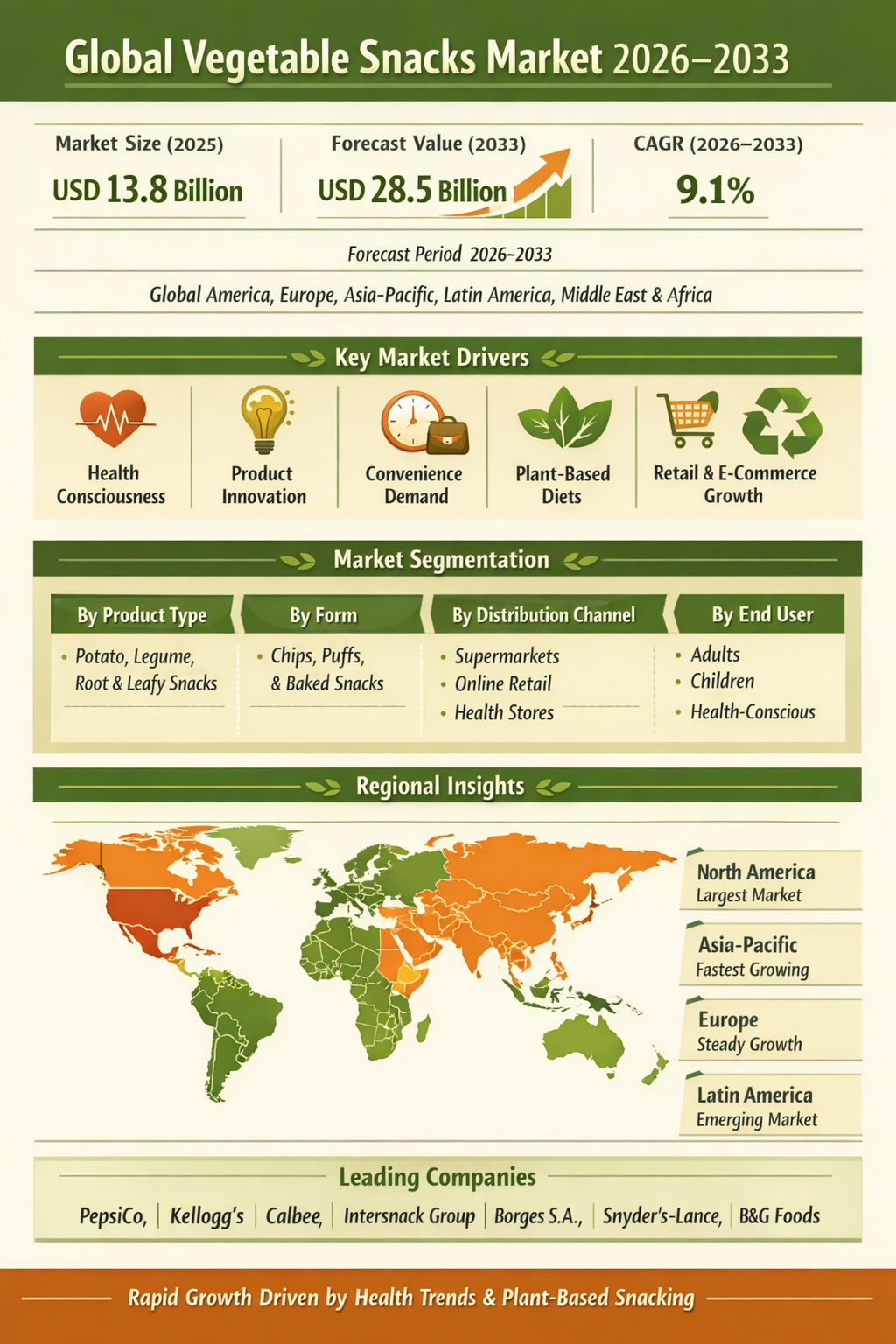
Global Vegetable Snacks Market Overview (2026???2033)
The Global Vegetable Snacks Market is experiencing rapid growth during the 2026???2033 forecast period, supported by rising health awareness and increasing demand for plant-based and functional snack alternatives.
Consumers are increasingly shifting from traditional fried snacks to baked, air-fried, and minimally processed vegetable snacks, which offer better nutritional value while maintaining taste and convenience.
According to Pheonix Research, growing awareness of lifestyle-related health conditions and rising adoption of balanced diets are significantly driving market demand.
Manufacturers are actively focusing on product innovation, including fortified snacks with fiber, protein, and micronutrients, along with organic and clean-label offerings.
Additionally, advancements in processing technologies such as air frying and extrusion, along with sustainable packaging solutions, are enhancing product appeal and market growth.
North America remains the largest market, driven by strong health awareness and retail penetration, while Asia-Pacific is the fastest-growing region, supported by urbanization, rising incomes, and changing dietary habits.
Key Drivers of Global Vegetable Snacks Market Growth
Increasing Health Consciousness
Consumers are seeking low-fat, nutrient-rich snack alternatives that support healthier lifestyles.
Product Innovation & Flavor Diversification
Manufacturers are introducing new flavors, organic variants, and premium snack formats.
Convenience and Ready-to-Eat Demand
Busy lifestyles are driving demand for portable, ready-to-consume snack products.
Rising Popularity of Plant-Based Diets
Growing vegan and plant-based trends are boosting demand for vegetable-based snacks.
Expansion of Retail & E-Commerce Channels
Online and offline retail expansion is improving product accessibility globally.
Sustainability and Clean Label Trends
Consumers prefer eco-friendly packaging and natural ingredient-based products.
Global Vegetable Snacks Market Segmentation
1. By Product Type
1.1 Potato-Based Snacks
1.1.1 Traditional Vegetable Chips
1.1.1.1 Retail Products
1.1.1.1.1 Mass Market Consumption
1.2 Legume-Based Snacks
1.2.1 Pea & Lentil Snacks
1.2.1.1 Protein-Enriched Products
1.2.1.1.1 Functional Snacks
1.3 Root & Tuber Snacks
1.3.1 Carrot, Beetroot & Sweet Potato Snacks
1.3.1.1 Health-Oriented Products
1.3.1.1.1 Organic Snack Segment
1.4 Leafy Vegetable Snacks
1.4.1 Kale & Spinach Chips
1.4.1.1 Premium Snacks
1.4.1.1.1 Clean Label Products
1.5 Mixed & Specialty Vegetable Snacks
1.5.1 Multi-Vegetable Snack Mixes
1.5.1.1 Gourmet Snacks
1.5.1.1.1 Premium Offerings
2. By Form
2.1 Chips / Crisps
2.1.1 Baked Chips
2.1.1.1 Low-Fat Products
2.1.1.1.1 Healthy Alternatives
2.2 Extruded Snacks / Puffs
2.2.1 Protein-Enriched Puffs
2.2.1.1 Snack Packs
2.2.1.1.1 Ready-to-Eat
2.3 Baked Snacks
2.3.1 Oven-Baked Products
2.3.1.1 Low-Calorie Snacks
2.3.1.1.1 Functional Foods
2.4 Others
2.4.1 Specialty Snack Formats
2.4.1.1 Premium Products
2.4.1.1.1 Health-Focused Offerings
3. By Distribution Channel
3.1 Supermarkets & Hypermarkets
3.1.1 Packaged Snack Sections
3.1.1.1 Retail Sales
3.1.1.1.1 Bulk Distribution
3.2 Convenience Stores
3.2.1 Ready-to-Eat Snacks
3.2.1.1 Single-Serve Packs
3.2.1.1.1 On-the-Go Products
3.3 Online Retail
3.3.1 E-Commerce Platforms
3.3.1.1 Direct Sales
3.3.1.1.1 Subscription Models
3.4 Specialty Health Stores
3.4.1 Organic & Natural Food Stores
3.4.1.1 Premium Products
3.4.1.1.1 Health-Oriented Segment
3.5 Foodservice Channels
3.5.1 Cafes & Restaurants
3.5.1.1 Healthy Snack Options
3.5.1.1.1 Premium Offerings
4. By End User
4.1 Adults
4.1.1 Daily Snack Consumers
4.1.1.1 Health-Conscious Buyers
4.1.1.1.1 Premium Segment
4.2 Children & Teenagers
4.2.1 Snack Consumers
4.2.1.1 Packaged Snack Products
4.2.1.1.1 School Consumption
4.3 Health-Conscious Consumers
4.3.1 Fitness-Oriented Consumers
4.3.1.1 Functional Foods
4.3.1.1.1 Clean Label Products
Global Vegetable Snacks Market Regional Insights
North America ??? Largest Market
High consumer awareness, strong retail presence, and demand for organic snacks drive market leadership.
Europe
Growing demand for plant-based, clean-label, and sustainable snack products supports steady growth.
Asia-Pacific ??? Fastest Growing Region
Urbanization, rising disposable incomes, and changing snacking habits are driving strong growth.
Latin America
Increasing snack consumption and retail expansion are boosting market demand.
Middle East & Africa
Growing urbanization and health awareness are supporting gradual market expansion.
Leading Companies in the Global Vegetable Snacks Market
PepsiCo, Inc. (Frito-Lay)
Kellogg Company
Calbee, Inc.
Intersnack Group
Borges Agricultural & Industrial Nuts, S.A.
Snyder???s-Lance, Inc.
Lantm??nnen Unibake AB
B&G Foods, Inc.
Better Snacks Co.
These companies focus on product innovation, sustainable sourcing, and flavor development to strengthen market presence.
Strategic Intelligence & Market Insights
Pheonix Demand Forecast Engine identifies plant-based snacking trends as key growth drivers.
Consumer Sentiment Analyzer highlights increasing demand for clean-label and functional snacks.
Innovation Tracker monitors advancements in cooking technologies and sustainable packaging.
Porter???s Five Forces Analysis indicates moderate competition with strong opportunities in premium segments.
Why the Global Vegetable Snacks Market Remains Critical
Supports healthier eating habits and plant-based diets
Encourages innovation in the snack food industry
Provides convenient and nutritious snacking options
Promotes sustainable and eco-friendly food production
Expands functional and clean-label food segments
Final Takeaway of Global Vegetable Snacks Market
The Global Vegetable Snacks Market is expected to grow rapidly through 2033, driven by rising health awareness, plant-based trends, and product innovation.
Companies focusing on clean-label products, sustainable packaging, functional ingredients, and premium snack offerings will be well positioned to capture long-term growth opportunities.
At Pheonix Research, our advanced forecasting models and market intelligence frameworks empower stakeholders to identify opportunities, optimize product strategies, and build competitive advantages in the global vegetable snacks market.
???? Social Mentions & Publication Channels
??Explore deeper insights and follow our cross-platform updates on??LinkedIn??and??X??for continuous intelligence and market coverage.
LinkedIn??: https://www.linkedin.com/in/pheonix-research-media/
X??: https://x.com/Pheonix_Insight
Table of Contents
Table of Contents
1. Executive Summary
1.1 Market Forecast Snapshot (2026???2033)
The Global Vegetable Snacks Market is projected to grow from USD 13.8 Billion in 2025 to USD 28.5 Billion by 2033, registering a CAGR of 9.1% during 2026???2033.
1.2 Global Market Size & CAGR Analysis
The market reflects strong expansion driven by increasing consumer preference for healthy, plant-based snacks, along with rising demand for convenient and functional food products.
1.3 Largest & Fastest-Growing Segments
Largest Segment: Potato-Based Snacks
Fastest-Growing Segment: Legume-Based & Functional Vegetable Snacks
1.4 Region-Level Leadership & Growth Trends
North America leads the market due to strong health awareness and retail penetration, while Asia-Pacific is projected to be the fastest-growing region through 2033.
1.5 Key Market Drivers
Increasing health consciousness among consumers
Growing demand for plant-based and functional snacks
Expansion of e-commerce and modern retail channels
Rising preference for clean-label and organic products
Continuous product innovation and flavor diversification
1.6 Competitive Landscape Overview
Moderately competitive market with global snack manufacturers focusing on product innovation, sustainable sourcing, and premium product development.
1.7 Strategic Outlook Through 2033
Focus on clean-label product development, sustainable packaging, functional ingredient integration, and expansion through digital retail platforms.
2. Introduction & Market Overview
2.1 Definition of the Global Vegetable Snacks Market
Covers vegetable-based snack products including chips, puffs, baked snacks, and functional snack products across retail and foodservice channels.
2.2 Scope of the Study
Comprehensive analysis of market size, segmentation, distribution channels, consumer trends, and global forecasts for 2026???2033.
2.3 Evolution from Traditional Snacks to Healthy Alternatives
The market is shifting from traditional fried snacks toward healthier, baked, and plant-based snack alternatives.
2.4 Role of Modern Retail & Distribution Infrastructure
Expansion of supermarkets, convenience stores, and online platforms is improving product accessibility and availability.
2.5 Impact of Health & Wellness Trends
Rising awareness of nutrition, obesity, and lifestyle diseases is driving demand for healthier snack options.
2.6 Integration of Clean Label & Sustainable Practices
Consumers are increasingly choosing natural, organic, and minimally processed snack products.
2.7 Technological Advancements in Processing & Packaging
Innovations in air-frying, baking, and eco-friendly packaging are enhancing product appeal and shelf life.
3. Research Methodology
3.1 Primary Research
Interviews with manufacturers, distributors, retailers, and industry experts.
3.2 Secondary Research
Industry reports, trade data, government publications, and corporate filings.
3.3 Market Size Estimation Model
Combination of bottom-up consumption analysis and top-down revenue modeling.
3.4 Forecast Assumptions (2026???2033)
Based on increasing health awareness, plant-based diet adoption, and retail expansion.
3.5 Data Validation & Triangulation
Cross-verification using supply chain insights and market benchmarks.
4. Market Dynamics
4.1 Drivers
4.1.1 Increasing Health Consciousness
Consumers are shifting toward low-fat, nutrient-rich snack options.
4.1.2 Growing Demand for Plant-Based Diets
Rising vegan and plant-based consumption trends are driving adoption.
4.1.3 Product Innovation and Flavor Diversification
New flavors, formats, and premium products are attracting consumers.
4.1.4 Expansion of Retail & E-Commerce Channels
Online and offline retail expansion is improving product accessibility.
4.1.5 Sustainability and Clean Label Trends
Demand for eco-friendly and natural products is driving market growth.
4.2 Restraints
4.2.1 Higher pricing of premium and organic products
4.2.2 Competition from traditional snack products
4.2.3 Limited awareness in developing regions
4.2.4 Supply chain challenges for raw materials
4.3 Opportunities
4.3.1 Expansion of functional and fortified snacks
4.3.2 Growth of organic and clean-label products
4.3.3 Increasing demand for plant-based alternatives
4.3.4 Expansion into emerging markets
4.4 Challenges
4.4.1 Maintaining product quality and shelf life
4.4.2 Managing production and raw material costs
4.4.3 Competition from established snack brands
4.4.4 Regulatory compliance and labeling standards
5. Global Vegetable Snacks Market Analysis (USD Billion), 2026???2033
5.1 Market Size Overview
5.2 CAGR Analysis
5.3 Region-Wise Revenue Distribution
5.4 Product Type Revenue Split
5.5 Distribution Channel Trends
5.6 End-User Consumption Analysis
6. Market Segmentation by Product Type (USD Billion), 2026???2033
6.1 Potato-Based Snacks
6.1.1 Vegetable Chips
6.1.1.1 Retail Products
6.1.1.1.1 Mass Market
6.2 Legume-Based Snacks
6.2.1 Pea & Lentil Snacks
6.2.1.1 Protein-Enriched Products
6.2.1.1.1 Functional Snacks
6.3 Root & Tuber Snacks
6.3.1 Carrot, Beetroot & Sweet Potato Snacks
6.3.1.1 Health-Oriented Products
6.3.1.1.1 Organic Segment
6.4 Leafy Vegetable Snacks
6.4.1 Kale & Spinach Snacks
6.4.1.1 Premium Products
6.4.1.1.1 Clean Label Segment
6.5 Mixed & Specialty Snacks
6.5.1 Multi-Vegetable Mixes
6.5.1.1 Gourmet Snacks
6.5.1.1.1 Premium Segment
7. Market Segmentation by Distribution Channel (USD Billion), 2026???2033
7.1 Supermarkets & Hypermarkets
7.1.1 Retail Packaged Snacks
7.1.1.1 Bulk Distribution
7.1.1.1.1 Consumer Packs
7.2 Convenience Stores
7.2.1 Ready-to-Eat Snacks
7.2.1.1 Single-Serve Packs
7.2.1.1.1 On-the-Go Products
7.3 Online Retail
7.3.1 E-Commerce Platforms
7.3.1.1 Direct Sales
7.3.1.1.1 Subscription Models
7.4 Specialty Health Stores
7.4.1 Organic Food Retailers
7.4.1.1 Premium Products
7.4.1.1.1 Health Segment
7.5 Foodservice Channels
7.5.1 Cafes & Restaurants
7.5.1.1 Healthy Snack Options
7.5.1.1.1 Premium Offerings
8. Market Segmentation by Geography
8.1 North America ??? Largest Market
8.2 Europe
8.3 Asia-Pacific ??? Fastest Growing Region
8.4 Latin America
8.5 Middle East & Africa
9. Competitive Landscape ??? Global
9.1 Market Share Analysis
9.2 Product Portfolio Benchmarking
9.3 Pricing Strategy Analysis
9.4 Distribution Network Mapping
9.5 Competitive Intensity & Differentiation
10. Company Profiles
10.1 PepsiCo, Inc.
10.2 Kellogg Company
10.3 Calbee, Inc.
10.4 Intersnack Group
10.5 Borges Agricultural & Industrial Nuts
10.6 Snyder???s-Lance, Inc.
10.7 Lantm??nnen Unibake AB
10.8 B&G Foods, Inc.
10.9 Better Snacks Co.
11. Strategic Intelligence & Pheonix AI-Backed Insights
11.1 Pheonix Demand Forecast Engine
11.2 Consumer Sentiment Analyzer
11.3 Product Innovation Tracker
11.4 Supply Chain Intelligence
11.5 Porter???s Five Forces Analysis
12. Future Outlook & Strategic Recommendations
12.1 Expansion of plant-based and functional snacks
12.2 Growth of clean-label and organic products
12.3 Sustainable packaging innovations
12.4 E-commerce expansion and digital marketing
12.5 Long-Term Market Outlook (2033+)
13. Appendix
14. About Pheonix Research
15. Disclaimer
Competitive Landscape
Competitive Landscape of the Global Vegetable Snacks Market
Executive Framing
The Global Vegetable Snacks Market operates within a moderately fragmented competitive landscape, characterized by the presence of
large multinational snack companies and rapidly emerging health-focused brands.
Key players such as PepsiCo, Inc. (Frito-Lay), Kellogg Company, Calbee, Inc., Intersnack Group, and B&G Foods, Inc.
dominate through strong distribution networks, product innovation capabilities, and established brand equity.
Competition is intensifying as consumer demand shifts toward plant-based, clean-label, and functional snack products,
encouraging both established players and new entrants to innovate aggressively.
Current Market Reality
The market is transitioning from traditional fried snacks to healthier alternatives such as baked, air-fried, and minimally processed vegetable snacks.
North America leads in consumption due to high health awareness, while Asia-Pacific is emerging as a high-growth region driven by urbanization
and evolving dietary preferences.
Companies are increasingly focusing on premiumization, organic ingredients, and functional nutrition to differentiate their offerings.
Additionally, the expansion of e-commerce and modern retail channels is intensifying competition by improving product accessibility globally.
Key Drivers of Competitive Intensity
- Rising global demand for healthy, plant-based snack alternatives
- Strong innovation in flavors, formats, and functional ingredients
- Growing consumer preference for clean-label and organic products
- Expansion of online retail and direct-to-consumer distribution channels
- Increasing investment in sustainable packaging and production practices
Strategic Implications
- Product Innovation: Development of functional, protein-enriched, and clean-label vegetable snacks
- Premiumization Strategy: Launch of gourmet, organic, and specialty snack offerings
- Sustainability Focus: Adoption of eco-friendly packaging and responsible sourcing
- Geographic Expansion: Targeting emerging markets in Asia-Pacific and Latin America
- Digital Growth: Leveraging e-commerce platforms and DTC models for wider reach
Forward Outlook
By 2033, the Global Vegetable Snacks Market is expected to evolve into a highly innovative, health-focused, and sustainability-driven segment
within the global snack industry.
Companies that invest in clean-label formulations, functional ingredients, sustainable packaging, and continuous product innovation will
secure long-term competitive advantages in this rapidly expanding market.
Value Chain
Global Vegetable Snacks Market: Value Chain & Market Dynamics
Executive Framing
The Global Vegetable Snacks Market operates within a health-driven, innovation-focused snacking ecosystem, fueled by rising demand for plant-based, clean-label, and functional snack products. Manufacturers are shifting from traditional fried snacks to baked, air-fried, and minimally processed vegetable-based alternatives.
Current Market Reality
The market is experiencing rapid growth, expanding from USD 13.8 billion in 2025 to USD 28.5 billion by 2033 at a CAGR of 9.1%. Growth is supported by increasing health awareness, premiumization trends, and expanding retail and e-commerce distribution channels, particularly in North America and Asia-Pacific.
Key Signals and Evidence
- Rising demand for plant-based and functional snack products.
- Increasing adoption of clean-label and organic ingredients.
- Advancements in air-frying, baking, and extrusion technologies.
- Expansion of online retail and direct-to-consumer distribution.
- Growing focus on sustainable packaging and eco-friendly production.
Strategic Implications
Companies are focusing on product innovation, premium positioning, and health-oriented branding to differentiate in a competitive market. Investment in sustainable sourcing, advanced processing technologies, and omnichannel distribution is becoming critical for long-term growth and market expansion.
Forward Outlook
The market is expected to evolve into a premium, functional, and sustainability-driven snacking segment. Future growth will be driven by:
- Expansion of functional and fortified vegetable snacks
- Increased adoption of clean-label and organic products
- Growth in e-commerce and direct-to-consumer channels
- Advancements in sustainable packaging and processing technologies
Companies that prioritize innovation, sustainability, and health-focused offerings will capture long-term value in the global vegetable snacks market.
Investment Activity
Investment & Funding Dynamics ??? Global Vegetable Snacks Market
Executive Framing
Current Market Reality
Valued at USD 13.8 billion in 2025 and projected to reach USD 28.5 billion by 2033 (CAGR 9.1%), the market reflects high-growth and innovation-driven investment activity. North America remains the leading investment hub due to strong demand for clean-label and functional snacks, while Asia-Pacific is emerging as the fastest-growing region supported by urbanization and evolving dietary habits. Leading companies such as PepsiCo, Kellogg Company, and Calbee, Inc. are investing in product diversification, sustainable sourcing, and premium snack innovations.
Key Signals and Evidence
- Plant-Based Snack Demand: Strong investment flow toward vegetable-based, vegan, and clean-label snack products.
- Health & Wellness Shift: Increasing capital allocation toward low-fat, baked, and functional snack alternatives.
- Product Innovation: Investments in legume-based snacks, root vegetable chips, and protein-enriched formulations.
- Sustainable Packaging: Growing focus on eco-friendly packaging solutions and reduced environmental impact.
- Processing Technology Advancements: Adoption of air-frying, baking, and extrusion technologies to improve product quality.
- Premiumization Trend: Rising investments in gourmet, organic, and specialty vegetable snack segments.
- E-Commerce Growth: Expansion of direct-to-consumer and online snack distribution channels.
Strategic Implications
Companies that invest in clean-label formulations, innovative vegetable ingredients, and sustainable production practices will capture significant market share. Investors are prioritizing brands with strong innovation pipelines, premium positioning, and scalable distribution networks. Strategic collaborations with retail chains, health-focused brands, and e-commerce platforms will enhance visibility and long-term growth potential.
Forward Outlook
From 2026 to 2033, investment in the Global Vegetable Snacks Market is expected to remain highly dynamic, with strong focus on functional ingredients, plant-based innovation, and sustainable packaging. M&A activity is likely to increase as large food companies acquire niche healthy snack brands to expand their portfolios. Continuous product innovation and global market expansion will remain key investment priorities.
Technology & Innovation
Global Vegetable Snacks Market: Technology & Innovation
Executive Framing
Technology and innovation in the Global Vegetable Snacks Market are focused on developing healthier, plant-based snack alternatives through advanced processing techniques, functional ingredient integration, and sustainable production methods. As consumers increasingly demand clean-label, low-fat, and nutrient-rich snacks, manufacturers are leveraging food technology, innovative cooking processes, and eco-friendly packaging solutions to enhance product quality, taste, and nutritional value.
Current Market Reality
Valued at USD 13.8 billion in 2025 and projected to reach USD 28.5 billion by 2033 at a CAGR of 9.1%, the market is experiencing rapid growth driven by rising health consciousness and the global shift toward plant-based diets. North America leads in product innovation and premium snack consumption, while Asia-Pacific is the fastest-growing region supported by urbanization, rising incomes, and evolving dietary preferences.
Key Signals and Evidence
- Advanced Cooking Technologies: Adoption of air frying, vacuum frying, and baking techniques to reduce oil content while maintaining taste and texture.
- Functional Ingredient Integration: Inclusion of fiber, plant-based proteins, vitamins, and micronutrients to enhance nutritional value.
- Clean Label & Organic Innovation: Increasing focus on natural ingredients, non-GMO products, and transparent labeling practices.
- Plant-Based Product Development: Expansion of vegetable and legume-based snacks aligned with vegan and flexitarian diets.
- Sustainable Packaging Solutions: Use of biodegradable, recyclable, and eco-friendly packaging materials to meet sustainability goals.
- Automation & Processing Efficiency: Implementation of advanced extrusion and processing technologies for scalable and consistent production.
Strategic Implications
Companies investing in clean-label formulations, advanced processing technologies, and sustainable packaging will gain a competitive advantage in the rapidly growing vegetable snacks market. Expanding into premium and functional snack segments, along with continuous flavor innovation, will be critical for differentiation. Additionally, leveraging e-commerce platforms and global distribution networks can enhance market reach and profitability.
Forward Outlook
The market is expected to evolve toward highly functional, plant-based, and minimally processed snack products supported by continuous technological innovation. Future developments will focus on improving nutritional profiles, enhancing taste without additives, and scaling sustainable production practices. Vegetable snacks are set to become a core category within the global healthy snacking ecosystem.
Market Risk
Risk Factors and Disruption Threats in the Global Vegetable Snacks Market
Executive Framing
The Global Vegetable Snacks Market is rapidly transforming into a high-growth, health-driven snacking segment, fueled by increasing consumer preference for plant-based, clean-label, and nutrient-rich food options. With a market size projected to grow from USD 13.8 billion in 2025 to USD 28.5 billion by 2033 at a CAGR of 9.1%, the category is emerging as a key pillar within the global healthy snacks ecosystem.
Current Market Reality
North America leads the market due to strong health awareness, advanced retail infrastructure, and high demand for organic snack products. Meanwhile, Asia-Pacific is the fastest-growing region, driven by urbanization, rising disposable incomes, and evolving dietary patterns. Potato-based and legume-based snacks dominate due to their taste familiarity and nutritional appeal.
Key Signals and Evidence
- Rising global shift toward plant-based and functional snacking habits.
- Increasing demand for baked, air-fried, and minimally processed snacks.
- Expansion of clean-label and organic snack product portfolios.
- Growing influence of fitness and wellness trends on consumer choices.
- Rapid growth of online retail and direct-to-consumer snack brands.
Strategic Implications
- Invest in product innovation with functional ingredients such as protein, fiber, and superfoods.
- Expand clean-label and organic product offerings to meet evolving consumer expectations.
- Adopt sustainable packaging solutions to align with environmental regulations.
- Strengthen e-commerce and omnichannel distribution strategies.
- Develop premium snack segments targeting health-conscious and urban consumers.
Forward Outlook
The Global Vegetable Snacks Market is expected to evolve into a premium, health-focused, and sustainability-driven segment. Growth will be supported by continuous innovation in processing technologies, increasing adoption of plant-based diets, and rising demand for functional snack products. Companies focusing on differentiation, nutritional value, and sustainable practices will secure long-term competitive advantages.
Regulatory Landscape
Regulatory & Policy Landscape: Global Vegetable Snacks Market
Executive Framing
The Global Vegetable Snacks Market operates within a comprehensive regulatory framework governed by food safety authorities such as the U.S. FDA, European Food Safety Authority (EFSA), Codex Alimentarius, and regional food regulatory bodies.
Regulations primarily focus on food safety, ingredient transparency, labeling standards, nutritional claims, and the use of additives, particularly as vegetable snacks are increasingly marketed as healthy and functional food products.
Current Market Reality
The market is witnessing increasing regulatory scrutiny around health claims such as ???low-fat,??? ???organic,??? ???clean-label,??? and ???plant-based,??? requiring manufacturers to provide validated nutritional and ingredient disclosures.
Additionally, governments across major markets are promoting healthier eating habits, leading to tighter controls on sodium, trans fats, and artificial additives in snack products, encouraging the shift toward minimally processed and naturally derived ingredients.
Key Signals and Evidence
- Strict food labeling and nutritional claim regulations in North America and Europe.
- Rising regulatory focus on clean-label and natural ingredient declarations.
- Limits on sodium, trans fats, and artificial additives in processed snacks.
- Certification requirements for organic and non-GMO snack products.
- Increasing sustainability regulations for packaging and waste reduction.
- Global alignment with Codex Alimentarius standards for food safety and trade.
Strategic Implications
Companies must ensure compliance with evolving labeling standards, clean-label requirements, and nutritional regulations to maintain consumer trust and regulatory approval. Transparency in ingredient sourcing and product formulation is becoming a key competitive differentiator.
Investment in sustainable packaging, organic certifications, and healthier product reformulation will be essential for long-term growth, particularly in premium and export-oriented segments.
Forward Outlook
Regulatory frameworks are expected to become more stringent, particularly around health claims, sustainability, and ingredient transparency. Governments will continue promoting healthier diets, driving demand for low-sodium, minimally processed, and nutrient-rich snack products.
In parallel, environmental regulations related to packaging waste, carbon emissions, and sustainable sourcing will shape product development and supply chain strategies across the vegetable snacks industry.