
Global Sports Betting Market Report, Size & Forecast 2026-2033
| Metric | Value |
|---|---|
| Market Size (2025) | USD 96.4 Billion |
| Market Size (2033) | USD 184.7 Billion |
| CAGR (2026???2033) | 8.5% |
| Base Year | 2025 |
| Forecast Period | 2026???2033 |
| Leading Growth Driver | Increasing legalization of online gambling platforms |
| Key Technology Trends | AI-powered odds generation, blockchain payments, live in-play betting, real-time analytics |
| Major Platform Segment | Online & Mobile Sports Betting Platforms |
| Popular Betting Categories | Football, Basketball, Cricket, Horse Racing, Tennis, Baseball, Esports |
| Key Market Opportunity | Expansion of mobile betting ecosystems and digital sports engagement |
| Regional Growth Factors | Rising smartphone penetration and internet accessibility worldwide |
Global Sports Betting Market Size & Forecast
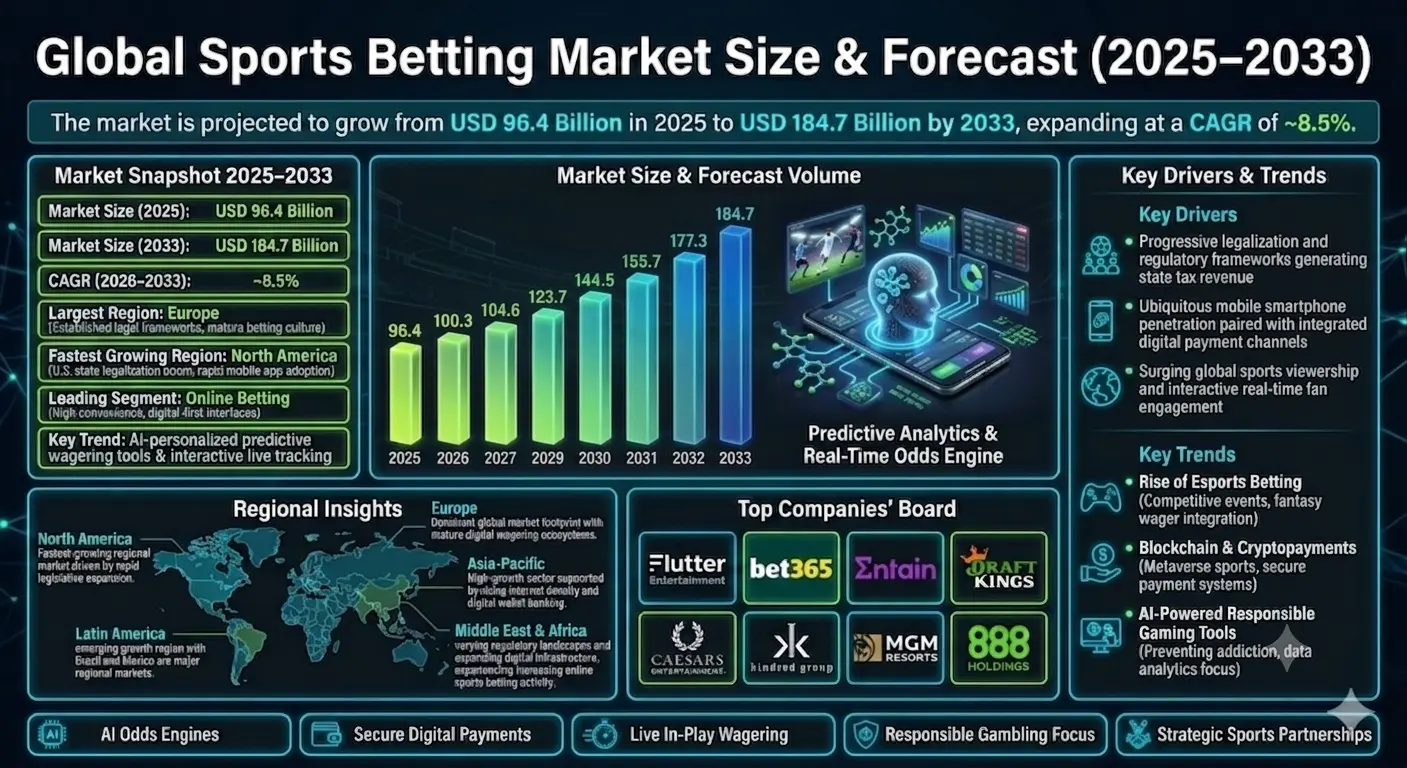
The global sports betting market is projected to witness remarkable growth during the forecast period from 2026 to 2033. The market was valued at approximately USD 96.4 billion in 2025 and is expected to reach nearly USD 184.7 billion by 2033, expanding at a CAGR of around 8.5%. The market growth is driven by increasing legalization of online gambling platforms, rapid digital transformation of betting ecosystems, rising smartphone penetration, expanding internet accessibility, and growing consumer engagement with live sports events worldwide. Sports betting involves wagering on the outcome of sporting events through physical betting outlets or digital platforms. It encompasses betting across sports such as football, basketball, cricket, horse racing, tennis, baseball, esports, and other competitive events. The market is experiencing substantial transformation through mobile betting applications, AI-powered odds generation, real-time analytics, blockchain-based payment systems, and live in-play betting innovations. Additionally, strategic partnerships between sports leagues, betting operators, and digital media platforms are significantly accelerating market expansion globally.Global Sports Betting Market Overview
The sports betting market forms a significant segment of the global online gaming, entertainment, and digital wagering industry. It provides consumers with interactive sports engagement experiences through both traditional bookmakers and advanced digital betting ecosystems. The market includes online sports betting, offline retail betting, mobile betting platforms, live betting systems, and fantasy sports wagering integrations. Operators are increasingly investing in advanced analytics engines, secure payment gateways, responsible gaming technologies, and personalized betting interfaces to enhance user engagement. Technological innovation in machine learning, predictive modeling, real-time event tracking, and digital identity verification is reshaping competitive dynamics. Major market participants include Flutter Entertainment, Bet365 Group Ltd., Entain plc, DraftKings Inc., Caesars Entertainment, Kindred Group, MGM Resorts International, Betsson AB, 888 Holdings plc, and PointsBet Holdings Ltd.Key Drivers of Global Sports Betting Market Growth
Increasing Legalization of Sports Betting
Governments across multiple regions are progressively legalizing and regulating sports betting activities to generate tax revenue and strengthen consumer protections. This regulatory expansion is significantly accelerating market growth.Rapid Growth of Online and Mobile Betting Platforms
The widespread adoption of smartphones and digital payment technologies is making sports betting more accessible and convenient for consumers. Mobile betting platforms now account for a substantial share of total betting activity.Rising Global Sports Viewership
Growing global audiences for football, cricket, basketball, esports, and other major sporting events are driving higher betting participation. Live event engagement is creating stronger consumer wagering activity.Technological Advancements in Betting Platforms
AI-driven odds engines, live betting capabilities, blockchain payment systems, and personalized recommendation algorithms are improving betting experiences. These technologies are increasing user retention and transaction volumes.Strategic Partnerships with Sports Organizations
Betting companies are increasingly forming sponsorship and advertising partnerships with sports leagues, clubs, and broadcasters. This is expanding market visibility and customer acquisition opportunities.Global Sports Betting Market Segmentation
By Platform
The market is segmented into online betting and offline retail betting. Online betting dominates the market due to growing digital adoption and convenience.By Betting Type
The market includes fixed-odds betting, exchange betting, live/in-play betting, spread betting, and parlay betting. Live betting is witnessing rapid growth due to real-time sports engagement.By Sports Type
Sports include football, basketball, cricket, baseball, tennis, horse racing, esports, and others. Football accounts for the largest market share globally.By Device
The market includes desktop platforms, mobile applications, and tablet-based betting systems. Mobile applications dominate due to increasing smartphone usage.Regional Market Dynamics
Europe
Europe dominates the global sports betting market due to mature regulatory frameworks, strong betting culture, and advanced digital wagering infrastructure. The United Kingdom, Germany, Italy, and Spain are major regional contributors.North America
North America is witnessing strong growth driven by progressive legalization across U.S. states and expanding digital betting adoption. The United States remains the fastest-growing regional market.Asia-Pacific
Asia-Pacific represents a high-growth market due to increasing internet penetration, rising sports popularity, and expanding digital payment adoption. India, Australia, Japan, and Southeast Asian markets are key contributors.Latin America
Latin America is gradually emerging as a strong growth region due to evolving regulatory frameworks and increasing mobile betting adoption. Brazil and Mexico are major regional markets.Middle East & Africa
The region is witnessing moderate growth due to varying regulatory landscapes and expanding digital infrastructure. Select African markets are experiencing increasing online sports betting activity.Competitive Landscape
The global sports betting market is highly competitive and technology-driven, with major operators competing through platform innovation, user experience optimization, market reach, and regulatory compliance. Key companies include Flutter Entertainment, Bet365 Group Ltd., Entain plc, DraftKings Inc., Caesars Entertainment, Kindred Group, MGM Resorts International, Betsson AB, 888 Holdings plc, and PointsBet Holdings Ltd. Companies are increasingly investing in AI-powered betting analytics, live streaming integrations, secure payment systems, and responsible gambling tools. Strategic acquisitions, sponsorship deals, and geographic expansion initiatives are shaping competitive dynamics.Strategic Outlook
The strategic outlook for the global sports betting market remains highly positive due to increasing legalization, digital adoption, and technological innovation. Future growth opportunities include blockchain-enabled betting ecosystems, metaverse sports wagering, AI-personalized betting experiences, and expanded esports betting platforms. Growing emphasis on responsible gaming frameworks and regulatory compliance will significantly influence future market development. Operators investing in platform security, data analytics, and omnichannel customer engagement are expected to strengthen competitive positioning.Final Market Perspective
The global sports betting market continues to evolve as digital technologies transform consumer engagement with live sports and wagering experiences. Rising sports viewership, regulatory expansion, and mobile-first betting adoption will continue driving market growth throughout the forecast period. Organizations that successfully combine technological innovation, regulatory excellence, and personalized customer engagement will remain strongly positioned in the evolving global sports betting market.Table of Contents
Table of Contents
- 1. Executive Summary
- 1.1 Global Sports Betting Market Snapshot (2026???2033)
- 1.2 Market Size & CAGR Analysis
- 1.3 Largest & Fastest-Growing Segments
- 1.4 Key Regional Insights
- 1.5 Major Market Growth Drivers
- 1.6 Competitive Landscape Overview
- 1.7 Strategic Outlook Through 2033
- 2. Introduction & Market Overview
- 2.1 Definition of Sports Betting
- 2.2 Scope of the Study
- 2.3 Evolution of Sports Wagering Platforms
- 2.4 Sports Betting Value Chain & Ecosystem
- 2.5 Regulatory & Licensing Framework
- 2.6 Responsible Gambling Standards
- 2.7 Technology Innovation Trends
- 3. Research Methodology
- 3.1 Primary Research
- 3.2 Secondary Research
- 3.3 Market Size Estimation Model
- 3.4 Forecast Assumptions (2026???2033)
- 3.5 Data Validation & Market Triangulation
- 4. Market Dynamics
- 4.1 Drivers
- 4.1.1 Increasing Legalization of Sports Betting
- 4.1.2 Rapid Growth of Online and Mobile Betting Platforms
- 4.1.3 Rising Global Sports Viewership
- 4.1.4 Technological Advancements in Betting Platforms
- 4.1.5 Strategic Partnerships with Sports Organizations
- 4.2 Restraints
- 4.2.1 Regulatory Uncertainty Across Regions
- 4.2.2 Concerns Regarding Gambling Addiction
- 4.2.3 Cybersecurity and Fraud Risks
- 4.2.4 Payment Processing Restrictions
- 4.3 Opportunities
- 4.3.1 Expansion of Esports Betting
- 4.3.2 Blockchain-Based Betting Ecosystems
- 4.3.3 AI-Personalized Betting Experiences
- 4.3.4 Emerging Market Digital Adoption
- 4.4 Challenges
- 4.4.1 Responsible Gambling Compliance
- 4.4.2 Market Saturation in Mature Regions
- 4.4.3 Cross-Border Regulatory Complexity
- 4.4.4 User Trust & Data Privacy Concerns
- 4.1 Drivers
- 5. Global Sports Betting Market Analysis (USD Billion), 2026???2033
- 5.1 Market Size Overview
- 5.2 CAGR Analysis
- 5.3 Regional Revenue Distribution
- 5.4 Betting Volume Trends
- 5.5 Platform Adoption Analysis
- 5.6 Future Growth Projections
- 6. Market Segmentation (USD Billion), 2026???2033
- 6.1 By Platform
- 6.1.1 Online Betting
- 6.1.2 Offline Retail Betting
- 6.2 By Betting Type
- 6.2.1 Fixed-Odds Betting
- 6.2.2 Exchange Betting
- 6.2.3 Live/In-Play Betting
- 6.2.4 Spread Betting
- 6.2.5 Parlay Betting
- 6.3 By Sports Type
- 6.3.1 Football
- 6.3.2 Basketball
- 6.3.3 Cricket
- 6.3.4 Baseball
- 6.3.5 Tennis
- 6.3.6 Horse Racing
- 6.3.7 Esports
- 6.3.8 Others
- 6.4 By Device
- 6.4.1 Desktop Platforms
- 6.4.2 Mobile Applications
- 6.4.3 Tablet-Based Betting Systems
- 6.1 By Platform
- 7. Market Segmentation by Geography
- 7.1 Europe
- 7.2 North America
- 7.3 Asia-Pacific
- 7.4 Latin America
- 7.5 Middle East & Africa
- 8. Competitive Landscape
- 8.1 Market Share Analysis
- 8.2 Platform Benchmarking
- 8.3 User Engagement Strategy Analysis
- 8.4 Strategic Partnerships & Acquisitions
- 8.5 Responsible Gaming & Compliance Strategies
- 9. Company Profiles
- 9.1 Flutter Entertainment
- 9.2 Bet365 Group Ltd.
- 9.3 Entain plc
- 9.4 DraftKings Inc.
- 9.5 Caesars Entertainment
- 9.6 Kindred Group
- 9.7 MGM Resorts International
- 9.8 Betsson AB
- 9.9 888 Holdings plc
- 9.10 PointsBet Holdings Ltd.
- 10. Strategic Intelligence & Pheonix AI Insights
- 10.1 Betting Demand Forecast Engine
- 10.2 User Engagement Analytics Dashboard
- 10.3 Real-Time Odds Intelligence Tracker
- 10.4 Regulatory Compliance Monitoring System
- 10.5 Automated Porter???s Five Forces Analysis
- 11. Future Outlook & Strategic Recommendations
- 11.1 Expansion of Mobile-First Betting Platforms
- 11.2 Investment in Blockchain Payment Integration
- 11.3 Strengthening Responsible Gambling Tools
- 11.4 Growth in Esports & Virtual Sports Betting
- 11.5 Long-Term Market Outlook (2033+)
- 12. Appendix
- 13. About Pheonix Research
- 14. Disclaimer
Competitive Landscape
Global Sports Betting Market Competitive Intensity & Market Structure Overview
The global sports betting market is highly competitive and moderately consolidated, characterized by strong competition among multinational betting operators, digital gaming platforms, casino-entertainment companies, and regional sportsbook providers. Competitive intensity is driven by platform innovation, regulatory compliance, betting experience optimization, customer acquisition strategies, and technological differentiation.
The market structure consists of large international sportsbook operators, regulated online wagering platforms, integrated casino and entertainment groups, fantasy sports companies, and emerging digital-native betting technology providers. Competition is shaped by licensing capabilities, digital infrastructure, payment ecosystem integration, sports media partnerships, and responsible gaming frameworks.
Increasing legalization, rapid digital transformation, rising mobile-first betting adoption, and expanding consumer participation in live sports wagering are intensifying competition across the global sports betting market.
Global Sports Betting Market Competitive Intensity & Market Structure Current Scenario
Leading Global Sports Betting Companies
Flutter Entertainment: Global market leader with an extensive sportsbook portfolio including FanDuel, Paddy Power, and Betfair, supported by advanced digital betting ecosystems.
Bet365 Group Ltd.: Leading online sportsbook operator recognized for strong live betting capabilities, broad global market reach, and advanced platform innovation.
Entain plc: Major betting operator with diversified sportsbook brands and strong international regulatory market presence.
DraftKings Inc.: Prominent digital sports betting platform with strong North American market penetration and advanced mobile-first betting infrastructure.
Caesars Entertainment: Integrated gaming and sportsbook company leveraging casino assets and omnichannel customer engagement strategies.
Kindred Group: Established online gaming and sportsbook provider focused on regulated market expansion and responsible gaming technologies.
MGM Resorts International: Major entertainment and betting operator strengthening digital sports wagering through strategic technology partnerships.
Betsson AB: Strong European digital betting operator with growing international expansion initiatives.
888 Holdings plc: Significant online betting platform provider with diversified digital gaming and sportsbook capabilities.
PointsBet Holdings Ltd.: Innovative sportsbook operator focused on differentiated betting experiences and advanced in-play wagering solutions.
Key Competitive Intensity & Market Structure Drivers
The progressive legalization and regulation of sports betting across multiple jurisdictions is significantly intensifying operator competition and geographic expansion.
The rapid shift toward mobile betting applications and digital wagering platforms is increasing competitive pressure around user experience and platform functionality.
Technological advancements in AI-powered odds generation, predictive analytics, and live in-play betting capabilities are creating strong product differentiation.
Strategic sponsorship agreements with sports leagues, teams, broadcasters, and digital media platforms are becoming critical competitive positioning tools.
Growing emphasis on secure payment systems, real-time analytics, and responsible gaming frameworks is shaping long-term market competitiveness.
Strategic Implications of Competitive Intensity & Market Structure
Operators are increasingly investing in AI-driven personalization engines and advanced analytics platforms to improve customer retention and wagering engagement.
Strategic acquisitions and cross-border licensing agreements are becoming essential for geographic expansion and regulatory market access.
Partnerships with sports media companies and streaming platforms are strengthening real-time betting integration and customer acquisition capabilities.
Responsible gambling tools, identity verification technologies, and regulatory compliance systems are emerging as major competitive differentiators.
Investment in blockchain-enabled payment systems, cybersecurity infrastructure, and omnichannel betting ecosystems is reshaping strategic market positioning.
Global Sports Betting Market Competitive Intensity & Market Structure Forward Outlook
The global sports betting market is expected to remain highly competitive as legalization expands and digital-first wagering ecosystems continue to evolve globally.
Future competition will increasingly focus on AI-personalized betting experiences, esports betting innovation, immersive live-stream wagering, and blockchain-integrated betting ecosystems.
North America and Asia-Pacific are expected to emerge as major competitive growth regions due to regulatory liberalization, rising sports engagement, and mobile payment adoption.
Advancements in real-time analytics, digital identity verification, and predictive wagering technologies are expected to significantly reshape market dynamics.
Overall, companies that successfully combine technological innovation, regulatory excellence, platform security, and personalized user engagement will remain strongly positioned in the evolving global sports betting market.
Value Chain
Global Sports Betting Market Value Chain & Supply Chain Evolution Overview
The global sports betting market value chain is evolving rapidly as regulatory liberalization, digital platform innovation, mobile-first consumer behavior, and advanced data-driven wagering technologies reshape the broader online gaming and interactive entertainment ecosystem. Sports betting has evolved from traditional retail wagering environments into highly sophisticated digital platforms offering real-time, personalized, and immersive betting experiences across global sporting events.
The sports betting value chain spans sports data acquisition, odds generation, software platform development, payment infrastructure integration, regulatory compliance management, customer acquisition, betting operations, risk management, and user engagement optimization. This interconnected ecosystem includes sports data providers, betting software developers, payment processors, regulatory authorities, cybersecurity firms, digital marketing agencies, sportsbook operators, media partners, and end-users.
Major companies including Flutter Entertainment, Bet365 Group Ltd., Entain plc, DraftKings Inc., Caesars Entertainment, Kindred Group, MGM Resorts International, Betsson AB, 888 Holdings plc, and PointsBet Holdings Ltd. are continuously investing in AI-powered analytics, real-time betting engines, secure payment systems, blockchain-based transaction capabilities, and responsible gaming technologies to strengthen market competitiveness.
Upstream supply chain operations depend on licensed sports data feeds, cloud infrastructure providers, payment technology platforms, identity verification systems, cybersecurity architecture, and software engineering resources. Midstream activities focus on sportsbook platform development, odds modeling, risk management systems, mobile application deployment, compliance integration, and customer interface optimization. Downstream operations include customer acquisition, user engagement management, transaction processing, live betting operations, customer support, and retention strategies.
Operational priorities across the sports betting value chain increasingly emphasize platform reliability, low-latency data processing, real-time event synchronization, payment security, regulatory compliance, responsible gambling controls, and personalized user experiences. However, the market continues to face challenges related to regulatory fragmentation, cybersecurity risks, fraud prevention, market saturation in mature regions, and rising customer acquisition costs.
Global Sports Betting Market Value Chain & Supply Chain Evolution Current Scenario
The current sports betting market is being shaped by accelerating online gambling legalization, rising mobile betting adoption, increasing live sports viewership, and growing demand for real-time interactive wagering experiences. Consumers are increasingly favoring digital sportsbooks that provide seamless mobile access, fast transactions, live event engagement, and personalized betting recommendations.
Europe currently dominates the global sports betting market due to mature regulatory frameworks, advanced sportsbook ecosystems, strong betting culture, and highly developed digital payment infrastructure. The United Kingdom remains one of the largest and most technologically advanced regional markets.
North America is emerging as one of the fastest-growing markets driven by progressive legalization across U.S. states, increasing sportsbook partnerships with professional sports leagues, and strong consumer adoption of digital wagering platforms.
Asia-Pacific is witnessing strong growth due to expanding internet access, increasing sports consumption, and growing digital payment adoption, while Latin America is emerging as a promising growth region supported by evolving regulatory reforms.
Operators are increasingly integrating live-streaming functionality, AI-powered recommendation systems, dynamic odds engines, and omnichannel customer engagement platforms to improve retention and maximize wagering activity.
Key Value Chain & Supply Chain Evolution Signals in Global Sports Betting Market
One of the most significant transformation signals is the rapid shift toward mobile-first betting ecosystems. Smartphones have become the dominant access channel, driving investment in intuitive mobile applications and optimized real-time user interfaces.
Another major signal is the increasing deployment of artificial intelligence and machine learning for odds generation, behavioral analytics, fraud detection, and personalized customer engagement strategies.
Live and in-play betting are rapidly transforming the market, requiring low-latency infrastructure capable of delivering instant event data processing and real-time dynamic pricing adjustments.
Blockchain-based payment systems and digital wallet integration are emerging as important innovations, improving transaction transparency, speed, and user trust in betting platforms.
Responsible gaming technologies are becoming increasingly critical. Operators are investing in AI-driven behavioral monitoring, self-exclusion tools, deposit controls, and real-time intervention systems to meet evolving regulatory expectations.
Sportsbook-media convergence is strengthening as operators increasingly partner with broadcasters, sports leagues, and digital content platforms to integrate betting directly into live sports engagement experiences.
Strategic Implications of Value Chain & Supply Chain Evolution in Global Sports Betting Market
Leading sportsbook operators are increasingly prioritizing platform scalability, AI-powered analytics, regulatory adaptability, and omnichannel engagement capabilities to maintain competitive advantage. Competitive differentiation increasingly depends on user experience quality, betting variety, payment flexibility, and real-time platform responsiveness.
Companies capable of delivering hyper-personalized betting ecosystems with advanced analytics, secure payment systems, and seamless cross-device engagement are expected to capture premium growth opportunities.
Strategic partnerships between betting operators, sports leagues, media companies, payment providers, and technology firms are becoming increasingly important for market expansion and ecosystem integration.
Regulatory compliance has become a critical strategic differentiator. Operators with scalable compliance frameworks and localized market adaptation capabilities are better positioned to expand across newly legalized jurisdictions.
Customer retention strategies are evolving beyond promotional offers toward gamified experiences, predictive recommendations, loyalty ecosystems, and immersive live-event engagement features.
Cybersecurity investment is becoming increasingly essential as operators seek to protect financial transactions, personal data, and platform integrity across highly connected digital wagering environments.
Global Sports Betting Market Value Chain & Supply Chain Evolution Forward Outlook
Between 2026 and 2033, the sports betting value chain is expected to become increasingly intelligent, decentralized, immersive, and highly personalized. Digital innovation will continue reshaping sportsbook operations and consumer engagement models.
Artificial intelligence will increasingly automate odds modeling, behavioral analytics, risk management, customer segmentation, and personalized wagering recommendations.
Blockchain-enabled betting ecosystems may gain wider adoption, enabling decentralized wagering models, transparent settlement systems, and enhanced transaction security.
Metaverse-integrated betting environments and immersive virtual sports engagement experiences may create entirely new interactive wagering opportunities.
Esports betting is expected to become an increasingly important market segment, driven by younger demographics and expanding global esports audiences.
Regulatory harmonization across international jurisdictions may improve operational efficiency and create stronger opportunities for cross-border sportsbook expansion.
Ultimately, the future sports betting value chain will evolve into a highly connected, AI-driven, secure, and immersive digital entertainment ecosystem capable of delivering personalized real-time wagering experiences at global scale.
Market-Specific Value Chain
- Sports Data Acquisition & Infrastructure: Licensed sports data feeds, event tracking systems, cloud hosting, identity verification, payment processing infrastructure, and cybersecurity architecture.
- Odds Modeling & Platform Engineering: Betting algorithms, AI analytics engines, sportsbook software development, mobile application engineering, and risk management systems.
- Regulatory Compliance & Licensing: Jurisdictional licensing, responsible gaming systems, fraud detection protocols, AML/KYC compliance, and legal oversight integration.
- Customer Acquisition & Market Engagement: Sports sponsorships, digital advertising, affiliate partnerships, media integrations, promotional campaigns, and customer onboarding systems.
- Live Betting Operations & Transaction Processing: Real-time event synchronization, in-play betting management, secure financial processing, customer support, and dynamic odds adjustment.
- Retention, Personalization & Ecosystem Expansion: Loyalty programs, AI-driven personalization, gamification, esports expansion, immersive betting innovation, and customer lifecycle optimization.
Company-to-Stage Mapping
- Sports Data Acquisition & Infrastructure: Sports data providers, cloud service providers, payment processors, cybersecurity firms, digital identity verification providers.
- Odds Modeling & Platform Engineering: Bet365 Group Ltd., DraftKings Inc., PointsBet Holdings Ltd., sportsbook technology developers.
- Regulatory Compliance & Licensing: Entain plc, Kindred Group, legal compliance specialists, responsible gaming technology firms.
- Customer Acquisition & Market Engagement: Flutter Entertainment, Caesars Entertainment, MGM Resorts International, digital marketing and media partners.
- Live Betting Operations & Transaction Processing: Betsson AB, 888 Holdings plc, payment integration partners, live event analytics providers.
- Retention, Personalization & Ecosystem Expansion: AI personalization providers, esports betting innovators, immersive wagering platform developers.
Investment Activity
Global Sports Betting Market Investment & Funding Dynamics Overview
The global sports betting market is witnessing strong investment momentum as regulatory liberalization, rapid digitalization, mobile-first betting adoption, and increasing global sports engagement continue reshaping the competitive landscape. Between 2026 and 2033, investment activity is expected to accelerate significantly across online betting platforms, AI-powered wagering technologies, blockchain-based transaction infrastructure, live betting systems, and customer engagement innovation.
The sports betting market represents one of the fastest-evolving segments within the global digital entertainment and online gaming ecosystem. Institutional investors, private equity firms, venture capital funds, gaming conglomerates, and strategic technology investors are increasingly allocating capital toward sports wagering operators, platform technology developers, compliance infrastructure providers, and payment technology innovators.
A major shift driving funding activity is the transition from traditional retail betting toward digital-first, mobile-centric, and data-driven wagering ecosystems. This transformation is encouraging significant capital deployment toward cloud-native betting platforms, predictive analytics engines, real-time odds generation systems, and personalized user engagement technologies.
Growing integration between betting operators, sports media companies, esports ecosystems, and digital streaming platforms is also creating substantial cross-industry investment opportunities. Strategic funding is increasingly focused on ecosystem expansion, customer acquisition optimization, and international market penetration.
Current Investment & Funding Landscape
Current investment trends in the sports betting market are heavily concentrated around platform scalability, AI-driven betting intelligence, cybersecurity, regulatory compliance technologies, digital wallet integration, and live event wagering capabilities.
- North America: The fastest-growing investment destination due to progressive U.S. state-level legalization, expanding online sportsbook licensing, and strong institutional investor participation.
- Europe: Continues to attract major investments due to mature regulatory frameworks, strong digital betting penetration, and established operator ecosystems.
- Asia-Pacific: Emerging as a high-growth investment region supported by increasing smartphone penetration, digital payment adoption, and expanding sports consumption.
- Latin America: Experiencing rising funding activity as governments modernize betting regulations and digital operators expand market access.
- Africa & Middle East: Select markets are attracting early-stage investments driven by growing mobile betting participation and digital financial inclusion.
Key Investment & Funding Drivers
- Increasing legalization and regulatory formalization of sports betting across multiple regions.
- Rapid expansion of mobile betting applications and digital wagering ecosystems.
- Rising consumer engagement with live sports streaming and in-play betting experiences.
- Growing demand for AI-powered predictive analytics and real-time betting intelligence.
- Strategic partnerships between sportsbooks, sports leagues, broadcasters, and media platforms.
- Advancements in blockchain-enabled payment systems and transaction transparency solutions.
- Expansion of esports betting and next-generation digital wagering formats.
- Rising investment in responsible gaming and regulatory compliance technologies.
Strategic Investment Areas
- AI & Machine Learning: Investment in predictive modeling, odds automation, fraud detection, and personalized betting recommendations.
- Mobile Betting Infrastructure: Funding for app performance optimization, omnichannel user interfaces, and real-time betting responsiveness.
- Blockchain & Payments: Capital deployment toward secure transactions, decentralized betting systems, and digital wallet integration.
- Live Betting Technology: Investments in low-latency event tracking, in-play betting systems, and real-time data synchronization.
- Responsible Gambling Technologies: Funding for behavioral monitoring tools, self-exclusion systems, and compliance-driven user protection solutions.
- Customer Acquisition Platforms: Strategic spending on affiliate networks, loyalty systems, and sports-media integration.
Strategic Investment Implications
- Companies with strong regulatory compliance infrastructure are attracting greater investor confidence.
- Technology differentiation is becoming the primary valuation driver for sports betting platforms.
- Cross-platform ecosystem integration is increasingly shaping capital allocation decisions.
- Operators investing in user personalization and retention technologies are expected to generate stronger long-term returns.
- Responsible gaming innovation is becoming a critical requirement for sustained funding support.
- Global expansion capabilities remain central to institutional investment attractiveness.
Forward Investment Outlook
The global sports betting market is expected to remain one of the most attractive digital entertainment investment sectors throughout the forecast period. Future funding activity is expected to focus on platform intelligence, decentralized wagering ecosystems, immersive user engagement technologies, and global regulatory expansion strategies.
Emerging areas of investment will include metaverse-integrated sports betting environments, augmented reality betting interfaces, AI-powered hyper-personalized wagering experiences, and blockchain-native betting ecosystems.
- North America: Will continue dominating capital inflows due to legalization momentum and high market monetization potential.
- Europe: Will remain a stable investment hub focused on technology upgrades and responsible gaming innovation.
- Asia-Pacific: Will witness rising strategic investments targeting mobile-first consumer segments.
- Latin America: Will attract growing early-stage and expansion capital as regulatory frameworks mature.
Long-term market investment opportunities will increasingly center on digital trust, platform security, data intelligence, and immersive customer engagement capabilities.
Overall, the sports betting market is positioned as a high-growth investment opportunity driven by digital transformation, expanding legalization, technological innovation, and evolving global consumer entertainment behavior.
Technology & Innovation
Global Sports Betting Market Technology & Innovation Landscape Overview
The Global Sports Betting Market is undergoing rapid technological transformation driven by advancements in artificial intelligence, real-time analytics, blockchain payment infrastructure, mobile betting platforms, and immersive digital engagement technologies. Operators are increasingly integrating intelligent betting engines, secure transaction systems, predictive analytics, and personalized user interfaces to enhance wagering experiences, improve operational efficiency, and strengthen regulatory compliance.
Technological innovation is reshaping the sports betting ecosystem by enabling real-time decision-making, seamless digital accessibility, advanced fraud detection, and interactive live betting experiences. These developments are allowing operators to create highly responsive, secure, and data-driven betting environments.
The market is also experiencing strong digital acceleration through cloud-based betting platforms, API-driven sports data integration, machine learning-powered odds optimization, and omnichannel user engagement systems that connect mobile, desktop, and retail wagering ecosystems.
Global Sports Betting Market Technology & Innovation Current Scenario
Currently, the sports betting market is witnessing significant innovation in AI-powered odds generation and predictive analytics systems. Machine learning algorithms are increasingly being used to analyze historical performance data, player statistics, match conditions, and betting behavior to generate dynamic odds with higher precision.
Live in-play betting technology has become one of the most transformative innovations, enabling bettors to place wagers in real time as sporting events unfold. Real-time event tracking, ultra-low latency data feeds, and instant odds recalibration are significantly enhancing engagement levels.
Mobile-first betting applications dominate the technological landscape, offering intuitive interfaces, real-time notifications, personalized promotions, and integrated digital wallets that improve user convenience and retention.
Blockchain and cryptocurrency integration are gaining traction as operators seek to improve transaction security, transparency, and processing speed while reducing payment friction.
Advanced identity verification technologies, including biometric authentication and AI-powered fraud detection systems, are increasingly being implemented to strengthen regulatory compliance and platform security.
Cloud-based platform architecture is also improving scalability, enabling operators to manage high-volume traffic during major sporting events while maintaining platform stability and performance.
Key Technology & Innovation Trends in Global Sports Betting Market
- AI-Powered Odds Generation: Machine learning systems enabling dynamic and highly accurate betting odds calculation.
- Live In-Play Betting Systems: Real-time wagering capabilities during ongoing sporting events.
- Blockchain Payment Integration: Secure, transparent, and decentralized payment processing for betting transactions.
- Mobile Betting Applications: Smartphone-based wagering platforms offering seamless user accessibility.
- Real-Time Sports Data Analytics: Instant event tracking and performance analytics supporting betting decisions.
- Personalized Recommendation Engines: AI-driven content and betting suggestions tailored to user behavior.
- Biometric Identity Verification: Advanced authentication systems improving platform security and compliance.
- Cloud-Based Betting Infrastructure: Scalable digital architecture supporting high transaction volumes.
- Responsible Gaming Technologies: AI-enabled tools monitoring betting behavior and promoting safe gambling practices.
- Immersive Betting Interfaces: AR, VR, and interactive streaming technologies enhancing user engagement.
Strategic Implications of Technology & Innovation
Technological innovation is fundamentally reshaping competitive dynamics within the sports betting market by shifting competition toward digital platform sophistication, predictive intelligence, user personalization, and transaction security.
Operators investing in advanced analytics, real-time engagement tools, and secure payment ecosystems are achieving stronger customer retention, increased betting frequency, and improved operational efficiency.
The integration of AI-powered responsible gaming systems is becoming strategically essential as regulators increasingly emphasize consumer protection and behavioral risk monitoring.
Mobile-first digital transformation is expanding market accessibility, enabling operators to reach broader consumer segments and capitalize on growing smartphone penetration globally.
However, challenges including cybersecurity threats, evolving regulatory requirements, high technology implementation costs, and data privacy concerns remain significant barriers to sustained innovation.
Global Sports Betting Market Technology & Innovation Forward Outlook
Looking ahead, the sports betting market is expected to evolve toward highly intelligent, immersive, and decentralized digital wagering ecosystems.
Artificial intelligence will increasingly power autonomous odds optimization, hyper-personalized betting experiences, predictive behavioral modeling, and enhanced fraud detection capabilities.
Blockchain-enabled smart contracts are expected to improve transaction transparency, automate payouts, and strengthen trust within decentralized betting ecosystems.
Immersive technologies such as augmented reality, virtual reality, and metaverse-integrated sports betting environments are likely to redefine user engagement by creating interactive digital wagering experiences.
Esports betting platforms and AI-driven real-time simulation wagering are anticipated to emerge as major innovation areas, expanding the market???s consumer base and betting formats.
Overall, the Global Sports Betting Market is entering a new era of digital innovation characterized by intelligent automation, secure decentralized payments, immersive user engagement, and advanced analytics, positioning the industry for sustained long-term growth and technological evolution.
Market Risk
Global Sports Betting Market Risk Factors & Disruption Threats Overview
The global sports betting market is witnessing rapid expansion driven by increasing legalization, widespread mobile betting adoption, technological innovation, and growing consumer engagement with live sports events. Despite strong long-term growth potential, the market faces significant risks and disruption threats related to regulatory volatility, cybersecurity vulnerabilities, responsible gambling pressures, fraud risks, and increasing competitive saturation.
One of the most significant risks impacting the sports betting market is regulatory uncertainty. Governments frequently revise gambling laws, taxation structures, advertising restrictions, and licensing requirements, creating operational unpredictability for betting operators across different jurisdictions.
Cybersecurity threats represent another major challenge. Sports betting platforms process high volumes of financial transactions and sensitive customer data, making them prime targets for cyberattacks, account fraud, payment breaches, and digital identity theft.
Rising concerns regarding problem gambling and social responsibility are intensifying pressure on operators to implement stricter responsible gaming frameworks, betting limits, age verification systems, and self-exclusion tools.
Match-fixing, betting manipulation, and integrity-related risks also remain ongoing threats to market trust and platform credibility, particularly in emerging and lightly regulated markets.
Intense competition and customer acquisition costs are increasing due to market saturation, aggressive promotional spending, and growing platform commoditization.
Additionally, technological disruption and evolving consumer behavior require continuous platform innovation to maintain engagement and retention.
Global Sports Betting Market Risk Factors & Disruption Threats Current Scenario
The current sports betting market is benefiting from strong digital growth, especially in mobile-first betting ecosystems and live in-play wagering platforms.
However, operators are facing increasing regulatory intervention related to advertising restrictions, affordability checks, anti-money laundering compliance, and consumer protection standards.
Several mature markets are introducing tighter controls on bonus promotions, sponsorship visibility, and user targeting practices, directly impacting operator marketing strategies.
Cybersecurity investments are rising as operators strengthen payment authentication systems, fraud detection algorithms, and customer identity verification protocols.
The rapid expansion of AI-powered betting models and algorithmic pricing systems is reshaping platform competitiveness but also raising concerns around fairness and transparency.
Emerging markets offer strong growth opportunities but often present legal ambiguity and enforcement inconsistency.
Global Sports Betting Market Key Risk Factors & Disruption Threat Signals
- Regulatory Volatility: Changing licensing rules, taxation policies, and operational restrictions.
- Responsible Gambling Compliance: Stricter consumer protection and affordability monitoring requirements.
- Cybersecurity Threats: Data breaches, account fraud, ransomware, and financial transaction attacks.
- Match-Fixing Risks: Betting integrity concerns affecting market trust.
- Advertising Restrictions: Reduced customer acquisition opportunities due to tighter promotional regulations.
- High Customer Acquisition Costs: Rising promotional expenses and competitive user acquisition pressure.
- Payment Processing Disruptions: Banking restrictions and digital transaction compliance barriers.
- Technology Obsolescence: Failure to adopt advanced betting analytics and real-time innovation.
- Market Saturation: Intense operator competition in mature regulated regions.
- Consumer Trust Risks: Reputation damage from security breaches or unfair betting practices.
Strategic Implications of Risk Factors
Sports betting operators must prioritize regulatory adaptability and maintain strong compliance frameworks to navigate increasingly fragmented legal environments.
Investment in responsible gambling technologies, AI-driven risk monitoring, and transparent consumer protection systems will become essential for long-term market sustainability. Strengthening cybersecurity infrastructure and secure digital payment ecosystems is critical for protecting customer trust and operational continuity.Operators should diversify market presence geographically to reduce overdependence on individual regulatory jurisdictions.
Continuous innovation in user experience, live analytics, and personalized betting engagement will be necessary to offset competitive saturation and improve retention.
Global Sports Betting Market Forward Risk Outlook
Looking ahead to 2026???2033, regulatory oversight will continue intensifying globally as governments seek stronger consumer protection and taxation controls.
AI-powered compliance systems, blockchain-enabled transparency tools, and advanced fraud detection platforms are expected to become core competitive differentiators.
Operators unable to balance growth with responsible gaming obligations may face licensing challenges and reputational setbacks.
Emerging opportunities in esports betting, immersive digital wagering, and next-generation live betting experiences will create growth potential but also introduce new regulatory and technological complexities.
Overall, sustained leadership in the global sports betting market will depend on regulatory resilience, digital security excellence, innovation capacity, and responsible customer engagement strategies.
Regulatory Landscape
Global Sports Betting Market Regulatory & Policy Environment Overview
The regulatory and policy environment governing the global sports betting market is shaped by gambling legislation, consumer protection frameworks, digital financial compliance requirements, responsible gaming mandates, anti-money laundering (AML) regulations, and data privacy laws. As sports betting transitions from traditional physical wagering to digitally enabled ecosystems, regulatory oversight has become increasingly complex and jurisdiction-specific.
Governments worldwide regulate sports betting to ensure fair gaming practices, prevent illegal wagering activities, protect consumers, generate tax revenues, and maintain the integrity of sporting events. Licensing requirements, taxation structures, advertising controls, player verification protocols, and operational transparency standards significantly influence market operations.
The rapid expansion of mobile betting platforms, cross-border digital wagering, blockchain payment systems, and live in-play betting technologies is driving the need for modernized regulatory frameworks focused on digital compliance, responsible gambling, and cybersecurity resilience.
Global Sports Betting Market Regulatory & Policy Environment Current Scenario
The current global regulatory landscape for sports betting remains highly fragmented, with jurisdictions ranging from fully legalized and regulated markets to highly restricted or prohibited betting environments.
In North America, regulatory momentum has accelerated significantly following legalization across multiple U.S. states after the repeal of federal restrictions. State-level gaming commissions oversee operator licensing, taxation, consumer safeguards, and responsible gaming compliance. Canada has also expanded regulated single-event sports betting frameworks.
Europe remains one of the most mature regulated sports betting markets, governed through national gambling authorities and broader regional consumer protection regulations. Countries such as the United Kingdom, Germany, Italy, and Spain maintain robust licensing systems, advertising controls, and responsible gaming standards.
Asia-Pacific presents a mixed regulatory environment, with mature regulated betting frameworks in markets such as Australia, while other countries maintain strict restrictions or state-controlled wagering systems. Regulatory modernization is gradually emerging across select jurisdictions.
Latin America is witnessing increasing legalization and regulatory reform, particularly in Brazil and other emerging markets, while parts of the Middle East and Africa continue to maintain varying levels of restriction and evolving oversight.
Key Regulatory & Policy Environment Signals in Global Sports Betting Market
- Expanding Legalization Frameworks: More governments are legalizing regulated sports betting to formalize market activity and capture tax revenues.
- Responsible Gaming Regulations: Mandatory player protection tools such as deposit limits, self-exclusion mechanisms, and behavioral monitoring are becoming standard requirements.
- Anti-Money Laundering Compliance: Enhanced KYC verification, transaction monitoring, and suspicious activity reporting obligations are strengthening operator oversight.
- Advertising and Promotional Restrictions: Regulators are tightening controls on sports betting marketing, sponsorship exposure, and youth-targeted promotional activities.
- Digital Identity Verification Standards: Stronger identity authentication requirements are improving platform security and preventing underage gambling.
- Data Privacy and Cybersecurity Regulation: Betting operators must increasingly comply with consumer data protection laws and secure digital transaction frameworks.
Strategic Implications of Regulatory & Policy Environment
The evolving regulatory environment is encouraging sports betting operators to prioritize compliance-driven platform development, operational transparency, and responsible gambling technology integration.
Licensing requirements are influencing market entry strategies, often favoring operators with strong regulatory expertise, local partnerships, and advanced compliance infrastructure.
Responsible gaming mandates are accelerating investment in AI-powered behavioral analytics, player monitoring systems, and automated intervention tools to identify problematic betting activity.
Advertising restrictions are reshaping customer acquisition strategies, encouraging operators to focus on personalized engagement, loyalty ecosystems, and data-driven retention models rather than aggressive promotional campaigns.
Cybersecurity and payment compliance standards are increasing demand for secure digital wallets, fraud prevention systems, and blockchain-based transaction traceability solutions.
Global Sports Betting Market Regulatory & Policy Environment Forward Outlook
Between 2026 and 2033, the regulatory environment for the global sports betting market is expected to become increasingly structured, technology-driven, and consumer-protection focused.
More jurisdictions are likely to legalize and regulate sports betting to formalize digital wagering activity, improve tax collection, and reduce illegal betting operations.
Responsible gaming regulations are expected to become more stringent, with greater use of AI-based monitoring, mandatory affordability assessments, and enhanced intervention requirements.
Cross-border digital betting regulations may become more coordinated, particularly regarding payment processing, AML enforcement, and digital identity verification.
Emerging technologies such as blockchain-enabled betting platforms, decentralized wagering ecosystems, and AI-powered odds systems will likely face new regulatory scrutiny to ensure transparency and consumer protection.
Overall, regulatory and policy developments will remain a defining market force, with operators investing in compliance innovation, secure digital infrastructure, and responsible gaming leadership expected to maintain long-term competitive advantage.