
Global Transport and Logistics Market size and share analysis 2026–2033
Global Transport and Logistics Market Forecast Snapshot (2026???2033)
| Metric | Value |
|---|---|
| Market Size (2025) | USD 8.92 Trillion |
| Market Size (2033) | USD 15.74 Trillion |
| CAGR (2026???2033) | 7.35% |
| Largest Segment | Freight Transportation Services |
| Fastest Growing Segment | Digital Logistics & Last-Mile Delivery Solutions |
| Leading End-Use Segment | Retail & E-commerce Supply Chain Operations |
| Key Trend | AI-Driven Supply Chain Optimization & Smart Logistics Automation |
| Regulatory Influence | Cross-Border Trade Policies, Transportation Safety Standards & Carbon Emission Regulations |
| Future Outlook | Growth Driven by Digital Transformation, E-commerce Expansion & Sustainable Logistics Infrastructure |
Global Transport and Logistics Market??Size & Forecast
The Global Transport and Logistics Market is expected to witness strong expansion during the forecast period from 2026 to 2033. The market was valued at USD 8.92 trillion in 2025 and is projected to reach approximately USD 15.74 trillion by 2033, registering a CAGR of 7.35%. The market growth is primarily driven by rising global trade activity, increasing e-commerce penetration, expanding supply chain networks, and growing demand for fast, reliable, and technology-enabled transportation solutions. Transport and logistics services are increasingly critical for freight movement, inventory management, warehousing, cross-border trade, and last-mile delivery. Rising adoption of AI-based route optimization, warehouse automation, telematics, blockchain logistics tracking, and electric transportation fleets is accelerating market growth. In addition, globalization, smart infrastructure investments, and sustainability-focused logistics modernization are supporting long-term market expansion.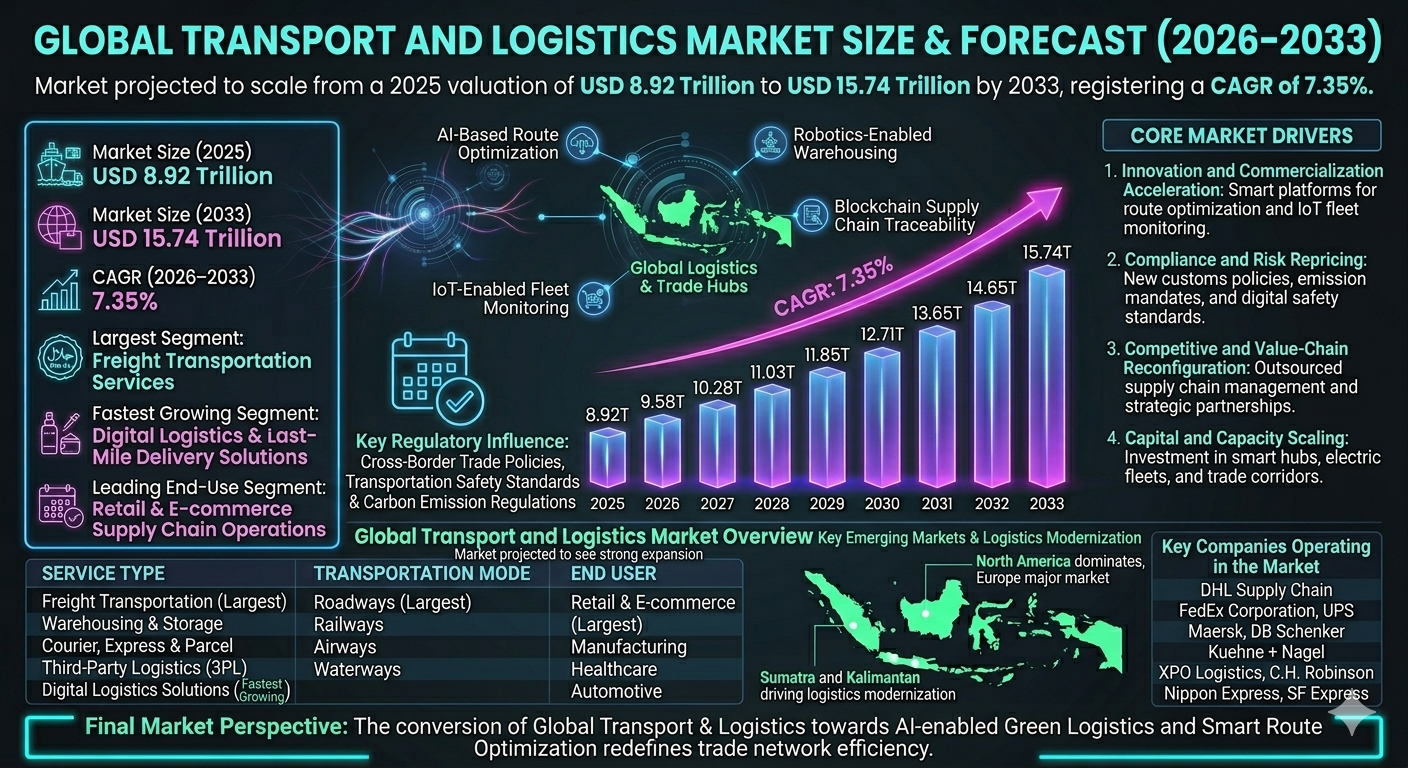
Global Transport and Logistics Market Overview
Transport and logistics services involve the planning, movement, storage, and management of goods across local, regional, and global supply chains. The market includes freight transportation, warehousing, courier services, third-party logistics (3PL), fourth-party logistics (4PL), supply chain management solutions, and digital logistics platforms. Transport and logistics services are widely utilized across manufacturing, retail, healthcare, automotive, industrial, and e-commerce sectors. The market is shifting from conventional transport systems toward digitally integrated logistics ecosystems, automated warehousing, AI-enabled fleet management, and sustainable transportation infrastructure.Structural Drivers of Market Growth
1. Innovation and Commercialization Acceleration
Rapid innovation in AI route optimization, robotics-enabled warehouses, IoT-based fleet monitoring, and autonomous transport systems is accelerating operational efficiency. Smart logistics platforms are significantly improving visibility, tracking, and delivery precision.Market Implications
Companies investing in automation, predictive analytics, and digital logistics ecosystems are expected to strengthen market leadership.2. Compliance and Risk Repricing
Transportation safety regulations, international customs policies, carbon emission mandates, and digital compliance frameworks are influencing operational modernization. Governments are increasingly promoting low-emission logistics networks and secure cross-border trade systems.Market Implications
Firms offering compliant, sustainable, and digitally secure logistics solutions are likely to gain stronger market trust.3. Competitive and Value-Chain Reconfiguration
The market is highly competitive as logistics providers, e-commerce companies, freight operators, technology firms, and infrastructure developers expand service offerings. Integrated digital supply chain ecosystems and strategic transportation partnerships are altering value-chain economics.Market Implications
Companies focusing on end-to-end supply chain integration and smart delivery networks may gain stronger margins.4. Capital and Capacity Scaling
Rising investment in logistics hubs, smart warehouses, electric fleet infrastructure, and digital transportation platforms is supporting market expansion. Trade corridor modernization and port infrastructure upgrades are also increasing demand.Market Implications
Operators scaling automation capabilities and logistics network capacity are expected to capture future opportunities.Global Transport and Logistics Market Segmentation Analysis
By Service Type
1. Freight Transportation Services
This remains the largest segment due to extensive global trade activity and industrial supply chain demand.2. Warehousing & Storage Services
Widely used for inventory management and supply chain flexibility.3. Courier, Express & Parcel Services
Fast-growing due to e-commerce delivery expansion.4. Third-Party Logistics (3PL)
Strong growth driven by outsourced supply chain management demand.5. Digital Logistics Solutions
Fastest-growing due to real-time analytics and automation benefits.By Transportation Mode
1. Roadways
Largest segment due to flexibility and widespread connectivity.2. Railways
Growing for cost-efficient long-distance cargo movement.3. Airways
Preferred for high-value and time-sensitive shipments.4. Waterways
Critical for international bulk cargo trade.By End User
1. Retail & E-commerce
Largest segment due to rapid online commerce expansion.2. Manufacturing
Strong demand for industrial supply chain coordination.3. Healthcare
Growing need for temperature-controlled logistics.4. Automotive
Extensive usage for component transportation and distribution.Regional Global Transport and Logistics Market Dynamics
North America
North America dominates the global transport and logistics market due to advanced logistics infrastructure, strong e-commerce penetration, and digital supply chain adoption.Europe
Europe remains a major market supported by sustainable transport initiatives and strong regional trade networks.Asia-Pacific
Asia-Pacific is the fastest-growing region due to manufacturing expansion, trade activity, and rapid digital infrastructure development.Latin America
Latin America is gradually expanding due to logistics modernization and increasing regional trade integration.Middle East & Africa
The region is witnessing emerging growth driven by infrastructure investments and strategic trade corridor development.Competitive Landscape
The Global Transport and Logistics Market is highly competitive with multinational logistics providers, freight operators, technology companies, and digital supply chain platforms expanding globally.Key Companies Operating in the Market Include:
- DHL Supply Chain
- FedEx Corporation
- United Parcel Service (UPS)
- Maersk
- DB Schenker
- Kuehne + Nagel
- XPO Logistics
- C.H. Robinson
- Nippon Express
- SF Express
Strategic Outlook
The future of the transport and logistics market will be shaped by AI-driven logistics orchestration, electric fleets, autonomous delivery systems, and blockchain-enabled supply chain transparency. Warehouse robotics, predictive maintenance, and smart route planning will significantly improve operational efficiency. The rise of sustainable logistics, cross-border e-commerce, and digital freight ecosystems is expected to create strong long-term growth opportunities.Final Market Perspective
The Global Transport and Logistics Market remains a major pillar within the global trade and supply chain ecosystem. Rising digitalization, infrastructure modernization, and e-commerce growth continue driving long-term market expansion. Companies capable of delivering scalable, technology-enabled, sustainable, and customer-centric logistics ecosystems will be best positioned to capture future opportunities. The convergence of AI, automation, digital visibility platforms, and green transportation is expected to redefine the future of the global transport and logistics industry.Table of Contents
Table of Contents
- 1. Executive Summary
- 1.1 Global Transport and Logistics Market Snapshot (2026???2033)
- 1.2 Market Size & CAGR Analysis
- 1.3 Largest & Fastest-Growing Segments
- 1.4 Key Regional Insights
- 1.5 Major Market Growth Drivers
- 1.6 Competitive Landscape Overview
- 1.7 Strategic Outlook Through 2033
- 2. Introduction & Market Overview
- 2.1 Definition of Transport and Logistics Services
- 2.2 Scope of the Study
- 2.3 Evolution of Global Supply Chain Networks
- 2.4 Logistics Ecosystem Analysis
- 2.5 Regulatory & Trade Compliance Framework
- 2.6 Industry Demand Trends
- 2.7 Innovation Landscape in Smart Logistics
- 3. Research Methodology
- 3.1 Primary Research
- 3.2 Secondary Research
- 3.3 Market Size Estimation Model
- 3.4 Forecast Assumptions (2026???2033)
- 3.5 Data Validation & Market Triangulation
- 4. Market Dynamics
- 4.1 Drivers
- 4.1.1 Rising Global Trade Activity
- 4.1.2 Expansion of E-commerce Ecosystems
- 4.1.3 AI-Driven Logistics Optimization
- 4.1.4 Smart Infrastructure Investments
- 4.1.5 Growing Demand for Sustainable Logistics
- 4.2 Restraints
- 4.2.1 Rising Fuel and Operational Costs
- 4.2.2 Infrastructure Bottlenecks
- 4.2.3 Regulatory Complexity Across Borders
- 4.2.4 Labor Shortages in Logistics Operations
- 4.3 Opportunities
- 4.3.1 Digital Logistics Platforms
- 4.3.2 Electric and Autonomous Fleets
- 4.3.3 Smart Warehouse Expansion
- 4.3.4 Cross-Border Trade Corridor Development
- 4.4 Challenges
- 4.4.1 Supply Chain Disruptions
- 4.4.2 Cybersecurity Risks in Digital Logistics
- 4.4.3 Sustainability Compliance Costs
- 4.4.4 Technology Integration Complexity
- 4.1 Drivers
- 5. Global Transport and Logistics Market Analysis (USD Trillion), 2026???2033
- 5.1 Market Size Overview
- 5.2 CAGR Analysis
- 5.3 Regional Revenue Distribution
- 5.4 Technology Adoption Trends
- 5.5 End-Use Demand Analysis
- 5.6 Future Growth Projections
- 6. Market Segmentation (USD Trillion), 2026???2033
- 6.1 By Service Type
- 6.1.1 Freight Transportation Services
- 6.1.2 Warehousing & Storage Services
- 6.1.3 Courier, Express & Parcel Services
- 6.1.4 Third-Party Logistics (3PL)
- 6.1.5 Digital Logistics Solutions
- 6.2 By Transportation Mode
- 6.2.1 Roadways
- 6.2.2 Railways
- 6.2.3 Airways
- 6.2.4 Waterways
- 6.3 By End User
- 6.3.1 Retail & E-commerce
- 6.3.2 Manufacturing
- 6.3.3 Healthcare
- 6.3.4 Automotive
- 6.1 By Service Type
- 7. Market Segmentation by Geography
- 7.1 North America
- 7.2 Europe
- 7.3 Asia-Pacific
- 7.4 Latin America
- 7.5 Middle East & Africa
- 8. Competitive Landscape
- 8.1 Market Share Analysis
- 8.2 Technology Benchmarking
- 8.3 Strategic Partnerships & Collaborations
- 8.4 Infrastructure Expansion Analysis
- 8.5 Service Positioning Strategies
- 9. Company Profiles
- 9.1 DHL Supply Chain
- 9.2 FedEx Corporation
- 9.3 United Parcel Service (UPS)
- 9.4 Maersk
- 9.5 DB Schenker
- 9.6 Kuehne + Nagel
- 9.7 XPO Logistics
- 9.8 C.H. Robinson
- 9.9 Nippon Express
- 9.10 SF Express
- 10. Strategic Intelligence & Pheonix AI Insights
- 10.1 Supply Chain Forecast Engine
- 10.2 Logistics Analytics Dashboard
- 10.3 Route Optimization Intelligence Tracker
- 10.4 Operational Efficiency Opportunity Analyzer
- 10.5 Automated Porter???s Five Forces Analysis
- 11. Future Outlook & Strategic Recommendations
- 11.1 Investment in AI-Powered Logistics Systems
- 11.2 Expansion of Sustainable Fleet Infrastructure
- 11.3 Strengthening Smart Warehouse Networks
- 11.4 Accelerating Cross-Border Digital Integration
- 11.5 Long-Term Market Outlook (2033+)
- 12. Appendix
- 13. About Pheonix Research
- 14. Disclaimer
Competitive Landscape
Global Transport and Logistics Market Competitive Intensity & Market Structure Overview
The global transport and logistics market is highly competitive and moderately consolidated, characterized by intense competition among multinational logistics providers, freight operators, courier companies, third-party logistics (3PL) providers, technology-enabled supply chain platforms, and integrated transportation service companies. Competitive intensity is driven by network scalability, service reliability, digital logistics capabilities, last-mile delivery efficiency, automation adoption, and sustainability-focused operational strategies.
The market structure consists of established global logistics leaders with extensive multimodal transportation infrastructure alongside regional specialists and emerging digital-first logistics platforms. Competition is increasingly shaped by AI-enabled route optimization, warehouse automation, smart fleet management, blockchain-based shipment visibility, and electric transportation fleet deployment.
Rising global trade activity, accelerating e-commerce penetration, increasing demand for real-time logistics visibility, and expanding digital supply chain transformation are significantly intensifying competition across the global transport and logistics market.
Global Transport and Logistics Market Competitive Intensity & Market Structure Current Scenario
Leading Global Transport and Logistics Companies
DHL Supply Chain: Global market leader with integrated logistics, warehousing, and advanced digital supply chain solutions.
FedEx Corporation: Major international logistics provider with strong express delivery and e-commerce fulfillment capabilities.
United Parcel Service (UPS): Leading global parcel and logistics company with strong last-mile delivery infrastructure.
Maersk: Dominant integrated container logistics provider with global freight and end-to-end supply chain capabilities.
DB Schenker: Major logistics player specializing in freight forwarding and digital supply chain management.
Kuehne + Nagel: Strong market participant focused on multimodal transport and intelligent logistics solutions.
XPO Logistics: Advanced technology-driven logistics company with strong freight optimization capabilities.
C.H. Robinson: Major third-party logistics provider focused on digital freight brokerage and transportation management.
Nippon Express: Key global logistics provider with strong Asia-Pacific operational footprint.
SF Express: Rapidly expanding logistics company recognized for digital delivery innovation and e-commerce logistics solutions.
Key Competitive Intensity & Market Structure Drivers
The rapid expansion of e-commerce fulfillment requirements is intensifying competition in last-mile delivery solutions.
AI-driven logistics orchestration and predictive route optimization are creating strong operational differentiation opportunities.
Sustainability regulations and carbon reduction mandates are reshaping transportation infrastructure competitiveness.
The increasing need for real-time supply chain visibility is accelerating investment in digital logistics platforms.
Cross-border trade complexity and customs compliance requirements are strengthening integrated global network competition.
Strategic Implications of Competitive Intensity & Market Structure
Logistics providers are increasingly investing in warehouse robotics, autonomous transport systems, and AI-powered fleet optimization.
Strategic partnerships with e-commerce platforms and digital freight marketplaces are becoming essential for market expansion.
Electric vehicle fleet deployment and low-emission transportation infrastructure are emerging as major competitive differentiators.
Blockchain-enabled shipment traceability and secure digital documentation are strengthening supply chain transparency.
Integrated multimodal logistics ecosystems are becoming central to long-term market leadership.
Global Transport and Logistics Market Competitive Intensity & Market Structure Forward Outlook
The transport and logistics market is expected to remain highly competitive as digital transformation and e-commerce-driven supply chain expansion continue accelerating.
Future competition will increasingly focus on autonomous delivery systems, AI-based supply chain orchestration, predictive logistics analytics, and sustainable fleet modernization.
North America will remain the dominant competitive region, while Asia-Pacific is expected to witness the fastest competitive expansion due to trade growth and digital logistics infrastructure development.
Advancements in smart warehouses, autonomous freight transport, blockchain logistics ecosystems, and green transportation corridors are expected to significantly reshape market dynamics.
Overall, companies that successfully combine network scalability, digital intelligence, sustainability integration, and customer-centric logistics innovation will remain strongly positioned in the evolving global transport and logistics market.
Value Chain
Global Transport and Logistics Market Value Chain & Supply Chain Evolution Overview
The Global Transport and Logistics Market value chain is undergoing rapid transformation from conventional transportation and warehousing systems toward a digitally integrated, automation-driven, and sustainability-focused logistics ecosystem. This evolution is being driven by increasing global trade volumes, rapid e-commerce expansion, rising customer expectations for faster deliveries, and growing adoption of AI-powered logistics technologies.
The modern transport and logistics value chain is becoming increasingly interconnected through digital platforms, real-time data analytics, predictive logistics planning, and intelligent transportation networks. Companies are focusing on improving operational visibility, reducing delivery lead times, and enhancing cost efficiency through advanced supply chain technologies.
The upstream segment begins with infrastructure development, transportation asset manufacturing, fuel and energy sourcing, software platform development, and logistics equipment production. This includes commercial vehicle manufacturers, shipping container suppliers, aircraft and rail equipment producers, warehouse automation providers, and digital logistics software vendors.
The operational core consists of freight transportation services, warehousing and storage operations, inventory management systems, route planning, fleet management, and multimodal logistics coordination. Automation, robotics, AI-driven route optimization, and IoT-enabled fleet tracking are significantly improving logistics performance and operational precision.
The downstream distribution network includes third-party logistics providers (3PL), fourth-party logistics operators (4PL), courier services, last-mile delivery companies, fulfillment centers, and digital freight marketplaces. Increasing adoption of omnichannel logistics models is reshaping distribution efficiency across global markets.
Retail and end-user delivery are increasingly influenced by customer-centric digital ecosystems where shipment visibility, real-time tracking, flexible delivery options, and automated customer communication systems have become essential competitive differentiators.
Overall, the transport and logistics value chain is transitioning into a technology-enabled, globally connected, data-driven ecosystem where speed, transparency, automation, and sustainability define competitive advantage.
Global Transport and Logistics Market Value Chain & Supply Chain Evolution Current Scenario
The current market structure reflects a hybrid logistics ecosystem combining traditional freight transportation networks with rapidly expanding digital logistics platforms.
Road, rail, air, and maritime transportation continue to form the foundation of logistics operations, while digital freight management systems, automated warehouses, and AI-based route planning platforms are rapidly modernizing operational workflows.
Warehousing and fulfillment operations are becoming increasingly automated through robotics, automated storage systems, and AI-driven inventory optimization tools. This is enabling faster order processing and improved supply chain responsiveness.
E-commerce growth is significantly accelerating demand for agile fulfillment systems and last-mile delivery innovation. Same-day delivery expectations are forcing logistics providers to invest heavily in decentralized fulfillment centers and route optimization technologies.
Cross-border logistics remains a critical growth driver, although customs complexity, geopolitical trade restrictions, and regulatory compliance challenges continue to create operational barriers.
Key Value Chain & Supply Chain Evolution Signals in Global Transport and Logistics Market
Digital logistics transformation is one of the most significant structural shifts, with AI-driven freight matching, predictive analytics, blockchain tracking, and cloud-based transportation management platforms reshaping operational efficiency.
Warehouse automation acceleration is transforming inventory handling, order processing, and fulfillment speed through robotics and smart storage systems.
Sustainability integration is becoming a strategic priority as logistics companies adopt electric fleets, carbon tracking systems, and low-emission transportation solutions.
Last-mile delivery innovation is creating new operational models through autonomous delivery systems, micro-fulfillment centers, and dynamic routing technologies.
Supply chain resilience initiatives are increasing as businesses diversify transportation routes and strengthen contingency logistics planning.
Strategic Implications of Value Chain & Supply Chain Evolution in Global Transport and Logistics Market
The evolving logistics value chain presents major strategic opportunities for transportation providers, digital platform operators, warehouse automation firms, and infrastructure developers.
Competitive advantage is increasingly determined by digital integration, network optimization capabilities, supply chain visibility, sustainability compliance, and fulfillment responsiveness.
Companies investing in AI-driven logistics orchestration, smart warehousing, predictive route optimization, and integrated digital freight ecosystems are expected to strengthen market leadership.
Strategic collaborations between logistics providers, e-commerce platforms, software developers, and transportation infrastructure operators are becoming increasingly critical for long-term growth.
Organizations capable of balancing operational efficiency, regulatory compliance, environmental sustainability, and customer-centric service models will achieve stronger market positioning.
Global Transport and Logistics Market Value Chain & Supply Chain Evolution Forward Outlook
Between 2026 and 2033, the transport and logistics value chain is expected to evolve into a fully intelligent, autonomous, and sustainability-driven ecosystem.
AI-powered logistics orchestration platforms will enable predictive route optimization, automated demand forecasting, and real-time supply chain decision-making.
Warehouse operations will become increasingly autonomous through robotics, machine vision systems, and smart inventory analytics.
Electric transportation fleets, hydrogen-powered freight solutions, and green logistics infrastructure will reshape operational sustainability standards.
Blockchain-enabled transparency and digital documentation systems will simplify cross-border trade and improve logistics security.
Ultimately, the future transport and logistics value chain will be defined by automation, real-time intelligence, operational resilience, and environmentally sustainable logistics networks.
Investment Activity
Global Transport and Logistics Market Investment & Funding Dynamics Overview
The Global Transport and Logistics Market is witnessing substantial investment momentum driven by expanding global trade activity, rapid digital supply chain transformation, e-commerce growth, and rising demand for intelligent logistics infrastructure. Logistics providers, freight operators, e-commerce companies, infrastructure developers, and technology firms are actively investing in AI-driven logistics platforms, warehouse automation, smart fleet management systems, electric transportation fleets, and digital freight ecosystems.
Investment activity is accelerating due to growing demand for real-time supply chain visibility, last-mile delivery optimization, predictive logistics analytics, cross-border trade efficiency, and sustainable transportation solutions. The transition toward digitally integrated logistics ecosystems is significantly reshaping capital allocation across the market.
Additionally, expanding investments in autonomous delivery technologies, smart warehousing, blockchain-based logistics tracking, charging infrastructure, and low-emission transportation networks are strengthening long-term growth opportunities globally.
Global Transport and Logistics Market Investment & Funding Dynamics Current Scenario
Currently, the global transport and logistics market demonstrates rising investment activity due to increasing capital requirements for fleet modernization, digital infrastructure deployment, automated warehousing systems, and sustainable logistics transformation. Leading logistics operators are heavily investing in AI-powered route optimization, warehouse robotics, telematics systems, predictive maintenance tools, and integrated supply chain visibility platforms.
The market is attracting strong funding into digital logistics startups, last-mile delivery platforms, smart freight marketplaces, electric fleet developers, and blockchain-enabled logistics software providers.
The industry is witnessing active mergers, acquisitions, infrastructure partnerships, and strategic alliances as logistics firms, technology providers, and transportation operators pursue service integration, capacity expansion, and digital transformation.
Key Investment & Funding Dynamics Signals in Global Transport and Logistics Market
- Rising global demand for faster freight movement and e-commerce fulfillment is accelerating logistics infrastructure investments.
- Expansion of digital logistics platforms and warehouse automation systems is increasing technology-focused capital deployment.
- Growing adoption of electric fleets and low-emission transportation solutions is strengthening sustainability-driven funding.
- Strategic investments in AI-powered route optimization and predictive supply chain analytics are reshaping operational priorities.
- Partnerships between logistics providers, e-commerce platforms, and technology firms are improving ecosystem scalability.
- Increasing regulatory focus on carbon emission reduction and transportation safety compliance is supporting investor confidence.
- Rising demand for integrated digital freight ecosystems and cross-border logistics optimization is accelerating R&D spending.
Strategic Implications of Investment & Funding Dynamics in Global Transport and Logistics Market
- Continuous investment in automation, AI logistics orchestration, and digital freight platforms is essential for long-term competitiveness.
- Capital allocation toward smart warehouses, fleet electrification, and digital visibility infrastructure will strengthen market positioning.
- Companies delivering scalable, technology-enabled, and sustainable logistics ecosystems are expected to gain stronger market share.
- Strategic acquisitions and infrastructure partnerships will accelerate network integration and operational efficiency.
- Investments in autonomous delivery systems and blockchain-enabled logistics transparency will remain major priorities.
- Compliance with trade regulations, transportation safety standards, and carbon emission mandates will remain critical for sustained growth.
- Organizations scaling intelligent logistics platforms and sustainable transportation networks are expected to capture substantial future opportunities.
Global Transport and Logistics Market Investment & Funding Dynamics Forward Outlook
Looking ahead, the Global Transport and Logistics Market is expected to maintain strong investment growth driven by digital transformation, e-commerce expansion, fleet electrification, and smart infrastructure modernization.
Future capital deployment will increasingly focus on autonomous freight systems, AI-based logistics optimization, electric transportation ecosystems, warehouse robotics, blockchain traceability platforms, and integrated supply chain intelligence solutions.
Smart logistics automation and sustainable transportation infrastructure are expected to become major long-term innovation priorities.
In conclusion, the Global Transport and Logistics Market represents a high-growth infrastructure and technology investment landscape where digital transformation, automation, sustainability, and intelligent logistics ecosystems will define future capital strategies.
Technology & Innovation
Global Transport and Logistics Market Technology & Innovation Landscape Overview
The global transport and logistics market is undergoing rapid technological transformation driven by advancements in artificial intelligence, Internet of Things (IoT), warehouse automation, blockchain-enabled supply chain visibility, autonomous transportation systems, and advanced fleet management technologies. The evolution of logistics technologies is increasingly focused on improving operational efficiency, real-time shipment visibility, predictive decision-making, and sustainable transportation optimization across global supply chains.
Modern transport and logistics systems are integrating AI-powered route optimization engines, cloud-based logistics orchestration platforms, digital twin simulations, robotic warehouse automation, and connected telematics infrastructure to enable seamless end-to-end supply chain operations. These innovations are significantly improving delivery accuracy, reducing operational costs, and enhancing logistics responsiveness.
The market is also witnessing rapid adoption of electric transportation fleets, autonomous delivery technologies, blockchain-secured cargo tracking, and real-time predictive analytics systems that are redefining global logistics infrastructure.
Global Transport and Logistics Market Technology & Innovation Current Scenario
Currently, innovation in the transport and logistics market is centered around digital supply chain integration and intelligent logistics automation. Traditional logistics systems are increasingly being replaced by connected digital ecosystems that enable real-time operational visibility and faster decision-making.
Artificial intelligence and machine learning are being widely deployed to optimize route planning, demand forecasting, inventory positioning, and predictive maintenance for transport assets.
Warehouse robotics and automated fulfillment systems are becoming a major innovation area, improving throughput efficiency, minimizing labor dependency, and supporting high-volume e-commerce logistics.
IoT-enabled telematics systems are gaining strong adoption by enabling real-time vehicle tracking, asset condition monitoring, fuel optimization, and driver performance analytics.
Blockchain technology is increasingly being integrated into logistics operations to improve cargo traceability, reduce fraud risks, and strengthen documentation transparency across international trade networks.
Electric vehicle fleets and smart charging infrastructure are also expanding rapidly as organizations pursue low-emission transportation strategies.
Key Technology & Innovation Trends in Global Transport and Logistics Market
- AI-Powered Route Optimization: Improving delivery efficiency and reducing transportation costs.
- Warehouse Robotics Automation: Accelerating fulfillment speed and operational scalability.
- IoT Fleet Monitoring Systems: Enabling real-time asset visibility and predictive maintenance.
- Blockchain Supply Chain Tracking: Enhancing cargo transparency and documentation security.
- Autonomous Delivery Technologies: Reducing labor dependency through self-driving logistics systems.
- Electric Fleet Infrastructure: Supporting sustainable transportation modernization.
- Digital Twin Logistics Simulation: Enabling operational planning and network optimization.
- Cloud-Based Logistics Platforms: Strengthening centralized supply chain orchestration.
- Predictive Analytics Engines: Enhancing demand forecasting and inventory optimization.
- Smart Last-Mile Delivery Systems: Improving urban delivery efficiency and customer satisfaction.
Strategic Implications of Technology & Innovation
Technological advancements are significantly reshaping competitive dynamics in the transport and logistics market by shifting competition from conventional freight operations toward intelligent, automated, and digitally interconnected logistics ecosystems.
Companies investing in AI-driven logistics intelligence, automation platforms, and sustainable transportation technologies are achieving stronger competitive differentiation through improved service reliability, lower operational costs, and enhanced delivery precision.
The growing integration of digital technologies is enabling logistics providers to strengthen supply chain resilience, improve customer responsiveness, and optimize global trade efficiency.
Advanced automation and predictive analytics are helping operators reduce delays, improve resource utilization, and increase operational scalability.
However, high infrastructure investment requirements, integration complexity, cybersecurity vulnerabilities, and regulatory adaptation challenges remain significant barriers to widespread technological adoption.
Global Transport and Logistics Market Technology & Innovation Forward Outlook
The future of transport and logistics technology is expected to evolve toward fully autonomous, AI-orchestrated, and sustainability-driven logistics ecosystems capable of delivering predictive, self-optimizing supply chain operations.
Emerging innovations include autonomous freight corridors, drone-based delivery systems, AI-powered logistics control towers, hydrogen-powered transport fleets, and self-learning warehouse robotics.
Digital twin supply chain ecosystems are expected to enable advanced simulation-based optimization for dynamic logistics planning.
Decentralized logistics intelligence supported by edge computing may strengthen localized operational decision-making and reduce latency across distributed transport networks.
Federated analytics platforms may further enhance secure collaboration across supply chain stakeholders while preserving operational data privacy.
Overall, the global transport and logistics market is evolving toward a highly intelligent ecosystem combining predictive analytics, connected automation, autonomous mobility, and sustainable digital infrastructure to redefine global supply chain efficiency and transportation performance worldwide.
Market Risk
Global Transport and Logistics Market Risk Factors & Disruption Threats Overview
The Global Transport and Logistics Market operates within a highly complex and disruption-sensitive ecosystem shaped by global trade volatility, supply chain fragmentation, geopolitical uncertainty, digital transformation, infrastructure modernization, and sustainability-driven operational restructuring.
While the market demonstrates strong long-term expansion driven by rising e-commerce activity, increasing international trade, digital supply chain integration, and smart logistics automation, it remains exposed to fuel price volatility, cross-border regulatory complexity, labor shortages, cybersecurity threats, and infrastructure bottlenecks.
A defining structural characteristic of the market is its dependence on network efficiency, route optimization, asset utilization, infrastructure reliability, and regulatory compliance across interconnected transportation systems.
Freight transportation services continue to dominate overall market volume, while higher-value growth is increasingly shifting toward digital logistics platforms, AI-driven optimization systems, autonomous delivery solutions, and sustainable last-mile delivery ecosystems.
The market is also transitioning from conventional logistics operations toward digitally integrated, automated, low-emission logistics ecosystems, creating strategic pressure for operators to modernize fleet, warehouse, and data infrastructure.
Global Transport and Logistics Market Current Risk Environment
The current market environment is characterized by strong demand growth, operational complexity, and structural supply chain disruption.
One of the most significant disruption factors involves global supply chain instability.
Port congestion, trade route disruptions, geopolitical conflicts, customs delays, and container shortages can significantly impact service continuity and delivery reliability.
Another major risk area is fuel and transportation cost volatility.
Fluctuations in diesel prices, aviation fuel costs, electricity pricing for EV fleets, and freight rate instability directly affect profitability.
The market also faces increasing regulatory pressure related to transportation safety standards, emissions reduction requirements, labor regulations, and cross-border trade compliance.
Compliance complexity is particularly high for multinational logistics providers operating across multiple regulatory jurisdictions.
Additionally, labor shortages across warehousing, trucking, and logistics management functions remain structurally significant.
Digitalization also introduces elevated cybersecurity exposure, data integrity risk, and operational vulnerability to system failures.
Key Market Risk & Disruption Signals in Global Transport and Logistics Market
- Supply Chain Disruption: Port congestion, route instability, and logistics bottlenecks affecting delivery continuity.
- Fuel Cost Volatility: Energy pricing fluctuations impacting transport operating economics.
- Regulatory Complexity: Cross-border trade policies and transportation compliance burdens.
- Labor Shortages: Driver scarcity and warehouse workforce constraints affecting service scalability.
- Cybersecurity Threats: Digital platform vulnerabilities disrupting logistics coordination.
- Infrastructure Constraints: Limited transport network capacity and aging logistics infrastructure.
- Carbon Compliance Pressure: Emissions reduction mandates accelerating costly fleet modernization.
- E-commerce Service Pressure: Rising demand for faster, low-cost last-mile delivery compressing margins.
Strategic Implications of Market Risk & Disruption
The evolving disruption environment creates both substantial digital transformation opportunities and increasing operational complexity.
One of the most important strategic implications is the need for intelligent logistics orchestration and network resilience.
Operators increasingly must combine AI route optimization, predictive analytics, digital visibility platforms, automated warehousing, and dynamic fleet allocation to remain competitive.
Companies are required to invest in electric transportation fleets, warehouse robotics, digital freight matching systems, and real-time supply chain monitoring.
Vertical integration across transportation modes, warehousing assets, digital control systems, and fulfillment infrastructure is becoming increasingly valuable.
The convergence of AI, automation, sustainability, blockchain traceability, and digital logistics ecosystems is reshaping value-chain economics.
Organizations with stronger operational resilience, digital intelligence, and low-emission logistics capabilities are expected to capture stronger long-term margins and market share.
Global Transport and Logistics Market Forward Risk Outlook
Looking ahead to 2026???2033, the Global Transport and Logistics Market is expected to become increasingly automated, connected, and sustainability-driven.
- Expansion of AI-Driven Logistics Platforms: Intelligent orchestration systems will become mainstream.
- Greater Electric Fleet Adoption: Low-emission transportation fleets will expand rapidly.
- Rising Warehouse Automation: Robotics and smart fulfillment systems will improve efficiency.
- Higher Cross-Border Digital Integration: Real-time customs and trade digitization will accelerate.
- Stronger Cybersecurity Infrastructure: Secure logistics data ecosystems will become essential.
- Growth in Autonomous Delivery Systems: Self-driving and drone-assisted logistics will expand.
- Increased Carbon Reporting Requirements: Sustainability transparency will intensify.
- Industry Consolidation: Strategic mergers and partnerships may reshape global competition.
In conclusion, the Global Transport and Logistics Market represents a mission-critical, disruption-sensitive, and digitally transforming ecosystem, where operational resilience, automation capability, sustainability readiness, and intelligent supply chain visibility will define long-term competitive success.
Regulatory Landscape
Global Transport and Logistics Market Regulatory & Policy Environment Overview
The regulatory and policy environment governing the global transport and logistics market is shaped by cross-border trade regulations, transportation safety standards, customs compliance frameworks, environmental emission mandates, digital trade governance, and infrastructure modernization policies. As global supply chains become increasingly interconnected and technology-driven, regulatory oversight is evolving to ensure operational efficiency, sustainability, security, and trade facilitation.
Transport and logistics operators must comply with a broad range of regulations covering freight movement, customs clearance, cargo security, driver safety, hazardous material transportation, carbon emission reduction, digital documentation, and multimodal transportation standards.
The growing adoption of AI-driven logistics systems, blockchain-enabled shipment tracking, autonomous delivery technologies, and electric transportation fleets is accelerating policy development around digital compliance, data governance, operational transparency, and sustainable mobility.
Global Transport and Logistics Market Regulatory & Policy Environment Current Scenario
The current regulatory framework for the transport and logistics market combines international trade governance, national transportation laws, environmental standards, customs modernization initiatives, and digital supply chain compliance requirements.
Global trade regulations established through multilateral trade agreements and customs organizations are significantly influencing international freight movement, tariff structures, documentation requirements, and border clearance efficiency.
Transportation safety authorities across major economies enforce stringent standards governing fleet operations, cargo handling, vehicle maintenance, driver certification, and accident prevention protocols.
Environmental regulators are increasingly implementing carbon emission reduction mandates, fuel efficiency requirements, and low-emission transport zone policies to promote sustainable logistics modernization.
Digital logistics platforms are also subject to growing cybersecurity, electronic documentation, and cross-border data transfer compliance frameworks as supply chains become increasingly digitized.
Key Regulatory & Policy Environment Signals in Global Transport and Logistics Market
- Cross-Border Trade Policies: Customs modernization, trade facilitation agreements, and tariff frameworks are directly influencing global logistics flows.
- Transportation Safety Standards: Vehicle safety regulations, driver compliance requirements, and cargo handling standards are shaping operational protocols.
- Carbon Emission Regulations: Environmental mandates are accelerating transition toward electric fleets and low-emission transportation systems.
- Digital Documentation Compliance: Electronic bills of lading, digital customs declarations, and automated shipment records are becoming increasingly standardized.
- Cybersecurity and Data Governance: Logistics digitization is driving stronger regulatory focus on platform security and supply chain data integrity.
- Infrastructure Investment Policies: Government-backed logistics corridor development and smart port modernization are strengthening market expansion.
Strategic Implications of Regulatory & Policy Environment
The evolving regulatory landscape is encouraging logistics companies to invest heavily in compliance automation, sustainable fleet modernization, digital customs integration, and intelligent supply chain monitoring systems.
Emission reduction regulations are accelerating deployment of electric vehicles, alternative fuel transport fleets, and route optimization systems that improve operational sustainability.
Customs modernization and trade digitization policies are improving supply chain efficiency through paperless documentation and faster cross-border processing.
Safety regulations are driving adoption of telematics, predictive maintenance systems, driver monitoring technologies, and automated risk management solutions.
International policy harmonization is also strengthening interoperability across multimodal transportation networks and digital freight ecosystems.
Global Transport and Logistics Market Regulatory & Policy Environment Forward Outlook
Between 2026 and 2033, the regulatory environment for the global transport and logistics market is expected to become increasingly digitized, sustainability-driven, and internationally standardized.
Governments are likely to introduce stricter carbon reporting mandates, broader electric fleet incentives, and stronger low-emission transport compliance requirements.
Cross-border digital trade policies are expected to accelerate paperless customs systems, real-time shipment visibility requirements, and blockchain-supported trade verification frameworks.
Autonomous logistics systems and AI-driven supply chain platforms may face expanded operational safety and digital governance regulations as adoption increases globally.
Overall, regulatory and policy developments will remain a critical market influence, with companies investing in sustainable logistics infrastructure, digital compliance capabilities, and globally aligned operational frameworks expected to maintain long-term competitive advantage.